Insight Blog
Agility’s perspectives on transforming the employee's experience throughout remote transformation using connected enterprise tools.
51 minutes reading time
(10173 words)
Featured
10 Best Employee Communication Platforms - Buyer's Guide to Choosing the Best One

Employee Communication Platform - Buyer's Guide to Choosing the Best One
Learn how to evaluate an employee communication platform with expert buying tips, must-have features, and common mistakes to avoid.
Employee Communication Platform - Buyer's Guide to Choosing the Best One

If you've ever had an employee say, "I never saw that email," or "Nobody told me about the update," you're not alone.
It's one of the biggest frustrations facing businesses today.
Whether you have 20 employees or 20,000, poor communication quietly drains productivity, creates confusion, and leaves teams feeling disconnected.
The problem isn't that organizations aren't communicating—it's that they're communicating across far too many places.
One message is sent by email, another appears in Microsoft Teams, someone shares a document in Google Drive, HR posts an update on the intranet, and a manager sends an urgent announcement through WhatsApp.
Before long, employees don't know where to look, what information is current, or which message matters most.
That confusion comes at a real cost.
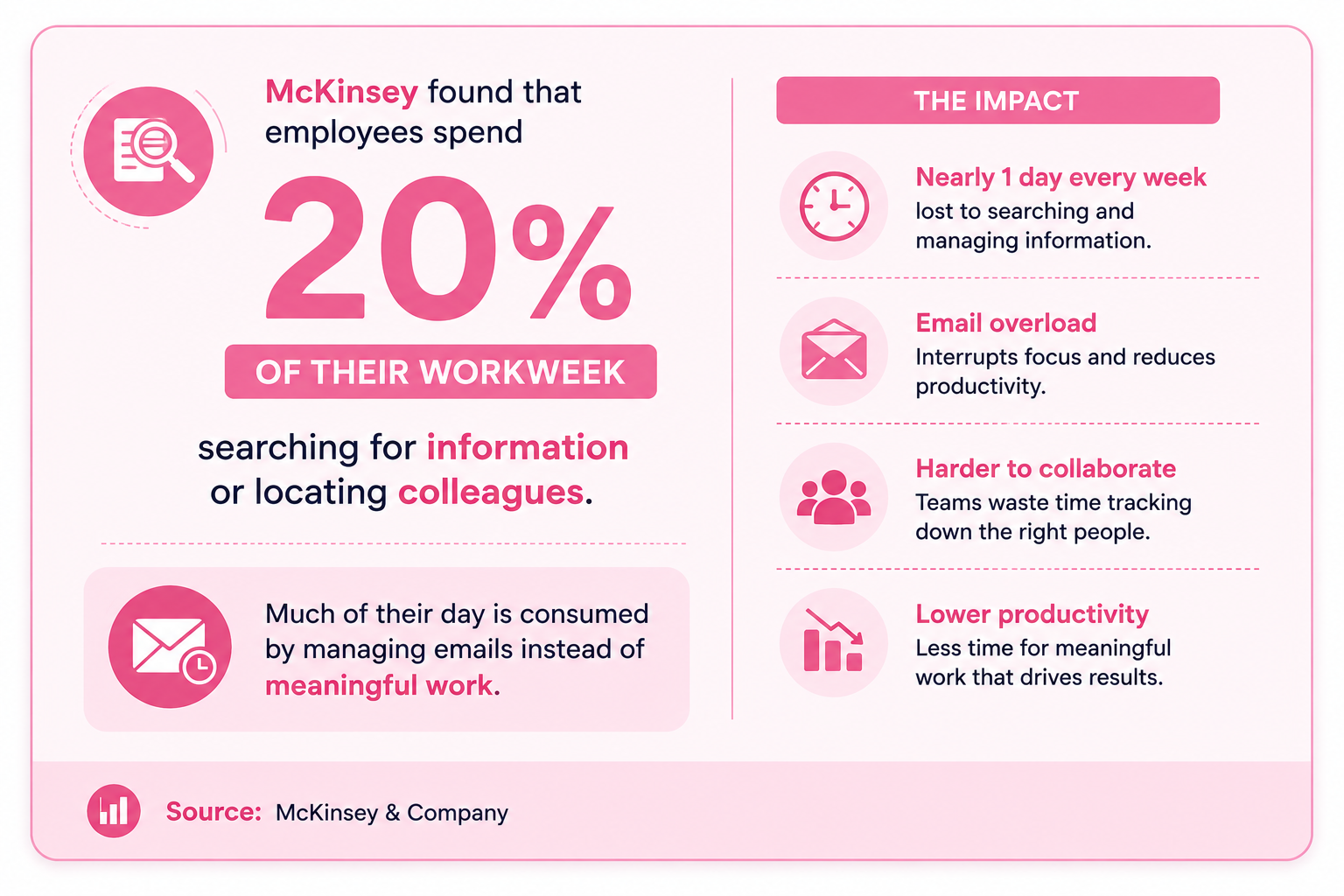
According to McKinsey & Company, employees spend nearly 20% of their workweek searching for internal information or tracking down colleagues who can help with specific tasks. That's almost one full day every week lost simply because information isn't easy to find—not because employees aren't working hard.
Think about that for a moment.
If your organization has 500 employees, you're potentially losing thousands of productive hours every single month simply because communication is scattered across disconnected systems.
That's not just frustrating—it's expensive.
20%
of the workweek
According to McKinsey & Company, employees spend nearly 20% of their workweek searching for internal information or tracking down colleagues who can help with specific tasks—equivalent to almost one full working day every week lost to inefficient communication and disconnected knowledge.
Source: McKinsey & Company
The good news is that the problem is entirely fixable.
A modern Employee Communication Platform brings conversations, announcements, documents, knowledge, events, and collaboration into one central place, making it easier for everyone to stay informed without constantly switching between different apps.
Instead of employees wondering where important information lives, they know exactly where to go.
But here's where many businesses make an expensive mistake.
Not every solution marketed as the best employee communication platform is actually designed to solve today's workplace challenges. Some focus almost entirely on chat, while others are little more than digital noticeboards.
The right workplace communication platform should do much more than send messages—it should improve collaboration, simplify knowledge sharing, increase employee engagement, and support both office-based and frontline teams from a single, secure hub.
If you're researching software for your organization, this guide is designed to help you make an informed decision before investing your budget.
We'll explain exactly what an Employee Communication Platform is, the features that genuinely matter, common mistakes buyers make, pricing models to expect, and how to compare leading solutions side by side.
You'll also discover practical questions to ask vendors, a buyer's checklist, and expert advice to help you choose a platform your employees will actually use—not one that becomes just another forgotten application.
By the end of this guide, you'll have a clear understanding of what separates an average communication tool from a truly effective workplace communication platform, giving you the confidence to choose the solution that's right for your business today—and scalable enough for where you're headed tomorrow.
Key Takeaways
- An employee communication platform centralizes company news, messaging, documents, and collaboration, creating a single source of truth for every employee.
- Organizations adopting modern workplace communication platforms improve employee engagement, reduce information silos, and streamline communication across office, remote, and frontline teams.
- The best solutions go beyond chat by combining AI-powered search, knowledge management, document control, employee recognition, mobile access, and enterprise security.
- When evaluating vendors, focus on business value rather than price alone by comparing integrations, scalability, user adoption, implementation support, and total cost of ownership.
- Choosing the right communication platform helps organizations increase productivity, strengthen company culture, simplify compliance, and build a more connected digital workplace.
What Is an Employee Communication Platform?
Imagine walking into an office where everyone knows exactly where to find company news, important documents, team conversations, upcoming events, and HR resources—all without searching through endless email chains or asking colleagues for the latest version of a file.
That's exactly what an Employee Communication Platform is designed to do.
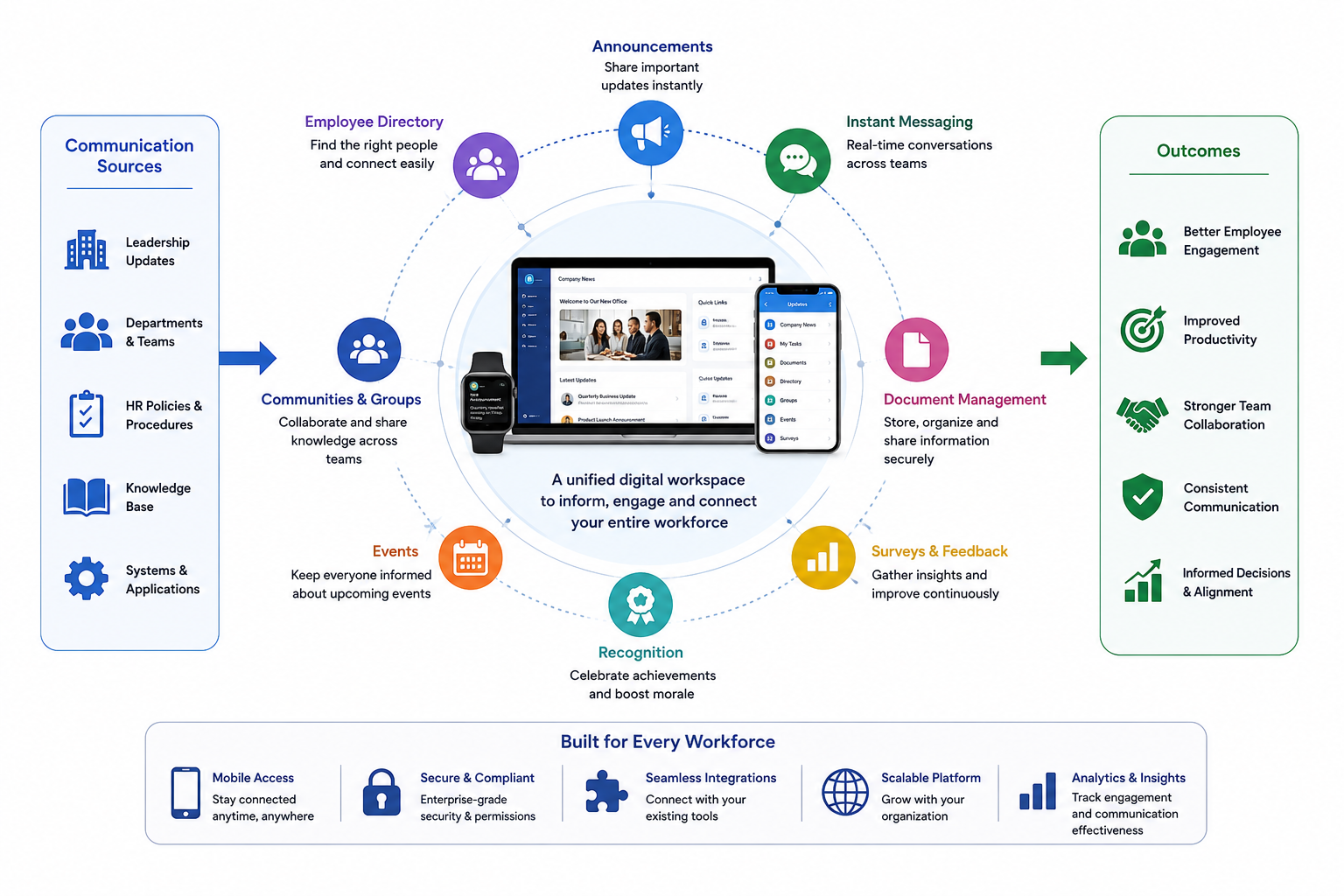
An Employee Communication Platform is a centralized digital workspace that helps organizations communicate, collaborate, and share information with employees from a single location. Rather than relying on multiple disconnected tools, it gives everyone one trusted place to receive updates, access resources, ask questions, and work together more efficiently.
Think of it as the digital headquarters for your organization.
Whether employees work in an office, remotely, or on the frontline, they can stay connected through company announcements, instant messaging, document sharing, employee directories, knowledge bases, events, and collaboration spaces—all from one secure platform.
Unlike traditional communication tools that only solve one problem, modern employee communication platforms bring multiple workplace functions together to improve productivity and employee engagement.
What Is an Employee Communication Platform
How Is It Different from Team Chat Apps?
Many organizations already use applications like Microsoft Teams, Slack, or Google Chat.
While these are excellent messaging tools, they're only one piece of the puzzle.
Team chat apps are built primarily for real-time conversations.
An Employee Communication Platform goes much further by becoming the central source of truth for your organization.
For example, a complete platform can include:
- Company-wide announcements
- Department or project spaces
- Document management and version control
- Employee directory
- Knowledge base and company policies
- Events and calendars
- Employee recognition
- Surveys and polls
- AI-powered search
- Mobile access for frontline workers
Instead of switching between five or six different systems every day, employees can find everything they need in one place.
Employee Communication Platform vs Intranet vs Employee App
These terms are often used interchangeably, but they aren't exactly the same.
A traditional intranet was originally designed as an internal website where employees could read company news and access documents.
While useful, many older intranets offered limited collaboration and were difficult to keep updated.
An employee app focuses on providing mobile access to workplace information, making it especially valuable for deskless workers who don't regularly sit at a computer.
An Employee Communication Platform combines the strengths of both while adding modern collaboration tools, AI capabilities, social features, workflow automation, and real-time communication.
In other words, today's platforms have evolved far beyond simple intranets—they've become complete digital workplaces.
Communication Platforms Examples
If you're wondering what these solutions look like in practice, here are several communication platforms examples used by organizations around the world:
- AgilityPortal
- Microsoft Viva Engage
- Staffbase
- Workvivo
- LumApps
- Haiilo
- Blink
- Unily
- Simpplr
- Firstup
Each platform offers different capabilities, but their goal is the same: helping employees communicate more effectively while reducing information silos.
Communication Platforms Examples in the Workplace
To better understand their value, here are a few communication platforms examples in the workplace:
- A manufacturing company uses digital noticeboards and mobile alerts to instantly notify frontline workers about safety procedures.
- A healthcare organization shares policy updates, training materials, and shift information across multiple hospital locations.
- A retail business delivers promotions, schedules, and HR announcements directly to employees' smartphones.
- A professional services firm centralizes project documents, company news, and employee recognition in one secure portal.
- A global enterprise uses AI search so employees can instantly find policies, documents, and experts across departments.
These examples show how modern communication platforms solve real business challenges, regardless of industry.
Communication Platform Apps
Today's leading communication platform apps are designed with mobile-first experiences in mind.
Employees can read company announcements, chat with colleagues, access documents, complete training, respond to surveys, and receive push notifications from virtually anywhere.
This is particularly important for frontline employees, field engineers, healthcare workers, logistics teams, hospitality staff, and retail associates who rarely work from a traditional office.
5 Examples of Communication Software
If you're comparing solutions, here are 5 examples of communication software that businesses commonly evaluate:
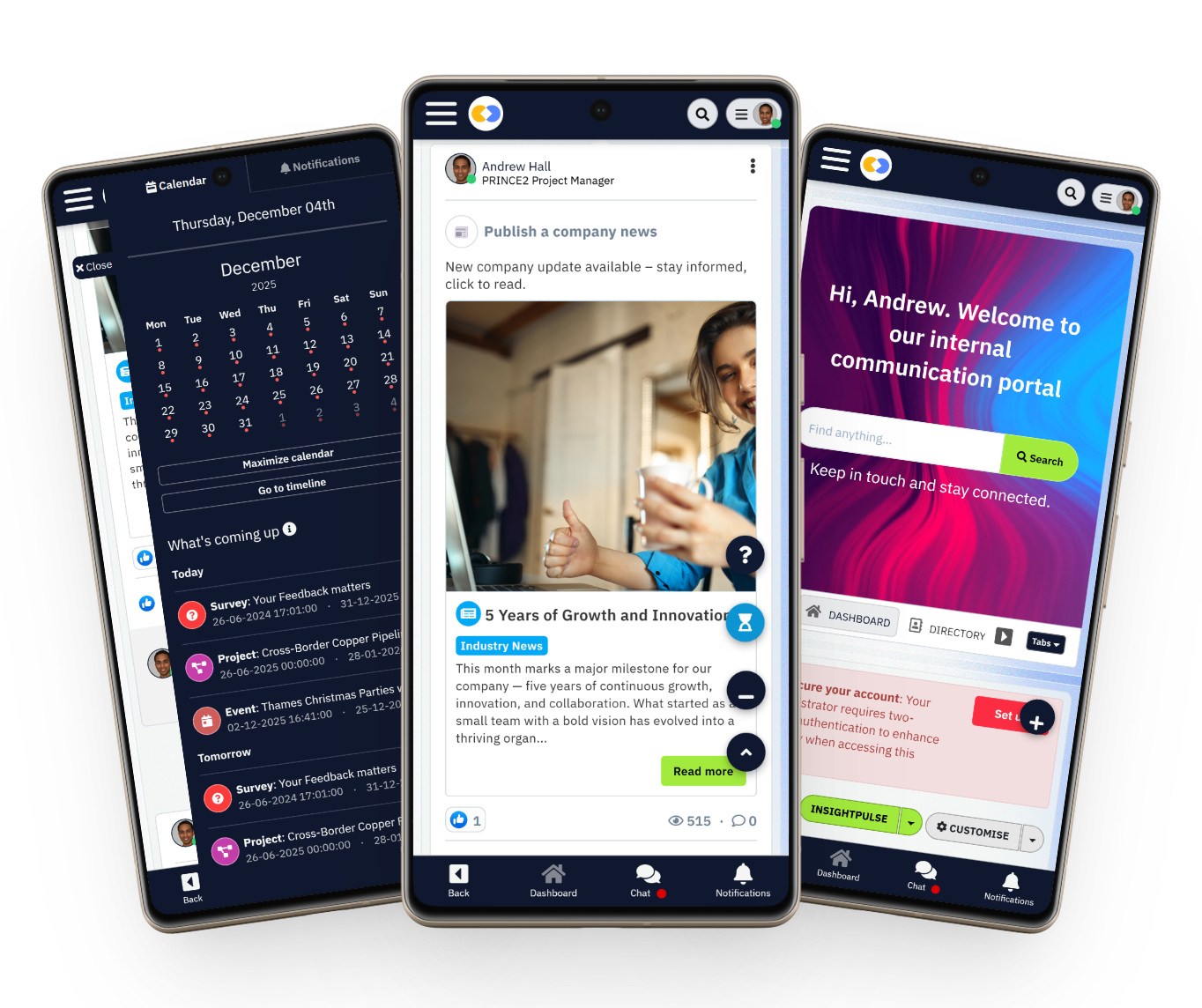
- AgilityPortal – An all-in-one employee communication platform combining intranet, collaboration, knowledge management, chat, AI search, and employee engagement tools.
- Microsoft Teams – Best known for team messaging, video meetings, and Microsoft 365 collaboration.
- Slack – A popular workplace messaging platform for fast team communication and integrations.
- Workvivo – Focused on employee engagement, company culture, and social communication.
- Staffbase – Designed for internal communications, employee news, and frontline workforce engagement.
The best choice ultimately depends on your organization's size, industry, communication challenges, security requirements, and long-term goals.
Rather than choosing software based on popularity alone, focus on selecting a solution that centralizes communication, supports collaboration, and gives employees a single, trusted place to stay informed.
Related Guides You May Want to Read Next
This Employee Communication Apps guide is designed as the main pillar. The resources below explore tools, strategies, and real-world use cases that help organisations improve how employees communicate and collaborate.
- What Are Internal Communication Tools? Definition, Types, and Examples
- Best Staff Communication Apps for Modern Teams
- Internal Communication Tools: What Works and What Doesn’t
- Real-Time Messaging at Work: Benefits, Risks, and Best Practices
- Digital Applications That Focus on Workplace Communication
- Best Apps for Employees to Stay Connected and Productive
- Effective Internal Communication in Retail: A Practical Guide
- Hybrid Work Collaboration Tools That Actually Support Teams
- Employee Portals Explained: Purpose, Features, and Use Cases
- Why Email Still Leads Business Communication in the Digital Age
- 16 Best Apps for Internal Employee Communication
- 7 Best Practices for Choosing the Right Employee Communication App
- How to Improve Team Dynamics Using Employee Communication Tools
- How to Manage IT Overload Inside Your Organisation
- Communication Tools: Types, Use Cases, and Examples
- Communication Software for Businesses: What to Look For
- Why Employees Use Instant Messaging at Work
- What Is a Virtual Workspace? Definition and Examples
Together, these articles form a complete employee communication knowledge hub, supporting the pillar guide with deeper insights and practical examples.
Why Employee Communication Platforms Matter More Than Ever
The way we work has changed significantly, with hybrid and remote teams becoming the norm and making communication more complex. Employees now expect instant access to information, wherever they are.
Most organisations operate across multiple locations, devices, and communication channels, making it harder to ensure the right information reaches the right people at the right time.
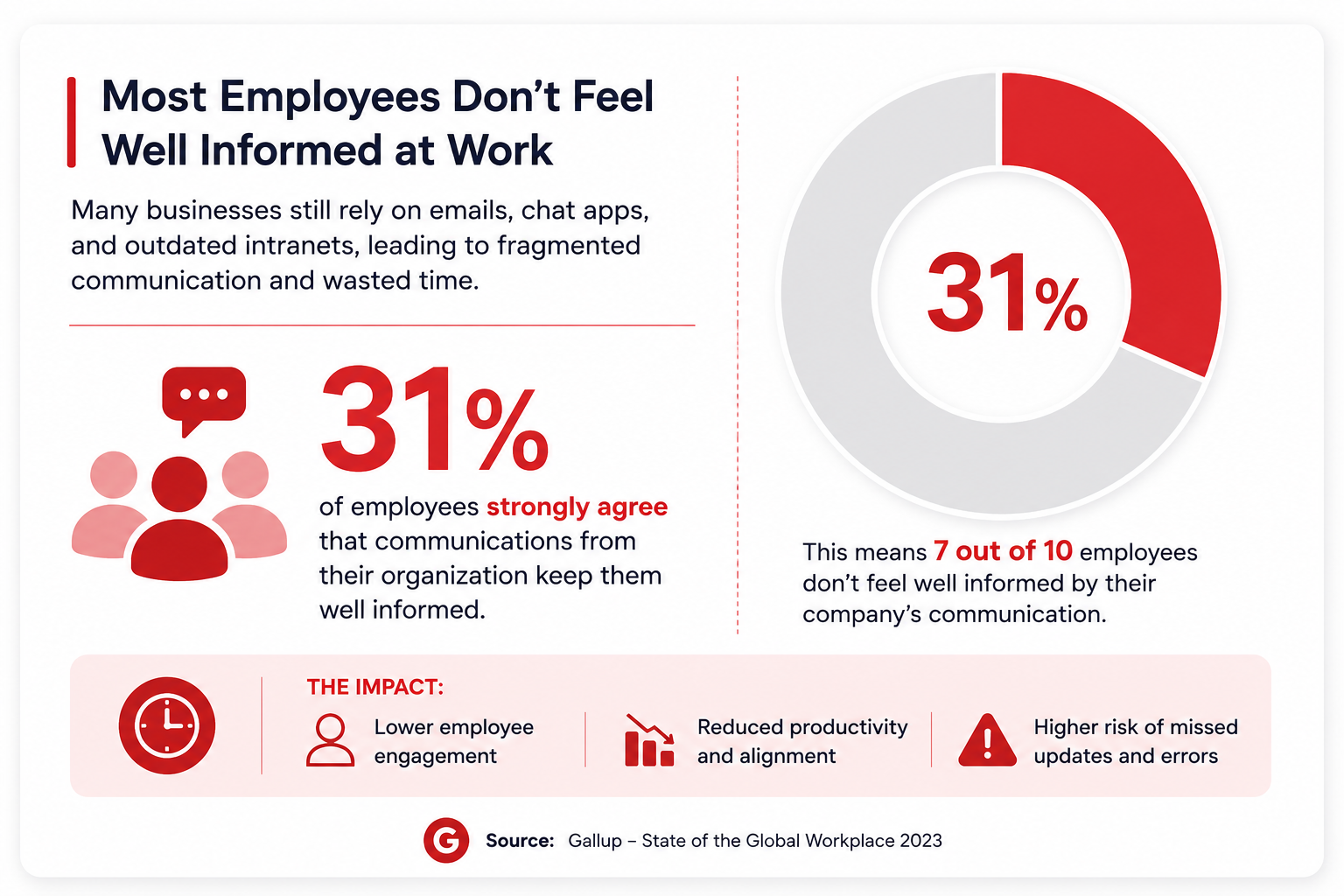
Many businesses still rely on emails, chat apps, and outdated intranets, leading to fragmented communication and wasted time.
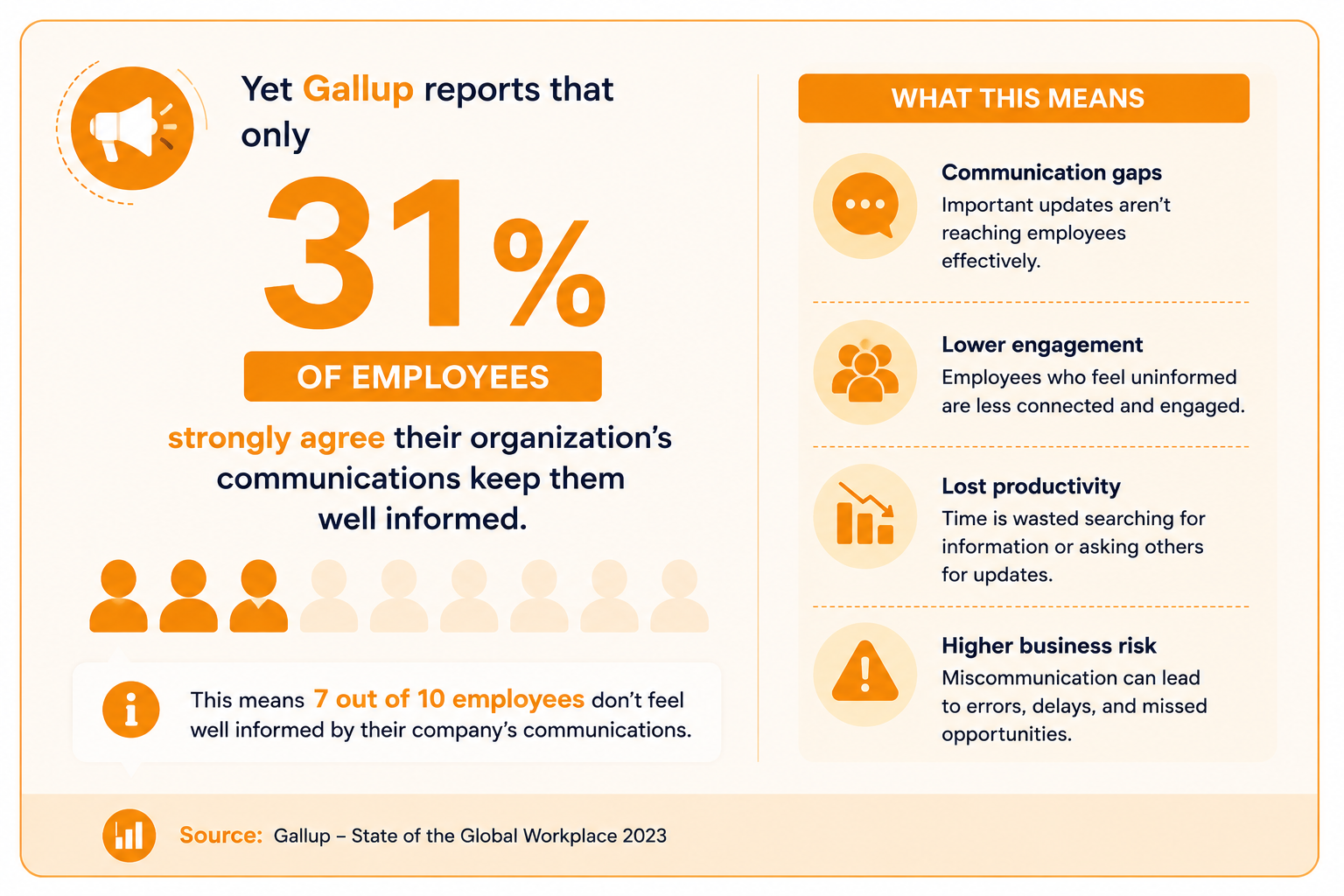
According to Gallup, only 31% of employees strongly agree that communications from their organization keep them well informed.
Why Employee Communication Platforms Matter More Than Ever
An employee communication platform addresses this by bringing news, messaging, documents, and collaboration into one place, giving employees a single source of truth.
These platforms also help reduce communication overload, boost engagement, connect frontline staff, and improve visibility of updates.
Ultimately, strong communication builds trust. When employees are informed and connected, they are more engaged, productive, and aligned with the business.
Why Companies Are Investing in Employee Communication Platforms
Work has fundamentally changed.
Today's employees are spread across offices, homes, customer sites, and multiple locations, making it harder than ever to keep everyone informed and aligned.
As communication becomes increasingly fragmented across email, chat apps, meetings, and business systems, organizations are investing in employee communication platforms to create a single source of truth that connects people, information, and work.

Why Companies Are Investing in Employee Communication Platforms
Remote & Hybrid Work: Simplifying Communication for Distributed Teams
Supporting Frontline Workers
Deskless employees are often the last to receive important company updates because they don't have regular access to email or desktop applications.
A mobile-first employee communication platform ensures frontline workers receive announcements, policies, schedules, and training instantly, helping create a more connected and informed workforce.
Reducing Email Overload and Streamlining Information Access
Reducing Email Overload and Streamlining Information Access
Email remains one of the biggest productivity killers in modern organizations.
McKinsey found that employees spend nearly 20% of their workweek searching for information or locating colleagues, while much of their day is consumed by managing emails instead of meaningful work.
By centralizing communication, documents, and company knowledge, employees spend less time searching and more time getting work done.
Improving Employee Engagement
Employees perform better when they feel informed, heard, and connected to the business.
Yet Gallup reports that only 31% of employees strongly agree their organization's communications keep them well informed.
Employee communication platforms improve engagement by making leadership updates, recognition, feedback, surveys, and company news accessible to everyone from a single location.
Improving Employee Engagement
Faster Company-wide Communication
Whether sharing a critical policy update, announcing organizational changes, or communicating during a crisis, speed matters.
Gartner research consistently highlights that organizations with effective digital workplace strategies improve collaboration and business agility by reducing communication barriers across departments.
A centralized platform allows businesses to publish announcements instantly, target specific audiences, track engagement, and ensure important messages reach the right employees without relying solely on email.
As organizations continue their digital transformation, employee communication platforms are no longer just communication tools—they've become strategic business solutions that improve productivity, strengthen culture, and help employees stay connected wherever they work.
Signs Your Business Needs an Employee Communication Platform
Signs Your Business Needs an Employee Communication Platform
If communication feels harder than it should, it's often because your business has outgrown the tools you're using.
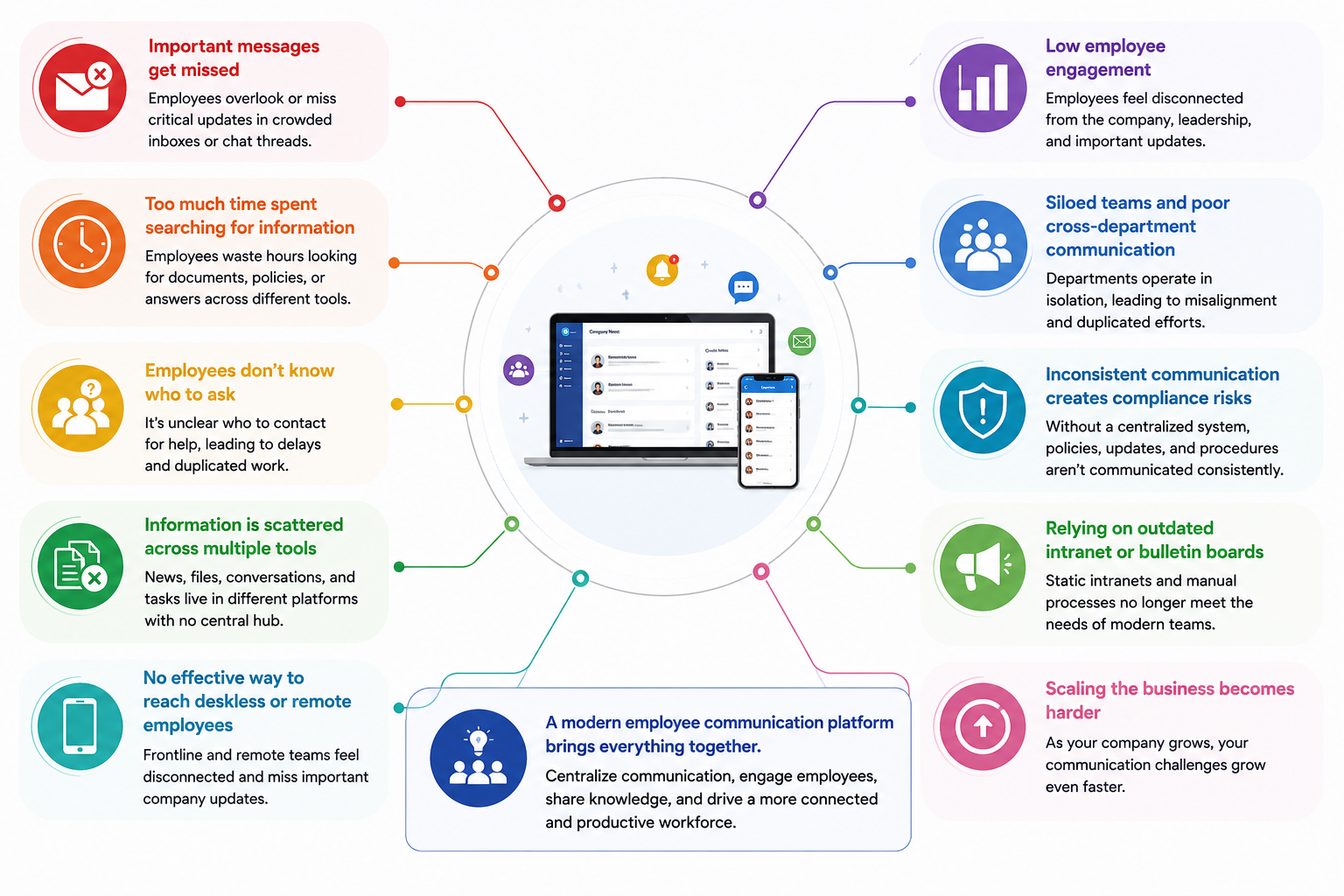
Many organizations rely on email, spreadsheets, and multiple work chat apps, but these solutions weren't designed to manage company-wide communication, knowledge sharing, or employee engagement at scale.
Below are some of the most common signs your organization is ready for an employee communication and engagement platform.
- Employees Ignore Company Emails - Important announcements are buried beneath hundreds of daily emails, making it easy for critical updates to be overlooked or forgotten.
- Information Is Scattered Everywhere - Policies, documents, and company news live across shared drives, email threads, cloud storage, and multiple applications. Employees waste valuable time trying to find the latest version of information.
- Teams Rely on Multiple Work Chat Apps - When departments use different messaging tools, conversations become fragmented, information gets lost, and collaboration suffers. A centralized platform keeps everyone connected in one place.
- Managers Struggle to Reach Frontline Workers - Deskless employees often don't have access to company email during their shift. A mobile-first staff messaging app ensures everyone receives important updates, regardless of where they work.
- New Employees Can't Find What They Need - Without a central knowledge hub, onboarding becomes slow and frustrating as new hires repeatedly ask where to find policies, forms, and training materials.
- Important Announcements Are Missed - Whether it's a compliance update, company news, or an urgent notification, relying on email alone doesn't guarantee employees will see the message.
- Policies Become Outdated - When documents are stored in multiple locations, employees often reference old versions, increasing the risk of mistakes and compliance issues.
- Employee Engagement Is Declining - Low participation in company initiatives, poor feedback scores, and limited interaction with leadership are clear indicators that communication isn't reaching employees effectively.
- Internal Systems Have Low Adoption - If employees avoid using your intranet or business applications because they're difficult to navigate, it may be time to replace them with a more intuitive solution.
- Staff Keep Asking the Same Questions - When employees repeatedly ask about holiday policies, procedures, or company updates, it usually means information isn't easy to find.
These are all business needs an employee communication platform examples that highlight the importance of centralizing workplace communication.
By replacing disconnected tools with a modern employee communication and engagement platform, organizations can reduce confusion, improve collaboration, increase engagement, and ensure every employee has access to the information they need—all from a single, trusted location.
The Benefits of Using an Employee Communication Platform
Investing in an Employee Communication Platform is about much more than improving messaging between employees.
It creates a connected digital workplace where communication, collaboration, knowledge, and engagement come together in one place.
Rather than juggling multiple tools, employees have a single destination for everything they need to work efficiently and stay informed.
Below are the key benefits organizations experience after implementing a modern employee communication platform.
Improve Internal Communication Across Teams and Departments
Effective communication is the foundation of every successful business.
A modern internal communication system centralizes company announcements, team messaging, documents, events, and policies into a single platform, ensuring employees always know where to find accurate information.
Key Features
- Company announcements
- Team and department spaces
- Instant messaging
- Document management
- Knowledge base
- AI-powered search
- Push notifications
Benefits
- Eliminates information silos
- Reduces email dependency
- Improves communication consistency
- Keeps everyone aligned across departments
Increase Employee Engagement Through Better Communication and Collaboration
Employees who feel informed and connected are more likely to stay engaged with their work.
An employee communication and engagement platform encourages two-way communication through social features, recognition, surveys, comments, polls, and feedback, giving every employee a voice.
Key Features
- Employee recognition
- Polls and surveys
- Company social feed
- Comments and reactions
- Leadership updates
- Employee communities
Benefits
- Higher employee morale
- Better participation
- Improved retention
- Stronger connection with leadership
Makes Company Knowledge Easy To Access and Improved Productivity
One of the biggest productivity challenges is knowing where information is stored. A centralized knowledge hub ensures policies, procedures, training materials, and documents are always accessible and up to date.
Key Features
- Knowledge base
- Document library
- Version control
- FAQs
- Smart search
- Content permissions
Benefits
- Faster access to information
- Reduced duplicate work
- Easier onboarding
- Better knowledge retention
Streamline Company Announcements for Faster, More Effective Communication
Instead of relying solely on email, organizations can publish targeted announcements to the right employees at the right time using multiple delivery channels.
Key Features
- Company news
- Targeted announcements
- Push notifications
- Scheduled publishing
- Read acknowledgements
- Audience targeting
Benefits
- Higher message visibility
- Faster communication
- Improved employee awareness
- Better crisis communication
Enhanced Team Collaboration and Productivity
Modern businesses depend on collaboration across departments and locations. An employee communication platform provides shared digital workspaces where teams can communicate, share files, assign tasks, and collaborate in real time.
Key Features
- Team spaces
- Group chat
- Shared files
- Task management
- Project collaboration
- Shared calendars
Benefits
- Faster teamwork
- Reduced duplication
- Improved cross-functional collaboration
- Better project visibility
Reduce Meeting Time
Many meetings happen simply because employees can't find information elsewhere. By providing a central place for updates, documents, and discussions, employees can often resolve questions without scheduling another meeting.
Key Features
- Company wiki
- Shared documentation
- Discussion forums
- Searchable knowledge base
- Activity feeds
Benefits
- Fewer unnecessary meetings
- More productive workdays
- Faster decision-making
- Increased efficiency
Mobile Access for Deskless Employees
Frontline workers, field teams, healthcare staff, warehouse employees, and retail associates rarely sit behind a desk. Mobile access ensures they stay connected wherever they work.
Key Features
- Mobile apps
- Push notifications
- Offline access
- Mobile chat
- Digital forms
- Mobile document access
Benefits
- Better frontline communication
- Faster updates
- Increased engagement
- Equal access to company information
Improve Compliance
Keeping employees informed about policies, procedures, and mandatory training is essential for compliance. A centralized platform provides visibility into who has received and acknowledged important communications.
Key Features
- Policy management
- Read receipts
- Document versioning
- Mandatory acknowledgements
- Audit trails
- Permission controls
Benefits
- Improved regulatory compliance
- Reduced business risk
- Better governance
- Easier auditing
Build a Stronger Company Culture
Culture isn't built through annual events—it's built through daily communication.
Sharing company news, celebrating achievements, welcoming new employees, and encouraging interaction helps employees feel connected to the organization.
Key Features
- Employee recognition
- Social communities
- Birthdays and milestones
- Company events
- Leadership communications
- Employee stories
Benefits
- Stronger workplace culture
- Increased employee satisfaction
- Higher retention
- Greater sense of belonging
AI-Powered Employee Support
Artificial intelligence is transforming workplace communication by helping employees find answers faster, automate routine tasks, and reduce the workload on HR and IT teams.
Key Features
- AI search
- AI chat assistants
- Automated FAQs
- Smart recommendations
- Content summarization
- Workflow automation
Benefits
- Instant answers
- Less time searching
- Reduced support requests
- Increased productivity
- Better employee experience
A modern Employee Communication Platform is no longer just another business application—it's the digital foundation that connects employees, simplifies communication, and supports collaboration across the entire organization.
By combining messaging, knowledge management, engagement, AI, and collaboration into one secure platform, businesses can create a more informed, productive, and connected workforce while reducing the complexity of managing multiple disconnected tools.
15 Questions Every Buyer Should Ask Before Purchasing an Employee Communication Platform
Choosing an Employee Communication Platform isn't just about comparing features—it's about finding a solution that supports your people, improves communication, and scales with your business.
The right platform should simplify collaboration, reduce information silos, and integrate seamlessly with your existing technology stack.
Before signing a contract or booking a demo, ask vendors these essential questions.

15 Questions Every Buyer Should Ask Before Purchasing an Employee Communication Platform
#1. Is the Platform Mobile-First?
If you have frontline, field, or remote employees, mobile access is essential. Look for native iOS and Android apps with push notifications, offline access, and a consistent user experience across devices.
Why it matters: Employees should be able to communicate and access company information from anywhere.
#2. Does It Support Frontline Workers?
Many communication platforms are designed for office staff, leaving deskless employees behind. Ensure the platform is built to support manufacturing, healthcare, retail, logistics, and field service teams.
Why it matters: Every employee deserves equal access to company communications.
#3. Can Employees Access It Without a VPN?
Modern cloud-based platforms should be securely accessible from anywhere without requiring complicated VPN connections.
Why it matters: Easier access leads to higher adoption and fewer IT support requests.
#4. Does It Integrate with Microsoft 365 and Google Workspace?
Your employee communication platform should connect with the tools your teams already use, including Outlook, Teams, SharePoint, OneDrive, Google Drive, Calendar, and Gmail.
Why it matters: Integrations reduce duplicate work and improve productivity.
#5. Does It Offer Open APIs and Automation?
Open APIs allow you to integrate with HR systems, CRM software, payroll platforms, identity providers, and other business applications.
Why it matters: Your platform should fit into your existing digital workplace—not replace everything.
#6. Can It Replace Multiple Communication Tools?
A modern platform should combine company news, messaging, document management, collaboration, knowledge sharing, employee recognition, and intranet capabilities in one solution.
Why it matters: Fewer systems mean lower costs and a better employee experience.
#7. Does It Include AI Features?
AI is quickly becoming a standard feature. Look for AI-powered search, intelligent assistants, content summaries, automated FAQs, and workflow automation.
Why it matters: AI helps employees find answers faster while reducing repetitive work.
#8. Can You Create Department or Team Spaces?
Your organization should be able to create dedicated workspaces for departments, projects, offices, or locations while keeping company-wide announcements centralized.
Why it matters: Employees only see the information that's relevant to the
#9. Does It Include Document Management and Version Control?
Policies, procedures, forms, and training materials should always remain current, with version history and permission controls.
Why it matters: Employees always access the latest approved documents.
#10. Does It Support Single Sign-On (SSO)?
Look for support for Microsoft Entra ID (Azure AD), Okta, Google Workspace, SAML 2.0, and other identity providers.
Why it matters: SSO improves security while making login easier for employees.
#11. What Security Standards and Compliance Certifications Are Available?
Ask about encryption, data hosting, backups, audit logs, role-based permissions, GDPR compliance, SOC 2, ISO 27001, HIPAA, and penetration testing.
Why it matters: Protecting sensitive employee and company information should never be optional.
#12. How Long Does Implementation Take?
Some platforms can be deployed in days, while enterprise implementations may take several months.
Why it matters: Understanding timelines helps you plan training, migration, and rollout.
#13. What Onboarding, Training, and Customer Support Are Included?
Find out whether implementation assistance, onboarding sessions, knowledge bases, webinars, and dedicated customer success managers are included.
Why it matters: Great support often determines how successful your rollout will be.
#14. Can the Platform Scale as Your Business Grows?
Your communication needs today may be very different in three years. Ensure the platform supports additional users, locations, languages, and future integrations.
Why it matters: Choosing a scalable solution avoids expensive migrations later.
#15. What Happens If We Decide to Leave?
Ask how your data can be exported, what happens to documents, how long data is retained, and whether there are exit fees.
Why it matters: Your organization should always retain ownership of its data.
Final Buyer's Checklist
Before making your decision, ensure your shortlisted platform offers:
- Mobile apps for every employee
- Company announcements and news
- Team messaging and collaboration
- AI-powered search and assistants
- Document management with version control
- Employee directory
- Department and project workspaces
- Microsoft 365 and Google Workspace integrations
- Single Sign-On (SSO)
- Enterprise-grade security and compliance
- Analytics and reporting
- Reliable onboarding and customer support
- Flexible APIs and automation
- Scalability for future growth
- Clear data export and exit options
Choosing the right Employee Communication Platform is a long-term investment. By asking these questions upfront, you'll be better equipped to select a solution that not only meets today's requirements but also supports your organization's communication, collaboration, and employee engagement strategy for years to come.
Employee Communication Platform Pricing Explained
The cost of an Employee Communication Platform can vary significantly depending on your organization's size, feature requirements, deployment model, and level of support.
While many vendors advertise attractive starting prices, it's important to look beyond the monthly subscription and consider the Total Cost of Ownership (TCO)—the complete cost of implementing, maintaining, and scaling the platform over time.
Most providers offer one of three pricing models. Per-user pricing charges a fee for each employee using the platform, making it suitable for smaller organizations but potentially expensive as your workforce grows.
Flat-rate pricing provides predictable monthly or annual costs regardless of user numbers, while enterprise pricing is typically customized for larger organizations that require advanced security, integrations, dedicated support, or bespoke functionality.
When comparing solutions, don't overlook additional expenses that may not appear in the advertised price.
These can include implementation services, data migration, onboarding, administrator training, premium support, API access, custom integrations, storage upgrades, or professional services.
A platform with a lower monthly fee may ultimately cost more if these extras are required.
Before making a decision, compare vendors based on their long-term value—not just the subscription price.
The right platform should reduce operational costs, improve productivity, and deliver a measurable return on investment over its lifetime.
When evaluating pricing, make sure you compare:
- Pricing model: Per-user, flat-rate, or enterprise licensing, including what's included in each plan.
- Implementation costs: Setup fees, data migration, employee training, onboarding, integrations, and ongoing support.
- Total Cost of Ownership (TCO): The overall investment over three to five years, including upgrades, maintenance, scalability, and future business growth.
Common Mistakes Buyers Make When Choosing an Employee Communication Platform
Selecting an Employee Communication Platform is a strategic business decision that affects how your entire workforce communicates, collaborates, and accesses information.
Yet many organizations focus on short-term requirements or individual features rather than evaluating the platform as a long-term investment.
The result is often poor adoption, fragmented communication, and the need to replace the platform within a few years.
Avoiding the following mistakes will help you choose a solution that delivers lasting business value and supports your organization's growth.
Buying a Chat Tool Instead of a Full Employee Communication Platform and Why It Can Limit Long-Term Success
One of the most common mistakes is assuming that a messaging application is enough.
While chat is an important feature, it doesn't replace company announcements, document management, knowledge sharing, employee directories, intranet capabilities, AI search, or governance.
The best employee communication platforms combine all of these capabilities into a single digital workplace.
Overlooking Mobile and Frontline Workers
Many businesses evaluate platforms from the perspective of office workers while overlooking employees in retail, healthcare, manufacturing, construction, hospitality, and field services.
If your workforce can't easily access company information from their mobile devices, communication gaps will continue to exist regardless of the software you purchase.
Choosing Based on Price Alone
The lowest-cost solution is rarely the best long-term investment.
Instead of focusing only on subscription costs, consider implementation, integrations, scalability, security, support, and the overall return on investment.
A platform that saves employees time every day often delivers significantly greater value than a cheaper alternative with limited functionality.
Overlooking Integrations
Your communication platform should work seamlessly with the systems your employees already use, including Microsoft 365, Google
Workspace, HR software, CRM platforms, identity providers, and business applications.
Without strong integrations, employees are forced to switch between multiple tools, reducing productivity and adoption.
Forgetting Security and Governance
As organizations share more sensitive information digitally, governance becomes increasingly important.
Look for features such as role-based permissions, document version control, audit logs, Single Sign-On (SSO), data encryption, compliance certifications, and content approval workflows. These capabilities help protect company information while supporting regulatory compliance.
Launching Without an Implementation Strategy
Technology alone doesn't transform communication—people do.
Even the most advanced platform will struggle if there isn't a clear rollout plan, executive sponsorship, employee training, and ongoing communication.
Successful implementations begin with defined objectives, stakeholder engagement, phased deployment, and measurable success metrics.
Failing to Drive User Adoption
One of the biggest reasons communication platforms fail is low adoption.
If employees don't understand the value of the platform or find it difficult to use, they'll simply return to email, shared drives, or consumer messaging apps.
Encourage adoption by providing training, promoting new features, gathering employee feedback, and making the platform the primary source for company communication and knowledge.
Thinking Only About Today's Needs
Many organizations choose a platform that solves immediate problems without considering future growth.
As your business expands, you'll likely need additional users, departments, locations, integrations, automation, and AI capabilities. Selecting a scalable platform from the outset avoids costly migrations and ensures your communication strategy can evolve alongside your business.
By avoiding these common mistakes, you'll be in a much stronger position to choose an Employee Communication Platform that not only meets your current requirements but also supports long-term communication, collaboration, employee engagement, and business growth.
The Top 10 Best Employee Communication Platforms Compared
The Top 10 Best Employee Communication Platforms Compared
| Employee Communication Platform | Best For | AI Features | Mobile App | Intranet | Chat | Knowledge Base |
| AgilityPortal | SMBs to Enterprise, all-in-one digital workplace | ✅ AI Search, AI Assistant, Content AI | ✅ | ✅ | ✅ Real time,a dn puch notifications | ✅ |
| Microsoft Viva Engage | Microsoft 365 organizations | ✅ Microsoft Copilot | ✅ | ⚠️ (via SharePoint) | ✅ (Teams) | ⚠️ |
| Workvivo | Employee engagement & culture | ✅ AI-powered content | ✅ | ✅ | ✅ | ✅ |
| Staffbase | Enterprise internal communications | ✅ AI content assistance | ✅ | ✅ | ⚠️ | ✅ |
| Simpplr | AI-powered intranet | ✅ AI Assistant & Search | ✅ | ✅ | ❌ | ✅ |
| LumApps | Large enterprises using Google or Microsoft | ✅ AI Search | ✅ | ✅ | ⚠️ | ✅ |
| Haiilo | Employee communications & advocacy | ✅ AI content tools | ✅ | ✅ | ⚠️ | ✅ |
| Unily | Enterprise digital workplace | ✅ AI-powered search | ✅ | ✅ | ⚠️ | ✅ |
| Blink | Frontline & deskless employees | ✅ AI assistance | ✅ | ⚠️ | ✅ | ✅ |
| Firstup | Enterprise employee communications | ✅ AI personalization | ✅ | ⚠️ | ⚠️ | ✅ |
*Starting prices are based on publicly available information where available. Enterprise vendors typically provide bespoke pricing based on organization size, features, and implementation requirements.
- ✅ = Included
- ⚠️ = Available through integrations, add-ons, or limited functionality
- ❌ = Not a core feature
When comparing platforms, don't focus solely on feature checklists or pricing.
Evaluate each solution based on ease of use, mobile experience, AI capabilities, security, implementation time, customer support, and how well it fits your existing technology stack.
The best Employee Communication Platform is one that employees will actively use every day, not simply the one with the longest list of features.
How to Choose the Right Workplace Communication Solution
With so many workplace communication tools available, choosing the right solution can feel overwhelming.
While many platforms offer similar features, the best choice depends on your organization's unique needs, workforce, and long-term objectives.
Rather than focusing on the vendor with the longest feature list, evaluate each solution based on how well it supports your people, processes, and future growth.
Below are the key factors every buyer should consider before making a decision.
Company Size
The size of your organization plays a major role in selecting the right solution.
Smaller businesses often benefit from an all-in-one platform that's easy to deploy and manage, while larger enterprises typically require advanced permissions, multiple workspaces, automation, and enterprise-grade administration.
Choose a solution that meets your current requirements while allowing room for growth.
Industry
Every industry has different communication challenges.
Healthcare organizations need secure access to policies and compliance documents, manufacturers require reliable communication with frontline workers, while professional services often prioritize collaboration and document sharing.
Look for software that aligns with your industry's operational requirements.
Budget
Don't evaluate software based solely on the monthly subscription cost.
Consider the overall value, including implementation, onboarding, training, integrations, ongoing support, and future upgrades.
A slightly higher investment can often deliver greater long-term savings through improved productivity and reduced reliance on multiple systems.
Security
Internal communications frequently contain confidential business information.
Look for features such as role-based permissions, Single Sign-On (SSO), data encryption, audit logs, document version control, and compliance with standards such as GDPR, SOC 2, or ISO 27001.
Strong security protects both your employees and your organization.
Scalability
Your communication needs will evolve as your business grows.
Select a platform that can easily accommodate additional employees, departments, office locations, languages, and integrations without requiring a complete migration in the future.
AI Readiness
Artificial intelligence is rapidly becoming a core part of the digital workplace.
Solutions that include AI-powered search, intelligent assistants, automated content creation, workflow automation, and smart recommendations can help employees find information faster while reducing repetitive administrative tasks.
User Adoption
Even the most powerful platform will fail if employees don't use it.
Prioritize solutions with an intuitive interface, excellent mobile experience, personalized dashboards, and minimal training requirements.
The easier the platform is to use, the more likely employees are to embrace it.
Future Growth
Think beyond today's requirements.
Consider how your organization may change over the next three to five years, including expansion into new markets, mergers, acquisitions, hybrid working, or increased automation.
Choosing a flexible, future-ready solution today will save significant time, cost, and disruption later.
A Simple Decision Framework
Before making your final decision, ask yourself these questions:
- Does the solution solve our biggest communication challenges today?
- Will employees actually use it every day?
- Can it replace multiple disconnected tools?
- Does it integrate with our existing business systems?
- Is it secure, scalable, and ready for future growth?
- Will it improve employee engagement and productivity?
- Does it provide a strong return on investment over the next several years?
The right workplace communication solution should do more than help employees exchange messages.
It should become the central hub for communication, collaboration, knowledge sharing, and employee engagement, supporting your organization as it grows while delivering measurable business value.
Implementation Checklist
Choosing the right workplace communication solution is only half the journey—successful implementation is what determines whether employees embrace the platform or continue using old habits.
A well-planned rollout minimizes disruption, accelerates user adoption, and helps your organization realize value much faster.
Use the checklist below to ensure you've covered every stage of your implementation.
✅ Workplace Communication Implementation Checklist
| Phase | Checklist | Status |
| Planning | Define business objectives and expected outcomes | ☐ |
| Identify communication challenges the platform will solve | ☐ | |
| Establish project scope, timeline, and budget | ☐ | |
| Select an implementation team | ☐ | |
| Stakeholders | Gain executive sponsorship | ☐ |
| Assign project owners and administrators | ☐ | |
| Involve HR, IT, Internal Communications, and department leaders | ☐ | |
| Identify employee champions to support adoption | ☐ | |
| Data Migration | Audit existing documents and content | ☐ |
| Remove outdated or duplicate information | ☐ | |
| Migrate documents, policies, and knowledge resources | ☐ | |
| Verify permissions and access controls | ☐ | |
| User Training | Create administrator training sessions | ☐ |
| Deliver employee onboarding guides | ☐ | |
| Prepare short video tutorials and FAQs | ☐ | |
| Provide ongoing support resources | ☐ | |
| Communication Plan | Announce the upcoming launch | ☐ |
| Explain benefits for employees | ☐ | |
| Share rollout milestones and timelines | ☐ | |
| Keep employees informed throughout deployment | ☐ | |
| Launch | Test the platform before release | ☐ |
| Roll out to pilot users or departments | ☐ | |
| Gather feedback and resolve issues | ☐ | |
| Launch company-wide | ☐ | |
| Adoption Campaign | Encourage employees to complete their profiles | ☐ |
| Publish regular company news and updates | ☐ | |
| Promote collaboration, recognition, and discussions | ☐ | |
| Reward early adopters and gather feedback | ☐ | |
| KPIs & Success Metrics | Measure login and adoption rates | ☐ |
| Track announcement readership | ☐ | |
| Monitor engagement and participation | ☐ | |
| Review search activity and content usage | ☐ | |
| Measure employee satisfaction and ROI | ☐ |
Best Practice Tips
- Start with a pilot group to identify improvements before a company-wide rollout.
- Keep communication simple and consistent so employees understand why the new platform is being introduced.
- Focus on adoption, not just deployment—a successful launch depends on employees actively using the platform.
- Measure performance regularly using engagement metrics, feedback, and business KPIs to continually improve the employee experience.
A structured implementation plan reduces risk, accelerates adoption, and ensures your investment delivers long-term value.
Organizations that combine strong leadership, effective training, and continuous communication are far more likely to achieve a successful rollout and lasting employee engagement.
Real Business Results: How Modern Workplace Communication Solutions Deliver Measurable Value
Investing in a modern workplace communication solution isn't just about replacing email or introducing another collaboration tool—it's about creating a more connected, informed, and engaged workforce.
Organizations that centralize communication, knowledge sharing, and employee engagement consistently report improvements in productivity, collaboration, and operational efficiency.
Below are a few real-world scenarios that demonstrate the impact these platforms can have.

How Modern Workplace Communication Solutions Deliver Measurable Value
Challenge: Employees Couldn't Find the Information They Needed
A growing professional services company found that employees were spending too much time searching across emails, shared drives, Microsoft Teams, and multiple cloud storage platforms to locate company policies, project documents, and internal announcements.
Information was duplicated, outdated, and often stored in different locations, leading to delays and unnecessary frustration.
The organization implemented AgilityPortal, an employee experience platform that combined an intranet, knowledge base, document management, company news, team collaboration, and AI-powered search into a single digital workplace.
Employees were given one secure location to access everything they needed, while managers could publish updates and manage content from a centralized dashboard.
Within months, employees reported spending less time searching for information, internal communication became more consistent, and departments collaborated more effectively.
Leadership also gained greater visibility into employee engagement through built-in analytics and communication insights.
Lesson Learned: A centralized knowledge hub significantly reduces information silos while improving productivity and collaboration across the organization.
Challenge: Frontline Employees Were Missing Important Updates
A multi-site organization struggled to communicate with frontline employees who rarely had access to company email during working hours. Critical announcements, policy updates, and shift information were often missed, resulting in inconsistent communication across locations.
To solve this, the business introduced the AgilityPortal employee app, giving every employee instant access to company news, push notifications, team messaging, digital documents, and workplace updates directly from their smartphone.
The mobile-first experience ensured employees stayed connected regardless of whether they worked in an office, warehouse, retail store, or on-site with customers.
As a result, communication became faster, engagement increased, and employees felt more connected to the business. Managers also reduced their reliance on printed notices and manual communication methods, saving valuable time while improving message reach.
Lesson Learned: A mobile-first communication strategy ensures every employee receives the same information at the same time, regardless of where they work.
Challenge: Employee Engagement Was Declining
As the company expanded, employees began feeling disconnected from leadership and less engaged with the organization. Recognition was inconsistent, feedback opportunities were limited, and important company news often went unnoticed.
The organization deployed AgilityPortal Employee Experience Platform to create a more engaging digital workplace.
By introducing employee recognition, company communities, surveys, leadership updates, social discussions, and collaboration spaces, the business created a culture where employees could actively participate instead of simply receiving information.
The result was higher employee participation, stronger cross-department collaboration, and improved visibility into employee sentiment. Leadership was able to communicate more transparently while employees became more involved in company initiatives and day-to-day collaboration.
Lesson Learned: Communication and engagement go hand in hand. When employees have a central place to connect, collaborate, and contribute, organizations build stronger cultures, improve retention, and create a more positive employee experience.
These examples demonstrate that successful digital workplace initiatives are not driven by technology alone.
They succeed because they simplify communication, eliminate information silos, and give employees easy access to the tools and knowledge they need every day.
Whether your goal is to improve collaboration, support frontline workers, or strengthen employee engagement, adopting a modern employee communication platform, such as AgilityPortal, provides the foundation for a more connected, productive, and engaged workforce.
How AgilityPortal can facilitate and help overcome internal communications challenges and optimize your communication processes?

If you're looking for a modern employee communication platform that does more than send announcements, AgilityPortal is designed to help organizations centralize communication, improve collaboration, and create a more connected workforce.
Rather than relying on disconnected emails, chat applications, and outdated intranets, AgilityPortal provides a single digital workplace where employees can access company news, documents, conversations, knowledge, and business resources from any device.
Whether your teams are office-based, remote, or frontline workers, everyone stays informed through one secure and easy-to-use platform.
Key Capabilities Include- Real-time company announcements delivered instantly through desktop, web, and the AgilityPortal employee app, ensuring employees never miss important updates.
- Centralized internal communications that bring together news, messaging, documents, knowledge bases, employee directories, events, and collaboration spaces into a single source of truth.
- Targeted communication that allows organizations to send personalized messages based on department, office, role, location, or employee groups, reducing information overload.
- Rich multimedia content, including images, videos, documents, GIFs, and interactive posts, to increase engagement and improve message retention.
- Employee engagement tools, such as surveys, polls, recognition, reactions, and feedback, that encourage two-way communication between leadership and employees.
- Emergency notifications with instant push alerts that help organizations communicate critical updates quickly during business disruptions or urgent situations.
- AI-powered search and knowledge management, enabling employees to locate policies, procedures, documents, and workplace information within seconds.
- Advanced analytics and reporting, providing insights into announcement reach, employee engagement, content performance, and communication effectiveness to support continuous improvement.
By combining internal communications, collaboration, knowledge management, employee engagement, AI capabilities, and mobile accessibility into one platform, AgilityPortal helps organizations eliminate information silos, improve productivity, strengthen company culture, and deliver a better employee experience.
For businesses looking to replace multiple workplace tools with a single, scalable solution, AgilityPortal provides the flexibility and functionality needed to support today's evolving workforce.
AgilityPortal
One Platform. Better Communication. More Engaged Employees.
Choosing the right employee communication platform is about more than replacing email or adding another messaging tool. Modern organizations need a solution that connects employees, centralizes company knowledge, improves collaboration, and keeps everyone informed—whether they're in the office, working remotely, or on the frontline.
AgilityPortal brings together internal communications, employee engagement, document management, AI-powered search, team collaboration, workflow automation, and a secure mobile experience into one intelligent digital workplace. Instead of switching between multiple applications, employees have a single destination for company news, conversations, documents, tasks, and workplace resources.
✔ Centralize company news, messaging, documents, and knowledge
✔ Connect office, hybrid, remote, and frontline employees from one platform
✔ AI-powered search to find information instantly
✔ 14-day free trial available — No credit card required
Discover how AgilityPortal helps organizations improve communication, increase employee engagement, and build a connected digital workplace from one secure platform.
✔ Connect office, hybrid, remote, and frontline employees from one platform
✔ AI-powered search to find information instantly
✔ 14-day free trial available — No credit card required
Future Trends Shaping the Next Generation of Workplace Communication
The workplace is entering a new era where communication is becoming increasingly intelligent, personalized, and data-driven.
Rather than simply delivering company announcements, modern digital workplace platforms are evolving into Employee Experience Platforms (EXP) that combine artificial intelligence, automation, analytics, collaboration, and knowledge management into a single ecosystem.
70%
of employees by 2028
According to Gartner, digital workplace applications with built-in Generative AI are expected to be used by 70% of employees by 2028, rising sharply from less than 10% in 2023.
2023
<10%
2028
70%
Source: Gartner
According to Gartner, by 2028, digital workplace applications with built-in Generative AI will be used by 70% of employees, up from less than 10% in 2023.
At the same time, IDC predicts worldwide spending on AI-centric systems will surpass $630 billion by 2028, highlighting how AI is becoming a core business capability rather than an optional feature.
For organizations investing in modern communication technologies today, the question is no longer if AI will transform the workplace—but how quickly.
Generative AI is rapidly changing how employees interact with workplace technology. Instead of manually searching for documents or navigating multiple systems, employees can simply ask an AI assistant a question in natural language.
Modern AI assistants can:
- Answer HR and IT questions instantly
- Summarize lengthy policies and documents
- Generate company announcements
- Draft internal communications
- Recommend relevant content
- Automate repetitive administrative tasks
Microsoft's 2024 Work Trend Index found that 75% of knowledge workers already use AI at work, with many reporting that AI helps them spend less time on repetitive tasks and more time on meaningful work.
Traditional keyword search is being replaced by semantic search powered by Large Language Models (LLMs), vector databases, and Retrieval-Augmented Generation (RAG). Rather than searching filenames or exact keywords, employees receive context-aware answers drawn from policies, documents, conversations, and knowledge bases.
According to Gartner, poor information management remains one of the biggest barriers to employee productivity. AI-powered enterprise search dramatically reduces the time employees spend locating information while improving decision-making across the organization.
Future workplace platforms will deliver:
- Conversational enterprise search
- Context-aware answers
- AI-generated summaries
- Cross-system knowledge discovery
- Expert recommendations
The era of broadcasting identical announcements to every employee is coming to an end. Modern communication platforms increasingly use AI to personalize the employee experience based on role, department, location, language, interests, and previous interactions.
Instead of overwhelming employees with irrelevant updates, personalized feeds surface the information that matters most, increasing engagement while reducing digital noise.
Organizations using personalization technologies typically see higher content consumption, stronger employee engagement, and improved adoption of internal communication initiatives.
As hybrid work becomes standard, voice communication is becoming faster, more natural, and increasingly integrated into digital workplaces.
Instead of typing long messages, employees can:
- Send voice notes
- Dictate announcements
- Record meeting summaries
- Capture field updates
- Communicate hands-free using mobile devices
This trend is particularly valuable for healthcare professionals, construction teams, manufacturing workers, logistics staff, and field engineers who often work away from desks.
Video has become one of the most effective forms of internal communication because it delivers tone, emotion, and context that written messages often cannot.
Short leadership videos, onboarding messages, product updates, training clips, and company announcements consistently achieve higher engagement than text-only communications.
According to Wyzowl's Video Marketing Report, 91% of businesses now use video as a communication and marketing tool, reflecting its growing role across both external and internal communications.
Modern workplace platforms increasingly support:
- Video announcements
- Video onboarding
- Executive updates
- Screen recordings
- Video knowledge libraries
The next evolution of workplace communication isn't simply reporting what happened—it's predicting what will happen next.
Modern platforms increasingly use predictive analytics to identify trends before they become problems, helping leaders make proactive decisions.
Examples include:
- Predicting employee disengagement
- Identifying declining content engagement
- Forecasting adoption rates
- Detecting communication gaps
- Measuring sentiment
- Recommending targeted communications
Combined with AI, predictive analytics enables organizations to deliver the right information to the right employee at exactly the right time.
The future of workplace communication will be defined by Artificial Intelligence, automation, personalization, and intelligent employee experiences.
Organizations that continue relying on disconnected tools and outdated intranets will struggle to keep employees informed and engaged, while businesses that embrace AI-powered digital workplaces will benefit from faster communication, improved productivity, stronger collaboration, and a more connected workforce.
The next generation of workplace technology isn't simply about communicating more—it's about communicating smarter.
Frequently Asked Questions About Employee Communication Platforms
What is an employee communication platform?
An employee communication platform is a centralized digital workspace that helps organizations communicate, collaborate, and share information with employees.
Instead of relying on multiple tools like email, chat apps, and shared drives, it combines company announcements, messaging, documents, knowledge sharing, and employee engagement into one secure solution.
Modern employee internal communication platforms also include AI search, mobile apps, and analytics to improve productivity and keep everyone connected.
What is the best employee communication platform?
The best platform depends on your organization's size, workforce, and business requirements.
Look for a solution that combines internal communications, document management, collaboration, employee engagement, mobile access, AI capabilities, and enterprise security.
Leading solutions include AgilityPortal, Microsoft Viva, Workvivo, Staffbase, Haiilo, Blink, LumApps, Simpplr, Unily, and Firstup.
Rather than choosing based on popularity, compare features, integrations, scalability, and long-term value.
What are internal comms platforms?
Internal comms platforms are software solutions designed to improve communication between employees and leadership.
They centralize company news, announcements, messaging, documents, surveys, and collaboration tools, making it easier for employees to stay informed and engaged regardless of where they work.
What's the difference between a staff communication platform and a staff messaging app?
A staff messaging app focuses primarily on real-time conversations between individuals or teams.
A staff communication platform, on the other hand, provides a much broader set of capabilities, including:
- Company announcements
- Knowledge management
- Employee directories
- Document sharing
- Team collaboration
- Employee recognition
- Surveys and feedback
- AI-powered search
Messaging is just one component of a complete communication solution.
Is an internal email tool enough?
For most modern organizations, no.
An internal email tool is useful for one-to-one communication but isn't designed for company-wide announcements, knowledge sharing, collaboration, or employee engagement. Emails are easily overlooked, difficult to organize, and rarely become a long-term knowledge resource.
Organizations increasingly replace internal-only emails with centralized communication hubs where employees can easily find the latest information.
Can I use WhatsApp for employee communication?
While many businesses use WhatsApp for employee communication, it's generally not recommended as a primary workplace communication solution.
Challenges include:
- Limited governance
- No document version control
- Difficult user management
- Compliance concerns
- Poor audit capabilities
- Mixing personal and business conversations
A dedicated workforce communications platform provides greater security, compliance, and control while delivering a much better employee experience.
What is an employee communication and engagement platform?
An employee communication and engagement platform combines communication tools with engagement features that help employees participate in company culture.
These typically include:
- Employee recognition
- Company news
- Polls and surveys
- Social communities
- Comments and reactions
- Leadership communications
- Events
- AI-powered knowledge search
The goal is not only to inform employees but also to encourage participation and collaboration.
What features should an HR communication platform include?
A modern HR communication platform should support far more than announcements.
Key features include:
- Policy management
- Employee onboarding
- HR document library
- Company announcements
- Employee directory
- Digital forms
- Knowledge base
- Mobile notifications
- Employee surveys
- AI-powered search
Many organizations now look for HR communication platforms that integrate directly with HRIS and payroll systems.
Why is mobile employee communication important?
Today's workforce is increasingly mobile. Employees need access to information whether they're in an office, warehouse, hospital, retail store, or working remotely.
A modern employee communication mobile app should allow employees to:
- Read company news
- Receive push notifications
- Access documents
- Chat with colleagues
- Complete forms
- View schedules
- Search company knowledge
Supporting mobile employee communication improves engagement and ensures every employee receives important updates regardless of location.
What is an internal communications mobile app?
An internal communications mobile app brings workplace communication directly to employees' smartphones or tablets.
Unlike traditional intranets, mobile apps provide real-time notifications, offline access, messaging, document sharing, and collaboration, making them ideal for frontline and hybrid workforces.
What is the difference between an intranet and a social intranet?
A traditional intranet mainly stores company information and documents.
A modern social intranet focuses on employee interaction by combining company news with collaboration, recognition, communities, messaging, and knowledge sharing.
Many organizations are now using an internal intranet social intranet for employee interaction because it encourages participation rather than simply publishing information.
How does AgilityPortal compare with other platforms?
AgilityPortal is an all-in-one digital workplace designed to combine internal communications, collaboration, knowledge management, AI search, employee engagement, document management, workflows, and mobile access into a single platform.
Unlike standalone messaging applications, AgilityPortal provides organizations with a complete communication ecosystem that supports office-based, remote, and frontline employees through both desktop and mobile experiences.
Is there an alternative to Studio Socialchorus or Beekeeper?
Yes.
Organizations comparing platforms often evaluate solutions such as Studio Socialchorus, the Beekeeper communication platform, Workvivo, Staffbase, Blink, Haiilo, LumApps, Microsoft Viva, Firstup, and AgilityPortal.
The right choice depends on your budget, workforce size, integration requirements, mobile capabilities, and long-term communication strategy.
What happened to Socialchorus?
Many buyers still search for terms such as Socialchorus Dynamic Signal, Socialchorus Firstup, Firstup Socialchorus, Socialchorus login, and Socialchorus pricing.
SocialChorus merged with Dynamic Signal and now operates as Firstup, an employee communications platform focused on enterprise internal communications and employee engagement.
Which solution is best for frontline workers?
Organizations with deskless employees should look for a mobile employee communication app that includes:
- Push notifications
- Offline access
- Company news
- Staff instant messaging
- Document management
- AI search
- Digital forms
- Team collaboration
The best platforms make it easy for employees to stay connected regardless of whether they're working in manufacturing, healthcare, logistics, construction, hospitality, or retail.
How long does implementation usually take?
Implementation depends on the size and complexity of your organization.
- Small businesses can often be up and running within a few days.
- Mid-sized organizations typically complete implementation in two to six weeks.
- Enterprise deployments with integrations, migrations, and custom configurations may take several months.
Working with an experienced implementation team significantly reduces deployment time while improving user adoption and long-term success.
Final Thoughts on Choosing the Best Workplace Operations Platform
Choosing the right workplace communication solution is about much more than comparing features or finding the lowest price.
It's about investing in technology that helps your people communicate more effectively, collaborate seamlessly, and stay connected wherever they work.
The right platform should become the central hub for company communication, knowledge sharing, employee engagement, and teamwork—not simply another application employees are expected to use.
As you evaluate different vendors, focus on the factors that deliver long-term business value.
Look for a solution that supports office-based, remote, and frontline employees, integrates with your existing business systems, offers enterprise-grade security, includes AI-powered capabilities, and provides an intuitive mobile experience. Most importantly, choose software that your employees will actually enjoy using every day.
If you're searching for the best employee communication platform, use the buyer's checklist in this guide to compare solutions objectively.
Consider how each platform handles internal communications, document management, employee engagement, mobile access, collaboration, and future scalability rather than relying solely on feature lists or marketing claims.
For organizations looking to consolidate multiple workplace tools into a single digital workplace, the AgilityPortal Employee Experience Platform provides an all-in-one solution that combines internal communications, AI-powered knowledge management, collaboration, employee recognition, workflow automation, and secure document management.
Combined with the AgilityPortal communication app, employees can access company news, announcements, chat, documents, tasks, and workplace resources from anywhere, helping office, remote, and frontline teams stay informed and connected.
Ultimately, the best communication solution is the one that simplifies work instead of adding complexity.
By selecting a platform that improves communication, strengthens employee engagement, increases productivity, and creates a single source of truth, your organization will be better equipped to build a connected, informed, and high-performing workforce for years to come.
AI Summary
- An employee communication platform brings company news, messaging, documents, knowledge sharing, and collaboration into one centralized digital workplace, reducing reliance on disconnected tools.
- Organizations are investing in modern workplace communication platforms to improve employee engagement, support hybrid and frontline workers, reduce email overload, and create a single source of truth.
- The best employee communication platforms include AI-powered search, document management, employee directories, mobile apps, collaboration spaces, analytics, and enterprise-grade security.
- Before purchasing a solution, compare usability, integrations, scalability, mobile experience, security, implementation support, and total cost of ownership—not just subscription pricing.
- Platforms such as AgilityPortal, Microsoft Viva, Workvivo, Staffbase, LumApps, Blink, Haiilo, and Firstup each target different business requirements, industries, and workforce types.
- Choosing the right platform helps organizations eliminate information silos, improve communication, strengthen company culture, and increase productivity across office, remote, and frontline teams.
Most Popular Posts

Effective communication among team members is vital for the productivity and success of any organization. Surprisingly, 60% of companies lack a long-term internal communication strategy, which p...


Businesses thrive on communication for efficiency, productivity and accomplishment. When the right information is passed from the right designation in the organization, it promotes positivity an...

Categories
Blog
(3214)
Business Management
(396)
Employee Engagement
(235)
Digital Transformation
(219)
Growth
(150)
Intranets
(142)
Internal communications
(107)
Remote Work
(68)
Sales
(53)
Collaboration
(53)
Customer Experience
(33)
Culture
(30)
Knowledge Management
(29)
Project management
(29)
Leadership
(20)
Comparisons
(9)
News
(1)

Related Posts

Choosing the best ERP for Shopify often starts when the workarounds stop working. Your store shows stock that the warehouse can't find. Wholesale orders live in spreadsheets. Finance spends days reconciling payouts, while customer service...

Could choosing the wrong proxy disrupt your team's work or increase costs without improving results? When comparing rotating proxies vs static proxies, the answer depends on what your business needs: a consistent IP address for an ongoing sessi...

What happens when a buyer asks Google for the best employee communication platform—and discovers competing brands before reaching your website? Choosing the best link building services can help a digital workplace business strengthen its broade...

Could gaps in digital accessibility be stopping your employees from completing the training they need to do their jobs? Imagine a new starter opening a mandatory course, only to discover they can't follow the audio, navigate the quiz with a keyboard ...

The Amazon advertising agency landscape has changed dramatically over the past two years. With the introduction of AI-powered shopping experiences, Amazon Rufus, advanced attribution reporting, Sponsored Brands Video, and Amazon DSP enhancement...

Annet Herges
I am a digital nomad, lover of exploring new places and making friends.
I love to travel and I love the internet. I take pictures of my travels and share them on the internet using Instagram.
Traveler, entrepreneur, and community builder. I share my insights on digital marketing and social media while inspiring you to live your fullest life.
Ready to learn more? 👍
One platform to optimize, manage and track all of your teams. Your new digital workplace is a click away. 🚀
Free for 14 days, no credit card required.