
Insight Blog
Agility’s perspectives on transforming the employee's experience throughout remote transformation using connected enterprise tools.
27 minutes reading time
(5322 words)
Why Internal Comms Fails in Large Organisations and the Communication Challenges Examples Causing It

Why Internal Comms Fails in Large Organisations and the Communication Challenges Examples Causing It
Why internal comms fails in large organisations. Real communication challenges examples, common barriers, and what successful companies do differently.
Why Internal Comms Fails in Large Organisations and the Communication Challenges Examples Causing It

At some point, almost every growing organisation hits the same wall: Internal Comms Fails, and no one can quite agree on why.
Leaders assume the message was clear. Teams swear they never saw it.
Somewhere in the middle, alignment quietly breaks down. And no, this usually isn't because the tools are bad or people don't care.
The reality is more uncomfortable. As organisations scale, communication becomes a systems problem, not a messaging one. Layers of approval, siloed teams, overloaded channels, and unclear ownership all creep in.
Messages get diluted, delayed, or ignored—not maliciously, but structurally.
That's why the most common communication challenges examples look less like dramatic blow-ups and more like slow, invisible failures: missed deadlines, duplicated work, confused priorities, and disengaged employees.
The data backs this up.
Industry research consistently shows that over 70% of internal communication using Online Platform for Communication initiatives fail to achieve their intended outcomes, not because information isn't shared, but because it doesn't translate into understanding or action.
Data Reality Check: Most Internal Comms Doesn’t Land
The data backs this up: industry research consistently shows that 70%+ of internal communication initiatives fail to achieve their intended outcomes — not because information isn’t shared, but because it doesn’t translate into understanding or action.
Outcome: Low adoption
Root cause: No behavior change
Fix: Clarity → action
In other words, communication is happening—but alignment isn't.
This article breaks that pattern down properly.
We'll walk through real-world examples of where internal communication goes wrong, the root causes behind those failures, and how organisations that get it right design communication to scale—without relying on noise, more tools, or constant reminders.
If internal comms feels harder than it should right now, you're not imagining it. Let's unpack why.
● Key Takeaways
- Most internal communication fails not because messages aren’t sent, but because they don’t lead to understanding or action.
- Information volume is not the problem; clarity, relevance, and context are.
- Internal comms should be designed to support decisions and behaviours, not just awareness.
- Teams disengage when communication feels repetitive, generic, or disconnected from daily work.
- Successful internal communication focuses on outcomes employees can act on immediately.
- Closing the gap between message and action is the difference between noise and impact.
Read this article: : Top 6 AI-Powered Project Management Tools To Use In 2023
The Real Reasons Internal Comms Breaks at Scale
When organisations grow, communication doesn't just get bigger—it gets heavier.
More people, more teams, more tools, more approvals.
What used to be a quick Slack message or a five-minute stand-up suddenly turns into a chain of emails, meetings, and follow-ups that still don't land the point. This is where most internal communication barriers quietly take root.
Hierarchy is usually the first culprit. As layers of management stack up, messages pass through filters—sometimes well-intentioned, sometimes political.
By the time information reaches the people who actually need to act on it, context is missing or priorities have shifted. Add silos into the mix, and teams start optimising for their own goals instead of the organisation's.
Marketing doesn't know what Ops is changing. HR updates policies that frontline teams never see. Everyone assumes "someone else" has communicated it.
Then there's message dilution. In large organisations, everything feels important, so everything gets broadcast. The result? Nothing stands out. Employees learn to skim, mute channels, or mentally defer messages "for later" that never comes.
Ironically, one of the biggest disadvantages of internal communication at scale is volume—too much information delivered without clarity on what actually matters.

The Real Reasons Internal Comms Breaks at Scale
Decision latency makes it worse.
When approvals take days or weeks, updates arrive late, out of sequence, or after teams have already improvised their own solutions.
That's when workarounds replace alignment, and trust in official communication starts to erode.
None of this means internal communication is broken by default.
It means that as organisations scale, communication needs to be designed, not just sent. Without structure, ownership, and intent, growth turns clarity into noise—and that's where breakdowns begin.
Key points to remember:
- Growth adds complexity faster than communication systems evolve
- Hierarchies filter and distort messages before they reach action-takers
- Silos cause teams to optimise locally instead of aligning globally
- High message volume leads to low message impact
- Slow approvals create outdated or ignored communication
- Undesigned communication turns clarity into noise at scale
Related Guides You May Want to Read Next
If you’re building internal comms that people actually follow (not just read), these guides go deeper into strategy, tools, templates, and real-world execution across teams and industries.
- The Internal Comms Calendar Most Teams Get Wrong (Steal This Step-by-Step Template)
- Internal Communications Strategy Examples: How Ops & IT Leaders Fix Broken Remote Communication Tools
- Best Practices to Make Your Internal Communication Strategy a Success
- Internal Communications Solutions for Distributed Teams That Bypass Email
- What Is Organizational Communication and Key Strategies Explained
- The Importance of Internal Communication for Employee Productivity
- What Is Employee Communication? A Complete Updated Guide
- What Are the Biggest Hurdles in Improving Internal Communications?
- HR Communication Plan Template: Strategies, Templates & Examples
- Communication Software: How It’s Transforming Healthcare Teams
- 10 Best Communication Tools Every Business Needs
- Top Internal Communication Tools to Enhance Employee Engagement
Internal Barriers That Stop Messages From Landing
Here's the frustrating truth: in most large organisations, communication does happen.
Emails are sent. Posts are published. Meetings are held. And yet—nothing changes.
That's because the real problem isn't delivery, it's landing.
This is where internal barriers of communication examples become painfully obvious.
Let's break down the most common ones, with real-world context.
Barrier #1. Unclear ownership
A policy update is shared company-wide, but no one is clearly accountable for making sure teams understand or apply it.
Managers assume HR will reinforce it. HR assumes managers will cascade it. Employees assume it doesn't apply to them yet. Decisions stall, compliance slips, and teams improvise their own interpretations.
As organisations scale, responsibility becomes distributed—but ownership doesn't. Without a named owner, communication becomes everyone's job and no one's priority.
Barrier #2. Inconsistent communication channels
The same message appears in email, Slack, Teams, an intranet post, and a meeting deck—sometimes with slight differences.
Employees don't know where to look, so they wait until someone tells them directly.
Messages get ignored, missed, or mistrusted. People rely on hallway conversations instead of official updates. Different teams adopt tools independently.
Over time, channels multiply without governance. Instead of clarity, you get fragmentation.
Barrier #3. Information overload
Employees receive dozens of updates a day—announcements, FYIs, reminders, newsletters.
Everything is marked "important," so nothing feels urgent. People skim, mute channels, or disengage entirely. Critical updates get buried under noise.
Organisations mistake visibility for effectiveness. Broadcasting replaces prioritisation, and volume replaces clarity.
Barrier #4. Lack of context
Leadership announces a change but doesn't explain why it matters, who it affects, or what's expected next. Employees are left filling in the gaps themselves.
Confusion, resistance, and inconsistent execution across teams.
Time pressure and top-down thinking. Leaders focus on what needs to be said, not how it will be understood.
The pattern to noticeAcross all these internal barriers of communication examples, the theme is the same: messages technically send, but they don't translate into shared understanding or action.
Organisations face these barriers not because they lack tools, but because communication hasn't been designed with ownership, relevance, and human behaviour in mind.
Fixing this starts by recognising that communication isn't a broadcast problem—it's an execution one.
Read this article: : Top 6 AI-Powered Project Management Tools To Use In 2023
Communication Challenges Examples from a Real Workplace (Case Study)
Case Study: HSBC (Enterprise Operations Division)
HSBC was rolling out a global operational change affecting compliance workflows across multiple regions.
The change was time-sensitive, regulated, and impacted frontline operations teams, regional managers, and central compliance.
Leadership believed the communication was solid:
- an all-staff email
- a policy update on the intranet
- a slide deck shared with managers
On paper, the message was "sent."
Regional teams were expected to update their local processes to reflect the new compliance requirements, retrain frontline staff on the revised workflows, and ensure everything was operational before the regulatory deadline.
This wasn't a phased rollout or a "when you can" change—it had a fixed window, external oversight, and real consequences if teams got it wrong or moved too slowly.
In short, teams were under pressure to act fast, stay aligned, and execute consistently across regions, all at the same time.
This is where the communication challenges examples start to show up in real life:
- Frontline teams didn't see the intranet update because it wasn't part of their daily workflow
- Managers received the slide deck but assumed compliance would follow up with details
- Regional teams interpreted timelines differently due to vague wording
- Some teams acted immediately, others waited for clarification that never came
Meanwhile, staff on the ground heard about the change informally—through peers, not official channels.
The outcomes were predictable—and costly:
- Missed deadlines in multiple regions
- Duplicated work, as teams rebuilt processes that later had to be corrected
- Policy confusion, with different versions being followed at the same time
- Frontline teams were last to know, despite being the most impacted
Internally, leadership saw this as an execution problem.
Employees saw it as another real life example of poor communication in the workplace—where information existed but wasn't usable.
This case isn't about incompetence or lack of effort. It highlights a structural issue common in large organisations:
- Communication was broadcast, not owned
- Context was assumed, not reinforced
- Channels were available, but not aligned to how people actually work
This is exactly how internal comms quietly fails—without a single dramatic moment, but with very real operational consequences.
In the next section, we'll look at how organisations that avoid this design communication differently, so messages don't just land—but lead to action.
Case Study: NHS (Hospital Trust Operations)
The NHS introduced a system-wide change to patient discharge procedures across multiple hospital trusts.
The change was designed to reduce bed blocking and improve patient flow, and it directly affected clinicians, ward managers, admin teams, and external care coordinators.
Leadership believed the communication was robust:
- an official email issued from central leadership
- updated guidance published on internal portals
- briefing packs shared with department heads
On paper, the message was "communicated."
NHS employees were expected to adopt the new discharge process immediately, adjust handover routines across wards and shifts, and begin coordinating earlier with social care partners.
This work had to happen alongside existing clinical duties, without additional capacity or extended transition periods.
All of this was carried out under fixed performance targets and intense operational pressure, where delays or misalignment could directly impact patient flow and care outcomes.
This is where the communication challenges examples surfaced clearly:
- Frontline staff didn't consistently see the portal updates because they weren't part of daily clinical workflows
- Different wards accessed different versions of the guidance, released weeks apart
- Managers assumed changes were covered during handovers, while staff expected formal training
- Some teams applied the new process straight away, others continued using old procedures
As a result, many staff learned about the changes informally—from colleagues rather than official channels.
The impact was immediate and measurable:
- Inconsistent execution across wards within the same hospital
- Duplicated paperwork and parallel processes running side by side
- Ongoing discharge delays, despite the policy change
- Conflicting performance data, making root causes harder to diagnose
Leadership viewed the issue as operational resistance.
Frontline teams experienced it as another real life example of poor communication in the workplace—where information existed but clarity never reached the people doing the work.
Communication Problems That Quietly Undermine Execution (And How to Fix Each One)
#1. Asking for Input, Then Disappearing
This one does more damage than leaders realise.
Teams are invited to share ideas or concerns, but once the input is collected, everything goes quiet. No update. No decision. No explanation.
Over time, people stop engaging—not because they don't care, but because they've learned it leads nowhere.
Always close the loop.
Even a brief follow-up saying "Here's what we heard and what we're doing with it" changes the dynamic completely. If nothing is changing, say that too. Silence is what kills trust.
#2. Leaving People Out of the Loop
This usually isn't intentional. It happens because information is shared informally or passed down selectively. Some teams hear about changes early, others find out late, and a few hear it second-hand.
The impact is subtle but serious: confusion, duplicated work, and resentment.
Decide upfront who must be informed for each type of decision—and make that list explicit. If someone is affected by a change, they shouldn't be finding out accidentally.
#3. Communicating in One Direction Only
Top-down updates without a way back are technically communication, but they're not conversation.
People are told what's happening, but they're given no safe or clear way to ask questions or push back.
Every major update should include a response path:
- a Q&A session
- a comment thread
- or a named contact for clarification
If people can't respond, they'll disengage—or worse, fill the gaps themselves.
#4. Communicating Only When It Feels Urgent
When organisations communicate only when something feels urgent, they unintentionally train employees to tune out.
Long periods of silence create uncertainty, and when communication finally does arrive, it often feels reactive, rushed, or defensive.
People start to assume that if they haven't heard anything, either nothing is happening or leadership is withholding information. Neither assumption builds trust.
The real damage shows up during moments of change or pressure. Suddenly, inboxes and channels are flooded with updates, clarifications, and last-minute instructions.
Employees are expected to absorb critical information quickly, often without enough context, while already dealing with disruption. At that point, even well-intended messages feel overwhelming, and important details are easily missed.
The fix isn't more communication during crises—it's consistency before them.
A predictable communication rhythm gives employees confidence that they won't be left guessing.
Weekly or bi-weekly updates from leadership, even when there's little to report, create a baseline of reliability. A simple message that says, "No major changes this week, here's what we're watching," reassures people that silence doesn't mean neglect.
Over time, this rhythm changes behaviour.
Employees stop speculating, rumours lose traction, and official channels regain credibility. When urgent communication is genuinely needed, people pay attention because it stands out against a backdrop of steady, expected updates.
Consistency doesn't just inform—it builds trust, reduces anxiety, and makes every future message more effective.
#5. Communicating Too Irregularly to Be Trusted
Updates arrive sporadically—heavy during change, silent during calm periods.
Employees don't know when to expect information, so they stop relying on official channels.
Set a predictable communication rhythm. Even "no major updates this week" is better than silence. Consistency builds credibility faster than volume.
#6. Operating Without Communication Standards
When organisations operate without clear communication standards, confusion becomes the default.
Each team develops its own style: some send long, detailed explanations, others fire off short messages with no context. Employees are left guessing what's urgent, what's optional, and what actually requires action.
Over time, this inconsistency slows execution and increases frustration, even when everyone has good intentions.
The impact shows up quickly.
People spend time chasing clarification instead of doing the work. Important messages get misread or ignored because they look the same as low-priority updates.
Managers are pulled into unnecessary follow-ups, and small misunderstandings snowball into bigger problems.
The fix isn't heavy process or rigid templates.
It's agreeing on a few non-negotiable basics that apply to every important message:
- Purpose: Why is this being communicated?
- Owner: Who is accountable for this message and its outcome?
- Audience: Who actually needs to see this?
- Expectation: What action, if any, is required next?
Standardising these elements reduces noise, speeds up decision-making, and makes communication easier to trust—without making it feel bureaucratic.
#7. No Shared Standards for How Messages Are Sent
When every team communicates differently, employees have to decode intent every time.
Is this urgent? Informational? Actionable? Who owns it?
That mental tax adds up.
Standardise the basics. For anything important, make sure the message clearly states:
- why it exists
- who owns it
- what's expected next
This reduces follow-up questions overnight.
#8. Only Highlighting Problems, Never Progress
When communication only surfaces to point out problems, employees start to brace themselves every time an update appears. Messages become associated with risk, criticism, or extra work.
Over time, this creates a defensive culture where people focus on avoiding mistakes rather than doing great work.
Progress still happens, but it goes unnoticed, which quietly drains motivation and engagement.
The real issue isn't negativity—it's imbalance. When success is invisible, teams don't know what "good" looks like, and leaders miss the chance to reinforce the behaviours they actually want repeated.
People stop stretching themselves because effort and improvement don't seem to matter unless something goes wrong.
The fix is straightforward and practical: make progress visible on purpose.
- Call out small wins, not just big milestones
- Highlight teams or individuals who model the right behaviours
- Explain why a piece of work mattered, not just that it happened
- Share progress regularly, not only at the end
Recognition isn't about praise for praise's sake. It's a powerful way to signal priorities, build momentum, and show teams that their work is seen and valued.
#9. Expecting Frontline Managers to Fix the Message
Managers are often left to "cascade" unclear or incomplete updates. Some do it well. Others struggle. The result is inconsistency and distortion.
Give managers ready-to-use context:
- talking points
- FAQs
- clarity on what's non-negotiable
They shouldn't have to interpret vague announcements on the fly.
#10. Using the Wrong Tool by Default
When organisations rely on the same tool by default—usually email—communication quality drops fast.
Complex changes explained in rushed messages get skimmed. Urgent actions buried in long threads get missed.
Over time, people stop trusting where to look, so they wait for verbal confirmation or do nothing at all. That's not a people problem; it's a tooling mismatch.
Large organisations need internal communication tools that match how work actually happens.
Platforms like AgilityPortal improve this by centralising communication, documents, tasks, and updates in one place, so messages don't float around disconnected from action.
Instead of broadcasting everything everywhere, teams can target messages by role, location, or context.
The practical improvement comes from being intentional:
- Use structured posts for complex change, not rushed emails
- Surface urgent actions where people already work
- Keep context, files, and discussion in one visible thread
- Reduce channel sprawl by giving teams a clear "source of truth"
The right tool doesn't just deliver messages—it helps them land, stick, and turn into action at scale.
#11. Treating Email as the Catch-All
When email becomes the default channel for everything, it quietly loses its power. It feels safe because everyone has access to it, but that's exactly the problem.
Important updates sit next to newsletters, CC chains, and FYI threads, all competing for attention.
Over time, people skim, defer, or miss messages entirely. Critical information doesn't fail because it wasn't sent—it fails because it looked like everything else.
A better approach is to treat email as a signpost, not the final destination. Large organisations work better when important communication lives where work actually happens.
That's where internal communication tools like AgilityPortal make a difference. Instead of scattering information across inboxes, teams get a single, visible source of truth that connects updates to context, documents, and action.
What works in practice:
- Use email to point people to one authoritative update
- Anchor key messages in a central platform, not threads
- Keep discussions, files, and decisions in one place
- Reduce duplication so people know exactly where to look
This shift alone can dramatically improve clarity and follow-through in large organisations.
#12. Waiting for Problems Before Explaining
Many organisations communicate reactively. They wait for confusion, resistance, or mistakes before clarifying.
By then, trust is already strained.
Communicate intent early. Share context before execution. Most confusion isn't caused by too much communication—it's caused by being late.
None of these issues exist alone. Together, they explain why internal communication often feels busy but ineffective. Fixing them doesn't require new tools.
It requires discipline, clarity, and the willingness to design communication with the same care as operations.
Internal Comms in the Public Service Sector: Why It's Harder Than It Looks
If internal communication feels harder in the public sector, that's because it genuinely is.
When people ask what are the common causes of problems in internal communications in public service sector, the answer usually isn't a lack of effort—it's structural complexity.
Public sector organisations operate under layers of governance, regulation, and accountability that most private companies never face. Every message often needs to be precise, compliant, and approved by multiple stakeholders.
That slows things down. By the time an update is cleared, frontline teams may already be dealing with the issue it was meant to address.
Another challenge is audience disconnect.
Messages are frequently written for compliance or audit purposes, not for the people doing the work. The language is technically correct but practically unclear. Frontline staff receive information that tells them what has changed, but not how it affects today's job.
Approval chains also play a role.
Communication moves upward for sign-off instead of outward for understanding. This creates delays, mixed signals, and inconsistent interpretation across departments or locations.
The key advisory takeaway is this: public sector comms improve when organisations design messages around execution, not just compliance. Clear ownership, simpler language, and earlier context-sharing make a real difference—without compromising governance.
What the Best Organisations Do Differently (And Why It Works)
When you look at companies with best internal communication practices, one thing becomes obvious very quickly: they don't communicate more—they communicate with intent.
They've accepted that clarity beats volume, and structure beats noise.
Here's what they consistently get right.
They Use Fewer Channels on Purpose
High-performing organisations are ruthless about channel sprawl.
Instead of adding a new tool or inbox every time a problem appears, they simplify. People know exactly where to look for updates, decisions, and context.
This matters because uncertainty kills attention. When employees have to guess where something might be shared, they stop looking altogether.
Fewer channels mean less cognitive load and faster alignment.
They Assign Clear Ownership to Communication
In strong organisations, important messages don't float around anonymously.
Someone owns them. That person is accountable not just for sending the message, but for making sure it's understood and acted on.
Ownership changes behaviour. It forces clarity, follow-up, and accountability—three things that are usually missing when comms fails.
They Tie Communication to Action, Not Announcements
Instead of broadcasting updates "for awareness," effective teams communicate with a purpose. Every message answers a simple question: what should change because of this?
When communication is linked to action, employees don't have to interpret intent—they can execute immediately.
They Build Feedback Loops In by Default
Finally, the best organisations never assume communication worked. They create space for questions, feedback, and correction. That might be comments, Q&A sessions, or quick check-ins—but the loop always closes.
That's the difference between talking at people and communicating with them.
Internal Comms Case Studies — Failure vs Success
This is where everything we've talked about becomes real. Internal comms case studies tend to fall into two clear buckets: organisations that thought they were communicating well, and organisations that designed communication to actually work.
The difference isn't budget or tools—it's intent and execution.
Below is a simple side-by-side to make that contrast obvious.
Case Study 1 - When Internal Comms Fails
In this scenario, leadership needed to roll out a significant operational change that affected multiple departments and frontline teams.
The intent was good, and the information was shared—but the execution was flawed.
What happened in practice:
- The update was pushed out through multiple channels at once (email, intranet posts, manager slide decks) with no single source of truth
- No one was clearly accountable for ensuring understanding or adoption after the initial announcement
- Messages were written broadly, so employees couldn't tell what applied to them specifically
- Managers interpreted the guidance differently and passed on inconsistent explanations
- Frontline teams often heard about changes second-hand or late, through colleagues rather than official comms
The impact:
- Confusion replaced clarity
- Teams duplicated work or delayed action "until it was clearer"
- Engagement dropped because updates felt noisy and unreliable
- Leadership mistook silence for agreement, only discovering issues when execution failed
This is a textbook example of how internal comms fails quietly—nothing breaks immediately, but alignment slowly erodes.
Case Study 2 - When Internal Comms Succeeds
In the successful scenario, the organisation treated communication as part of execution, not a broadcast exercise.
Fewer messages were sent, but each one was designed to land.
What they did differently:
- Chose one primary channel as the official source of truth
- Assigned a named owner responsible for follow-up, not just delivery
- Clearly defined the audience so messages were relevant, not generic
- Explained why the change mattered and what success looked like
- Equipped managers with clear context and FAQs, instead of vague slides
- Built in feedback loops so questions surfaced early
The impact:
- Faster, more consistent adoption across teams
- Fewer clarification requests and less rework
- Higher trust in official communication channels
- Visible execution instead of assumed alignment
These are the common traits you see in real internal communications success stories: clarity, ownership, and intent.
The difference between failure and success isn't effort or tools. It's whether communication is designed to drive action, not just awareness.
Failure vs Success - What Changed
| Area | Failure Scenario | Success Scenario |
| Ownership | No clear owner after sending | Named owner responsible for follow-through |
| Channels | Messages scattered across tools | One clear source of truth |
| Clarity | "For awareness" updates | Clear actions and expectations |
| Manager role | Left to interpret messages | Given context and guidance |
| Feedback | Assumed understanding | Questions and feedback encouraged |
| Outcome | Confusion, disengagement | Adoption and alignment |
Successful internal communication isn't louder or more frequent.
It's deliberate. Organisations that get this right don't rely on hope—they design communication so understanding and action are the default, not the exception.
Build Internal Communication That Actually Scales — with AgilityPortal
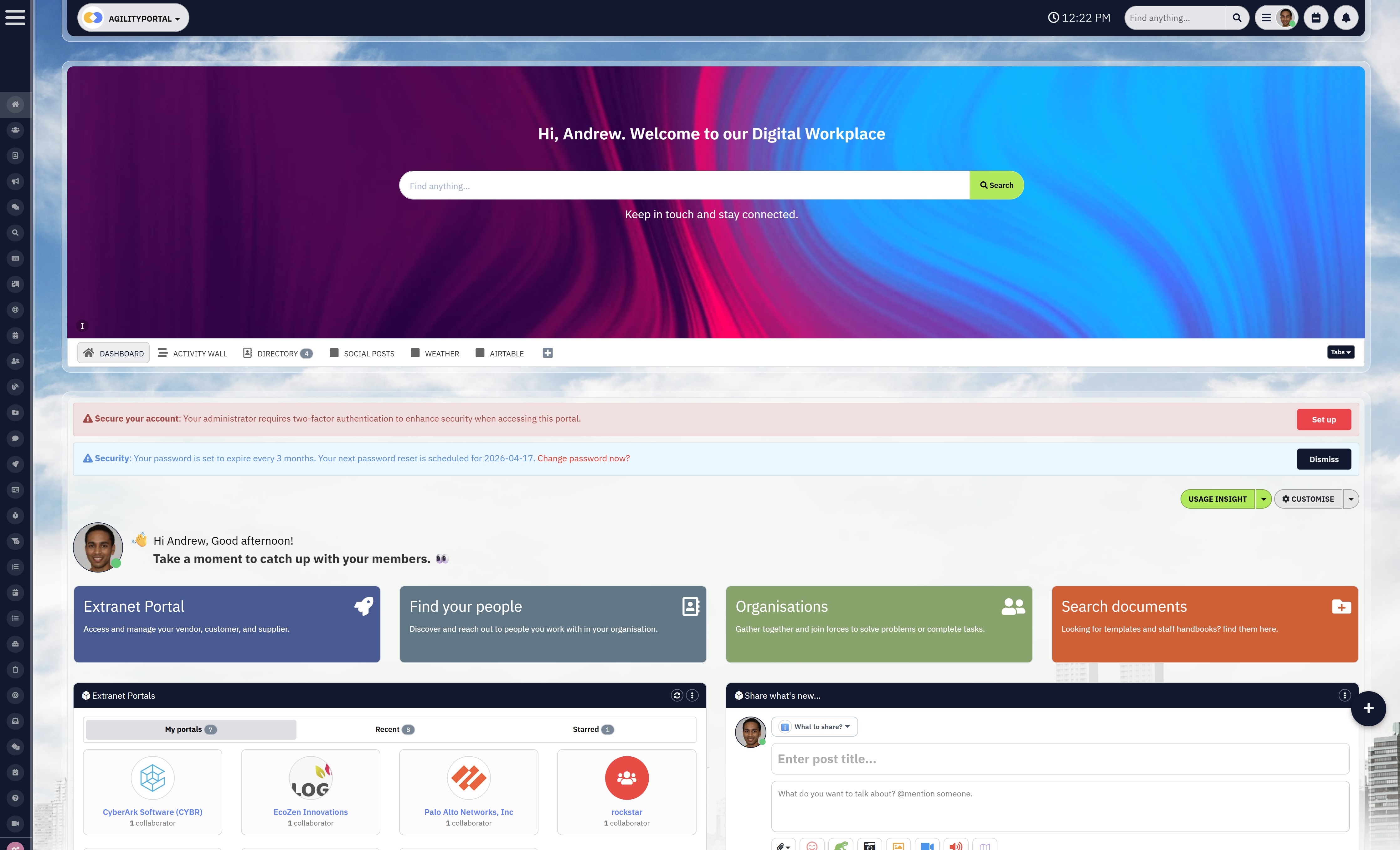
Build Internal Communication That Actually Scales — with AgilityPortal
The companies with strong internal communication aren't winning because they send more messages or have bigger comms teams. They win because they've built a culture of clarity, collaboration, and transparency—supported by systems that actually work at scale. That's where AgilityPortal fits in.
AgilityPortal helps large organisations centralise communication, planning, and execution in one place. From targeted updates and shared calendars to document collaboration and engagement insights, everything is designed to make communication easier to follow, not easier to ignore. Teams know where to look, what matters, and what's expected—without drowning in noise.
If you're serious about fixing the communication breakdowns holding your organisation back, don't guess.
See how AgilityPortal works in practice. Book your free demo today and experience communication that drives action—not confusion.
Wrapping up Internal Comms Doesn't Fail Because People Don't Care
If there's one thing this article should make clear, it's this: internal communication doesn't fail because employees are disengaged, lazy, or resistant to change. It fails when organisations scale complexity faster than clarity.
Layers get added, tools multiply, messages spread wider—but no one stops to redesign how communication actually works at scale.
What we've done in this article is strip the problem back to reality.
We've walked through why internal comms breaks in large organisations, the real barriers that stop messages from landing, and concrete examples of how those failures play out in day-to-day operations.
We've also shown what successful organisations do differently—and, crucially, why it works.
The value here isn't theory. It's pattern recognition.
You should now be able to spot:
- where communication is breaking down in your own organisation
- which habits are quietly undermining execution
- and which fixes you can apply immediately, without waiting for a reorganisation or new strategy
The biggest takeaway is simple but powerful: effective internal communication is not about broadcasting more information. It's about designing communication as a system—with ownership, relevance, context, and feedback built in.
When organisations make that shift, clarity scales with growth instead of collapsing under it. And that's when internal comms starts driving execution, not just noise.
Frequently Asked Questions
Why does Internal Comms Fails in large organisations so often?
Because scale introduces complexity faster than communication systems evolve. Messages get filtered, delayed, or diluted as organisations grow, which breaks alignment even when intentions are good.
What are some real communication challenges examples in large companies?
Common examples include mixed messages across departments, employees hearing about changes late, and teams acting on outdated information due to unclear ownership.
What are typical internal barriers of communication examples organisations face?
These include unclear responsibility for follow-up, overloaded channels, siloed teams, and messages delivered without enough context to act on them.
What are the biggest disadvantages of internal communication at scale?
When poorly designed, internal communication can create noise, slow decision-making, increase rework, and reduce trust in official updates.
How do internal communication barriers affect day-to-day work?
They cause missed deadlines, duplicated effort, inconsistent execution, and frustration among employees who feel out of the loop.
Can you share real life examples of poor communication in the workplace?
Yes—employees acting on different versions of the same policy, frontline teams learning about changes informally, or managers interpreting guidance inconsistently are common scenarios.
What are effective communication problems in the workplace and solutions leaders should focus on?
Clear ownership, fewer channels, predictable communication rhythms, and embedding updates into daily workflows are proven starting points.
Why do internal comms case studies often show similar failure patterns?
Because many organisations focus on sending messages rather than designing communication for understanding, feedback, and execution.
What do strong internal communications success stories have in common?
They prioritise clarity over volume, assign ownership to communication, and create feedback loops so messages don't just land—they lead to action.
What can we learn from companies with best internal communication practices?
They simplify channels, communicate with intent, support managers with context, and treat communication as a system—not a broadcast.
Why is internal communication harder in the public sector?
The most common causes of problems in internal communications in the public service sector are heavy governance, long approval chains, and messages designed for compliance rather than execution.
Most Popular Posts

Effective communication among team members is vital for the productivity and success of any organization. Surprisingly, 60% of companies lack a long-term internal communication strategy, which p...


Businesses thrive on communication for efficiency, productivity and accomplishment. When the right information is passed from the right designation in the organization, it promotes positivity an...

Categories
Blog
(3196)
Business Management
(395)
Employee Engagement
(235)
Digital Transformation
(218)
Growth
(150)
Intranets
(141)
Internal communications
(106)
Remote Work
(68)
Sales
(53)
Collaboration
(52)
Customer Experience
(32)
Culture
(30)
Knowledge Management
(29)
Project management
(29)
Leadership
(20)
Comparisons
(9)
News
(1)

Related Posts

Could AI produce your next workplace video faster—and still deliver a message your employees can trust? As more businesses use video for onboarding, training and leadership updates, one question keeps coming up: will AI replace video editors in...

Could the best machine learning systems help your employees spend less time sorting requests, updating spreadsheets and chasing information—and more time doing useful work? That's the opportunity, but finding the right system starts with knowin...

What would happen to your team's work and customer information if an employee's MacBook disappeared today? If you're wondering how to protect your Mac physically, the answer goes beyond buying a case. A MacBook used at home, on a train or in a ...

Welcome to AgilityPortal's guide to the best VPN for Remote teams. How do you give employees secure access to company systems when they work from home, the office and everywhere in between? It's a question more businesses need to answer: 28% of worki...

Have you ever left a meeting thinking everyone agreed on the next step, only to discover a week later that each person remembered something different? Open source meeting transcription can help teams keep a searchable record of the conversation...


Jill Romford
I am a digital nomad, lover of exploring new places and making friends.
I love to travel and I love the internet. I take pictures of my travels and share them on the internet using Instagram.
Traveler, entrepreneur, and community builder. I share my insights on digital marketing and social media while inspiring you to live your fullest life.
Ready to learn more? 👍
One platform to optimize, manage and track all of your teams. Your new digital workplace is a click away. 🚀
Free for 14 days, no credit card required.