
Insight Blog
Agility’s perspectives on transforming the employee's experience throughout remote transformation using connected enterprise tools.
20 minutes reading time
(4059 words)
Internal Communications Solutions for Distributed Teams That Bypass Email

Internal Communications Solutions for Distributed Teams That Bypass Email
Discover smarter Internal Communications Solutions for distributed teams with a modern corporate internal communication platform that reduces noise, improves alignment, and replaces email chaos.
Internal Communications Solutions for Distributed Teams That Bypass Email

Let's be honest — email feels safe. It's familiar, it's been around forever, and it gives leaders that comforting sense of "message sent, job done." But for distributed teams, that assumption is quietly breaking things.
Important updates get buried under CCs and reply-alls.
Frontline workers rarely check inboxes during shifts.
And leadership often mistakes silence for understanding — when in reality, the message never really landed.
That's why many organisations searching for Internal Communications Solutions eventually realise the problem isn't effort, it's the channel itself.
Here's the stat that should make any decision-maker pause: Gallup reports that poor communication costs organisations an average of 7 hours per employee, per week in lost productivity.
That's not a tech issue — that's a business one
As teams become more distributed, relying on email as your primary corporate internal communication platform creates blind spots you can't see, measure, or fix.
And in modern workplaces, what you can't see is usually what hurts you most.
● Key Takeaways: Internal Communication for Distributed Teams
- Email and chat were never designed to support distributed teams at scale, leading to missed context and false alignment.
- Poor internal communication quietly drains productivity, trust, and decision speed across remote and frontline teams.
- Tool sprawl creates silos, forcing employees to guess where conversations and updates actually live.
- Modern communication works best when it is role-based, visible, and designed around groups instead of broadcasts.
- High-performing organisations replace noise with clarity by centralising communication and making engagement measurable.
Read this article: : Top 6 AI-Powered Project Management Tools To Use In 2023
The Real Problem Remote Teams Are Dealing With (But Rarely Say Out Loud)
Remote and hybrid work didn't just change where people sit — it broke the old assumption that everyone naturally stays in the loop.
Most organisations are still patching together communication with tools that were never designed to work as a system.
Here's what that looks like in real life.
Employees don't actually have a clear, shared way to communicate with each other. Some conversations happen in email, others in chat, others in project tools, and plenty in private messages. People spend more time figuring out where to ask a question than actually getting an answer.
At the same time, companies keep adding tools that promise to fix communication — but instead just duplicate what already exists. One tool for chat, another for updates, another for documents, another for announcements.
On paper, it looks flexible. In practice, it creates silos.

Information gets fragmented. Context disappears. Teams talk around each other instead of with each other.
So what happens?
- Important updates live in multiple places
- The same question gets asked in three different tools
- Decisions get made without shared visibility
- Employees miss things not because they're disengaged, but because they're overwhelmed
There's also no clear signal for what actually matters.
Everything looks urgent.
Everything demands attention.
And because there's no single place that shows what's been seen, acknowledged, or acted on, leaders are left guessing.
The result isn't just miscommunication — it's quiet inefficiency.
Work slows down, trust erodes, and teams stop relying on shared channels altogether, choosing private messages instead. That's when silos really take hold.
Until organisations reduce tool overlap and give employees one consistent way to communicate, collaborate, and stay aligned, remote work will keep amplifying confusion — not productivity.
Why Distributed Teams Break Traditional Communication Models

Why Distributed Teams Break Traditional Communication Models
Distributed teams didn't choose to break old communication models — they simply exposed how fragile those models already were.
The moment teams started working across shifts, time zones, and locations, the cracks became obvious.
Not everyone is online at the same time.
Not everyone sits at a desk.
And not everyone consumes information the same way anymore. A message sent at 9 a.m. might land at 6 p.m. for someone else — or get buried before they even start their day.
What's changed most, though, is how information moves.
Communication no longer flows neatly from the top down. It moves sideways — between teams, across roles, and in quick bursts that depend on context. Decisions happen in real time, often collaboratively, and waiting hours (or days) for someone to catch up creates friction that slows everything down.
This is where traditional approaches really struggle.
When messages live in different tools or inboxes, decision latency creeps in. People hesitate because they're missing context. Others move ahead without alignment. By the time everyone is "in the loop," the moment has already passed.
And then there's reply-all culture.
What started as a way to keep people informed has turned into noise. Long threads, repeated explanations, conflicting replies — all of it makes it harder to see what actually matters. Instead of clarity, teams get fatigue. Instead of alignment, they get overload.
The hard truth is this: distributed teams don't need more messages, reminders, or follow-ups.
They need contextual visibility — a clear way to see what's important, who it affects, and what action (if any) is expected. Without that, communication scales in volume, but not in effectiveness.
The Email Trap Most Organisations Don't Notice
Email creates a comforting illusion of control.
You send the message. You see it leave your outbox. Maybe you even CC the right people. On the surface, it feels like communication happened. But this is where the problem starts — because sending isn't the same as landing.
For leadership teams, email quietly creates false confidence.
There's no real visibility into what actually happened after the message was sent.
In practice:
- You don't know who read it, skimmed it, or missed it entirely
- Silence gets mistaken for agreement
- Lack of questions is assumed to mean clarity
Most of the time, people are confused — they just don't know where, or whether, to respond.
Email also treats everyone the same, even when they're not.
A frontline worker, a manager, and an executive all receive the same message, in the same format, with the same priority — regardless of relevance.

There's no built-in way to tailor communication by role, location, or responsibility.
The result?
- Important updates get ignored because they don't feel relevant
- Critical information gets buried under low-priority noise
- Employees start filtering messages aggressively just to cope
Then there's the feedback problem.
Email is slow by design. Responses happen privately. Decisions get scattered across threads.
There's no clear, real-time signal that says:
- "This has been understood"
- "This needs action"
- "This is blocked"
By the time issues surface, they've usually already turned into delays, rework, or frustration.
And perhaps the biggest limitation of an internal communications email platform is this: it was never meant to be a shared source of truth.
Information lives in individual inboxes, not in a place the organisation can actually see, reference, or learn from. Once a message scrolls past, it might as well not exist.
None of this means email is useless. It still has its place.
But when it becomes the backbone of internal communication, it quietly works against alignment — not because people aren't paying attention, but because the system itself can't show what's really happening.
What Modern Internal Communication Should Actually Do
At this point, most organisations don't need another tool — they need a reset in expectations.
Modern internal communication isn't about pushing information out faster.
It's about making sure the right people see the right information at the right time, and can respond without friction. That's the baseline today, not a nice-to-have.
This is where effective Internal Communications Solutions separate themselves from older approaches.
Instead of broadcasting the same message to everyone and hoping it sticks, modern communication needs to be structured around how people actually work.
That means:
- Messages tied to roles, locations, and teams - People shouldn't have to guess whether something applies to them. Relevance drives attention.
- Two-way communication by default - Employees need a clear way to ask questions, clarify context, and contribute — not just receive instructions.
- Visibility into who saw what (and who didn't) - Leaders need insight, not assumptions. Communication without visibility is just noise.
- One place employees actually return to daily - Not another forgotten tool, but a shared space that becomes part of how work gets done.
This is why many organisations are rethinking their setup and moving toward a unified team communication platform rather than juggling disconnected tools.
When updates, conversations, and collaboration live together, context stops getting lost.
It also explains the shift away from generic broadcasts toward communication platforms for groups, where teams can engage around shared goals instead of chasing information across inboxes and apps.
The standard has changed.
And most older internal communication systems simply weren't designed to meet it.
Why Chat Alone Doesn't Solve the Problem
Let's be real for a moment — chat feels like progress.
It's fast, informal, and better than endless email threads.
That's why so many teams adopt internal chat software and assume the communication problem is solved. Messages move quicker, replies are instant, and everything feels more "modern."
But speed isn't the same as alignment.
Chat is built for conversation, not continuity. It works great in the moment, then quietly breaks down over time.
Here's where things start to fall apart:
- Conversations disappear fast - What mattered yesterday is buried by lunchtime. Scrollback becomes the archive — and nobody scrolls.
- Important updates get lost in chatter - Announcements, decisions, and FYIs sit right next to emojis, side jokes, and quick questions. Everything looks equally urgent, so nothing really is.
- No long-term knowledge structure - Chat doesn't organise information in a way people can reliably find later. New starters and cross-functional teams are left piecing together history from fragments.
- Context collapses over time - A message might make sense in the moment, but weeks later the "why" is gone. Decisions lose their reasoning, and teams repeat the same conversations again and again.
This is the trap many organisations fall into.
They add chat on top of existing tools, thinking it will unify communication — but instead it becomes another stream to monitor. Another place where things might have been said.
That's why relying on chat alone rarely works as a corporate internal communication platform. It's great for quick exchanges, but weak at creating shared understanding across teams, locations, and time zones.
Effective communication platforms recognise this difference.
They don't just enable talking — they preserve context, surface what matters, and make sure information doesn't vanish the moment the next message arrives.
Because at scale, conversation is easy.
Clear communication is not.
The Rise of Purpose-Built Team Communication Platforms
What's happening now isn't a trend — it's an evolution.
As teams became more distributed, organisations slowly realised that stacking tools on top of email and chat wasn't fixing communication. It was just making it harder to follow.
The real shift came when companies stopped asking "How do we send messages faster?" and started asking "How do we keep people aligned without constant chasing?"
That's where purpose-built platforms entered the picture.
These platforms are designed for distributed work by default, not retrofitted for it.
They're built around how people actually collaborate day to day — across locations, roles, and schedules — rather than assuming everyone is sitting in the same office checking the same inbox.
Instead of forcing teams to juggle multiple apps, they bring key elements together in one place:
- Conversations that don't disappear the moment the day gets busy
- Updates that feel relevant instead of overwhelming
- Files and information that stay connected to the work they belong to
- Workflows that support accountability without turning into surveillance
This approach changes behaviour in a subtle but important way.
Employees stop asking, "Where should I post this?" Leaders stop wondering, "Did anyone actually see that?" And communication starts to feel intentional rather than reactive.
This is the space that platforms like AgilityPortal was built for — not to replace every tool overnight, but to give organisations a clearer, calmer way to communicate as they scale.
One that reduces noise, removes duplication, and helps teams stay aligned without adding friction.
Because when communication is designed around people instead of inboxes, alignment stops being something you chase — it becomes something you can see.
Read this article: : Top 6 AI-Powered Project Management Tools To Use In 2023
Why Group-First Communication Outperforms Broadcast Messaging
Broadcast messages look efficient on paper. One message, everyone included, job done.
But in reality, mass communication is one of the fastest ways to get ignored — especially in distributed teams.
People engage when information feels meant for them, not when it feels like background noise.
When messages are sent to everyone by default, relevance drops. Employees have to mentally filter what applies to their role, location, or team. Over time, that filtering turns into skipping — not because people don't care, but because they're overloaded.
Group-first communication flips that dynamic.
Instead of shouting into the void, information is shared in the right context, with the right people.
That context changes how messages are received and acted on.
Here's why it works better:
- Teams engage more when messages feel relevant - When updates are shared within a specific group, people pay attention because they know it affects their work. With announcements, important information is clearly separated from everyday chatter. Admins and leaders can post updates knowing they won't get buried — and more importantly, they can see exactly who has read and acknowledged each message. No guessing. No follow-up emails. No "just checking you saw this."
- Group context improves understanding - Seeing a message alongside related discussions, decisions, and files makes it easier to grasp the "why," not just the "what."
- Fewer messages, higher impact - Targeted communication reduces repetition and follow-ups. One clear message in the right place beats five reminders sent everywhere.
- Less noise, more signal - Employees stop scanning for relevance and start focusing on action. That alone reduces friction.
This is why modern communication platforms for groups consistently outperform broadcast-heavy approaches.
They respect attention, preserve context, and reduce the cognitive load that comes with constant company-wide messaging.
It's also why platforms like AgilityPortal are built around shared spaces where teams communicate with purpose, not interruption.
Alignment happens naturally when people see information in the context of the work and relationships that matter to them.
Because the goal isn't to reach everyone.
It's to reach the right people — and make it stick.
The Compliance, Security, and Trust Question Leaders Can't Ignore
This is the part most teams only think about after something goes wrong.
As communication spreads across email, chat apps, file tools, and side channels, risk quietly increases.
Not because people are careless — but because no one can clearly see where information lives, who has access to it, or how decisions were made.
For leaders, that lack of visibility isn't just uncomfortable. It's a liability.
Modern organisations need communication they can stand behind — not just culturally, but legally and operationally too.
That starts with auditability.
- Clear, auditable communication trails - Important decisions shouldn't live in private inboxes or disappear into chat history. Leaders need a reliable record of what was shared, when, and with whom — especially for compliance, HR, and regulatory situations.
- Controlled access by role and responsibility - Not everyone should see everything. Sensitive updates, people data, and operational information need to be shared intentionally, with permissions that reflect real-world roles — not broad "all staff" defaults.
- Reduced reliance on unofficial tools - When employees can't find information in approved systems, they create their own workarounds. Personal messaging apps, private file shares, and untracked tools feel convenient — until they aren't. Centralised communication reduces that behaviour by design.
- Clear data ownership and residency - With growing scrutiny around data protection, many organisations are asking hard questions about where their data lives and who ultimately controls it — especially when relying heavily on UC platforms. Transparency here isn't optional; it's expected.
This is where enterprise buyers tend to lean forward.
Because once communication becomes business-critical — not just operational — trust, control, and accountability matter just as much as speed. And any platform that can't offer those things clearly will eventually become a risk, no matter how easy it is to use.
What High-Performing Organisations Are Doing Differently
The gap between teams that struggle with communication and teams that stay aligned isn't effort — it's structure.
High-performing organisations have quietly changed how communication works, not how often it happens.
What's interesting is that these patterns keep showing up across industries. Different companies, different sizes — same moves.
Here's what they're doing differently.
1. They Rely on One Central Place for Team Communication
High-performing teams don't ask, "Where was that shared?"
They already know.
Instead of spreading conversations across email, chat tools, and document comments, they use one central team communication platform as the default place work-related communication lives.
That doesn't mean fewer conversations — it means:
- Less duplication
- Fewer missed updates
- Faster alignment
When everyone knows where communication happens, participation becomes natural instead of forced.
2. They Separate Conversations From Announcements
Not everything deserves the same treatment.
High-performing organisations clearly separate:
- Day-to-day conversations (questions, collaboration, problem-solving)
- Official announcements (policy changes, company updates, leadership messages)
Why this matters:
- Important updates don't get lost in casual chatter
- Employees know when something actually requires attention
- Leaders stop repeating the same message across multiple channels
Clarity replaces noise.
3. They Design for Frontline and Mobile Workers First
This is a big one.
Teams that perform well don't design communication around desk workers and hope everyone else catches up. T
hey assume many employees are:
- On the move
- On shifts
- On mobile devices
- Offline at times
So communication is built to work where employees are, not where leadership sits.
That means:
- Mobile-first access
- Simple navigation
- Information that's easy to scan, not hunt for
When frontline teams are included by design, engagement follows naturally.
4. They Use Engagement Signals to Guide Leadership Decisions
High-performing organisations don't guess whether communication is working — they can see it.
They pay attention to:
- Who's engaging with updates
- Where participation drops off
- Which teams are overloaded
- Which messages actually drive action
That insight changes leadership behaviour. Messages get clearer. Timing improves. Communication becomes intentional instead of reactive.
And most importantly, leaders stop assuming alignment — they can verify it.
None of this is experimental anymore.
These practices are already standard in organisations that have figured out how to operate at scale with distributed teams. The difference is subtle, but powerful: communication becomes something you can see, measure, and improve — not just send and hope for the best.
Choosing the Right Direction (Without Ripping Everything Out)
This is usually the moment where people hesitate.
They agree the current setup isn't working… but they don't want a painful rollout, a long migration, or weeks of disruption. That fear is valid — and it's also based on an outdated assumption.
This shift doesn't have to be dramatic.
This Isn't a "Big Bang" Replacement
The smartest organisations don't switch everything off and start again.
They layer new communication practices on top of what already exists, then let behaviour change naturally.
Teams adopt what's useful. Old habits fade because they're no longer needed — not because they're banned.
Change sticks when it feels optional, not forced.
Email Still Exists — It Just Stops Running the Company
Email isn't evil. It's just overworked.
In modern setups, email keeps doing what it's good at:
- External communication
- Formal notices
- One-to-one exchanges
What it stops doing is acting as the backbone of internal alignment.
That role shifts to a shared space where updates, conversations, and collaboration are visible — not buried in inboxes.
The Shift Is Additive, Not Disruptive
The goal isn't to replace tools overnight. It's to reduce overlap and confusion over time.
When teams have:
- One clear place for internal updates
- One consistent way to communicate with each other
- One shared view of what's happening
They naturally stop duplicating effort elsewhere.
That's where platforms like AgilityPortal fit — not as a rip-and-replace solution, but as a unifying layer that brings structure to communication without forcing teams to relearn how to work.
The right direction doesn't create friction — it removes it.
You don't need a radical transformation to fix internal communication. You need a calmer, clearer system that works alongside what you already have and gradually becomes the place teams trust most.
When that happens, alignment stops being something you chase.
It just happens.
See What Clear Internal Communication Actually Feels Like
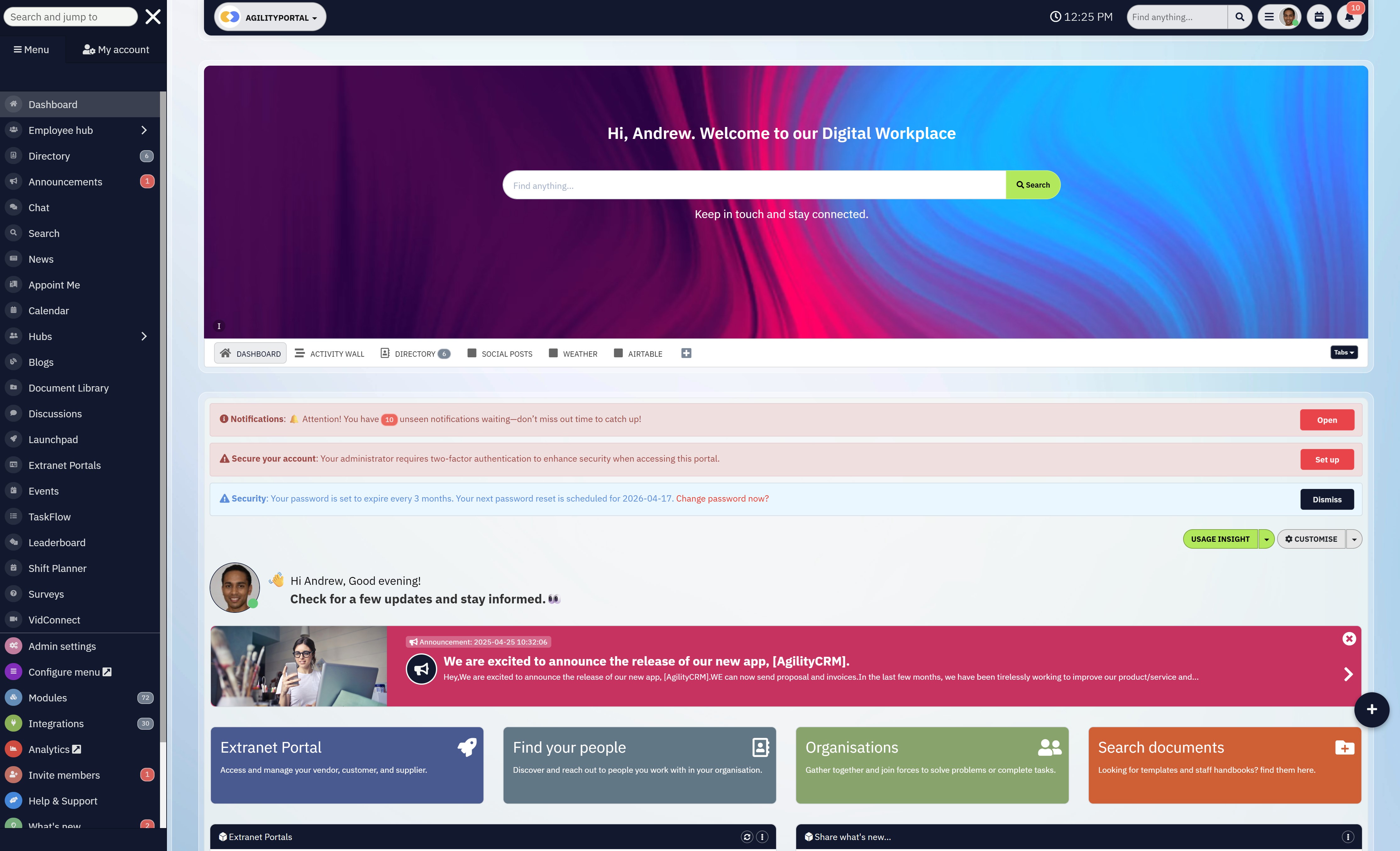
See What Clear Internal Communication Actually Feels Like
If any of this sounds familiar — missed updates, tool overload, unclear alignment — the problem isn't your people. It's the way communication is structured.
AgilityPortal gives distributed teams one clear place to communicate, collaborate, and stay aligned — without relying on inboxes, endless chat threads, or disconnected tools.
It's built for real-world teams:
- Frontline, remote, and hybrid workers
- Leaders who need visibility, not guesswork
- Organisations tired of juggling tools that don't talk to each other
Features:
- Team Spaces & Group Communication
- Structured Announcements & Company Updates
- Internal Chat & Direct Messaging
- Role-Based & Targeted Communication
- Read Receipts & Engagement Visibility
- Centralised Communication Hub
- Mobile-First Access for Frontline Teams
- Threaded Discussions with Context
- Secure File Sharing & Collaboration
- Activity Feeds & Push Notifications
- Permissions & Access Controls
- Audit Trails & Communication History
- Reduced Tool Sprawl
Try AgilityPortal free for 14 days.
No credit card. No setup headaches. No pressure.
Just a calmer, clearer way to see how your teams actually communicate — and where things finally start to click.
Final Thought: Communication Isn't About Sending — It's About Landing
Here's the reframe most organisations miss.
Communication doesn't fail because leaders don't send enough messages.
It fails because there's no certainty those messages were seen, understood, or acted on. Sending is easy.
Landing is what actually moves work forward.
When teams are distributed, clarity matters more than volume.
People need to know what matters, why it matters, and what's expected of them — without digging through inboxes, chat threads, or half-remembered conversations.
That's why the best Internal Communications Solutions don't focus on pushing more updates.
They focus on:
- Making information visible
- Preserving context
- Reducing noise
- Creating shared understanding across teams
Consistently. Visibly. At scale.
And here's the simple truth that closes the loop:
If your teams are distributed, your communication approach must be too.
Because alignment doesn't happen by accident anymore — it has to be designed.
Most Popular Posts

Effective communication among team members is vital for the productivity and success of any organization. Surprisingly, 60% of companies lack a long-term internal communication strategy, which p...


Businesses thrive on communication for efficiency, productivity and accomplishment. When the right information is passed from the right designation in the organization, it promotes positivity an...

Categories
Blog
(3248)
Business Management
(399)
Employee Engagement
(237)
Digital Transformation
(224)
Growth
(151)
Intranets
(142)
Internal communications
(110)
Remote Work
(68)
Sales
(53)
Collaboration
(53)
Customer Experience
(33)
Culture
(30)
Project management
(30)
Knowledge Management
(29)
Leadership
(20)
Comparisons
(9)
News
(1)

Related Posts

Searching for "communal work spaces near me" but unsure which option will actually suit your growing business? By the end of this guide, you'll know how to compare offices to rent, spot extra costs and ask the right questions before committing....

Do you know what happens to your information after you share it with an AI assistant? That question sits at the heart of AI privacy—and it's easy to overlook when you're trying to finish a task. You paste in a customer email, upload a spr...

What would happen if your website moved successfully, but your customers and employees suddenly couldn't reach you by email? Email migration tools can help transfer your messages, but keeping business communication running takes more than copyi...

Does your team still message HR to ask where the holiday policy is? Employee self service should make everyday tasks easier, giving people a straightforward way to find answers, access documents and submit requests. But when policies are buried...

How quickly can a new partner go from signing an agreement to confidently working with your business? If the answer involves chasing documents, forwarding training links and answering the same questions repeatedly, your onboarding process may n...


Jill Romford
I am a digital nomad, lover of exploring new places and making friends.
I love to travel and I love the internet. I take pictures of my travels and share them on the internet using Instagram.
Traveler, entrepreneur, and community builder. I share my insights on digital marketing and social media while inspiring you to live your fullest life.
Ready to learn more? 👍
One platform to optimize, manage and track all of your teams. Your new digital workplace is a click away. 🚀
Free for 14 days, no credit card required.