
Insight Blog
Agility’s perspectives on transforming the employee's experience throughout remote transformation using connected enterprise tools.
19 minutes reading time
(3742 words)
How Microservices Architecture Is Powering Scalable SaaS Platforms

How Microservices Architecture Is Powering Scalable SaaS Platforms
Microservices architecture is reshaping how SaaS platforms scale, deploy faster, and stay resilient. Learn how it works, why it matters, and when to use it.
How Microservices Architecture Is Powering Scalable SaaS Platforms

Let's be honest—SaaS users are ruthless.
If your app is slow, buggy, or down for even a few minutes, they don't complain… they leave. Today's customers expect speed, uptime, and constant improvement, all at scale, and they expect it by default.
That's where traditional monolithic architectures start to crack.
What works fine with 500 users quickly becomes a bottleneck at 50,000.
Every update feels risky. Every outage feels expensive. And every new feature takes longer than it should.
This is why more founders and product leaders are turning to microservices—and why almost every serious saas development company is building with scalability in mind from day one.
Microservices solve real, painful SaaS problems:
- You can scale only what's under pressure
- Teams can ship faster without stepping on each other
- One failure doesn't take down the whole platform
And the stakes are high.
According to industry data, 98% of organisations say a single hour of downtime costs over $100,000, which makes "we'll fix it later" a dangerous strategy.
In this guide, you'll learn what microservices architecture actually is, why it's powering today's most scalable SaaS platforms, the benefits and trade-offs you need to understand, and when it makes sense to adopt it—before growth forces your hand.
Read this article: : Top 6 AI-Powered Project Management Tools To Use In 2023
The Scalability Challenge in Modern SaaS

Here's the uncomfortable truth most SaaS teams run into sooner or later: success breaks your product before failure ever does.
Early on, everything feels fine. Traffic is predictable. Features ship quickly. One codebase, one deployment, one database. Clean. Simple. Manageable.
Then growth hits.
More users log in at the same time. One feature gets hammered while others sit idle.
Enterprise customers demand uptime guarantees.
A single bug suddenly affects everyone. And every release becomes a white-knuckle event because you're touching the entire system just to make a small change.
This is the scalability trap modern SaaS platforms fall into.
The problem isn't just handling more users — it's handling uneven growth. Login services spike on Mondays. Reporting features choke at month-end. Notifications explode during campaigns. Scaling the whole application to handle one hot path is like buying a bigger house because your kitchen is crowded.
And the cost of getting this wrong is brutal. Research shows that over 70% of users abandon a SaaS product after experiencing repeated performance issues, even if they like the features.
That's churn you don't get to win back.
This is why experienced teams — and any serious development company — stop asking "Can our system handle growth?" and start asking "Which parts need to scale, and which don't?"
Modern SaaS scalability isn't about brute force anymore. It's about precision.
And that's exactly where traditional architectures start holding teams back — not because they're bad, but because they were never designed for the kind of growth SaaS success creates.
So, What Is Microservices Architecture?
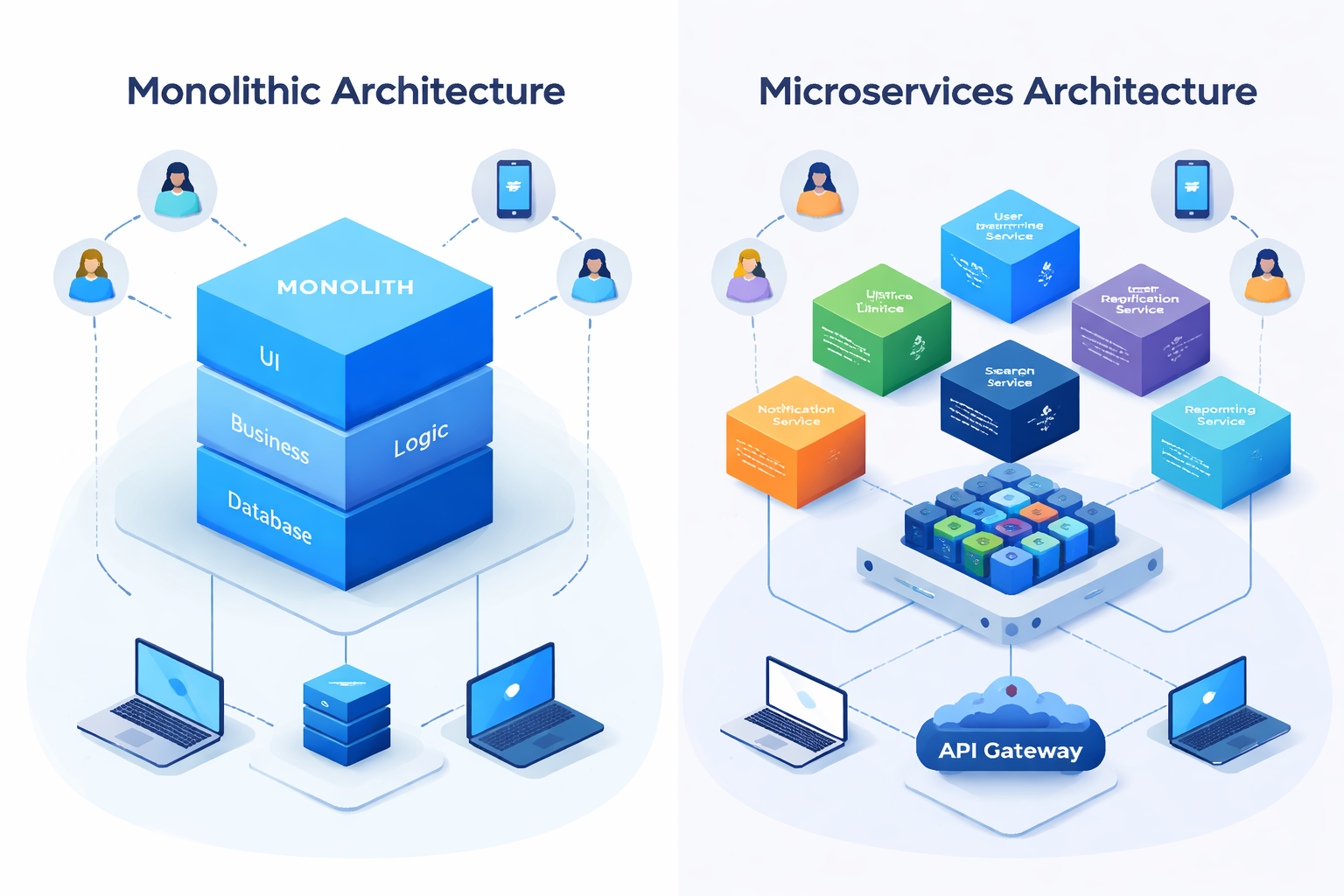
So, What Is Microservices Architecture?
Microservices architecture means breaking a SaaS application into small, independent services, where each service does one job well and runs on its own.
No giant, tangled codebase.
No "touch one thing and everything breaks" drama.
Think of it like this:
Instead of one massive machine trying to do everything, you have a set of smaller machines — login, billing, notifications, search, reporting — all working together.
Each microservice:
- Handles one clear responsibility
- Can be built, deployed, and scaled independently
- Communicates with other services through APIs
This is why modern Product Development Services focus on designing SaaS systems with scalability built in from the start.
How Microservices Differ from Monolithic Systems
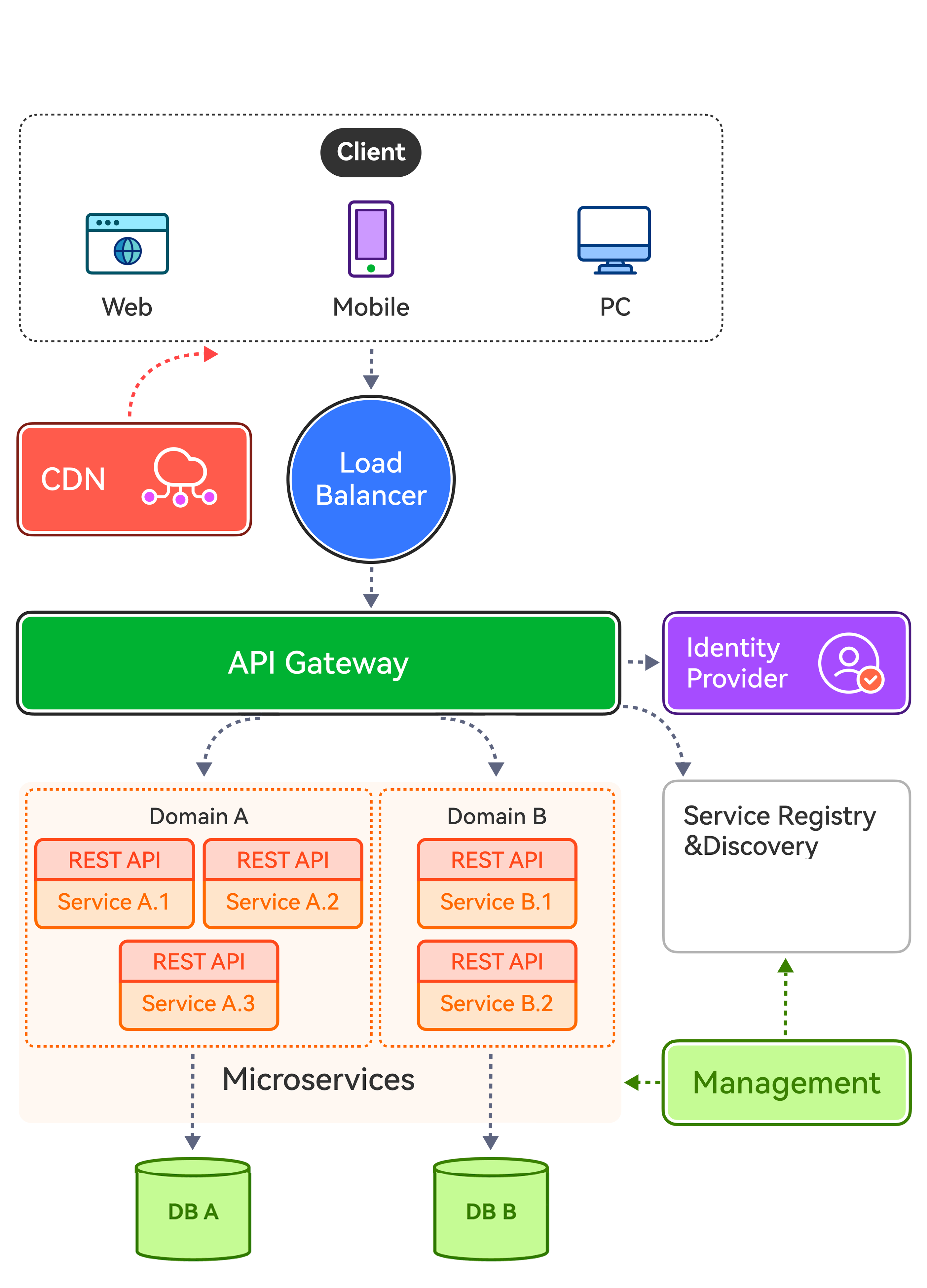
How Microservices Differ from Monolithic Systems
In a monolithic system, everything lives in one place:
- One codebase
- One deployment
- One failure point
If you want to update billing logic, you redeploy the entire app. If one part crashes, the whole system feels it.
With microservices, each part lives in its own lane:
- Updating search doesn't touch billing
- Scaling notifications doesn't mean scaling the entire platform
- A failure stays contained instead of spreading
That separation is the real superpower here.
One Service = One Responsibility, One Deployable Unit
This is the rule that keeps microservices from turning into chaos.
Each service should:
- Do one thing (and only one thing)
- Own its logic and, often, its data
- Be deployable without coordinating a dozen teams
When teams respect this boundary, development speeds up fast. When they don't, microservices become micro-mess.
APIs: The Glue That Holds Everything Together
Microservices don't talk directly to each other's databases or internal logic.
They communicate through APIs.
APIs define:
- What data a service exposes
- How other services interact with it
- Clear contracts that reduce breaking changes
This makes systems more predictable, easier to evolve, and safer to scale.
Monolith vs Microservices
- Deployment mode - Monolith: One big deployment, every time, Microservices: Small, independent deployments
- Scaling approach - Monolith: Scale the whole app, even if one feature is busy, Microservices: Scale only what's under load
- Failure impact - Monolith: One bug can affect everyone, Microservices: Failures stay isolated
- Development speed - Monolith: Slows down as the codebase grows, Microservices: Teams move faster with less coordination
Microservices don't magically make a SaaS product better — but they remove the architectural ceiling that stops good products from scaling.
Why Microservices Are a Natural Fit for SaaS Platforms

Why Microservices Are a Natural Fit for SaaS Platforms
Here's the thing most people miss: SaaS doesn't grow in a straight line. It never has.
One week usage is calm. The next week a new customer onboards 5,000 users.
A feature goes viral. A sales deal closes faster than expected. Suddenly one part of your platform is on fire while everything else is just… fine.
This is why microservices work so well for SaaS. They scale the same way SaaS grows — unevenly, unpredictably, and fast.
Instead of throwing more servers at the entire application, microservices let you scale only what's under pressure. Login can scale independently. Notifications can spike without dragging reporting down. Billing can stay stable while everything else flexes.
That's a huge psychological relief for product and engineering teams. You're no longer bracing for impact every time growth shows up.
Microservices also make it far easier to:
- Support global users without slowing everyone down
- Roll out new features without risking the whole platform
- Handle usage spikes without emergency deployments
- Ship updates continuously, without downtime or panic
This is why any experienced development company designing for long-term growth almost always ends up here — not because it's trendy, but because the alternative eventually becomes painful.
Key SaaS Drivers Behind Microservices Adoption
- Multi-tenant environments - SaaS platforms rarely serve just one customer type. Different tenants behave differently, consume features differently, and grow at different speeds. Microservices allow isolation where it matters, reducing cross-tenant risk.
- Feature experimentation and A/B testing - Modern SaaS lives on experimentation. Microservices make it possible to test, roll back, and iterate on features without freezing the entire roadmap. That speed advantage compounds fast.
- Regional scaling and compliance - Data residency laws, latency expectations, and regional demand force SaaS platforms to think globally. Microservices allow services to be deployed closer to users — or restricted to specific regions — without re-architecting everything.
- High availability expectations - Users don't care why your app went down. They only remember that it did. Microservices reduce blast radius, making outages smaller, shorter, and far less damaging to trust.
SaaS success creates pressure. Microservices don't remove that pressure — they give you room to breathe while you grow.
Core Benefits of Microservices for Scalable SaaS
This is the part where microservices stop sounding like an architectural theory and start feeling like a competitive advantage.
These benefits aren't abstract — they're the reasons SaaS teams sleep better at night once they make the switch.
Independent Scalability
Scale only what's under load — not the entire system
This is the big one.
In a traditional setup, one busy feature forces you to scale everything. That's expensive, inefficient, and honestly a little reckless. Microservices flip that logic on its head.
If search traffic spikes, scale search.
If notifications explode, scale notifications.
If billing stays quiet, leave it alone.
You're no longer overpaying "just in case."
You're scaling with intent — and that's exactly how high-performing SaaS platforms stay profitable as they grow.
Any seasoned development company will tell you this is where cost control and performance finally line up.
Faster Development & Deployment
Teams ship without waiting, and releases stop being scary
Ever had a feature ready but delayed because another team wasn't finished? Or worse — shipped a small change and accidentally broke something unrelated?
Microservices remove that friction.
Teams work in parallel. Features move independently. Deployments become smaller, safer, and far more frequent. That creates a powerful psychological shift:
shipping becomes normal instead of stressful.
Less waiting. Less coordination drama. Less "don't touch production on Fridays."
Improved Resilience
One service fails ≠ the platform goes down
Outages don't destroy SaaS businesses. Uncontained outages do.
With microservices, failure is expected — and designed for. If one service misbehaves, it doesn't take the whole platform with it. Users might lose a feature temporarily, but they don't lose trust in your product entirely.
This containment effect massively reduces panic, churn, and reputation damage. You move from "everything is broken" to "we're isolating and fixing one issue."
That difference matters more than most teams realise.
Technology Flexibility
Different services, different stacks (when it actually makes sense)
Microservices give you freedom — but not chaos.
You can choose the right tool for the job:
- High-performance language for real-time services
- Flexible frameworks for fast-moving features
- Stable, boring tech where reliability matters most
This flexibility lets teams innovate without rewriting the whole platform. The key is discipline: flexibility is a weapon only when used deliberately, not emotionally.
Microservices don't just help SaaS platforms scale technically — they reduce risk, speed up teams, and remove the fear that growth will break everything you've built.
That's why they've become the default choice once SaaS success stops being hypothetical.
Read this article: : Top 6 AI-Powered Project Management Tools To Use In 2023
How Microservices Power Real-World SaaS Growth
This is where microservices stop being an architectural decision and start becoming a growth engine.
When SaaS platforms scale in the real world, they don't just get more users — they get more complexity.
Different usage patterns.
Different customer expectations.
Different pressure points.
Microservices handle that reality far better than one giant system ever could.
Horizontal Scaling in Cloud Environments
Instead of scaling up (bigger servers, bigger bills), microservices scale out.
Each service runs independently, so the platform can add capacity exactly where demand appears. Login services scale during peak hours. Search scales during heavy usage. Reporting scales at month-end. Everything else stays lean.
This is how platforms grow without burning money just to stay online.
AgilityPortal is a good example here. As customers adopt different modules — chat, document management, employee engagement, analytics — usage doesn't spike evenly.
A microservices-based setup allows AgilityPortal to scale collaboration features heavily for frontline teams while keeping admin and reporting services stable and cost-efficient.
Autoscaling Tied to Real Usage
Modern SaaS growth is unpredictable.
One customer launch, one internal announcement, or one global rollout can change traffic patterns overnight.
Microservices paired with cloud autoscaling react automatically:
- Traffic increases → services scale
- Traffic drops → services scale back
No emergency calls. No manual provisioning. No guesswork.
For platforms like AgilityPortal, this means handling sudden onboarding of large teams or partners without degrading performance for existing customers — a critical trust factor in enterprise environments.
Zero-Downtime Deployments
Downtime is a trust killer. Users may forgive missing features, but they remember outages.
Microservices make zero-downtime deployments achievable because changes are isolated.
You can deploy a new version of one service while the rest of the platform keeps running normally.
AgilityPortal benefits from this directly by rolling out feature updates, security patches, and performance improvements without interrupting daily operations for distributed teams — especially important for organisations relying on the platform as a central communication hub.
Faster Onboarding of Enterprise Customers
Enterprise customers don't just bring more users — they bring:
- Custom requirements
- Higher usage volumes
- Integration demands
- Strict uptime expectations
Microservices allow SaaS platforms to onboard these customers faster by scaling and adapting only the services they actually use. There's no need to redesign the entire system for every large deal.
This flexibility makes enterprise growth sustainable instead of fragile.
Companies That Popularised Microservices
The microservices movement didn't start with theory — it started with survival.
- Netflix adopted microservices to survive massive global traffic spikes and frequent failures, building systems that assume things will break and recover automatically.
- Amazon rebuilt its internal architecture around services long before "microservices" became a buzzword, enabling independent teams to deploy continuously at enormous scale.
Microservices didn't make these companies successful — success forced them to adopt microservices.
AgilityPortal is following the same principle at a different scale: building an architecture that doesn't just work today, but won't collapse when growth accelerates tomorrow.
The Role of Cloud & Containers in Microservices
Microservices can exist without the cloud — but in practice, they almost never do.
The reason is simple: microservices demand flexibility, and traditional infrastructure just isn't built for that pace.
When services need to scale independently, deploy constantly, and recover automatically, the cloud stops being a "nice to have" and becomes the foundation.
Why Microservices Rarely Exist Without the Cloud
Microservices create lots of moving parts:
- Multiple services
- Independent deployments
- Variable traffic patterns
- Frequent scaling events
Trying to manage that manually on fixed servers is a fast route to burnout.
Cloud platforms solve this by offering:
- On-demand infrastructure
- Built-in redundancy
- Global availability
- Pay-for-what-you-use scaling
This is why any serious development company building microservices designs cloud-first. Without it, microservices quickly become more work than they're worth.
Containers - The Unsung Hero (Docker, Explained Simply)
Containers package a service with everything it needs to run — code, runtime, dependencies, configuration — into a single, portable unit.
Why that matters:
- It runs the same in dev, staging, and production
- No "works on my machine" excuses
- Faster deployments and rollbacks
In a microservices world, containers are what keep services isolated, predictable, and easy to move.
Orchestration: How Kubernetes Keeps the Chaos in Check
Once you're running dozens (or hundreds) of containers, you need a traffic controller.
That's where orchestration comes in.
Orchestration tools:
- Start and stop containers automatically
- Restart failed services
- Scale services up or down based on demand
- Distribute traffic intelligently
Without orchestration, microservices quickly turn into micro-panic. With it, the platform largely runs itself.
Infrastructure as Code & Automated Scaling
Modern microservices platforms don't rely on manual setup.
Instead:
- Infrastructure is defined in code
- Environments can be recreated consistently
- Scaling rules are automated
- Human error drops dramatically
This approach makes SaaS platforms repeatable and resilient, not fragile and hand-built.
It's one of the biggest mindset shifts teams experience when moving to microservices — and one of the most valuable.
Supporting Technologies That Make Microservices Work
Microservices don't survive on containers alone. They rely on a supporting cast that keeps everything connected and observable.
API Gateways
API gateways act as the front door to your services.
They handle:
- Routing requests to the right service
- Authentication and rate limiting
- Versioning and access control
This keeps internal services clean and protects them from external chaos.
Service Discovery
In a dynamic system, services are constantly starting, stopping, and moving.
Service discovery answers one critical question automatically:
"Where is this service right now?"
Without it, services wouldn't know how to find each other. With it, the system adapts in real time.
Load Balancing
Load balancers spread traffic evenly across service instances so no single node gets overwhelmed.
This is what keeps performance stable during spikes and prevents one busy user group from slowing everyone else down.
Centralised Logging and Monitoring
Here's the blunt truth: microservices are invisible without observability.
Centralised logging and monitoring let teams:
- Trace requests across multiple services
- Spot failures before users do
- Understand performance bottlenecks
- Fix issues without guesswork
If you can't see what's happening, you don't have a scalable system — you have a ticking clock.
Cloud platforms, containers, and orchestration aren't optional extras in microservices.
They're the control system that makes scalability practical instead of painful. Without them, microservices don't scale — they just multiply problems.
Best Practices for SaaS Teams Adopting Microservices
Microservices can absolutely power scale — but only if you're disciplined.
Done badly, they don't simplify anything; they just move complexity into places you're not ready for. The teams that succeed follow a few non-negotiable rules.
Here's what actually works in the real world.
Start With Clear Service Boundaries
f you get this wrong, everything else suffers.
Each service must have one clear responsibility. Not "user stuff." Not "general logic." One job. One purpose. One reason to exist.
When boundaries are fuzzy, services start leaking logic into each other, dependencies explode, and suddenly your "microservices" behave like a distributed monolith — the worst of both worlds.
Any experienced development company will tell you: boundaries aren't a technical decision, they're a product decision. If you can't explain what a service does in one sentence, it's too big.
Design APIs Before You Write Code
This is where most teams rush — and regret it later.
APIs are contracts. Once other services depend on them, changing them becomes painful.
Designing APIs first forces you to think about:
- What data should be exposed
- What shouldn't be exposed
- How services evolve without breaking others
When APIs are an afterthought, teams end up tightly coupled without realising it. When APIs are deliberate, services stay independent and replaceable.
Automate Everything (Tests, Deploys, Rollbacks)
Manual microservices don't scale. Period.
If deployments require human coordination, approvals, or late-night heroics, you've already lost the scalability battle. Automation isn't a "nice to have" here — it's survival.
At minimum, teams should automate:
- Testing
- Deployments
- Rollbacks
The psychological benefit is huge. Engineers stop fearing releases. Shipping becomes routine instead of stressful. And mistakes become recoverable instead of catastrophic.
Invest Early in Observability
This is the part teams always underestimate.
In a microservices world, problems don't announce themselves politely. One slow service can ripple across the system in subtle ways. Without observability, you're debugging blind.
You need visibility into:
- Logs across services
- Metrics and performance trends
- Request tracing from start to finish
If you wait until production issues appear to add observability, you'll be reacting instead of controlling. The earlier you invest here, the calmer your platform becomes as it grows.
Prioritise Data Ownership Per Service
Shared databases are a silent microservices killer.
Each service should own its data.
That doesn't mean duplication is evil — it means coupling is. When multiple services write to the same database tables, independence disappears fast.
Clear data ownership:
- Reduces cross-team friction
- Prevents accidental breakage
- Makes services easier to evolve
Yes, it requires more thought up front. But it saves orders of magnitude more pain later.
Microservices reward discipline and punish shortcuts.
Teams that treat them casually end up overwhelmed. Teams that follow these practices build SaaS platforms that scale without fear — and without constant firefighting.
Conclusion- Microservices as a Growth Enabler — Not a Silver Bullet
Microservices architecture isn't a magic fix, and it's not something teams should adopt just because it sounds modern.
When implemented intentionally, though, it becomes a powerful enabler for scalable SaaS platforms. It allows teams to grow without constantly worrying that the next surge in users or features will bring the entire system to its knees.
What microservices really do is reward discipline.
Teams that define clear boundaries, invest in automation, and take observability seriously gain speed, resilience, and confidence as they scale.
Teams that cut corners, rush decisions, or treat microservices casually tend to feel the pain quickly — complexity doesn't disappear, it just moves to where you're least prepared for it.
For growing SaaS platforms, this distinction matters more than most leaders realise.
Microservices often mark the line between a platform that scales smoothly as demand increases and one that eventually has to pause innovation just to rewrite its core.
Used thoughtfully, microservices don't just support growth — they protect it.
Most Popular Posts

Effective communication among team members is vital for the productivity and success of any organization. Surprisingly, 60% of companies lack a long-term internal communication strategy, which p...


Businesses thrive on communication for efficiency, productivity and accomplishment. When the right information is passed from the right designation in the organization, it promotes positivity an...

Categories
Blog
(3248)
Business Management
(399)
Employee Engagement
(237)
Digital Transformation
(224)
Growth
(151)
Intranets
(142)
Internal communications
(110)
Remote Work
(68)
Sales
(53)
Collaboration
(53)
Customer Experience
(33)
Culture
(30)
Project management
(30)
Knowledge Management
(29)
Leadership
(20)
Comparisons
(9)
News
(1)

Related Posts

Searching for "communal work spaces near me" but unsure which option will actually suit your growing business? By the end of this guide, you'll know how to compare offices to rent, spot extra costs and ask the right questions before committing....

Do you know what happens to your information after you share it with an AI assistant? That question sits at the heart of AI privacy—and it's easy to overlook when you're trying to finish a task. You paste in a customer email, upload a spr...

What would happen if your website moved successfully, but your customers and employees suddenly couldn't reach you by email? Email migration tools can help transfer your messages, but keeping business communication running takes more than copyi...

Does your team still message HR to ask where the holiday policy is? Employee self service should make everyday tasks easier, giving people a straightforward way to find answers, access documents and submit requests. But when policies are buried...

How quickly can a new partner go from signing an agreement to confidently working with your business? If the answer involves chasing documents, forwarding training links and answering the same questions repeatedly, your onboarding process may n...


Jill Romford
I am a digital nomad, lover of exploring new places and making friends.
I love to travel and I love the internet. I take pictures of my travels and share them on the internet using Instagram.
Traveler, entrepreneur, and community builder. I share my insights on digital marketing and social media while inspiring you to live your fullest life.
Ready to learn more? 👍
One platform to optimize, manage and track all of your teams. Your new digital workplace is a click away. 🚀
Free for 14 days, no credit card required.