
Insight Blog
Agility’s perspectives on transforming the employee's experience throughout remote transformation using connected enterprise tools.
12 minutes reading time
(2379 words)
Featured
Internal Comms Tools for Modern Workplaces: The 2026 Playbook

Internal Comms Tools for Modern Workplaces: The 2026 Playbook
Internal comms tools for modern workplaces in 2026. Learn what’s broken, what works, and how to choose internal comms software that drives real engagement.
Internal Comms Tools for Modern Workplaces: The 2026 Playbook

Let's be blunt: internal communication in modern workplaces is failing — and it's not because employees don't care.
It's failing because most organisations are still relying on outdated team communication tools and fragmented internal comms software that were never designed for how people actually work today.
Employees are overwhelmed with messages spread across email, chat apps, shared drives, intranets, and unofficial tools like WhatsApp.
Important updates get buried, frontline workers get missed entirely, and leadership assumes communication happened simply because something was "sent." In reality, it wasn't seen, read, or trusted.
The cost is measurable. Studies consistently show that poor internal communication leads to lost productivity, duplicated work, and disengagement.
Research indicates that employees lose up to 40% of their productive time switching between apps, searching for information, or clarifying messages that should have been clear the first time.
At the same time, organisations with effective internal communication practices are up to 3.5× more likely to outperform their peers, yet most companies still can't answer a basic question: who actually received and understood our message?
2026 makes this problem impossible to ignore.
Hybrid work is no longer temporary.
Frontline and deskless employees expect the same access to information as office staff.
AI is increasing message volume, not clarity. And leaders are under pressure to prove engagement, alignment, and accountability — not just broadcast announcements.
Where productive time goes
Studies suggest employees can lose up to 40% of productive time switching between apps, hunting for context, or duplicating work.
40%
Potential time lost
Up to 40% lost to tool switching & context hunting
60% remaining productive time
Note: “Up to 40%” is a directional benchmark and varies by role, industry, and tool stack.
This is where modern internal comms tools matter.
Not more channels.
Not louder messages.
But systems designed to ensure communication reaches the right people, at the right time, with visibility into what actually happens next.
The purpose of this article is simple: to help decision-makers understand why traditional approaches to internal communication are breaking down, what buyers should realistically expect from modern internal comms software, and how to choose tools that work in real organisations — not just on vendor slides.
Because if employees don't see it, read it, or trust it — it didn't happen.
Key Takeaways: Internal Comms Tools That Actually Work
- Tool overload creates communication overload in the workplace; modern internal comms tools reduce channels and restore clarity.
- Stop broadcasting to everyone—use targeting and segmentation so messages stay relevant and don’t become info overload.
- One-way updates don’t scale; build feedback loops so you can spot confusion early and fix it fast.
- If you can’t measure reach, read rates, and acknowledgements, you can’t answer how to demonstrate ROI for internal comms software.
- Mobile-first access is non-negotiable for frontline and hybrid teams; if people can’t access updates easily, engagement drops.
- Low usage isn’t “a people problem” — it’s usually poor structure, weak visibility, and the wrong tool for the job.
Read this article: : Top 6 AI-Powered Project Management Tools To Use In 2023
What "Internal Comms Tools" Actually Mean in 2026
Let's clear something up, because this is where a lot of companies get stuck.
Most organisations already use apps for teams to communicate. Email. Chat tools. File shares. Video calls. On paper, it looks like communication is covered.
In reality? It's fragmented.
Email gets ignored.
Chat messages disappear in noise.
Intranets become document graveyards.
These tools are useful, but on their own, they're not internal team communication tools. They're just channels.
Modern internal comms isn't about sending messages — it's about making sure the right people actually receive, understand, and act on them.
That's the big shift happening right now.
In 2026, internal comms tools are moving away from broadcast-only updates ("we sent the email") toward two-way, measurable communication.
Leaders don't just want to push information out — they want to know:
- Who saw it
- Who acknowledged it
- Who missed it
- And what happened next
This is where traditional communication and collaboration tools fall short. They help people talk, but they don't prove communication worked.

And with hybrid work, frontline staff, contractors, and distributed teams, this gap is getting wider.
You can't rely on hallway conversations or all-hands meetings anymore. You need digital tools for communicating virtually that are designed for reach, visibility, and accountability — not just convenience.
Another important change: internal comms is no longer owned by IT alone.
Today, effective internal communication sits right between HR, Operations, and Leadership.
HR cares about engagement and culture. Ops cares about execution and consistency. Leadership cares about alignment and trust. Internal comms tools now have to serve all three — without adding yet another disconnected system.
So when we talk about internal comms tools in 2026, we're not talking about "another app."
We're talking about platforms that bring structure, visibility, and clarity to how organisations communicate — especially when teams are spread out, busy, and overwhelmed.
That distinction matters, because using the wrong tool doesn't just slow communication down — it creates false confidence that communication happened when it didn't.
What Does an Internal Communicator Do?
An internal communicator is responsible for ensuring information flows clearly, consistently, and effectively across an organisation.
Their role goes far beyond sending updates — they shape how employees understand strategy, change, and culture.
Key responsibilities typically include:
- Creating and maintaining a clear internal communication strategy aligned with business goals
- Ensuring messages from leadership are consistent, timely, and easy to understand
- Managing internal communication channels and digital platforms used by employees
- Supporting change, transformation, and crisis communication internally
- Defining and maintaining the organisation's internal tone of voice
- Improving how information is shared between teams, departments, and locations
- Enabling two-way communication through feedback, engagement, and dialogue
- Ensuring internal content is accurate, accessible, and up to date
- Supporting employee engagement and organisational alignment initiatives
- Acting as the internal point of contact for communication guidance and best practices
- Measuring communication effectiveness and identifying areas for improvement
- Staying informed on internal communications trends, tools, and employee expectations
This role is increasingly strategic. Internal communicators help organisations reduce confusion, strengthen trust, and ensure employees don't just receive information — they understand and act on it.
Related Guides You May Want to Read Next
This guide is designed to give you a complete view of internal communications. The articles below go deeper into specific tools, industries, and future trends covered in this pillar.
- Communication Software: How It’s Transforming Healthcare Teams Overnight
- 10 Best Communication Tools Every Business Needs in 2026
- Why Email Continues to Lead Business Communication in the Digital Age
- Effective Internal Communication in Retail: The Ultimate Guide for 2026
- What Are the Digital Applications That Focus on Workplace Communications?
- What Is Internal Communication Tools? The Power of Internal Comms Platforms
- The Future of Internal Communications in the Workplace (2026 and Beyond)
- The Hidden Communication Gaps Slowing Down UAE Healthcare
- Why Unified Communications Is Important for Business
- 7 Signs You Need to Invest More Effort into Internal Communications
- What Is Organizational Communication? Key Strategies Explained
- 7 Best Communication Tools for Nonprofits in 2025 and Beyond
- Why Internal Communications Is Important in 2025
- How to Improve Internal Communication Within an Organization
5 Real Problems Teams Are Trying to Fix (And Why They Keep Coming Back)
If you're researching internal comms tools right now, it's probably not because things are "mostly fine."
It's because communication feels noisy, messy, and ineffective — even though you're using plenty of tools already.
1. Information Overload and Fragmentation Are Killing Clarity

Information Overload and Fragmentation Are Killing Clarity
Let's start with the big one: info overload.
Employees today aren't under-informed — they're overwhelmed.
Messages come in through email, chat apps, shared drives, intranets, PDFs, and meeting follow-ups. The result is communication overload in the workplace, where important updates compete with everything else for attention.
This leads directly to brain information overload. People skim. They ignore. They postpone. And critical messages get lost, even when they were technically "sent."
The irony?
The more tools organisations add to fix communication, the worse the overload becomes. Instead of clarity, teams experience fragmentation — content scattered everywhere, with no single source of truth. Over time, employees stop trusting that they've seen everything they need to see.
That's why overcoming information overload isn't about sending more messages. It's about fixing how communication is structured, targeted, and surfaced.
2. There's Little Alignment — and No Clear Communication Strategy

There's Little Alignment — and No Clear Communication Strategy
Another hard truth: many organisations don't actually have an internal communication strategy. They have habits.
Updates go out because they always have. Emails get sent to everyone "just in case." Teams post messages without thinking about relevance, timing, or impact. The assumption is that volume equals visibility.
It doesn't.
Without alignment around what matters, when to communicate, and who truly needs to be involved, messages become background noise. Leaders believe they've communicated direction, but teams interpret things differently — or miss them entirely.
That gap between intent and understanding is where execution breaks down.
3. Limited Two-Way Communication Creates Silence, Not Engagement

Limited Two-Way Communication Creates Silence, Not Engagement
Most internal communication still flows in one direction: top-down.
Announcements go out, policies get shared, and then… nothing. No response. No confirmation. No signal that the message landed.
This limited two way communication is one of the biggest reasons internal comms fail.
When employees don't have simple ways to respond, ask questions, or provide input, communication turns into broadcasting — not conversation.
Strong organisations rely on feedback loops to understand what's working and what isn't. Weak ones assume silence means agreement.
In a healthy feedback loop company, communication isn't complete until there's acknowledgement, clarification, or action. Without that loop, leaders are flying blind.
4. The Result: Low Engagement Across the Organisation
When messages feel irrelevant, overwhelming, or one-sided, engagement drops — fast.
This is how you end up with low engagement, poor engagement, and eventually low employee engagement across the board.
Employees stop opening updates. They skim headlines. They disengage emotionally, even if they're still doing the work.
Over time, this turns into reduced engagement, slower adoption of change, more mistakes, and higher attrition.
Not because people don't care — but because communication stopped working for them.
5. No One Can Prove What's Actually Working

No One Can Prove What's Actually Working
Finally, there's the question leadership always asks — and rarely gets a clear answer to:
Is this working?
Most teams can't show who received a message, who understood it, or whether it led to action. That makes it almost impossible to explain how to demonstrate ROI for internal communication.
Without data, internal comms is seen as a "soft function" — important, but hard to justify investment in. And when budgets tighten, tools without measurable impact are the first to be questioned.
Modern buyers aren't just looking to communicate better. They're looking for visibility, accountability, and proof.
Because if you can't measure communication, you can't improve it — and you definitely can't defend it at the board level.
Internal Comms Tools vs Email vs Chat vs Intranet
By the time buyers reach this point, they're usually not asking whether they need better internal communication. They're asking a more practical question:
"Why isn't what we already use enough?"
The answer comes down to what each tool was actually designed to do — and where it breaks under modern workplace demands.
Why Email Fails at Visibility
Email is familiar, which makes it feel safe. But familiarity hides its biggest weakness: you can't see what actually happened.
Once an email is sent, visibility disappears. You don't know who opened it, who skimmed it, who ignored it, or who misunderstood it. Important updates compete with meeting invites, newsletters, and external noise. Inboxes become triage zones, not places for clarity.
At scale, email turns internal communication into guesswork.
Leaders assume alignment because messages were sent.
Employees assume they missed something important because they probably did.
Email works for one-to-one or external communication — but it fails as a system for organisation-wide internal comms.
Why Chat Tools Fail at Persistence
Chat tools are excellent for fast conversations. They are not built for durable communication.
Messages move quickly, get buried just as fast, and are rarely revisited days or weeks later.
Even important updates disappear into scrolling timelines, reactions, and side conversations. If someone is off-shift, in a different time zone, or simply busy, the message is effectively gone.
Chat optimises for immediacy, not memory. That's fine for coordination — but internal communication requires persistence, context, and accountability.
Without those, teams end up repeating the same messages or assuming everyone already knows.
Why Intranets Fail at Engagement
Traditional intranets promise centralisation but usually deliver indifference.
Content lives there, but employees aren't drawn to it. Updates sit passively, waiting to be discovered. There's little urgency, limited targeting, and minimal insight into whether anyone actually engaged.
Over time, intranets become document libraries instead of communication engines.
People visit them only when forced — not because they trust them as the place where important things happen.
Engagement drops, and leaders mistake silence for understanding.
| Channel | Best Used For | Where It Breaks Down | Role in a 2026 Stack |
|---|---|---|---|
| Formal notices, external communication, one-to-one messages | No visibility, inbox overload, impossible to prove who read or understood messages | Supporting channel — not suitable as a primary internal comms system | |
| Chat Tools | Quick questions, real-time collaboration, team coordination | Messages disappear fast, poor persistence, critical updates get buried | Tactical communication layer — not a system of record |
| Intranet | Document storage, policies, reference materials | Low engagement, passive content, employees rarely check it voluntarily | Knowledge base — not an active communication engine |
| Internal Comms Platform | Targeted updates, engagement, feedback, organisational alignment | Requires ownership and strategy — not just deployment | Primary system of record for internal communication |
Must-Have Capabilities in Modern Internal Comms Tools (No Exceptions)
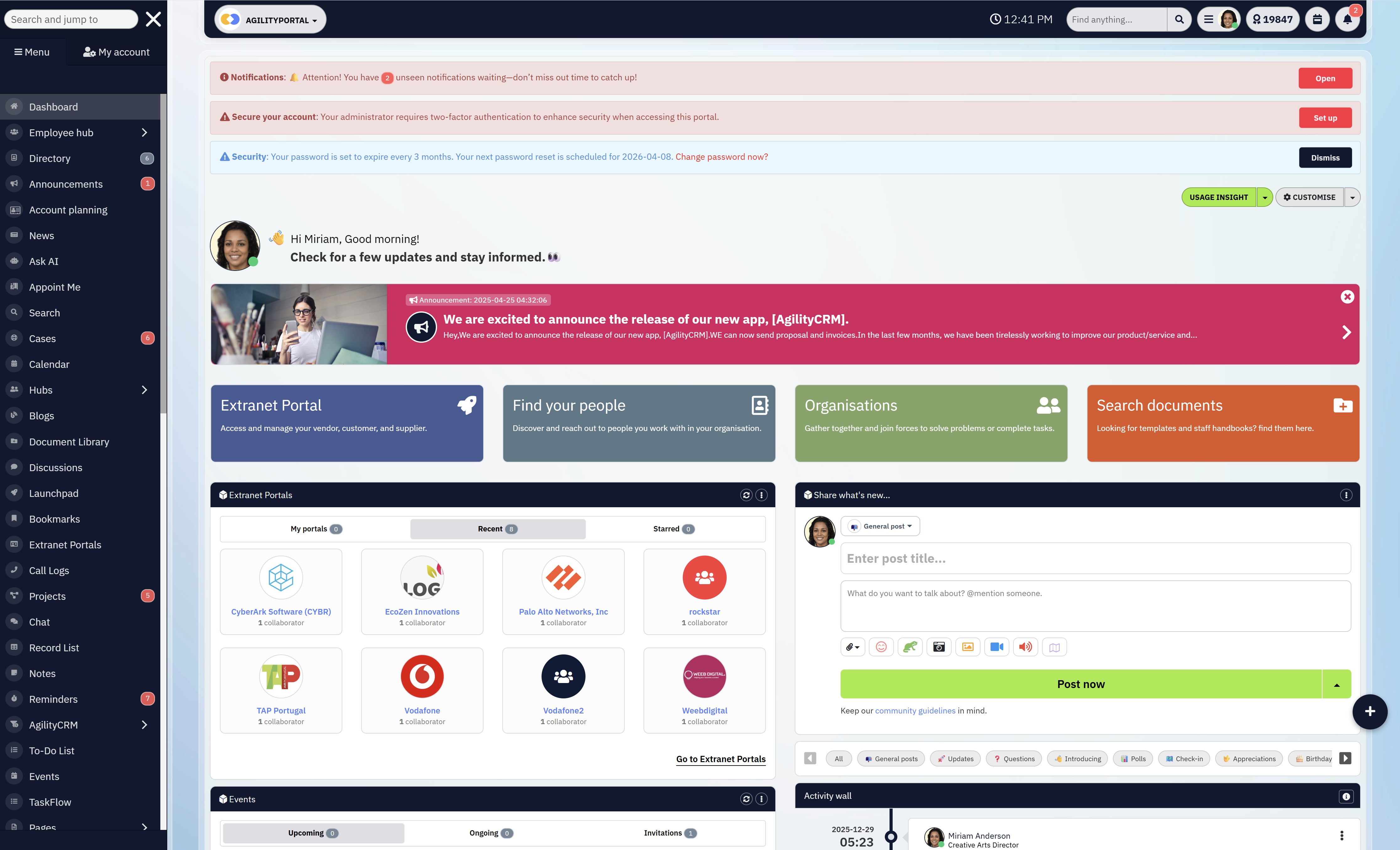
Must-Have Capabilities in Modern Internal Comms Tools (No Exceptions)
By the time teams start evaluating internal comms tools seriously, they're usually done experimenting.
- They don't want "nice-to-haves."
- They don't want another pilot that goes nowhere.
- They want something that actually fixes the mess.
So let's be clear about what must be there in 2026 — not features for a sales page, but capabilities that solve real operational problems.
Why Internal Comms Platforms Fill the Gap
Internal comms platforms exist because email, chat, and intranets all fail in different ways — and modern organisations need something none of them provide on their own.
A dedicated internal comms platform creates a system of record for communication.
Messages are targeted, visible, persistent, and measurable. Employees know where to look for important updates. Leaders know what landed, what didn't, and where follow-up is needed.
This isn't about replacing every tool. It's about giving communication a clear home — one that reduces noise instead of adding to it.
When organisations make this shift, internal communication stops being reactive and fragmented. It becomes intentional, reliable, and scalable — which is exactly what modern workplaces need.
A Centralised Communication Hub (Not Just Another Channel)
First things first: modern internal comms tools need to act as a single source of truth.
That doesn't mean replacing every system your organisation already uses. It means having one central communication layer where important updates live, don't get buried, and can be found later.
If employees still have to guess whether something was shared in email, chat, a document, or a meeting recap, you haven't fixed anything — you've just added another place to check.
A real internal comms platform reduces fragmentation. It doesn't contribute to it.
Targeted Messaging, Not "Send to Everyone"
Broadcasting everything to everyone is one of the fastest ways to create noise.
Modern platforms support audience segmentation — messaging by role, department, location, shift, or team. This is basic table stakes now, not advanced functionality.
Targeted communication improves relevance, reduces overload, and increases trust. When people know messages are meant for them, they pay attention. When everything is global, nothing feels important.
This is how you move from volume to value.
Read Receipts, Acknowledgements, and Engagement Analytics
This is where many tools quietly fall apart.
Sending a message is not the same as communicating.
Buyers increasingly expect delivery confirmation, read status, and acknowledgement tracking — especially for policy updates, safety notices, or operational changes.
Industry-standard internal comms platforms provide engagement analytics that answer real questions:
- Who received this?
- Who read it?
- Who acknowledged it?
- Who didn't?
Without this, leadership is guessing — and guessing doesn't scale.
Mobile-First Access for Frontline and Deskless Workers
If your internal comms tool only works well on a desktop, it's already obsolete.
Frontline employees, field teams, and shift workers rely on mobile access. That means mobile-first design, not a stripped-down afterthought.
Push notifications, offline access, simple authentication, and fast load times aren't "nice UX touches." They're essential for reach and adoption in modern organisations.
If frontline workers are excluded, engagement numbers will always lie.
Integration with Existing Systems (Without Chaos)
Buyers don't want a rip-and-replace scenario. They want platform interoperability.
That means clean integrations with:
- Identity providers (SSO)
- HR systems
- Document management tools
- Email and calendar platforms
- Collaboration tools already in use
The goal is consolidation at the communication layer, not disruption across the entire stack.
Good internal comms tools sit on top of your ecosystem and make it usable — they don't force a rebuild.
Governance, Permissions, and Compliance Controls
As internal communication becomes more measurable and more central, governance matters.
Modern platforms include:
- Role-based access control (RBAC)
- Content approval workflows
- Audit trails
- Data retention policies
- Compliance-ready permissions
This isn't about bureaucracy — it's about trust, accountability, and protecting the organisation as communication scales.
When everyone can post anything, anywhere, without oversight, confidence erodes quickly.
If a tool doesn't do these things, it's not an internal comms platform — it's noise.
And most organisations already have enough noise.
Read this article: : Top 6 AI-Powered Project Management Tools To Use In 2023
Internal Comms Tools That Fail (And Why It's Not Really Their Fault)
Here's the uncomfortable truth most teams eventually run into:
A lot of internal comms tools don't fail because they're bad tools.
They fail because they're being used for the wrong job.
When communication breaks down, organisations often blame adoption, culture, or "people not engaging."
In reality, the problem is usually a tool–use-case mismatch.
Let's break down where things go wrong.
Why Chat-First Tools Fail at Internal Communication
Chat tools are great for fast conversations. They're terrible for structured communication.
In chat-first environments, messages are:
- Time-bound instead of persistent
- Buried quickly by newer conversations
- Hard to resurface days or weeks later
Important updates get lost in a stream of reactions, side conversations, and notifications.
Even when something is posted in the "right channel," there's no guarantee the right people see it — or remember it.
Chat tools optimise for speed, not clarity. They work well for coordination between small groups, but they struggle when communication needs to be deliberate, visible, and auditable.
That's why leadership often assumes something was communicated, while employees insist they never saw it. Both can be technically right — and that's the problem.
Why Document Repositories Fail Engagement
Document repositories are excellent for storage.
They are not communication tools.
Uploading a policy, update, or announcement to a shared drive assumes people will:
- Know it exists
- Know where to find it
- Decide to open it
In practice, none of that reliably happens.
Documents don't create urgency. They don't prompt action. They don't tell you who's seen what. Over time, repositories turn into static libraries that employees visit only when forced to.
Engagement doesn't fail because people hate documents — it fails because passive content doesn't compete with daily work.
Why Email Fails at Scale and Visibility
Email feels safe because it's familiar. But at scale, it's one of the least effective internal comms channels.
Inbox fatigue is real. Important updates sit next to newsletters, meeting invites, and external noise. People triage, skim, and delete.
More importantly, email offers almost no reliable visibility. You can't confidently answer:
- Who actually read this?
- Who ignored it?
- Who misunderstood it?
Once organisations grow beyond a certain size — or operate across shifts, locations, or time zones — email becomes a guessing game. And guessing is not a strategy.
Why Tool Overload Kills Adoption Entirely
This is where everything collapses.
When employees are expected to monitor:
- Chat apps
- Intranets
- Shared drives
- Project tools
- Plus unofficial workarounds
They stop trying.
Tool overload creates cognitive fatigue. People disengage not because they don't care, but because they don't know where to look anymore. Every new platform promises clarity and delivers another login.
Adoption drops, trust erodes, and internal communication becomes background noise.
At that point, adding another tool — even a good one — just makes the problem worse unless consolidation is part of the plan.
These tools aren't broken — they're just being used outside their strengths.
Internal communication requires persistence, visibility, targeting, and proof. When organisations rely on tools designed for conversation, storage, or broadcasting alone, failure is inevitable.
And once trust in internal communication is lost, it's incredibly hard to get back.
What High-Performing Organisations Do Differently
High-performing organisations don't communicate more.
They communicate deliberately.
They've learned — often the hard way — that internal communication isn't a soft skill or a side function.
It's operational infrastructure. And they treat it that way.
Here's what they do differently.
They Consolidate, Not Stack Tools
The first move high-performing teams make is consolidation.
Instead of piling new tools on top of old ones, they reduce the number of places employees need to check.
They understand that every extra channel adds friction, confusion, and cognitive load.
This doesn't mean ripping everything out.
It means choosing one core platform where critical communication lives — and making everything else secondary.
The result?
Less noise. More clarity. And far fewer "I didn't see that" moments.
They Design Communication Around How Employees Actually Work
Average organisations design comms around org charts and tools.
High-performing ones design comms around real work patterns.
They consider:
- Shift-based schedules
- Frontline vs desk-based roles
- Time zones and locations
- Mobile vs desktop access
They stop assuming everyone sits at a laptop checking email all day.
Communication is delivered in ways that fit naturally into employees' routines — not as interruptions, but as part of the workflow.
When communication aligns with how people work, engagement stops being forced. It becomes automatic.
They Measure Communication Effectiveness, Not Just Activity
Sending a message is not a metric.
High-performing organisations track communication effectiveness, not output. They want to know what actually happened after a message was sent.
They measure:
- Reach and visibility
- Read and acknowledgement rates
- Engagement over time
- Drop-off points
This data turns internal comms from guesswork into something measurable and improvable.
It also changes behaviour — because when leaders know communication is being measured, clarity improves fast.
They Treat Internal Comms as Infrastructure, Not Announcements
This is the biggest mindset shift.
Internal communication isn't just about announcements, updates, or leadership messages.
It's the system that supports:
- Change management
- Policy rollout
- Operational consistency
- Culture and trust
High-performing organisations build internal comms the same way they build IT or finance systems — with structure, governance, and long-term thinking.
They don't ask, "Did we send it?"
They ask, "Did it land — and did it work?"
The Operational Payoff Is Real
This approach isn't theoretical. It produces very real outcomes:
- Faster change adoption because people actually understand what's changing and why
- Fewer mistakes because instructions and updates aren't missed or misinterpreted
- Higher engagement because communication feels relevant and two-way
- Lower attrition because employees feel informed, included, and aligned
In short, strong internal communication reduces friction everywhere else.
And once organisations experience this level of clarity, they don't go back — because the cost of poor communication becomes painfully obvious.
How to Choose the Right Internal Comms Tool (A Buyer's Framework That Works)
Once teams get serious about fixing internal communication, the question isn't "Which tool has the most features?"
It's "Which platform will actually work in our organisation — now and a year from now?"
High-intent buyers tend to ask the same core questions. If a vendor can't answer these clearly, that's a red flag.
1. Who Owns Internal Comms in Your Organisation?
This sounds simple, but it's where many rollouts fail.
Is internal communication owned by HR? Internal Comms? Operations? IT? Leadership?
Or is it shared — and therefore owned by no one?
The right internal comms tool must support multiple stakeholders without turning into a governance nightmare. HR needs engagement insights.
Ops needs execution and consistency. Leadership needs visibility and trust.
If a platform only works for one department, it won't scale — politically or operationally.
2. Who Actually Needs to Receive Messages?
This is where buyer intent sharpens.
Ask yourself:
- Is this for office-based teams only?
- Does it include frontline, deskless, or shift workers?
- What about contractors, partners, or temporary staff?
Many tools look great in demos but quietly exclude large parts of the workforce. If people don't have reliable access — especially on mobile — engagement data becomes meaningless.
The right platform makes audience targeting and inclusive reach non-negotiable, not optional add-ons.
3. What Must Be Tracked and Proven?
This is the turning point for most buyers.
Modern internal comms isn't just about publishing content — it's about proof.
You should be able to answer:
- Who received this message?
- Who read or acknowledged it?
- Who didn't?
- Where did engagement drop off?
If a tool can't give you defensible answers to these questions, it puts leaders back into guesswork mode. And guesswork doesn't survive audits, compliance reviews, or board-level scrutiny.
Buyers increasingly choose platforms that make communication measurable by default, not as an afterthought.
4. What Happens When People Don't Engage?
This is where most tools go silent.
If a critical update is ignored, missed, or misunderstood, what happens next?
Does the system surface that risk — or does it shrug?
Strong internal comms platforms don't just report low engagement.
They enable action:
- Follow-ups
- Targeted reminders
- Escalation paths
- Feedback collection
If non-engagement has no visibility and no consequence, communication remains optional — and optional communication always fails.
5. Will This Still Work in 12–24 Months?
Finally, buyers need to think beyond today's problems.
Ask:
- Will this scale as headcount grows?
- Can it handle more locations, teams, or use cases?
- Will it reduce tools over time — or add another one?
The best internal comms platforms act as a foundation, not a temporary fix. They grow with the organisation, absorb more use cases, and reduce fragmentation over time.
If adopting a tool creates another silo, you'll be back here again in a year.
The right internal comms tool isn't the loudest or the flashiest — it's the one that brings structure, visibility, and accountability to communication at scale.
And that's exactly why more organisations are moving toward platform-style internal comms solutions instead of disconnected apps. They don't just send messages — they make communication work.
The 2026 Internal Comms Stack: What to Consolidate (And What to Stop Expecting)
By 2026, most organisations aren't asking "Which tool should we add?"
They're asking "Which tools can we finally stop relying on for the wrong things?"
That mindset change matters — because the future of internal communication isn't about replacing everything.
It's about putting each tool back in its proper role.
Why Organisations Are Moving Toward One Core Platform
High-performing organisations are converging on a simple truth:
internal communication needs a system of record.
Not another channel.
Not another inbox.
A place where important communication lives, persists, and can be proven.
When communication is scattered, no one can confidently say:
- What the latest message was
- Who saw it
- What version is correct
- Or whether action was taken
That's why organisations are moving toward one core internal comms platform — a central layer that sits above chat, email, and documents and brings structure to all of them.
This isn't about control for control's sake. It's about reducing ambiguity. When employees know where to look for important updates, trust and adoption follow naturally.
Where Chat, Email, and Documents Still Fit (Yes, They Still Matter)
This is where a lot of confusion creeps in.
The move toward a core platform doesn't mean chat, email, or documents disappear. It means they stop being misused.
- Chat stays great for quick questions, coordination, and real-time collaboration
- Email remains useful for external communication and formal notices
- Documents are still essential for reference, policies, and deep content
What changes is expectation.
None of these tools are good at being the source of truth for internal communication. They weren't designed to provide visibility, accountability, or long-term clarity — and forcing them into that role is what caused the mess in the first place.
In 2026, organisations are finally letting tools do what they're good at — and nothing more.
Why Internal Comms Needs Its Own System of Record
This is the real shift.
Internal communication is now recognised as business-critical infrastructure, on par with HR systems, finance platforms, and CRM tools.
And like any critical system, it needs:
- Persistence
- Governance
- Measurement
- Accountability
A dedicated internal comms system of record allows organisations to:
- Centralise critical updates
- Control audience targeting
- Track engagement and acknowledgement
- Close feedback loops
- Prove communication effectiveness over time
Without this, leaders are left piecing together signals from tools that were never designed to answer strategic questions.
And once organisations adopt a proper system of record for internal comms, something interesting happens — communication stops being reactive. It becomes intentional.
This Is a Strategy Shift, Not a Tool Swap
The organisations getting this right aren't chasing trends. They're redesigning how communication works across the business.
They stop asking:
"What's the next tool we should try?"
And start asking:
"What's the one place communication should live — and how do other tools support it?"
That shift reduces noise, improves engagement, and creates clarity that scales. It also future-proofs the organisation as teams grow more distributed, more mobile, and more overloaded with information.
Because in 2026, the biggest risk isn't choosing the wrong tool.
It's continuing without a clear communication foundation at all.
7 Best Employee Communication Software Options for 2026
| Platform | AI-Driven Personalization | Automated Audience Segmentation | Behavioral Targeting | Multichannel Personalization | Real-Time Customization |
|---|---|---|---|---|---|
| AgilityPortal | ✔ Advanced | ✔ Role, location, behaviour | ✔ Engagement-based | ✔ Web, mobile, notifications | ✔ Yes |
| Staffbase | ✔ Limited | ✔ Predefined groups | ✖ | ✔ Email, app | ◐ Partial |
| Workvivo | ✔ Basic | ✔ Team-based | ✖ | ✔ App-first | ◐ Limited |
| Simpplr | ✔ Strong | ✔ Attribute-based | ◐ Limited | ✔ Web, mobile | ◐ Partial |
| MangoApps | ◐ Emerging | ✔ Department-based | ✖ | ✔ Email, web, app | ✖ |
| Microsoft Viva Engage | ✔ Limited | ✔ Microsoft groups | ✖ | ✔ Teams-centric | ✖ |
| Firstup | ✔ Strong | ✔ Dynamic | ✔ Rules-based | ✔ Email, app, SMS |
Why Teams Choose AgilityPortal for Internal Communication
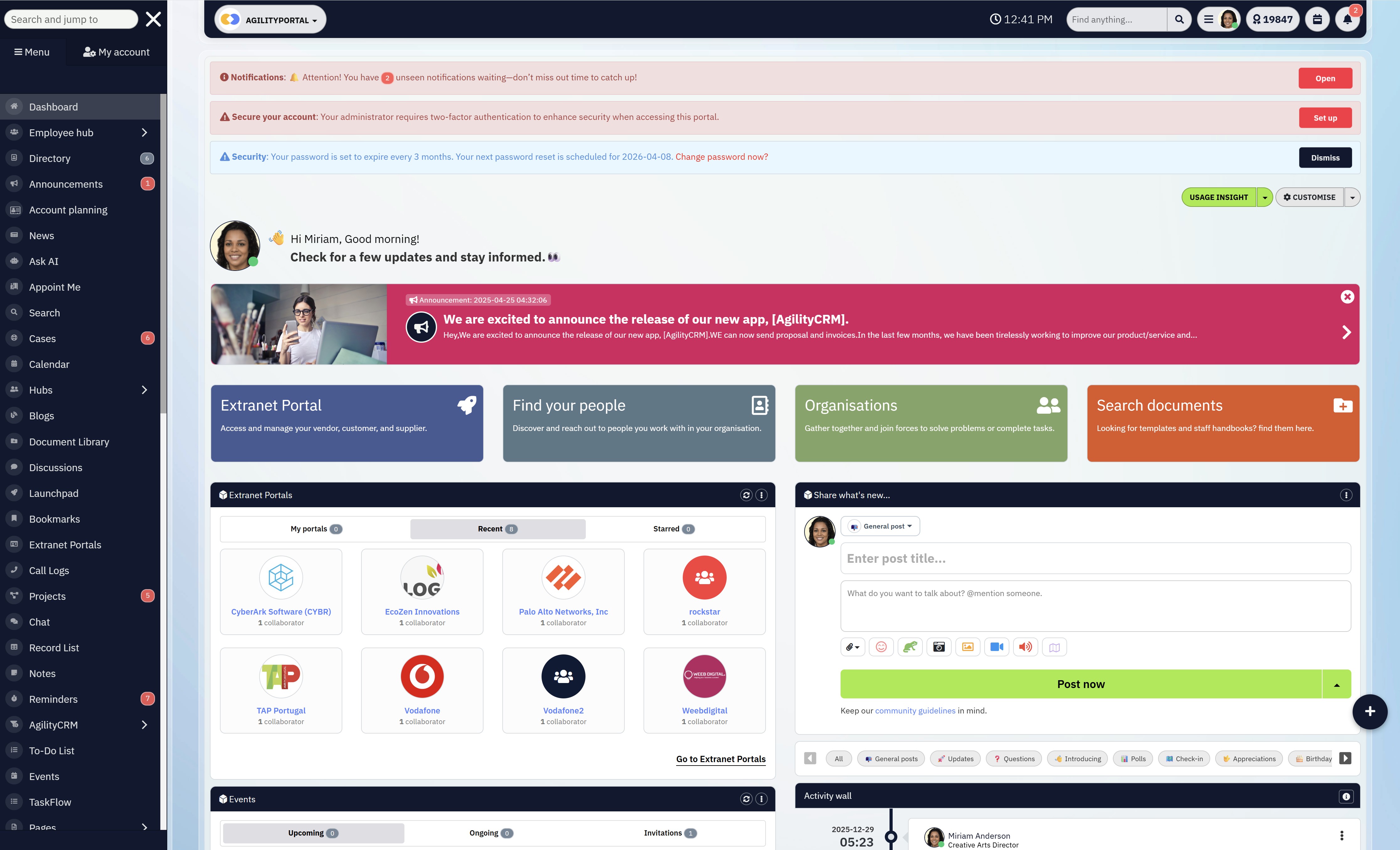
Most internal comms tools promise better communication.
AgilityPortal is built to prove it's actually happening.
AgilityPortal is a modern internal communication platform designed to replace fragmented emails, noisy chat channels, and underused intranets with one clear, trusted hub.
It gives organisations a single place to deliver critical updates, engage employees, and measure communication effectiveness — without adding another disconnected tool.
Unlike basic team communication tools, AgilityPortal is purpose-built for reach, adoption, and accountability.
Messages are targeted, visible, and trackable, so leaders know exactly who received an update, who engaged with it, and where follow-up is needed. No more guessing. No more "we sent the email."
AgilityPortal has transformed the way we communicate with our 6,000-strong workforce, many of whom are traditionally hard to reach. The difference has been especially clear during critical periods, allowing us to share urgent, time-sensitive information quickly and reliably with staff wherever they are across the county.
William Hackett - Communications & Engagement Lead, Dyson
Built for Real Organisations, Not Ideal Scenarios
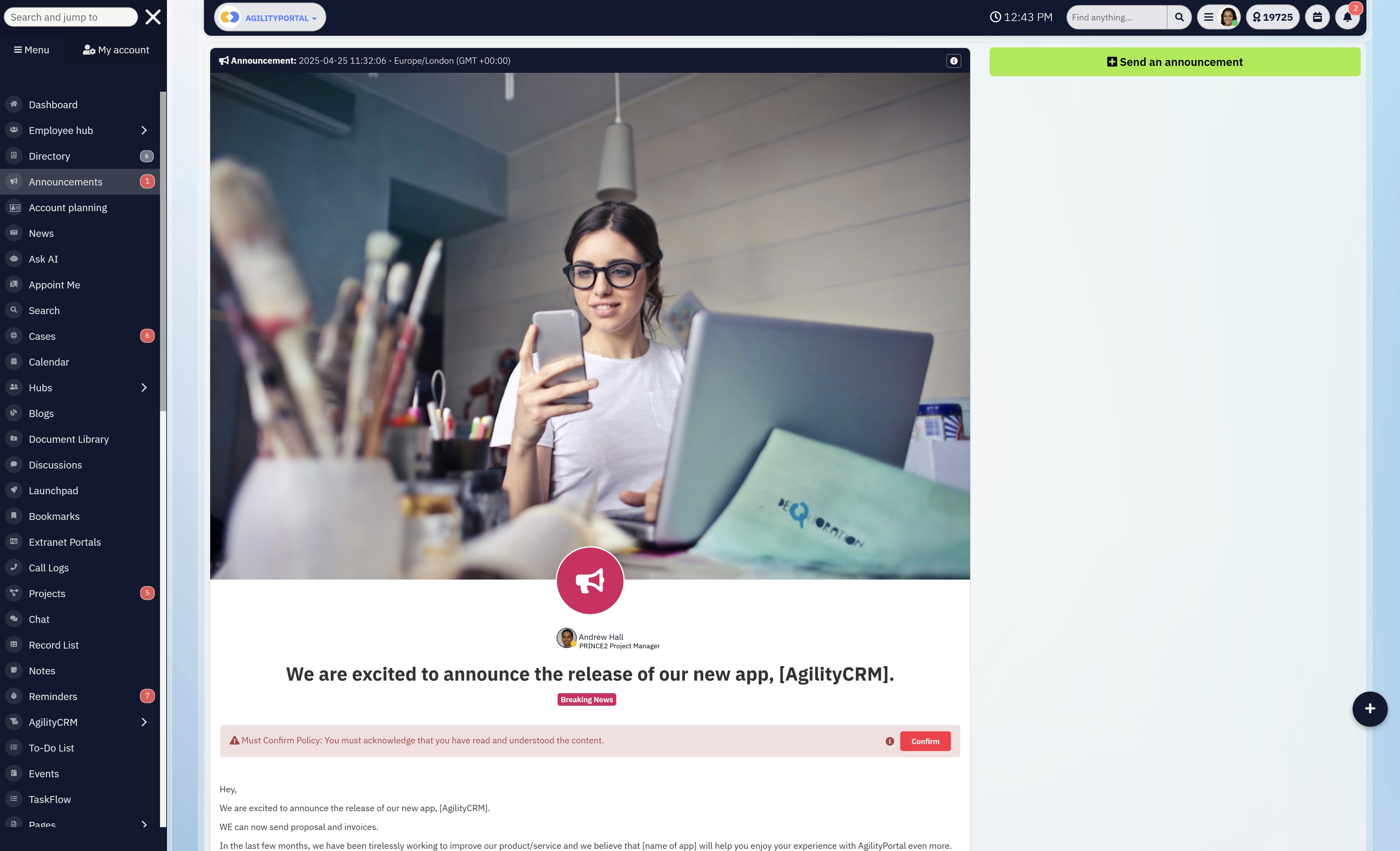
AgilityPortal works for:
- Hybrid and remote teams
- Frontline and deskless employees
- HR, Internal Comms, and Operations leaders
With mobile-first access, role-based targeting, read acknowledgements, feedback loops, and built-in analytics, AgilityPortal turns internal communication into something you can manage — not chase.
It also integrates cleanly with the tools you already use, so you can consolidate communication without ripping everything out.
The Outcome: Clarity Instead of Noise
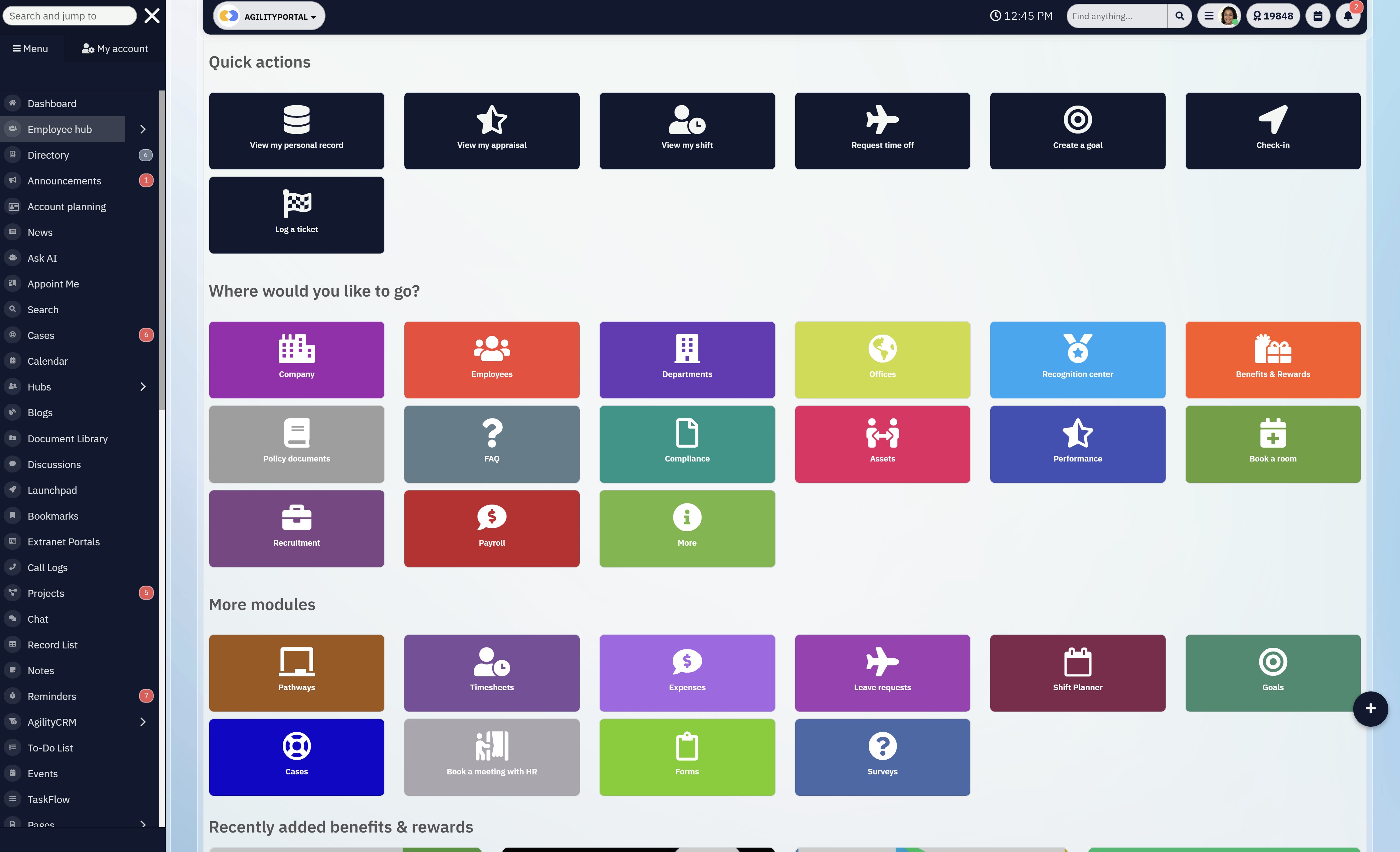
Teams using AgilityPortal reduce communication overload, improve engagement, and gain real visibility into what's working. Internal communication stops being a black box and starts behaving like infrastructure — reliable, measurable, and scalable.
If your organisation is ready to move beyond fragmented internal comms tools and adopt a platform people actually use, AgilityPortal gives you a clear path forward.
See how modern teams centralise internal communication with AgilityPortal.
Final Takeaway - This Is a Business Decision Now
Internal communication isn't failing because employees don't care.
It's failing because organisations keep using the wrong tools for the job — and hoping effort will make up for structural gaps. It won't. In modern workplaces, good intentions don't survive information overload, fragmented channels, and invisible engagement.
By 2026, internal comms tools are no longer optional support systems.
They are business-critical infrastructure. They influence execution, safety, compliance, engagement, and trust. When communication works, everything else gets easier. When it doesn't, problems multiply quietly until they become expensive.
Buyers who get this right are prioritising three things above all else: reach, adoption, and proof. Reach means every employee — including frontline and remote workers — actually receives critical information.
Adoption means people use the platform without being chased. Proof means leaders can demonstrate, with confidence, that communication happened and had impact.
The right internal comms platform replaces chaos with clarity. It reduces noise instead of adding to it. It creates a single place employees trust for important updates. And it gives leadership visibility instead of assumptions.
At this point, the real risk isn't choosing the wrong tool.
The real risk is continuing to rely on systems that were never designed to make communication work — and paying the price in disengagement, confusion, and missed execution.
That's the decision modern organisations need to make now.
Frequently Asked Questions About Internal Comms Tools
What are some internal communication tools examples used in modern organisations?
Common internal communication tools examples include company-wide announcement platforms, employee hubs, intranet software, mobile workforce apps, internal comms email platforms, and engagement-focused tools that support feedback and analytics.
In practice, most organisations use a mix of tools — the challenge is ensuring they work together instead of creating noise.
Can you provide a list of communication tools with examples?
A practical list of communication tools with examples typically includes:
- Internal comms email platforms for formal updates
- Chat and messaging tools for real-time collaboration
- Intranet or digital workplace platforms for centralised communication
- Mobile apps for frontline and deskless workers
- Feedback and survey tools to support two-way communication
The key is not how many tools you use, but whether employees know where to look for critical information.
How are internal communication tools used in an organization?
Internal communication tools in an organization are used to share updates, align teams, support change initiatives, distribute policies, gather feedback, and reinforce culture.
When implemented correctly, they act as a single source of truth rather than disconnected channels competing for attention.
What are the best internal communication platforms in 2026?
The best internal communication platforms are those that combine targeted messaging, engagement tracking, mobile access, and governance in one place.
Buyers increasingly look for consolidation instead of standalone tools, which is why many organisations are replacing fragmented stacks with modern internal comms platforms.
Are internal comms email platforms still relevant?
Yes — but only for specific use cases.
Internal comms email platforms still work well for formal notices and external-facing communication. However, they are rarely effective on their own for engagement, visibility, or two-way communication at scale.
What are some internal comms tools examples companies commonly evaluate?
Typical internal comms tools examples include digital workplace platforms, employee engagement tools, intranet solutions, recognition-focused products like Nectar internal comms tools, and survey-based feedback systems.
Buyers now evaluate tools based on reach, adoption, and measurable impact — not just features.
Is there a reliable list of internal comms tools?
There is no single universal list of internal comms tools because needs vary by organisation size, workforce type, and industry.
However, most evaluations include platforms for announcements, collaboration, feedback, and analytics.
Many buyers also look for an internal comms tools PDF or buyer guide during the research phase to compare options offline.
What are common internal barriers of communication examples?
Typical internal barriers of communication examples include information overload, unclear messaging, inconsistent leadership communication, siloed departments, and lack of feedback loops.
These barriers often grow as organisations scale and add more tools without a clear strategy.
What are common communication challenges examples in workplaces?
Common communication challenges examples include missed updates, conflicting messages, low engagement, frontline workers being excluded, and leadership assuming communication happened when it didn't.
These are also some of the most common internal challenges examples organisations try to solve with modern internal comms tools.
What are the common causes of problems in internal communications?
When buyers ask what are the common causes of problems in internal communications, the answer is usually structural:
- Too many channels
- No clear ownership
- One-way communication
- Lack of measurement
- Poor alignment between teams
Technology alone doesn't fix this — but the wrong technology makes it worse.
Can you share real life examples of poor communication in the workplace?
Yes.
Real life examples of poor communication in the workplace include safety updates missed by frontline staff, policy changes buried in email, teams working from outdated documents, and employees hearing critical news externally before internally.
These failures are rarely intentional — they're systemic.
Do you have a short case study on communication skills?
A simple short case study on communication skills often shows that when organisations introduce clear messaging, feedback loops, and visibility into engagement, confusion drops and execution improves.
The biggest gains usually come from consistency and clarity, not more messaging.
Can you provide a case study on communication with questions and answers?
A typical case study on communication with questions and answers explores:
- What problem the organisation faced
- Which internal comms tools were used
- How engagement and understanding were measured
- What changed after implementation
These case studies consistently show that structured internal communication outperforms ad-hoc messaging.
Which companies have the best internal communication practices?
Companies with best internal communication practices share a few traits: they consolidate tools, prioritise two-way communication, measure engagement, and treat internal comms as business infrastructure — not just announcements.
Industry leaders invest as much in communication systems as they do in operational systems.
Most Popular Posts

Effective communication among team members is vital for the productivity and success of any organization. Surprisingly, 60% of companies lack a long-term internal communication strategy, which p...


Businesses thrive on communication for efficiency, productivity and accomplishment. When the right information is passed from the right designation in the organization, it promotes positivity an...

Categories
Blog
(3224)
Business Management
(396)
Employee Engagement
(235)
Digital Transformation
(220)
Growth
(150)
Intranets
(142)
Internal communications
(109)
Remote Work
(68)
Sales
(53)
Collaboration
(53)
Customer Experience
(33)
Culture
(30)
Knowledge Management
(29)
Project management
(29)
Leadership
(20)
Comparisons
(9)
News
(1)

Related Posts

AI for personal injury law firms is becoming part of everyday casework. These tools can help teams sort through medical records, build timelines, draft demand packages and find details buried in a big case file. That could free up attorneys and...

Ever left an online meeting unsure what was decided—and wondered how to run an effective meeting without wasting everyone's time? A call can bring a distributed team together quickly, but when it starts late, includes people who don't know why ...

Where can I send a fax from in my area when a document needs to go out today? The answer might be a nearby print or shipping shop, a library or an online fax service, but what's available depends on your location. The UPS Store lists a ne...

AI in internal communications can help a small team turn one important update into useful messages, answers and resources for employees—but only when the information is accurate and a person checks the result. Comms teams are expected to keep p...

How is Edge AI changing business operations in 2026, and when does it make sense to process data near where it is created instead of sending it all to the cloud? The investment forecasts point to growing interest: Capgemini Research Institute's...


Jill Romford
I am a digital nomad, lover of exploring new places and making friends.
I love to travel and I love the internet. I take pictures of my travels and share them on the internet using Instagram.
Traveler, entrepreneur, and community builder. I share my insights on digital marketing and social media while inspiring you to live your fullest life.
Ready to learn more? 👍
One platform to optimize, manage and track all of your teams. Your new digital workplace is a click away. 🚀
Free for 14 days, no credit card required.