
Insight Blog
Agility’s perspectives on transforming the employee's experience throughout remote transformation using connected enterprise tools.
37 minutes reading time
(7496 words)
Featured
Internal Communications Strategy: How to Use an Online Platform for Communication in the Workplace (2026 Guide)

Internal Communications Strategy: How to Use an Online Platform for Communication in the Workplace (2026 Guide)
A practical guide for Ops and IT leaders on building an internal communications strategy using an online platform for communication that teams actually adopt.
Internal Communications Strategy: How to Use an Online Platform for Communication in the Workplace (2026 Guide)

Let's be honest for a second.
Most internal communication problems don't exist because employees "don't pay attention" or because managers aren't sending enough updates.
That's the lazy explanation.
The real issue is structural — and it's quietly costing organisations far more than most leaders realise.
Here's a stat that should stop you mid-scroll:
Not wasted on social media.
Not spent slacking off. Lost inside systems that were supposed to make work easier.
Critical productivity loss hiding in plain sight
Industry research shows that employees lose an average of 9.3 hours per week simply trying to find information or clarify internal messages — that’s over 20% of the working week gone. Not wasted on social media. Not spent slacking off. Lost inside systems that were supposed to make work easier.
Operational impact: delayed execution, duplicated effort, and constant clarification loops that quietly drain Ops and IT capacity.
That number is higher than most productivity loss estimates you'll see quoted, and it hits Ops and IT teams hardest.
Why? Because fragmented tools, email overload, and unofficial "shadow IT" channels turn communication into noise instead of signal.
Important updates get buried. Decisions lack context. Teams work off different versions of the truth.
The irony is that many organisations already own enough tools to communicate effectively. The failure isn't tooling — it's the absence of a clear internal communications strategy tied to how work actually gets done.
Without that strategy, even the best online platform for communication becomes just another place people are told to check and quickly forget.
In 2026, Ops and IT buyers aren't looking for louder megaphones.
They want fewer systems, clearer ownership, predictable communication patterns, and proof that people are actually absorbing and acting on what's shared. Adoption, not activity, is the real KPI.
This guide is built for that reality.
We'll walk through why internal communication breaks as organisations scale, how to design a strategy that supports execution (not just awareness), and where a modern platform genuinely fits — without adding complexity or tool sprawl.
The goal isn't more communication. It's communication that actually moves work forward.
● Key Takeaways
- Internal communication breaks down at scale not because of people, but because systems lack structure, ownership, and predictability.
- Employees lose significant productive time searching for information when communication is fragmented across tools and channels.
- An internal communications strategy should prioritise execution, clarity, and accountability — not message volume.
- Online platforms are effective only when they act as infrastructure, centralising context, decisions, and responsibility.
- Predictable cadence and clear targeting reduce noise and improve trust far more than frequent broadcasts.
- Meaningful success shows up in fewer clarification loops, faster decisions, and less reliance on email and meetings.
Read this article: : Top 6 AI-Powered Project Management Tools To Use In 2023
What an Internal Communications Strategy Really Means Today

What an Internal Communications Strategy Really Means Today
Let's clear something up early, because this is where most organisations go wrong.
An internal communications strategy is not about sending more messages.
It's not about adding more channels.
And it's definitely not about "keeping people informed" in the abstract.
That thinking belongs to a different era.
Here's a stat most leadership teams never see coming:
Research shows that nearly 1 in 4 employees admit they actively ignore internal messages they believe are “not actionable” — even when those messages come from leadership.
Why it matters: if messages don’t clearly lead to action, attention drops fast — and critical updates get treated like background noise.
That's not an attention problem. That's a strategy problem.
A modern internal communications strategy is about enabling execution, not broadcasting updates.
It answers three uncomfortable questions upfront:
- What decisions should this communication support?
- What action should follow — immediately or later?
- Who is accountable if nothing happens?
When communication doesn't clearly connect to work, people tune it out.
Ops teams see this as missed deadlines and duplicated effort. IT sees it as tool sprawl, workarounds, and "Why didn't anyone follow the process?" conversations. Same root cause. Different symptoms.
Today, strategy means deliberately connecting people, processes, and decisions — so information arrives with context, timing, and ownership. It means fewer messages, not more.
Fewer tools, not more. And far less ambiguity about what matters right now.
This is also why internal communication can no longer sit in a single department.
Comms may shape the message, but Ops understands execution, and IT controls the systems that carry it. When those three don't co-own the strategy, communication becomes theatre — it looks busy, but nothing moves.
A real strategy makes communication predictable, purposeful, and operationally useful. Anything else is just noise with a nicer template.
Related Guides You May Want to Read Next
If you’re building internal comms that people actually follow (not just read), these guides go deeper into strategy, tools, templates, and real-world execution across teams and industries.
- The Internal Comms Calendar Most Teams Get Wrong (Steal This Step-by-Step Template)
- Internal Communications Strategy Examples: How Ops & IT Leaders Fix Broken Remote Communication Tools
- Best Practices to Make Your Internal Communication Strategy a Success
- Internal Communications Solutions for Distributed Teams That Bypass Email
- What Is Organizational Communication and Key Strategies Explained
- The Importance of Internal Communication for Employee Productivity
- What Is Employee Communication? A Complete Updated Guide
- What Are the Biggest Hurdles in Improving Internal Communications?
- HR Communication Plan Template: Strategies, Templates & Examples
- Communication Software: How It’s Transforming Healthcare Teams
- 10 Best Communication Tools Every Business Needs
- Top Internal Communication Tools to Enhance Employee Engagement
The Role of an Online Platform in a Modern Communication Strategy

The Role of an Online Platform in a Modern Communication Strategy
If you're leading Ops or IT, you've probably seen this movie before: a department buys a new tool to "fix communication," adoption spikes for two weeks, then everyone drifts back to email, WhatsApp, Teams chats, or whatever feels fastest in the moment.
Not because the tool is bad — because the organisation never built a system around it.
That's exactly why point solutions fail at scale.
They solve one slice of the problem (broadcast messages, chat, newsletters, updates), but they don't solve the real issue: communication without context and ownership becomes noise.
And when people are under pressure, they default to whatever channel gets the quickest response, even if it creates long-term mess.
This is where an online platform matters — not as "another app," but as infrastructure.
The job of a platform is to centralise the three things internal communication usually lacks:
- Messages (so people aren't hunting across five places to find the latest update)
- Context (so updates are attached to the project, policy, customer, site, or incident they relate to)
- Ownership (so it's obvious who's responsible, what's changed, and what action is expected)
When you get those three right, you stop relying on memory and luck.
People don't have to guess where to look, or which version is real, or whether a decision is final.
Now, here's the part most organisations underestimate: platform sprawl is not "flexibility." It's chaos with a friendly label. When every team has its own toolset, you don't get innovation — you get fragmentation.
Updates go out, but they don't land consistently.
The same information gets re-posted in different places, slightly differently, and suddenly nobody trusts any of it. That's when your digital workplace turns into a game of telephone.
The best online communication platforms avoid that by giving teams autonomy inside boundaries. You can still let departments run their own channels, spaces, or hubs — but within a shared structure that makes information easy to find, decisions easy to track, and responsibility impossible to dodge.
So the platform isn't the strategy. It's the delivery system.
A good one protects consistency across the organisation while still letting teams move fast locally. That's how you scale communication without turning it into bureaucracy.
Common Failure Patterns in Large Organisations (and Why They Repeat)
This is the part where most organisations realise the problem isn't people — it's patterns.
The same mistakes show up again and again, regardless of industry, headcount, or budget. Different logos. Same outcomes.
Let's break them down properly.

Communication Overload With No Prioritisation
Most employees aren't under-informed.
They're overwhelmed.
Here's a stat that usually lands hard with leadership teams:
That means people aren't missing messages because they're careless. They're filtering aggressively just to survive the day.
When everything is marked "important," nothing is. Without clear prioritisation, urgency signals collapse.
Critical updates get treated the same as FYI posts, and eventually people stop trying to tell the difference.
Tools Chosen by Departments, Not Architecture
This one quietly destroys scale.
Teams pick tools that work locally — marketing chooses one platform, operations another, HR another — all with good intentions.
But no one steps back and asks how those tools fit into a coherent communication architecture.
The result?
- Information lives in silos
- Updates get duplicated (and contradicted)
- IT ends up supporting tools it never approved
What looks like agility at team level becomes fragility at organisational level.
Communication stops flowing through the business and starts bouncing between disconnected systems.
Low Adoption Disguised as "Change Resistance"
This is the most dangerous myth.
When employees don't use a communication tool, it's often labelled as resistance, culture, or lack of training.
But here's the uncomfortable truth:
Tool abandonment isn’t a usability problem
Research consistently shows that over 60% of employees abandon internal tools because they don’t see a clear connection between the platform and their day-to-day work — not because the tool is hard to use.
What this signals: adoption fails when platforms feel optional, disconnected, or irrelevant to real execution.
If a message doesn't help someone do their job faster, better, or with less risk, it won't survive the first busy week. No amount of onboarding fixes that.
Adoption fails when tools are introduced without purpose, ownership, or workflow alignment.
Read this article: : Top 6 AI-Powered Project Management Tools To Use In 2023
Why Most Internal Comms Initiatives Stall After Launch
Launch day always looks good.
Six months later? Silence.
That's because many initiatives are treated as projects instead of systems. There's energy upfront, but no operating model behind it. No cadence. No accountability. No clear rules for what belongs where.
Once the initial push fades, behaviour drifts back to old habits — email chains, side chats, and undocumented decisions. The platform is still there, but it's no longer trusted as the source of truth.
And once trust is gone, recovery is brutally hard.
The common thread across all these failures is simple: communication wasn't designed as infrastructure.
It was treated as content, tools, or announcements. Large organisations don't fail at internal comms because they lack effort — they fail because they lack structure.
That's exactly what the next sections will address.
Strategy First, Platform Second: The Correct Order of Decisions
This is where most buying conversations quietly go off the rails.
Ops and IT teams are often pulled into platform evaluations before the organisation has agreed on what communication is supposed to do. Demos happen. Feature lists grow.
Everyone has opinions. And yet — six months after rollout — the same complaints resurface: "people aren't using it," "messages get missed," "we still rely on email."
That's not bad software. That's the wrong order of decisions.
Here's a stat that usually resets the room:
Research shows that organisations that select communication platforms before defining ownership and outcomes are nearly twice as likely to replace or heavily reconfigure those tools within 18 months. That's wasted spend, wasted effort, and a hit to credibility for everyone involved.
Let's walk through the order that actually works.
Strategy-first mistakes are expensive
Research shows that organisations that select communication platforms before defining ownership and outcomes are nearly twice as likely to replace or heavily reconfigure those tools within 18 months.
Operational impact: wasted budget, reset adoption efforts, and loss of credibility across Ops and IT.
Define Outcomes Before Selecting Software
Before you look at a single platform, you need answers to some uncomfortable questions.
What should be different if communication is working?
Faster decisions? Fewer escalations? Less rework? Clearer accountability?
If the outcome isn't measurable, the platform will end up being judged on vibes — how modern it feels, how nice the UI looks, how busy it appears. None of those predict whether it will survive contact with real work.
Strong teams define outcomes first, then ask: what capabilities support this? Not the other way around.
Clarify Who Owns Communication (and Who Doesn't)
This is where most strategies quietly fail.
If "everyone owns communication," then no one does. Messages go out, but no one is accountable for whether they were understood, acted on, or ignored.
- Ops usually owns execution.
- IT owns systems and access.
- Comms shapes messaging.
But ownership must be explicit. Who decides where something is posted? Who enforces standards? Who retires outdated content? Without clarity, platforms fill up fast — and trust drains even faster.
Ownership isn't about control. It's about accountability.
Decide What Should Not Be Communicated
This sounds counterintuitive, but it's critical.
Not everything deserves a broadcast.
Not every update needs a post. Not every decision needs to be shared organisation-wide.
One of the biggest drivers of message fatigue is the absence of boundaries. When teams don't know what not to communicate, everything becomes public, urgent, and noisy.
High-performing organisations are ruthless about exclusion. They design communication so that relevance is the default, not something employees have to filter for themselves.
Governance Models That Actually Work in Practice
Governance doesn't mean bureaucracy — it means guardrails.
The most effective models are lightweight but firm:
- Clear rules for what lives where
- Consistent naming and structure
- Agreed cadence for updates
- Simple escalation paths
When governance is missing, platforms decay. When it's too heavy, people bypass it. The balance is designing rules that make the right behaviour easier than the wrong one.
And here's the key point Ops and IT buyers appreciate: good governance reduces support load.
Fewer "where do I find this?" questions. Fewer duplicated tools. Fewer emergency clean-ups later.
Get the strategy right first, and the platform becomes an accelerator. Get it wrong, and even the best software turns into just another place people are told to check — and quietly stop trusting.
What to Look for in the Best Online Communication Apps
If you're evaluating tools, here's the hard truth: most communication apps look impressive in demos and disappoint in real operations.
The gap isn't capability — it's effectiveness under pressure.
So instead of listing shiny features, let's talk about what actually works, why it works, and how effective it is once real teams start using it.
Core Features That Actually Matter
The best online communication apps share a small set of non-negotiable capabilities.
Not dozens. Just the right ones.
- Structured communication spaces - Messages aren't dumped into a single stream. They live where work lives — by team, project, site, policy, or initiative.
- Clear ownership and visibility - Every update has an owner. Every space has accountability. No anonymous broadcasts, no "someone should follow up" ambiguity.
- Targeted distribution - Not everyone needs everything. Role-based, location-based, or group-based visibility prevents message fatigue.
- Search that works like memory, not archaeology - People can quickly find decisions, not just documents or keywords.
- Auditability and history = You can see what changed, when, and why — without chasing screenshots or email threads.
Nice-to-haves like emojis, reactions, or fancy themes are fine. But they don't move outcomes. Structure does.
Why This Approach Works in Practice
These features work because they align with how people actually behave at work.
When communication is contextual and predictable, employees don't need to remember where to look — they just know.
That reduces cognitive load, which is the silent killer of adoption.
People don't resist tools because they hate them; they abandon them because they add friction during busy moments.
This model also shifts communication from "push" to pull with intent. Instead of blasting updates and hoping someone reads them, information lives in a place people already visit to do work.
That's when communication becomes part of execution, not an interruption to it.
For Ops and IT teams, this structure also prevents entropy. Fewer duplicate messages. Fewer side channels. Fewer emergency clean-ups six months after rollout.
How Effective This Is Over Time
Effectiveness shows up in boring but powerful ways — which is exactly what you want.
- Fewer clarification messages
- Shorter decision cycles
- Less reliance on email for internal updates
- Higher trust in the platform as the source of truth
Here's the stat most vendors won't highlight:
Structure cuts clarification noise fast
Organisations that standardise communication around structured, role-based platforms report up to 35% fewer internal clarification requests within the first year.
Operational impact: fewer follow-up questions, less rework, and significantly reduced time spent chasing answers across teams.
That's not a UX win — that's an operational one.
And unlike feature-heavy tools that peak early and fade fast, platforms built this way age well. As the organisation grows, the system absorbs complexity instead of amplifying it.
That's the difference between an app people use and one they quietly work around.
How an Online Platform Supports Day-to-Day Operational Execution
This is where theory stops and reality kicks in.
Most Ops and IT leaders don't care about "engagement" in the abstract. They care about whether work moves forward without constant chasing, meetings, and clarification loops.
A well-designed online platform earns its keep here — quietly, consistently, and under pressure.
Let's make this practical.

How an Online Platform Supports Day-to-Day Operational Execution
Keeping Frontline and Desk Teams Aligned
Frontline teams and desk teams usually operate on different rhythms, but they're expected to act like one organisation. That's where breakdowns happen.
A central platform gives both sides access to the same source of truth, without forcing everyone into the same workflow.
Frontline staff see only what's relevant to their role, shift, or location. Desk teams can share updates with confidence that they won't get lost in email chains or private chats.
That's not a communication volume issue — that's a visibility and context problem.
When updates live in a shared, structured space, alignment becomes passive.
People don't need reminders; they just operate from the same information.
Frontline–office misalignment is a major error driver
Research shows that misalignment between frontline and office teams contributes to nearly 40% of operational errors in distributed organisations.
Operational impact: inconsistent execution, avoidable mistakes, and increased risk caused by teams acting on different information.
Reducing Dependency on Meetings and Email
Meetings and email fill the gaps left by weak systems.
When decisions, updates, and context aren't easy to find, teams default to "let's jump on a call" or endless reply-all threads. That feels productive, but it's expensive and doesn't scale.
An effective platform reduces this by making communication persistent and visible.
Updates don't disappear after a meeting ends. Decisions don't live in someone's inbox. New joiners don't need a download session just to catch up.
The result?
- Fewer status meetings
- Shorter emails (or none at all)
- Less re-explaining the same thing to different people
That's not a culture shift — it's a system doing its job.
Enabling Asynchronous Work Without Losing Accountability
Asynchronous work only fails when accountability is vague.
A good platform allows teams to work across time zones, shifts, and schedules while still knowing:
- What's been decided
- What's pending
- Who owns the next action
This matters more than ever.
Studies show that teams relying primarily on synchronous communication experience up to 25% more delays when working across locations or shifts. Waiting for availability is still waiting — just with better tools.
When updates are documented, visible, and owned, work keeps moving even when people aren't online at the same time.
Synchronous communication slows distributed teams
Studies show that teams relying primarily on synchronous communication experience up to 25% more delays when working across locations or shifts.
Operational impact: work pauses while teams wait for availability, approvals, or meetings instead of progressing asynchronously.
Turning Communication Into an Operational Asset
This is the real shift most organisations never make.
Communication stops being something you do and becomes something the organisation runs on. Updates support execution.
Messages reduce risk. Information compounds instead of expiring.
Over time, this shows up as:
- Faster onboarding
- Fewer mistakes caused by outdated info
- Higher trust in internal systems
- Less firefighting for Ops and IT
When communication is structured and reliable, it stops being a cost centre and starts behaving like infrastructure. Quiet. Boring. Effective.
And in operations, boring is exactly what you want.
Planning and Cadence: Making Communication Predictable, Not Noisy
This is where even solid strategies quietly fall apart.
Most organisations don't suffer from lack of communication — they suffer from unpredictable communication.
Updates arrive randomly, urgency is inconsistent, and teams never quite know what's coming next.
That unpredictability forces people to stay on constant alert, which ironically makes them miss more, not less.
Here's a stat that usually surprises Ops leaders:
Consistency beats volume every time.
Communication between us is completely unpredictable and I think it killing the vibe
by u/SoapMactavish627 in r/CasualConversation
Predictable cadence drives action
Research shows that employees are up to 2.5× more likely to read and act on internal updates when communication follows a predictable cadence rather than ad-hoc posting — even when the total message volume stays the same.
Operational insight: consistency builds attention habits, while randomness trains employees to ignore messages.
Consistency beats volume every time.
Why Consistency Matters More Than Volume
When communication is consistent, people build habits.
They know when updates usually arrive, where to look, and how much attention to give them. That reduces mental load — and when cognitive load drops, attention goes up.
In contrast, high-volume, irregular communication trains people to skim or ignore messages entirely. They don't know what's important, so they treat everything as optional.
That's how critical updates get lost in plain sight.
Strong internal comms feel boring on the surface.
That's intentional. Predictability creates trust.
Aligning Updates to Business Rhythms
Every organisation already has natural rhythms:
- Weekly operational updates
- Monthly performance reviews
- Quarterly planning cycles
- Seasonal or shift-based patterns
Effective communication plugs into those rhythms instead of fighting them.
Ops teams especially benefit from this because updates arrive when decisions are actually being made — not randomly in between.
When updates align with how work flows, communication stops feeling like an interruption and starts feeling like part of the job.
How Structured Planning Prevents Last-Minute Chaos
Last-minute messages usually signal upstream failure.
When there's no plan, everything becomes urgent by default. Leaders scramble. Teams react. And the platform fills with "quick updates" that create confusion instead of clarity.
Structured planning flips that dynamic.
You decide in advance:
- What needs to be communicated
- Who owns it
- When it goes out
- What action is expected
That simple structure removes panic from the system. It also dramatically reduces rework — because people aren't constantly correcting, clarifying, or walking back rushed messages.
Where Communication Calendars Fit (and Where They Don't)
Communication calendars are useful — but only when used correctly.
They work best for:
- Planned updates (policy changes, launches, recurring ops comms)
- Setting expectations across teams
- Avoiding message pileups
They don't work as a substitute for strategy.
A calendar won't fix unclear ownership, poor targeting, or irrelevant messages. In fact, without those foundations, calendars can make things worse by locking bad communication into a schedule.
Used properly, a calendar supports cadence. Used blindly, it just organises the noise.
Predictable communication doesn't feel exciting — and that's the point.
When teams know what to expect, they stop bracing for disruption and start focusing on execution. That's how strategy quietly turns into operational momentum.
Measuring What Actually Matters (Beyond Logins and Page Views)
This is where most internal communication programs accidentally mislead themselves.
Logins, page views, and message opens feel reassuring because they're easy to track.
But for Ops and IT leaders, they're dangerously shallow.
High activity doesn't mean communication is working — it often just means people are hunting for answers, double-checking decisions, or compensating for missing context.
Here's the uncomfortable reality: surface metrics measure movement, not progress. They tell you something happened, not whether it mattered.
To understand whether communication is actually supporting the business, you need to look deeper.
Why Surface Metrics Lie
Activity-based metrics inflate confidence without proving impact.
- A login doesn't tell you whether someone understood an update
- A page view doesn't tell you whether it changed behaviour
- A read receipt doesn't tell you whether action followed
In some cases, rising activity is a warning sign — it can indicate confusion, rework, or poor initial clarity.
Ops teams often see this show up as repeated questions or duplicated work, even when dashboards look "healthy."
Signals of Healthy Communication Adoption
Real adoption shows up quietly, not loudly. You see it in outcomes, not clicks.
Look for signals such as:
- Fewer clarification questions after major updates
- Reduced reliance on email for internal coordination
- Faster decision-making with less back-and-forth
- Teams referencing shared updates instead of forwarding screenshots
These signals indicate that communication is being absorbed and reused, not just consumed.
Linking Communication to Execution Outcomes
For Ops and IT buyers, this is the real test.
Effective communication should correlate with:
- Fewer missed handoffs
- Lower rework caused by outdated information
- Faster onboarding for new hires
- More consistent process adherence
When communication is aligned with execution, performance issues become easier to diagnose because everyone is operating from the same context.
When to Intervene — and When Not To
One of the biggest mistakes leaders make is intervening too early or too often.
You should intervene when:
- The same questions keep appearing after updates
- Teams revert to unofficial channels for critical work
- Key messages require repeated re-explanation
You should not intervene just because:
- Engagement spikes temporarily drop
- Fewer messages are being posted
- Communication feels "quieter"
Quiet, predictable systems often mean things are working.
The goal isn't to maximise activity — it's to reduce unnecessary communication while increasing clarity. When that happens, the metrics that matter start showing up in operations, not dashboards.
Real-World Use Cases Ops and IT Actually Care About
(What worked, what broke, and what changed)
This is where internal communication either proves its value — or quietly gets exposed.
The examples below aren't theoretical.
They're patterns pulled from large, complex organisations that had real operational pain, fixed it, and learned some hard lessons along the way.
Change Rollouts Without Inbox Chaos
When Siemens rolled out global process changes across multiple regions, the biggest issue wasn't resistance — it was message fragmentation. Updates went out via email, SharePoint, team chats, and regional tools.
People received the same message three different ways, sometimes with different wording.
What changed
- Communication was anchored to the process change itself, not broadcasted
- Updates lived in one structured location tied to execution
- Regional teams added context locally without rewriting the core message
Impact
- Fewer follow-up emails asking "which version is correct?"
- Faster adoption of the new process
- Reduced load on IT support during rollout weeks
Challenge
- Early pushback from teams used to "sending quick emails"
- Required clear ownership rules to stop parallel updates
Policy Updates That Don't Get Ignored
In large healthcare systems like the NHS, policy communication has real consequences. Missed updates don't just cause confusion — they create risk.
Historically, policies were emailed or uploaded to shared drives. Staff technically "had access," but awareness and recall were unreliable.
What changed
- Policy updates were published where staff already went to do work
- Changes were highlighted clearly instead of re-sending full documents
- Staff could see what changed and why it mattered
Impact
- Higher policy awareness during audits
- Fewer compliance-related escalations
- Less reliance on managers to manually "chase confirmation"
Challenge
- Cultural shift from "send and forget" to "publish and maintain"
- Needed discipline to retire outdated content
Cross-Site and Hybrid Team Alignment
Retail organisations like Walmart face a constant alignment problem: frontline locations move fast, head office plans ahead, and communication often arrives too late or without context.
What changed
- Updates were structured by location, role, and timing
- Frontline teams saw only what applied to them
- Head office updates were tied directly to operational actions
Impact
- Fewer operational inconsistencies between sites
- Less confusion during promotions and seasonal changes
- Improved trust in internal updates as "worth reading"
Challenge
- Initial fear of "over-segmentation"
- Required IT involvement to get access rules right
Crisis and Time-Sensitive Communication
During major service disruptions and safety incidents, organisations like Shell learned the hard way that speed without structure creates chaos.
Early crisis messages went out fast — but through multiple channels — leading to rumours, duplicated instructions, and conflicting guidance.
What changed
- One authoritative channel for crisis updates
- Clear ownership of messaging
- Time-stamped updates with visible status changes
Impact
- Faster response coordination
- Reduced misinformation
- Clear audit trail after the event
Challenge
- Pressure to "just send something now"
- Needed executive buy-in to respect the single source of truth
Across all these organisations, the outcome wasn't driven by better wording or more frequent messages. The impact came from structure, ownership, and predictability.
The challenges were also consistent:
- Breaking email-first habits
- Enforcing ownership without slowing teams down
- Resisting the urge to add "just one more channel"
But once those hurdles were cleared, communication stopped being a bottleneck — and started behaving like infrastructure.
That's the difference Ops and IT teams notice immediately.
Bringing It All Together: A Practical Framework You Can Apply
At this point, the pattern should be clear: internal communication doesn't fail because people don't care — it fails because the system isn't designed to support how work actually happens.
The good news is you don't need a massive transformation program to fix it.
You need a clear sequence and the discipline to follow it.
Here's a framework Ops and IT teams can actually use without turning this into a year-long initiative.
Step 1: Fix the Foundation First (Before Touching Tools)
Start by getting alignment on the basics. This is where most organisations try to cut corners — and where problems quietly multiply later.
Focus on:
- What outcomes communication should support (execution, compliance, speed, clarity)
- Who owns internal communication decisions and standards
- What types of updates deserve structured communication — and what doesn't
If you skip this step, every tool decision after it will be guesswork. You'll be solving symptoms instead of causes.
Step 2: Stabilise Structure, Not Volume
Once ownership and purpose are clear, fix the structure.
This means:
- Defining where different types of communication live
- Creating consistency in how updates are published
- Making it obvious what's current, what's changed, and what action is expected
Resist the urge to communicate more.
The goal here is predictability, not visibility. When people know where to look and what to expect, attention improves without extra effort.
Step 3: Address Behaviour, Not Resistance
If adoption is low, don't default to training or change-management jargon.
Instead, look at:
- Whether updates are clearly tied to real work
- Whether communication arrives too late to be useful
- Whether people are forced to hunt for context
Most so-called "resistance" disappears once communication saves people time instead of costing it.
What to Fix First, Second, and Last
If you need a clear order, use this:
Fix first
- Ownership and accountability
- Where information lives
- What gets communicated at all
Fix second
- Cadence and planning
- Targeting and relevance
- Governance rules that reduce noise
Fix last
- Feature optimisation
- Nice-to-have enhancements
- Advanced analytics and dashboards
Starting at the bottom of this list is how teams end up busy but ineffective.
Mistakes to Avoid in the First 90 Days
The first three months set the tone — for better or worse.
Common mistakes to avoid:
- Rolling out a platform before agreeing on rules
- Letting "quick updates" bypass structure
- Measuring success purely on activity metrics
- Adding more channels to fix confusion
Early discipline feels uncomfortable, but it prevents long-term decay.
How to Tell If Your Approach Is Actually Working
You'll know communication is improving when:
- Fewer clarification questions follow major updates
- Teams stop forwarding screenshots and old emails
- Decisions reference shared information instead of memory
- Ops and IT spend less time firefighting "where is this?" issues
If things feel quieter but work is moving faster, that's a good sign. Effective communication doesn't draw attention to itself — it quietly removes friction.
That's the real payoff of a strong internal communications strategy: not more noise, but less drag on the organisation.
Async Team Communication: Built for How Teams Actually Work
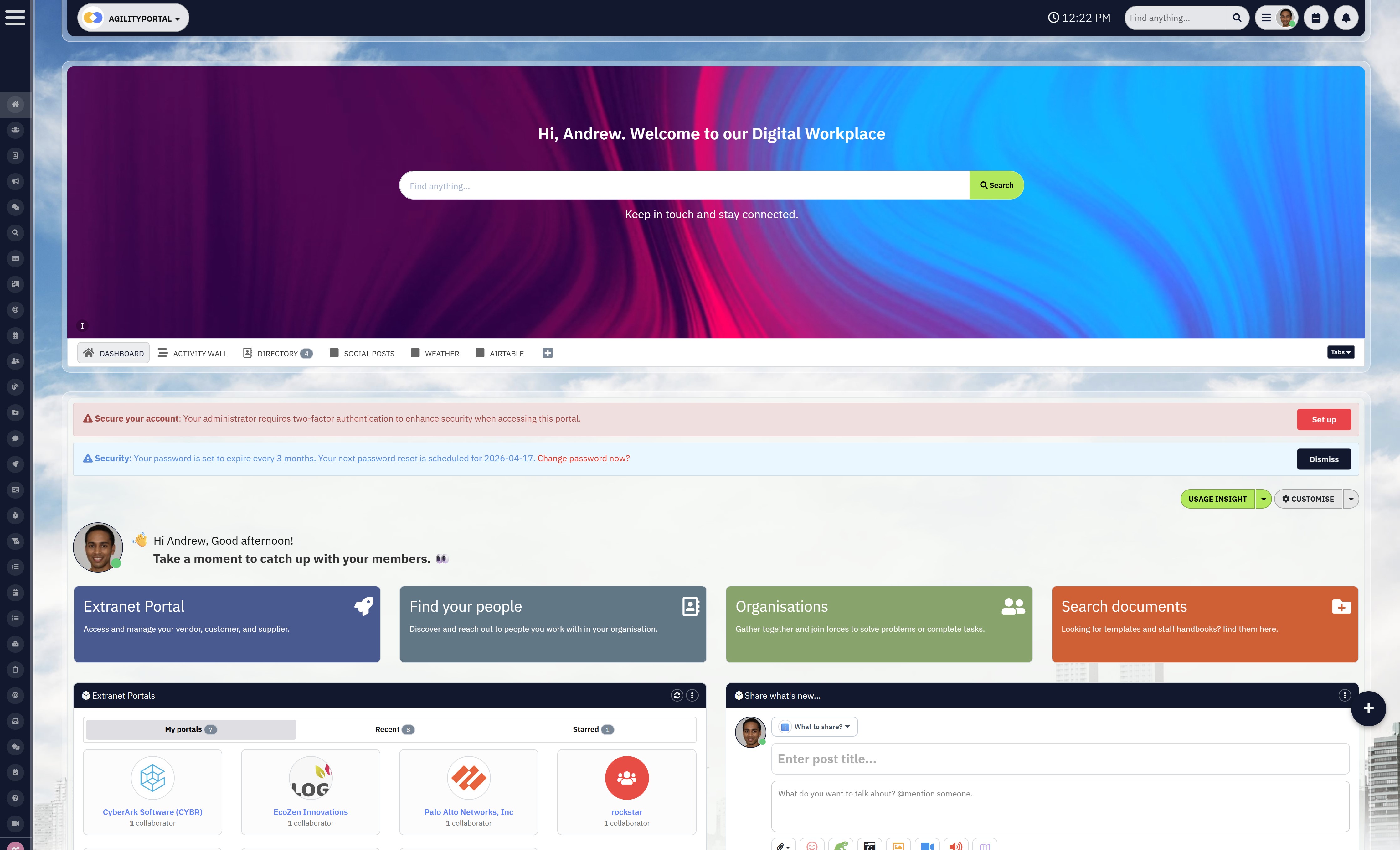
Async Team Communication: Built for How Teams Actually Work
Working asynchronously isn't about cutting meetings just for the sake of it — it's about respecting how real people work across time zones, shifts, and busy schedules.
When you're not bumping into colleagues every day, communication has to do more than just deliver messages. It has to create clarity, context, and connection.
That's where AgilityPortal comes in.
AgilityPortal is designed to bring a human layer back to asynchronous collaboration — without adding noise or tool sprawl. Teams can share updates where work actually happens, keep conversations tied to projects and decisions, and stay aligned without relying on endless meetings or inbox chains.
Instead of jumping on calls that could've been avoided, teams use AgilityPortal to:
- Share updates that don't disappear
- Keep context attached to work, not chat threads
- Stay organised across teams, roles, and locations
- Integrate seamlessly with the tools they already use
The result? Fewer interruptions, better focus, and communication that actually moves work forward — even when everyone isn't online at the same time.
Replace your next meeting-that-could-have-been-an-email with AgilityPortal.
See how structured, async-first communication really works.
Wrapping It All Up: Communication That Actually Scales
If there's one takeaway from this guide, it's this: internal communication doesn't break because organisations stop caring — it breaks because the way they communicate doesn't scale with the way they work.
As teams grow, spread across locations, and operate across shifts, ad-hoc messaging, inbox-driven updates, and meeting-heavy habits quietly turn into friction. Information gets harder to find.
Context gets lost. And work slows down in ways that are hard to diagnose but impossible to ignore.
The organisations that get this right don't communicate more — they communicate with intent.
They design structure before tools, define ownership before rollout, and create predictable rhythms that employees can actually rely on. When communication is treated as operational infrastructure, not background noise, clarity improves and execution follows.
This is where a platform approach matters.
Not as a silver bullet, but as a way to make good communication habits repeatable at scale.
When updates live alongside work, decisions stay visible, and teams know exactly where to look, communication stops being something people chase — it becomes something they trust.
If your current setup feels busy but brittle, that's a signal.
The fix isn't another channel or more messages. It's a clearer strategy, supported by the right structure, cadence, and platform.
Get that right, and internal communication stops slowing the business down — and starts quietly pulling it forward.
Frequently Asked Questions (FAQ)
What does online communication actually mean in a modern workplace?
Online communication refers to how teams share information, coordinate work, and make decisions using digital systems instead of relying on physical proximity.
In practice, this includes updates, collaboration, documentation, and coordination across locations and time zones.
AgilityPortal brings these interactions into one structured environment so communication supports real work instead of scattering across emails and chat tools.
What are the main types of online communication used by teams today?
Most organisations use a mix of real-time and asynchronous communication. Real-time includes chat and meetings, while asynchronous covers updates, announcements, documentation, and collaboration over time.
AgilityPortal supports both by allowing instant conversations when needed, while keeping longer-term communication tied to projects, teams, and operational context.
Can you give examples of online communication in real teams?
Examples include leadership updates, operational announcements, project coordination, policy changes, and cross-team collaboration. In AgilityPortal, these examples live in dedicated spaces rather than inboxes or chat threads, so teams can revisit decisions and context later without relying on memory.
What are examples of online communication tools organisations use?
Common tools include chat apps, email platforms, video conferencing software, document sharing systems, and intranet portals. The challenge is that these tools often operate in silos.
AgilityPortal combines communication, collaboration, and documentation into a single platform so teams don't have to jump between systems to stay aligned.
How can teams communicate effectively online without overload?
Effective online communication focuses on relevance, structure, and predictability.
Broadcasting everything to everyone creates noise. AgilityPortal helps teams target updates by role or group, keep communication tied to work, and establish predictable rhythms so employees know what to expect and where to look.
What methods of online communication work best for remote or hybrid teams?
Remote teams benefit most from asynchronous-first communication supported by clear ownership and shared context. This reduces delays caused by time zones or shift patterns.
AgilityPortal enables this by keeping updates visible, searchable, and attached to ongoing work rather than relying on meetings or instant responses.
What is an online communication portal?
An online communication portal is a central place where employees access updates, collaborate, and find information related to their work.
AgilityPortal acts as this portal by bringing together announcements, team communication, documents, and collaboration tools in one governed environment.
How do organisations keep a reliable online communication log?
A communication log tracks what was shared, when, and by whom.
This is critical for audits, handovers, and accountability. AgilityPortal automatically maintains this history so teams can trace decisions and updates without manual tracking or screenshots.
What's the difference between communication tools and collaboration platforms?
Communication tools focus on sending messages.
Collaboration platforms support ongoing work, shared context, and outcomes. AgilityPortal is designed as a collaboration-first platform, where communication supports execution rather than existing as disconnected conversations.
How does online communication support collaboration across teams?
Online communication enables teams to collaborate without being in the same place or online at the same time. AgilityPortal supports this by keeping discussions, updates, and documents connected to the same workspace, so collaboration continues even when teams work asynchronously.
Is real-time communication always better than asynchronous communication?
Not always. Real-time communication is useful for urgent issues, but over-reliance on it slows distributed teams. AgilityPortal balances real-time interaction with asynchronous updates, allowing teams to move work forward without waiting for meetings or responses.
What should Ops and IT look for in an online communication system?
Ops and IT leaders should look for structure, governance, integration, and scalability. AgilityPortal provides role-based access, clear ownership, auditability, and integration with existing systems — reducing tool sprawl while improving reliability.
Can online communication tools replace meetings entirely?
Meetings still have a place, but many exist only to share information.
AgilityPortal reduces unnecessary meetings by making updates, decisions, and context available asynchronously, so meetings are used for discussion and problem-solving rather than status reporting.
How does online communication impact productivity?
When communication is fragmented, employees spend excessive time searching for information or clarifying updates. AgilityPortal reduces this friction by acting as a single source of truth, helping teams focus on execution instead of chasing answers.
Are there free online communication tools, and how do they compare?
Many free tools exist, but they often lack structure, governance, or scalability.
AgilityPortal is designed for organisations that need reliability, accountability, and long-term adoption rather than short-term convenience.
How do teams choose the right online communication platform?
The right platform aligns with how the organisation works, not just how it chats.
AgilityPortal is suited for teams that want communication to support operations, collaboration, and clarity — not just fast messaging.
Most Popular Posts

Effective communication among team members is vital for the productivity and success of any organization. Surprisingly, 60% of companies lack a long-term internal communication strategy, which p...


Businesses thrive on communication for efficiency, productivity and accomplishment. When the right information is passed from the right designation in the organization, it promotes positivity an...

Categories
Blog
(3186)
Business Management
(393)
Employee Engagement
(235)
Digital Transformation
(216)
Growth
(150)
Intranets
(141)
Internal communications
(106)
Remote Work
(68)
Sales
(53)
Collaboration
(52)
Customer Experience
(32)
Culture
(30)
Knowledge Management
(29)
Project management
(29)
Leadership
(20)
Comparisons
(9)
News
(1)

Related Posts

The best ai image editors can save a team hours of repetitive work. A marketing manager can remove a distracting background, an HR team can improve a staff event photo, and an online shop can turn a basic product shot into something ready to pu...

Ever opened a PDF just before a meeting and realised you need to edit a page, pull figures from a scanned report, or gather everyone's comments? What should be a quick task can turn into a frustrating search for the right tool. That lost time a...

Looking for a New Job Remotely can feel like a simple next step: update your CV, turn on job alerts and start applying. In reality, the strongest remote job searches start much earlier. You need to be clear about the work you want, the kind of ...

Hiring globally is easier than employing globally Have you found the right person for a role, only to realise they live in a country where your business has no legal entity? That's where EOR international hiring can be useful. An Employer of Re...

Sales operations and planning are essential to harmonizing sales objectives with operational capabilities, ensuring seamless coordination between departments like sales, marketing, production, and finance. This alignment enables businesses to forecas...


Jill Romford
I am a digital nomad, lover of exploring new places and making friends.
I love to travel and I love the internet. I take pictures of my travels and share them on the internet using Instagram.
Traveler, entrepreneur, and community builder. I share my insights on digital marketing and social media while inspiring you to live your fullest life.
Ready to learn more? 👍
One platform to optimize, manage and track all of your teams. Your new digital workplace is a click away. 🚀
Free for 14 days, no credit card required.