Insight Blog
Agility’s perspectives on transforming the employee's experience throughout remote transformation using connected enterprise tools.
1 hour and 35 minutes reading time
(18979 words)
15 Best Frontline Communication Tools for 2027 That Keep Every Worker Connected

5 Best Frontline Communication Tools for 2027 That Keep Every Worker Connected
Compare the best frontline communication Tools for 2027 to reach deskless workers, share updates, improve safety and keep teams connected.
5 Best Frontline Communication Tools for 2027 That Keep Every Worker Connected

Frontline communication used to mean putting an update on a noticeboard and hoping people saw it.
But that just doesn't work anymore. If you manage retail staff, care teams, warehouse workers, hospitality employees or people working out in the field, getting the right information to them quickly can affect safety, customer service and whether they feel part of the business.
The problem is, most frontline employees are not sitting at a desk checking company email all day. They are on shifts, moving between sites and often using a shared or personal phone.
Even so, they still need an easy way to see company updates, check policies, complete training, view shift information and ask questions when something is unclear.
80%
of frontline employees
McKinsey found that 80% of frontline employees feel their company gives them few opportunities to connect at work. It also found that 55% engage with internal company communications less than once a month, leaving many employees at risk of missing information that matters.
Source:
McKinsey
And there is a real gap here.
McKinsey found that 80% of frontline employees feel their company gives them few chances to connect at work, while 55% engage with internal company communications less than once a month.
That is a lot of people potentially missing information that matters.
In this guide, we will look at the best frontline communication platforms in 2027, what features are actually worth paying attention to and how to choose a tool your employees will want to use.
Key Takeaways
- Frontline communication platforms help deskless employees access important updates, policies, training and company information without relying on email or noticeboards.
- The best frontline intranet app is mobile-friendly, simple to use and gives employees one trusted place to find the latest information during a busy shift.
- Targeted announcements, secure chat, searchable documents and policy acknowledgements are more useful than sending every employee the same update.
- Businesses should set clear rules around personal devices, privacy, shared-device access and out-of-hours communication before launching a platform.
- Employee feedback, manager follow-up and clear content ownership are essential if frontline communication is going to stay useful over time.
- The right platform should reduce communication gaps and unnecessary app switching, not create more notifications or make employees feel constantly monitored.
Frontline communication meaning: So, what does it actually mean?
Frontline communication means the way a business shares important information with employees who do not usually work at a desk. This includes retail staff, warehouse operatives, care workers, hospitality teams, drivers and field employees.
For example, a supermarket manager may need to alert staff about a product recall before the next shift starts. A warehouse team may need an immediate safety update after equipment is changed.
A care provider may need to share a new procedure with workers across several locations. In a hotel, employees may need to see a large event schedule, service changes or guest requirements before they arrive.
These employees still need access to safety updates, shift changes, company news, training and policies. But because they may not have a company email address or regular laptop access, information needs to be quick to find and easy to understand on a mobile device.
Frontline communication tools are also known as (workforce management software examples):
- Deskless worker communication platforms
- Employee communication apps
- Frontline employee apps
- Internal communication platforms
- Mobile employee communication tools
- Frontline intranet platforms
- Employee engagement platforms
- Workforce communication software
- Digital workplace platforms
- Employee experience platforms (EX platforms)
You may also hear frontline employees called deskless workers, while internal communication describes how information is shared within an organisation.
Why Does Frontline Communication Break Down So Easily?

Why Does Frontline Communication Break Down So Easily
On paper, keeping everyone updated should be simple.
You send an announcement, people read it, and everyone carries on. But when your employees work different shifts, across several locations, or away from a desk all day, things get messy very quickly.
One update might go out by email. Another gets pinned to a noticeboard. A manager may share something in a WhatsApp group, while someone else sends an SMS or mentions it during a shift handover. Before long, people are getting different versions of the same message, or missing it altogether.
That can be frustrating when it is just a company update. But when it involves a safety process, a policy change, a customer issue or an urgent shift update, it can become a genuine business problem.
Managers may not know who has seen the information, and employees may feel they are always the last to know.
The goal is not to bombard people with more notifications or expect them to answer messages when they are off the clock. It is to give everyone one simple, trusted place to find the information they need, when they need it.
Why Frontline Teams Need a Different Kind of Communication
Frontline employees are not all working in the same place, on the same schedule or with the same access to technology. A retail team may be spread across dozens of stores, while warehouse and logistics workers are moving around busy sites.
Healthcare and care teams need quick access to accurate procedures, while construction and field-service workers may be travelling between jobs all day.
That means a one-size-fits-all email update rarely works. Frontline teams need communication that is mobile-friendly, relevant to their location or role and easy to access during a busy shift.
Here is what that usually looks like in practice:
- Retail employees need quick updates on promotions, product recalls, opening hours and store procedures.
- Warehouse and logistics teams need real-time safety guidance, shift updates and operational alerts.
- Manufacturing employees need access to standard operating procedures, equipment updates and compliance notices.
- Care and healthcare workers need reliable access to patient-care guidance, training and policy changes.
- Construction and field-service teams need site-specific instructions, safety information and job updates while on the move.
- Hospitality and restaurant employees need to see event details, menu changes, guest requirements and shift announcements before service begins.
Why Email and Noticeboards Are No Longer Enough
Email and noticeboards still have their place, but they are not enough when you are trying to reach people who work different shifts, in different locations or away from a desk all day.
A message on a noticeboard only works if someone sees it.
An email only works if the employee has a company email address and time to check it.
That leaves too much room for important information to be missed.
Here is where the usual approach starts to fall short:
- Not every frontline employee has a company email address or regular access to a laptop.
- Noticeboards can quickly become cluttered, making important updates easy to overlook.
- Printed information can be out of date, especially when policies, procedures or schedules change.
- Employees cannot easily search a noticeboard or old email thread when they need an answer quickly.
- Managers have no clear way to confirm who has read a critical update, such as a safety notice or new policy.
- Different sites may receive information at different times, creating confusion and inconsistent ways of working.
- Employees may rely on colleagues or personal WhatsApp groups for updates, which can lead to incomplete information and privacy concerns.
A good frontline workforce software gives everyone one reliable place to check the latest updates, find documents and confirm they have read information that matters.
The 15 best frontline communication platforms to demo in 2027
There is no single platform that will be right for every business.
A small retail group may need something simple for shift updates and quick team messages, while a larger organisation may need a full frontline intranet with documents, training, policies, employee feedback and secure access for thousands of people.
The important thing is not choosing the platform with the longest feature list.
It is choosing one that fits how your employees actually work.
Can they log in easily?
Can they find important information quickly?
Will managers be able to target the right teams without creating more noise?
To make the comparison easier, here is a quick look at 15 frontline communication platforms worth considering in 2027.
| Platform | Best for | Standout strengths | Consider before choosing |
| AgilityPortal | Businesses wanting one connected workplace | Frontline intranet, announcements, chat, documents, forms, learning and employee engagement | Best when you want more than a basic communication app, best workforce communication software for remote teams |
| Happeo | Google Workspace businesses | Social intranet, Google Workspace integration and knowledge sharing | Better suited to organisations heavily invested in Google |
| Interact Software | Internal communications teams | Employee intranet, targeted news, content management and employee directories | Review mobile and frontline workflow needs |
| Claromentis | Organisations needing a custom intranet | Intranet, e-learning, documents, policies and business processes | May need more configuration than simpler tools |
| Simpplr | AI-led employee experience | Search, personalised content, intranet and employee communications | Stronger fit for larger digital workplace programmes |
| Firstup | Large, distributed organisations | Personalised communications, enterprise segmentation and campaign delivery | Can be more than smaller organisations require |
| MangoApps | Employee communication and work management | Intranet, collaboration, task tools and knowledge sharing | Review setup requirements and feature depth |
| Assembly | Employee recognition and culture | Recognition, rewards, surveys and employee engagement | Less suited if document management is the main priority |
| Connecteam | Operational and shift-based teams | Scheduling, time tracking, forms, task management and updates | Compare intranet and long-term knowledge features |
| Staffbase | Enterprise employee communications | Targeted communications, employee app and campaign management | Often best for larger organisations with a dedicated comms team |
| Blink | Mobile-first frontline teams | Simple news feed, chat, documents and employee access | Assess how much wider intranet functionality you need |
| Workvivo | Culture and employee engagement | Social communication, recognition, community building and feedback | Review operational tools for frontline teams |
| Microsoft Viva Engage | Microsoft 365 organisations | Communities, leadership updates and Microsoft ecosystem access | Can be less straightforward for employees without Microsoft accounts |
| SharePoint | Microsoft-centric intranet projects | Document libraries, permissions, collaboration and Microsoft 365 integration | Can be complex to maintain and less intuitive for frontline use |
| Confluence | Knowledge-heavy teams | Documentation, structured knowledge and team collaboration | Not designed primarily as a frontline employee communication app |
1. AgilityPortal — best for an all-in-one frontline intranet and communication hub
Best for: organisations that want one mobile-friendly place for frontline communication, company knowledge, training and everyday employee tools.
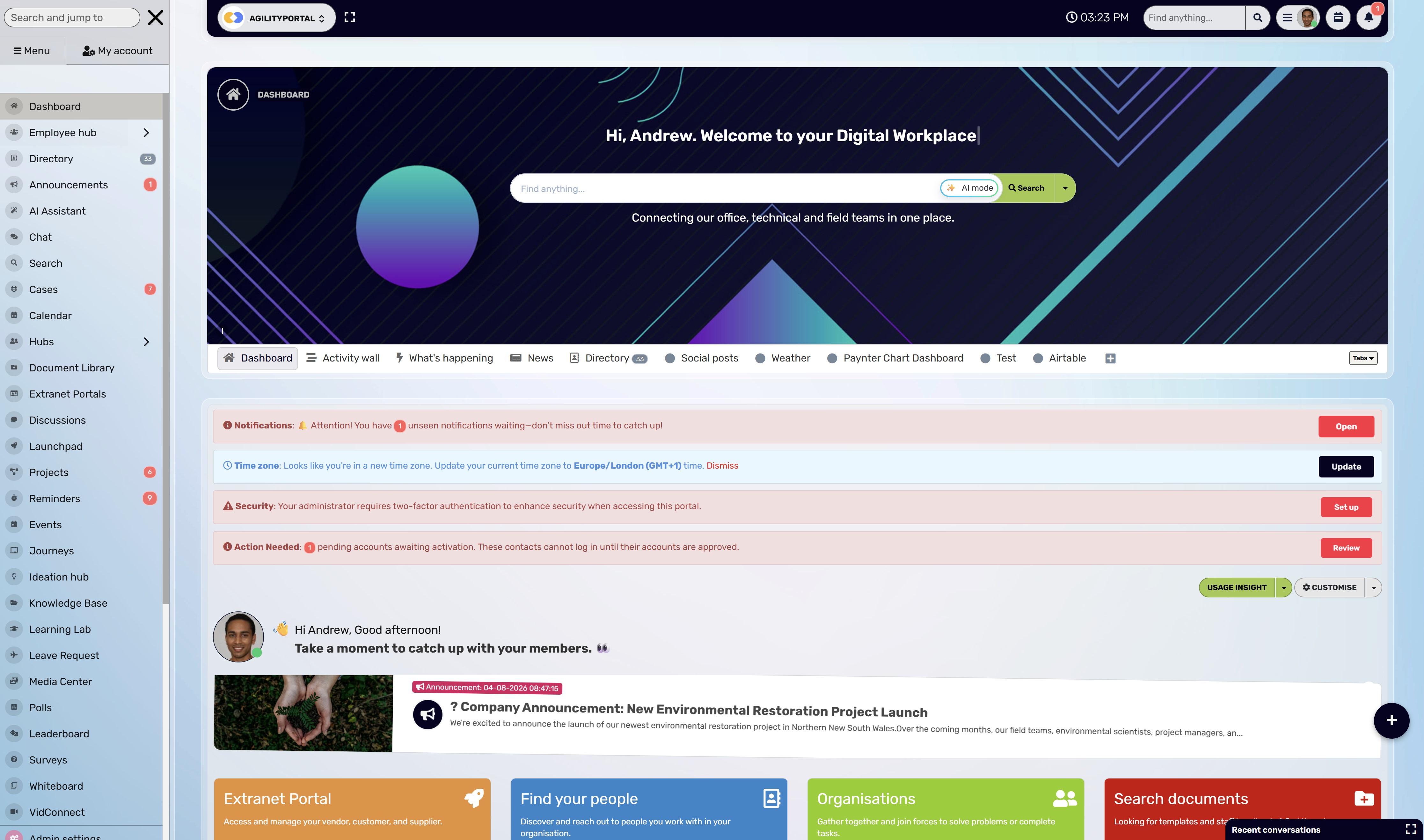
1. AgilityPortal — best for an all-in-one frontline intranet and communication hub
AgilityPortal is an all-in-one frontline intranet and employee communication platform that helps deskless, remote and office-based employees stay connected. Rather than relying on email chains, noticeboards and separate apps, businesses can bring updates, conversations, knowledge and everyday work tools into one secure place.
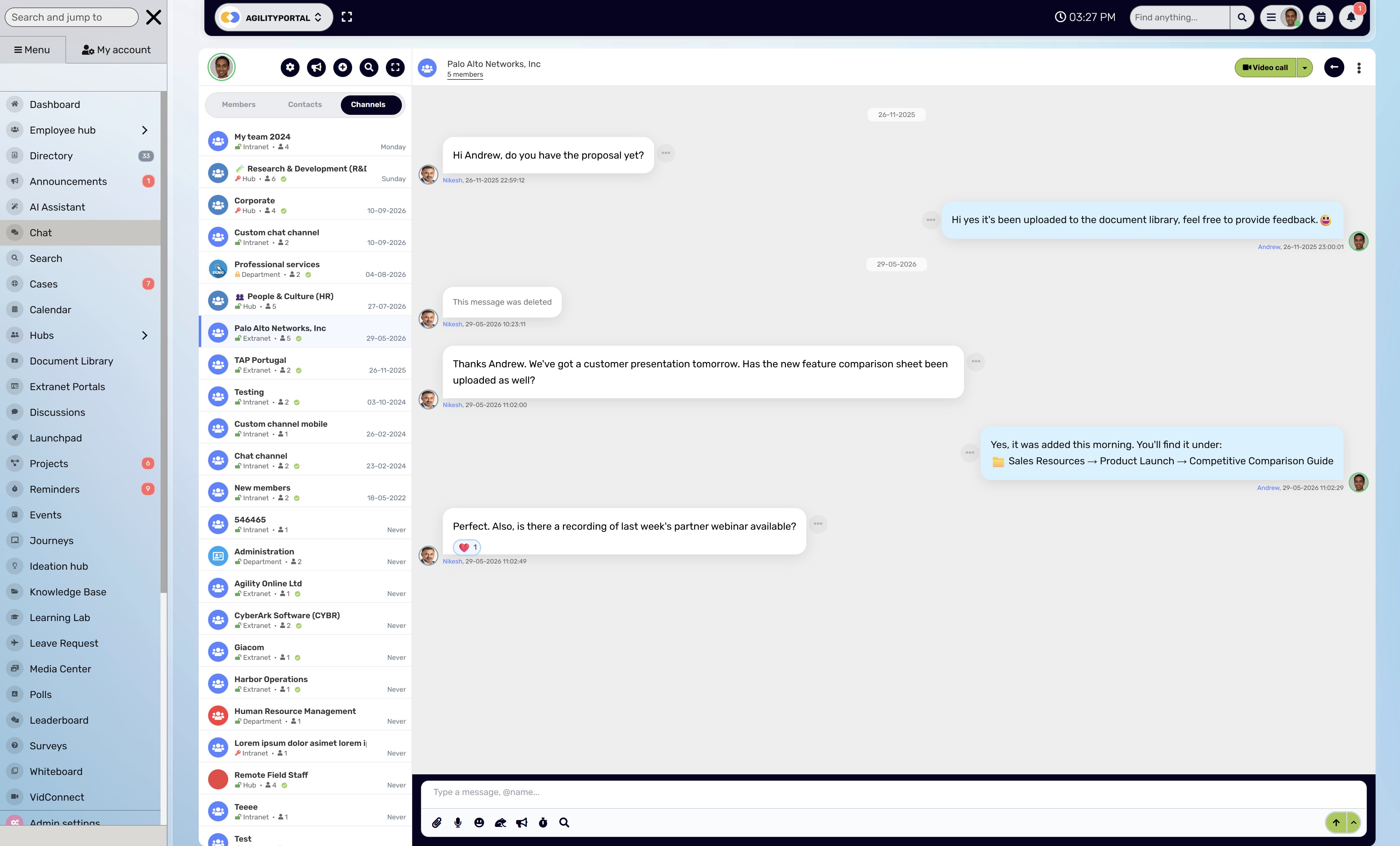
Deskless worker communication platforms
Employees can use AgilityPortal on mobile or desktop to read announcements, join Spaces for their team, location or department, chat securely and access documents without having to chase someone for the latest version.
They can also complete learning, submit forms, manage tasks and acknowledge important updates, such as a new safety process or company policy.
Why teams shortlist it
Teams shortlist AgilityPortal when they want more than a basic employee news feed. It gives HR, internal communications and operations teams a practical way to keep employees informed while also helping them find documents, complete actions and stay connected to their wider organisation.
Key strengths
- Mobile and desktop access for frontline, remote and office-based employees.
- Company announcements and targeted updates for specific teams, locations or departments.
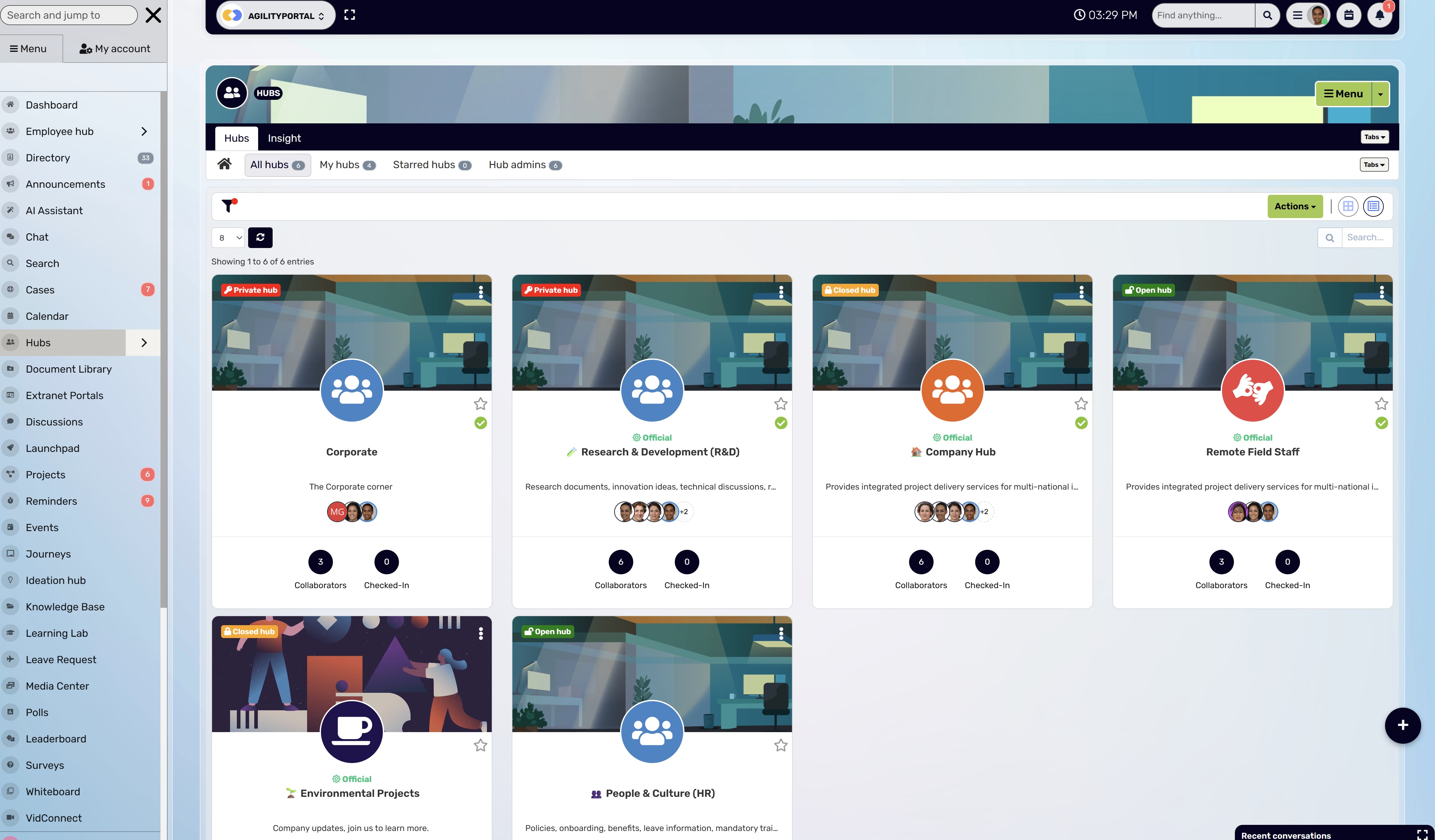
- Dedicated Spaces to organise communication, resources and conversations.
- Secure chat for real-time employee messaging.
- Document management and searchable knowledge resources.
- Learning and onboarding content for training employees at scale.
- Digital forms, tasks and approvals for everyday operational work.
- Acknowledgements for important policies, compliance notices and safety updates.
Potential drawbacks
AgilityPortal is designed as a broader digital workplace, so it may offer more features than a business needs if it only wants a simple push-to-talk or basic messaging app. Organisations should decide which modules they want to launch first, rather than switching everything on at once.
Who should shortlist
AgilityPortal is a strong option for HR leaders, internal communications teams, operations managers and IT teams that want to bring frontline communication, intranet content, employee engagement and everyday work tools into one platform.
It is particularly useful for growing organisations that do not want to keep adding separate apps as their workforce expands. Employees can access AgilityPortal through the web app or on mobile devices, making it easier for remote, deskless and office-based teams to stay informed wherever they work.
The platform also works independently, so organisations are not required to rely on Microsoft Teams, Google Workspace or SharePoint as the foundation of their employee experience. That makes it a scalable choice for businesses with around 100 to 10,000 employees, multiple locations and a need for reliable mobile access and push notifications to keep everyone up to date.
Our Verdict · #1
AgilityPortal
Best for bringing frontline communication, knowledge, documents and everyday employee tools into one secure digital workplace.
#1
Our pick
Starting price
From $99/month for 25–99 employees, with a 14-day free trial.
Best feature
Employees can access announcements, Spaces, chat, documents, learning, forms and tasks from one mobile-friendly platform.
AgilityPortal is a strong choice for organisations that need more than a simple employee news feed. It gives frontline, remote and office-based employees one place to find updates, policies, training and everyday work information, while helping managers communicate with the right people at the right time.
What clients like
- Company updates, chat, documents and employee tools sit in one platform.
- Spaces can be created for departments, locations, teams and projects.
- Mobile access helps keep frontline, remote and office employees connected.
- Forms, learning, tasks and acknowledgements support everyday employee work.
What to consider
- The range of available features can feel busy for new users at first.
- Teams need a clear rollout plan so employees know which areas to use and when.
- Organisations should launch the most useful modules first, rather than everything at once.
- It is better suited to connected workplace communication than a basic push-to-talk-only tool.
Pricing, product features and plan availability can change. Confirm current details with AgilityPortal before purchasing.
2. Happeo: Best for Google Workspace Teams
Best for: organisations that use Google Workspace and want an intranet that brings company news, people, documents and shared knowledge into one familiar place.
2. Happeo: Best for Google Workspace Teams
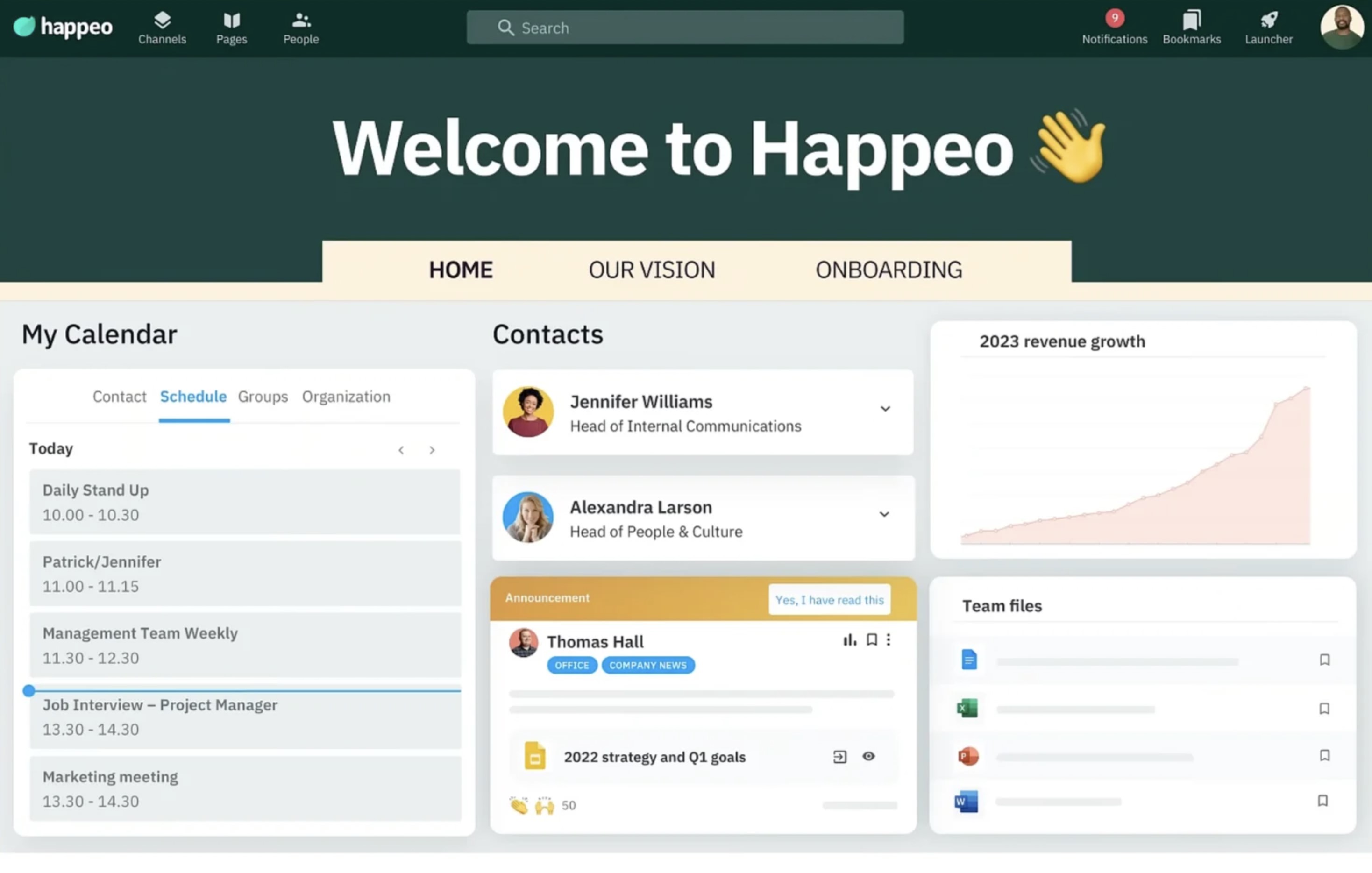
Happeo is an intranet platform built around Google Workspace. It gives employees a central place to read company updates, visit department pages, find colleagues and access files that would otherwise be scattered across Google Drive, email and different team folders.
For frontline teams, this can be useful when employees need a clearer way to find company policies, local updates and important resources without digging through old emails. Its social-style channels also give businesses a more engaging way to share news than a standard intranet page alone.
Why teams shortlist it
Teams usually shortlist Happeo when Google Workspace is already central to how they work.
It can make Google Drive content easier to discover and gives internal communications teams a more structured way to publish news, create department hubs and keep employees connected.
Key strengths
- Strong fit for organisations already using Google Workspace and Google Drive.
- Company pages and channels for sharing news, resources and team updates.
- Employee directory to help people find colleagues and understand the organisation.
- Search tools that make shared knowledge and documents easier to locate.
- More engaging internal communication experience than relying on email alone.
- Useful for building department, location or company-wide information hubs.
Potential drawbacks
Happeo is most appealing to businesses that are already committed to Google Workspace. Organisations using Microsoft 365 or a mixed software environment should check how well it fits their existing systems before choosing it. It is also more focused on intranet communication and knowledge sharing than operational tools such as task management, forms and frontline workflows.
Who should shortlist
Happeo is worth shortlisting for HR, internal communications and IT teams that use Google Workspace and want to create a more organised, engaging employee intranet.
It is a sensible option for businesses that need to improve access to company news and shared knowledge, particularly where employees are currently relying on email and scattered Google Drive folders.
Editor’s Review
Happeo
Best for Google Workspace organisations that want an intranet for company news, shared knowledge and employee communication.
Top
Google fit
Pricing
Custom pricing. Compare current options and verified customer feedback before shortlisting.
Best feature
Its intranet experience is designed to bring Google Workspace content, company updates and employee knowledge into one central hub.
Happeo is worth considering for businesses that already rely heavily on Google Workspace and want a more engaging way to share company news, build department pages and make shared knowledge easier for employees to find. It is more focused on intranet communication and knowledge sharing than operational frontline workflows.
What reviewers like
- Close fit with Google Workspace for teams already using Google tools.
- A central intranet for company news, department content and shared resources.
- Employee profiles and structured pages can make information easier to discover.
- Review feedback commonly highlights its user-friendly interface and support.
What to consider
- It is most compelling for organisations already invested in Google Workspace.
- Teams needing detailed task management, forms or scheduling may need additional tools.
- Large information libraries still need clear ownership and navigation rules.
- Check mobile access and frontline needs during a real employee pilot.
Review-site ratings, pricing and product features can change. Confirm current details during your evaluation.
3. Interact Software: Best for Internal Communications Teams
Best for: organisations that want a well-established employee intranet for sharing company news, policies, documents and updates across a distributed workforce.
Interact Software is an employee intranet platform that helps businesses create a central place for internal communication. It is designed for organisations that want to move away from long email chains and disconnected document folders, giving employees one place to check company news, find resources and stay up to date with what is happening across the business.
For frontline teams, Interact can help internal communications and HR teams publish targeted updates for different locations, departments or employee groups. This is useful when not everyone needs to see the same message, such as a store-specific procedure, a regional announcement or a policy that only applies to certain roles.
Why teams shortlist it
Teams shortlist Interact when they need more control over internal content, communications and employee information. It gives communicators a structured way to create intranet pages, share news and keep important resources available beyond the moment an email is sent.
Key strengths
- Central intranet for company news, policies, documents and employee resources.
- Targeted communications for departments, locations, job roles or employee groups.
- Employee directory to help people find colleagues and understand the organisation.
- Content management tools for internal communications and HR teams.
- Search functionality to make information easier to find later.
- Mobile access that helps employees stay connected when they are away from a desk.
- Analytics that can help teams understand which content employees are engaging with.
Potential drawbacks
Interact is primarily an intranet and internal communications platform, rather than an all-in-one operational tool. Businesses that need built-in shift scheduling, task management, forms, learning or detailed frontline workflows may need additional software or integrations.
Who should shortlist
Interact is worth shortlisting for internal communications teams, HR leaders and larger organisations that need a reliable intranet for keeping employees informed. It is particularly useful for businesses with multiple offices, sites or locations that want more consistency in how company information is shared.
Editor’s Review
Interact Software
Best for larger organisations that need a structured intranet, targeted communications and employee experience tools in one platform.
Top
Enterprise fit
Pricing
Custom pricing. Review current options and independent feedback before making a shortlist.
Best feature
Targeted intranet communications and employee resources for organisations managing different locations, roles and audiences.
Interact Software is built for organisations that want to replace scattered internal communications, document stores and employee resources with a more structured digital workplace. It can be a good fit for large or distributed teams, but it needs thoughtful planning, ownership and content governance to get the most value from it.
What reviewers like
- Review feedback highlights the platform’s intranet capabilities and customer support.
- Targeted communication can help different employee groups receive more relevant updates.
- Useful for organising company news, employee resources and internal knowledge.
- Employee experience features can support feedback, communities and engagement.
What to consider
- A successful launch needs active involvement from internal communications and IT teams.
- Large intranet projects require clear content ownership and governance.
- Evaluate mobile access and frontline workflows with real employee pilot groups.
- Teams seeking a very simple, lightweight app may find the platform broader than they need.
Review-site ratings, pricing and product features can change. Confirm current details during your evaluation.
4. Claromentis: Best for Customisable Intranets and Internal Processes
Best for: organisations that want an employee intranet that can combine internal communication with documents, learning, policies and custom business processes.
Claromentis is an intranet platform designed for businesses that need more than a place to post company news. It brings together internal communication, document management, learning, policies and employee self-service tools, giving organisations a central hub for everyday information and processes.
For frontline teams, this can be useful when employees need quick access to standard operating procedures, safety guidance, training materials or forms without having to rely on a manager to send the latest version. It can also help businesses create different areas for departments, locations or roles, so employees see information that is relevant to their work.
Why teams shortlist it
Teams shortlist Claromentis when they want to tailor an intranet around their own way of working. It is often considered by organisations that need structured content, policy management, employee learning and workflow support in the same environment.
Key strengths
- Customisable intranet pages for departments, teams, locations and employee groups.
- Document management for policies, procedures and important business files.
- Learning tools for employee training and onboarding.
- Forms and workflow capabilities for requests, approvals and internal processes.
- Internal news and communication tools to keep employees informed.
- Search functionality to help employees find resources without asking around.
- Useful for organisations with compliance, policy or process-heavy requirements.
Potential drawbacks
Claromentis can require more planning and configuration than a simple employee communication app. Businesses should be clear about their content structure, permissions and processes before rollout, otherwise the intranet can become difficult for employees to navigate.
Who should shortlist
Claromentis is worth shortlisting for HR, IT, compliance and operations teams that need a more structured and customisable intranet. It is a good fit for organisations that want to centralise policies, documents, training and internal processes alongside frontline communication.
Editor’s Review
Claromentis
Best for organisations that need a customisable intranet for communication, knowledge, learning and internal business processes.
Top
Custom fit
Pricing
Custom pricing. Review current plans, implementation requirements and independent feedback before deciding.
Best feature
Its broad intranet toolkit can combine company communication, documents, learning, forms and workflows in one environment.
Claromentis is a strong option for organisations that need a more tailored intranet, particularly where policies, processes, training and compliance content all need a central home. It offers more depth than a basic employee news app, but businesses should plan their content structure and launch carefully to keep the experience simple.
What reviewers like
- Review feedback often highlights ease of use and helpful customer support.
- Broad functionality for intranet content, learning, documents and internal processes.
- Useful for creating structured areas for departments, locations and employee groups.
- Can support organisations with policy, compliance and operational knowledge needs.
What to consider
- Its range of options can require more setup and planning than a basic communication app.
- Teams need clear ownership for pages, permissions, documents and workflows.
- Customisation should be balanced with a simple experience for frontline employees.
- Test mobile access, search and key employee journeys before a full rollout.
Review-site ratings, pricing and product features can change. Confirm current details during your evaluation.
5. Simpplr: Best for Personalised Employee Intranet Experiences
Best for: mid-sized and larger organisations that want a modern intranet with personalised content, strong search and employee communication tools.
Simpplr is an employee experience platform that brings company communications, people information and workplace knowledge together in one central intranet. It is designed to make internal information easier to find, so employees do not have to search through old emails, folders and chat messages to get an answer.
For frontline employees, that can be particularly helpful when they need quick access to policies, training materials, operational guidance or company updates from a mobile device. Rather than showing everyone the same homepage, Simpplr can help organisations make content more relevant based on a person's role, department or location.
Why teams shortlist it
Teams shortlist Simpplr when employee experience and information discovery are high priorities. It is often considered by organisations that have plenty of internal content but struggle to make it easy for employees to find what matters to them.
Key strengths
- Personalised intranet content based on employee role, department or location.
- Search tools designed to help employees find policies, resources and company information quickly.
- Internal communications for publishing company news and leadership updates.
- Employee directory and people profiles to make it easier to find the right colleague.
- Mobile access for employees who are not regularly at a desk.
- Analytics that help communications teams understand content reach and engagement.
- Useful for organisations that want a more polished, employee-friendly intranet experience.
Potential drawbacks
Simpplr is generally better suited to organisations that need a dedicated intranet and employee experience platform. Businesses looking for built-in operational tools, such as shift scheduling, detailed task management or frontline forms, may need additional systems or integrations.
Who should shortlist
Simpplr is worth shortlisting for HR leaders, internal communications teams and IT departments that want to make company information easier to find and more relevant to each employee. It is particularly suitable for larger or growing organisations with several departments, locations or employee groups.
Editor’s Review
Simpplr
Best for organisations that want a personalised employee intranet with strong search, communication and employee experience features.
Top
Search fit
Pricing
Custom pricing. Compare current plans and independent user feedback before shortlisting.
Best feature
Personalised intranet content and search that can help employees find the right information, policies and resources more quickly.
Simpplr is suited to organisations that want to make company information easier to discover and more relevant to each employee. It combines intranet content, internal communication and employee experience features, making it a strong consideration for larger businesses with complex information needs and distributed workforces.
What reviewers like
- Independent reviews regularly mention ease of use and an intuitive interface.
- Employees can access information, updates and resources from one central place.
- Search and content organisation can improve information discovery.
- Review feedback also highlights customer support and content-management capabilities.
What to consider
- It is generally a stronger fit for organisations with a wider employee experience strategy.
- Teams needing schedules, tasks or detailed frontline workflows may require integrations.
- Personalisation and search still depend on well-managed internal content.
- Test whether its mobile experience meets the needs of shift-based employees before rollout.
Review-site ratings, pricing and product features can change. Confirm current details during your evaluation.
6. Firstup: Best for Large-Scale Employee Communications
Best for: large organisations that need to deliver personalised company communications to employees across many locations, roles and languages.
Firstup is an employee communications platform built for organisations that need to reach a large and diverse workforce. It helps internal communications teams create, target and measure company updates, so employees receive information that is more relevant to their role, location or interests.
For frontline teams, this can be useful when head office needs to share an important update with thousands of employees but does not want to send the same message to everyone. A retail manager may need store-specific information, while warehouse staff need safety guidance and office teams need a different update altogether.
Why teams shortlist it
Teams shortlist Firstup when communication reach, targeting and personalisation are the main priorities. It is particularly useful for large businesses that have struggled with important messages being lost in email, ignored in company portals or shared inconsistently across locations.
Key strengths
- Targeted communications based on location, role, department and employee audience.
- Mobile-first employee access for deskless and frontline workers.
- Communication planning and campaign tools for internal communications teams.
- Content personalisation to help reduce irrelevant updates.
- Analytics that show reach, engagement and employee response.
- Support for large, distributed and multilingual workforces.
- Useful for leadership communications, company-wide announcements and change-management campaigns.
Potential drawbacks
Firstup is primarily focused on enterprise employee communications. Businesses looking for broader day-to-day work tools, such as task management, forms, learning, document collaboration or project tools, may need to use additional platforms alongside it.
Who should shortlist
Firstup is worth shortlisting for enterprise HR teams, internal communications leaders and global organisations that need to reach a large number of employees across multiple sites or countries. It is a strong fit when the main challenge is delivering relevant, measurable communication at scale.
Editor’s Review
Firstup
Best for large organisations that need targeted employee communications across frontline, office and distributed workforces.
Top
Reach at scale
Pricing
Custom pricing. Compare requirements, rollout support and independent feedback before selecting a provider.
Best feature
Targeted, multi-channel employee communication designed to reach different roles, locations and frontline audiences.
Firstup is built for enterprise employee communications, particularly where organisations need to reach large, diverse workforces across sites, shifts and regions. Its strengths are communication reach, targeting and campaign delivery rather than acting as a complete operational work-management platform.
What reviewers like
- Review feedback highlights ease of posting, managing and interacting with content.
- Targeted communication can make updates more relevant for different employee groups.
- Useful for organisations managing large, dispersed and multilingual workforces.
- Communication analytics can help teams understand reach and engagement.
What to consider
- It is primarily designed for enterprise communications rather than detailed daily workflows.
- Teams may need separate systems for tasks, forms, learning or broader knowledge management.
- A targeted communication strategy is needed to prevent employees receiving too many updates.
- Smaller organisations may find a lighter platform better suited to their needs.
Review-site ratings, pricing and product features can change. Confirm current details during your evaluation.
7. MangoApps: Best for Communication and Everyday Employee Work
Best for: organisations that want to combine employee communication, knowledge sharing, collaboration and operational tools in one platform.
MangoApps is a digital workplace platform that brings together company news, employee communities, documents, tasks, learning and collaboration tools. It is aimed at businesses that want employees to have one main place to communicate, find information and complete everyday work, rather than switching between several separate systems.
For frontline teams, MangoApps can be useful when employees need to see updates, access standard operating procedures, complete checklists or training, and communicate with managers from one mobile-friendly app. It can work well for businesses trying to replace a mix of noticeboards, group chats, shared folders and separate employee apps.
Why teams shortlist it
Teams shortlist MangoApps when they are looking for more than an intranet or basic employee communication tool. It offers a broader set of modules, which can help businesses bring different parts of the employee experience together in one place.
Key strengths
- Company news, employee communities and targeted internal communications.
- Knowledge sharing and document access for policies, procedures and resources.
- Task management and workflow support for everyday operational work.
- Learning and training tools for onboarding and employee development.
- Mobile access for frontline employees working away from a desk.
- Team collaboration features, including messaging and shared spaces.
- Configurable platform that can support different departments and employee groups.
Potential drawbacks
Because MangoApps includes a wide range of features, the setup can feel more involved than a simple communication app. Organisations need to plan their content, permissions and module rollout carefully to avoid overwhelming employees with too many areas to check.
Who should shortlist
MangoApps is worth shortlisting for HR, operations and IT teams that want to consolidate employee communication, knowledge and practical work tools. It is particularly suitable for organisations with frontline employees who need both company updates and access to everyday operational resources.
Editor’s Review
MangoApps
Best for organisations that want communication, knowledge, tasks and employee tools in one configurable digital workplace.
TopAll-in-one fit
Pricing
Custom pricing. Compare requirements, setup needs and independent user feedback before deciding.
Best feature
Its broad toolkit brings employee communication, intranet content, knowledge, tasks and collaboration into one place.
MangoApps is suited to businesses that want to reduce tool switching by combining employee communication with wider workplace features. Its flexibility can be useful for frontline and distributed teams, although organisations should plan the rollout carefully so employees are not overwhelmed by too many modules at once.
What reviewers like
- Reviewers often highlight the broad range of communication and collaboration features.
- Intranet, chat, knowledge, documents and tasks can be brought into one environment.
- Customisable areas can support different teams, departments and employee groups.
- Mobile access can help connect distributed and frontline employees.
What to consider
- The wide feature set can create a learning curve for new users.
- Configuration and content ownership need planning before launch.
- Start with the modules that solve immediate employee problems first.
- Test the mobile experience with frontline employees during a pilot.
Review-site ratings, pricing and product features can change. Confirm current details during your evaluation.
8. Assembly: Best for Employee Recognition and Culture
Best for: organisations that want to improve employee recognition, feedback and connection alongside their internal communications.
Assembly is an employee engagement platform centred on recognition, rewards, surveys and company culture. It gives employees a place to celebrate good work, recognise colleagues and share feedback, which can be especially valuable for frontline employees who may not regularly see leadership or colleagues outside their immediate shift.
For example, a warehouse manager could recognise a team member for spotting a safety issue, a retail employee could thank a colleague for helping during a busy promotion, or a hospitality team could celebrate great customer feedback. Small moments like these can help people feel seen, particularly when they work across different locations or schedules.
Why teams shortlist it
Teams shortlist Assembly when the main goal is to make recognition and employee feedback more consistent. It is often used by HR and people teams that want to strengthen culture and give employees a more visible way to celebrate contributions across the business.
Key strengths
- Employee recognition tools for peer-to-peer and manager-led appreciation.
- Rewards and incentives that can support recognition programmes.
- Surveys and feedback tools to understand employee sentiment.
- Social updates that help employees see wins happening across the business.
- Useful for recognising frontline employees who may be less visible to head office.
- Can support stronger connections between teams, locations and departments.
Potential drawbacks
Assembly is not a full frontline intranet or operational communication platform. Businesses that need documents, policy acknowledgements, learning, tasks, forms or a searchable knowledge base will likely need another system alongside it.
Who should shortlist
Assembly is worth shortlisting for HR leaders, people teams and employee engagement managers who want to make recognition and feedback a more visible part of everyday work. It works particularly well as part of a wider employee communication strategy, rather than as the only platform used by frontline teams.
Editor’s Review
Assembly
Best for organisations that want to strengthen employee recognition, rewards and workplace culture alongside their internal communications.
TopRecognition fit
Pricing
Pricing varies by requirements. Check current plans and independent reviews before making a decision.
Best feature
Peer-to-peer recognition, rewards and milestone celebrations that can help employees feel seen across locations and shifts.
Assembly is focused on employee recognition and culture rather than being a full frontline intranet. It can work well alongside a wider employee communication platform when a business wants to make appreciation, celebrations and feedback more visible across frontline, remote and office teams.
What reviewers like
- Recognition and rewards give employees a clear way to celebrate good work.
- Milestones, anniversaries and employee achievements can be highlighted consistently.
- Its social recognition approach can support employee connection across locations.
- Useful for HR and people teams building a stronger culture of appreciation.
What to consider
- It is not designed to replace a full intranet, knowledge base or operational communication platform.
- Businesses may need separate tools for policies, documents, training and frontline workflows.
- Recognition programmes need manager participation and clear guidelines to remain meaningful.
- Check how it fits with existing employee communications and HR systems.
Review-site ratings, pricing and product features can change. Confirm current details during your evaluation.
9. Connecteam: Best for Shift-Based Operational Teams
Best for: small and mid-sized businesses that need to manage frontline communication, schedules, time tracking and everyday operations from one mobile app.
Connecteam is built for deskless and shift-based employees. It combines employee communication with practical operational tools, such as scheduling, time clocks, checklists, forms and task management. That makes it a useful option for businesses where employees need to receive updates and complete work-related actions while they are on the move.
For example, a cleaning company can send job details and checklists to field workers, a restaurant manager can share shift changes with staff, or a security business can use forms and updates to keep teams aligned across different sites.
Why teams shortlist it
Teams shortlist Connecteam because it gives managers a practical way to communicate with employees while also managing day-to-day work. It is especially useful when businesses are still relying on paper timesheets, spreadsheets, WhatsApp groups and separate scheduling tools.
Key strengths
- Mobile-first employee communication for deskless and frontline teams.
- Shift scheduling and availability tools for managing staff rotas.
- Time clock and timesheet features for tracking working hours.
- Forms, checklists and task tools for operational work.
- Employee updates, chat and company information in one app.
- Useful for field services, hospitality, retail, security, cleaning and operational teams.
- Designed for employees who may not have a company email address or laptop.
Potential drawbacks
Connecteam is strongest when scheduling, time tracking and operational management are a priority. Organisations that need a more content-rich intranet, advanced knowledge management or broader employee engagement tools may find they need additional software as they grow.
Who should shortlist
Connecteam is worth shortlisting for operations managers, HR teams and business owners managing shift-based or mobile employees. It is a particularly good fit for small and mid-sized organisations that want to replace disconnected operational tools with one easy-to-use employee app.
Editor’s Review
Connecteam
Best for shift-based and mobile teams that need employee communication, scheduling, time tracking and operational tools in one app.
TopOperations fit
Pricing
Multiple plans are available. Review current requirements, feature limits and independent feedback before choosing.
Best feature
It combines shift scheduling, time tracking, forms, tasks and employee communication for deskless teams.
Connecteam is designed for organisations that need to manage day-to-day frontline operations as well as employee communication. It can be useful for retail, field service, hospitality, security and other shift-based teams that want to replace paper processes, spreadsheets and separate workforce apps.
What reviewers like
- Independent reviews often highlight its all-in-one approach to scheduling, time tracking and communication.
- Mobile access is suited to employees working in the field or away from a desk.
- Forms, checklists and task tools can support everyday operational work.
- Its features can help reduce reliance on paper, spreadsheets and personal group chats.
What to consider
- It is strongest for operational workforce management, rather than a content-heavy employee intranet.
- Location and time-tracking features need clear privacy rules and employee communication.
- Organisations should check plan limits as their workforce and feature needs grow.
- Businesses needing broader knowledge management may require another platform or integration.
Review-site ratings, pricing and product features can change. Confirm current details during your evaluation.
10. Staffbase: Best for Enterprise Employee Communications
Best for: larger organisations that need to deliver targeted, mobile-friendly communications to employees across many locations, roles and languages.
Staffbase is an employee communications platform built to help large organisations reach both desk-based and frontline employees. It gives internal communications teams a central place to publish company news, leadership updates, campaigns and important announcements, while allowing them to tailor content for different employee groups.
For frontline workers, that can mean receiving updates that are relevant to their location, department or role rather than being sent every message from head office. A manufacturing team may need a safety update, a retail team may need information about a new promotion and a regional manager may need to share a local business announcement.
Why teams shortlist it
Teams shortlist Staffbase when they need to improve communication reach across a large workforce. It is commonly considered by businesses that have a dedicated internal communications function and want better control over how messages are planned, targeted and measured.
Key strengths
- Employee app and intranet tools for reaching deskless and office-based workers.
- Targeted communications for different locations, roles, departments and languages.
- Campaign management tools for internal communications teams.
- Mobile access for employees who are not regularly at a desk.
- Analytics to help leaders understand message reach and engagement.
- Supports leadership communications, company news and change-management updates.
- Useful for large, geographically distributed organisations.
Potential drawbacks
Staffbase is primarily focused on employee communications and may be more than smaller businesses need. Organisations looking for a wider digital workplace with built-in tasks, forms, learning, project tools and operational workflows should check whether they need additional platforms or integrations.
Who should shortlist
Staffbase is worth shortlisting for enterprise HR leaders, internal communications teams and organisations with large frontline workforces across multiple locations. It is a strong choice when the main goal is to improve the consistency, reach and measurement of employee communication at scale.
Editor’s Review
Staffbase
Best for enterprise organisations that need governed, targeted communications for large, distributed and frontline workforces.
TopEnterprise fit
Pricing
Custom pricing. Review your communication, governance and deployment requirements before requesting quotes.
Best feature
Targeted employee communications and engagement analytics for reaching the right people across locations, roles and channels.
Staffbase is designed for businesses with a serious internal communications requirement, especially those managing large frontline or multilingual workforces. It combines an employee app and intranet approach with targeting, campaign tools and measurement, making it more suited to enterprise communication programmes than basic employee messaging.
What reviewers like
- Gartner reviewers highlight more organised internal communication across distributed and frontline teams.
- Targeted employee updates can help reduce irrelevant messages.
- Analytics can help communicators understand which content is reaching employees.
- Mobile and intranet access support employees across different locations and working patterns.
What to consider
- It is generally best suited to enterprise organisations with a dedicated communications function.
- Teams need content governance and audience rules to get the value from targeting features.
- Businesses seeking extensive task, learning or workflow tools may need integrations.
- Smaller organisations may find a simpler platform better matched to their needs.
Review-site ratings, pricing and product features can change. Confirm current details during your evaluation.
13. Microsoft Viva Engage: Best for Microsoft 365 Organisations
Best for: organisations already using Microsoft 365 that want to build employee communities, leadership communication and social conversations in the same ecosystem.
Microsoft Viva Engage is Microsoft's employee community and communication tool. It is designed to help employees share updates, join conversations, follow leadership announcements and connect with colleagues across departments and locations.
For frontline teams, Viva Engage can be useful when employees already use Microsoft tools and need a more social, accessible way to keep up with company news. A regional manager could share a video update with store employees, a manufacturing business could create a community for safety information, or employees could ask questions and share ideas with the wider organisation.
Why teams shortlist it
Teams shortlist Viva Engage when Microsoft 365 is already central to the business. It can be a practical option for organisations that want to extend their existing Microsoft environment rather than introduce a completely separate employee communication platform.
Key strengths
- Works within the wider Microsoft 365 and Viva ecosystem.
- Company communities for departments, locations, leaders and employee interests.
- Social feed for announcements, conversations, reactions and employee updates.
- Leadership communication tools, including live events and video updates.
- Mobile access for employees who need to stay connected away from a desk.
- Familiar option for businesses already using Microsoft Teams, SharePoint and Entra ID.
- Can help reduce the number of separate communication tools employees need to use.
Potential drawbacks
Viva Engage works best when employees already have access to Microsoft 365 accounts and the organisation has a clear Microsoft adoption strategy. It may be less straightforward for frontline workforces without corporate email addresses, shared devices or regular access to Microsoft tools. Businesses may also need SharePoint or other Microsoft products for a complete intranet and knowledge-management experience.
Who should shortlist
Microsoft Viva Engage is worth shortlisting for IT, HR and internal communications teams in Microsoft 365 organisations. It is a sensible choice for businesses that want to build employee communities and improve leadership communication without moving away from their existing Microsoft environment.
Editor’s Review
Microsoft Viva Engage
Best for Microsoft 365 organisations that want employee communities, leadership communication and workplace conversation in the same ecosystem.
TopMicrosoft fit
Pricing
Availability depends on your Microsoft 365 and Viva licensing. Check your existing plan and feature requirements.
Best feature
Employee communities and social-style conversations that work within the wider Microsoft 365 environment.
Microsoft Viva Engage is a sensible option for organisations already using Microsoft 365 that want to improve employee connection and leadership communication. It is particularly useful for workplace communities and social interaction, although organisations may need other Microsoft tools or platforms for a complete intranet, document hub or frontline workflow solution.
What reviewers like
- Independent reviews often mention its familiar and easy-to-use social communication experience.
- Communities can help employees connect across departments, locations and roles.
- It fits naturally for businesses already working in Microsoft 365 and Teams.
- Leadership updates, conversations and employee recognition can be shared in one place.
What to consider
- It is most useful when employees already have Microsoft 365 access and familiarity.
- Frontline teams without corporate accounts may need a simpler access approach.
- Document management and structured intranet content may require SharePoint or Viva Connections.
- Employee communities need active leadership participation to remain useful.
Review-site ratings, licensing and product features can change. Confirm current details during your evaluation.
11. Blink: Best for Simple Mobile-First Frontline Communication
Best for: frontline organisations that want a straightforward employee app for news, chat, documents and everyday updates.
Blink is a mobile-first employee communication platform designed for deskless workers. It gives employees a simple place to read company news, message colleagues, access documents and complete basic forms without needing to rely on a company email address or desktop computer.
For a frontline workforce, that simplicity can be valuable. A retail team can check a promotion update before a shift, a logistics manager can share a site announcement with drivers, or a care provider can make sure employees have access to the latest guidance from their phone.
Why teams shortlist it
Teams shortlist Blink when ease of use is a top priority. Its familiar, social-style experience can make it easier for employees to get started, particularly when they are already used to using mobile apps and do not have time for lengthy training.
Key strengths
- Mobile-first employee app designed for frontline and deskless workers.
- Company news feed for updates, announcements and employee stories.
- Secure chat for direct and group conversations.
- Document hub for policies, resources and important information.
- Forms and surveys for collecting employee feedback and responses.
- Simple, familiar interface that can help encourage employee adoption.
- Useful for businesses with employees who do not have company email addresses.
Potential drawbacks
Blink is focused on straightforward frontline communication and employee access. Businesses that need deeper knowledge management, learning, complex workflows, project tools or a more extensive intranet may need to connect it with other systems.
Who should shortlist
Blink is worth shortlisting for HR, internal communications and operations teams that need a simple, mobile-friendly way to keep frontline employees informed. It is particularly suitable for retail, hospitality, logistics, care and service businesses where quick employee adoption matters more than a large set of advanced features.
Editor’s Review
Blink
Best for frontline organisations that want a simple, mobile-first employee app for news, chat, documents and everyday updates.
TopMobile fit
Pricing
Pricing varies by requirements. Compare current options and independent reviews before deciding.
Best feature
A simple mobile-first experience for company updates, employee chat, resources, forms and frontline communication.
Blink is a mobile-first employee communication platform aimed at deskless and frontline workforces. It is a sensible option when fast employee adoption is the main priority, particularly for teams that need company news, chat and document access without rolling out a heavier intranet programme.
What reviewers like
- Independent reviews commonly highlight its mobile usability and employee communication focus.
- A social-style experience can make company updates familiar and easy to use.
- Chat, news, documents and employee resources can be accessed from one app.
- Useful for businesses with employees who do not use company email every day.
What to consider
- It is better suited to frontline communication than a complex, content-heavy digital workplace.
- Businesses needing detailed workflows, task management or learning may need integrations.
- Review mobile access, search and key employee journeys during a real frontline pilot.
- Teams still need clear content ownership to avoid an overcrowded employee feed.
Review-site ratings, pricing and product features can change. Confirm current details during your evaluation.
12. Workvivo: Best for Building Employee Connection and Culture
Best for: organisations that want to make internal communication feel more social, inclusive and engaging for employees across different locations.
Workvivo is an employee experience platform that combines company news, social updates, recognition, communities and employee feedback. It is designed to help employees feel more connected to the wider organisation, especially when they do not work in the same office or see company leaders regularly.
For frontline employees, Workvivo can provide a more accessible way to hear company news, celebrate team achievements and join workplace conversations. A restaurant group could share employee recognition across sites, a healthcare provider could create communities for different roles, or a retail business could use updates to help staff feel connected to the brand beyond their individual store.
Why teams shortlist it
Teams shortlist Workvivo when employee culture, recognition and two-way communication are the main priorities. It can help businesses move away from top-down announcements and give employees more opportunities to share ideas, react to updates and feel involved.
Key strengths
- Social-style company feed for news, employee stories and leadership updates.
- Employee communities for teams, interests, locations and departments.
- Recognition tools that help celebrate achievements and good work.
- Polls and feedback features that support two-way communication.
- Mobile access for frontline, remote and desk-based employees.
- Live video and event features for company-wide communication.
- Strong focus on employee experience, belonging and engagement.
Potential drawbacks
Workvivo is strongest for employee engagement and culture-building. Organisations that need detailed operational tools, such as shift scheduling, complex forms, workflow automation or structured document management, may need additional systems alongside it.
Who should shortlist
Workvivo is worth shortlisting for HR leaders, internal communications teams and organisations that want to build a stronger sense of connection across a distributed workforce. It is particularly useful for businesses where frontline employees feel disconnected from head office, company culture or the wider employee community.
Editor’s Review
Workvivo
Best for organisations that want to strengthen employee culture, recognition, communities and two-way communication.
TopCulture fit
Pricing
Custom pricing. Compare your employee engagement, communication and rollout needs before choosing.
Best feature
A social-style employee experience that combines company updates, communities, recognition and feedback.
Workvivo is best known for helping employees feel more connected to the wider organisation. It can be especially useful where frontline teams feel disconnected from company culture, leadership communication or colleagues outside their immediate location.
What reviewers like
- Social-style updates and communities can make employee communication more engaging.
- Recognition, comments and polls support two-way employee participation.
- Mobile access helps frontline, remote and office employees stay connected.
- Useful for leadership communication and celebrating team achievements.
What to consider
- It is strongest for culture and engagement rather than detailed operational workflows.
- Businesses may need other tools for shift scheduling, forms or structured knowledge management.
- Communities need active moderation and content ownership to remain useful.
- Test whether the mobile experience meets the needs of frontline shifts and locations.
Review-site ratings, pricing and product features can change. Confirm current details during your evaluation.
14. SharePoint: Best for Microsoft-Based Document and Intranet Hubs
Best for: organisations already using Microsoft 365 that need a central place for policies, documents, department pages and internal information.
SharePoint is Microsoft's platform for creating intranet sites, managing documents and sharing internal knowledge. Many organisations use it as the central place for company policies, HR information, department resources and important business documents.
For frontline teams, SharePoint can be useful when employees need access to the latest procedures, safety guidance, training material or company updates. A manufacturing employee could check a standard operating procedure, a retail manager could access a store handbook or a care worker could find the latest policy without waiting for someone to email it across.
Why teams shortlist it
Teams shortlist SharePoint because it is often already included within their Microsoft 365 setup. It provides strong document controls, permissions and integrations with Microsoft Teams, OneDrive and other Microsoft tools, making it a natural option for businesses that want to keep their workplace technology in one ecosystem.
Key strengths
- Strong document management for policies, procedures and employee resources.
- Department and company intranet sites that can be tailored to different audiences.
- Microsoft 365 integration with Teams, OneDrive, Outlook and Viva tools.
- Permission controls for managing who can access sensitive information.
- Version history to help employees access the latest approved document.
- Search tools for finding files, pages and internal resources.
- Can support structured knowledge hubs for HR, operations and compliance teams.
Potential drawbacks
SharePoint can be powerful, but it is not always the easiest platform for frontline employees to use without careful design. Businesses often need IT support, content governance and ongoing maintenance to keep sites simple, current and easy to navigate. It is also less focused on social communication, recognition and everyday employee engagement than specialist employee apps.
Who should shortlist
SharePoint is worth shortlisting for IT, HR and operations teams already committed to Microsoft 365. It is a good option for organisations that mainly need a secure, structured intranet and document hub, particularly where policies, compliance and access control are major priorities.
Editor’s Review
Microsoft SharePoint
Best for Microsoft 365 organisations that need a secure intranet, document hub and structured knowledge base.
TopDocument fit
Pricing
Usually available through Microsoft 365 licensing. Check your existing plan, storage and implementation needs.
Best feature
Strong document management, permissions and version control for policies, procedures and employee resources.
SharePoint is a powerful option for organisations that want to create a secure intranet and central knowledge hub within Microsoft 365. It works particularly well for policy-heavy businesses, but it needs careful design and governance to remain easy for frontline employees to use.
What reviewers like
- Strong document management, permissions and version history.
- Close integration with Microsoft Teams, OneDrive and Microsoft 365 tools.
- Can support department sites, policy hubs and structured employee resources.
- Useful for organisations with detailed compliance and knowledge-management requirements.
What to consider
- It can require substantial design, administration and ongoing content governance.
- A poorly designed SharePoint site can be difficult for frontline employees to navigate.
- Social communication and employee engagement may require Microsoft Viva or another platform.
- Test key tasks, search and mobile access before launching to the full workforce.
Review-site ratings, licensing and product features can change. Confirm current details during your evaluation.
15. Confluence: Best for Teams That Need a Structured Knowledge Base
Best for: organisations that need a central place to create, organise and maintain detailed internal knowledge, procedures and project documentation.
Confluence is a knowledge-sharing platform from Atlassian. It is widely used by technology, product and operations teams to create internal pages, document processes and keep project information in one organised workspace. Rather than storing important guidance in email threads or random folders, teams can build a shared source of truth that employees can return to whenever they need an answer.
For frontline teams, Confluence can be useful when there is a lot of operational knowledge to manage. A logistics business could store warehouse procedures, a field-service company could create troubleshooting guides or a manufacturing team could document equipment processes and safety instructions.
Why teams shortlist it
Teams shortlist Confluence when their main issue is scattered knowledge. It gives employees a structured place to document processes, collaborate on guidance and keep information updated over time, especially when it is used alongside other Atlassian tools such as Jira.
Key strengths
- Structured knowledge base for policies, procedures, project information and internal guides.
- Collaborative pages that teams can create and update together.
- Organised spaces for departments, projects, locations or operational areas.
- Search tools to help employees find documentation and answers.
- Version history and page permissions for managing changes and access.
- Strong fit for organisations already using Jira and the wider Atlassian ecosystem.
- Useful for keeping detailed operational knowledge out of email and chat threads.
Potential drawbacks
Confluence is primarily a knowledge and documentation platform, not a dedicated frontline communication app. It does not offer the same social feed, employee recognition, targeted news or mobile-first communication experience as a full employee intranet platform. It can also feel too technical or document-heavy if not designed carefully for frontline employees.
Who should shortlist
Confluence is worth shortlisting for IT, operations, product and compliance teams that need to centralise detailed internal knowledge. It is most useful for organisations that already use Atlassian tools and want a better way to manage procedures, documentation and shared operational guidance.
Editor's Review · Knowledge Management
Confluence
Best for teams that need a structured place to document processes, projects and internal knowledge.
Best
for knowledge
Pricing
Free and paid plans are available. Costs vary by team size, product tier and Atlassian setup.
Best feature
Shared Spaces, collaborative pages and version history help teams turn scattered documents into a more organised knowledge base.
Confluence is a well-known knowledge and documentation platform, particularly for teams already working with tools such as Jira. It gives people a central place to create process guides, meeting notes, project documentation and internal how-to content. For frontline communication, it can work well as the “source of truth” behind updates, although it is not primarily designed as a mobile-first employee communication app.
What reviewers like
- Pages and Spaces make it easier to organise team knowledge by topic, project or department.
- Version history helps teams see what changed and maintain more reliable documentation.
- It is particularly useful for project teams that already use the wider Atlassian ecosystem.
- Teams can collaborate on documents instead of passing files back and forth by email.
What to consider
- Without clear ownership, old pages and duplicate content can build up quickly.
- It can feel more document-focused than a dedicated frontline intranet or employee app.
- Busy frontline workers may need simpler navigation and better mobile-first communication journeys.
- Organisations still need a separate plan for urgent alerts, acknowledgements and employee feedback.
Product capabilities, pricing and integrations can change. Review independent feedback and test the platform against your own employee and governance needs.
So, What Should a Frontline Communication Platform Actually Do?
When you are comparing platforms, it is easy to get distracted by long feature lists.
But the better question is much simpler: will this actually help your employees get the information they need, without making their day harder?
A good frontline communication platform should fit around the reality of busy shifts, different locations and employees who may not have a work email or laptop.
Here is what to look for.
Make Urgent Updates Hard to Miss
Some updates can wait until an employee has a quiet moment. Others cannot. If there is a safety issue, site closure, product recall or major process change, the right people need to see it quickly.
A good platform should let managers send targeted alerts to the employees affected, rather than sending every update to the whole company. It should also give managers a way to see whether important information has been read and follow up where needed.
Look for:
- Targeted notifications by location, department, job role or shift.
- Priority alerts for urgent safety, operational or compliance updates.
- Read receipts or acknowledgement requests for critical messages.
- Escalation options when an employee has not seen an important update.
- Clear records showing when a policy or procedure was shared.
- A separate emergency communication plan, such as phone trees, SMS or emergency services alerts.
One important point: no business should rely on a single app for a genuine emergency. Internet access, device availability and power can all fail, so critical incident procedures need a reliable backup plan.
Give Employees One Trusted Place for Everyday Answers
Most communication problems are not caused by one big announcement.
They happen because employees cannot quickly find a simple answer to an everyday question.
Which version of the policy is current? What is the shift procedure? Where is the training guide? Who should I contact?
A useful platform should give employees one trusted place to find the latest information, instead of making them search old emails, WhatsApp messages or paper folders.
Look for:
- Searchable policies, procedures and standard operating instructions.
- Shift guidance, local updates and site-specific resources.
- Employee handbooks, benefits information and HR FAQs.
- Training materials, onboarding content and refresher guides.
- Document version control, so employees are not using outdated information.
- Clear categories and navigation that make sense to frontline employees.
- A mobile-friendly knowledge base that is easy to check during a shift.
The goal is simple: when an employee has a question, they should know exactly where to look first.
Support Two-Way Communication, Not Just Broadcasting
Employees do not want to feel like communication only happens to them. If a platform is only used to push out announcements, it can quickly become another channel people ignore.
The strongest platforms give employees a way to ask questions, share ideas, react to updates and tell managers when something is not working. This does not mean every conversation needs to become public, but it does mean employees need a safe and practical way to be heard.
Look for:
- Polls and pulse surveys to gather quick employee feedback.
- Comments and reactions on company news and updates.
- Q&A areas where employees can ask questions and see useful answers.
- Suggestion forms for improvement ideas, safety concerns or operational feedback.
- Recognition tools that let managers and colleagues celebrate good work.
- Private routes for sensitive HR, conduct or wellbeing concerns.
- Feedback loops where leaders explain what action has been taken.
If people keep sharing feedback but never see a response, trust drops quickly. Even a short update explaining what will happen next can make a real difference.
Work for People Without Corporate Email
This is one of the biggest issues with frontline communication. Many employees do not have a company email address, a work laptop or even an assigned device. If logging in is difficult, adoption will fail before the platform has a chance to prove its value.
The platform should make access secure but simple. Employees should not need to remember complicated passwords or wait for an IT ticket just to read a shift update.
Look for:
- Passwordless login options, such as one-time codes or secure links.
- SMS or personal-email invitations for employees without corporate inboxes.
- QR-code onboarding that can be completed quickly during induction.
- Single sign-on for employees who do use Microsoft, Google or another identity system.
- Clear shared-device rules for kiosks, tablets or site-based phones.
- Identity checks that prevent the wrong person accessing employee information.
- Simple account recovery when employees change their phone or forget how to log in.
The easier you make the first login, the more likely employees are to keep using the platform.
Be Usable on a Busy Shift
Frontline employees are not going to spend 20 minutes learning a new app during a busy shift. They need to be able to open it, find what they need and get back to work.
That means the experience needs to be fast, clear and built for mobile from the start. A platform that looks great on a large office monitor but feels clumsy on a phone will not get the adoption most businesses are hoping for.
Look for:
- Fast loading times on mobile devices.
- Clear navigation with straightforward labels and limited menu clutter.
- Mobile content that is easy to read without constant zooming or scrolling.
- Support for different languages where teams are multilingual.
- Short, visual updates that employees can understand quickly.
- Access that works reliably in areas with weak connectivity where possible.
- Simple ways to save, search or return to important information later.
- Accessibility features that support employees with different needs.
The best test is to ask a few frontline employees to try the platform before you commit. If they can find a policy, read an update and ask a question without help, you are heading in the right direction.
The Business Case Is Clear, but the Risks Still Need Managing
A good frontline communication platform can make a real difference.
It can help employees get important updates faster, reduce confusion between sites and give managers a clearer way to share policies, training and operational guidance.
But the platform itself is only part of the answer.
If messages are sent to the wrong people, employees are expected to respond outside working hours or sensitive information is left open on a shared device, the tool can create new problems instead of solving old ones.
The best approach is to look at each situation in a simple way: what is the benefit, what could go wrong and what should the business do to manage it properly?
| Workplace situation | What could go wrong | Recommended approach |
| An urgent safety update needs to reach warehouse employees | A worker misses the message because it was sent to the wrong group or they were not on shift | Target the update by site, role and shift. Request acknowledgement and follow up with anyone who has not confirmed they have read it. |
| A manager uses a WhatsApp group for work updates | Personal numbers are exposed, messages are hard to track and staff may feel pressured to reply outside work | Use an approved workplace communication channel with clear rules around privacy, working hours and expected response times. |
| A new policy is published | Employees cannot tell which version is current, and managers have no record of who has seen it | Store policies in one central place, use version control and request acknowledgement where the policy is important. |
| An employee feedback survey is sent out | Employees lose trust if they take the time to respond but never hear what happened next | Share the main findings, explain what action will be taken and be honest about what cannot be changed straight away. |
| Employees use shared tablets or site devices | The wrong person could access sensitive HR, payroll or personal information | Use secure sign-in, automatic logouts, role-based access and clear shared-device rules. |
| Too many updates are sent every day | Employees start ignoring notifications, including messages that genuinely matter | Use targeting carefully, separate urgent alerts from general news and give managers clear publishing guidelines. |
| A manager posts an unclear operational update | Different sites interpret it differently, creating inconsistent ways of working | Use plain language, link to the current procedure and give employees a clear place to ask questions. |
The aim is not to make frontline communication overly complicated. It is to make sure the business gives employees the right information, through the right channel, at the right time — while respecting their privacy and time outside work.
Privacy, Security and Employee Trust
A frontline communication platform should make life easier for employees, not leave them wondering who can see their data, whether they are expected to reply after work or if every action is being watched.
This is especially important when people use their own phones, work from shared devices or access information about colleagues, customers or business operations. The more transparent the business is from the start, the more likely employees are to trust and use the platform.
Here are the areas worth agreeing before rollout:
- BYOD policy: Be clear about whether employees can use personal phones, what the business can and cannot access, and how staff can remove work access if they leave.
- Role-based access: Employees should only see the information, documents and conversations relevant to their role, location or level of responsibility.
- Data minimisation: Only collect the information the platform genuinely needs. Avoid asking for personal data simply because the system allows it.
- Retention rules: Decide how long messages, acknowledgements, forms and employee data should be kept, and when they should be deleted.
- GDPR and local employment obligations: Check that the platform, policies and data handling are appropriate for the countries where employees work. It is sensible to involve your Data Protection Officer or legal adviser early.
- Audit trails: Keep appropriate records for important policies, safety notices, approvals and acknowledgements, especially where there may be a compliance requirement.
- Avoiding unnecessary monitoring: Tracking whether someone has read an urgent safety update is one thing. Constantly monitoring activity, location or response times without a clear reason can damage trust.
- Clear notification expectations: Tell employees which messages are urgent, when they are expected to respond and whether they should ever engage with work updates outside paid working hours.
Employees are far more likely to use a workplace app when they understand the rules and feel that the platform is there to support them, rather than monitor them.
A Realistic Workplace Example
Imagine a regional retailer changes its food-allergen process on Friday afternoon.
Head office emails the update, but many weekend staff do not have company inboxes. A shift manager takes a screenshot and shares it in a personal group chat. Several employees do not see it, while others are unsure whether the screenshot is the latest version.
By Saturday morning, different stores are working from different information.
That is not just inconvenient. It creates a safety risk, affects employee confidence and makes it harder for the business to show that it communicated the change properly.
Here is what went wrong:
- The update was sent through a channel that did not reach all frontline employees.
- A personal messaging group became the unofficial source of business information.
- Employees could not easily check the current approved procedure.
- The business had no clear record of who had read or understood the update.
- Store managers were left to fill the communication gap themselves.
A stronger approach would be to:
- Send a targeted mobile alert to affected stores, roles and shift teams.
- Link directly to the current allergen policy, rather than sharing a screenshot.
- Ask employees to acknowledge the update before beginning the relevant shift.
- Give managers a list of employees who have not acknowledged it.
- Escalate to direct manager contact where a critical update remains unread.
- Keep the approved policy in one searchable location for employees to check again later.
That is the difference between simply sending a message and building a communication process people can rely on.
What Does the Data Say About Frontline Communication and Engagement?
It is worth being realistic here: a communication platform will not fix every employee-engagement problem on its own.
Pay, leadership, workload, career opportunities and management all matter too.
But when employees cannot easily access information, feel disconnected from the business or only hear about changes through other people, that clearly makes the wider employee experience harder.
The data shows why businesses should take frontline communication seriously.
80%
of frontline employees
80% of frontline employees say their company gives them few opportunities to connect at work. McKinsey also found that 55% engage with internal company communications less than once a month.
This does not automatically mean employees do not care. More often, it means important updates are not reaching people through a channel that fits a busy, shift-based or deskless workday.
Source:
McKinsey
- 80% of frontline employees say their company provides few opportunities to connect at work. McKinsey also found that 55% of frontline employees engage with internal corporate communications less than once a month. That does not necessarily mean employees do not care. It often means communication is not reaching them in a format or channel that fits their workday.
- Only 20% of employees globally were engaged at work in 2025, according to Gallup. Better communication is not a magic fix, but clear expectations, regular recognition and a genuine chance for employees to share feedback all play a part in helping people feel more connected to their work and employer.
- Around 80% of the global workforce is not desk-based. The World Economic Forum highlights just how many people work in warehouses, shops, construction sites, care settings, transport and other frontline roles. That is why desktop-only communication programmes leave a large part of the workforce at a disadvantage.
- Usage data matters, but it should not become a vanity exercise. Microsoft's frontline reporting tools can help organisations monitor active users, chat activity, channel activity and rollout progress. Those figures are useful, but they should be looked at alongside more meaningful measures, such as whether employees can find policies, complete training, receive safety updates and feel informed.
The bigger point is that frontline employees should not have to work harder than everyone else just to stay informed.
When information is simple to access, relevant to their role and shared through a channel they can actually use, businesses have a much better foundation for trust, consistency and engagement.
Who Should Own Frontline Communication?
Frontline communication should not sit with one person or department alone. HR may own employee policies, internal communications may write company updates and IT may manage the platform, but frontline employees experience all of
it as one thing.
The best results usually come when HR, internal communications, IT and operations work together.
That way, the platform is not only well designed; it also contains useful information, fits real working conditions and has clear rules around privacy and access.
| Role | Responsibility | Why it matters |
| Chief People Officer / HR Director | Owns the employee experience, inclusion, people policies and major workplace communications. | Helps make sure frontline employees are treated as part of the organisation, not an afterthought. |
| Internal Communications Lead | Plans company updates, manages the content calendar and makes sure messages are clear and targeted. | Prevents employees being overwhelmed by too many vague or irrelevant updates. |
| Internal Communications Lead | Oversees integrations, employee access, identity management and technical rollout. | Makes sure the platform works reliably, securely and at the scale the business needs. |
| CISO / Data Protection Officer | Reviews security, privacy, retention rules and the use of employee data. | Protects employee information and reduces unnecessary privacy or compliance risks. |
| Operations Director | Ensures communication reflects real site, shift and operational needs. | Keeps updates practical for employees doing the day-to-day work. |
| Department Managers | Encourage adoption, answer local questions, collect feedback and escalate concerns. | Managers turn company-wide messages into clear actions for their own teams. |
| Employees | Read important updates, acknowledge critical information, share feedback and use the platform responsibly. | Keeps communication two-way and helps the business understand what is working. |
The main thing is to avoid treating frontline communication as "an HR project" or "an IT project." It is a shared business responsibility, because poor communication affects safety, service, compliance, productivity and employee trust.
A Practical Internal Communication Rollout Plan That Employees Will Actually Use
Launching a new frontline communication platform is not just about choosing the software and sending out a login link.
If employees open the app and find an empty feed, outdated documents or updates that do not apply to them, they will stop checking it very quickly.
Internal communications teams should lead the content and employee experience side of the rollout, but work closely with HR, IT, operations and frontline managers.
The aim is to make the platform useful from day one, not simply announce that another app now exists.
Here is a practical plan you can follow.
- Start with the communication problems you are trying to solve.
Speak to employees and managers first. Are important updates being missed? Are people struggling to find policies? Are different sites receiving different information? Be specific, because this will shape what you launch and how you measure success. - Map your frontline audiences properly.
List the different employee groups, locations, job roles, shift patterns, languages and device access. A warehouse night-shift team may need very different communication from office staff or regional managers. - Set clear channel rules before you launch.
Decide what should be published in the platform, what still belongs in email and when SMS or emergency procedures should be used. Employees should never have to guess where to find a critical update. - Bring the right people into the project early.
Internal communications should not be left to solve access, privacy or operational issues alone. Include HR, IT, operations, data protection and a few frontline managers from the beginning. - Pilot with a real frontline team.
Choose one site, department or location that reflects how employees actually work. Use the pilot to test login, navigation, content, notifications and manager support before rolling it out to everyone. - Make first-time access as simple as possible.
The first login should take minutes, not days. Use clear joining instructions, QR codes, single sign-on or secure passwordless options where appropriate. Have someone available to help employees who are less confident with technology. - Launch with genuinely useful content.
Do not launch with a welcome message and an empty platform. Make sure employees can immediately find current policies, team contacts, shift guidance, training, FAQs and a few relevant company updates. - Give managers a simple communication playbook.
Managers need to know how to write short, useful updates, when to use urgent notifications and how to respond to employee questions. Keep the guidance practical, with examples they can copy. - Be upfront about personal devices and out-of-hours expectations.
Clearly explain whether employees can use personal phones, what data the company can access and when they are expected to read or respond to messages. This is important for trust. - Track the measures that show whether communication is improving.
Avoid focusing only on downloads or likes. Look at whether employees can log in, read important updates, acknowledge policies, find documents, complete training and share feedback. - Show employees that their feedback leads somewhere.
If employees say information is hard to find or notifications are too frequent, respond visibly. Even a short update saying, "You told us this was not working, so we changed it," helps build credibility. - Review content, permissions and ownership every quarter.
Old documents, inactive groups and unclear permissions make platforms harder to use over time. Internal communications and IT should regularly check what needs updating, archiving or improving.
The best internal communication platforms become part of everyday work because employees see a reason to use them. Keep the launch simple, make the content useful and keep improving it based on what frontline teams tell you.
What Will Change Next for Frontline Teams?
Frontline communication is moving beyond simply sending company updates to employees' phones. The next step is making workplace information easier to find, easier to understand and more connected to the tools people already use during their shift.
That does not mean every business needs to rush into the latest technology. The aim should always be to remove friction for employees, not add another app, another password or another reason to feel watched.
Here are a few changes we are likely to see more of.
- Better mobile search and easier access to knowledge. Employees will expect to find a policy, procedure or answer from their phone in seconds, rather than searching through emails or asking a manager for a document.
- More multilingual communication. Businesses with diverse workforces will increasingly need to provide updates, training and key documents in the languages employees understand best. Clear communication is not only about translating words; it is about making information genuinely usable.
- AI-assisted summaries and translation. AI can help internal communications teams turn long updates into shorter summaries, translate content more quickly and make knowledge easier to search. But important safety, HR and policy information should always have human review before it is published.
- More connected employee workflows. Communication platforms will become more closely linked with HR systems, scheduling, learning, forms and operational tools. Instead of switching between several apps, employees may be able to check a shift update, complete training and read a new procedure in one place.
- A stronger focus on transparent data practices. Employees will want to know what information is being collected, why it is needed and who can access it. Businesses that explain this clearly will be in a much better position to earn trust.
- Managers will need stronger digital communication skills. Writing a useful update, responding to feedback and knowing when to send an urgent notification are now part of good people management. Managers will need support and practical training, not just access to the platform.
The best technology will not make employees feel permanently connected to work or under constant observation. It will help them get the right information at the right time, then get on with doing their job well.
Frontline Communication: Operations Trends Shaping the Future
Frontline communication is becoming more closely connected to day-to-day operations. In the past, it was mainly about sending company news, policy updates or staff announcements.
Now, employees increasingly need one place to check a shift change, find the latest procedure, complete a task, report an issue and ask a question without switching between several apps.
Here are the operational trends shaping what comes next.
Communication Is Moving Closer to the Work Itself
Frontline communication is becoming part of the everyday workflow, rather than something employees have to remember to check separately. Instead of sending a general email about a process change, businesses can link the update directly to the task, site, equipment or shift where it matters.
For example, a warehouse employee may see a safety update alongside a new picking procedure, while a retail team receives a promotion update before their shift starts. This makes information more relevant and reduces the chance that employees miss something important because it was buried in a general company announcement.
Mobile Access Is Becoming the Default
Most frontline employees do not spend their day at a desk.
They may be on a shop floor, travelling between customer sites, working in a warehouse or moving between care appointments. That means communication needs to work properly on a phone, not just look good on a desktop screen.
Employees should be able to open an app, find the latest update or document and get back to work without endless scrolling, complicated menus or slow-loading pages. If a platform is difficult to use during a busy shift, employees will not keep returning to it.
More Businesses Are Connecting Communication With HR and Scheduling
Employees do not think in separate software categories.
They simply want to know where they are working, what has changed, what training they need to complete and where to find an answer when they are stuck.
That is why more businesses are connecting frontline communication with HR systems, scheduling tools, learning content, documents and forms. Instead of switching between several apps, employees can have a more joined-up experience that makes daily work easier to manage.
Managers Are Becoming Communication Coaches
A manager's job is no longer just to pass on a message from head office. They need to explain what an update means for their team, answer questions and make sure people understand what action is expected.
For example, sharing a new policy is not enough if employees are unsure how it affects their next shift. Good managers bring the update to life, give practical context and create space for employees to raise concerns.
That means businesses need to give managers the right tools, guidance and time to communicate well.
Two-Way Feedback Is Becoming More Important
Employees want more than a stream of announcements. They want to be able to ask questions, share ideas and flag issues before they turn into bigger problems.
This could be through quick polls, feedback forms, Q&A areas, comments or private reporting channels. The important part is what happens after the feedback is collected. If employees keep sharing their views but never hear what changed, they will quickly stop taking part.
Data Needs to Be Useful, Not Intrusive
Communication platforms can help businesses understand whether important information has been seen, whether training has been completed and where employees are struggling to find answers. Used properly, that data can improve safety, compliance and employee support.
But there is a line. Tracking whether someone has acknowledged a critical safety update is reasonable. Constantly monitoring activity, response times or personal-device use without a clear reason is not. Businesses need to be transparent about what they collect, why they collect it and how it will be used.
AI Will Help Simplify Information, Not Replace Judgment
AI can help internal communications and operations teams turn long updates into short summaries, translate content and make workplace knowledge easier to search. This could save time for employees who need a quick answer during a busy shift.
However, AI should support good judgment, not replace it. Safety procedures, HR policies, compliance information and important operational guidance still need to be reviewed by the right people before employees rely on them.
Final Thoughts
Frontline communication is not fixed by simply giving employees another app to download.
The real goal is to make sure people can get timely, relevant and trusted information without being overwhelmed by notifications, confused by different channels or made to feel they need to be available outside working hours.
The best platforms make everyday work easier. Employees should be able to check what matters today, find a policy or procedure tomorrow and ask for help when something is unclear. Managers should be able to share the right update with the right people, while HR and internal communications teams can keep information accurate, useful and easy to access.
That matters for operations, safety, compliance and customer service. But it matters just as much for employees who may have felt disconnected from head office or left out of digital workplace decisions in the past.
If your organisation needs communication, knowledge, documents, learning, forms and employee engagement in one place, an integrated digital workplace such as AgilityPortal can be a more practical choice than relying on a standalone news feed or chat app.
The right platform should help people feel informed and included, while giving them more time to focus on the work that matters.
FAQ on frontline communication
What is frontline communication?
Frontline communication is how a business shares important updates, policies, training, shift information and everyday guidance with employees who are not usually sitting at a desk. This can include retail staff, warehouse teams, care workers, drivers, hospitality employees and field-based workers.
The main goal is to make sure employees can access the information they need without relying on noticeboards, long email chains or personal messaging groups.
What are frontline communication platforms?
Frontline communication platforms are apps or digital workplace tools that help businesses keep deskless and shift-based employees connected. They can include company news, chat, documents, forms, training, feedback, polls and urgent alerts.
The best option depends on whether your organisation mainly needs communication, or also needs a frontline intranet, employee knowledge base, learning tools and operational workflows.
What is the best frontline communication platform for employees without company email?
The best platform is one that makes access simple without compromising security. Look for secure SMS invitations, QR-code onboarding, passwordless login or identity options that do not rely on every employee having a corporate email account.
You should also check whether the platform works well on personal and shared devices, especially if employees are based across shifts or locations.
Are there free frontline communication platforms?
Some providers offer free trials, limited free plans or low-cost entry packages. However, free tools may have limits around employee numbers, storage, security controls, analytics, integrations or advanced communication features.
Before choosing a free option, think about whether it can support your workforce as the business grows. Moving employees and documents to a new system later can create more work than choosing the right platform from the start.
What should I look for in a frontline intranet app?
A good frontline intranet app should be easy to use on a mobile phone and give employees one trusted place to find company information.
Look for:
- Mobile-friendly access for employees away from a desk.
- Targeted announcements for specific locations, teams or roles.
- Searchable policies, documents and standard operating procedures.
- Secure chat and two-way communication options.
- Training, forms, tasks or acknowledgement features where needed.
- Simple login for employees without company email.
- Clear privacy, access and shared-device controls.
Can employees use a frontline communication platform on a personal phone?
Yes, many frontline communication platforms are designed for employees using their own devices. However, the organisation should have a clear BYOD policy that explains what the business can access, how work information is protected and what employees are expected to do outside working hours.
Employees should never be left wondering whether they are expected to monitor work messages in their personal time.
Is WhatsApp suitable for internal frontline communication?
WhatsApp can feel convenient, but it is usually not a good long-term solution for official workplace communication.
It can expose personal phone numbers, make records difficult to manage and create pressure for employees to respond outside work.
It is also harder to control who sees sensitive information or confirm whether an important policy update was read. An approved workplace platform gives the business clearer boundaries, better security and one reliable source of information.
How do frontline communication platforms handle urgent safety alerts?
Most platforms allow managers to send urgent updates to specific sites, departments, job roles or employee groups.
Some also support acknowledgement requests, helping managers see who has confirmed they have read the message.
For genuinely critical incidents, businesses should still have backup communication processes. An app is useful, but it should not be the only method relied on during an emergency.
How does a frontline communication platform login work?
A frontline communication platform login should be quick and secure. Depending on the system, employees may use a company email address, single sign-on, a one-time passcode, SMS invitation, QR code or passwordless sign-in link.
The right method depends on the workforce. For example, a business with shared devices or employees without company email will need a different approach from an office-based Microsoft 365 organisation.
Is Blink the world's best frontline app?
Blink is a recognised mobile-first platform for frontline communication, with features such as company news, chat, documents and employee access. But there is no single "best" platform for every business.
The right choice depends on your workforce size, industry, existing systems, security needs and whether you also need a frontline intranet app, learning tools, HR services, forms, task management or a wider digital workplace.
What are frontline communications jobs?
Frontline communications jobs usually involve helping organisations keep deskless, customer-facing and shift-based employees informed.
Job titles may include internal communications manager, employee communications specialist, frontline engagement manager, digital workplace manager or employee experience lead.
The work can involve creating company updates, managing intranet content, supporting managers, gathering employee feedback and making sure important information reaches people across different locations and shifts.
AI Summary
- Frontline communication platforms help deskless, shift-based and mobile employees access company updates, policies, training and everyday information without relying on company email.
- The strongest platforms combine targeted announcements, secure chat, searchable documents, employee feedback and mobile access, so people can find what they need during a busy shift.
- A frontline intranet app gives employees one trusted place to check the latest procedures, shift guidance, safety updates and company news, rather than relying on noticeboards or personal group chats.
- Free frontline communication platforms may be useful for small-scale testing, but businesses should check user limits, security controls, data privacy, document access and support before rolling one out widely.
- A frontline communication platform login should be simple and secure, particularly for employees without corporate email addresses or regular access to a work computer.
- The best approach is not simply sending more messages. It is giving employees relevant information, clear communication boundaries and an easy way to ask questions or share feedback.
Most Popular Posts

Effective communication among team members is vital for the productivity and success of any organization. Surprisingly, 60% of companies lack a long-term internal communication strategy, which p...


Businesses thrive on communication for efficiency, productivity and accomplishment. When the right information is passed from the right designation in the organization, it promotes positivity an...

Categories
Blog
(3162)
Business Management
(392)
Employee Engagement
(233)
Digital Transformation
(211)
Growth
(149)
Intranets
(139)
Internal communications
(106)
Remote Work
(68)
Sales
(53)
Collaboration
(52)
Customer Experience
(32)
Culture
(30)
Knowledge Management
(29)
Project management
(29)
Leadership
(20)
Comparisons
(9)
News
(1)

Related Posts

Frontline communication used to mean putting an update on a noticeboard and hoping people saw it. But that just doesn't work anymore. If you manage retail staff, care teams, warehouse workers, hospitality employees or people working out in the field,...

Remote work gives businesses access to wider talent and more flexibility, including people working in remote administrative jobs. However, it can also create a familiar problem: employees spend too much time chasing updates, sitting through mee...

How many meetings have started late because someone could not find the link, could not connect to the meeting-room system, or simply could not hear the people sitting around the table? It happens more often than most businesses would like to ad...

If you'd asked me a few years ago what AI could actually do, I'd probably have said, "Answer questions and write a few paragraphs." That was impressive at the time, but it didn't take long before everything changed. Then AI stopped being just a...

Work chat apps have become the everyday communication layer for modern organisations. Teams use them to ask quick questions, share files, coordinate shifts, solve customer issues and keep projects moving without filling everyone's inbox. ...

Jill Romford
I am a digital nomad, lover of exploring new places and making friends.
I love to travel and I love the internet. I take pictures of my travels and share them on the internet using Instagram.
Traveler, entrepreneur, and community builder. I share my insights on digital marketing and social media while inspiring you to live your fullest life.
Ready to learn more? 👍
One platform to optimize, manage and track all of your teams. Your new digital workplace is a click away. 🚀
Free for 14 days, no credit card required.