
Insight Blog
Agility’s perspectives on transforming the employee's experience throughout remote transformation using connected enterprise tools.
32 minutes reading time
(6361 words)
Finding Communal Work Spaces Near Me: How to Choose the Right Space for Your Growing Business

Finding Communal Work Spaces Near Me: How to Choose the Right Space for Your Growing Business
Searching for communal work spaces near me? Compare office rental costs, usable space, facilities and lease terms to find the right fit for your growing team.
Finding Communal Work Spaces Near Me: How to Choose the Right Space for Your Growing Business

Searching for "communal work spaces near me" but unsure which option will actually suit your growing business?
By the end of this guide, you'll know how to compare offices to rent, spot extra costs and ask the right questions before committing.
The first step is understanding how your team works.
According to the Office for National Statistics, 28% of working adults in Great Britain worked in a hybrid arrangement between January and March 2025.
For a business with employees splitting their time between home and the office, that makes daily attendance an important starting point when deciding how much space to rent.
28%:
of working adults in Great Britain worked in a hybrid
arrangement between January and March 2025
Plan office space around actual attendance. Before comparing offices to rent, check how many employees typically work on site and how many attend on your busiest days. Use your own team’s working patterns to assess desk requirements, meeting space and flexibility.
Data context: The Office for National Statistics reported that 28% of working adults in Great Britain hybrid worked between January 8 and March 30, 2025. Hybrid working means combining working from home with traveling to work. The figure covers Great Britain, not the United States, and does not show how many desks an individual business needs.
Source: Office for National Statistics — Who has access to hybrid work in Great Britain? Published June 11, 2025.
Whether you're searching for "offices to rent near me", browsing "offices to let near me" or viewing a particular office to let, look beyond the photographs and advertised price.
Can your employees get there easily?
Is there enough privacy for calls?
What happens if you need more desks—or fewer?
We'll walk through workspace types, location, total costs, viewing checks and rental terms, finishing with a practical checklist to help you choose a space that fits your team and budget.
Key Takeaways
- When searching for communal work spaces near me, compare locations against your team’s commuting needs, accessibility and working patterns.
- Compare office spaces for rent by total cost, including additional building charges, utilities, meeting rooms and any other expenses specified in the agreement.
- Check usable space, desk availability and private call areas so the workspace supports your busiest realistic working day.
- Before committing, confirm permitted business activities, repair responsibilities, rent increases, renewal provisions and exit conditions.
- Test shortlisted spaces during working hours and keep employees connected after the move with shared office guidance, documents and announcements.
Why Finding Communal Work Spaces Near Me Is About More Than Location
What happens when the workspace you can afford doesn't give your team enough room to work comfortably?
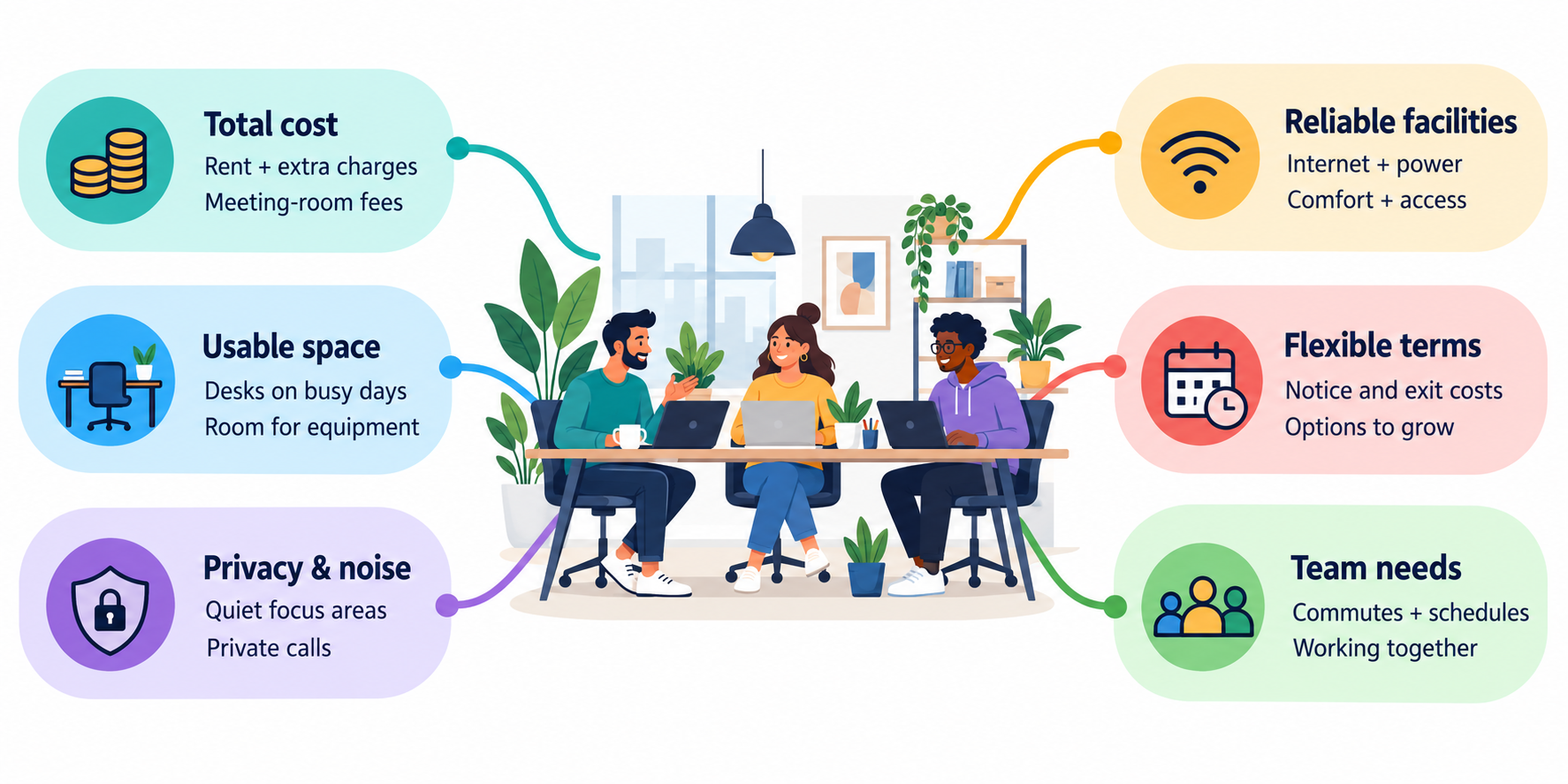
That's the practical challenge behind searching for "communal work spaces near me". You're balancing location, cost and usable space—and an affordable desk isn't necessarily good value if you can't take a private call or seat your team together.
Public discussions reflect these concerns.
In one Reddit thread, a prospective coworking user questioned the combined expense of membership, commuting and food.
In another, a user described struggling to concentrate because of lengthy phone conversations in the shared workspace.
These are individual experiences rather than representative research, but they highlight useful questions to ask before paying.
Why Finding Communal Work Spaces Near Me Is About More Than Location
The advertised price may not cover the space you need
When comparing offices to rent, check whether the price includes enough meeting-room time for your normal working week.
CoworkingCafe's Q2 2026 report put the UK median meeting-room rate at £30 per hour, rising to £54 in Greater London.
At £30 an hour, eight hours of separately charged meeting-room use would add £240 to your monthly bill.
That's an illustration, not a quote: some memberships include room credits or different rates.
A cheaper membership can therefore become less attractive once you add the facilities your team actually needs.
£30/hour
The UK median starting rate for coworking meeting rooms
Check what your workspace membership includes. CoworkingCafe’s Q2 2026 report puts the UK median starting meeting-room rate at £30 per hour. Eight hours charged separately at that rate would add £240 a month. This is an illustrative calculation, not a provider quote.
Source: CoworkingCafe — Q2 2026 report , published 29 July 2026.
Is shared workspace worth the total cost? In the discussion below, a Reddit user questions coworking membership costs alongside commuting and food expenses. It is an individual perspective, not survey evidence.
Why should I pay to work? in r/CoWorking
Before committing: ask for a written total covering your desks, meeting hours and additional charges.
Available desks don't always mean suitable space
Space is also about availability at the right time.
A recent Reddit discussion about workplace hot-desking described competition for preferred desks and bookings that went partly unused.
Although that discussion concerned an employer's office rather than a commercial coworking provider, it illustrates why booking arrangements deserve attention.
Before choosing an office to let, ask:
- Can everyone sit together on your busiest day?
- Are hot desks guaranteed or subject to availability?
- Can several employees take calls without disturbing others?
- How far ahead do meeting rooms need booking?
- What would adding two more people cost?
The strongest shortlist balances total cost with usable space.
Whether you search for "offices to rent near me" or "offices to let near me", compare what each option lets your team do during a normal working day—not just its distance from your postcode.
What Kind of Workspace Does Your Business Need?
Before comparing offices to rent, think about what your team needs to do during a normal working day.
Do employees spend hours on customer calls, need quiet space to concentrate or mainly come together for meetings?
Communal workspaces are shared environments where different businesses use facilities such as kitchens, meeting rooms and lounges.
But renting a hot desk in an open room gives you a different experience from having a private office within the same building.
| Workspace type | Worth considering when… | What to check |
| Coworking hot desks | Attendance varies and employees don't need permanent desks | Booking rules, peak-day availability, noise and storage |
| Dedicated desks | Regular attendees want a consistent place to work | Security, storage, privacy and guest access |
| Private serviced office | Your team needs an enclosed room with managed facilities | Included services, meeting-room allowances and extra charges |
| Conventional office lease | You need greater control over the layout and a longer-term base | Fit-out costs, repairs, lease obligations and options for expansion |
Plan around your busiest realistic day, alongside your usual attendance.
If you employ 15 people but normally have six on site, you may not need 15 permanent desks. However, you still need a workable arrangement for days when everyone attends—whether that means reserving extra desks or booking a suitable meeting room.
Businesses comparing their options can use this practical guide to choosing commercial space for a small business to evaluate property types, location, costs and due diligence.
Before viewing an office to let, write down your essential requirements: desk numbers, private call space, accessibility, storage and budget.
This gives you a consistent way to assess each property and helps you avoid paying for features your team won't use.
Check Usable Space Against Rentable Space
When comparing offices to rent, don't assume the advertised square footage is all available for your desks and equipment.
Usable square footage generally describes the space your business can occupy within its premises. Rentable square footage can also include an allocated share of common areas. The measurement method matters: BOMA's office measurement standards provide a recognized framework for calculating rentable office area.
Before comparing prices, ask the landlord or broker:
- Is the advertised size usable or rentable square footage?
- What shared areas are included in the calculation?
- Which measurement standard was used?
- Can you provide a floor plan showing the dimensions and areas included?
For example, a listing might quote 1,200 rentable square feet, while the private office area is smaller. Check the actual layout to see whether your desks, storage and meeting space fit comfortably.
Compare both the area you pay for and the space your team can actually use.
Searching for Offices to Rent Near Me? Define "Near" First

Searching for Offices to Rent Near Me? Define "Near" First
An office five minutes from your home might mean an hour-long commute for everyone else.
Before searching for "offices to rent near me", decide whose journey the location needs to work for: your employees, customers or both.
Start by asking your team which areas they can reasonably reach.
Compare travel times during normal commuting hours, rather than relying on distance alone. A slightly farther office with a direct train connection could be easier to reach than somewhere nearby that requires two buses.
When comparing locations, check:
- Public transport: Are services frequent enough for your working hours?
- Parking and cycling: Are spaces available, secure and included in the price?
- Accessibility: Is there a suitable route from the station or car park through to the workspace?
- Evening journeys: Are surrounding streets well lit, and can employees get home after late meetings?
- Customer access: Can visitors find the building and reach reception easily?
Make your searches specific enough to reflect those needs:
- "Offices to rent near [station or town]"
- "Private coworking office for eight people in [location]"
- "Offices to let near me with step-free access"
- "Serviced office with meeting rooms in [postcode]"
When an office to let makes your shortlist, confirm its exact address, current availability and usable space with the provider. Ask which photographs show your proposed office and which show communal facilities.
Visit using the journey your employees would actually make.
Try the commute at your usual start time and check the return options. That gives you a more useful picture than a map pin or an advertised "five-minute walk from the station".
Compare the Total Cost of Offices to Rent
An office advertised at $1,200 a month might look affordable—but what will you actually pay once your team moves in?
When comparing offices to rent, ask each provider for a written breakdown of recurring charges, upfront payments and potential exit costs.
This helps you compare a coworking membership, serviced office and conventional lease on the same basis.
| Cost to check | What to ask |
| Rent or membership | Is the price per person, per desk or for the whole office? |
| Service charges and utilities | What is included, and can charges increase? |
| Internet, cleaning and parking | Are these included, optional or charged separately? |
| Meeting rooms | How many hours are included, and what do additional bookings cost? |
| Business rates | Are they included in the quote, and who is responsible for paying? |
| VAT | Does the quoted price include any applicable VAT? |
| Deposit and setup | How much is payable upfront, and when is the deposit refundable? |
| Leaving the space | Could notice requirements, repairs or reinstatement create additional costs? |
$45 per hour:
the national median starting price for coworking meeting rooms
reported in CoworkingCafe’s September 2026 U.S. pricing study
Budget for the meeting space your team actually needs. When comparing offices to rent, check whether meeting-room hours are included or charged separately. At $45 an hour, eight hours of separately billed room use would add $360 to a monthly budget. This calculation is illustrative, not a provider quote.
Data context: CoworkingCafe’s U.S. pricing report, published September 9, 2026, reports a national median starting meeting-room price of $45 per hour. This is a listing-based pricing benchmark, not an average invoice or a guaranteed rate in your location. Room capacity, facilities, booking conditions and membership allowances can differ.
Check business rates before agreeing to an office to let
According to US law firm Holland & Knight's guide to commercial lease costs, tenants under a triple net (NNN) lease typically pay a share of property taxes, building insurance and operating expenses in addition to base rent.
Before committing, ask which costs are included and which are billed separately.
Your actual responsibilities depend on the lease wording, so don't assume the advertised rent covers everything.
Turn the advertised rent into a realistic budget
Here's an illustrative monthly calculation, rather than a market quote:
| Expense | Monthly amount |
| Advertised rent | $1,200 |
| Common area maintenance (CAM) or building service charges | $250 |
| Utilities | $180 |
| Additional meeting-room bookings | $120 |
| Subtotal before any applicable taxes or other lease charges | $1,750 |
That is $550 more each month, or $6,600 over a year, than the advertised rent. Security deposits, furniture and setup costs would need a separate upfront budget.
These figures are illustrative, not US market averages. Check which expenses are included in the rent to avoid counting them twice.
Also remove the UK business rates and VAT references from the surrounding section to keep the article consistent with your US audience.
Confirm the Space Allows Your Business Activities
An attractive office to let still needs to accommodate the way your business operates.
Regular customer appointments, training sessions, product storage or evening events may introduce requirements that ordinary desk-based work does not.
The U.S. Small Business Administration's guidance on choosing a business location explains that local zoning can restrict particular business activities. It recommends checking with the local planning department or equivalent office before choosing premises.
Confirm these points before committing:
- Permitted use: Does the lease allow your specific business activities?
- Local approvals: Does your intended use require zoning confirmation, permits or occupancy approval?
- Visitors: Are customer appointments, group sessions and events allowed?
- Operating hours: Can your team work evenings or weekends?
- Signage: Can you display your company name outside the building?
- Alterations: Can you install partitions, equipment or additional wiring?
- Deliveries and storage: Are there restrictions affecting supplies, packages or inventory?
Ask the provider about building rules and lease permissions, then verify local requirements with the relevant authority. Landlord approval and local government approval are separate checks.
Viewing an Office to Let: Things to Check Before You Commit
When viewing an office to let, picture your team using it on a busy working day. Would everyone have somewhere comfortable to work, take calls and meet without getting in each other's way?
Visit during normal working hours so you can assess the space while other tenants are using it.
Use this checklist when comparing offices to rent:

Viewing an Office to Let: Things to Check Before You Commit
| What to check | What to look for or ask |
| Usable space | Can desks, chairs and equipment fit comfortably, with clear walking routes? Confirm which areas are exclusively yours. |
| Desk availability | Are seats guaranteed, assigned or first come, first served? Can your team sit together? |
| Noise | Listen for calls, conversations, traffic and construction. Are quiet areas separate from social spaces? |
| Internet | Test a video call from the actual office. Ask about upload speeds, wired connections, outages and backup connectivity. |
| Power outlets | Are outlets conveniently positioned for your equipment without trailing cables across walkways? |
| Privacy | Can conversations be overheard outside meeting rooms? Are private call spaces available when you need them? |
| Meeting rooms | Check capacity, screens, video-call equipment, booking rules and additional charges. |
| Lighting and temperature | Look for screen glare, poor lighting, stuffiness and uncomfortable temperatures. Ask who controls heating and cooling. |
| Furniture | Try the chairs and desks. Confirm which furniture is included and whether you can bring your own. |
| Accessibility | Check the route from parking or public transportation to the entrance, elevators, workspace, restrooms and meeting rooms. |
| Security and storage | Ask about access controls, visitors, lockable storage and responsibility for lost or stolen equipment. |
| Facilities | Inspect restrooms, kitchens and shared areas. Ask how often they are cleaned and how maintenance issues are handled. |
| Access hours | Confirm evening, weekend and holiday access, including any additional fees. |
| Parking and deliveries | Check parking availability, bike storage, delivery arrangements and package security. |
| Condition and repairs | Look for leaks, damage and worn equipment. Record existing issues and get promised repairs in writing. |
| Room to grow | Ask what happens if you need extra desks or a larger office, including the cost and notice required. |
Where available, book a trial day before signing.
Bring colleagues who handle different tasks, such as customer calls, focused work and team meetings. Test the space using your normal equipment and working routine.
Afterward, ask each person what helped them work and what got in the way. Use that feedback alongside the full cost and agreement terms when making your decision.
Understand How the Office Rent Is Quoted
Before comparing offices to rent near me, check exactly what each advertised price means.
A quote might cover a desk, a private office, or a price per square foot—and the time period can change the calculation significantly.
Ask whether the rate is:
- Per person or per desk each month.
- For the entire office each month.
- Per rentable square foot per year.
- Per square foot per month.
Illustrative example: If an office contains 1,000 rentable square feet and the quoted base rent is $30 per square foot per year, the calculation is:
1,000 × $30 = $30,000 annually
$30,000 ÷ 12 = $2,500 monthly
That is the base rent. Add any separately payable operating expenses, utilities, insurance or property-tax charges specified in the agreement.
Ask every provider for a monthly total based on the same requirements, with additional charges clearly identified.
This makes it easier to compare a coworking membership with a serviced office or conventional commercial lease.
Keep Your Team Connected After the Move
You've found the right space—but does everyone know how to use it?
A move runs more smoothly when employees can find practical information without repeatedly asking a manager.
Before the first working day, publish a short office guide in one shared location. Include:
- Getting there: The address, public transportation options, parking and accessible entrances.
- Building access: Opening hours, entry instructions and what to do if an access card stops working.
- Desks and meeting rooms: How to reserve space, invite visitors and cancel unused bookings.
- Shared-space etiquette: Expectations for calls, noise, kitchens and keeping desks clear.
- Help and safety: Office contacts, emergency procedures and where to report maintenance or IT problems.
- Policies and documents: Links to current workplace guidance and relevant company policies.
Make someone responsible for keeping this information current.
Update the guide when access arrangements, contacts or booking procedures change, and tell employees about changes that affect them.
Give remote employees the same access to informationIf some employees work from home or another location, avoid letting important decisions stay in office conversations. Record meeting outcomes, share announcements and make documents available to everyone who needs them.
An employee hub such as AgilityPortal's workplace hub can provide a central place for office guidance, company updates and shared resources.
For example, an employee could check arrival instructions before visiting, find the latest policy and catch up on a team announcement from the same place.
After the first few weeks, ask employees what is still confusing. Use their feedback to improve both the office arrangements and the guidance. A successful move should make everyday work easier, wherever your employees are working.
Choose a Space That Works for Your Business
Start with what your business needs, then compare properties against those requirements.
Look at the full cost, check how much flexibility you need and use the same criteria to assess every option.
Local conditions matter, too. Rent, availability and room for negotiation vary between locations, so check your assumptions against current listings and written quotes in your target area.
The right commercial space supports everyday work without creating constant financial or practical headaches.
Your team can work comfortably, the costs remain manageable and the agreement gives you options when circumstances change.
Choose a space that fits your people, your budget and your plans—with enough flexibility for those plans to evolve.
Your Final Workspace Checklist
Before turning your search for "offices to let near me" into a signed agreement, check that the space meets your team's everyday needs.
Use this checklist to review your shortlist:
- The location works for your team. Employees can reasonably reach the office during normal commuting hours, with suitable transportation, parking and accessible routes.
- There is enough usable space. Your busiest expected day is covered, including desks, private calls and team meetings.
- You have tested the working environment. You have checked noise, internet connectivity, lighting, temperature and meeting facilities during working hours.
- The full cost fits your budget. You understand the rent, additional charges, upfront payments and any expenses that could increase.
- Responsibilities are clear. The agreement explains who handles maintenance, repairs, cleaning, security and other building services.
- You understand how to leave. Notice periods, renewal provisions, deposit conditions and potential end-of-agreement charges are clear.
- There is a realistic plan for growth. You know whether you can add desks, change offices or reduce space—and what those changes would cost.
- Employees have the information they need. Access instructions, office contacts, booking procedures and workplace guidance are ready to share.
If you cannot confidently check an item, ask for clarification before committing. Get important promises about costs, facilities or flexibility in writing.
Choose the workspace that fits how your team actually works and what your business can afford. A comfortable working environment, manageable costs and a clear agreement give you a stronger foundation for growth.
Final Thoughts on Choosing the Best Workplace Operations Platform
Searching for "communal work spaces near me" is a useful starting point.
The next step is finding somewhere your team can work comfortably at a cost your business can sustain.
When comparing office spaces for rent, focus on everyday needs: a manageable commute, enough usable space, reliable internet and privacy when it matters. Test your shortlist during working hours, request a complete cost breakdown and understand the agreement before signing.
Think beyond moving day, too.
Your space should accommodate realistic changes in your team, while employees need clear access instructions, shared information and ways to stay connected wherever they work.
Start with your requirements, compare each option consistently and choose the space that supports your next stage of growth.
FAQ
What should I check when comparing office spaces to let?
When comparing office spaces to let, check the usable floor area, total monthly cost, internet, accessibility and agreement terms.
Visit during working hours to assess noise and how busy shared facilities become. Ask for important promises about repairs, services and availability in writing.
How do I find office spaces near me that suit my team?
Start your search for "office spaces near me" with locations employees can reasonably reach.
Compare commuting times, public transportation, parking and nearby facilities.
Shortlist properties that meet your budget and working requirements, then confirm availability directly with the provider.
What should I look for when searching for office spaces to rent near me?
When searching for "office spaces to rent near me", look beyond the advertised price.
Confirm how many people the space comfortably accommodates, whether meeting rooms cost extra and what happens if your team grows.
A trial day can help you test the space before committing.
What does "spaces for rent business" mean in property searches?
The search phrase "spaces for rent business" can return offices, retail units, workshops and other commercial properties.
Narrow your search by adding your location and intended activity, such as "private office for six people in Austin." Confirm that the property permits your proposed use.
What questions should I ask before choosing an office for lease?
Before choosing an office for lease, ask how rent is calculated, which expenses are additional and whether payments increase during the term.
Also clarify maintenance responsibilities, renewal options, security deposits and any conditions for leaving or transferring the lease.
Are commercial spaces for rent suitable for every business?
Commercial spaces for rent serve different purposes, so a property advertised as commercial will not automatically suit your activities.
Check the layout, building facilities, lease restrictions and local requirements. Customer-facing businesses may need different access, parking and facilities from a desk-based team.
What should I consider before taking an office on lease?
Taking an office on lease means assessing the full commitment, including upfront costs, ongoing charges and obligations when the agreement ends.
Consider how long you can realistically predict your space requirements, and have a qualified commercial real estate attorney review terms you do not understand.
How do I choose a small office to rent?
Choose a small office to rent by checking how your team and equipment fit into the actual layout.
Allow for comfortable seating, storage, clear walking routes and private conversations. Confirm whether the advertised capacity includes practical working space or simply the maximum number of desks.
Is a small office to let the same as a coworking desk?
A small office to let usually refers to an enclosed room or suite, while a coworking desk is typically within a shared working area.
However, listing terminology varies. Confirm whether you receive exclusive use, lockable access and permission to leave equipment overnight.
What is included in serviced offices to let?
Serviced offices to let may include furniture, internet, utilities, cleaning and access to shared facilities.
Packages vary, so request an itemized quote. Check meeting-room allowances, printing, parking, after-hours access and any fees for adding employees.
How should growing companies compare business spaces to rent?
Compare business spaces to rent against the same requirements: attendance, location, privacy, facilities and total cost.
Ask how easily you can add desks or move into a larger unit. Balance that flexibility against any additional price or commitment.
What should I check before choosing a commercial room for rent?
Before choosing a commercial room for rent, confirm that its permitted use matches your work.
Check privacy, sound insulation, visitor access, storage and shared facilities. Ask whether utilities and cleaning are included and whether there are restrictions on operating hours or equipment.
Should I consider offices for sale near me instead of renting?
Searching for "offices for sale near me" may be worthwhile if you need a long-term base and have the funds to buy and maintain premises. Compare financing, ownership expenses and the effect on cash reserves with renting.
Consider whether the property could still suit your business if staffing or location needs change.
How can I compare office spaces for rent fairly?
Compare office spaces for rent using a consistent monthly budget and the same assumptions about desks, attendance and meeting hours. Separate refundable deposits from ongoing expenses, include additional charges and check what each agreement provides.
This makes headline prices more meaningful.
AI Summary
- Searching for communal work spaces near me starts with understanding your team’s needs. Compare hot desks, dedicated desks, private serviced offices and conventional office leases against attendance, privacy, facilities and budget.
- When comparing office spaces to rent near me, assess commuting times, public transportation, parking and accessibility for your employees and visitors. Confirm the exact location and current availability directly with the provider.
- Compare the total cost of office spaces for rent, including additional building charges, utilities, meeting rooms and any property taxes or insurance expenses passed through under the agreement. Confirm whether rent is quoted monthly, annually or per square foot.
- Check usable space against rentable square footage. Visit during working hours to test noise, internet, comfort, desk availability and private call facilities. Where available, arrange a trial day with employees who have different working needs.
- Before choosing an office for lease, confirm permitted business activities and applicable local requirements. Review repair responsibilities, rent increases, renewal provisions, exit conditions and options for changing your space as the team grows.
- Keep employees connected after the move with clear access instructions, office contacts, booking procedures and shared policies. An employee hub such as AgilityPortal can provide a central place for guidance, documents and announcements across working locations.
Most Popular Posts

Effective communication among team members is vital for the productivity and success of any organization. Surprisingly, 60% of companies lack a long-term internal communication strategy, which p...


Businesses thrive on communication for efficiency, productivity and accomplishment. When the right information is passed from the right designation in the organization, it promotes positivity an...

Categories
Blog
(3248)
Business Management
(399)
Employee Engagement
(237)
Digital Transformation
(224)
Growth
(151)
Intranets
(142)
Internal communications
(110)
Remote Work
(68)
Sales
(53)
Collaboration
(53)
Customer Experience
(33)
Culture
(30)
Project management
(30)
Knowledge Management
(29)
Leadership
(20)
Comparisons
(9)
News
(1)

Related Posts

Searching for "communal work spaces near me" but unsure which option will actually suit your growing business? By the end of this guide, you'll know how to compare offices to rent, spot extra costs and ask the right questions before committing....

Do you know what happens to your information after you share it with an AI assistant? That question sits at the heart of AI privacy—and it's easy to overlook when you're trying to finish a task. You paste in a customer email, upload a spr...

What would happen if your website moved successfully, but your customers and employees suddenly couldn't reach you by email? Email migration tools can help transfer your messages, but keeping business communication running takes more than copyi...

Does your team still message HR to ask where the holiday policy is? Employee self service should make everyday tasks easier, giving people a straightforward way to find answers, access documents and submit requests. But when policies are buried...

How quickly can a new partner go from signing an agreement to confidently working with your business? If the answer involves chasing documents, forwarding training links and answering the same questions repeatedly, your onboarding process may n...


Jill Romford
I am a digital nomad, lover of exploring new places and making friends.
I love to travel and I love the internet. I take pictures of my travels and share them on the internet using Instagram.
Traveler, entrepreneur, and community builder. I share my insights on digital marketing and social media while inspiring you to live your fullest life.
Ready to learn more? 👍
One platform to optimize, manage and track all of your teams. Your new digital workplace is a click away. 🚀
Free for 14 days, no credit card required.