
Insight Blog
Agility’s perspectives on transforming the employee's experience throughout remote transformation using connected enterprise tools.
45 minutes reading time
(8999 words)
Growing Globally? How to Manage International Shipping Without Losing Team Alignment

Growing Globally? How to Manage International Shipping Without Losing Team Alignment
Learn how to manage international shipping as your business grows while keeping global teams aligned, informed and ready to handle disruption.
Growing Globally? How to Manage International Shipping Without Losing Team Alignment

International shipping can feel surprisingly straightforward when you're sending a few orders abroad each month.
Pick a carrier, complete the paperwork, track the parcel and keep the customer informed.
But when a business starts growing internationally, that simple process can quickly turn into a web of customs requirements, carriers, suppliers, warehouses, customer service teams and employees working across different countries and time zones.
And the external environment isn't getting simpler.
The International Chamber of Shipping's 2025–2026 Maritime Barometer identified geopolitical instability as the industry's leading risk, alongside concerns including regulatory fragmentation and cybersecurity.
#1
shipping industry risk
The International Chamber of Shipping's 2025–2026 Maritime Barometer identified geopolitical instability as the industry's leading risk, with wider concerns including regulatory fragmentation, cybersecurity and changing global trade patterns.
Source: International Chamber of Shipping, Maritime Barometer 2025–2026
That matters because a delayed shipment isn't only a logistics problem.
Someone may need to update the customer.
Finance might need to understand an unexpected charge.
Sales needs a realistic delivery date.
A regional manager may need to change plans.
Leadership may need to know whether the problem is isolated or affecting hundreds of orders.
This guide explains how to manage international shipping while keeping growing teams aligned, informed and able to make decisions without turning every shipping problem into another meeting.
Key Takeaways
- International shipping becomes an internal communication challenge as businesses expand across more markets, carriers, warehouses and time zones.
- Shipping delays, customs issues and carrier changes can quickly affect operations, sales, customer service and finance when teams are not working from the same information.
- Clear ownership, documented escalation procedures and market-specific guidance help global teams make faster decisions when shipping problems occur.
- Specialist logistics systems should manage shipments, while employee communication and knowledge platforms help people find procedures, understand changes and coordinate their response.
- Growing businesses should treat team alignment as an ongoing part of international shipping strategy rather than waiting for communication problems to appear as volumes increase.
International Shipping Isn't Just About Moving Parcels Anymore
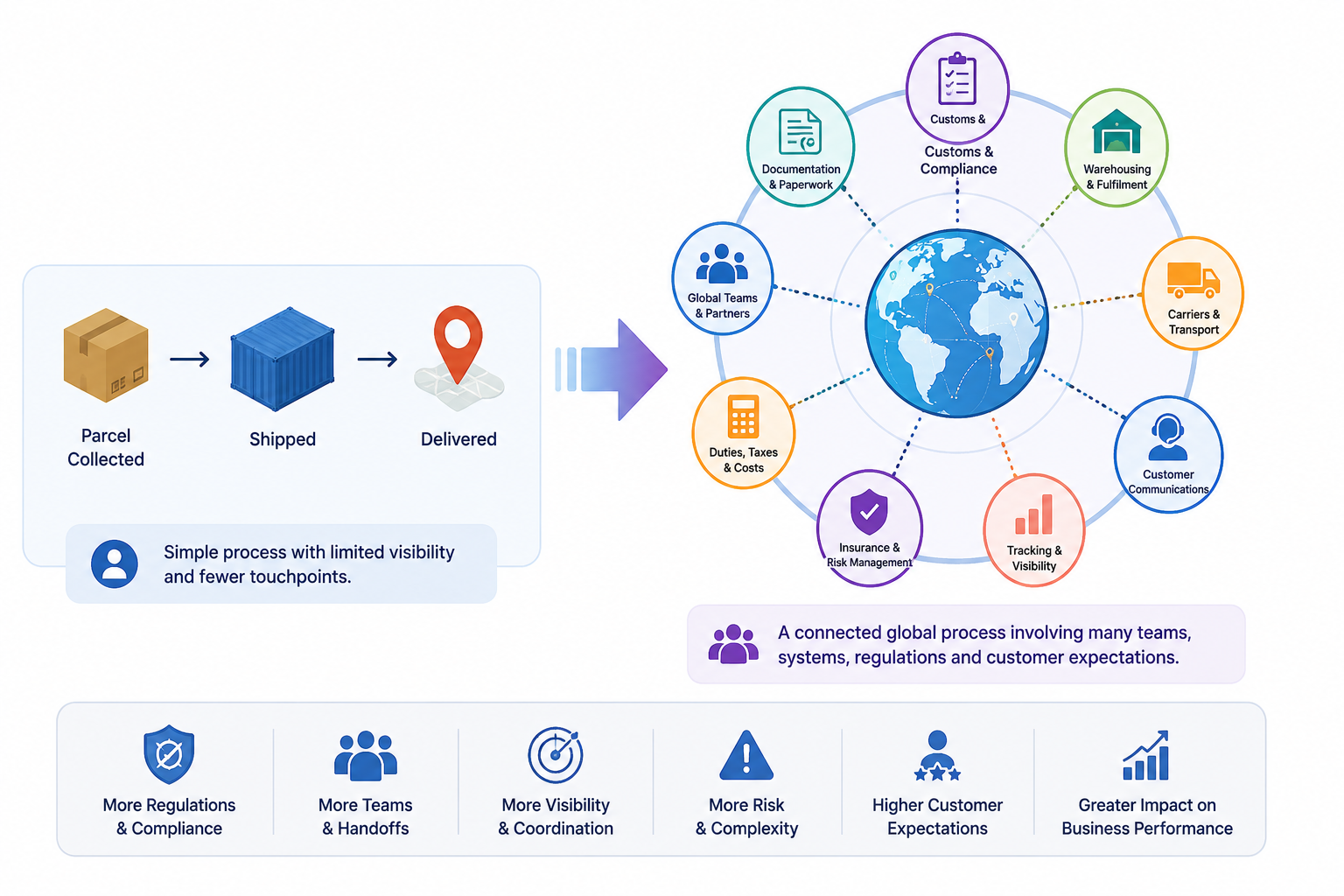
International Shipping Isn't Just About Moving Parcels Anymore
At its simplest, international shipping means transporting goods from one country to another.
But businesses don't operate at their simplest for very long.
As order volumes increase—especially in global ecommerce fulfillment environments—international shipping starts touching more parts of the organisation:
- Operations chooses carriers and coordinates fulfilment.
- Finance monitors duties, taxes and shipping costs.
- Sales communicates delivery expectations.
- Customer service handles delays and complaints.
- Procurement works with suppliers.
- Warehouse teams prepare goods and documentation.
- Compliance teams may monitor regulatory requirements.
- IT maintains the systems connecting those activities.
- Managers make decisions when something doesn't go according to plan.
That's the part growing companies sometimes underestimate.
You're not simply scaling the number of parcels leaving a warehouse. You're scaling the number of decisions, handoffs and pieces of information surrounding every shipment.
And every additional handoff creates another opportunity for information to get lost.
The Real Tension: Global Reach Creates Opportunity and Complexity
Selling internationally can open access to customers that would have been unreachable a generation ago.
That's the opportunity.
The complication is that your internal operating model has to grow with your external reach.
A company might start with:
One warehouse → one carrier → one operations manager → one market
A few years later, the same business could be dealing with:
Multiple warehouses → multiple carriers → customs agents → suppliers → regional managers → customer service teams → multiple currencies → different regulations → several time zones
At this stage, international shipping is no longer just a fulfilment function—it becomes a coordination challenge across the entire organisation. Every shipment now depends on multiple teams making aligned decisions at the right time, often without sharing the same working hours or even the same systems.

The Real Tension: Global Reach Creates Opportunity and Complexity
For example, a delay at customs in Germany might require operations to reroute stock, finance to adjust landed cost forecasts, customer service to update delivery expectations, and sales to renegotiate timelines with a key account—all within the same 24-hour window.
If those teams are not working from the same information, the customer may receive conflicting updates or no update at all.
Or consider a scenario where a supplier in Asia changes packaging specifications. The warehouse team may adapt quickly, but if procurement, compliance, and logistics are not aligned, shipments can be rejected at the destination port, creating avoidable delays and additional costs.
The shipping process hasn't simply become bigger.
It has become more interconnected.
And that interconnectedness is where most growing businesses feel the strain: delays are no longer isolated events, they ripple across departments, customers, and markets almost instantly.
That's why businesses need to think about international shipping as both a logistics process and an information-management process.
Where International Shipping Starts Getting Complicated
International expansion introduces requirements that domestic shipping teams may never previously have encountered.
What often looks like a simple "send it abroad" process quickly becomes a regulated, multi-step workflow involving compliance, documentation, finance, logistics partners and customer communication all at once.
At a domestic level, most teams are used to predictable rules: standard delivery addresses, familiar carriers, and relatively consistent tax structures. Once you move across borders, that simplicity disappears.
Every country introduces its own import rules, documentation standards, restricted goods lists, and customs expectations. Even small differences in how data is recorded can cause delays at the border.
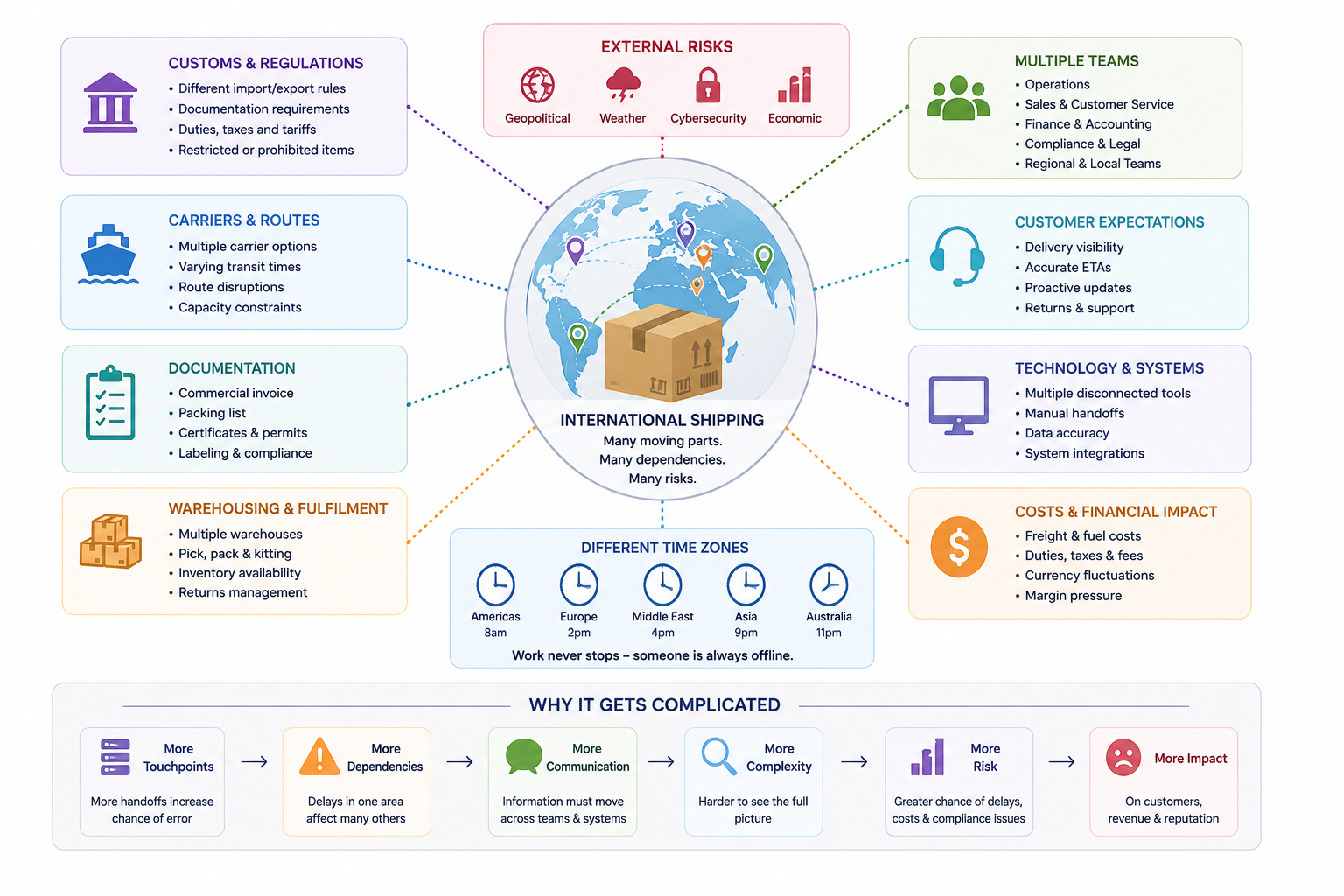
Where International Shipping Starts Getting Complicated
For UK exporters, for example, HMRC guidance states that businesses may need an EORI number and export declaration, while declarations can require information including commodity codes, departure and destination details, consignee and consignor information, packaging, transport methods, costs, valuation information, licences and certificates.
In practice, this means that a single shipment depends on multiple internal teams providing accurate, consistent data before the goods even leave the warehouse.
Those requirements make accurate information important long before a parcel reaches the border.
A missing code, incorrect valuation, or incomplete consignee detail doesn't just slow down shipping—it can trigger inspections, additional charges, or even the return of goods to sender. This is why international shipping is as much about data quality and internal coordination as it is about physical transport.
From a customs and documentation point of view
Documentation errors can delay otherwise perfectly prepared shipments, and in international logistics, even minor inconsistencies can escalate quickly. Customs authorities rely entirely on the accuracy of the information provided, and they will not interpret or "fill in the gaps" if something is missing.
Depending on the goods and markets involved, teams may need to manage:
- Commercial invoices
- Customs declarations
- Commodity or HS codes
- Certificates
- Export licences
- Country-of-origin information
- Consignee details
- Shipment valuations
- Transport documentation
Each of these documents often depends on different departments. For example, finance may control valuation data, operations may handle packaging and dispatch details, and compliance may be responsible for licensing. Without a clear process, these dependencies can easily break down.
This is one reason responsibility needs to be clear. In many growing businesses, international shipping issues don't come from lack of effort—they come from unclear ownership.
If operations thinks finance owns a document while finance assumes the freight forwarder handles it, nobody really owns it. The result is last-minute scrambling, delayed shipments, and avoidable customer impact.
Duties, taxes and landed costs
The price of shipping isn't necessarily the total cost of getting the product to the customer. In international trade, the "shipping cost" is only one part of the full landed cost equation.
Businesses may need to consider tariffs, import VAT, customs duties, brokerage fees, insurance, storage and other destination-specific costs. These can vary significantly depending on the product category, country of origin, trade agreements, and even how goods are classified under customs codes.
This becomes especially important when scaling into new markets. A product that is profitable domestically may become significantly less profitable once duties and import taxes are applied. Without visibility of these costs, businesses risk underpricing products or eroding margins without realising it.
If those costs aren't visible internally, sales teams can promise margins or prices that don't reflect reality. This is where alignment between finance, sales, and operations becomes critical. Everyone needs access to the same landed cost assumptions so that pricing decisions are based on accurate, up-to-date information rather than estimates or outdated spreadsheets.
Carrier selection
Courier, air freight, sea freight and road freight all solve different problems, and choosing the right option is rarely just a cost decision. Each method comes with trade-offs in speed, reliability, capacity, tracking visibility, and risk exposure.
A business sending urgent replacement components has different requirements from one moving pallets of low-margin goods. In the first case, speed and reliability may outweigh cost considerations entirely. In the second, cost efficiency and consolidation may be more important than delivery speed.
The cheapest carrier isn't automatically the best choice if delays generate customer complaints, missed installations or production downtime. In international shipping, the "true cost" of a delay often extends far beyond the logistics invoice. It can affect customer relationships, service-level agreements, and even contractual penalties.
This is why carrier selection should be treated as a strategic decision rather than a purely operational one. It should reflect customer expectations, product criticality, and the business's tolerance for risk—not just the lowest available rate.
Returns
International returns are easy to overlook when expansion is being planned, but they quickly become a significant operational challenge once cross-border sales begin to scale.
Then customers start returning products, and the complexity increases immediately. Unlike domestic returns, international returns often involve additional customs declarations, re-import documentation, duties, and longer transit times. In some cases, returned goods may even be treated as new imports when re-entering the country of origin.
Suddenly the company needs processes for reverse logistics, customs documentation, refunds, inspection and inventory reconciliation. Each of these steps may involve different teams, systems, and external partners, which increases the risk of delays or miscommunication if processes are not clearly defined.
Returns should be designed into the international shipping strategy rather than treated as an exception later. Businesses that plan for returns early are better able to protect margins, maintain customer satisfaction, and avoid operational bottlenecks when return volumes increase.
Why Team Alignment Becomes a Shipping Problem
Imagine this.
A UK business sells equipment to customers throughout Europe.
A shipment to a major customer is held at customs.
The warehouse knows because the carrier contacted them.
Customer service doesn't.
Sales doesn't.
The account manager tells the customer everything is still on schedule.
Meanwhile, operations discusses the problem in a private messaging channel. Someone eventually emails finance. A regional manager hears about the delay the following morning.
Nothing particularly dramatic happened.
Nobody deliberately withheld information.
The business simply didn't have a reliable way of turning a logistics event into shared organisational knowledge.
That's how misalignment happens.
And research into global teams has repeatedly highlighted the importance of communication, role clarity and trust. A study of 218 global project workers across 33 teams found important relationships between aligned communication norms, role clarity, trust, satisfaction and performance.
Shipping software can tell you where the package is.
It can't automatically ensure every employee who needs that information understands what it means for their work.
218
global project workers
Research involving 218 global project workers across 33 teams found important links between communication norms, role clarity, trust, employee satisfaction and project performance.
Source: International Journal of Project Management
Maybe Your Shipping Technology and Workplace Technology Have Different Jobs
This distinction matters.
A transport management system, carrier portal, or warehouse management app is designed to excel at one thing: moving and tracking physical goods efficiently across complex supply chains.
In contrast, your employee communication and knowledge systems are built to support something entirely different—how people understand, coordinate, and act on information inside the organisation.
When businesses try to force one system to replace the other, they often introduce unnecessary complexity, duplicated effort, and confusion about where information actually lives.
A more effective approach is to recognise that each system has a distinct role in the wider operational ecosystem:
| System | Primary Job | Typical Information |
| Shipping platform | Move and track goods | Carrier, tracking, delivery status |
| Warehouse system | Manage fulfilment | Inventory, picking, packing |
| ERP | Manage business transactions | Orders, purchasing, finance |
| CRM | Manage customer relationships | Accounts, opportunities, interactions |
| Employee intranet | Keep employees aligned | Policies, updates, procedures, knowledge |
| Workplace chat | Coordinate conversations | Questions, alerts, discussions |
The goal is not to consolidate everything into a single "all-in-one" tool.
Instead, it is to design a clear and connected information environment where employees instinctively know where to find the right information, at the right time, without friction or guesswork.
What Information Should Global Teams Actually Share?
Not every employee needs every shipping update.
If everyone is constantly notified about every minor change, the result isn't better alignment—it's information overload. People start ignoring updates, important signals get lost, and teams end up slower to respond, not faster.
Instead, global organisations should be intentional about what becomes shared operational knowledge versus what stays within specialist systems or teams.
Shipping policies
Create a single, trusted source of truth that everyone can rely on.
This should clearly define:
- Approved carriers and preferred shipping partners
- Standard shipping methods by region or product type
- Packaging and labelling requirements
- Insurance rules and liability coverage
- Customs procedures and compliance steps
- Restricted or prohibited products by market
- Returns and reverse logistics processes
- Escalation procedures for delays or issues
- Required documentation for international shipments
The key principle is consistency. When something changes—whether it's a carrier update, a customs rule, or a packaging requirement—it should be updated in this central location immediately. Avoid scattering updates across email threads, PDFs, or chat messages that quickly become outdated.
Market-specific guidance
International shipping is never truly "one-size-fits-all." Each market has its own rules, expectations, and operational realities.
For example, shipping into France may involve different customs expectations than shipping into Canada, Australia, or Japan.
To support this, regional teams should have access to clearly structured, market-specific guidance such as:
- Local delivery expectations and service levels
- Country-specific customs requirements and documentation rules
- Key regional contacts (carriers, brokers, partners)
- Approved local carriers or fulfilment options
- Market-specific escalation routes
- Known restrictions or regulatory considerations
- Returns handling processes by region
This ensures local teams can act confidently without constantly waiting for HQ clarification.
Disruption updates
Operational disruption should never be buried in individual inboxes or private chat threads.
When something significant happens—such as a carrier suspending a route, customs delays increasing, or geopolitical events affecting trade lanes—employees need immediate access to a single, verified source of truth.
This central update should clearly communicate:
- What has changed
- Which shipments or markets are affected
- What actions are being taken
- What teams need to do next
- When the next update will be provided
The goal is simple: reduce confusion, eliminate duplicated communication, and ensure every team is working from the same information at the same time.
Ownership
In global operations, uncertainty often comes not from the problem itself—but from not knowing who is responsible for solving it.
Every team should clearly understand who has authority when something goes wrong, especially across time zones where immediate clarification isn't always possible.
This includes defining:
- Who makes decisions during shipping disruptions
- Who owns escalation handling
- Who communicates with customers during incidents
- Who approves exceptions or alternative shipping methods
- Who is responsible for final resolution sign-off
When ownership is clear, teams move faster, decisions are made with confidence, and issues are resolved without unnecessary delays or internal confusion.
Who Should Own What?
Global shipping works better when responsibilities are explicit.
| Role | Responsibility | Why It Matters |
| Operations Manager | Shipping processes, carriers and fulfilment | Maintains day-to-day operational control |
| Supply Chain/Logistics Manager | Transport strategy and logistics partners | Connects shipping decisions with wider supply chain planning |
| Finance | Duties, taxes, shipping costs and financial controls | Helps manage regulatory exposure |
| Compliance/Legal | System access, integrations and security | Keeps operational information flowing securely |
| IT Director | Customer communication during delivery issues | Prevents operational problems becoming customer-experience failures |
| Customer Service | Documentation workflows | Reduces overpromising |
| Sales | Setting realistic customer expectations | Keeps distributed employees informed |
| Internal Communications | Significant company-wide operational updates | Resource management |
| Regional Managers | Local execution and escalation | Provides market-specific context |
| Zoho WLeadershiprkplace | Risk appetite and strategic decisions | Ensures shipping supports the wider growth strategy |
In smaller businesses, one person might perform several of these functions.
That's fine.
The important thing is knowing who owns the decision.
Global Teams Need Communication That Works While People Are Sleeping
One of the biggest differences between running domestic operations and managing a global business is something surprisingly simple: time.
When your team in London is finishing for the day, colleagues in New York may still have several hours left to work, while teams across Asia-Pacific could already be preparing for the next working day. That becomes particularly important in international shipping, where customs delays, carrier updates and customer problems don't necessarily happen during head-office working hours.
This changes how businesses need to think about internal communication.
If important decisions only exist inside meetings, video calls or private conversations, employees working in another time zone immediately start at a disadvantage. They may begin their shift without knowing that a shipment has been delayed, a customer promise has changed or a new customs issue needs attention.
That's why global operations work better when businesses adopt an asynchronous-first approach. Important information should remain accessible whether the person who created it is online or asleep.
That means consistently documenting things such as:
- Decisions and agreed actions
- Shipping and operational procedures
- Changes to policies or processes
- Incidents and service disruptions
- Responsibilities and ownership
- Deadlines and important dates
- Escalation procedures and contacts
Imagine a carrier informs your UK operations team at 4:30pm that several shipments won't clear customs as expected. By the time colleagues in another region start working, the UK team may already be offline.
If the update only exists inside a meeting or someone's inbox, those employees have to wait for answers. But if the issue, impact, owner and next steps have been recorded centrally, the next team can continue working immediately.
This doesn't mean businesses should eliminate meetings. Real-time conversations are still useful for resolving complicated issues, building relationships and making decisions quickly.
The important difference is what happens afterwards.
Decisions made during meetings should become accessible organisational knowledge rather than disappearing when everyone closes the call.
Put simply, meetings can help your global teams make decisions, but meetings shouldn't become the company's database.
The Human Side of Global Operations Matters Too
Global expansion isn't simply about processes and software.
You're bringing together people with different languages, cultures, working patterns and communication expectations.
Research published in 2025 reviewing 51 empirical studies on global virtual teams highlighted communication, cultural differences, team cohesion, communication technologies and human factors as recurring themes affecting global virtual teams.
That matters when operations become stressful.
A message such as:
"We need this sorted immediately."
may be interpreted differently depending on language, culture, hierarchy and context.
Businesses therefore need more than faster messaging.
They need clearer communication norms.
For example:
- What counts as urgent?
- Which channel should be used for an operational incident?
- Who needs to be informed?
- Who makes the final decision?
- When should something be escalated?
- What information must be documented afterwards?
Those rules remove ambiguity before pressure arrives.
51
empirical studies reviewed
A 2025 academic review analysed 51 empirical studies on global virtual teams and highlighted communication, cultural differences, team cohesion, technology and human factors as recurring influences on how distributed teams operate.
Source: Business and Professional Communication Quarterly, 2025
What Happens When Shipping Disruption Hits?
Shipping disruption is where a good operating model really proves its value.
When everything is running normally, small communication gaps can go unnoticed. But when a port closes, a customs issue holds up goods, a carrier cancels a route or geopolitical events affect a region, those gaps quickly become visible.
The International Chamber of Shipping's 2025–2026 Maritime Barometer identified geopolitical instability as a leading concern for the shipping industry, alongside challenges such as regulatory fragmentation, cybersecurity threats and changing global trade patterns.
For growing businesses, the important point is that many of these risks sit outside their direct control. You can't prevent political instability, customs delays, extreme weather or every carrier failure.
What you can control is how quickly your organisation understands the problem, decides what to do and communicates that decision to the people who need it.
Imagine a container carrying stock for several major customers is unexpectedly delayed at a European port. Operations receives the first notification, but the impact doesn't stop there. Customer service needs revised delivery information, sales needs to know which accounts are affected, finance may need to calculate additional costs, and regional managers need to understand whether alternative stock is available.
Without a clear process, that single shipping problem can quickly create dozens of emails, chat messages and conflicting updates.
A simple incident workflow helps prevent that.
1. Detect the disruption
The first step is recognising that something has happened and determining whether it requires wider action.
The operations or logistics team might receive an alert from a carrier, freight forwarder, warehouse or customs agent.
Not every delay needs to become a company-wide incident. Businesses should define thresholds so employees understand when normal operational management becomes an escalation.
2. Assess the impact
Before sending updates, establish what is actually affected.
That might include:
- Shipments and order numbers
- Customers
- Countries or regions
- Products or inventory
- Expected delivery dates
- Financial exposure
- Service-level agreements
- Estimated duration of the disruption
This gives teams a shared picture instead of relying on assumptions.
3. Assign an owner
Someone needs to own the response.
Without clear ownership, responsibility can float between operations, customer service, sales and management while everyone assumes someone else is dealing with the problem.
The incident owner doesn't necessarily need to solve every issue personally. Their job is to coordinate the response, confirm decisions and make sure important actions don't disappear between departments.
4. Publish one verified update
Create a central internal update containing the facts that have been confirmed.
For example:
- What happened?
- When did it happen?
- Which shipments are affected?
- Which customers or markets may be impacted?
- What action is being taken?
- Who owns the incident?
- When will the next update be provided?
This becomes the source employees can return to rather than relying on forwarded emails or screenshots from different conversations.
5. Notify the right people
Not everybody needs every operational notification.
Inform the teams whose work is genuinely affected, which might include:
- Operations and logistics
- Customer service
- Sales and account management
- Finance
- Regional managers
- Compliance
- Leadership
Targeted communication helps people act without creating unnecessary noise for the rest of the organisation.
6. Act on the disruption
Once the impact is understood, teams can decide what needs to change.
That could mean switching carriers, rerouting goods, releasing replacement stock from another warehouse, adjusting customer delivery dates or reviewing additional shipping costs.
Customer-facing teams should also agree on what customers will be told so different departments don't provide conflicting explanations.
7. Keep the information current
Shipping incidents change.
A delay initially expected to last two days might be resolved within hours, or it could develop into a much larger problem.
Update the central incident record whenever meaningful information changes. Employees starting work in another region should be able to see the current situation without searching through yesterday's messages.
8. Review what happened
Once the disruption is resolved, don't simply close the issue and move on.
Ask:
- What worked?
- Where did communication slow down?
- Did employees know who was responsible?
- Was important information difficult to find?
- Were customers given consistent updates?
- Could the disruption have been handled faster?
- Does a policy or process need changing?
The answers turn an operational problem into useful organisational knowledge.
A strong disruption process doesn't eliminate international shipping risk. It stops that risk from being multiplied internally by unclear ownership, fragmented information and disconnected communication.
When everyone knows what happened, who owns the response and what happens next, disruption becomes something the organisation can manage rather than a stream of disconnected messages.
How to Manage International Shipping Without Losing Team Alignment
Managing international shipping without losing team alignment doesn't require a huge transformation programme.
In fact, growing businesses are usually better off starting with the basics: understand how information moves, establish clear ownership, and make sure employees can find reliable answers when they need them.
The goal isn't to add more meetings or introduce another layer of administration. It's to remove the communication gaps that become increasingly expensive as orders, markets, warehouses and teams grow.
Here's a practical way to approach it.
1. Map your international shipping process
Start by following a real order through the entire journey.
Map what happens from the moment the customer places an order through fulfilment, documentation, customs clearance, transportation, delivery and, potentially, a return.
Then identify every person or department involved.
That could include sales, finance, operations, warehouse teams, customer service, compliance teams and external freight partners.
You're looking for more than logistics steps. You want to understand where one team becomes dependent on another.
For example, can the warehouse dispatch an international order without information from finance? Does customer service depend on operations for delivery updates? Who provides the commodity code required for customs?
Those dependencies are where alignment matters most.
2. Identify the information handoffs
Once you've mapped the process, look at the information moving between each stage.
Ask some basic questions:
- What information is required?
- Who creates it?
- Where does it come from?
- Where is it stored?
- Who checks it?
- Who updates it when something changes?
- Who needs to know about the change?
You might discover that customs information lives in one system, carrier information in another and internal procedures inside someone's spreadsheet.
Individually, those systems may work perfectly well. The problem appears when employees can't see how the information connects.
3. Find your communication gaps
Now look for the places where important information could easily disappear.
Common warning signs include employees relying heavily on:
- Private emails
- Personal spreadsheets
- Verbal instructions
- Old PDFs
- Individual knowledge
- Unstructured chat messages
- Documents saved on individual devices
- Information passed between colleagues manually
These can become single points of failure.
Imagine the only employee who understands a particular customs process goes on holiday. If the procedure exists mainly in their head and a collection of old emails, the business suddenly has a problem.
Good international operations shouldn't depend on one person being available.
6. Create clear escalation rules
Not every late parcel is an emergency.
Businesses need to define the difference between a normal operational issue and something requiring wider attention.
For example:
- Normal delay
- Operational issue
- Customer escalation
- Compliance concern
- Major shipping incident
Then define what happens at each level.
Who gets notified? Who makes the decision? When does senior management become involved? Does customer service need to contact affected customers?
Clear escalation rules prevent relatively small problems from generating unnecessary panic while ensuring serious issues receive attention quickly.
7. Build market-specific knowledge
A process that works perfectly in one country may not translate neatly into another.
Customs procedures, documentation, taxes, carriers, delivery expectations and regulations can all vary between markets.
Give regional teams access to the information relevant to them.
That might include local carrier contacts, customs guidance, market restrictions, returns procedures and escalation contacts.
But avoid creating completely disconnected regional information silos.
There should still be a common organisational structure so employees can understand both the global policy and any local variations.
8. Standardise important operational updates
When disruption happens, employees shouldn't receive five differently worded explanations of the same problem.
Create a simple update format everyone understands.
For example:
- Affected market: Germany
- Issue: Customs clearance delay
- Shipments affected: Orders dispatched between 18–20 August
- Customer impact: Expected 24–48 hour delay
- Current action: Freight partner investigating clearance issue
- Owner: European Logistics Manager
- Next update: 3:00pm GMT
A standard structure makes updates much easier to scan, particularly when employees are dealing with several issues simultaneously or starting work in another time zone.
9. Train employees on the process
Publishing a new shipping procedure doesn't mean employees understand it.
Training should cover the situations people are actually likely to encounter.
What happens when customs holds a shipment? Who contacts the customer? Where should employees report a carrier problem? What happens when documentation is incorrect? Who has authority to approve an alternative shipping method?
Scenario-based training can be particularly useful because employees practise making decisions before they're dealing with a real customer or urgent shipment.
10. Review the tools you're already using
More software isn't automatically the answer.
Look at the systems employees already use and ask whether they're making the international shipping process clearer or fragmenting information further.
Your organisation might already have separate platforms for:
- Shipping and tracking
- Warehouse management
- ERP
- CRM
- Employee communication
- Document management
- Workplace chat
- Knowledge management
That's not necessarily a problem.
The issue is whether employees understand which system should be used for which purpose and can move between them without constantly recreating information.
11. Make operational knowledge searchable
A policy nobody can find is barely better than having no policy at all.
Structure your knowledge around the language employees actually use.
An employee might search for:
"Shipment stuck at customs"
rather than:
"International freight exception escalation procedure."
Think about those real-world questions when naming and organising content.
Searchable workplace knowledge becomes particularly valuable for distributed teams because employees can answer routine questions without waiting for somebody in another country to come online.
12. Measure recurring problems
Individual shipping problems can look random until you start tracking them.
Look for patterns such as:
- Repeated customs delays
- Documentation errors
- Carrier problems
- Customer complaints
- Incorrect delivery expectations
- Internal escalations
- Repeated employee questions
- Missed handoffs between departments
If employees keep asking the same question, that's useful information.
It may mean the process is unclear, the training is insufficient or the answer is too difficult to find.
13. Run post-incident reviews
Significant shipping problems shouldn't simply disappear once the goods arrive.
Take a little time to understand what happened.
Ask:
- What caused the problem?
- When did we discover it?
- Who needed to know?
- Did they receive the information quickly enough?
- Was ownership clear?
- What information was difficult to find?
- Did customers receive consistent updates?
- What would we do differently next time?
The objective isn't to find someone to blame.
It's to find weaknesses in the process before the same problem happens again.
14. Turn lessons into institutional knowledge
A post-incident review only has value if something changes afterwards.
Update procedures, FAQs, training materials and escalation guidance based on what the organisation learned.
This is how businesses stop repeatedly solving the same problem from scratch.
Over time, individual employee experience becomes institutional knowledge that new employees and teams can use.
15. Repeat the process as you enter new markets
Finally, don't assume the operating model that works across two countries will still work when you're shipping to twenty.
Every new market introduces different combinations of customers, regulations, carriers, languages, time zones and operational dependencies.
Review your communication and knowledge processes alongside your logistics strategy whenever the business expands.
That's the bigger lesson.
International shipping doesn't become difficult simply because more parcels are moving. It becomes difficult because more people, decisions and pieces of information have to move together.
Treat team alignment as an ongoing operational capability, and your internal processes have a much better chance of keeping pace with your global growth.
Where a Digital Workplace Fits Into International Shipping

Where a Digital Workplace Fits Into International Shipping
This is where a platform such as AgilityPortal can play a supporting role.
AgilityPortal isn't a replacement for specialist shipping, customs, ERP or warehouse software.
Instead, a digital workplace can provide the employee-facing layer around those operational systems.
For example, an organisation could use its employee intranet to centralise:
- International shipping policies
- Market-specific procedures
- Customs guidance
- Operational announcements
- Carrier contacts
- Training materials
- FAQs
- Incident updates
- Escalation procedures
- Shipping knowledge
- Process changes
Employees can then use communication and collaboration features to discuss issues while retaining a central location for verified information.
This distinction is important.
Your logistics systems help goods move across borders.
Your digital workplace helps the people responsible for those goods stay aligned.
For organisations comparing workplace technology, the best work intelligence platform isn't necessarily the one claiming to replace every operational system. It's the one that helps employees discover reliable information, understand what's happening and act on the knowledge already spread across the business.
AgilityPortal
Keep Global Teams Aligned When International Operations Get Complicated
International shipping becomes harder to manage when customs procedures, carrier updates, regional guidance and operational decisions are scattered across emails, shared drives, chat conversations and different business systems. AgilityPortal gives organisations a central digital workplace where employees can find the information they need to support international operations.
Instead of relying on meetings or individual employees to pass information between regions, teams can centralise shipping policies, market-specific procedures, escalation routes, training, operational announcements and disruption updates. This gives employees working across different locations and time zones a more consistent source of workplace knowledge.
Keep information moving when your teams work across time zones
Give operations, sales, customer service, finance and regional teams access to current procedures and verified updates, helping employees understand what has changed, who owns the response and what needs to happen next.
Workplace Situation vs Business Risk
The one thing to note is international shipping problems rarely stay inside the logistics team.
A customs change can affect operations, a delayed shipment can create problems for sales, and an outdated process can quickly lead to inconsistent customer communication.
The risk increases when teams are distributed across different locations, systems and time zones.
That's why it helps to look at common workplace situations not just as shipping issues, but as potential business and communication risks.
The table below shows how everyday operational scenarios can create wider problems if ownership, knowledge and communication aren't clearly managed.
| Workplace Situation | Business Risk | Recommended Approach |
| Customs rule changes | Employees continue following outdated instructions, increasing the risk of delays, incorrect documentation or compliance issues | Maintain centrally controlled procedures and notify affected teams whenever requirements change |
| Shipment delayed | Sales or customer service gives customers inaccurate delivery information | Publish one verified disruption update that clearly explains the issue, impact, owner and next steps |
| Regional team starts work after HQ closes | Decisions are delayed because nobody available locally knows what action they can take | Document escalation authority and give regional managers clear decision-making boundaries |
| New employee joins operations | Critical shipping knowledge remains with experienced employees instead of becoming part of the onboarding process | Provide structured onboarding, practical shipping guidance and access to a searchable knowledge base |
| Carrier changes process | Different teams continue following different versions of the same procedure | Update the central process immediately and send targeted notifications to employees affected by the change |
| Customer complains about a delivery | Customer service lacks enough shipment context to provide an accurate response | Connect customer-facing workflows with current operational information and define escalation routes |
| New market launches | Existing processes are copied into a market with different customs, regulatory or customer requirements | Complete a market-specific readiness review before shipping volume increases |
| Experienced employee leaves | Important operational knowledge disappears with the employee | Capture procedures, contacts, common problems and decision-making knowledge before it becomes dependent on individuals |
| Customs documentation is rejected | Teams waste time identifying who owns the error and correcting inconsistent information | Assign clear ownership for documentation, validation and compliance checks |
| Multiple teams receive different carrier updates | Employees act on conflicting information and customers receive inconsistent messages | Maintain one verified internal update rather than relying on forwarded emails or private chats |
| Shipping costs suddenly increase | Sales continues quoting prices based on outdated assumptions and margins are reduced | Share updated landed-cost information between finance, operations and sales |
| Major disruption occurs overnight | Employees in another region start work without understanding what happened | Use asynchronous incident updates that record the issue, impact, actions and responsible owner |
| Returns increase in a new market | Define one end-to-end international returns workflow with clear responsibilities | Define one end-to-end international returns workflow with clear responsibilities |
| Employee cannot find a shipping policy | Decisions are made using memory, assumptions or outdated documents | Make operational knowledge searchable and organise it around the questions employees actually ask |
The common thread across these examples is information.
Most of these problems aren't caused simply because an employee made a mistake. They happen because the organisation hasn't made it easy enough to find the right information, understand who owns the decision, or communicate a change to everyone affected.
Take a carrier process change as an example. Operations may understand the new procedure immediately, but if sales, customer service and regional teams are still working from an old document, the business effectively has several versions of the truth operating at once.
The same applies when a shipment is delayed. Tracking software may show exactly where the goods are, but that doesn't automatically tell customer service what to say, finance whether additional costs are expected, or sales whether a delivery commitment needs to change.
This is where better operational communication becomes important.
Growing businesses should aim to create a simple flow:
Change happens → information is verified → ownership is confirmed → affected employees are notified → central guidance is updated
When that process becomes routine, international shipping disruption is much less likely to turn into internal confusion.
The objective isn't to eliminate every problem. No organisation can prevent customs delays, carrier failures or changes in international trade rules.
The objective is to make sure employees know what to do when those problems happen.
That's what turns a reactive shipping operation into a more resilient global business.
Could Work Intelligence Make Global Operations Smarter?
This is an area likely to become increasingly important.
Growing businesses already generate enormous amounts of workplace information through documents, messages, policies, procedures, operational systems and employee activity.
The problem isn't always a lack of information.
Often, there's too much of it.
Work intelligence technologies can potentially help employees find relevant knowledge, surface patterns and understand workplace information faster.
Imagine an operations manager asking:
"What's our escalation process when a European shipment is held at customs?"
Instead of searching old emails and shared folders, they could be directed towards the current approved procedure.
Or a regional manager could ask:
"Who owns shipping escalations for Germany?"
The value isn't simply AI generating an answer.
The real value comes from connecting employees with reliable organisational knowledge.
That means companies still need good governance, accurate source information and human ownership.
AI can't fix knowledge that was never properly organised in the first place.
What Should Businesses Measure?
Tracking delivery times alone doesn't tell you whether your organisation is scaling effectively.
Consider operational and employee-facing indicators together.
Shipping metrics- On-time delivery
- Customs delays
- Shipping cost per order
- Damage rate
- Return rate
- Carrier performance
- Average clearance time
- Time taken to communicate major disruption
- Number of escalations caused by missing information
- Employee policy acknowledgement
- Search success for operational knowledge
- Repeat questions
- Training completion
- Time required to onboard operational employees
A business can have sophisticated logistics software and still have poor operational communication.
Measure both sides.
International Shipping Checklist for Growing Businesses
Expanding into a new international market involves much more than finding a carrier that can deliver there. Before the first shipment leaves the warehouse, businesses need to understand the customs requirements, costs, responsibilities and internal processes that will support those orders once volumes begin to grow.
This is also where team alignment matters. Operations may understand the shipping process, but finance needs visibility of duties and margins, customer service needs realistic delivery expectations, and regional teams need to know what to do when something goes wrong.
The best time to identify those gaps is before international shipping becomes business-critical.
Use this checklist as a practical pre-launch review for each new country or market.
- ✓ Confirm customer demand justifies entering the market.
- ✓ Understand destination-country import requirements.
- ✓ Confirm required customs registrations and documentation.
- ✓ Verify commodity or HS codes for the products being shipped.
- ✓ Review applicable duties, taxes and other import costs.
- ✓ Establish realistic shipping costs and expected margins.
- ✓ Choose appropriate carriers, couriers or freight partners.
- ✓ Define packaging and labelling requirements.
- ✓ Establish appropriate shipping insurance requirements.
- ✓ Design the international returns and reverse-logistics process.
- ✓ Assign clear operational ownership for international shipping.
- ✓ Create customer escalation procedures for delays and other problems.
- ✓ Document market-specific shipping processes and exceptions.
- ✓ Train customer-facing employees on delivery expectations and escalation procedures.
- ✓ Centralise current policies, procedures, contacts and guidance.
- ✓ Establish a process for communicating significant shipping disruptions.
- ✓ Define who can make operational decisions when headquarters is offline.
- ✓ Test the complete shipping process before significantly increasing volume.
- ✓ Monitor delivery performance and internal communication effectiveness.
- ✓ Review the process after entering the market and correct recurring problems.
Don't Treat the Checklist as a One-Time Exercise
Completing these steps before launch doesn't mean the process is finished.
International shipping conditions change. Carriers update their services, customs requirements evolve, costs fluctuate and employees discover problems that weren't obvious during planning. A process that worked well for the first 100 shipments may start showing weaknesses once the business is processing thousands.
That makes the final two steps particularly important: monitoring and reviewing.
Look beyond traditional shipping metrics such as delivery times and costs. Pay attention to what is happening inside the organisation as well.
Are customer service teams repeatedly asking operations for the same information? Are employees struggling to find the latest customs procedure?
Are regional managers waiting for headquarters to approve routine decisions? Are customers receiving different explanations depending on which employee they speak to?
Those are signs that the logistics process may be working better than the communication process supporting it.
Turn What You Learn Into Organisational Knowledge
Every new market will teach the business something.
Perhaps one carrier consistently performs better in a particular region. Maybe customers frequently misunderstand local delivery times. A customs requirement might create an unexpected bottleneck, or employees may discover that an escalation process is too slow when headquarters is offline.
Don't leave those lessons inside emails, meetings or individual employees' heads.
Update your procedures, training materials, FAQs and market-specific guidance so the next employee can benefit from what the organisation has already learned.
A useful cycle is:
Plan → Test → Ship → Monitor → Learn → Update → Scale
That approach makes international expansion more manageable because the organisation improves alongside its shipping operation.
The goal isn't to create a perfect international shipping process before entering a new country. It's to create one that employees understand, can follow and know how to improve when reality doesn't match the original plan.
The Future of International Shipping Is Also About Information
International shipping will continue becoming more digital.
Automation, predictive analytics, AI, smarter tracking and integrated logistics networks can give businesses better visibility into what's happening outside the organisation.
But there's another challenge sitting inside the organisation.
Can employees make sense of that information?
A company might know that 300 orders are delayed almost instantly.
The harder questions are:
Who needs to know?
What should customer service say?
Does sales need to change delivery promises?
Should operations switch carriers?
Does finance need to reassess costs?
Who has authority to decide?
Technology can shorten the distance between a parcel and its tracking data.
Businesses also need to shorten the distance between information and the employee who needs to act on it.
That's where communication, knowledge management and work intelligence become part of the global operating model.
Related Guides You May Want to Read Next
International shipping becomes much easier to manage when the people behind the operation stay connected. These guides explore internal communication, distributed teams, knowledge sharing, digital workplace strategy and the systems businesses can use to keep employees aligned across locations and time zones.
- Internal Communications Strategy: How to Use an Online Platform for Communication in the Workplace
- Internal Communications Solutions for Distributed Teams That Bypass Email
- Communication Framework: How to Rebuild Effective Communication for Remote and Distributed Teams
- How an Employer of Record Simplifies Global Hiring and Employee Onboarding in 2026
- Distributed Team Management Software: Does It Solve Payroll, Compliance & Payments Issues at Scale?
- The Digital Workplace Strategy Playbook Every HR and IT Leader Needs
- Digital Workplace Platform: The Complete 2026 Guide
- Best Practices for Using Cloud Platforms to Build Highly Collaborative, Productive Teams
- 10 Best Frontline Communication Platforms: 2026 Buyer's Guide
Together, these resources explore the people side of global growth — helping organisations improve communication across time zones, reduce information silos, preserve operational knowledge and give distributed employees a more consistent way to stay informed as the business expands.
Conclusion: Global Growth Works Better When Information Travels Too
International shipping gives growing businesses access to customers, suppliers and opportunities far beyond their domestic market. But every new market also adds another layer of operational complexity.
The businesses that handle that complexity well don't simply invest in better carriers and logistics technology. They build an internal operating model that keeps employees informed as conditions change.
That means defining ownership, documenting processes, centralising knowledge, establishing escalation routes and giving distributed teams a reliable way to understand what's happening.
Specialist logistics systems should continue doing what they're designed to do: manage goods, carriers, inventory and transportation. Workplace platforms should solve a different problem by helping people communicate, discover knowledge and coordinate their response.
Ultimately, managing international shipping isn't only about getting a parcel from one country to another.
As your organisation grows, the bigger challenge is making sure the right information reaches the right person at the right time.
Because goods can cross a border in hours. Your internal knowledge shouldn't take days to catch up.
AI Summary
- International shipping becomes more complex as businesses expand into new markets, adding customs requirements, carriers, warehouses, suppliers, regional teams and different time zones to everyday operations.
- Shipping disruption is not only a logistics problem. Delays, customs issues and carrier changes can affect operations, sales, customer service, finance and regional teams, making fast and accurate internal communication essential.
- Growing businesses need clear ownership for customs documentation, carrier problems, returns, customer escalations and major incidents so employees know who is responsible when something goes wrong.
- Global teams work more effectively when shipping policies, market-specific procedures, disruption updates, responsibilities and escalation routes are documented in one trusted and searchable source of information.
- Specialist shipping, warehouse, ERP and tracking systems should manage logistics, while employee communication, knowledge management and digital workplace tools help people understand changes and coordinate their response.
- A digital workplace such as AgilityPortal can centralise shipping policies, operational guidance, training, announcements and incident updates, helping distributed teams stay aligned as international operations grow.
Most Popular Posts

Effective communication among team members is vital for the productivity and success of any organization. Surprisingly, 60% of companies lack a long-term internal communication strategy, which p...


Businesses thrive on communication for efficiency, productivity and accomplishment. When the right information is passed from the right designation in the organization, it promotes positivity an...

Categories
Blog
(3206)
Business Management
(395)
Employee Engagement
(235)
Digital Transformation
(218)
Growth
(150)
Intranets
(142)
Internal communications
(106)
Remote Work
(68)
Sales
(53)
Collaboration
(52)
Customer Experience
(33)
Culture
(30)
Knowledge Management
(29)
Project management
(29)
Leadership
(20)
Comparisons
(9)
News
(1)

Related Posts

An AI coworker could help solve a problem most businesses know well: too much knowledge work and too little time. Employees spend their day searching for information, preparing updates and answering the same questions. Having a system tha...

When is the right time to upgrade to a self-hosted AI agent—and how do you know whether switching will solve your team's problems or create more work? Picture an employee asking your AI assistant where to find the latest leave policy. It cannot...

Could an AI coworker take some of the busywork off your team's plate? The best AI coworkers promise to help employees research topics, prepare documents, find information and handle recurring tasks. But choosing one means looking beyond an impressive...

Are your company updates reaching everyone—or just the employees who have time to check their inbox? Intranet and digital signage can help you connect with people who rarely sit at a desk, work different shifts or miss announcements buried betw...

How many customers could your business lose while your team is too busy to answer—and could a customer service AI agent help close that gap? Missed calls and unanswered messages can mean lost bookings, frustrated customers and more pressure on employ...


Jill Romford
I am a digital nomad, lover of exploring new places and making friends.
I love to travel and I love the internet. I take pictures of my travels and share them on the internet using Instagram.
Traveler, entrepreneur, and community builder. I share my insights on digital marketing and social media while inspiring you to live your fullest life.
Ready to learn more? 👍
One platform to optimize, manage and track all of your teams. Your new digital workplace is a click away. 🚀
Free for 14 days, no credit card required.