
Insight Blog
Agility’s perspectives on transforming the employee's experience throughout remote transformation using connected enterprise tools.
42 minutes reading time
(8387 words)
Communication Framework: How to Rebuild Effective Communication for Remote and Distributed Teams

Communication Framework: How to Rebuild Effective Communication for Remote and Distributed Teams
Learn how to build a communication framework that keeps remote teams aligned, improves collaboration, reduces confusion, and boosts employee engagement.
Communication Framework: How to Rebuild Effective Communication for Remote and Distributed Teams

Have you ever finished a busy workday only to realize half your time was spent searching for information, chasing updates, or wondering if someone had already completed the task?
If that sounds familiar, you're not alone.
The biggest challenge in managing distributed teams isn't the distance between people—it's the lack of a clear communication framework that keeps everyone aligned.
Without a structured communication framework model, even talented teams struggle.
Important conversations disappear into endless chat threads, documents live in multiple places, meetings multiply, and employees waste valuable time trying to figure out where information belongs.
The result isn't just frustration—it leads to slower decisions, duplicated work, lower engagement, and reduced productivity.
The numbers back this up.
According to McKinsey & Company, employees spend up to 28% of their workweek searching for information across disconnected tools instead of doing meaningful work.
That's more than an entire day every week lost to poor communication rather than poor performance.
28%
of the workweek
According to McKinsey, employees can spend up to 28% of their workweek searching for information across disconnected systems.
Source: McKinsey Global Institute
The good news is that fixing this doesn't require more meetings or another messaging app.
It requires building a communication framework that gives every employee clarity about where to communicate, how to collaborate, and where knowledge should live.
In this guide, you'll learn how to create a practical framework that strengthens effective communication, improves effective communication skills across your organization, and helps remote and distributed teams stay connected, productive, and aligned—no matter where they're working.
Key Takeaways
- A communication framework provides a structured approach to how information is shared, documented, and managed across remote and distributed teams.
- Effective communication depends on clear communication channels, defined ownership, centralized knowledge, and consistent documentation—not simply more meetings or messages.
- Organizations managing distributed teams should embrace asynchronous communication, knowledge sharing, and standardized communication processes to reduce confusion and improve collaboration.
- Measuring communication success through employee engagement, response times, knowledge usage, and collaboration metrics helps continuously improve your communication framework.
- Modern digital workplace platforms like AgilityPortal bring communication, collaboration, document management, employee engagement, and knowledge management together in one secure platform.
Why Every Remote Business Needs a Communication Framework
When your business is small, communication often happens naturally. Everyone knows who's working on what, questions get answered quickly, and important updates are easy to share. But as your company grows, hires more employees, and expands across different locations or time zones, that informal approach starts to break down.
Remote and distributed teams introduce a new level of complexity. Conversations happen across email, chat platforms, video calls, project management tools, and shared documents. Without a structured communication framework, information becomes scattered, employees struggle to find what they need, and valuable knowledge gets buried in endless conversations.
Many organizations assume adding another messaging platform or scheduling more meetings will solve the problem. In reality, these often create even more noise. Team members are interrupted throughout the day, important announcements disappear in busy chat channels, and employees are left guessing which tool they should use for different types of communication.

This lack of structure has real business consequences.
IDC estimates that knowledge workers spend around 8.8 hours every week searching for information across multiple systems.
A communication framework supported by a centralized knowledge base helps reduce this wasted time by making important information easier to find.
8.8
hours every week
According to IDC, knowledge workers spend around 8.8 hours every week searching for information across multiple systems.
Source: IDC research on knowledge worker productivity and information search.
The impact extends beyond productivity.
Microsoft's Work Trend Index consistently highlights that digital overload—constant notifications, meetings, emails, and messages—is making it harder for employees to focus and collaborate effectively. As communication becomes fragmented, decision-making slows, projects take longer to complete, and teams become increasingly disconnected.
Poor communication also affects employee engagement.
Gallup has repeatedly found that employees who feel informed, connected, and supported by their managers are significantly more engaged at work than those who don't. When communication is inconsistent or unclear, employees are more likely to feel isolated, lose confidence in leadership, and become disengaged.
A well-designed communication framework solves these problems by creating clear expectations for how information flows throughout the organization. Instead of relying on individual habits or constant interruptions, every employee knows where announcements belong, where documents are stored, which channels are used for collaboration, and when different communication methods should be used.
Ultimately, the goal isn't to send more messages—it's to make every message easier to find, understand, and act on.
Organizations that invest in a clear communication framework spend less time searching for information, make faster decisions, and create a workplace where employees can collaborate with confidence, whether they're in the office, working from home, or spread across multiple countries.
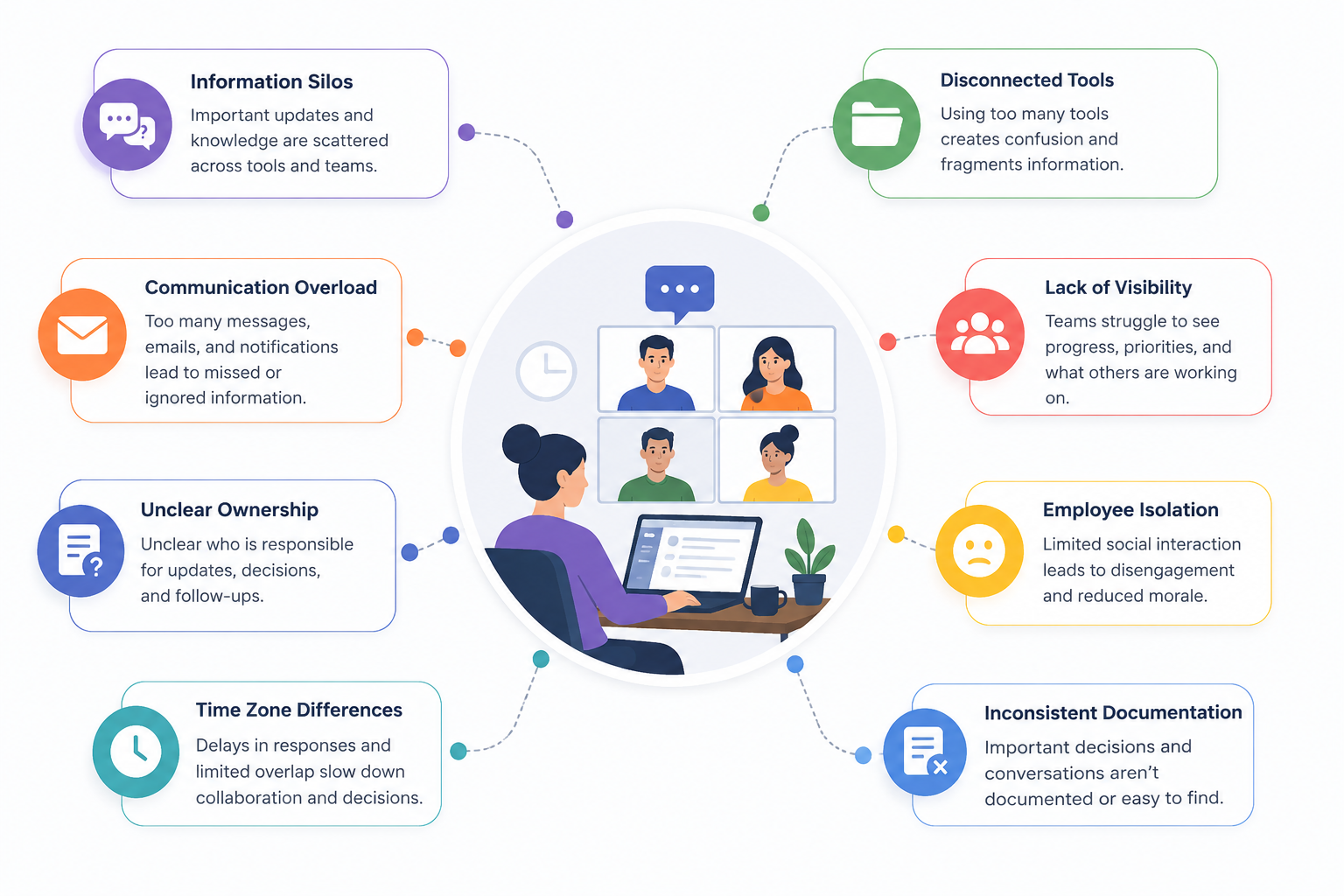
Common Communication Challenges Remote Teams Face
Working remotely gives employees more flexibility, but it also introduces communication challenges that many organizations underestimate.
Without a clear communication framework, teams can quickly become disconnected, leading to slower decision-making, duplicated work, and frustrated employees.
Recognizing these common issues is the first step toward building a workplace where information flows efficiently and everyone stays aligned.
Common Communication Challenges Remote Teams Face
Information Is Scattered Across Too Many Tools and Platforms
One of the biggest frustrations for remote employees is simply finding the information they need.
Files are stored in cloud drives, conversations happen in chat apps, meeting notes sit in shared documents, and important decisions are buried in email threads.
This scattered approach creates several problems:
- Employees waste time searching for documents.
- Different teams use different versions of the same file.
- Important decisions become difficult to track.
- New employees struggle to find reliable information.
- Valuable company knowledge is lost over time.
A centralized knowledge hub helps create a single source of truth that everyone can rely on.
Too Many Meetings Which Is Hurting Productivity Instead of Improving Communication
When teams can't easily communicate asynchronously, meetings often become the default solution.
While regular check-ins are valuable, excessive meetings leave employees with less time to focus on meaningful work.
Common signs of meeting overload include:
- Daily meetings with little value.
- Long discussions that could have been written updates.
- Multiple meetings covering the same topics.
- Employees attending meetings they don't need.
- Reduced productivity due to constant interruptions.
The best communication frameworks encourage employees to reserve meetings for collaboration, brainstorming, and complex discussions rather than routine updates.
Constant Chat Notifications Creating More Noise Than Communication
Messaging platforms like Slack and Microsoft Teams make collaboration faster, but they can also become overwhelming when every conversation happens in real time.
Employees often experience:
- Hundreds of notifications every day.
- Important announcements disappearing in busy channels.
- Constant interruptions that reduce concentration.
- Pressure to reply immediately.
- Difficulty finding previous conversations.
A healthy communication framework defines which conversations belong in chat and which should be documented elsewhere for future reference.
Important Knowledge Disappears Without Proper Documentation
Many remote organizations rely too heavily on verbal conversations or chat messages. Unfortunately, if information isn't documented, it quickly disappears.
Poor documentation can result in:
- Employees asking the same questions repeatedly.
- Inconsistent processes across departments.
- Slow onboarding for new hires.
- Knowledge leaving when employees move on.
- Teams making decisions without historical context.
Good documentation saves time, improves consistency, and ensures valuable knowledge remains accessible long after a conversation ends.
Distributed Teams Start Struggling When Employees Work Different Hours
Distributed teams often span multiple countries and continents. While this provides access to a wider talent pool, it also means employees aren't always working at the same time.
This can lead to:
- Delayed responses to important questions.
- Longer project timelines.
- Scheduling difficulties.
- Increased dependency on meetings.
- Misunderstandings caused by delayed context.
Organizations that embrace asynchronous communication allow employees to contribute effectively without needing everyone online simultaneously.
Lack of Company Updates Leads to Employees Feel Disconnected from Their Team and Company Culture
Remote work can sometimes leave employees feeling disconnected from their colleagues and the wider organization.
Without regular interaction, it's easy for people to feel like they're working alone rather than as part of a team.
Common symptoms include:
- Lower employee engagement.
- Reduced collaboration between departments.
- Weaker relationships with colleagues.
- Less participation in company initiatives.
- Increased risk of burnout and turnover.
An effective communication framework encourages regular leadership updates, team recognition, social interaction, and open feedback channels to help employees stay connected and engaged.
Although each of these issues may seem manageable on its own, together they create significant barriers to productivity and collaboration. The good news is that they all stem from the same underlying problem—a lack of structure.
So by implementing a clear communication framework, organizations can reduce confusion, improve collaboration, and create a more connected workplace where employees always know what to communicate, where to communicate it, and how to access the information they need.
What Makes an Effective Communication Framework When It Comes to Distributed Teams?
Think of a communication framework as the operating system for your business. It doesn't replace email, chat, video calls, or meetings—it gives each of those tools a clear purpose.
Without a framework, people waste time deciding where to ask questions, who owns a task, or which version of a document is correct. With one in place, communication becomes faster, more consistent, and far less stressful.
This matters more than ever for organizations managing distributed teams.
According to McKinsey & Company, employees spend up to 28% of their workweek searching for information across disconnected systems instead of focusing on productive work.
That lost time adds up quickly and often leads to delays, duplicated effort, and frustration.
Communication expert Matt Abrahams puts it simply:
That quote highlights an important truth. Sending a message doesn't guarantee it's been received, understood, or acted upon.
An effective communication framework ensures information reaches the right people, through the right channels, at the right time.
Below are the building blocks every successful communication framework should include.
Clear Communication Channels: Everyone Knows Where to Communicate
One of the quickest ways to create confusion is by allowing every communication tool to be used for everything.
Employees shouldn't have to guess whether an announcement belongs in email, Microsoft Teams, Slack, your intranet, or a project management platform.
Instead, assign a clear purpose to every communication channel.
For example:
- Company announcements belong on the intranet or employee hub.
- Quick questions are handled through team chat.
- Project updates stay inside your project management software.
- Policies and procedures live in a searchable knowledge base.
- Sensitive discussions happen during video meetings or one-to-one conversations.
Clear communication channels don't just improve productivity—they also strengthen security. One of the downsides of remote work is the difficulty of verifying who employees are actually communicating with.
A growing threat is Business Email Compromise (BEC), where attackers impersonate colleagues, managers, suppliers, or other trusted contacts to request sensitive information, approve fraudulent payments, or change banking details.
Without clear communication protocols, employees may struggle to identify legitimate requests from malicious ones.
A well-designed communication framework helps reduce this risk by defining approved communication channels, establishing verification procedures for high-risk requests, and encouraging employees to confirm unusual payment instructions or sensitive requests through a secondary trusted channel.
These simple practices make it much harder for cybercriminals to exploit confusion while helping employees communicate with greater confidence.
When everyone follows the same communication standards, employees spend less time searching for information, make faster decisions, collaborate more effectively, and significantly reduce the risk of costly communication mistakes or security incidents.
Defined Ownership: Make It Clear Who Is Responsible
One of the biggest causes of communication breakdown is uncertainty about ownership.
People assume someone else is responsible, tasks fall through the cracks, and important updates never happen.
Every process should clearly answer questions like:
- Who owns this project?
- Who approves decisions?
- Who communicates updates?
- Who maintains documentation?
- Who should employees contact for help?
Management expert Peter Drucker famously said:
Expert Insight
“The most important thing in communication is hearing what isn't said.”
Great leaders don't just listen to words—they pay attention to silence, hesitation, body language, and what employees choose not to say. In remote and distributed teams, creating regular feedback opportunities helps uncover issues long before they become major problems.
In other words, silence often signals confusion.
Clear ownership removes uncertainty and gives employees confidence about who is accountable.
Centralized Knowledge: Create One Source of Truth
If employees need to search five different systems to find a policy, document, or meeting note, your communication framework isn't working.
A centralized knowledge hub gives everyone one trusted location for company information.
This should include:
- Company policies
- HR documents
- Training materials
- Process documentation
- Frequently asked questions
- Department resources
- Meeting notes
- Templates and forms
Research by IDC estimates that knowledge workers spend around 2.5 hours every day searching for information or recreating content they can't find.
That's a significant productivity drain that can often be eliminated with better knowledge management.
A modern employee intranet or digital workplace makes this information searchable and accessible from anywhere.
Documentation Standards: Don't Let Knowledge Walk Out the Door
Every important decision should be documented—not just discussed during meetings or buried in chat messages.
Without documentation:
- New employees take longer to onboard.
- Teams repeat the same mistakes.
- Important knowledge disappears when employees leave.
- Different departments create inconsistent processes.
Good documentation doesn't need to be complicated. It simply needs to answer:
- What was decided?
- Why was the decision made?
- Who approved it?
- Where can employees find it later?
As organizations grow, documented knowledge becomes one of their most valuable assets.
Meeting Guidelines: Hold Fewer Meetings That Actually Matter
Meetings aren't the enemy—unnecessary meetings are.
Many remote teams schedule meetings simply because there isn't another reliable way to communicate. Unfortunately, this often creates "meeting fatigue," leaving employees with less uninterrupted time to do meaningful work.
An effective communication framework defines when meetings are appropriate and when they aren't.
Good meeting practices include:
- Good meeting practices include:
- Share an agenda beforehand.
- Invite only people who need to attend.
- Keep meetings focused on decisions and collaboration.
- Record key outcomes and action items.
- Share notes with anyone who couldn't attend.
For people managing a heavy meeting schedule, Kai can also capture action items and connect meeting follow-ups with email, calendar, and task workflows.
According to Microsoft's Work Trend Index, employees spend an increasing portion of their working week in meetings, emails, and chats, making uninterrupted focus time increasingly difficult to protect.
Organizations that prioritize asynchronous communication help employees reclaim that time.
Feedback Loops: Communication Should Never Be One-Way
The strongest organizations don't just broadcast information—they actively listen.
Employees closest to customers, products, and day-to-day operations often spot problems long before leadership does. If they don't have an easy way to share ideas or concerns, valuable insights are lost.
Effective feedback loops can include:
- Employee surveys
- Pulse polls
- Anonymous suggestion boxes
- Team retrospectives
- One-to-one check-ins
- Open Q&A sessions with leadership
- Idea and innovation platforms
According to Gallup, employees who feel their opinions count at work are significantly more likely to be engaged than those who don't.
Engagement isn't created through more announcements—it's built by giving employees a genuine voice and showing that their feedback leads to action.
Bringing It All Together
An effective communication framework model isn't about adding more communication tools—it's about creating clarity.
When employees know where information lives, who owns decisions, how work is documented, and how feedback is shared, effective communication becomes part of the company's culture rather than something people have to think about.
For organizations managing distributed teams, these six pillars provide a foundation for better collaboration, faster decision-making, and stronger employee engagement.
The result is a workplace where communication supports productivity instead of slowing it down—and where everyone can focus on delivering their best work, wherever they are.
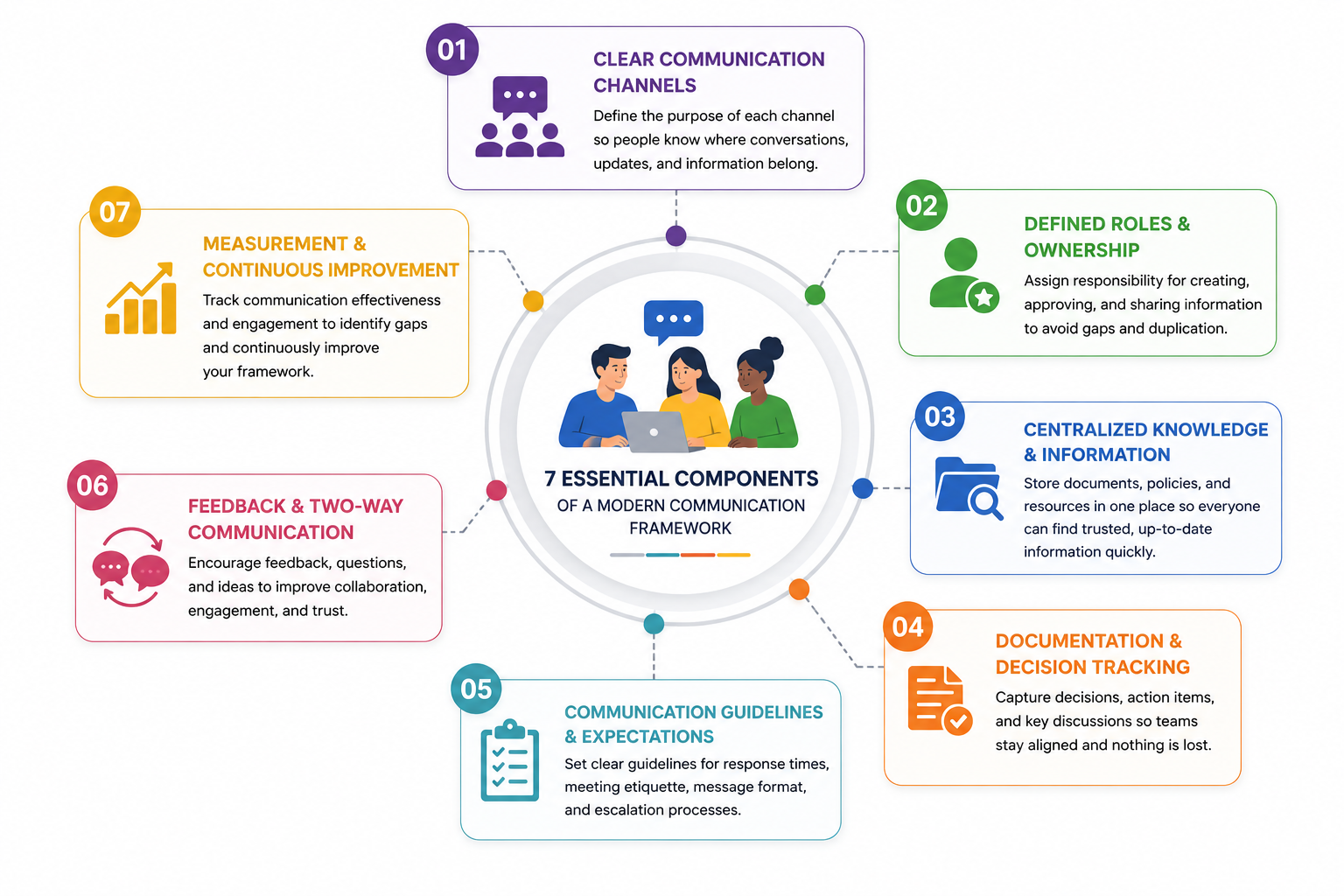
The 7 Essential Components of a Modern Communication Framework
If you've made it this far, you've probably realized that effective communication isn't about sending more emails, scheduling more meetings, or adopting the latest collaboration tool.
It's about creating a system that helps everyone communicate consistently, find information quickly, and understand exactly what's expected of them.
Think of these seven components as the foundation of a successful communication framework.
Each one plays a different role, but together they create a workplace where information flows smoothly, employees stay aligned, and collaboration becomes much easier—whether your team works in one office or across multiple countries.
The table below provides a quick overview of each component before we explore them in more detail.
The 7 Essential Components of a Modern Communication Framework
| Component | Why It Matters | Business Benefit |
| Communication Channels | Defines where different types of communication should happen. | Reduces confusion and keeps conversations organized. |
| Documentation | Captures decisions, processes, and knowledge in one place. | Prevents knowledge loss and speeds up onboarding. |
| Collaboration Standards | Establishes consistent ways for teams to work together. | Improves teamwork and reduces duplicated effort. |
| Knowledge Management | Creates a central source of truth for company information. | Employees spend less time searching for answers. |
| Leadership Communication | Ensures leaders communicate consistently and transparently. | Builds trust, alignment, and employee engagement. |
| Employee Feedback | Gives employees opportunities to share ideas and concerns. | Encourages continuous improvement and innovation. |
| Performance Measurement | Tracks communication effectiveness using measurable KPIs. | Helps identify gaps and continuously improve communication. |
These components aren't standalone initiatives—they work together. For example, having excellent documentation means little if employees don't know where to find it. Likewise, strong leadership communication loses its impact if there are no feedback channels for employees to respond.
As communication expert Matt Abrahams says:
Expert Insight
“The single biggest problem in communication is the illusion that it has taken place.”
Just because a message has been sent doesn't mean it has been understood. High-performing organizations remove assumptions by documenting decisions, choosing the right communication channels, and creating a communication framework that keeps everyone aligned.
The organizations that communicate most effectively don't simply invest in better technology.
They build clear processes, define expectations, encourage transparency, and continuously improve how information flows throughout the business.
Let's take a closer look at each of these seven components and how they help create a communication framework that supports collaboration, employee engagement, and long-term business success.
Here's How to Build a Communication Framework Step-by-Step
Building a communication framework does not need to be complicated.
The goal is simple: help your team understand what should be communicated, where it should happen, who owns it, and how people should respond.
Here is a practical step-by-step approach you can use.
Step #1: Audit Existing Communication
Start by looking at how your team communicates today.
Review the tools, channels, meetings, and processes your employees already use. This includes email, chat apps, video calls, project management tools, shared drives, intranet pages, and team meetings.
Look for signs of confusion, such as:
- Employees asking the same questions repeatedly.
- Important updates being missed.
- Too many tools being used for the same purpose.
- Documents stored in different places.
- Decisions being made without clear records.
This gives you a clear picture of what is working and what is creating friction.
Step #2: Identify Communication Gaps
Once you understand the current setup, look for the gaps.
Ask simple questions:
- Where does information get lost?
- Which updates are not reaching the right people?
- Where are employees wasting time searching?
- Which teams feel disconnected?
- Which processes rely too much on one person?
This step helps you spot the weak points in your current communication framework model before they become bigger business problems.
Step #3: Define Communication Channels
Next, decide which channel should be used for each type of communication.
For example:
- Company announcements should go on the intranet or employee hub.
- Quick questions can go in team chat.
- Project updates should stay inside project management tools.
- Policies and procedures should live in a knowledge base.
- Sensitive conversations should happen in one-to-one meetings or video calls.
This removes guesswork and helps employees know exactly where to go for information.
Step #4: Establish Response Expectations
Remote and distributed teams need clear response expectations, especially when people work in different time zones.
Set simple rules around response times, such as:
- Urgent issues: respond as soon as possible.
- Team chat: respond within the working day.
- Email: respond within 24–48 hours.
- Project comments: respond based on agreed deadlines.
- Non-urgent updates: use asynchronous communication.
This prevents employees from feeling pressured to reply instantly to everything.
Step #5: Create Documentation Standards
Good documentation is what turns conversations into reusable knowledge.
Decide what needs to be documented and where it should live. This may include decisions, meeting notes, project updates, processes, policies, FAQs, and training resources.
A simple documentation standard should explain:
- What must be documented.
- Who is responsible for updating it.
- Where the document should be stored.
- How often it should be reviewed.
- What format employees should use.
This helps prevent knowledge from being trapped in chat messages, emails, or people's heads.
Step #6: Train Employees
A communication framework only works if people understand how to use it.
Do not just publish the rules and expect everyone to follow them. Walk employees through the framework and explain why it matters.
Training should cover:
- Which tools to use and when.
- Where to find company information.
- How to document decisions.
- How to communicate across time zones.
- How to escalate urgent issues.
- How to give feedback.
Keep the training simple, practical, and easy to repeat during onboarding.
Step #7: Measure and Improve
Your communication framework should not be a one-time project. It should improve over time.
Track what is working and what still feels messy.
Useful metrics include:
- Employee engagement scores.
- Internal search activity.
- Meeting hours.
- Response times.
- Employee feedback.
- Repeated questions.
- Knowledge base usage.
- Project delays caused by poor communication.
Then use that data to improve the system. Remove unnecessary channels, update outdated documents, simplify processes, and ask employees what would make communication easier.
A strong communication framework is not about controlling every conversation. It is about giving people enough structure so they can communicate clearly, find information quickly, and work together without unnecessary confusion.
How the Right Communication Tools Help Build a More Connected Digital Workplace
Choosing the right communication tools can make a huge difference to how well your team collaborates—but more tools don't always mean better communication.
In fact, one of the biggest mistakes organizations make is introducing a new app every time they encounter a communication problem.
Before long, employees are switching between multiple platforms just to complete a single task.
Research from Microsoft's Work Trend Index shows that the average employee spends a significant portion of their day switching between emails, meetings, chats, and documents. This constant context switching makes it harder to focus, slows decision-making, and contributes to digital fatigue.
The best approach is to build a communication toolkit where every platform has a clear purpose and works together as part of your overall communication framework.
Below are the essential categories every remote or distributed team should consider.
| Tool Category | Primary Purpose | Best For |
| Team Chat | Quick conversations and real-time collaboration | Instant messaging, quick questions, team discussions |
| Video Meetings | Face-to-face communication | Team meetings, presentations, one-to-ones, workshops |
| Knowledge Base | Centralized company knowledge | Policies, procedures, FAQs, training, documentation |
| Employee Intranet | Company-wide communication and engagement | News, announcements, directories, resources and collaboration |
| Project Management | Planning and tracking work | Tasks, deadlines, project updates and accountability |
| Employee Mobile Apps | Keeping everyone connected anywhere | Frontline workers, remote employees, field teams |
Let's look at each one in more detail.
Team Chat for Everyday Collaboration
Team chat platforms help employees communicate quickly without filling inboxes with short messages.
They work well for asking questions, sharing updates, and collaborating throughout the day.
Common uses include:
- Quick questions and answers
- Team discussions
- File sharing
- Department channels
- Project conversations
The key is setting clear rules. Chat should be used for short conversations—not as the permanent home for important company knowledge.
Video Meetings for Meaningful Conversations
Not every discussion can happen through text. Video meetings allow teams to collaborate, brainstorm ideas, solve complex problems, and build stronger relationships.
Video works best for:
- Team meetings
- Client presentations
- Employee onboarding
- Performance reviews
- Brainstorming sessions
- Sensitive conversations
However, avoid using meetings for information that could easily be shared asynchronously.
Knowledge Bases That Preserve Company Knowledge
A searchable knowledge base ensures employees always know where to find accurate information.
This typically includes:
- Company policies
- Standard operating procedures
- HR documents
- Training materials
- Frequently asked questions
- Product documentation
- Internal guides
Instead of asking colleagues the same questions repeatedly, employees can find answers themselves, saving time for everyone.
Employee Intranets That Keep Everyone Connected
An employee intranet acts as the digital headquarters for your organization. Rather than relying on disconnected systems, it provides one place where employees can access company news, documents, announcements, directories, events, and collaboration tools.
Modern intranets help organizations:
- Improve internal communication
- Share company news
- Manage documents
- Support employee engagement
- Deliver onboarding resources
- Connect remote and frontline employees
For growing businesses, an intranet often becomes the foundation of a successful communication framework.
Project Management Tools That Keep Work Moving
Communication without accountability quickly becomes noise.
Project management platforms help teams organize work, assign responsibilities, monitor progress, and keep everyone aligned on deadlines.
These tools are ideal for:
- Task management
- Project planning
- Workflow automation
- Team collaboration
- Progress tracking
- Reporting
When communication and project updates happen together, teams spend less time asking for status updates and more time delivering results.
Employee Mobile Apps for Frontline and Remote Workers
Not every employee spends the day sitting behind a desk. Mobile communication apps ensure frontline workers, field teams, and remote employees stay informed wherever they are.
A good employee app enables people to:
- Receive company announcements
- Access documents
- Complete forms
- View schedules
- Chat with colleagues
- Submit feedback
- Participate in surveys and recognition programs
This helps create a more connected workforce, regardless of location.
Why an All-in-One Digital Workplace Often Works Best
Why an All-in-One Digital Workplace Often Works Best
Many organizations start with one communication tool and gradually add more as new challenges arise.
Before long, employees are juggling multiple apps for chat, meetings, documents, project management, announcements, and employee engagement.
The problem isn't the individual tools—it's the lack of integration between them.
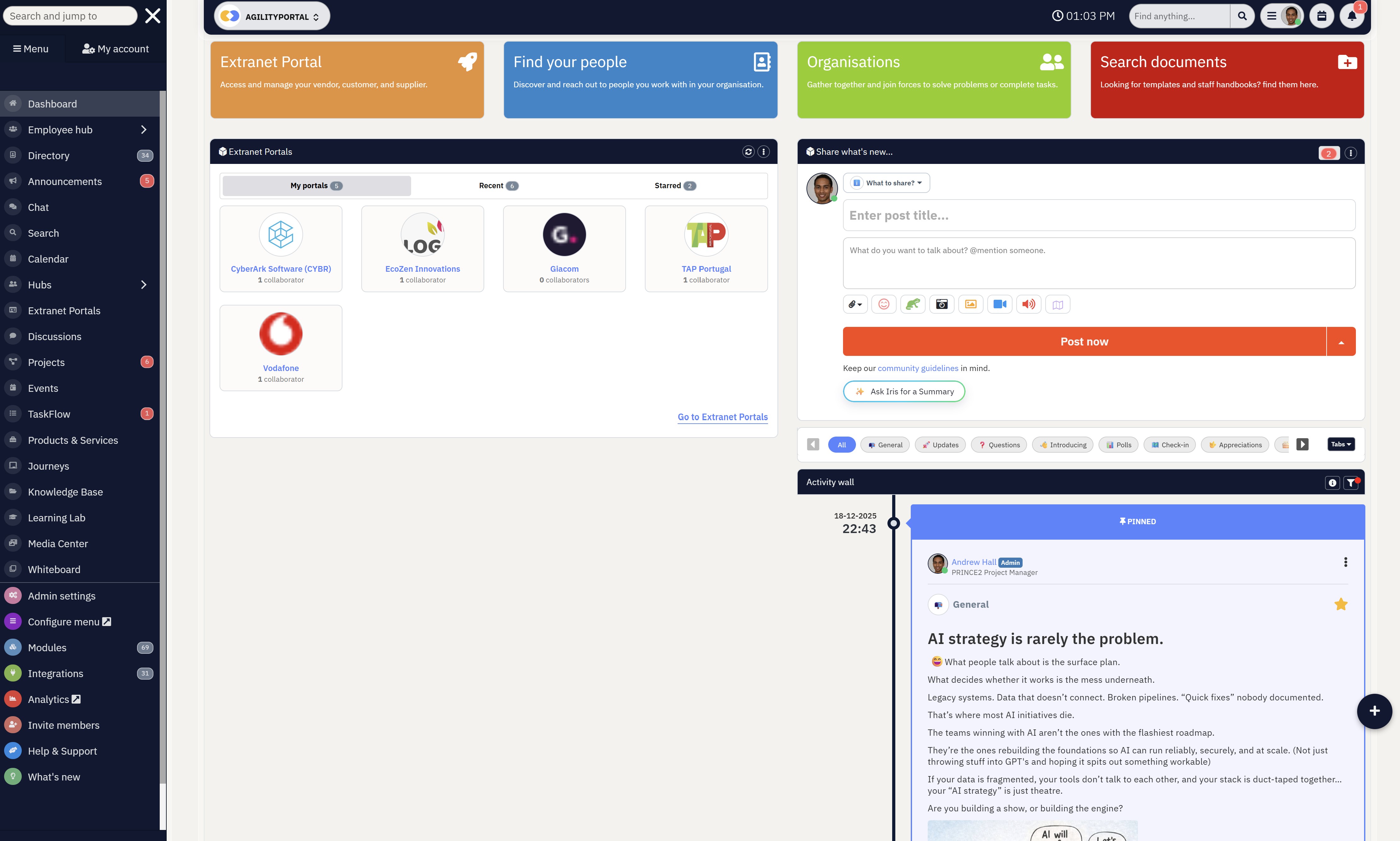
An all-in-one digital workplace helps solve this by bringing communication, collaboration, knowledge sharing, and employee engagement into a single platform. Instead of constantly switching between applications, employees have one place to access the information and tools they need to do their jobs effectively.
Platforms like AgilityPortal combine many of these capabilities into a unified digital workplace, including an employee intranet, team chat, document management, knowledge base, announcements, project collaboration, employee engagement tools, mobile access, and workflow automation.
This reduces information silos, improves productivity, and supports a more consistent communication framework across the entire organization.
Ultimately, the best communication tool isn't necessarily the one with the most features—it's the one that helps your people communicate clearly, collaborate efficiently, and find the information they need without unnecessary complexity.
Top SharePoint Replacement
A Modern Intranet Platform Built for Employee Communication, Collaboration & Knowledge Management
AgilityPortal is a modern SharePoint replacement online designed for businesses that want a simpler and more engaging way to manage employee communication, collaboration, documents, and company knowledge from one centralized platform. Unlike traditional intranet systems, AgilityPortal combines social collaboration, document management, AI-powered search, team communication, and employee engagement tools into one secure digital workplace platform.
Businesses replacing SharePoint often choose AgilityPortal because it is easier to use, faster to deploy, mobile-friendly, and designed to improve employee adoption without the complexity of managing multiple disconnected SharePoint sites and document libraries.
See why businesses are moving away from outdated intranet systems and choosing AgilityPortal to centralize communication, collaboration, and workplace knowledge.Communication Framework Best Practices To Follow
Building a communication framework is only the first step.
The real value comes from how consistently it's applied across your organization.
Even the best-designed framework will fail if employees don't understand it, leaders don't follow it, or information isn't kept up to date. Successful organizations treat communication as an ongoing business process rather than a one-time project.
Create a Single Source of Truth
One of the most effective ways to improve workplace communication is to establish a single source of truth for company information.
Employees should always know where to find the latest policies, procedures, announcements, and project documentation without having to search through emails, chat conversations, or multiple cloud storage platforms.
A centralized knowledge base or employee intranet reduces confusion, prevents duplicate work, and ensures everyone is working from the same information.
Reduce Unnecessary Meetings
Meetings should help people make decisions, solve problems, and collaborate—not simply share information that could have been communicated another way.
Before scheduling a meeting, ask whether the discussion truly requires everyone to be present or whether it could be handled through a written update, recorded video, or project management platform.
Reducing unnecessary meetings gives employees more uninterrupted time to focus on meaningful work while improving overall productivity.
Embrace Asynchronous Communication
Not every conversation needs an immediate response.
For organizations managing distributed teams across different locations and time zones, asynchronous communication allows employees to contribute when they're available rather than waiting for everyone to be online at the same time.
Written updates, shared documents, recorded presentations, and project comments help teams move work forward while respecting different working hours and reducing communication bottlenecks.
Document Important Decisions
Conversations are temporary, but documentation creates lasting organizational knowledge.
Every significant decision, process, or project update should be recorded in a location that employees can easily access later.
This prevents important information from being buried in chat threads or forgotten after meetings. It also makes onboarding new employees much easier, as they can quickly understand previous decisions without relying on colleagues to explain the history.
Standardize Company Announcements
Employees should never have to wonder where important company news will be published.
Whether it's leadership updates, policy changes, product launches, or organizational announcements, every major communication should follow a consistent process and be shared through the same trusted channel.
Standardizing announcements ensures important messages reach the right people and reduces the risk of employees missing critical information.
Measure Communication Effectiveness
An effective communication framework should be reviewed regularly to ensure it's delivering results.
Rather than relying on assumptions, organizations should track meaningful metrics such as employee engagement, internal search activity, meeting hours, response times, knowledge base usage, and employee feedback.
These insights help identify communication gaps, highlight opportunities for improvement, and ensure the framework continues to evolve as the business grows.
Encourage Open and Transparent Communication
Strong communication frameworks don't just help leaders share information—they also make it easy for employees to ask questions, share ideas, and raise concerns.
Creating an environment where people feel comfortable speaking up encourages innovation, strengthens trust, and improves employee engagement.
Regular feedback sessions, pulse surveys, Q&A forums, and one-to-one conversations all contribute to a culture where communication flows in every direction rather than simply from the top down.
The most successful organizations don't communicate more—they communicate better.
By creating a single source of truth, reducing unnecessary meetings, embracing asynchronous communication, documenting key decisions, standardizing announcements, measuring performance, and encouraging transparency, businesses can build a communication framework that scales with their growth.
These best practices not only improve effective communication but also help remote and distributed teams collaborate more efficiently, make better decisions, and stay connected no matter where they're working.
How To Measuring the Success of Your Communication Framework
Building a communication framework is only half the job.
The real question is whether it's actually improving the way your teams work together. Without measuring results, it's impossible to know what's working, what's causing friction, and where improvements are needed.
The most successful organizations don't rely on guesswork. Instead, they regularly review key performance indicators (KPIs) that show how communication affects productivity, collaboration, and employee engagement.
By monitoring the right metrics, you can continuously refine your communication framework and ensure it continues to support your business as it grows.
The table below highlights some of the most valuable metrics to track.
| Metric | What It Measures | Why It Matters |
| Employee Engagement | How connected and motivated employees feel. | Higher engagement often leads to better productivity, lower turnover, and stronger collaboration. |
| Response Times | How quickly employees respond to messages, requests, and approvals. | Faster responses help projects move forward and reduce delays. |
| Knowledge Searches | How often employees search for company information. | High search volumes may indicate employees struggle to find information quickly. |
| Meeting Hours | The amount of time employees spend in meetings each week. | Too many meetings reduce focus time and can impact productivity. |
| Internal Search Success | Whether employees find what they need on the first search. | A high success rate suggests your knowledge management system is effective. |
| Employee Satisfaction | How employees feel about workplace communication. | Regular surveys reveal communication strengths and areas for improvement. |
| Productivity | The impact communication has on completing work efficiently. | Better communication reduces duplicated effort and unnecessary delays. |
| Collaboration | How effectively teams work together across departments and locations. | Strong collaboration leads to faster decision-making and improved business outcomes. |
Employee Engagement
Employee engagement is one of the clearest indicators of communication effectiveness.
When people understand company goals, receive regular updates, and feel their opinions are valued, they're more likely to be motivated and committed to their work.
According to Gallup, highly engaged teams experience higher productivity, stronger customer satisfaction, and lower absenteeism than disengaged teams.
Measuring engagement through pulse surveys, participation rates, and employee feedback helps determine whether your communication framework is creating a more connected workforce.
Response Times
Communication should keep work moving—not create bottlenecks.
Tracking how quickly employees respond to messages, approvals, and requests can highlight areas where communication is slowing projects down.
If response times continue to increase, it may indicate unclear ownership, overloaded communication channels, or too many competing priorities.
Knowledge Searches
Employees shouldn't have to spend valuable time hunting for information.
Monitoring how often people search your knowledge base or intranet—and what they're searching for—can reveal gaps in documentation or content organization.
If the same topics are searched repeatedly, it may be time to improve navigation, update documentation, or make important resources easier to find.
Meeting Hours
Meetings are essential for collaboration, but too many meetings can quickly reduce productivity.
Tracking the average number of meeting hours per employee helps identify whether your organization is relying too heavily on synchronous communication.
A healthy communication framework encourages employees to use meetings for discussion and decision-making while sharing routine updates asynchronously whenever possible.
Internal Search Success
Finding information should be quick and effortless. Measuring how often employees successfully locate what they need on their first search provides valuable insight into the effectiveness of your knowledge management system.
Low search success rates often point to outdated content, poor document organization, or inconsistent naming conventions.
Employee Satisfaction
Regular employee surveys provide direct feedback on how people experience communication across the organization.
Questions about leadership transparency, access to information, collaboration, and communication tools can uncover issues that performance metrics alone may not reveal.
Listening to employees—and acting on their feedback—is one of the fastest ways to strengthen your communication framework.
Productivity
Ultimately, communication should make work easier. While productivity is influenced by many factors, improvements in communication often lead to faster project delivery, fewer duplicated tasks, and better use of employees' time.
Organizations should monitor project completion times, workflow efficiency, and operational performance to understand how communication contributes to business success.
Collaboration
Strong collaboration is one of the primary goals of any communication framework.
Teams that communicate effectively share knowledge more freely, solve problems faster, and make better decisions together.
Look for indicators such as cross-department collaboration, shared projects, employee participation, and knowledge sharing. These metrics provide valuable insight into whether communication is helping teams work together or creating unnecessary barriers.
Continuous Improvement Is the Key to Long-Term Success
No communication framework is ever truly finished. As your organization grows, adopts new technologies, and expands into new markets, the way your teams communicate will naturally evolve.
By regularly measuring engagement, response times, knowledge usage, meeting effectiveness, employee satisfaction, productivity, and collaboration, you'll have the insights needed to make informed improvements.
Rather than reacting to communication problems after they occur, you'll be able to identify trends early, refine your processes, and build a communication framework that continues to support your people and your business for years to come.
Final Thoughts: Strong Communication Doesn't Happen by Accident
A successful remote or distributed team isn't built on more meetings, longer email threads, or another messaging app.
It's built on a clear communication framework that gives everyone confidence about where information belongs, how decisions are shared, and who is responsible for keeping work moving forward.
When employees know where to find information, understand which communication channels to use, and have access to a single source of truth, confusion begins to disappear.
Teams spend less time searching for answers, fewer tasks fall through the cracks, and collaboration becomes more natural. Over time, this leads to better productivity, stronger employee engagement, faster decision-making, and a more connected workplace.
The good news is that building an effective communication framework doesn't require starting from scratch.
Small improvements—such as documenting key decisions, reducing unnecessary meetings, improving knowledge sharing, and standardizing communication practices—can have a significant impact across your entire organization.
If your teams are struggling with scattered information, communication silos, or disconnected tools, now is the perfect time to review your current approach.
Ask yourself a simple question: Does every employee know where to find the information they need and how they should communicate with the rest of the business? If the answer is no, there's an opportunity to improve.
Build a Better Communication Framework with AgilityPortalAgilityPortal is an all-in-one digital workplace designed to help organizations simplify communication, improve collaboration, and keep employees connected—whether they're working in the office, remotely, or across multiple locations.
With features including an employee intranet, knowledge management, team collaboration, document management, employee engagement, internal communications, mobile access, and workflow automation, AgilityPortal provides everything you need to build a structured, scalable communication framework in one secure platform.
Ready to improve communication across your organization?
Book a free demo today and discover how AgilityPortal can help your teams communicate more clearly, collaborate more effectively, and grow with confidence.
Frequently Asked Questions About Communication Frameworks
What is a communication framework?
A communication framework is a structured system that defines how information moves throughout an organization.
It establishes which communication channels employees should use, who is responsible for sharing information, how decisions are documented, and where company knowledge is stored.
Unlike informal communication, a communication framework creates consistency, helping employees communicate more effectively regardless of whether they're working in the office, remotely, or across multiple locations.
Why is a communication framework important?
A communication framework reduces confusion, improves collaboration, and helps employees find the information they need quickly.
Without clear communication processes, important updates become buried in emails or chat threads, projects slow down, and knowledge is easily lost.
Research from McKinsey & Company found that employees spend up to 28% of their workweek searching for information across disconnected systems.
A structured communication framework helps reduce this wasted time by creating a single source of truth and defining clear communication processes.
How do remote teams communicate effectively?
The most successful remote teams combine synchronous communication, such as video meetings and instant messaging, with asynchronous communication, including shared documents, project management software, and knowledge bases.
They also establish clear communication guidelines so everyone understands where conversations should happen and how quickly responses are expected.
Effective remote communication usually includes:
- Clearly defined communication channels.
- A centralized knowledge base.
- Regular leadership updates.
- Documented decisions.
- Transparent feedback processes.
- Communication protocols for different time zones.
These practices help distributed teams stay aligned while reducing unnecessary meetings and communication overload.
What tools support a communication framework?
A strong communication framework isn't built around a single tool. Instead, it combines several technologies that work together to improve collaboration and knowledge sharing.
Common communication tools include employee intranets, team chat platforms, video conferencing software, project management systems, document management platforms, knowledge bases, employee mobile apps, and workflow automation solutions.
Many organizations now choose an all-in-one digital workplace to reduce the number of disconnected applications employees need to use every day.
What is the difference between a communication strategy and a communication framework?
Although they're often used interchangeably, they serve different purposes.
A communication strategy focuses on why you're communicating and what you want to achieve. It defines objectives, target audiences, key messages, and business outcomes.
A communication framework focuses on how communication happens every day. It outlines communication channels, documentation standards, response expectations, ownership, and communication workflows.
Think of it this way:
- A communication strategy sets the direction.
- A communication framework provides the system that turns that strategy into consistent daily practice.
Organizations need both to achieve effective internal communication.
What is a communication framework model?
A communication framework model is a structured approach that organizations use to standardize communication across teams.
It defines the people involved, the communication channels they use, the types of messages being shared, expected response times, documentation standards, feedback mechanisms, and success metrics.
Rather than leaving communication to individual preferences, a communication framework model creates repeatable processes that improve collaboration, knowledge sharing, and decision-making across the entire business.
How often should a communication framework be reviewed?
A communication framework should be reviewed at least once or twice a year, or whenever significant organizational changes occur.
Business growth, remote hiring, mergers, new software implementations, or changes in company structure often require communication processes to be updated.
Regular reviews help identify outdated documentation, ineffective communication channels, and new opportunities to improve collaboration before they become larger operational issues.
What are the biggest communication challenges for distributed teams?
Organizations managing distributed teams commonly face challenges such as information silos, communication overload, unclear ownership, inconsistent documentation, time zone differences, and employee isolation.
These issues can slow projects, reduce engagement, and make collaboration more difficult.
The best way to overcome these challenges is by implementing a structured communication framework that defines where information lives, how it should be shared, who owns communication, and how employees collaborate across departments and locations.
Research consistently shows that clear communication structures, defined expectations, centralized knowledge hubs, and transparent leadership communication significantly improve remote team collaboration and productivity.
AI Summary
- A communication framework helps remote and distributed teams define where communication happens, who owns updates, how decisions are documented, and where employees find trusted information.
- Effective communication is not about sending more messages—it is about creating clarity, reducing confusion, and making sure employees understand what matters.
- Common challenges include scattered information, too many meetings, chat overload, poor documentation, time zone delays, and employee isolation.
- A strong communication framework model includes clear communication channels, defined ownership, centralized knowledge, documentation standards, meeting guidelines, feedback loops, and measurable KPIs.
- Organizations managing distributed teams should use asynchronous communication, knowledge management, employee feedback, and leadership updates to keep everyone aligned.
- Platforms like AgilityPortal help businesses improve internal communication, reduce information silos, support remote collaboration, and build a more connected digital workplace.
Most Popular Posts

Effective communication among team members is vital for the productivity and success of any organization. Surprisingly, 60% of companies lack a long-term internal communication strategy, which p...


Businesses thrive on communication for efficiency, productivity and accomplishment. When the right information is passed from the right designation in the organization, it promotes positivity an...

Categories
Blog
(3192)
Business Management
(394)
Employee Engagement
(235)
Digital Transformation
(218)
Growth
(150)
Intranets
(141)
Internal communications
(106)
Remote Work
(68)
Sales
(53)
Collaboration
(52)
Customer Experience
(32)
Culture
(30)
Knowledge Management
(29)
Project management
(29)
Leadership
(20)
Comparisons
(9)
News
(1)

Related Posts

What would happen to your team's work and customer information if an employee's MacBook disappeared today? If you're wondering how to protect your Mac physically, the answer goes beyond buying a case. A MacBook used at home, on a train or in a ...

Welcome to AgilityPortal's guide to the best VPN for Remote teams. How do you give employees secure access to company systems when they work from home, the office and everywhere in between? It's a question more businesses need to answer: 28% of worki...

Have you ever left a meeting thinking everyone agreed on the next step, only to discover a week later that each person remembered something different? Open source meeting transcription can help teams keep a searchable record of the conversation...

The best ai image editors can save a team hours of repetitive work. A marketing manager can remove a distracting background, an HR team can improve a staff event photo, and an online shop can turn a basic product shot into something ready to pu...

Ever opened a PDF just before a meeting and realised you need to edit a page, pull figures from a scanned report, or gather everyone's comments? What should be a quick task can turn into a frustrating search for the right tool. That lost time a...

Jill Romford
I am a digital nomad, lover of exploring new places and making friends.
I love to travel and I love the internet. I take pictures of my travels and share them on the internet using Instagram.
Traveler, entrepreneur, and community builder. I share my insights on digital marketing and social media while inspiring you to live your fullest life.
Ready to learn more? 👍
One platform to optimize, manage and track all of your teams. Your new digital workplace is a click away. 🚀
Free for 14 days, no credit card required.