Insight Blog
Agility’s perspectives on transforming the employee's experience throughout remote transformation using connected enterprise tools.
47 minutes reading time
(9322 words)
Why Employees Feel Disconnected at Work (and Strategies on How to Keep Yours Engaged)

Why Employees Feel Disconnected at Work (and Strategies on How to Keep Yours Engaged)
Why do employees feel disconnected at work? Explore the causes of disengagement and practical strategies for building a more connected, engaged workforce.
Why Employees Feel Disconnected at Work (and Strategies on How to Keep Yours Engaged)

You know that employee who turns up, gets their work done, joins the meetings and replies to messages, but doesn't really seem connected to the company anymore?
They're still doing the job, but mentally, they've started to check out.
That's becoming a much bigger workplace problem than many businesses realise.
According to Gallup's State of the Global Workplace 2026, just 20% of employees worldwide were engaged at work in 2025. That's down from the 23% high recorded in 2022 and 2023.
In simple terms, a huge number of people are going through the working day without feeling particularly connected to their job, their manager or the organisation they work for.
20%
of employees globally are engaged
According to Gallup's State of the Global Workplace 2026, just 20% of employees worldwide were engaged at work in 2025, down from the 23% high recorded in 2022 and 2023.
Source: Gallup — State of the Global Workplace 2026
And it's not always about pay or wanting to leave. Sometimes employees simply stop feeling involved.
They don't know what's happening across the business, communication feels one-way, good work goes unnoticed, or they can't see how what they do fits into the bigger picture.
So, why do employees feel disconnected at work, and more importantly, what can you actually do about it?
That's what we're going to look at — the warning signs, what's driving the problem and some practical strategies you can use to build a more connected and engaged workforce.
Key Takeaways
- Employees can still perform well while feeling disconnected from their managers, colleagues, company culture, or the wider purpose of the organisation.
- Employee engagement is shaped by everyday experiences such as communication, recognition, manager support, access to information, and whether employees feel heard.
- Remote, hybrid, frontline, and distributed teams need deliberate ways to communicate and build relationships so physical distance doesn't turn into workplace isolation.
- Managers play a major role in employee engagement, making regular feedback, recognition, clear communication, and meaningful check-ins essential.
- A modern employee intranet or digital workplace can support engagement by bringing communication, knowledge, communities, recognition, and feedback into one accessible place.
- The best employee engagement strategy isn't built around perks alone; it's about creating a workplace where people feel informed, valued, heard, and connected.
What does feeling disconnected at work actually mean?
We know that feeling, disconnected at work doesn't necessarily mean someone hates their job or is already looking for somewhere else to work. That's where businesses can easily get it wrong.
An employee might actually enjoy what they do and still feel disconnected from the organisation around them.
Maybe they rarely hear from their manager. Perhaps important company updates seem to happen somewhere they don't have access to. Or they simply don't understand what the business is trying to achieve and where their role fits into it.
Think about it this way.
You can have a perfectly good job, decent pay and nice colleagues, but if you constantly feel like you're the last person to know what's going on, it's difficult to feel like you're really part of the company.

What does feeling disconnected at work actually mean?
That feeling of disconnection can show up in different ways. Employees might feel distant from:
- their colleagues and wider teams
- their manager or senior leadership
- the company's purpose and direction
- important information and workplace decisions
- recognition for the work they contribute
- the wider company culture and community
And this is where it's worth separating disconnection from dissatisfaction and disengagement.
A dissatisfied employee is generally unhappy with something about their job, such as pay, workload, management or working conditions. A disengaged employee has often started withdrawing their effort or enthusiasm.
A disconnected employee, on the other hand, may still be performing well but doesn't feel particularly involved, informed or part of something bigger.
That's why employee disconnection can be easy to miss. Someone doesn't have to complain, perform badly or hand in their notice for there to be a problem. Sometimes the first sign is simply that they've stopped feeling like they belong.
Why are employees feeling increasingly disconnected from work?
There isn't one single reason employees feel disconnected at work. Usually, it's a combination of small things that build up over time.
Think about your own working day.
You might start with emails, jump into a Teams or Zoom meeting, check a group chat, look for a document someone shared last week, respond to another notification and then realise you've spent half the morning trying to work out what's actually going on.
Now imagine doing that every day while also feeling like nobody really notices the work you're doing.
That's where disconnection can start.
Communication has become fragmented
Most businesses don't have a communication shortage. If anything, they have the opposite problem.
There are emails, group chats, video calls, project management tools, shared drives, WhatsApp groups, company announcements and countless notifications competing for attention.
The problem is that more communication doesn't automatically mean better communication.
When information is spread across too many places, employees have to figure out where to look. Important announcements get buried, conversations happen without everyone involved, and people can easily feel like they're always one step behind.
This is especially difficult when you have office-based, remote, hybrid and frontline employees all accessing information differently.
A better approach is to give employees a clear place where they know they can find important company information, updates, documents and conversations without having to hunt for them.
Employees don't always understand the bigger picture
Here's another common problem: people know what they're supposed to do today, but they don't really know why they're doing it.
An employee might have a list of tasks, targets and deadlines but very little understanding of where those things fit into the company's wider plans.
That matters.
Gallup reports that fewer than one in three employees strongly agree that their organisation's mission or purpose makes them feel their job is important.
When people understand where the company is going and can see how their own work contributes, there's a stronger sense of purpose. Without that connection, work can gradually become a list of tasks rather than something employees feel part of.
And this doesn't require some huge inspirational speech from the CEO every Monday morning. Sometimes it's as simple as managers regularly explaining what's happening, why priorities have changed and how the team's work contributes.
Good work can easily go unnoticed
We've probably all experienced this at some point.
You put extra effort into something, solve a difficult problem or help get a project over the line... and nobody says anything.
Do that enough times and eventually you start wondering why you're putting in the extra effort.
Recognition doesn't always need to mean bonuses, awards or expensive employee reward programmes. A quick message from a manager, a colleague publicly saying thank you, celebrating a project milestone or recognising someone who helped another team can make a difference.
The important part is making sure people feel that their contribution is actually seen.
And recognition shouldn't only come from senior management either. Peer-to-peer recognition can be just as valuable because the people working alongside you often understand exactly what went into getting something done.
There's another problem: managers are becoming disengaged too
31% → 22%
Manager engagement decline
According to Gallup's workplace research, global manager engagement fell from 31% in 2022 to just 22% in 2025. That's a 9 percentage-point drop at a time when managers play a major role in shaping the everyday employee experience.
Source: Gallup workplace research
It's easy to talk about employee engagement as if managers are somehow outside the problem.
They're not.
Gallup's recent workplace research shows that global manager engagement fell from 31% in 2022 to 22% in 2025. That's a significant drop, particularly when you consider how much influence managers have over the everyday employee experience.
Think about what happens when a manager becomes disengaged.
They communicate less. Feedback becomes less frequent. Recognition disappears. One-to-one conversations become another meeting to get through, and employees may start feeling like nobody is really paying attention.
It can quickly become a chain reaction:
Disengaged manager → weaker communication and support → disconnected employees → lower engagement
That's why organisations can't expect managers to keep everyone else motivated while ignoring whether those managers themselves have the support, information, training and time they need to do their jobs properly.
Hybrid and remote work aren't automatically the problem
Remote work often gets blamed whenever employee connection comes up, but it's not quite that simple.
You can have a fully remote team that's highly engaged, just as you can have people sitting a few desks apart who barely feel connected to each other or the company.
The real challenge is how you create that sense of connection when people aren't naturally seeing each other every day.
More companies are running into this simply because they're building teams remotely, and a growing number are doing it across different time zones, which makes keeping everyone connected even harder. But there are ways to reduce some of that friction. For example, companies choosing to hire nearshore talent in Latin America can benefit from working hours that overlap more closely with the US working day.
That overlap might sound like a small thing, but think about how much easier it makes everyday communication. Instead of waiting hours for a response, people can jump on a quick call, ask a question while someone is actually online, solve a problem together or simply have the informal conversations that help colleagues get to know each other.
Because what holds a team together over the long run is actually feeling like a team.
When people are working remotely, real-time communication can play an important role in creating that sense of belonging. It shouldn't mean filling everyone's calendar with meetings, but employees should have regular opportunities to talk, collaborate and make decisions together rather than relying entirely on delayed messages.
That's why the bigger question isn't whether people are working remotely. It's whether your workplace has been designed to keep them connected wherever they're working.
- Do remote employees hear the same company news?
- Can they easily contribute to conversations?
- Are managers checking in with them?
- Can they find colleagues and knowledge without physically walking across the office?
Hybrid and remote working haven't necessarily created employee disconnection, but they've certainly exposed weaknesses in how some businesses communicate.
The organisations that get it right are the ones that make connection intentional rather than assuming it will happen on its own.
And don't forget the people who don't sit behind a desk
This is one area that gets overlooked far too often.
Think about employees working in warehouses, construction sites, healthcare, retail stores, restaurants, manufacturing facilities or out in the field.
They may not have a company laptop. Some won't regularly check corporate email. Others might only hear company news when their manager remembers to pass it on.
Meanwhile, employees sitting at headquarters have access to announcements, documents, company conversations and leadership updates throughout the day.
You can see how quickly an information gap starts to appear.
If you're serious about keeping employees connected, communication has to reach everyone — not just the people sitting in front of a computer.
That's where mobile access and a central employee communication platform can be genuinely useful. A modern digital workplace such as AgilityPortal can give office-based, remote and frontline employees one place to access company news, conversations, knowledge, documents and recognition from wherever they're working.
But the technology is only part of it.
The bigger goal is much simpler: make sure every employee feels informed, included and able to participate in what's happening across the organisation.
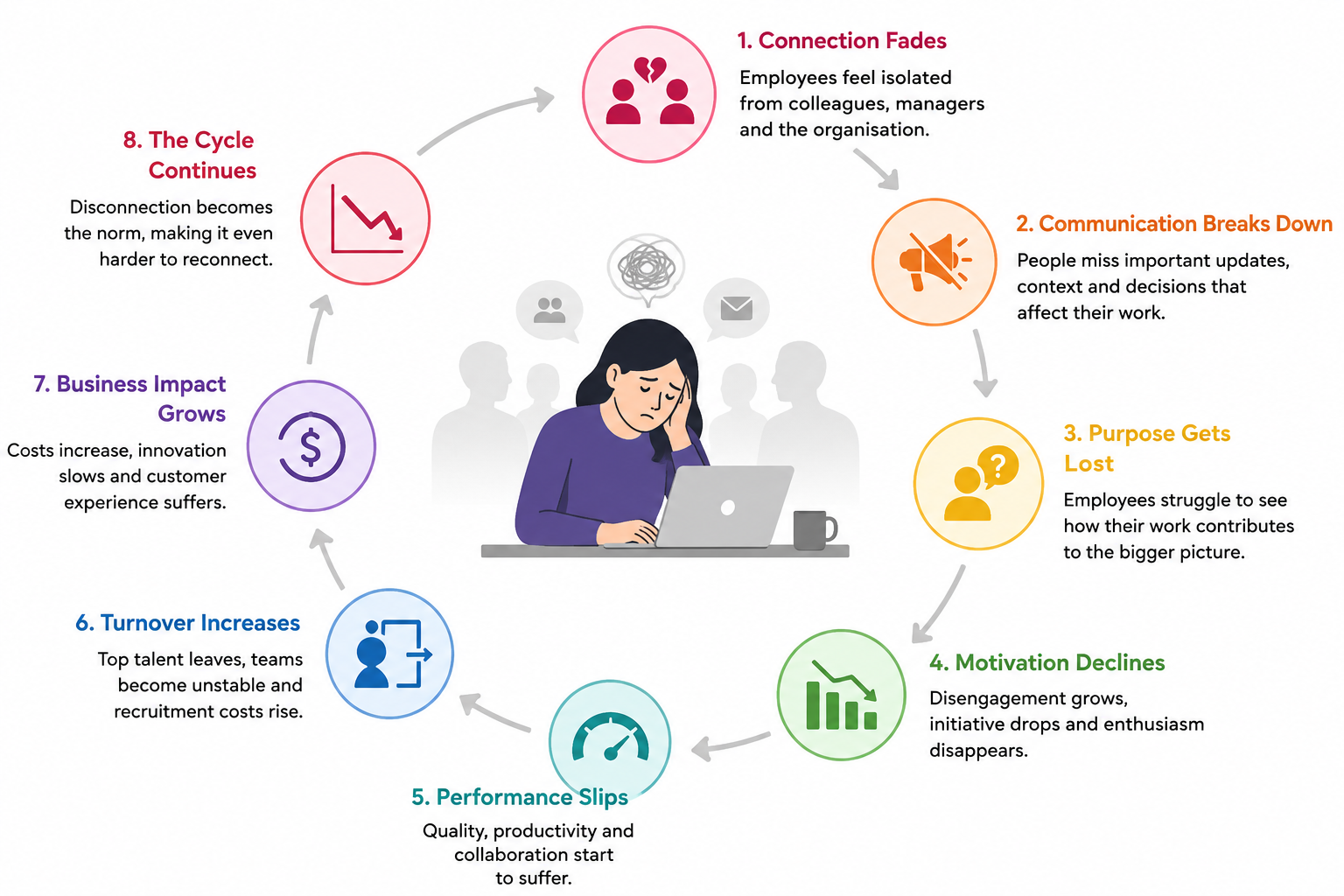
What happens when employees stop feeling connected?
Its a fact that employee disconnection often starts quietly.
People still turn up and get their work done, but they stop contributing ideas, volunteering for things or putting in that extra effort.
When that starts happening across a team, the impact can quickly spread.
Gallup estimates that low employee engagement cost the global economy around $10 trillion in lost productivity in 2025, equivalent to roughly 9% of global GDP.
And inside a business, you can usually see the impact in a few familiar places:
- Productivity drops: Employees do what's required, but they're less likely to go beyond it.
- Turnover increases: If people don't feel connected to the company, there's less reason to stay when another opportunity comes along.
- Collaboration suffers: Teams start working in silos and useful information doesn't move around as easily.
- Knowledge gets lost: Employees become less likely to share what they know, making it harder for others to find answers and solve problems.
- Ideas dry up: If employees don't believe anyone is listening, eventually they stop suggesting improvements.
- Customers notice: Disconnected employees can struggle to deliver the same level of enthusiasm, knowledge and service.
The tricky part is that none of this usually happens overnight.
By the time productivity or turnover becomes an obvious problem, employees may have been feeling disconnected for months.
So, what are the warning signs you should be looking for?
What happens when employees stop feeling connected?
The warning signs your employees are becoming disconnected
Employee disconnection doesn't usually come with a big warning sign.
In fact, most employees won't suddenly announce that they've stopped feeling connected to the company.
You'll normally notice it through small changes in behaviour.
Someone who used to share ideas stops contributing. People read company updates but rarely comment or respond. Team conversations become quieter, recognition disappears, and managers only seem to communicate when there's a problem.
Some of the most common warning signs include:
- Employees stop contributing ideas or asking questions.
- Company announcements and internal communications get little engagement.
- Recognition between colleagues becomes rare.
- Managers communicate mainly when something goes wrong.
- Teams start keeping knowledge and information to themselves.
- Employees aren't clear about company goals or priorities.
- Participation in events, communities and workplace activities drops.
- Absence or employee turnover begins increasing.
- Employees increasingly treat work as simply something they have to get through.
One of these things on its own doesn't necessarily mean you've got an engagement problem. But when several start happening together, it's worth paying attention.
The important thing is to spot those changes early. It's much easier to reconnect someone who's starting to drift away than someone who's already decided they no longer want to be there.
So, how do you keep employees connected and engaged?
Knowing why employees become disconnected is useful, but the bigger question is what you actually do about it.
There isn't one engagement trick that's going to fix everything.
What tends to work is getting the everyday things right: communication, access to information, recognition, good management and giving people a genuine opportunity to participate.
Here are some practical places to start.

So, how do you keep employees connected and engaged?
#1. Give employees one reliable place for company information
Think about how frustrating it is when you know a document exists, but you can't remember whether it was emailed, posted in a group chat or saved somewhere in a shared drive.
Employees shouldn't have to search five different systems just to understand what's happening at work. Give them one reliable place where they know important information will be available.
That could include:
- Company news and announcements.
- Policies and important documents.
- Department and project updates.
- Events and workplace information.
- Links to commonly used tools and resources.
This is where a modern intranet or digital workplace can help. The goal isn't to introduce another app employees need to check; it's to bring the information they're already looking for into one easier-to-access place.
#2. Make communication a two-way conversation
Nobody really feels connected to a company that constantly talks at them.
Employees should be able to respond, ask questions and participate in conversations rather than simply receiving another announcement from management.
Give people opportunities to:
- Comment on company updates.
- Participate in polls and surveys.
- Ask questions through Q&A.
- Join workplace communities.
- Share ideas and feedback.
- Start conversations themselves.
The important part is what happens afterwards. If employees keep providing feedback and nothing changes—or nobody even acknowledges it—they'll eventually stop bothering.
#3. Help people understand where the company is going
It's difficult to care about the bigger picture when nobody has explained what the bigger picture actually is.
Employees should understand what the organisation is trying to achieve and, importantly, how their own work contributes to it.
Keep the connection simple:
Company goal → Team objective → Employee contribution
Managers can reinforce this by:
- Explaining company priorities in everyday language.
- Connecting team projects to wider business goals.
- Sharing progress rather than only final results.
- Explaining why priorities or decisions have changed.
- Showing employees the impact of their work.
You don't need everyone memorising the company's five-year strategy. They just need to understand where you're going and why their contribution matters.
#4. Make recognition part of everyday work
People like knowing when they've done a good job. It really doesn't need to be more complicated than that.
Recognition also doesn't always need to come from senior leadership. Sometimes a quick thank you from a manager or colleague means more because they actually understand the work involved.
You could encourage:
- Peer-to-peer recognition.
- Manager shout-outs.
- Celebrating project milestones.
- Recognising work anniversaries and achievements.
- Sharing customer compliments.
- Highlighting employees who've helped colleagues.
The key is consistency. If recognition only happens at the annual awards dinner, you're missing hundreds of smaller opportunities throughout the year.
#5. Give managers the tools and training to communicate
Your managers probably have more influence over engagement than any internal campaign you run.
Gallup reports that managers account for around 70% of the variance in team engagement. That's huge when you think about it.
But managers need support too. You can't simply tell them to "engage their teams" and expect it to happen.
Help managers:
- Hold useful one-to-one conversations.
- Give regular feedback.
- Recognise good work.
- Communicate company changes clearly.
- Spot early signs of disengagement.
- Manage remote and hybrid teams.
- Know where to escalate employee concerns.
If managers themselves are overloaded, poorly informed or disengaged, that's eventually going to affect the people they manage.
#6. Make knowledge ridiculously easy to find
Employee connection isn't only about whether people feel socially connected.
There's an operational side to it too.
Imagine asking a simple question and being sent between three people before somebody finally says, "I think there's a document about that somewhere."
That gets frustrating very quickly.
Employees should be able to easily find:
- Policies and procedures.
- How-to guides.
- Training materials.
- Frequently asked questions.
- Company documents.
- Subject-matter experts.
- Previous answers and shared knowledge.
A searchable knowledge base or employee intranet can make a big difference here. The less time people spend hunting for information, the more time they can spend actually doing their jobs.
#7. Create communities beyond the organisational chart
People don't only connect because they're in the same department.
Someone in marketing might have far more in common with somebody in product, finance or another country than the person sitting next to them.
Give employees places to connect around:
- Shared interests.
- Projects.
- Office locations.
- Professional skills.
- Employee resource groups.
- Social activities.
- Industry topics.
- Learning and development.
This becomes particularly useful for distributed teams where those spontaneous conversations don't happen naturally.
For businesses building teams internationally, even practical decisions around where people are located can help.
Companies that hire nearshore talent in Latin America can have greater overlap with US working hours, making it easier for colleagues to communicate in real time, collaborate and actually get to know each other.
The point isn't that everyone needs to be online every minute. It's that remote employees still need opportunities to feel like they're part of a team rather than names appearing in a chat window.
#8. Don't forget frontline and deskless employees
If your employee communication strategy only works from a laptop, you're probably excluding part of your workforce.
Frontline employees often don't sit at a desk checking company email throughout the day. They still need access to the same important information and opportunities to participate.
Think about whether they can easily:
- Read company announcements.
- Access policies and documents.
- Find colleagues.
- Ask questions.
- Complete training.
- Join conversations.
- Receive recognition.
- Provide feedback.
Mobile access becomes especially important here. Someone shouldn't need to sit behind a corporate computer to feel part of the company.
#9. Give employees a genuine voice
Running an annual employee survey and then disappearing for twelve months isn't really listening.
If you're asking people what they think, they need to see that somebody is paying attention.
A better process looks more like:
Feedback → Acknowledgement → Action → Communication
That could mean:
- Regular pulse surveys.
- Anonymous feedback channels.
- Employee polls.
- Q&A with leadership.
- Ideas and suggestion boards.
- Manager check-ins.
- Follow-up communication explaining what's changing.
You won't be able to act on every suggestion. That's fine. What matters is explaining what you've heard, what you're doing about it and, where appropriate, why something isn't changing.
#10. Measure connection, not just clicks
This is where businesses can easily fool themselves.
If 800 employees opened an announcement, does that mean they're engaged?
Not necessarily.
Logins + clicks + likes ≠ employee engagement.
Those numbers are useful, but look beyond them.
Track things such as:
- Employee sentiment.
- Communication reach.
- Participation in conversations.
- Recognition activity.
- Knowledge searches and discovery.
- Survey participation.
- Manager effectiveness.
- Retention and absence.
- Employee feedback trends.
The goal isn't to create the prettiest engagement dashboard. It's to understand whether employees actually feel informed, involved and connected.
And if the numbers tell you they don't, that's when the real work starts.
What does a connected workplace actually look like?
It's easy to talk about creating a "connected workplace", but what does that actually look like for the person turning up to work every day?
Imagine a new frontline employee starting on Monday.
Instead of being handed a few documents, added to several group chats and expected to figure everything else out themselves, their first few weeks follow a much clearer journey:
Welcome → People → Knowledge → Training → Communication → Community → Recognition → Feedback
Welcome
From day one, the employee knows where to go and what they need to do.
They're introduced to the company, their team and the basics without being overwhelmed with information.
That could include:
- A personalised welcome message.
- A simple onboarding checklist.
- Important policies and documents.
- Details about their team and manager.
People
Starting somewhere new is much easier when you can actually work out who's who.
Rather than relying on introductions or trying to remember everyone's name after one meeting, employees can quickly discover:
- Who's on their team.
- Who their manager is.
- Who does what across the business.
- Who to contact when they need help.
Knowledge and training
Now imagine the employee has a question about a process two weeks later. Instead of asking around until they find the right person, they can search for the answer themselves.
Give employees easy access to:
- Policies and procedures.
- How-to guides.
- Training and onboarding materials.
- Frequently asked questions.
- Shared company knowledge.
This helps people become independent without making them feel like they're on their own.
Communication and community
Connection really starts building when employees aren't just receiving information but actually feel part of the conversation.
They should be able to:
- See what's happening across the company.
- Join team and company conversations.
- Ask questions.
- Participate in communities.
- Share ideas and updates.
- Connect with colleagues outside their immediate team.
For frontline, remote and distributed employees, this can be particularly important because those everyday office conversations simply don't happen naturally.
Recognition
Then, a few weeks into the job, the employee does something well.
Their manager notices. A colleague gives them a shout-out. Other people across the team can see and celebrate it.
Recognition could include:
- Peer-to-peer appreciation.
- Manager recognition.
- Project achievements.
- Work anniversaries and milestones.
- Customer compliments.
They're no longer simply completing tasks. They're starting to see that their contribution matters.
Feedback
Finally, employees need to know that their voice counts too.
Give them simple ways to:
- Answer pulse surveys.
- Participate in polls.
- Suggest improvements.
- Ask leadership questions.
- Raise concerns.
- Share feedback with managers.
And most importantly, show them what happens afterwards.
That's what a connected workplace should feel like.
Employees know where to find information, who to speak to, what's happening, why their work matters and how they can participate.
The technology sitting behind all of this matters, but it's not really the point. The point is making sure an employee doesn't feel like they're standing on the outside of the company trying to work their way in.
Who is actually responsible for employee engagement?
Employee engagement often gets handed over to HR, but that's not really how it works.
HR can create the strategy, run surveys and introduce new programmes, but they can't control what an employee experiences every day. Engagement is influenced by leadership, managers, communication, technology and even how colleagues treat each other.
In other words, it's everyone's responsibility, but different people own different parts of it.
| Role | What they're responsible for | Why it matters |
| Senior leadership | Setting the direction, communicating the company's purpose and being transparent about important decisions. | Employees need to understand where the company is going and why their work matters. |
| HR / People Team | Building the employee experience, monitoring engagement, supporting managers and acting on employee feedback. | HR can spot wider patterns and make sure engagement isn't treated as a one-off initiative. |
| Internal Communications | Making sure company news, changes and important information reach the right employees. | Poor communication is one of the quickest ways to make people feel left out. |
| Managers | Day-to-day communication, feedback, coaching, recognition and checking in with employees. | For most employees, their manager has the biggest influence on what working for the company actually feels like. |
| IT | Making workplace technology accessible, reliable, secure and easy to use. | Employees can't stay connected if information is scattered across systems they can't easily access. |
| Employees | Participating, sharing knowledge, providing feedback and supporting colleagues. | Connection works both ways. Employees also help create the culture they're part of. |
The important thing is not to assume someone else is dealing with it.
If leadership isn't communicating, managers aren't checking in, HR isn't listening and employees can't easily find information, adding another engagement survey probably isn't going to change much.
A connected workplace works better when everyone understands the part they play — with HR helping bring those pieces together rather than being expected to carry the whole thing.
Where technology helps employee engagement — and where it doesn't
Technology can make it much easier to keep employees connected, especially when you've got people working across different offices, remotely, on the frontline or even in different countries.
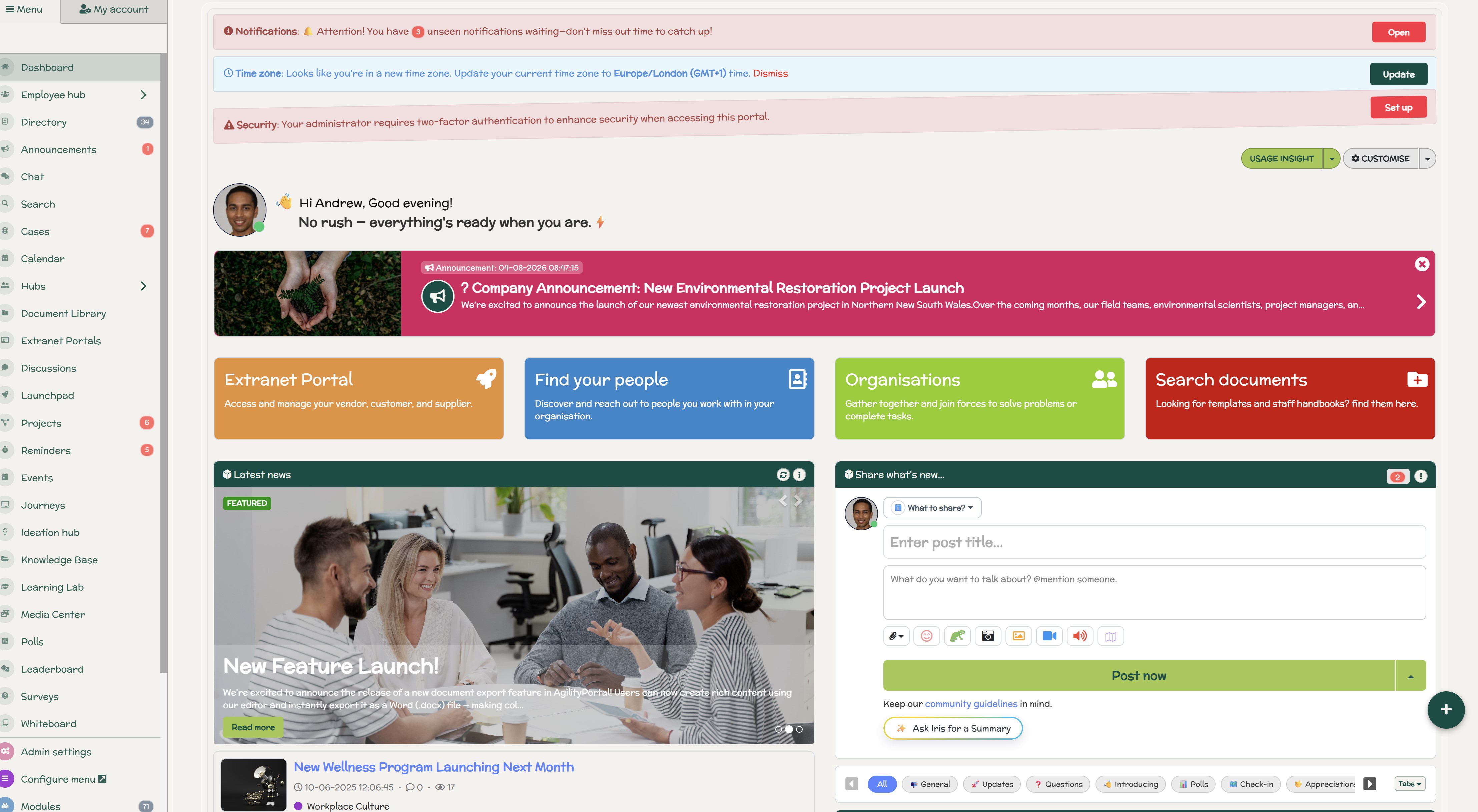
A good employee engagement platform or employee communication platform gives people somewhere they can actually see what's happening across the company instead of relying on scattered emails, group chats and shared drives.
Think of the role of technology like this:
Connect → Communicate → Share → Recognise → Learn → Listen
Where technology helps employee engagement — and where it doesn't
A modern digital workplace platform can help employees:
- Stay connected with colleagues and teams.
- Receive company news and internal communications.
- Find policies, documents and company knowledge.
- Join communities and workplace discussions.
- Recognise colleagues and celebrate achievements.
- Access employee training and onboarding resources.
- Complete surveys, polls and provide feedback.
- Find colleagues through an employee directory.
- Access workplace information from mobile devices.
- Stay connected when working remotely or on the frontline.
This is where an employee intranet such as AgilityPortal can be useful. Instead of communication, knowledge and employee engagement happening across completely separate systems, organisations can bring those experiences together in one digital workplace.
For example, an employee could open AgilityPortal in the morning, read an important company announcement, recognise a colleague, find a policy they need, ask a question in their team community and complete a short training course without jumping between several different platforms.
That can remove a lot of the friction that makes employees feel disconnected in the first place.
But technology can't fix a broken workplace culture
This is the part that's sometimes forgotten.
Buying the best employee engagement software in the world won't suddenly make employees feel valued if their manager never speaks to them.
Technology can make communication easier, but it can't create meaningful communication on its own.
Software won't magically fix:
- Bad management.
- Poor leadership.
- A toxic workplace culture.
- Lack of employee trust.
- Employees feeling undervalued.
- Leaders who don't communicate.
- Managers who ignore employee feedback.
- A company that doesn't recognise good work.
If employees repeatedly provide feedback through an employee survey and nothing happens, adding another survey tool isn't going to improve engagement.
The same applies to internal communication. You can have a brilliant internal communication platform, but if every announcement is corporate jargon that employees don't care about, people will eventually stop reading it.
That's why technology should support your employee engagement strategy, not become the strategy.
Get the human side right first: good managers, clear communication, recognition, trust and a culture where employees feel comfortable contributing. Then use workplace technology to make those behaviours easier and more consistent across the organisation.
That's when an employee intranet stops being somewhere people occasionally visit and starts becoming part of how employees actually experience the company.
AgilityPortal
Bring Communication, Knowledge and Employee Engagement Into One Place
Keeping employees engaged gets harder when company news, conversations, documents, training and workplace knowledge are spread across different systems. AgilityPortal brings those experiences together in one central employee intranet and digital workplace, helping HR, Internal Communications and business leaders create a more connected employee experience.
Whether employees are working in the office, remotely, on the frontline or across different locations, they can use one employee engagement platform to keep up with company news, find colleagues, access knowledge, join communities, recognise good work and contribute to workplace conversations.
Give employees one place to feel connected
Support your employee engagement strategy by making it easier for people to communicate, find information, share knowledge, participate in communities, access training and receive recognition wherever they work.
A practical employee engagement checklist for 2026
So, how do you know whether your employee engagement strategy is actually working?
You don't need to start with a huge employee experience project.
A good first step is simply looking at how people communicate, find information, interact with managers and stay connected across the organisation.
This employee engagement checklist is particularly useful for HR leaders, internal communications teams, business owners and organisations managing remote, hybrid and frontline employees.
1. Can every employee access important company communication?
Start with the basics. If you publish an important announcement today, can everyone actually see it?
Check whether:
- Frontline and deskless employees receive company updates.
- Remote workers have access to the same information as office employees.
- Important announcements aren't buried in email or group chats.
- Employees can access internal communications from mobile devices.
A good internal communication strategy should reach the entire workforce, not just employees sitting behind a laptop.
2. Do employees understand organisational priorities?
Employees are more likely to feel connected when they understand where the business is going and where they fit into it.
Ask yourself:
- Do employees understand current company goals?
- Are managers explaining changing priorities?
- Can teams see how their work contributes?
- Does leadership communicate progress regularly?
This is where leadership communication and employee engagement are closely connected.
3. Can employees easily find policies and company knowledge?
We've all wasted time looking for a document we know exists somewhere.
If employees regularly have to ask colleagues where policies, procedures or documents are stored, your knowledge management strategy probably needs some work.
Employees should be able to quickly find:
- HR policies.
- Company procedures.
- Training materials.
- Workplace documents.
- Frequently asked questions.
- Internal knowledge and expertise.
A searchable employee intranet or knowledge management platform can make this much easier.
4. Are managers communicating regularly?
Managers have a huge influence on whether employees feel connected.
Look beyond scheduled performance reviews and ask whether managers are actually having regular conversations with their teams.
That includes:
- One-to-one check-ins.
- Team updates.
- Coaching and feedback.
- Recognition.
- Conversations about workload and priorities.
Good manager communication should be part of everyday work rather than something that happens twice a year.
5. Can employees easily provide feedback?
Employee communication shouldn't only travel from the top down.
Employees should have simple ways to tell you what's working and what isn't through:
- Employee pulse surveys.
- Polls.
- Q&A.
- Suggestion channels.
- Manager conversations.
- Employee communities.
More importantly, make sure somebody actually responds. Employee feedback becomes meaningless when people repeatedly speak up and nothing happens.
6. Is employee recognition visible?
Ask yourself when you last saw someone publicly thanked for doing a good job.
A strong employee recognition programme doesn't need to be complicated.
Look for:
- Manager recognition.
- Peer-to-peer recognition.
- Project celebrations.
- Employee achievements.
- Work anniversaries.
- Customer compliments.
Small moments of appreciation can help employees feel that their contribution matters.
7. Are remote, hybrid and frontline employees genuinely included?
This is a big one.
An employee engagement strategy for remote and frontline workers can't depend entirely on office meetings and corporate email.
Check whether these employees can:
- Receive company news.
- Access documents and knowledge.
- Participate in conversations.
- Find colleagues.
- Complete training.
- Give feedback.
- Receive recognition.
If they can't, you've probably got an employee experience gap.
8. Can employees connect beyond their immediate team?
A connected workplace shouldn't simply mirror your organisational chart.
Give employees opportunities to build relationships through:
- Employee communities.
- Project groups.
- Interest groups.
- Department spaces.
- Social conversations.
- Learning communities.
This becomes particularly valuable when you're trying to improve employee engagement in a hybrid workplace.
9. Does leadership explain major changes?
Employees don't need to know every detail behind every business decision, but silence creates uncertainty very quickly.
During restructures, leadership changes, new technology rollouts or changes in company direction, communicate:
- What's changing.
- Why it's happening.
- When it's happening.
- How employees will be affected.
- Where employees can ask questions.
Good internal communications during organisational change can prevent rumours filling the information gap.
10. Do you actually act on engagement problems?
Running an employee engagement survey is the easy part.
What matters is what happens afterwards.
A simple approach is:
Listen → Understand → Act → Communicate → Measure again
If employees keep raising the same problem year after year, don't be surprised when survey participation starts falling.
11. Is workplace technology helping or making things worse?
Take a look at your digital workplace from an employee's perspective.
How many applications do they need just to get through a normal working day?
Ask:
- Is company communication spread across multiple tools?
- Is knowledge difficult to search?
- Are employees constantly switching applications?
- Are important conversations happening in disconnected systems?
- Is there one clear place employees can start their working day?
Sometimes adding another workplace app creates more fragmentation rather than solving it.
That's why organisations increasingly look at employee intranet software, employee communication platforms and digital workplace platforms that bring communication, knowledge and collaboration together.
12. Are you measuring things that actually matter?
Don't confuse activity with engagement.
Thousands of intranet logins might look impressive on a dashboard, but they don't automatically mean employees feel connected.
Combine employee engagement metrics with things such as:
- Employee sentiment.
- Communication reach.
- Survey participation.
- Recognition activity.
- Knowledge engagement.
- Manager effectiveness.
- Absenteeism.
- Employee retention.
- Participation across remote and frontline teams.
The goal isn't simply to get employees clicking more things. It's to create a workplace where people can find what they need, understand what's happening and genuinely feel part of the organisation.
If you're answering "no" to several questions on this checklist, that's probably where your employee engagement action plan should start.
The future of employee engagement is about connection, not perks
Free lunches, team socials and employee perks are nice to have, but they're not going to fix a workplace where people feel ignored, uninformed or disconnected.
The workplace itself is changing too. We're seeing more hybrid and remote teams, distributed workforces, frontline employees using mobile technology and AI becoming part of everyday work.
As more of the employee experience becomes digital, businesses need to think much more deliberately about how they maintain the human side of work.
Put simply:
The more digital work becomes, the more deliberately organisations need to design human connection.
AI will change how employees find information and get work done
AI is quickly becoming another layer of the digital employee experience. Employees can already use AI to search company knowledge, summarise information, automate repetitive tasks and get answers without waiting for someone else to respond.
That's useful, but it changes what employees need from their workplace.
Organisations will need to make sure employees can:
- Find trusted company knowledge quickly.
- Understand when and how workplace AI should be used.
- Access up-to-date policies and procedures.
- Know when they need a human rather than an AI answer.
- Share knowledge instead of keeping it trapped within individual teams.
The opportunity isn't to replace human interaction. It's to use AI to remove some of the frustrating work around finding information so people have more time to collaborate, solve problems and communicate.
Managers will matter even more
As teams become more distributed, employees may have fewer spontaneous conversations with managers.
That makes intentional communication more important.
Managers will need to get better at:
- Checking in with remote and hybrid employees.
- Giving regular feedback.
- Recognising good work.
- Explaining changing business priorities.
- Spotting early signs of employee disengagement.
- Building relationships across distributed teams.
An employee engagement platform can support those conversations, but it can't have them for you. Employees still need managers who listen, communicate and actually know what's happening within their teams.
Access to knowledge will become part of the employee experience
Employees increasingly expect workplace information to be as easy to find as information outside work.
Nobody wants to spend 20 minutes searching through emails, shared drives and old messages for a policy that should take seconds to find.
That's why knowledge management, employee intranets and AI-powered enterprise search are becoming closely connected to employee experience.
A connected digital workplace should make it easier for employees to:
- Search company knowledge.
- Find policies and documents.
- Discover subject-matter experts.
- Access training and onboarding.
- Keep up with company announcements.
- Find answers without chasing colleagues.
When information is accessible, employees can get on with their jobs instead of constantly trying to work out where things are.
Employee engagement will become less about where people work
The old idea of workplace culture being something that happens mainly inside an office is becoming harder to maintain.
Modern organisations may have office employees, home workers, contractors, international teams and frontline staff all working together.
A strong digital workplace strategy therefore needs to make sure location doesn't determine how connected someone feels.
That means giving everyone opportunities to:
- Access the same important information.
- Participate in company conversations.
- Connect with colleagues.
- Share ideas and feedback.
- Receive recognition.
- Understand what's happening across the business.
And that's really where the future of employee engagement is heading.
The companies that keep employees engaged won't necessarily be the ones offering the biggest list of perks. They'll be the ones making it easy for people to communicate, find what they need, understand why their work matters and feel like they genuinely belong — wherever they're working from.
Conclusion — connection has to be designed into the workplace
Keeping employees engaged isn't about finding one big initiative that's suddenly going to make everyone love coming to work.
Most of the time, it's about getting the everyday experience right.
Employees are more likely to feel connected when they understand what's happening across the business, know why their work matters, can easily find the information and people they need, receive recognition for their contribution and feel like somebody actually listens when they speak up.
That's why a good employee engagement strategy needs to go beyond surveys, perks and the occasional team-building day.
For organisations managing remote, hybrid, frontline and distributed employees, communication and connection need to be deliberately built into the way people work.
That means supporting:
- Clear and consistent internal communication.
- Easy access to company knowledge and policies.
- Better manager-to-employee communication.
- Employee recognition and feedback.
- Communities that bring people together.
- Mobile access for frontline and deskless workers.
- A digital workplace where employees know where to find what they need.
This is where a modern employee intranet and employee communication platform can help bring those pieces together, but technology is only the enabler.
Ultimately, employees don't become engaged because you've bought engagement software. They become engaged when they feel informed, valued, heard and genuinely part of the organisation.
And that's the real goal: don't just give people somewhere to work. Give them a workplace they actually feel connected to.
Frequently asked questions about employee engagement
Why do employees feel disconnected at work?
Employees can feel disconnected when communication is poor, managers aren't checking in, good work goes unnoticed or they don't understand what's happening across the organisation.
Common causes include:
- Poor internal communication.
- Lack of recognition.
- Weak relationships with managers.
- Limited access to company information.
- Few opportunities to provide feedback.
- Remote or frontline employees feeling left out.
The important thing to remember is that someone can still be doing a good job while feeling disconnected from the company around them.
Why is employee engagement important?
Why is employee engagement important? Because it affects much more than whether people enjoy coming to work.
Engagement can influence productivity, retention, collaboration, customer experience and how willing employees are to contribute beyond their basic responsibilities.
For businesses, stronger engagement can help:
- Improve employee retention.
- Encourage knowledge sharing.
- Strengthen workplace culture.
- Improve communication and collaboration.
- Increase participation and innovation.
- Create a better employee experience.
That's why employee engagement shouldn't simply be treated as an HR initiative. It's a business issue too.
What are some employee engagement examples?
Good employee engagement examples don't have to involve expensive programmes or huge company events. Some of the most effective things happen during everyday work.
For example:
- Managers holding regular one-to-one conversations.
- Employees recognising colleagues for good work.
- Leadership answering employee questions.
- Running short pulse surveys and acting on the results.
- Creating employee communities and interest groups.
- Making company knowledge easy to find.
- Celebrating team and individual achievements.
- Giving frontline employees mobile access to company communication.
The best activities are usually the ones employees actually find useful rather than something HR has introduced simply because it's labelled "engagement".
What should an employee engagement plan include?
An employee engagement plan should start with the problems you're actually trying to solve. There's little point launching ten new initiatives if employees are telling you their biggest issue is poor communication from managers.
A practical plan should cover:
- Current employee engagement levels.
- The main causes of disengagement.
- Clear engagement objectives.
- Internal communication.
- Manager responsibilities.
- Recognition and feedback.
- Employee development.
- Remote and frontline inclusion.
- Engagement metrics.
- Regular reviews and improvements.
Think of it as an ongoing process: Listen → Prioritise → Act → Communicate → Measure → Improve.
What does CIPD say about employee engagement?
If you're researching employee engagement CIPD guidance, the Chartered Institute of Personnel and Development is a useful professional source for understanding engagement from an HR and people-management perspective.
CIPD's work generally connects employee engagement with areas such as:
- Employee voice.
- Good people management.
- Organisational culture.
- Leadership.
- Employee wellbeing.
- Motivation and commitment.
- Meaningful work.
For HR teams developing an engagement strategy, professional research from organisations such as CIPD can be useful alongside employee surveys and your own workplace data.
How do you measure an employee engagement score?
An employee engagement score usually combines responses to survey questions covering how employees feel about their work, managers and organisation.
You might measure:
- Job satisfaction.
- Sense of belonging.
- Manager relationships.
- Recognition.
- Confidence in leadership.
- Understanding of company goals.
- Likelihood of recommending the organisation.
- Intention to stay.
But don't become obsessed with getting one perfect number. A score of 78 means very little if you don't understand why employees answered the way they did.
Look at the score alongside comments, participation, retention, absence and other employee engagement metrics to understand what's really happening.
What are employee engagement jobs?
Employee engagement jobs are roles focused on improving how employees experience, communicate with and participate in an organisation.
Depending on the size of the business, you might see titles such as:
- Employee Engagement Manager.
- Head of Employee Experience.
- Internal Communications Manager.
- Employee Experience Manager.
- People and Culture Manager.
- Head of Internal Communications.
- HR Business Partner.
In smaller organisations, employee engagement will often sit within HR or internal communications rather than having a dedicated role.
Where can I find useful employee engagement articles and research?
When looking for employee engagement articles, don't rely entirely on generic lists of engagement ideas.
Look for research that helps you understand why employees behave the way they do and what actually influences engagement.
Useful sources include:
- Gallup workplace research.
- CIPD research and factsheets.
- SHRM workplace resources.
- Academic and university research.
- Government workplace studies.
- Employee experience research from established organisations.
Then compare that external research with what your own employees are telling you. Industry benchmarks are useful, but your own workforce data should ultimately shape your engagement priorities.
How can managers keep employees engaged?
Managers don't need elaborate engagement programmes. Employees generally want managers who communicate, listen and recognise their contribution.
Managers can start by:
- Holding regular check-ins.
- Giving useful feedback.
- Recognising good work.
- Explaining changing priorities.
- Asking employees for input.
- Helping employees understand how their work contributes.
Small, consistent behaviours usually matter more than occasional big gestures.
How can you reconnect disengaged employees?
Start by finding out why they've become disconnected rather than immediately trying to "motivate" them.
Have a genuine conversation and look for issues around:
- Workload.
- Management.
- Recognition.
- Career development.
- Communication.
- Team relationships.
- Access to information.
- Feeling excluded from decisions.
Once you understand the cause, you can agree on practical changes and check in regularly to see whether things are improving.
Does remote work cause employee disengagement?
Not automatically.
Remote employees can be highly engaged when communication, management and collaboration are handled well.
Problems tend to appear when people feel isolated, miss important information or have very little interaction with colleagues.
Remote employee engagement therefore depends heavily on:
- Regular manager communication.
- Real-time collaboration.
- Access to company information.
- Social connection.
- Recognition.
- Inclusion in company conversations.
The goal shouldn't be forcing connection through endless video meetings. It's making sure distance doesn't turn into isolation.
How does internal communication affect employee engagement?
Good internal communication helps employees understand what's happening, why decisions are being made and how their work fits into the organisation.
When communication works well, employees can:
- Stay informed.
- Understand company priorities.
- Ask questions.
- Participate in discussions.
- Find important information.
- Feel included during organisational change.
Poor communication does the opposite. It creates information gaps, rumours and the feeling that decisions are happening somewhere else without employees being involved.
Can an employee intranet improve employee engagement?
Yes, but simply launching an intranet won't automatically make employees engaged.
A modern employee intranet can support engagement by giving employees one place to access communication, knowledge, communities, recognition and workplace resources.
It can help organisations:
- Centralise company announcements.
- Improve knowledge sharing.
- Connect remote and frontline employees.
- Support employee communities.
- Provide peer-to-peer recognition.
- Collect feedback.
- Improve access to policies and documents.
The technology works best when it's supporting a wider employee engagement plan built around good communication, strong management, recognition and employee voice.
AI Summary
- Employees feel disconnected at work when communication breaks down, recognition is limited, managers don't check in regularly, or people struggle to understand how their work contributes to the wider organisation.
- A strong employee engagement strategy focuses on everyday workplace experiences rather than perks alone. Clear communication, supportive managers, recognition, employee voice and easy access to information all help employees feel more connected.
- Remote, hybrid, frontline and distributed teams need deliberate ways to communicate and collaborate. An effective employee engagement plan should make sure employees can participate regardless of their location, role or device.
- Managers have a major influence on employee engagement and employee experience. Regular check-ins, useful feedback, recognition and clear communication can help organisations identify disconnection before it develops into wider disengagement.
- Organisations should measure more than an employee engagement score. Employee sentiment, communication reach, recognition, participation, retention, knowledge sharing and manager effectiveness can provide a better picture of how connected employees really are.
- AgilityPortal provides an employee intranet and digital workplace where organisations can centralise internal communication, knowledge, employee communities, recognition, training, feedback and workplace resources for office, remote and frontline employees.
Most Popular Posts

Effective communication among team members is vital for the productivity and success of any organization. Surprisingly, 60% of companies lack a long-term internal communication strategy, which p...


Businesses thrive on communication for efficiency, productivity and accomplishment. When the right information is passed from the right designation in the organization, it promotes positivity an...

Categories
Blog
(3192)
Business Management
(394)
Employee Engagement
(235)
Digital Transformation
(218)
Growth
(150)
Intranets
(141)
Internal communications
(106)
Remote Work
(68)
Sales
(53)
Collaboration
(52)
Customer Experience
(32)
Culture
(30)
Knowledge Management
(29)
Project management
(29)
Leadership
(20)
Comparisons
(9)
News
(1)

Related Posts

What would happen to your team's work and customer information if an employee's MacBook disappeared today? If you're wondering how to protect your Mac physically, the answer goes beyond buying a case. A MacBook used at home, on a train or in a ...

Welcome to AgilityPortal's guide to the best VPN for Remote teams. How do you give employees secure access to company systems when they work from home, the office and everywhere in between? It's a question more businesses need to answer: 28% of worki...

Have you ever left a meeting thinking everyone agreed on the next step, only to discover a week later that each person remembered something different? Open source meeting transcription can help teams keep a searchable record of the conversation...

The best ai image editors can save a team hours of repetitive work. A marketing manager can remove a distracting background, an HR team can improve a staff event photo, and an online shop can turn a basic product shot into something ready to pu...

Ever opened a PDF just before a meeting and realised you need to edit a page, pull figures from a scanned report, or gather everyone's comments? What should be a quick task can turn into a frustrating search for the right tool. That lost time a...


Annet Herges
I am a digital nomad, lover of exploring new places and making friends.
I love to travel and I love the internet. I take pictures of my travels and share them on the internet using Instagram.
Traveler, entrepreneur, and community builder. I share my insights on digital marketing and social media while inspiring you to live your fullest life.
Ready to learn more? 👍
One platform to optimize, manage and track all of your teams. Your new digital workplace is a click away. 🚀
Free for 14 days, no credit card required.