
Insight Blog
Agility’s perspectives on transforming the employee's experience throughout remote transformation using connected enterprise tools.
23 minutes reading time
(4584 words)
Why Knowledge Management Fails in Most Companies (And How to Fix It)

Why Knowledge Management Fails in Most Companies (And How to Fix It)
Why knowledge management fails in most companies and what to do instead. Fix broken systems, improve adoption, and make knowledge actually useful.
Why Knowledge Management Fails in Most Companies (And How to Fix It)

Ever wondered why your carefully built knowledge base just… doesn't get used?
You've put in the effort—documents are there, processes are documented, everything looks organised on the surface.
But when people actually need information, they still ask around, dig through messages, or worse… guess.
Here's the uncomfortable truth: in most organisations, knowledge management fails not because of a lack of tools, but because it never becomes part of how people actually work.
28%
of the workweek
According to McKinsey & Company, employees spend up to 28% of their workweek just searching for information—that’s over a full day every week lost to something your system was supposed to fix.
Source: McKinsey Global Institute
And you're not imagining it.
According to McKinsey & Company, employees spend up to 28% of their workweek just searching for information.
That's over a full day every week lost to something your system was supposed to fix.
So if your knowledge system feels more like a storage dump than a useful resource, you're not alone—and more importantly, it's fixable.
Key Takeaways
- Most knowledge systems fail because they are treated as storage tools instead of being embedded into how people actually work.
- Poor ownership and lack of governance lead to outdated, duplicated, and untrusted information.
- Employees avoid using knowledge systems when search is weak, navigation is complex, or content feels unreliable.
- Lost productivity, repeated work, and slow decision-making are direct business costs of ineffective knowledge management.
- Modern approaches focus on fast access, strong search, and integrating knowledge into daily workflows, not separate systems.
The State of Knowledge Management in 2026
So here's the reality: traditional knowledge management approaches are fundamentally broken, and layering AI on top of them isn't going to fix the problem.
That might not sit well if you've spent years building what's often called a "single source of truth."
You'll hear it everywhere—centralise everything, put it in one place, and you'll solve knowledge chaos.
Vendors push this hard too, especially now with AI slapped on top as the "next big productivity boost."
But let's be real—it doesn't work like that.
The idea of a single source of truth completely ignores how information actually behaves inside modern organisations.
Knowledge doesn't live neatly in one platform like Microsoft SharePoint or eGain. It's scattered across tools like Salesforce, Slack, Microsoft Teams, SAP, Oracle, and Workday—and it doesn't stay still. It changes constantly, and a lot of it walks out the door when employees leave.
That's the real issue: knowledge isn't static, and it isn't centralised. It's distributed, messy, and always evolving.
So instead of trying to bolt AI onto isolated systems, what organisations actually need is something bigger—an organisational memory that spans everything.
A layer that connects your entire information landscape.
So employees don't have to think, "Where do I go to find this?"
They just search, find, and use what they need—regardless of where it lives.
Because the real problem isn't access to information.
It's the effort it takes to find it.
1,000+
cloud apps per enterprise
According to Gartner, the average enterprise now uses over 1,000 cloud applications, with nearly 70% introduced without IT approval.
Source: Gartner
What Is Knowledge Management (And What It's Supposed to Do)
Let's not overcomplicate it—knowledge management is simply how your company captures, organises, shares, and actually uses information.
That includes everything from internal documents and processes to team know-how, lessons learned, and even those "only John knows how to do this" tasks that somehow never get written down.
In theory, it sounds straightforward.
You create a system where:
- Important knowledge is documented
- Information is easy to find
- Teams can share what they know
- Employees can quickly get answers without chasing people
That's the goal.
But here's where things start to fall apart.
So what is knowledge management really supposed to do?
At its core, a proper system should:
- Capture knowledge before it disappears (especially when people leave)
- Organise it in a way that actually makes sense
- Make it searchable and accessible instantly
- Help employees use that knowledge in real work situations
In other words, it shouldn't just store information—it should help people get their job done faster and better.
Why the reality rarely matches expectations
If you search things like "what is knowledge management", "knowledge management system examples", or "how to improve knowledge sharing in a company", you'll see a lot of ideal scenarios.
Clean dashboards. Perfectly structured content. Seamless collaboration.
That's not how it plays out in most companies.
Instead, what you usually get is:
- A knowledge base nobody updates
- Documents buried under layers of folders
- Multiple versions of the same file
- Employees asking questions that already have answers
And this is exactly where the gap appears.
Companies think they've implemented knowledge management…
But in reality, they've just created another place to dump information.
The real problem most companies ignore
The biggest mistake?
Treating knowledge management like a tool, not a behaviour.
You can roll out platforms like Microsoft SharePoint or Confluence, but if people don't trust the content, can't find what they need, or don't see the value—it's dead on arrival.
That's why so many businesses end up Googling things like:
- "why knowledge management fails"
- "knowledge management problems in organisations"
- "how to fix knowledge management system"
Because deep down, they already know something isn't working.
What knowledge management should feel like (but usually doesn't)
When it's done right, it should feel effortless.
You search → you find → you use → you move on.
No digging. No asking around. No second-guessing whether the information is outdated.
And more importantly, it should fit naturally into the tools and workflows your team already uses—not sit off to the side as "that system we're supposed to use but don't."
If that's not how your current setup works, then you're not dealing with a knowledge system—you're dealing with a knowledge problem.
And that's exactly why knowledge management fails in most companies.
What Is Knowledge Management (And What It's Supposed to Do)
Have you ever stopped and thought, "We've got all this information… so why can't anyone find anything?"
That's usually the first sign something's off.
At its core, knowledge management is meant to be simple. It's about capturing what your organisation knows, organising it in a way that makes sense, and making sure people can actually use it when they need it.
Not tomorrow. Not after asking three people. Right when they're doing the work.
But here's where things start to break down.
Most companies think they've "done" knowledge management because they've implemented a tool or created a shared space for documents.
On paper, everything looks fine—files are stored, folders are structured, and there's technically a place to go for answers.
In reality, though, it rarely works that way.
This is exactly why so many businesses end up searching things like "why knowledge management fails", "knowledge management failures in organisations", or "what are the challenges of knowledge management". Because deep down, they've already realised something isn't clicking.
And they're right.
The Gap Between What Should Happen and What Actually Happens
Knowledge management is supposed to reduce friction. It should make work faster, easier, and more consistent.
When it's working properly, employees don't need to guess, chase answers, or recreate work that already exists.
But in most companies, the opposite happens.
Instead of clarity, you get confusion. Instead of speed, you get delays. Instead of trust, you get hesitation.
In fact, research from McKinsey & Company shows that employees spend up to 28% of their workweek searching for information. That's not just inefficiency—that's a direct result of knowledge management failures happening at scale.
And it's not because the information doesn't exist.
It's because it's buried, outdated, duplicated, or simply too hard to find.
28%
of work time
Research from McKinsey & Company shows employees spend up to 28% of their workweek searching for information— a clear sign of knowledge systems failing at scale.
Source: McKinsey Global Institute
A Real-World Example of Why Knowledge Management Fails
Let's make this practical.
Imagine a typical setup. Your company uses Microsoft SharePoint to store documents, Slack for internal communication, and Salesforce to manage customer data.
Now a sales rep needs a proposal template.
They check SharePoint first.
There are multiple versions, and it's not clear which one is current. So they move to Slack and search there. Someone shared a file a few months ago, but there's no context around whether it's still valid.
At this point, they do what most people do—they message a colleague and ask for the "latest version."
That colleague sends a file.
The cycle continues.
This is one of the most common knowledge management fails examples. The information exists, but the system isn't trusted, isn't clear, and isn't easy to use—so people work around it instead of with it.
Why Knowledge Management Fails in Most Companies
So what's actually going wrong?
Most organisations treat knowledge management as something you install, not something you build into how people work. That's the root of the problem—and it explains why knowledge management fails so often.
It usually starts with ownership. When no one is responsible for keeping content accurate, it quickly becomes outdated. Documents sit untouched, processes evolve without updates, and before long, people stop trusting the system entirely. Once that trust is gone, usage drops off fast.
Then there's the over-reliance on tools. Companies roll out platforms like Microsoft SharePoint or Confluence thinking the problem is solved. But without structure, governance, and clear rules around how knowledge should be created and maintained, these tools just become storage spaces. That's one of the most common knowledge management failures.
User experience makes things worse. If it's difficult to find information, if search doesn't work properly, or if everything feels buried, people won't use it. They'll take the easier route—usually asking a colleague instead. That behaviour spreads quickly and becomes the default way of working.
Adoption is another issue. Even a well-built system fails if employees don't see the value. If contributing feels like extra effort, or there's no clear benefit, people simply won't engage. Over time, the system becomes incomplete and unreliable.
On top of that, knowledge doesn't stand still. Without regular updates and clear processes, content becomes outdated, duplicated, and inconsistent. At that point, the problem shifts from finding information to trusting it.
But the biggest issue? Most companies treat knowledge as something to store, not something to use.
Information sits in systems, disconnected from daily workflows, rather than being surfaced at the moment it's needed.
And that's why, when people ask "what are the challenges of knowledge management", the real answer isn't just technology—it's usability, behaviour, and integration.
The Real Cost When Knowledge Systems Break Down
It's easy to think of internal knowledge systems as a "nice to have." Something that keeps things organised, maybe saves a bit of time here and there.
But when these systems break down, the impact hits every part of the business—and it adds up fast.
It shows up in how people work, how decisions get made, and ultimately, how much money the business loses without even realising it.
For example, research from McKinsey & Company found that employees spend up to 28% of their workweek searching for information. That's not just inefficiency—that's a direct financial drain.
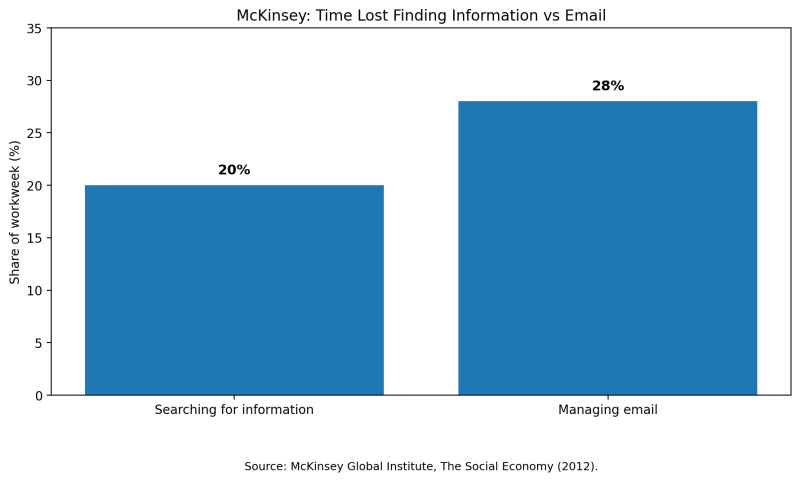
Let's break down what that actually means in real terms:
- Lost productivity = real salary cost - If an employee earning £40K spends 28% of their time searching for information, that's over £11K per year per employee in wasted time. Multiply that across a team of 50 or 100 people, and you're looking at hundreds of thousands lost annually.
- Slower decision-making = missed revenue opportunities - When teams don't have quick access to accurate information, decisions get delayed or made with incomplete data. That can mean missed deals, slower execution, and falling behind competitors.
- Rework and duplication = double spending - Employees often recreate documents, redo analysis, or repeat tasks because they can't find existing work. You're effectively paying twice for the same output.
- Longer onboarding = higher ramp-up costs - New hires take longer to become productive when information is scattered or unclear. Instead of contributing quickly, they spend weeks figuring out where things are and who to ask—costing both time and salary.
- Dependency on individuals = business risk - When knowledge lives in people instead of systems, you create single points of failure. If someone leaves, critical know-how goes with them—leading to disruption, delays, and additional recovery costs.
- Operational inefficiency = hidden overhead - Teams rely on constant back-and-forth communication just to get answers. That creates unnecessary meetings, messages, and interruptions that quietly eat into the workday.
This isn't just about disorganisation—it's about performance.
When information is hard to access, unreliable, or disconnected from daily work, everything slows down. Costs increase, output drops, and teams become reactive instead of efficient.
And the worst part? Most of these losses don't show up clearly on a balance sheet—they're hidden in wasted time, duplicated effort, and missed opportunities.
Fixing it isn't about adding more systems.
It's about making information easy to find, easy to trust, and available exactly when people need it—without thinking twice.
Signs Your Knowledge Management Is Already Failing
Let's be honest for a second—deep down, you probably already know if something isn't working.
You don't need a full audit or consultant to tell you. The signs show up in everyday work… you just have to notice them.
Here's what it typically looks like.

Signs Your Knowledge Management Is Already Failing
People Keep Asking the Same Questions
You've seen it.
Same questions. Same answers. Different day.
Someone asks in Slack or Microsoft Teams, and within minutes someone replies… even though the answer already exists somewhere.
That's your first red flag.
It tells you two things:
- People either can't find the information
- Or they don't trust where it lives
Either way, the system isn't doing its job.
The Documents Exist… But Nobody Uses Them
This one's painful.
You know the documents are there. They've been created, uploaded, and neatly stored in something like Microsoft SharePoint.
But when it comes to actually using them?
Silence.
People ignore them completely and go straight to asking a colleague instead. Why? Because it's faster and more reliable (in their mind).
At that point, your system has basically become a digital archive—not a working tool.
Multiple Versions of the Same File
"Final_v2"
"Final_v3"
"Final_FINAL"
"Final_THIS_ONE_USE_THIS"
Sound familiar?
When you've got multiple versions of the same document floating around, nobody knows what's correct anymore. And once that doubt creeps in, trust disappears.
This is one of the clearest signs things are slipping.
Because now people aren't just struggling to find information—they're second-guessing it.
New Hires Are Completely Lost
A good system should make onboarding easier.
But if new employees are constantly asking:
- "Where do I find this?"
- "Is this the latest version?"
- "Who do I ask for this?"
…then something's broken.
Instead of getting up to speed quickly, they're relying on people to guide them through everything. That slows them down—and pulls everyone else away from their work too.
Everything Happens in Chat Instead
Here's the big one.
If your team relies heavily on Slack or Teams for answers, decisions, and knowledge sharing, it's usually not because they prefer chat.
It's because your system isn't working.
Chat becomes the "real" knowledge hub:
- Quick answers
- Easy access
- Immediate responses
But the downside?
That knowledge disappears just as quickly as it came.
It gets buried in threads, lost over time, and never becomes reusable.
If you're seeing even two or three of these signs, you're not dealing with a small issue—you're looking at a system that's already failing.
And the tricky part?
Most teams adapt to it. They work around the problem instead of fixing it.
But over time, that workaround becomes the way your company operates—and that's where the real inefficiency kicks in.
The good news? Once you spot these patterns, you can actually start fixing them.
How to Fix a Failing Knowledge Management System
Alright—so if you've recognised the signs, the next question is obvious:
How do you actually fix it without ripping everything out and starting again?
Because let's be real—that's what most companies think they need to do. New tool, new system, fresh start.
But that's usually the wrong move.
Fixing this isn't about replacing everything. It's about changing how your system works for people.

How to Fix a Failing Knowledge Management System
Start With Ownership (Because Without It, Nothing Sticks)
Here's the blunt truth—if nobody owns the knowledge, it will fall apart.
Every time.
You need clear responsibility. Not vague "teams" or shared ownership… actual people who are accountable for specific areas of content.
That means:
- Someone is responsible for keeping content accurate
- Someone reviews and updates it regularly
- Someone makes sure it stays relevant
Without that, things get outdated fast—and once people spot outdated content, they stop trusting the whole system.
Make It Easy to Use (Or No One Will Use It)
This is where most systems quietly fail.
If it takes more than a few seconds to find something, people won't bother. They'll just ask someone instead.
So the focus needs to shift from "where should we store this?" to "how quickly can someone find this?"
That means:
- Clean, simple navigation (not 10 layers of folders)
- Search that actually works
- A structure that makes sense to real users—not just admins
Think about it like this: if your system feels like hard work, people will avoid it.
Bring Knowledge Into the Flow of Work
One of the biggest mistakes companies make is separating knowledge from where work actually happens.
You've got documents in one place, conversations in another, tasks somewhere else…
It's disconnected.
Instead, knowledge should show up where people are already working—inside tools like Slack, Microsoft Teams, or your internal platform.
So instead of:
👉 "Go search for it"
It becomes:
👉 "Here's what you need, right now"
That shift alone removes a huge amount of friction.
Stop Treating Knowledge Like a Static Library
Most systems are built like storage.
Upload a document → leave it there → hope it stays useful.
That doesn't work anymore.
Knowledge needs to stay alive.
That means:
- Content gets reviewed and refreshed regularly
- Old or duplicate content gets cleaned up
- Information evolves as the business changes
This is also where AI can actually help—but only if it's used properly. Not as a gimmick, but to summarise, surface, and keep content usable.
Get People to Actually Contribute (This Is the Hard Part)
You can build the perfect system—but if people don't use it, it's dead.
So you need to make contribution part of how work gets done, not an extra task.
That could mean:
- Encouraging teams to document as they go
- Recognising or rewarding useful contributions
- Making it ridiculously easy to add or update content
Because right now, most employees think:
👉 "Why should I document this?"
You need to flip that into:
👉 "It's easier if I do."
The Shift That Actually Fixes Everything
Here's what this all comes down to:
You're not fixing a system—you're fixing behaviour.
Once knowledge becomes:
- Easy to find
- Easy to trust
- Easy to contribute to
…everything changes.
People stop working around the system and start relying on it.
And that's when it finally starts doing what it was supposed to do in the first place.
What Modern Knowledge Management Should Look Like
So if most systems aren't working… what does a good setup actually look like?
It's not about building the perfect system. It's about making things simple for the people using it.
Modern knowledge management isn't rigid. It doesn't force everything into one place. Instead, it connects everything so people can access what they need without thinking about where it lives. Information might sit across tools like Salesforce or Slack, but from the user's point of view, it feels like one system.
Search becomes the starting point. Not folders. Not navigation. You type what you need and get the answer. No digging. No guessing which version is correct.
AI plays a role, but only if it saves time. It should summarise content, highlight what matters, and bring the right information forward. If it doesn't reduce effort, it's just noise.
Knowledge also needs to sit inside the flow of work. Not off to the side. People shouldn't have to leave what they're doing to go find answers. The answers should come to them, in the tools they already use.
And most importantly, it needs to feel natural. No friction. No second guessing. Just quick access to reliable information.
That's the shift.
It's no longer about storing knowledge. It's about making it usable.
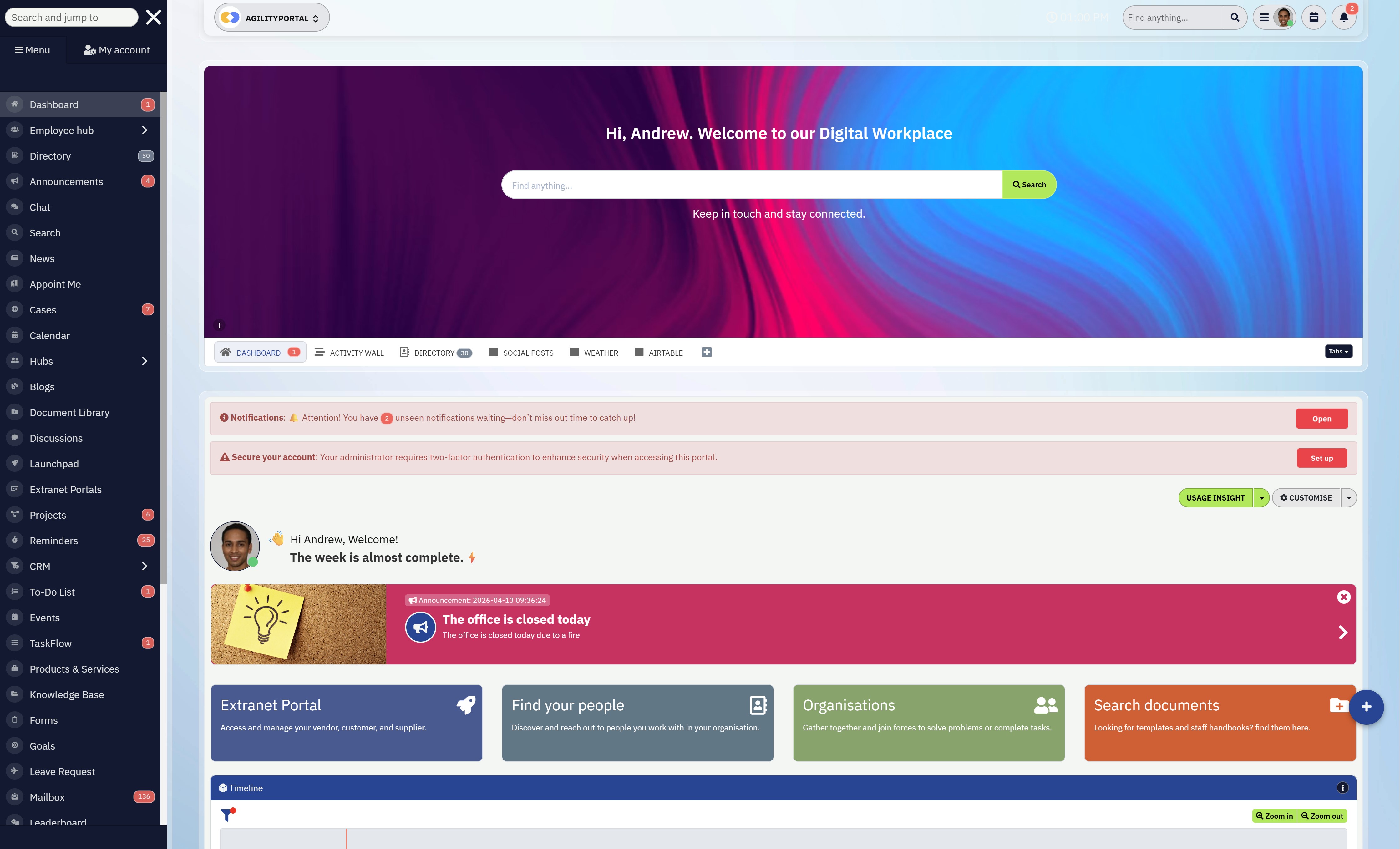
Platforms like AgilityPortal are moving in this direction by connecting communication, knowledge, and workflows into one place. Not as another tool, but as part of how work actually happens.
That's the goal.
Make knowledge easy. Make it fast. Make it something people rely on without even thinking about it.
One Platform. All Your Knowledge. No More Guesswork. Try AgilityPortal More Then Just a Knowledge Base.
If you're reading this and thinking, "this sounds exactly like us"—you're not alone.
Most teams aren't struggling because they lack information.
They're struggling because they can't access, trust, or use it when it matters.
That's exactly the problem AgilityPortal is built to solve.
Instead of juggling multiple tools, scattered documents, and endless chat threads, AgilityPortal brings everything into one connected space.
Your communication, knowledge, documents, and workflows all work together—so your team doesn't have to waste time searching or second-guessing.
Imagine this instead:- You search once… and get the right answer.
- Your team works from the same up-to-date information.
- Knowledge doesn't get lost when someone leaves.
That's the shift.
If you're ready to stop patching a broken system and actually fix how your team works, it's worth seeing how it looks in practice.
FAQ
Why do knowledge management systems fail?
Most systems don't fail because of the technology—they fail because of how they're used. Companies often focus on rolling out tools instead of thinking about how people will actually find, trust, and use the information. If there's no clear ownership, no structure, and no reason for employees to engage, the system quickly becomes outdated and ignored.
What is the biggest problem with knowledge management?
The biggest issue is usually a mix of poor ownership and bad user experience. If no one is responsible for keeping content accurate, it becomes unreliable. And if it's hard to find information, people won't even try. Once trust and usability drop, the whole system starts to fall apart.
How can you improve knowledge management?
Start by focusing on how people work, not just where information is stored. Make it easy to search, keep content updated with clear ownership, and bring knowledge into the tools your team already uses. The goal is simple—people should be able to find what they need quickly without thinking about where it lives.
What tools are best for knowledge management?
The best tools aren't just storage systems. They combine communication, search, and content into one connected experience. Platforms like AgilityPortal go beyond basic document storage by helping teams access and use knowledge as part of their everyday work, not as a separate system they have to manage.
AI Summary
- Most knowledge management systems fail because they are treated as static storage tools rather than being integrated into how employees actually work.
- Common issues include outdated content, poor ownership, weak search functionality, and low employee adoption.
- Employees often bypass knowledge systems entirely, relying on chat tools like Slack or Teams because it’s faster and more reliable.
- Research shows employees can spend a significant portion of their workweek searching for information, creating hidden productivity and financial costs.
- Disconnected tools and siloed information make it harder for teams to find, trust, and reuse knowledge effectively.
- Modern knowledge management focuses on fast search, real-time access, and embedding knowledge directly into daily workflows.
Most Popular Posts

Effective communication among team members is vital for the productivity and success of any organization. Surprisingly, 60% of companies lack a long-term internal communication strategy, which p...


Businesses thrive on communication for efficiency, productivity and accomplishment. When the right information is passed from the right designation in the organization, it promotes positivity an...

Categories
Blog
(3224)
Business Management
(396)
Employee Engagement
(235)
Digital Transformation
(220)
Growth
(150)
Intranets
(142)
Internal communications
(109)
Remote Work
(68)
Sales
(53)
Collaboration
(53)
Customer Experience
(33)
Culture
(30)
Knowledge Management
(29)
Project management
(29)
Leadership
(20)
Comparisons
(9)
News
(1)

Related Posts

AI for personal injury law firms is becoming part of everyday casework. These tools can help teams sort through medical records, build timelines, draft demand packages and find details buried in a big case file. That could free up attorneys and...

Ever left an online meeting unsure what was decided—and wondered how to run an effective meeting without wasting everyone's time? A call can bring a distributed team together quickly, but when it starts late, includes people who don't know why ...

Where can I send a fax from in my area when a document needs to go out today? The answer might be a nearby print or shipping shop, a library or an online fax service, but what's available depends on your location. The UPS Store lists a ne...

AI in internal communications can help a small team turn one important update into useful messages, answers and resources for employees—but only when the information is accurate and a person checks the result. Comms teams are expected to keep p...

How is Edge AI changing business operations in 2026, and when does it make sense to process data near where it is created instead of sending it all to the cloud? The investment forecasts point to growing interest: Capgemini Research Institute's...


Jill Romford
I am a digital nomad, lover of exploring new places and making friends.
I love to travel and I love the internet. I take pictures of my travels and share them on the internet using Instagram.
Traveler, entrepreneur, and community builder. I share my insights on digital marketing and social media while inspiring you to live your fullest life.
Ready to learn more? 👍
One platform to optimize, manage and track all of your teams. Your new digital workplace is a click away. 🚀
Free for 14 days, no credit card required.