
Insight Blog
Agility’s perspectives on transforming the employee's experience throughout remote transformation using connected enterprise tools.
39 minutes reading time
(7803 words)
How Bespoke Software Development Solves the Biggest Digital Transformation Challenges in 2026 and Beyond

How Bespoke Software Development Solves the Biggest Digital Transformation Challenges in 2026 and Beyond
Discover how bespoke software development can solve major digital transformation challenges, from legacy systems and integration to automation and scalability.
How Bespoke Software Development Solves the Biggest Digital Transformation Challenges in 2026 and Beyond

Belive it or not but businesses today have more SaaS platforms, cloud services, automation tools and AI capabilities available to them than at any other point in history.
Yet despite this abundance of technology, many organisations still struggle to turn digital investment into real operational improvement.
This is where bespoke software development becomes an important consideration, especially when off-the-shelf tools fail to align with how a business actually works day to day.
In practice, companies often discover that their systems don't communicate properly with each other.
Employees end up relying on manual workarounds, copying data between platforms, or maintaining spreadsheets just to keep processes moving.
Data becomes fragmented across disconnected applications, and older legacy systems can prevent newer tools from integrating effectively. This creates inefficiencies that slow down decision-making and increase operational risk.
70%+
Digital Transformations Lose Momentum
Research from McKinsey highlights the scale of the challenge, showing that more than 70% of organisations that have undertaken digital transformation report that their efforts lose momentum at some stage. This reinforces why successful transformation depends on more than simply introducing new technology.
Source: McKinsey – How to Restart Your Stalled Digital Transformation
Research from McKinsey highlights the scale of the issue, showing that more than 70% of organisations that have undertaken digital transformation report that their efforts lose momentum at some stage, often due to integration and adoption challenges rather than a lack of technology.
In this article, we'll explore the biggest digital transformation challenges businesses face in 2026, and where bespoke software development can realistically help remove those barriers without adding unnecessary complexity.
Key Takeaways
- Bespoke software development is most valuable when existing platforms cannot efficiently support critical workflows, integrations, or operational requirements.
- Legacy systems, disconnected applications, manual processes, and fragmented data remain some of the biggest barriers to successful digital transformation.
- Custom software does not always mean replacing existing technology; APIs, middleware, and bespoke integrations can extend the life of systems that still perform important business functions.
- Businesses should follow a practical buy, configure, integrate, extend, then build approach before committing to full custom development.
- Successful digital transformation depends on more than software alone. Employee adoption, governance, cybersecurity, data quality, training, and continuous improvement all influence the outcome.
- Beyond 2026, bespoke development will increasingly focus on connecting SaaS platforms, AI agents, APIs, workflow automation, and custom business logic into one coordinated technology environment.
What is bespoke software development, and where does it fit into digital transformation?
If your not aware already bespoke software development refers to software that is designed and built specifically around a company's unique processes, users, integrations and operational requirements.
Unlike off-the-shelf tools that are created for a broad market, bespoke solutions are shaped by how a business actually works day-to-day, rather than forcing the business to adapt to the software.
In the context of digital transformation, bespoke software typically sits in the "fill the gaps" layer.
It is not usually the starting point of transformation, but it becomes relevant when existing platforms cannot fully support critical workflows, data flows or integrations.
Businesses can work with providers of custom software from Pulsion to create applications and platforms around their specific business needs rather than adapting their processes to fit generic software.
In other words, it helps bridge the space between standardised systems and the specific way an organisation needs to operate.
Bespoke software vs off-the-shelf software
| Area | Bespoke Software | Off-the-Shelf Software |
| Business fit | Built around specific requirements | Designed for common requirements |
| Implementation | Usually longer | Usually faster |
| Upfront cost | Higher | Typically lower |
| Customisation | Extensive | Vendor dependent |
| Integration | Can be designed around existing systems | Depends on APIs/connectors |
| Scalability | Designed around expected requirements | Vendor/platform dependent |
| Maintenance | Business/development partner responsibility | Vendor responsibility |
It's important not to assume that bespoke software is automatically the better option. In many cases, established off-the-shelf platforms are more cost-effective, faster to deploy, and already proven at scale.
The decision is not about "custom vs standard" in a vacuum, but about which approach best fits the specific problem being solved, the maturity of the organisation, and the long-term operational impact.
So, what's making digital transformation so difficult in 2026?

So, what's making digital transformation so difficult in 2026?
Basically digital transformation becomes difficult not because businesses lack tools, but because there is often a mismatch between what the organisation is trying to become and what its current setup can realistically support.
In other words, the future operating model a business wants to achieve (faster workflows, better customer experience, real-time data, automation) often collides with the constraints of its existing environment.
Those constraints usually sit in three places: outdated or fragmented technology, rigid or inconsistent business processes, and organisational structures that were designed for a previous way of working. When these three areas don't evolve together, even well-funded transformation programmes start to slow down or stall.
Research from McKinsey highlights that successful digital transformation depends on more than just technology investment.
It points to the importance of scalable operating models, distributed and flexible technology systems, accessible and well-governed data, and strong adoption supported by effective change management.
In practice, this means transformation is as much about how a business operates as it is about the tools it uses.
A useful way to understand this is through a simple framework:
People + Process + Data + Technology
Software — including bespoke software development — plays a key role in improving the process, data, and technology layers. It can streamline workflows, connect systems, and structure information in a more usable way.
However, it cannot independently solve challenges related to people, such as resistance to change, lack of training, unclear ownership, or poor adoption.
Without addressing the human side of transformation, even the best-designed software will struggle to deliver meaningful impact.
The Core Challenges
#1. Legacy systems are holding modern workflows back
Let's be honest — a lot of businesses are still running on systems that feel like they belong in another decade.
We're talking about things like:
- Old ERP or CRM systems that "sort of work" but haven't been updated in years
- Applications that the original vendor no longer properly supports
- On-premise databases sitting on ageing servers in a back room somewhere
- Teams still relying heavily on spreadsheets because the main system can't do what they need
- Tools that don't have modern APIs, so they can't easily connect to anything else
- And in some cases, absolutely critical business software that everyone is too scared to touch because "if it breaks, everything stops"
And that's really the problem — these systems aren't always broken, they're just stuck. They were built for how the business worked 10–15 years ago, not how it works today.
So instead of helping people move faster, they end up slowing everything down.
Where bespoke software helps
Now, this is where bespoke software development can actually make a real difference — but not in the "rip everything out and start again" way people often assume.
A smarter approach is usually:
Legacy system → custom API or middleware layer → modern applications
In simple terms, you don't throw away the old system straight away. Instead, you build something in between that helps it talk to newer tools.
Think of it like a translator. The old system speaks one language, the new tools speak another, and the middleware sits in the middle making sure they understand each other.
That means you can keep the system that still does its core job, while still modernising the experience around it.
A real-world example
Imagine a logistics company that's still running a warehouse system built 15 years ago.
It's not pretty, but it works. It handles thousands of daily transactions — stock movements, dispatches, returns, the lot. The problem is, it doesn't connect to anything modern.
So customers can't track orders in real time, and staff can't use mobile devices in the warehouse. Everything is still very "old school".
Instead of trying to replace the entire system (which would be risky, expensive, and disruptive), the business builds a middleware layer on top of it.
Now that layer can:
- Pull data from the old warehouse system
- Feed it into a modern customer portal so clients can track deliveries in real time
- Push updates to a mobile app used by warehouse staff
- Sync key information with newer CRM or reporting tools
So suddenly, the business feels modern on the outside — even though the core system underneath hasn't changed yet.
And that's the key point: bespoke software doesn't always mean replacing what you've got. Sometimes it just means making what you've got actually work in today's world.
#2. Your systems work — they just don't work together
This is often where digital transformation quietly breaks down in practice. On paper, most organisations already have "modern" systems in place. In reality, those systems rarely talk to each other in a meaningful way.
Instead of a connected digital ecosystem, businesses end up with a collection of isolated tools, each solving a specific problem but none designed to work as part of a unified workflow.
This typically includes:
- HR systems managing people data in isolation
- CRM platforms holding customer information separately
- ERP systems controlling finance and operations in their own environment
- Intranets storing internal communications and documents
- Finance software running billing and reporting independently
- Project management tools tracking delivery in a separate workspace
- Customer platforms handling interactions without wider system visibility
- Document repositories acting as standalone knowledge silos
Individually, each system may function well. Collectively, they create fragmentation.
How custom integration changes the workflow
Bespoke software development addresses this problem by removing the need for manual system bridging and replacing it with structured, automated data flow.
Instead of employees moving information between tools, systems are connected through defined integration logic.
A simplified model looks like this:
System A → API / integration layer → business rules → System B → automated notification
In this setup, data moves automatically between systems based on predefined rules, validations, and triggers.
The result is not just faster processing, but a fundamentally different operating model:
- Data is entered once, not multiple times
- Systems stay synchronised in real time or near real time
- Workflows are consistent and auditable
- Employees focus on decision-making rather than data transfer
- Information becomes accessible across the organisation without manual effort
Rather than replacing existing tools, custom integration allows them to work together as a single, coordinated system.
#3. Manual processes are surviving inside supposedly digital businesses
Even in organisations that consider themselves "fully digital," a surprising number of core workflows still rely on manual effort behind the scenes.
The surface-level tools may be modern, but the way work actually moves through the business often isn't.
Common examples include:
- Spreadsheet-based approval chains that are emailed back and forth
- Email-driven requests with no structured tracking or visibility
- Manual onboarding processes involving multiple disconnected steps
- Repetitive data entry across different systems
- Paper forms that are later digitised or re-entered
- Copying and pasting information between applications
- Managers chasing employees for updates via email or chat
Individually, these may seem minor. But collectively, they create friction, slow down decision-making, and introduce avoidable errors. More importantly, they reveal a gap between "having digital tools" and actually having digitised processes.
This is where automation becomes genuinely useful
Workflow automation is most valuable when it removes predictable, repeatable steps that humans shouldn't need to manage manually. The goal isn't to replace people or over-engineer processes with AI, but to ensure that routine business logic is handled consistently and transparently by systems.
A well-designed automated workflow typically follows a clear, structured path:
Request → Validation → Approval → System Update → Notification → Audit Trail
In practice, this means a request is submitted once, automatically checked against predefined rules, routed to the correct approver, updated in the relevant system, and logged for accountability — without requiring constant manual follow-up.
This kind of automation doesn't need to be complex or AI-driven to be effective. In many cases, the biggest gains come simply from removing unnecessary human handoffs and ensuring that information flows reliably between systems.
A simple visual diagram of this flow can be highly effective in illustrating how much hidden manual effort exists inside "digital" organisations.
#4. Off-the-shelf software solves 80% of the problem — but the remaining 20% matters
Most off-the-shelf software is designed to solve common business problems in a standardised way. And for the majority of organisations, it does exactly that very well.
In fact, for around 80% of use cases, existing SaaS platforms and enterprise tools are more than sufficient.
The challenge begins when businesses try to force unique or complex internal processes into systems that were never designed to support them.
When that happens, teams don't stop working — they adapt. And those adaptations often introduce hidden inefficiencies across the organisation, such as:
- Workarounds that bypass intended system workflows
- Extra spreadsheets used to "fill the gaps"
- Duplicate data entry across multiple platforms
- Poor user experience for employees trying to navigate rigid systems
- Shadow IT emerging as teams adopt unofficial tools to get work done
- Additional SaaS subscriptions added to patch missing functionality
Individually, these issues may seem minor. But collectively, they create a fragmented digital environment where systems no longer reflect how the business actually operates.
Over time, this leads to increased operational friction, inconsistent data, and reduced visibility across core processes.
When should you customise and when should you buy?
The key decision is not whether bespoke software is "better," but whether it is necessary.
A practical way to evaluate this is through a progressive decision framework:
Buy → Configure → Integrate → Extend → Build
- Buy: Use an existing off-the-shelf solution when it meets the core requirement with minimal compromise.
- Configure: Adjust settings, workflows, and permissions within the platform to better fit your processes.
- Integrate: Connect multiple systems so data flows between them without manual intervention.
- Extend: Add custom modules, plugins, or lightweight development on top of existing platforms.
- Build: Develop bespoke software only when the business requirement cannot be met efficiently through any of the previous steps.
In most cases, organisations should aim to stay as far left on this spectrum as possible.
Moving toward bespoke development only becomes justified when simpler, lower-cost approaches cannot deliver the required functionality without creating ongoing inefficiencies or operational risk.
#5. Data is everywhere, but nobody has the complete picture
One of the most common (and most underestimated) digital transformation challenges is not a lack of data, but the fact that it is scattered across too many disconnected systems.
Most organisations already have more data than they can effectively use — it is simply fragmented across different tools that were never designed to work together.
For example:
- Customer information sits in a CRM system, often with incomplete or duplicated records.
- Employee data is stored in an HRIS platform, separate from operational systems.
- Financial records such as invoices and payments live in accounting or finance software.
- Key documents are stored in SharePoint, Google Drive, or similar repositories.
- Day-to-day operational information is still tracked in spreadsheets or local files.
Individually, each system may function well. The problem emerges when leaders try to answer simple but critical business questions such as "What is our true customer value?" or "How efficient is our end-to-end process?" — because the answer requires combining data from multiple disconnected sources.
This fragmentation leads to duplicated effort, inconsistent reporting, and a lack of trust in the data itself.
Teams often end up exporting information into spreadsheets just to reconcile it manually, which reintroduces the very inefficiencies digital transformation is meant to remove.
Bespoke software can create the connective layer
This is where bespoke software development can play a strategic role — not by replacing existing systems, but by connecting them into a coherent data ecosystem.
A well-designed custom solution can act as a connective layer between disparate platforms, enabling data to flow more intelligently across the organisation.
Key capabilities include:
- APIs: Securely connecting systems so data can be exchanged automatically rather than manually exported and imported.
- Data pipelines: Moving and transforming data between systems in real time or on scheduled intervals.
- Unified dashboards: Bringing multiple data sources into a single view for reporting and decision-making.
- Data synchronisation: Ensuring updates in one system are reflected consistently across others.
- Master data management: Establishing a single source of truth for critical entities such as customers, employees, or products.
- Permissions and access control: Ensuring users only see the data they are authorised to access across all connected systems.
- Search and discovery layers: Allowing users to find relevant information across multiple systems without needing to know where it is stored.
However, this is also an area where caution is essential. Connecting systems increases both capability and responsibility. Without proper governance, organisations risk creating new data silos, inconsistent logic, or security vulnerabilities.
Strong data governance, GDPR compliance, and clearly defined access controls are critical when designing any bespoke integration layer. Data should only be shared where there is a legitimate business need, and every connection between systems should be designed with security and privacy in mind from the outset.
When implemented correctly, however, a bespoke connective layer can transform fragmented data into a unified, reliable foundation for decision-making — without forcing a costly and disruptive replacement of existing systems.
#6. Scaling exposes technology decisions that worked when the company was smaller
As organisations grow, the systems and processes that once felt "good enough" quickly start to show their limitations.
What works smoothly for a team of 50 employees can become inefficient, error-prone, and even unmanageable at 250 or 1,000+ employees.
The same applies on the customer side. A business handling 100 customers with manual processes may cope reasonably well, but at 10,000 or 100,000 customers, those same workflows can collapse under their own weight.
This is where scaling exposes the hidden cost of early technology decisions—especially when operations rely heavily on spreadsheets, email chains, and manual administration rather than structured systems.
At scale, several key issues begin to emerge:
- Performance: Systems and processes slow down as data volumes increase, leading to delays, bottlenecks, and frustrated users.
- Permissions: Managing who can access what becomes increasingly complex, raising both security risks and administrative overhead.
- Workflow volume: Manual processes that once handled a small number of requests become overwhelmed, creating backlogs and inconsistent outcomes.
- Automation: Lack of automation becomes a major constraint, forcing teams to spend more time on repetitive tasks instead of higher-value work.
- Reporting: Aggregating data from multiple spreadsheets and systems becomes time-consuming and unreliable, making it difficult to get accurate, real-time insights.
- Multi-location operations: As businesses expand geographically, inconsistent processes across sites lead to duplication, misalignment, and operational inefficiencies.
- International requirements: Different regulations, languages, currencies, and compliance rules add further complexity that manual systems are rarely designed to handle.
At this stage, the issue is no longer just about efficiency—it becomes a structural limitation. Without scalable systems in place, growth itself starts to create operational friction rather than business value.
#7. AI is creating another integration problem
AI is rapidly becoming a standard expectation inside modern businesses, but in practice it is introducing a new and often overlooked challenge: integration.
Most organisations don't struggle to access AI tools anymore — they struggle to make those tools genuinely useful within their existing environment.
The real value of AI only emerges when it can interact with the systems a business already relies on, including:
- Internal knowledge bases and documentation
- CRM platforms and customer histories
- Employee systems such as HR and onboarding tools
- Document repositories and file storage systems
- Customer records and support interactions
- Operational workflows and approval processes
- Existing enterprise applications and legacy platforms
Without this connectivity, AI remains a standalone tool that produces generic outputs rather than meaningful business insight or action.
In other words, the challenge is no longer "how do we use AI?" but "how do we connect AI to everything we already use?"
An AI assistant is only useful if it can safely reach the right information
For AI to deliver real operational value, it must sit on top of a controlled and well-structured data environment. Otherwise, it risks becoming inaccurate, inconsistent, or even unsafe in a business context.
A practical way to understand this is through the flow of information:
Business systems → permissions → APIs/data layer → AI → employee
Each stage in this chain matters.
- Business systems hold the source of truth (CRM, HR, finance, documents, etc.)
- Permissions determine what data is allowed to be accessed and by whom
- APIs or data layers provide structured, secure access to that information
- AI models interpret and generate responses based on the available data
- Employees receive insights, recommendations, or automated outputs
If any part of this chain is weak or poorly designed, the AI layer becomes unreliable.
This introduces three critical considerations for organisations:
- Security: AI must not expose sensitive or restricted data across departments or users
- Hallucination risk: without proper data grounding, AI may generate confident but incorrect answers
- Governance and permissions: access control must be enforced consistently across all connected systems
This is why many AI initiatives fail at the enterprise level — not because the models are weak, but because the underlying data architecture is fragmented.
In this context, bespoke software and integration layers often become essential. They provide the structured bridge between existing systems and AI tools, ensuring that intelligence is built on accurate, permissioned, and well-governed data rather than disconnected information silos.
Central Tension
Here's the catch: custom software can create new problems too
While bespoke software development can be a powerful enabler of digital transformation, it is not without its own risks and trade-offs.
Some of the most common challenges include:
- Higher upfront investment – Custom software typically requires more initial capital than off-the-shelf alternatives, especially when discovery, design, and testing phases are included.
- Longer development time – Unlike SaaS tools that can be deployed quickly, bespoke systems often take months to design, build, and refine.
- Poor requirements definition – If business needs are not clearly understood from the outset, the final product may miss critical functionality or overcomplicate simple processes.
- Scope creep – Projects can expand beyond their original intent, increasing cost, complexity, and delivery timelines.
- Vendor dependency – Relying on a single development partner can create long-term dependency for updates, fixes, and enhancements.
- Security vulnerabilities – Custom-built systems must be carefully designed and tested to avoid introducing security gaps that established platforms have already addressed.
- Ongoing maintenance burden – Unlike SaaS products that include updates, bespoke systems require dedicated maintenance planning and resources.
- Technical debt – Poor architectural decisions or rushed development can create long-term limitations that are expensive to resolve later.
- Documentation gaps – Without proper documentation, systems become difficult to maintain, scale, or transfer between teams.
- Key-person dependency – If only a small number of developers understand the system, knowledge loss can create operational risk.
McKinsey notes that digital and analytics transformation can introduce additional cyber, data, privacy and operational-resilience risks alongside traditional budget, talent and implementation risks.
This reinforces the importance of treating custom software as a strategic capability rather than a purely technical build exercise.
Bespoke doesn't mean building everything yourself
A common misconception is that adopting bespoke software means abandoning all existing tools and rebuilding everything from the ground up. In reality, the most effective digital architectures are hybrid in nature.
A more sustainable approach is:
SaaS + APIs + integrations + bespoke components
This model allows businesses to leverage proven platforms for standardised functions (such as email, HR, or accounting), while using custom development only where differentiation, integration complexity, or unique workflows demand it.
Rather than:
Build everything from scratch
modern digital transformation strategies focus on orchestration — connecting systems intelligently, extending capabilities where needed, and avoiding unnecessary reinvention of already-solved problems.
Practical Decision Section
Does your business actually need bespoke software?
Before investing in custom development, it's important to step back and assess whether your organisation genuinely needs a bespoke solution or whether the problem can be solved through configuration, integration, or better use of existing tools.
The following checklist highlights common operational signals that suggest your current software stack may no longer be fit for purpose:
- Employees repeatedly enter the same information into multiple systems, creating duplication and increasing the risk of errors.
- Critical workflows still depend on spreadsheets rather than structured, system-driven processes.
- Existing platforms do not integrate effectively, forcing teams to manually transfer or reconcile data.
- Employees have created unofficial workarounds (such as shadow IT tools or personal tracking systems) to get their work done.
- Important business processes rely heavily on email chains rather than automated workflows or system triggers.
- Existing SaaS tools require excessive customisation or constant workarounds just to meet basic operational needs.
- Legacy technology is actively preventing the launch of new products, services, or internal improvements.
- Reporting requires manually combining data from multiple systems, often in spreadsheets, before any meaningful insight can be produced.
- As the business scales, administrative effort increases faster than revenue or headcount efficiency.
- Your competitive advantage is tied to a unique workflow or operational model that off-the-shelf software cannot replicate or support effectively.
If several of these points resonate with your organisation, it may indicate that bespoke software development—or at least a more tailored integration and automation strategy—should be seriously considered.
Before you build anything, ask these questions
Before committing to bespoke software development, decision-makers need to slow down and interrogate the problem properly.
Many digital transformation projects fail not because the technology is wrong, but because the problem definition was never clear in the first place. These questions act as a safeguard against building expensive systems that don't actually solve the right issue.
1. What operational problem are we actually solving?
This is the most important question because it forces clarity. Many organisations jump straight to "we need a new system" without defining the real issue.
For example, a company might think it needs a new CRM, when the real problem is actually inconsistent sales processes across teams. In that case, software alone won't fix the issue—process alignment will.
2. Can an existing platform already solve it?
Not every problem requires custom development. Many SaaS tools already solve common business challenges effectively.
For instance, a business wanting better project tracking might not need a bespoke system if tools like Jira, Asana or Monday.com already meet 90% of their needs.
Building from scratch in this case would add unnecessary cost and complexity.
3. Could integration solve the problem instead?
Often the issue isn't the lack of software, but the lack of connection between systems.
For example, instead of building a new HR platform, a company might simply need to integrate its HR system with payroll and onboarding tools so data flows automatically between them. Integration is usually faster, cheaper and lower risk than rebuilding functionality.
4. Which systems and data will the solution need?
nderstanding dependencies early prevents major architectural problems later.
For example, if a new customer portal needs real-time inventory data, but the inventory system is legacy and batch-updated overnight, the design must account for that limitation. Without this question, teams often discover critical constraints too late
5. Who will actually use it?
Software only delivers value if people use it consistently.
For example, a beautifully designed internal dashboard is useless if frontline staff find it too complex and revert to spreadsheets. Identifying real users early ensures the system is designed around their workflows, not assumptions.
6. What happens if adoption is poor?
This question forces teams to think beyond launch day.
For example, if a new workflow system is introduced but only 40% of staff adopt it, the business may end up running two parallel processes—creating confusion, duplication and data inconsistency.
Planning for adoption risk helps avoid wasted investment.
7. Who owns security and data governance?
Every bespoke system introduces responsibility for data protection, access control and compliance.
For example, if a custom application stores customer data, someone must define who can access it, how it is encrypted, and how GDPR requirements are met.
Without clear ownership, security gaps often appear after launch.
8. How will the software be maintained?
Software is not a one-time project—it is an ongoing asset.
For example, if a bespoke system relies on third-party APIs, those APIs may change over time. Without a maintenance plan, the system can gradually break or become outdated, creating operational risk.
9. What does success look like?
Success must be measurable, not assumed.
For example, instead of saying "we want better efficiency," a clearer goal would be "reduce manual data entry time by 40%" or "cut customer onboarding time from 5 days to 2." This ensures the project can be evaluated objectively.
10. What happens when the business changes?
Businesses evolve, and software must evolve with them.
For example, a system built for a single location may struggle when the company expands internationally and needs multi-currency, multi-language or regional compliance features. Thinking ahead prevents early obsolescence.
By working through these questions before development begins, organisations significantly reduce the risk of building software that is expensive, underused or misaligned with real business needs.
Instead, they create a foundation for solutions that are purposeful, scalable and genuinely tied to operational outcomes.
Governance
Who should own a bespoke software project?
Ownership of a bespoke software initiative should never sit with a single department.
It is a cross-functional effort that requires alignment between business leadership, technical teams, and the people who will ultimately use the system.
| Role | Responsibility |
| CEO/Executive Sponsor | Business outcome and investment |
| CIO/CTO | Technology strategy and architecture |
| Operations Leader | Process requirements |
| CISO/Security Lead | Security and risk |
| DPO/Legal | Privacy and compliance |
| Product Owner | Requirements and priorities |
| Department Managers | Operational validation |
| Employees | User testing and feedback |
| Development Partner | Design, development and technical delivery |
Each role contributes a different layer of accountability, from strategic direction through to day-to-day usability.
When any of these perspectives are missing, the risk of misalignment increases significantly—often resulting in software that is technically sound but operationally ineffective.
Don't leave digital transformation entirely with IT.
The people performing the process every day need to help design the solution.
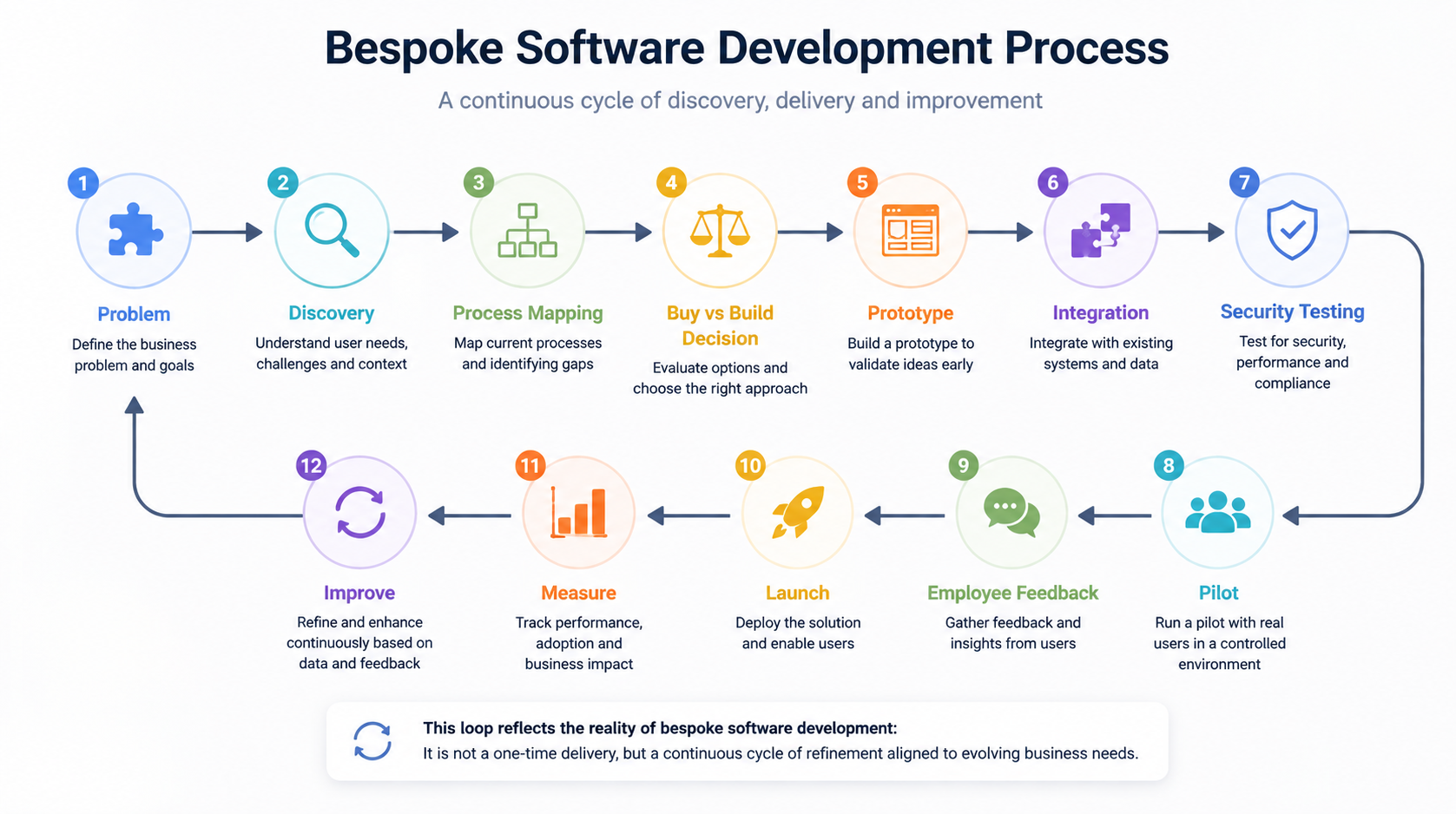
What does a sensible bespoke software development roadmap look like?
A successful bespoke software project follows a structured, iterative roadmap rather than a linear "build and launch" approach.
Each stage reduces risk, validates assumptions, and ensures the final solution actually improves how the business operates.
It starts with clearly defining the real operational problem, not just the requested feature set. From there, the process moves through discovery and mapping to understand how work is currently done, where friction exists, and what systems are involved.
Only once the current state is fully understood should teams evaluate whether the solution should be bought, configured, integrated, or built. This prevents unnecessary custom development and ensures bespoke work is only used where it adds genuine value.
A prototype is then created to validate assumptions early, followed by integration into existing systems. Security testing ensures compliance and resilience before any wider rollout.
A controlled pilot phase allows real users to test the system in live conditions, generating feedback that is used to refine workflows and usability. Once confidence is established, the solution is launched more broadly.
Post-launch, the focus shifts to measurement and continuous improvement, ensuring the software evolves alongside the business rather than becoming static.
How Much Does Bespoke Software Cost?
There is no universal price for bespoke software because every project has different requirements.
Current UK pricing examples show smaller bespoke systems starting around £20,000, mid-range platforms potentially reaching £60,000 to £200,000 and highly complex enterprise software extending considerably beyond that.
The number of integrations, users, platforms, security requirements and complexity of migrating data can all affect the eventual cost.
Ongoing support should also be included when assessing total ownership costs. Bespoke software requires maintenance after launch as operating systems, third party tools, security threats and business requirements continue to change.
It is therefore more useful to compare long-term value and total cost of ownership than simply comparing the initial price with the monthly subscription for an off the shelf package.
What does a sensible bespoke software development roadmap look like?
A practical bespoke software development roadmap follows a clear, iterative flow:
Problem → Discovery → Process Mapping → Buy vs Build → Prototype → Integration → Security Testing → Pilot → Employee Feedback → Launch → Measure → Improve
- Problem – Define the core business challenge and desired outcomes.
- Discovery – Gather requirements, stakeholder input, and technical constraints.
- Process Mapping – Document current workflows and identify inefficiencies.
- Buy vs Build – Evaluate whether existing tools can solve the problem or if custom software is needed.
- Prototype – Build a lightweight version to validate assumptions quickly.
- Integration – Ensure the solution connects smoothly with existing systems.
- Security Testing – Assess vulnerabilities, compliance, and data protection requirements.
- Pilot – Roll out to a small user group in a controlled environment.
- Employee Feedback – Collect real-world user insights and friction points.
- Launch – Deploy the solution across the organisation.
- Measure – Track performance against defined success metrics.
- Improve – Iterate based on data and feedback to refine the system over time.
This sequence can serve as the article's primary process graphic, offering a clear, end-to-end view of how bespoke software should be delivered.
Don't forget the employee side of digital transformation

Don't forget the employee side of digital transformation
Digital transformation is often discussed in terms of systems, automation, and operational efficiency—but it only succeeds when employees are supported through the change.
Without clear communication, accessible resources, and a single place to find what they need, even the best technology investments can fall short.
This is where AgilityPortal fits naturally into the conversation.
Transformation introduces new layers of change across the organisation, including:
- Processes that may be redesigned or standardised
- Systems that employees must learn and adopt
- Policies that evolve to reflect new ways of working
- Training requirements to build new skills and confidence
- Documentation that needs to be updated and centralised
- Responsibilities that may shift across teams
- Ways of working that require cultural adaptation
For employees, this can quickly become overwhelming if information is scattered across emails, shared drives, and multiple platforms.
A digital workplace helps reduce that friction by providing an employee-facing layer where organisations can centralise everything people need to stay informed and productive, including:
- Transformation updates and progress communications
- Policies and governance documents
- Organisational knowledge and best practices
- Standard operating procedures (SOPs)
- Training materials and onboarding resources
- Internal documentation and guides
- Frequently asked questions (FAQs)
- Employee feedback channels and surveys
- Company-wide announcements and news
AgilityPortal can be referenced as an example of how organisations bring these resources together in one place, creating a more connected and informed workforce—without replacing the specialist operational tools teams already rely on.
AgilityPortal
A Digital Workplace for Safer, Better-Connected Construction Teams
AgilityPortal helps construction companies connect office teams, site managers, contractors and frontline workers through one central digital workplace platform. Safety announcements, documents, training, forms and site communication can all be made accessible from one place — including on mobile devices.
Rather than relying on email, paper documents, messaging apps and disconnected systems, teams can use AgilityPortal as the workforce-facing layer of their construction site safety management system, helping important safety information reach the right people at the right time.
Connect the site with the office
Centralise safety communication, RAMS, policies, training, digital forms and workforce updates while giving frontline construction teams mobile access to the information they need.
What will bespoke software development look like beyond 2026?
Beyond 2026, bespoke software development will increasingly be less about building entire applications from scratch and more about connecting, extending and orchestrating existing technologies.
AI-assisted development and low-code tools will speed up routine development, while API-first and composable architectures will make it easier to combine SaaS platforms, internal systems and custom components. The result could be a more hybrid approach:
SaaS + APIs + AI + automation + bespoke business logic
AI agents will also push custom software beyond traditional applications. Instead of simply displaying information, systems could retrieve data, trigger workflows, update records and coordinate tasks across multiple platforms.
Internal copilots could provide employees with a single interface for accessing knowledge and completing routine work.
However, more automation also creates more responsibility. Human-in-the-loop controls will remain important for sensitive financial, HR, security and compliance decisions, while cybersecurity, permissions, data governance and audit trails will need to be designed into systems from the start.
Ultimately, the future of bespoke software isn't about writing more code. It's about making the right technologies work together around the specific needs of the business.
Final Thoughts
Digital transformation isn't about replacing every application or rebuilding systems from scratch. It's about removing the operational barriers that prevent people, processes, systems, and data from working together effectively.
Sometimes SaaS solutions are sufficient to meet the need without added complexity. Sometimes the right answer is simply integrating existing tools so they communicate properly. And in other cases, the process is unique, complex, or strategically important enough that bespoke software becomes the most sensible and sustainable option.
The key is not ideology, but fit-for-purpose decision-making: choosing the lightest, most effective approach that solves the real problem rather than forcing unnecessary engineering.
True transformation is measured less by the amount of technology introduced and more by the reduction in friction across the organisation.
When systems align and work becomes easier, the impact is felt everywhere—from productivity to decision-making to customer experience.
Ultimately, successful transformation is the one that makes work feel simpler, faster, and more connected for the people who do it every day.
FAQ
1. What is bespoke software development?
Bespoke software development refers to creating tailored digital products designed around specific business needs. These bespoke software solutions often take the form of a bespoke application or bespoke application software, built to solve unique operational challenges rather than relying on generic tools.
2. How does bespoke software support digital transformation?
Bespoke software plays a key role in digital transformation by enabling bespoke business software and a fully integrated bespoke software system that aligns with company workflows, improves efficiency, and supports long-term scalability.
3. What digital transformation challenges can bespoke software solve?
A bespoke software agency can help businesses overcome issues such as disconnected systems, manual processes, and data silos by delivering tailored platforms that unify operations and improve decision-making.
4. What is the difference between bespoke and off-the-shelf software?
Off-the-shelf tools are built for mass use, while a software bespoke company delivers custom-built systems designed specifically for one organisation's needs, offering greater flexibility and long-term adaptability.
5. Is bespoke software more expensive than SaaS?
While bespoke software solutions may require higher upfront investment than SaaS, they often reduce long-term costs by eliminating unnecessary subscriptions and providing exactly the functionality a business needs.
6. When should a business build custom software?
Businesses should consider bespoke app development when existing tools no longer support growth, processes are becoming inefficient, or when competitive advantage depends on unique functionality.
7. Can bespoke software integrate with legacy systems?
Yes, bespoke application development is often used to bridge modern platforms with legacy systems, ensuring data flows smoothly across old and new infrastructure.
8. How long does bespoke software development take?
Timelines vary depending on complexity, but a bespoke software development agency typically delivers projects in phases, from discovery and design through to deployment and ongoing support.
9. What are the risks of bespoke software development?
Risks can include scope creep, budget overruns, and dependency on a bespoke software system that requires ongoing maintenance and governance to remain effective.
10. Will AI reduce the need for bespoke software developers?
No—AI will enhance rather than replace development. Even with automation, bespoke software solutions will still require human expertise to design, integrate, and maintain systems that align with business strategy.
AI Summary
- Bespoke software development helps organisations solve digital transformation challenges when existing platforms, legacy systems, and off-the-shelf software cannot fully support their operational requirements.
- Common problems include disconnected systems, manual workflows, fragmented data, legacy technology, poor integrations, scalability limitations, and employees relying on spreadsheets or workarounds to keep processes moving.
- Custom software does not always mean replacing existing technology. APIs, middleware, integrations, and bespoke components can connect legacy systems with modern applications while reducing the risk and disruption of a complete replacement.
- Businesses should follow a buy, configure, integrate, extend, then build approach. Bespoke development is most valuable when established SaaS platforms cannot solve an important operational requirement efficiently.
- AI, low-code platforms, API-first architecture, composable software, workflow automation, and AI agents are changing bespoke development, with more solutions focused on connecting and orchestrating existing technologies rather than building everything from scratch.
- Successful digital transformation still depends on people as much as technology. Security, governance, employee adoption, training, process design, data quality, and continuous improvement all influence whether bespoke software delivers meaningful business value.
Most Popular Posts

Effective communication among team members is vital for the productivity and success of any organization. Surprisingly, 60% of companies lack a long-term internal communication strategy, which p...


Businesses thrive on communication for efficiency, productivity and accomplishment. When the right information is passed from the right designation in the organization, it promotes positivity an...

Categories
Blog
(3192)
Business Management
(394)
Employee Engagement
(235)
Digital Transformation
(218)
Growth
(150)
Intranets
(141)
Internal communications
(106)
Remote Work
(68)
Sales
(53)
Collaboration
(52)
Customer Experience
(32)
Culture
(30)
Knowledge Management
(29)
Project management
(29)
Leadership
(20)
Comparisons
(9)
News
(1)

Related Posts

What would happen to your team's work and customer information if an employee's MacBook disappeared today? If you're wondering how to protect your Mac physically, the answer goes beyond buying a case. A MacBook used at home, on a train or in a ...

Welcome to AgilityPortal's guide to the best VPN for Remote teams. How do you give employees secure access to company systems when they work from home, the office and everywhere in between? It's a question more businesses need to answer: 28% of worki...

Have you ever left a meeting thinking everyone agreed on the next step, only to discover a week later that each person remembered something different? Open source meeting transcription can help teams keep a searchable record of the conversation...

The best ai image editors can save a team hours of repetitive work. A marketing manager can remove a distracting background, an HR team can improve a staff event photo, and an online shop can turn a basic product shot into something ready to pu...

Ever opened a PDF just before a meeting and realised you need to edit a page, pull figures from a scanned report, or gather everyone's comments? What should be a quick task can turn into a frustrating search for the right tool. That lost time a...


Annet Herges
I am a digital nomad, lover of exploring new places and making friends.
I love to travel and I love the internet. I take pictures of my travels and share them on the internet using Instagram.
Traveler, entrepreneur, and community builder. I share my insights on digital marketing and social media while inspiring you to live your fullest life.
Ready to learn more? 👍
One platform to optimize, manage and track all of your teams. Your new digital workplace is a click away. 🚀
Free for 14 days, no credit card required.