
Insight Blog
Agility’s perspectives on transforming the employee's experience throughout remote transformation using connected enterprise tools.
37 minutes reading time
(7439 words)
10 Best Proxy Providers for 2027: Our Smart Buyer’s Guide Before You Choose Read This

10 Best Proxy Providers for 2027: Our Smart Buyer’s Guide Before You Choose Read This
Compare the best proxy providers for 2027 for secure web scraping, automation and AI projects, with practical tips on pricing, reliability and compliance.
10 Best Proxy Providers for 2027: Our Smart Buyer’s Guide Before You Choose Read This

How can a business collect the public web data it genuinely needs without creating avoidable security, privacy or supplier-risk problems?
That's the question more teams are now facing. From competitor price monitoring and SEO research to brand protection, recruitment insight and AI projects, businesses increasingly rely on public web data to make quicker, better-informed decisions.
The Best Proxy Providers can make this work more reliable by helping teams route requests through suitable IP networks and test information across different locations.
The market is growing quickly.
17.39%
projected CAGR
Mordor Intelligence estimates that the web scraping market will grow from $1.56 billion in 2026 to $3.49 billion by 2031, reflecting growing demand for market intelligence, automation and AI-ready data.
Source:
Mordor Intelligence
Mordor Intelligence estimates that the web scraping market will grow from $1.56 billion in 2026 to $3.49 billion by 2031, representing a 17.39% CAGR.
2031 That growth reflects a real business need, but it also means more organisations are relying on external providers for tools that can affect data handling, security and reputation.
The risk is worth taking seriously.
The UK Government reports that 43% of businesses identified a cyber breach or attack in the previous 12 months, rising to 65% of medium-sized businesses and 69% of large businesses.
Choosing a proxy supplier should therefore involve more than comparing prices or IP numbers.
In this article, you'll learn how proxy services work, which proxy types suit different business tasks, what to look for when comparing ten trusted providers, and the practical checks your IT, security and legal teams should make before using one.
Key Takeaways
- The best proxy providers should match the business use case, location requirements, session controls and budget, rather than simply offering the largest advertised IP pool.
- Residential, datacenter, ISP/static residential and mobile proxies all serve different purposes, with their own trade-offs around cost, speed, stability and targeting.
- A proxy provider can support legitimate market research, SEO testing, advert verification and public-web monitoring, but it does not remove legal, privacy or website-term responsibilities.
- Businesses should assess IP sourcing, security controls, pricing terms, account access and acceptable-use policies before committing to a provider.
- The safest approach is to start with a limited proof of concept, use approved corporate accounts and regularly review the supplier, costs and business purpose.
First, what does a proxy provider actually do?
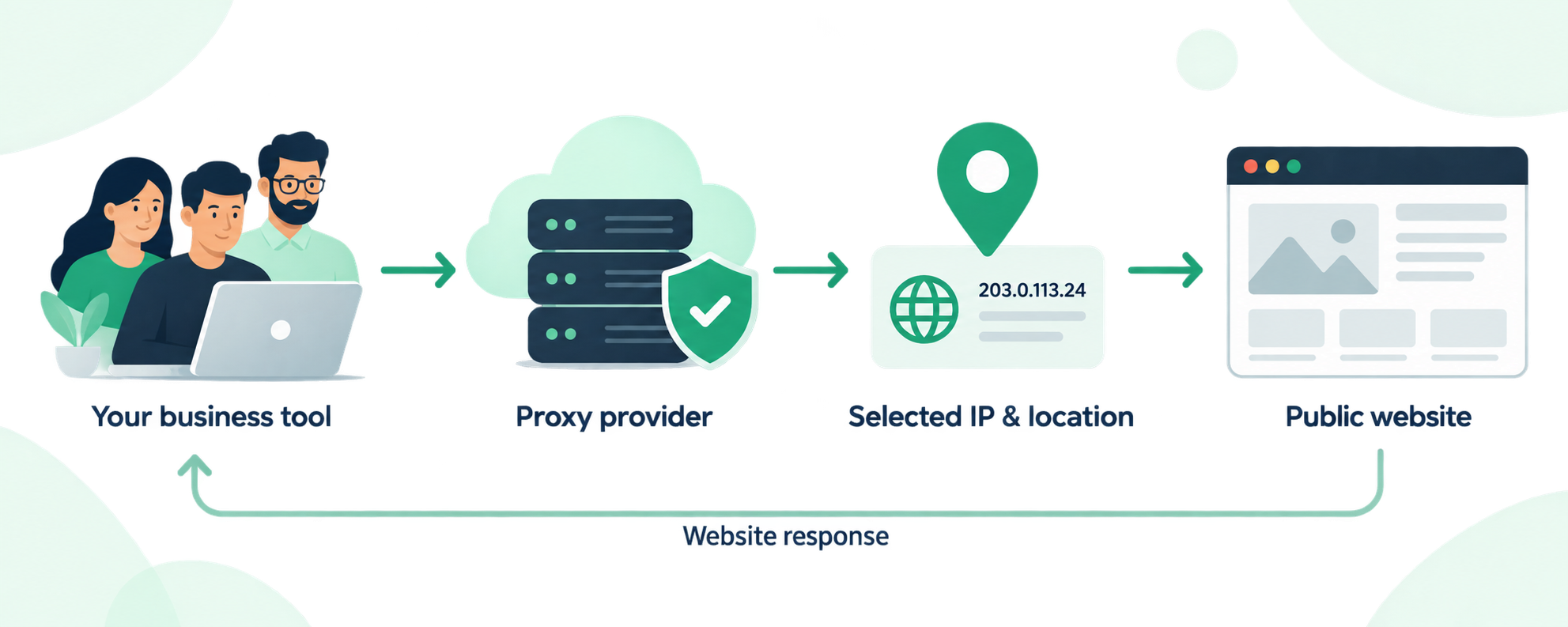
What is a proxy provider meaning in simple terms? It is a service that gives your business an alternative IP address to route internet requests through before they reach a website or online service.
Instead of every request coming directly from your company's network, a proxy sits in the middle.
It can help a tool access publicly available web pages from a chosen country, city, internet provider or device type. Some proxies also rotate IP addresses automatically, which can help with legitimate large-scale research, location testing or monitoring work.
For example, an e-commerce team might use a UK-based proxy to check how a publicly listed product price appears to customers in Manchester, while an SEO team may use one to review location-specific search results.
That said, a proxy is not a legal workaround or a free pass to ignore a website's terms, access restrictions or data protection responsibilities.
Businesses should still be clear about what they are collecting, why they need it and whether the activity is permitted.
The four proxy types you'll come across
Not every proxy works the same way.
The right choice depends on the task, the level of consistency required and how much the business is prepared to spend.
| Proxy type | Often used for | Main strength | Watch-out |
| Residential proxies | Public-web research, local price checks and location testing | Uses IP addresses associated with household internet connections, giving broader IP diversity | Usually more expensive and requires careful review of how IPs are sourced |
| Datacenter proxies | High-volume, lower-complexity tasks such as basic monitoring | Fast, scalable and often more affordable | Easier for websites to identify as non-residential traffic |
| ISP/static residential proxies | Persistent sessions, account testing and repeat checks from one location | Keeps the same IP address over time while retaining a residential-style connection | Smaller pools and higher cost per IP |
| Mobile proxies | Mobile-specific testing and apps that behave differently on mobile networks | Routes traffic through mobile network IP addresses | Often expensive and unnecessary for most standard business research |
For many organisations, the sensible starting point is the simplest proxy type that meets the approved business need.
There is no point paying for a large rotating residential network if a few static datacenter IPs can safely do the job.
Why Businesses Are Investing in Workplace Operations Platforms

Why Businesses Are Investing in Workplace Operations Platforms
A proxy provider can support legitimate business research and testing when used responsibly.
It helps teams view public web information from different locations, reduce pressure on a single company IP address and run approved automated checks more reliably.
Common use cases include:
- Competitor price monitoring: Check publicly listed prices, promotions and stock availability across different markets.
- SEO and search-result testing: See how search results appear in different cities or countries without relying on one office location.
- US market research and testing: Businesses targeting American customers can use US-based IP coverage to review how public search results, adverts, product pages and local offers appear across the country. This guide to Best USA proxies is useful when comparing options for US-focused research.
- Ad verification: Confirm that paid adverts appear in the intended location, language and format.
- Brand protection: Find publicly visible fake listings, unauthorised sellers, misleading claims or brand impersonation.
- Market research: Collect permitted public information about customer trends, products, services and local competitors.
- Website quality assurance: Test whether your own website, forms, landing pages and content work correctly for users in different regions.
- Travel and retail comparison: Monitor publicly displayed fares, availability, delivery options and product pricing across locations.
- Recruitment research: Review public job listings, salary signals and skills demand to inform workforce planning.
- AI and data projects: Gather approved, relevant public data for analysis, provided the business has completed the necessary legal, privacy and governance checks.
- Cybersecurity testing: Help authorised security teams test how company systems respond to access from different locations or network types.
The key is to keep the activity proportionate.
Use proxies to support a clear business purpose, collect only what is needed, and avoid bypassing access controls, terms of use or privacy obligations.
Best Proxy Providers Compared: Bandwidth, Sessions and Use Cases
The table below compares ten proxy providers based on the features that matter most when choosing a service: whether unlimited bandwidth is available, the proxy types offered, session-control options and the business use cases each provider is best suited to.
Availability, limits and pricing can vary by plan, so always confirm the latest details directly with the provider before making a decision.
| Provider | Bandwidth option | Proxy types and session control | Best for |
| 1. Live Proxies | Unlimited bandwidth on eligible plans | Rotating residential and mobile proxies; sticky sessions up to 24 hours | Long-running parallel workflows |
| 2. IPRoyal | Unmetered static residential, ISP, datacenter and mobile options | Private datacenter, dedicated ISP and mobile proxies; dedicated IPs and sticky sessions | IP-based subscriptions |
| 3. Webshare | Unlimited bandwidth on selected plans | Private and dedicated datacenter proxies; private and dedicated static residential proxies; dedicated, static and rotating options | Budget-focused, high-volume workloads |
| 4. Oxylabs | Unmetered dedicated datacenter and ISP products | Dedicated ISP and datacenter proxies with persistent sessions | Enterprise-scale operations |
| 5. Decodo | Unlimited-traffic options on selected products | Dedicated ISP and datacenter proxies; rotating and sticky sessions | Flexible automation |
| 6. Rayobyte | Unmetered static datacenter and ISP products | Dedicated datacenter and static ISP proxies; static and rotating options | High-speed, US-focused workloads |
| 7. SOAX | Port-based unmetered options on selected plans | Dedicated US datacenter proxies with configurable rotation | Location-sensitive workflows |
| 8. ProxyEmpire | Unlimited residential plans | Dedicated static residential and mobile proxies; rotating and sticky sessions | Flat-rate residential traffic |
| 9. Infatica | Unlimited traffic on dedicated datacenter and ISP plans | Dedicated static ISP and datacenter proxies; rotating, timed and sticky sessions | Mixed automation workloads |
| 10. DataImpulse | Non-expiring pay-as-you-go traffic alternative | Residential, mobile, datacenter and premium residential proxies; rotating and sticky sessions | Flexible, low-cost traffic purchasing |
How We Compared the Best Proxy Providers
We compared the providers using practical criteria that matter when businesses need reliable, manageable and responsible proxy access:
- Proxy types: Whether the provider offers residential, mobile, ISP/static residential and datacenter proxies.
- Bandwidth options: Whether unlimited or unmetered traffic is available, and which products or plans it applies to.
- Location targeting: Available country, region, city, ZIP code, ISP, ASN and carrier-level controls.
- Session control: Whether users can choose rotating, sticky or static IP sessions, and the published session duration.
- Protocols and compatibility: Support for HTTP(S), SOCKS5 and the networks where each protocol is available.
- Developer experience: Authentication methods, dashboard usability, API access, documentation and integrations.
- Pricing structure: Entry pricing, pay-as-you-go options, minimum commitments, bandwidth expiry, overages and potential surcharges.
- Scale and support: Connection or thread limits, traffic controls, account management and enterprise support.
- Trust and transparency: IP sourcing disclosures, KYC/KYB practices, acceptable-use policies, security information and compliance documentation.
- Managed tooling: Availability of web scrapers, unblockers, browser tools, search APIs, datasets or other managed data-collection services.
We did not treat vendor-reported IP pool size or success-rate claims as direct ranking factors without shared definitions and independent testing.
Providers can measure available IPs differently — for example, monthly unique addresses, potential addresses, observed addresses or simultaneously active IPs — so those figures are not always directly comparable.
Related Proxy Guides You May Want to Read Next
This Best Proxy Providers guide helps businesses compare proxy options for responsible web research, automation and location testing. The resources below explore proxy management, session strategies, network control and the fundamentals of choosing the right service.
- Mastering Proxy Management: The Key to Faster, Smarter Web Scraping
- Sticky Sessions vs Rotating IPs: How to Choose the Right Proxy Strategy
- Best Proxy Service Providers for 2026: Based on Your Needs
- Why Smart Companies Use a Proxy Server to Take Back Control of Their Network
- What Is a Proxy Server? Examples, Benefits and Best Proxy Services
Together, these guides give you a clearer picture of how proxy providers, session controls and responsible proxy management fit into a practical web-data strategy.
1. Live Proxies
1. Live Proxies
Live Proxies unlimited bandwidth rotating residential and rotating mobile products for teams that need to distribute approved requests across changing IP addresses.
Its mobile product documents unlimited threads and a 30-minute sticky-session option, while its residential offering is designed for rotation-based workflows. Check the specific plan before buying, as sticky-session duration and bandwidth terms vary by product.
Best for: Teams running long, parallel workflows that need rotating residential or mobile IPs, rather than fixed dedicated addresses.
Strengths:
- Rotating residential and mobile proxy options are available.
- Unlimited-thread access is documented for its rotating mobile product.
- Suitable for workflows where IP rotation is more useful than maintaining one static connection.
Limitations:
- Current public product information should be checked carefully for session-duration limits.
- It is less suited to projects that specifically need dedicated ISP or datacenter proxy products.
- "Unlimited bandwidth" eligibility depends on the selected plan.
Pricing checked September 23, 2026:
- Review the current Live Proxies plan page before publishing a starting price, as its traffic and session terms are product-specific.
2. IPRoyal
IPRoyal offers residential, ISP/static residential, datacenter and mobile proxy products. Its paid proxy overview documents distinct pricing models: residential traffic is billed per GB, while ISP and datacenter products are sold per IP. It also supports rotating and sticky sessions for applicable products.
Best for: Buyers who want a broad proxy range and the flexibility to choose between traffic-based residential access and IP-based static products.
Strengths:
- Residential, ISP, datacenter and mobile proxy options are available.
- Residential traffic does not expire after purchase.
- Dedicated products support stable, long-running sessions.
- SOCKS5 support is documented across key proxy products.
Limitations:
- Do not describe all static products as "unlimited" without the fair-use context.
- Datacenter products include traffic thresholds under IPRoyal's fair-use policy.
- Pricing varies substantially by product type, traffic volume and subscription duration.
Pricing checked September 23, 2026:
- Residential proxies display from $1.75/GB, datacenter proxies from $1.39 per proxy and ISP proxies from $2.40 per proxy; mobile pricing is shown separately by daily access.
3. Webshare
3. Webshare
Webshare offers rotating residential, ISP and datacenter proxies, but not mobile proxies. Its residential page documents HTTP/SOCKS5 and country-to-ASN selectors with combination limits. Its endpoint generator supports rotation and one-minute-to-24-hour sticky windows.
Compare the best Webshare alternatives according to whether you need rotating residential, static ISP, datacenter or mobile access.
Compare the best Webshare alternatives according to whether you need rotating residential, static ISP, datacenter or mobile access.
Best for: Developers who want a permanent free datacenter starting point, granular plan customisation and a straightforward dashboard/API before moving to paid residential or ISP access.
Strengths:
- Ten datacenter proxies and up to 1 GB per month are available permanently without a card.
- API documentation, downloadable lists, two authentication methods and configurable plans support self-service use.
- Rotating and static proxy options allow teams to start small.
Limitations:
- No mobile proxies or broad managed scraping API were documented.
- Promotional residential pricing should not be confused with the standard list price.
- Limits vary by plan; the free tier is datacenter, not residential.
Pricing checked September 23, 2026:
- Confirm the current promotion before publishing exact figures. Webshare's free datacenter option remains its clearest entry point; paid datacenter, ISP and residential plans are priced separately.
4. Oxylabs
4. Oxylabs
Oxylabs offers dedicated datacenter and ISP proxies alongside residential, mobile and managed web-data products. Its dedicated products are designed for persistent access, with per-IP pricing and defined concurrency or fair-use limits depending on the service.
Best for: Enterprise teams that need scalable proxy infrastructure, account support and adjacent managed data-collection tooling.
Strengths:
- Dedicated ISP and datacenter proxy products support stable, persistent sessions.
- Enterprise-oriented support, documentation and proxy-management controls are available.
- Also offers managed tooling for web data collection beyond raw proxy access.
Limitations:
- Pricing is more complex than a basic self-service proxy plan.
- Dedicated products have concurrency and traffic thresholds that should be reviewed before purchase.
- Some ISP plans require speaking with the sales team rather than using instant checkout.
Pricing checked September 23, 2026:
- Dedicated datacenter access is advertised from $1.20 per IP, while dedicated ISP pricing is custom. Confirm thresholds, locations and session limits with Oxylabs before publishing
5. Decodo
5. Decodo
Decodo provides residential, mobile, ISP/static residential and datacenter proxies, as well as a Site Unblocker product.
Its rotating proxy options support IP rotation and sticky sessions, while dedicated datacenter and ISP products are billed per IP with unlimited traffic subject to fair-use rules.
Best for: Teams that want flexible automation options and a mix of proxy infrastructure with managed web-data tools.
Strengths:
- Covers residential, mobile, ISP and datacenter proxy categories.
- Supports rotating and sticky sessions, including configurable intervals for relevant products.
- Offers dedicated proxy plans alongside usage-based options.
- Provides managed tooling in addition to standard proxy access.
Limitations:
- "Unlimited" products remain subject to fair-use conditions.
- Pricing differs by network type and billing model, so comparisons need to be product-for-product.
- Teams should confirm whether they need a proxy plan, Site Unblocker or another Decodo data product.
Pricing checked September 23, 2026:
- Dedicated datacenter and ISP proxy plans are priced per IP; residential and mobile services are generally traffic-based.
6. Rayobyte
6. Rayobyte
Rayobyte offers residential, datacenter, static ISP and rotating ISP proxies. Its static ISP product highlights unlimited bandwidth, while its residential and rotating ISP products give teams the option to keep an IP for a session or rotate automatically.
Best for: High-speed, US-focused work where teams need dedicated datacenter or static ISP options alongside residential access.
Strengths:
- Dedicated datacenter and static ISP proxy products are available.
- Static ISP plans document unlimited bandwidth.
- Rotating ISP options provide more flexibility for approved, repeated requests.
- Sticky-session controls are available for residential workflows.
Limitations:
- Pricing varies by country, number of IPs and commitment length.
- Static IPs are not automatically the right fit for every task; they need active replacement if blocked.
- Managed scraping features are less extensive than some enterprise data platforms.
Pricing checked September 23, 2026:
- Rayobyte's public pricing depends on the proxy category and region. Check the current plan page before publishing a single "from" figure.
7. SOAX
7. SOAX
SOAX provides residential, mobile, ISP and US datacenter proxy products, with configurable rotation and session controls.
Its US datacenter service is aimed at teams that need fast, location-specific access without paying for a broader global proxy setup.
Best for: Location-sensitive research, advert verification and public-web monitoring where country, city or ISP-level targeting matters.
Strengths:
- Flexible location targeting and configurable IP rotation.
- Offers residential, mobile and US datacenter proxy options.
- Supports a range of protocols, including HTTP(S) and SOCKS5.
- Has a Sandbox option for evaluating the service before a paid commitment.
Limitations:
- Pricing is credit-based and may be less straightforward than a simple per-GB plan.
- Detailed targeting and premium location choices can affect cost.
- Confirm which network types are included in each plan rather than assuming all features apply.
Pricing checked September 23, 2026:
- SOAX uses a credit-based model. Its Builder plan has been advertised at $200 per month, while a no-subscription Sandbox option is available for testing.
8. ProxyEmpire
ProxyEmpire offers rotating residential, static residential and mobile proxies. Its products support rotating and sticky sessions, and its mobile offering includes dedicated options with unlimited bandwidth.
Best for: Teams that want flat-rate or rollover-friendly residential and mobile proxy options with flexible location controls.
Strengths:
- Residential and mobile products support rotating and sticky sessions.
- Targeting can include country, region, city and ISP or carrier settings for applicable rotating products.
- Mobile options include unlimited-bandwidth dedicated plans.
- Supports data rollover on eligible traffic-based products.
Limitations:
- Static residential targeting is more limited than rotating residential targeting.
- Bandwidth terms differ between residential, static residential and mobile plans.
- It is important to check whether the selected product is traffic-based or port-based.
Pricing checked September 23, 2026:
- ProxyEmpire's static residential product is billed by traffic, while mobile and residential plan structures vary. Confirm the current starting rate before publishing.
9. Infatica
Infatica offers residential, mobile, datacenter and ISP proxy services, with rotating, sticky and timed session options across relevant products. Its dedicated datacenter and ISP plans are positioned for teams that want more predictable traffic terms for regular automation work.
Best for: Mixed automation workloads that combine rotating residential coverage with dedicated datacenter or ISP access.
Strengths:
- Covers residential, mobile, datacenter and ISP proxy categories.
- Supports session options for both rotation and continuity.
- Dedicated product plans can suit teams with predictable workloads.
- Provides broader business proxy infrastructure beyond one network type.
Limitations:
- "Unlimited traffic" is relevant to selected dedicated plans, not every Infatica product.
- Pricing and technical controls vary by proxy type.
- Buyers should confirm current location coverage and session availability in writing before committing.
Pricing checked September 23, 2026:
- Review Infatica's current dedicated datacenter and ISP plans directly, as pricing is based on the product, traffic model and required locations.
10. DataImpulse
DataImpulse offers residential, premium residential, mobile and datacenter proxies. Its strongest differentiator is a pay-as-you-go traffic model where purchased traffic does not expire.
It supports rotating and sticky sessions, with location targeting available from country level through to more granular options on applicable plans.
Best for: Developers and smaller teams that want flexible, lower-cost traffic purchasing without expiry dates.
Strengths:
- Pay-as-you-go traffic does not expire.
- Residential, mobile, datacenter and premium residential proxy options are available.
- Supports HTTP, HTTPS and SOCKS5.
- Rotating and sticky sessions can be configured for different workflows.
- Country targeting is included, with more detailed options available for relevant plans.
Limitations:
- It is more developer-focused than a fully managed data-collection platform.
- It does not provide the same breadth of managed scraping APIs and datasets as some enterprise competitors.
- Premium targeting and support features may cost more than the entry-level rate.
Pricing checked September 23, 2026:
- Residential traffic is advertised from $1 per GB, with non-expiring pay-as-you-go purchasing.
How to Choose the Best Proxy IP Provider for Your Actual Use Case
It is easy to get distracted by huge IP pool numbers, impressive uptime claims and long feature lists.
But the best proxy IP provider is not necessarily the one with the most addresses. It is the one that fits the task your business needs to complete, without paying for capacity or complexity you will never use.
Start by being specific.
What are you trying to check, how often will you need to do it and from which locations? A small team reviewing local search results once a week has very different requirements from an e-commerce business monitoring thousands of publicly listed products across several markets.
Start with the job, not the proxy typeHere are a few practical examples:
- Checking 50 local search results each week: A static proxy or a modest rotating proxy pool may be enough. You need consistent, location-specific results, not a huge enterprise network.
- Monitoring public competitor prices across multiple markets: Residential proxies with country targeting can be useful when your team needs to see how publicly listed products, offers and availability differ by region.
- Testing your own website from several locations: A small, controlled proxy network may be all you need to check that your landing pages, forms, checkout journeys or local content load correctly for users in different countries.
- Verifying digital adverts: Choose a provider with reliable country or city targeting, so your marketing team can confirm that campaigns appear in the right market, language and format.
- Running long automation workflows: Look for sticky session control and bandwidth terms that work for sustained, approved tasks. Switching IPs too frequently can interrupt workflows that need a consistent connection.
- Training AI using web-scraped information: This needs more than a technical buying decision. Legal, privacy, security and data-governance teams should review the data source, purpose, retention period and lawful basis before collection starts.
A sensible rule is to begin with the smallest proxy setup that can meet the approved business objective. Test it against a controlled use case, monitor the cost and success rate, then scale only if there is a clear reason to do so.
Questions to ask every provider before signing
Before committing to a plan, ask the provider clear questions.
The quality of its answers will tell you a lot about how seriously it takes responsible use.
- Where do the IP addresses come from, and how are they sourced?
- How does the provider obtain consent where this is relevant?
- Can it clearly explain its acceptable-use policy and prohibited activities?
- What activity logs are collected, who can access them and how long are they retained?
- Does it support secure authentication, IP allowlists and role-based access?
- Which countries, cities, network types and targeting levels are genuinely available on the plan?
- How are traffic usage, overages, concurrent connections and bandwidth limits priced?
- What support is available if a target website blocks legitimate activity?
- Does the contract cover data protection, security commitments and incident-notification responsibilities?
- Can the provider support a limited proof of concept before you commit to a larger plan?
A short trial with a defined business use case is usually the best way to assess a provider.
Test the locations you need, monitor success rates and costs, and involve IT or security before scaling access across the business.
Here's Where Proxy Use Can Become a Business Risk
Proxy services have legitimate uses, but they should not be treated as a shortcut around rules, technical controls or responsible data practices. The technology may change how a request reaches a website, but the business using it remains accountable for the activity.
A sensible approach is to focus on a clear business purpose, collect only the data genuinely needed and make sure the relevant teams understand the boundaries before a project begins.
Public information is not automatically free to collect and reuse
Just because information is visible online does not mean a business can automatically collect it at scale, keep it indefinitely or reuse it for any purpose. Websites may have terms of service, contractual restrictions, copyright protections, access controls and personal data considerations.
This matters especially when information includes identifiable people, such as employee profiles, customer details, social media posts or public job applicant data. The ICO has warned that automated data scraping can create privacy risks when publicly accessible personal information is involved.
The risk becomes even more significant for AI projects. The ICO describes web scraping involving personal data for generative AI training as high-risk and "invisible" processing.
Organisations need to be able to explain why the collection is necessary, identify an appropriate lawful basis and put safeguards in place before they begin.
This does not mean businesses should avoid every use of web data. It means they should be clear about the purpose, consider whether a direct API, licence or permission-based source is more appropriate, and seek legal advice where the situation is unclear.
A proxy can hide traffic patterns, but it does not remove accountability
A proxy may help a business test content from another location or manage approved automated requests.
It does not make prohibited activity acceptable, and it does not remove the organisation's responsibility for how employees or tools behave online.
Key risks to consider include:
- Website terms and access restrictions: Using a proxy does not override a website's terms, subscription limits, login requirements or technical restrictions.
- Data protection and personal data: Collecting publicly visible personal information can still trigger privacy obligations, particularly if it is stored, profiled, shared or used for AI training.
- Rate limiting and operational impact: Excessive automated requests can slow down or disrupt another organisation's website. Set sensible limits and avoid aggressive traffic patterns.
- Contractual restrictions: A supplier agreement, platform contract or data licence may limit what information can be accessed, collected or reused.
- Reputational damage: If customers, partners or competitors believe the business is collecting information irresponsibly, the damage can extend beyond the technical issue.
- Poorly sourced IP addresses: Providers should be able to explain how their IP networks are sourced and what controls they use. Lack of transparency is a warning sign.
- Shadow IT: Employees using personal or unapproved proxy accounts create security gaps, weak audit trails and unclear accountability.
OWASP highlights that unwanted automated activity can affect both individual privacy and the security of web applications. owasp.org That is why businesses should combine proxy technology with clear governance, approved tools, proportionate request limits and regular review.
A Realistic Workplace Example: Competitor Monitoring Without Creating a Compliance Headache
Imagine a retail operations team that wants weekly visibility of publicly listed competitor prices in the UK, Germany and France.
The goal is reasonable: understand how products, promotions and stock availability differ across markets, then use those insights to support commercial decisions.
The problem starts when the project is treated as a quick technical task rather than a controlled business process.
A team might sign up for a cheap proxy account, run continuous automated checks and collect everything it can find. That can create unnecessary cost, poor-quality data and avoidable privacy or compliance concerns.
A more responsible approach looks like this:
- Define the data points that are genuinely needed. For example, product name, public price, promotion, stock status and country. Do not collect extra information simply because it is available.
- Check legal, contractual and website restrictions. Review the relevant terms, access restrictions and internal policies before setting up automated requests.
- Avoid account-only content and personal information. The team should only monitor permitted, publicly available product information. It should not access customer accounts, employee data or content behind logins.
- Use country-targeted proxies only where they add value. UK, German and French IP coverage may be useful if public prices or promotions genuinely vary by location.
- Set modest request rates. Schedule checks at sensible intervals, avoid excessive traffic and do not attempt to bypass security controls, CAPTCHAs or access restrictions.
- Store the results securely. Keep collected information in an approved system, restrict access to the people who need it and apply a sensible retention period.
- Review the project every quarter. Check whether the data is still useful, whether costs remain proportionate and whether the provider, policies and collection methods still meet internal requirements.
| Situation | What can go wrong | Better approach |
| Staff use personal proxy accounts | There is no audit trail, supplier review or secure access control | Use an approved corporate account managed by IT or security |
| Team collects more data "just in case" | Higher privacy, storage and governance risk | Minimise collection to the specific information needed |
| Automation runs continuously | Site disruption, blocks, unnecessary cost and poor data quality | Set sensible limits, monitoring and regular review points |
| Vendor is chosen only on price | Poor IP sourcing, weak security controls or unreliable support | Complete vendor, security and compliance checks before purchasing |
Who Should Own Proxy Governance Inside the Business?
Proxy use should never sit with one person working alone. It can involve external suppliers, automated data collection, employee access and, in some cases, personal data.
The clearest approach is to give each team a defined responsibility, with one senior owner accountable for the overall decision.
IT and security should approve the technical setup
The CIO, IT Director or CISO should assess whether a proxy provider is technically safe enough to use. This includes reviewing authentication options, encryption, audit logs, IP allowlists, access controls, provider security practices and incident-response processes.
They should also make sure employees are not sharing proxy accounts, storing credentials in unsecured places or connecting unapproved tools to company systems.
Legal and the Data Protection Officer should set the guardrails
Legal Counsel and the Data Protection Officer should decide what the business can collect, use and retain.
Their role is especially important when a project may involve public personal information, cross-border activity or AI data collection.
They should review:
- Whether personal data could be collected or inferred
- The lawful basis, business purpose and data-minimisation approach
- Website terms, contractual restrictions and intellectual-property considerations
- International data transfers and where information is stored
- Retention periods, deletion processes and employee access
- Supplier agreements, data-processing terms and notification obligations
Business teams should own the purpose and results
arketing, SEO, operations, research and product teams should clearly explain why proxy access is needed before it is approved.
They should define the project, identify the data points required, nominate approved users and make sure activity remains within the agreed scope.
For example, a marketing team may use location-based proxies to check whether an advert appears correctly in a target market. That does not automatically give the team permission to collect unrelated customer information or run unlimited automated requests.
HR and internal communications have a supporting role
HR and internal communications are not normally responsible for selecting proxy technology, but they can help employees use it correctly.
They should make approved-use rules easy to find, publish the policy in the employee intranet and include the guidance in relevant training or onboarding materials.
Clear communication reduces the chance of employees using personal proxy accounts or unapproved tools because they do not know what is allowed.
A 10-Step Checklist Before You Buy a Proxy Service
Choosing a proxy service is not just a technical purchasing decision. It can affect data protection, cybersecurity, supplier risk, employee access and your organisation's reputation.
A short checklist helps you avoid signing up for a service that looks cheap and capable on paper but creates unnecessary problems later.
Here is what to do before you buy:
- Define the exact business objective. Be clear about what the proxy service needs to achieve, such as checking public competitor prices, testing your website in another country or verifying an advert. A clear purpose prevents teams from collecting data or buying capacity they do not need.
- Map the data you need and exclude unnecessary personal data. List the exact data points required for the project, then remove anything that does not directly support the goal. This reduces privacy risk, storage costs and the chance of collecting sensitive information by accident.
- Check website terms, legal restrictions and permission requirements. Publicly visible information is not always unrestricted. Reviewing the rules early helps the business avoid disputes, blocked access and compliance issues.
- Choose the least complex proxy type that meets the need. A large residential network may be unnecessary for a small website-testing project. Starting with the simplest suitable option keeps costs lower and makes the service easier to manage.
- Shortlist providers based on sourcing and compliance transparency. Ask how IPs are sourced, what the provider permits and whether it can explain its security and data-handling controls. If a supplier cannot answer clearly, that is a warning sign.
- Complete security and data-protection due diligence. IT, security, legal and the Data Protection Officer should review the supplier where appropriate. This helps confirm that the provider's controls, contracts and incident processes meet your organisation's standards.
- Set up a limited proof of concept. Test the provider with one approved use case before committing to a larger plan. This gives you real evidence about location coverage, reliability, session control, support and cost.
- Use named accounts, MFA, access controls and usage limits. Avoid shared logins. Give access only to approved employees, require multi-factor authentication where available and set sensible traffic limits. This creates accountability and reduces the risk of misuse.
- Publish an acceptable-use policy in your employee intranet. Employees should know which tools are approved, what they can use them for and where to ask questions. Clear guidance reduces shadow IT and stops well-meaning staff from using personal proxy accounts.
- Review the supplier, use case, costs and outcomes at least quarterly. Business needs, supplier terms and website restrictions can change. Regular reviews help you confirm the service is still useful, proportionate and compliant.
This process may feel more thorough than simply comparing price plans, but it protects the business from buying the wrong service, losing control of employee access or discovering compliance issues after the project has already grown.
What Will Change Next for Proxy Providers and Web Data Collection?
Proxy services are likely to become less about simply accessing a large pool of IP addresses and more about giving businesses a controlled, accountable way to carry out legitimate data collection.
As more teams use automation and AI, the questions around sourcing, privacy and supplier responsibility will become harder to ignore.
One likely change is greater scrutiny of how providers source their IP addresses and obtain consent where relevant. Businesses will increasingly expect providers to explain their network practices clearly, rather than relying on vague claims about the size or quality of their proxy pool.
There is also likely to be more demand for managed, compliance-aware data-collection services. Many organisations do not want staff building complex scraping workflows without oversight. They will look for providers that offer clearer controls, support and audit trails alongside the technical infrastructure.
AI governance will become more closely linked to web data collection too.
Before data is used to train, test or enrich an AI system, organisations will need to understand where it came from, whether personal information is involved, how long it will be kept and who is responsible for approving its use.
The strongest providers will likely differentiate themselves through:
- Clearer IP sourcing and consent information
- Stronger supplier assurance and security documentation
- Better audit logs, authentication and access controls
- More flexible location targeting and session management
- Practical guidance on responsible, permitted use
- Support for data minimisation, retention and deletion practices
The conversation is changing. Instead of asking only, "Can we scrape this data?", responsible businesses are increasingly asking, "Should we collect it, do we have a valid reason, and can we explain how we are using it?"
Final Thoughts - Choose the Best Proxy Provider With Control, Not Just Speed
So basically the Best Proxy Providers are not always the ones claiming the biggest IP pool, the lowest headline price or the fastest setup.
For business use, the right provider is the one that fits your actual project while giving your organisation clear controls, transparent IP sourcing, sensible pricing and a position you can confidently explain to IT, legal and senior management.
A small team checking local search results may only need a few stable IPs. A larger e-commerce or research operation may need country targeting, rotating sessions and more robust account controls.
Either way, the goal should be the same: use the least complex service that can complete the approved task reliably and responsibly.
Before comparing plans, write down:
- The data you genuinely need
- Why the business needs it
- Who will have access to the proxy account
- Where the collected information will be stored
- Which countries and locations are required
- What website terms, privacy rules and internal policies apply
- How often the activity will be reviewed
That short exercise makes it much easier to choose the right provider, control costs and avoid an expensive compliance or security mistake.
Frequently Asked Questions About Proxy Providers
Are proxy providers legal?
Yes, proxy providers can be used for legitimate business purposes, including website testing, public market research, ad verification and SEO monitoring.
However, legality depends on how the service is used, the data involved, the target website's rules and the laws that apply in the relevant countries.
A proxy should never be treated as permission to bypass access restrictions, ignore website terms or collect personal data irresponsibly.
Which proxy type is best for web scraping?
It depends on the task. Datacenter proxies can be a good fit for fast, lower-complexity workloads, while residential proxies may be more suitable for location-specific public-web research.
The best residential proxy providers are usually those that can clearly explain how their IP addresses are sourced, offer suitable location targeting and give businesses enough control over sessions and access.
Start with the smallest, least complex setup that meets your approved use case.
What are the cheapest residential proxies?
The cheapest residential proxies are not always the best value.
Low advertised prices can come with limited location coverage, traffic expiry, slower support, unclear IP sourcing or hidden overage costs.
When comparing cheap residential proxy providers, check the cost per GB, minimum purchase, traffic expiry date, country availability, session options and any charges for additional features.
A slightly higher-priced service may be the more cost-effective choice if it is more reliable and transparent.
What makes a proxy provider trustworthy?
The top proxy providers should be transparent about how their IP networks are sourced and managed. Look for:
- Clear acceptable-use rules
- Transparent pricing and bandwidth terms
- Secure authentication and access controls
- Reliable documentation, APIs and support
- Appropriate data-processing and security information
- Location and session controls that fit your use case
- A trial or proof-of-concept option before a larger commitment
Are ISP proxies better than residential proxies?
Neither is automatically better. Best ISP proxies are often useful when a task needs a stable, persistent connection from one IP address, such as approved website testing or long-running workflows.
Residential proxies may be better for work that needs broader IP diversity or country-specific research. The right choice depends on whether you need consistency, scale, location coverage or lower cost.
Can employees use free proxy services for work?
Not without approval from IT or security.
Free or unmanaged services can create security, privacy, logging and reliability concerns. Employees should use approved corporate accounts with clear access controls and acceptable-use rules.
Do proxies make web scraping compliant?
No. A proxy changes how an internet request is routed; it does not decide whether collecting, storing or reusing information is lawful, ethical or permitted.
Businesses still need to consider website terms, access restrictions, privacy obligations and internal policies.
What should businesses check before using proxies for AI data?
Businesses should complete legal, privacy, security and governance reviews before collecting data for AI projects, especially where personal data could be involved.
The ICO has made clear that web-scraped personal data used for generative AI can involve high-risk processing, so organisations need to justify the purpose, lawful basis and safeguards.
AI Summary
- Proxy providers route internet requests through alternative IP addresses, helping businesses carry out approved location testing, public-web research, advert verification and automation more reliably.
- The best proxy providers offer different network types, including residential, datacenter, ISP/static residential and mobile proxies, each with different costs, session controls and use cases.
- Businesses should choose a provider based on the actual job, such as checking local search results, monitoring publicly listed competitor prices or testing a website in another country, rather than simply choosing the largest IP pool.
- Residential proxies can support location-specific research, while datacenter and ISP proxies may be a better fit for stable, high-speed or lower-complexity workloads.
- A proxy does not override website terms, access restrictions, privacy rules or data-protection responsibilities. Teams should collect only the data they need and avoid personal data unless its use has been properly assessed.
- Before buying a proxy service, involve IT, security and legal where appropriate, review how IPs are sourced, test the provider with a limited proof of concept and publish clear acceptable-use guidance for employees.
Most Popular Posts

Effective communication among team members is vital for the productivity and success of any organization. Surprisingly, 60% of companies lack a long-term internal communication strategy, which p...


Businesses thrive on communication for efficiency, productivity and accomplishment. When the right information is passed from the right designation in the organization, it promotes positivity an...

Categories
Blog
(3178)
Business Management
(393)
Employee Engagement
(234)
Digital Transformation
(215)
Growth
(149)
Intranets
(141)
Internal communications
(106)
Remote Work
(68)
Sales
(53)
Collaboration
(52)
Customer Experience
(32)
Culture
(30)
Knowledge Management
(29)
Project management
(29)
Leadership
(20)
Comparisons
(9)
News
(1)

Related Posts

Sales operations and planning are essential to harmonizing sales objectives with operational capabilities, ensuring seamless coordination between departments like sales, marketing, production, and finance. This alignment enables businesses to forecas...

How can a business collect the public web data it genuinely needs without creating avoidable security, privacy or supplier-risk problems? That's the question more teams are now facing. From competitor price monitoring and SEO research to brand protec...

The sales interview is a crucial part of the job search process, as it provides an opportunity for the candidate to showcase their skills, experience, and personality to the hiring manager. In this interview, the candidate is evaluated on their...

Most workplace incidents do not start with one dramatic failure. They usually begin with something ordinary: a blocked walkway, rushed manual handling, a poorly set-up workstation, unclear procedures, or a safety concern that nobody reported. U...

Are you still relying on spreadsheets to manage your customer data? If so, you're not alone—but you might be holding your business back. A study by Forrester found that 68% of sales professionals waste time switching between tools to find customer in...


Jill Romford
I am a digital nomad, lover of exploring new places and making friends.
I love to travel and I love the internet. I take pictures of my travels and share them on the internet using Instagram.
Traveler, entrepreneur, and community builder. I share my insights on digital marketing and social media while inspiring you to live your fullest life.
Ready to learn more? 👍
One platform to optimize, manage and track all of your teams. Your new digital workplace is a click away. 🚀
Free for 14 days, no credit card required.