
Insight Blog
Agility’s perspectives on transforming the employee's experience throughout remote transformation using connected enterprise tools.
49 minutes reading time
(9803 words)
How to Measure Employee Satisfaction Before Small Problems Become Big Ones

How to Measure Employee Satisfaction Before Small Problems Become Big Ones
Learn how to measure employee satisfaction between annual surveys, spot problems early and use feedback to make changes your team can see.
How to Measure Employee Satisfaction Before Small Problems Become Big Ones

If employee satisfaction dropped on your team tomorrow, how soon would you know?
If your next chance to ask is the annual survey, you could spend months missing the small frustrations that make work harder every day.
In a 2024 Pew Research Center survey, only half of U.S. workers said they were very or extremely satisfied with their jobs.
And while 62% were highly satisfied with their relationship with their manager, just 30% felt the same about their pay.
50 percent
of U.S. workers surveyed were very or extremely satisfied with their job overall
An overall employee satisfaction score gives you a starting point. Ask separately about workload, scheduling and manager support to find out what needs attention.
Research context. In the same 2024 survey, 38% reported being somewhat satisfied and 12% said they were not too satisfied or not at all satisfied.
That's why it's worth asking about specific parts of the job alongside the big question about overall satisfaction. Pew Research Center
Here are three everyday issues worth asking your team about:
- Unpredictable shifts. Last-minute rota changes make it hard for people to plan childcare, travel or time off.
- Uneven workloads. The same people keep picking up extra work, and the strain can be easy to miss when deadlines are still being met.
- Too little support. When a shift gets busy or priorities change, employees may be unsure who to turn to for help.
By the end of this guide, you'll know what to ask between annual surveys, how to calculate an employee satisfaction score and how it differs from an employee engagement score.
You'll also see how to turn the feedback into one concrete change and check whether it helped.
Key Takeaways
- Ask about employee satisfaction between annual surveys. Keep one overall question consistent and use follow-up questions to check specific issues such as workload, scheduling or manager support.
- Calculate your employee satisfaction score by dividing satisfied and very satisfied responses by all valid answers, then multiplying by 100. Report survey participation alongside the score.
- Track employee satisfaction and your employee engagement score separately. Satisfaction reflects how people feel about their job and working conditions, while engagement reflects how invested or connected they feel.
- When satisfaction drops, identify the question, team or location behind the change. Use one-to-ones or stay interviews to find out what employees are experiencing before deciding what to fix.
- Trial one change, give it an owner and tell employees when you’ll check back. Ask the same question again and share what you learned in a “You said, we did” update.
Why Managers Should Track Employee Satisfaction Between Annual Surveys

Why Managers Should Track Employee Satisfaction Between Annual Surveys
The annual survey tells you how people felt when you asked. What happens when you change the way they work six months later?
Imagine you've changed how weekend shifts are allocated.
On paper, the new rota is fairer. Most shifts are covered, and complaints have gone down. Then, in a one-to-one, someone tells you the new rota makes it harder to arrange childcare.
Another employee says they've stopped asking for swaps because they assume the answer will be no. Those are two different problems, and each calls for a different response.
ContactMonkey's 2026 benchmark found an average open rate of 76% across more than 255,000 internal email campaigns. That figure measures reach. To learn how a change is landing with your team, use the update they already receive to ask a specific question.
If you announce a new rota by email or in your team's digital workspace, ask what's working and where people are still having trouble. ContactMonkey's 2026 Internal Email Benchmark Report
Once you hear back, talk to the people affected and decide what you can fix or escalate.
Tell the team who's handling it and when they'll hear back. In the rota example, you might trial a clearer shift-swap process and ask the same scheduling question a month later to see whether it helped.
A company-wide employee engagement score can help leadership see the bigger picture.
When you're managing a team through a change, you also need to know which part of the working day got harder, who's affected and what you can do about it this month.
What Is Employee Satisfaction?
Employee satisfaction is how content people are with their jobs and the conditions they work in.
It covers how they feel about their role, how they're treated and whether the job meets their needs.
Someone might enjoy serving customers and get on well with their team, yet feel frustrated because their shifts keep changing at short notice.
That's why an employee satisfaction survey works best when it asks about specific parts of the job.
Pay and benefits matter, but so do a manageable workload, predictable hours, support from managers, recognition and opportunities to grow. If someone says they're dissatisfied, a follow-up question can help you work out whether the issue is something you can fix locally or something you need to raise with leadership.
Employee satisfaction can help managers understand where retention problems may be starting. If several people mention the same concern in check-ins or exit interviews, it's worth looking at that feedback alongside employee turnover.
For example, if people keep leaving a team where weekend shifts change at short notice, ask what would make the rota easier to plan around.
An employee engagement score answers a different question. Depending on how it's calculated, it can tell you how motivated people feel or how connected they are to the organisation.
Looking at both measures can help you understand why someone cares about doing a good job but still feels unhappy with the way their work is organised.
Why Is Employee Satisfaction Important?
When people are frustrated at work, it can show up in ways that are easy to misread. A team might stop volunteering for extra shifts, offer fewer ideas in meetings or lose experienced colleagues.
Tracking employee satisfaction helps managers find out what's behind those changes, whether it's workload, a lack of support or limited opportunities to grow.
Say a warehouse team keeps hitting its targets, but a short pulse survey shows that satisfaction with workload has fallen. A few conversations reveal that the same people are staying late to keep orders moving.
As a manager, you can review how work is allocated, make a change and ask the same question a few weeks later to see whether it helped.
Examples of employee engagement metrics include an employee engagement score, survey participation and voluntary turnover.
The engagement score summarises responses to engagement questions, participation shows how many people responded, and turnover shows how many people chose to leave.
Read those figures alongside direct feedback to decide where to investigate.
When choosing employee engagement strategies, start with the issue employees have raised and the change you want them to notice. If people say it takes too long to get help, you might introduce more regular manager check-ins.
To measure the success of that initiative, ask whether employees are getting help sooner when they're stuck.
Gather that feedback through a short survey, a one-to-one or your employee experience platform. Then tell the team what you learned and what you'll do next.
Employee Satisfaction vs. Employee Engagement Score
Employee satisfaction tells you how people feel about their job and the conditions they work in.
An employee engagement score summarises how connected or motivated they feel, based on the questions you ask.
The distinction matters because the two measures can point managers towards different decisions.
| Measure | What it helps you understand | Example survey item |
| Employee satisfaction | How content employees are with their job overall or with a specific area, such as workload, pay or manager support. | "How satisfied are you with the support you receive from your manager?" |
| Employee engagement score | How employees feel about aspects of engagement such as pride in the organisation, motivation or commitment. | "I feel proud to work for this organisation." |
Say your team's engagement score holds steady, but satisfaction with workload falls. People may still care about the work and take pride in what they deliver while finding the current pace hard to sustain.
As a manager, you'd want to look at staffing, priorities and how work is shared before deciding what to change.
Engagement scoring methods vary.
One organisation might calculate the average percentage of favourable responses across several questions, while another uses a different set of questions or scoring method.
When comparing results over time, use the same questions, response scale and calculation. If a score drops, look at the individual responses to see what's driving the change.
For a step-by-step breakdown, see AgilityPortal's guide to measuring employee engagement.
13 Factors That Contribute to Employee Satisfaction
A dip in employee satisfaction tells you something has changed.
The next question is what. Are people struggling with the workload, unsure how to progress or tired of finding out about changes at the last minute?
These 13 factors give managers specific topics to explore in an employee satisfaction survey or a team check-in.
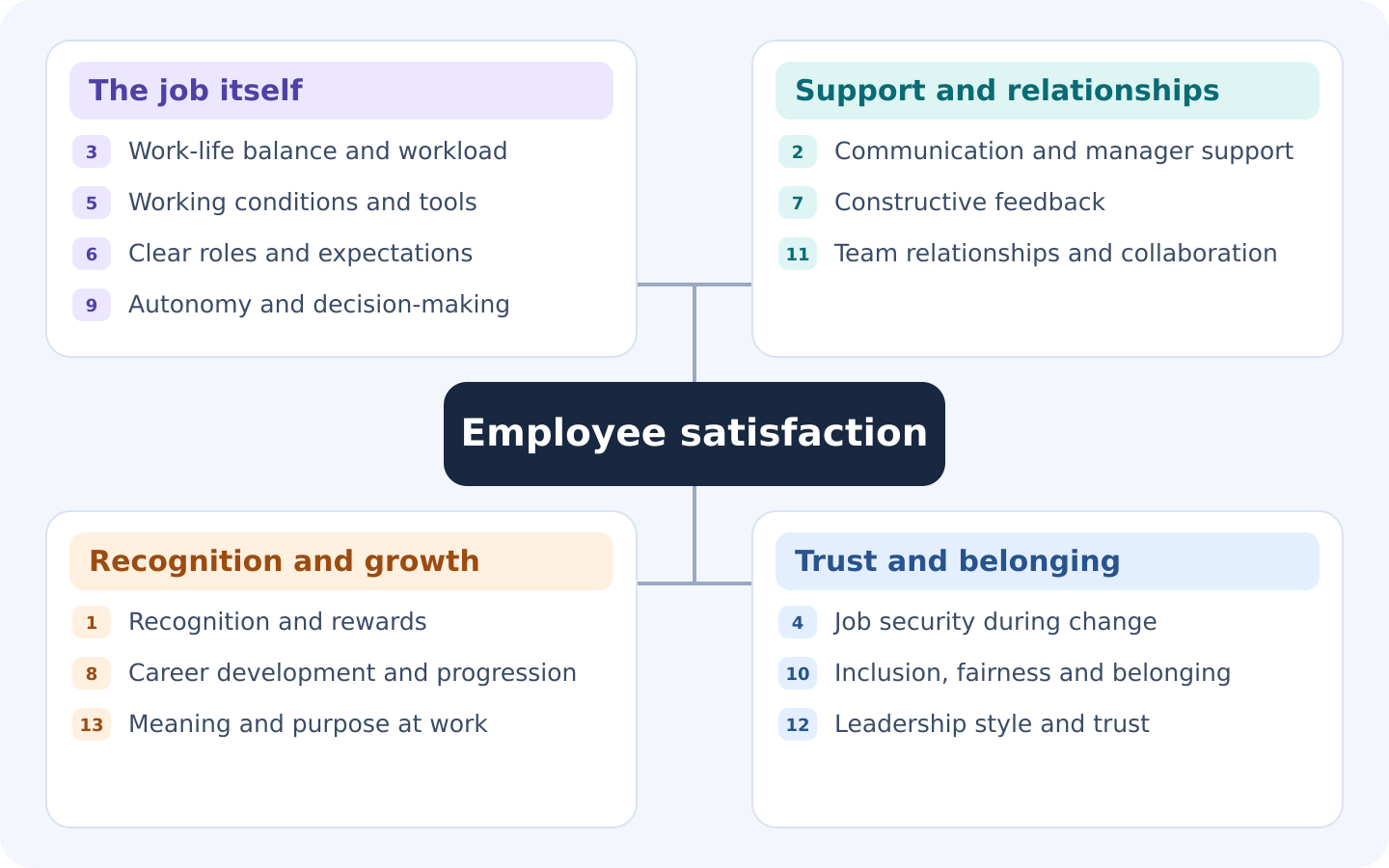
13 Factors That Contribute to Employee Satisfaction
1. Employee Recognition and Rewards
Think about whose work gets noticed on your team.
The person who closes a big sale might get a public thank-you, while the colleague who trained three new starters goes unrecognised. Both contributions matter.
Make recognition specific by naming what someone did, who it helped and why it made a difference.
2. Internal Communication and Manager Support
People need to know what's changing, why it matters and who can help if it creates a problem.
A team update can cover the basics, while a one-to-one gives employees space to raise concerns they'd rather discuss privately.
When someone asks for help, agree who'll take the next step and when you'll follow up.
3. Work-Life Balance and Manageable Workloads
Flexibility looks different for a store colleague than it does for someone working from home.
For shift-based teams, knowing next week's hours early enough to plan childcare may matter more than any formal flexibility policy.
- Ask how often people finish late or cover extra shifts.
- Check how much notice employees get when their hours change.
- Review who absorbs the extra work when someone is off.
4. Job Security and Confidence During Change
During a restructure or quieter trading period, people want to know what it could mean for their role, hours and team.
Share what has been decided, explain which decisions are still pending and give a date for the next update. A regular update gives employees somewhere to bring questions as the situation develops.
5. Working Conditions and the Tools People Need
Ask employees what makes an ordinary day harder than it needs to be. It might be a shared tablet that never holds a charge, a noisy workspace or a system that makes them enter the same details twice.
Start with a recurring issue you can fix, then check whether the change made the job easier.
6. Clear Roles and Expectations
People can be busy all day and still be unsure whether they're doing the right work. That often happens when two managers set competing priorities or when a handover leaves ownership unclear.
During onboarding and check-ins, agree what good work looks like, who owns each task and what should take priority when deadlines clash.
7. Constructive Feedback Employees Can Use
"Communicate better" leaves someone guessing.
"Flag stock delays before the afternoon handover so the next shift can plan around them" gives them something they can try.
Effective employee feedback describes what happened, explains the impact and agrees a next step. Give employees room to explain what made the task difficult, too.
8. Career Development and Internal Progression
Employees may be ready for more responsibility without knowing what their next move could be.
Use career conversations to connect their interests to opportunities they can act on.
- Explain what skills or experience they need for the next role.
- Offer a relevant stretch assignment, shadowing opportunity or mentor.
- Set a date to review progress and discuss what comes next.
9. Autonomy and Decision-Making
Think about how many routine decisions need your approval.
Could a team lead resolve a straightforward customer complaint or arrange a shift swap within agreed limits?
Set clear boundaries, give people examples of when to escalate and let them make everyday decisions within their role. Then ask where approvals still slow them down.
10. Inclusion, Fairness and Belonging
Look at how opportunities and information reach different groups.
Are colleagues on evening shifts hearing about training in time to sign up? Do remote employees have a way to contribute before decisions are made?
These everyday details help managers see where workplace inclusion breaks down and where a small change could make access fairer.
11. Team Relationships and Collaboration
A supportive team makes it easier to ask for help, hand work over and raise a mistake early.
If friction keeps coming up between teams, look at where their work overlaps.
A short conversation between shifts about what makes a good handover may solve a problem that's been frustrating both sides for weeks.
12. Leadership Style and Trust
Employees notice what leaders do after they ask for feedback.
If teams raise the same staffing concern three times, tell them who's reviewing it, what can happen locally and when they'll hear more.
Where leadership has made a decision, explain the reasoning in plain language so managers can answer questions consistently.
13. Meaning and Purpose at Work
Show people who benefits from the work they do.
If a warehouse team improves its stock checks, share how that helped stores avoid cancelled orders. If a support team rewrites an onboarding guide, tell them which questions new starters now resolve on their own. Specific examples make the impact of everyday work easier to see.
When measuring the success of employee engagement initiatives, pair your employee engagement score with a question about the condition you're trying to improve.
If you change how shifts are scheduled, ask employees how satisfied they are with the notice they receive, then repeat the same question after a few rota cycles.
4 Ways to Measure Employee Satisfaction Between Annual Surveys
If your employee satisfaction score drops, what should you do on Monday morning?
That depends on what changed.
A short pulse survey can help you pinpoint the issue, conversations can explain why it matters, and workforce trends can show you where to look next.
Here's how to use all three between annual surveys.
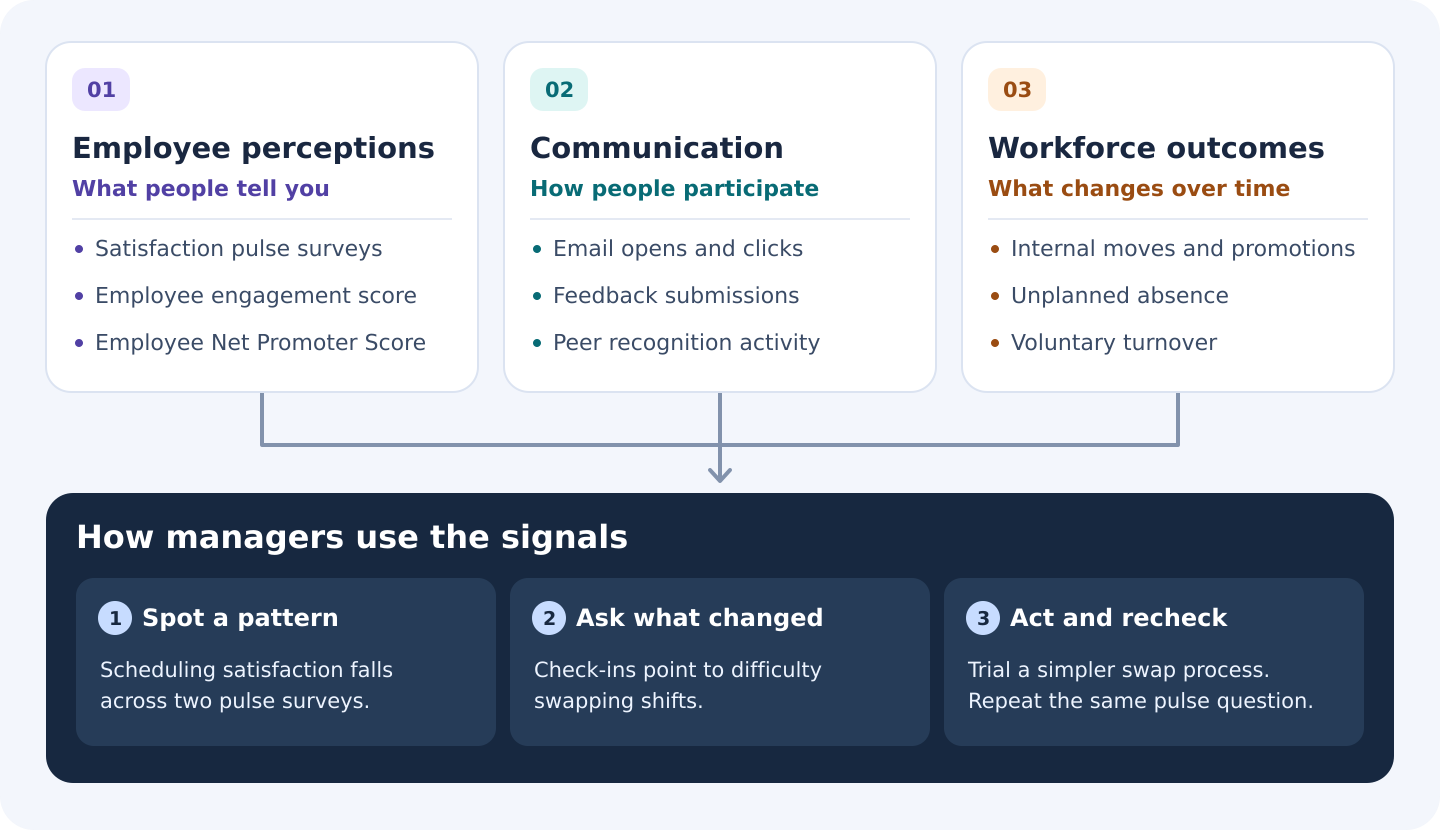
4 Ways to Measure Employee Satisfaction Between Annual Surveys
1. Run a Short Employee Pulse Survey
Keep one overall question consistent, such as "Overall, how satisfied are you with your job right now?" Use the same five-point scale each time so you can compare results.
Then rotate one or two questions around a specific issue, such as access to equipment, clarity of priorities or support from a manager.
To calculate the percentage favourable, divide the number of satisfied and very satisfied responses by the total number of valid responses, then multiply by 100. Show how many people answered alongside the score. A result based on 12 responses deserves a different level of confidence from one basedon 120.
Start with a monthly or quarterly check-in and choose a channel employees already use.
An email-based pulse survey tool can work for teams that regularly check email.
For shift-based teams, a mobile workspace may be easier to access.
2. Use One-to-Ones to Understand What Changed
A survey might show that employees are less satisfied with manager support.
In a one-to-one, you might learn that supervisors are available during the day but hard to reach on evening shifts.
That gives you a specific problem to solve.
- Ask what changed. "What's made your work easier or harder since we last spoke?"
- Ask for an example. "Can you walk me through the last time that happened?"
- Agree on a follow-up. "Here's what I'll look into, and here's when I'll get back to you."
Look for recurring themes across conversations and share them in aggregate when reporting back to the wider team.
3. Hold Stay Interviews Before People Decide to Leave
Enter youA stay interview gives you time to talk about what makes the job worth staying for and what might change that.
Try asking "What would make this a better place for you to work over the next six months?" If someone mentions career progression, find out whether they need training, a chance to take on new responsibilities or more visibility into open roles.
If you already track employee Net Promoter Score (eNPS), use it alongside these conversations.
It measures willingness to recommend your organisation as a place to work. Calculate it by subtracting the percentage of detractors who score 0–6 from the percentage of promoters who score 9–10.
Use all valid responses in the denominator, including scores of 7–8, and compare the trend over several quarters.r text here ...
4. Review Exit Feedback and Workforce Trends
Review exit interview themes alongside voluntary turnover over a rolling 12-month period.
If several people who left the same team mention unpredictable hours, check whether current employees are experiencing the same issue. You might learn that the problem affects one shift or location and needs a local fix.
Use the same approach with unplanned absence and internal mobility.
A rise in absence can prompt a conversation about workload or staffing.
A low rate of internal moves can prompt questions about access to vacancies or development opportunities. Ask employees what they're experiencing before drawing a conclusion from either trend.
How to Structure an Employee Engagement Scorecard
When measuring the success of employee engagement initiatives, group your metrics by the question they answer. Direct feedback tells you what employees say about work.
Participation shows how they interact with workplace channels and programmes. Workforce outcomes help you spot patterns worth investigating.
| What you're tracking | Metric examples | How to use them |
| Employee perceptions | Employee satisfaction pulse results, employee engagement score and eNPS | Compare like-for-like results over time. Check the individual questions to see whether workload, priorities or manager support changed. |
| Communication and participation | Unique email opens, click-throughs, estimated read time, feedback submissions and the share of eligible employees giving or receiving peer recognition | Use opens as an indicator of reach. Clicks show that people followed a link, while replies or poll answers give you direct feedback. If recognition participation falls, ask whether staff can access the programme and find it worth using. |
| Workforce outcomes | Internal moves and promotions relative to headcount, unplanned absence days relative to scheduled workdays, and rolling 12-month voluntary turnover | Review trends by team or location where group sizes allow. Use the patterns to decide where to follow up with employees. |
For example, if you introduce a clearer shift-swap process, track one direct measure first.
Ask employees how satisfied they are with the process before the change and again after a few rota cycles.
Then use the comments to decide what still needs fixing and tell the team what you'll do next.
How to Calculate an Employee Satisfaction Score
Start with one question in your employee satisfaction survey: "Overall, how satisfied are you with your job?"
Give employees five options, from very dissatisfied to very satisfied.
To calculate a percentage-favourable employee satisfaction score, count the people who selected satisfied or very satisfied. Divide that number by everyone who answered the question, including those who selected the neutral option, then multiply by 100. Leave skipped answers out of the calculation.
Worked example: You invite 80 employees to take the survey. Fifty respond and answer the satisfaction question. Of those, 36 select satisfied or very satisfied.
| Measure | Calculation | Result |
| Employee satisfaction score | 36 favourable answers ÷ 50 valid answers × 100 | 72% |
| Survey participation rate | 50 respondents ÷ 80 employees invited × 100 | 62.5% |
Report the two figures together. In this example, 72% of the people who answered were satisfied or very satisfied.
The participation rate gives managers context before they use that result to make a decision for the whole team.
When you run the next survey, keep the question, response scale and scoring method the same. If the score drops and fewer people responded, check whether the mix of respondents changed before concluding that satisfaction fell across the team.
For groups too small to report without risking confidentiality, combine results into a larger group or report only the overall score.
Download the Employee Satisfaction Checklist
Use this checklist to measure employee satisfaction between annual surveys. It walks you through choosing what to ask, calculating your score and recording one action to try.
There's space to name an owner, set a follow-up date and record what changed.
Download the Employee Satisfaction Checklist
Use this three-page checklist to measure employee satisfaction between annual surveys. It walks you through choosing what to ask, calculating your score and recording one action to try. There’s space to name an owner, set a follow-up date and record what changed.
Open or download the checklist (PDF)
If the preview is blank on your device, use the PDF link above.
How to Improve Employee Satisfaction
Start with one thing employees say makes their job harder. If your latest pulse survey points to unpredictable shifts, find out when the problem starts.
Is the rota published too late, or does it keep changing once it's out? The answer determines what you fix first.
1. Pick a Problem Your Team Can See You Fix
When several people raise the same issue, agree who owns it and when the team will hear back. A manager might be able to fix a confusing handover this week.
A staffing shortage may need a decision from leadership. In either case, tell employees what's happening so they know where their feedback went.
Give people a clear route to raise concerns privately, too. They should know who to contact if the issue involves their line manager or feels too sensitive to discuss in a team meeting.
2. Make the Working Week Easier to Plan
Ask employees what would give them more control over their time.
For an office team, that might mean flexible start times or fewer meetings outside core hours. For frontline staff, it could mean earlier rotas, a simpler way to swap shifts or a fairer approach to weekend cover.
Look at workload alongside flexibility. If the same people regularly work late, review what can be paused, reassigned or covered before the next busy period.
3. Give People a Clear Next Step in Their Career
Turn "I'd like to progress" into a conversation about what comes next.
Ask what kind of work the employee wants to do, explain what the next role requires and agree on one opportunity to build that experience. That could be shadowing a team lead, running a handover or taking ownership of a small project.
Set a date to revisit the plan. It gives both of you a chance to see whether the employee got the opportunity you agreed on and what support they need next.
4. Notice the Work That Keeps the Team Running
Think about who helped a new starter, caught an error before it reached a customer or covered a difficult handover.
Those contributions are easy to overlook because they often happen quietly. A thank-you carries more weight when you name what the person did and explain who it helped.
Ask people how they prefer to be recognised. Some appreciate a team shout-out, while others would rather hear it in a one-to-one.
5. Go Back and Ask Whether the Change Helped
After you've made a change, use the same employee satisfaction survey question to check whether people noticed a difference.
If you introduced earlier rotas, ask again how satisfied employees are with the notice they receive.
If the score stays flat, follow up. The rota may now come out earlier, but late changes could still be disrupting people's plans.
Share what you learned and what you'll do next. That follow-up gives employees a reason to keep speaking up and gives managers a clearer basis for deciding where to act.
What Causes Employee Dissatisfaction?
When employee satisfaction drops, look for the problems people keep bringing up.
Pay might be the biggest concern in one team, while unpredictable shifts or unclear priorities could be frustrating another.
Here are six common issues to ask about:
- Pay that feels out of step with the role. Employees may question whether they're paid fairly when their responsibilities grow but their pay stays the same.
- Unclear career prospects. It's hard to picture a future with the company when promotion criteria are vague or training is hard to access.
- Inconsistent management. Shifting priorities, mixed messages and approvals for routine decisions can make it harder for people to do their jobs.
- Strained working relationships. Unresolved conflict or poor cooperation can leave people reluctant to ask colleagues or managers for help.
- Work that goes unnoticed. People can feel overlooked when the effort they put into training new starters, solving problems or covering busy shifts rarely gets acknowledged.
- Work spilling into personal time. Last-minute rota changes, regular overtime and after-hours messages can make it hard to plan life outside work.
Use your next pulse survey or team check-in to find out which issue is affecting people most. Then agree on one change you can make and tell the team when you'll check whether it helped.
What to Do When Employee Satisfaction Drops
Start by finding out where the score fell and which question drove the change.
Check how many people answered and whether participation changed since the last survey.
If the drop is concentrated in one location or shift, speak to the people who work there before rolling out a company-wide fix.
Example — Scheduling Satisfaction Falls at One Location
magine a retailer with six stores. In its latest employee pulse survey, satisfaction with scheduling drops at one location.
The store manager checks in with staff across different shifts and hears the same thing several times. Rotas come out late, and shifts are sometimes changed at short notice. That makes it hard for people to arrange childcare or plan travel.
The manager agrees to publish rotas two weeks ahead and tell staff directly when a published shift changes. They explain when the new process starts and ask the same scheduling question in the next pulse survey.
If satisfaction is still low, they can ask whether staff are getting enough notice upfront and how often shifts are still changing after publication.
In AgilityPortal, you can run a short poll in the relevant store Space, then post a "You said, we did" update there. Include what staff raised, what you changed and when you'll check back.
That gives employees a clear way to see what happened after they spoke up.
Here Are The Top 5 Benefits of Increased Employee Satisfaction in Your Organisation
An improvement in employee satisfaction is easier to understand when you can see what changed in the working day.
People might spend less time untangling conflicting instructions, feel more comfortable raising a concern or see a realistic path to their next role.
Here are five benefits managers can look for and ways to tell whether the changes they've made are helping.
1. Better Employee Retention
omeone can enjoy their job and still consider leaving because the hours are hard to plan around or there's no clear route to progression.
A stay interview gives you a chance to hear what's making the job harder to stay in while there's still time to do something about it.
For example, if experienced team members keep asking how to move into supervisor roles, spell out what those roles require and give interested employees a chance to build that experience.
Then check whether they can see a more realistic path forward.
- Ask what makes people want to stay and what might make them reconsider.
- Look for recurring themes in stay interviews, exit feedback and pulse surveys.
- Review voluntary turnover over time alongside what current employees tell you.
2. Less Time Lost to Everyday Friction
Some of the things that frustrate employees also slow them down. Imagine two supervisors giving a team different priorities at the start of the day. People spend time checking which task comes first, switching between jobs or redoing work that was based on earlier instructions.
A shared list of priorities and a clear point of contact can make that working day simpler.
After a few weeks, ask whether employees know what to focus on when priorities clash.
You can also check whether the team is spending less time chasing approvals or correcting avoidable mistakes. That gives you a more concrete view of what improved than a satisfaction score alone.
3. Earlier Feedback When Problems Arise
When employees see a manager follow through on a concern, they have more reason to bring up the next one while it's still manageable. Suppose the evening team tells you that handover notes leave them guessing which orders are urgent.
You could agree on a simple way to flag priority orders and test it for a week.
What you do after the trial matters just as much as asking for feedback in the first place.
- Tell both shifts what changed and why.
- Ask the evening team whether they can now identify urgent orders quickly.
- If confusion remains, find out what information is still missing and agree who'll add it.
4. Smoother Collaboration Across Teams
Recurring disagreements often point to a problem in how work passes between teams.
If sales regularly promises delivery dates before operations has checked capacity, both teams end up dealing with frustrated customers. Start by asking each side where they get stuck and what information would help them make a better decision.
A practical fix could be agreeing which orders need a capacity check before sales confirms a date, who gives the answer and how quickly they'll respond.
After a few weeks, ask both teams whether the process is easier to work with and check how often customers still need a revised delivery date.
5. A More Sustainable Workload
A team can meet its targets while the same people repeatedly skip breaks, stay late or cover gaps in the rota.
Asking about workload in an employee satisfaction survey can help you see where that pressure is building and whether it's concentrated in a particular shift, role or location.
- Check when overtime or missed breaks tend to occur.
- Review what can be postponed, reassigned or covered differently during busy periods.
- Repeat the same workload question after the change and check whether people are finishing closer to their scheduled hours.
If employees say the workload feels more manageable but one shift is still running late, you have a specific issue to investigate in the next check-in.
5 Examples of What Employee Satisfaction Looks Like in Practice
What would a more satisfied team say about working here?
You might hear, "I can plan around my shifts," "My manager notices what I do," or "I know who to ask when I'm stuck." Those answers give managers something concrete to work towards.
Here are five examples of what that looks like and how to check whether it's working.
1. Flexible Working That Fits the Role
A customer support team might work from home on days when most requests come in online.
A field service team might need something different, such as more notice of route changes, a way to swap assignments or access to job details before arriving on site. Start by asking what employees would like more control over and where the role gives you room to offer it.
In a six-month randomised trial involving 1,612 Trip.com employees, the group offered hybrid working reported higher job satisfaction. Its quit rate was 4.8%, compared with 7.2% in the office-based group. That's a one-third relative reduction in this trial. Read the hybrid working study published in Nature.
- Ask desk-based employees when being together in person helps them get work done.
- Ask frontline employees what would make their hours or assignments easier to plan around.
- After a trial, repeat the same question about flexibility and check how the arrangement is working for employees and customers.
33%
lower quit rate in the hybrid working group in a six-month Trip.com trial
If you trial hybrid working, ask employees what the arrangement makes easier and where it creates problems. Check job satisfaction alongside retention so you can see how people feel as well as whether they stay.
Research context. The randomised trial included 1,612 Trip.com employees. The quit rate was 4.8% in the hybrid group and 7.2% in the office-based group, a relative reduction of about 33%. The hybrid group also reported higher job satisfaction.
Source · Nature, Hybrid Working From Home Improves Retention Without Damaging Performance (2024)
2. Recognition That Reaches the People Doing the Work
It's easy to recognise the person who handled a difficult customer call. It's just as important to notice the colleague who caught an error in the handover notes and saved the next shift from repeating it.
Name what the person did and explain who it helped. That makes the recognition feel earned and shows the rest of the team what good work looks like.
Gallup and Workhuman followed nearly 3,500 employees from 2022 to 2024. Employees who received high-quality recognition were 45% less likely to have changed organisations two years later. See the Gallup and Workhuman research on recognition and retention.
- Notice contributions across roles, locations and shifts, including work customers rarely see.
- Ask whether people prefer a private thank-you or a public shout-out.
- Give colleagues a simple way to recognise someone who helped them.
45 percent
lower likelihood of changing organisations over two years among
employees who received high-quality recognition
Look at whose work gets noticed. Alongside sales wins and customer praise, recognise the people who train new starters, catch mistakes and keep handovers running smoothly.
Research context. Gallup and Workhuman tracked nearly 3,500 employees from 2022 to 2024 and found an association between recognition quality and whether employees changed organisations.
Source · Gallup and Workhuman, Employee Retention Depends on Getting Recognition Right (2024)
3. Development and Support That Fit the Individual
Two people in the same role can want very different things from work.
One might want to become a team lead. Another might want to get better at handling complex customer queries.
Ask each person what they'd like to get better at, then agree on an opportunity they can realistically fit into their working week.
That could mean letting an aspiring team lead run a handover with support nearby, or giving a service colleague time to shadow someone who handles escalations.
At the next one-to-one, ask whether they had a chance to practise and what they still need help with. You can also use a pulse survey to ask whether people can see a development opportunity that fits their goals.
4. Regular Communication With a Clear Way to Respond
A new starter might receive a welcome email, an onboarding checklist and a week of training, yet still be unsure who to ask when they encounter something the training didn't cover.
Give them a named contact and book short check-ins during their first few weeks. Ask where they're getting stuck and use their answers to improve the next starter's experience.
The same approach works for established teams. If you announce a change to a process, leave room for employees to tell you what happens when they try it.
- Explain what's changing, who it affects and when it starts.
- Ask one specific question, such as "Which part of the new process takes longer than it used to?"
- Report back on what you heard, what you'll change and when you'll check in again.
5. Collaboration That Makes the Job Easier
A collaborative workplace is one where employees can get the information they need from another team without having to chase three people. Say field technicians regularly arrive at appointments missing details that customer support already collected.
Ask both teams to look at a few recent jobs and agree on what needs to be captured before an appointment is handed over.
Give the new handover a few weeks, then ask technicians whether they're getting what they need. Check whether repeat calls for missing information have fallen, too.
Pairing employee satisfaction feedback with a practical measure like this helps you see whether the change made the job easier and where people are still getting stuck.
How to Report Employee Satisfaction Trends to Leadership
Start with the decision you need leadership to make.
If satisfaction with scheduling has fallen at one store, explain what employees are experiencing, what the manager can change and where they need support.
Keep the update focused on four things:
- What changed. Show the previous and current employee satisfaction scores, with the number of people who answered each time. If participation changed, mention it so leaders can interpret the comparison.
- What employees told you. Summarise the recurring themes from pulse surveys or check-ins. If staff repeatedly mention last-minute rota changes, say so plainly.
- What you'll try. Name the change, who owns it and any decision leadership needs to make. For example, the store manager could trial publishing rotas two weeks ahead.
- When you'll check back. Set a review date and repeat the same scheduling question. Track how often shifts change after the rota is published so you can compare what employees report with what happened on the ground.
If satisfaction rises after the trial, report the sequence plainly. "Scheduling satisfaction rose after we started publishing rotas earlier, and staff said they had more time to plan."
That gives leadership a reason to continue the trial while leaving room to check what else changed, such as staffing levels or the number of last-minute swaps.
Learn How AgilityPortal Helps You Improve Employee Satisfaction
Learn How AgilityPortal Helps You Improve Employee Satisfaction
When employees flag a problem, they want to know who's handling it and what happens next.
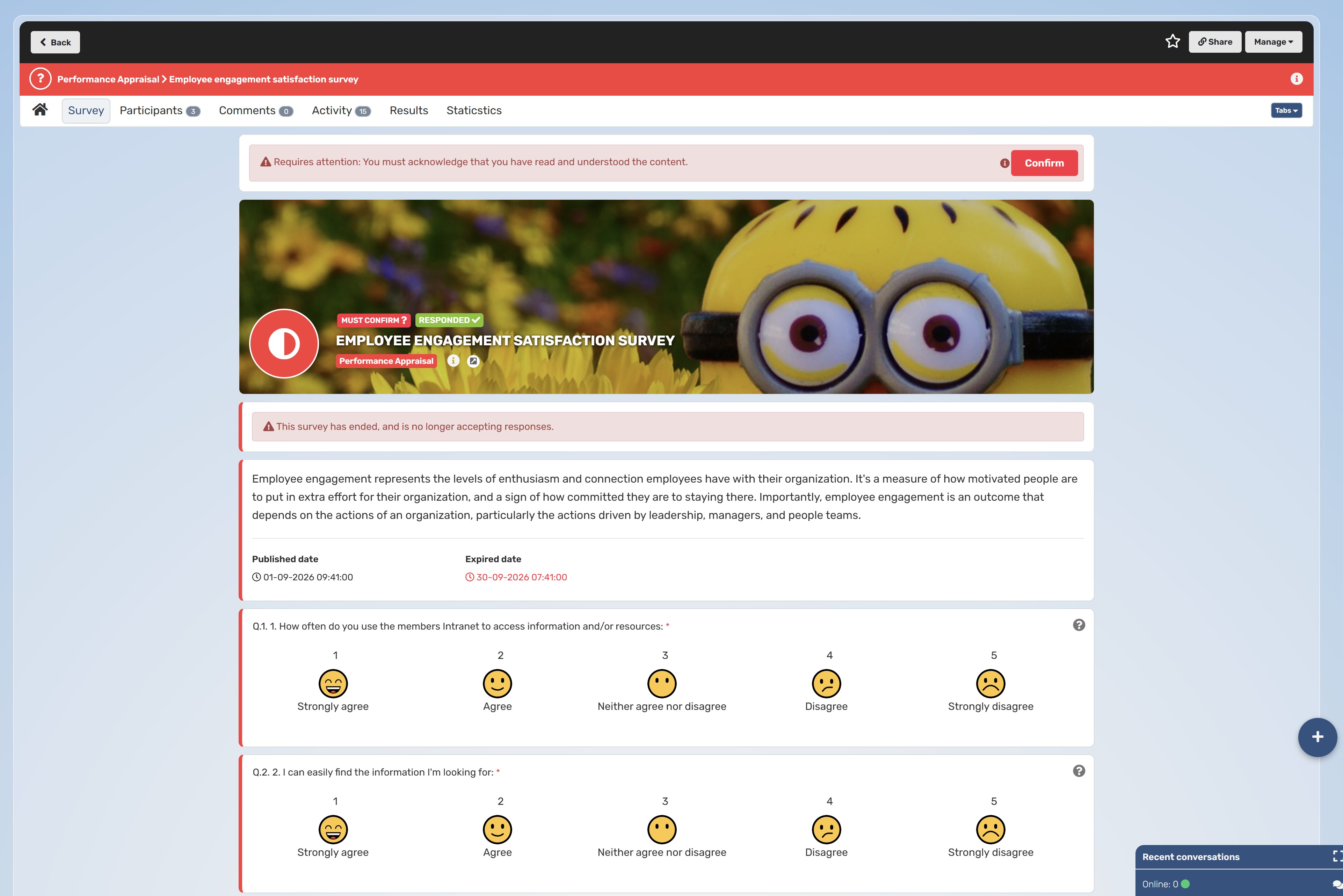
AgilityPortal gives managers one place to ask for feedback, share decisions and follow up with the people affected. You can run a short poll in a team or location Space, then post a "You said, we did" update so employees can see what changed.
Give employees one place to find answers and speak upBring policies, announcements, quick links and support contacts together in your employee intranet. A store colleague can check the latest shift-swap guidance on their phone.
A new starter can find out who to ask for help. And when a process changes, managers can share the update with the right team and ask whether it's working.
Employee Feedback & Communication
Show Employees What Changed After They Spoke Up
With AgilityPortal, you can run a short pulse poll in a team or location Space, share the action you’re taking and check back with the same team. Employees can find the latest update alongside the policies, quick links and support contacts they use at work.
Try a “You said, we did” update. If staff tell you that last-minute rota
changes make it hard to plan, explain what you’re changing and when it
starts. After a few rota cycles, ask the same scheduling question to
see whether the change helped.
- Employee Polls & Surveys
- Team & Location Spaces
- Targeted Announcements
- Employee Resources & Quick Links
- Desktop & Mobile Access
Bring one employee satisfaction question to the demo. See how to turn it into a short poll and share a follow-up with the team it affects.
Final Thoughts
You don't need to wait for the annual survey to find out what's making work harder for your team.
Start with one question about something employees deal with every day, such as how much notice they get before a shift changes or how easy it is to get help when they're stuck. A short pulse survey can show you where to look.
A few conversations can help you work out what to change.
Once you've agreed on a change, tell people what you heard, what you're doing about it and when you'll check back. Then ask the same question again.
If employee satisfaction improves, look at what employees say is working better. If the score stays flat, ask what's still getting in their way.
With AgilityPortal, you can run a quick poll in the team's Space and follow it up with a "You said, we did" update.
Start with one issue you can act on before the next survey, and give your team a chance to tell you whether the change made their working day better.
Related Guides on Employee Feedback and Engagement
Planning your next employee satisfaction survey? These guides can help you choose what to ask, decide which engagement metrics to track and show employees what changed after they gave feedback.
- Employee Temperature Check Questions for Your Next Pulse Survey
- How to Run an Employee Engagement Survey in Four Steps
- How to Measure Employee Engagement Step by Step
- A Manager’s Guide to Acting on Engagement Survey Results
- What HR Can Do to Improve Employee Engagement Beyond Team Perks
- Practical Staff Appreciation Ideas for Recognising Employees
If you already have survey results, start with the manager’s guide to acting on feedback. Use it to choose one issue to address and decide when to check whether the change helped.
Frequently Asked Questions About Employee Satisfaction
What is employee satisfaction? How do authors define it?
Employee satisfaction describes how people feel about their job overall and about specific parts of it, such as pay, supervision and opportunities to progress.
Organisational psychologist Paul E. Spector approaches job satisfaction at both levels.
That distinction helps explain why someone can enjoy the work itself and still feel dissatisfied with their pay or prospects. Paul Spector's research on job satisfaction.
What is a synonym for employee satisfaction?
Job satisfaction is the closest synonym for employee satisfaction.
Use workplace satisfaction when you're talking more broadly about the working environment, including the tools, facilities or support people have access to.
What are some examples of employee satisfaction?
Employee satisfaction examples include a store colleague who gets enough notice to plan around their shifts, a new starter who knows where to get help, and a technician who has the tools and information needed to finish a job.
Each example gives you a specific topic to ask about in your next check-in.
What should an employee satisfaction survey include?
Start with one overall question, then use your employee satisfaction questionnaire to find out which parts of the job are working well and which need attention.
For a short pulse survey, try these three questions:
- Overall, how satisfied are you with your job?
- How satisfied are you with the support you receive from your manager?
- What one change would make your working day easier?
Use the same five-point scale for the first two questions and leave the last one open for comments.
Where can I find an employee satisfaction PDF?
The University of Minnesota offers the Minnesota Satisfaction Questionnaire, along with a PDF manual that explains the instrument and its scoring.
It's a useful reference if you want to see how a structured questionnaire measures different aspects of job satisfaction. Download the Minnesota Satisfaction Questionnaire manual (PDF).
What is a simple employee satisfaction framework?
Ask a consistent question, look into recurring concerns, agree on one action and check whether it helped.
For example, if people say they get too little notice of shift changes, find out when the changes happen, trial a fix and repeat the same scheduling question after a few rota cycles.
How do you calculate an employee satisfaction score?
For a percentage-favourable score, divide the number of satisfied and very satisfied responses by the total number of valid answers, then multiply by 100.
If 36 out of 50 respondents chose one of those options, the employee satisfaction score is 72% favourable. Report the participation rate alongside it.
What is a good employee engagement score benchmark?
Start with your previous score using the same questions, response scale and calculation.
If you use an external employee engagement score benchmark, check whether it covers a similar workforce and uses a comparable method.
The percentage of favourable survey responses and the percentage of employees classified as engaged are different measures. Gallup's employee engagement reporting standards.
What was the employee engagement score in 2022?
In its annual U.S. analysis, Gallup reported that 32% of full- and part-time employees working for organisations were engaged in 2022, while 18% were actively disengaged.
Use those figures as historical context when comparing trends. Gallup's 2022 U.S. employee engagement findings.
What is an eNPS score?
An eNPS score, or employee Net Promoter Score, measures how likely employees are to recommend their organisation as a place to work.
On a 0–10 scale, subtract the percentage of detractors (0–6) from the percentage of promoters (9–10). Include people who scored 7–8 in the total number of valid responses.
If 45% are promoters and 20% are detractors, your eNPS is +25. Employee Net Promoter Score calculation guide.
What does "employee score Equifax" refer to?
If you came across employee score Equifax while looking for HR metrics, you may be looking for The Work Number. Equifax's Employment Data Report contains employment and income information supplied by participating employers.
Employee satisfaction and engagement scores come from employee feedback and serve a different purpose. Equifax's sample Employment Data Report.
AI Summary
- Employee satisfaction describes how people feel about their job and working conditions, including workload, scheduling, manager support and opportunities to progress. An employee engagement score reflects how connected or invested people feel, based on the questions used.
- Use short pulse surveys, one-to-ones and stay interviews to check employee satisfaction between annual surveys. Keep one overall satisfaction question consistent and rotate questions about specific issues your team can address.
- To calculate a percentage-favourable employee satisfaction score, divide the number of satisfied and very satisfied responses by the total number of valid answers and multiply by 100. Report survey participation alongside the score.
- If satisfaction drops, check which question drove the change and whether it was concentrated in one team, shift or location. Use feedback to understand what changed, and review trends such as voluntary turnover for context.
- Choose one change to trial, give it an owner and tell employees when you’ll follow up. Repeat the same survey question and report what changed alongside participation and employee comments.
Most Popular Posts

Effective communication among team members is vital for the productivity and success of any organization. Surprisingly, 60% of companies lack a long-term internal communication strategy, which p...


Businesses thrive on communication for efficiency, productivity and accomplishment. When the right information is passed from the right designation in the organization, it promotes positivity an...

Categories
Blog
(3262)
Business Management
(399)
Employee Engagement
(239)
Digital Transformation
(226)
Growth
(152)
Intranets
(142)
Internal communications
(111)
Remote Work
(68)
Sales
(53)
Collaboration
(53)
Customer Experience
(34)
Culture
(30)
Project management
(30)
Knowledge Management
(29)
Leadership
(20)
Comparisons
(9)
News
(1)

Related Posts

If employee satisfaction dropped on your team tomorrow, how soon would you know? If your next chance to ask is the annual survey, you could spend months missing the small frustrations that make work harder every day. In a 2024 Pew Research Center sur...

Ever cancelled a meeting to give your team more focus time, only to watch that time disappear into Slack pings, email alerts and "quick questions"? That's how context switching at work can eat into the time you thought you'd got back. In a rece...

How much time does your team spend turning a simple company update into something employees will actually read? AI for internal communications can help you move from rough notes to a clear announcement, newsletter or leadership message, with mo...

What is a case management system, and could it save your team from chasing emails, missing updates, and wondering who's handling what? Imagine a customer complaint or employee enquiry lands in your inbox. Before you can sort it out, you're alre...

AI-assisted software development is rapidly changing how modern businesses build software, and it's happening much faster than many companies expected. From AI coding tools that generate code suggestions in seconds to intelligent testing automation a...


Annet Herges
I am a digital nomad, lover of exploring new places and making friends.
I love to travel and I love the internet. I take pictures of my travels and share them on the internet using Instagram.
Traveler, entrepreneur, and community builder. I share my insights on digital marketing and social media while inspiring you to live your fullest life.
Ready to learn more? 👍
One platform to optimize, manage and track all of your teams. Your new digital workplace is a click away. 🚀
Free for 14 days, no credit card required.