
Insight Blog
Agility’s perspectives on transforming the employee's experience throughout remote transformation using connected enterprise tools.
49 minutes reading time
(9800 words)
A Manager’s Guide to Taking Action on Engagement Survey Results Before Trust Is Lost

A Manager’s Guide to Taking Action on Engagement Survey Results Before Trust Is Lost
Learn how managers can take action on engagement survey results, build employee trust, choose priorities and create an employee survey action plan.
A Manager’s Guide to Taking Action on Engagement Survey Results Before Trust Is Lost

Employee engagement surveys give people a chance to say what is working, what is getting in the way and where leadership needs to pay closer attention.
But taking action on engagement survey results is the part that determines whether employees see the process as worthwhile or simply another request for feedback that disappears into a dashboard.
That matters because managers shape the day-to-day experience of work.
70%
of team engagement variance
Gallup says managers account for at least 70% of the variance in team engagement. With only 20% of employees worldwide engaged in 2025, managers need support to turn survey feedback into visible action, not a long list of initiatives.
Source:
Gallup Global Indicator
Gallup says managers account for at least 70% of the variance in team engagement, while only 20% of employees worldwide were engaged in 2025.
The answer is not to launch a long list of initiatives after every survey.
It is to listen carefully, choose the issues a team can genuinely influence, communicate openly and show steady progress.
This guide explains how managers can understand employee engagement survey results, lead a constructive team conversation and build an employee survey action plan that earns trust rather than creating more survey fatigue.
Key Takeaways
- Taking action on engagement survey results is what shows employees that their feedback has been heard and treated seriously.
- Managers should focus on one to three practical priorities instead of making a long list of commitments that cannot be delivered.
- Employee engagement survey results should be discussed as team-wide patterns, while protecting anonymity and avoiding speculation about individual comments.
- A credible employee survey action plan includes a clear problem, named owner, realistic deadline, success measure and regular progress update.
- Managers should escalate issues they cannot solve, such as staffing, pay, benefits, safety or company-wide policy, and tell employees when they can expect an update.
- A digital workplace helps make survey actions, policy changes, knowledge and follow-up feedback visible to frontline, remote and hybrid employees.
Why Survey Results Can Either Build Trust or Quietly Damage It
Asking employees for feedback creates an expectation.
People have taken time to explain what is helping them do good work, what is frustrating them and what may be affecting their wellbeing, confidence or motivation.
If nothing happens afterwards, employees may reasonably conclude that future surveys are a waste of time.
That does not mean leaders need an instant answer to every concern. It does mean they need to acknowledge what they heard, explain what can happen next and be open where change will take longer.
A note on where this is coming from.
At AgilityPortal, we build and support the digital workplace apps companies use to reach frontline staff. We spend much of our time in the gap between what an internal communications team sends and what someone in a warehouse, store, site or ward actually receives.
That reality is familiar to the React Native developers at Incora, whose work continues well beyond an app's launch. Maintaining, refining and improving how people use workplace technology is where a clear pattern emerges: sending a message is easy; making sure it reaches people and leads to action is much harder.A message can be well written, approved and published on time, yet still fail to reach the people who need it.
It may be buried in a feed, missed by an employee on shift, difficult to find again or disconnected from the action it was supposed to support. Survey follow-up has the same problem.
It is not enough for leadership to say that it has listened; employees need to see what changed because they spoke up.
The good news is that survey results can become a useful starting point for better conversations.
They can help managers spot gaps in communication, workload, recognition, development, leadership or access to the right information. The risk comes when organisations treat the survey as the finish line instead of the beginning of the work.
What Taking Action on Engagement Survey Results Actually Means
Taking action on engagement survey results does not mean trying to fix every score, respond to every comment or launch a long list of initiatives.
That approach normally creates too many promises, too little ownership and very little change that employees can actually see.
A useful employee survey action plan focuses on a small number of issues that matter to employees and can be improved in a realistic timeframe.
The aim is not to make the report look better. It is to make work better.

What Taking Action on Engagement Survey Results Actually Means
It Is Not About Fixing Every Score
A low score deserves attention, but it is not automatically the first thing a manager should act on.
Some issues may be important but sit outside the team's control, such as company-wide pay policy, staffing budgets or major technology decisions.
Others may have a lower score but be easier to improve and have a more immediate effect on how people experience work.
Before choosing a priority, managers should use three simple tests:
- Does this materially affect employee experience? Focus on issues that make it harder for people to do good work, feel informed, feel recognised or trust their manager and the business.
- Can this manager or leadership team influence it? A team manager may not be able to change a benefits package, but they may be able to improve how updates are shared, how workloads are planned or how development conversations happen.
- Can employees see a meaningful improvement within a sensible timeframe? Employees do not need every issue resolved within a month. They do need to see that progress is real. A clear improvement within 30, 60 or 90 days is usually more credible than a vague promise to "work on engagement."
For example, if employees say they cannot find important process updates, the best response may not be a broad communication campaign.
It could be as practical as creating one searchable place for shift changes, policies and operational updates, then making sure everyone knows where to find it.
Start With Patterns, Not Individual Comments
Survey scores, written comments and one-off feedback all serve different purposes.
Quantitative results show the scale of an issue.
They can reveal whether employees generally feel informed, supported or recognised. Written comments help explain why a score may be high or low. Individual anecdotes can uncover useful detail, but they should not be treated as proof that every employee has the same experience.
Managers should look for themes that appear across the results.
For example, several comments about unclear priorities, combined with a low score for communication, may point to a genuine issue with how decisions are being shared. A single comment about one difficult meeting may still matter, but it may need a different response.
Anonymity is essential here.
Managers should never try to work out who made a comment, ask employees to explain their individual response or use survey feedback as part of a performance-management conversation.
Doing that can quickly undermine psychological safety and make people less likely to be honest in the future.
The best question is not, "Who said this?" It is, "What does this feedback tell us about the experience people are having, and what can we improve together?"
Related Employee Engagement, Survey and Feedback Guides
Taking action on engagement survey results is only one part of creating a workplace where employees feel informed, heard and supported. These AgilityPortal guides cover employee engagement surveys, feedback, communication, digital workplace tools and the practical ways organisations can improve the employee experience.
- A Guide to Conducting an Employee Engagement Survey
- Employee Engagement Survey Newsletter: A Complete Guide
- Top Free Employee Engagement Tools to Boost Morale and Connection
- Employee Engagement Platforms for Businesses
- Intranet Feedback and Evaluation Surveys: Questions, Examples and More
- Employee Engagement Forums: Examples, Benefits and Guidelines
- Work Engagement vs Organisational Engagement: What Is the Difference?
- How to Boost Employee Engagement in a Hybrid Workplace
- What Is an Employee Experience Platform and Why Does It Matter?
- How Employee Engagement Improves Employer Branding
Together, these guides support a stronger topic cluster around employee feedback, employee engagement surveys, internal communication, workplace culture, digital employee experience and practical follow-through.
What Managers Should Look For in Employee Engagement Survey Results
Employee engagement survey results can be overwhelming at first.
There may be participation figures, favourability scores, written comments, benchmark comparisons and breakdowns by team or location. Managers do not need to become data analysts overnight.
They do need to understand what the results say about their team's real working experience.
The goal is to identify the employee engagement drivers that are helping people do their best work, along with the issues that are making work harder than it needs to be.
That gives managers a sensible starting point for employee survey action planning.

What Managers Should Look For in Employee Engagement Survey Results
Check the participation rate first
The employee survey participation rate tells you how many people had their say.
A high response rate gives more confidence that the employee engagement survey results represent the wider team experience.
A lower participation rate does not mean the feedback should be ignored. It may simply mean that employees need more time, clearer communication or greater confidence that their feedback is anonymous.
However, managers should avoid making big assumptions from a small group of responses.
If participation is low, it can be useful to ask:
- Did employees have enough time to complete the survey?
- Could frontline, remote or shift-based employees access it easily?
- Do employees trust that their survey responses are confidential?
- Have people seen action taken after previous employee feedback surveys?
Recognise the strengths worth protecting
It is easy to focus entirely on low scores, but strong results matter too. They show what employees value and what leaders should avoid disrupting.
For example, a team may score highly for peer support, flexible working, manager communication or employee recognition. Those strengths may be helping the team cope with pressure in other areas. Calling them out also shows employees that the survey is not only used to find problems.
Recognition can be a practical action in itself. Let people know what is working, thank those who have helped create that experience and consider how the same behaviours could be applied elsewhere.
Look for low scores and meaningful changes over time
A low employee engagement score can signal an area that needs attention, but context matters. Managers should compare results with the previous employee survey, the company average and any relevant industry benchmark where available.
A score that has fallen over time may be more important than a score that has always been steady.
It can indicate that something has changed in the team, such as workload, leadership, communication, staffing levels, workplace technology or access to development opportunities.
Look beyond the score itself and ask:
- Is this a new issue or a long-running concern?
- Is it affecting the whole team or a particular group?
- Is it likely to affect retention, wellbeing, productivity or customer service?
- Is the issue something we can address locally?
Use employee comments to understand the story behind the numbers
Survey comments can add valuable detail to employee feedback.
A score may show that people feel unclear about priorities, but comments can reveal whether the problem is too many changing requests, inconsistent messages from managers or difficulty finding the latest process information.
Comments should support the wider picture, not override it. One strongly worded response may point to an important issue, but it should not be treated as the experience of every employee.
Managers should look for repeated themes, such as:
- Employees struggling to find important information.
- Confusion about priorities or changing processes.
- Concerns about workload and staffing.
- Limited recognition for good work.
- Lack of feedback, career development or training.
- Poor communication between departments, sites or shifts.
Compare groups carefully while protecting anonymity
Where reporting thresholds allow it, managers may be able to compare employee survey results by location, role, department, shift pattern or length of service. This can help uncover differences that a company-wide average would hide.
For example, office-based employees may feel informed while frontline workers do not.
New starters may feel supported during onboarding while longer-serving employees feel unclear about development. Remote employees may have a different experience from people who work on-site.
However, confidentiality must come first. Do not analyse small groups where people could be identified, and never use survey results to make assumptions about individual employees.
The purpose is to understand workplace patterns and improve employee experience, not to monitor people.
Focus on areas with the highest potential impact
Managers should prioritise engagement survey actions that can improve the everyday employee experience.
Common high-impact areas include:
- Manager communication and leadership visibility.
- Workload, resourcing and role clarity.
- Employee recognition and appreciation.
- Career growth, training and development.
- Access to the policies, processes and information employees need.
- Trust, psychological safety and confidence in leadership.
- Collaboration between teams, departments and locations.
The strongest employee survey action plan usually focuses on one to three of these areas. That gives the team enough room to make meaningful progress and gives employees a clear way to see whether their feedback is being acted on.
| What managers see | What it may mean | Sensible next move |
| Low score but limited influence | A wider business issue, such as pay policy or staffing budgets | Escalate it to the right leaders and explain the limit clearly |
| Falling score over time | An emerging employee engagement risk | Discuss likely causes and agree practical next steps |
| Strong score | A valuable team strength | Protect it, recognise it and avoid disrupting what works |
| Polarised feedback | Different groups are experiencing work differently | Explore the theme without identifying individuals |
| Low participation rate | Employees may lack time, access or trust in the survey process | Review accessibility, anonymity and past follow-up |
| Repeated comments about communication | Important information may be hard to find or reaching employees too late | Create a clearer, more reliable employee communication process |
How to Discuss Engagement Survey Results With Your Team
Discussing employee engagement survey results is where managers turn numbers into a meaningful conversation.
The aim is not to defend the business, explain away every low score or leave the meeting with a list of promises nobody can keep.
It is to help employees feel heard, understand what the results are showing and agree on a small number of practical improvements.
That manager-led conversation matters.
Gallup estimates that managers account for at least 70% of the variance in team engagement, so the way a manager handles survey feedback can have a real effect on whether employees trust the process. Gallup

How to Discuss Engagement Survey Results With Your Team
Prepare before the meeting
Managers should not open the survey dashboard for the first time in front of their team.
Spend time reviewing the employee engagement survey results first, and involve HR or a senior leader where the feedback includes issues such as safety, discrimination, serious workload concerns, pay, staffing or company-wide policy.
The preparation stage should focus on two or three themes, not every number in the report.
Employees do not need a long presentation.
They need an honest explanation of what the team heard and a chance to talk about what should happen next.
Before the meeting, managers should:
- Identify the team's strengths as well as areas for improvement.
- Review comments for recurring themes without trying to identify respondents.
- Separate local issues from matters that need wider leadership involvement.
- Decide what can realistically be improved over the next 30, 60 or 90 days.
- Be ready to explain what cannot be changed immediately.
It is also important to set clear ground rules. Feedback is valid even when it is difficult to hear. There should be no blame, no guessing who wrote particular comments and no commitments made in the room that cannot be delivered.
Use a simple meeting structure
A survey follow-up meeting does not need to be complicated. In fact, a simple and repeatable structure is usually better.
- Thank employees for taking part
Recognise that people gave their time and feedback. Explain that the discussion is about learning from the results, not judging individual responses. - Share the headline results, including strengths
Start with what the team is doing well. This helps create a balanced conversation and protects the things employees value. - Acknowledge difficult feedback without becoming defensive
If employees have raised concerns about communication, workload, recognition or leadership, say so clearly. Avoid phrases such as "that is not really what is happening" or "you may have misunderstood." - Ask what sits behind the patterns
The survey identifies where issues may exist. The team conversation helps explain why they are happening in everyday work. - Agree which one or two areas deserve action first
Do not try to solve everything. Choose priorities the team can influence and employees will notice. - Explain when the team will hear the next update
End with a clear date. This is what stops the conversation becoming another meeting that goes nowhere.
Gallup recommends that action-planning discussions create a safe space and give employees enough time to share what would make their workplace better. It suggests allowing around an hour for the conversation rather than rushing through the results. Gallup's survey follow-up guidance
A realistic scenario
Imagine a customer-support team of 28 employees. The engagement survey shows that employees generally value their colleagues and feel proud of the service they provide. However, scores for communication and workload have fallen since the previous survey.
The manager's first instinct is to explain that the business has been busy, a new system has caused delays and staffing is being reviewed. All of that may be true, but it does not answer the employee experience behind the result.
Instead, the manager begins the meeting like this:
"Thank you for taking part in the survey. The results show that this team supports each other well and takes pride in helping customers. They also show that many of you feel changes are communicated too late and workloads have become harder to manage. I do not want to assume I know the full reason, so I would like us to talk about what this looks like in practice and agree what we can improve."
During the discussion, employees explain that process changes are usually announced in a live meeting. Employees on late shifts often miss them, and the information is then difficult to find. They also say that customer escalations are being assigned unevenly.
The team agrees on two actions:
- Publish operational updates in one searchable location before they take effect.
- Review the escalation process and introduce a clearer rotation system within 30 days.
The manager cannot immediately resolve the wider staffing issue, but they commit to escalating it to senior leadership and giving the team an update within two weeks.
That is a credible employee survey action plan. It does not pretend every issue is fixed, but it shows that the feedback has led to clear action.
Why this matters in the data
Gallup's research is clear that employee surveys only work when organisations act on the findings.
It warns that asking employees for their opinions and then ignoring the response can reduce engagement and increase turnover. Gallup's employee survey guidance
23%
higher profitability
78%
lower absenteeism
Gallup reports that business units in the top quartile for employee engagement experience 23% higher profitability and 78% lower absenteeism than those in the bottom quartile. This does not mean one survey action creates these outcomes, but it shows why employee feedback follow-up is a practical business responsibility, not only an HR exercise.
Source:
Gallup employee survey research
The business case is also significant. Gallup reports that business units in the top quartile for employee engagement experience 23% higher profitability and 78% lower absenteeism than those in the bottom quartile.
These figures do not mean one meeting or one action plan will create those results on its own. They do show why managers should treat engagement survey follow-up as a practical business responsibility, not just an HR exercise. Gallup
Useful questions managers can ask:The right questions encourage employees to explain the issue without putting anyone on the spot.
- "What stands out most to you in these results?"
- "What are we doing that we should protect?"
- "What is making this issue difficult in day-to-day work?"
- "What is one change within this team that would make the biggest difference?"
- "What could we test over the next 90 days?"
- "What support do we need from the wider organisation?"
- "How will we know whether this change has helped?"
- "What should I update you on, even if the answer takes longer than we would like?"
The most important part is what happens after the meeting. Employees do not need perfection. They need honest communication, visible ownership and evidence that speaking up can lead to change.
Build an Employee Survey Action Plan People Can Believe In
An employee survey action plan should not be a polished document that disappears after one leadership meeting. Employees need to see that their feedback has led to practical changes, with clear ownership and regular updates.
The strongest plans are usually simple. They focus on a few priorities, make realistic commitments and explain how progress will be measured. Trying to solve every issue raised in an employee engagement survey often creates a long list of promises that are difficult to deliver.
Here is a practical seven-step approach.
1. Choose one to three priorities
Start by narrowing the results down to the issues that will have the biggest effect on employee experience.
This may be manager communication, workload, recognition, career development, access to information or clarity around priorities.
Do not try to fix every score in the survey. A team that commits to two meaningful changes and follows through will build more trust than a team that announces 15 initiatives and delivers none of them.
The best priorities are usually:
- Important to employees.
- Within the team's or organisation's influence.
- Realistic to improve within the next few months.
- Easy for employees to recognise when progress has been made.
2. Describe the real problem clearly
Vague action plans are hard to deliver. "Improve communication" sounds positive, but it does not explain what is going wrong or what will change.
Instead, describe the issue in terms employees will recognise.
For example:
Frontline employees do not always receive operational updates before their shift begins, which can lead to inconsistent information and unnecessary questions.
That makes the action clearer:
Publish a short weekly operations update before each rota begins and store it in a searchable employee knowledge hub.
A clear problem statement helps managers choose the right action, assign responsibility and measure whether the change worked.
3. Co-design possible solutions with employees
Employees are often closest to the problem.
They understand where information gets lost, which processes create unnecessary work and what would make daily tasks easier.
Rather than imposing a generic HR initiative, ask employees what a useful improvement would look like.
The final decision may still sit with the manager or leadership team, but employee input helps ensure the action is grounded in reality.
For example, if employees say they feel overlooked, a manager could ask:
- What kind of recognition would feel meaningful?
- Is the issue that good work goes unnoticed, or that recognition is inconsistent?
- Would peer recognition, manager feedback or a regular team round-up make the biggest difference?
This approach also improves buy-in. Employees are more likely to support an action plan when they have helped shape it.
4. Name one accountable owner
Every action needs one clearly named owner.
This does not mean that person has to do all the work themselves. It means they are responsible for moving the action forward, coordinating people and reporting back.
Without ownership, tasks tend to be discussed repeatedly but not completed.
For example:
- The operations manager owns the weekly frontline update.
- The team lead owns the employee recognition process.
- The HR business partner owns manager training.
- The IT or digital workplace owner supports the knowledge hub or employee intranet.
If several people are involved, make sure everyone still knows who has overall accountability.
5. Set a realistic deadline
Employees do not expect every issue to be solved immediately. They do expect to know when something will happen next.
Use simple milestones:
- 30 days: confirm the action, assign ownership and start the first change.
- 60 days: review early progress and gather employee feedback.
- 90 days: assess whether the action is helping and decide what to continue, adjust or escalate.
A deadline should be realistic. It is better to say that a larger issue will take six months and provide regular updates than to promise a solution next month that never arrives.
6. Decide how success will be measured
An employee survey action plan needs more than activity. Publishing an update or holding a meeting is not automatically proof that employee experience has improved.
Choose a measure that fits the action. It could include:
- A short employee pulse survey question.
- Participation in a recognition initiative.
- The number of employees accessing a knowledge page.
- Completion rates for training or manager check-ins.
- Fewer repeated questions about process changes.
- Improved results in the next employee engagement survey.
- A reduction in absence, errors or delays where the link is relevant.
For example, if the action is to improve frontline communication, a pulse-survey question could ask:
"I receive the information I need to do my job effectively."
This gives managers a direct way to see whether the new communication process is helping.
7. Make progress visible
The final step is where many employee survey action plans lose momentum.
Employees should not have to ask repeatedly whether anything has happened.
Publish the agreed priorities, owners and key dates in one trusted place. Then provide updates even when progress is slower than expected. A short update that says, "We are still working through the new process and will share the next step by 15 June," is far better than silence.
An employee intranet or digital workplace can be useful here. It gives teams a central space for action-plan updates, supporting documents, progress notes, polls and reminders.
That is particularly important for frontline, remote and shift-based employees who may not see every email or attend every meeting.
| Priority | Action | Owner | Deadline | Success measure | Update channel |
| Shift communication | Publish a weekly operations update before each rota | Operations manager | 30 days | 80% of employees say they receive key updates in time | Employee intranet |
| Recognition | Start a monthly peer-recognition round-up | Team lead | 60 days | Participation levels and pulse-survey feedback | News feed or team Space |
| Career development | Hold quarterly development conversations with every team member | Department manager | 90 days | Completion rate and employee feedback | Manager check-in record |
| Process clarity | Create one searchable page for policy and process updates | Digital workplace owner | 60 days | Fewer repeat questions and page usage data | Knowledge hub |
A credible employee survey action plan does not need to be complicated. It needs to show employees that leadership listened, chose practical priorities and is prepared to follow through.
When the Issue Is Bigger Than One Manager
Managers play a major role in employee engagement, but they cannot solve every issue raised in an employee survey.
Some concerns sit at department, leadership or company level and need decisions, budget or policy changes that are outside one manager's control.
This may include:
- Pay, bonus or reward policies.
- Staffing levels and workforce planning.
- Employee benefits.
- Organisation-wide workload or burnout concerns.
- Workplace safety and wellbeing risks.
- Systemic leadership or culture issues.
- Technology that makes work harder.
- Poor processes, unclear structures or organisational design.
- Company policies affecting flexible work, career progression or training.
It is important that managers do not take personal responsibility for decisions they cannot make. That can lead to false promises, frustration and a loss of trust when progress does not happen as expected.
However, escalating an issue is still a form of action. Employees do not need their manager to have every answer. They do need to know that their feedback has reached the right person and that somebody is accountable for responding.
A manager can say:
"The feedback about staffing levels is clear, and I understand the impact it is having on the team. I cannot approve additional roles myself, but I have raised this with our department director and HR. I will share an update with you by the end of the month, even if the final decision is still being worked through."
This response does three useful things. It acknowledges the issue, explains the manager's level of authority and gives employees a clear date for the next update.
Managers should also distinguish between what can happen locally and what needs wider support.
For example, a manager may not be able to change the overall staffing budget, but they may be able to improve how work is prioritised, reduce unnecessary meetings, clarify responsibilities or make sure concerns are recorded and escalated consistently.
A simple escalation process can help:
- Record the survey theme and the business or employee impact.
- Identify who owns the decision, such as HR, operations, IT, health and safety or senior leadership.
- Escalate the issue with clear evidence from the survey and team discussion.
- Tell employees that the issue has been raised and who is reviewing it.
- Give a specific date for the next update.
- Continue sharing progress, even where the answer is delayed or the request cannot be approved.
The key is not to make employees feel that their feedback has been passed into a black hole.
When managers communicate clearly about what they can influence, what needs escalation and when employees will hear more, they protect trust even when the final answer is not immediate.
Who Owns the Response After an Engagement Survey?
An employee engagement survey should never become "an HR problem" once the results are published. HR may run the survey and support the process, but the response needs shared ownership across the organisation.
Employees will judge the survey by what changes afterwards.
That means everyone involved needs to understand their role, from executive leadership setting priorities to managers holding team conversations and employees helping shape workable solutions.
| Role | Responsibility |
| Chief People Officer or HR Director | Sets the survey follow-up framework, makes sure reporting is handled responsibly, gives managers practical guidance and holds senior leaders accountable for organisation-wide commitments. |
| Executive leadership | Owns company-wide issues such as resourcing, reward, benefits, major policy decisions, organisational design and leadership culture. Leaders should communicate what they have heard and what they will do next. |
| Department managers | Discuss local employee engagement survey results with their teams, identify patterns, co-create practical actions, assign ownership and provide regular progress updates. |
| Internal communications team | Makes survey findings, action-plan milestones and messages clear, accessible and relevant for different employee groups, including frontline, remote and shift-based staff. |
| IT or digital workplace owner | Provides a secure, central place to publish action plans, policies, resources and updates. They can also help make sure information is accessible on mobile devices and easy for employees to find. |
| HR business partners | Help managers interpret results, identify where issues need escalation and support employee survey action planning across departments. |
| Health and safety, legal or compliance teams | Review and act on feedback that involves workplace safety, discrimination, harassment, employee wellbeing, privacy or legal risk. |
| Employees | Give context to the results, suggest practical improvements, take part in discussions and share honest feedback about whether the agreed actions are helping. |
Clear ownership prevents employee feedback from getting lost between teams.
It also stops managers from carrying responsibility for decisions they cannot make, while ensuring senior leaders remain accountable for issues that need company-wide action.
The simplest way to make this work is to name an owner for every commitment, set a deadline and publish progress in one trusted place. Employees do not need every issue fixed immediately.
They need to know who is responsible, what is happening next and when they will hear more.
A Realistic Workplace Example
Imagine a hybrid customer-support team with 28 employees. Some work from home during normal business hours, while others cover evenings and weekends.
The latest employee engagement survey shows that the team feels proud of the service it provides and values the support of colleagues.
However, two areas score poorly: communication and recognition.
What happened
The management team initially decides to send more all-company emails. Their thinking is understandable. If employees say they are not receiving enough information, sending more updates seems like the obvious answer.
But that solution misses the real problem.
During the follow-up meeting, employees explain that important process changes are often shared in live meetings or long email threads. Night-shift staff regularly miss the meetings, while remote employees struggle to find the latest version of an update when they need it. Some employees also say that good work tends to be recognised informally by managers but is not visible across the wider team.
The issue is not simply that there are too few messages. It is that the right information is not reaching the right people at the right time.
Why more emails may fail
Adding more emails could make things worse. Employees may still miss updates while working different shifts, and important messages may become buried among routine communication.
This is a common internal communication problem. The company believes it has communicated because an update has been sent. Employees feel uninformed because they could not access, understand or find that update when it mattered.
The same applies to recognition. A manager saying "thank you" in a private message is positive, but it may not create the wider sense that good work is noticed and valued across the team.
What should happen instead
After discussing the employee survey results, the team agrees on three practical actions:
- A short, shift-ready operations update is published every week before the new rota begins.
- Process changes are stored on one searchable knowledge page, rather than being spread across emails and meeting notes.
- A monthly peer-recognition post gives employees a simple way to acknowledge helpful colleagues and good work.
The customer-support manager owns the weekly update and makes sure it is written in plain language. The operations manager owns the process page and is responsible for keeping it accurate. The team lead coordinates the recognition post, but everyone can contribute.
This employee survey action plan is specific, visible and realistic. It also addresses the real cause of the feedback rather than treating the survey score as a problem that can be fixed with more messages.
How progress is checked
After 60 days, the manager sends a short pulse survey with questions such as:
- "I receive important work updates in time to do my job effectively."
- "I know where to find the latest process information."
- "Good work is recognised within my team."
The manager also checks whether employees are using the knowledge page and whether the number of repeated questions about process changes has reduced.
If the results improve, the team can continue and refine the approach. If they do not, the manager should bring the issue back to the team and ask what still is not working.
That is the value of taking action on engagement survey results. The survey identifies the concern, but the team conversation reveals the real problem and leads to a practical improvement employees can actually experience.
Common Mistakes That Make Employee Survey Action Plans Fail
Most employee survey action plans do not fail because leaders do not care. They fail because the plan is too broad, too vague or quietly abandoned once the initial results meeting is over.
Here are common mistakes, with examples of what they look like in practice.
| Mistake | What it looks like | Better approach |
| Trying to address every issue | A survey identifies problems with workload, pay, communication, recognition, career development and technology. Leadership announces an initiative for every area, but none gets enough time, budget or attention to make a difference. | Choose one to three priorities with the clearest impact and a realistic chance of progress. |
| Announcing actions without owners or dates | A manager says, "We are going to improve communication," but no one is responsible for the work and employees do not know when they will see a change. | Name one accountable owner, set a deadline and explain how progress will be shared. |
| Treating comments as evidence of individual behaviour | A manager reads a negative comment and says, "I know exactly who wrote this. They have complained before." | Treat comments as anonymous feedback. Look for recurring themes rather than trying to identify respondents. |
| Sharing only positive findings | Leadership publishes a message celebrating high scores for teamwork but says nothing about poor scores for workload or trust in leadership. | Share the strengths and the difficult findings. Explain what is being reviewed and what happens next. |
| Promising changes beyond the manager's authority | A manager tells the team, "We will hire two more people," even though headcount approval sits with senior leadership and finance. | Say what you can influence, escalate what you cannot and give employees a date for an update. |
| Forgetting to update employees after the launch meeting | A team agrees to improve access to process information, then hears nothing for two months. Employees assume the plan has been dropped. | Publish short updates, including when progress is delayed. Silence damages trust more than an honest delay. |
| Re-running surveys before previous actions have had time to work | A business sends a pulse survey every two weeks after announcing a new communication process. Employees see no meaningful change yet and become frustrated by repeated requests for feedback. | Give actions time to take effect, then use a focused pulse survey to measure whether the change is helping. |
For example, imagine employees report that they are struggling to find important policy updates.
A weak response would be to announce a new "communication improvement programme" with no owner, no deadline and no explanation of what will change.
A stronger response would be:
"Employees have told us that policy updates are difficult to find. By 30 June, the operations manager will publish all current policies in one searchable knowledge hub. We will share progress every two weeks and ask for feedback after 60 days."
The difference is simple.
The first response sounds positive but does not create accountability. The second gives employees something clear to look for and a way to judge whether the business followed through.
How a Digital Workplace Helps Turn Feedback Into Visible Progress
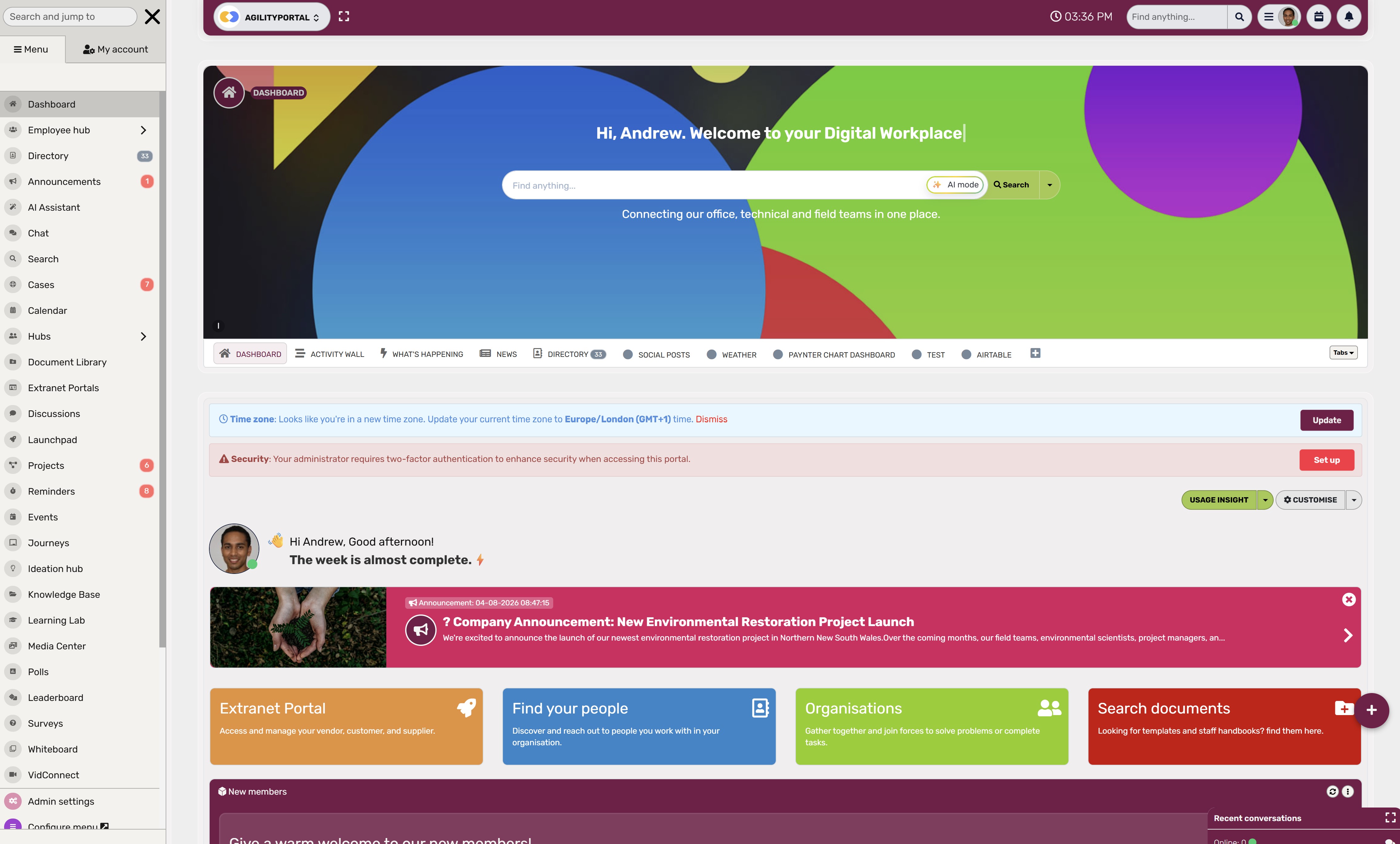
How a Digital Workplace Helps Turn Feedback Into Visible Progress
An employee survey action plan can lose momentum when results, meeting notes, policy changes and progress updates are scattered across emails, spreadsheets, chat messages and separate team meetings.
Employees may be told that action is happening, but still struggle to find the latest update or understand who owns the next step.
This is especially common in organisations with frontline, remote, hybrid or shift-based teams.
Not everyone is in the same meeting, checks email at the same time or has easy access to a desktop computer.
A digital workplace gives organisations one accessible place to turn employee feedback into visible progress.
Publish the findings and action plan in one place
Employees should be able to see the high-level survey findings, agreed priorities and next steps without searching through a long email chain.
The update does not need to include every score or every anonymous comment.
It should clearly explain:
- What employees said.
- What the organisation is prioritising.
- What will happen next.
- Who owns each action.
- When employees can expect another update.
This creates a more transparent employee communication process and gives people confidence that their feedback has not disappeared after the survey closed.
Create a dedicated Space for each priority
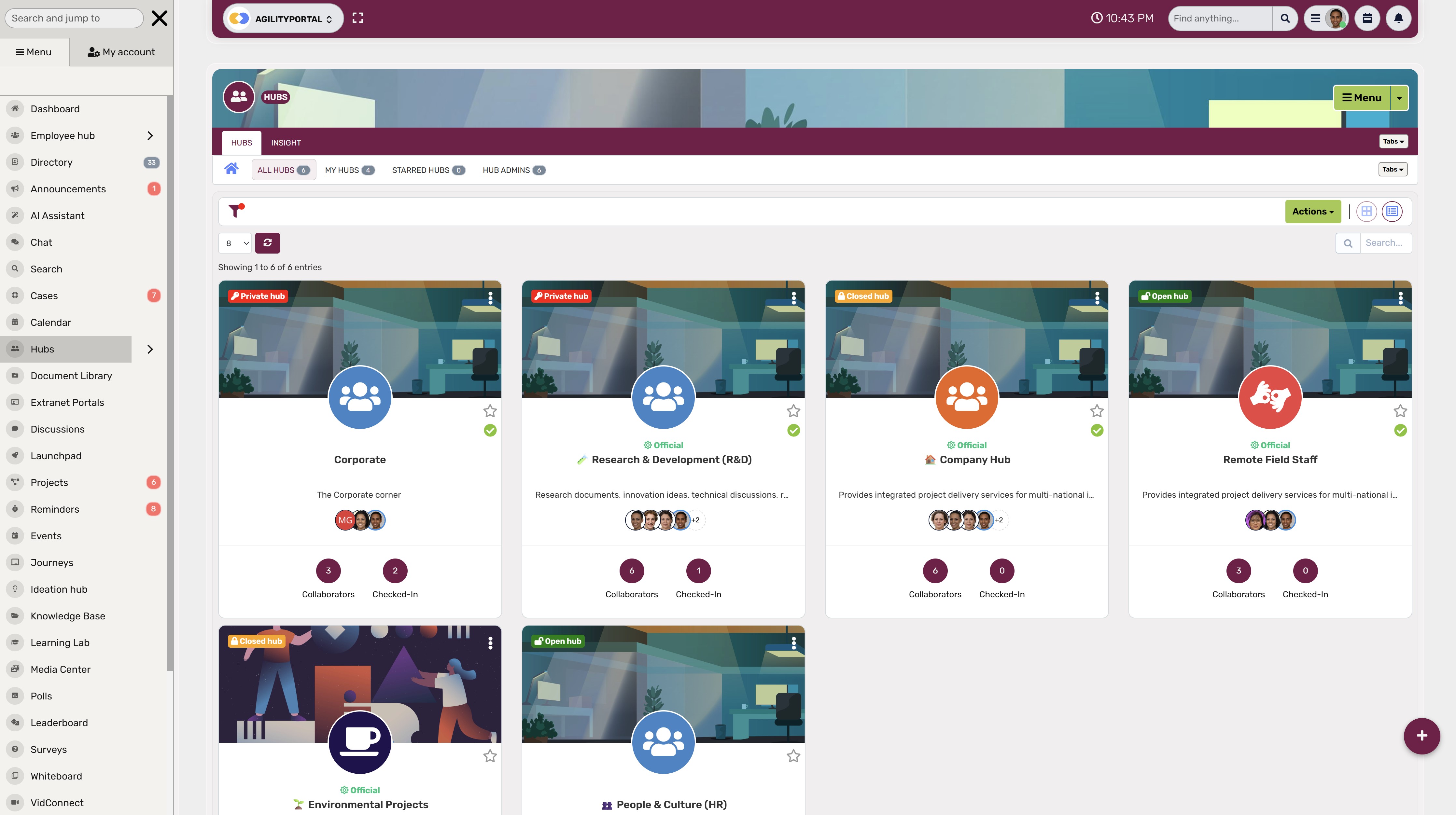
Create a dedicated Space for each priority
For larger actions, it can help to create a dedicated space or page for each priority. For example, an organisation may have separate areas for improving frontline communication, strengthening recognition or simplifying a difficult process.
Each Space can include:
- The problem the business is trying to address.
- The agreed action plan.
- Named owners and contributors.
- Important documents, policies or training resources.
- Key dates and milestones.
- Progress updates.
- A way for employees to ask questions or share further feedback.
This makes accountability easier. Employees can see what has been agreed, while managers have a central place to keep information accurate and current.
Use announcements, chat and reminders to reach more employees
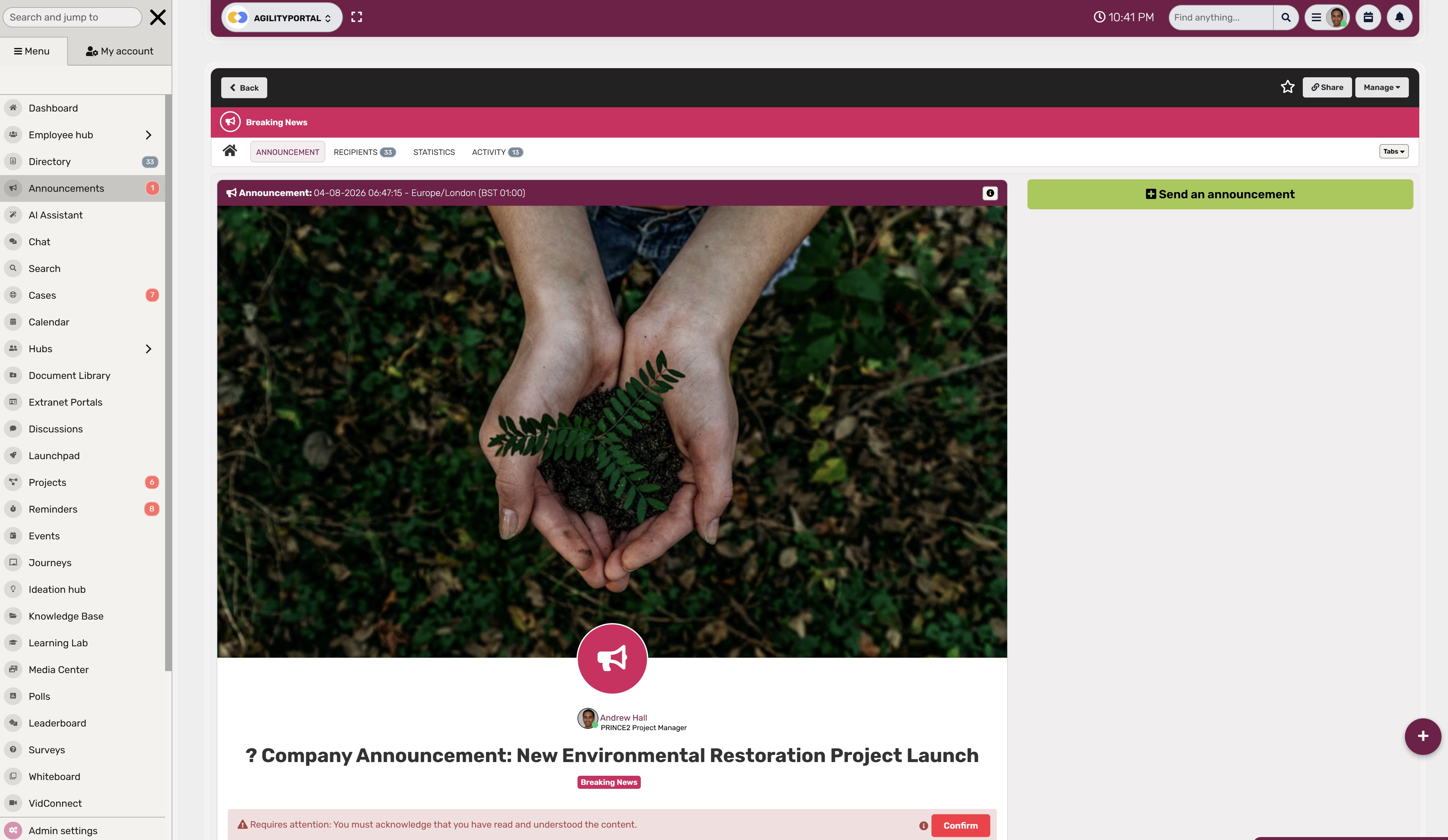
Use announcements, chat and reminders to reach more employees
Publishing an update is only useful if employees actually see it. Announcements, chat messages and reminders can help make sure important action-plan updates reach people working across different locations, shifts and devices.
For example, an operations manager could publish a new process update in the knowledge hub, send an announcement to the affected team and schedule a reminder before the change takes effect.
This is more reliable than relying on one all-company email and hoping everyone has read it.
The message should be short and practical:
"From Monday, the new escalation process will apply to all support requests. The full process is available in the Operations Space. Please review it before your next shift."
Collect acknowledgements for important changes
Some updates need more than a notification. If a survey action leads to a revised policy, new safety procedure or important operational process, organisations may need employees to confirm that they have read and understood it.
Acknowledgements give managers a clearer view of whether information has reached the right people.
They also create a useful record for policies, training and compliance-sensitive changes.
This should be used thoughtfully.
Employees do not need to acknowledge every routine announcement, but they should be able to confirm important updates that affect how they work.
Use pulse surveys to check whether change is helping
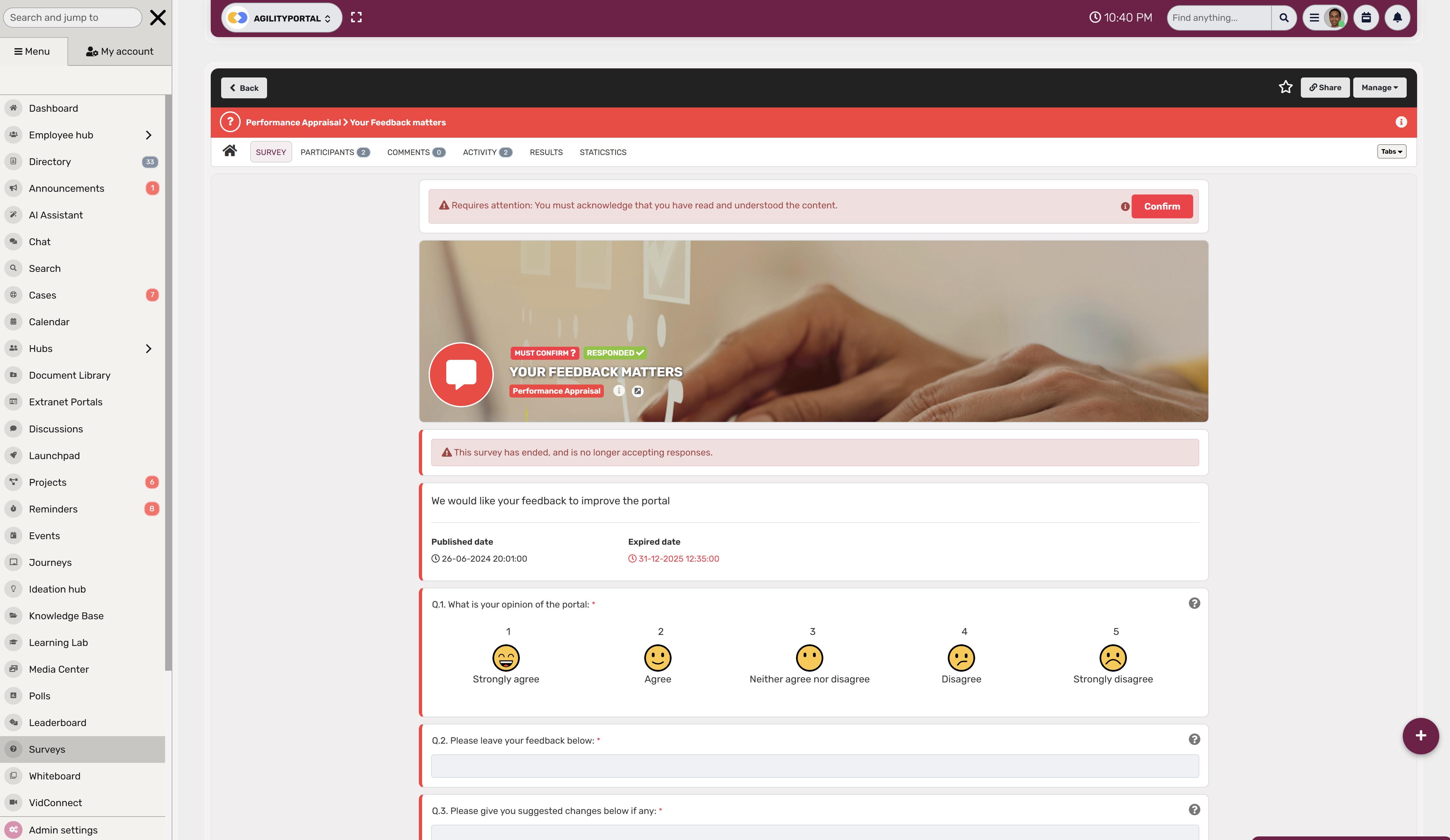
Use pulse surveys to check whether change is helping
A full employee engagement survey may only happen once or twice a year.
A focused pulse survey can help leaders check whether an agreed action is improving employee experience before the next major survey cycle.
For example, after improving internal communication, a short pulse survey could ask:
- "I receive the information I need to do my job effectively."
- "I know where to find the latest process updates."
- "I feel informed about changes that affect my work."
The results should lead to another conversation or adjustment. Pulse surveys should not become constant requests for feedback without visible follow-up.
Give employees a searchable source of truth
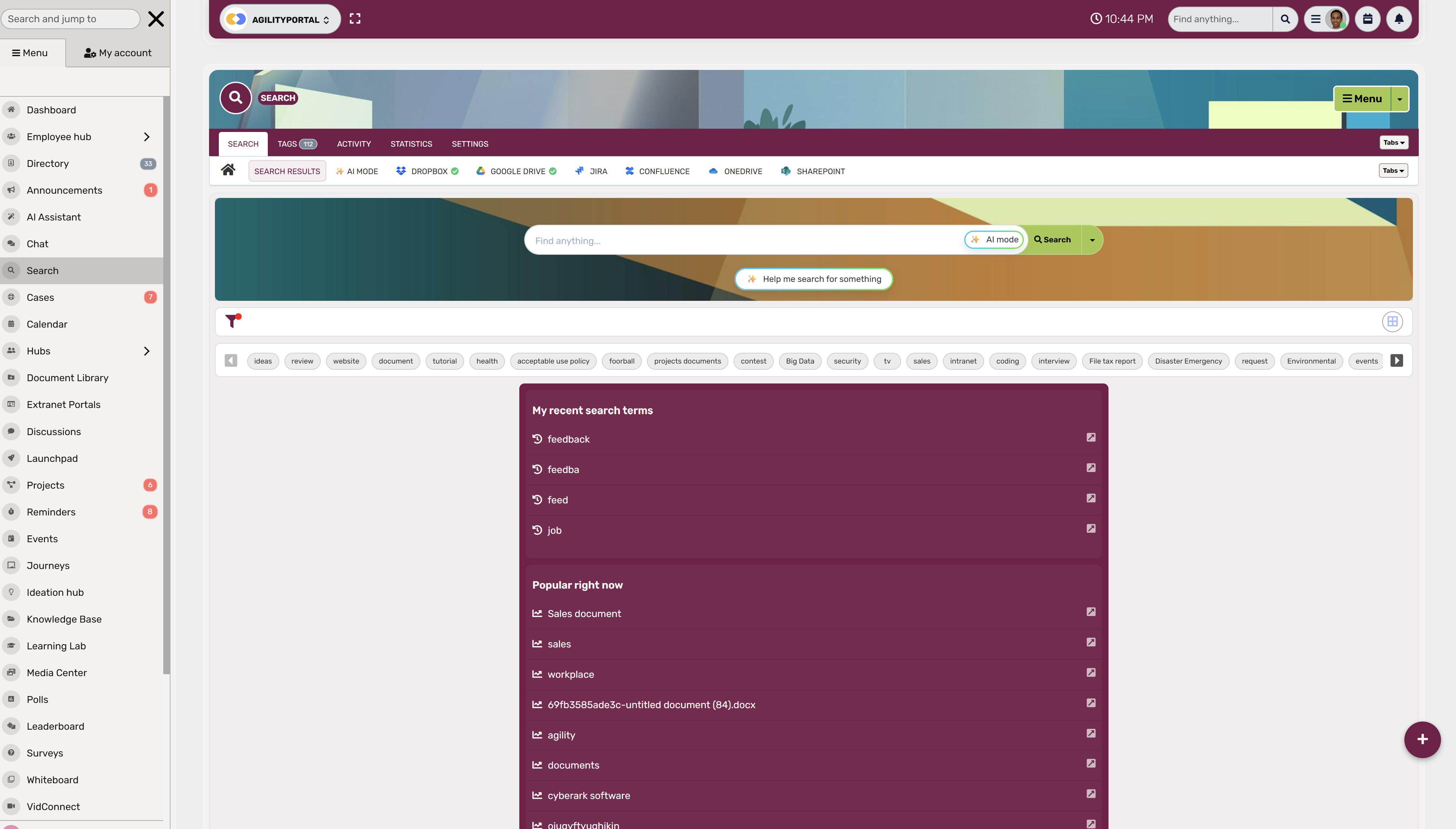
Give employees a searchable source of truth
Employees should not have to rely on memory, old emails or asking the same questions repeatedly.
A searchable knowledge hub gives people a reliable place to find current policies, operational updates, action-plan progress and supporting resources.
That matters because communication is not only about sending information. It is about making sure employees can find and use information when they need it.
For organisations using AgilityPortal, survey follow-up can be supported through Spaces, announcements, polls, forms, knowledge pages, tasks and employee communications.
This helps leaders make progress visible after the survey closes, while giving employees one trusted place to see what has changed because they spoke up.
AgilityPortal
Turn Employee Survey Feedback Into Visible Workplace Progress
AgilityPortal gives HR teams, managers and employees one digital workplace for keeping survey follow-up clear and accessible. Organisations can publish employee engagement survey results, create action-plan Spaces, assign tasks, share policy or process updates, collect acknowledgements and run pulse polls to check whether improvements are helping. Instead of leaving progress spread across emails, chat threads and meeting notes, employees have one trusted place to see what was heard, what is changing and when the next update is due.
Feedback builds trust when employees can see what happens next.
The Future of Employee Listening Is Continuous but Action Still Matters Most
For many organisations, the annual employee engagement survey is no longer the only way to understand how people feel about work. Short pulse surveys, employee forums, manager check-ins, onboarding feedback and exit surveys can give leaders a more current picture of employee experience.
This shift towards continuous employee listening can be useful. It helps organisations spot issues earlier, particularly during periods of change, restructuring, rapid growth or new technology rollouts. Instead of waiting a year to discover that employees are unclear about priorities or struggling with workload, managers can identify themes sooner and make smaller adjustments.
But more frequent feedback does not mean employees need more disruption.
A pulse survey should be short, focused and connected to a clear purpose. If a team has agreed to improve communication, for example, the next survey should ask whether employees now receive the information they need. It should not introduce 30 unrelated questions or reopen every issue from the previous engagement survey.
The best continuous-listening approach follows a simple cycle:
- Listen to employees through a survey, forum, check-in or feedback tool.
- Identify one or two clear themes.
- Agree a practical action with an owner and timeline.
- Share progress openly.
- Use a short pulse survey or team discussion to see whether the change is helping.
- Adjust the approach where needed.
This makes employee listening part of normal management rather than a large annual event that produces a report and then disappears.
Manager capability will become even more important as employee feedback becomes more frequent. Gallup reports that managers account for at least 70% of the variance in team engagement. Gallup That means managers need more than access to survey results. They need the confidence to discuss difficult feedback, protect employee anonymity, choose realistic priorities and communicate openly when an issue needs escalation.
Manager training and support should therefore be part of every employee engagement strategy. A manager who receives a dashboard without guidance may feel pressured to solve problems they do not control. A manager who understands how to lead a follow-up discussion and build a realistic employee survey action plan is far more likely to create trust.
The future of employee listening is not about collecting more data for its own sake. It is about making feedback easier to act on. Employees will continue to share their views when they can see that leaders listen carefully, make practical changes and keep them informed about what happens next.
Frequently Asked Questions About Employee Engagement Survey Results
What should an engagement survey results template include?
An engagement survey results template should make it easy for employees and managers to understand what was heard and what will happen next.
Include the survey participation rate, key strengths, priority areas for improvement, employee comments or themes, agreed actions, named owners, deadlines and a date for the next progress update.
A simple structure is:
| Section | What to include |
| What we heard | The main survey themes and headline results |
| What is working | Strengths the team should protect |
| What we will improve | One to three realistic priorities |
| Action owner | The person accountable for each action |
| Timeline | 30-, 60- and 90-day milestones |
| How we will measure progress | Pulse survey, completion data or employee feedback |
| Next update | A clear date employees can expect to hear more |
How should managers interpret employee engagement survey results?
Managers should look beyond one score and identify the patterns behind the employee engagement survey results.
Start with participation levels, strengths, changes from the previous survey, gaps against company benchmarks and recurring feedback themes.
Then focus on issues the team can genuinely influence, such as communication, recognition, workload, role clarity, access to information or career development.
The goal is not to fix every score. It is to choose a small number of improvements employees will notice.
What should an employee engagement survey results presentation PPT include?
An employee engagement survey results presentation PPT should be clear, honest and brief. Avoid overwhelming employees with every chart or score.
A useful presentation includes:
- Why the survey was run.
- Participation rate.
- What employees said is working well.
- The two or three main themes requiring attention.
- Relevant employee comments or themes, with anonymity protected.
- The actions being taken.
- Who owns each action and when employees will receive an update.
End the presentation with a discussion question, such as: "What would make the biggest difference to this team over the next 90 days?"
How should leaders use Gallup employee engagement survey results?
Gallup employee engagement survey results are most useful when leaders use them to start team conversations, not simply report a score. Gallup's engagement approach focuses on workplace conditions that affect performance, including clear expectations, recognition, development, resources and a connection to purpose. Gallup
Leaders should discuss the results openly, involve employees in choosing priorities and create practical team actions.
Gallup also warns that asking employees for feedback without acting on it can reduce trust in the process. Gallup
Can I download employee engagement survey questions in PDF format?
An employee engagement survey questions PDF can be helpful for planning a survey, manager training or employee communication.
However, the questions should match the organisation's goals and be reviewed for clarity, confidentiality and relevance to the workforce.
Useful topic areas include:
- Communication and access to information.
- Manager support and feedback.
- Recognition.
- Workload and wellbeing.
- Career development.
- Inclusion and belonging.
- Tools, systems and resources.
- Confidence in leadership.
If you create a PDF, include a short explanation of how responses will remain confidential and what employees can expect after the survey closes.
What is the Gallup Q12 employee engagement survey?
The Gallup Q12 employee engagement survey is a research-based survey that measures 12 workplace conditions linked to engagement.
Its themes include clear expectations, access to the right materials and equipment, recognition, development, feeling heard and connection to the organisation's purpose.
The exact Q12 questions are proprietary to Gallup and should not be copied or reproduced without permission. Organisations can instead use original questions that explore similar workplace themes or work directly with Gallup. Gallup's Q12 overview
What are good employee engagement survey questions and answers?
Good employee engagement survey questions and answers should be simple, neutral and actionable.
Avoid vague wording or questions that combine two separate issues.
Examples include:
| Survey question | What a low score may suggest |
| "I know what is expected of me at work." | Unclear priorities, inconsistent communication or role confusion |
| "I receive the information I need to do my job well." | Updates may be late, fragmented or difficult to find |
| "Good work is recognised in my team." | Recognition may be inconsistent or not meaningful |
| "I have opportunities to learn and grow here." | Employees may need clearer development conversations or training access |
| "I feel comfortable sharing ideas or concerns." | Psychological safety or trust in leadership may need attention |
The answer options should usually use a consistent scale, such as strongly disagree to strongly agree, alongside an optional open comment field.
What should businesses look for in employee engagement survey vendors?
When comparing employee engagement survey vendors, look beyond the survey questions and dashboards. The strongest option should help the business take action after results are collected.
Consider whether the vendor provides:
- Anonymous and confidential response options.
- Mobile access for frontline and deskless employees.
- Reporting by team, role or location while protecting anonymity.
- Benchmarking where relevant.
- Pulse surveys for follow-up measurement.
- Manager guidance and action-planning tools.
- Clear data-security and privacy controls.
- Integrations with HR systems, employee communication tools or a digital workplace.
- Accessible reporting that employees and managers can understand.
The best vendor is not necessarily the one with the most features.
It is the one that helps your organisation collect credible feedback, turn it into a practical employee survey action plan and keep employees updated on progress.
AI Summary
- Taking action on engagement survey results is what turns employee feedback into meaningful change. A survey alone will not build trust unless employees can see a clear response afterwards.
- Managers should focus on one to three practical priorities rather than trying to fix every score. The best actions are important to employees, within the organisation’s influence and realistic to deliver.
- Employee engagement survey results should be discussed as patterns, not used to identify individual respondents. Protecting anonymity and psychological safety helps employees feel safe to give honest feedback.
- A credible employee survey action plan names the problem, action owner, deadline, success measure and next update. Employees need to know what will change and when they will hear more.
- Some concerns, including pay, staffing, benefits, technology and company-wide policies, may be bigger than one manager. Escalating these issues clearly and providing updates is still meaningful action.
- A digital workplace helps keep action plans, progress updates, policy changes and pulse feedback accessible to frontline, remote and shift-based employees after the survey closes.
Most Popular Posts

Effective communication among team members is vital for the productivity and success of any organization. Surprisingly, 60% of companies lack a long-term internal communication strategy, which p...


Businesses thrive on communication for efficiency, productivity and accomplishment. When the right information is passed from the right designation in the organization, it promotes positivity an...

Categories
Blog
(3228)
Business Management
(396)
Employee Engagement
(235)
Digital Transformation
(220)
Growth
(151)
Intranets
(142)
Internal communications
(110)
Remote Work
(68)
Sales
(53)
Collaboration
(53)
Customer Experience
(33)
Culture
(30)
Knowledge Management
(29)
Project management
(29)
Leadership
(20)
Comparisons
(9)
News
(1)

Related Posts

Have you ever welcomed a new employee, shared a mountain of information, and wondered how much they'll remember by tomorrow? A clear presentation can make the first day easier by showing new starters who to contact, where to find key informatio...

What would your leadership team do if a serious allegation about your business started spreading online before anyone knew whether it was true? That's where crisis communication and management really matter. An employee spots the post, screensh...

AI for personal injury law firms is becoming part of everyday casework. These tools can help teams sort through medical records, build timelines, draft demand packages and find details buried in a big case file. That could free up attorneys and...

Ever left an online meeting unsure what was decided—and wondered how to run an effective meeting without wasting everyone's time? A call can bring a distributed team together quickly, but when it starts late, includes people who don't know why ...

Where can I send a fax from in my area when a document needs to go out today? The answer might be a nearby print or shipping shop, a library or an online fax service, but what's available depends on your location. The UPS Store lists a ne...


Jill Romford
I am a digital nomad, lover of exploring new places and making friends.
I love to travel and I love the internet. I take pictures of my travels and share them on the internet using Instagram.
Traveler, entrepreneur, and community builder. I share my insights on digital marketing and social media while inspiring you to live your fullest life.
Ready to learn more? 👍
One platform to optimize, manage and track all of your teams. Your new digital workplace is a click away. 🚀
Free for 14 days, no credit card required.