
Insight Blog
Agility’s perspectives on transforming the employee's experience throughout remote transformation using connected enterprise tools.
56 minutes reading time
(11201 words)
In-House Marketing Agency vs Remote Marketer: Which Could Cost You More?

In-House Marketing Agency vs Remote Marketer: Which Could Cost You More?
Compare in-house marketing agency vs agency vs a remote marketer. Explore hidden costs, skills and management demands before choosing your marketing setup.
In-House Marketing Agency vs Remote Marketer: Which Could Cost You More?

Could your next marketing hire cost you more than the results they deliver?
If you're weighing up in-house marketing vs agency support—or considering a dedicated remote marketer—the hardest part is knowing what your money will actually buy.
You need someone who understands your business, delivers good work and helps you grow.
But comparing a salary with an agency retainer or a remote marketer's monthly fee can hide the costs that matter most.
Budget pressure makes that decision even more important. Gartner's 2026 CMO Spend Survey found that 56% of surveyed chief marketing officers said they lacked the budget to deliver their strategy.
The survey largely represented businesses with annual revenues above $1 billion, so it provides context rather than a small-business spending benchmark.
56 percent
of surveyed CMOs said their marketing organisation lacked the budget
needed to deliver its 2026 strategy
Before choosing an in-house marketer, marketing agency or dedicated remote professional, compare the full cost of delivering your brief. Include tools, specialist support and internal management time alongside the headline fee.
Research context. Gartner surveyed 401 CMOs and other marketing leaders between January and March 2026 across North America, the UK and Europe. The vast majority represented businesses with annual revenue above $1 billion. This is large-company context, not a small-business budget benchmark.
For a business owner or marketing manager, the practical problems can look familiar:
- Unexpected costs: Software, recruitment, specialist support and extra deliverables stretch the original budget.
- Missing skills: One marketer cannot necessarily handle strategy, SEO, design, content and paid advertising equally well.
- More management work: Briefing, reviewing and chasing updates take time away from running your business.
- Unclear accountability: Work gets completed, but nobody can explain how it supports your commercial goals.
There's also a distinction worth making upfront: a remote marketing agency can be an in-house employee.
In this article, "dedicated remote marketer" means an externally supplied professional assigned to your business.
This guide will help you compare all three options on the work you need delivered, the full cost and the management involved.
You'll explore their strengths, hidden expenses and practical use cases, so you can choose a setup that fits your business before committing your budget.
Why Is Choosing Marketing Agency Support More Complicated Than Comparing Prices?

Why Is Choosing Marketing Agency Support More Complicated Than Comparing Prices
Imagine you've decided your business needs more marketing support. You speak to a recruiter, request an agency proposal and explore hiring a dedicated remote marketer.
Each option sounds convincing.
An in-house marketer promises focus and a deeper understanding of your business. An marketing agency offers access to several specialists. A dedicated remote marketer offers ongoing support without recruiting locally.
But are you comparing the same amount of work, the same skills and the same level of responsibility?
A marketer's salary buys their working time and expertise. An agency retainer buys an agreed service, with limits on what's included. A dedicated remote marketer's fee buys a particular person's capacity, potentially with support from their provider.
That creates three competing arguments:
- "Hire in-house—you need someone who knows your business." That knowledge matters, but you still need to cover any skills they lack.
- "Choose an agency—you get a team instead of one person." Access to specialists can help, but check how much of their time your agreement actually includes.
- "Hire a remote marketer—you get dedicated support at a manageable cost." That can work well, provided their skills fit the job and someone can manage their priorities.
The question is whether the arrangement gives you enough of the right expertise to deliver your priorities—and what it costs once you include everything needed to make it work.
That's the argument this comparison will examine: which setup gives your business the capacity, ownership and results it needs at a cost you can sustain?
Start by understanding what each option actually provides.
In-House Marketing Agency vs Remote Marketer: What's the Difference?
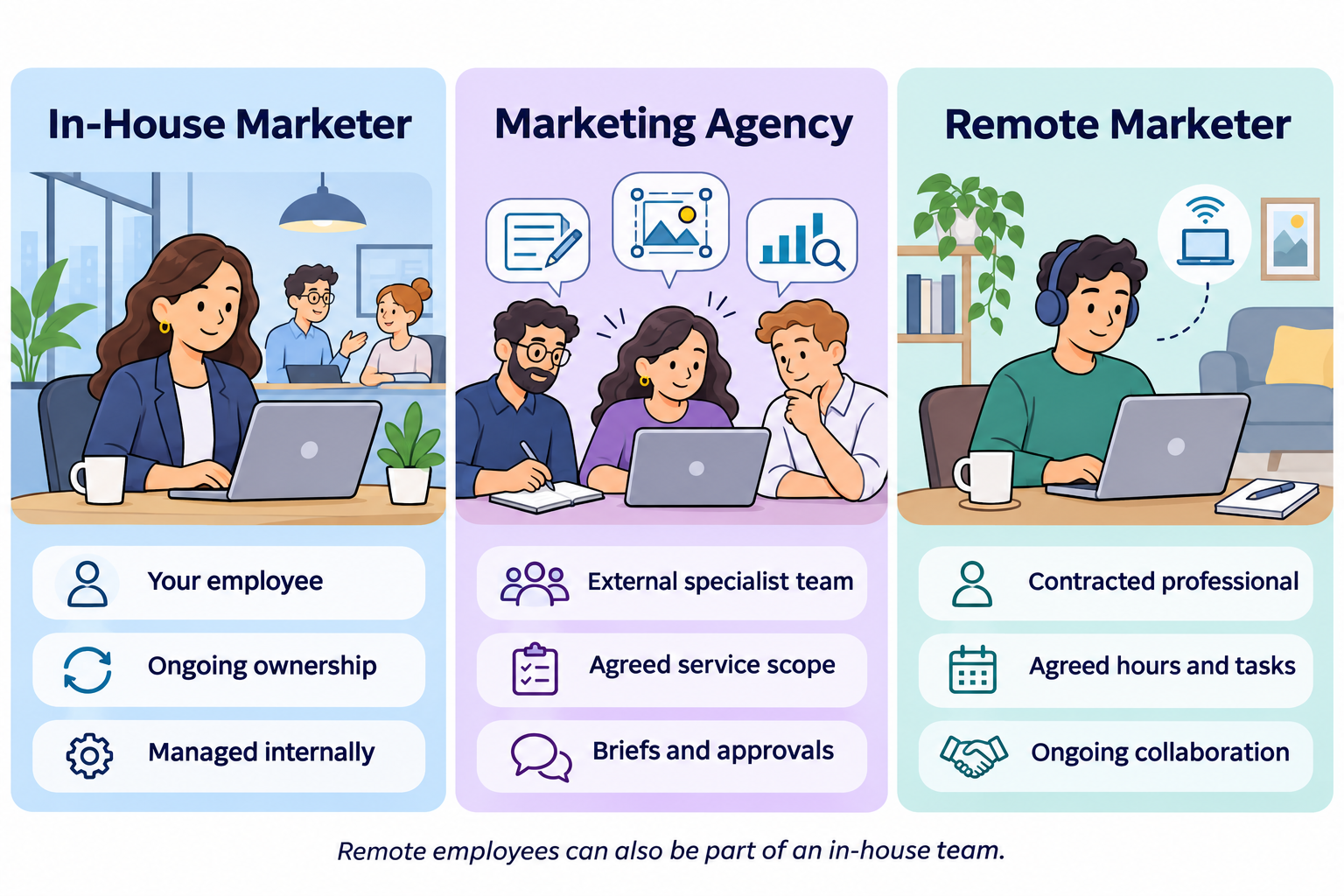
The main difference is who employs the marketer, how you access their skills and who manages their work.
An in-house marketer is employed directly by your business and forms part of your internal marketing team.
A marketing agency provides agreed services through an external team, while a dedicated remote marketer contributes ongoing support for defined hours or responsibilities.
These categories can overlap: a remote marketer can also be your employee. For this comparison, "dedicated remote marketer" means an externally contracted or supplied professional assigned to your business.
Before comparing costs, clarify the scope, available capacity and management responsibilities.
Consider which work needs internal ownership and which needs specialist support, then establish how you will coordinate documents and updates with external partners.
In-House Marketing Agency vs Remote Marketer: What's the Difference?
What Is an In-House Marketer?
An in-house marketer is an employee who manages marketing activities within your business.
Depending on their experience and responsibilities, they might plan campaigns, develop your content marketing strategy, manage email marketing or coordinate external specialists.
Working closely with sales, customer service and leadership helps them understand your customers, products and priorities. That knowledge can make everyday decisions and approvals easier, particularly when creating content that demonstrates your expertise.
However, hiring one marketer does not give you every marketing skill. A strong content marketer may still need support with technical SEO, graphic design or paid advertising.
When building your marketing team, identify those gaps and budget for the additional support needed.
What Does a Marketing Agency Provide?
A marketing agency is an external business that provides marketing services under an agreed contract or scope of work.
Those services might include strategy, SEO, content creation, social media, paid advertising, email campaigns or website development.
A marketing agency can give you access to several specialists without employing each person directly. This can suit businesses that need expertise across different channels or additional capacity for a particular project.
The important detail is what your agreement includes.
A full-service marketing agency may offer many services, but your retainer could cover only a small selection. Confirm the deliverables, people involved, reporting arrangements and additional charges before signing.
You will also need someone inside your business to explain priorities, provide information and approve the agency's work.
What Is a Dedicated Remote Marketer?
A dedicated remote marketer is a marketing professional who supports your business from another location, usually for agreed working hours or a defined allocation of time.
They could be a direct employee, an independent contractor or a professional supplied through a staffing provider. Their responsibilities might include content production that demonstrates your expertise, email campaigns, social media management or marketing coordination.
For this comparison, "dedicated remote marketer" means an externally contracted or supplied professional assigned to support your business. A remote employee on your payroll belongs within the in-house category, even if they never visit your office.
Check what "dedicated" means in practice: whether the person works exclusively for you, how many hours are included and who provides supervision or absence cover.
Agree how you will coordinate work with external partners, including access to briefs, campaign documents and progress updates.
Marketing Agency vs In-House Marketer vs Dedicated Remote Marketer
| Comparison area | In-house marketer | Marketing agency | Dedicated remote marketer |
| Working arrangement | Employee within your business | External company providing agreed marketing services | Externally contracted or supplied professional working remotely |
| Skills available | The employee's expertise, supported by colleagues or specialists where needed | Access to specialists included in your contract | The individual's expertise, plus any support included by their provider |
| Typical responsibilities | Ongoing marketing activity, internal coordination and brand ownership | Defined services such as SEO, paid advertising, content or campaign delivery | Agreed recurring tasks or ownership of a specific marketing function |
| Day-to-day management | Your business sets priorities and manages performance | Your internal contact briefs the agency and reviews delivery | Your business, the provider or both manage priorities |
| Capacity included | Contracted working hours, allowing for leave and other responsibilities | Deliverables, hours or resources specified in the agreement | Agreed hours and allocation; exclusivity must be confirmed |
| Business knowledge | Builds through involvement with your teams and customers | Develops through onboarding, access and ongoing collaboration | Develops through onboarding and integration with your team |
| Costs to compare | Salary, employer costs, recruitment, tools and additional support | Agency fees, onboarding, extra work and internal review time | Pay or provider fees, tools, supervision and additional support |
| Continuity to check | Cover during leave, absence or recruitment | Account-team stability, handovers and replacement arrangements | Absence cover and replacement support under the agreement |
| Potential fit | Consistent work requiring close internal involvement | Work needing several specialist skills or flexible external capacity | A defined ongoing workload suited to one person's capabilities |
Before choosing a marketing agency or hiring a marketer, write down the work you need completed each month.
Comparing each option against that same brief will reveal whether you're buying enough capacity—and where additional costs could appear.
Which Marketing Setup Fits Your Business? A Quick Comparison
Do you need someone to own marketing every day, a team of specialists to deliver campaigns, or a dedicated professional to handle a defined workload?
The right setup depends on the work you need, the expertise it requires and how much management you can provide.
When comparing in-house marketing vs agency support, start with those requirements before looking at prices.
Agency marketing services can suit businesses that need several specialist skills within an agreed scope. An in-house marketer can provide ongoing ownership and close collaboration with your teams.
A dedicated remote marketer can support recurring work, provided their skills and availability match your needs.

Which Marketing Setup Fits Your Business? A Quick Comparison
In-House Marketing vs Agency vs Remote Marketer at a Glance
| Comparison area | In-house marketer | Marketing agency | Dedicated remote marketer |
| Typical arrangement | Employee hired directly by your business | External service provider working to an agreed contract | Externally contracted or supplied professional assigned to your business |
| Skills available | The individual's expertise, plus colleagues or additional specialists | Specialists included in your agency marketing agreement | The individual's expertise and any provider support included |
| Day-to-day management | Your business sets priorities, reviews work and manages performance | Your business provides briefs, approvals and feedback; the agency manages its delivery team | Your business, the provider or both manage the work, depending on the agreement |
| Business knowledge | Builds through regular involvement with customers and internal teams | Depends on onboarding, access to information and account-team continuity | Depends on onboarding, team integration and time spent supporting your business |
| Content planning and production | Can connect content closely to internal expertise, with extra production support where needed | Can combine strategy, writing, design and distribution if these services are included | Can provide consistent content delivery within the professional's skills and agreed capacity |
| Capacity | Limited by working hours, competing priorities and leave | Limited by the agreed scope, deliverables and allocated resources | Limited by contracted hours, workload and any shared commitments |
| Costs to check | Salary, employer costs, recruitment, software and specialist support | Retainer or project fees, extra deliverables, production costs and internal oversight | Pay or provider fees, software, supervision, specialist support and absence cover |
| Potential fit | Steady work requiring close internal involvement | Campaigns or projects requiring a mix of specialist skills | A clearly defined, ongoing workload suited to one professional |
How Does Content Affect Your Choice?
Think about the role of content in marketing for your business.
Do you need someone to interview customers and capture internal expertise, or do you already have ideas that need turning into articles, emails and campaigns?
An in-house marketer may find it easier to gather information through everyday conversations. A marketing agency may offer writers, designers and distribution specialists within one agreement.
A dedicated remote marketer can maintain a publishing schedule when they have clear briefs and access to the right people.
Check who will supply the ideas, create the content, approve it and measure its performance. Those responsibilities affect both the cost and the time your team needs to contribute.
Which Option Should You Shortlist?
- Consider an in-house marketer when you have a sustained workload, need close internal coordination and can support the employee's development.
- Consider a marketing agency when you need several specialist skills, a defined campaign or additional delivery capacity.
- Consider a dedicated remote marketer when you have recurring tasks, clear priorities and a workload that fits one person's expertise.
For an agency vs remote marketer comparison, ask whether you need access to several disciplines or consistent capacity from one professional.
Neither arrangement guarantees better value: the answer depends on what is included and how well it matches your workload.
Before requesting quotes, write a short monthly brief covering deliverables, skills, deadlines and responsibilities. That gives you a fair basis for comparing all three options.
What Does Each Marketing Option Really Cost?
The real cost of marketing support is the amount you spend to get the agreed work delivered—not simply the salary or monthly fee.
In-house marketing costs, marketing agency costs and remote marketer fees can include very different levels of service.
Before comparing proposals, ask each candidate or provider to price the same workload.
Then identify what your business must supply, manage or purchase separately.

What Does Each Marketing Option Really Cost
In-House Marketing Costs Beyond the Salary
A salary is the starting point for employing a marketer.
To understand the full commitment, account for the resources they need to do their job and the support required when their expertise falls short.
Your cost comparison should include:
- Recruitment and onboarding: Advertising the vacancy, recruiter fees where applicable, interviews and time spent introducing the employee to your business.
- Employer costs and benefits: Relevant employer contributions, pension costs and benefits for the country where you employ them.
- Software and equipment: A computer, design tools, email platforms, analytics access and other necessary subscriptions.
- Training and development: Courses, mentoring and time to develop skills.
- Management time: Setting priorities, reviewing performance and approving work.
- Specialist support: External help with areas such as technical SEO, video production, web development or advertising.
- Absence and replacement cover: How essential work will continue during leave, illness or a vacancy.
For example, hiring a content marketer may improve your publishing schedule while leaving technical website issues unresolved.
If you also need a search optimisation agency, include that support in your in-house marketing budget.
A capable employee can still need specialist help. Build the role around a realistic workload rather than assuming one salary covers every marketing discipline.
Marketing Agency Costs Beyond the Retainer
A marketing agency retainer pays for an agreed service.
What matters is the scope behind the number: the deliverables, expertise, working time and responsibilities included.
Check the proposal for:
- Setup and onboarding fees: Initial research, account audits, tracking setup and campaign planning.
- Deliverable limits: The number of articles, campaigns, designs, landing pages or other outputs included.
- Revision allowances: How many review rounds are covered and what further changes cost.
- Production charges: Photography, filming, editing, illustration or development.
- Reporting and account management: Whether dashboards, analysis and review meetings are included.
- Work outside the scope: Additional channels, urgent requests or changes to the original brief.
- Third-party expenses: Software, stock assets, media placements and other purchases.
If you're comparing an advertising agency or ad agency, ask whether the quoted fee covers campaign management only or also includes creative production, landing pages and measurement. Confirm whether advertising spend is separate.
When comparing SEO optimization companies, request a breakdown of technical work, content creation, implementation and reporting. An audit that identifies problems and a service that fixes those problems are different purchases.
Searching for a "marketing agency near me" can help you find providers available for face-to-face collaboration. However, proximity alone does not establish value. Compare relevant experience, scope, communication and total costs alongside location.
When reviewing a full-stack marketing agency's service page, such as CNV Creative's, distinguish the services listed from those included in a specific proposal. Confirm deliverables, exclusions and additional charges before comparing costs.
Dedicated Remote Marketer Costs Beyond the Monthly Fee
Lets look at a dedicated remote marketer's cost depends on whether you contract directly with the professional or use a provider.
Confirm what the fee includes, how much capacity you receive and who manages delivery.
Account for:
- Recruitment or provider fees: Placement charges, setup fees and any ongoing service margin.
- Onboarding: Training on your products, customers, systems and brand.
- Software and equipment: Which tools you provide and which the professional or provider supplies.
- Supervision: Briefing, prioritisation, feedback and quality checks.
- Time-zone coordination: Whether working hours overlap sufficiently for approvals and collaboration.
- Specialist support: Additional expertise beyond the marketer's individual capabilities.
- Absence cover: Whether a replacement is available and how handovers work.
- Payment arrangements: Any applicable currency conversion or payment-processing charges.
For instance, a remote marketer might handle email campaigns, social publishing and content coordination while an advertising agency manages paid campaigns. Both fees belong in your total outsourced marketing costs, along with the time needed to coordinate work with external partners.
Ask what "dedicated" means in the contract. Confirm allocated hours, exclusivity, availability and whether provider support includes active supervision or recruitment assistance only.
Which Campaign Costs Apply Whichever Model You Choose?
Some marketing expenses relate to running campaigns rather than employing a marketer or hiring an agency.
They may apply under any setup, although a particular agreement could already include them.
|
|
|
|||
| Advertising spend | Budget paid to advertising platforms or publishers | Separate media spend from advertising agency management fees | |||
| Creative production | Photography, video, graphics and copywriting | Check which assets the employee or provider will produce within their existing allocation | |||
| Landing pages and development | Design, building, hosting and maintenance | Confirm whether your agency scope or existing web budget covers the work | |||
| Marketing software | Email, CRM, analytics, scheduling and testing tools | Check existing subscriptions and which licences the provider supplies | |||
| Content resources | Research, interviews, specialist writing and asset licences | Identify what is included in content delivery and what requires additional payment | |||
| Measurement and reporting | Tracking configuration, dashboards and analysis | Distinguish initial setup from ongoing reporting already covered by the fee |
A fair comparison should show the staffing or service cost, the additional support required and the campaign budget separately.
Before committing, ask every provider the same question: "What else will we need to pay for to deliver this brief?" Their answer will make your comparison more useful than a headline monthly price.
How Do You Compare Marketing Costs Fairly?
A fair in-house vs agency cost comparison starts with the same workload, quality expectations and time period.
Comparing an employee's salary with an agency retainer tells you little unless both options can deliver what your business needs.
Follow these four steps to build a marketing budget that reflects the full cost of delivery.
Start With the Work You Actually Need
Write a monthly brief before requesting quotes or advertising a role. Specify the quantity of work, its complexity and who supplies the information.
For example, your brief might include:
| Monthly requirement | Scope to compare |
| Two email campaigns | Copywriting, template-based design, audience selection, testing and scheduling |
| Four blog articles | Approximately 1,000 words each, including research, editing and uploading |
| Paid campaign management | One advertising platform, an agreed campaign structure and weekly optimisation |
| Monthly reporting | A performance report, recommendations and one review meeting |
Also record assumptions.
Are interviews needed for each article?
Are advertising assets supplied?
Does the website already have suitable landing pages and conversion tracking?
The more clearly you define the work, the easier it becomes to identify gaps in a quote or job description.
Compare the Skills and Capacity Included
Ask each candidate or provider how they would deliver the brief.
Check the people involved, their relevant experience and the capacity allocated to your business.
An in-house marketer might handle content and email but need paid advertising support. An agency might cover every discipline while limiting article production or revisions.
A dedicated remote marketer might have the right skills but insufficient contracted hours.
For each option, establish:
- What is included: Deliverables, responsibilities and working capacity.
- What needs extra support: Specialist work, production or technical implementation.
- What your team must provide: Research, subject expertise, assets and approvals.
- What happens when demand increases: Extra fees, longer timelines or additional recruitment.
If an option cannot meet the brief, add the cost of the missing support before comparing totals.
Add Internal Management and Review Time
Marketing outsourcing costs include the time your business spends making the arrangement work.
Estimate the hours needed for briefing, meetings, approvals, fact-checking, coordination and correcting work. Apply the same approach to managing an employee.
For planning purposes:
Annual internal oversight cost = monthly oversight hours × internal hourly cost × 12
For example, eight hours a month at an assumed internal cost of £50 an hour equals £4,800 a year.
This represents staff time allocated to marketing oversight. It may be an existing payroll cost rather than an additional cash payment, so show it separately when assessing affordability.
Calculate the Total Cost Over 12 Months
Use this formula for each option:
Total annual cost = setup + annual staffing or service fees + tools + additional support + internal oversight + agreed campaign expenses
For an employee, include relevant employer costs and benefits within staffing costs. For external providers, identify any setup charges and services outside the main fee.
Illustrative Example: Comparing the Same Marketing Brief:The following figures are hypothetical UK planning assumptions in GBP, not market averages, salary benchmarks or supplier quotes. They illustrate a 12-month comparison for the monthly brief above.
The example assumes a mid-level in-house generalist, an agency team and an externally supplied remote marketer with sufficient capacity. Missing specialist support is budgeted separately.
Figures exclude VAT, and actual tax treatment and costs will vary.
| Annual cost item | In-house marketer | Marketing agency | Dedicated remote marketer |
| Recruitment or setup | £3,000 | £2,000 | £1,000 |
| Staffing or service fees | £48,000 | £42,000 | £30,000 |
| Employer costs and benefits | £9,000 | Included in provider fee | Included in provider fee |
| Additional tools | £2,400 | £1,200 | £2,400 |
| Additional specialist support | £6,000 | £0 assumed | £6,000 |
| Internal oversight | £3,600 | £4,800 | £7,200 |
| Advertising spend | £12,000 | £12,000 | £12,000 |
| Total illustrative annual cost | £84,000 | £62,000 | £70,600 |
Assumptions behind the comparison:
- In-house staffing assumes a £48,000 salary, with a separate illustrative allowance for employer costs and benefits.
- Agency services assume £3,500 a month; remote support assumes a provider fee of £2,500 a month.
- Additional specialist support is assumed to cost £500 a month where required.
- Internal oversight assumes six, eight and twelve hours a month respectively, valued at £50 an hour. These are example inputs, not typical management requirements.
- Advertising spend is £1,000 a month for every option and is separate from management fees.
- The agency fee is assumed to cover the full delivery brief. Any exclusions would need adding.
- Tools already included in provider fees are not counted again.
In this example, the remote marketer has the lowest headline service fee, while the agency has the lowest total modelled cost. Different quotes, skills or management requirements could reverse that result.
Use your own figures to make the decision.
Compare delivery capability alongside the total: a lower annual cost only represents value if the arrangement can produce the work your business needs.
When Should You Hire an In-House Marketer?
Hiring an in-house marketer makes sense when you have consistent work, need close involvement with your business and can support the person doing the job.
The role should solve a clear capacity or skills problem, with enough ongoing responsibility to justify the full employment cost.
Ask yourself: what would this person own each week, and who would help them succeed?
You Have Enough Consistent Work to Support the Role
n in-house marketer can suit a business with recurring campaigns, customer communications, content requirements and sales support needs.
Before recruiting, map out a typical month. Separate essential work from occasional projects, then check whether the responsibilities fit a realistic working week.
A backlog of unfinished ideas does not necessarily amount to a well-defined job.
If demand is irregular or concentrated in one specialist project, external support may fit better.
Your Marketing Depends on Daily Business Knowledge
Some marketing work requires frequent conversations with sales, product teams, customer service and leadership.
An in-house marketer can build that understanding through regular involvement. They can turn customer questions into content, adjust messaging after sales feedback and coordinate campaigns around operational changes.
This is particularly useful when approvals depend on detailed product knowledge or several internal stakeholders.
However, the employee still needs access to those people and time to gather information.
Someone Can Manage and Develop the Employee
Hiring an in-house marketer creates a management responsibility. Someone must agree priorities, provide feedback, remove obstacles and assess performance.
If your first hire is relatively junior, consider who will guide their strategy and development. Expecting them to decide the entire marketing direction while learning the job can leave both sides frustrated.
Match the seniority of the hire to the responsibility you need them to carry.
A business without marketing leadership may need an experienced lead before adding execution capacity.
Your Budget Covers the Role and Its Skills Gaps
An in-house marketing team needs tools, training and, sometimes, external specialists. Include those costs before committing to a salary.
One generalist may be strong at content marketing strategy and email marketing but need help with design, technical SEO or paid media. Another may excel at campaign planning while relying on others for production.
Do not build a job description that expects one person to perform every discipline equally well.
When building your marketing team, identify the essential skills, decide what can be developed and budget for the work that needs specialist support.
Hiring internally is worth considering when you can clearly define the role, keep the person productively occupied and provide the management and resources they need.
54 percent
of B2B marketers surveyed cited a lack of resources as a challenge
outside content creation
Check whether your marketing plan has enough time, people and specialist support behind it. Adding an in-house marketer or outsourced marketing services only helps if the arrangement addresses the resources your workload actually needs.
Research context. This finding comes from Content Marketing Institute and MarketingProfs’ B2B research for the 2025 outlook, published in October 2024. It describes respondents’ reported challenges and does not establish which staffing model performs best.
Source · CMI and MarketingProfs, B2B Content Marketing: Outlook for 2025
When Should You Hire a Marketing Agency?
Hiring a marketing agency makes sense when you need specialist expertise or additional capacity within a clearly defined scope.
Outsourced marketing services can help you deliver work that would otherwise require several hires or skills you only need occasionally.
The arrangement works best when your business knows what it wants to achieve and appoints someone to manage the relationship.
Your Project Needs Several Specialist Skills
A website launch, campaign or market expansion may need research, copywriting, design, development, advertising and measurement.
A marketing agency can bring those disciplines together, provided they are included in your agreement. This can reduce the work involved in sourcing and coordinating separate suppliers.
Before signing, ask which skills are available to your account and who will manage the handovers between specialists.
A broad service list does not establish what your particular contract covers.
You Need Expertise That Does Not Justify a Permanent Hire
You may need a technical SEO audit, paid advertising support or marketing automation setup without having enough work for a full-time specialist.
Outsourced marketing services let you purchase an agreed level of support for that requirement.
Compare the proposed scope with the work you actually need, including implementation and follow-up.
For example, if an agency will identify website problems, establish who will fix them and whether that work is included.
Your Campaign Demand Changes Throughout the Year
An agency can provide additional capacity around launches, seasonal campaigns or other busy periods.
Check how that flexibility works in practice. Ask about notice periods, minimum commitments, availability and the cost of increasing or reducing the scope.
Do not assume an agency can absorb extra work immediately.
Agree how changes will be requested, priced and scheduled before demand increases.
You Have an Internal Owner Who Can Brief and Approve Work
Hiring a marketing agency does not remove your business from the process. The agency needs accurate information, clear priorities and timely decisions.
Appoint an internal contact who can coordinate feedback, approve deliverables and explain changes in the business.
Without that ownership, work can stall or move forward on incomplete assumptions.
Before choosing a provider, confirm these responsibilities:
| What to check | Questions to ask the marketing agency |
| Delivery team | Who will do the work, what is their relevant experience, and will subcontractors be involved? |
| Service limits | Which deliverables, channels, revisions and working capacity are included? |
| Additional charges | What costs extra, and how will changes receive approval? |
| Reporting | Who prepares the reports, what will they measure, and who explains the findings? |
| Internal input | What information, access, assets and approval time must our team provide? |
| Continuity | What happens if the account manager or a key specialist changes? |
Choose an agency when its expertise, capacity and working arrangements fit your brief—and your business can provide the input needed to keep delivery moving.
When Does a Dedicated Remote Marketer Make Sense?
A dedicated remote marketer can suit a business with a steady workload, clear priorities and enough internal direction to keep delivery moving.
The arrangement works best when you know what needs doing and the required skills fit the person you hire.
For this comparison, we mean an externally contracted or supplied professional assigned to your business. A remote employee hired directly belongs within your in-house marketing team.
You Have a Clearly Defined, Ongoing Workload
Remote marketing support can be useful for recurring responsibilities such as email campaigns, content production, social media scheduling and reporting.
Before you hire a remote marketer, map out the tasks, deadlines and expected workload. Confirm that the agreed hours leave enough room for research, meetings, revisions and administrative work.
For example, maintaining an established email programme is a clearer assignment than asking someone to "handle all our marketing" without defined priorities.
You Need Close, Ongoing Collaboration
A dedicated professional can build familiarity with your brand, customers and working practices over time.
That continuity can help when work requires regular input from sales, product teams or leadership.
Make collaboration practical by providing:
- Access to relevant documents and subject experts.
- Agreed working hours and suitable overlap for discussions.
- One place for briefs, feedback and approved assets.
- A named contact who can resolve questions.
Being remote does not prevent close collaboration, but the working arrangements need to support it.
The Required Skills Fit One Person's Role
A dedicated remote marketer might be well suited to content and email delivery while needing specialist help with technical SEO, design or paid advertising.
Ask for relevant work examples and discuss how they would approach your actual brief. Check what they can deliver independently and where additional expertise is needed.
A full-time allocation gives you more of someone's capacity; it does not expand their expertise into every marketing discipline.
Your Business Can Provide Direction and Feedback
Remote marketing support still requires priorities, information and decisions.
Someone inside your business must explain the goals, approve work and address obstacles.
Agree who sets the plan, how progress is reviewed and how quickly feedback should arrive. If you need the marketer to develop strategy as well as execute it, make that responsibility explicit and assess their experience accordingly.
Remote working does not automatically mean lower costs, flexible availability or less management.
Compare the full fee, working hours, supervision requirements and absence arrangements before deciding whether the model fits.
What Hidden Costs Could Make Your Choice More Expensive?
Hidden marketing costs often appear when the arrangement leaves important work or responsibilities uncovered.
A low salary or attractive monthly fee can become expensive if you need additional suppliers, repeated revisions or substantial management time.
Watch for these six marketing outsourcing mistakes and hiring problems.
Hiring Execution Support When You Need Marketing Leadership
An execution-focused marketer can deliver tasks well while still needing someone to decide the audience, positioning, budget and channel priorities.
Example: You hire someone to publish content, but nobody has established which customers to target or how the content should support sales. Work gets produced without a clear commercial direction.
Prevention: Decide who owns marketing strategy before hiring. If that capability is missing, include suitable leadership support in the plan and budget.
Expecting One Person to Replace an Entire Specialist Team
Content writing, design, SEO, advertising and marketing analytics require different skills. Combining them in one role can create gaps or competing priorities.
Example: Your marketer maintains the publishing schedule but struggles to fix tracking problems and optimise paid campaigns. You then need external support that was missing from the original budget.
Prevention: Separate essential skills from occasional specialist requirements. Build a realistic role and price the additional support upfront.
Choosing a Low Fee Without Checking the Scope
A lower quote may cover fewer deliverables, limited revisions or advice without implementation. Comparing headline fees can hide those differences.
Example: An agency's SEO package includes recommendations, but your business must separately pay a developer to implement them.
Prevention: Request a written breakdown of deliverables, exclusions, responsibilities and additional rates. Compare every proposal against the same brief.
Losing Time Through Unclear Briefs and Slow Approvals
Incomplete instructions create questions and revisions. Delayed feedback can disrupt schedules and leave campaigns waiting for decisions.
- Example: Three stakeholders provide conflicting comments on an email campaign, requiring several rewrites before anyone approves it.
- Prevention: Use one agreed brief, appoint a final approver and consolidate feedback. Set realistic review deadlines and explain what happens when approvals are late.
Good agency management includes keeping your own decision-making process organised.
Discovering You Lack Access to Accounts, Files or Reporting
An arrangement becomes harder to manage when essential information sits with one employee or provider and your business cannot access it independently.
- Example: You change suppliers and discover that nobody internally has administrator access to the advertising account or editable campaign files.
- Prevention: Agree account administration, data access, file delivery and any relevant usage rights at the start. Maintain appropriate business-controlled access and confirm handover requirements in writing.
Having No Plan for Absence, Turnover or Handover
Marketing activity can stall when a key person is unavailable and nobody knows how to continue their work.
- Example: A marketer leaves before a scheduled launch, taking undocumented knowledge about campaign settings, deadlines and outstanding approvals with them.
- Prevention: Keep current campaign records, schedules and process notes in a shared location. Agree absence cover and handover responsibilities with employees and providers.
Before committing your budget, ask what would happen if the workload changed or the main person became unavailable. The answer can expose hidden marketing costs that a monthly quote will never show.
What Hidden Costs Could Make Your Choice More Expensive?
A hybrid marketing team combines internal ownership with external expertise or capacity.
Instead of choosing one model for every task, you decide which responsibilities belong inside your business and where outside support earns its place.
Combining in-house and outsourced marketing can help cover skills gaps without recruiting for every discipline. However, it also creates coordination work.
Any potential value depends on clear responsibilities, suitable capacity and the full cost of managing the arrangement.
Internal Marketing Lead With an Agency for Specialist Delivery
An internal marketing lead sets priorities, manages the budget and connects marketing activity with sales and business goals.
An agency handles defined specialist work, such as technical SEO, paid advertising or campaign production.
This arrangement can suit a business that has marketing leadership but lacks the workload or budget to employ several specialists.
The trade-off is management time. Your internal lead needs enough capacity to brief the agency, review recommendations and coordinate implementation.
Dedicated Remote Marketer With Occasional Specialist Support
A dedicated remote marketer handles recurring work within their expertise, while specialists support tasks such as website development, design or advertising setup.
For example, the remote marketer might manage email campaigns and content production, with a technical SEO specialist brought in for a defined project.
This can suit a business with an established plan and a workload that largely fits one professional. Someone must still own strategic decisions, approve additional spending and coordinate the specialist support.
Small Internal Team With External Help During Busy Periods
A small in-house marketing team manages regular activity and brings in external support for launches, seasonal campaigns or temporary gaps.
The benefit is access to additional capacity without permanently expanding every role. The limitation is availability: suppliers need suitable notice, clear briefs and time to learn the business.
Agree which work can move outside the team and how internal staff will review it before the busy period begins.
Who Owns Strategy, Delivery and Reporting?
Use the following as a starting structure, then adjust it to the people and contracts involved.
| Hybrid marketing setup | Strategy owner | Delivery responsibilities | Reporting responsibilities |
| Internal lead and specialist agency | Internal marketing lead | Agency delivers agreed specialist work; internal staff handle their assigned activities | Agency reports on its scope; internal lead assesses overall performance |
| Remote marketer and occasional specialists | Named business leader or experienced marketing lead | Remote marketer manages recurring work; specialists deliver defined assignments | Each contributor supplies results; the named lead consolidates and reviews them |
| Small internal team and additional external support | Internal head of marketing or team lead | Internal team runs ongoing activity; external providers handle agreed additional work | Providers report on their assignments; internal lead maintains the overall view |
Give the combined arrangement one accountable owner.
That person should resolve competing priorities, identify gaps and ensure individual reports connect to the same business objectives.
Clearly assigned ownership is also a central recommendation in Dialect's discussion of hybrid marketing arrangements.
Which Option Fits Your Situation? Three Practical Examples
The following scenarios are hypothetical examples, designed to show how workload, management capacity and skills gaps can change the decision.
They are not client case studies or promises of results.
Example 1: A Founder-Led Business With Inconsistent Marketing
A founder publishes occasional articles, sends emails when time allows and experiments with advertising.
Several activities are underway, but there is no agreed audience, campaign plan or definition of success.
- Workload: Irregular content, email and advertising tasks.
- Management capacity: The founder can approve decisions but has limited time to provide daily direction.
- Skills gap: Prioritisation, planning and measurement.
- Decision to explore: Establish marketing leadership and a focused plan before committing to more execution.
Hiring a junior marketer or purchasing a content package could increase output while leaving the underlying direction unclear. A defined planning engagement or experienced marketing lead may help establish what ongoing support is actually needed.
The trade-off: Some budget goes towards diagnosis and planning before production increases. The purpose is to avoid committing to a role or retainer built around uncertain priorities.
Example 2: A Growing Business With a Clear Plan and Recurring Work
A business has defined its audience and priorities.
It needs regular email campaigns, articles, social updates and monthly reporting.
An experienced manager can provide briefs and review delivery.
- Workload: Predictable recurring tasks with clear deadlines.
- Management capacity: A named manager is available for regular guidance and approvals.
- Skills gap: Consistent execution across a defined set of channels.
- Decision to explore: Compare an appropriately skilled in-house hire with a dedicated remote marketer.
An in-house employee may suit work requiring frequent involvement in internal meetings or on-site activities.
An externally supplied remote professional may fit when the work can be organised remotely and the agreed hours cover the workload.
The trade-off: Compare employment costs, provider fees, continuity, collaboration needs and specialist support. Neither location nor contract type establishes which person will deliver better work.
Example 3: An Established Marketing Team Missing Specialist Expertise
An internal team manages strategy, content and customer communications but lacks experience with technical SEO and paid campaign measurement.
- Workload: A defined technical backlog followed by ongoing monitoring and improvements.
- Management capacity: The marketing lead can brief specialists and coordinate with the website team.
- Skills gap: Technical diagnosis, implementation guidance and measurement.
- Decision to explore: Compare focused agency support with hiring a suitably experienced specialist.
An agency may fit if the requirement spans several disciplines or does not justify a permanent role. A specialist hire may fit if the work is substantial, continuous and closely connected to daily operations.
The trade-off: External support requires coordination and a clear implementation scope. Hiring creates a longer-term employment commitment and may still leave some specialist needs uncovered.
Before choosing, write down the work that needs doing, who can manage it and which skills are missing.
Those three answers give you a stronger basis for comparing in-house, agency, remote and hybrid options.
Should You Hire a Marketing Agency or Build an In-House Team?
This video explores when agency support, freelancers or an in-house team might suit your business, along with questions to consider before hiring.
Presented by a marketing agency, it offers a provider's perspective on the decision.
What Should You Ask Before Hiring a Marketer or Agency?
Before committing your budget, agree who will do the work, what is included and how performance will be reviewed.
Use the same marketing hiring checklist for an in-house candidate, a dedicated remote marketer or an external agency, adapting questions to the arrangement.
The most useful questions to ask a marketing agency go beyond its service list. They establish what your business will receive and what you must contribute to make delivery work.
1. Who Owns the Strategy and Sets Priorities?
Ask who will decide the target audience, messaging, channel mix and budget allocation.
If strategy is already established, explain who maintains it. If you need strategic direction, confirm that the person or provider has the experience and responsibility to supply it.
2. Who Will Actually Do the Work?
Identify the people delivering the services and their relevant experience. For an agency or staffing provider, ask whether subcontractors are involved and what happens if the assigned person changes.
For an individual hire, discuss which tasks they can handle independently and where they need support.
3. What Deliverables and Capacity Are Included?
Agree quantities, deadlines, quality expectations and revision allowances. Clarify whether capacity is defined by working hours, completed deliverables or another arrangement.
"Content support" could mean writing articles, editing supplied drafts or managing an entire publishing process. Put the intended responsibilities in writing.
4. What Costs Extra?
Ask about setup, software, advertising spend, production, specialist support and work outside the agreed scope.
Establish how additional spending receives approval. Your business should understand the cost of a change before authorising it.
5. How Much Internal Management Is Required?
Confirm who supplies briefs, answers questions, reviews work and approves campaigns. Estimate the time these responsibilities require and assign them to someone with enough capacity.
A provider's delivery timetable also depends on your team meeting its commitments.
6. What Access Will We Have to Accounts, Files and Data?
Agree appropriate business-controlled access to marketing accounts, reporting, campaign records and shared assets. Clarify which editable files will be supplied and any relevant usage restrictions.
Check these arrangements before work begins, while everyone is available to resolve gaps.
7. How Will Success Be Measured?
Agree the objectives, baseline figures, reporting sources and review schedule. Ask how the marketer or agency will distinguish completed work from progress towards business outcomes.
Each measure should help you make a decision, rather than simply fill a dashboard.
8. What Happens During Absences or Staff Changes?
Confirm which activities need cover, who provides it and how information is handed over. Ask whether replacement support is included or charged separately.
For an employee, plan how colleagues or external support will maintain essential activity.
9. What Are the Exit and Handover Arrangements?
Understand notice periods, outstanding commitments and the process for transferring work. Specify the accounts, files, documentation and campaign information needed for continuity.
Keep the answers alongside your proposal or job description. This turns your marketing hiring checklist into a record you can revisit when responsibilities or costs become unclear.
Compare Your Options With a Marketing Hiring Checklist
Use this three-page checklist to compare an in-house marketer, marketing agency or dedicated remote marketer.
Define your workload, check the full costs and responsibilities, and record your decision with a practical review plan.
Download the Marketing Hiring Decision Checklist
Use this three-page checklist to compare an in-house marketer, marketing agency or dedicated remote marketer against the same requirements. Check workload, skills, total costs and responsibilities, then record your decision and plan 30-, 60- and 90-day reviews.
Open or download the checklist (PDF)
If the preview is blank on your device, use the PDF link above.
How Will You Know Whether Your Marketing Setup Is Working?
Marketing performance measurement should track both reliable delivery and progress towards agreed business goals.
An employee or agency can complete every task while campaigns still need improvement. Equally, early commercial results may be difficult to interpret before tracking and reporting are established.
Use a 30-, 60- and 90-day review to assess the arrangement, resolve problems and agree the next priorities
47 percent
of B2B marketers surveyed identified measuring content results
as a challenge
Agree what success means before work begins. Track completed deliverables separately from audience response and business outcomes, then use consistent reporting to decide what to continue, improve or stop.
Research context. CMI and MarketingProfs reported this finding in their B2B Content Marketing: Outlook for 2025 research, published in October 2024. The question concerned content measurement challenges, not the performance of agencies compared with employees.
Source · CMI and MarketingProfs, B2B Content Marketing: Outlook for 2025
First 30 Days: Establish Access, Baselines and Responsibilities
Start by checking that the marketer or agency can access the information, systems and people needed to deliver the brief.
During the first month:
- Confirm priorities, responsibilities and approval routes.
- Record baseline performance using agreed definitions and reporting sources.
- Check tracking and identify gaps that could distort results.
- Agree the delivery calendar, budget and reporting schedule.
- Document dependencies, such as website changes or input from sales.
The review question: Does everyone have what they need to deliver the plan and measure progress?
If historical tracking is unreliable, record that limitation instead of treating incomplete figures as a dependable benchmark.
By 60 Days: Review Delivery and Collaboration
Assess whether the working arrangement is producing the expected quality and keeping activity moving.
Review:
- Whether agreed deliverables arrive on time.
- Whether work meets the brief and quality expectations.
- How quickly feedback and approvals move through your business.
- Whether reports are accurate, consistent and useful.
- Whether actual spending and management time match the original assumptions.
The review question: Is the setup delivering reliably, and what is slowing it down?
Marketing accountability applies to both sides. If internal approvals or missing information delay work, include those problems in the review.
By 90 Days: Assess Commercial Progress and Agree Next Actions
Review available evidence against the objectives established at the start. Depending on your business, this might include qualified enquiries, sales-accepted leads, conversion rates, customer acquisition costs or campaign-attributed revenue.
Consider the context: sales-cycle length, budget, seasonality, tracking limitations and changes to the offer can affect what the results mean.
The review question: What progress can we demonstrate, what remains uncertain and what should we change next?
Agree which activities to continue, adjust or stop. Assign an owner and deadline to each action.
Separate Delivery Measures From Business Outcomes
| Measurement type | Examples | What it helps you assess |
| Delivery measures | Campaigns launched, articles published, deadlines met and revisions required | Whether agreed work is being completed reliably |
| Operational measures | Approval turnaround, reporting accuracy and internal management hours | Whether the working arrangement is efficient |
| Audience response | Relevant visits, email clicks and landing-page conversions | Whether people are responding to the activity |
| Business outcomes | Qualified opportunities, acquired customers and attributable revenue | Whether marketing is contributing to commercial goals |
Treat the 90-day review as a decision point rather than a universal deadline for proving return on investment.
SEO, in particular, may need longer to assess meaningful changes, depending on the site, competition and work required.
Agree realistic milestones at the outset, then judge performance against the evidence available and the commitments made.
Related Guides on Marketing Teams, Strategy and Collaboration
Comparing in-house marketing vs agency support or a dedicated remote marketer? These guides explore how to structure your team, plan content, measure campaign performance and coordinate work with external partners.
- Building an Effective and Successful Marketing Team
- 12 Mistakes to Avoid When Implementing a Content Marketing Strategy
- How Performance Marketing Helps Businesses Track ROI
- Using Content Marketing to Demonstrate Expertise and Grow Your Community
- Using Partner and Supplier Portals to Organise External Collaboration
- Why Email Can Hold Back Partner Collaboration—and What to Use Instead
If you are still defining the role or service you need, start with the marketing team guide. If you already work with external providers, explore the collaboration guides to review how you share briefs, documents and progress updates.
Final Thoughts - Which Could Cost You More?
Any of the three can cost you more when the skills, capacity or management requirements do not fit your business.
An in-house marketer can become overstretched, a marketing agency can leave essential work outside its scope, and a dedicated remote marketer can need more direction than your team has time to provide.
The in-house marketing vs agency vs remote marketer decision starts with understanding what you need delivered.
Compare each option against the same brief, time period and quality expectations, then include tools, specialist support, campaign expenses and internal management time.
Before committing, make sure you can answer three questions:
- Can this person or team deliver the work we need?
- What will the complete arrangement cost?
- Who owns priorities, approvals and performance?
Whichever setup you choose, keep briefs, documents, responsibilities and progress updates accessible to the people involved. AgilityPortal can support that coordination by giving your internal team a shared place to organise information and track responsibilities.
Choose the arrangement you can properly resource, manage and measure.
That gives your marketing budget a stronger foundation than the lowest headline price.
Frequently Asked Questions
What is the difference between in-house marketing and agency marketing companies?
An in-house marketer is employed directly by your business and works within your team.
Agency marketing companies provide external services under an agreed scope. The main differences concern employment, available expertise, working capacity and responsibility for managing delivery.
Is a digital marketing agency in UK markets cheaper than an in-house marketer?
A digital marketing agency in UK markets may cost less when you need several specialist skills for a limited workload. An in-house marketer may offer better value for consistent work requiring close internal involvement.
Compare total employment costs with agency fees, exclusions and internal management time.
What is a dedicated remote marketer, and how does the role differ from agency marketing jobs?
A dedicated remote marketer supports a business from another location for agreed hours or responsibilities. Agency marketing jobs are roles within an agency and may involve several client accounts.
Check whether a remote professional is assigned exclusively to your business or shares their time across clients.
Can a remote marketer be part of an in-house team?
Yes. A remote marketer employed directly by your business is part of your in-house team.
An externally contracted professional can also collaborate closely with employees, although their employment and management arrangements remain different.
Location alone does not determine whether marketing is in-house or outsourced.
What hidden costs should you check before hiring a digital marketing agency London businesses can work with?
When comparing a digital marketing agency London businesses can work with, check onboarding fees, production charges, revision limits, software costs and work outside the contract.
Include your own briefing and approval time. Confirm whether advertising spend is separate from campaign management fees.
How should you choose a digital marketing agency for small business UK requirements?
When choosing a digital marketing agency for small business UK requirements, start with your goals, workload and available budget. Look for relevant experience, clear deliverables and reporting you understand.
Confirm who will handle your account and how much input your team must provide.
How can you identify the best digital marketing agency in London for your business?
The best digital marketing agency in London for your business depends on your objectives, required expertise and working arrangements.
Compare relevant work examples, speak with the proposed delivery team and request a detailed scope. Treat rankings and awards as supporting information rather than proof of suitability.
Can you combine an in-house marketer with agency support, including a provider such as Make Agency?
Yes. A hybrid arrangement can combine internal strategy and brand ownership with external specialist delivery.
If Make Agency is on your shortlist, assess its proposed responsibilities, costs and reporting using the same criteria as other providers. Give the combined arrangement one accountable internal owner.
Should a marketing agency London internship replace an experienced marketing hire?
No. A marketing agency London internship is a learning opportunity, rather than a substitute for experienced marketing leadership. Interns need supervision, feedback and suitable responsibilities.
If your business needs someone to independently own strategy or complex campaigns, recruit or contract for that experience.
Who should own marketing accounts and data?
Your business should retain appropriate administrative access to its core marketing accounts and visibility of its campaign data. Agree account control, file delivery, usage rights and handover responsibilities in writing.
Give providers the access they need while maintaining business continuity if the relationship ends.
Most Popular Posts

Effective communication among team members is vital for the productivity and success of any organization. Surprisingly, 60% of companies lack a long-term internal communication strategy, which p...


Businesses thrive on communication for efficiency, productivity and accomplishment. When the right information is passed from the right designation in the organization, it promotes positivity an...

Categories
Blog
(3264)
Business Management
(399)
Employee Engagement
(239)
Digital Transformation
(226)
Growth
(153)
Intranets
(142)
Internal communications
(111)
Remote Work
(68)
Sales
(53)
Collaboration
(53)
Customer Experience
(34)
Culture
(30)
Project management
(30)
Knowledge Management
(29)
Leadership
(20)
Comparisons
(9)
News
(1)

Related Posts

Could your next marketing hire cost you more than the results they deliver? If you're weighing up in-house marketing vs agency support—or considering a dedicated remote marketer—the hardest part is knowing what your money will actually buy. You need ...

If employee satisfaction dropped on your team tomorrow, how soon would you know? If your next chance to ask is the annual survey, you could spend months missing the small frustrations that make work harder every day. In a 2024 Pew Research Center sur...

Ever cancelled a meeting to give your team more focus time, only to watch that time disappear into Slack pings, email alerts and "quick questions"? That's how context switching at work can eat into the time you thought you'd got back. In a rece...

How much time does your team spend turning a simple company update into something employees will actually read? AI for internal communications can help you move from rough notes to a clear announcement, newsletter or leadership message, with mo...

What is a case management system, and could it save your team from chasing emails, missing updates, and wondering who's handling what? Imagine a customer complaint or employee enquiry lands in your inbox. Before you can sort it out, you're alre...


Annet Herges
I am a digital nomad, lover of exploring new places and making friends.
I love to travel and I love the internet. I take pictures of my travels and share them on the internet using Instagram.
Traveler, entrepreneur, and community builder. I share my insights on digital marketing and social media while inspiring you to live your fullest life.
Ready to learn more? 👍
One platform to optimize, manage and track all of your teams. Your new digital workplace is a click away. 🚀
Free for 14 days, no credit card required.