Insight Blog
Agility’s perspectives on transforming the employee's experience throughout remote transformation using connected enterprise tools.
24 minutes reading time
(4746 words)
Intranet hub, Web intranet, or Employee Portal? Why the Differences Matter More Than Ever in 2026

Intranet hub, Web intranet, or Employee Portal? Why the Differences Matter More Than Ever in 2026
Intranet hub, web intranet, or employee portal? Learn the key differences, risks, and best choice for CEOs and HR leaders in 2026.
Intranet hub, Web intranet, or Employee Portal? Why the Differences Matter More Than Ever in 2026

Most companies say they have an intranet.
In reality, what they have is often an old system that people stopped using years ago.
In 2026, this creates a real problem.
Leaders keep hearing words like Intranet hub, Web intranet, or Employee Portal, and they sound similar — but they are not the same thing. Picking the wrong one can quietly slow teams down, confuse employees, and waste money.
Work has changed. Teams are now hybrid, remote, and spread across locations. People work on phones, not just laptops. They expect tools to be fast, simple, and helpful.
But many legacy platforms were built to store documents, not to help people work together. That gap is why this debate matters more than ever.
Here's the hard truth: Gallup reports that only 23% of employees worldwide feel engaged at work.
One big reason is poor internal tools.
When employees don't check your platform daily, they miss updates, feel disconnected, and stop caring.
In 2026, if people don't use it every day, it's not helping your business — and it's not an intranet worth keeping.
Only 23% of employees feel engaged at work
Source: Gallup (Worldwide employee engagement)
23%
Breakdown: 23% engaged • 77% not engaged
Read this article: : Top 6 AI-Powered Project Management Tools To Use In 2023
What Is an Intranet Hub? (And Why CEOs Care)
An intranet hub is the main place where work actually happens.
It is not just a web intranet that stores files or a basic intranet web portal people visit once in a while.
An intranet hub brings communication, documents, tasks, updates, and tools into one clear space employees use every day.
In the past, many organisations depended on an intranet web server to host internal pages and files. That worked when everyone sat in the same office. In 2026, that setup struggles. Teams are remote, frontline, and always moving. They need an intranet online that works on any device and feels simple to use.
What sets an intranet hub apart is daily usage.
It replaces scattered tools instead of adding another one. Email overload drops. Messages are easier to find. This is why many platforms are now described as intranet plus — they combine communication, collaboration, and knowledge in one place.
This matters even more in structured environments like a government intranet, where information must be clear, controlled, and easy to access. Leaders need confidence that people see updates and follow guidance without chasing them across systems.
From a CEO's view, the value is straightforward.
One hub lowers software costs, improves visibility, and helps teams move faster. An intranet hub is no longer optional. It is the backbone of how modern organisations work.
Other Common Terms Used for Intranets
- Web intranet – An internal website mainly used for news and documents
- Intranet web portal – A login-based page that links to tools and resources
- Intranet web server – The technical system that hosts intranet content
- Intranet online – A cloud-based intranet accessed through the browser
- Intranet plus – A modern intranet with added tools like chat, tasks, and analytics
- Government intranet – A secure internal platform designed for public sector use
Different names often describe similar tools, but the experience is not the same. In 2026, what matters most is not the label — it's whether people actually use it every day.
What Is a Web Intranet? (And Where It Falls Short)
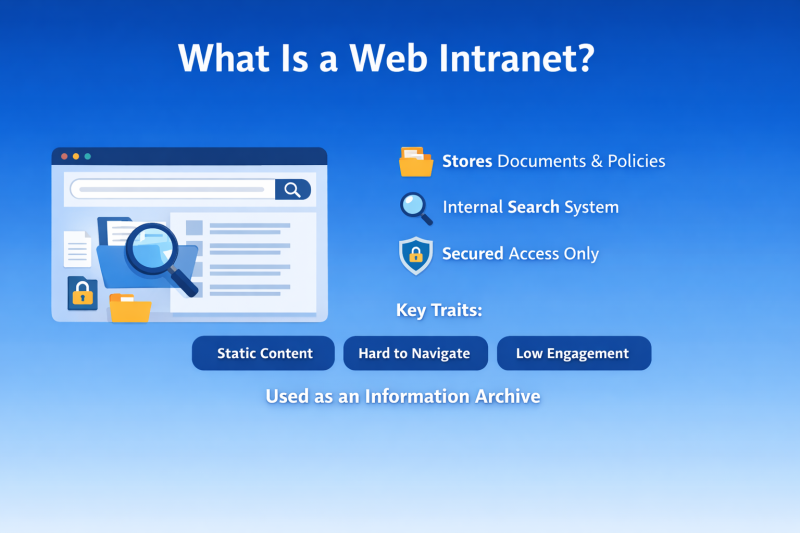
A web intranet is usually a browser-based internal website.
It is often built on tools like SharePoint or a basic CMS and acts as a central place for company news, policies, and documents.
Employees log in, find what they need, and log out. For many organisations, this is what they still call their intranet today.
This model made sense years ago.
Companies used an intranet web server to host internal pages when teams worked in one office and communication moved top-down. It worked well enough for sharing files and announcements.
But in 2026, work no longer looks like that. Teams are hybrid, frontline, and constantly switching devices. A static intranet online experience quickly feels slow and disconnected.
The biggest issue is how a web intranet is used. It is designed to be visited occasionally, not daily. There is little interaction, limited collaboration, and no strong reason for employees to keep coming back.
Over time, content goes out of date, pages get ignored, and adoption drops — even if the platform looks good on paper.
For HR and internal communications, this creates real problems.
Important updates are missed. Policies are not read.
Engagement stays flat because the platform is not part of everyday work. In many cases, the web intranet becomes a quiet archive instead of a living workplace tool.
In short, a web intranet can store information, but it struggles to support modern work. Without daily relevance, it cannot compete with tools employees actually use — and that gap matters more than ever in 2026.
What Is an Employee Portal? (Useful but Limited)
An employee portal is a system designed to help staff complete specific tasks. Most of the time, it focuses on HR needs like viewing payslips, requesting leave, updating personal details, or reading company policies.
Employees log in, do what they need to do, and log out.
This type of tool became popular because it reduced manual work for HR teams. Instead of emailing forms or chasing approvals, employees could handle things themselves. For compliance and record-keeping, this works well. It keeps information organised and controlled.
The limitation is how narrow the experience is. An employee portal is not built for daily interaction. It does not encourage conversation, teamwork, or a sense of belonging. There is no natural place for company updates, recognition, or collaboration. Once a task is done, there is no reason to stay.
For leaders, this creates a false sense of coverage. It may look like "we already have an intranet," but employees only visit when they must. Important messages still get lost in email. Culture still lives in scattered tools. Engagement still suffers.
The reality check is simple. An employee portal is not an intranet. It is a useful tool, but only one piece of a much bigger digital workplace puzzle.
Employee portals examples or Also Known As
- HR portal
- Employee self-service portal
- Staff Intranet portal
- HR system portal
- People portal
- Workforce portal
Different names, same core idea: task-focused, helpful, but limited on its own.
Why the Language Really Matters
Most teams are actually aiming for the same goal: a modern digital workplace where employees can do good work without friction.
CEOs want speed and visibility. HR wants engagement and retention. IT wants security and stability. The problem is not the goal — it's the language used to describe it.
When one team says "web intranet," another hears "old document site."
When someone says "employee portal," others think "HR system only." And when the word "intranet" comes up, many leaders still picture something outdated and unused. That gap in understanding causes real problems.
Research shows that digital transformation is now a shared responsibility. CIOs are more involved in business strategy than ever, and HR and internal communications teams increasingly share goals with IT. But when each group uses different terms for similar tools, alignment breaks down. Decisions slow. Budgets get questioned. Projects stall.
This confusion often shows up during funding discussions.
If a platform is described as a "traditional intranet," it is easy for decision-makers to dismiss it as low value. It sounds like a nice-to-have instead of a core business system. As a result, requests get delayed, reduced, or rejected — even when the underlying need is real.
The cost goes beyond budgets. Mixed language leads to duplicated tools, disconnected systems, and employees bouncing between platforms that do not talk to each other. That hurts productivity and weakens the employee experience.
In 2026, success depends on clear, shared language.
When leaders agree on what they are building — and why — teams align faster, investments make sense, and the digital workplace actually works for everyone.
Intranet Hub vs Web Intranet vs Employee Portal (2026 Comparison)
| Feature / Area | Intranet Hub | Web Intranet | Employee Portal |
| Primary Purpose | Run daily work in one place | Share information | Complete HR tasks |
| Daily Usage | Used every day | Used occasionally | Used only when needed |
| Employee Engagement | High (updates, interaction, recognition) | Low (mostly read-only) | Very low |
| Mobile & Frontline Friendly | Yes, mobile-first | Limited | Basic task access only |
| Collaboration | Built-in (comments, chat, teamwork) | Minimal | None |
| Content Type | News, tasks, docs, conversations | Pages, files, announcements | Payslips, leave, personal data |
| Integration with Other Tools | Deep integrations, replaces tool sprawl | Links to other systems | Usually standalone |
| HR Value | Engagement, onboarding, culture | Policy hosting | Self-service efficiency |
| CEO Value | Visibility, speed, lower SaaS costs | Limited insight | Compliance support |
| Scalability | Grows with teams and regions | Harder to manage over time | Scales only for HR |
| Best Used As | Digital workplace backbone | Information archive | Supporting HR system |
| Biggest Risk | Needs adoption strategy | Becomes outdated quickly | Mistaken for a full intranet |
Intranet Hub vs Web Intranet vs Employee Portal (2026)
In 2026, the difference between these tools is no longer technical — it's about how people actually use them.
Many organisations still group them together, but their impact on productivity and engagement is very different.
Daily usage- An intranet hub is designed to be opened every day. Employees start and end their work there.
- A web intranet is checked occasionally, usually when someone needs a document.
- An employee portal is used only when a task is required, like booking leave or downloading a payslip.
- An intranet hub is mobile-first and works smoothly on phones for deskless and frontline teams.
- A web intranet often works on mobile, but feels clunky and slow.
- An employee portal is usable on mobile, but only for quick tasks, not ongoing work.
- An intranet hub encourages interaction, updates, recognition, and feedback.
- A web intranet mostly pushes information one way.
- An employee portal has almost no engagement layer at all.
- An intranet hub is built for workers without desks, emails, or laptops.
- A web intranet struggles here and is often ignored by frontline staff.
- An employee portal gives access to HR tasks but little else.
- An intranet hub connects tools, conversations, documents, and workflows in one place.
- A web intranet links to other systems but rarely replaces them.
- An employee portal usually stands alone as a single-purpose system.
- An intranet hub grows with the organisation and adapts to new teams and regions.
- A web intranet becomes harder to manage as content grows.
- An employee portal scales for HR tasks, but not for collaboration or culture.
- If your platform is used monthly, it's failing.
- If it's used daily, it's an intranet hub.
Why the Differences Matter More Than Ever in 2026
In 2026, choosing between an intranet hub, a web intranet, or an employee portal is not a small decision.
It directly affects how people work every day.
The workplace has changed fast, and many internal systems have not kept up.
What's changed
Hybrid work is no longer a trend. It is permanent. Teams are split across offices, homes, and job sites.
At the same time, frontline and deskless workers expect tools that work smoothly on their phones, not just on a desktop computer. If a platform is slow or hard to use on mobile, people simply ignore it.
On top of that, AI search and automation are no longer "nice extras." Employees expect to find answers fast and get help without digging through pages and folders.
The risk of choosing wrong
When organisations pick the wrong type of platform, adoption drops quickly. Employees stop logging in because it does not help them do their job.
To fill the gap, teams create their own workarounds using WhatsApp, personal email, or too many Slack channels.
This leads to messy communication and lost information.
There are also real compliance risks.
Important policies are missed, updates are not read, and there is no clear record of who saw what.
Over time, HR and internal communications teams pay the price. They spend more time chasing people, repeating messages, and defending tools that no one wants to use.
In short, the differences matter because the cost of getting it wrong is high. In 2026, the right choice supports daily work. The wrong one quietly drains time, trust, and energy from the whole organisation.
How CEOs Should Evaluate the Right Option
For CEOs, this decision should not start with features or vendor demos. It should start with how work actually happens inside the organisation. The right platform supports speed, clarity, and scale.
The wrong one becomes another cost that people quietly avoid.
Ask these questions first
Will employees open this daily?
If the answer is no, it is not a core workplace tool. Daily use is the clearest signal of value.
Does it reduce tools or add more?
Every new system should remove friction, not create another login. If it adds to tool sprawl, it's a step backwards.
Can it scale across regions and roles?
What works for head office must also work for frontline teams, remote staff, and global offices. One-size-for-HQ tools fail fast.
Does it give leadership visibility without micromanagement?
You want insight into engagement and activity, not another system that requires chasing reports or checking up on people.
Watch out for these red flags
"It's basically SharePoint with a new theme."
This usually means the same old problems with a fresh coat of paint.
"We'll train people to use it."
If a platform needs heavy training to get adoption, it's already lost. Good tools fit naturally into daily work.
In 2026, the best platforms don't need convincing. Employees use them because they make work easier. That's the standard CEOs should hold every option against.
Read this article: : Top 6 AI-Powered Project Management Tools To Use In 2023
How HR Leaders Should Evaluate the Right Option
For HR leaders, the right platform in 2026 is not just about systems — it's about people.
The goal is to keep employees informed, engaged, and supported without creating more work for HR teams.

How HR Leaders Should Evaluate the Right Option
HR priorities in 2026 (and why they matter more now)
Employee engagement is no longer something HR can "sense" or guess. Data matters.
According to Gallup, only 23% of employees worldwide feel engaged at work.
That means most employees are either doing the bare minimum or actively disengaged. HR needs engagement analytics that show what people read, what they ignore, and where attention drops off — not just vanity metrics like logins.
Onboarding speed is another pressure point.
Research consistently shows that employees decide whether to stay long-term within their first 90 days. If new hires feel lost, disconnected, or overwhelmed, churn starts early. HR needs platforms where onboarding content, people, and support live in one place, so new employees feel productive in days, not weeks.
Internal communication is also harder than ever. Hybrid and frontline teams do not sit at desks checking email all day. Missed messages lead to missed policies, missed deadlines, and real compliance risks.
Studies show that poor communication is one of the top drivers of workplace mistakes and employee frustration. HR needs tools that support targeted messaging — so the right people see the right message at the right time, without blasting everyone.
Recognition and feedback have moved from "nice to have" to essential.
Data shows that employees who feel recognised are far more likely to stay and perform well. Yet many organisations still rely on annual surveys and ad-hoc praise.
In 2026, HR needs continuous feedback loops and simple recognition tools built into daily work, not bolted on as extras.
What HR should look for in a platform
The right option gives HR visibility without extra admin.
Engagement insights should be built in, not pulled from five different systems.
Communications should be easy to create and target without raising IT tickets. Content should be simple to update so information stays fresh and trusted.
Most importantly, the platform should support how employees actually work today. If HR has to chase people to read updates or complete onboarding steps, the tool is failing.
In 2026, HR success depends on clarity, connection, and confidence. The right platform helps HR focus on people and culture. The wrong one quietly adds friction, frustration, and risk.
Real-World Use Cases in 2026

Real-World Use Cases in 2026
Fast-growing companies often start with good intentions but end up with too many tools.
One app for chat, another for files, another for updates, and email on top of everything.
As teams grow, this creates confusion and slows work down.
An intranet hub helps scaling companies bring everything into one place.
Employees know where to go, leaders get visibility, and new hires ramp up faster because there is a single source of truth.
Nonprofits aligning remote teams
Nonprofits usually work with limited budgets, remote staff, and volunteers spread across regions.
Important updates often get lost in email chains or WhatsApp groups. A modern intranet hub gives nonprofits one shared space for updates, documents, and collaboration.
This keeps everyone aligned, reduces miscommunication, and helps teams stay connected to the mission, even when they never meet in person.
Enterprises modernising outdated intranets
Large organisations often rely on legacy web intranets that look fine but are barely used.
Content is hard to find, mobile access is poor, and employees avoid logging in unless forced.
By moving to an intranet hub, enterprises turn a passive system into an active workplace.
Communication becomes two-way, engagement increases, and leadership gains real insight into what is happening across the organisation.
Frontline-heavy organisations improving reach
Frontline workers in industries like healthcare, retail, construction, and logistics rarely sit at desks or check email.
Traditional intranets fail them completely. An intranet hub designed for mobile access allows frontline staff to receive updates, policies, and alerts in real time.
This improves reach, reduces mistakes, and helps workers feel included instead of disconnected.
Across all these examples, the pattern is the same.
When organisations choose tools built for how people actually work in 2026, communication improves, engagement rises, and teams move faster.
Where Most Organisations Get This Wrong

Where Most Organisations Get This Wrong
The biggest mistakes organisations make with intranets are not technical. They are strategic — and they show up again and again.
Buying tools based on IT preference
Many intranet decisions are driven by what IT already knows or manages, not by how employees actually work.
The result is a system that is secure and stable, but painful to use.
When usability loses to convenience, adoption suffers. Employees don't complain — they just stop logging in.
Treating the intranet as a "project" instead of a product
A common pattern is the big launch: months of planning, a rollout email, maybe some training.
Then… nothing. The intranet is considered "done."
In reality, a modern intranet needs ongoing ownership, updates, and improvement.
When it's treated as a one-time project, it quickly becomes outdated and ignored.
Ignoring adoption metrics
Many organisations track page views or logins and assume things are fine.
They're not. What matters is who is using the platform, how often, and what they are actually doing.
If leaders are not measuring daily usage, engagement, and reach, they are flying blind — and problems go unnoticed until it's too late.
Over-customising legacy platforms
Trying to force old systems to behave like modern intranet hubs usually backfires.
Heavy customisation increases cost, slows updates, and creates fragile systems that are hard to maintain. Worse, it locks organisations into outdated foundations while pretending they are "modernised."
These mistakes all lead to the same outcome: low adoption, wasted budget, and frustrated teams.
In 2026, the organisations that win are the ones that stop fixing old problems and start choosing platforms built for how work actually happens today.
20 Intranet Platforms to Consider in 2026

20 Intranet Platforms to Consider in 2026
| # | Platform | Product Description |
| 1 | AgilityPortal | A true intranet hub built for daily use. Combines communication, documents, collaboration, engagement analytics, onboarding, and mobile-first access in one platform. Best suited for organisations that want one central workplace instead of tool sprawl. An all in one Worker hub, employee hub, people hub a complete powerfull electronic workplace. |
| 2 | Microsoft SharePoint | Widely used as a web intranet. Strong for document management, but often complex to manage and weak on engagement without heavy customisation. |
| 3 | Workvivo | Social-first intranet focused on engagement and internal communications. Popular with HR teams, but less strong as an all-in-one workplace hub. |
| 4 | Simpplr | Clean, modern intranet experience with good content targeting. Primarily focused on communications rather than full workplace operations. |
| 5 | LumApps | Built around Google Workspace and Microsoft 365. Strong integrations, but can feel content-heavy and less task-driven. |
| 6 | Unily | Enterprise-grade intranet often used by large organisations. Powerful, but expensive and complex to implement. |
| 7 | Happeo | Google Workspace–centric intranet with a social layer. Works well for comms, less so for broader collaboration. |
| 8 | MangoApps | Feature-rich intranet with collaboration tools. Can feel overwhelming without careful setup. |
| 9 | Igloo | Long-standing intranet vendor with solid document and collaboration features. Less modern compared to newer hubs. |
| 10 | Staffbase | Strong for top-down communications and frontline reach. Not designed to replace multiple work tools. |
| 11 | Interact | Focused on internal communications and knowledge sharing. More traditional intranet approach. |
| 12 | Claromentis | Customisable intranet with workflow features. Often used in regulated industries. |
| 13 | Jostle | Simple, people-focused intranet aimed at engagement. Limited depth beyond communications. |
| 14 | Blink | Mobile-first tool for frontline workers. Strong on reach, weaker as a full intranet replacement. |
| 15 | Guru | Great for internal knowledge and answers, but not a full intranet or employee experience platform. |
| 16 | Confluence | Popular for documentation and technical teams. Not built for company-wide engagement. |
| 17 | Notion | Flexible internal workspace used by smaller teams. Lacks governance and structure at scale. |
| 18 | Basecamp | Useful for team collaboration, but not designed as a company intranet. |
| 19 | Slack | Excellent for messaging, but poor for structured knowledge, policies, and long-term alignment. |
| 20 | Workplace from Meta | Social-style internal communication tool. Engagement-focused, but limited as a full workplace hub. |
Many of these tools solve part of the problem.
Only a true intranet hub brings communication, collaboration, knowledge, and engagement together in one place employees actually use every day.
Advantages of a Modern Intranet Hub
A modern intranet hub is not just a nicer version of an old intranet. It changes how people work, communicate, and stay connected. Here are the key advantages that matter most in 2026.
- One place for everything - Employees no longer need to jump between email, chat apps, folders, and random links. A single intranet hub becomes the go-to place for updates, documents, tasks, and tools. This saves time and reduces daily frustration.
- Higher employee engagement - When people use the intranet every day, they feel more connected. Updates are seen, not missed. Recognition and feedback feel natural, not forced. This directly supports engagement, which is critical when most employees already feel disconnected at work.
- Better communication, less noise - Targeted messages mean employees only see what is relevant to them. This cuts down on inbox overload and prevents important updates from getting lost. Clear communication builds trust and reduces mistakes.
- Stronger onboarding and knowledge sharing - New hires get one clear starting point. Policies, guides, and people are easy to find. Instead of asking the same questions again and again, employees can help themselves and get productive faster.
- Mobile access for all workers - A modern intranet hub works just as well on a phone as it does on a laptop. This is essential for frontline and remote workers who do not sit at desks but still need to stay informed and involved.
- Lower costs and less tool sprawl - Replacing multiple tools with one platform reduces software costs and complexity. IT spends less time supporting scattered systems, and teams spend more time doing real work.
- Real visibility for leaders - Leaders can see what content is working, what is being read, and where engagement drops. This insight helps organisations improve communication instead of guessing.
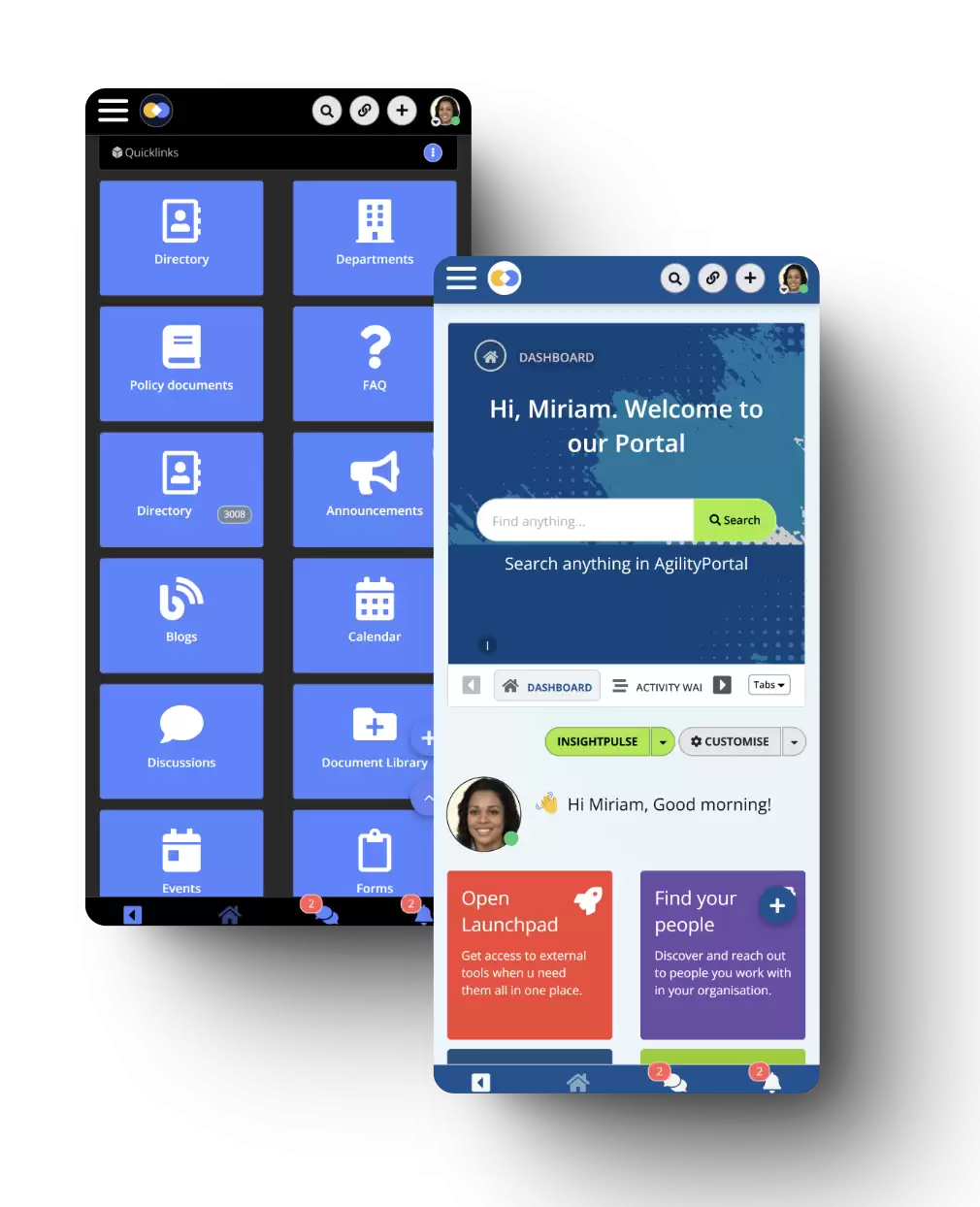
In 2026, the biggest advantage is simple: a modern intranet hub supports how people actually work today, not how work used to happen years ago.
Wrapping up
In 2026, the difference between these platforms is no longer subtle — it's operational.
- A web intranet stores information
- An employee portal manages tasks
- An intranet hub runs the organisation
Each has a role, but they are not interchangeable.
Treating them as the same thing leads to poor adoption, wasted budget, and frustrated teams. Leaders who get this right create clarity, speed, and alignment across the business.
Leaders who don't end up chasing people, messages, and outcomes.
If your goal is real engagement, clear communication, and faster execution, the difference isn't about wording or trends. It's a strategic decision that shapes how your organisation works every single day.
Frequently Asked Questions (FAQ)
What is an intranet portal?
An intranet portal is a private website used inside an organisation.
It gives employees or members one place to access documents, updates, tools, and internal systems.
Some portals are basic and task-focused, while modern versions act as a full intranet hub used every day.
What is the difference between a staff intranet and an employee portal?
A staff intranet is designed for communication, collaboration, and sharing information across teams.
An employee portal usually focuses on HR tasks like payslips, leave requests, and personal details.
In 2026, many organisations combine both into one intranet hub instead of running separate systems.
What is a student intranet used for?
A student intranet is commonly used by schools, colleges, and universities to share announcements, learning resources, schedules, and internal updates.
Modern student intranets are moving beyond static pages and becoming interactive platforms that students actually check daily.
What does "my intranet" mean?
"My intranet" usually refers to a personalised intranet experience.
When employees say my intranet, they expect to see relevant news, tasks, documents, and updates tailored to their role, location, or department — not generic content meant for everyone.
What is My UNB intranet?
My UNB intranet is an example of a branded intranet portal used by an institution to centralise internal resources for staff or students.
Like many traditional intranets, its success depends on how easy it is to use, how often it's updated, and whether people actually rely on it daily.
What does intranet plus mean?
Intranet plus is a term often used to describe a modern intranet that goes beyond document storage.
This usually includes communication tools, collaboration features, engagement tracking, and integrations — turning the intranet into a daily workplace hub rather than a static site.
Do small organisations really need an intranet?
Yes.
Even small teams benefit from a simple intranet because it reduces confusion, keeps information in one place, and avoids relying on email or chat apps for everything.
The key is choosing something easy to use, not overbuilt.
How do I know if our intranet is failing?
If people only log in once a month, rely on email instead, or ask the same questions repeatedly, the intranet is not doing its job.
A healthy intranet is used daily and helps people get work done faster.
Most Popular Posts

Effective communication among team members is vital for the productivity and success of any organization. Surprisingly, 60% of companies lack a long-term internal communication strategy, which p...


Businesses thrive on communication for efficiency, productivity and accomplishment. When the right information is passed from the right designation in the organization, it promotes positivity an...

Categories
Blog
(3192)
Business Management
(394)
Employee Engagement
(235)
Digital Transformation
(218)
Growth
(150)
Intranets
(141)
Internal communications
(106)
Remote Work
(68)
Sales
(53)
Collaboration
(52)
Customer Experience
(32)
Culture
(30)
Knowledge Management
(29)
Project management
(29)
Leadership
(20)
Comparisons
(9)
News
(1)

Related Posts

What would happen to your team's work and customer information if an employee's MacBook disappeared today? If you're wondering how to protect your Mac physically, the answer goes beyond buying a case. A MacBook used at home, on a train or in a ...

Welcome to AgilityPortal's guide to the best VPN for Remote teams. How do you give employees secure access to company systems when they work from home, the office and everywhere in between? It's a question more businesses need to answer: 28% of worki...

Have you ever left a meeting thinking everyone agreed on the next step, only to discover a week later that each person remembered something different? Open source meeting transcription can help teams keep a searchable record of the conversation...

The best ai image editors can save a team hours of repetitive work. A marketing manager can remove a distracting background, an HR team can improve a staff event photo, and an online shop can turn a basic product shot into something ready to pu...

Ever opened a PDF just before a meeting and realised you need to edit a page, pull figures from a scanned report, or gather everyone's comments? What should be a quick task can turn into a frustrating search for the right tool. That lost time a...


Jill Romford
I am a digital nomad, lover of exploring new places and making friends.
I love to travel and I love the internet. I take pictures of my travels and share them on the internet using Instagram.
Traveler, entrepreneur, and community builder. I share my insights on digital marketing and social media while inspiring you to live your fullest life.
Ready to learn more? 👍
One platform to optimize, manage and track all of your teams. Your new digital workplace is a click away. 🚀
Free for 14 days, no credit card required.