Insight Blog
Agility’s perspectives on transforming the employee's experience throughout remote transformation using connected enterprise tools.
37 minutes reading time
(7341 words)
Importance of Workplace Communication in 2026: Workforce Communication Examples for Hybrid Teams

Importance of Workplace Communication in 2026: Workforce Communication Examples for Hybrid Teams
Learn the importance of workplace communication and discover workforce communication examples that improve employee engagement, collaboration, and productivity.
Importance of Workplace Communication in 2026: Workforce Communication Examples for Hybrid Teams

Work has changed a lot over the last few years.
With more people working remotely, in the office, or splitting their time between both, keeping everyone connected is no longer just an HR responsibility—it's a business priority.
When employees don't receive the right information at the right time, productivity drops, collaboration suffers, and people can quickly feel disconnected from their teams.
In fact, research from Gallup found that employees who feel connected to their organisation are significantly more engaged at work, and highly engaged teams can achieve 23% higher profitability than those with low engagement.
Strong communication plays a major role in creating that connection.
28%
of the workweek
According to McKinsey, employees can spend up to 28% of their workweek searching for information across disconnected systems.
Source: McKinsey Global Institute
This highlights the importance of workplace communication in every organisation, regardless of its size or industry.
From company announcements and team meetings to instant messaging and mobile updates, using the right communication methods helps employees stay informed, work together more effectively, and feel like they're part of something bigger.
In this guide, we'll explain why workplace communication matters, explore practical workforce communication examples that businesses use every day, look at the biggest communication challenges organisations face, and share simple best practices for building a more connected, engaged, and productive workforce.
Key Takeaways
- The importance of workplace communication extends beyond sharing information—it strengthens employee engagement, improves collaboration, and supports better business performance.
- Successful organisations combine multiple communication channels, including workplace email, instant messaging, mobile apps, announcements, and video communication, to reach every employee.
- Poor communication in the workplace can lead to lower productivity, information silos, employee disengagement, higher staff turnover, and inconsistent customer experiences.
- Investing in effective communication skills in the workplace and providing regular communication training helps managers and employees collaborate more effectively and resolve issues faster.
- Modern employee communication platforms like AgilityPortal centralise internal communications and employee engagement, making it easier to connect office-based, remote, and frontline workers from one secure digital workplace.
State of Workplace Communication in 2026
The workplace has changed more in the last few years than it did in the previous decade. Employees are now spread across offices, homes, job sites, and even different countries, making communication more challenging than ever.
At the same time, businesses are using more digital tools, creating new opportunities to collaborate—but also increasing the risk of information overload.
Today's employees expect timely updates, easy access to information, and the ability to communicate from anywhere.
They don't want to search through endless emails or switch between multiple apps just to find a document or company announcement. They want communication to be simple, relevant, and accessible.
Businesses that continue relying on outdated communication methods are finding it harder to keep employees engaged, aligned, and productive.
As organisations grow, having a clear communication strategy supported by the right technology is becoming a business necessity rather than a nice-to-have.
In 2026, successful organisations are focusing on communication that is:
- Mobile-first, so employees can stay connected wherever they work.
- Two-way, giving employees a voice instead of simply broadcasting information.
- Personalised, delivering relevant updates based on departments, roles, or locations.
- Centralised, reducing the need to switch between multiple workplace apps.
- Data-driven, using analytics to understand what employees are reading and engaging with.
- AI-powered, helping employees quickly find information, answers, and company knowledge.
The organisations that invest in modern workplace communication today will be better equipped to improve employee engagement, strengthen collaboration, and adapt to whatever the future of work brings next.
What Is Workplace Communication?
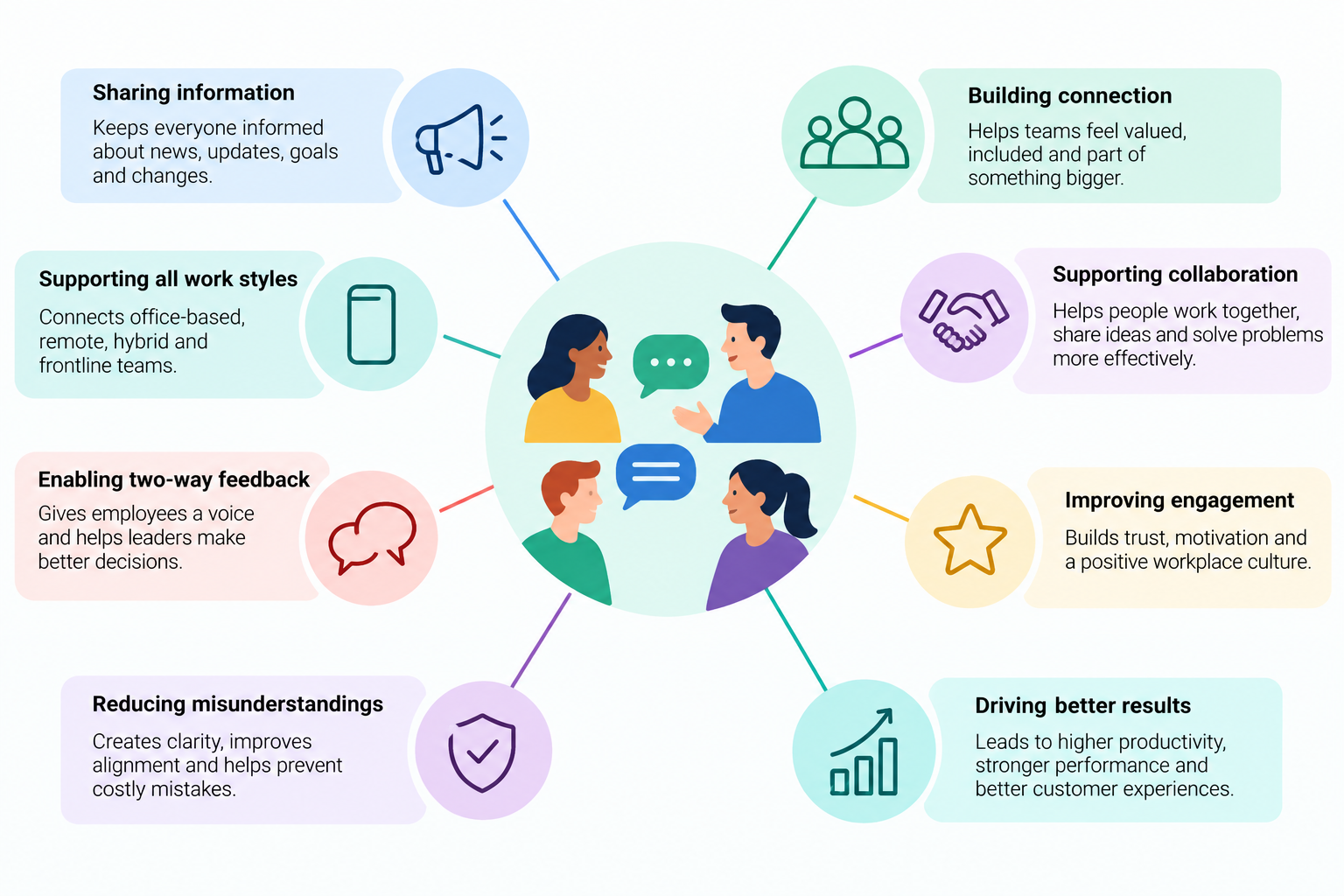
Workplace communication is the way employees, managers, and leadership share information, ideas, and feedback to help the organisation achieve its goals.
It happens every day through conversations, meetings, instant messages, video calls, documents, and even a simple workplace email.
Good communication isn't just about passing on information—it's about making sure the message is clear, understood, and encourages the right action.
That's why effective communication in the workplace is one of the most valuable skills any organisation can develop.
What Is Workplace Communication
Internal vs. External Communication
Internal communication takes place between people inside the organisation.
This includes team meetings, company announcements, one-to-one conversations, project updates, and workplace chat platforms.
Its purpose is to keep employees informed, aligned, and working towards common goals.
External communication, on the other hand, is aimed at people outside the business, such as customers, suppliers, partners, job candidates, and stakeholders.
This could include emails, marketing campaigns, customer support, social media, or sales conversations.
Formal vs. Informal Communication
Not every message needs to follow the same format.
Formal communication includes company policies, leadership announcements, performance reviews, official reports, and important workplace email communications.
These messages usually follow a structured process and are used when accuracy and consistency matter.
Informal communication happens naturally throughout the working day.
It includes quick chats between colleagues, instant messages, video calls, team discussions, and casual conversations that help employees solve problems faster and build stronger working relationships.
Why Communication Matters Across Every Department
Every department depends on strong communication to do its job well.
Human Resources uses it to onboard new employees and share company updates.
Sales teams rely on clear communication to manage customer relationships, while IT departments keep employees informed about security updates and system changes. Operations, finance, marketing, and customer service all depend on accurate information flowing between teams.
This is why communication skills in the workplace are so important.
Employees who communicate clearly are more likely to collaborate effectively, avoid misunderstandings, solve problems faster, and deliver better results.
When organisations invest in effective communication in the workplace, they create stronger teams, improve employee engagement, and build a culture where everyone has the information they need to succeed.
8 Benefits of Effective Workplace Communication

1. Higher Productivity
Strong communication is one of the biggest factors behind a successful business.
Whether employees are working in the office, remotely, or across multiple locations, they need quick access to accurate information to do their jobs well.
Despite this, many organisations still struggle with communication gaps that affect productivity, employee satisfaction, and business performance.
Below are some of the biggest benefits of investing in effective communication in the workplace.
2. Stronger Employee Engagement
People are more engaged when they understand how their work contributes to the company's goals.
Regular updates from leadership, opportunities to ask questions, and open conversations help employees feel included rather than disconnected.
Engaged employees are also more likely to stay with the organisation, recommend it to others, and contribute beyond their core responsibilities.
3. Better Team Collaboration
Successful teams rely on open communication.
When colleagues can easily share ideas, ask for help, and provide updates, collaboration becomes much more natural.
Whether communication happens through meetings, chat platforms, video calls, or a simple workplace email, sharing information effectively helps teams solve problems faster and achieve better results together.
4. Faster and Better Decision-Making
Good decisions depend on good information.
Leaders who receive regular feedback from employees, managers, and different departments have a much clearer understanding of what's happening across the organisation.
Instead of relying on assumptions, they can make informed decisions based on real insights, helping the business respond more quickly to new opportunities and challenges.
5. Increased Employee Confidence and Morale
Employees perform at their best when they know what's expected of them.
Clear communication removes uncertainty, reduces unnecessary stress, and creates an environment where people feel supported.
When managers communicate openly and recognise employee contributions, it also builds trust and strengthens workplace relationships.
6. Fewer Misunderstandings and Workplace Conflicts
Many workplace disagreements start because expectations were unclear or information wasn't shared properly.
Encouraging honest conversations and active listening helps resolve issues before they become larger problems.
Organisations that promote respectful communication often experience fewer conflicts and stronger teamwork.
7. Greater Innovation and Knowledge Sharing
The best ideas rarely come from one person working alone.
Organisations that encourage employees to share feedback, suggest improvements, and collaborate across departments create an environment where innovation can thrive.
When everyone feels comfortable contributing ideas, businesses are more likely to discover new ways to improve products, services, and internal processes.
8. Improved Business Performance
Effective communication has a direct impact on business success.
Projects are delivered more efficiently, customers receive better service, and employees spend less time dealing with avoidable mistakes.
According to Grammarly's State of Business Communication report, poor communication costs businesses billions of dollars every year through lost productivity, operational inefficiencies, and preventable errors.
Investing in better communication isn't simply about improving conversations—it's about improving overall business performance.
Developing strong communication skills in the workplace is no longer optional.
Businesses that prioritise clear, consistent, and transparent communication build more engaged employees, stronger teams, better leaders, and healthier workplace cultures.
Whether communication takes place through meetings, collaboration platforms, mobile apps, or everyday conversations, creating an environment where information flows freely is one of the smartest investments any organisation can make.
Why the Importance of Workplace Communication Has Never Been Greater

The way people work has changed dramatically over the last few years.
Hybrid working, remote teams, and flexible schedules have made communication at work more important than ever.
Employees are no longer sitting in the same office, making it essential for organisations to communicate clearly, consistently, and across multiple channels.
In today's environment, communication is no longer just about sharing updates—it plays a central role in shaping employee experience, driving performance, and maintaining alignment across teams. Without strong communication practices, even the most well-planned strategies can fail to deliver results.
Research from Gallup found that organisations with highly engaged employees experience 23% higher profitability compared to those with lower engagement levels.
This is one reason why internal communications and employee engagement have become top priorities for business leaders looking to improve performance and retain talented employees.
To understand why communication matters so much, it's helpful to look at the key areas it directly impacts:
23%
Higher Profitability
Research from Gallup found that organisations with highly engaged employees experience 23% higher profitability than organisations with lower employee engagement.
Strong internal communications and employee engagement help businesses improve
performance, build stronger workplace connections, and retain talented employees.
Source: Gallup employee engagement research
Stronger Employee Engagement
Employees want to feel informed, listened to, and connected to the organisation's goals.
Regular updates, transparent leadership, and opportunities to provide feedback help create a workplace where employees feel valued. When communication improves, engagement naturally follows.
Key ways communication supports engagement include:
- Providing regular updates on company performance and goals
- Encouraging two-way communication between employees and leadership
- Recognising employee contributions and achievements
- Creating opportunities for feedback and open discussion
Higher Productivity
People perform better when they know exactly what is expected of them.
Clear communication reduces confusion, avoids duplicated work, and allows employees to spend more time focusing on meaningful tasks instead of chasing information.
Effective communication improves productivity by:
- Clarifying roles, responsibilities, and expectations
- Reducing misunderstandings and errors
- Streamlining workflows and processes
- Ensuring teams have access to the information they need
Better Team Collaboration
Successful collaboration depends on sharing ideas openly and working towards common goals.
Whether employees are working from home or in the office, effective communication helps teams coordinate projects, solve problems faster, and make better decisions together.
Strong communication enables collaboration through:
- Clear project updates and shared objectives
- Open channels for discussion and idea sharing
- Consistent use of collaboration tools
- Alignment across departments and teams
Improved Employee Retention
Employees are more likely to remain with organisations where they feel informed and appreciated.
Regular communication from managers and leadership helps build trust, strengthens relationships, and creates a greater sense of belonging.
Communication contributes to retention by:
- Building trust between employees and leadership
- Providing clarity around career development opportunities
- Creating a sense of inclusion and belonging
- Addressing concerns before they escalate
A Stronger Company Culture
Culture isn't built through posters on the wall—it's built through daily conversations.
Open communication encourages transparency, inclusivity, and recognition, helping organisations create a positive workplace where employees enjoy working.
A strong communication culture includes:
- Open and honest conversations at all levels
- Recognition of achievements and milestones
- Encouragement of diverse perspectives
- Consistent messaging that reflects company values
Faster Decision-Making
Good decisions require accurate information.
When information flows freely between departments and leadership teams, organisations can respond more quickly to opportunities, solve problems faster, and reduce costly delays.
Communication supports faster decisions by:
- Ensuring timely access to relevant information
- Reducing bottlenecks in approval processes
- Encouraging collaboration across teams
- Providing clarity on priorities and objectives
Better Customer Experiences
Employees who understand company goals, policies, and customer expectations are better equipped to deliver outstanding service.
Clear internal communication often leads to more consistent customer experiences and stronger client relationships.
Internal communication improves customer outcomes by:
- Aligning teams around customer expectations
- Ensuring consistent messaging across touchpoints
- Enabling faster responses to customer needs
- Empowering employees with the right information
Reducing the Impact of Poor Communication
The cost of poor communication in the workplace goes far beyond missed emails or delayed meetings.
Misunderstandings can lead to lower productivity, frustrated employees, duplicated work, poor customer service, and higher staff turnover.
Common consequences of poor communication include:
- Confusion around roles and responsibilities
- Increased errors and rework
- Low employee morale and engagement
- Missed deadlines and project delays
- Inconsistent customer experiences
Developing effective communication skills in the workplace helps prevent these issues by ensuring employees understand expectations, collaborate effectively, and feel confident sharing ideas and feedback.
Ultimately, organisations that invest in better communication create more engaged employees, stronger teams, healthier workplace cultures, and better business outcomes. In today's fast-moving workplace, communication is no longer just a soft skill—it's a competitive advantage.
15 Workforce Communication Examples Every Organisation Should Use
Every organisation communicates differently, but the most successful businesses use a mix of communication methods to keep employees informed, engaged, and connected.
Below are some of the most effective workforce communication examples, along with brief context and real-world scenarios to show how they are used in practice.

15 Workforce Communication Examples Every Organisation Should Use
1. Company-Wide Announcements
- What it's used for: Sharing important business news, company updates, achievements, leadership messages, or organisational changes.
- Example: A CEO announcing a company merger or quarterly results.
- Impact on communication: Ensures everyone receives the same information at the same time, creating transparency and reducing rumours or misinformation.
2. Instant Messaging
- What it's used for: Quick conversations, asking questions, sharing files, and collaborating in real time.
- Example: A team using Slack or Teams to quickly resolve a customer issue.
- Impact on communication: Speeds up decision-making, reduces unnecessary emails, and allows teams to solve problems much faster.
3. Department Updates
- What it's used for: Keeping individual teams informed about department goals, project progress, deadlines, and operational changes.
- Example: A marketing team sharing weekly campaign performance updates.
- Impact on communication: Helps departments stay aligned while ensuring employees understand what's happening within their own teams.
4. Video Messages from Leadership
- What it's used for: Delivering strategic updates, company announcements, or messages from executives in a more personal way.
- Example: A leadership video outlining company goals for the upcoming year.
- Impact on communication: Builds trust, strengthens leadership visibility, and helps employees feel more connected to the organisation.
5. Employee Recognition Posts
- What it's used for: Celebrating employee achievements, milestones, promotions, birthdays, and exceptional performance.
- Example: Highlighting an employee who exceeded sales targets.
- Impact on communication: Boosts morale, increases employee engagement, and encourages a culture of appreciation.
6. Pulse Surveys
- What it's used for: Collecting regular employee feedback on engagement, wellbeing, workplace culture, and job satisfaction.
- Example: A short monthly survey asking employees about workload and stress levels.
- Impact on communication: Gives leadership valuable insights while showing employees that their opinions are heard and valued.
7. Knowledge Base Articles
- What it's used for: Storing company policies, procedures, FAQs, training materials, and best practice guides.
- Example: An internal portal where employees can find HR policies or IT troubleshooting steps.
- Impact on communication: Reduces repetitive questions and ensures employees can quickly find reliable information whenever they need it.
8. Team Meetings
- What it's used for: Discussing priorities, reviewing progress, solving challenges, and planning upcoming work.
- Example: Weekly stand-up meetings to track project progress.
- Impact on communication: Encourages collaboration, improves alignment, and keeps projects moving in the right direction.
9. Digital Noticeboards
- What it's used for: Displaying company news, safety notices, shift information, upcoming events, or important reminders in shared workplace areas.
- Example: Screens in a warehouse showing shift schedules and safety alerts.
- Impact on communication: Keeps frontline and deskless employees informed, even if they don't regularly use email or desktop computers.
10. Mobile Workforce Alerts
- What it's used for: Sending urgent notifications, operational updates, emergency alerts, or schedule changes directly to employees' mobile devices.
- Example: Notifying staff about a sudden shift change or weather disruption.
- Impact on communication: Delivers critical information instantly, ensuring employees stay informed wherever they're working.
11. Policy Updates
- What it's used for: Informing employees about changes to company policies, compliance requirements, or workplace procedures.
- Example: Communicating updates to remote work policies.
- Impact on communication: Promotes consistency across the organisation while helping employees remain compliant with internal policies.
12. Employee Onboarding Communication
- What it's used for: Welcoming new hires, introducing company values, providing training resources, and guiding employees through their first weeks.
- Example: Sending a structured onboarding plan with training materials and introductions.
- Impact on communication: Creates a positive first impression and helps new employees become productive more quickly.
13. Project Collaboration Spaces
- What it's used for: Bringing project teams together to share documents, assign tasks, discuss progress, and manage deadlines in one location.
- Example: Using tools like Asana or Trello to manage project workflows.
- Impact on communication: Reduces information silos and keeps everyone working from the latest updates and shared resources.
14. Crisis Communications
- What it's used for: Delivering urgent information during emergencies, business disruptions, cybersecurity incidents, severe weather, or health and safety events.
- Example: Sending immediate alerts during a system outage or safety incident.
- Impact on communication: Provides clear, accurate information quickly, reducing confusion and helping employees respond appropriately.
15. AI-Powered Employee Assistants
- What it's used for: Answering employee questions, locating company information, supporting HR requests, automating routine tasks, and providing instant assistance.
- Example: A chatbot helping employees find leave policies or submit requests.
Impact on communication: Improves access to information, reduces response times, and allows employees to find answers without waiting for support from HR or management.
Choosing the Right Communication Methods
No single communication channel can meet every business need. The most successful organisations combine announcements, messaging, meetings, mobile alerts, knowledge sharing, and employee feedback into one connected communication strategy.
By using the right mix of tools, businesses create a more informed workforce, improve collaboration, and build a stronger workplace culture.
Common Workplace Communication Challenges
Even organisations with the best intentions can experience communication problems.
As businesses grow, teams become more distributed and technology continues to evolve, keeping everyone informed becomes increasingly difficult.
Without a clear communication strategy, important messages can easily be overlooked, misunderstood, or lost altogether.
Below are some of the most common workplace communication challenges businesses face today and how they affect employees and overall business performance.
| Challenge | Example | Recommended Solution |
| Information overload | Too many emails | Centralise communications |
| Communication silos | Departments don't share information | Shared collaboration spaces |
| Remote worker isolation | Employees feel disconnected | Mobile-first communication |
| Email fatigue | Important updates missed | Push notifications and announcements |
| Poor leadership communication | Employees don't know company direction | Regular leadership updates |
| Multiple workplace apps | Employees constantly switch platforms | Unified employee communication platform |
| Lack of employee feedback | Low engagement | Pulse surveys and two-way communication |
1. Information Overload
Employees receive hundreds of notifications, emails, chat messages, and meeting invitations every week. Instead of making communication easier, too much information often makes it harder to identify what actually matters.
Common examples include:
- Receiving dozens of emails every day.
- Multiple chat notifications interrupting work.
- Important announcements buried beneath less important updates.
- Employees unsure which communication channel to check first.
Business impact:
- Lower productivity.
- Missed deadlines.
- Important information being overlooked.
- Increased employee frustration.
2. Too Many Workplace Apps
Many organisations use separate applications for messaging, documents, HR, projects, meetings, announcements, and file sharing.
Constantly switching between platforms wastes valuable time and creates communication gaps.
Common examples include:
- Microsoft Teams for chat.
- Outlook for email.
- SharePoint for documents.
- Zoom for meetings.
- Another platform for company news.
Business impact:
- Employees spend more time searching than working.
- Information becomes scattered across multiple systems.
- Collaboration becomes slower and less efficient.
- Higher software costs and lower user adoption.
3. Remote and Hybrid Worker Isolation
Employees working remotely can easily feel disconnected from their colleagues and the wider organisation.
Without regular communication, they may miss important updates, social interactions, and opportunities to contribute.
Common examples include:
- Remote employees excluded from informal office discussions.
- New starters struggling to build relationships.
- Field workers receiving updates long after office staff.
- Limited opportunities to ask questions or share ideas.
Business impact:
- Reduced employee engagement.
- Lower morale.
- Increased staff turnover.
- Weaker collaboration across teams.
4. Poor Leadership Communication
Employees look to leaders for direction, reassurance, and transparency. When leadership communicates inconsistently or shares very little information, uncertainty quickly spreads throughout the organisation.
Common examples include:
- Company changes announced without explanation.
- Limited visibility from senior management.
- Employees learning about decisions through rumours.
- Lack of opportunities to ask leadership questions.
Business impact:
- Reduced trust in leadership.
- Increased uncertainty.
- Lower employee confidence.
- Poor organisational alignment.
5. Communication Silos
Departments often communicate well internally but very little with other teams. As a result, valuable knowledge remains trapped within individual departments instead of benefiting the wider organisation.
Common examples include:
- HR unaware of operational challenges.
- Sales and marketing using different customer information.
- Duplicate work across departments.
- Teams solving the same problems independently.
Business impact:
- Poor cross-functional collaboration.
- Inefficient processes.
- Slower decision-making.
- Missed business opportunities.
6. Email Fatigue
Email remains an important business tool, but many employees simply receive too much of it. Constant inbox notifications make it difficult to distinguish between urgent messages and routine updates.
Common examples include:
- Large "Reply All" email chains.
- Newsletters mixed with urgent requests.
- Employees ignoring non-critical emails.
- Duplicate messages sent through multiple channels.
Business impact:
- Important emails overlooked.
- Slower response times.
- Reduced employee focus.
- Increased workplace stress.
7. Lack of Mobile Communication
Many frontline employees, field workers, retail staff, healthcare professionals, and warehouse teams don't spend their day sitting behind a computer.
If communication relies only on desktop systems, these employees often miss important information.
Common examples include:
- Shift workers without company email accounts.
- Drivers missing schedule changes.
- Retail employees unaware of policy updates.
- Construction teams relying on paper notices.
Business impact:
- Inconsistent communication.
- Delayed responses.
- Lower employee engagement.
- Greater risk of compliance or safety issues.
Most communication issues in the workplace can be solved by simplifying how information is shared.
Rather than adding more communication tools, successful organisations focus on creating one central place where employees can access news, collaborate with colleagues, ask questions, and find the information they need.
An effective internal communication strategy should make communication easy—not another obstacle employees have to manage.
By reducing unnecessary complexity and giving employees the right information at the right time, businesses can improve collaboration, strengthen engagement, and create a more connected workforce.
How Technology Is Transforming Workplace Communication

Technology has completely changed the way businesses communicate with their employees.
As more organisations embrace hybrid working, mobile workforces, and geographically dispersed teams, relying on traditional communication methods is no longer enough. Employees expect instant access to company news, documents, colleagues, and support—regardless of where they're working.
In many workplaces, important updates are still shared through long email chains, paper noticeboards, spreadsheets, or word of mouth.
While these methods may have worked in the past, they often lead to inconsistent messaging, missed updates, and employees feeling disconnected from the organisation.
Modern employee communication software solves these problems by bringing everything together in one central location.
Instead of searching across multiple systems, employees can access the information they need through a single employee communication platform, whether they're using a desktop, tablet, or smartphone.
What Modern Workplace Communication Technology Provides
Today's internal communication tools do much more than simply send announcements.
They create a connected digital workplace where employees can collaborate, communicate, and stay informed in real time.
Key capabilities include:
- Company-wide announcements to keep everyone informed about important news and business updates.
- Instant messaging and team chat for quick conversations and faster collaboration.
- Video meetings and live broadcasts that allow leadership to communicate directly with employees.
- Mobile communication so frontline and remote workers receive updates wherever they are.
- Employee recognition features that celebrate achievements and strengthen workplace culture.
- Pulse surveys and feedback tools that encourage two-way communication and improve employee engagement.
- Knowledge bases and document libraries that give employees instant access to policies, procedures, and company resources.
- AI-powered search and assistants that help employees find answers quickly without waiting for HR or IT support.
Why Businesses Are Moving Towards Unified Communication Platforms
One of the biggest challenges facing organisations today is communication fragmentation.
Employees often switch between email, chat applications, file storage platforms, project management tools, and video conferencing software just to complete a single task.
A unified digital workplace brings these communication channels together into one connected experience. Instead of wondering where information has been shared, employees know exactly where to go for announcements, conversations, documents, tasks, and company resources.
The benefits include:
- Reduced information overload.
- Faster access to business-critical information.
- Better collaboration across departments.
- Greater employee engagement.
- Improved communication with frontline and remote workers.
- Fewer disconnected workplace applications.
- Higher productivity and stronger teamwork.
Choosing the Right Employee Communication Platform
Not every organisation needs the same communication solution.
Office-based businesses may prioritise document collaboration and knowledge sharing, while organisations with frontline or deskless workers often need mobile-first communication that doesn't rely on company email addresses.
When evaluating an employee communication platform, look for features such as:
- Mobile apps for iOS and Android.
- Company news and announcements.
- Secure team messaging.
- Employee directories.
- Video communication.
- Surveys and feedback tools.
- Knowledge management.
- AI-powered search.
- Integrations with Microsoft 365, Google Workspace, HR systems, and collaboration tools.
- Analytics to measure employee engagement.
Ultimately, technology should make communication easier—not more complicated.
The best workplace communication platforms reduce complexity by bringing people, information, and collaboration together in one secure, easy-to-use digital workspace.
This enables organisations to communicate more effectively, improve employee engagement, and build stronger connections across the entire workforce.
Best Practices for Improving Workplace Communication
Improving workplace communication doesn't always require a complete overhaul of your existing processes.
Often, small changes can make a significant difference to how employees share information, collaborate, and stay connected. The key is to create a communication strategy that is simple, consistent, and accessible to everyone, regardless of where they work.
Below are some proven best practices that help organisations build stronger communication and a more engaged workforce.
1. Centralise Workplace Communication
One of the biggest frustrations employees face is having to search through multiple applications to find information. Company news may be stored in one platform, documents in another, and conversations somewhere else entirely.
Bringing everything together into a single employee communication platform makes it much easier for staff to stay informed.
Best practices include:
- Store company news in one central location.
- Create a searchable knowledge base.
- Keep documents and policies up to date.
- Reduce duplicate communication across multiple apps.
2. Use Multiple Communication Channels
Not every employee consumes information in the same way. Some prefer email, while others rely on mobile notifications, instant messaging, or face-to-face meetings.
Using a combination of communication channels helps ensure important messages reach everyone.
Consider using:
- Company announcements.
- Team chat.
- Workplace email.
- Video messages.
- Team meetings.
- Push notifications.
- Digital noticeboards.
- SMS alerts for urgent communications.
3. Make Communication Mobile-First
Many employees don't work behind a desk. Retail staff, healthcare workers, construction teams, warehouse employees, and field engineers often rely entirely on their mobile devices.
A mobile-first communication strategy ensures everyone receives the same information regardless of their location.
This could include:
- Mobile employee apps.
- Push notifications.
- Digital payslips.
- Shift updates.
- Mobile document access.
- Emergency alerts.
4. Encourage Two-Way Communication
Effective communication isn't simply about sending information—it's also about listening. Employees should feel comfortable asking questions, sharing ideas, and providing honest feedback.
Businesses that encourage open conversations often build stronger trust between employees and leadership.
Simple ways to encourage feedback include:
- Pulse surveys.
- Employee suggestion boxes.
- Q&A sessions with leadership.
- Anonymous feedback forms.
- Team discussions.
- Regular one-to-one meetings.
5. Personalise Employee Updates
Sending every message to every employee usually creates information overload. Instead, communicate based on relevance.
For example:
- HR updates for all employees.
- IT maintenance notifications for affected users.
- Sales announcements for sales teams.
- Location-specific updates for regional offices.
- Department news for individual teams.
Personalised communication helps employees focus on the information that matters most to their role.
6. Measure Employee Engagement
You can't improve communication if you don't understand what's working. Measuring employee engagement provides valuable insight into whether your communication strategy is effective.
Useful metrics include:
- Announcement read rates.
- Employee survey participation.
- Mobile app adoption.
- Video view counts.
- Knowledge base searches.
- Employee feedback scores.
- Chat and collaboration activity.
Reviewing these insights regularly allows organisations to continually improve their communication strategy.
7. Help Managers Become Better Communicators
Managers are often the first point of contact for employees, making them one of the most important links in the communication chain. Even with the best technology in place, poor management communication can create confusion and reduce employee confidence.
Organisations should invest in helping managers develop strong communication skills.
Training should focus on:
- Active listening.
- Giving constructive feedback.
- Explaining change clearly.
- Running productive team meetings.
- Resolving workplace conflicts.
- Communicating with empathy.
- Supporting remote and hybrid teams.
Build a Communication Strategy That Puts Employees First
The most successful organisations don't communicate more—they communicate better. They provide the right information, to the right people, at the right time using the right communication channel.
By centralising communication, embracing mobile technology, encouraging employee feedback, and giving managers the skills they need to communicate effectively, businesses can improve collaboration, strengthen employee engagement, and build a workplace where everyone feels informed, connected, and valued.
How to Measure the Success of Your Workplace Communication Strategy
Launching new communication initiatives is only the first step.
To understand whether they are making a meaningful impact, organisations need to consistently evaluate their effectiveness. Measuring the right indicators helps reveal what is working, where adjustments are needed, and whether employees are truly benefiting from your communication efforts.
A strong starting point is gathering direct feedback from employees.
Pulse surveys, one-to-one conversations, focus groups, and anonymous feedback channels can provide valuable insight into how communication is perceived across the organisation. These methods often highlight gaps or challenges that data alone may not reveal.
In addition to qualitative feedback, it is important to track measurable indicators that show how communication is influencing engagement, collaboration, and overall performance. For example, monitoring how employees interact with communication channels can help determine whether key messages are being seen and understood.
This includes tracking announcement read rates, email open and click-through rates, article views, employee reactions and comments, video watch time, and participation in surveys.
If your organisation uses an internal communication platform or intranet, adoption metrics are equally important. Indicators such as daily and monthly active users, mobile app usage, profile completion rates, login frequency, knowledge base searches, document downloads, and time spent on the platform can show whether employees find these tools useful and accessible.
Communication effectiveness is also closely linked to employee engagement.
Metrics such as engagement survey results, Employee Net Promoter Score (eNPS), retention rates, turnover, absenteeism, participation in company initiatives, and peer recognition activity can provide a broader view of how communication is shaping the employee experience.
Beyond internal impact, workplace communication can influence wider business outcomes.
Organisations often track customer satisfaction, project completion rates, on-time delivery of objectives, productivity levels, customer retention, sales performance, operational efficiency, and cost savings. While communication is not the sole driver of these results, improvements often follow when employees are better informed, aligned, and connected.
Ultimately, measuring communication success should be an ongoing process.
By combining data insights with employee feedback, organisations can continuously refine their approach, strengthen engagement, and ensure that every message delivers meaningful value to the workforce.
How AgilityPortal Helps Improve Workplace Communication
How AgilityPortal Helps Improve Workplace Communication
Building an effective workplace communication strategy is about more than simply sending messages—it's about making sure every employee has access to the right information, at the right time, through the right channel.
As organisations grow, this becomes increasingly difficult when communication is spread across emails, chat apps, shared drives, and multiple disconnected systems.
That's where AgilityPortal helps.
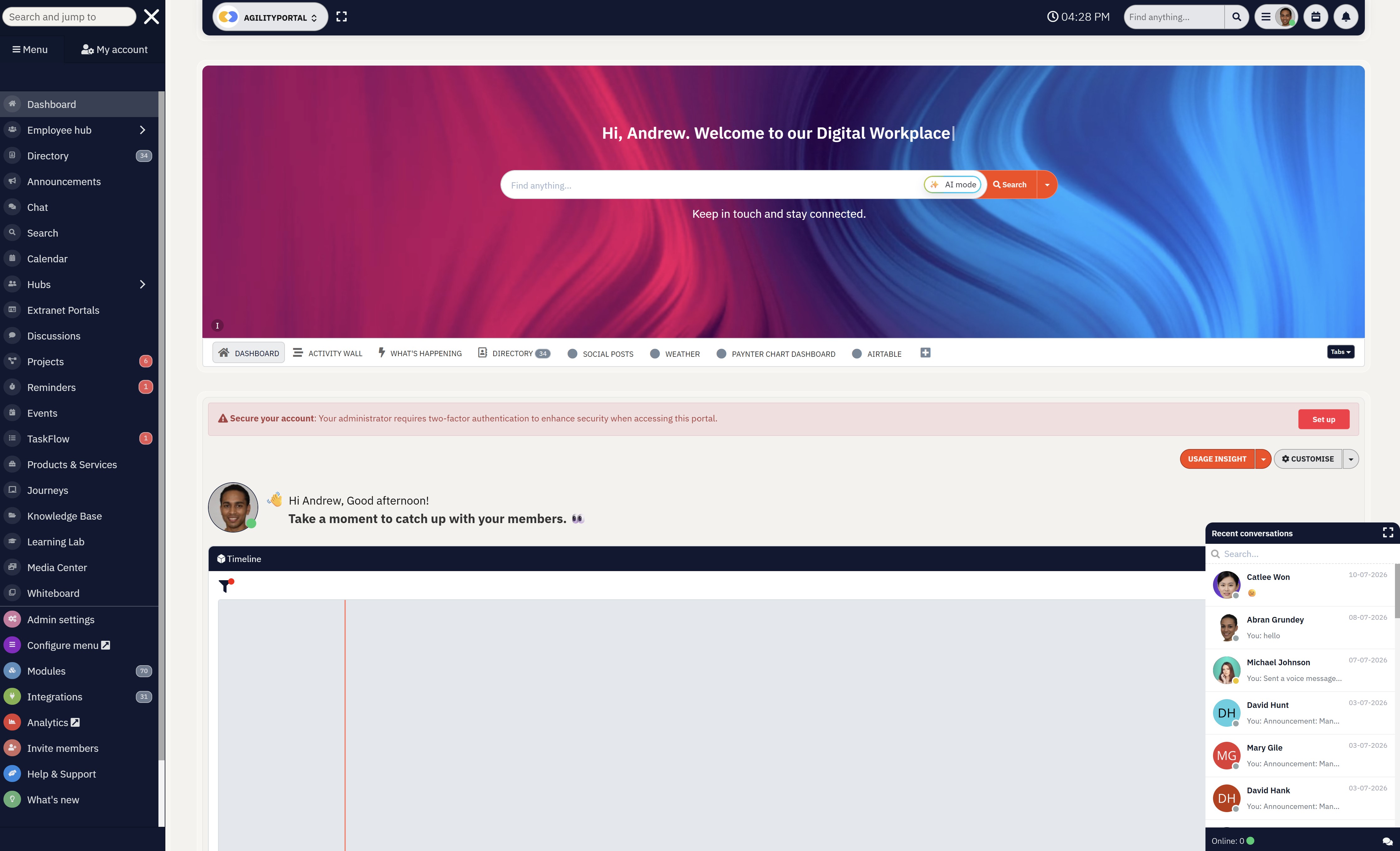
AgilityPortal is an all-in-one employee communication platform designed to bring your workforce together in a single digital workplace.
Whether your employees work from the office, at home, or on the frontline, everyone has access to the same news, conversations, documents, and business updates from one secure location.
Instead of switching between multiple workplace applications, employees can communicate, collaborate, and stay informed using one easy-to-use platform.
With AgilityPortal, organisations can:- Publish company announcements and leadership updates.
- Send instant messages to individuals, teams, or departments.
- Create dedicated collaboration spaces for projects and business units.
- Share policies, procedures, and knowledge through a searchable knowledge base.
- Collect employee feedback using polls, surveys, and forms.
- Recognise employee achievements to strengthen workplace culture.
- Deliver mobile notifications to remote and frontline employees in real time.
- Manage company events, training, and employee onboarding.
- Use AI-powered search to help employees quickly find information.
- Measure communication effectiveness with engagement analytics and reporting.
Modern employees expect communication to be fast, accessible, and available on any device.
AgilityPortal is built with a mobile-first approach, allowing employees to stay connected whether they're working in an office, on a construction site, in a healthcare setting, or travelling between customer locations.
By combining internal communications, collaboration, knowledge sharing, employee engagement, and business productivity tools into one platform, AgilityPortal helps organisations reduce communication silos, improve collaboration, and create a more connected workforce.
Whether your goal is to improve employee engagement, replace outdated intranet software, reduce workplace app fatigue, or strengthen communication across your entire organisation, AgilityPortal provides the tools businesses need to communicate with confidence.
Built for Better Workplace Communication
Improve Workplace Communication With One Connected Employee Platform
Poor communication in the workplace often happens when company news, workplace email, team conversations, documents, feedback, and employee resources are spread across too many disconnected systems.
AgilityPortal brings workplace communication, collaboration, knowledge sharing, employee engagement, and internal updates together in one secure digital workplace. This gives office-based, remote, hybrid, and frontline employees a clear place to find information and stay connected.
- Centralised company announcements, leadership messages, and workplace updates
- Real-time employee chat, group messaging, reminders, and team collaboration
- Mobile access for remote, hybrid, frontline, and deskless employees
- Employee recognition, polls, surveys, reactions, and two-way feedback tools
- Searchable knowledge bases, company policies, documents, and shared resources
- Targeted communication based on department, office, role, or employee group
- Engagement analytics to measure views, participation, adoption, and communication performance
Frequently Asked Questions
Why is workplace communication important?
Workplace communication is essential because it keeps employees informed, aligned, and working towards the same goals.
Clear communication helps improve collaboration, employee engagement, productivity, and decision-making while reducing misunderstandings and unnecessary delays.
Organisations that invest in effective communication often build stronger workplace cultures and retain employees for longer.
What are some examples of workplace communication?
There are many ways organisations communicate with employees every day.
Common examples include:
- Company announcements
- Team meetings
- Instant messaging
- Workplace email
- Video conferencing
- Employee recognition posts
- Pulse surveys
- Mobile notifications
- Knowledge base articles
- Project collaboration spaces
- Digital noticeboards
- Leadership updates
Using a combination of communication channels helps ensure employees receive the right information at the right time.
What are effective communication skills in the workplace?
Developing effective communication skills in the workplace enables employees to work together more efficiently and build stronger professional relationships.
Some of the most valuable communication skills include:
- Active listening
- Clear verbal communication
- Professional written communication
- Giving and receiving constructive feedback
- Empathy and emotional intelligence
- Conflict resolution
- Collaboration and teamwork
- Presentation skills
- Adaptability
- Asking thoughtful questions
Strong communication skills in the workplace help reduce misunderstandings, improve teamwork, and create a more positive working environment.
How can organisations improve communication at work?
Improving communication at work starts with having a clear communication strategy supported by the right tools and leadership.
Businesses can improve communication by:
- Using a central employee communication platform.
- Reducing the number of disconnected workplace apps.
- Encouraging two-way employee feedback.
- Keeping communication simple and consistent.
- Providing regular company updates.
- Making communication accessible on mobile devices.
- Measuring employee engagement and communication performance.
Small improvements made consistently often have the biggest long-term impact.
What causes poor communication in the workplace?
Poor communication in the workplace usually develops when employees struggle to access information or receive inconsistent messages.
Common causes include:
- Too many communication platforms.
- Lack of leadership communication.
- Information overload.
- Communication silos between departments.
- Limited employee feedback.
- Unclear expectations.
- Over-reliance on email.
- Outdated communication processes.
Addressing these issues can significantly improve collaboration, employee engagement, and business performance.
Is workplace email still important?
Yes. Although collaboration tools have become more popular, workplace email continues to play an important role for formal communication, policy updates, compliance notices, customer correspondence, and external business communication.
However, many organisations now combine email with instant messaging, mobile notifications, employee apps, and collaboration platforms to ensure important messages aren't missed.
How do internal communications and employee engagement work together?
There is a strong connection between internal communications and employee engagement. Employees who receive regular updates, understand company goals, and feel their opinions are valued are generally more engaged and motivated.
Effective internal communication helps organisations:
- Build trust with employees.
- Improve transparency.
- Recognise employee achievements.
- Encourage collaboration.
- Increase employee satisfaction.
- Strengthen workplace culture.
When communication improves, engagement often improves alongside it.
Is effective communication in the workplace training worthwhile?
Absolutely. Effective communication in the workplace training helps employees and managers develop the skills needed to communicate clearly, collaborate effectively, and resolve conflicts professionally.
Training programmes often cover topics such as:
- Active listening.
- Business writing.
- Giving constructive feedback.
- Leadership communication.
- Conflict management.
- Presentation skills.
- Communicating with remote and hybrid teams.
- Cross-functional collaboration.
Organisations that invest in communication training often see improvements in employee confidence, teamwork, productivity, and overall business performance.
What are the signs of effective communication in the workplace?
Successful organisations typically demonstrate effective communication in the workplace through consistent, transparent, and accessible communication practices.
Some common signs include:
- Employees understand company goals.
- Teams collaborate effectively.
- Information is easy to find.
- Managers communicate regularly.
- Employees actively share feedback.
- Decisions are made quickly.
- Workplace conflicts are resolved constructively.
- High levels of employee engagement and trust.
When these behaviours become part of everyday work, communication shifts from being a business challenge to a competitive advantage.
AI Summary
- The importance of workplace communication goes far beyond sharing information—it strengthens employee engagement, improves collaboration, increases productivity, and helps employees stay aligned with organisational goals.
- Effective workplace communication combines multiple channels, including workplace email, instant messaging, video meetings, mobile notifications, company announcements, and knowledge sharing to ensure employees receive the right information at the right time.
- Common workforce communication examples include leadership updates, employee recognition, team meetings, pulse surveys, digital noticeboards, onboarding communication, project collaboration spaces, mobile alerts, and AI-powered employee assistants.
- Poor communication in the workplace often results in lower productivity, information silos, employee disengagement, duplicated work, higher staff turnover, and inconsistent customer experiences.
- Modern employee communication platforms such as AgilityPortal help organisations centralise internal communications and employee engagement by combining messaging, announcements, collaboration, knowledge management, surveys, analytics, and AI-powered search into a single digital workplace.
- To improve communication at work, organisations should centralise communication, encourage two-way feedback, support mobile employees, measure engagement, invest in effective communication skills in the workplace training, and continuously optimise their communication strategy using employee feedback and analytics.
Most Popular Posts

Effective communication among team members is vital for the productivity and success of any organization. Surprisingly, 60% of companies lack a long-term internal communication strategy, which p...


Businesses thrive on communication for efficiency, productivity and accomplishment. When the right information is passed from the right designation in the organization, it promotes positivity an...

Categories
Blog
(3214)
Business Management
(396)
Employee Engagement
(235)
Digital Transformation
(219)
Growth
(150)
Intranets
(142)
Internal communications
(107)
Remote Work
(68)
Sales
(53)
Collaboration
(53)
Customer Experience
(33)
Culture
(30)
Knowledge Management
(29)
Project management
(29)
Leadership
(20)
Comparisons
(9)
News
(1)

Related Posts

Choosing the best ERP for Shopify often starts when the workarounds stop working. Your store shows stock that the warehouse can't find. Wholesale orders live in spreadsheets. Finance spends days reconciling payouts, while customer service...

Could choosing the wrong proxy disrupt your team's work or increase costs without improving results? When comparing rotating proxies vs static proxies, the answer depends on what your business needs: a consistent IP address for an ongoing sessi...

What happens when a buyer asks Google for the best employee communication platform—and discovers competing brands before reaching your website? Choosing the best link building services can help a digital workplace business strengthen its broade...

Could gaps in digital accessibility be stopping your employees from completing the training they need to do their jobs? Imagine a new starter opening a mandatory course, only to discover they can't follow the audio, navigate the quiz with a keyboard ...

The Amazon advertising agency landscape has changed dramatically over the past two years. With the introduction of AI-powered shopping experiences, Amazon Rufus, advanced attribution reporting, Sponsored Brands Video, and Amazon DSP enhancement...


Jill Romford
I am a digital nomad, lover of exploring new places and making friends.
I love to travel and I love the internet. I take pictures of my travels and share them on the internet using Instagram.
Traveler, entrepreneur, and community builder. I share my insights on digital marketing and social media while inspiring you to live your fullest life.
Ready to learn more? 👍
One platform to optimize, manage and track all of your teams. Your new digital workplace is a click away. 🚀
Free for 14 days, no credit card required.