Insight Blog
Agility’s perspectives on transforming the employee's experience throughout remote transformation using connected enterprise tools.
48 minutes reading time
(9503 words)
Benefits of AI Chatbots in Healthcare: A Buyer's Guide to AI in Healthcare That Saves Time

Benefits of AI Chatbots in Healthcare: A Buyer's Guide to AI in Healthcare That Saves Time
Discover the benefits of AI chatbots in healthcare. Compare features, costs, and key buying factors to choose the right solution for your organization.
Benefits of AI Chatbots in Healthcare: A Buyer's Guide to AI in Healthcare That Saves Time

If you've ever tried calling your doctor's surgery only to spend ages on hold or waited days for a simple appointment confirmation, you're not alone.
Healthcare teams are under huge pressure, balancing patient care with constant admin, calls, and repetitive tasks.
That's why the Benefits of AI Chatbots in Healthcare are getting so much attention.
They're not about replacing staff, but about handling routine work so clinicians can focus on patients.
The data supports this.
McKinsey reports nurses spend around 15% of their shift on documentation and 6% searching for information, while doctors spend about 11% on paperwork.
AI could give nurses back nearly 20% of their time, freeing them up for patient care.
20%
More Time for Patient Care
According to McKinsey, nurses spend around 15% of every shift on documentation and another 6% searching for information, while doctors spend approximately 11% of their clinical time completing paperwork. AI-powered automation could give nurses back nearly 20% of their working time to focus on patient care.
Source: McKinsey & Company — Reimagining the Nursing Workload
We're already seeing results.
The NHS has expanded AI tools to help patients find services faster and support clinicians with documentation.
Early outcomes showed phone queues dropping by nearly 30%, with doctors spending more time with patients.
30%
Fewer Phone Queues
Early NHS AI initiatives are already delivering measurable improvements. By introducing AI-powered patient support and clinical documentation tools, phone queues fell by nearly 30%, allowing clinicians to spend more time with patients and less time completing administrative tasks.
Source: NHS AI Pilot Programme (2026)
At the same time, patient expectations have shifted.
People want quick answers, easy booking, and 24/7 access—just like other digital services.
This is where modern health tech comes in. AI chatbots can answer common questions, book appointments, send reminders, and reduce routine enquiries.
The result is better patient experience and less pressure on staff.
If you're considering an AI chatbot, you're likely asking: is it secure, will it integrate, and will it deliver ROI?
This guide will walk you through the real-world Benefits of AI Chatbots in Healthcare, what to look for, and how to choose the right solution.
Key Takeaways
- AI chatbots in healthcare improve patient access by providing 24/7 support, automating routine enquiries, and reducing pressure on frontline teams without increasing headcount.
- The most successful healthcare AI chatbot implementations focus on operational efficiency, digital patient engagement, and measurable business outcomes rather than simply automating conversations.
- Enterprise medical chatbot software should integrate with EHR and EMR systems, patient self-service portals, appointment scheduling platforms, and existing healthcare workflows.
- Security and compliance are essential. Healthcare leaders should prioritise HIPAA and GDPR compliance, role-based permissions, encryption, audit logs, and secure patient communication.
- Choosing the right AI healthcare software requires evaluating scalability, vendor expertise, conversational AI capabilities, analytics, and long-term alignment with your organisation's digital health technology strategy.
The Biggest Challenges Facing Healthcare Today

The Biggest Challenges Facing Healthcare Today
The biggest challenge isn't a lack of technology—it's a lack of time.
Doctors, nurses, and administrative teams are under constant pressure to deliver high-quality patient care while managing endless paperwork, phone calls, appointment bookings, and routine enquiries.
According to McKinsey, nurses spend around 15% of their shift on documentation, while doctors spend approximately 11% of their clinical time on administrative tasks instead of treating patients.
15%
Nursing Shift on Documentation
According to McKinsey, nurses spend approximately 15% of every shift completing documentation, while doctors spend around 11% of their clinical time on administrative tasks instead of treating patients. Reducing this administrative burden through AI and workflow automation allows healthcare professionals to dedicate more time to delivering quality patient care.
Source: McKinsey & Company — Reimagining Healthcare Productivity
At the same time, patient expectations have changed.
People want to book appointments online, receive instant answers, and access healthcare services 24/7, just like they do with banking or online shopping.
Unfortunately, many healthcare providers still rely on busy phone lines and manual processes that struggle to keep up.
Staff shortages, rising operational costs, and disconnected systems only add to the problem.
Healthcare leaders are now turning to healthcare technology and health tech solutions that can automate repetitive tasks without compromising patient care.
This is where AI chatbots in healthcare are making a real difference—helping organisations improve efficiency, reduce administrative workloads, and give healthcare professionals more time to focus on what matters most: their patients.
JJ
Jessica Jones
Director | AgilityPortal
"Healthcare organisations don't have a patient problem—they have a capacity problem. Most clinicians want to spend more time caring for people, but too much of their day is consumed by administrative work, repetitive enquiries, and fragmented communication. The right AI chatbot doesn't replace healthcare professionals; it removes the friction that prevents them from delivering exceptional care. When AI is integrated into a secure employee communication platform, healthcare teams can respond faster, collaborate more effectively, and dedicate more time to the moments that matter most to patients."
Jessica Jones is a Director at AgilityPortal, where she works with healthcare organisations to modernise internal communication, streamline workflows, and implement AI-powered digital workplace solutions that improve operational efficiency and employee engagement.
What Are AI Chatbots in Healthcare?
When people hear the term AI chatbots in healthcare, they often imagine a robot replacing doctors or nurses.
That's not how today's technology works.
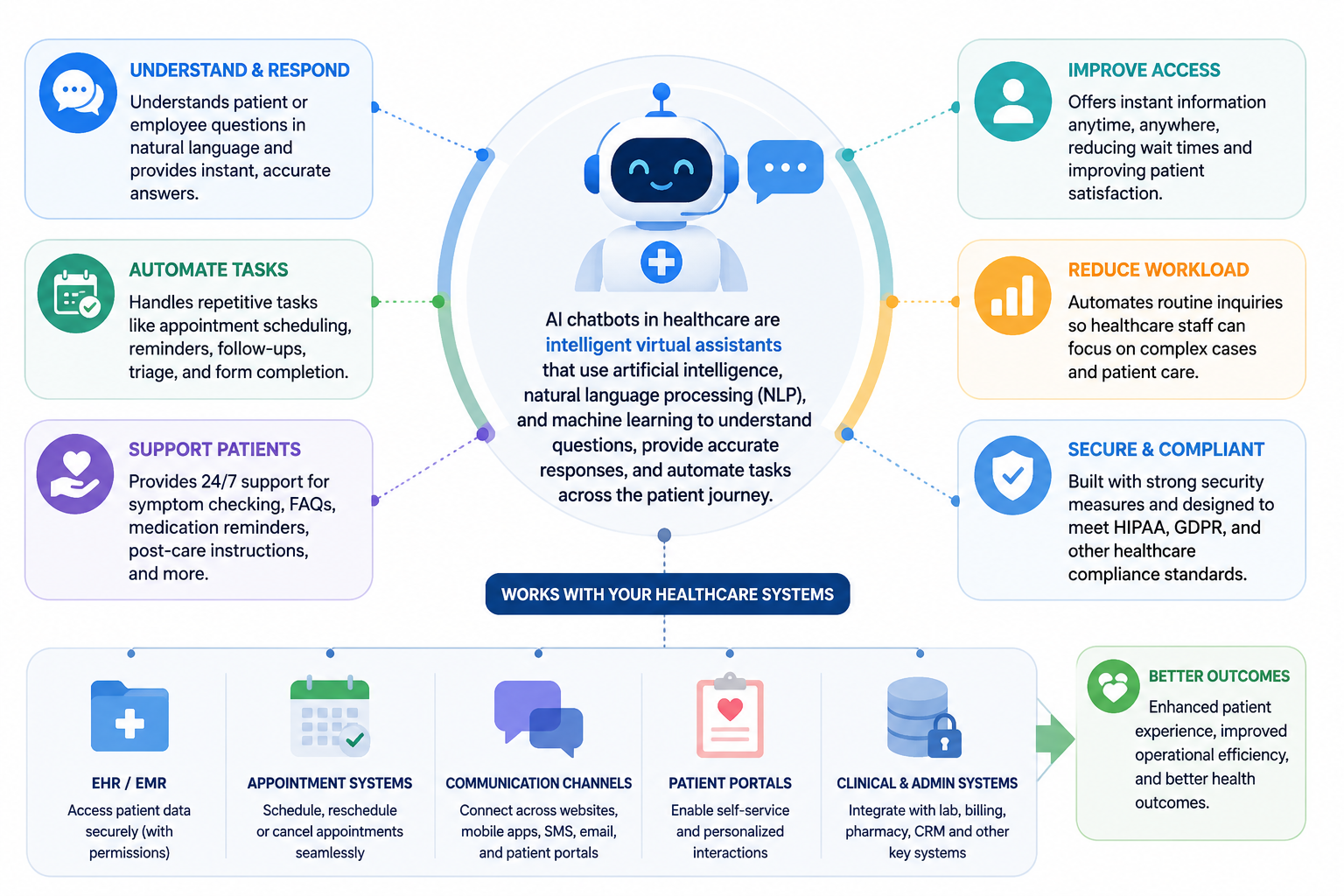
Think of an AI chatbot as a digital assistant that's available 24 hours a day. It can answer common questions, guide patients to the right services, book appointments, send reminders, and even help healthcare employees find information—all within seconds.
Instead of replacing healthcare professionals, it handles repetitive tasks so staff can spend more time delivering quality care.
It's also important to understand that not all chatbots are the same.
What Are AI Chatbots in Healthcare?
Conversational AI vs Rule-Based Chatbots
The simplest chatbots follow a fixed set of rules.
They're designed to answer specific questions by guiding users through pre-defined options, such as selecting from a menu or clicking buttons.
These are ideal for straightforward tasks like checking clinic opening hours or providing parking information.
Conversational AI chatbots are much more advanced. They use natural language processing (NLP) and machine learning to understand how people naturally speak or type.
Rather than relying on exact keywords, they can interpret intent, ask follow-up questions, remember context, and provide more personalised responses.
For example, if a patient types:
"I've had a sore throat for three days and I'm struggling to swallow."
A conversational AI chatbot can recognise the symptoms, ask additional questions, recommend the appropriate next step, or direct the patient to urgent care if necessary.
A rule-based chatbot, on the other hand, would usually respond only if the patient selected the correct predefined option.
Voice Bots vs Chatbots: Which One Is Right for Your Healthcare Needs?
You'll also hear the terms voice bots and chatbots used interchangeably, but they're designed for different experiences.
A chatbot communicates through text on websites, patient portals, or mobile apps, making it ideal for booking appointments, answering FAQs, or helping patients navigate healthcare services.
A voice bot performs similar tasks but through spoken conversation over the phone or smart devices.
Many hospitals now use voice AI to answer incoming calls, verify patient details, route callers to the correct department, or automate appointment confirmations without requiring a receptionist.
Together, these technologies help healthcare providers offer faster support while reducing pressure on busy administrative teams.
| Healthcare Challenge | Business Impact | How AI Chatbots Help |
| Staff shortages | Increased workload and burnout | Automate repetitive enquiries and administrative tasks |
| Long patient wait times | Lower patient satisfaction | Provide instant 24/7 responses |
| Administrative burden | Reduced productivity | Automate bookings, reminders, and FAQs |
| High call volumes | Overloaded reception teams | Handle thousands of conversations simultaneously |
| Rising operational costs | Higher cost per patient interaction | Improve efficiency without increasing headcount |
| Missed appointments | Lost revenue and wasted clinical time | Send automated reminders and confirmations |
| Disconnected systems | Time wasted searching for information | Integrate with EHR, CRM, and scheduling platforms |
Patient-Facing vs Employee-Facing AI Chatbots
Not every chatbot is built for patients.
Many healthcare organisations also use AI internally to support doctors, nurses, and administrative staff.
Patient-facing AI chatbots commonly help with:
- Booking or rescheduling appointments
- Symptom triage and directing patients to appropriate care
- Prescription refill reminders
- Answering insurance or billing questions
- Providing post-treatment instructions
- Sharing vaccination or screening reminders
- Answering frequently asked questions 24/7
Employee-facing AI chatbots are designed to support healthcare workers by helping them:
- Find HR policies and employee benefits
- Access clinical protocols and internal documentation
- Submit IT support requests
- Book annual leave or shifts
- Complete onboarding and mandatory training
- Quickly locate forms, procedures, and organisational resources
Chatbots in Healthcare Examples
There are already thousands of successful chatbots in healthcare being used around the world.
A hospital might use an AI chatbot to reduce the number of incoming phone calls by allowing patients to schedule appointments online.
A private clinic could use one to answer insurance queries after business hours. Mental health providers often use conversational AI to perform initial wellbeing assessments before connecting patients with a clinician.
Large healthcare systems also deploy internal chatbots to help employees quickly locate policies, submit HR requests, or find the information they need without searching through multiple systems.
As the technology continues to mature, healthcare tech providers are finding new ways to automate routine tasks while improving both patient satisfaction and operational efficiency.
The rapid adoption of conversational AI is also changing how people engage with digital health and wellness tools. Platforms built around AI-powered conversations are attracting millions of users, demonstrating growing demand for always-available, personalized interactions. For example, Character AI has more than 20 million monthly active users, highlighting how mainstream conversational AI has become and why healthcare organizations are increasingly exploring similar technologies for patient engagement and mental health support.
If you've been reading any chatbot in healthcare research paper, you'll notice a common theme.
The research consistently shows that AI chatbots perform best when they're used to support healthcare professionals—not replace them.
The biggest benefits come from reducing administrative workloads, improving access to information, shortening response times, and creating a smoother experience for both patients and staff.
Why Healthcare Providers Are Investing in AI Chatbots

Why Healthcare Providers Are Investing in AI Chatbots
Healthcare organisations aren't investing in AI chatbots because they're the latest trend—they're investing because they solve real problems.
Staff shortages, rising patient demand, and increasing administrative workloads are forcing hospitals and clinics to rethink how they deliver care.
The numbers tell the story.
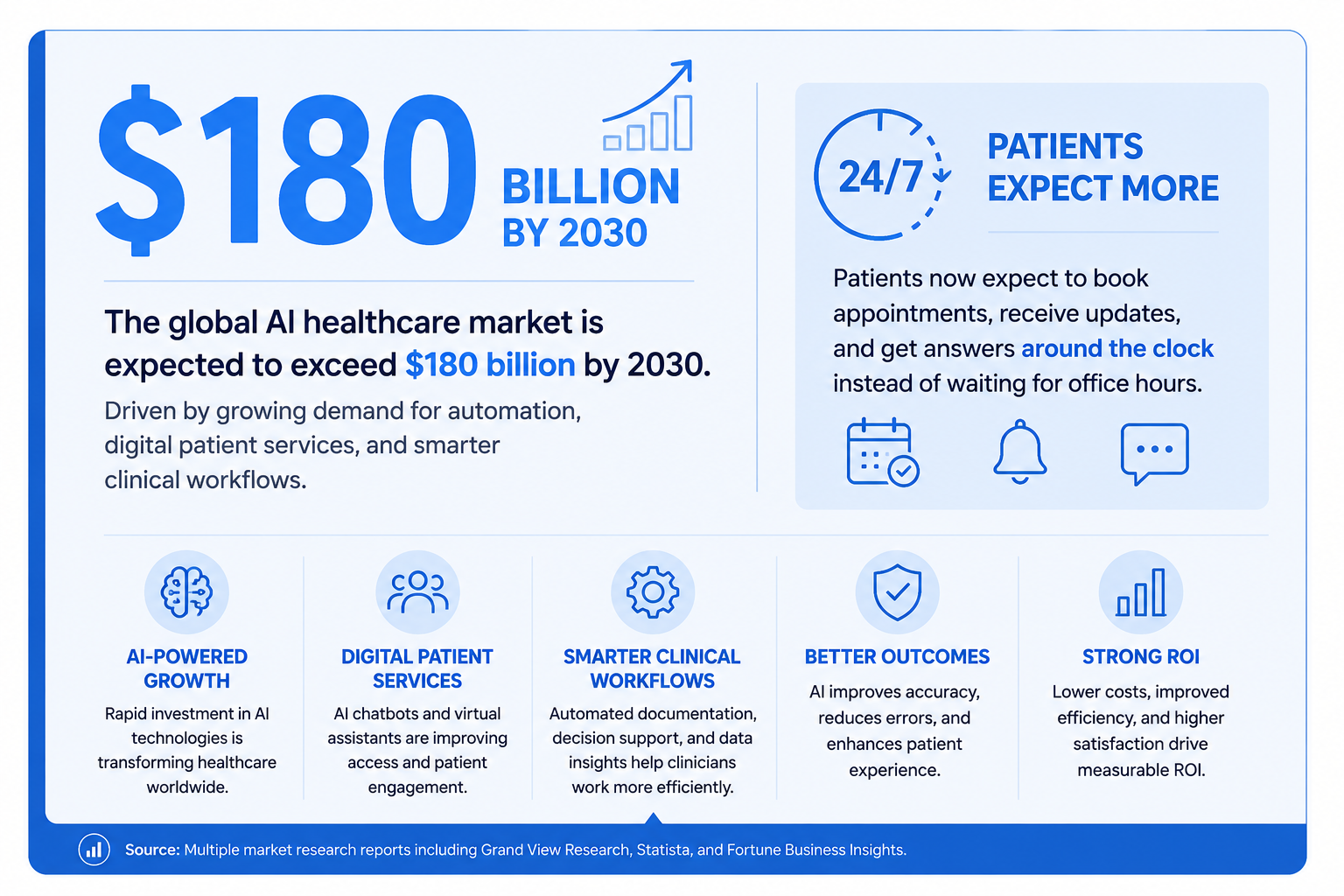
The global AI healthcare market is expected to exceed $180 billion by 2030, driven by growing demand for automation, digital patient services, and smarter clinical workflows.
At the same time, patients now expect to book appointments, receive updates, and get answers around the clock instead of waiting for office hours.
This shift has made health technology a strategic priority rather than a future ambition.
From large hospital networks to local GP practices, organisations are adopting health tech solutions that improve efficiency without sacrificing the quality of patient care.
Leading healthcare tech companies are responding by developing AI chatbots that can automate appointment scheduling, answer common patient questions, support symptom triage, and reduce the burden on reception teams.
Instead of replacing healthcare professionals, these tools free up valuable time so doctors, nurses, and administrative staff can focus on delivering better patient outcomes.
For many healthcare providers, AI chatbots are no longer a nice-to-have—they're becoming an essential part of modern healthcare delivery.
The global AI healthcare market is expected to exceed $180 billion by 2030
15 Strategic Reasons Healthcare Leaders Are Investing in AI Chatbots
Healthcare executives aren't investing in AI chatbots simply to keep up with the latest technology trends—they're investing because the business case is becoming impossible to ignore.
From reducing operational costs and easing workforce pressures to improving patient access and strengthening the digital experience, AI chatbots are helping healthcare organisations solve some of their biggest challenges while supporting long-term digital transformation goals.
The 15 strategic benefits below go beyond basic automation.
They highlight how AI chatbots can create measurable value across every part of a healthcare organisation, enabling leaders to improve efficiency, increase capacity, enhance patient satisfaction, and build a more resilient healthcare system without compromising the quality of care.
1. Expand Patient Access Without Expanding Headcount
For many healthcare leaders, the real challenge is not demand. It is capacity.
Patients expect faster access to services, but recruiting more administrative and clinical staff is becoming increasingly difficult.
Labour costs are rising, experienced employees are harder to retain, and existing teams are already under pressure. In that environment, simply adding more people is not a sustainable way to improve access.
AI chatbots offer a different model. They act as a digital extension of the workforce, handling routine patient interactions at scale.
They can:
- Answer common patient questions instantly
- Manage appointment bookings and rescheduling
- Send automated reminders and follow-ups
- Process cancellations efficiently
- Provide service and clinic information
- Direct patients to the appropriate department
From a CEO's perspective, the value lies in scalable service delivery. Every conversation handled automatically gives staff more time to focus on complex cases, vulnerable patients, and work that requires judgement and empathy.
This also changes the economics of growth. Traditionally, increasing patient access meant expanding call centres, hiring more reception staff, or extending opening hours. AI chatbots allow healthcare organisations to support more patients without increasing operating costs at the same rate.
The result is a more responsive service, lower pressure on frontline teams, and a stronger digital access model. For healthcare executives, this is not simply about automation.
It is about building an organisation that can meet rising demand while protecting margins, workforce capacity, and service quality.
2. Reduce Administrative Overhead Across Every Department
Administrative work has quietly become one of the biggest cost drivers in healthcare.
Every appointment booked, referral processed, insurance query answered, prescription renewed, or patient record updated requires valuable staff time.
While each task is essential, the combined workload places enormous pressure on administrative teams and pulls clinical staff away from patient care.
For healthcare executives, the challenge isn't simply reducing paperwork—it's improving operational efficiency across the entire organisation. AI chatbots can automate many of these repetitive interactions, from answering common patient questions and managing appointment requests to collecting pre-visit information and routing enquiries to the correct department.
This allows healthcare organisations to streamline processes, reduce manual effort, and make better use of existing resources.
Instead of increasing headcount to manage growing demand, leaders can reallocate employees to higher-value work that directly improves patient outcomes.
The result is a more efficient operation with lower administrative costs, faster response times, and a workforce focused on delivering care rather than managing routine tasks.
3. Improve Capacity Utilisation Across Clinical Services
Every unused appointment slot represents lost clinical capacity, while every missed appointment delays care for another patient.
Across hospitals, clinics, and specialist practices, inefficient scheduling can have a significant impact on both operational performance and patient outcomes.
AI chatbots help healthcare organisations maximise existing clinical capacity by automating appointment scheduling, sending personalised reminders, managing cancellations, and filling vacant appointment slots in real time.
Rather than relying on manual phone calls, patients can confirm, cancel, or reschedule appointments through a digital assistant in just a few clicks.
This improves appointment utilisation, reduces costly no-shows, and helps clinicians spend more time delivering care instead of waiting for missed appointments.
For healthcare executives, better capacity management means increasing patient throughput and improving service delivery without expanding facilities or recruiting additional staff.
4. Strengthen the Digital Patient Experience
Patients increasingly judge healthcare providers by the quality of their digital experience. Whether booking an appointment, requesting information, or asking a simple question, they expect the same speed and convenience they receive from other digital services.
AI chatbots create a modern digital front door that gives patients immediate access to the information and services they need.
Instead of waiting in telephone queues or navigating multiple departments, patients can receive instant answers, complete self-service tasks, and access support whenever it's convenient.
For healthcare organisations, this creates a more connected and consistent patient journey across websites, mobile applications, patient portals, and messaging platforms.
A better digital experience not only improves patient satisfaction but also strengthens trust, increases engagement, and encourages patients to use digital services rather than traditional support channels.
5. Protect Clinical Staff From Administrative Burnout
Healthcare professionals are facing unprecedented levels of administrative pressure.
Documentation, appointment coordination, patient enquiries, and routine administrative requests consume valuable time that could otherwise be spent providing care.
Administrative overload is also contributing to staff burnout, lower job satisfaction, and increasing workforce retention challenges. Recruiting new clinicians is difficult, but retaining experienced professionals is even more valuable.
AI chatbots help relieve this pressure by taking ownership of repetitive administrative interactions before they reach clinicians or support teams.
Common patient questions, scheduling requests, policy enquiries, and internal support requests can all be handled automatically, allowing healthcare professionals to focus on complex clinical decisions and meaningful patient interactions.
From an executive perspective, investing in technology that supports workforce wellbeing is no longer simply an operational improvement—it has become a strategic investment in organisational resilience, employee retention, and long-term service quality.
6. Improve Operational Resilience During Peak Demand
Healthcare demand is rarely predictable.
Seasonal illnesses, public health emergencies, vaccination programmes, and unexpected service disruptions can dramatically increase patient enquiries within a matter of hours.
Scaling traditional support teams during these periods is expensive and often impractical. Hiring temporary staff takes time, while existing employees are already operating under significant pressure.
AI chatbots provide healthcare organisations with the flexibility to manage sudden increases in demand without compromising service quality.
They continue answering patient questions, directing individuals to appropriate services, providing health information, and managing appointment requests regardless of the volume of incoming enquiries.
This operational resilience allows healthcare providers to maintain continuity during busy periods while protecting staff from becoming overwhelmed.
Instead of reacting to demand with additional resources, organisations can confidently scale patient support using intelligent automation.
7. Accelerate Patient Navigation and Care Pathways
One of the biggest frustrations for patients isn't necessarily waiting for treatment—it's knowing where to go in the first place. Many people contact the wrong department, book appointments they don't need, or spend valuable time trying to understand which service is right for them.
AI chatbots simplify this journey by acting as an intelligent first point of contact.
Rather than forcing patients to navigate complicated websites or wait on hold, the chatbot can ask a few simple questions before guiding them to the most appropriate service.
For example, an AI chatbot can help patients:
- Find the correct clinic or specialist
- Book appointments with the right department
- Access urgent care guidance
- Locate nearby healthcare facilities
- Receive pre-appointment instructions
- Understand referral requirements
By improving care navigation, healthcare organisations reduce unnecessary appointments, minimise administrative bottlenecks, and ensure clinicians spend more time treating patients who genuinely require their expertise.
8. Transform Every Patient Interaction Into Actionable Intelligence
Every patient conversation contains valuable information, but most organisations never use it.
Questions about appointment availability, prescription requests, waiting times, complaints, and service feedback often disappear once the interaction ends. AI chatbots change this by capturing structured data that can be analysed to improve operational performance.
Healthcare executives gain visibility into trends such as:
- Frequently asked patient questions
- Peak enquiry times
- Common service frustrations
- Appointment demand by department
- Patient satisfaction trends
- Emerging operational issues
Rather than relying solely on surveys, leaders gain continuous insights into what patients actually need. These analytics support better resource planning, service improvements, and more informed strategic decisions.
9. Create a Modern Digital Front Door
For many patients, their first impression of a healthcare organisation isn't made in a waiting room—it's made online.
Whether someone is booking an appointment, checking symptoms, or looking for opening hours, they expect a fast and intuitive digital experience. Unfortunately, many healthcare websites still feel disconnected, making it difficult for patients to find the information they need.
AI chatbots have become a key part of what many healthcare leaders call the digital front door. Instead of acting as another communication channel, they become the central access point for patient services.
Patients can:
- Book or change appointments
- Ask questions at any time
- Access forms and documents
- Request prescription renewals
- Find departments or specialists
- Receive personalised guidance
A seamless digital experience doesn't just improve patient satisfaction—it increases digital adoption, reduces pressure on reception teams, and strengthens the organisation's reputation for delivering modern healthcare.
10. Strengthen Security, Compliance, and Governance
Healthcare organisations manage some of the world's most sensitive information, making security and compliance non-negotiable.
Any new technology must protect patient privacy while supporting regulatory requirements such as HIPAA, GDPR, and local healthcare standards.
Enterprise AI chatbots are designed with governance in mind. Rather than allowing information to flow through unsecured messaging channels, they provide a secure and auditable environment for patient interactions.
Key capabilities often include:
- Role-based access controls
- End-to-end encryption
- Audit trails
- Consent management
- Secure authentication
- Data retention policies
For executives, this provides confidence that digital transformation initiatives support compliance without introducing unnecessary risk.
11. Connect Healthcare Systems Without Increasing Complexity
One of the biggest obstacles to digital transformation is the number of disconnected systems healthcare organisations rely on every day.
Patient records may sit inside an EHR, appointment scheduling in another application, HR data somewhere else, and internal knowledge spread across multiple platforms.
Modern AI chatbots don't replace these systems—they connect them.
Through integrations, employees and patients can access information from multiple platforms through a single conversation, reducing the need to switch between applications.
Typical integrations include:
- Electronic Health Records (EHR)
- Electronic Medical Records (EMR)
- Patient Portals
- Microsoft Teams
- CRM platforms
- Appointment management systems
- Knowledge bases
- HR systems
This creates a more connected digital workplace while reducing time spent searching for information.
12. Improve Employee Productivity Beyond Patient Services
AI chatbots aren't only valuable for patients—they can also transform the employee experience.
Healthcare staff frequently need access to HR policies, clinical procedures, IT support, onboarding documents, training resources, and internal communications. Finding this information often means searching multiple systems or contacting another department.
An internal AI chatbot gives employees instant access to the answers they need.
Instead of waiting for someone to respond, staff can quickly:
- Locate clinical guidelines
- Access hospital policies
- Submit IT support requests
- Check HR information
- Find training materials
- Complete onboarding tasks
By reducing the time employees spend searching for information, healthcare organisations improve productivity while creating a better experience for their workforce.
13. Scale Services Without Investing in Additional Infrastructure
Traditionally, supporting more patients required expanding facilities, increasing administrative staff, or growing contact centre operations.
AI changes that equation.
Because chatbots can handle thousands of conversations simultaneously, organisations can significantly increase patient capacity without investing in additional physical infrastructure.
This becomes particularly valuable during:
- Seasonal flu outbreaks
- Vaccination programmes
- Public health campaigns
- Unexpected service disruptions
- Periods of rapid organisational growth
Healthcare leaders gain a scalable support model that grows alongside patient demand while maintaining consistent service levels and controlling operational costs.
14. Future-Proof Your Digital Transformation Strategy
Healthcare is evolving rapidly, and organisations that invest in flexible digital platforms today will be far better prepared for tomorrow's challenges.
AI chatbots are no longer standalone tools—they're becoming an integral part of broader digital transformation strategies that include automation, patient engagement, analytics, and intelligent workflows.
Choosing the right platform today creates opportunities to expand into areas such as:
- AI-powered patient self-service
- Voice assistants
- Workflow automation
- Predictive analytics
- Remote patient engagement
- Intelligent knowledge management
Rather than solving a single operational problem, AI becomes a foundation for continuous innovation across the organisation.
15. Deliver Measurable Business Value and Return on Investment
Every technology investment should ultimately answer one question: Does it create measurable value?
The strongest business case for AI chatbots isn't based on replacing staff—it's based on improving efficiency, increasing capacity, and delivering better patient experiences while controlling costs.
Healthcare organisations commonly measure success using metrics such as:
- Reduced call volumes
- Faster response times
- Higher patient satisfaction scores
- Lower appointment no-show rates
- Increased digital self-service adoption
- Reduced administrative workload
- Improved workforce productivity
- Better utilisation of clinical resources
- Lower operational costs
For executive teams and boards, these outcomes translate into something far more valuable than automation alone.
They demonstrate that AI supports strategic objectives by improving operational performance, strengthening patient engagement, and enabling sustainable growth without placing additional pressure on already stretched healthcare teams.
What Are The Real-World AI Chatbot Use Cases Across Healthcare in 2026
One of the biggest misconceptions about AI chatbots is that they're only useful for large hospitals.
In reality, organisations of every size are using conversational AI to improve patient access, reduce administrative workloads, and deliver better digital experiences.
The use cases vary depending on the type of healthcare provider, but the objective is always the same: improve operational efficiency while making it easier for patients to access the care they need.
| Healthcare Provider | Common AI Chatbot Use Cases |
| Hospitals | Appointment scheduling, patient triage, visitor information, discharge instructions, department navigation and billing enquiries. |
| Private Clinics | Online appointment booking, patient follow-ups, prescription renewal requests, insurance queries and automated reminders. |
| Dental Practices | Appointment management, treatment FAQs, post-procedure care instructions, payment enquiries and recall reminders. |
| Mental Health Services | Initial wellbeing assessments, appointment scheduling, crisis signposting, therapy resources and patient check-ins. |
| Care Homes | Family communication, visitor information, staff support, resident updates and enquiry management. |
| Telehealth Providers | Virtual appointment scheduling, patient onboarding, identity verification, technical support and consultation reminders. |
| NHS Organisations | Service navigation, referral guidance, vaccination campaigns, prescription information, appointment management and patient self-service. |
AI Chatbot Use Cases in Hospitals for Patient Engagement and Operational Efficiency
Hospitals manage thousands of patient interactions every day, making them oneof the biggest beneficiaries of AI chatbot technology
Rather than overwhelming reception teams and contact centres, chatbots can answer routine questions instantly, help patients find the correct department, explain visiting policies, and assist with appointment management.
This reduces call volumes while ensuring staff can focus on delivering clinical care.
Key use cases include:
- Appointment scheduling and rescheduling
- Patient triage and symptom checking
- Department navigation and wayfinding
- Visitor information and visiting hours
- Billing and insurance enquiries
Private Clinics Use Cases
Private healthcare providers compete on patient experience as much as clinical expertise.
AI chatbots help clinics provide a premium digital experience by allowing patients to book appointments online, receive automated reminders, request prescription renewals, and ask questions without waiting for office hours.
This creates a more convenient experience while reducing the administrative burden on practice staff.
Key use cases include:
- Online appointment booking
- Automated reminders and follow-ups
- Prescription renewal requests
- Insurance and payment queries
- General patient enquiries
Dental Practices Use Cases
Dental practices often deal with a high volume of repetitive enquiries, from appointment availability and treatment costs to post-procedure advice.
AI chatbots automate these conversations, helping patients access information quickly while reducing interruptions for reception teams.
They can also improve attendance by sending automated reminders and allowing patients to reschedule appointments online.
Key use cases include:
- Appointment booking and rescheduling
- Treatment FAQs and pricing information
- Post-procedure care instructions
- Payment and insurance queries
- Recall and reminder notifications
Mental Health Services Use Cases
Access to mental health support often starts with communication.
AI chatbots can provide a confidential and accessible first point of contact, helping individuals find the right service, complete initial wellbeing assessments, access self-help resources, or book appointments.
While they are not a replacement for qualified professionals, they can improve access to support and reduce barriers for people seeking help.
Key use cases include:
- Initial wellbeing assessments
- Appointment scheduling
- Crisis support signposting
- Self-help resources and guidance
- Patient check-ins and follow-ups
Care Homes Use Cases
Care homes receive frequent enquiries from families, prospective residents, healthcare professionals, and suppliers.
AI chatbots can answer common questions about visiting hours, admissions, available services, and contact details, while also supporting internal staff with policies and operational information.
This improves communication without increasing administrative workload.
Key use cases include:
- Visitor information and visiting hours
- Admissions and availability enquiries
- Family communication updates
- Staff support and internal queries
- General information requests
Telehealth Providers Use Cases
Digital healthcare providers depend on seamless online experiences.
It can play an important role by guiding patients through registration, verifying information, scheduling virtual consultations, providing technical assistance, and sending reminders before appointments.
By automating these tasks, telehealth providers can deliver faster, more consistent patient experiences at scale.
Key use cases include:
- Patient onboarding and registration
- Identity verification
- Virtual appointment scheduling
- Technical support for consultations
- Appointment reminders and notifications
NHS Organisations Use Cases
Across NHS organisations, AI chatbots are increasingly being used to improve patient access while easing pressure on frontline services.
Common applications include directing patients to the most appropriate service, managing appointment enquiries, providing prescription information, supporting vaccination campaigns, and answering frequently asked questions.
As demand continues to grow, AI is becoming an important tool for improving efficiency while allowing healthcare professionals to dedicate more time to patient care.
Key use cases include:
- Service navigation and triage
- Appointment management
- Prescription and medication information
- Vaccination campaign support
- Frequently asked questions and patient self-service
What Features Should You Look for in a Healthcare AI Chatbot?
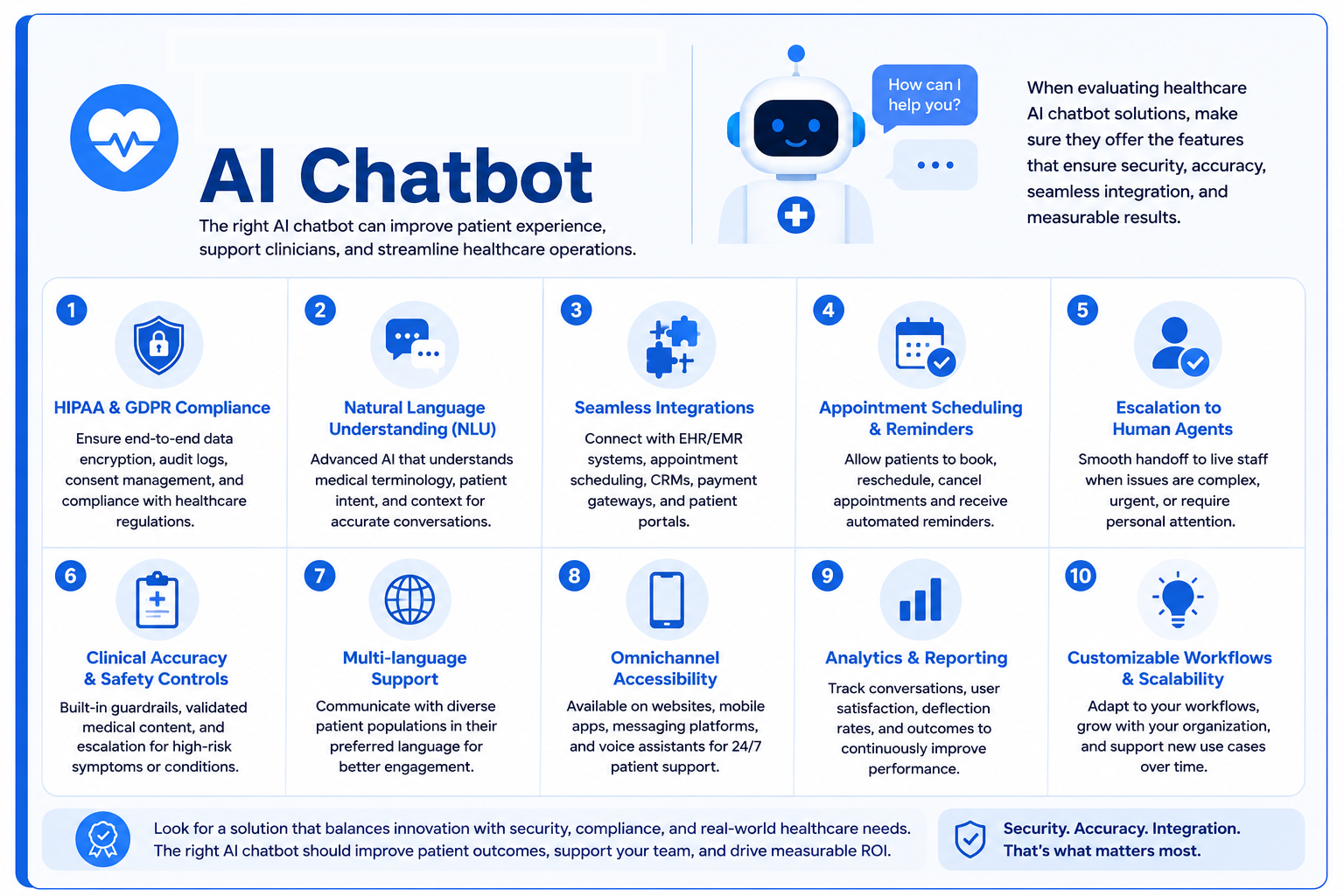
Choosing the right healthcare AI chatbot isn't about selecting the platform with the longest list of features.
It's about investing in a solution that improves patient access, integrates with your existing systems, protects sensitive health information, and delivers measurable business value.
As more healthcare organisations adopt AI, the market has become crowded with vendors making similar promises.
Before making an investment, healthcare executives should evaluate whether a platform aligns with their operational goals, compliance requirements, and long-term digital transformation strategy.
Here are the capabilities that matter most.
What Features Should You Look for in a Healthcare AI Chatbot?
AI That Understands Patients, Not Just Keywords
The best AI chatbots do far more than answer predefined questions. They understand natural conversations, recognise intent, and provide relevant responses without forcing patients to navigate endless menus.
Look for platforms that support:
- Natural Language Processing (NLP)
- Conversational AI
- Context-aware conversations
- Multi-language support
- Continuous AI learning and improvement
- Intelligent routing and escalation
For example, if a patient types "I've been coughing for several days and need to see someone this week," the chatbot should understand the request, identify the appropriate clinic, and guide the patient through the next steps rather than responding with a generic FAQ.
Seamless Integration With Your Existing Healthcare Systems
An AI chatbot should become part of your digital ecosystem—not another standalone application.
The most valuable healthcare chatbot software integrates with systems your organisation already uses, allowing patients and staff to access accurate information without switching between platforms.
Essential integrations include:
- Electronic Health Records (EHR)
- Electronic Medical Records (EMR)
- Patient Portals
- Appointment Scheduling Systems
- CRM Platforms
- Microsoft Teams
- Microsoft 365
- Knowledge Management Systems
- Identity Providers and Single Sign-On (SSO)
The fewer disconnected systems your staff need to manage, the greater the operational efficiency.
Enterprise-Grade Security and Healthcare Compliance
Healthcare organisations handle highly sensitive patient information, making security one of the most important evaluation criteria.
Any AI chatbot should support recognised security and compliance standards while giving your organisation complete control over patient data.
Look for capabilities such as:
- HIPAA compliance
- GDPR compliance
- SOC 2 certification
- End-to-end encryption
- Role-based access controls
- Audit logs
- Data retention policies
- Secure authentication and Single Sign-On
Strong governance ensures patient trust while reducing organisational risk.
Omnichannel Patient Communication
Patients expect to communicate through the channel that's most convenient for them.
Rather than limiting conversations to your website, modern healthcare chatbot platforms should provide a consistent experience across multiple digital touchpoints.
Support should include:
- Healthcare websites
- Patient portals
- Mobile applications
- SMS messaging
- Facebook Messenger
- Voice assistants
- Live chat
Providing patients with multiple ways to engage helps improve accessibility while reducing pressure on traditional call centres.
Analytics That Demonstrate Business Value
Implementing an AI chatbot is only the beginning. Executive teams also need evidence that the investment is delivering measurable results.
The right platform should provide dashboards that help monitor operational performance and identify opportunities for continuous improvement.
Key performance indicators include:
- Patient satisfaction scores
- Average response time
- First-contact resolution rate
- Appointment booking conversion
- Digital self-service adoption
- Call volume reduction
- Conversation completion rate
- Escalation rate to human staff
- Most common patient enquiries
These insights help healthcare leaders measure ROI, optimise patient services, and make informed decisions based on real operational data rather than assumptions.
Healthcare AI Chatbot Buyer's Checklist
Before selecting a vendor, ask these questions:
| Evaluation Criteria | Why It Matters |
| Does it integrate with your EHR or EMR? | Eliminates duplicate work and improves workflow efficiency. |
| Is it HIPAA and GDPR compliant? | Protects patient data and supports regulatory compliance. |
| Does it support conversational AI and NLP? | Creates more natural and accurate patient interactions. |
| Can patients book and manage appointments? | Improves access while reducing administrative workload. |
| Does it offer omnichannel communication? | Meets patients wherever they prefer to engage. |
| Are analytics and reporting included? | Enables leaders to measure adoption, efficiency, and ROI. |
| Can it scale as your organisation grows? | Supports long-term digital transformation initiatives. |
| Does the vendor provide implementation and ongoing support? | Helps ensure successful adoption across the organisation. |
Ultimately, the best healthcare AI chatbot isn't necessarily the one with the most features—it's the one that fits seamlessly into your existing workflows, supports your staff, improves the patient experience, and delivers measurable value over time.
When evaluated strategically, an AI chatbot becomes far more than a communication tool; it becomes a core component of your organisation's digital healthcare strategy.
Common Problems Buyers Make, That You Should Know About
Investing in a medical AI chatbot can transform patient communication and operational efficiency—but only if the implementation is approached strategically.
Many healthcare organisations focus heavily on features and pricing, only to discover later that the platform doesn't integrate with their existing systems, meet compliance requirements, or deliver the expected return on investment.
Whether you're evaluating conversational AI in healthcare for the first time or replacing an existing solution, avoiding these common mistakes can save your organisation significant time, money, and frustration.
Choosing Price Over Long-Term Value
Budget will always play a role in any purchasing decision, but selecting the cheapest solution often becomes the most expensive mistake.
Low-cost platforms may lack advanced AI capabilities, enterprise security, healthcare integrations, or the scalability required as your organisation grows.
Instead of evaluating vendors based solely on monthly subscription costs, healthcare leaders should consider the total value the platform delivers over its lifetime.
Ask yourself:
- Will it reduce administrative costs?
- Can it improve patient satisfaction?
- Will it increase operational efficiency?
- Can it scale with future demand?
The right investment should support your organisation's long-term health technology strategy, not simply solve today's problem.
Ignoring Security and Regulatory Compliance
Healthcare organisations manage highly sensitive patient information, making compliance one of the most critical evaluation criteria.
An AI medical chatbot that doesn't support healthcare regulations exposes organisations to unnecessary legal, financial, and reputational risks.
Before selecting any platform, confirm that it supports:
- HIPAA compliance (where applicable)
- GDPR compliance
- Data encryption
- Audit logs
- Role-based permissions
- Secure authentication
- Data retention policies
Compliance shouldn't be treated as an optional feature—it's a fundamental business requirement.
Overlooking Integration With Existing Healthcare Systems
One of the fastest ways to reduce the value of any new technology is to deploy it in isolation.
If your chatbot cannot connect with your Electronic Health Records (EHR), Electronic Medical Records (EMR), patient portal, appointment scheduling software, or CRM, your teams may end up duplicating work instead of eliminating it.
Modern healthcare tech should simplify operations by connecting systems, not creating additional silos.
Look for solutions that integrate with:
- EHR and EMR platforms
- Patient portals
- Appointment scheduling software
- Microsoft Teams and Microsoft 365
- CRM platforms
- Identity providers (SSO)
- Knowledge management systems
A connected digital ecosystem creates a far better experience for both patients and employees.
Focusing Only on Patient Support
Many buyers evaluate chatbots purely from the patient's perspective, overlooking the value they can provide internally.
Today's conversational AI in healthcare can support clinicians, administrators, HR teams, and IT departments by helping employees quickly find policies, clinical guidelines, training materials, and operational information.
By supporting both patients and employees, organisations maximise their return on investment while improving productivity across multiple departments.
Underestimating Change Management
Technology alone doesn't transform organisations—people do.
Even the most advanced chatbot will struggle if employees don't understand how it works or why it has been introduced.
Successful implementations typically include:
- Staff training sessions
- Executive sponsorship
- Internal communication campaigns
- Clear governance and ownership
- Ongoing performance reviews
When employees understand that AI is designed to support—not replace—them, adoption rates increase significantly.
Not Defining Success Before Implementation
Many healthcare organisations launch new technology without agreeing on what success actually looks like.
Before deploying a chatbot, leadership teams should identify measurable objectives that align with wider business goals.
Examples include:
- Reduce patient call volumes by 30%
- Increase online appointment bookings
- Improve patient satisfaction scores
- Reduce average response times
- Lower administrative workload
- Increase digital self-service adoption
Defining KPIs from the outset makes it easier to demonstrate business value and secure future investment.
Choosing a Vendor Without a Long-Term Vision
An AI chatbot shouldn't be viewed as a standalone project.
The best platforms become part of a broader health tech and digital transformation strategy, supporting automation, patient engagement, workforce productivity, and operational efficiency for years to come.
When evaluating vendors, ask questions beyond today's requirements.
Consider:
- How often is the AI platform updated?
- Does the roadmap include new healthcare capabilities?
- Can the platform support future automation initiatives?
- Is the vendor experienced in healthcare?
- Will the solution scale as your organisation grows?
Healthcare leaders aren't simply buying software—they're investing in technology that should continue delivering value as patient expectations, regulatory requirements, and healthcare delivery continue to evolve.
Healthcare AI Chatbot Implementation Checklist
Choosing the right AI chatbot is only half the journey.
A successful implementation requires careful planning, cross-functional collaboration, and ongoing optimisation.
Use this checklist to ensure your organisation is well-prepared before launching a new AI chatbot.
| ✔ Checklist Item | Why It Matters | Status |
| Define clear business objectives | Identify what success looks like, whether it's reducing call volumes, improving patient satisfaction, increasing appointment bookings, or lowering administrative costs. | ☐ |
| Identify high-impact use cases | Start with repetitive, high-volume processes such as appointment scheduling, FAQs, prescription requests, or patient navigation. | ☐ |
| Engage key stakeholders early | Involve clinical leaders, operational managers, IT, compliance, HR, and patient services to ensure organisation-wide support. | ☐ |
| Review existing workflows | Map current patient journeys and identify where automation will create the greatest operational value. | ☐ |
| Audit existing healthcare systems | Review your EHR, EMR, patient portal, CRM, scheduling platform, and communication tools to understand integration requirements. | ☐ |
| Confirm integration capabilities | Ensure the chatbot connects with existing systems without creating duplicate work or isolated data silos. | ☐ |
| Complete a security and compliance review | Verify the platform supports HIPAA, GDPR, encryption, audit logs, role-based permissions, and organisational governance policies. | ☐ |
| Develop conversation workflows | Design patient journeys for appointment booking, cancellations, FAQs, symptom guidance, prescription requests, and escalation to staff. | ☐ |
| Define escalation procedures | Decide when conversations should be transferred to reception teams, clinicians, or specialist departments. | ☐ |
| Create a knowledge base | Prepare accurate answers for frequently asked questions, policies, clinic information, and patient guidance before launch. | ☐ |
| Train employees | Ensure reception teams, clinicians, administrators, and managers understand how the chatbot works and how it supports their roles. | ☐ |
| Run a pilot programme | Launch with a single department or patient group before rolling out across the organisation. | ☐ |
| Collect staff and patient feedback | Use surveys and analytics to identify opportunities for improvement before wider deployment. | ☐ |
| Monitor key performance indicators (KPIs) | Track patient satisfaction, response times, call reduction, appointment bookings, chatbot adoption, and escalation rates. | ☐ |
| Continuously optimise | Review chatbot conversations regularly, update knowledge, refine AI responses, and add new workflows as organisational needs evolve. | ☐ |
Executive Tip
Don't try to automate everything on day one.
The most successful healthcare organisations begin with one or two high-impact use cases—such as appointment scheduling or patient enquiries—measure the results, and then expand gradually.
This phased approach reduces implementation risk, encourages staff adoption, and allows your organisation to demonstrate measurable ROI before scaling AI across additional departments.
Further Reading & Trusted Resources
If you're researching AI chatbots for healthcare or planning a digital transformation initiative, the following resources provide valuable guidance, industry research, and evidence-based insights.
Healthcare AI & Chatbot Research
A comprehensive overview of how healthcare chatbots are being used, their benefits, limitations, and implementation considerations.
A physician-led study evaluating the safety of leading AI chatbots for medical advice and highlighting the importance of clinical oversight.
An in-depth review covering AI agents, patient-facing chatbots, clinical decision support, workflow automation, and future healthcare applications.
Healthcare Technology & Innovation
Explore real-world examples of clinician-reviewed AI chatbots supporting cancer care, cataract surgery, diabetic retinopathy, and community healthcare workers.
A detailed analysis of how leading technology companies are shaping the future of AI-powered healthcare assistants and digital patient engagement.
Best Practice Guidance
When evaluating an AI chatbot platform, healthcare leaders should ensure it:
- Supports HIPAA and GDPR compliance
- Integrates with EHR and EMR systems
- Includes audit logs and role-based permissions
- Provides clear escalation paths to human clinicians
- Delivers measurable analytics and ROI reporting
- Supports secure patient communication across multiple channels
- Is designed to assist healthcare professionals—not replace clinical judgement
Remember, even the most advanced AI chatbot should complement healthcare professionals rather than replace them.
Current research consistently shows that AI delivers the greatest value when used to automate administrative tasks, improve patient access, and support clinical workflows while keeping qualified healthcare professionals responsible for diagnosis, treatment decisions, and patient care.
Looking for a Healthcare Communication Platform With Built-In AI?

Looking for a Healthcare Communication Platform With Built-In AI?
Implementing an AI chatbot is only one piece of the puzzle. Healthcare organisations also need a secure platform that connects employees, streamlines communication, centralises knowledge, and supports day-to-day operations.
That's where AgilityPortal comes in.
AgilityPortal is a secure communication and collaboration platform with built-in AI, designed to help healthcare teams work more efficiently from one place.
With AgilityPortal, organisations can deploy AI chatbots, centralise information, improve internal communication, and automate everyday workflows—all while keeping data secure.
Instead of juggling multiple tools, teams get a single platform that supports better coordination, faster access to information, and improved patient care.
Ready to modernise your healthcare workplace? Explore how AgilityPortal can support your organisation.
AgilityPortal
One Secure Healthcare Platform. Built-In AI. Better Connected Teams.
Implementing a medical AI chatbot is only one part of delivering a modern digital healthcare experience. Healthcare organisations also need a secure platform that connects clinicians, administrators, frontline workers, and support teams while keeping communication, documents, knowledge, and workflows in one place.
AgilityPortal combines a healthcare communication platform with built-in AI chatbots, knowledge management, employee collaboration, workflow automation, and intelligent search—giving your organisation everything it needs to improve employee productivity and patient outcomes from a single digital workplace.
✔ Built-in AI Assistants for employees
✔ Secure communication for healthcare teams
✔ Digital workplace for hospitals, clinics and care providers
✔ 14-day free trial available — No credit card required
Discover how AgilityPortal helps healthcare organisations connect employees, automate workflows, and deploy AI from one secure platform.
✔ Secure communication for healthcare teams
✔ Digital workplace for hospitals, clinics and care providers
✔ 14-day free trial available — No credit card required
Final Thoughts
The conversation around AI in healthcare has moved far beyond simple automation.
Today's AI chatbots are no longer just digital assistants that answer frequently asked questions—they're becoming an essential part of how modern healthcare organisations improve patient access, streamline operations, and support overburdened clinical teams.
As patient expectations continue to rise and workforce challenges persist, healthcare leaders need solutions that do more than solve short-term problems.
The right AI chatbot should strengthen your organisation's digital front door, reduce administrative overhead, improve communication, and help patients access the right care more quickly. At the same time, it must meet the highest standards for security, compliance, and data privacy.
However, technology alone isn't the answer.
The most successful implementations happen when AI is viewed as part of a broader digital transformation strategy rather than a standalone project.
That means choosing a platform that integrates seamlessly with your Electronic Health Record (EHR), Electronic Medical Record (EMR), patient portal, scheduling software, and other core healthcare systems. A connected ecosystem creates a better experience for both patients and employees while eliminating unnecessary manual work.
As you evaluate different vendors, look beyond feature lists and marketing promises.
Ask how the platform will support your organisation over the next five years, not just the next five months. Consider its ability to scale as patient demand grows, adapt to changing regulations, and evolve alongside your wider health technology strategy.
Ultimately, the value of an AI medical chatbot isn't measured by the number of conversations it handles—it's measured by the outcomes it delivers.
Faster patient access, reduced administrative workloads, higher staff productivity, improved patient satisfaction, and measurable operational efficiencies are the metrics that matter most.
Healthcare is changing rapidly, and organisations that invest in intelligent, integrated healthcare tech today will be better positioned to meet tomorrow's challenges.
The goal isn't to replace people with AI—it's to give healthcare professionals the time, tools, and support they need to deliver exceptional care while building a more resilient, efficient, and patient-centred organisation.
Frequently Asked Questions About AI Chatbots in Healthcare
Are AI chatbots safe to use in healthcare?
Yes—provided you choose an enterprise-grade healthcare AI chatbot designed specifically for healthcare.
The best platforms support HIPAA and GDPR compliance, encrypt patient data, maintain audit logs, and use role-based permissions to protect sensitive information.
A secure medical AI chatbot should always complement clinical workflows rather than replace healthcare professionals.
What is the difference between a medical AI chatbot and a traditional chatbot?
A traditional chatbot usually follows predefined rules and responds to basic questions.
An AI medical chatbot uses natural language processing (NLP) and machine learning to understand conversations, recognise patient intent, and provide more personalised responses.
Modern conversational AI in healthcare can assist with appointment scheduling, patient navigation, symptom guidance, and administrative support, creating a far better experience for both patients and staff.
What are the biggest benefits of AI chatbots in healthcare?
The Benefits of AI Chatbots in Healthcare extend far beyond answering frequently asked questions.
Healthcare organisations commonly use AI to:
- Reduce administrative workloads
- Improve patient access to care
- Automate appointment scheduling
- Support digital patient engagement
- Increase operational efficiency
- Improve patient satisfaction
- Reduce call centre volumes
- Support clinicians with routine administrative tasks
- Deliver 24/7 AI patient support
Ultimately, AI enables healthcare teams to spend less time on repetitive administration and more time delivering high-quality patient care.
Can AI chatbots replace doctors or nurses?
No.
AI should never replace clinical judgement or healthcare professionals.
Instead, a clinical chatbot supports clinicians by automating repetitive administrative work, helping patients access information, and improving communication across the organisation.
Healthcare leaders see AI as a workforce enablement tool—not a replacement for human expertise.
Can AI chatbots schedule patient appointments?
Absolutely.
One of the most common applications of AI appointment scheduling is allowing patients to book, reschedule, or cancel appointments without speaking to reception staff.
This helps healthcare providers:
- Reduce call volumes
- Minimise appointment no-shows
- Improve clinic utilisation
- Offer patients 24/7 self-service booking
- Reduce administrative costs
Can AI chatbots perform symptom assessments?
Many organisations use an AI symptom checker to help patients understand the most appropriate next step based on the symptoms they report.
However, it's important to understand that AI symptom checkers are designed to support care navigation—not diagnose medical conditions.
Patients presenting urgent or complex symptoms should always be referred to qualified healthcare professionals.
How does conversational AI improve patient engagement?
Conversational AI in healthcare makes communication faster, easier, and more accessible.
Rather than waiting on hold, patients can receive instant answers, complete routine tasks, and access support whenever they need it.
A modern patient engagement chatbot can:
- Answer common questions
- Send appointment reminders
- Share post-treatment guidance
- Support medication adherence
- Collect patient feedback
- Guide patients to appropriate services
This creates a more connected patient journey while improving overall satisfaction.
What integrations should healthcare organisations look for?
The best AI healthcare software integrates with the systems healthcare providers already use every day.
These typically include:
- Electronic Health Records (EHR)
- Electronic Medical Records (EMR)
- Patient self-service portals
- Appointment scheduling platforms
- Microsoft Teams
- CRM systems
- Knowledge management platforms
- Identity providers and Single Sign-On
A connected platform supports healthcare workflow automation while reducing duplicate work across departments.
Are AI chatbots suitable for hospitals as well as small clinics?
Yes.
Whether you're operating a regional hospital, specialist practice, dental clinic, private healthcare provider, or community health organisation, AI can be adapted to your operational needs.
Many organisations use:
- Hospital chatbot software to support patient navigation and appointment management.
- Healthcare customer service automation to reduce pressure on reception teams.
- A virtual healthcare assistant to answer common patient enquiries around the clock.
The use case may differ, but the objective remains the same: improving efficiency while enhancing patient care.
What should healthcare leaders look for when choosing a chatbot platform?
Selecting the best AI chatbots in healthcare requires more than comparing feature lists.
Healthcare executives should evaluate whether the platform offers:
- Enterprise-grade security
- HIPAA and GDPR compliance
- AI-powered conversations
- EHR and EMR integrations
- Omnichannel communication
- Analytics and reporting
- Scalability
- Vendor implementation support
The right solution should become part of your wider health technology strategy rather than operate as another standalone application.
Are there real examples of chatbots in healthcare?
Yes. There are thousands of successful chatbots in healthcare examples across hospitals, private clinics, dental practices, mental health providers, care homes, telehealth organisations, and NHS Trusts.
Organisations use AI to:
- Improve AI patient communication
- Automate appointment management
- Support patient onboarding
- Deliver prescription reminders
- Reduce administrative enquiries
- Enable digital patient engagement
- Improve operational efficiency through healthcare automation
As healthcare tech continues to evolve, AI is becoming a core component of modern health tech strategies, helping organisations deliver better patient experiences while reducing operational costs.
Is there research supporting AI chatbots in healthcare?
Yes.
There is a growing body of evidence from peer-reviewed chatbot in healthcare research paper publications showing that AI can improve administrative efficiency, patient engagement, and access to healthcare services when implemented responsibly.
The strongest outcomes occur when AI is used to support clinicians rather than replace them.
Modern healthcare technology combines intelligent automation with human expertise, allowing organisations to deliver safer, faster, and more personalised care while accelerating their digital transformation initiatives.
AI Summary
- AI chatbots in healthcare help hospitals, clinics, and other care providers improve patient access, reduce administrative pressure, and provide faster support without increasing headcount at the same rate.
- A healthcare AI chatbot can answer routine questions, manage appointment bookings, send reminders, support patient navigation, and provide 24/7 digital assistance while allowing clinicians and administrative teams to focus on higher-value work.
- The biggest benefits of AI chatbots in healthcare include lower call volumes, improved patient satisfaction, reduced appointment no-shows, faster response times, better workforce productivity, and more efficient use of clinical capacity.
- Conversational AI in healthcare works best when it supports healthcare professionals rather than replacing clinical judgement, with clear escalation routes for urgent, complex, or sensitive patient enquiries.
- Healthcare leaders should assess security, compliance, EHR and EMR integrations, scalability, analytics, multilingual support, human handover, and vendor experience before selecting medical chatbot software.
- A successful implementation should begin with clearly defined use cases, measurable KPIs, strong governance, staff training, a controlled pilot, and ongoing optimisation based on patient feedback and performance data.
Most Popular Posts

Effective communication among team members is vital for the productivity and success of any organization. Surprisingly, 60% of companies lack a long-term internal communication strategy, which p...


Businesses thrive on communication for efficiency, productivity and accomplishment. When the right information is passed from the right designation in the organization, it promotes positivity an...

Categories
Blog
(3214)
Business Management
(396)
Employee Engagement
(235)
Digital Transformation
(219)
Growth
(150)
Intranets
(142)
Internal communications
(107)
Remote Work
(68)
Sales
(53)
Collaboration
(53)
Customer Experience
(33)
Culture
(30)
Knowledge Management
(29)
Project management
(29)
Leadership
(20)
Comparisons
(9)
News
(1)

Related Posts

Choosing the best ERP for Shopify often starts when the workarounds stop working. Your store shows stock that the warehouse can't find. Wholesale orders live in spreadsheets. Finance spends days reconciling payouts, while customer service...

Could choosing the wrong proxy disrupt your team's work or increase costs without improving results? When comparing rotating proxies vs static proxies, the answer depends on what your business needs: a consistent IP address for an ongoing sessi...

What happens when a buyer asks Google for the best employee communication platform—and discovers competing brands before reaching your website? Choosing the best link building services can help a digital workplace business strengthen its broade...

Could gaps in digital accessibility be stopping your employees from completing the training they need to do their jobs? Imagine a new starter opening a mandatory course, only to discover they can't follow the audio, navigate the quiz with a keyboard ...

The Amazon advertising agency landscape has changed dramatically over the past two years. With the introduction of AI-powered shopping experiences, Amazon Rufus, advanced attribution reporting, Sponsored Brands Video, and Amazon DSP enhancement...


Jill Romford
I am a digital nomad, lover of exploring new places and making friends.
I love to travel and I love the internet. I take pictures of my travels and share them on the internet using Instagram.
Traveler, entrepreneur, and community builder. I share my insights on digital marketing and social media while inspiring you to live your fullest life.
Ready to learn more? 👍
One platform to optimize, manage and track all of your teams. Your new digital workplace is a click away. 🚀
Free for 14 days, no credit card required.