Insight Blog
Agility’s perspectives on transforming the employee's experience throughout remote transformation using connected enterprise tools.
51 minutes reading time
(10263 words)
AI-Powered Workplace Management: How AI Is Changing the Modern Workplace

AI-Powered Workplace Management: How AI Is Changing the Modern Workplace
This title aligns perfectly with the content you've already written, naturally includes the primary keyword, and is likely to attract broader search traffic because users looking for examples, benefits, software, systems, workflows, and best practices would all find it relevant.
AI-Powered Workplace Management: How AI Is Changing the Modern Workplace

Its 2026 and the way we work is changing faster than at any point in the last decade.
Employees now expect instant access to information, leaders need better visibility into performance, and businesses are under constant pressure to do more with fewer resources.
As a result, many organizations are moving away from traditional workplace management approaches and embracing AI-powered workplace management to improve productivity, communication, and decision-making.
The shift is already underway.
According to a report by the consulting firm McKinsey, generative AI could add between $2.6 trillion and $4.4 trillion in value to the global economy annually, with workplace productivity being one of the biggest beneficiaries.
Companies that fail to adapt risk falling behind competitors that are using intelligent automation to streamline operations, reduce manual work, and create better employee experiences.
$4.4T
annual economic value
According to McKinsey, generative AI could contribute between $2.6 trillion and $4.4 trillion to the global economy every year, with workplace productivity expected to be one of the largest beneficiaries.
Source: McKinsey Global Institute
From automated onboarding and employee support to smarter collaboration and workflow optimization, modern workplace management software is evolving into a strategic business tool rather than just an administrative platform.
Organizations are increasingly investing in workplace management systems that can connect teams, automate routine tasks, and provide actionable insights in real time.
In this article, you'll discover practical AI powered workplace examples, explore AI workflow examples that save teams hours every week, learn how creating AI enabled workflows can support daily project management activities, and understand both the benefits of AI in the workplace and the challenges businesses should consider before implementation.
Whether you're evaluating new workplace technologies or planning your digital workplace strategy, this guide will help you understand where workplace management is heading and how your organization can stay ahead.
Key Takeaways
- AI-powered workplace management helps organizations improve productivity, employee communication, collaboration, and operational efficiency through intelligent automation.
- Modern workplace management software uses AI to automate repetitive tasks, streamline approvals, improve knowledge sharing, and provide employees with faster access to information.
- Common AI workflow examples include employee onboarding, leave requests, policy acknowledgements, project management automation, help desk routing, and internal communications.
- The benefits of AI in the workplace include reduced administrative workload, improved employee engagement, better decision-making, enhanced workplace collaboration, and faster business processes.
- Organizations that successfully implement workplace management systems with AI capabilities can create a more connected, efficient, and future-ready digital workplace.
What Is AI-Powered Workplace Management and Why Does It Matter?

What Is AI-Powered Workplace Management and Why Does It Matter
Workplace management has traditionally focused on coordinating people, processes, communication, and resources to keep organizations running efficiently.
However, as businesses become more digital and distributed, traditional approaches are struggling to keep pace with growing demands for productivity, collaboration, and real-time decision-making.
This is where AI-powered workplace management is changing the game.
How Workplace Management Has Evolved Over the Last Decade
A decade ago, most organizations relied on disconnected tools, spreadsheets, emails, and manual processes to manage workplace operations.
While these methods worked for smaller teams, they often created bottlenecks, duplicated work, and made it difficult to access critical information quickly.
Today, businesses are adopting modern workplace management software that centralizes communication, knowledge sharing, project coordination, employee engagement, and workflow automation within a single platform.
The goal is no longer simply managing work—it's creating a smarter, more connected workplace where employees can perform at their best.
The Role of AI in Modern Workplace Operations
Artificial intelligence is helping organizations move beyond basic automation and toward intelligent decision-making.
From automated employee onboarding and content recommendations to predictive analytics and smart search capabilities, AI is transforming how teams operate.
Many organizations are already using AI powered workplace examples such as virtual assistants, intelligent knowledge bases, automated approvals, sentiment analysis, and workflow optimization tools to reduce repetitive tasks and improve employee experiences.
Beyond software, AI is also moving into everyday hardware. AI glasses with camera functionality are an emerging example - wearable devices that bring hands-free AI assistance, real-time information, and visual capture into the flow of daily work, without requiring employees to reach for a screen.
These innovations allow employees to focus on high-value work instead of spending hours on manual administration.
Why Organizations Are Investing in Smarter Workplace Management Systems
Businesses are increasingly investing in advanced workplace management systems because they recognize that efficiency, agility, and employee experience are directly linked to business performance.
Intelligent platforms help organizations automate routine processes, improve collaboration, and gain greater visibility into workplace operations.
One of the biggest drivers of adoption is the growing use of AI-enabled workflows.
Whether it's automating leave requests, streamlining approvals, improving project tracking, or supporting managers with real-time insights, organizations are discovering how AI workflow examples can eliminate delays and improve productivity across every department.
As the workplace continues to evolve, companies that embrace AI-powered workplace management will be better positioned to adapt, innovate, and compete in an increasingly digital business environment.
Key Takeaways
- Enterprise collaboration software must reduce security, compliance, and operational risk as teams scale, not introduce new blind spots.
- Disconnected tools create hidden productivity loss, with employees spending significant time searching for information across systems.
- A true business collaboration platform connects communication, documents, tasks, and context in one governed environment.
- Advanced capabilities like contextual search, analytics, mobile access, and role-based permissions separate platforms from basic tools.
- Enterprises outgrow standalone collaboration tools quickly; long-term success depends on governance, adoption, and scalability.
Why Businesses Are Rethinking How Work Gets Done
The traditional workplace model was built around manual processes, siloed departments, and endless email chains.
While these methods worked for many years, they are becoming increasingly inefficient in today's fast-moving business environment.
Organizations now need to make decisions faster, support distributed teams, and improve employee productivity without increasing operational costs.
This shift is driving demand for modern workplace management software and intelligent workplace management systems that can automate routine tasks, improve collaboration, and provide employees with the tools they need to work more effectively.
As a result, businesses across every industry are exploring how AI-powered workplace management can help them stay competitive while creating better employee experiences.

Why Businesses Are Rethinking How Work Gets Done
The Growing Demand for Productivity and Efficiency
Business leaders are under constant pressure to improve performance while controlling costs.
Unfortunately, many employees still spend a significant portion of their day searching for information, attending unnecessary meetings, or performing repetitive administrative tasks.
This is where AI-powered workplace management is making a measurable difference.
By automating routine activities and streamlining business processes, organizations can free employees to focus on higher-value work that drives growth and innovation.
Common productivity improvements include:
- Automating repetitive administrative tasks
- Reducing time spent searching for information
- Accelerating approvals and business processes
- Improving task prioritization and workload management
- Delivering real-time insights to managers and executives
Many organizations are already implementing AI workflow examples such as automated onboarding, intelligent document routing, and approval workflows to eliminate bottlenecks and improve efficiency.
Managing Hybrid and Remote Teams at Scale
The rise of hybrid and remote work has fundamentally changed how organizations operate.
Employees are no longer working from a single location, making communication, collaboration, and accountability more difficult to manage.
Traditional workplace management systems often struggle to provide the visibility needed to support distributed teams.
Modern platforms, however, use artificial intelligence to help managers understand employee engagement, identify communication gaps, and improve collaboration across locations.
Examples of how organizations are supporting hybrid teams include:
- AI-powered employee communication tools
- Smart scheduling and calendar coordination
- Automated task assignment and follow-up reminders
- Knowledge-sharing platforms with intelligent search
- Employee engagement analytics and reporting
These AI powered workplace examples help organizations maintain productivity and collaboration regardless of where employees are working.
The Challenge of Information Overload and Disconnected Tools
One of the biggest workplace challenges today is information overload.
Employees often switch between multiple applications throughout the day, making it difficult to find the information they need when they need it.
Documents are stored in different systems, conversations happen across various channels, and important knowledge is often buried inside emails or private messages.
This fragmentation creates frustration, delays decision-making, and reduces overall productivity.
Organizations are increasingly turning to workplace management software that centralizes information and uses artificial intelligence to surface relevant content instantly.
Key benefits include:
- Faster access to organizational knowledge
- Reduced duplication of work
- Improved document discovery
- Better knowledge retention
- Enhanced collaboration across departments
Many AI-enabled workflows can automatically categorize documents, recommend content, and provide employees with contextual information, reducing the time spent searching for answers.
Rising Employee Expectations for Smarter Workplace Experiences
Today's employees expect workplace technology to be as intuitive and personalized as the consumer applications they use every day.
They want instant answers, seamless communication, and tools that help them work more efficiently.
Organizations that fail to meet these expectations often experience lower engagement, reduced productivity, and higher employee turnover.
This is one reason why the benefits of AI in the workplace are attracting so much attention from business leaders.
Modern employees increasingly expect:
- Personalized workplace experiences
- Self-service access to information
- Intelligent recommendations and guidance
- Faster support and issue resolution
- Better collaboration tools
- Reduced administrative burden
By leveraging AI-powered workplace management solutions, businesses can create smarter workplace experiences that improve employee satisfaction while helping teams perform at their highest potential.
Companies that embrace these technologies today will be better positioned to attract talent, improve retention, and build a more productive workforce for the future.
8 Real-World Examples of Artificial Intelligence in the Workplace
Artificial intelligence is no longer something businesses are experimenting with—it's becoming a practical tool that helps organizations improve efficiency, reduce manual work, and create better employee experiences.
Below are eight real-world examples of artificial intelligence in the workplace, including common business scenarios and the benefits organizations achieve when implementing these solutions.
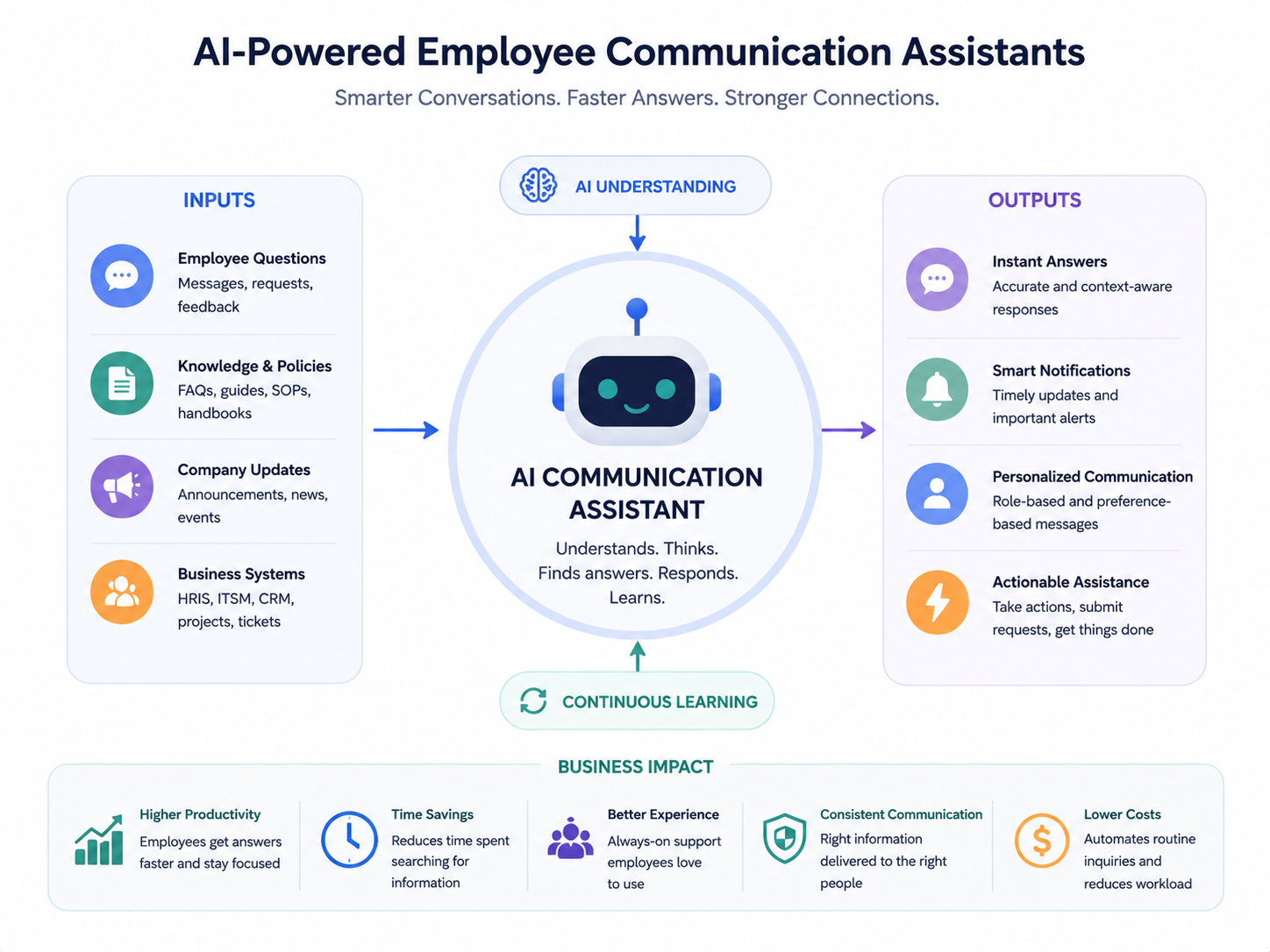
1. AI-Powered Employee Communication Assistants
Communication remains one of the biggest workplace challenges, particularly for organizations with remote, hybrid, or frontline employees.
AI-powered workplace management platforms are increasingly using intelligent assistants to help employees find answers, access resources, and stay informed without waiting for HR or management responses.
A manufacturing company with 1,200 employees receives hundreds of HR-related questions every week regarding annual leave, company policies, payroll dates, and benefits.
1. AI-Powered Employee Communication Assistants
How AI Helped:
The company implemented an AI communication assistant within its workplace management system. Employees could ask questions in natural language and receive instant answers based on company policies and knowledge base articles.
Results:
- Reduced HR support tickets by 40%
- Faster employee response times
- Improved employee satisfaction
- Reduced administrative workload for HR teams
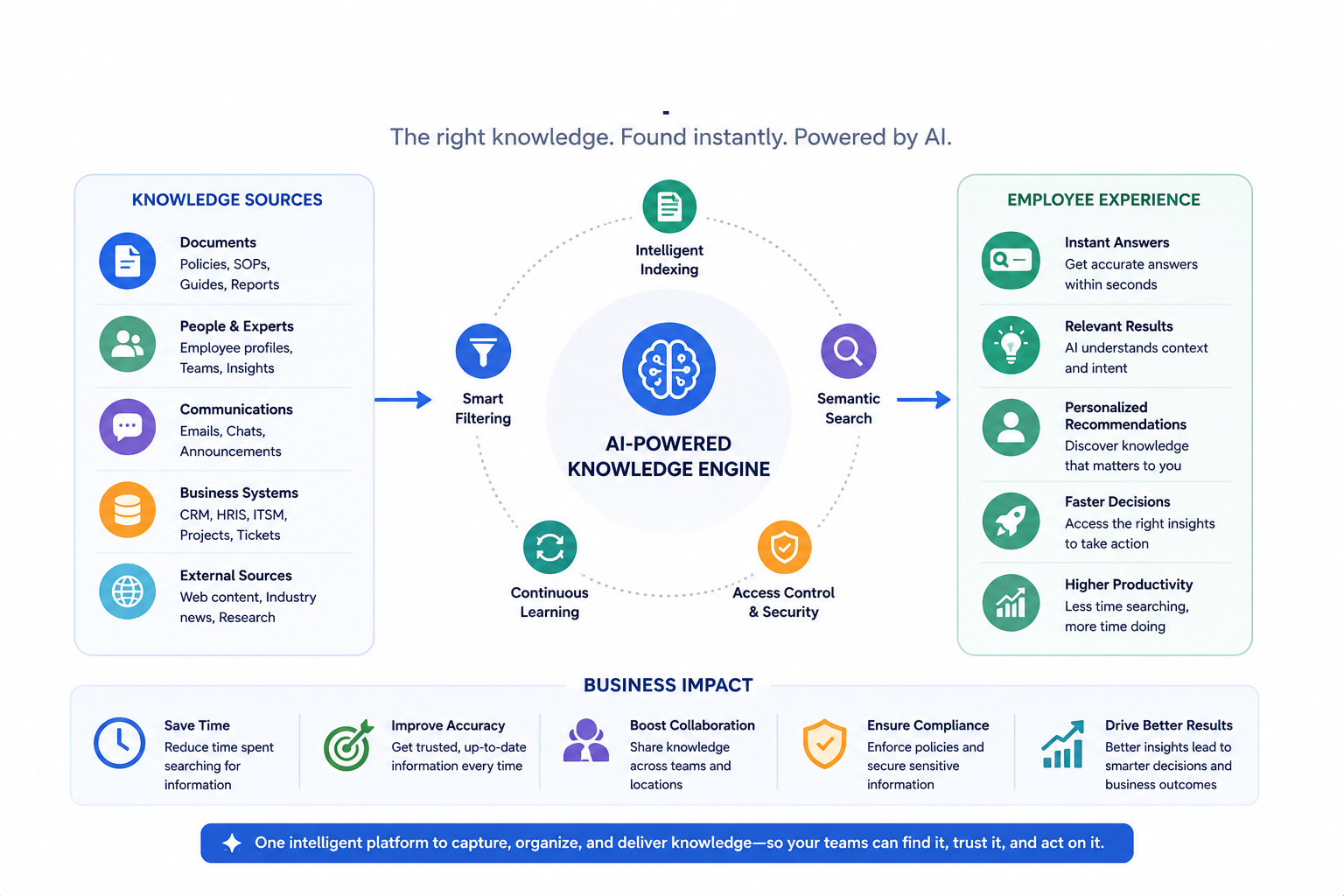
2. Automated Knowledge Management and Enterprise Search
Many organizations struggle with information being scattered across multiple systems, making it difficult for employees to locate documents, policies, and important business knowledge.
A consulting firm found employees were spending significant time searching for project templates, client documents, and internal procedures stored across various systems.
2. Automated Knowledge Management and Enterprise Search
How AI Helped:
The organization introduced intelligent enterprise search within its workplace management software. The system automatically indexed content and delivered relevant results based on employee roles and search intent.
Results:
- Reduced time spent searching for information
- Improved knowledge sharing
- Increased productivity across departments
- Better use of existing organizational knowledge
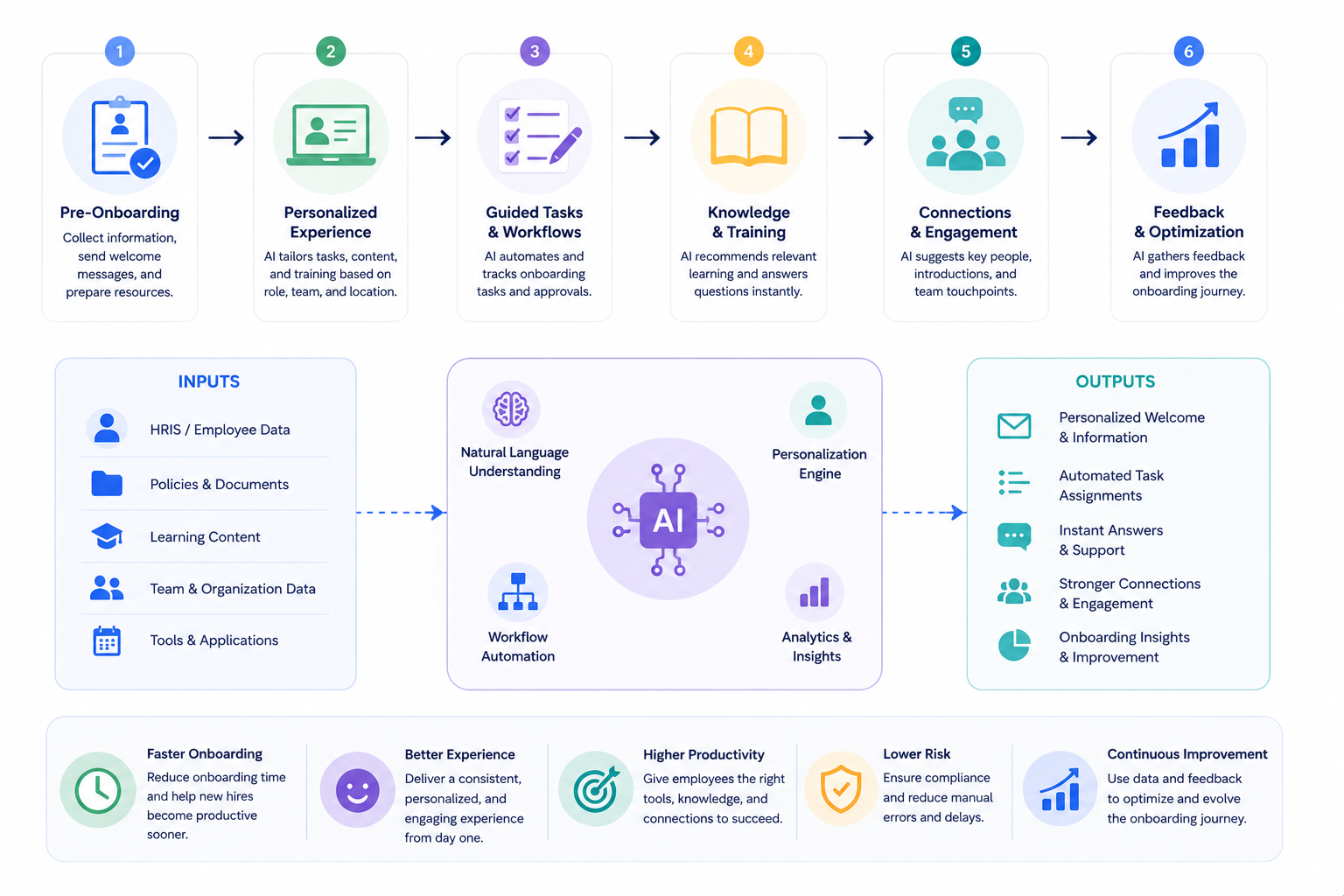
3. Intelligent Employee Onboarding Experiences
3. Intelligent Employee Onboarding Experiences
Employee onboarding often involves numerous manual processes, paperwork, and repetitive communications that consume valuable HR resources. A healthcare provider hiring dozens of employees each month struggled to deliver consistent onboarding experiences across multiple locations.
How AI Helped:
The company implemented AI-enabled workflows that automatically assigned training, distributed documents, scheduled onboarding tasks, and tracked completion progress.
This reflects a broader trend in workplace management software, where AI helps centralize communication, workflows, and employee tasks within a single platform. Lorka AI is one example of this trend, combining workplace communication, workflow automation, task management, and productivity tracking in a unified environment.
Results:
- Faster employee onboarding
- Improved compliance completion rates
- Reduced administrative effort
- More consistent employee experiences
4. Smart Scheduling and Calendar Coordination
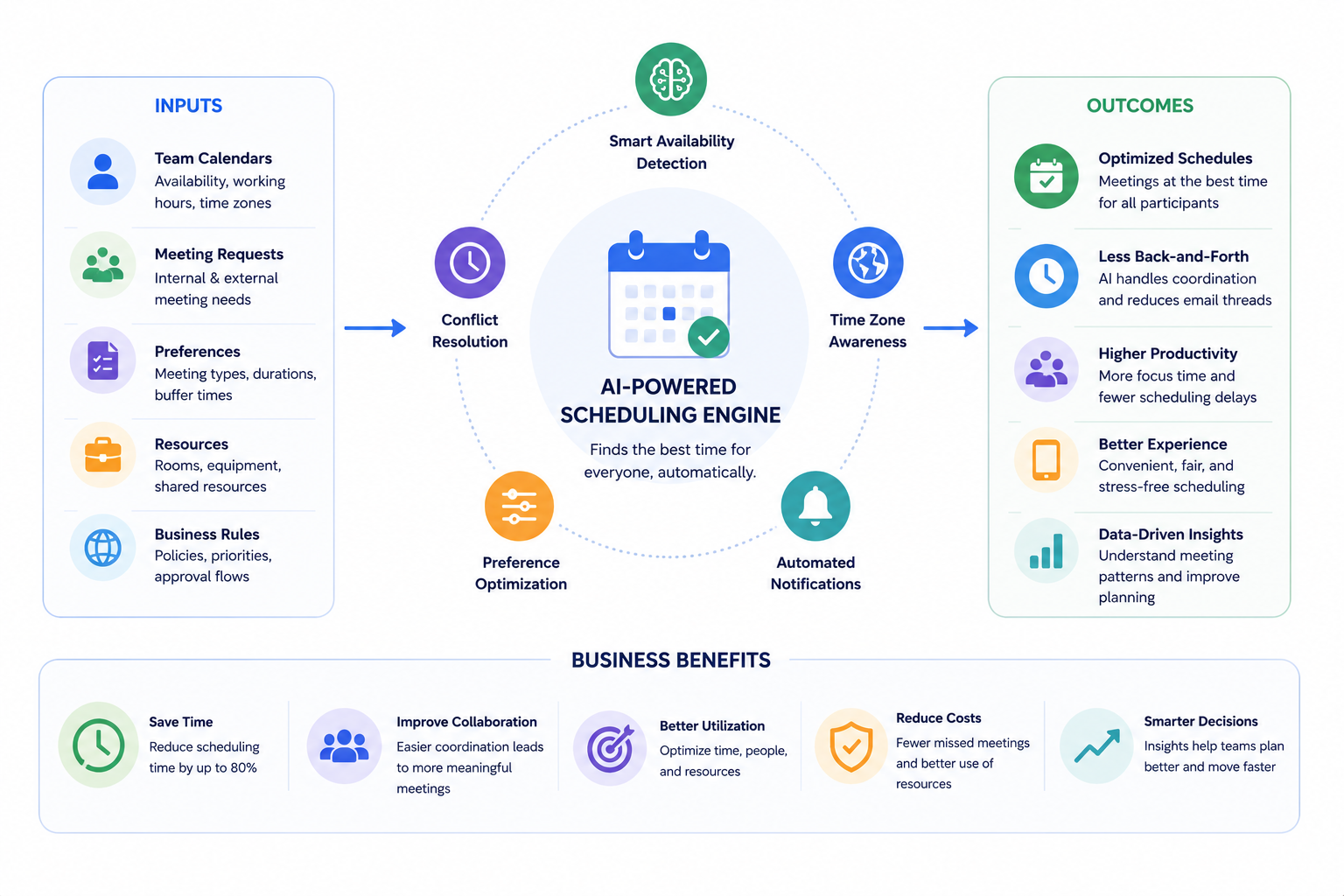
4. Smart Scheduling and Calendar Coordination
Scheduling meetings between multiple departments can be surprisingly time-consuming, especially in organizations operating across different time zones.
A global software company regularly struggled to coordinate meetings between teams located in the United Kingdom, United States, and Australia.
How AI Helped:
An AI-powered scheduling assistant analyzed calendars, availability, time zones, and meeting priorities to recommend optimal meeting times automatically.
Results:
- Reduced scheduling conflicts
- Less time spent coordinating meetings
- Improved team collaboration
- Better use of employee time
5. AI-Driven Employee Engagement and Sentiment Analysis
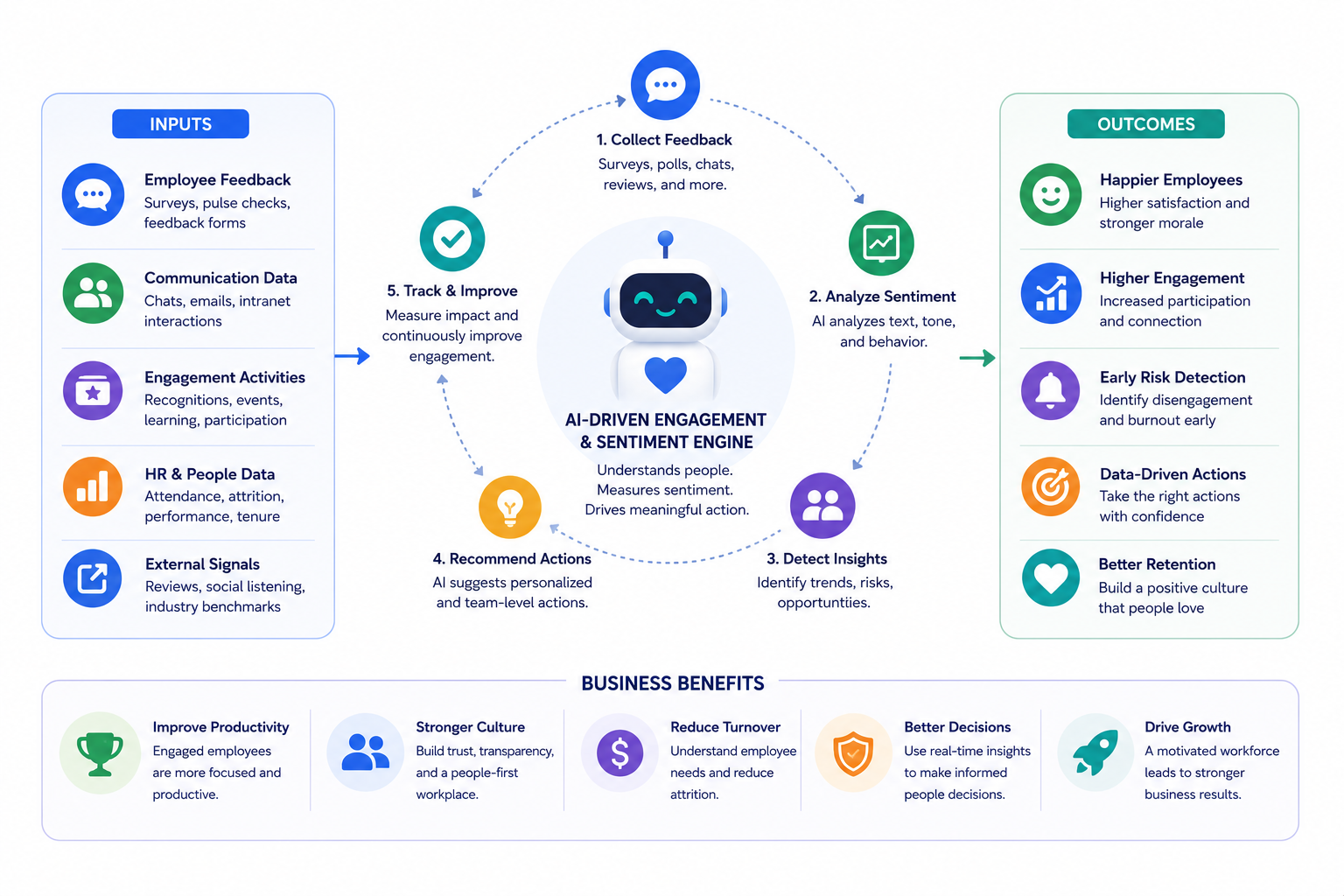
5. AI-Driven Employee Engagement and Sentiment Analysis
Employee engagement can significantly impact productivity, retention, and overall workplace culture. However, identifying engagement issues before they become serious problems is often difficult.
A retail organization experienced rising employee turnover but lacked visibility into workforce morale and engagement levels.
How AI Helped:
The company implemented sentiment analysis tools that reviewed employee survey responses, feedback submissions, and workplace interactions to identify trends and potential concerns.
Results:
- Early identification of engagement issues
- Better management decision-making
- Improved employee retention
- Increased employee satisfaction scores
6. Automated Document Management and Content Recommendations
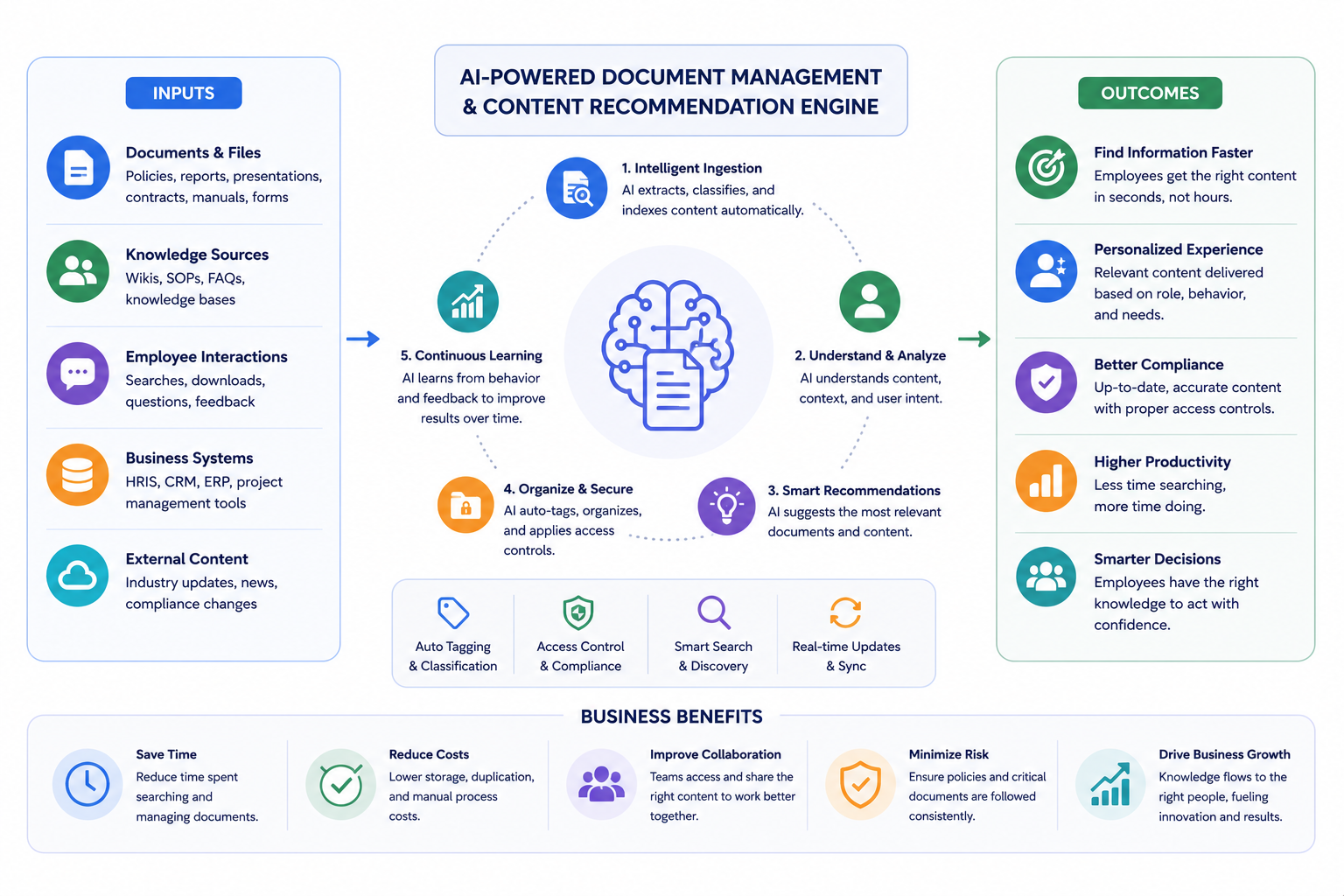
6. Automated Document Management and Content Recommendations
As businesses grow, document libraries can become difficult to manage, resulting in outdated information and duplicated content. A financial services company stored thousands of documents, making it challenging for employees to locate the most current versions.
How AI Helped:
The organization introduced AI-powered document management capabilities that automatically categorized files, identified outdated content, and recommended relevant documents to employees.
Results:
- Improved document accuracy
- Faster content discovery
- Reduced duplicate content
- Better compliance management
7. Workflow Automation for Approvals and Business Processes
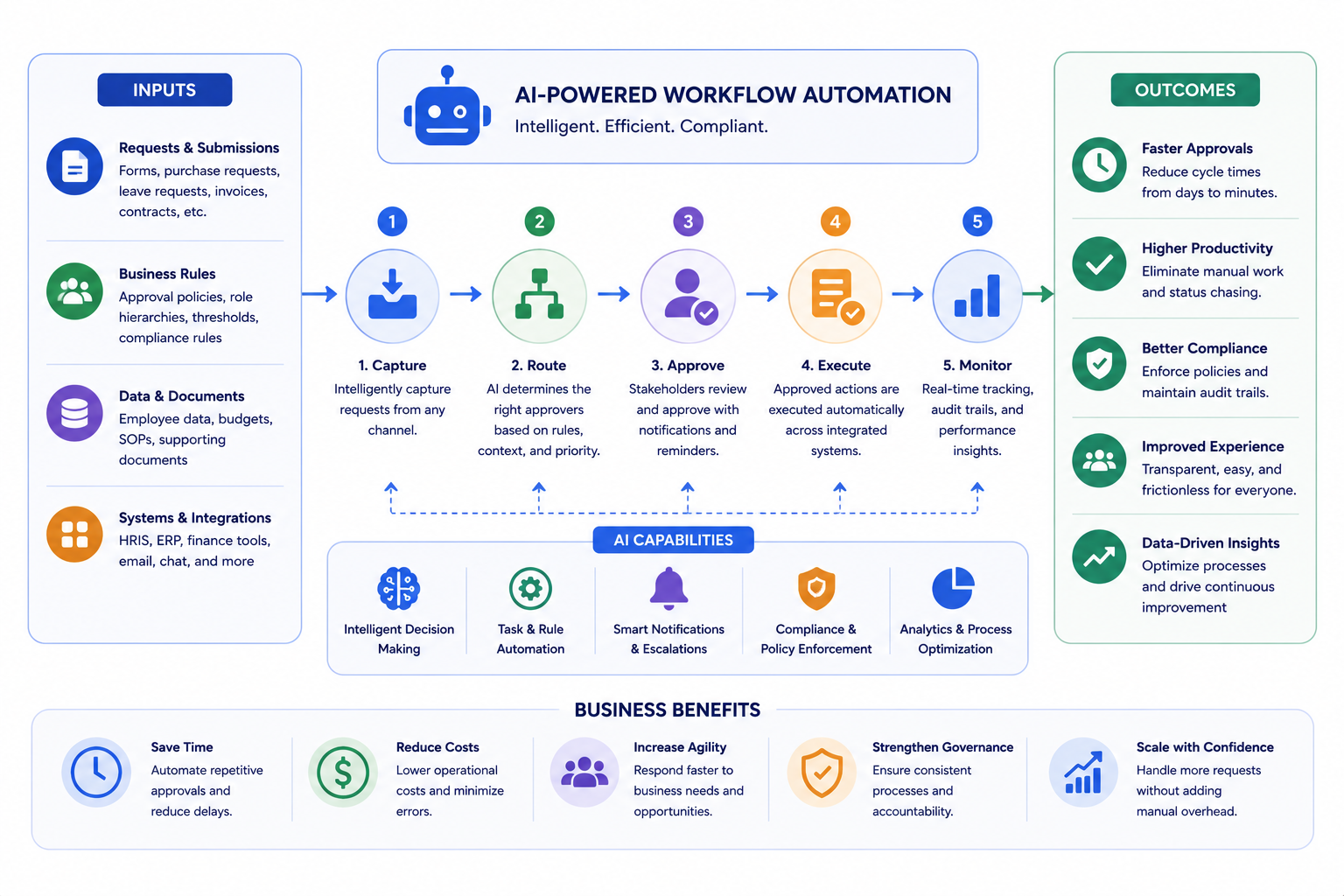
7. Workflow Automation for Approvals and Business Processes
Manual approvals often create bottlenecks that delay projects and frustrate employees.
A large construction company relied on email-based approval processes for expenses, procurement requests, and operational forms. Approvals frequently became delayed when managers were unavailable.
How AI Helped:
The company implemented AI workflow examples that automatically routed requests to the appropriate approvers, sent reminders, escalated overdue items, and tracked progress in real time.
Results:
- Faster approval cycles
- Reduced processing delays
- Improved accountability
- Greater operational efficiency
This example clearly demonstrates how creating AI enabled workflows can help you in your daily project management work by eliminating manual follow-ups and improving process visibility.
8. Predictive Workforce Analytics and Reporting
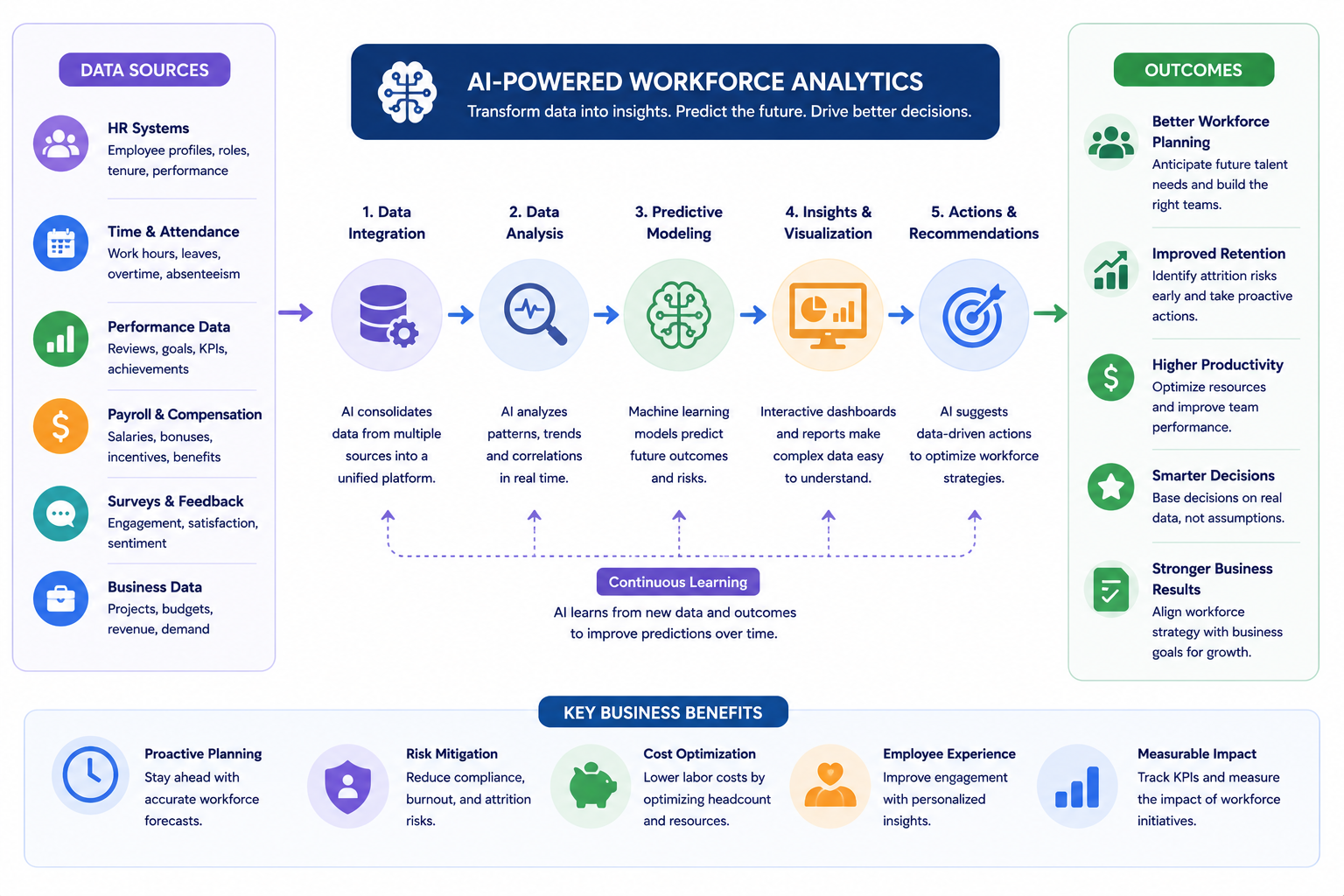
8. Predictive Workforce Analytics and Reporting
Traditional reporting focuses on past performance, while artificial intelligence helps organizations predict future outcomes and make proactive decisions. A customer service organization experiencing frequent staffing shortages can overcome its forecasting struggles by partnering with an AI-powered customer service outsourcing expert like Everhelp, shifting from traditional past-performance reporting to AI-driven predictive insights and proactive decision-making.
How AI Helped:
Using predictive workforce analytics, the company analyzed historical trends, employee schedules, seasonal patterns, and workload forecasts to improve workforce planning.
Results:
- Improved resource allocation
- Reduced overtime costs
- Better customer service coverage
- More informed business planning
The most successful AI-powered workplace management initiatives are not focused on replacing employees—they are focused on helping employees work smarter.
Whether through intelligent search, workflow automation, communication tools, or predictive analytics, these technologies enable organizations to reduce inefficiencies, improve employee experiences, and create more productive workplaces.
Practical AI-Powered Workplace Examples Businesses Can Implement Today
While artificial intelligence may sound complex, many of the most effective applications are surprisingly practical.
Organizations of all sizes are using AI-powered workplace management solutions to improve employee experiences, automate repetitive tasks, and make better business decisions.
The following examples demonstrate how businesses are applying AI in everyday workplace scenarios and the measurable impact these solutions can deliver.
How AI Creates Personalized Employee Experiences for Employees
Modern employees expect workplace technology to adapt to their needs in the same way consumer platforms like Netflix or Spotify personalize recommendations.
AI-powered workplace management platforms can analyze employee roles, departments, interests, and behavior patterns to deliver more relevant content, training, and communications.
A healthcare organization with multiple departments found employees were missing important announcements because everyone received the same communications regardless of role.
How It Helped:
The company introduced AI-driven content recommendations that automatically delivered relevant updates, training materials, and company news to each employee based on their job function.
Benefits:
- New nurses automatically receive onboarding resources relevant to healthcare compliance.
- Managers see leadership training content tailored to their responsibilities.
- Sales teams receive product updates related to their accounts and territories.
- Employees spend less time searching for information and more time completing meaningful work.
AI can automate repetitive administrative tasks.
Administrative tasks often consume valuable employee time and reduce productivity. One of the biggest benefits of AI in the workplace is its ability to automate repetitive activities that previously required manual intervention.
An HR department was spending several hours each week manually processing annual leave requests, updating spreadsheets, and notifying managers.
How It Helped:
The organization implemented AI-enabled workflows that automatically reviewed requests, routed approvals, updated employee records, and sent notifications without HR intervention.
Benefits:
- Leave requests are approved faster.
- HR teams spend less time on manual administration.
- Employees receive instant status updates.
- Managers gain better visibility into workforce availability.
This is one of the most common AI workflow examples used by organizations implementing workplace management software.
Delivering Instant Answers Through Workplace Chat Assistants
A retail company with 2,000 employees received hundreds of repetitive HR and IT support requests every month.
The company deployed an AI workplace assistant within its workplace management system. Employees could ask questions in natural language and receive immediate responses based on approved company information.
Benefits:
- Employees receive answers 24/7 without waiting for support teams.
- HR and IT departments handle fewer repetitive enquiries.
- Information remains consistent across the organization.
- Employees become more self-sufficient and productive.
Example questions employees might ask include:
- "How many annual leave days do I have remaining?"
- "Where can I find the expense policy?"
- "How do I request a new laptop?"
- "What training courses are available for my role?"
These AI powered workplace examples are becoming increasingly common as organizations look to improve employee support and communication.
Supporting Managers with Data-Driven Decision Making
Managers often make decisions based on incomplete information, which can lead to inefficiencies, missed opportunities, or employee dissatisfaction. AI-powered workplace management tools provide actionable insights that help leaders make better decisions faster.
A customer service manager struggled to understand why employee turnover was increasing despite positive performance metrics.
How It Helped:
The organization's AI analytics platform identified declining engagement scores, increased overtime hours, and reduced participation in company initiatives. This allowed leadership to intervene before additional employees left.
Benefits:
- Managers identify problems before they become serious.
- Leadership gains real-time visibility into workforce trends.
- Employee engagement issues can be addressed earlier.
- Better decisions are made using data rather than assumptions.
Examples of AI-driven management insights include:
- Predicting employee turnover risks.
- Identifying departments with declining engagement.
- Forecasting future staffing requirements.
- Highlighting training gaps and development opportunities.
- Tracking productivity and project performance trends.
These capabilities are transforming workplace management systems from simple operational tools into strategic platforms that support business growth and workforce success.
Practical AI-Powered Workplace Examples Businesses Can Implement Today
While artificial intelligence may sound complex, many of the most effective applications are surprisingly practical.
Organizations of all sizes are using AI-powered workplace management solutions to improve employee experiences, automate repetitive tasks, and make better business decisions.
The following examples demonstrate how businesses are applying AI in everyday workplace scenarios and the measurable impact these solutions can deliver.
Employees receive information that is more relevant to their role and responsibilities
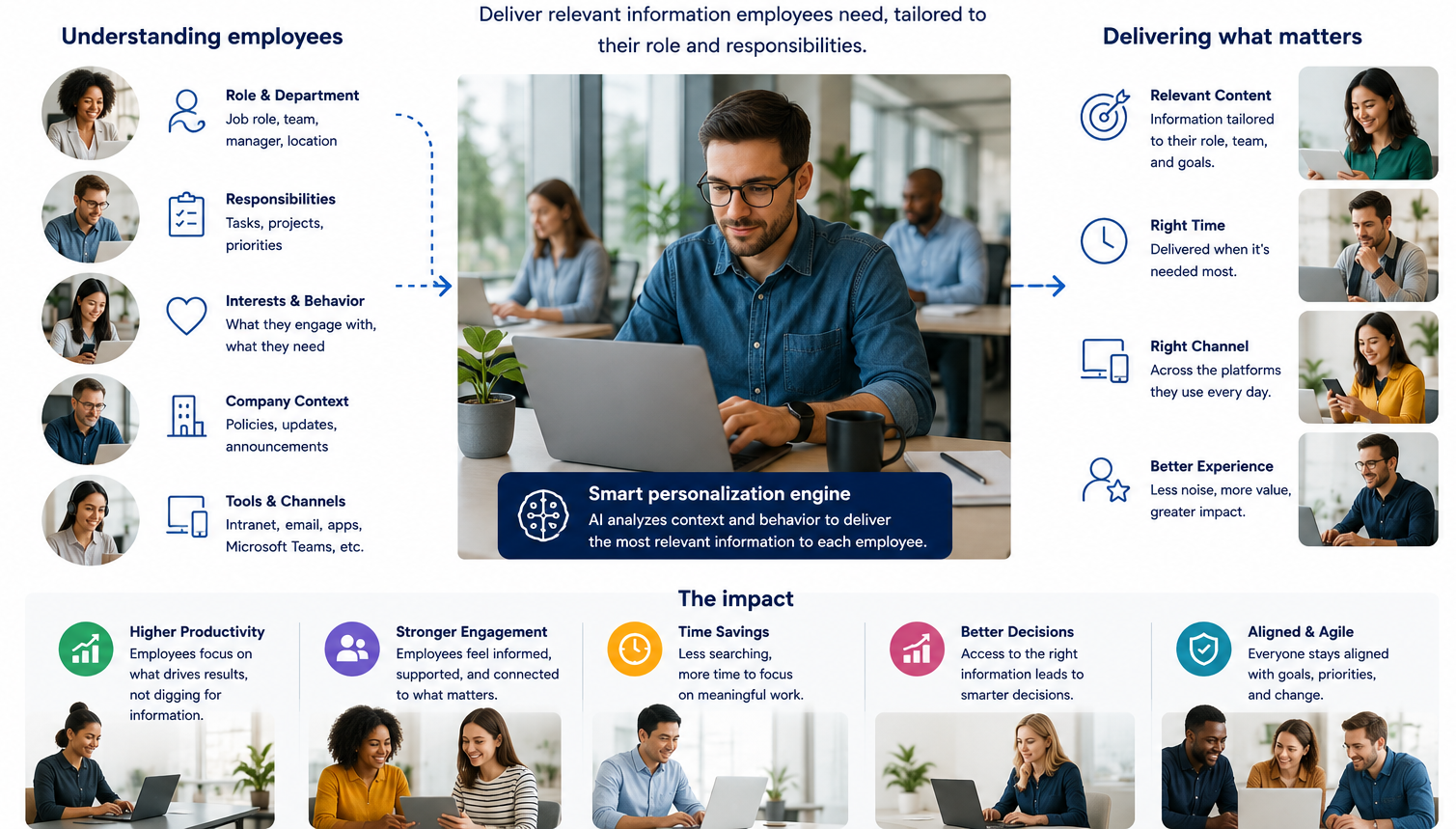
Employees receive information that is more relevant to their role and responsibilities
One of the biggest challenges facing modern organizations is information overload. Employees are often bombarded with company announcements, training resources, policy updates, and internal communications, much of which may not be relevant to their role.
AI-powered workplace management platforms solve this problem by delivering personalized content based on job title, department, location, and employee behavior.
For example, a healthcare organization discovered that important updates were being overlooked because every employee received the same communications.
By implementing AI-powered content recommendations, employees automatically received information that was relevant to their specific responsibilities.
Benefits include:
- New employees receive role-specific onboarding content.
- Managers receive leadership-focused training resources.
- Sales teams receive product and customer updates.
- Employees spend less time searching for information.
- Internal communication engagement improves significantly.
Routine administrative work can be completed automatically
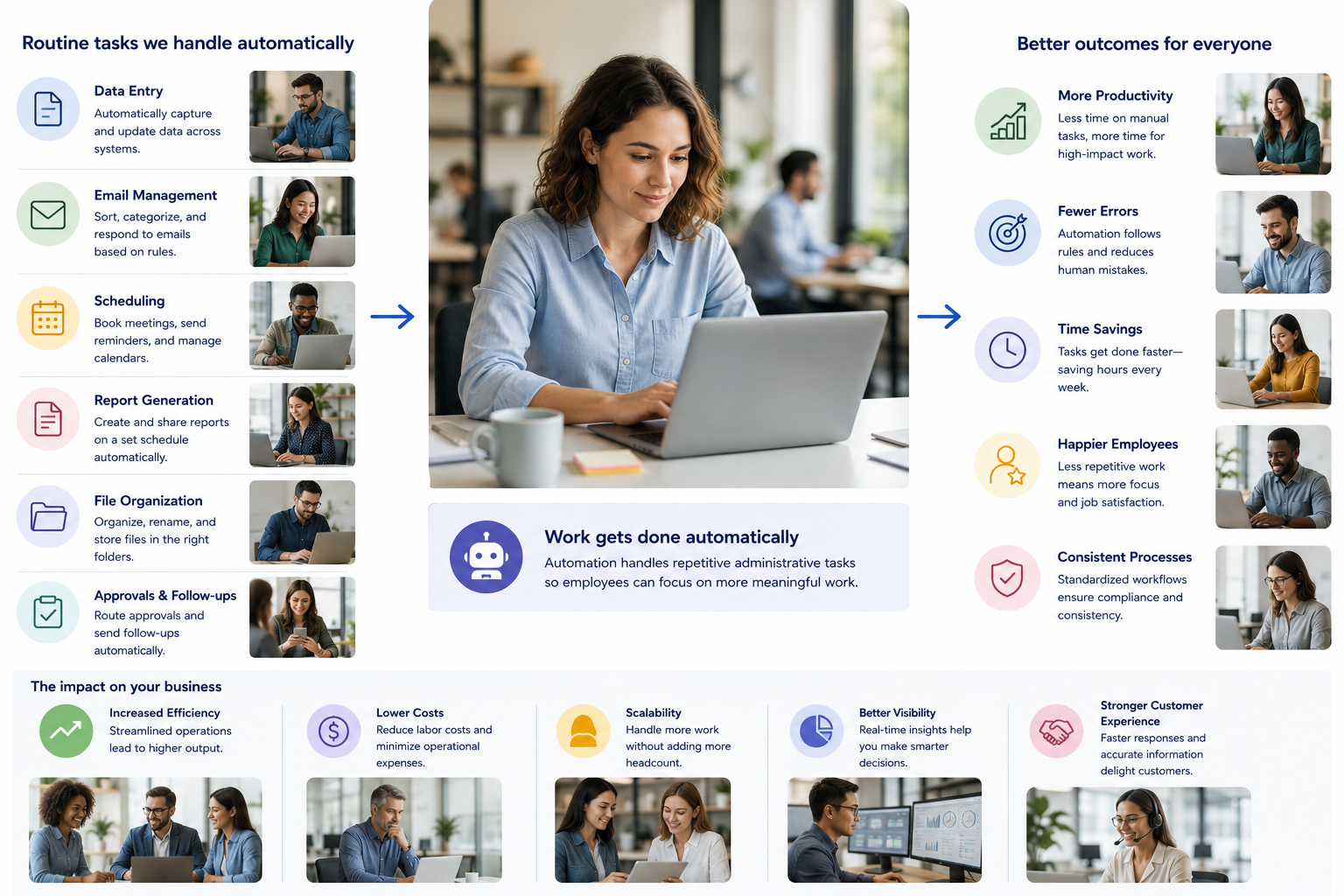
Routine administrative work can be completed automatically
Many employees spend a surprising amount of time completing repetitive administrative tasks that add little strategic value.
Processing leave requests, updating records, routing approvals, and sending notifications are all activities that can be automated through AI-enabled workflows.
A typical example involves an HR department spending several hours each week managing annual leave requests. After implementing workflow automation through a workplace management system, requests were automatically reviewed, routed to managers, approved, and recorded without manual intervention.
Benefits include:
- Faster approval processes.
- Reduced administrative workload.
- Improved process consistency.
- Fewer human errors.
- Better workforce visibility.
This remains one of the most valuable AI workflow examples because it delivers immediate productivity improvements across multiple departments.
Employees can receive answers instantly without waiting for support teams
Employees regularly need assistance with policies, procedures, benefits, training, and IT-related questions. Unfortunately, waiting for support teams to respond can slow productivity and create frustration throughout the organization.
A retail company with thousands of employees found that HR and IT departments were overwhelmed by repetitive enquiries. By introducing an AI assistant into its workplace management software, employees could ask questions in natural language and receive immediate answers based on company-approved information.
Employees can quickly find answers to questions such as:
- How many annual leave days do I have remaining?
- Where can I find the expense policy?
- How do I request new equipment?
- What training courses are available to me?
- How do I submit an IT support request?
Benefits include:
- 24/7 employee support.
- Reduced workload for HR and IT teams.
- Consistent and accurate responses.
- Faster problem resolution.
- Improved employee productivity.
These AI powered workplace examples are becoming increasingly popular as businesses look for ways to improve employee support while reducing operational costs.
Managers gain deeper visibility into workforce trends and performance
Making decisions without reliable data can be difficult, particularly when managing large teams. AI-powered workplace management systems help leaders identify patterns, monitor engagement, forecast workforce needs, and address issues before they become major problems.
For example, a customer service manager noticed employee turnover increasing despite strong performance metrics.
AI analytics revealed declining engagement levels, excessive overtime, and reduced participation in company initiatives. Armed with these insights, leadership was able to take corrective action before retention issues worsened.
AI can help managers identify:
- Employees who may be at risk of leaving.
- Departments experiencing engagement challenges.
- Workforce capacity and staffing requirements.
- Skills gaps and training opportunities.
- Productivity and collaboration trends.
Benefits include:
- Better workforce planning.
- Improved employee retention.
- More informed decision-making.
- Greater operational visibility.
- Stronger organizational performance.
These capabilities are transforming workplace management systems from simple administrative tools into intelligent platforms that help businesses make faster, smarter, and more strategic decisions.
AI Workflow Examples That Save You and Yout Teams Time Every Day
One of the biggest benefits of AI-powered workplace management is its ability to automate everyday business processes.
Many organizations still rely on emails, spreadsheets, and manual follow-ups to manage routine tasks. This often leads to delays, mistakes, and unnecessary administrative work.
By creating AI-enabled workflows, businesses can automate repetitive processes, improve consistency, and save employees valuable time.
The following examples show some of the most common workflows organizations use and how they can be set up to improve efficiency.
New employee onboarding can run automatically from day one
Employee onboarding is one of the easiest workflows to automate. Instead of HR manually sending emails, assigning training, sharing documents, and tracking progress, an AI-powered workflow can complete these tasks automatically.
To set this up, the workflow is triggered as soon as a new employee is added to the workplace management system.
The system can automatically send welcome messages, assign onboarding courses, share company policies, create tasks for managers, and remind employees to complete required actions.
This type of workflow is most useful for organizations that regularly hire new employees and want to deliver a consistent onboarding experience while reducing HR administration.
Leave requests can move through approvals without endless emails
Many businesses still manage annual leave requests through email, which can be slow and difficult to track.
Employees submit requests, managers forget to respond, and HR teams spend time chasing approvals.
An AI workflow can automate this process by checking leave balances, routing requests to the correct manager, sending reminders, and updating records once approval is given.
Employees can also receive automatic notifications at every stage.
This workflow is ideal for organizations with growing teams where managing employee leave manually is becoming time-consuming and difficult to monitor.
Policy acknowledgements can be tracked automatically
Most organizations need employees to read and acknowledge important policies relating to health and safety, data protection, compliance, or company procedures.
Tracking this manually can be extremely difficult, especially in larger organizations.
An AI-powered workflow can automatically publish policies, request acknowledgements, send reminders to employees who have not responded, and generate reports showing completion rates.
Managers can instantly see who has completed the requirement and who still needs follow-up.
This workflow should be used whenever organizations need proof that employees have reviewed important information or completed mandatory compliance requirements.
Employee support requests can be routed to the right team automatically
Employees often need help from HR, IT, Facilities, Finance, or Operations teams.
Without a structured process, requests can easily be lost, delayed, or sent to the wrong department.
A workflow can automatically review incoming requests, identify the type of issue, assign it to the correct team, and track progress until the issue is resolved.
AI can also suggest answers from a knowledge base before a ticket is even created.
This approach works particularly well for organizations receiving large volumes of support requests and looking to improve response times while reducing pressure on support teams.
Internal communications can be reviewed and published faster
Publishing company announcements, policy updates, and leadership messages often involves multiple reviews and approvals before employees can see the content. This process can slow down communication and create unnecessary bottlenecks.
An AI-enabled workflow can automatically route content to the right reviewers, notify approvers when action is needed, schedule publication dates, and track employee engagement after the content goes live. The system can even recommend the best audience for specific communications.
This workflow is especially useful for HR, internal communications, and leadership teams that regularly publish content and want to ensure information reaches employees quickly and consistently.
By implementing these AI workflow examples, organizations can eliminate repetitive administrative work, reduce delays, improve employee experiences, and allow teams to focus on more valuable activities.
In many cases, businesses see benefits almost immediately because employees spend less time managing processes and more time getting work done.
Here Are Some Ways AI-Enabled Workflows Improve Daily Project Management Activities
Project managers spend a large portion of their day tracking tasks, chasing updates, managing deadlines, and keeping stakeholders informed.
While these activities are important, they can also be time-consuming and repetitive.
This is where AI-enabled workflows can make a significant difference.
By automating routine activities and providing real-time insights, AI-powered workplace management tools help project teams work more efficiently and focus on delivering successful outcomes.
Reducing Manual Project Administration
Project administration is necessary, but it often takes time away from higher-value work.
Activities such as updating project plans, tracking task status, sending reminders, and generating reports can quickly consume hours each week.
AI-powered workplace management software can automate many of these administrative tasks, reducing the burden on project managers and team members.
For example, AI can:
- Update project dashboards automatically.
- Generate progress reports in real time.
- Track project milestones and deadlines.
- Notify stakeholders when tasks are completed.
- Maintain project records without manual updates.
As a result, project managers spend less time on administration and more time focusing on strategy, problem-solving, and team leadership.
Identifying Project Risks Before They Become Issues
One of the biggest challenges in project management is spotting problems early enough to prevent delays or budget overruns.
Traditional project reviews often identify issues after they have already impacted the project.
AI can continuously monitor project data and highlight warning signs before they become major concerns.
For example, AI can identify:
- Tasks that are consistently running behind schedule.
- Team members who may be overloaded.
- Projects at risk of missing deadlines.
- Budget trends that suggest overspending.
- Resource shortages that could impact delivery.
By identifying these risks early, project managers can take corrective action before small problems turn into costly issues.
Automating Task Assignments and Reminders
Keeping projects moving often requires constant follow-up.
Project managers frequently spend time assigning tasks, sending reminders, and checking whether work has been completed.
AI-enabled workflows can automate much of this process by assigning work based on predefined rules, project priorities, team availability, or employee skills.
This can include:
- Automatically assigning tasks to the right person.
- Sending deadline reminders before due dates.
- Escalating overdue tasks to managers.
- Reassigning work when employees are unavailable.
- Tracking progress without manual intervention.
This helps ensure projects continue moving forward without requiring constant oversight from project managers.
Improving Team Collaboration and Accountability
Successful projects depend on strong communication and clear accountability.
When team members work across different departments, locations, or time zones, it can be difficult to maintain visibility and alignment.
AI-powered workplace management platforms help teams stay connected by centralizing project information, conversations, files, and updates in one place.
This improves collaboration by:
- Providing a single source of project information.
- Making responsibilities clear for every team member.
- Automatically notifying users of important updates.
- Reducing communication silos.
- Improving transparency across the project team.
When everyone has access to the same information, projects run more smoothly and accountability improves across the organization.
Using AI Insights to Make Faster Decisions
Project managers are often required to make decisions quickly. However, gathering information from multiple systems and reports can delay decision-making and increase risk.
AI helps by analyzing large amounts of project data and presenting insights in a simple, actionable format.
These insights can help managers:
- Prioritize critical tasks.
- Allocate resources more effectively.
- Forecast project completion dates.
- Identify productivity trends.
- Make informed decisions based on real-time data.
Rather than relying on assumptions or outdated reports, project managers can use AI-generated insights to make faster, more confident decisions that keep projects on track.
Organizations that successfully implement AI workflow examples often find that project teams become more productive, communication improves, and managers gain greater visibility into project performance. Over time, these improvements can lead to faster project delivery, reduced operational costs, and better business outcomes.
The Biggest Benefits of AI in the Workplace
Businesses are investing heavily in AI-powered workplace management because the benefits extend far beyond simple automation.
When implemented correctly, artificial intelligence can improve productivity, enhance employee experiences, reduce operational costs, and help organizations make smarter decisions.
While every organization will see different results depending on how AI is used, the following benefits are among the most common and impactful.
Increased Productivity Across Departments
One of the most noticeable benefits of AI in the workplace is improved productivity. Employees often spend a large portion of their day searching for information, managing repetitive tasks, responding to emails, or completing manual administrative work.
AI helps eliminate many of these time-consuming activities by automating processes and providing faster access to information.
For example, an HR team can automate onboarding tasks, a finance department can streamline approvals, and project managers can automate status updates and reporting.
As a result, employees spend less time on routine work and more time focusing on activities that contribute directly to business growth.
This is one reason why AI-powered workplace management has become a priority for organizations looking to improve efficiency.
Faster Access to Organizational Knowledge
Knowledge is one of the most valuable assets within any organization, but it is often difficult to find. Important documents, procedures, policies, and project information are frequently stored across multiple systems, making it challenging for employees to locate what they need.
AI-powered search and knowledge management tools solve this problem by helping employees find answers instantly. Instead of searching through folders, emails, or multiple applications, employees can simply ask a question and receive the information they need.
This not only saves time but also reduces frustration and improves decision-making across the organization.
Many workplace management systems now include intelligent search capabilities because organizations recognize that easy access to information has a direct impact on productivity and performance.
Improved Employee Experience and Engagement
Employees expect workplace technology to be simple, intuitive, and helpful. When systems are difficult to use or processes take too long, frustration increases and engagement often declines.
AI helps create a better employee experience by personalizing content, simplifying processes, and providing faster support. Employees can receive relevant training, instant answers to common questions, and access to the information they need without waiting for assistance. This creates a smoother and more efficient work environment.
Organizations that invest in employee experience often see higher engagement levels, improved retention rates, and stronger workplace culture.
AI-powered workplace examples such as intelligent assistants, personalized learning paths, and automated support services are becoming increasingly common because they help employees feel more connected and supported.
Better Operational Visibility and Reporting
Business leaders need accurate information to make informed decisions. Unfortunately, many organizations still rely on manual reporting processes that can be time-consuming and quickly become outdated.
AI can collect and analyze data from multiple sources in real time, providing leaders with a clear view of workplace performance. Managers can identify trends, monitor productivity, track employee engagement, and detect potential issues before they become serious problems.
This level of visibility allows organizations to respond more quickly to challenges and make decisions based on real-time information rather than assumptions. As workplace management software continues to evolve, advanced reporting and predictive analytics are becoming standard features.
Reduced Costs Through Automation
Reducing costs is often one of the first reasons businesses explore AI. By automating repetitive tasks and streamlining workflows, organizations can reduce the amount of time employees spend on low-value activities.
For example, AI-enabled workflows can automatically process requests, route approvals, update records, and send notifications without requiring manual intervention. This reduces administrative overhead while improving accuracy and consistency.
The long-term savings can be significant, particularly for larger organizations that process thousands of transactions, requests, or communications each month. Many businesses find that automation not only reduces costs but also improves service quality and employee satisfaction.
Enhanced Workplace Collaboration
Collaboration is essential for business success, especially in hybrid and remote work environments. However, communication gaps, disconnected systems, and information silos can make collaboration difficult.
AI-powered workplace management platforms help bring teams together by centralizing communication, documents, knowledge, and workflows in a single location. Employees can quickly find information, collaborate on projects, and stay aligned regardless of where they are working.
Artificial intelligence can also recommend relevant content, connect employees with subject matter experts, and surface information that helps teams make better decisions. As a result, collaboration becomes more efficient, communication improves, and projects move forward more smoothly.
What the Data Says About AI in the Workplace
Research continues to show that organizations are seeing measurable benefits from adopting AI technologies. Businesses report improvements in employee productivity, reductions in administrative workload, faster completion of routine processes, and higher employee satisfaction levels.
As AI-powered workplace management continues to mature, organizations that embrace these technologies are likely to gain a competitive advantage through greater efficiency, stronger employee engagement, and improved operational performance. Rather than replacing employees, AI is helping people work smarter, make better decisions, and focus on the tasks that create the most value for the business.
Understanding the Pros and Cons of AI-Powered Workplaces
Like any technology, AI-powered workplace management comes with both benefits and challenges.
While AI can improve productivity, automate repetitive tasks, and help organizations make smarter decisions, it also introduces new considerations around security, adoption, and governance.
Understanding both sides helps businesses create a realistic implementation strategy and avoid common mistakes.
Key Advantages Organizations Should Consider
AI can help organizations work more efficiently by reducing manual effort and providing employees with better access to information.
Many businesses begin seeing value shortly after implementing AI-powered workplace management solutions because routine tasks can be completed faster and with greater accuracy.
Some of the biggest advantages include:
- Improved employee productivity across departments.
- Faster access to company knowledge and information.
- Reduced administrative and repetitive work.
- Better employee experiences and workplace support.
- Improved decision-making through data-driven insights.
- Faster approvals and workflow completion.
- Greater operational visibility for managers and leadership.
Common Implementation Challenges
While the benefits are significant, implementing AI successfully requires planning, training, and ongoing management. Organizations that expect AI to solve every problem immediately often face disappointment.
Common challenges businesses encounter include:
- Poor data quality affecting AI recommendations.
- Lack of clear business objectives.
- Integrating AI with existing systems.
- Employees not fully understanding how to use new tools.
- Unrealistic expectations about results.
- Insufficient training and support.
- Difficulty measuring return on investment initially.
Data Privacy and Security Considerations
AI systems often process large amounts of company and employee data. This makes security, compliance, and privacy important considerations during implementation.
Organizations should carefully evaluate:
- How employee data is collected and stored.
- Whether AI tools comply with industry regulations.
- User permissions and access controls.
- Data encryption and security measures.
- Third-party vendor security standards.
- Audit trails and activity monitoring.
- Policies governing the use of sensitive information.
Managing Employee Adoption and Change Resistance
Employees may be concerned that AI will replace jobs or significantly change the way they work. Without proper communication, even the best AI solutions can face resistance from users.
Organizations can improve adoption by:
- Clearly explaining the purpose of AI initiatives.
- Demonstrating how AI supports employees rather than replaces them.
- Providing practical training and guidance.
- Starting with simple use cases that deliver quick wins.
- Encouraging employee feedback throughout implementation.
- Celebrating early success stories.
- Offering ongoing support after deployment.
Balancing Automation With Human Decision-Making
AI can analyze data and automate processes at incredible speed, but human judgment remains essential. The most successful organizations use AI to support decision-making rather than completely replace it.
Businesses should ensure that:
- Critical decisions still involve human oversight.
- Managers can review AI-generated recommendations.
- Employees understand when human intervention is required.
- AI outputs are regularly monitored for accuracy.
- Ethical considerations are part of decision-making processes.
- Automation is applied to appropriate tasks.
- Accountability remains clearly defined.
Organizations that strike the right balance between technology and human expertise are often the ones that achieve the greatest long-term success from AI-powered workplace management.
What Features Should You Look for in Workplace Management Software?
Not all workplace management software is created equal. Some platforms focus only on communication, while others specialize in project management or document storage.
The best workplace management systems bring everything together in a single platform that helps employees communicate, collaborate, access information, and complete work more efficiently.
As AI-powered workplace management becomes more common, businesses should look beyond basic functionality and focus on features that improve productivity, employee experience, and long-term scalability.
Essential Workplace Management Software Features
| Feature | Why It Matters | Business Benefit |
| Workflow Automation | Automates repetitive tasks and approvals | Saves time and reduces manual work |
| AI-Powered Search | Helps employees find information instantly | Improves productivity and knowledge sharing |
| Employee Communication Tools | Keeps employees informed and connected | Increases engagement and collaboration |
| Mobile Accessibility | Supports frontline, field, and remote workers | Improves workforce connectivity |
| Analytics & Reporting | Provides visibility into workplace performance | Supports better decision-making |
| System Integrations | Connects existing business applications | Eliminates data silos and duplicate work |
Workflow Automation Helps Eliminate Repetitive Tasks
One of the most valuable features in any workplace management system is workflow automation.
Employees spend countless hours processing requests, chasing approvals, sending reminders, and updating records. These activities add little strategic value but consume a significant amount of time.
A modern workplace management software solution should allow organizations to automate routine processes such as employee onboarding, leave requests, expense approvals, policy acknowledgements, and support requests.
AI-enabled workflows can automatically route tasks, notify stakeholders, and escalate overdue actions without human intervention.
Key capabilities to look for include:
- Automated approvals and routing.
- Custom workflow builders.
- Reminder and notification systems.
- Task assignment automation.
- Process tracking and visibility.
- Escalation rules for overdue actions.
AI-Powered Search Makes Information Easier to Find
Employees often waste valuable time searching for policies, procedures, documents, and company information.
As organizations grow, information becomes spread across multiple systems, making knowledge difficult to locate.
AI-powered workplace management platforms solve this problem by allowing employees to search using natural language and receive accurate answers instantly. Instead of searching through folders and files, employees can simply ask a question and find what they need within seconds.
Important search capabilities include:
- Natural language search.
- Intelligent document recommendations.
- Knowledge base integration.
- Content tagging and categorization.
- Role-based search results.
- AI-assisted answer generation.
Employee Communication and Collaboration Tools Keep Teams Connected
Strong communication is the foundation of every successful workplace.
Whether employees work in an office, remotely, or in the field, they need easy ways to stay informed and collaborate with colleagues.
The best workplace management software includes tools that support announcements, discussions, chat, team collaboration, file sharing, and employee engagement.
These capabilities help reduce communication silos and improve alignment across the organization.
Features worth considering include:
- Company announcements.
- Team chat and messaging.
- Employee communities and groups.
- Discussion forums.
- File sharing and collaboration.
- Employee recognition tools.
Mobile Accessibility Supports Frontline and Remote Workers
Today's workforce is more distributed than ever. Many employees spend little or no time sitting at a desk, making mobile access essential.
A workplace management system should provide a seamless experience across smartphones, tablets, and desktop devices. Employees should be able to access information, complete tasks, communicate with colleagues, and participate in workplace activities regardless of location.
Mobile functionality should include:
- Mobile applications for iOS and Android.
- Push notifications.
- Mobile document access.
- Mobile approvals and workflows.
- Employee directory access.
- Offline capabilities where needed.
Analytics and Reporting Provide Valuable Business Insights
Business leaders need visibility into workplace activity to make informed decisions. Without data, it can be difficult to understand employee engagement, communication effectiveness, system adoption, or workflow performance.
Advanced workplace management software includes dashboards and reporting tools that help organizations track performance and identify opportunities for improvement.
Useful reporting capabilities include:
- Employee engagement analytics.
- Communication performance metrics.
- Workflow completion tracking.
- User adoption reporting.
- Productivity trends.
- Department and team insights.
Integration With Existing Business Systems Reduces Complexity
Most organizations already use tools such as Microsoft 365, Google Workspace, HR platforms, payroll systems, and project management applications. A workplace management system should connect with these tools rather than operate separately.
Strong integrations help eliminate duplicate data entry, improve user adoption, and create a more connected digital workplace. Employees can access the information they need without constantly switching between applications.
Common integrations include:
- Microsoft 365.
- Google Workspace.
- Microsoft Teams.
- SharePoint.
- HRIS and payroll systems.
- CRM platforms.
- Learning management systems.
- Help desk and ticketing tools.
Choosing workplace management software with these core capabilities will help organizations build a more connected, productive, and future-ready workplace while maximizing the long-term value of their technology investment.
Choosing the Right Workplace Management System for Long-Term Success
Choosing a workplace management system is about much more than selecting software with the longest list of features.
The right platform should help employees communicate more effectively, simplify daily work, improve collaboration, and support the organization's future growth.
As businesses continue adopting AI-powered workplace management solutions, decision-makers need to think carefully about how a platform will perform not only today but also several years from now.
A well-chosen system can improve productivity, strengthen employee engagement, and create a more connected workplace, while the wrong choice can lead to poor adoption and wasted investment.
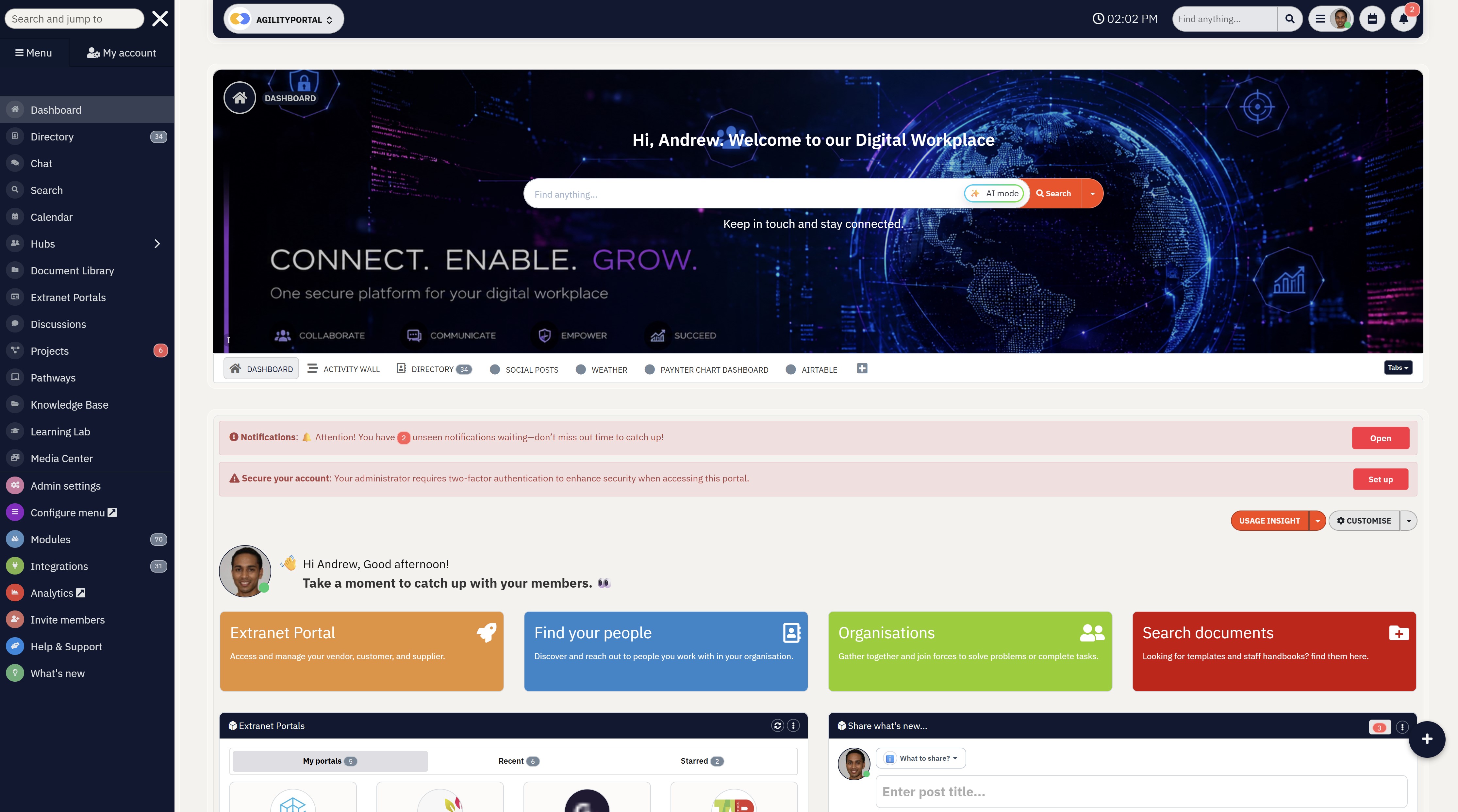
Choosing the Right Workplace Management System for Long-Term Success
Questions to ask before selecting a platform
Before investing in workplace management software, organizations should start by clearly defining their goals and challenges.
Every business has different needs, which is why it is important to evaluate whether a platform can solve real workplace problems rather than simply offering impressive features.
For example, some businesses may need better employee communication, while others may be focused on workflow automation, knowledge sharing, or improving employee engagement.
Decision-makers should consider how easily employees will use the platform, whether it integrates with existing systems, and if it can support future growth.
They should also evaluate the level of support provided by the vendor, the quality of the user experience, and whether the platform aligns with the organization's long-term digital workplace strategy.
Evaluating scalability and user adoption
Scalability is often overlooked during software evaluations, yet it can become one of the most important factors as an organization grows.
A workplace management system that performs well for a small team may struggle when hundreds or thousands of employees begin using it daily.
Businesses should therefore ensure that the platform can handle future growth without requiring major upgrades or disruptive migrations.
User adoption is equally important. Even the most advanced workplace management software will deliver little value if employees do not actively use it.
The platform should be simple, intuitive, and designed around the needs of employees. Organizations that prioritize ease of use often achieve much higher adoption rates, leading to greater returns from their technology investment.
A system that employees enjoy using is far more likely to become part of their daily workflow.
Measuring ROI from workplace technology investments
Every business wants to understand the return on investment from its workplace technology.
While the cost of the software is easy to calculate, the value it delivers often extends far beyond direct financial savings.
Many organizations see improvements in productivity, employee engagement, communication effectiveness, and operational efficiency after implementing a modern workplace management system.
For example, employees may spend less time searching for information, managers may gain better visibility into workplace activity, and administrative teams may reduce the amount of manual work required to complete routine processes.
Over time, these improvements can generate significant business value through higher productivity, better employee experiences, and more efficient operations.
Measuring these outcomes helps organizations understand whether their investment is delivering the expected results.
Why all-in-one digital workplace platforms are gaining popularity
Many organizations are moving away from disconnected applications and replacing them with all-in-one digital workplace platforms.
Instead of using separate tools for communication, document management, collaboration, employee engagement, and workflow automation, businesses are increasingly looking for solutions that bring everything together in one place.
This approach creates a more seamless employee experience because users no longer need to switch between multiple systems throughout the day.
Information becomes easier to find, collaboration improves, and employees can complete more of their work from a single platform.
As AI-powered workplace management continues to evolve, organizations are increasingly recognizing the value of having communication, knowledge management, workflow automation, and employee engagement tools integrated into one connected workplace environment.
Ultimately, the most successful workplace management systems are those that not only solve today's challenges but also provide the flexibility, scalability, and innovation needed to support the future of work.
AI-Powered Workplace Management Platform
Built for Smarter Employee Communication, Workflow Automation & Workplace Productivity
AgilityPortal helps organizations bring employee communication, knowledge management, workflow automation, employee engagement, onboarding, document management, and collaboration into one secure digital workplace platform.
A modern workplace management system for teams that want to improve productivity, simplify communication, automate everyday processes, and give employees faster access to the information they need.
The Future of AI-Powered Workplace Management
The future of work will be shaped by organizations that can adapt quickly, make smarter decisions, and create better employee experiences. AI-powered workplace management is no longer just about automating repetitive tasks; it is becoming the foundation of how modern businesses operate.
As artificial intelligence continues to evolve, organizations will increasingly rely on workplace management software to improve communication, streamline workflows, support employees, and provide real-time insights that help leaders make better decisions.
Over the next few years, workplaces will become far more intelligent and connected. Instead of employees searching through multiple applications, documents, and communication channels to find information, AI will automatically surface relevant content, recommend actions, and provide answers when they are needed.
Workplace management systems will become central hubs where communication, collaboration, knowledge sharing, employee engagement, and workflow automation work together seamlessly. This will help employees spend less time managing work and more time completing meaningful tasks that drive business results.
Artificial intelligence will also become more predictive rather than reactive.
Today, many organizations use data to understand what has already happened. In the future, AI-powered workplace management platforms will help businesses anticipate problems before they occur. Managers may receive early warnings about declining employee engagement, project delays, communication breakdowns, skills gaps, or employee burnout.
This proactive approach will allow organizations to address challenges before they affect productivity, retention, or business performance.
Business leaders will increasingly rely on AI-generated insights to support decision-making. Rather than reviewing dozens of reports and dashboards, executives will receive recommendations based on workplace trends, employee activity, operational performance, and organizational goals.
These insights will help leaders allocate resources more effectively, improve workforce planning, identify growth opportunities, and respond more quickly to changing market conditions. As workplace management software continues to advance, data-driven decision-making will become accessible to organizations of all sizes.
The future will also bring more sophisticated AI-enabled workflows. Many of today's automation tools simply follow predefined rules, but future systems will be able to learn from historical data, adapt to changing situations, and continuously improve performance.
Routine activities such as onboarding employees, approving requests, assigning tasks, managing projects, and publishing communications will become increasingly automated.
Employees will still play a critical role in decision-making, creativity, and relationship building, but AI will handle much of the administrative work that currently slows organizations down.
Ultimately, the organizations that benefit most from AI-powered workplace management will be those that view artificial intelligence as a tool for empowering employees rather than replacing them.
Businesses that successfully combine human expertise with intelligent technology will create more productive workplaces, improve employee experiences, and gain a competitive advantage in an increasingly digital economy.
The future workplace will not simply be more automated—it will be smarter, faster, more connected, and better equipped to support how people work.
Wrapping up
AI-powered workplace management is no longer a future trend—it is quickly becoming a key part of how modern organizations operate.
From automating routine tasks and improving employee communication to providing valuable business insights, AI is helping companies work smarter and more efficiently.
Businesses that invest in workplace management software and AI-enabled workflows can improve productivity, strengthen employee engagement, and reduce operational complexity.
However, success depends on using AI to support employees rather than replace them. Organizations that embrace these technologies today will be better prepared to adapt, compete, and thrive in the future workplace.
FAQ on AI-powered workplace management
What is AI-powered workplace management?
AI-powered workplace management refers to the use of artificial intelligence to improve how employees communicate, collaborate, access information, and complete work. It combines workplace automation tools, employee communication platforms, workflow automation software, and intelligent workplace technologies to help organizations operate more efficiently. These systems can automate repetitive tasks, provide real-time insights, and improve the overall employee experience.
How does AI improve workplace productivity?
AI improves productivity by reducing manual work and helping employees find information faster. Instead of spending time searching through emails, documents, or multiple applications, employees can access information instantly through intelligent workplace solutions. AI can also automate approvals, assign tasks, generate reports, and streamline business process automation, allowing teams to focus on more valuable work.
What are some common AI workflow examples?
Some of the most common AI workflow examples include employee onboarding, leave request approvals, expense management, policy acknowledgements, help desk ticket routing, and internal communications workflows. Many organizations also use workflow automation software to automate project updates, training assignments, and document approvals. These automated processes help reduce delays and improve operational efficiency.
What are the benefits of AI in the workplace?
The benefits of AI in the workplace include improved productivity, faster decision-making, enhanced collaboration, reduced administrative costs, and better employee experiences. AI employee engagement tools can help organizations identify workforce trends, while workplace analytics platforms provide valuable insights into performance and communication effectiveness. Businesses can also benefit from faster access to organizational knowledge and improved workforce productivity.
What challenges should businesses consider before implementing AI?
While AI offers many advantages, organizations should consider factors such as employee adoption, data privacy, system integration, and change management. Successful implementation requires clear goals, employee training, and a strong digital workplace strategy. Businesses should also ensure that intelligent workplace technologies are used to support employees rather than replace critical human decision-making.
How do workplace management systems support hybrid work?
Modern workplace management systems help hybrid teams stay connected regardless of location. They provide centralized access to communication tools, documents, company resources, and collaboration features. Many digital workplace platforms also include mobile access, employee directories, team collaboration tools, and workplace automation capabilities that support both office-based and remote employees.
Can AI improve employee engagement?
Yes. AI can improve employee engagement by delivering personalized content, identifying potential engagement issues, and providing employees with faster access to support and information. AI employee engagement solutions can analyze feedback, survey responses, and workplace activity to help leaders better understand workforce sentiment. This allows organizations to take action earlier and create a more positive employee experience.
What is the difference between workplace management software and a workplace management system?
The terms are often used interchangeably, but workplace management software usually refers to a specific application or platform, while a workplace management system describes the broader framework of tools, processes, and technologies used to manage workplace operations. In practice, many organizations use workplace management software as the foundation of their workplace management system, bringing together employee communication, knowledge management, collaboration, analytics, and workflow automation into one integrated solution.
AI Summary
- AI-powered workplace management helps businesses improve productivity, communication, collaboration, workflow automation, employee engagement, and decision-making.
- Modern workplace management software uses AI to automate repetitive tasks, support project management, improve knowledge sharing, and help employees access information faster.
- AI workflow examples include employee onboarding, leave approvals, policy acknowledgements, help desk routing, internal communications, task reminders, and project reporting.
- AI-powered workplace examples show how businesses can personalize employee experiences, reduce manual work, provide instant support, and give managers better workforce insights.
- The benefits of AI in the workplace include faster processes, lower admin workload, improved employee experience, better collaboration, stronger reporting, and reduced operational complexity.
- Choosing the right workplace management system means focusing on ease of use, automation, AI search, employee communication, mobile access, integrations, analytics, security, and scalability.
Most Popular Posts

Effective communication among team members is vital for the productivity and success of any organization. Surprisingly, 60% of companies lack a long-term internal communication strategy, which p...


Businesses thrive on communication for efficiency, productivity and accomplishment. When the right information is passed from the right designation in the organization, it promotes positivity an...

Categories
Blog
(3242)
Business Management
(398)
Employee Engagement
(236)
Digital Transformation
(223)
Growth
(151)
Intranets
(142)
Internal communications
(110)
Remote Work
(68)
Sales
(53)
Collaboration
(53)
Customer Experience
(33)
Culture
(30)
Project management
(30)
Knowledge Management
(29)
Leadership
(20)
Comparisons
(9)
News
(1)

Related Posts

Does your team still message HR to ask where the holiday policy is? Employee self service should make everyday tasks easier, giving people a straightforward way to find answers, access documents and submit requests. But when policies are buried...

How quickly can a new partner go from signing an agreement to confidently working with your business? If the answer involves chasing documents, forwarding training links and answering the same questions repeatedly, your onboarding process may n...

Looking for the best GraphQL CMS because keeping several brands organised is becoming a headache? You update a product description for one website, then realise two other brands are still showing the old version. Meanwhile, your frontend ...

Are you weighing up an employer of record vs local entity to hire overseas—and wondering which option will help you grow without creating expensive compliance problems? If you're a business owner, HR director or people operations leader struggling to...

Why does your internet connection seem fast until everyone joins a video call or starts uploading files? Understanding the factors to consider when choosing an internet service provider can help you avoid a package that looks good on paper but ...


Jill Romford
I am a digital nomad, lover of exploring new places and making friends.
I love to travel and I love the internet. I take pictures of my travels and share them on the internet using Instagram.
Traveler, entrepreneur, and community builder. I share my insights on digital marketing and social media while inspiring you to live your fullest life.
Ready to learn more? 👍
One platform to optimize, manage and track all of your teams. Your new digital workplace is a click away. 🚀
Free for 14 days, no credit card required.