Insight Blog
Agility’s perspectives on transforming the employee's experience throughout remote transformation using connected enterprise tools.
34 minutes reading time
(6724 words)
Virtual Healthcare Assistant - 12 Powerful Ways AI Is Transforming Patient Care in 2026

Virtual Healthcare Assistant: 12 Powerful Ways AI Is Transforming Patient Care in 2026
Discover how a Virtual Healthcare Assistant is transforming patient care in 2026. Learn how AI improves scheduling, communication, engagement, and healthcare efficiency.
Virtual Healthcare Assistant: 12 Powerful Ways AI Is Transforming Patient Care in 2026

Healthcare teams are under more pressure than ever right now.
Between staff shortages, rising patient expectations, admin overload, and longer wait times, many clinics and healthcare organizations are struggling to keep up.
That's exactly why the idea of a virtual healthcare assistant has gone from being a "nice-to-have" technology to something many providers now see as essential.
And honestly, it's not hard to see why.
Patients today expect faster responses, easier appointment scheduling, better communication, and more personalized support — but healthcare staff are already stretched thin.
A recent report found that the global AI healthcare market is projected to grow from over $56 billion in 2026 to more than $1 trillion by 2034, showing just how aggressively healthcare organizations are investing in AI-powered systems and automation.
$1T+
AI healthcare growth
A recent industry report found that the global AI healthcare market is projected to grow from over $56 billion in 2026 to more than $1 trillion by 2034, highlighting how aggressively healthcare organizations are investing in AI-powered healthcare systems, intelligent automation, predictive healthcare analytics, and digital patient engagement technologies.
Source: Fortune Business Insights
We're already seeing hospitals, clinics, and private healthcare providers use AI healthcare assistants to automate appointment reminders, reduce repetitive admin tasks, improve patient engagement, and help teams respond faster without increasing workload.
Even major companies like Amazon are now launching AI-powered healthcare assistants designed to support patients 24/7.
In this article, you'll learn exactly what a Virtual Healthcare Assistant is, how healthcare organizations are using AI to improve patient care, the biggest benefits and challenges, what features actually matter, and how this technology is changing the future of healthcare communication in 2026 and beyon
Key Takeaways
- Virtual Healthcare Assistant platforms help healthcare organizations automate patient communication, scheduling, reminders, and repetitive administrative tasks.
- AI-powered healthcare systems are improving patient engagement, reducing operational pressure, and helping healthcare teams respond faster across digital channels.
- Healthcare providers are increasingly investing in intelligent healthcare automation, predictive patient support, and conversational AI technologies to improve care delivery.
- Features like secure patient messaging, healthcare workflow automation, EHR integration, mobile healthcare access, and compliance management are becoming essential in modern healthcare platforms.
- Healthcare organizations adopting AI healthcare assistants can improve patient experience, reduce staff burnout, streamline operations, and scale healthcare services more efficiently.
What Is a Virtual Healthcare Assistant?
What Is a Virtual Healthcare Assistant
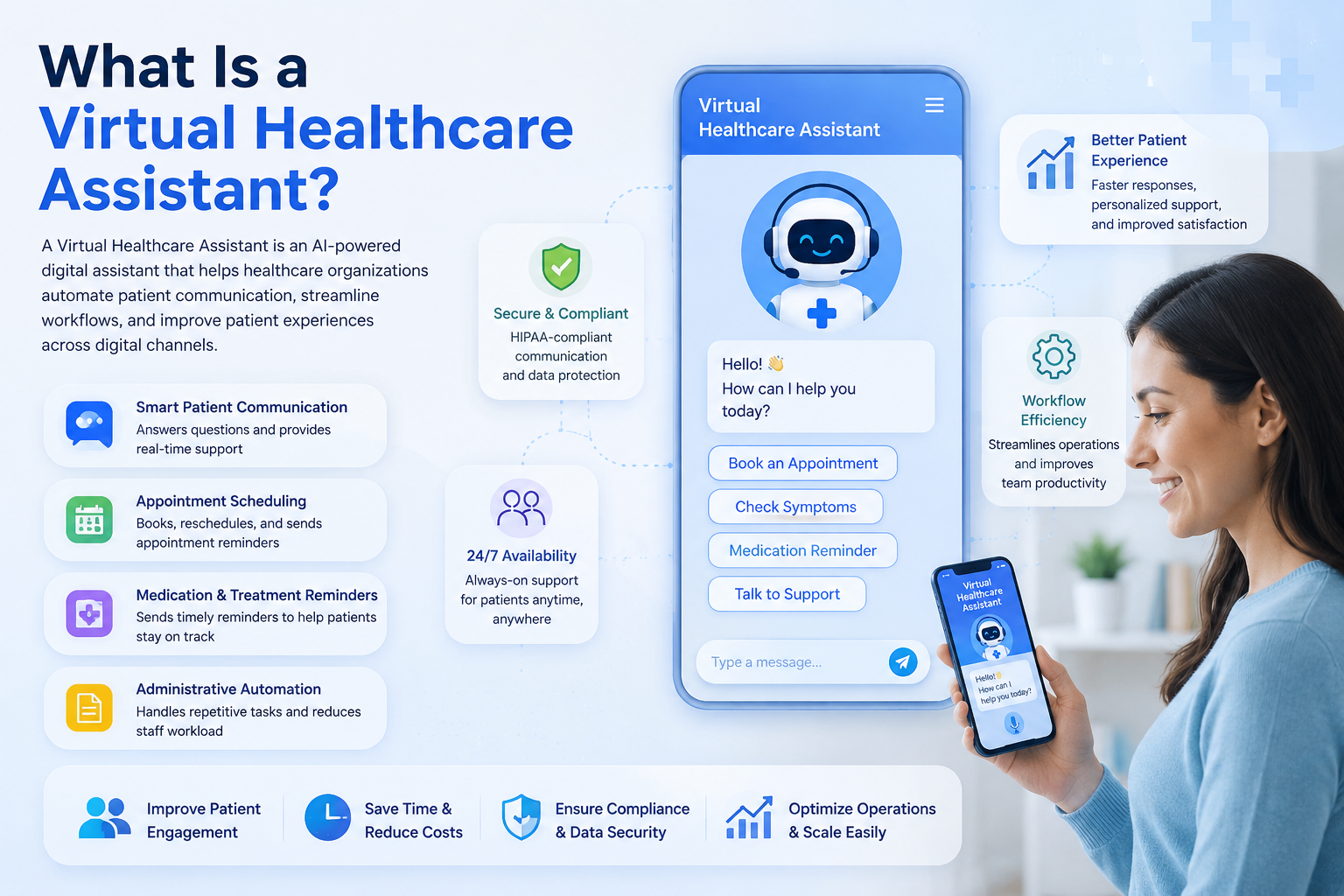
A Virtual Healthcare Assistant is basically an AI-powered tool designed to help healthcare organizations handle everyday patient communication, scheduling, admin work, and support tasks faster and more efficiently.
Think of it like having a digital healthcare support assistant that works 24/7 without getting overwhelmed by repetitive tasks.
Instead of relying entirely on reception staff or manual processes, many clinics now use AI healthcare assistants to automate appointment reminders, answer common patient questions, manage follow-ups, support patient engagement, and improve communication across healthcare teams.
The interesting part is that this technology is no longer limited to large hospitals with massive budgets.
Smaller clinics, dental offices, telehealth providers, and private healthcare practices are now adopting healthcare automation software because patients expect quicker responses and smoother experiences.
At the same time, healthcare providers are under pressure to reduce admin workload, improve patient satisfaction, and deal with staffing shortages. That's where AI in healthcare is starting to make a real impact.
How AI healthcare assistants work in modern clinics
Most modern virtual medical assistant platforms work by connecting directly into healthcare workflows and communication systems.
For example, instead of staff manually calling patients all day, an AI patient communication tool can automatically send reminders, confirmations, follow-ups, and even answer basic patient questions instantly.
Some AI healthcare assistant platforms can also:
- Schedule appointments automatically
- Send prescription reminders
- Help patients complete forms online
- Route support tickets to the correct department
- Provide multilingual patient support
- Reduce missed appointments
- Support remote patient communication
- Improve healthcare workflow automation
A lot of these systems now use conversational AI, meaning patients can interact with them almost like chatting with a real person. That's one reason why healthcare chatbot software and AI-powered patient engagement tools are growing so quickly in 2026.
The difference between a virtual medical assistant and traditional admin staff
Now to be clear — a Virtual Healthcare Assistant is not designed to replace healthcare workers or front-desk staff. The real goal is to remove repetitive admin tasks so healthcare teams can focus more on patient care.
Traditional admin staff still play a huge role in healthcare organizations because patients often need empathy, reassurance, and human interaction.
But many repetitive tasks like appointment reminders, document collection, patient intake, and basic support requests can now be handled much faster through AI healthcare automation.
Here's the easiest way to think about it:
- Human staff handle complex patient needs and personal interactions
- AI healthcare assistants handle repetitive tasks and routine communication
That combination helps clinics operate more efficiently without putting even more pressure on healthcare workers who are already stretched thin.
Why healthcare providers are adopting AI faster in 2026
Honestly, healthcare organizations don't really have much choice anymore. Patient expectations have changed dramatically over the last few years.
People now expect healthcare communication to work more like modern customer service.
They want faster replies, online scheduling, digital communication, mobile access, and instant updates without waiting on hold for long periods.
At the same time, healthcare providers are dealing with:
- Staff shortages
- Burnout and admin overload
- Rising operational costs
- Increased patient demand
- More remote and hybrid healthcare services
- Growing compliance and documentation requirements
That's why AI in healthcare is growing so aggressively right now. Healthcare organizations are realizing that automation is no longer just about saving time — it's becoming essential for improving patient experience and keeping operations running smoothly.
The healthcare providers adopting virtual healthcare assistant technology today are often seeing improvements in patient communication, operational efficiency, appointment management, and overall patient engagement.
And in many cases, staff are finally getting some relief from the constant administrative pressure that slows healthcare teams down every day.
Why Healthcare Organizations Are Investing in Virtual Healthcare Assistant Technology in 2026
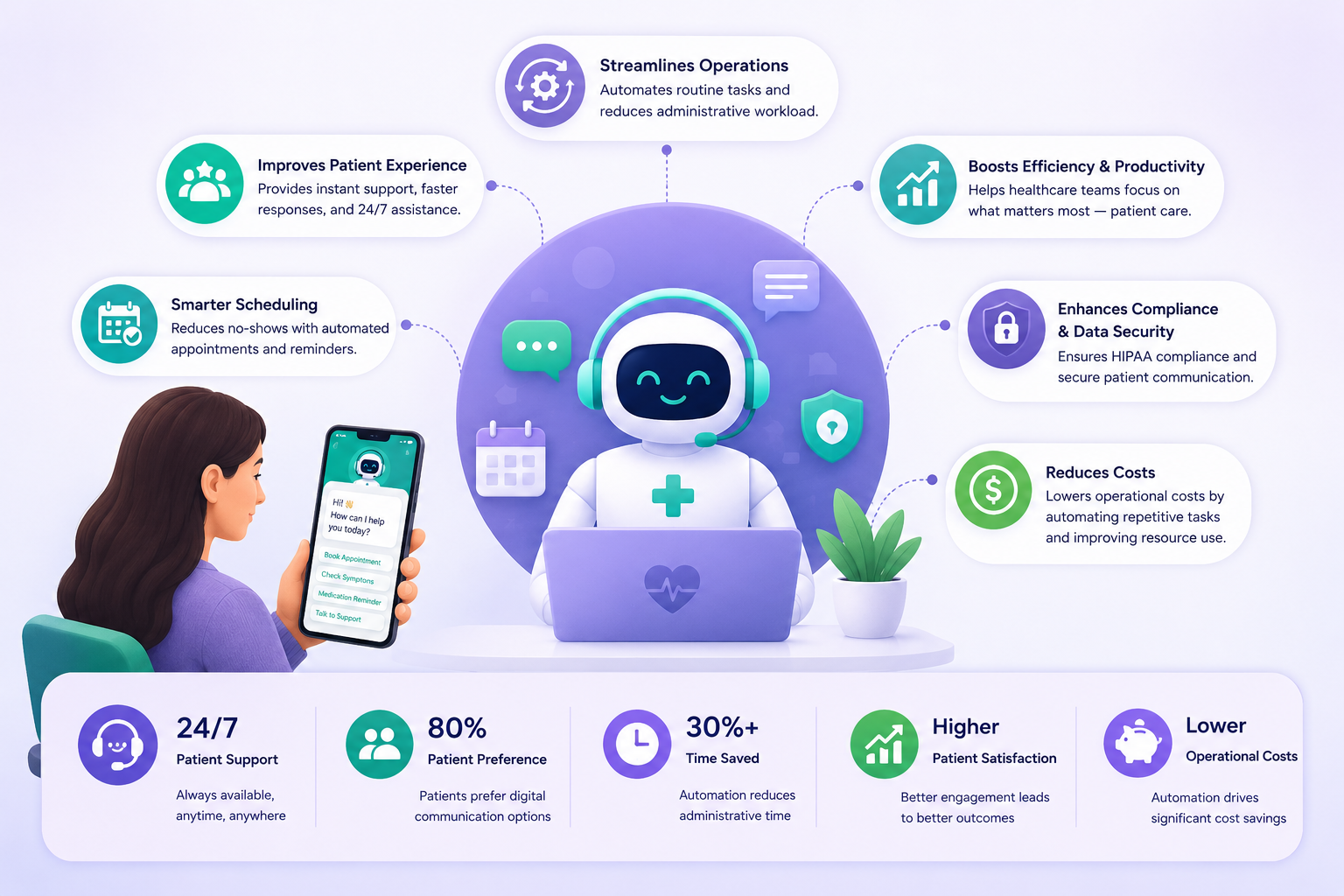
Well you guessed it AI, healthcare organizations are investing heavily in Virtual Healthcare Assistant technology right now, and honestly, it's happening for a pretty simple reason — the old way of managing patient communication and administrative work just isn't sustainable anymore.
Healthcare teams are overwhelmed.
Patients expect faster responses, online appointment booking, digital communication, and personalized care experiences, while hospitals and clinics are trying to manage staffing shortages, rising operational costs, compliance requirements, and endless administrative work at the same time.
That's exactly why technologies like AI healthcare assistants, healthcare workflow automation, virtual medical assistants, and patient engagement software are becoming such a huge priority across the healthcare industry.
Even some of the world's biggest healthcare organizations and technology companies are already investing heavily in AI-powered healthcare support systems.
For example:
- Amazon has introduced AI healthcare assistant technology to help improve patient support and healthcare navigation.
- Microsoft continues expanding AI healthcare tools through its cloud and healthcare platforms.
- Oracle is integrating AI into healthcare operations and electronic health record systems.
- CVS Health has invested heavily in digital patient communication and virtual care services.
- Mayo Clinic is actively researching how AI can improve diagnostics, patient experience, and operational efficiency.
And this trend is only accelerating in 2026.
Why Healthcare Organizations Are Investing in Virtual Healthcare Assistant Technology in 2026
Rising patient expectations for faster communication
Patients today expect healthcare communication to feel just as fast and convenient as every other digital service they use daily.
Nobody wants to spend 25 minutes waiting on hold just to reschedule an appointment anymore.
Patients now expect:
- Online appointment scheduling
- Instant appointment confirmations
- Automated reminders
- Faster response times
- Mobile-friendly communication
- Secure patient messaging
- Self-service healthcare portals
That shift is forcing healthcare organizations to modernize how they communicate.
This is where AI patient communication tools and healthcare chatbot software are making a massive difference.
Instead of front-desk teams manually handling every single request, AI-powered systems can instantly respond to common questions, route patients to the correct department, and automate routine communication 24/7.
For example, many healthcare providers now use AI-powered virtual assistants to:
- Confirm appointments automatically
- Send prescription reminders
- Answer FAQs
- Handle patient intake forms
- Support telehealth communication
- Provide multilingual support
The result is usually a much smoother patient experience while reducing pressure on healthcare staff at the same time.
The growing cost of administrative workloads
One of the biggest hidden problems in healthcare is the amount of time staff spend handling repetitive admin work.
A huge percentage of healthcare operations still involve manual scheduling, paperwork, phone calls, data entry, follow-ups, and internal coordination. That creates operational bottlenecks that slow everyone down.
And the cost adds up fast. Healthcare organizations are also starting to rely on tools like an RVU calculator to better understand provider productivity, optimize resource allocation, and make more data-driven operational decisions
Healthcare organizations are now realizing that many administrative tasks don't actually require human intervention anymore. This is one reason why healthcare automation software and AI healthcare support platforms are growing so rapidly.
A modern Virtual Healthcare Assistant can help automate tasks like:
- Patient scheduling
- Reminder notifications
- Medical form collection
- Patient onboarding
- Internal workflow routing
- Follow-up communication
- Basic support requests
Instead of staff wasting hours on repetitive processes, healthcare teams can focus more on patient care and high-value work.
Some organizations are even using AI-driven analytics to predict appointment no-shows and automate proactive patient outreach before problems happen.
That's a major shift from reactive healthcare operations to more intelligent and predictive healthcare management.
Healthcare staffing shortages and burnout challenges
This is probably the biggest reason healthcare providers are adopting AI faster than ever.
Healthcare burnout is becoming a serious global problem.
Doctors, nurses, administrators, and support staff are dealing with increasing workloads, staffing shortages, longer hours, and constant operational pressure. Many healthcare workers spend nearly as much time on documentation and administrative work as they do with actual patients.
That's creating major retention problems across the healthcare industry.
A lot of healthcare organizations are now turning to virtual healthcare assistant technology because they simply cannot continue scaling operations by hiring alone.
AI healthcare assistants help reduce pressure by handling repetitive communication and workflow tasks behind the scenes.
For example, a clinic using AI healthcare automation may reduce:
- Manual scheduling calls
- Administrative backlogs
- Missed appointments
- Delayed patient responses
- Internal communication bottlenecks
- Staff workload overload
And when healthcare staff spend less time buried in admin work, patient care often improves naturally.
That's why many healthcare leaders no longer see AI as just another technology trend. They see it as a practical solution for improving operational efficiency, supporting healthcare teams, and delivering a better patient experience without burning out staff in the process.
Here are 12 Powerful Ways a Virtual Healthcare Assistant Improves Patient Care
A lot of people still think a Virtual Healthcare Assistant is just a chatbot sitting on a website answering simple questions, but the reality is way bigger than that now.
Modern AI healthcare assistants are being used across hospitals, clinics, telehealth providers, dental practices, and private healthcare organizations to automate communication, reduce admin work, improve patient engagement, and help healthcare teams operate far more efficiently.
The interesting part is that most patients don't even realize AI is working behind the scenes during many healthcare interactions now.
Here's how healthcare organizations are actually using this technology in the real world.

Here are 12 Powerful Ways a Virtual Healthcare Assistant Improves Patient Care
#1. Automating appointment scheduling and reminders
This is probably one of the most common uses of healthcare automation software today.
Instead of patients needing to call a clinic during office hours, an AI-powered virtual medical assistant can allow patients to:
- Book appointments online
- Reschedule visits automatically
- Receive SMS and email reminders
- Confirm attendance instantly
- Join telehealth sessions through automated links
Imagine a busy dental clinic handling 150+ patients every day.
Before using AI scheduling tools, the reception team spent hours every morning answering phone calls, updating calendars, and manually sending reminders.
After integrating a Virtual Healthcare Assistant, patients can now:
- Book appointments online 24/7
- Receive automated reminder texts 48 hours before appointments
- Confirm or cancel appointments instantly
- Automatically fill vacant appointment slots from cancellation lists
The clinic reduces admin workload while improving appointment efficiency at the same time.
- Fewer missed appointments
- Reduced phone call volume
- Faster scheduling process
- Better patient experience
- Lower administrative costs
- Improved healthcare workflow automation
Most healthcare organizations integrate AI scheduling systems directly into:
- Electronic Health Records (EHR) systems
- Healthcare CRM software
- Telehealth platforms
- Patient portals
- SMS and email communication tools
Platforms like Epic Systems, Oracle Health, and Salesforce already support healthcare workflow integrations for AI-powered patient communication.
#2. Reducing missed appointments with AI follow-ups
Missed appointments cost healthcare organizations millions every year.
That's why many providers now use AI patient communication tools to proactively follow up with patients automatically.
A private healthcare clinic notices that patients frequently forget specialist appointments booked weeks in advance.
Instead of relying on staff to manually chase patients, the clinic uses an AI healthcare assistant to:
- Send reminders 7 days before appointments
- Send another reminder 24 hours before
- Allow patients to confirm attendance with one click
- Automatically trigger follow-up messages if patients don't respond
Some advanced systems can even predict likely no-shows using AI analytics.
- Reduced no-show rates
- Improved patient attendance
- Better schedule management
- Higher operational efficiency
- Increased clinic revenue
#3. Improving patient communication across channels
Patients don't all communicate the same way anymore.
Some prefer SMS. Others prefer email, apps, patient portals, or live chat.
Modern AI healthcare support platforms allow organizations to centralize communication across multiple channels.
A hospital group may use a Virtual Healthcare Assistant across:
- SMS notifications
- Mobile healthcare apps
- Website chat support
- Email communication
- Patient self-service portals
Instead of patients waiting on hold for basic information, AI systems can instantly answer common questions like:
- Appointment times
- Prescription refill status
- Insurance information
- Clinic opening hours
- Test result notifications
Benefits
- Faster patient responses
- Better patient engagement
- Reduced support backlog
- Improved communication consistency
- Better patient satisfaction
#4. Supporting remote patient engagement
Remote healthcare and telehealth services exploded over the last few years, and AI is helping healthcare providers manage that demand more effectively.
A telehealth provider uses an AI-powered healthcare assistant to:
- Send video appointment links automatically
- Remind patients to upload medical documents
- Provide post-appointment follow-up instructions
- Monitor patient check-ins remotely
- Collect patient feedback after consultations
Benefits
- Better remote patient communication
- Improved telehealth experience
- Reduced admin overhead
- Faster remote support
- Higher patient retention
#5. Helping healthcare staff respond faster to requests
Healthcare staff are constantly interrupted by repetitive questions and requests.
AI systems now help filter, prioritize, and route requests automatically.
A patient sends a support request through a hospital portal.
Instead of waiting for a receptionist to manually process it, the AI healthcare assistant instantly categorizes the request and routes it to:
- Billing
- Clinical support
- Appointment scheduling
- Prescription management
- Technical support
Benefits
- Faster response times
- Less admin pressure on staff
- Improved internal workflows
- Better patient communication experience
#6. Streamlining healthcare workflow automation
Healthcare organizations still rely heavily on manual processes.
That creates delays, paperwork bottlenecks, and operational inefficiencies.
A healthcare provider automates patient onboarding using healthcare workflow automation tools.
Patients receive:
- Digital intake forms
- Automated compliance documents
- Insurance verification requests
- Pre-appointment instructions
before they even arrive at the clinic.
Benefits
- Reduced paperwork
- Faster patient processing
- Improved operational efficiency
- Better data accuracy
- Reduced administrative costs
#7. Improving medical document access and sharing
AI-powered healthcare systems also improve how documents and patient records are managed.
Instead of patients calling clinics to request documents manually, a secure patient portal connected to a Virtual Healthcare Assistant can provide:
- Lab results
- Medical records
- Referral letters
- Prescription information
- Discharge documents
Through secure digital access.
Benefits
- Faster document retrieval
- Improved patient convenience
- Reduced admin workload
- Better information accessibility
- Enhanced healthcare collaboration
#8. Supporting multilingual patient communication
Many healthcare providers serve multilingual communities, and communication barriers can create serious problems.
A healthcare organization uses AI-powered translation and multilingual healthcare chatbot software to support patients in multiple languages.
Patients can receive:
- Appointment reminders
- Healthcare instructions
- Follow-up communication
- Support responses
in their preferred language automatically.
Benefits
- Better patient understanding
- Improved accessibility
- Higher patient satisfaction
- Reduced communication barriers
- More inclusive healthcare services
#9. Reducing repetitive administrative tasks
This is where AI probably saves healthcare organizations the most time overall.
Instead of staff manually handling repetitive tasks every day, AI healthcare assistants automate:
- Data entry
- Follow-up reminders
- Form processing
- Internal notifications
- Scheduling workflows
- FAQ responses
Benefits
- Reduced staff burnout
- Lower operational costs
- Improved efficiency
- More time for patient care
- Better workforce productivity
#10. Enhancing patient satisfaction and experience
Patients judge healthcare organizations heavily on communication and responsiveness now.
A patient who can:
- Book appointments online
- Get instant responses
- Receive reminders automatically
- Access documents digitally
- Communicate through mobile devices
Is far more likely to report a positive healthcare experience.
Benefits
- Better patient engagement
- Higher satisfaction scores
- Improved patient loyalty
- Better online reviews
- Increased patient retention
#11. Supporting healthcare compliance and record keeping
Healthcare compliance requirements are becoming more complex every year.
AI systems help automate documentation and audit tracking.
Healthcare automation software can automatically log:
- Patient communication history
- Consent records
- Appointment updates
- Document access activity
- Compliance acknowledgements
Benefits
- Improved audit readiness
- Better compliance tracking
- Reduced human error
- Stronger data security
- Easier record management
#12. Helping healthcare teams scale operations efficiently
One of the biggest reasons organizations invest in Virtual Healthcare Assistant technology is scalability.
A growing healthcare provider expanding into multiple locations uses AI-powered patient communication systems to standardize operations across every clinic.
Instead of hiring large admin teams at every location, AI helps manage:
- Scheduling
- Communication
- Follow-ups
- Patient onboarding
- Internal workflow automation
from one centralized system.
Benefits
- Easier business scaling
- Lower operational costs
- More consistent patient experience
- Improved healthcare operations management
- Better resource allocation
The Biggest Challenges Healthcare Providers Face Without AI Automation

The Biggest Challenges Healthcare Providers Face Without AI Automation
A lot of healthcare organizations are still relying on outdated systems, manual processes, spreadsheets, disconnected software, and overloaded front-desk teams to manage patient operations every day.
The problem is that healthcare has changed dramatically over the last few years, but many internal systems haven't kept up.
Patients now expect digital-first healthcare experiences.
They want fast responses, online access, personalized care communication, and seamless healthcare coordination.
But when clinics and hospitals continue using fragmented systems and manual workflows, things start breaking down very quickly.
And honestly, this is where many healthcare providers are starting to fall behind competitors that are investing in smarter healthcare technology solutions.
Communication delays between staff and patients
One of the biggest frustrations patients have today is slow communication.
Nobody enjoys waiting days for a callback, sitting on hold for long periods, or chasing updates about appointments, referrals, prescriptions, or test results.
Without modern digital patient engagement platforms, communication often becomes reactive instead of proactive.
For example, many healthcare practices still rely heavily on:
- Manual phone scheduling
- Voicemail callbacks
- Paper-based intake forms
- Email chains
- Separate messaging systems
That creates delays across the entire patient journey.
This is especially problematic for organizations trying to improve:
- Patient access management
- Clinical communication workflows
- Care coordination systems
- Healthcare service delivery
- Patient retention strategies
A patient who struggles to get updates or support quickly may start looking elsewhere for care, especially as more healthcare providers now offer digital-first experiences.
Imagine a patient trying to reschedule a specialist appointment.
Without automated healthcare communication tools, they may:
- Call the clinic
- Wait on hold
- Leave a voicemail
- Wait hours or days for a response
- Miss available appointment slots
Now compare that with a healthcare provider using a connected patient communication platform where patients can instantly:
- Reschedule online
- Receive live availability updates
- Get automated confirmations
- Access support through secure messaging
The difference in patient experience is massive.
Information silos across disconnected systems
Another major challenge is disconnected healthcare systems.
Many healthcare organizations use multiple tools that don't properly communicate with each other. One platform manages scheduling, another handles records, another manages billing, and another handles communication.
The result is fragmented healthcare operations.
This creates serious issues for:
- Clinical data management
- Care team collaboration
- Healthcare information sharing
- Patient record accessibility
- Operational visibility
Staff often waste valuable time switching between systems trying to find information.
And when systems don't sync correctly, mistakes happen.
A patient updates their contact information through a healthcare portal, but the update doesn't sync across every internal system.
Now:
- Billing has old information
- Appointment reminders go to the wrong number
- Clinical staff can't reach the patient
- Follow-up communication fails
These kinds of operational gaps create frustration for both staff and patients.
Healthcare providers adopting connected healthcare ecosystems and intelligent workflow platforms are reducing these issues by centralizing communication, records, and patient interactions into more unified systems.
Disconnected systems often lead to:
- Duplicate data entry
- Communication breakdowns
- Delayed patient care
- Administrative inefficiencies
- Reduced productivity
- Increased operational risk
And as healthcare organizations scale, these inefficiencies become even harder to manage.
Staff burnout caused by repetitive admin work
This is probably one of the most serious problems in healthcare right now.
Healthcare professionals are spending an enormous amount of time handling repetitive non-clinical tasks instead of focusing on patient care.
Things like:
- Appointment coordination
- Patient follow-ups
- Form processing
- Documentation updates
- Referral tracking
- Manual notifications
- Internal admin requests
all add up quickly.
Without healthcare process optimization tools in place, teams become overwhelmed by operational workload.
And over time, that creates burnout.
A medical practice may have highly trained staff spending hours every day manually processing intake forms and chasing appointment confirmations instead of helping patients directly.
Now imagine introducing:
- Intelligent scheduling systems
- Automated patient intake software
- Smart healthcare notifications
- Clinical workflow management tools
- Self-service patient portals
Suddenly, staff spend less time buried in repetitive admin work and more time supporting actual patient needs.
Healthcare burnout can lead to:
- Higher employee turnover
- Reduced care quality
- Lower staff morale
- Increased operational stress
- Slower patient response times
- Difficulty retaining healthcare talent
That's why many healthcare organizations are now investing heavily in technologies like:
- Healthcare operations management software
- Smart patient engagement systems
- Medical workflow optimization tools
- Intelligent healthcare support platforms
- Digital care coordination solutions
Not because they want to replace healthcare workers, but because they need to reduce pressure on teams before operational strain starts affecting patient outcomes and business performance.
What Features Should You Look for in a Virtual Healthcare Assistant?
Not all Virtual Healthcare Assistant platforms are built the same, and honestly, this is where many healthcare organizations make mistakes.
A lot of providers rush into buying healthcare technology because it sounds impressive, but then realize later the system doesn't integrate properly, staff struggle to use it, or patients simply avoid it altogether.
The best AI healthcare platforms should actually make life easier for both healthcare teams and patients — not add more complexity.
When evaluating a virtual healthcare support system, there are several key features that really matter if you want long-term success, better patient engagement, and smoother healthcare operations.
Secure patient communication tools
Security is probably the most important feature of any healthcare communication platform.
Healthcare organizations handle highly sensitive patient information every day, so secure communication isn't optional — it's essential.
A strong digital healthcare communication system should support:
- Encrypted messaging
- Secure patient portals
- Access controls and permissions
- Audit logs and activity tracking
- HIPAA-compliant communication
- Secure document sharing
Patients also want reassurance that their information is protected, especially when using online healthcare services and mobile healthcare apps.
Why this matters
Without secure healthcare communication systems, organizations risk:
- Data breaches
- Compliance violations
- Patient trust issues
- Financial penalties
- Operational disruption
That's why healthcare cybersecurity and secure patient messaging are becoming huge priorities in 2026.
AI-powered scheduling and reminders
One of the most valuable features in any healthcare automation platform is intelligent appointment management.
Healthcare providers lose huge amounts of time and revenue through missed appointments, scheduling conflicts, and manual booking processes.
A modern AI-driven patient scheduling system should be able to:
- Automate bookings
- Handle cancellations
- Send appointment reminders
- Fill canceled appointment slots
- Reduce no-show rates
- Manage recurring appointments
The best systems can even personalize communication based on patient preferences.
Why this matters
Efficient scheduling directly improves:
- Patient flow management
- Healthcare resource utilization
- Clinic efficiency
- Patient satisfaction
- Revenue optimization
For busy healthcare organizations, automation here can save staff hours every single week.
Mobile-friendly healthcare collaboration
Healthcare is no longer tied to desktops and office-based systems.
Doctors, nurses, specialists, and support staff often work across multiple locations, departments, and devices throughout the day.
That's why modern mobile healthcare communication platforms are becoming essential.
Healthcare staff need secure access to:
- Patient updates
- Internal messaging
- Appointment information
- Care coordination tools
- Healthcare notifications
- Clinical collaboration systems
From smartphones and tablets without disrupting workflows.
Mobile-first healthcare systems help improve:
- Clinical team communication
- Response times
- Remote healthcare coordination
- Workforce flexibility
- Healthcare productivity
This is especially important for hospitals, remote healthcare teams, home healthcare providers, and telemedicine organizations.
Integration with healthcare systems and workflows
One of the fastest ways to create operational problems is introducing software that doesn't connect properly with existing healthcare systems.
A good Virtual Healthcare Assistant should integrate smoothly with tools healthcare organizations already use daily, including aesthetic emr software for practices that need specialized clinical and patient-record workflows.This may include:
- Electronic Medical Records (EMR)
- Electronic Health Records (EHR)
- Practice management software
- Billing systems
- Telehealth platforms
- CRM healthcare solutions
- Clinical workflow systems
The goal is to create connected healthcare operations rather than adding more disconnected software.
Strong healthcare software integration helps organizations:
- Reduce duplicate data entry
- Improve operational visibility
- Streamline healthcare workflows
- Improve patient data accuracy
- Reduce admin inefficiencies
Without integration, staff often end up manually transferring information between systems, which defeats the entire purpose of automation.
Compliance and data protection features
Healthcare compliance requirements are becoming stricter every year.
Any healthcare AI platform must support proper compliance management and healthcare data governance.
A strong healthcare automation solution should include:
- Compliance monitoring
- Role-based permissions
- Data retention controls
- Secure cloud storage
- Audit reporting
- Patient consent management
- Data encryption standards
Healthcare organizations also need to ensure AI tools align with healthcare regulations and patient privacy requirements in their region.
Proper healthcare compliance features help reduce:
- Legal risks
- Security vulnerabilities
- Unauthorized data access
- Regulatory penalties
- Operational disruptions
Trust is everything in healthcare, and organizations that fail to protect patient information can damage both reputation and patient confidence very quickly.
Important Features to Look for in a Virtual Healthcare Assistant
| Feature | What It Does | Main Benefit |
| Secure Patient Messaging | Protects patient communication with encrypted systems | Improves patient trust and compliance |
| AI Appointment Scheduling | Automates bookings and reminders | Reduces missed appointments |
| Healthcare Workflow Automation | Streamlines repetitive admin tasks | Saves staff time and improves efficiency |
| Mobile Healthcare Access | Supports communication across devices | Improves flexibility for healthcare teams |
| Telemedicine Integration | Connects virtual healthcare services | Enhances remote patient care |
| EHR & EMR Integration | Syncs patient records and workflows | Reduces duplicate data entry |
| Patient Self-Service Portals | Allows patients to manage appointments and records | Improves patient experience |
| Clinical Collaboration Tools | Helps teams communicate internally | Improves care coordination |
| Compliance Management Features | Supports healthcare regulations and audit tracking | Reduces legal and compliance risk |
| AI Healthcare Analytics | Tracks patient trends and operational performance | Supports better decision-making |
This is where healthcare organizations should really slow down before choosing a platform.
The best Virtual Healthcare Assistant isn't necessarily the one with the most features — it's the one that actually fits your healthcare workflows, improves patient communication, supports healthcare staff, and integrates properly with the systems you already use every day.
How AI Is Shaping the Future of Healthcare Communication
How AI Is Shaping the Future of Healthcare Communication
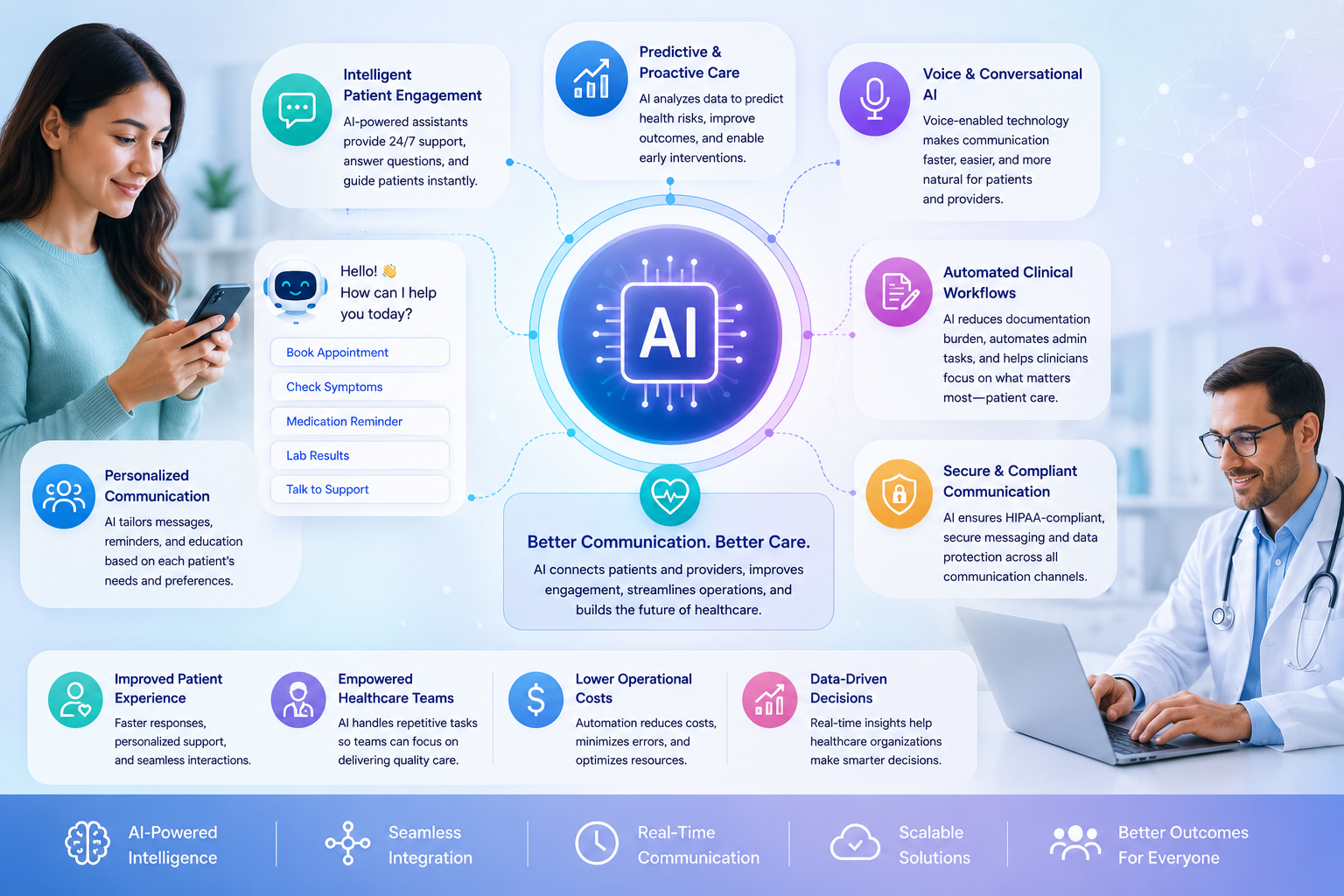
The future of healthcare communication is changing incredibly fast right now, and honestly, a lot of it is being driven by artificial intelligence.
What started as simple healthcare chatbots and appointment reminders has now evolved into much smarter systems capable of understanding patient behavior, predicting healthcare needs, supporting doctors in real time, and automating large parts of healthcare operations.
Healthcare organizations are no longer looking at AI as just another digital tool. They're starting to see it as part of the core infrastructure needed to improve patient access, reduce operational pressure, and deliver more personalized healthcare experiences at scale.
One of the biggest trends happening right now is the rise of predictive healthcare technology. Instead of waiting for patients to reach out with problems, AI systems are becoming proactive.
Modern healthcare AI platforms can analyze patient patterns, communication history, appointment behavior, wearable device data, and treatment activity to identify potential risks early. Predictive analytics tools are already being used to detect complications, identify readmission risks, and support early intervention strategies before health conditions become more serious.
This shift toward proactive care is also changing how healthcare organizations approach patient engagement.
Instead of generic reminders and one-size-fits-all communication, healthcare providers are increasingly using personalized healthcare engagement systems that adapt communication based on individual patient needs, language preferences, treatment history, and behavioral patterns.
For example, a diabetes patient may automatically receive personalized medication reminders, nutritional guidance, follow-up scheduling prompts, and remote monitoring alerts based on their treatment plan.
A cardiac patient may receive ongoing wellness check-ins and AI-generated health recommendations tied to wearable device data and remote monitoring systems. These kinds of personalized healthcare communication workflows are becoming far more common as AI platforms become more sophisticated.
Another major trend shaping the industry is the rapid growth of voice-enabled healthcare assistants and conversational AI systems. Healthcare organizations are investing heavily in voice technology because speaking is often faster, easier, and more natural than typing or navigating complex healthcare portals.
The AI voice agents in healthcare market is projected to grow from approximately $650 million in 2026 to over $11.6 billion by 2035, highlighting just how aggressively this technology is expanding across the healthcare sector.
We're already seeing healthcare providers use voice AI for:
- Clinical documentation
- Ambient medical transcription
- Appointment scheduling
- Patient triage support
- Medication reminders
- Remote healthcare monitoring
- Voice-driven patient navigation systems
Large healthcare technology companies are moving quickly into this space as well. Microsoft recently introduced Dragon Copilot, a healthcare-focused AI assistant designed to help clinicians automate clinical documentation, referrals, and administrative tasks using ambient voice technology.
$11.6B
market projection
The AI voice agents in healthcare market is projected to grow from approximately $650 million in 2026 to more than $11.6 billion by 2035, highlighting how rapidly healthcare providers are adopting voice AI, conversational healthcare systems, virtual patient assistants, and intelligent healthcare automation technologies.
Source: Towards Healthcare
Meanwhile, companies like Epic Systems, Oracle, and AI healthcare startups like Suki and Ambience Healthcare are heavily investing in AI-powered clinical workflow automation and voice-enabled healthcare systems.
One particularly interesting trend is the rise of ambient AI healthcare systems. These tools can listen during patient consultations, automatically generate medical notes, summarize conversations, update patient records, and reduce the enormous administrative burden placed on clinicians.
Many healthcare providers are adopting these systems specifically to combat physician burnout and improve operational efficiency.
At the same time, healthcare organizations are also exploring how AI can improve healthcare accessibility for underserved and remote populations. Voice-based healthcare AI is becoming especially important for elderly patients, multilingual communities, visually impaired users, and patients with limited digital literacy.
Researchers are already studying how conversational AI and multilingual voice-interactive healthcare systems can help bridge healthcare accessibility gaps and improve remote patient support.
Another important trend is the move toward what many are calling the "digital healthcare front door." This means patients increasingly interact with healthcare organizations through AI-powered communication systems before ever speaking with a human.
Conversational AI platforms are now being integrated into patient portals, telehealth systems, mobile healthcare apps, and intelligent contact centers to streamline healthcare communication and reduce operational friction.
Analysts project the conversational AI healthcare market could exceed $59 billion by 2030 as adoption continues accelerating globally.
$59B+
AI healthcare market
Industry analysts project the conversational AI healthcare market could exceed $59 billion by 2030 as healthcare organizations rapidly adopt AI-powered patient communication, virtual healthcare assistants, intelligent scheduling systems, and healthcare automation tools to improve patient experience and reduce operational pressure.
Source: Frost & Sullivan
Of course, there are still important concerns around healthcare AI adoption, especially involving privacy, transparency, security, and patient trust.
Healthcare organizations need to ensure AI systems remain compliant, explainable, and secure while still maintaining human oversight where needed.
Interestingly though, some recent research suggests patients increasingly perceive AI healthcare chatbots as highly empathetic in text-based interactions, in some cases even more empathetic than human healthcare professionals.
The bigger picture here is that healthcare communication is shifting from reactive, manual, and fragmented systems toward intelligent, connected, and predictive healthcare ecosystems.
AI is no longer just improving efficiency behind the scenes — it's actively reshaping how healthcare organizations communicate, engage with patients, manage workflows, and deliver care in the future.
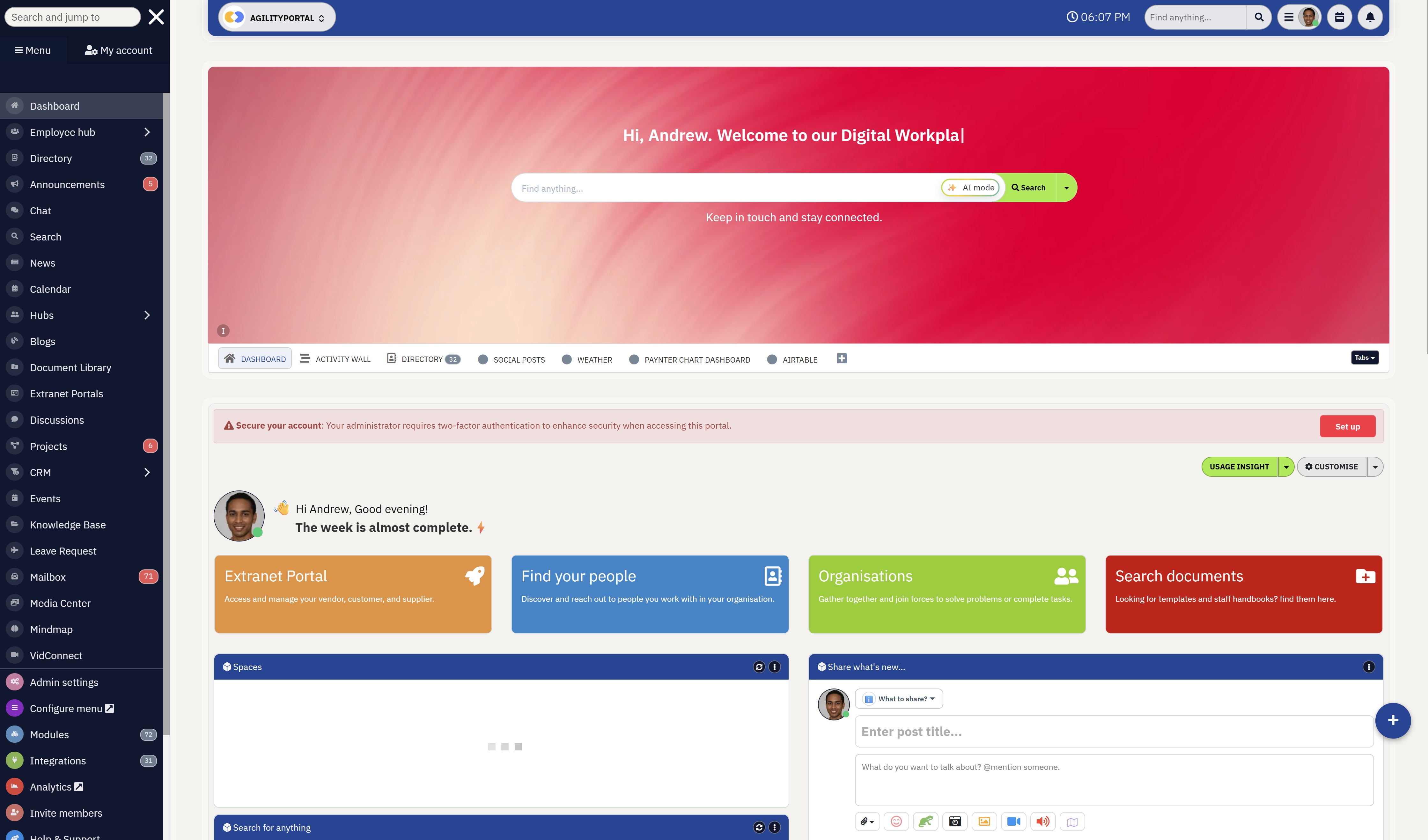
One Platform to Manage Remote Healthcare Staff, Communication & Compliance
One Platform to Manage Remote Healthcare Staff, Communication & Compliance
Healthcare organizations are increasingly managing remote teams, frontline staff, hybrid workers, and distributed clinics across multiple locations.
AgilityPortal helps healthcare providers centralize employee communication, secure document sharing, policy management, onboarding, workforce collaboration, and compliance tracking into one connected digital workplace platform.
Designed for modern healthcare environments, AgilityPortal improves operational visibility, reduces communication gaps, supports mobile healthcare teams, and helps organizations manage remote staff more efficiently without relying on disconnected systems.
- Built for remote and distributed healthcare teams
- Centralized communication, compliance, and workforce management
- Secure document sharing and policy acknowledgement tracking
- Mobile-first platform for frontline healthcare workers
- Streamlines onboarding, updates, and internal collaboration
- Helps reduce operational silos and administrative workload
- Easy to use across clinics, departments, and healthcare locations
Built for Modern Healthcare Teams
Managing Remote Healthcare Staff Shouldn’t Feel This Difficult
Healthcare organizations are under increasing pressure to manage distributed teams, improve patient communication, maintain compliance, and reduce operational bottlenecks — all while supporting remote and hybrid healthcare workers across multiple locations.
AgilityPortal helps healthcare providers centralize communication, policy management, employee updates, secure document sharing, onboarding, compliance workflows, and workforce collaboration into one connected digital workplace platform.
- Secure communication for remote healthcare teams
- Centralized healthcare document management
- Employee onboarding and policy acknowledgement tracking
- Mobile access for frontline and remote healthcare staff
- Healthcare workflow automation and announcements
- Team collaboration across clinics and healthcare departments
Final Thoughts
A Virtual Healthcare Assistant is quickly becoming one of the most valuable tools healthcare organizations can invest in.
From improving patient communication and reducing missed appointments to streamlining healthcare operations and lowering administrative workload, AI is helping providers deliver faster and more connected patient experiences.
The important thing to understand is that AI is not replacing healthcare workers — it's supporting them by removing repetitive tasks and freeing up more time for patient care.
As patient expectations continue to evolve, healthcare providers that modernize their communication systems, patient engagement strategies, and digital healthcare workflows now will be far better positioned to compete and scale in the future.
AI Summary
- Virtual Healthcare Assistant platforms help healthcare organizations automate patient communication, appointment scheduling, reminders, follow-ups, and repetitive administrative tasks across digital healthcare environments.
- Healthcare providers increasingly use AI-powered healthcare assistants to improve patient engagement, reduce staff workload, support telehealth services, and streamline healthcare operations.
- Common healthcare AI use cases include automated appointment booking, secure patient messaging, AI voice assistants, healthcare chatbot systems, patient intake automation, and intelligent clinical workflow management.
- Modern healthcare automation focuses on improving patient experience, reducing operational bottlenecks, strengthening healthcare communication, and supporting more connected digital healthcare ecosystems.
- Healthcare organizations using disconnected systems often struggle with fragmented communication, administrative overload, delayed patient responses, inefficient workflows, and reduced operational visibility.
- The best Virtual Healthcare Assistant software supports healthcare workflow automation, EHR integration, compliance management, mobile healthcare access, multilingual communication, and patient self-service capabilities.
- Organizations investing in AI healthcare platforms and intelligent patient engagement systems can improve operational efficiency, reduce staff burnout, enhance patient satisfaction, and scale healthcare services more effectively.
Most Popular Posts

Effective communication among team members is vital for the productivity and success of any organization. Surprisingly, 60% of companies lack a long-term internal communication strategy, which p...


Businesses thrive on communication for efficiency, productivity and accomplishment. When the right information is passed from the right designation in the organization, it promotes positivity an...

Categories
Blog
(3196)
Business Management
(395)
Employee Engagement
(235)
Digital Transformation
(218)
Growth
(150)
Intranets
(141)
Internal communications
(106)
Remote Work
(68)
Sales
(53)
Collaboration
(52)
Customer Experience
(32)
Culture
(30)
Knowledge Management
(29)
Project management
(29)
Leadership
(20)
Comparisons
(9)
News
(1)

Related Posts

Could AI produce your next workplace video faster—and still deliver a message your employees can trust? As more businesses use video for onboarding, training and leadership updates, one question keeps coming up: will AI replace video editors in...

Could the best machine learning systems help your employees spend less time sorting requests, updating spreadsheets and chasing information—and more time doing useful work? That's the opportunity, but finding the right system starts with knowin...

What would happen to your team's work and customer information if an employee's MacBook disappeared today? If you're wondering how to protect your Mac physically, the answer goes beyond buying a case. A MacBook used at home, on a train or in a ...

Welcome to AgilityPortal's guide to the best VPN for Remote teams. How do you give employees secure access to company systems when they work from home, the office and everywhere in between? It's a question more businesses need to answer: 28% of worki...

Have you ever left a meeting thinking everyone agreed on the next step, only to discover a week later that each person remembered something different? Open source meeting transcription can help teams keep a searchable record of the conversation...


Jill Romford
I am a digital nomad, lover of exploring new places and making friends.
I love to travel and I love the internet. I take pictures of my travels and share them on the internet using Instagram.
Traveler, entrepreneur, and community builder. I share my insights on digital marketing and social media while inspiring you to live your fullest life.
Ready to learn more? 👍
One platform to optimize, manage and track all of your teams. Your new digital workplace is a click away. 🚀
Free for 14 days, no credit card required.