Insight Blog
Agility’s perspectives on transforming the employee's experience throughout remote transformation using connected enterprise tools.
30 minutes reading time
(6039 words)
Importance of Digital Tools in Education: Ways Digital Tools Empower Students

Importance of Digital Tools in Education: Ways Digital Tools Empower Students
Discover the importance of digital tools in education, how they empower students, improve learning, boost collaboration and support AI-powered education.
Importance of Digital Tools in Education: Ways Digital Tools Empower Students

Why Are Digital Tools So Important in Education Today?
Have you ever wondered how students would cope if schools suddenly took away laptops, online learning platforms and digital resources?
Technology has become such a big part of education that it's difficult to imagine a modern classroom without it. But are students actually learning better because of these tools?
The importance of digital tools in education goes beyond replacing textbooks with screens.
Today's students need access to information, opportunities to collaborate, personalised learning experiences and the digital skills required for their future careers.
Yet not every school has the resources, training or infrastructure to make that happen.
37 percent
of lower secondary teachers used AI for their work in 2024
AI is becoming part of everyday teaching. Schools can help educators use it to prepare lessons, develop learning resources and provide student support, while ensuring that technology strengthens rather than replaces independent thinking.
The OECD Digital Education Outlook 2026 reports this figure using findings from the 2024 Teaching and Learning International Survey (TALIS). AI adoption does not automatically mean improved learning outcomes.
According to the OECD Digital Education Outlook 2026, 37% of lower secondary teachers reported using AI for their work in 2024.
This highlights how quickly emerging technologies are becoming part of education, even as questions remain about their effectiveness.
So, what difference do digital tools really make?
In this article, we'll explore how they empower students, improve learning experiences, support teachers and prepare young people for an increasingly digital future.
Key Takeaways
- The importance of digital tools in education goes beyond replacing textbooks with screens. The right technology helps students access learning resources, develop essential skills and participate more actively in their education.
- Digital learning tools support personalised and inclusive education through adaptive exercises, recorded lessons, assistive technology and flexible learning materials that accommodate different student needs.
- Shared documents, cloud-based platforms and interactive applications improve student collaboration, communication and independent learning while helping teachers monitor progress and provide timely feedback.
- AI tools in education can support personalised tutoring, research, writing and problem-solving, but students must learn to verify information, protect their privacy and use AI responsibly rather than depend on automated answers.
- Schools achieve better results when digital tools support clear learning objectives, teachers receive appropriate training and technology adoption is measured against student engagement, accessibility and learning outcomes.
What Are Digital Tools in Education?
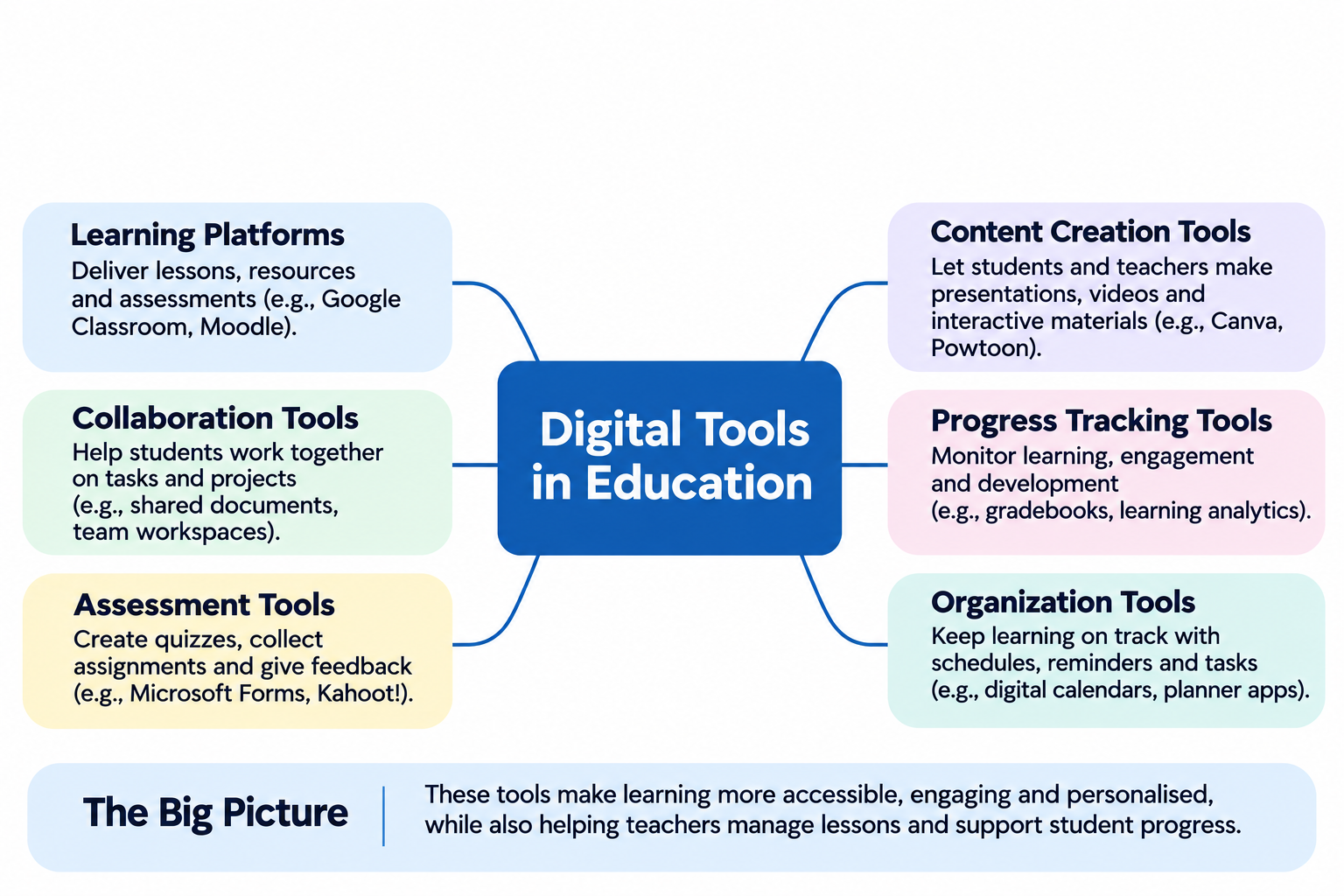
Digital tools in education are software applications, online platforms and technology-based resources that help students learn and teachers deliver lessons more effectively.
They make it easier to access educational materials, complete assignments, communicate with classmates and track learning progress, whether students are in a classroom or studying from home.
Think about how much easier group projects have become.
Instead of meeting in person to work on a single document, students can now collaborate online, share ideas and receive feedback in real time.
Teachers can also use digital learning tools to create interactive lessons, assess student performance and provide additional support when needed.
Here are some common examples of digital tools for teaching and learning and how they're used in education:
What Are Digital Tools in Education
| Category | Examples | Educational purpose |
| Learning management | Moodle, Google Classroom | Organise lessons, assignments and learning materials |
| Collaboration | Microsoft Teams, Google Docs | Support group projects, discussions and teamwork |
| Interactive learning | Kahoot!, Quizizz | Make quizzes and classroom activities more engaging |
| AI learning tools | ChatGPT, Khanmigo | Provide explanations, guided practice and learning support |
| Creative tools | Canva, Adobe Express | Create presentations, videos and digital projects |
| Accessibility tools | Immersive Reader, screen readers | Help students with different learning needs access content |
However, simply introducing technology into a classroom doesn't guarantee better results.
The real benefits of digital tools in education come from choosing the right technology for specific learning objectives, ensuring students can access it and helping teachers use it effectively.
10 Ways Digital Tools Empower Students and Improve Learning
The importance of digital tools in education becomes clearer when we look beyond the technology itself and focus on what students actually gain from using it. Schools can invest heavily in educational software, but unless those tools improve accessibility, engagement, academic performance or essential skills, the investment delivers limited value.
For educational institutions, the priority should be creating learning environments where technology addresses genuine challenges. Here are ten ways digital tools can empower students and how schools can put those benefits into practice.
1. Make Learning More Accessible and Inclusive
Not every student learns under the same circumstances. Some have disabilities, others live in remote areas, and many need additional flexibility to balance their education with personal responsibilities.
One of the key benefits of digital tools in education is their ability to remove barriers that might otherwise prevent students from participating fully in learning.
Here are some practical ways digital learning tools improve accessibility:
- Remote learning access: Students can attend virtual classes, access course materials and complete assignments from anywhere with an internet connection.
- Assistive technology: Screen readers, text-to-speech software and speech recognition tools help students with visual, reading or physical disabilities.
- Recorded lessons: Students can revisit explanations, pause videos and review difficult topics at their own pace.
- Captions and transcripts: Subtitles and written transcripts support students with hearing impairments and those learning in a second language.
- Flexible learning materials: Adjustable font sizes, alternative document formats and accessible learning platforms accommodate different learning preferences and needs.
- Self-paced learning: Students who need additional time can work through educational resources without feeling pressured to keep up with everyone else.
For example, a student with dyslexia might use text-to-speech software to understand a reading assignment, while another student recovering from an illness can access recorded lessons to avoid falling behind.
However, accessibility isn't simply about providing technology. Schools must also consider internet connectivity, device availability, teacher training and whether digital resources meet recognised accessibility standards.
The goal should be to create an inclusive learning environment where every student has a fair opportunity to participate, regardless of their circumstances.
2. Enable Personalised Learning Experiences
Traditional classroom teaching often follows a fixed pace, which can leave some students struggling while others are ready to move ahead.
One of the biggest benefits of digital tools in education is the opportunity to adapt learning experiences to individual needs.
Adaptive learning platforms can recommend exercises based on previous answers, identify knowledge gaps and provide additional practice.
Consider a mathematics class where students work through different exercises based on their understanding of fractions. Instead of repeating material they already know, learners receive support where they need it most.
However, personalised learning works best when teachers regularly review student progress and use the information to guide their teaching decisions.
3. Improve Student Engagement and Motivation
Keeping students interested is one of the biggest challenges educators face, particularly when lessons rely heavily on passive listening.
Interactive digital tools can turn students into active participants through quizzes, simulations, educational games and multimedia presentations.
A science teacher, for instance, could use an interactive simulation to demonstrate how electrical circuits work before students attempt a practical experiment.
Platforms such as Kahoot! and Quizizz can also make knowledge checks more engaging.
The key is to avoid confusing entertainment with learning. Schools should evaluate whether interactive activities improve understanding, participation and knowledge retention rather than simply making lessons more enjoyable.
4. Encourage Collaboration and Teamwork
Have you ever worked on a group assignment where one student does most of the work while everyone else struggles to coordinate? It's a familiar problem in education, and one that digital collaboration tools can help address.
Collaboration is an essential academic and workplace skill, but traditional group projects often come with challenges. Students may have different schedules, limited opportunities to meet or difficulty keeping track of individual contributions.
This is where the importance of digital tools in education becomes particularly clear.
Platforms such as Google Workspace for Education and Microsoft Teams for Education allow students to work together, exchange feedback and manage shared assignments without needing to be in the same physical location.
Some of the biggest benefits of digital collaboration tools include:
- Real-time collaboration: Students can edit shared documents, presentations and spreadsheets simultaneously, making group assignments easier to coordinate.
- Better communication: Online discussions, group messaging and video meetings help students exchange ideas and ask questions outside classroom hours.
- Improved project organisation: Shared calendars, task lists and project boards help students understand deadlines, responsibilities and progress.
- Peer learning and feedback: Students can review each other's work, suggest improvements and learn from different perspectives.
- Greater accountability: Version histories, assigned tasks and contribution tracking make it easier for teachers to understand how students participate.
- Stronger problem-solving skills: Working together on digital projects encourages students to discuss challenges, evaluate solutions and make collective decisions.
Consider a history class preparing a presentation about the Industrial Revolution. Rather than asking everyone to work independently and combine their findings at the last minute, students can create a shared research document, assign responsibilities and build their presentation together.
Teachers can monitor progress, provide feedback and intervene when group members need additional support.
These experiences also help students develop skills they'll eventually use in professional environments. As discussed in AgilityPortal's guide to team collaboration, effective collaboration depends on clear communication, shared responsibilities and access to the right information.
However, giving students collaboration software doesn't automatically create better teamwork. Schools should establish clear expectations around participation, respectful communication, individual contributions and responsible information sharing.
The goal is to use digital tools for teaching and learning to make collaboration more meaningful, inclusive and productive, while helping students build the communication and teamwork skills they'll need beyond the classroom.
6. Provide Instant Feedback and Track Learning Progress
Waiting several days for assignment feedback can make it difficult for students to identify mistakes while a topic is still fresh.
Digital assessment tools help address this problem through automated quizzes, practice exercises and learning progress dashboards.
A language-learning platform, for example, might identify repeated grammar mistakes and recommend targeted exercises.
Teachers can also use assessment data to identify students who may need additional support before falling further behind.
However, automated feedback should complement teacher assessment. Complex reasoning, creativity and individual circumstances still require human judgement.
7. Encourage Independent and Self-Directed Learning
One of the biggest advantages of digital tools in education is that students no longer have to rely entirely on classroom lessons to develop their knowledge.
With access to online learning platforms, digital libraries and educational resources, students can take greater responsibility for how, when and what they learn.
Think about a student struggling with a mathematics assignment.
Instead of waiting until the next lesson, they can watch an explanation, practise similar problems and explore different approaches until they understand the concept.
Digital learning tools encourage independent learning in several ways:
- Access to educational resources: Online libraries, academic journals and learning platforms allow students to explore subjects beyond their textbooks.
- Self-paced learning: Recorded lectures, tutorials and interactive exercises let students revisit difficult concepts without feeling pressured to keep up with classmates.
- Academic writing support: Students can access writing guides, proofreading resources and academic support services. For instance, EduBirdie offers writing-related assistance that students can use to better understand academic writing requirements, subject to their institution's academic integrity rules.
- Better research skills: Digital research platforms help students find information, compare sources and develop evidence-based arguments.
- Personalised learning goals: Progress dashboards, digital planners and learning management systems help students monitor achievements and identify areas for improvement.
- Greater confidence: Having access to additional explanations and learning materials encourages students to work through challenges before seeking assistance.
Independent learning also requires students to develop good judgement. Not every website provides reliable information, and AI-generated explanations can sometimes contain mistakes.
Resources such as Google Scholar can help students discover academic publications, while Khan Academy provides structured lessons and practice exercises across different subjects.
For educational institutions, the priority should be teaching students how to select trustworthy resources, manage their study time and use academic support responsibly.
Ultimately, the importance of technology in education isn't simply about giving students more information. It's about helping them become confident, resourceful learners who can take ownership of their education while knowing when to seek guidance.
8. Strengthen Digital Literacy and Online Safety
43 percent
of eighth-grade students fell below the basic digital
skills benchmark across participating EU countries
Giving students access to digital devices isn't enough. Schools also need to teach practical skills such as evaluating online information, protecting personal data and using technology responsibly for learning.
The International Computer and Information Literacy Study (ICILS 2023) assessed eighth-grade students across 22 EU education systems. The figure represents the average across participating EU countries and is not a global estimate.
Digital literacy is no longer an optional skill. Students need to understand how to find reliable information, communicate responsibly and protect themselves online.
The growing use of AI-generated content, social platforms and online research makes these abilities particularly important.
For example, teachers could ask students to investigate a misleading online claim, identify its original source and explain why the information may be unreliable.
Practical digital literacy education should cover:
- Evaluating websites and identifying misinformation.
- Protecting personal information and managing privacy settings.
- Recognising phishing attempts and online scams.
- Understanding responsible AI use and academic integrity.
- Communicating respectfully in digital environments.
These skills help students become more confident and responsible technology users inside and outside the classroom.
9. Support Creativity and Digital Content Creation
Digital technology gives students more ways to demonstrate what they've learned.
Instead of relying exclusively on written assignments, educators can introduce videos, podcasts, interactive presentations, digital portfolios and multimedia projects.
For instance, students studying environmental conservation could create a short documentary explaining local sustainability challenges.
Creative tools such as Canva and Adobe Express can help students organise information and communicate ideas visually.
The educational value comes from the thinking behind the project, not the sophistication of the software. Assessment should focus on originality, subject knowledge, communication and appropriate use of digital resources.
10. Prepare Students for Future Careers and Digital Workplaces
Today's students will enter workplaces where digital communication, online collaboration, information management and AI-assisted workflows are increasingly common.
Education should prepare them for these environments rather than treating digital skills as separate from academic learning.
Students who regularly collaborate on shared documents, organise digital projects and communicate through online platforms gain practical experience with workplace-style processes.
They also need to understand how to use AI responsibly, verify automated outputs and recognise when human judgement is necessary.
For schools, the objective isn't simply to introduce more technology. It's to help students develop transferable skills that remain valuable as digital tools continue to evolve.
Ultimately, the impact of digital technology on education depends on how thoughtfully it is implemented. The strongest results come when schools combine accessible tools, trained educators, clear learning objectives and regular evaluation. Technology should expand what students can achieve, not become a substitute for effective teaching.
How Artificial Intelligence Is Changing Digital Learning
Artificial intelligence is changing how students access information, complete assignments and interact with educational resources.
Instead of relying entirely on textbooks or waiting for teacher feedback, students can now use AI-powered learning tools to explore difficult subjects, practise new skills and receive explanations tailored to their needs.
However, the real importance of digital tools in education isn't about replacing traditional teaching methods. It's about giving students more opportunities to learn while helping educators deliver better support.
AI-Powered Personalised Learning
Every student learns differently, and AI makes it easier to provide individual support without requiring teachers to create separate lessons for everyone.
AI-powered educational platforms can:
- Adapt exercises based on student performance and understanding.
- Explain difficult concepts using simpler language or alternative approaches.
- Recommend additional learning materials when students struggle.
- Provide immediate feedback on practice questions and activities.
- Help teachers identify knowledge gaps through learning analytics.
For example, an AI tutor might recognise that a student repeatedly struggles with algebra and suggest additional exercises before introducing more advanced topics.
Platforms such as Khan Academy are exploring how AI-assisted tutoring can support personalised learning while keeping educators involved.
AI Tools for Research, Writing and Problem-Solving
AI is also influencing how students research topics, organise information and approach academic assignments.
Tools such as ChatGPT can help students brainstorm ideas, understand unfamiliar terminology, develop research questions and receive feedback on early drafts.
At the same time, collaborative technology is making group assignments more manageable.
As discussed in this guide to improving online student engagement, shared documents and cloud-based applications allow multiple students to contribute to presentations, reports and spreadsheets while tracking changes and discussing ideas.
Combining AI assistance with collaborative digital tools can support several learning activities:
- Research planning: Students can generate research questions and identify topics requiring further investigation.
- Writing development: AI can suggest improvements to structure, clarity and grammar while students retain responsibility for their work.
- Group collaboration: Shared documents allow classmates to organise contributions, exchange feedback and develop assignments together.
- Problem-solving: Students can compare possible solutions and ask AI to explain different approaches.
- Presentation preparation: AI-assisted brainstorming and digital design tools can help students organise and communicate their findings.
The objective should always be to strengthen students' understanding rather than simply produce assignments faster.
The Risks of Over-Reliance on AI in Education
Despite these advantages, AI introduces challenges that schools cannot afford to ignore.
Students who rely on AI-generated answers without questioning them may develop weaker research habits and critical thinking skills.
Some of the main concerns include:
- Inaccurate information: AI systems can generate convincing explanations that contain factual errors or fabricated references.
- Academic integrity: Submitting AI-generated work as original student work may violate institutional policies.
- Data privacy: Students may unknowingly share personal information or sensitive educational data with third-party platforms.
- Algorithmic bias: AI-generated recommendations and explanations can reflect biases within training data.
- Reduced independent thinking: Excessive dependence on automated answers may discourage students from developing their own reasoning.
UNESCO's Guidance for Generative AI in Education and Research highlights the importance of human-centred approaches, privacy protection and appropriate governance when introducing generative AI into education.
For schools, the priority should be establishing clear AI usage policies, training teachers and helping students evaluate AI-generated information critically.
Ultimately, AI should support student learning, not replace independent thinking, meaningful collaboration or the guidance of qualified educators.
How Digital Tools Support Teachers and Educational Institutions
While much of the conversation around educational technology focuses on students, teachers and school administrators benefit just as much from having the right digital tools.
Think about how much time educators spend preparing lessons, marking assignments, responding to parents and organising classroom activities.
When these processes are handled manually, they can take valuable time away from teaching and supporting students.
Digital tools for teaching and learning help schools simplify everyday responsibilities while creating more organised and connected learning environments.
Some of the biggest benefits include:
- Faster lesson preparation: Teachers can create lesson plans, organise educational resources and develop interactive learning materials using digital platforms.
- Simplified assignment management: Learning management systems allow educators to distribute assignments, collect submissions and provide feedback from one location.
- Better student progress monitoring: Digital assessment tools help teachers identify learning gaps, monitor academic performance and provide additional support when needed.
- Improved parent communication: Online portals, messaging systems and digital newsletters make it easier to share school announcements, academic updates and important information.
- Collaborative lesson planning: Teachers can share teaching materials, discuss classroom challenges and develop resources together.
- Centralised knowledge sharing: Schools can organise policies, training materials, teaching guides and institutional documents in a searchable digital library.
Internal communication is another area where educational institutions can benefit. Teachers, administrative staff and school leaders often work across different departments, campuses and schedules, making information difficult to coordinate.
A centralised digital workplace platform such as AgilityPortal can help educational institutions bring internal communication, document sharing, team collaboration and knowledge management into one environment.
Rather than relying on scattered emails and disconnected systems, staff can access announcements, share resources and collaborate more efficiently.
The real value isn't simply reducing administrative work. It's giving educators more time to focus on teaching, student engagement and delivering better learning experiences.
What Are the Challenges of Using Digital Tools in Education?
Despite the growing importance of digital tools in education, introducing technology into classrooms doesn't automatically improve learning outcomes.
Schools can invest in expensive educational platforms and still struggle with low adoption, distracted students or teachers who haven't received adequate training.
The challenge is finding the right balance between technology and effective teaching.
Here are some common disadvantages of digital tools in education and practical ways schools can address them.
| Challenge | Practical solution |
| Unequal access to devices and internet | Provide shared devices, downloadable resources and offline learning alternatives |
| Student distractions | Establish clear technology usage policies and structured digital learning activities |
| Privacy and data security | Review platform security, restrict unnecessary data collection and follow applicable privacy regulations |
| Limited teacher training | Offer ongoing professional development and practical technology training |
| AI-generated misinformation | Teach students to verify information, evaluate sources and question AI-generated answers |
| Excessive screen time | Balance digital activities with classroom discussions, physical activities and offline assignments |
Why These Challenges Matter
One of the biggest concerns is the digital divide.
Students without reliable internet access or suitable devices may struggle to participate in online assignments, creating inequalities between learners.
Teacher readiness is equally important.
Even the most advanced digital learning tools provide limited value when educators don't understand how to integrate them into lessons.
According to UNESCO's Global Education Monitoring Report on Technology in Education, the effectiveness of educational technology depends on factors including access, appropriate governance and teacher preparation.
Schools also need to consider student wellbeing. Constant notifications, excessive screen time and unrestricted access to online content can distract learners from their educational goals.
To address these issues, educational institutions should:
- Evaluate whether each digital tool supports a specific learning objective.
- Provide accessible alternatives for students facing technological barriers.
- Train teachers before introducing new educational platforms.
- Establish clear policies covering online safety, AI use and student data.
- Regularly review student feedback, engagement and learning outcomes.
Ultimately, the challenges of digital tools in education shouldn't discourage schools from adopting technology.
Instead, they highlight the need for thoughtful planning, responsible implementation and continuous improvement.
The objective should never be to make every classroom activity digital. It should be to use technology where it genuinely improves the teaching and learning experience.
How Artificial Intelligence Is Changing Digital Learning
Artificial intelligence is changing how students access information, complete assignments and interact with educational resources.
Instead of relying entirely on textbooks or waiting for teacher feedback, students can now use AI-powered learning tools to explore difficult subjects, practise new skills and receive explanations tailored to their needs.
However, the real importance of digital tools in education isn't about replacing traditional teaching methods. It's about giving students more opportunities to learn while helping educators deliver better support.
AI-Powered Personalised Learning
Every student learns differently, and AI makes it easier to provide individual support without requiring teachers to create separate lessons for everyone.
AI-powered educational platforms can:
- Adapt exercises based on student performance and understanding.
- Explain difficult concepts using simpler language or alternative approaches.
- Recommend additional learning materials when students struggle.
- Provide immediate feedback on practice questions and activities.
- Help teachers identify knowledge gaps through learning analytics.
For example, an AI tutor might recognise that a student repeatedly struggles with algebra and suggest additional exercises before introducing more advanced topics.
Platforms such as Khan Academy are exploring how AI-assisted tutoring can support personalised learning while keeping educators involved.
AI Tools for Research, Writing and Problem-Solving
AI is also influencing how students research topics, organise information and approach academic assignments.
Tools such as ChatGPT can help students brainstorm ideas, understand unfamiliar terminology, develop research questions and receive feedback on early drafts.
At the same time, collaborative technology is making group assignments more manageable.
As discussed in this guide to improving online student engagement, shared documents and cloud-based applications allow multiple students to contribute to presentations, reports and spreadsheets while tracking changes and discussing ideas.
Combining AI assistance with collaborative digital tools can support several learning activities:
- Research planning: Students can generate research questions and identify topics requiring further investigation.
- Writing development: AI can suggest improvements to structure, clarity and grammar while students retain responsibility for their work.
- Group collaboration: Shared documents allow classmates to organise contributions, exchange feedback and develop assignments together.
- Problem-solving: Students can compare possible solutions and ask AI to explain different approaches.
- Presentation preparation: AI-assisted brainstorming and digital design tools can help students organise and communicate their findings.
The objective should always be to strengthen students' understanding rather than simply produce assignments faster.
The Risks of Over-Reliance on AI in Education
Despite these advantages, AI introduces challenges that schools cannot afford to ignore.
Students who rely on AI-generated answers without questioning them may develop weaker research habits and critical thinking skills.
Some of the main concerns include:
- Inaccurate information: AI systems can generate convincing explanations that contain factual errors or fabricated references.
- Academic integrity: Submitting AI-generated work as original student work may violate institutional policies.
- Data privacy: Students may unknowingly share personal information or sensitive educational data with third-party platforms.
- Algorithmic bias: AI-generated recommendations and explanations can reflect biases within training data.
- Reduced independent thinking: Excessive dependence on automated answers may discourage students from developing their own reasoning.
UNESCO's Guidance for Generative AI in Education and Research highlights the importance of human-centred approaches, privacy protection and appropriate governance when introducing generative AI into education.
For schools, the priority should be establishing clear AI usage policies, training teachers and helping students evaluate AI-generated information critically.
Ultimately, AI should support student learning, not replace independent thinking, meaningful collaboration or the guidance of qualified educators.
Final Thoughts on Why Digital Tools Matter for the Future of Education
The importance of digital tools in education goes far beyond introducing new technology into classrooms.
It's about giving students better opportunities to learn, collaborate, develop digital literacy skills and prepare for a world where technology plays an increasingly important role.
From personalised learning experiences and AI-powered educational tools to accessible resources and online collaboration, digital technology can help remove learning barriers and give students greater control over their education.
However, technology alone won't guarantee better academic outcomes.
Schools still need qualified teachers, equal access to learning resources, clear digital policies and a commitment to responsible technology use.
As education continues to evolve, the question isn't whether schools should embrace digital tools, but how they can use them effectively.
Ultimately, the goal is simple: empower students with the knowledge, confidence and practical skills they need to succeed both inside and outside the classroom.
AI Summary
- The importance of digital tools in education goes beyond replacing textbooks with technology. Digital learning platforms, interactive resources and online applications help students access information, participate in lessons, complete assignments and develop essential skills for an increasingly digital world.
- Digital tools empower students by making learning more accessible, personalised and engaging. Recorded lessons, assistive technology, adaptive learning platforms and interactive exercises allow students to learn at their own pace, revisit difficult concepts and receive additional support when needed.
- Collaboration is another major benefit of digital tools in education. Shared documents, cloud-based applications and online discussion platforms allow students to contribute to group assignments, exchange feedback, organise projects and develop communication and teamwork skills regardless of their location.
- Artificial intelligence is changing digital learning through personalised tutoring, research assistance, writing feedback and adaptive exercises. However, students must verify AI-generated information, protect personal data and follow academic integrity policies. AI should support independent thinking rather than replace it.
- Schools can maximise the benefits of digital tools by setting clear learning objectives, providing teacher training, improving accessibility and establishing responsible technology policies. Measuring student engagement and learning progress helps educators determine whether digital tools are genuinely improving educational outcomes.
Most Popular Posts

Effective communication among team members is vital for the productivity and success of any organization. Surprisingly, 60% of companies lack a long-term internal communication strategy, which p...


Businesses thrive on communication for efficiency, productivity and accomplishment. When the right information is passed from the right designation in the organization, it promotes positivity an...

Categories
Blog
(3280)
Business Management
(400)
Employee Engagement
(240)
Digital Transformation
(228)
Growth
(156)
Intranets
(142)
Internal communications
(111)
Remote Work
(68)
Sales
(53)
Collaboration
(53)
Customer Experience
(34)
Culture
(30)
Project management
(30)
Knowledge Management
(29)
Leadership
(20)
Comparisons
(9)
News
(1)

Related Posts

What Should You Put in a Corporate Wellness Kit? When was the last time an employee received a company gift they genuinely appreciated, rather than something that ended up forgotten in a desk drawer? Employee wellbeing is becoming increasingly import...

Why Are Digital Tools So Important in Education Today? Have you ever wondered how students would cope if schools suddenly took away laptops, online learning platforms and digital resources? Technology has become such a big part of education that it's...

Are your digital marketing strategies keeping up with how customers discover, research and buy from businesses today? As we head into 2027, digital marketing is becoming more and more challenging. And AI-powered search is changing how peop...

By the time you send your 30th application, the silence starts to feel personal. You've spent 15 or 20 years leading teams, solving problems, and getting results. Now your inbox is full of automated confirmations and the odd rejection that land...

Could you spot a made-up source in an AI-generated answer before you cited it in an assignment? That's where digital literacy comes in. Alongside reading, writing and maths, it's a skill students draw on every day to judge what they find online...


Jill Romford
I am a digital nomad, lover of exploring new places and making friends.
I love to travel and I love the internet. I take pictures of my travels and share them on the internet using Instagram.
Traveler, entrepreneur, and community builder. I share my insights on digital marketing and social media while inspiring you to live your fullest life.
Ready to learn more? 👍
One platform to optimize, manage and track all of your teams. Your new digital workplace is a click away. 🚀
Free for 14 days, no credit card required.