
Insight Blog
Agility’s perspectives on transforming the employee's experience throughout remote transformation using connected enterprise tools.
46 minutes reading time
(9127 words)
Digital Marketing Trends for 2027 - 12 Strategies You Need to Try

Digital Marketing Trends for 2027 - 12 Strategies You Need to Try
Explore 12 digital marketing trends and strategies for 2027. Discover what's changing, what's working and how businesses can stay ahead.
Digital Marketing Trends for 2027 - 12 Strategies You Need to Try

Are your digital marketing strategies keeping up with how customers discover, research and buy from businesses today?
As we head into 2027, digital marketing is becoming more and more challenging.
And AI-powered search is changing how people find information, advertising costs are putting pressure on marketing budgets, and customers expect faster responses, personalised experiences and greater transparency from brands.
At the same time, businesses are competing for attention across more platforms, making it harder to stand out and turn website visitors into paying customers.
18 percent
of Google searches in Pew Research's study
generated an AI summary
Customers are finding answers directly in search results. For businesses, this means adapting content and SEO strategies to reach audiences beyond traditional website clicks.
The problem?
What worked a year or two ago might not deliver the same results today.
Businesses can no longer rely on traditional SEO, paid advertising or social media alone.
They need to understand the latest digital marketing trends and adapt their digital marketing strategies to changing customer expectations.
But not every new trend deserves your time or money. So, where should you focus your efforts?
In this guide, we'll break down 12 digital marketing trends for 2027, explore the latest statistics shaping the industry, and share practical strategies you can start using to attract more customers, improve engagement and get better results from your marketing budget.
Key Takeaways
- Digital marketing trends in 2027 are being shaped by AI-powered search, short-form video, personalisation, first-party data and smarter marketing automation.
- Artificial intelligence can improve content creation, customer targeting and campaign efficiency, but businesses still need human oversight to maintain accuracy, originality and customer trust.
- Successful digital marketing strategies should focus on customer behaviour, conversion rates and retention rather than relying entirely on website traffic, social media followers or viral content.
- First-party data, authentic content and connected customer experiences are becoming increasingly important as businesses adapt to changing privacy expectations and more complex buying journeys.
- Businesses should use a 90-day digital marketing strategy to audit performance, test new approaches and invest in trends that deliver measurable improvements in leads, conversions and revenue.
Why Is Digital Marketing Important for Businesses in 2027?
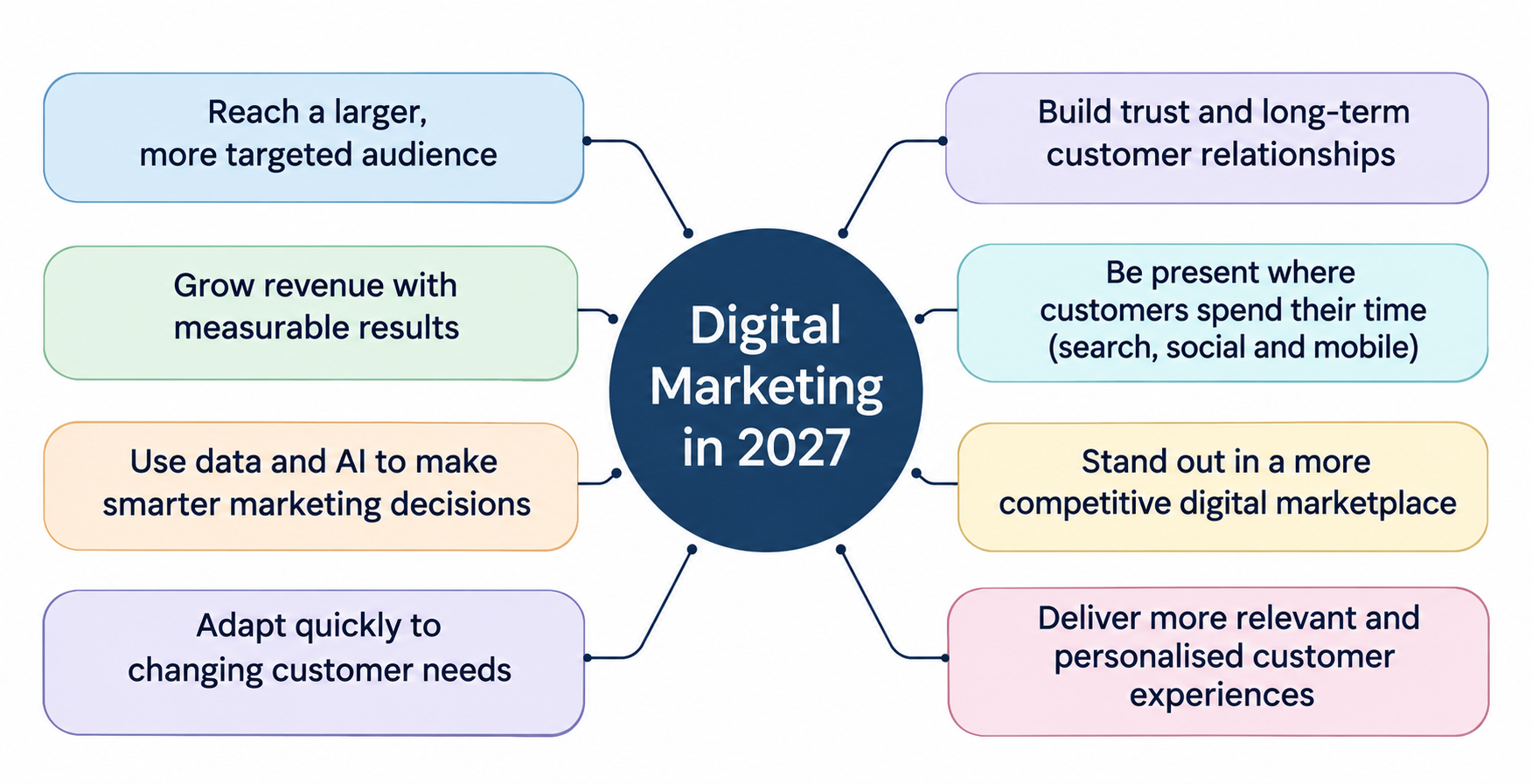
Why Is Digital Marketing Important for Businesses in 2027
Think about the last time you wanted to buy something or learn more about a company.
Chances are, you searched Google, checked customer reviews, watched a video or visited the brand's social media page before making a decision.
That's exactly why digital marketing has become such an important part of running a successful business.
Customers now have more choices, more information and higher expectations than ever before.
80 percent
of marketers consider customer experience
a key competitive differentiator
Customers expect businesses to be easy to find, quick to respond and capable of delivering experiences that feel relevant to their needs. Attracting attention is no longer enough. Businesses also need to build trust and give customers a reason to return.
They want businesses to be easy to find, quick to respond and capable of delivering experiences that feel relevant to their needs. In fact, Salesforce's State of Marketing report found that 80% of marketers consider customer experience a key competitive differentiator. This highlights why attracting attention is no longer enough. Businesses also need to build trust and give people a reason to return.
Traditional advertising still has its place, but the way people discover products and services has changed dramatically.
Instead of relying solely on television, radio or print advertising, businesses can now reach potential customers through search engines, social media, email campaigns, video content and other online platforms.
For businesses looking to improve their online visibility, working with specialists, such as an SEO Agency Calgary, can help them develop a more focused search strategy, reach relevant audiences and compete more effectively in local search results.
And here's what makes digital marketing particularly valuable: you can measure what's working, understand customer behaviour and adjust your approach without waiting months to see results.
Whether you're a small business trying to attract your first customers or an established company looking to increase sales, the right digital marketing strategies can help you reach the right audience at the right time.
As we move into 2027, understanding these opportunities is essential.
Let's look at how businesses can use digital marketing to stay competitive, meet changing customer expectations and achieve sustainable growth.
What Is Changing in Digital Marketing in 2027?
The way people discover brands, compare products and make purchasing decisions is changing faster than many businesses can keep up with.
As we approach 2027, digital marketing trends are being shaped by artificial intelligence, evolving consumer behaviour and growing expectations around customer experience.
One of the biggest changes is how customers find information online. Google is no longer the only starting point.
People are turning to AI-powered search tools, social media platforms and video content to research products, compare services and get recommendations. This means businesses need to think beyond traditional search rankings when trying to reach potential customers.
Buying decisions are changing, too. Customers increasingly look for genuine reviews, transparent pricing, useful content and evidence that a business can deliver on its promises. A polished advertisement might grab attention, but trust often determines whether someone makes a purchase.
Then there's the growing demand for convenience and personalisation. People expect relevant recommendations, quick answers and smooth experiences across websites, apps and other digital channels.
Digital Marketing Statistics to Know Before 2027
73%
Of marketers face greater scrutiny of their budgets
48.6%
Selected short-form video among their highest-ROI content formats
53%
Struggle to differentiate content in an AI-saturated market
37.7%
Plan to increase investment in AI chatbots
Figures reflect survey findings, not 2027 forecasts.
However, they also want businesses to respect their privacy and handle personal information responsibly.
Recent research from HubSpot's State of Marketing 2026 highlights the pressure facing marketing teams:
- 73% of marketers report greater scrutiny of their budgets.
- 48.6% selected short-form video among their highest-ROI content formats.
- 53% struggle to differentiate their content in an AI-saturated market.
- 37.7% plan to increase investment in AI chatbots.
These findings show why businesses need to rethink where they invest their time and money. The challenge for 2027 isn't simply adopting new technology.
It's understanding what customers actually value and choosing strategies that deliver measurable results.
12 Digital Marketing Trends and Strategies to Try in 2027
Keeping up with digital marketing isn't just about adopting the latest technology or jumping onto every new platform.
It's about understanding how customer behaviour is changing and finding smarter ways to attract, engage and retain the people who matter to your business.
So since 2027 is around the corner, some of the biggest opportunities will come from artificial intelligence, personalised customer experiences, video marketing and better use of customer data.
However, not every trend will deliver results for every business. What works for a large ecommerce brand might not make sense for a small local company.
So, which digital marketing trends are actually worth your attention?
Let's explore 12 important developments, the research behind them and practical strategies you can use to stay ahead of the competition.
#1. AI Search Is Changing How Customers Discover Brands
Remember when getting your website onto the first page of Google was one of the biggest goals in digital marketing?
That's still important, but the way people search for information is changing.
Instead of scrolling through multiple websites, customers can now use AI-powered tools such as ChatGPT, Google's AI Overviews and Perplexity to compare products, research services and get answers to their questions. In some cases, they can find what they need without visiting a website at all.
According to Pew Research Center, 18% of Google searches examined in March 2025 generated an AI summary. The research also found that users clicked traditional search results less frequently when an AI summary appeared.
For businesses, this creates a new challenge. Ranking well in Google doesn't necessarily guarantee the same level of website traffic it once did. Your content also needs to be useful, credible and easy for AI-powered search systems to understand.
This is particularly important for businesses competing in local markets.
For instance, a company working with an SEO Agency Vancouver may want to look beyond traditional keyword rankings and focus on local search visibility, customer reviews and content that answers location-specific questions. These efforts can help businesses become easier to discover as customers explore different ways of searching online.
How can businesses adapt their digital marketing strategies?
- Answer real customer questions - Identify 20 common questions people ask before purchasing your products or services. Create helpful content that answers each question clearly.
- Make your content more credible - Include original research, expert insights, customer examples and trustworthy sources that support your claims.
- Improve your website structure - Use descriptive headings, relevant structured data and clear explanations to help search engines understand your content.
- Monitor AI search visibility - Check whether tools such as ChatGPT, Perplexity and Google AI Overviews mention your brand accurately when answering relevant questions.
- Measure more than website traffic - Track qualified leads, organic conversions, branded searches and referral traffic from AI platforms.
What should you measure?
So you might think what do I focus, well first thing is organic conversion rates, qualified AI referral traffic and growth in branded searches. These metrics can help you understand whether your content is attracting potential customers, even as search behaviour changes.
Traditional SEO isn't disappearing, but businesses need to think beyond rankings. In 2027, being visible where customers find answers could be just as important as getting them to click through to your website.
#2. AI-Powered Personalisation Is Moving Beyond First Names
Do you remember when receiving an email with your first name in the subject line felt personal?
These days, customers expect a lot more than that.
AI-powered personalisation is changing how businesses communicate with their audiences. Instead of sending the same offers, emails and recommendations to everyone, companies can use customer behaviour, browsing activity and purchase history to deliver content that reflects what people are actually interested in.
And there's a good reason to take this seriously. According to Salesforce's State of the Connected Customer, 73% of customers expect companies to understand their unique needs and expectations. This shows why generic marketing messages can struggle to connect with today's consumers.
Think about an online clothing retailer. A first-time visitor might see a welcome offer and popular products, while a returning customer who previously browsed winter jackets could receive recommendations for similar items. Both customers visit the same website, but their experiences are tailored to their interests.
However, there's a catch. Personalisation only works when customers feel comfortable with how their information is being used. Collecting excessive data or making overly specific recommendations can quickly undermine trust. Businesses need to balance relevance with transparency, consent and privacy.
How can businesses use AI-powered personalisation effectively?
- Segment customers by behaviour - Group your audience based on browsing history, previous purchases, interests and where they are in the buying journey.
- Create personalised website experiences - Show relevant content, product recommendations or offers to new visitors, returning customers and existing subscribers.
- Automate timely follow-ups - Send useful emails when customers abandon a shopping basket, download a resource or show interest in a particular service.
- Use AI to identify buying signals - Analyse customer interactions to understand which products or services they may be interested in next.
- Test whether personalisation works - Compare personalised campaigns against a non-personalised control group to see whether they genuinely improve results.
What should you measure?
Track conversion rate uplift, repeat purchase rates, customer engagement and revenue generated per email recipient.
These figures will help you understand whether personalisation is improving the customer experience or simply adding complexity to your marketing.
Effective personalisation isn't about proving how much you know about your customers. It's about making their experience easier and more relevant.
As we head into 2027, businesses that use AI responsibly to understand customer intent will be better positioned to build meaningful, long-term relationships.
#3. Short-Form Video Is Becoming a Powerful Product Discovery Tool
When was the last time you discovered a product while scrolling through TikTok, Instagram Reels or YouTube Shorts?
You're certainly not alone.
Short-form videos are changing how customers find brands, explore products and make purchasing decisions.
According to HubSpot's State of Marketing 2026, 48.6% of marketers selected short-form video among their highest-ROI content formats. This helps explain why businesses are investing in quick product demonstrations, customer testimonials and behind-the-scenes content.
The appeal is simple.
A 30-second video can demonstrate how a product works, answer a common question or build trust faster than a lengthy advertisement.
However, getting thousands of views doesn't necessarily mean generating sales.
How can businesses make short-form video work?
- Answer customer questions - Create 30–60-second videos addressing common problems or buying concerns.
- Show products in action - Use demonstrations, tutorials and authentic customer experiences.
- Repurpose content - Adapt successful videos for TikTok, Instagram Reels and YouTube Shorts.
- Test different hooks - Experiment with opening questions, visuals and messages to capture attention.
- Track actual results - Measure website visits, enquiries and purchases rather than views alone.
What should you measure?
Video retention, engagement, qualified traffic and conversions.
Short-form video works best when it helps customers make decisions, not simply when it entertains them. In 2027, organisations should focus on creating useful, authentic videos that turn attention into meaningful results.
#4. First-Party Data Is Becoming a Competitive Advantage
With growing privacy concerns and restrictions on third-party tracking, businesses are rethinking how they collect and use customer information.
Instead of relying heavily on external advertising platforms, marketers are placing greater value on first-party data, which customers share directly through website interactions, purchases, subscriptions and enquiries.
According to Twilio's State of Customer Engagement Report, businesses are increasingly using customer data to deliver more relevant experiences while addressing growing expectations around privacy and transparency.
For businesses, the opportunity is to build stronger customer relationships through data-driven marketing, rather than depending entirely on paid advertising or third-party audience targeting.
How can businesses build an effective first-party data strategy?
- Collect data with permission - Use newsletter subscriptions, customer accounts and useful downloadable resources.
- Improve customer segmentation - Organise audiences by interests, purchase behaviour and engagement levels.
- Connect marketing tools - Integrate your CRM, email marketing software and website analytics to understand the customer journey.
- Be transparent - Explain how customer information is collected, stored and used.
- Deliver personalised experiences - Use consented data to provide relevant recommendations and targeted marketing campaigns.
What should you measure?
Email opt-in rates, customer engagement, repeat purchases and growth in your consented audience.
Owning a trusted relationship with your customers is becoming more valuable than simply collecting more data.
In 2027, businesses that prioritise privacy, customer trust and effective data management will be better positioned to deliver sustainable marketing results.
#5. Social Commerce Is Shortening the Path From Discovery to Purchase
Ever spotted a product on Instagram or TikTok and wanted to buy it immediately?
That's the appeal of social commerce.
Customers can discover products, read reviews, watch demonstrations and sometimes complete purchases without leaving their favourite social platforms.
Among the biggest digital marketing industry trends, social commerce is changing how businesses turn online engagement into sales. Instead of relying on customers to visit a website first, brands can reach potential buyers while they're already browsing content.
This is particularly relevant for retailers, ecommerce businesses and consumer brands.
As businesses evaluate trends in digitale marketing, the opportunity is to make shopping easier while building trust through authentic content and customer recommendations.
However, social media engagement doesn't always translate into revenue. Businesses need to focus on removing purchasing barriers rather than simply chasing views and followers.
What Are Ecommerce Owners Saying?
Does having more social media followers actually lead to more sales? Here's what ecommerce business owners are discussing on Reddit.
Interestingly, not every business is convinced that social media engagement leads to sales.
In a Reddit discussion about converting followers into customers, one ecommerce owner reported having around 15,000 Instagram followers but attributed only 5% of conversions to social media, compared with 85% from Google and 10% from email.
While this is one business owner's experience rather than an industry benchmark, it raises an important question: Are your social media efforts generating customers, or just followers?
How can businesses take advantage of social commerce?
- Make products easy to discover - Use product tags, shopping links and clear descriptions.
- Show authentic experiences - Share customer reviews, demonstrations and user-generated content.
- Work with relevant creators - Partner with influencers whose audiences match your ideal customers.
- Simplify the buying journey - Reduce unnecessary steps between discovering a product and completing a purchase.
- Track sales performance - Measure conversions, average order value and revenue from social channels.
What should you measure?
Social commerce conversion rates, customer acquisition costs, average order value and social-attributed revenue.
Social commerce isn't just about selling on social media. It's about making the journey from discovering a product to buying it as simple as possible.
#6. Authentic Content Is Becoming More Valuable in an AI-Driven World
With AI tools making it easier to produce blog posts, images, videos and social media content, businesses are publishing more than ever.
But here's the problem: when everyone can generate content in seconds, how do you make yours stand out?
According to HubSpot's State of Marketing 2026, 53% of marketers struggle to differentiate their content in an AI-saturated market. This highlights a growing challenge for brands competing for customer attention.
One of the most important content marketing trends for 2027 is the growing value of original experiences, expert opinions and trustworthy information. Customers want more than generic advice. They want real examples, honest reviews and evidence that a business understands their problems.
This doesn't mean businesses should stop using AI.
As we explore in our guide to AI in content creation and creative processes, the technology can support content development, but human creativity and expertise remain essential for producing something genuinely valuable.
How can businesses create more authentic content?
- Share original experiences - Publish customer success stories, product demonstrations and lessons learned from real projects.
- Include expert perspectives - Feature employees, industry specialists and customers who can provide first-hand insights.
- Use AI responsibly - Let AI assist with research, outlines and editing, but verify claims and add original analysis. Our guide to AI for internal communications explains how teams can use AI to prepare content while maintaining human editorial oversight.
- Show evidence - Support important claims with statistics, screenshots, research and genuine customer feedback.
- Build brand credibility - Maintain consistent messaging, transparent authorship and accurate information across marketing channels. Encourage teams to contribute their expertise through knowledge sharing and collaborative content publishing.
What should you measure?
Content engagement, organic traffic, backlinks, branded searches and conversions from content.
In 2027, creating more content won't necessarily make your business more visible. Creating content people can trust, learn from and act on will be far more valuable.
#7. Marketing Automation Is Becoming More Intelligent and More Accountable
Lets get into automation, marketing automation is no longer just about scheduling emails or sending the same message to hundreds of subscribers.
With artificial intelligence, businesses can now identify buying signals, personalise customer journeys and automate repetitive tasks without constantly relying on manual input.
But there's a catch. Automating more doesn't automatically mean getting better results. Poorly timed messages, inaccurate customer data and excessive follow-ups can frustrate customers rather than encourage them to buy.
As AI becomes a bigger part of digital marketing strategies in 2027, businesses need to focus on using automation responsibly.
That means combining intelligent technology with clear processes, accurate information and human oversight.
For example, connecting marketing systems with an internal communication and collaboration platform can help sales, marketing and customer service teams coordinate campaigns, share updates and respond to customer enquiries more consistently.
How can businesses use intelligent marketing automation effectively?
- Automate repetitive tasks - Use automated workflows for lead follow-ups, email campaigns, customer onboarding and abandoned shopping baskets.
- Identify buying signals - Use AI-powered lead scoring to prioritise customers who are more likely to convert.
- Improve team coordination - Explore how AI for internal communications can help teams prepare, review and distribute updates more efficiently. Insight Blog
- Connect your workflows - Reduce disconnected tools and manual handovers. Our guide to reducing app fatigue explains why connected workplace systems matter. Insight Blog
- Keep humans involved - Set approval rules for sensitive communications and regularly review automated responses for accuracy.
What should you measure?
Lead response time, conversion rates, customer engagement, hours saved and automation error rates.
The future of marketing automation isn't about removing people from the process. It's about helping teams work faster, make better decisions and deliver more relevant customer experiences.
#8. Omnichannel Marketing Is Creating More Connected Customer Experiences
Have you ever contacted a company through live chat, followed up by email and then had to explain your problem all over again? It's frustrating, and it's exactly what businesses need to avoid.
Omnichannel marketing is becoming increasingly important as customers move between websites, social media, email, mobile apps and other digital channels.
They expect businesses to recognise their previous interactions and provide a consistent experience, regardless of where the conversation takes place.
According to Zendesk's Customer Experience Trends Report, customers increasingly expect businesses to deliver fast, personalised and connected experiences across different communication channels. This puts pressure on companies to bring customer information and interactions together, so people don't have to repeat themselves whenever they switch from live chat to email, social media or customer support.
However, being active on multiple platforms doesn't automatically create an omnichannel experience. The real challenge is connecting customer information, marketing messages and internal teams so that interactions feel seamless.
How can businesses improve their omnichannel marketing strategy?
- Map the customer journey - Identify how customers move between search engines, social media, websites and customer support.
- Connect customer information - Integrate your CRM, marketing automation tools and communication channels to reduce disconnected experiences.
- Keep messaging consistent - Make sure promotions, product information and brand messaging remain accurate across every channel.
- Improve internal coordination - Use an internal communication platform to keep marketing, sales and support teams informed about campaigns and customer updates.
- Remove unnecessary friction - Make it easier for customers to continue conversations or complete purchases when switching devices or channels.
What should you measure?
Customer journey completion rates, cross-channel conversions, customer satisfaction and repeat purchases.
Customers don't think in terms of marketing channels. They simply expect businesses to remember their needs and make every interaction easier.
In 2027, businesses that connect their digital experiences will be better positioned to build customer loyalty and improve conversions.
#9. Micro-Influencers and Customer Advocacy Are Challenging Traditional Advertising
Would you trust a celebrity promoting a product they've never used, or a smaller creator who regularly shares honest reviews and real experiences? For many customers, credibility matters more than follower counts.
That's why micro-influencer marketing and customer advocacy are becoming important digital marketing strategies.
Instead of spending heavily on celebrity endorsements, businesses are partnering with niche creators, loyal customers and industry experts who have established trust within their communities.
According to Influencer Marketing Hub's research, influencer marketing continues to attract investment as brands look for more authentic ways to reach targeted audiences. However, campaign performance varies considerably depending on audience relevance, content quality and how results are measured.
For businesses, the opportunity isn't simply finding someone with thousands of followers. It's identifying people whose recommendations genuinely influence purchasing decisions.
How can businesses make influencer marketing more effective?
- Work with niche creators - Choose micro-influencers whose audiences match your ideal customers.
- Encourage customer advocacy - Invite satisfied customers to share honest reviews, testimonials and product experiences.
- Focus on authenticity - Give creators room to communicate naturally rather than forcing scripted advertisements.
- Track real conversions - Use referral links, discount codes and campaign tracking to measure sales.
- Build long-term partnerships - Develop ongoing relationships with creators who consistently deliver meaningful engagement.
What should you measure?
Influencer-attributed sales, referral traffic, customer acquisition costs and campaign return on investment.
Influence isn't just about audience size. It's about trust, relevance and the ability to inspire action. In 2027, businesses that prioritise genuine customer relationships over vanity metrics may find more sustainable ways to grow.
#10. Conversion Rate Optimisation Is Becoming More Important Than Traffic Growth
Getting more visitors to your website sounds great, but what happens when those visitors leave without buying anything, booking a demo or making an enquiry?
That's where conversion rate optimisation (CRO) comes in. Rather than spending more money on advertising to attract additional traffic, businesses are focusing on improving the experience of people already visiting their websites.
According to Baymard Institute's research on shopping cart abandonment, the average documented online shopping cart abandonment rate is approximately 70%. While not every abandoned basket represents a lost sale, the figure highlights how much potential revenue can be affected by friction in the buying journey.
For businesses following the latest digital marketing industry trends, improving website usability, building customer trust and simplifying purchasing decisions can be just as valuable as increasing visitor numbers.
How can businesses improve their website conversion rates?
- Simplify the buying journey - Reduce unnecessary form fields, confusing navigation and complicated checkout processes.
- Improve website performance - Use Google PageSpeed Insights to identify loading speed and mobile usability problems.
- Test your calls to action - Experiment with button wording, landing-page layouts and messaging to discover what encourages visitors to take action.
- Build customer confidence - Include genuine testimonials, transparent pricing and clear product information.
- Improve team collaboration - Keep marketing, design and sales teams aligned on website improvements using AgilityPortal's collaboration tools.
What should you measure?
Website conversion rates, revenue per visitor, checkout completion rates and cost per acquisition.
More traffic doesn't always mean more revenue.
#11. Customer Retention Is Becoming a Core Digital Marketing Strategy
Attracting new customers is important, but keeping existing ones can be just as valuable.
With growing competition and pressure on marketing budgets, businesses are paying more attention to customer retention strategies that encourage repeat purchases and long-term loyalty.
According to Bain & Company, small improvements in customer retention can significantly influence profitability, although the impact varies by industry.
How can businesses improve customer retention?
- Personalise follow-ups: Send relevant recommendations and offers based on previous purchases.
- Improve onboarding: Help new customers understand and get value from your products.
- Reward loyalty: Offer meaningful benefits to returning customers.
- Listen to feedback: Use surveys and customer insights to identify problems early.
What should you measure?
Customer lifetime value, repeat purchase rate, churn and retention rate.
Sustainable growth isn't just about acquiring more customers. It's about giving existing customers reasons to stay.
#12. Marketing Measurement Is Moving Beyond Last-Click Attribution
Which marketing channel deserves credit when someone discovers your business on social media, reads your blog and finally converts through Google? That's the challenge with traditional last-click attribution.
As customer journeys become more complex, businesses need a clearer understanding of how different marketing channels contribute to sales.
Google Analytics 4 provides attribution reporting capabilities that help marketers examine conversion paths beyond the final interaction.
How can businesses improve marketing measurement?
- Track the full journey - Analyse interactions across search, email, social media and paid advertising.
- Use consistent tracking - Apply UTM parameters and clear conversion goals.
- Test campaign impact - Run controlled experiments to estimate incremental sales.
- Focus on profitability - Compare marketing spend with customer acquisition costs and revenue.
What should you measure?
Marketing ROI, cost per acquisition, incremental revenue and conversion rates.
The last click doesn't always tell the full story.
In 2027, understanding which activities genuinely influence customer decisions will help businesses spend their marketing budgets more effectively.
Which Digital Marketing Strategies Should Businesses Prioritise in 2027?
With so many digital marketing trends emerging, it's easy to feel like your business needs to try everything.
But here's the reality: not every marketing strategy deserves the same investment of time or money.
A small business with a limited budget might see better results from improving its website conversion rate or creating helpful video content than investing heavily in AI-powered personalisation.
Meanwhile, a larger company with an established customer base may benefit more from marketing automation, advanced analytics and customer retention campaigns.
The key is to focus on strategies that address your customers' needs and support measurable business goals.
Here's how different digital marketing strategies compare in terms of budget, implementation difficulty and potential priority for businesses in 2027.
| Digital marketing strategy | Budget required | Difficulty | Priority |
| AI search optimisation | Low–medium | Medium | High |
| Short-form video marketing | Low–medium | Medium | High |
| Conversion rate optimisation | Low–medium | Medium | High |
| First-party data collection | Medium | Medium | High |
| AI-powered personalisation | Medium–high | High | Medium |
| Influencer marketing | Variable | Medium | Test first |
| Advanced marketing attribution | Medium–high | High | Depends on scale |
Note: These are general editorial assessments for small and medium-sized businesses, not independently measured industry rankings. Actual costs and priorities will vary.
So, where should you start?
Look at your existing marketing performance before committing to new tools or campaigns.
If you're attracting plenty of visitors but generating few enquiries, prioritise conversion optimisation. If customers struggle to discover your business, focus on search visibility and content marketing.
For businesses with limited resources, choosing two or three high-impact strategies and testing them consistently will usually be more manageable than spreading the budget across every emerging trend.
Ultimately, the best digital marketing strategy for 2027 isn't necessarily the newest or most expensive.
It's the one that helps you reach the right customers, solve real problems and generate measurable results.
How to Build a 90-Day Digital Marketing Strategy for 2027
Knowing which digital marketing trends to follow is one thing, but putting them into practice is where businesses often struggle.
With limited budgets, competing priorities and constantly changing customer expectations, it's important to have a clear plan rather than trying everything at once.
The good news?
You don't need to completely overhaul your marketing approach.
A 90-day digital marketing strategy gives you enough time to identify opportunities, test new ideas and measure what's actually working.
Here's a practical three-step approach to getting started.
Days 1–30: Audit Your Marketing Performance and Set Benchmarks
Before investing in new campaigns, take a closer look at your current results.
Review website traffic, search rankings, customer behaviour, conversion rates and marketing expenses.
Use tools such as Google Analytics and Google Search Console to understand where visitors come from and how they interact with your website.
Your action plan:
- Identify your three biggest marketing weaknesses or missed opportunities.
- Record baseline metrics, including traffic, leads, conversions and acquisition costs.
- Set two or three realistic, measurable goals for the next 90 days.
Days 31–60: Test New Digital Marketing Strategies
Now it's time to put your findings into action. Rather than launching several expensive campaigns, focus on a few controlled experiments.
You could optimise existing content for AI-powered search, publish short-form product videos or improve a landing page that's attracting visitors but generating few enquiries.
Your action plan:
- Launch three focused marketing experiments with clear objectives.
- Assign a budget, responsible team member and success metric to each.
- Monitor performance weekly and document what you're learning.
Days 61–90: Measure Results and Scale What Works
By this stage, you should have enough initial information to identify promising opportunities, although some strategies, particularly SEO, may need longer to show meaningful results.
Compare your experiments against their starting benchmarks or control groups.
Look beyond impressions and clicks to understand whether your efforts are generating qualified leads, sales or stronger customer engagement.
Your action plan:
- Review campaign performance and calculate costs against measurable outcomes.
- Improve successful campaigns and pause experiments that consistently underperform.
- Create a follow-up plan for the next 90 days based on your findings.
A successful digital marketing strategy isn't built overnight.
Start with what you know, test what you don't and use real performance data to guide your next investment.
By following this 90-day framework, businesses can approach 2027 with a clearer direction, better budget control and a stronger understanding of what their customers actually respond to.
Digital Marketing Trends Businesses Should Be Cautious About in 2027
Not every digital marketing trend is worth following.
While new technologies and platforms promise faster growth, some can waste your marketing budget or damage customer trust when implemented without a clear strategy.
The challenge for businesses in 2027 is knowing which opportunities are genuinely valuable and which are simply generating hype.
Here are six trends worth approaching carefully:
- Fully automated AI content creation - Publishing AI-generated articles, emails and social posts without human review can lead to inaccurate information, repetitive content and weaker brand credibility.
- Chasing viral content - Millions of views might look impressive, but they mean little if the audience isn't interested in your products or services.
- Joining every new social platform - Spreading your resources across too many channels can reduce content quality and make it harder to engage your target audience.
- Replacing traditional SEO with AI search optimisation - AI-powered discovery is growing, but established SEO practices, including technical optimisation and helpful content, remain essential.
- Over-personalising without consent - Using customer information without appropriate permission or transparency can undermine trust and create privacy compliance risks.
- Relying entirely on AI-generated analytics - Automated marketing reports can overlook tracking errors, attribution limitations and important customer behaviour.
So, should businesses avoid these trends altogether?
Not necessarily.
The important thing is to test new approaches, understand their limitations and measure the results before committing significant resources.
The bottom line?
A digital marketing trend is only worth adopting when it solves a real customer problem or improves a measurable business outcome.
The Impact of AI on Digital Marketing in 2027: Opportunities, Risks and What Comes Next
Artificial intelligence is no longer just a tool for generating blog posts or writing social media captions.
In 2027, AI is reshaping how businesses attract customers, personalise experiences, manage campaigns and measure marketing performance.
But here's the bigger question: Is AI actually making digital marketing more effective, or simply creating more content and competition?
According to McKinsey's research on generative AI, marketing and sales are among the business functions with significant potential to benefit from generative AI.
How Is AI Changing Digital Marketing?
AI is influencing almost every stage of the customer journey, from the moment someone searches for a product to the point they make a purchase.
| AI application | Impact on digital marketing |
| AI-powered search | Changes how customers discover brands and compare products |
| Content generation | Speeds up content production but increases competition for attention |
| Predictive analytics | Helps identify customer behaviour patterns and potential opportunities |
| AI personalisation | Delivers more relevant recommendations, emails and website experiences |
| Marketing automation | Reduces repetitive work and supports faster campaign execution |
| AI chatbots and assistants | Provides immediate answers and supports customer enquiries |
What Are the Biggest Risks of AI in Marketing?
Despite these opportunities, businesses shouldn't assume that more automation automatically produces better results.
AI-generated content can contain errors, automated campaigns can deliver irrelevant messages, and poorly managed customer data can create privacy concerns.
These challenges are explored further in AgilityPortal's guide to why AI marketing strategies fail and how businesses can fix them.
There's also the growing problem of AI content saturation, where businesses publish similar-looking articles and marketing messages that offer little original value.
For businesses planning their digital marketing strategies for 2027, the priority should be using AI to support human expertise rather than replacing it. This applies beyond customer-facing marketing.
Our guide to AI for internal communications explains how teams can use AI to create content faster while maintaining editorial oversight and a consistent brand voice.
How can businesses prepare for AI-driven marketing?
- Start with practical use cases - Automate repetitive tasks before investing in complex AI systems.
- Maintain editorial oversight - Review AI-generated content for accuracy, originality and brand consistency.
- Protect customer data - Apply appropriate consent, security and privacy controls.
- Measure real outcomes - Track conversions, customer satisfaction and revenue rather than content production volume.
Businesses should also consider how AI fits into their wider operations.
As explored in our article on AI assistants in internal communications, organising reliable information and maintaining human oversight can make AI-powered workflows more useful.
AI will continue to influence digital marketing, but the businesses most likely to benefit are those combining automation with original insights, human judgement and a clear understanding of customer needs.
Related Guides on Digital Marketing Trends, AI and Business Growth
Looking for practical ways to apply the latest digital marketing trends? These AgilityPortal guides explore AI-powered marketing, SEO strategies, campaign performance and how businesses can turn emerging technologies into measurable growth.
- How AI Is Transforming the Digital Marketing Industry
- What Is the Best AI Tool for Digital Marketing? Top 16 Tools of 2026
- The Rise of AI in Digital Marketing
- ROI Marketing: How to Use AI in Digital Marketing for Better Results
- How to Use Agile Project Management for SEO and Digital Marketing
- How to Drive Business Growth Through Engaging Digital Marketing Campaigns
- Best AI Tools for Digital Marketing vs SEO Agencies: Which Delivers Faster Growth?
If you're planning your digital marketing strategy for 2027, start with the AI marketing tools guide to explore your options. Then review the SEO and marketing campaign guides to identify practical improvements you can test, measure and scale over the next 90 days.
Final Thoughts on Preparing Your Business for Digital Marketing in 2027
The digital marketing landscape is changing quickly, but one thing remains the same: successful marketing starts with understanding your customers and delivering genuine value.
As we've explored, the biggest digital marketing trends in 2027 will be shaped by artificial intelligence, changing search behaviour, short-form video, personalisation and smarter use of customer data.
However, adopting every new technology or platform won't automatically deliver better results.
What matters is choosing the right digital marketing strategies for your business, testing them carefully and measuring their impact on customer engagement, conversions and revenue.
If you're unsure where to begin, start with the 90-day framework outlined in this guide. Review your existing performance, identify your biggest opportunities and focus on two or three improvements you can realistically implement.
Remember, AI can help you work faster, automation can reduce repetitive tasks and analytics can improve decision-making. But creativity, customer trust and human judgement remain essential.
The businesses best positioned for 2027 won't necessarily be those using the most marketing tools. They'll be the ones using the right tools to solve real customer problems.
So, which digital marketing trend will you put into practice first?
Frequently Asked Questions About Digital Marketing Trends
1. What are the biggest digital marketing trends in 2027?
The biggest digital marketing trends 2027 is expected to bring include AI-powered search, personalised customer experiences, short-form video, first-party data, social commerce and smarter marketing automation.
Businesses are also placing greater emphasis on customer retention, conversion rate optimisation and measuring the actual revenue generated by marketing campaigns.
The key is to choose strategies that match your customers' behaviour rather than following every emerging trend.
2. How have digital marketing trends changed from 2023 to 2027?
Looking back at digital marketing trends 2023, businesses were heavily focused on short-form video, influencer marketing, social media advertising and the early adoption of generative AI tools.
By 2026, AI-powered search, marketing automation and privacy-conscious data collection had become increasingly important.
Looking towards 2027, the focus is shifting from experimenting with AI to demonstrating measurable business value, improving content quality and creating more connected customer experiences.
3. What were the most important digital marketing trends in 2026?
The leading digital marketing trends 2026 included AI-generated content, search experiences powered by artificial intelligence, short-form video, social commerce and customer personalisation.
Businesses also increased their attention to first-party data and marketing automation.
Many of these developments are expected to continue influencing digital marketing strategies in 2027, particularly as businesses look for better ways to measure performance and improve marketing efficiency.
4. Where can I find a digital marketing trends PDF?
If you're searching for a digital marketing trends PDF, start with research published by established marketing and technology organisations.
Useful resources include HubSpot's State of Marketing reports, Salesforce's marketing research and Think with Google.
These sources publish marketing research, industry insights and downloadable resources, although PDF availability varies by report.
You can also save this article as a PDF using your browser's print function.
5. What are some recent trends in marketing with examples?
If you're looking for recent trends in marketing with examples, here are four practical applications:
- AI search optimisation: Updating helpful website content to answer questions customers ask AI-powered search tools.
- Short-form video: A retailer publishing product demonstrations on Instagram Reels or TikTok.
- Personalised email marketing: An online store recommending products based on previous purchases.
- Conversion optimisation: A software company simplifying its demo request form to generate more enquiries.
Each example shows how businesses can apply emerging trends to achieve specific marketing goals.
6. What are Google's digital marketing trends for 2027?
When researching Google digital marketing trends, businesses should pay attention to AI-powered search experiences, evolving search behaviour, video discovery and privacy-focused measurement.
Google's Think with Google platform provides research and insights into consumer behaviour, advertising and emerging marketing technologies.
For 2027, marketers should continue monitoring changes to Google Search, AI Overviews, Google Ads and Google Analytics rather than assuming traditional SEO is becoming irrelevant.
7. What are the current marketing trends businesses should focus on?
The most relevant current marketing trends depend on your industry, audience and available resources.
For many small and medium-sized businesses, improving organic search visibility, creating useful video content, collecting first-party customer data and optimising website conversions are practical starting points.
Businesses with more established marketing operations may also benefit from AI-powered personalisation, predictive analytics and advanced campaign measurement.
Start with the opportunities supported by your existing performance data.
8. How are social media marketing trends from 2026 influencing 2027?
Many social media marketing trends 2026 are continuing to shape marketing plans for 2027, particularly short-form video, creator partnerships, social commerce and authentic customer-generated content.
However, businesses are becoming more selective about where they invest their resources.
Rather than focusing entirely on followers, likes and viral reach, marketers are increasingly looking at qualified traffic, customer enquiries, conversions and revenue.
The most effective social media strategy is one that connects audience engagement with measurable business results.
AI Summary
- Digital marketing trends in 2027 are expected to focus on AI-powered search, personalisation, short-form video, first-party data and smarter marketing automation. Businesses should prioritise strategies that improve customer experiences and measurable results.
- Artificial intelligence is changing how customers discover brands, compare products and interact with businesses. AI can improve productivity and campaign performance, but human oversight remains important for accuracy, originality and customer trust.
- Short-form video, social commerce and authentic content continue to influence customer purchasing decisions. Businesses should focus on relevant audiences and meaningful conversions rather than chasing views, followers or viral content alone.
- First-party data, customer retention and conversion rate optimisation are becoming increasingly important. Improving existing customer relationships and removing friction from the buying journey can support sustainable growth without relying entirely on additional traffic.
- A practical 90-day digital marketing strategy starts with auditing existing performance, testing focused improvements and measuring results. Businesses should invest in strategies that solve customer problems, demonstrate business value and match their available resources.
Most Popular Posts

Effective communication among team members is vital for the productivity and success of any organization. Surprisingly, 60% of companies lack a long-term internal communication strategy, which p...


Businesses thrive on communication for efficiency, productivity and accomplishment. When the right information is passed from the right designation in the organization, it promotes positivity an...

Categories
Blog
(3280)
Business Management
(400)
Employee Engagement
(240)
Digital Transformation
(228)
Growth
(156)
Intranets
(142)
Internal communications
(111)
Remote Work
(68)
Sales
(53)
Collaboration
(53)
Customer Experience
(34)
Culture
(30)
Project management
(30)
Knowledge Management
(29)
Leadership
(20)
Comparisons
(9)
News
(1)

Related Posts

What Should You Put in a Corporate Wellness Kit? When was the last time an employee received a company gift they genuinely appreciated, rather than something that ended up forgotten in a desk drawer? Employee wellbeing is becoming increasingly import...

Why Are Digital Tools So Important in Education Today? Have you ever wondered how students would cope if schools suddenly took away laptops, online learning platforms and digital resources? Technology has become such a big part of education that it's...

Are your digital marketing strategies keeping up with how customers discover, research and buy from businesses today? As we head into 2027, digital marketing is becoming more and more challenging. And AI-powered search is changing how peop...

By the time you send your 30th application, the silence starts to feel personal. You've spent 15 or 20 years leading teams, solving problems, and getting results. Now your inbox is full of automated confirmations and the odd rejection that land...

Could you spot a made-up source in an AI-generated answer before you cited it in an assignment? That's where digital literacy comes in. Alongside reading, writing and maths, it's a skill students draw on every day to judge what they find online...


Annet Herges
I am a digital nomad, lover of exploring new places and making friends.
I love to travel and I love the internet. I take pictures of my travels and share them on the internet using Instagram.
Traveler, entrepreneur, and community builder. I share my insights on digital marketing and social media while inspiring you to live your fullest life.
Ready to learn more? 👍
One platform to optimize, manage and track all of your teams. Your new digital workplace is a click away. 🚀
Free for 14 days, no credit card required.