
Insight Blog
Agility’s perspectives on transforming the employee's experience throughout remote transformation using connected enterprise tools.
30 minutes reading time
(6048 words)
Employer of Record vs Local Entity: 7 Costly Mistakes to Avoid to Stay Compliant

Employer of Record vs Local Entity: 7 Costly Mistakes to Avoid to Stay Compliant
Compare an employer of record vs local entity, avoid seven costly global hiring mistakes, and keep employees informed as your business expands.
Employer of Record vs Local Entity: 7 Costly Mistakes to Avoid to Stay Compliant

Are you weighing up an employer of record vs local entity to hire overseas—and wondering which option will help you grow without creating expensive compliance problems?
If you're a business owner, HR director or people operations leader struggling to find the right talent locally, international hiring can open up more options.
That pressure is real: the World Economic Forum's Future of Jobs Report 2025 found that 63% of surveyed employers identified skills gaps as a major barrier to business transformation between 2025 and 2030.
Its research covered more than 1,000 employers representing over 14 million workers across 55 economies.
63%:
of surveyed employers identified skills gaps as a barrier to business transformation for 2025–2030
Skills shortages put workforce planning under pressure. When considering overseas recruitment, compare an employer of record with a local entity against your hiring needs and operating plans. This finding measures skills concerns, not EOR adoption.
Source: World Economic Forum — Future of Jobs Report 2025, Workforce Strategies
But finding the right person is only the beginning.
You also need to establish who handles employment contracts, payroll, benefits and local requirements—and how your new colleagues will access policies, complete training and stay connected to your business.
An employer of record can support overseas hiring, while a local entity gives you your own established company in that market.
Neither option automatically makes every aspect of your operation compliant. The right choice depends on where people work, what they do and your plans for growth.
This guide compares both options, walks through seven costly mistakes and gives you practical checks to discuss with your HR, finance and local advisers.
You'll also learn how to keep global employees informed and supported, because a hiring arrangement needs to work for your people as well as your business.
Getting these decisions right early can help you avoid preventable costs, unclear responsibilities and disruption as your team grows.
Key Takeaways
- Choose an employer of record or local entity based on local requirements, employee responsibilities and your operating plans. Neither option automatically guarantees compliance.
- Check the actual employing company, relevant permissions and contractual responsibilities. Assign clear owners for employment administration, payroll inputs, benefits and employee data.
- Compare total costs over the same hiring forecast and time period. Include service fees, employment costs, entity overheads and exit charges, while assessing refundable deposits separately for cash flow.
- Review employment terms locally and assess permanent establishment risk separately. Revisit the arrangement when employee roles, working locations or business activities change.
- Give global employees structured onboarding, relevant policies, training and clear support contacts. AgilityPortal can help organise resources and connect teams, while legal and tax questions require appropriate specialist advice.
Why the Employer of Record vs Local Entity Decision Matters in 2026
The appeal of an employer of record is straightforward: hire overseas without first building your own local employment infrastructure.
For a growing business testing a new market or recruiting specialist talent, that can be a useful starting point.
The problem comes when "the EOR handles employment" becomes "we don't need to check anything else."
In 2026, businesses need to look beyond who issues the employment contract.
The OECD's November 2025 update clarified how cross-border home working can create a taxable business presence, with further explanatory guidance published in 2026.
This does not mean every overseas employee creates a tax liability.
It does mean that working arrangements and business activities deserve a proper assessment under the relevant domestic rules and tax treaty.
For founders, HR directors and finance leaders, that creates three practical questions:
- Is the arrangement suitable locally? Check how the proposed EOR structure fits the country's employment rules and your employees' actual roles.
- Who owns each responsibility? Payroll inputs, benefit changes, employee concerns and policy updates need named owners across your business and the provider.
- Does the setup still fit your plans? An arrangement chosen for an initial hire deserves another look when you add a team, develop local customers or establish wider operations.
There is also an employee experience issue.
Even when employment administration runs smoothly, your people still need clear onboarding, accessible policies, regular communication and someone who can answer their questions. Those processes need deliberate ownership.
The argument is simple: choose your hiring structure around how your business will actually operate—not just how quickly you can onboard someone.
An EOR may suit your current needs; a local entity may better support a broader presence.
Either way, checking the responsibilities, costs and employee support arrangements early gives you a stronger foundation for growth.
27%:
of surveyed employers highlighted cross-border remote work as a promising way to improve talent availability
International flexibility is part of employers’ talent strategies for 2025–2030. Before approving overseas working, establish the location, assess the proposed employment arrangement and assign responsibility for local checks. This figure does not measure how many employers use an EOR.
Source: World Economic Forum — Future of Jobs Report 2025, Workforce Strategies
What Is an Employer of Record—and How Does It Compare With a Local Entity?
What Is an Employer of Record—and How Does It Compare With a Local Entity?
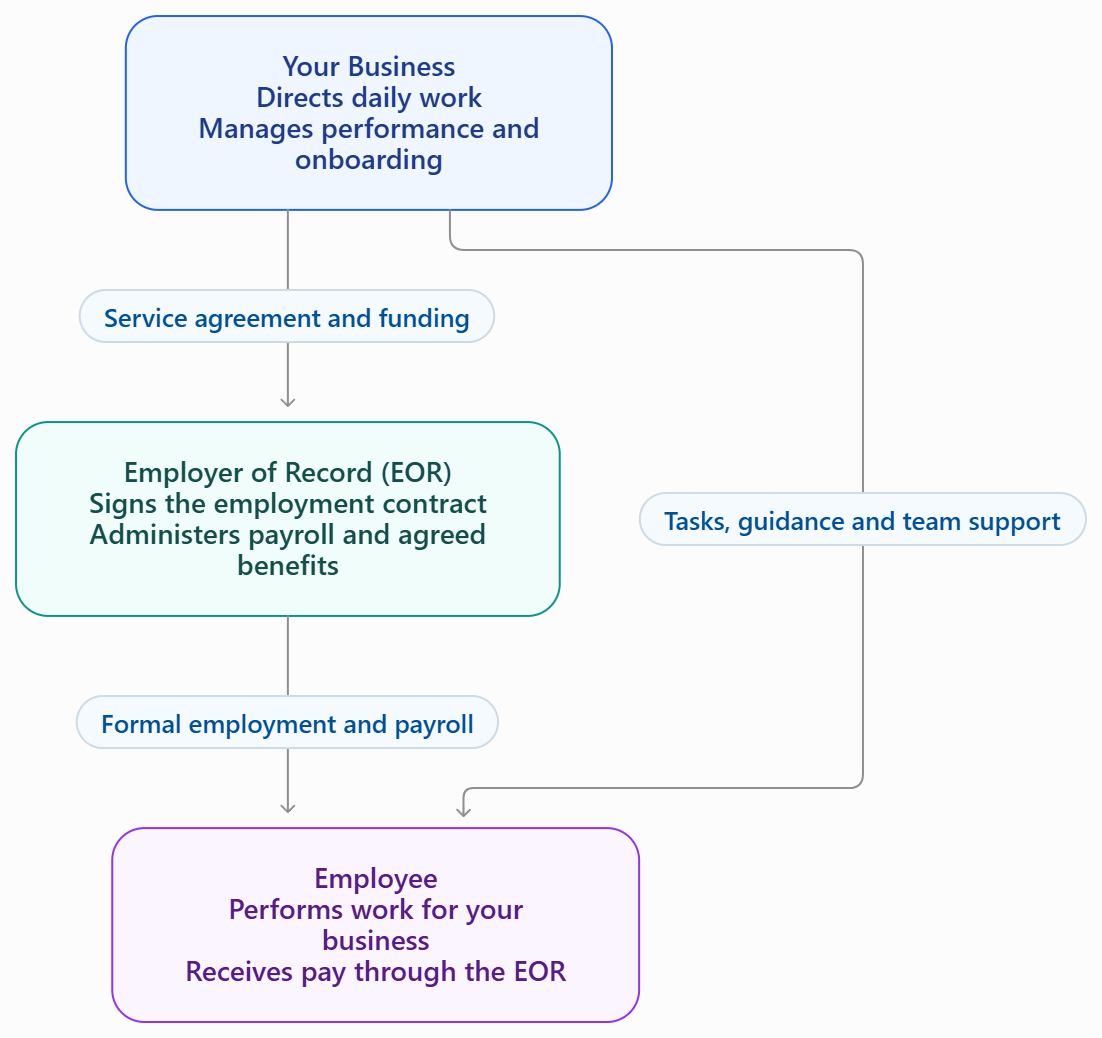
An employer of record (EOR) is a third-party organisation that formally employs workers who carry out work for your business.
In a typical arrangement, the EOR signs the employment contract and administers payroll, statutory deductions and benefits, while your managers direct the employee's everyday work. The exact arrangement must fit the rules of the country where the person works.
A local entity is your own company established in that country, such as a subsidiary.
When it hires employees directly, it signs their employment contracts and takes on the associated employer responsibilities.
You can outsource payroll or seek specialist support, but your company remains the employer.
For example, imagine you want to recruit a customer support specialist overseas. An EOR arrangement could allow its local employing company to hire that person to support your business.
With your own local entity, that company would employ the specialist directly. In either case, you still need to plan their management, onboarding and access to company information.
Employer of Record vs Local Entity: Key Differences
| Comparison point | Employer of record | Your own local entity |
| Legal employer | The EOR's employing company signs the employee's contract. Confirm exactly which company this is. | Your locally established company signs the contract and employs the worker directly. |
| Setup | Requires provider checks, agreement on responsibilities and local employee onboarding. Suitability depends on local rules. | Requires company formation and relevant employment, tax and payroll registrations before hiring, where applicable. |
| Costs | Typically includes recurring service fees alongside salary, employer contributions, benefits and any additional contractual charges. | Includes formation costs and ongoing accounting, filings, payroll, employment support and administration, alongside employee costs. |
| Control | Your business generally directs everyday work, while employment changes must be coordinated with the EOR. | Your company manages employment decisions directly, within local legal requirements. |
| Responsibilities | The EOR handles agreed employment administration. Your business still needs clear oversight of its own obligations, workplace practices and employee support. | Your company owns employer obligations and manages any external advisers or service providers it appoints. |
| Business fit | Worth assessing for initial hires or hiring where you do not have your own entity, provided the arrangement is suitable locally. | Worth assessing when you need a broader local business presence, direct employment control or infrastructure for longer-term operations. |
There is no universal price, setup timeline or employee count that makes one option the automatic winner.
Compare both against the country, the work employees will perform and your expected business activity.
Is an EOR the Same as a Payroll Provider or Contractor Arrangement?
These options serve different purposes:
- A payroll provider calculates pay and may process payments, deductions and filings. Providing payroll services alone does not make it the employee's legal employer.
- An employer of record formally employs the worker under the agreed arrangement and handles specified employment responsibilities.
- An independent contractor supplies services through a genuinely self-employed relationship. Calling someone a contractor does not, by itself, establish their legal status; the actual working relationship matters.
When comparing an employer of record vs local entity, start by establishing who employs the person, who handles each obligation and whether the structure fits local requirements.
That gives you a useful basis for comparing costs—and helps prevent responsibilities from falling between your business and its providers.
7 Costly Mistakes to Avoid to Stay Compliant
When comparing an employer of record vs local entity, the biggest problems often start with assumptions: assuming everything is included, assuming someone else owns a task, or assuming the arrangement will still work when your business grows.
Here are seven mistakes to check before they become expensive distractions.

7 Costly Mistakes to Avoid to Stay Compliant
#1. Assuming an Employer of Record Removes Every Compliance Risk
An employer of record can take on significant employment administration, but you still need to understand how the arrangement works in each country.
A provider's coverage map is a starting point—not a substitute for checking the proposed structure.
Before signing, establish:
- Who actually employs your workers: Identify the legal company signing their employment contracts and whether another local partner is involved.
- What permissions are required: Ask how the arrangement fits applicable employment, agency or labour-supply rules.
- What the agreement covers: Check responsibilities for contracts, payroll, benefits, complaints and termination.
- What your business must still handle: Clarify management practices, workplace information, payroll inputs and any separate tax assessment.
Taylor Wessing's comparative employer of record guide provides useful background on how restrictions and risks can differ between jurisdictions.
Practical fix: Create a responsibility checklist naming your internal owner, the EOR contact and the local adviser for each important task. Record who approves decisions, who acts and who keeps the evidence.
#2. Choosing on Price Without Comparing the Full Cost
A monthly service fee is useful for comparing providers, but it does not tell you the total cost of employing someone.
The service fee is the main administration charge, so ask whether equipment, background checks, visa support or particular benefits carry extra charges. Teamed's employer of record, for example, advertises pricing from USD 599 per employee per month, with zero FX markup and no setup fees.
It states that salaries, employer taxes and statutory benefits pass through at cost. These are the provider's published terms, checked in October 2026; confirm your country-specific quote before committing.
You should also check deposits and advance funding. Teamed's page states that its initial funding includes a refundable deposit equal to one month's salary alongside the first month's employment cost. A refundable deposit affects cash flow even when it is not ultimately an expense.
For your own local entity, compare formation and registration costs alongside accounting, filings, payroll administration, employment advice and ongoing support.
Hypothetical budgeting example—not a market average:
Suppose a provider quotes a service fee of USD 600 per employee per month.
For five employees over 12 months:
5 × USD 600 × 12 = USD 36,000 in annual service fees.
That excludes salaries, employer contributions, benefits and any additional charges.
Your entity comparison should cover the same five roles, country and 12-month period, including both employment costs and entity overheads.
Practical fix: Ask for an itemised forecast showing recurring costs, one-off charges, refundable deposits and possible exit costs. Compare equivalent benefits and assumptions across both options.
#3. Reusing the Same Employment Terms in Every Country
Copying your home-country contract and changing the employee's address might save drafting time.
It can also leave important local requirements unaddressed.
Treat the following as areas for local review:
- Contract language and required employment particulars.
- Working hours, overtime and rest periods.
- Annual leave, public holidays and other statutory leave.
- Mandatory benefits and employer contributions.
- Probation, notice and termination procedures.
- Confidentiality, intellectual property and restrictive clauses.
Your global handbook can explain shared values and company processes, but country-specific supplements should address local requirements.
Employees also need to understand which document applies when guidance differs.
Practical fix: Arrange review by appropriately qualified local advisers before hiring. Keep approved versions organised by country, with an owner and review date, and agree how future changes will reach affected employees.
#4. Ignoring Permanent Establishment and Corporate Tax Exposure
Employment administration and corporate tax exposure are different questions.
An EOR arrangement should not be treated as automatic protection from a taxable business presence overseas.
A permanent establishment, in broad terms, is a business presence that can give another country rights to tax certain business profits. Whether one exists depends on the applicable rules, any relevant tax treaty and the facts.
The OECD's November 2025 update clarified when cross-border remote working can create a taxable presence. It does not mean every overseas home office creates one, or that the same outcome applies everywhere.
Ask a qualified tax adviser to assess factors such as:
- What the employee actually does in the country.
- Their authority to negotiate or conclude business.
- Where and how regularly they work.
- Why your business needs the work performed there.
- How their role connects with wider local operations.
Practical fix: Obtain a country-specific assessment before committing to the arrangement. Revisit it when roles, working locations, commercial authority or business activities change.
#5. Leaving Payroll, Benefits and Employee Data Responsibilities Unclear
Payroll problems can begin well before payday.
A manager approves a bonus after the deadline, HR sends an outdated salary figure, or everyone assumes someone else has reported a benefits change.
Using an EOR or payroll provider does not remove the need for reliable internal inputs.
| Process | What to agree before launch |
| Payroll changes | Who submits salary, bonus, leave and expense information, and by when |
| Approvals | Who checks and approves inputs and payroll reports |
| Corrections | Who investigates errors and communicates with the employee |
| Benefits | Who handles enrolment, eligibility changes and employee questions |
| Employee data | Which information each party needs and how it is shared securely |
| Access and retention | Who can view records, when access ends and how retention decisions are made |
Avoid assuming one organisation has the same data-protection role for every activity. Have the relevant privacy responsibilities and arrangements checked for the actual services and locations involved.
Practical fix: Document owners, deadlines, secure submission routes and escalation contacts before the first payroll. Walk through a sample payroll cycle so gaps become visible early.
#6. Treating Onboarding and Policy Communication as an Afterthought
An employee can receive their contract and salary correctly while still feeling disconnected from your business.
They might know how to contact the EOR about a payslip but have no idea where to find your security policy, who approves leave internally or which manager handles a workplace concern.
Build onboarding around both local employment information and everyday company life:
- A named manager: Someone responsible for expectations, support and regular check-ins.
- Relevant policies: Clear access to company guidance and applicable local documents.
- Required learning: Assigned training with clear completion expectations.
- Support routes: Separate contacts for payroll, HR, IT and sensitive concerns.
- Team connection: Introductions, company updates and access to relevant conversations.
AgilityPortal can support this process through onboarding pathways, document libraries, learning resources and team spaces.
These give employees a shared place to find information and connect with colleagues across locations.
Practical fix: Use an onboarding checklist with named owners and scheduled follow-ups. Check that employees can find and understand the information; making a document available alone does not establish legal compliance.
#7. Failing to Reassess the Arrangement as the Business Grows
The arrangement you chose for your first overseas hire deserves another look when your operating plans change.
Perhaps you are building a local sales team, opening premises, entering new customer contracts or spending more management time coordinating multiple providers.
Those changes should trigger a review rather than an automatic renewal.
Review your setup when:
- Hiring forecasts or employee responsibilities change substantially.
- Local commercial activity expands.
- Customers or contracts require a locally established business.
- Tax or legal advice identifies a change in exposure.
- Service fees and administrative demands alter the cost comparison.
- Employees need different benefits or more direct employment support.
If you decide to move employees to your own entity or another provider, plan the transition carefully. Contracts, employment continuity, accrued entitlements, benefits, payroll records and any consultation or consent requirements need local review.
Employees also need a clear explanation of what is changing, when it happens and whom to contact.
Practical fix: Set scheduled reviews and specific decision triggers.
There is no universal employee threshold that makes an EOR unsuitable or a local entity cheaper—the decision should follow your actual costs, obligations and operating plans.
Employer of Record vs Local Entity: Free Evaluation Checklis
Planning to hire overseas?
Download this practical three-page checklist to compare costs, clarify responsibilities, review local requirements and plan employee onboarding before choosing your hiring structure.
Employer-of-Record-vs-Local-Entity-Checklis_20261022-121553_1
897 kb
Employer of Record or Local Entity: How Do You Decide?
Choosing an employer of record vs local entity starts with your operating plan.
Before comparing providers or registering a company, get clear on where you want to hire, what those employees will do and how you expect the business to grow.
Use this checklist to guide the conversation with HR, finance and your local advisers:
- Where will employees work, and what will they do? Document their working location, responsibilities and decision-making authority. A customer support role and a senior employee negotiating local contracts may raise different questions for your advisers.
- Is the proposed arrangement permitted and suitable locally? Confirm the actual employing company, any relevant permissions and whether the structure fits the work involved.
- Do you need employment support or a broader business presence? Hiring someone is one requirement. Opening premises, holding licences or entering local customer contracts may introduce others.
- What is the total cost under your hiring forecast? Compare both options over the same period, using equivalent salaries, benefits and headcount assumptions. Separate ongoing expenses from deposits and other cash-flow requirements.
- Who owns employment, tax, payroll and data decisions? Name the people responsible for approvals, advice, administration and resolving problems. Make sure your internal team and external providers understand their roles.
- How will employees access policies, support and training? Plan onboarding, relevant local guidance, manager contact and access to company information before the employee starts.
An EOR is worth assessing when you need employment support in a country where you do not have your own entity.
A local entity is worth assessing when your plans require a wider operating presence or direct employment infrastructure. Neither should be selected on headcount or headline fees alone.
Bring HR, finance and appropriately qualified local legal and tax advisers into the decision.
Give them the same hiring forecast and operating plan, then record why the chosen arrangement fits—and what changes would trigger another review.
Keeping Global Employees Connected With AgilityPortal
Whether you choose an employer of record or a local entity, your employees need a clear connection to your business.
They should know where to find updates, which policies apply to them and who can help when questions come up.
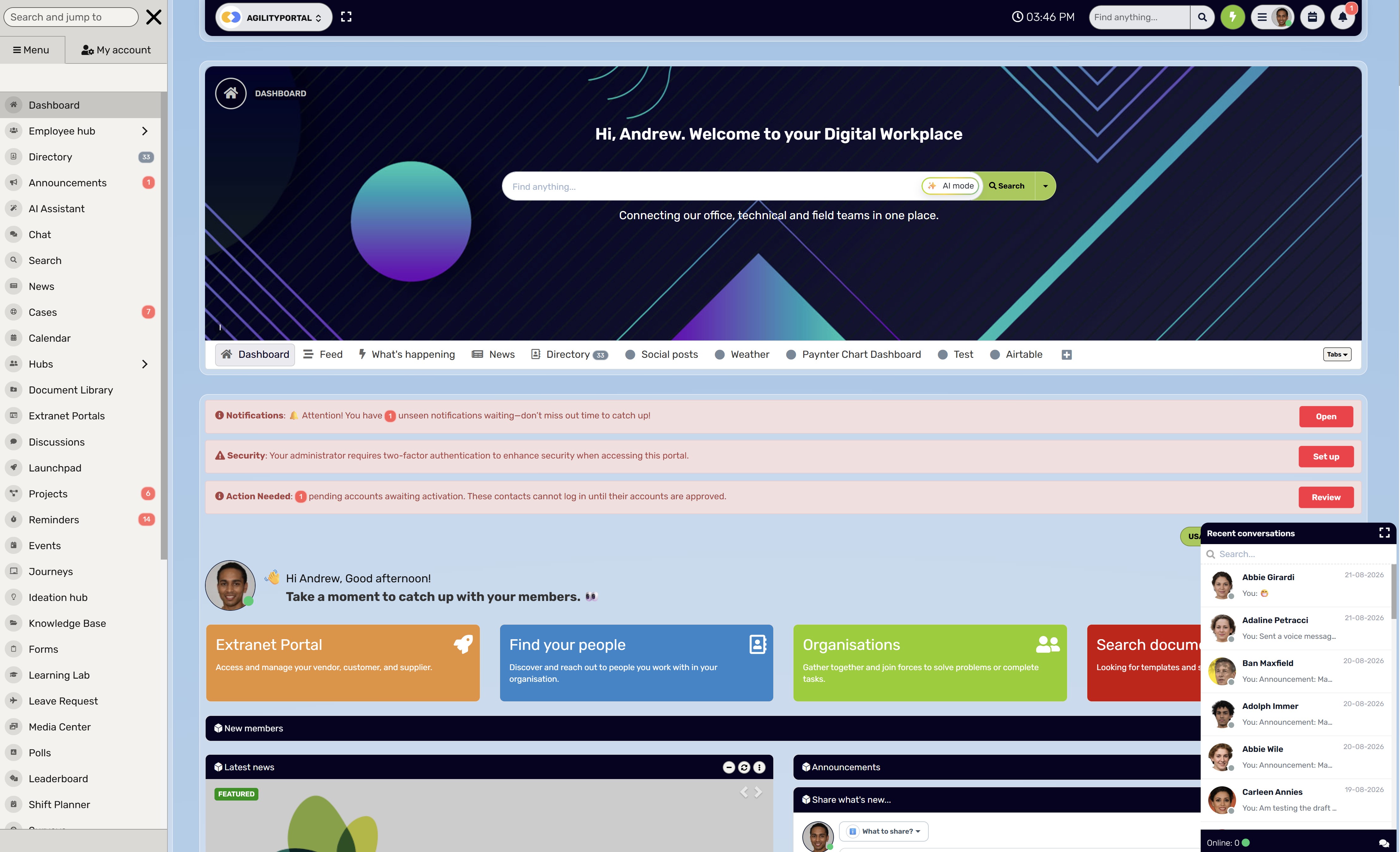
AgilityPortal gives HR leaders and internal communications teams a shared digital workplace to support global employee onboarding, knowledge sharing and everyday collaboration:
- Keep updates and policies accessible. Use a central employee portal to organise company announcements, HR documents and relevant local policies, with access appropriate to each employee's role.
- Structure onboarding and learning. Give new colleagues onboarding pathways, learning resources and clear tasks so they understand your business and their next steps.
- Connect distributed teams. Create location and team spaces where employees can ask questions, share knowledge and celebrate achievements across offices and time zones.
- Make support easier to find. Keep HR contacts and guidance visible, including when employees should contact their manager, your internal HR team or the EOR.
For a practical starting point, use our internal communication strategy template to plan your channels, messages and measures of success.
Clear communication supports a consistent employee experience. Your employment arrangements and local obligations still need their own specialist oversight.
Explore how AgilityPortal helps you onboard, inform and connect your global workforce.
AGILITYPORTAL · CONNECT YOUR GLOBAL WORKFORCE
Give every employee a clear connection to your business
Whether you hire through an employer of record or your own local entity, your people need accessible information, useful training and someone to turn to. AgilityPortal brings employee communication, onboarding, learning and shared documents into one digital workplace, helping HR and internal communications teams support colleagues across locations and time zones.
- Guide new employees through structured onboarding pathways with clear tasks and resources.
- Organise company guidance and relevant local HR policies with access appropriate to each employee’s role.
- Provide learning resources to support role training and ongoing development.
- Connect distributed colleagues through company announcements, location spaces and team conversations.
- Make HR contacts and support routes easier to find, including guidance on when to contact your EOR.
AgilityPortal supports employee communication and access to workplace resources. Employment administration, legal advice and tax assessments remain with your appointed providers, advisers and responsible internal teams.
Conclusion: Choose a Hiring Structure That Fits Your Business
Choosing an employer of record vs local entity means looking beyond the monthly fee and how quickly someone can start.
Your decision needs to reflect where employees work, what they do and the kind of presence you want to build.
An EOR can provide employment support where you do not have your own entity.
A local entity can support broader operations and direct employment.
Both require clear responsibilities, realistic budgets and advice appropriate to the country and your circumstances.
Before committing, bring HR, finance and local advisers together to check the arrangement, compare total costs and assign ownership of key tasks. Set review points so your hiring structure keeps pace with your plans.
Then make sure your employees have what they need to succeed: structured onboarding, accessible policies, useful training and a clear route to support.
Explore how AgilityPortal helps you onboard, inform and connect your global workforce—wherever your next hire is based.
FAQ
What Is the Employer of Record Meaning, and How Does It Differ From a Local Entity?
The employer of record meaning is a third-party organisation that formally employs workers who perform work for another business.
It typically handles employment contracts, payroll and agreed benefits administration, while the client business manages everyday work.
With a local entity, your own locally established company employs the workers directly. Comparing an employer of record vs local entity means assessing legal suitability, responsibilities, total costs and your plans for operating in that country.
Is "Employer on Record" the Same as "Employer of Record"?
People sometimes search for "employer on record" when they mean "employer of record." Employer of record, usually shortened to EOR, is the standard term used for this hiring arrangement.
When reviewing a provider, confirm the actual employing company and its responsibilities rather than relying on the label alone.
What Is an EOR Employee? Is "Employee of Record" the Correct Term?
An EOR employee is someone formally employed by an employer of record who performs work for a client business. The EOR handles agreed employment administration, while the client typically directs daily tasks and performance.
"Employee of record" is sometimes used in searches, but it is not the standard name for the provider or arrangement. Use "employer of record" for the organisation and "EOR employee" for the worker.
Does Using Employer of Record Services Remove Permanent Establishment Risk?
No. Employer of record services should not be treated as automatic protection from permanent establishment risk—a taxable business presence overseas. The employee's activities, authority and working arrangements can still require assessment under relevant domestic rules and tax treaties.
Obtain country-specific tax advice before hiring and revisit the assessment when the role or your operations change.
The OECD's updated guidance explains how cross-border remote working can affect taxable presence.
Are EOR Services Cheaper Than Setting Up a Local Entity?
EOR services may be more economical for some hiring plans, but there is no universal break-even point. Compare service fees, employment costs, benefits, additional charges and cash-flow requirements against entity formation, accounting, filings, payroll and ongoing support.
Use the same country, roles, headcount forecast and comparison period. A lower headline administration fee does not necessarily mean a lower total cost.
Can EOR Companies Move Employees to Your Own Local Entity?
A move from EOR companies to your own entity may be possible, but the process depends on local law, contracts and the circumstances. It may require new agreements, a transfer process or other steps reviewed by local advisers.
Before proceeding, confirm how employment continuity, accrued leave, benefits, payroll records and any consultation or consent requirements will be handled. Give employees clear information about the change and their support contacts.
Who Manages Onboarding and Employee Communication for an EOR Employee?
Who Manages Onboarding and Employee Communication for an EOR Employee?
Responsibility should be agreed between your business and the provider. The EOR typically handles employment-related onboarding, while your business should assign ownership of role training, manager introductions, company policies and team communication.
An EOR employee needs clear routes for both employment questions and everyday support.
AgilityPortal can help organise onboarding pathways, learning resources, documents and team spaces so that information is easier to find.
Is a HireRight Background Report Included in Employer of Record Services?
Do not assume a HireRight background report, or another provider's screening service, is included in employer of record services. Ask whether background checks are available, who conducts them, what they cover and whether additional charges apply.
Before requesting screening, confirm the applicable requirements for the role and country, including privacy, notices and any necessary permissions. A background report alone does not establish that the wider hiring arrangement is compliant.
AI Summary
- An employer of record formally employs workers who perform work for your business. With a local entity, your own locally established company employs them directly. Compare both against local rules, employee responsibilities and your operating plans.
- Using employer of record services does not automatically remove every compliance risk. Confirm the actual employing company, relevant local permissions and the responsibilities assigned to each party.
- Compare total costs rather than headline fees. Include salaries, employer contributions, benefits, administration, additional charges and exit costs. Separate refundable deposits from expenses when assessing cash-flow requirements.
- Review employment terms locally and assess corporate tax exposure separately. An EOR arrangement does not automatically eliminate permanent establishment risk; the work performed and applicable domestic rules and tax treaties matter.
- Assign clear owners for payroll inputs, benefits changes, employee data and support requests. Give global employees structured onboarding, relevant policies, training and accessible HR contacts. AgilityPortal can help organise these resources and connect teams.
- Reassess your hiring structure as roles, locations, costs and business activities change. There is no universal headcount threshold for switching to a local entity. Make the decision with HR, finance and appropriately qualified local advisers.
Most Popular Posts

Effective communication among team members is vital for the productivity and success of any organization. Surprisingly, 60% of companies lack a long-term internal communication strategy, which p...


Businesses thrive on communication for efficiency, productivity and accomplishment. When the right information is passed from the right designation in the organization, it promotes positivity an...

Categories
Blog
(3236)
Business Management
(397)
Employee Engagement
(235)
Digital Transformation
(222)
Growth
(151)
Intranets
(142)
Internal communications
(110)
Remote Work
(68)
Sales
(53)
Collaboration
(53)
Customer Experience
(33)
Culture
(30)
Project management
(30)
Knowledge Management
(29)
Leadership
(20)
Comparisons
(9)
News
(1)

Related Posts

Are you weighing up an employer of record vs local entity to hire overseas—and wondering which option will help you grow without creating expensive compliance problems? If you're a business owner, HR director or people operations leader struggling to...

Why does your internet connection seem fast until everyone joins a video call or starts uploading files? Understanding the factors to consider when choosing an internet service provider can help you avoid a package that looks good on paper but ...

Is your vendor invoice management process keeping client projects moving, or leaving your team chasing approvals and questioning what's ready to pay? When several suppliers work on the same project, small gaps can quickly become expensive problems.&n...

What is virtual office software, and could it help your remote team feel more connected? Working from home has its perks, but having plenty of calls and messages doesn't always mean feeling part of a team. Gallup's 2026 State of the Global Work...

In today's competitive talent landscape, learning and development (L&D) has become a non-negotiable priority for enterprises. Organizations that invest in employee growth not only boost engagement and retention but also build agile, future-ready ...


Jill Romford
I am a digital nomad, lover of exploring new places and making friends.
I love to travel and I love the internet. I take pictures of my travels and share them on the internet using Instagram.
Traveler, entrepreneur, and community builder. I share my insights on digital marketing and social media while inspiring you to live your fullest life.
Ready to learn more? 👍
One platform to optimize, manage and track all of your teams. Your new digital workplace is a click away. 🚀
Free for 14 days, no credit card required.