
Insight Blog
Agility’s perspectives on transforming the employee's experience throughout remote transformation using connected enterprise tools.
51 minutes reading time
(10293 words)
Why the Traditional Job Relocation Package Is Failing—and What Smart Employers Offer Instead

Why the Traditional Job Relocation Package Is Failing—and What Smart Employers Offer Instead
Is the traditional job relocation package outdated? Discover why standard benefits are failing employees and what smart employers now offer instead.
Why the Traditional Job Relocation Package Is Failing—and What Smart Employers Offer Instead

A traditional job relocation package once felt like a compelling offer.
An employer might pay for professional movers, temporary accommodation, travel and even help with selling a home.
For an employee expected to move permanently to a fixed workplace, that support made practical sense. The problem is that work—and what employees expect from it—has changed.
Remote and hybrid working have weakened the connection between a job and one permanent office.
Employees also have different housing situations, family commitments, caregiving responsibilities and lifestyle priorities.
As a result, a standard package can cost an employer thousands while still failing to address what the employee actually needs.
63%
of employers
According to SHRM, 63% of employers offered hybrid working opportunities for most employees in 2023, showing how firmly workplace flexibility has become established.
Source:
SHRM
The wider workplace has changed too.
SHRM reported that 63% of employers offered hybrid working opportunities for most employees in 2023.
That means relocation policies can no longer be designed separately from flexible-working strategies. Employers must also consider tax, payroll, employment law and employee experience before agreeing to a move.
So, what should replace the old approach?
This guide explains why traditional relocation packages are losing relevance, what employees value now and how employers can build a fairer, more flexible and practical relocation policy.
Key Takeaways
- A traditional job relocation package can fail when it focuses on moving belongings but ignores the employee’s family, financial and practical circumstances.
- Remote and hybrid work have not eliminated relocation, but employers should confirm that a permanent move is genuinely necessary for the role.
- Core-flex packages combine essential relocation support with benefits employees can select based on their individual needs.
- Employers must clearly explain eligible relocation expenses, tax treatment, cost limits, attendance expectations and repayment conditions.
- Relocation should be measured by employee satisfaction, productivity and retention—not simply whether the employee completed the move.
What Does a Job Relocation Package Traditionally Include?
A job relocation package is the financial and practical support an employer provides when a new or existing employee must move to accept a role, transfer to another workplace or complete an international assignment.
Its purpose is simple: reduce the cost, disruption and personal pressure associated with moving for work.
The exact support varies considerably.
A senior executive moving internationally may receive a fully managed service, while a junior employee moving between UK cities might receive a fixed allowance.
The important point is that the employee understands what is covered, what must be paid upfront and whether any of the money may need to be repaid later.

What Does a Job Relocation Package Traditionally Include
The Benefits Most Employees Expect to See
A comprehensive relocation package may cover:
- Professional packing and moving services
- Storage and insurance for personal belongings
- Travel to the new location
- One or more house-hunting trips
- Temporary accommodation
- Lease termination fees
- Help selling or purchasing a home
- Settling-in expenses
- Travel support for immediate family members
- Childcare or school-search assistance
- Visa and immigration support
- Tax advice or tax gross-up payments
- Language or cultural training for international moves
Indeed identifies moving services, insurance, home-sale support, house-hunting trips and temporary accommodation among the benefits commonly included in an employee relocation package.
International moves are usually more complicated because the employer must consider immigration, payroll, tax and local employment requirements.
For example, a business employing someone in Portugal without establishing its own local entity may decide to use a capable Portugal EOR to employ the worker legally and manage local payroll and employment administration.
This may allow the organisation to hire the person where they already live instead of paying for an unnecessary international relocation.
Employers should not assume that every listed benefit must appear in every package. The support should reflect the role, destination, length of assignment and employee's circumstances.
The Four Common Ways Employers Pay for Relocation
The way support is delivered can be just as important as the amount offered.
| Package model | How it works | Main benefit | Main limitation |
| Directly managed | The employer or a relocation provider arranges and pays for approved services | Gives the employee extensive practical support | Can be expensive and offer limited personal choice |
| Reimbursement | The employee pays approved expenses and submits receipts | Gives the employer greater control over spending | The employee may need to cover substantial costs upfront |
| Lump sum | The employee receives a fixed relocation allowance | Simple to administer and flexible for the employee | The employee carries the risk of overspending |
| Core-flex | The employer funds essential services and lets the employee choose additional benefits | Balances consistency with personalisation | Requires clear rules, systems and administration |
A directly managed package gives the employer more control and removes much of the organisational burden from the employee.
However, it can become expensive when services are included that the employee does not need.
Reimbursement keeps spending tied to approved costs, but it can place employees under financial pressure while they wait to be repaid.
This is particularly problematic when temporary accommodation, deposits and travel must all be funded at the same time.
A lump-sum package gives employees more freedom, but the headline amount can be misleading if tax, price changes or unexpected expenses reduce its real value.
Core-flex packages attempt to find a middle ground.
The employer covers essential services—such as moving costs, travel and temporary accommodation—while allowing the employee to choose optional support based on their circumstances.
Those options might include childcare, pet transportation, additional storage or partner career assistance.
For many modern employers, this flexible model makes more sense than giving every relocating employee the same package.
It establishes a fair foundation without pretending that every move—or every household—is identical.
So, Are Traditional Relocation Packages Really Failing?
Traditional relocation packages aren't failing because employees no longer need help moving.
They're failing when employers treat every relocation as the same predictable journey: accept the job, move near the office, receive a fixed set of benefits and begin working on-site.
That model still works for some positions, particularly roles tied to a factory, healthcare facility, laboratory, regional office or customer location. However, it becomes much less effective when applied to remote-capable employees, hybrid teams and people whose family or financial circumstances do not fit a standard policy.
The workplace data shows why this matters.
Gallup's 2025 research found that 51% of remote-capable US employees worked in a hybrid arrangement, while hybrid employees spent an average of only 46% of their working week in the office—the equivalent of approximately 2.3 days.
Gallup also found that even among remote-capable employees classified as fully on-site, the proportion working with teams spread across different locations rose from 13% in 2023 to 27% in 2025.
51%
worked hybrid
46%
of the week in-office
13% → 27%
worked in distributed teams
Gallup’s 2025 research found that 51% of remote-capable US employees worked in a hybrid arrangement. Hybrid employees spent an average of 46% of their working week in the office—approximately 2.3 days.
Even among remote-capable employees classified as fully on-site, the proportion working with teams spread across different locations increased from 13% in 2023 to 27% in 2025.
These figures suggest that bringing one employee closer to an office does not necessarily place them closer to their actual colleagues.
An organisation could spend thousands moving somebody to Manchester, London or New York, only for that employee to spend much of the week communicating with teammates in other cities or countries.
That doesn't make relocation pointless. It means employers need a clearer business reason for requiring it.
A traditional package is most likely to fail when it:
- Assumes every role must be connected to one permanent office
- Gives employees the same benefits regardless of their circumstances
- Measures success only by whether the move was completed
- Ignores family, housing, accessibility and caregiving needs
- Treats relocation as a financial transaction rather than a major life event
- Fails to explain tax liabilities or repayment conditions
- Provides little support once the employee arrives
- Does not help the employee connect with their new team or community
The Package Solves the Move but Misses the Person
Imagine two employees are each offered a £10,000 relocation allowance.
The first is renting, lives alone and can complete the move using a removal company and a short period of temporary accommodation. The allowance may cover most of the disruption.
The second employee has a partner who would need to leave their job, two children who need new schools, a mortgage, an elderly relative who relies on them and a disability that limits suitable housing options.
The same £10,000 may not come close to solving the real problem.
Offering both employees an identical amount may look consistent, but it does not necessarily produce a fair outcome. Equality gives everyone the same package. A fair relocation policy establishes consistent rules while recognising genuine differences in what employees need to complete a successful move.
The relocation industry is already responding to this problem.
Atlas Van Lines' 2026 Corporate Relocation Survey found that flexibility over either the full relocation benefit or part of it was most commonly determined by company policy rather than employee seniority.
The survey also found that the most common additional incentives were:
- Cost-of-living salary adjustments — 52%
- Relocation or sign-on bonuses — 49%
- Extended temporary housing — 38%
52%
persuaded to relocate
According to the Atlas Corporate Relocation Survey, 52% of surveyed companies said additional incentives frequently persuaded an employee to relocate.
This suggests employees may not be rejecting relocation itself. They may be rejecting packages that fail to address the real financial, housing and practical consequences of moving.
Crucially, 52% of surveyed companies said these additional incentives frequently persuaded an employee to relocate. That matters because it suggests employees are not simply rejecting relocation.
They may be rejecting packages that fail to address the real financial and practical consequences of moving.
A better approach might combine essential moving support with flexible benefits for childcare, temporary housing, partner employment assistance, accessibility requirements or additional visits home.
The Old Office-Centred Assumption No Longer Fits Every Role
Remote and hybrid work have not removed the need for physical workplaces.
They have made the relationship between an employee, their team and an office more complicated.
Employers now manage several different situations:
- Remote-first roles with no regular office requirement
- Hybrid positions requiring specific attendance days
- Teams divided between several offices
- Short-term and project-based assignments
- Employees who move independently
- Return-to-office policies introduced after recruitment
- Cross-border remote-working requests
- Employees who commute periodically instead of relocating permanently
Gallup reports that hybrid work has remained broadly stable since 2022. Its research also found that hybrid schedules are divided almost evenly between those determined by employees, managers or teams, and senior leadership.
This demonstrates why vague promises such as "flexible working available" are not enough when asking somebody to relocate.
Before offering a job relocation package, the employer should be able to answer some basic questions:
- Which workplace must the employee attend?
- How frequently must they be there?
- Which colleagues will actually be based at that location?
- Could periodic travel achieve the same business outcome?
- Is the attendance requirement likely to change?
- What happens if the employee moves and the company later closes or downsizes the office?
- Has the employee received these expectations in writing?
SHRM argues that remote and hybrid arrangements remain important tools for attracting and retaining talent, particularly when employers need to reach broader or underused talent pools.
That does not mean every position should become remote.
It means relocation should be based on a genuine operational requirement rather than an outdated assumption that productive work always happens near headquarters.
The real issue, then, is not whether employers should stop offering relocation support. It is whether they should continue spending money on rigid packages designed for a workplace that no longer operates in the same way.
Related Employee Relocation, Hybrid Work & Onboarding Guides
A successful job relocation package involves more than paying moving expenses. These related AgilityPortal guides explore hybrid work, remote employee management, international hiring, digital onboarding, employee wellbeing and the systems organisations need to support people across different locations.
- What Is a Workplace Portal? How It Supports Hybrid Work and Flexible Teams
- How to Manage Remote Employees and Overcome Common Challenges
- How to Streamline Onboarding With a Digital Workplace
- How to Onboard Employees So They Won’t Leave
- How an Employer of Record Simplifies Global Hiring and Employee Onboarding
- Distributed Workforce: Strategies for Successful Management
- Employee Experience Platform: Is Disengagement Killing Your Team?
- How Financial Stress Affects Employee Wellbeing—and How Employers Can Help
- The Digital Workplace Strategy Playbook Every HR and IT Leader Needs
- Internal Communications Solutions for Distributed Teams
Together, these guides create a stronger topic cluster around employee relocation, global mobility, hybrid work, remote onboarding, international employment, employee experience and supporting distributed teams before, during and after workplace change.
Remote Work Didn't Kill Relocation—It Changed the Reason for It
Remote work hasn't made employee relocation unnecessary.
Hospitals still need healthcare professionals on-site, manufacturers need specialists close to production facilities and regional leaders may need to live near the teams and customers they manage. International expansion, secure workplaces and the opening of new branches can also make a physical move essential.
What has changed is the assumption that hiring somebody from another region must automatically result in a permanent move.
Before approving a relocation fund, employers should now ask whether moving the employee is genuinely necessary. Could the role be performed remotely?
Would monthly travel achieve the same result? Does the employee need to relocate permanently, or would temporary accommodation during an initial onboarding period be enough?
These questions matter because relocation and removal expenses can quickly extend beyond hiring a moving company.
Employers may also need to cover travel, storage, deposits, temporary housing, lease termination, family support and tax advice.
A seemingly straightforward move can therefore become a significant and long-term business expense.
Relocation still makes sense when:
- A specialist must work with equipment at a particular location
- A leader is responsible for a regional workforce or operation
- A new office, factory or branch is opening
- The role involves secure or regulated on-site work
- An international assignment supports business expansion
- A new employee needs a defined period of in-person training
- Regular physical access to customers or facilities is essential
The difference is that smart employers now require a clear operational reason before asking someone to move.
Employers Can Recruit Talent Without Moving Everyone
Remote and hybrid working allow organisations to recruit beyond the distance employees can reasonably commute.
Instead of limiting a search to candidates living near an office—or increasing the relocation fund to persuade somebody to move—employers can consider whether the work can be performed from another approved location.
This can provide several advantages:
- Access to a wider talent pool
- Lower relocation and removal expenses
- Faster recruitment for remote-capable positions
- Access to specialist skills in other regions
- Greater inclusion for people unable to relocate
- Less disruption for employees and their families
- Reduced risk of losing a candidate over a compulsory move
This is especially valuable when a highly qualified candidate has a partner with an established career, children attending local schools or caring responsibilities that make relocation unrealistic.
However, employers shouldn't simply remove relocation assistance and tell the employee to work remotely.
Remote workers may still need home-office equipment, secure technology, coworking access, occasional travel and support connecting with their team.
Part of the original relocation fund may therefore be redirected towards creating an effective long-term working arrangement.
For example, instead of spending £20,000 on a permanent move, an employer might fund:
- A properly equipped home workspace
- Secure internet and IT equipment
- Monthly travel to the main office
- Temporary accommodation during onboarding
- Regional coworking membership
- Quarterly in-person team meetings
- Additional support for cross-border compliance
This does not mean remote work will always cost less. It means employers can spend money on the arrangement the role actually requires rather than defaulting to a permanent move.
But "Work From Anywhere" Creates Risks of Its Own
Allowing an employee to work from another location may sound easier than managing relocation and removal expenses, but it introduces a different set of responsibilities.
An employee's location can affect:
- Payroll registration and tax deductions
- Local employment rights
- National Insurance or social security obligations
- Immigration and right-to-work requirements
- Data protection and cybersecurity
- Benefits eligibility
- Salary and cost-of-living calculations
- Corporate tax or permanent establishment exposure
- Working hours and time-zone coordination
- The organisation's ability to employ that person legally
These risks become particularly serious when an employee moves to another country without telling HR. The employee may continue working normally, but the organisation could unknowingly be breaching local payroll, immigration or employment requirements.
A clear remote-location policy should require employees to request approval before changing their permanent working location. HR, Payroll, Legal, IT and Information Security should then assess whether the proposed arrangement is workable.
Employers should record:
- The employee's approved working location
- Whether the arrangement is permanent or temporary
- Expected office-attendance days
- Who will pay for business travel
- Which relocation or remote-working expenses are covered
- Any restrictions on international working
- The date the arrangement will be reviewed
- What happens if the business later changes its workplace policy
Remote work is therefore not a free substitute for a job relocation package. It shifts the organisation's costs and risks rather than removing them.
The better decision is not automatically "relocate" or "work remotely." It is the arrangement that meets the operational need while remaining fair, sustainable and compliant.
What Employees May Value More Than a Standard Moving Package
A traditional job relocation package usually concentrates on the physical move: packing belongings, hiring a removal company, arranging travel and paying for temporary accommodation.
These services remain useful, but they do not always address the personal, financial and professional disruption employees experience when moving for work.
Modern relocation support is becoming more flexible because employees do not all need the same things. One person may want the employer to manage the entire move.
Another may prefer control over their relocation fund, while an employee with children might value school-search assistance more than professional packing.
The best approach is not necessarily to spend more. It is to give employees meaningful support based on their circumstances while maintaining clear and consistent rules.

What Employees May Value More Than a Standard Moving Package
Flexible Cash Allowances With Proper Guidance
A lump-sum allowance gives the employee a fixed amount to manage their own relocation and removal expenses.
Instead of using suppliers selected by the employer, the employee can decide how to divide the money between movers, storage, travel, accommodation and other eligible costs.
This flexibility can be attractive.
A renter moving alone may not need a fully managed service and could use the relocation fund more efficiently.
An employee moving with a family may choose to spend more on temporary housing or school-search visits.
However, a lump sum is not automatically a better option.
Employees may:
- Underestimate the real cost of moving
- Receive quotes that later increase
- Face unexpected tax consequences
- Choose uninsured or unreliable suppliers
- Spend too much in one area
- Run out of money before completing the move
- Struggle to pay deposits and other upfront costs
- Feel that the employer has handed over the money and withdrawn its support
Employers can reduce these risks without removing employee choice. They might provide:
- A list of vetted moving and storage companies
- A relocation-cost calculator
- Guidance explaining eligible expenses
- Clear tax information
- Access to independent financial or legal advice
- A named HR or mobility contact
- Recommended temporary accommodation providers
- Emergency support for genuinely unexpected costs
- A written explanation of any repayment conditions
This creates a sensible balance. The employee controls the allowance, but they are not left to manage a complicated life event without guidance.
Core-Flex Benefits Built Around Real Circumstances
A core-flex relocation package combines essential benefits with optional support chosen by the employee.
The core part protects the basic purpose of the move. It might include:
- Professional moving services
- Travel to the new location
- Temporary accommodation
- Insurance for belongings
- Basic tax guidance
- Visa and immigration support
- Essential accessibility arrangements
The flexible part allows employees to select additional benefits that reflect their household and circumstances.
Options might include:
- Childcare during the move
- School-search assistance
- Career support for a partner
- Pet transportation
- Additional storage
- Home-finding services
- Accessibility-related housing support
- Coworking membership
- Home-office equipment
- Language or cultural training
- Additional settling-in leave
- Extra visits home during a temporary assignment
Imagine two employees are moving to the same location. One has young children and needs childcare and help researching schools. The other lives alone but needs additional storage and a coworking membership.
A core-flex policy provides both employees with the same essential protection while allowing them to use part of the relocation fund differently.
That is more useful than forcing everyone to select from an identical list of services.
Employers still need boundaries.
Optional benefits, maximum values and approval processes should be published clearly. Otherwise, flexibility can turn into inconsistent treatment, uncontrolled spending and frustration when one employee receives support another did not know was available.
Temporary Relocation Instead of Permanent Upheaval
Not every business requirement justifies a permanent move.
An employee may only need to work near a particular office or facility for a limited project, onboarding period or leadership assignment.
Alternatives to permanent relocation include:
- Project-based assignments
- Rotational placements
- Regular commuter arrangements
- Short-term accommodation
- Extended business travel
- Trial periods before a permanent move
- Splitting time between two approved locations
- Temporary international assignments
For example, a technical specialist might need to spend six months supporting the launch of a new facility.
Paying for short-term accommodation and regular visits home may be more practical than moving the employee's entire household.
Temporary arrangements can reduce disruption, but they must not become permanent by accident. Repeated travel and long periods away from home can affect wellbeing, relationships and performance.
They may also create tax, immigration, payroll and employment-law implications.
Employers should therefore define:
- The reason for the assignment
- Its expected start and end dates
- Accommodation and travel arrangements
- How often the employee can return home
- Which expenses the employer will cover
- How working hours will be managed
- When the arrangement will be reviewed
- What happens if the assignment is extended
- Whether permanent relocation will eventually be considered
Temporary relocation should remain a deliberate arrangement, not an open-ended way of avoiding a proper decision.
Remote-Work and Home-Office Support
For remote-capable roles, the best alternative to a permanent move may be to help the employee work effectively from their current location.
A remote-working package could include:
- Laptop, monitors and other equipment
- A desk and ergonomic chair
- A broadband or connectivity allowance
- Coworking-space access
- Cybersecurity hardware or software
- An ergonomic assessment
- Occasional travel to the main office
- Temporary accommodation during office visits
- Regional team gatherings
- In-person onboarding
- Secure document and communication tools
This support is often more closely connected to the employee's everyday experience than paying for a move they do not want or need.
The employer must still be clear about expectations.
Employees should know how often they must attend the office, who pays for travel and whether their approved home location affects their salary or benefits.
A remote-working arrangement should never be presented as fully flexible if regular attendance will later be required.
Support for the Whole Household
An employee rarely relocates in isolation. Even when the job offer is attractive, the move may affect everyone living with them.
The success of a relocation can depend on:
- Whether the employee's partner can find suitable work
- The availability and cost of childcare
- Access to appropriate schools
- Housing affordability
- Healthcare provision
- Transport connections
- Elder-care responsibilities
- Disability and accessibility requirements
- Language and cultural differences
- Whether the family can establish a local support network
An employee may accept a role enthusiastically but struggle after the move because their partner cannot find work or their children cannot settle into new schools. If the household is unhappy, the employee may eventually leave—regardless of how smoothly the removal company delivered their belongings.
Employers do not need to solve every private problem. They do, however, need to recognise that relocation is a household transition rather than a delivery exercise.
Practical support could include local-area guides, school information, partner career coaching, healthcare guidance, community introductions and scheduled check-ins after the move. These benefits may cost less than increasing the relocation allowance, yet make a much greater difference to whether the employee stays.
The modern alternative to a standard moving package is therefore not one new benefit. It is a more thoughtful combination of financial choice, practical guidance, household support and flexible ways of working. That is what turns relocation spending into a sustainable employee experience.
Imagine Offering £10,000 and Still Losing the Employee
Imagine a senior product manager accepts a hybrid role requiring two office days each week.
The employer provides a £10,000 relocation fund and expects the employee's family to move within eight weeks.
The problem?
Their partner cannot transfer jobs, suitable childcare near the office is limited and the allowance will not cover temporary accommodation alongside the cost of leaving their existing home.
HR considers the job relocation package delivered, while the manager expects the employee to maintain full productivity throughout the move.
Within months, financial pressure, family disruption and a poor onboarding experience leave the employee considering resignation.
A pre-move assessment could have identified these problems earlier.
The employer might have offered a phased hybrid arrangement, temporary accommodation, childcare support and clear information about costs and tax.
The lesson is simple: paying relocation and removal expenses does not guarantee a successful move. Employers must support the employee's wider transition—or risk losing both the person and the money spent recruiting and relocating them.
The Hidden Risks Behind a Generous-Looking Offer
A large relocation fund can make a job offer look attractive, but the headline figure rarely tells the whole story. Tax treatment, repayment clauses, changing employment obligations and inconsistent eligibility rules can all reduce the package's value—or turn it into a source of conflict.
Before accepting or approving a job relocation package, both the employee and employer should understand what the offer is actually worth, which costs are covered and what happens if the arrangement changes.
A Headline Allowance May Not Equal Its Real Value
Suppose an employee is offered £12,000 to cover relocation and removal expenses.
They may assume the entire amount is available for moving services, temporary accommodation, travel and deposits. However, the tax treatment depends on the type of expense, when it is paid and whether it meets the relevant conditions.
According to HMRC guidance on relocation costs, qualifying relocation expenses of up to £8,000 may be exempt from tax and National Insurance.
Qualifying costs can include:
- Buying or selling a home
- Moving belongings
- Purchasing certain items for the new home
- Eligible bridging-loan costs
The exemption is conditional. HMRC states that the move must normally involve a new employee starting work in a new area or an existing employee changing their workplace.
The employee's new home must also be reasonably close to the new workplace while their previous home was not. Eligible expenses must be paid before the end of the tax year following the one in which the employee started the new job.
Amounts above £8,000 and non-qualifying expenses may need to be reported and may attract tax and National Insurance. That means a £12,000 headline allowance does not automatically provide £12,000 of spending power.
Employers should therefore explain:
- Which expenses qualify under the policy
- Which payments may be taxable
- Whether the allowance will be paid through payroll
- Whether the company will pay suppliers directly
- Whether the employer offers a tax gross-up
- What receipts and evidence the employee must provide
- The deadline for submitting expenses
- What happens when costs exceed the approved limit
A tax gross-up is an additional payment intended to cover some or all of the tax created by a benefit. It can protect the employee's intended spending power, but it also increases the employer's total cost.
Neither HR nor the employee should guess how the rules apply. Tax treatment varies by country, type of payment and individual circumstances. Employers should involve Payroll and obtain professional tax advice where necessary.
Repayment Clauses Can Damage Trust
Employers often include a repayment or clawback clause in a job relocation package. This allows the organisation to recover some or all of its costs if the employee leaves within a specified period.
The business reason is understandable. An employer may spend thousands recruiting, moving and onboarding an employee, only for that person to resign shortly afterwards. A repayment clause discourages employees from accepting support without intending to remain in the role.
Problems arise when the clause is unclear, disproportionate or hidden within a long policy document.
A poorly designed clause might:
- Demand full repayment after the employee has completed most of the required period
- Apply when the employer terminates the position
- Include costs the employee did not know were recoverable
- Treat voluntary resignation and redundancy in the same way
- Allow managers to make inconsistent exceptions
- Require immediate repayment without considering hardship
- Recover more than the employer's genuine cost
For example, an employee might accept £15,000 in relocation support with an 18-month repayment period. If they resign after 17 months and must repay the entire amount, the policy may feel punitive even if the clause is legally enforceable.
A tapered repayment schedule is generally easier to understand and defend. An illustrative structure could be:
| When employment ends | Illustrative amount repayable |
| Within the first 6 months | 100% |
| Between 6 and 12 months | 66% |
| Between 12 and 18 months | 33% |
| After 18 months | Nothing |
The actual arrangement should be reviewed by appropriate legal and HR advisers.
The policy should also explain whether repayment applies when:
- The employee resigns voluntarily
- The employer makes the role redundant
- The employee is dismissed
- The workplace location changes again
- A visa application is refused
- Illness or caring responsibilities make the move unsustainable
- The employer materially changes the role
- The employee cannot complete the relocation for reasons outside their control
Clawbacks should protect legitimate business investment without trapping an employee in an unsuitable or fundamentally changed role. Clear terms, proportionate recovery and case-by-case review are essential.
Remote Moves Can Create Compliance Surprises
Relocation does not always involve an employer asking somebody to move.
A remote employee may decide to change city, region or country while continuing to perform the same job.
To the employee, this may appear to be a private lifestyle decision. To the employer, it can change the legal and operational basis of the employment relationship.
A new working location may affect:
- Payroll deductions and tax withholding
- Social security or National Insurance obligations
- Minimum wage and working-time rules
- Holiday, family-leave and termination rights
- Benefits and insurance eligibility
- Immigration and right-to-work status
- Data protection and cybersecurity controls
- Health and safety responsibilities
- Corporate tax exposure
- The organisation's registration obligations
- Whether the employer can legally employ the person there
Imagine a UK-based employee moves to Portugal and continues working remotely without informing HR. Their access to company systems still works, their manager sees no immediate difference and their salary continues to be processed through UK payroll.
However, the employer may now need to assess Portuguese employment, tax, social security, immigration and data-handling requirements. The organisation may also need a lawful way to employ and pay the person in that location.
What looked like a simple personal move can create compliance obligations for several departments.
A remote-location policy should therefore require employees to obtain written approval before permanently or temporarily changing where they work.
The request should capture:
- Proposed working location
- Intended start and end dates
- Citizenship and right-to-work status
- Whether the move is permanent or temporary
- Expected office attendance
- Time-zone implications
- Access to company and customer data
- Equipment and security requirements
- Tax and payroll considerations
- Emergency contact and residential details
HR should coordinate the review, but Legal, Payroll, Finance, IT, Security and Data Protection may all need to contribute.
Approval should be confirmed before the employee moves—not after the organisation discovers the change through payroll, an IP address or a security alert.
Unequal Packages Can Become an Employee-Relations Problem
Not every employee needs the same relocation support.
A senior executive moving internationally will usually require a different package from a graduate relocating within the UK.
Different treatment is not automatically unfair. The problem is whether the organisation can explain why the difference exists.
Relocation decisions often become difficult when they depend on:
- Employee seniority
- Salary level
- Negotiating ability
- Departmental budget
- Individual manager discretion
- Whether the employee is a new hire or an internal transfer
- Family or housing circumstances
- Whether the employee has a disability
- The strategic importance of the role
A company may offer a larger allowance to employees with children or homeowners because their moves are more complicated. However, poorly designed rules could unintentionally disadvantage younger employees, single employees, carers or people whose needs do not fit traditional definitions of family.
Disability and accessibility requirements also need careful consideration. An employee may need adapted housing, accessible transport, specialist moving support or additional time to relocate. These should not simply be treated as optional extras competing for space within the same limited relocation fund.
Inconsistent manager discretion creates another risk. If one department pays for temporary accommodation while another refuses the same request without a clear reason, employees may see the policy as arbitrary. Confidential packages can also become an employee-relations issue when people later compare what they received.
The goal should not be to give every employee an identical package.
It should be to make decisions that are:
- Based on published eligibility criteria
- Connected to genuine business and employee needs
- Consistently approved
- Properly documented
- Reviewed for equality and accessibility implications
- Clear enough to explain if challenged
- Flexible within defined boundaries
A core-flex policy can help. Every eligible employee receives a consistent set of core benefits, while additional support is selected from an approved menu based on the circumstances of the move.
The final decision should record why the package was appropriate, who approved any exception and how similar future cases should be handled. That creates accountability without removing all flexibility.
A generous-looking offer can still fail when its tax treatment is unclear, its repayment terms feel punitive or its eligibility decisions cannot be explained.
The real value of a job relocation package lies not only in how much money is offered, but in how transparently, fairly and responsibly the support is managed.
Notice
This section provides general information and is not legal, employment or tax advice. Employers and employees should obtain professional guidance based on their location and circumstances.
This section provides general information and is not legal, employment or tax advice. Employers and employees should obtain professional guidance based on their location and circumstances.
Who should actually own employee relocation?
Employee relocation is often treated as an HR responsibility, but one department cannot safely manage the entire process alone.
A job relocation package can involve recruitment, tax, payroll, immigration, employment law, data security, IT access and departmental budgets.
HR should coordinate the employee journey, but each specialist team must take responsibility for decisions within its area.
| Role | Responsibility | Why it matters |
| Chief People Officer or HR Director | Set the overall relocation and employee-experience strategy | Keeps relocation aligned with recruitment, retention and workforce planning |
| Head of Talent | Confirm whether relocation is necessary to recruit a candidate | Prevents poorly justified moves and unnecessary relocation expenses |
| Global Mobility or HR Manager | Manage the policy, suppliers, approvals and employee journey | Gives employees a consistent point of contact throughout the move |
| Payroll and Finance | Review allowances, tax treatment, reimbursements and budgets | Prevents incorrect deductions, reporting failures and unexpected costs |
| Legal Counsel | Review contracts, mobility clauses, clawbacks and local employment obligations | Reduces contractual and jurisdictional risk |
| Data Protection Officer or CISO | Assess data protection and cybersecurity risks connected to the new location | Protects employee, customer and company information |
| IT Director | Arrange equipment, secure access and technical support | Ensures the employee can work securely from the first day |
| Department Manager | Define the business need, location requirements and office-attendance expectations | Prevents managers making promises that conflict with company policy |
| Employee | Provide accurate location information, receipts and required documents | Enables the employer to assess the move and meet its obligations |
How to Redesign an Employee Relocation Policy Without Creating Chaos
A modern relocation policy needs to offer flexibility without turning every move into a separate negotiation.
Employees should understand what support is available, while managers need clear limits on what they can approve.
The following 15-step framework can help organisations redesign their approach.
1. Define Why Relocation Is Necessary
Start with the business problem, not the package.
Confirm why the employee must live near a particular workplace.
The role may require access to specialist equipment, secure information, customers or an on-site team. If the work can be performed remotely or through occasional office visits, permanent relocation may not be justified.
2. Separate Business Needs From Management Preferences
A manager preferring their team in the office is not automatically a valid reason to relocate somebody.
Ask managers to document:
- Which duties require physical presence
- How frequently the employee must attend
- Why another office cannot be used
- Which colleagues are based there
- Whether temporary travel could meet the need
This prevents the organisation from funding moves that provide little operational value.
3. Identify Who Is Eligible
Define whether relocation support is available to:
- New employees
- Existing employees transferring internally
- International assignees
- Temporary project workers
- Graduate recruits
- Senior or specialist appointments
- Employees affected by an office move
- Remote workers asked to begin attending an office
Eligibility should be based on clear criteria rather than informal promises made during recruitment.
4. Establish Consistent Eligibility Criteria
Employees do not necessarily need identical packages, but the organisation should be able to explain why different levels of support exist.
Criteria might include:
- Distance from the new workplace
- Role requirements
- Length of assignment
- Domestic or international location
- Employee or employer-initiated move
- Renter or homeowner status
- Household circumstances
- Accessibility requirements
Document any exception and record who approved it. This reduces the risk of the best negotiators receiving better treatment than everyone else.
5. Choose the Appropriate Package Model
Different moves may require different forms of support.
Employers can choose between:
- Managed relocation: The employer arranges and pays approved suppliers.
- Reimbursement: The employee pays eligible expenses and submits receipts.
- Lump sum: The employee receives a fixed relocation fund.
- Core-flex: Essential services are covered, with optional benefits selected by the employee.
- Hybrid support: The employer funds periodic travel, temporary accommodation or remote-working equipment instead of a permanent move.
The package should reflect the complexity of the move and the level of support the employee is reasonably expected to manage.
6. Assess the Employee's Circumstances
Before finalising the job relocation package, speak to the employee about the practical implications.
Consider:
- Housing and tenancy commitments
- Partner employment
- Children and schools
- Childcare
- Elder-care responsibilities
- Disability and accessibility
- Immigration status
- Pets and storage
- Preferred moving dates
- Temporary accommodation
- Financial pressure created by upfront expenses
This does not mean the employer must fund every request. It helps identify problems that could prevent the move from succeeding.
7. Set Clear Cost Limits
State exactly what the organisation will and will not pay.
The policy should define:
- Maximum package value
- Eligible relocation and removal expenses
- Excluded costs
- Spending limits by category
- Approved suppliers
- Receipt requirements
- Approval thresholds
- Claim deadlines
- Treatment of unexpected expenses
- What happens if the relocation fund runs out
Avoid vague wording such as "reasonable costs" unless the policy also explains who decides what is reasonable.
8. Explain Tax Treatment Before Acceptance
Employees need to understand the approximate value of the offer after applicable deductions.
The employer should explain:
- Which payments may be taxable
- Whether suppliers will be paid directly
- Whether reimbursements will be processed through payroll
- Whether a tax gross-up is available
- What evidence the employee must retain
- When professional tax advice is recommended
Do not wait until the employee sees an unexpected deduction on their payslip.
9. Review Legal and Location-Related Risks
Domestic and international relocations can change the employer's obligations.
Before approval, involve the relevant specialists to assess:
- Employment law
- Payroll registration
- Tax and social security
- Right-to-work and immigration
- Data protection
- Cybersecurity
- Health and safety
- Benefits eligibility
- Insurance
- Corporate registration or permanent establishment risk
HR can coordinate the review, but it should not make specialist tax or legal decisions alone.
10. Create a Remote-Location Approval Process
The policy should cover employees who choose to move as well as those asked to relocate.
Require employees to request approval before changing their permanent working location, particularly when moving internationally.
The request should include:
- Proposed location
- Expected moving date
- Length of stay
- Immigration status
- Working hours
- Office-attendance implications
- Equipment and security requirements
This gives the organisation time to identify compliance problems before the employee moves.
11. Document Attendance Expectations
An employee should not relocate based on a vague promise of flexible working.
Confirm in writing whether the role is:
- Fully remote
- Hybrid
- Primarily office-based
- Temporarily assigned
- Required on-site on specific days
Also state how often the employee must attend, which workplace applies and who pays for travel. If attendance expectations could change, explain the review process.
12. Make Repayment Terms Proportionate
If the employer uses a clawback clause, make it visible and understandable before the employee accepts the package.
A fair policy should explain:
- How long the repayment period lasts
- Which costs can be recovered
- How the amount reduces over time
- When repayment does not apply
- How hardship or exceptional cases will be reviewed
A tapered schedule is generally more proportionate than demanding full repayment near the end of the agreed period.
13. Publish Everything Centrally
Relocation information should not be scattered across emails, shared drives and individual HR folders.
Use the employee intranet to publish:
- The current relocation policy
- Eligibility criteria
- Available benefits
- Request and expense forms
- Approved suppliers
- Tax guidance
- Repayment terms
- Frequently asked questions
- Contact details
- Approval status and assigned tasks
Centralising this information helps employees find reliable answers and reduces repeated questions to HR.
14. Continue Supporting the Employee After the Move
Relocation does not end when the removal company leaves.
Schedule check-ins after 30, 60 and 90 days to discuss:
- Housing and settling-in problems
- Family wellbeing
- Team integration
- Equipment and workplace access
- Unexpected expenses
- Workload and productivity
- Any additional support needed
These conversations can identify problems before they lead to disengagement or resignation.
15. Measure Outcomes and Review the Policy
Track whether the policy delivers value for employees and the business.
Useful measures include:
- Relocation acceptance rate
- Average cost per move
- Spending against budget
- Time to complete relocation
- Time to full productivity
- Employee satisfaction
- Retention after 12 and 24 months
- Number of exceptions
- Repayment disputes
- Supplier performance
- Remote-location compliance incidents
Review the policy at least annually and whenever tax rules, employment requirements or workplace strategies change.
A successful relocation policy should not simply move an employee from one address to another. It should help the employee become productive, connected and likely to remain with the organisation—without creating avoidable financial, legal or operational risk.
What Should Employers Measure After the Move?
A successful relocation should be measured by more than whether the employee arrived at their new location.
Employers should track:
- Relocation offer acceptance and rejection reasons
- Average cost and budget variance
- Time from acceptance to starting the role
- Time to full productivity
- Employee satisfaction after 30, 90 and 180 days
- Retention after 12 and 24 months
- Policy exceptions and repayment disputes
- Remote-location compliance incidents
- Manager satisfaction
- Relocation supplier performance
- Differences in access or outcomes between employee groups
These measures show whether the job relocation package delivered lasting value. If employees complete the move but remain stressed, take longer to settle or resign shortly afterwards, the policy has not achieved its real purpose.
Where AgilityPortal Fits Into a Modern Relocation Experience
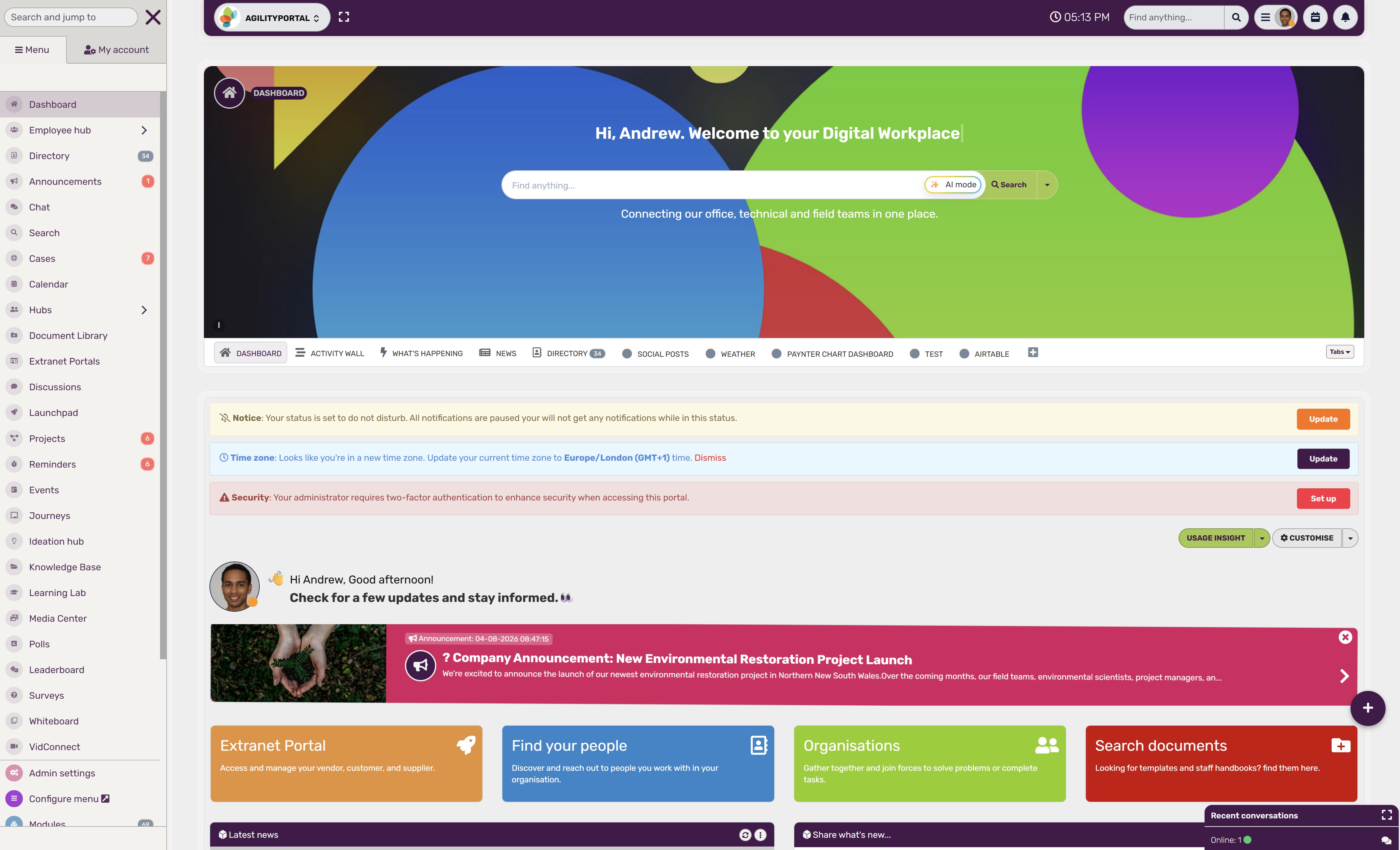
Where AgilityPortal Fits Into a Modern Relocation Experience
A flexible relocation policy only works when employees can understand it, find the correct documents and reach the right people.
That is where a central digital workplace becomes part of the relocation experience.
AgilityPortal does not physically move employees or provide legal and tax advice. Instead, it gives HR teams one secure place to coordinate communication, information and onboarding before, during and after a move.
Organisations can use AgilityPortal to:
- Publish the latest relocation policy and eligibility rules
- Create a searchable source of approved HR guidance
- Store relocation forms, FAQs and approval processes
- Create private onboarding or relocation spaces
- Assign moving, compliance and onboarding tasks
- Share office, local-area and team information
- Deliver required training
- Connect employees with managers and colleagues
- Announce policy changes
- Provide mobile access while employees are moving
- Collect feedback after 30, 60 and 90 days
This reduces the risk of employees relying on outdated emails or repeatedly contacting HR for the same information.
It also helps the organisation deliver a consistent experience, even when every job relocation package is different.
AgilityPortal
Give Relocating Employees One Place for Guidance, Tasks and Support
A job relocation package becomes harder to manage when policies, forms, approvals, onboarding tasks and employee guidance are scattered across emails, shared drives and disconnected systems. AgilityPortal gives HR teams a central digital workplace where employees can access the latest relocation information throughout their move.
Organisations can publish relocation policies, explain eligible expenses, assign onboarding tasks, share office and local-area information, deliver training and connect relocating employees with managers and colleagues. This creates a more consistent employee experience before, during and after the move.
Support the employee journey—not just the move
Centralise relocation guidance, forms, tasks, announcements, training and team communication so employees know what to do, where to find information and who to contact when they need support.
See how AgilityPortal helps HR teams create a more connected employee journey before, during and after workplace change.
The Future Isn't "No Relocation"—It's Smarter Mobility
Employee relocation is not disappearing. It is becoming more selective, flexible and closely connected to wider workforce planning.
Instead of automatically asking employees to move near an office, employers will increasingly decide location requirements according to the role.
Some jobs will still require permanent relocation, while others may be better suited to remote work, temporary assignments, rotational placements or periodic travel.
Employers should expect to see:
- More role-based location decisions
- Greater use of core-flex relocation packages
- Temporary and project-based assignments
- More employee choice over relocation benefits
- Remote-work and relocation policies managed together
- Greater scrutiny of tax, immigration and employment risks
- More accurate employee-location records
- Personalised support governed by consistent rules
- Relocation measured as an employee journey rather than a completed move
The World Economic Forum's Future of Jobs Report 2025 found that employers in several regions planned to expand remote and hybrid work to improve access to talent.
This reinforces the need to connect recruitment, workplace location and skills planning.
The future is not about eliminating the job relocation package. It is about using relocation only where it creates genuine value—and providing flexible, practical support when it does.
Final Thoughts on Choosing the Best Job Relocation Packages
The traditional job relocation package is not disappearing, but the one-size-fits-all model is becoming harder to justify.
Remote and hybrid work have given employers more options, while employees increasingly expect support that reflects their housing, family, financial and accessibility needs.
A larger relocation fund will not fix a poorly planned move.
Employers must first decide whether relocation is genuinely necessary, explain what the package covers and be transparent about tax, repayment and attendance requirements.
The smartest approach combines consistent core benefits with enough flexibility to support different circumstances. It also treats relocation as an employee journey that continues beyond moving day.
Ultimately, a successful package does more than pay relocation and removal expenses. It helps the employee settle, become productive, connect with their new team and build a sustainable future with the organisation.
If the employee completes the move but leaves shortly afterwards, the relocation has not succeeded—regardless of how generous the original offer appeared.
Frequently Asked Questions About Job Relocation Packages
What should a job relocation package include?
A job relocation package may cover professional movers, travel, storage, insurance, temporary accommodation, lease termination, home-finding support and family travel.
International packages may also include visa assistance, tax guidance, language training and support for a partner or children.
The offer should clearly explain spending limits, exclusions, tax treatment and repayment conditions.
What is included in relocation expenses in the UK?
Relocation expenses in the UK can include moving belongings, temporary accommodation, travel, home sale or purchase costs, certain items for a new home and eligible bridging-loan expenses.
However, an employer's policy may not cover every cost recognised by HMRC. Employees should check which expenses require prior approval, receipts and submission before a specified deadline.
Is there a tax-free relocation allowance in the UK?
HMRC states that up to £8,000 of qualifying relocation expenses may be exempt from tax and National Insurance when its conditions are met.
The move must normally relate to starting a new job or changing workplace, and the new home must be reasonably close to the new workplace.
Costs above the limit or non-qualifying payments may be taxable. Check the current HMRC guidance and obtain professional advice where needed.
How much relocation assistance should I ask for?
Calculate the likely cost of movers, deposits, travel, storage, temporary accommodation, lease termination and family support before proposing a figure.
You should also ask whether the payment is taxable and whether the employer pays suppliers directly.
The appropriate amount depends on the distance, destination, household size and housing situation—not simply the employee's salary.
What is a generous relocation package?
A generous relocation package is not necessarily the one with the largest headline allowance.
It should cover the employee's realistic costs without forcing them to fund major expenses upfront.
Strong packages may include temporary housing, tax support, family assistance, paid settling-in leave and flexible benefits. Clear terms and practical guidance can be more valuable than a large but taxable lump sum.
How does a relocation package calculator work?
A relocation package calculator estimates the likely cost of moving based on distance, household size, transport, storage, accommodation, deposits and other approved expenses.
Employers can use it to set realistic budgets, while employees can identify whether an allowance is sufficient. Any estimate should include a contingency for price changes and clarify which payments could be taxable.
Are there jobs with relocation packages abroad from the UK?
Yes. International relocation support is more common for specialist, senior, technical, healthcare, engineering and shortage-skilled positions. Packages may include flights, shipping, visas, temporary accommodation and tax advice.
Candidates should confirm whether the employer provides a permanent transfer, temporary assignment or local employment contract, as each arrangement creates different immigration, payroll and benefits implications.
Can I find jobs with relocation packages with no experience?
Jobs with relocation packages and no experience do exist, but they are less common than packages for specialist or senior positions.
Some graduate schemes, apprenticeships, hospitality roles, seasonal work and public-sector recruitment programmes may provide accommodation or limited relocation assistance.
Applicants should confirm whether the offer is genuine, which costs are covered and whether repayment is required if they leave early.
Is a lump-sum relocation package better than reimbursement?
A lump sum gives the employee more choice and is easier for the employer to administer. However, the employee carries the risk of underestimated costs and unexpected tax.
Reimbursement gives the employer greater spending control but may require the employee to pay large expenses upfront. Core-flex packages can provide a useful middle ground.
What is a core-flex relocation package?
A core-flex package combines essential employer-funded benefits with optional support selected by the employee.
Core benefits may include movers, travel and temporary accommodation.
Flexible options might cover childcare, pet transportation, partner career support, additional storage or home-office equipment. This creates consistency while recognising that employees have different needs.
Can an employer require an employee to relocate?
This depends on the employment contract, mobility clauses, reasonableness and applicable employment law. In the UK, a mobility clause may allow an employer to require a move within defined limits, but the request must not be unreasonable.
Employers generally do not have to provide compensation unless the contract requires it. GOV.UK provides further guidance.
What happens if a remote employee moves without telling the employer?
An undisclosed move can affect payroll, tax, employment rights, immigration, benefits and data security. An international move may also create registration or corporate tax obligations for the employer.
Remote employees should obtain written approval before changing their permanent working location, even when their duties and working hours will remain unchanged.
What can employers offer instead of permanent relocation?
Alternatives include remote work, hybrid arrangements, temporary assignments, periodic office travel, coworking access and short-term accommodation.
Employers may also redirect part of the relocation fund towards home-office equipment, secure connectivity or regional team meetings. The best option depends on why physical presence is required and how often the employee must attend.
How can an intranet support relocating employees?
An intranet gives employees one place to access relocation policies, forms, approved suppliers, tasks and HR contacts. It can also support onboarding, introduce the new team and provide information about the workplace and local area.
Centralising this guidance reduces confusion and helps HR provide a consistent relocation experience.
AI Summary
- A traditional job relocation package may cover moving services, travel, temporary accommodation, storage, home-finding support and other approved relocation expenses.
- Remote and hybrid working have not eliminated relocation, but employers should confirm that a permanent move is genuinely necessary before asking an employee to relocate.
- Modern employers are moving towards lump-sum, core-flex and personalised packages that combine essential benefits with support chosen around the employee’s circumstances.
- A generous headline allowance may be reduced by tax, unexpected costs or unclear exclusions. UK employers and employees must understand which relocation expenses qualify for tax relief.
- A successful relocation policy should address family needs, accessibility, immigration, payroll, cybersecurity, repayment clauses and post-move employee support.
- AgilityPortal can centralise relocation policies, forms, tasks, onboarding resources and HR communication, creating a more consistent employee experience before, during and after a move.
Most Popular Posts

Effective communication among team members is vital for the productivity and success of any organization. Surprisingly, 60% of companies lack a long-term internal communication strategy, which p...


Businesses thrive on communication for efficiency, productivity and accomplishment. When the right information is passed from the right designation in the organization, it promotes positivity an...

Categories
Blog
(3214)
Business Management
(396)
Employee Engagement
(235)
Digital Transformation
(219)
Growth
(150)
Intranets
(142)
Internal communications
(107)
Remote Work
(68)
Sales
(53)
Collaboration
(53)
Customer Experience
(33)
Culture
(30)
Knowledge Management
(29)
Project management
(29)
Leadership
(20)
Comparisons
(9)
News
(1)

Related Posts

Choosing the best ERP for Shopify often starts when the workarounds stop working. Your store shows stock that the warehouse can't find. Wholesale orders live in spreadsheets. Finance spends days reconciling payouts, while customer service...

Could choosing the wrong proxy disrupt your team's work or increase costs without improving results? When comparing rotating proxies vs static proxies, the answer depends on what your business needs: a consistent IP address for an ongoing sessi...

What happens when a buyer asks Google for the best employee communication platform—and discovers competing brands before reaching your website? Choosing the best link building services can help a digital workplace business strengthen its broade...

Could gaps in digital accessibility be stopping your employees from completing the training they need to do their jobs? Imagine a new starter opening a mandatory course, only to discover they can't follow the audio, navigate the quiz with a keyboard ...

The Amazon advertising agency landscape has changed dramatically over the past two years. With the introduction of AI-powered shopping experiences, Amazon Rufus, advanced attribution reporting, Sponsored Brands Video, and Amazon DSP enhancement...


Jill Romford
I am a digital nomad, lover of exploring new places and making friends.
I love to travel and I love the internet. I take pictures of my travels and share them on the internet using Instagram.
Traveler, entrepreneur, and community builder. I share my insights on digital marketing and social media while inspiring you to live your fullest life.
Ready to learn more? 👍
One platform to optimize, manage and track all of your teams. Your new digital workplace is a click away. 🚀
Free for 14 days, no credit card required.