
Insight Blog
Agility’s perspectives on transforming the employee's experience throughout remote transformation using connected enterprise tools.
51 minutes reading time
(10259 words)
Stop Guessing: How External Data APIs Help Marketing Teams Make Smarter Decisions

Stop Guessing: How External Data APIs Help Marketing Teams Make Smarter Decisions
Discover how external data APIs help marketing teams uncover market signals, improve targeting and make smarter decisions without relying on guesswork.
Stop Guessing: How External Data APIs Help Marketing Teams Make Smarter Decisions

Lets get into external data APIs, and how it gives marketing teams access to market signals, customer information and competitive intelligence that their internal systems cannot generate alone.
That matters because even the most detailed internal dashboard can only reveal part of what is happening.
Campaign reports may show that conversions have fallen, engagement has shifted or a particular customer segment has stopped responding. What they may not explain is why.
Changing economic conditions, competitor activity, regional events, consumer sentiment and emerging market trends can all influence performance without appearing in a company's internal data.
This also leaves many marketing teams making important decisions using fragmented information, outdated reports or educated guesswork.
According to Salesforce's State of Marketing research, only one in four marketers is satisfied with how their organisation uses data to power personalised customer interactions.
The problem is not necessarily a lack of data.
It is turning information from different sources into timely, trustworthy insight.
This guide explains what external data APIs are, how marketing teams use them, where they provide practical value and what integration, privacy and security risks businesses must manage.
It also provides a practical framework for introducing third-party data without creating another disconnected or unreliable source.
Key Takeaways
- External data APIs give marketing teams access to market, customer and competitor signals that internal systems cannot provide alone.
- More data does not automatically lead to better decisions; accuracy, relevance, freshness and human judgement still matter.
- Third-party API integration can improve customer segmentation, demand forecasting, campaign personalisation and competitor research.
- Every external API introduces potential data-quality, privacy, security, reliability and vendor-dependency risks that must be managed.
- Marketing can own the business case, but IT, security, privacy, legal and data teams should share responsibility for governance.
- The best API integrations begin with a defined business decision and include clear ownership, monitoring, human review and an exit plan.
What Are External Data APIs, in Plain English?

What Are External Data APIs, in Plain English?
An external data API is a connection that allows one business system to request information from another organisation's database or platform automatically.
Instead of an employee downloading spreadsheets, copying figures or repeatedly checking different websites, the API delivers the required information directly to an approved application.
You can think of an API as a controlled messenger between two systems.
One system asks for specific information, the API passes on the request, and the external provider returns the available data in a format the receiving system can understand.
For example, a marketing team could use an SEO API to retrieve keyword volumes, search trends, competitor rankings and other search-market information.
That data could then appear inside an internal dashboard, reporting tool or campaign-planning workflow without the team collecting every result manually.
External Data Versus the Information Your Company Already Owns
Most organisations already generate a significant amount of internal data.
This might include:
- CRM records and customer interactions
- Sales history and revenue figures
- Website and campaign analytics
- Employee feedback
- Customer support requests
- Email engagement data
- Previous campaign results
This information is valuable because it reflects what has happened inside the business. However, it may not explain what is changing in the wider market.
External data comes from outside the organisation and can include:
- Market and industry trends
- Economic indicators
- Company and competitor information
- Search volumes and keyword trends
- Location and mobility data
- Public records
- News coverage
- Weather information
- Consumer sentiment
- Demographic information
An external data API retrieves this information automatically. A third-party API integration is the broader process of connecting that external provider to the organisation's CRM, analytics platform, marketing system or another business workflow.
The distinction matters. Internal data might reveal that visits to a product page have fallen.
External search data could show that demand for the entire product category has declined, while competitor information might reveal that another company has gained visibility for the same search terms.
Combining those signals gives the marketing team a clearer basis for deciding what to do next.
How Does Information Move Between Systems?
Although the technology behind an API can be complex, the basic process is relatively straightforward:
- A business application sends an approved request for specific information.
- The third-party API checks the application's credentials and permissions.
- The external provider finds and returns the requested data.
- The receiving business validates, cleans and standardises that information.
- The data enters a dashboard, CRM, analytics platform or automated workflow.
- An employee or an approved business system uses the information to support a decision.
The important word here is "support." An API can retrieve information quickly and consistently, but it cannot guarantee that the information is accurate, relevant or suitable for a particular decision.
Marketing teams still need to check where the data came from, how recently it was updated and what limitations may affect it.
The most useful model is:
Internal signals → external context → combined insight → informed decision
External data APIs give teams a broader view of what is happening, but people remain responsible for interpreting that information and deciding how the business should respond.
Related Data, API Integration & Marketing Technology Guides
External data APIs are only one part of building a connected, data-driven business. These related AgilityPortal guides explore cloud data management, API security, customer data platforms, business intelligence, marketing analytics, AI integration and the governance organisations need when connecting external systems.
- Why Cloud Data Management Tools Are Transforming Business Data
- How Can Businesses Leverage Big Data? 8 Practical Ways to Use It
- Centralising Customer Data: The Power of Customer Data Platforms in Marketing
- 10 Best MCP Servers for SEO and AI-Powered Keyword Research
- The Future of Digital Transformation in Marketing
- The Rise of AI in Digital Marketing
- Unlocking Business Value Through Data Transformation With Power BI
- Secure Digital Transformation: Seven Data-Protection Strategies
- AI Privacy and Security in Collaboration Tools: What’s Really at Risk?
- How Microservices Architecture Is Powering Scalable SaaS Platforms
Together, these guides strengthen the topic cluster around external data APIs, third-party API integration, marketing analytics, customer data, business intelligence, API security, data governance and connected digital workplaces.
Why Internal Marketing Data Only Tells Part of the Story
Internal marketing data is essential, but it has a natural limitation: it mainly records what has already happened within the organisation's own systems.
Your CRM can show which customers opened an email, visited a landing page or completed a purchase.
Website analytics can reveal where visitors came from, how long they stayed and where they left. Campaign reports can compare conversion rates, advertising costs and engagement levels.
All of that information is useful.
The problem is that it often shows the result without fully explaining the circumstances surrounding it.

Why Internal Marketing Data Only Tells Part of the Story
Your Dashboard Can Show What Happened—but Not Always Why
Imagine that conversions on an important product page suddenly fall.
The marketing dashboard might identify the date the decline started, the affected traffic sources and the customer segments that stopped converting. However, it may not reveal that a competitor launched a major promotion during the same period.
The same problem can appear in other situations:
- Demand increases in one region, but the CRM cannot show that a major local event influenced customer activity.
- Campaign engagement falls, but internal reports do not reveal a wider change in consumer sentiment.
- Footfall drops at a particular location, but sales data does not include weather, transport disruption or local economic conditions.
- Recruitment campaigns underperform, but internal records cannot show changing salary expectations or declining labour availability within the region.
- Search traffic falls, but website analytics alone may not reveal that customer language and search behaviour have changed.
When teams only have internal information, they may respond to the wrong problem.
They could change a campaign that was performing reasonably well, increase advertising spend when overall demand is falling or blame creative content for results caused by external market conditions.
External data APIs can provide the missing context.
They allow teams to bring relevant market, competitor, economic, location, search and sentiment data into the systems where decisions are already being made.
More Information Can Still Produce Worse Decisions
Connecting more data sources does not automatically create better insight. In fact, irrelevant or unreliable data can make a poor decision look more convincing.
Businesses need to understand several important distinctions:
- More data is not the same as relevant data. A large dataset has little value if it does not help answer the specific business question.
- Real-time data is not necessarily accurate data. Information can arrive instantly and still be incomplete, incorrectly classified or based on a weak source.
- Correlation does not prove causation. Two changes occurring at the same time does not mean that one caused the other.
- An automated recommendation is not an accountable decision. A system can identify patterns, but people must consider context, consequences and limitations.
For example, an external data source might show increased interest in a particular topic while a campaign experiences higher conversions. It would be tempting to assume that the trend caused the improvement.
However, changes in pricing, targeting, seasonality or competitor activity may also have contributed.
This is why marketing teams should begin with a clear question before connecting another source. What information is missing? How will it influence the decision? How reliable is the provider, and what might the data fail to capture?
External data APIs expand an organisation's field of vision, but data quality and sound human judgement determine whether that wider view is genuinely useful.
Where External Data APIs Can Make Marketing Decisions Smarter
The most useful external data APIs do more than add numbers to a dashboard.
They help marketing teams answer questions their internal systems cannot resolve on their own.
Why is demand changing?
Which customer groups represent the strongest opportunity?
Is a campaign succeeding because of the creative work, or is the wider market influencing the result?
By combining internal performance data with relevant external signals, businesses can make decisions with a clearer understanding of what is happening around them.
Here are some of the most practical ways marketing teams use external data APIs.
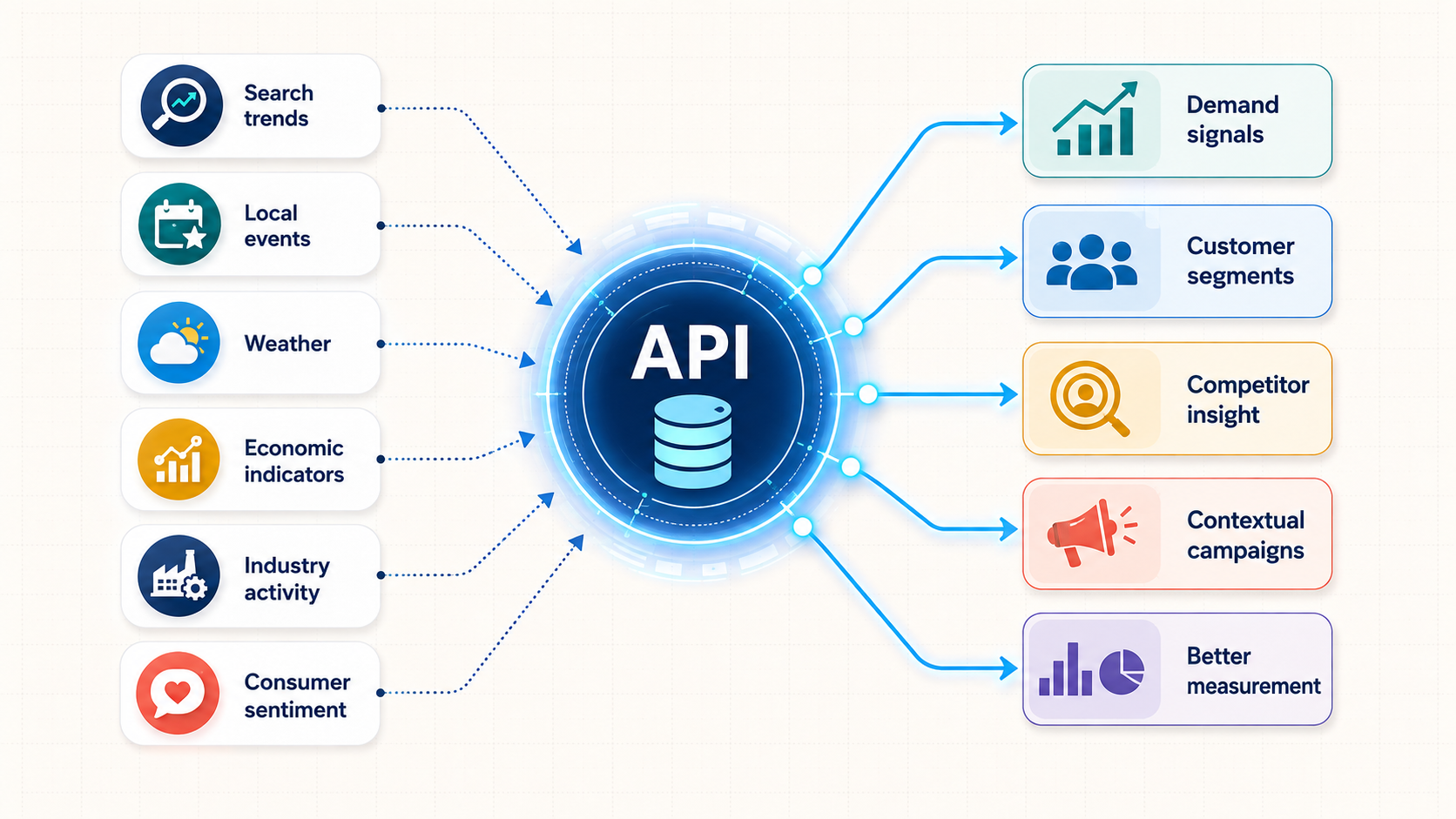
Where External Data APIs Can Make Marketing Decisions Smarter
Spot Changing Demand Before It Appears in Sales Reports
Sales reports are backward-looking. They tell you what customers have already purchased, but they may not reveal an emerging shift until it begins affecting revenue.
External data APIs can provide earlier signals by monitoring:
- Search patterns and keyword volumes
- Local events and public holidays
- Weather conditions
- Economic indicators
- Industry activity
- Consumer sentiment
- News and social conversations
- Competitor announcements
For example, rising search interest around a particular workplace problem could indicate that demand is developing before enquiries appear in the CRM. A marketing team could respond by creating relevant content, adjusting advertising or preparing sales resources around that issue.
Weather and local-event data can also help retailers, hospitality providers and service businesses anticipate regional demand. Economic information may help B2B teams recognise when particular industries are expanding, reducing spending or changing priorities.
This is one of the clearest examples of how external data APIs improve marketing decisions. Instead of waiting for a monthly sales report to confirm a change, teams can use early signals to support demand forecasting, inventory planning, content creation and campaign timing.
These signals should inform forecasts rather than be treated as guarantees. Search interest can rise without producing purchases, while social sentiment may not represent the organisation's actual target audience.
Build More Meaningful Customer Segments
Traditional customer segments are often built from limited internal fields such as age, location, job title or previous purchases. External data can add context that helps businesses understand who their customers are and what may influence their needs.
Depending on the market and permitted use, a third-party data integration may provide:
- Industry classification
- Company size and estimated revenue
- Business location
- Company growth signals
- Technology usage
- Demographic and regional context
- Buying intent
- Customer interests
- Wider market behaviour
For a B2B marketing team, firmographic enrichment could distinguish a growing 500-person technology business from a ten-person local firm, even when both originally entered the CRM through the same form. The team can then adapt its content, product recommendations and sales follow-up to the likely needs of each organisation.
This makes external data for customer segmentation particularly valuable when internal records are incomplete. It can reduce manual research and help teams avoid sending the same generic campaign to every contact.
However, better segmentation sh
ould not become intrusive surveillance. Organisations should only collect information that is necessary for a defined and legitimate purpose. They must also consider accuracy, privacy, permitted usage and whether customers would reasonably expect their information to be used in that way.
The goal is to improve relevance—not to create profiles that customers or employees would find invasive.
Understand Competitors Without Relying on Occasional Research
Competitor research is often completed as a one-off exercise and then left untouched for months.
During that time, competitors may change their prices, launch products, enter new regions or shift their market positioning.
APIs for market research and competitor analysis can help businesses monitor selected external signals more consistently, including:
- Company announcements
- Pricing changes
- Product launches
- Recruitment and hiring patterns
- New office or retail locations
- Online reviews
- Search visibility
- Advertising activity
- News coverage
- Share of voice
Hiring activity can provide useful clues.
If a competitor begins recruiting salespeople, engineers or customer-support staff in a new region, it may suggest expansion before the business makes a formal announcement.
Search data can also reveal whether competitors are gaining visibility around commercially valuable topics. Review data may expose repeated customer frustrations that another business could address through its own product, service or messaging.
This does not mean teams should react to every competitor movement. External data should help them recognise meaningful patterns, not encourage constant imitation.
The most useful insight is often not what a competitor has done, but what that change reveals about the wider market.
Personalise Campaigns Using Current Context
Personalisation is more useful when it reflects a customer's present situation rather than relying entirely on previous behaviour.
External data APIs can add current context by allowing teams to:
- Adjust campaign messages around regional weather or events
- Change promotions based on local stock or service availability
- Use company growth signals in B2B outreach
- Tailor content to an organisation's industry or size
- Respond to changes in customer sentiment
- Adapt campaign timing around relevant economic developments
Imagine a software provider targeting businesses undergoing rapid expansion.
A company-information API could identify organisations showing growth through hiring activity, new locations or funding announcements.
The marketing team could then provide content about onboarding, communication and workforce coordination rather than sending a generic software promotion.
That is a practical example of API integration for personalised marketing. The external signal does not determine the message by itself. It gives the team context for producing something more relevant.
Businesses must still avoid making the personalisation feel invasive. Customers should not be left wondering how the company obtained sensitive information about them. Personalisation works best when it is useful, proportionate and easy to understand.
Improve Campaign Measurement
A campaign can perform well or badly for reasons that have little to do with the marketing work itself.
Suppose conversions rise during a new campaign. The team may credit its advertising, creative content or targeting. But what if demand increased across the entire product category?
What if a competitor temporarily stopped advertising, favourable weather increased footfall or a major local event changed customer behaviour?
External information gives teams additional context for testing whether results were influenced by:
- The campaign itself
- Seasonal changes
- Economic conditions
- Competitor activity
- Local events
- Weather
- Industry trends
- Wider category demand
Combining internal and external marketing data can therefore improve attribution and reduce misleading conclusions. It helps teams compare what happened inside the campaign with what was happening in the market at the same time.
This does not remove uncertainty.
Marketing performance is influenced by many overlapping factors, and external data rarely proves a direct cause by itself. However, it can help teams challenge easy assumptions and ask better questions before moving budgets or changing strategy.
That is the real value of external data APIs.
They do not eliminate judgement or make decisions automatically. They give marketing teams a wider evidence base, making it easier to recognise changing conditions, test assumptions and act with greater confidence.
What Does 3rd Party API Integration Look Like in a Real Workplace?
The easiest way to understand 3rd party API integration is to look at how organisations use it to solve everyday business problems.
A third-party API connects an organisation's existing software with an external data provider or service.
This could involve adding company information to a CRM, bringing live weather data into an employee communication platform or using labour-market data to support workforce planning.
The following API integration examples show how the technology can help marketing, internal communications and HR teams without removing human responsibility from important decisions.
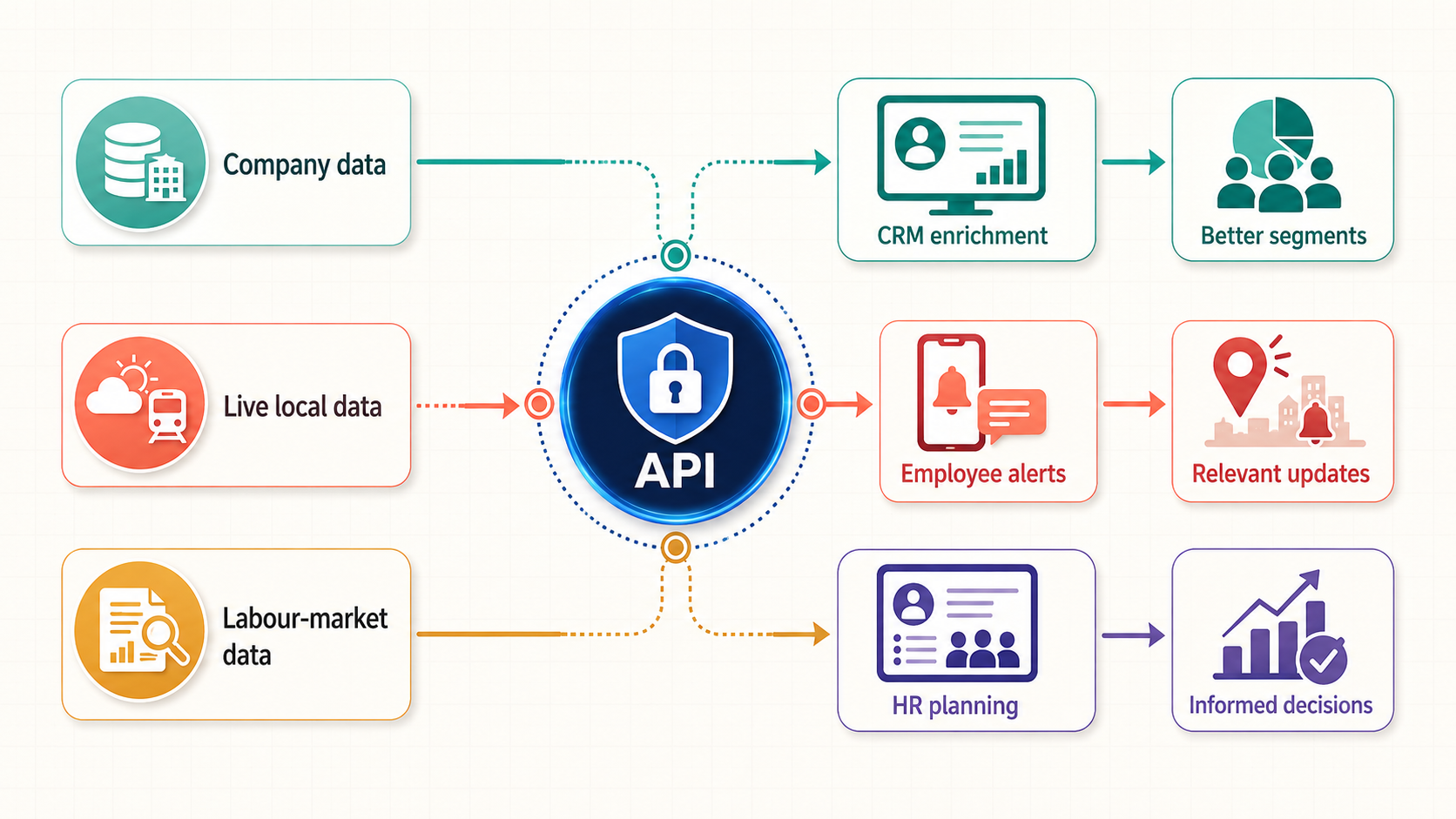
What Does 3rd Party API Integration Look Like in a Real Workplace
A B2B Marketing Team Enriches Incomplete CRM Records
Imagine a B2B marketing team with thousands of contacts in its CRM. The database contains names, email addresses and company names, but many records are missing basic information such as industry, company size, location and estimated revenue.
Without that information, meaningful customer segmentation becomes difficult.
A ten-person consultancy may receive the same campaign as a multinational business, even though their needs, budgets and buying processes are completely different.
The organisation introduces a People Data API to enrich existing contact records with trusted external data.Through this CRM integration, the system can add fields such as:
- Industry classification
- Company size
- Headquarters location
- Estimated revenue
- Business growth indicators
- Website and domain information
This form of B2B data enrichment helps the marketing team create more relevant customer segments, personalise campaigns and reduce the time employees spend researching individual companies.
However, automated data enrichment should never be accepted without review. External records can be outdated, incomplete or matched to the wrong organisation. The team should test the provider's accuracy, document how the information may be used and create a process for correcting unreliable data.
The integration should help employees make better decisions—not allow questionable information to spread silently through the CRM.
An Internal Communications Team Supports Distributed Employees
Now imagine an organisation with employees working across offices, warehouses, retail locations and remote sites. The internal communications team regularly sends operational updates, but most messages are generic because local conditions are difficult to monitor manually.
This becomes a problem when severe weather, transport disruption or a local emergency affects one location but not the rest of the workforce.
The organisation connects weather and transport APIs to its employee communication platform. These external data APIs provide location-specific information that can be used to alert the relevant communications team when conditions may affect a workplace.
For example, the integration could identify:
- Severe weather warnings
- Rail or public transport disruption
- Road closures
- Flood warnings
- Extreme temperatures
- Local emergency notices
Employees at the affected location can then receive a timely and relevant update rather than waiting for information to move through several managers.
This type of API integration can improve internal communications and employee safety, particularly for organisations managing distributed or frontline workers. It can also reduce irrelevant notifications because unaffected employees do not need to receive every local alert.
However, high-impact communications should not be published automatically without appropriate controls. A responsible manager should verify the information, assess its relevance and approve instructions before they are sent. The API provides the external signal, while the organisation remains accountable for the workplace response.
HR Uses External Labour-Market Data for Workforce Planning
HR teams often plan recruitment using internal information such as previous salaries, time-to-hire figures and historical applicant numbers. While useful, these records may not reflect current labour-market conditions.
Imagine that an organisation is struggling to recruit software engineers in a particular region. Its internal data shows rising hiring costs and fewer suitable applicants, but it does not explain whether the problem is specific to the company or affecting the wider market.
A labour-market API could provide external workforce data covering:
- Regional salary benchmarks
- Skills availability
- Job-posting activity
- Hiring demand
- Competitor vacancies
- Employment trends
- Talent-location patterns
- Skills shortages
Combining this information with internal recruitment data can support more informed workforce planning.
HR may discover that the required skills are scarce locally, that salary expectations have changed or that remote recruitment would provide access to a wider talent pool.
The organisation could then reconsider its salary range, job requirements, working arrangements or training strategy.
However, external benchmarks should guide human judgement rather than dictate employment decisions. Labour-market information may contain gaps, regional bias or outdated assumptions.
It should not automatically determine an employee's salary, reject a candidate or decide whether a role remains available in a particular location.
Why Internal Marketing Data Only Tells Part of the Story
Internal marketing data is essential, but it has a natural limitation: it mainly records what has already happened within the organisation's own systems.
Your CRM can show which customers opened an email, visited a landing page or completed a purchase. Website analytics can reveal where visitors came from, how long they stayed and where they left. Campaign reports can compare conversion rates, advertising costs and engagement levels.
All of that information is useful. The problem is that it often shows the result without fully explaining the circumstances surrounding it.
Your Dashboard Can Show What Happened—but Not Always Why
Imagine that conversions on an important product page suddenly fall.
The marketing dashboard might identify the date the decline started, the affected traffic sources and the customer segments that stopped converting. However, it may not reveal that a competitor launched a major promotion during the same period.
The same problem can appear in other situations:
- Demand increases in one region, but the CRM cannot show that a major local event influenced customer activity.
- Campaign engagement falls, but internal reports do not reveal a wider change in consumer sentiment.
- Footfall drops at a particular location, but sales data does not include weather, transport disruption or local economic conditions.
- Recruitment campaigns underperform, but internal records cannot show changing salary expectations or declining labour availability within the region.
- Search traffic falls, but website analytics alone may not reveal that customer language and search behaviour have changed.
When teams only have internal information, they may respond to the wrong problem. They could change a campaign that was performing reasonably well, increase advertising spend when overall demand is falling or blame creative content for results caused by external market conditions.
External data APIs can provide the missing context.
They allow teams to bring relevant market, competitor, economic, location, search and sentiment data into the systems where decisions are already being made.
Where external data APIs can make marketing decisions smarter
External data APIs are most valuable when they answer questions that internal marketing systems cannot answer alone.
A CRM can show which customers purchased a product. An analytics platform can reveal which campaign generated the visit. However, neither system may explain why demand changed, what competitors were doing or whether a wider market trend influenced customer behaviour.
By connecting internal performance data with relevant external information, marketing teams can see the broader context surrounding their results.
Spot Changing Demand Before It Appears in Sales Reports
Sales reports confirm what customers have already purchased. By the time a significant trend appears in monthly revenue figures, the opportunity to respond early may have passed.
External data APIs can provide earlier signals by monitoring information such as:
- Search patterns and keyword volumes
- Local events
- Weather conditions
- Economic indicators
- Industry activity
- News coverage
- Consumer sentiment
- Competitor announcements
For example, a steady rise in searches for a particular workplace solution could suggest that more businesses are becoming interested in the problem it addresses. A marketing team might respond by creating supporting content, testing a campaign or preparing sales material before the trend begins generating direct enquiries.
Weather and local-event information can also help organisations anticipate regional demand. Retailers may adjust promotions based on expected conditions, while hospitality and travel businesses can change campaign timing around major events.
Economic and industry data can help B2B marketers recognise when particular sectors are expanding, reducing spending or facing new regulatory pressures.
These early signals can support demand forecasting, campaign planning and inventory decisions. They should not, however, be treated as guaranteed predictions. Increased search activity or positive sentiment does not always translate into sales.
Build More Meaningful Customer Segments
Many organisations create customer segments using a small number of internal fields, such as location, job title, purchase history or email engagement.
External data can add context through:
- Firmographic enrichment
- Industry classification
- Company size
- Estimated revenue
- Business location
- Demographic context
- Buying-intent signals
- Customer interests
- Company growth indicators
For a B2B marketing team, this could mean separating small professional-service firms from large manufacturing organisations instead of sending both groups the same campaign.
A third-party data integration might identify each company's industry, number of employees and geographic reach. The marketing team can then adapt its content, examples and product recommendations to the likely requirements of each segment.
External data for customer segmentation is particularly useful when CRM records are incomplete. It can reduce manual research while helping teams create more relevant customer experiences.
However, greater personalisation does not justify collecting every piece of information available. Businesses should only use data that is necessary for a defined purpose. They should also consider whether the information is accurate, lawfully obtained and reasonably expected by the people it describes.
Useful personalisation should feel relevant—not invasive.
Understand Competitors Without Relying on Occasional Research
Competitor research is often conducted during an annual strategy exercise and then allowed to become outdated. In reality, competitors can change prices, launch products or enter new markets at any time.
External data sources may help teams track:
- Company announcements
- Pricing changes
- Hiring patterns
- New locations
- Product launches
- Online reviews
- Search rankings
- Advertising activity
- News coverage
- Share of voice
Hiring patterns can provide particularly useful signals. If a competitor begins recruiting sales and customer-support employees in a new country, it may suggest geographic expansion before the company announces it publicly.
Online reviews can expose recurring customer frustrations, while search data can show which competitors are gaining visibility around commercially important topics.
The purpose is not to copy every competitor move.
Marketing intelligence should help businesses recognise meaningful market changes and identify unmet customer needs. Teams still need to determine whether a competitor's decision is relevant to their own strategy.
Personalise Campaigns Using Current Context
Traditional personalisation often relies on information collected from previous interactions.
A customer viewed a page, downloaded a guide or purchased a particular product, so the next campaign reflects that behaviour.
External data APIs can add current context to those historical signals.
Marketing teams might use them to:
- Adjust campaign messages around regional weather
- Change offers based on local product availability
- Respond to relevant industry developments
- Use company growth signals in B2B outreach
- Tailor content to an organisation's size or sector
- Adapt campaign timing around local events
Imagine a software company targeting businesses that are rapidly increasing their headcount. A company-information API could identify organisations showing sustained hiring activity.
The marketing team could then provide practical content about onboarding, internal communication and knowledge sharing.
The external signal makes the campaign more relevant, but it should not be used to make unsupported assumptions. Hiring activity may indicate growth, employee turnover or seasonal recruitment.
A responsible campaign acknowledges that uncertainty rather than presenting an assumption as a known fact.
Improve Campaign Measurement
Marketing results rarely exist in isolation. A campaign may perform better or worse because of circumstances that have little to do with its creative content or targeting.
External data can help teams test whether performance was influenced by:
- The campaign itself
- Seasonal demand
- Economic conditions
- Competitor activity
- Local events
- Weather changes
- Industry trends
- Wider category demand
Suppose conversions increase during a new advertising campaign. The marketing team may initially credit the campaign. However, external search data might show that interest across the entire product category increased during the same period.
Alternatively, a strong campaign may appear to have underperformed because poor weather, transport disruption or a competitor promotion temporarily changed customer behaviour.
Combining internal and external marketing data does not provide perfect attribution, but it gives teams more evidence against which to test their assumptions. This can prevent them from cancelling effective campaigns, increasing spending unnecessarily or repeating strategies that benefited from temporary market conditions.
External data APIs cannot make business decisions automatically. Their real value lies in helping marketing teams see beyond their own dashboards, understand the conditions surrounding their results and make decisions based on a broader and more reliable picture.
Who Should Own an External API Integration?
An external API integration should never become the responsibility of one person or department simply because they requested it.
Marketing may own the business case, but that does not mean the marketing team should make every decision about data quality, security, privacy, contracts and technical maintenance.
Third-party API governance works best when ownership is shared across the relevant business and technical roles.
The exact people involved will depend on the organisation and the sensitivity of the data.
However, responsibilities should usually be divided as follows:
| Role | Primary responsibility | Why it matters |
| Marketing leader | Defines the business problem, intended use and expected outcome | Prevents an API from being introduced without a clear marketing purpose |
| Data or analytics lead | Tests the data's accuracy, coverage, consistency and suitability | Reduces the risk of weak or misleading information influencing decisions |
| IT or integration team | Builds, documents, monitors and maintains the connection | Supports reliability and ensures the integration can be repaired or replaced |
| CISO or security lead | Reviews authentication, credentials, permissions and access controls | Protects systems from unauthorised access and unnecessary data exposure |
| Data Protection Officer | Assesses how personal data is collected, transferred and used | Helps the organisation meet privacy and data-protection obligations |
| Legal or procurement team | Reviews licensing, service levels, liability and termination terms | Prevents unexpected usage restrictions, costs and contractual dependency |
| Department manager | Reviews recommendations before they affect operational activity | Keeps an accountable person involved in important decisions |
| Employees | Report inaccurate data, unexpected results and workflow problems | Helps uncover issues that technical monitoring may not detect |
Marketing Should Own the Purpose
The marketing leader should explain why the integration is needed and what decision it is expected to improve.
For example, the goal might be to:
- Enrich incomplete CRM records
- Identify changing customer demand
- Monitor competitor activity
- Improve campaign segmentation
- Measure the effect of external market conditions
- Reduce manual research
This business owner should also define how success will be measured. An integration should not be considered successful merely because it transfers data correctly.
It must produce a measurable improvement, such as faster research, better segmentation, more accurate forecasting or stronger campaign performance.
Data Teams Should Test Whether the Information Is Trustworthy
A technically reliable connection can still deliver poor-quality information.
The data or analytics lead should assess:
- Where the provider obtains its data
- How frequently the information is updated
- Which markets, industries or regions it covers
- How missing values are handled
- Whether records can be matched incorrectly
- Whether estimates are clearly identified
- What biases or limitations may affect the dataset
These checks should happen before external data is used in customer targeting, forecasting or automated recommendations.
IT and Security Should Own the Connection
IT or integration specialists should be responsible for the technical implementation and ongoing maintenance. Their work should include documenting the data flow, monitoring errors, managing rate limits and planning for outages.
Security specialists should separately review how the API authenticates requests and what systems or data it can access. API keys and tokens must be stored securely, permissions should be limited to what is necessary, and unusual activity should be monitored.
This separation matters because the person building an integration should not be the only person assessing its security.
Privacy, Legal and Procurement Cannot Be an Afterthought
If an external data API processes information about customers, prospects or employees, the Data Protection Officer or appropriate privacy specialist should assess whether the intended use is lawful, necessary and transparent.
Legal and procurement teams should review questions such as:
- Can the data be used commercially?
- Can it be used for advertising or profiling?
- Is the provider allowed to change its prices or terms without warning?
- What service levels are guaranteed?
- Who is liable if the data is inaccurate?
- What happens to stored data when the contract ends?
- Can the organisation move to another provider?
These issues are much easier to resolve before an integration becomes embedded in business processes.
Employees Still Play an Important Role
The employees using the data are often the first people to notice that something is wrong.
They may identify an incorrect company classification, an implausible recommendation or an external alert that does not match local conditions.
They need a simple way to report questionable information without having to understand the technology behind the integration. Their feedback should form part of the organisation's monitoring and review process.
Ultimately, marketing can own the reason for introducing an external API, but ownership of the integration itself must be shared.
Clear responsibilities ensure that business value, data quality, security, privacy and human accountability are considered throughout the API's lifecycle.
Third-Party API Integration Best Practices Businesses Can Apply Now
A successful third-party API integration begins long before developers start connecting systems. Businesses must first understand the decision they want to improve, the information they need and the risks introduced by relying on an external provider.
The following third-party API integration best practices can help organisations create connections that are useful, secure and manageable over the long term.
1. Start With the Decision You Want to Improve
Do not begin by asking, "Which APIs could we connect?"
Start with the business decision:
- Are we trying to identify changing customer demand?
- Do we need to improve CRM segmentation?
- Are we attempting to forecast sales more accurately?
- Do employees need faster access to local operational information?
- Is HR trying to understand regional skills shortages?
Defining the decision gives the integration a clear purpose. It also makes it easier to measure whether the external data produces genuine business value.
2. Identify the Information That Is Actually Missing
Before purchasing another data source, confirm that the required information is not already available within the organisation.
Relevant data may already exist in:
- CRM records
- Customer-support systems
- Website analytics
- Sales reports
- Employee surveys
- Finance systems
- HR platforms
- Previous market research
- Internal knowledge bases
Connecting another provider when the information already exists can increase cost, duplication and confusion. The goal is to close a genuine information gap—not create another database.
3. Investigate Where the Provider Gets Its Data
A professional-looking API does not guarantee reliable underlying information.
Ask the provider:
- Where does the data originate?
- Is it collected directly or purchased from another company?
- How frequently is it updated?
- Does it cover the markets and regions relevant to the business?
- Are estimates clearly distinguished from verified facts?
- Can individuals or companies correct inaccurate records?
- Does the provider depend on additional subcontractors?
If the supplier cannot clearly explain its data sources, the organisation should not use that information for important decisions.
4. Test Data Quality Before Full Integration
Run a limited test using records or situations the organisation can independently verify.
When evaluating company data from B2B data providers, test the same sample of target accounts across vendors to compare field completeness, update dates and matching accuracy.
Assess the data for:
- Accuracy
- Completeness
- Timeliness
- Consistency
- Geographic coverage
- Duplicate records
- Incorrect matches
- Missing values
- Potential bias
For example, a company-information API may correctly classify large organisations but perform poorly when identifying smaller businesses. A labour-market dataset may provide strong national coverage while missing important regional differences.
Testing should reveal where the data is reliable and where human verification remains necessary.
5. Confirm How the Data May Be Used
The fact that information is technically accessible does not mean the organisation is permitted to use it for every purpose.
Legal, procurement and privacy teams should review:
- Commercial usage rights
- Marketing and advertising restrictions
- Profiling limitations
- Data-retention requirements
- Redistribution restrictions
- Intellectual-property terms
- International data transfers
- Prohibited industries or use cases
- Requirements to display attribution
This step is particularly important when considering a free 3rd party API. A free service may allow testing or personal projects while prohibiting commercial use.
6. Map the Complete Data Flow
The organisation should document what data enters the business, where it is stored and how it moves between systems.
A useful data-flow map should show:
- Which provider supplies the information.
- Which API endpoints are used.
- What data fields are requested.
- Which business system receives the information.
- Where the information is stored.
- Which employees or applications can access it.
- Whether it is shared with another provider.
- How long it is retained.
- How it is corrected or deleted.
Without this visibility, businesses can lose track of how external information is being used and who has access to it.
7. Collect Only What the Business Needs
External data providers may offer hundreds of fields, but that does not mean the organisation should collect all of them.
If marketing only requires company size, industry and location for segmentation, it may not need personal contact details, financial estimates or detailed employee information.
Data minimisation reduces:
- Privacy exposure
- Storage requirements
- Security risk
- Integration complexity
- Unnecessary processing
- The impact of inaccurate information
Every requested field should have a clear connection to the agreed business purpose.
8. Protect API Keys and Credentials
API keys, access tokens and other credentials should never be placed in public code, shared through unprotected messages or stored in documents that anyone can access.
Technical and security teams should:
- Use secure credential-management tools.
- Encrypt data in transit.
- Apply the least-privilege principle.
- Limit each integration to the permissions it requires.
- Rotate credentials regularly.
- Revoke unused credentials.
- Separate development and production access.
- Monitor unusual API activity.
- Avoid placing sensitive tokens in URLs or logs.
If a credential is exposed, an attacker may be able to retrieve data, consume paid resources or access connected business systems.
9. Prepare for Rate Limits, Errors and Outages
External APIs are not always available. Providers may experience downtime, apply request limits or return incomplete responses.
The integration should be designed to handle these situations safely through:
- Clear timeout rules
- Controlled retries
- Local caching where appropriate
- Error logging
- Usage monitoring
- Backup data sources
- Manual fallback processes
- User-friendly failure messages
A temporary API outage should not cause an entire CRM, employee platform or marketing workflow to stop functioning.
Teams must also understand the provider's rate limits.
If a plan allows only a fixed number of requests, an unexpected increase in activity could interrupt the service or create additional charges.
10. Keep a Human Review Point
External data can support automated workflows, but consequential decisions should remain subject to appropriate human review.
Human approval is particularly important when data may affect:
- Employment decisions
- Employee communications
- Customer eligibility
- Pricing
- Financial decisions
- Safety instructions
- High-value marketing expenditure
- Legal or compliance responses
The reviewer should be able to see which information influenced the recommendation and challenge it when necessary.
Human involvement should be meaningful. Asking someone to approve hundreds of recommendations without sufficient time or context is not effective oversight.
11. Monitor Technical Performance and Data Quality
Once the integration is live, monitoring should cover more than basic availability.
Track technical measures such as:
- Uptime
- Response speed
- Failed requests
- Authentication errors
- Rate-limit warnings
- Unexpected cost increases
- Changes to API endpoints
The organisation should also monitor the information itself:
- Has accuracy declined?
- Is the data still current?
- Are more records failing to match?
- Has the provider changed its methodology?
- Are employees reporting questionable results?
- Is the integration still improving the intended decision?
An API can remain technically operational while the value of its data deteriorates.
12. Create an Exit Plan Before the Integration Becomes Critical
Third-party providers can increase prices, change their terms, remove features or close services entirely.
Before an external API becomes embedded in daily operations, the organisation should determine:
- Whether the data can be exported.
- How long it would take to replace the provider.
- Whether an alternative API is available.
- Which internal workflows depend on the integration.
- What happens to stored data when the contract ends.
- How credentials and access will be revoked.
- Whether the system can continue operating without the API.
An exit plan reduces vendor lock-in and prevents a provider's decision from becoming an operational emergency.
13. Publish Approved Guidance Centrally
Employees need a trusted place to find information about approved APIs and external data sources.
Central guidance should explain:
- Which integrations are approved
- Who owns each integration
- What business purpose each API supports
- Which data may be used
- What employees must not do
- How to report inaccurate information
- Where to report security concerns
- What to do when an integration fails
- When human approval is required
Publishing this guidance through an employee intranet or central knowledge platform prevents policies from becoming scattered across emails, chat messages and private documents.
14. Train the Employees Who Use the Information
Employees do not need to become API developers, but they should understand the limitations of the data appearing in their systems.
Training should explain:
- Where the information comes from
- How recently it was updated
- Which fields are estimates
- What the data can and cannot prove
- When results require verification
- How to identify unusual outputs
- How to report an error
- Who remains accountable for the final decision
This is particularly important when information appears inside a familiar CRM or dashboard. Employees may assume data is internally verified simply because it appears in an approved business system.
15. Review Whether the Integration Still Provides Value
Every external API integration should have a named owner and a regular review schedule.
The review should consider:
- Whether the original business problem still exists
- Whether the data remains accurate and relevant
- Whether employees are using it
- Whether it has improved the intended decision
- Whether the cost remains justified
- Whether security or privacy risks have changed
- Whether a better provider is available
- Whether the integration should be modified or removed
Unused integrations should not be left running indefinitely. They continue to create cost, maintenance work and potential security exposure even when employees no longer rely on them.
The strongest third-party API integration strategy is not the one with the most connections. It is the one where every integration has a defined purpose, an accountable owner, reliable information and a clear plan for what happens when something changes.
How Do You Know Whether the Integration Is Improving Decisions?
A third-party API integration should not be judged solely by whether it connects successfully or delivers data on time.
The real question is whether the information helps employees make faster, more accurate or more valuable decisions.
That requires businesses to measure three areas: technical performance, marketing outcomes and governance.
Start by Monitoring Operational Performance
An API cannot support reliable decisions if it regularly fails, returns old information or leaves important gaps in the data.
Useful operational metrics include:
- API uptime: How consistently is the external service available?
- Response time: How quickly does the provider return requested information?
- Failed requests: How often do requests time out, return errors or produce incomplete results?
- Data freshness: When was the information last updated?
- Coverage: Does the provider include the markets, industries, regions and organisations the business needs?
- Completeness: How many records contain the required fields?
- Manual processing time saved: Has the integration reduced downloading, copying, cleaning or researching data manually?
These measurements help determine whether the integration is technically dependable. However, good technical performance does not automatically mean the data is useful.
An API can maintain 99.9% uptime while consistently delivering information that is incomplete, irrelevant or unsuitable for the decision being made.
Connect the Data to Marketing Outcomes
Marketing teams should measure whether external data improves the specific activity that justified the integration.
Relevant marketing metrics may include:
- Segmentation accuracy: Are customers being placed into more appropriate and useful groups?
- Campaign response rate: Are externally enriched segments responding more positively?
- Conversion rate: Does the additional context help turn more prospects into customers?
- Cost per qualified lead: Is the team spending less to attract relevant opportunities?
- Forecast accuracy: Are demand and campaign predictions becoming more reliable?
- Speed from signal to action: How quickly can the team respond after an external change is detected?
- Research time saved: Are employees spending less time gathering company, market or competitor information?
- Recommendation acceptance: How often do employees find the resulting insight useful enough to act on?
Where possible, compare outcomes before and after the integration. Businesses can also test enriched and non-enriched customer segments to determine whether the external data produces a meaningful difference.
The evaluation must account for other influences. A higher conversion rate may result from new creative work, seasonal demand, pricing changes or competitor activity rather than the API alone.
Measure Governance, Not Just Performance
An integration can produce positive marketing results while still creating unacceptable security, privacy or operational risks.
Governance metrics should include:
- Number of approved third-party integrations
- Number of unowned or undocumented APIs
- Security incidents or exposed credentials
- Data-quality complaints
- Incorrect customer or company matches
- Privacy concerns
- Policy exceptions
- Unauthorised data sources
- Time taken to correct inaccurate information
- Time taken to respond to API failures
- Percentage of integrations reviewed on schedule
- Number of inactive connections removed
These measurements reveal whether the organisation understands and controls its external data environment.
For example, a growing number of API integrations may initially look like evidence of innovation. If several lack named owners, current documentation or security reviews, that growth represents additional risk rather than progress.
Agree on Success Before Launching the Integration
The organisation should define success during the planning stage rather than after the API is already operating.
A clear objective might be:
- Reduce manual company research by 30%.
- Improve the completeness of CRM industry fields.
- Identify relevant market changes within 24 hours.
- Reduce the time required to create customer segments.
- Improve demand-forecast accuracy.
- Decrease the number of irrelevant employee alerts.
- Resolve reported data errors within two working days.
Each target should have an owner, a baseline and a review period. This makes it easier to determine whether the integration should be expanded, modified, replaced or removed.
API Usage Is Not the Same as Business Value
The number of API calls is a technical usage metric—not proof that the integration is improving decisions.
A system might make millions of requests while employees ignore the resulting information. Another integration may run only once a day but provide a critical market signal that prevents a costly mistake.
Businesses should therefore avoid presenting high request volumes, growing data storage or an increasing number of connected APIs as evidence of success.
The most important measures are whether the external information is reliable, whether employees use it appropriately and whether it improves the decision the integration was created to support.
Where AgilityPortal Fits Into the Picture
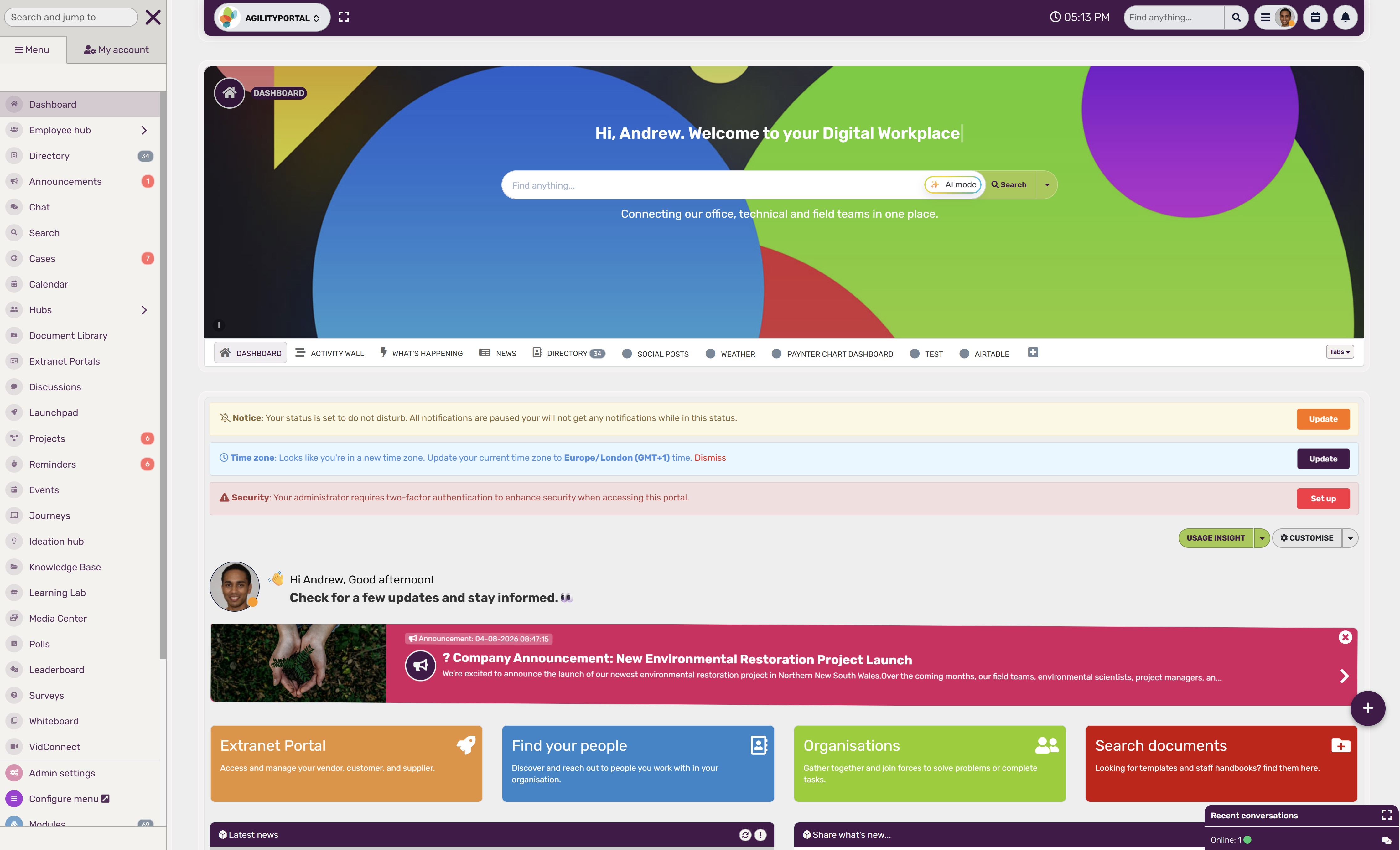
Where AgilityPortal Fits Into the Picture
An employee intranet or digital workplace platform will not replace specialist API management, analytics, privacy or cybersecurity tools. Nor should it.
Technical teams still need appropriate systems for securing credentials, monitoring API activity, managing access and identifying failures. Data teams need analytics tools to validate information, while legal and compliance specialists must assess licences, privacy obligations and permitted uses.
The missing piece is often the workplace layer that connects these technical decisions with the people expected to follow them.
An external API integration can be properly configured but still create problems if employees do not know:
- Which integrations are approved
- Where the data comes from
- What the information may be used for
- Which results require human review
- How to report inaccurate data
- Who owns the integration
- What to do when the service fails
- Where to escalate privacy or security concerns
When this guidance is scattered across old emails, chat messages, shared drives and private documents, employees cannot reliably find or follow it.
AgilityPortal can provide a shared digital workplace where organisations publish approved API and data-use policies, centralise documentation and keep operational guidance accessible to the employees who need it.
For example, an organisation could use AgilityPortal to:
- Publish its approved third-party integration policy
- Maintain a searchable register of authorised APIs
- Explain the purpose and limitations of each data source
- Assign named business and technical owners
- Communicate changes to integrations or providers
- Deliver security and data-literacy training
- Collect employee policy acknowledgements
- Publish outage and fallback procedures
- Provide clear reporting and escalation routes
- Keep frequently asked questions in one trusted location
This becomes particularly important when API-generated information appears in systems used by marketing, HR, internal communications or operations teams. Employees may assume that data is accurate and approved simply because it appears inside a familiar business application.
Central guidance helps them understand what the information can and cannot prove. It also gives employees a place to report questionable results rather than allowing errors to circulate unnoticed.
AgilityPortal can therefore provide the shared workplace layer where integration policies, responsibilities, training and operational updates remain visible to the people affected by them.
It does not manage the API itself; it helps the organisation manage the knowledge, communication and accountability surrounding its use.
AgilityPortal
Give Employees One Trusted Place for API Policies and Integration Guidance
External data APIs can support better marketing, HR and operational decisions, but employees still need to understand where the information comes from, how it may be used and when human review is required. AgilityPortal gives organisations a central digital workplace for publishing approved API policies, data-use guidance, ownership details, training and operational procedures.
Instead of allowing integration instructions to become scattered across email, chat, shared drives and private documents, organisations can create one searchable source of trusted guidance. Employees can find approved integrations, understand data limitations, identify the correct owner and follow clear reporting or escalation procedures when something goes wrong.
Turn API governance into guidance employees can actually follow
Centralise approved integration policies, security instructions, data-use rules, training and support contacts so employees know which external data sources they can trust and how to use them responsibly.
What Changes as APIs and AI Become More Closely Connected?
As AI agents become more capable, they will increasingly use external APIs to retrieve current market, customer and competitor information. Instead of relying only on previously collected data, an AI system could check search trends, economic indicators or company activity before preparing a recommendation.
This could help marketing teams respond faster, but it also raises the standard of oversight required. Employees will need stronger data-literacy skills so they can question where information came from, when it was updated and whether the provider permits the intended use. A confident AI answer is not necessarily an accurate or compliant one.
API governance will therefore become an important part of AI governance. Businesses will need clearer access controls, documented data sources and machine-readable policies that define which systems an AI agent can contact, what information it can retrieve and which actions require human approval.
Marketing roles are likely to shift accordingly. Employees may spend less time manually gathering information and more time verifying sources, interpreting patterns and deciding how the organisation should respond.
That does not mean AI agents will replace marketing decision-makers.
They can retrieve information, identify patterns and recommend actions, but people must still assess the commercial context, customer impact and potential consequences. As these technologies become more connected, accountable human judgement will become more important, not less.
Final Thoughts on Using External Data APIs
External data APIs can help marketing, HR and business teams see beyond the limits of their internal dashboards.
They provide wider context around customer behaviour, competitor activity, economic conditions and changing market demand.
However, the goal should not be to collect the largest possible volume of information. More data can create more confusion when its source, accuracy and intended use are unclear.
A successful integration begins with an important business decision. What does the team need to understand, and what context is currently missing? Once that is clear, the organisation can evaluate whether an external API provides relevant, reliable and legally usable information.
Every connection should be treated as both a business opportunity and a governance responsibility. Marketing may define the need, but IT, security, data, privacy and legal teams all have roles to play. Employees must also understand the limitations of the information appearing in their systems.
APIs can collect data and identify patterns, but people should remain accountable for decisions that affect customers, employees or the wider business.
Better decisions do not come from connecting to everything; they come from knowing which information to trust, when to use it and who remains responsible for the outcome.
AI Summary
- External data APIs give marketing teams access to market, customer, competitor and economic information that their internal systems cannot generate alone.
- Combining external data with CRM, sales and campaign information can improve customer segmentation, demand forecasting, personalisation and marketing measurement.
- More data does not automatically produce better decisions. Information must be accurate, relevant, current and suitable for the decision being made.
- Third-party API integration introduces potential security, privacy, data-quality, service reliability and vendor-dependency risks that businesses must actively manage.
- Marketing can own the business purpose, but IT, security, data, privacy, legal and procurement teams should share responsibility for implementation and governance.
- AgilityPortal can centralise API policies, approved integration guidance, training, ownership details and operational updates so employees understand how external data should be used.
Most Popular Posts

Effective communication among team members is vital for the productivity and success of any organization. Surprisingly, 60% of companies lack a long-term internal communication strategy, which p...


Businesses thrive on communication for efficiency, productivity and accomplishment. When the right information is passed from the right designation in the organization, it promotes positivity an...

Categories
Blog
(3214)
Business Management
(396)
Employee Engagement
(235)
Digital Transformation
(219)
Growth
(150)
Intranets
(142)
Internal communications
(107)
Remote Work
(68)
Sales
(53)
Collaboration
(53)
Customer Experience
(33)
Culture
(30)
Knowledge Management
(29)
Project management
(29)
Leadership
(20)
Comparisons
(9)
News
(1)

Related Posts

Choosing the best ERP for Shopify often starts when the workarounds stop working. Your store shows stock that the warehouse can't find. Wholesale orders live in spreadsheets. Finance spends days reconciling payouts, while customer service...

Could choosing the wrong proxy disrupt your team's work or increase costs without improving results? When comparing rotating proxies vs static proxies, the answer depends on what your business needs: a consistent IP address for an ongoing sessi...

What happens when a buyer asks Google for the best employee communication platform—and discovers competing brands before reaching your website? Choosing the best link building services can help a digital workplace business strengthen its broade...

Could gaps in digital accessibility be stopping your employees from completing the training they need to do their jobs? Imagine a new starter opening a mandatory course, only to discover they can't follow the audio, navigate the quiz with a keyboard ...

The Amazon advertising agency landscape has changed dramatically over the past two years. With the introduction of AI-powered shopping experiences, Amazon Rufus, advanced attribution reporting, Sponsored Brands Video, and Amazon DSP enhancement...


Annet Herges
I am a digital nomad, lover of exploring new places and making friends.
I love to travel and I love the internet. I take pictures of my travels and share them on the internet using Instagram.
Traveler, entrepreneur, and community builder. I share my insights on digital marketing and social media while inspiring you to live your fullest life.
Ready to learn more? 👍
One platform to optimize, manage and track all of your teams. Your new digital workplace is a click away. 🚀
Free for 14 days, no credit card required.