
Insight Blog
Agility’s perspectives on transforming the employee's experience throughout remote transformation using connected enterprise tools.
31 minutes reading time
(6116 words)
Digital Transformation for Traditional Businesses: A Step-by-Step Guide to Getting Started in 2026

Digital Transformation for Traditional Businesses: A Step-by-Step Guide to Getting Started in 2026
Learn how digital transformation for traditional businesses improves efficiency, reduces costs, modernizes operations, and creates a practical roadmap for long-term growth.
Digital Transformation for Traditional Businesses: A Step-by-Step Guide to Getting Started in 2026

If you've been thinking about Digital Transformation for Traditional Businesses, you're not alone.
Many business owners know they need to modernize, but they're not sure where to begin.
The biggest mistake? Believing that buying new software will magically fix old business problems.
In reality, technology is only one piece of the puzzle.
Here's something worth thinking about: around 70% of digital transformation projects fail to meet their goals, according to research from McKinsey.
In most cases, it isn't because the technology was bad. It's because businesses didn't have a clear plan, involved the wrong people, or tried to change everything at once.
70%
Fail to Meet Their Goals
Around 70% of digital transformation projects fail to achieve their intended goals. The main causes are often unclear strategies, weak leadership, poor employee adoption, and attempts to change too much at once. Traditional businesses can reduce this risk by starting with one clear problem, setting measurable outcomes, and introducing change in manageable stages.
Source: McKinsey & Company
Now, take a quick look around your workplace. Is someone still entering the same information into multiple systems?
- Are employees chasing emails to find documents?
- Are customers waiting longer than they should because of manual processes?
These everyday frustrations are often the first signs that your business is ready for digital transformation.
The good news is that getting started doesn't have to be complicated or expensive.
You don't need to replace every system overnight. Instead, successful businesses focus on fixing one business problem at a time, choosing technology that supports their goals rather than driving them.
By the end of this guide, you'll understand what Digital Transformation for Traditional Businesses really means, how to build a practical roadmap, which mistakes to avoid, and the first steps you can take to modernize your business with confidence.
Whether you're running a manufacturing company, retail business, construction firm, healthcare practice, or professional services business, you'll leave with a clear action plan instead of just another list of software recommendations.
Key Takeaways
- The digital transformation of traditional businesses begins by improving business processes before investing in new technology.
- Successful transformation starts with identifying operational bottlenecks, setting measurable goals, and prioritizing high-impact improvements.
- Cloud computing, workflow automation, AI, and digital workplace platforms help businesses improve efficiency, collaboration, and long-term scalability.
- Employee adoption is just as important as the technology itself, making communication, training, and change management essential for success.
- Measuring productivity, customer satisfaction, operational efficiency, and technology adoption ensures every digital investment delivers measurable business value.
What Is the Digital Transformation of Traditional Businesses?
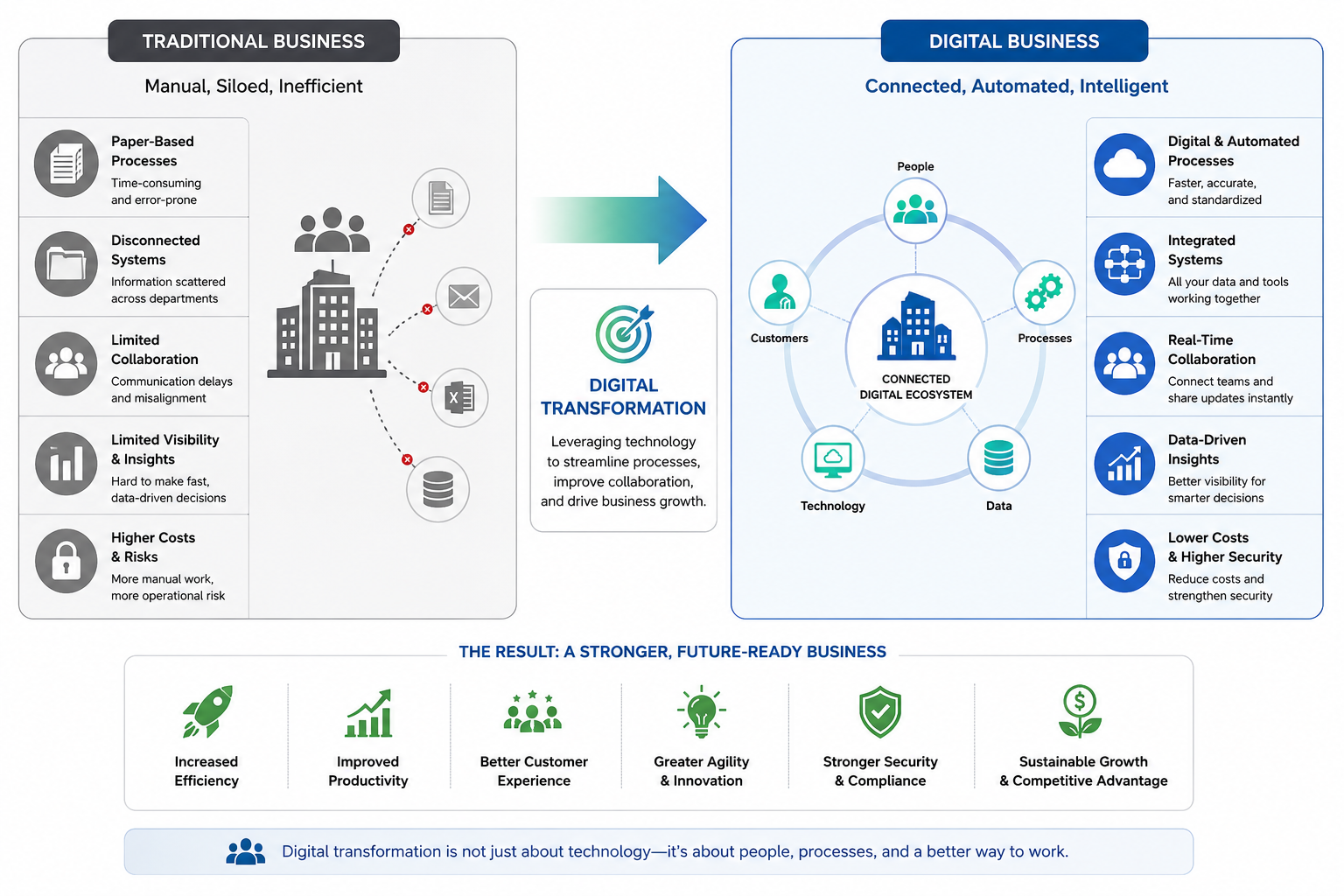
The digital transformation of traditional businesses is about improving the way a company works by using technology to solve real business problems. It isn't simply buying new software, moving files to the cloud, or replacing paper forms with digital ones.
True transformation changes how people work, how customers are served, and how decisions are made.
Many people confuse digitization with digital transformation, but they're not the same thing.
- Digitization means converting something from paper to digital, such as scanning invoices or storing documents online.
- Digital transformation goes much further. It improves entire workflows, removes repetitive tasks, connects teams, and helps businesses become faster, more efficient, and more competitive.
For example, replacing a spreadsheet with another spreadsheet stored in the cloud isn't digital transformation. But connecting your sales, finance, HR, and operations systems so information flows automatically between departments—that's real transformation.
This matters because businesses that embrace digital transformation often see measurable improvements.
According to a Deloitte study, digitally mature organizations are more likely to achieve stronger revenue growth, improve customer experiences, and respond faster to changing market conditions than businesses relying on outdated processes.
What Is the Digital Transformation of Traditional Businesses
At the heart of the digital transformation of traditional businesses are four key pillars.
- People - Technology only works when employees understand and adopt it. Training, communication, and leadership support are just as important as the software itself.
- Processes - Before investing in new tools, review how work gets done today. Remove unnecessary steps and automate repetitive tasks instead of simply digitizing inefficient workflows.
- Technology - Choose technology that solves a specific business challenge. The best solution isn't always the one with the most features—it's the one that fits your business goals and integrates with your existing systems.
- Data - Good decisions depend on reliable data. Bringing information together from different departments gives leaders a complete picture of the business and helps identify opportunities to improve performance.
When these four areas work together, the digital transformation of traditional businesses becomes much more than an IT project.
It becomes a long-term business strategy that helps companies reduce costs, improve productivity, deliver better customer experiences, and stay competitive in an increasingly digital world.
Ask AI About Digital Transformation
Use these AI tools to explore digital transformation for traditional businesses, build a digital transformation roadmap, compare business technologies, identify processes to automate, and discover practical ways to modernize your business without disrupting day-to-day operations.


Why Digital Transformation Is No Longer Optional in 2026
Business has changed rapidly over the past few years.
Customers expect faster service, personalized experiences, and the ability to interact with your business across multiple channels. At the same time, competitors are using modern technology to operate more efficiently, make faster decisions, and bring new products and services to market.
For traditional businesses, standing still is no longer a safe option. Delaying digital transformation can lead to higher operating costs, slower growth, and lost opportunities.
Today's leading organizations are using technologies such as cloud computing, artificial intelligence (AI), automation, and the Internet of Things (IoT) to improve productivity, streamline operations, and create better customer experiences.
These technologies are no longer reserved for large enterprises—they've become accessible tools that businesses of all sizes can use to stay competitive.
According to Gartner, organizations that invest in digital transformation are better positioned to adapt to changing market conditions and respond more quickly to customer needs.
Here are some of the biggest challenges businesses face when they delay digital transformation:
| Challenge | Business Impact |
| Increasing Competition | Digitally mature businesses can launch products faster, improve customer service, and adapt to market changes more quickly. |
| Rising Customer Expectations | Customers expect fast responses, personalized experiences, and consistent service across every touchpoint. |
| Manual Processes | Paper-based and repetitive tasks reduce productivity, increase costs, and make it harder to scale the business. |
| Poor Access to Data | Information stored across multiple systems makes reporting slower and business decisions less accurate. |
| Outdated Technology | Legacy systems are harder to maintain, integrate, and secure, increasing both operational costs and business risk. |
The good news is that digital transformation doesn't mean replacing everything overnight.
The most successful businesses improve one process at a time, measure the results, and build on that success.
With the right strategy, digital transformation becomes less about technology and more about creating a business that's faster, more efficient, and better prepared for future growth.
Signs Your Business Is Ready for Digital Transformation
Many business owners think digital transformation is something they'll deal with "next year."
The reality is that most companies don't realize they're falling behind until growth slows, costs increase, or customers start choosing competitors.
The good news is that your business usually gives you clear warning signs long before it reaches that point.
Your Team Spends Too Much Time on Manual Work
If employees are copying data between systems, searching for documents, approving requests through email, or repeating the same tasks every day, you're paying for work that technology can often handle automatically.
When routine administration takes priority over higher-value work, productivity suffers.
Information Is Spread Across Too Many Systems
Many traditional businesses rely on a mix of spreadsheets, email, shared drives, paper records, and standalone software. When employees have to search multiple places to find information, mistakes become more common and decisions take longer.
A connected business is almost always a more efficient business.
Customers Expect Faster Service Than You Can Deliver
Today's customers expect quick responses, online access, and consistent service. If your internal processes slow down sales, support, or project delivery, customer satisfaction can quickly decline.
Digital transformation isn't just about improving internal operations—it's about creating a better customer experience.
Growth Is Becoming Harder to Manage
Many businesses operate successfully for years with manual processes. The challenge comes when the business grows. More employees, customers, locations, and projects create more complexity, making old ways of working difficult to sustain.
If growth feels harder instead of easier, your processes—not your people—may be holding the business back.
You're Making Decisions Without Reliable Data
Business owners need accurate information to make confident decisions.
If reports take days to prepare, departments work with different versions of the same data, or you rely on instinct because information isn't available, it's a strong sign that your systems need to evolve.
You're Reacting Instead of Planning
One of the biggest signs a business is ready for digital transformation is when leaders spend more time solving daily operational problems than planning future growth.
When your business constantly feels like it's "firefighting," modernizing your processes can free up valuable time to focus on strategy rather than administration.
The goal of digital transformation isn't to replace everything you already have. It's to remove the friction that slows your business down.
If several of these challenges sound familiar, it's probably time to start thinking about digital transformation—not by buying more software, but by identifying the business processes that will deliver the greatest return when improved.
Where to Start Your Digital Transformation Journey
One of the biggest mistakes business owners make is thinking digital transformation starts with buying new software. It doesn't.
The most successful projects begin by understanding how your business operates today.
Once you know what's slowing your business down, you can invest in technology that delivers measurable improvements instead of adding more complexity.

Where to Start Your Digital Transformation Journey
Audit Your Existing Business Processes
Every successful digital transformation begins with an honest assessment of your current business. Take a close look at how work moves through your organization, from customer enquiries and approvals to finance, HR, and operations.
Ask simple questions like:
- Which tasks are still done manually?
- Where do employees waste the most time?
- Which systems don't communicate with each other?
- What processes create delays for customers?
Just as importantly, review your existing infrastructure. Outdated hardware, disconnected software, and manual workflows often hide the biggest productivity bottlenecks.
Completing this audit gives you a clear baseline, making it much easier to measure the return on future digital investments.
Identify Your Biggest Bottlenecks
Once you've mapped your processes, identify the areas creating the most frustration.
These might include:
- Employees entering the same data into multiple systems.
- Teams searching for documents across shared drives and email.
- Approval processes delayed by manual paperwork.
- Customer requests taking days instead of hours.
Trying to fix everything at once rarely works. Instead, focus on the problems that have the biggest impact on productivity, customer experience, or operating costs.
Set Business Goals Before Choosing Technology
Technology should support your business strategy—not define it.
Before comparing software vendors, decide what success looks like.
For example, your goals might include:
- Reduce administrative work by 30%.
- Improve customer response times.
- Speed up employee onboarding.
- Give staff one place to find company information.
- Reduce paper-based processes across the business.
When you start with business outcomes, choosing the right technology becomes much easier.
Prioritize High-Impact Quick Wins
Not every improvement needs to be a large-scale project. Some of the most valuable wins come from solving everyday problems that employees deal with every day.
Document management is a great example. Many traditional businesses still rely on paper files, email attachments, and shared folders to manage important documents. Moving to a secure cloud-based document management system makes files easier to find, improves collaboration, and strengthens security.
Agreat example is a simple tools such as a DocHub online tool to edit PDF text that allows employees to edit, sign, merge, and organise contracts without printing or scanning paperwork. While this may seem like a small change, it can save hours every week, reduce manual handling, and eliminate one of the most common workplace frustrations.
These quick wins also help employees see the value of digital transformation early, making it easier to gain support for larger projects in the future.
Focus on Progress, Not Perfection
The digital transformation of traditional businesses is a journey, not a one-time project. Businesses that see the greatest return don't try to replace every system overnight. They improve one process, measure the results, build confidence across the organisation, and then move on to the next opportunity.
Small, well-planned improvements often create more lasting value than large, disruptive technology projects.
The Biggest Mistakes Traditional Businesses Make
The digital transformation of traditional businesses isn't just about adopting new technology—it's about making better business decisions. Many transformation projects fail because companies focus on software before strategy.
According to McKinsey, around 70% of digital transformation initiatives fail, with poor planning, weak leadership, and low employee adoption being some of the biggest reasons.
Here are the mistakes business owners should avoid.
70%
of digital transformation initiatives
Fail to Achieve Their Goals
According to McKinsey, around 70% of digital transformation initiatives fail to deliver their intended results. The biggest problems are often not the technology itself, but poor planning, weak leadership support, and low employee adoption.
Poor planning
Weak leadership
Low employee adoption
Successful transformation starts with clear goals, visible leadership,
employee involvement, and a step-by-step rollout.
Source: McKinsey & Company
Buying Software Without a Strategy
Technology should solve a business problem, not create a new one.
Many companies invest in expensive platforms because competitors are using them or because the features look impressive. But without clear business goals, those tools often end up underused or abandoned altogether.
Start by identifying the challenges you want to solve, whether it's reducing manual work, improving customer service, or increasing productivity. Once you know the outcome you're aiming for, choosing the right technology becomes much easier.
Trying to Digitize Everything at Once
One of the fastest ways to derail a transformation project is by trying to modernize every department at the same time.
Successful businesses take a phased approach. They improve one process, measure the results, learn from the experience, and then expand into other areas.
Small wins build confidence and reduce the risk of costly mistakes.
Ignoring Employee Adoption
Even the best technology won't deliver results if employees don't use it.
Digital transformation is as much about people as it is about technology. Employees need to understand why changes are being made, how the new systems will make their jobs easier, and where they can get support during the transition.
Businesses that involve staff early are far more likely to achieve successful adoption.
Failing to Modernize Your Infrastructure
Modern technology relies on modern infrastructure.
Cloud computing serves as the backbone of modern enterprise operations by offering flexible storage solutions, secure access to business data, and the ability for employees to work from anywhere.
Instead of relying on local servers and disconnected file shares, cloud platforms centralize information, improve collaboration, simplify backups, and make it easier to scale as the business grows.
Without a solid cloud foundation, many digital transformation initiatives become harder to manage and more expensive to maintain.
No Executive Sponsorship
Digital transformation cannot be treated as an IT project alone.
Business owners and senior leaders must actively support the initiative, communicate its importance, and remove obstacles that prevent progress.
When leadership is engaged, employees are more likely to embrace change and departments work together toward common goals.
Poor Change Management
People naturally resist change when they don't understand it.
Introducing new systems without training, communication, or a clear rollout plan often leads employees to return to their old ways of working.
A successful transformation includes regular communication, practical training, ongoing support, and measurable milestones so everyone understands the progress being made.
Focus on Business Outcomes, Not Technology
The most successful digital transformation projects don't begin with software demonstrations—they begin with business goals.
When you improve processes first, build the right cloud foundation, involve employees, and introduce change gradually, technology becomes an enabler of growth rather than another business expense.
That's what separates businesses that simply adopt new tools from those that achieve lasting digital transformation.
Digital Transformation Roadmap: Your First 90 Days
One of the biggest myths about digital transformation is that it takes years before you see results. While long-term transformation is an ongoing journey, the first 90 days are where you build momentum.
Instead of trying to change everything at once, focus on one business area, prove the value, and then expand. This reduces risk, improves employee adoption, and gives leadership confidence that the investment is paying off.
Here's a simple roadmap that many traditional businesses can follow.
| Timeline | Focus | Key Actions | Expected Outcome |
| Month 1 | Assess Your Business | Review current systems, map business processes, identify bottlenecks, speak with department managers, and define success metrics. | Clear understanding of where time, money, and productivity are being lost. |
| Month 2 | Launch a Pilot Project | Choose one high-impact process to improve, implement a digital solution, train employees, and gather feedback. | Early wins that demonstrate value while minimizing disruption to the wider business. |
| Month 3 | Measure, Improve & Expand | Review KPIs, identify lessons learned, optimise workflows, and create a roadmap for rolling out improvements to other departments. | A proven framework that can be scaled across the business with greater confidence. |
Month 1: Understand Before You Invest
The first month should be spent learning—not buying.
Review how work flows through your business and identify the areas causing the biggest delays. Speak with employees because they're often the first to spot inefficient processes that leadership may overlook.
By the end of Month 1, you should know:
- Which manual tasks consume the most time.
- Which systems don't work together.
- Where customers experience delays.
- Which processes will deliver the fastest return if improved.
This assessment becomes the foundation of your digital transformation strategy.
Month 2: Start Small With a Pilot Project
Rather than rolling out new technology across the entire organisation, select one department or process where you can demonstrate quick results.
For many businesses, this could include:
- Moving document management to the cloud.
- Automating employee onboarding.
- Digitising approval workflows.
- Improving internal communication.
- Introducing a company intranet or knowledge base.
The goal isn't to transform the entire business in one month. It's to build confidence, gather feedback, and prove that digital transformation delivers measurable value.
Month 3: Measure, Improve and Expand
After your pilot has been running for several weeks, it's time to evaluate the results.
Measure improvements such as:
- Time saved on manual tasks.
- Faster customer response times.
- Employee adoption rates.
- Reduction in paperwork.
- Increased collaboration between departments.
- Cost savings and operational efficiency.
Use this data to refine your approach before expanding into other business areas.
Digital transformation should never be viewed as a one-time technology project. It is a continuous process of improving how your business operates, supported by technology that delivers measurable business outcomes.
The Goal After 90 Days
By the end of your first 90 days, you shouldn't expect your entire business to be transformed.
Instead, you should have:
- A clear digital transformation strategy.
- One successful pilot project with measurable results.
- Greater employee confidence in new ways of working.
- Reliable data to support future investment decisions.
- A practical roadmap for scaling digital transformation across the rest of the business.
This phased approach reduces risk, keeps costs under control, and gives traditional businesses a much stronger foundation for long-term digital success.
Technologies Worth Considering (Only After Planning)
Once you've identified your biggest business challenges and created a clear roadmap, it's time to look at technology.
The key is to choose solutions that support your business goals—not simply the latest software on the market.
Think about the outcome you want to achieve first, then select the right tools to help you get there.
| Business Goal | Technology to Consider | Business Benefit |
| Improve employee communication | Employee communication platforms and intranet software like AgilityPortal | Keep employees informed, connected, and engaged from one central location. |
| Automate repetitive work | Workflow automation platforms | Reduce manual tasks, speed up approvals, and improve productivity. |
| Manage documents securely | Cloud document management systems | Centralize files, improve collaboration, and reduce reliance on paper documents. |
| Strengthen customer relationships | Customer Relationship Management (CRM) software | Track customer interactions, improve sales processes, and deliver better customer service. |
| Make smarter decisions | Business intelligence and analytics tools | Turn business data into reports and dashboards that support faster, data-driven decisions. |
| Increase productivity | AI assistants and automation tools | Help employees draft content, summarize information, automate repetitive work, and save valuable time. |
Employee Communication Platforms
Many digital transformation projects overlook internal communication, yet it's often one of the biggest barriers to success. If employees don't know what's changing or can't easily access information, even the best technology investments can struggle.
Platforms like AgilityPortal bring together company news, documents, employee directories, knowledge bases, tasks, chat, forms, and collaboration tools in one secure digital workplace.
Instead of switching between multiple applications, employees have a single place to communicate, collaborate, and stay informed.
For traditional businesses with office, remote, and frontline workers, this creates a more connected workforce and improves employee adoption during digital transformation.
Workflow Automation
Manual processes slow businesses down.
Workflow automation tools remove repetitive tasks such as approval requests, leave applications, onboarding checklists, and document routing. Employees spend less time on administration and more time on work that adds value.
Start by automating your highest-volume processes before expanding into other areas.
Cloud Document Management
Document management is often one of the quickest areas to improve.
Cloud-based document management systems provide secure access to business files from anywhere while improving collaboration, version control, and data security. Employees no longer need to search through email attachments or shared drives to find the latest version of a document.
Combined with online document editing and digital signatures, businesses can significantly reduce paperwork and improve operational efficiency.
Customer Relationship Management (CRM)
As businesses grow, managing customer relationships becomes more complex.
A CRM system keeps customer information, communications, sales opportunities, and service requests in one place. This helps sales and support teams respond faster, deliver a more consistent customer experience, and identify new opportunities for growth.
Business Intelligence
Good decisions depend on accurate data.
Business intelligence platforms collect information from across your organisation and present it in easy-to-understand dashboards. Instead of relying on spreadsheets or guesswork, business owners can monitor performance, identify trends, and make informed decisions based on real-time insights.
AI Assistants
Artificial intelligence is becoming an important part of modern business operations, but it should support employees—not replace them.
AI assistants can help summarize meetings, draft emails, generate reports, answer employee questions, and automate repetitive administrative tasks. Used correctly, AI allows employees to focus on higher-value work while improving overall productivity.
Choose Technology That Solves Problems
The digital transformation of traditional businesses isn't about building the biggest technology stack. It's about choosing the right tools that solve real business challenges.
Whether you're implementing AgilityPortal to improve internal communication, introducing workflow automation to remove manual processes, or adopting cloud-based document management, every investment should have one clear purpose: helping your business operate more efficiently, serve customers better, and prepare for long-term growth.
How to Measure the Success of Your Digital Transformation
Digital transformation isn't successful just because you launched new software. Success comes from seeing measurable improvements in how your business operates, how employees work, and how customers experience your services.
That's why every digital transformation project should have clear Key Performance Indicators (KPIs) from the very beginning. Without them, it's difficult to know whether your investment is delivering real business value.
According to PwC, organizations that regularly measure digital performance are more likely to achieve their transformation goals because they can quickly identify what's working and make improvements where needed.
Here are some of the most important metrics every business owner should monitor.
| KPI | What to Measure | Why It Matters |
| Employee Productivity | Tasks completed, projects delivered, or output per employee. | Shows whether new systems are helping employees work more efficiently. |
| Customer Response Time | Average time taken to respond to enquiries or support requests. | Faster responses usually lead to higher customer satisfaction and loyalty. |
| Manual Tasks Eliminated | Number of repetitive processes automated or removed. | Demonstrates how much administrative work has been reduced. |
| Cost Savings | Lower operating costs, reduced paper usage, or fewer manual processes. | Helps calculate the return on your digital transformation investment. |
| Technology Adoption Rate | Percentage of employees actively using new systems. | High adoption is one of the strongest indicators of long-term success. |
| Time Saved | Hours saved through automation and improved workflows. | Shows where employees are gaining time to focus on higher-value work. |
Employee Productivity
One of the biggest goals of digital transformation is helping employees spend less time on administration and more time doing meaningful work.
If your team is completing projects faster, collaborating more effectively, and spending less time searching for information, your transformation is moving in the right direction.
Customer Response Time
Customers expect quick answers and efficient service.
Whether it's responding to enquiries, processing orders, or resolving support tickets, reducing response times is one of the easiest ways to improve customer satisfaction while gaining a competitive advantage.
Manual Tasks Eliminated
Every manual process you remove saves time and reduces the risk of human error.
Track how many repetitive activities have been automated, such as approvals, document routing, employee onboarding, or data entry. Even small improvements can deliver significant savings over time.
Cost Savings
Digital transformation should create measurable financial benefits.
Monitor areas such as:
- Reduced printing and paper costs.
- Lower administrative expenses.
- Fewer software licences through platform consolidation.
- Reduced overtime caused by inefficient processes.
Looking at these savings alongside your technology investment gives you a clearer picture of your overall return on investment (ROI).
Technology Adoption Rate
New technology only delivers value when people actually use it.
Measure how many employees have logged in, completed training, or actively use the new platform each week or month. If adoption is low, it may indicate a need for additional training, communication, or process improvements.
For example, if you've introduced a digital workplace platform such as AgilityPortal, monitor how often employees access company news, collaborate with colleagues, share documents, or complete everyday tasks within the platform. High engagement is a strong sign that employees are embracing new ways of working.
Time Saved
Time is one of the easiest benefits to measure and one of the most valuable.
Calculate how long common tasks took before digital transformation compared with today.
For example:
- Finding company documents.
- Approving leave requests.
- Onboarding new employees.
- Sharing company announcements.
- Completing compliance forms.
Saving just a few minutes on routine tasks can add up to hundreds of productive hours across the business each year.
Try To Focus on Business Outcomes, Not Software:
The goal of digital transformation isn't to install new technology—it's to improve business performance.
When you consistently measure productivity, customer experience, employee adoption, operational efficiency, and cost savings, you'll have clear evidence that your digital transformation is delivering real value. More importantly, these insights help you identify your next opportunity for improvement, ensuring your business continues to evolve rather than standing still.
Final Thoughts on Choosing the Best Workplace Operations Platform
So basically digital transformation of traditional businesses isn't about chasing the latest technology or replacing every system you already have. It's about building a business that's more efficient, more connected, and better prepared for future growth.
The most successful businesses don't begin by buying software—they begin by understanding their biggest challenges. They identify what's slowing the business down, improve one process at a time, measure the results, and then build on those early successes.
Whether it's moving documents to the cloud, automating repetitive tasks, improving employee communication, or giving your workforce access to a modern digital workplace like AgilityPortal, every improvement should solve a real business problem and deliver measurable value.
Remember, digital transformation is a journey, not a destination. You don't need to transform your entire business overnight. Small, well-planned changes often deliver the biggest long-term results.
If you're ready to begin, start with one simple question:
"What's the one business process causing the most frustration today?"
Solve that first. Measure the impact. Learn from the experience. Then use that success as the foundation for your next improvement.
By taking a practical, step-by-step approach, you'll reduce risk, increase employee adoption, improve customer experiences, and create a business that's ready to compete in an increasingly digital world.
Frequently Asked Questions About Digital Transformation for Traditional Businesses
What is digital transformation for traditional businesses?
Digital transformation for traditional businesses is the process of using technology to improve how a company operates, serves customers, and supports employees. It's about making everyday work faster, more efficient, and more connected—not simply replacing paper with digital files or buying new software.
Successful digital transformation focuses on improving business processes first and then choosing technology that supports those improvements.
How much does digital transformation cost?
There isn't a one-size-fits-all answer because the cost depends on your business size, existing systems, and goals.
Small improvements, such as moving documents to the cloud or introducing an employee communication platform, can often be implemented with a modest monthly investment. Larger projects involving multiple systems, custom integrations, or enterprise software require a bigger budget.
Rather than asking, "How much does it cost?" business owners should ask, "What return will this investment deliver?
Where should a small business start?
The best place to start is by identifying your biggest business challenge.
Ask yourself:
- Which task wastes the most time?
- Which process frustrates employees?
- Where are customers experiencing delays?
Start with one improvement that delivers quick results. For many businesses, this could mean digitizing document management, improving employee communication, or automating approval workflows before expanding into other areas.
How long does digital transformation take?
Digital transformation isn't a project with a finish date—it's an ongoing process of continuous improvement.
Many businesses begin seeing measurable benefits within the first 60 to 90 days after launching their first digital initiative. Larger transformation programmes can take several months or even years, depending on the complexity of the business.
The most successful organisations focus on making steady improvements rather than trying to change everything at once.
Which industries benefit the most from digital transformation?
Almost every industry can benefit from digital transformation.
Some of the biggest improvements are seen in:
- Manufacturing
- Construction
- Healthcare
- Professional services
- Retail
- Logistics and transportation
- Financial services
- Education
- Hospitality
- Non-profit organisations
Any business that relies on manual processes, paper-based systems, or disconnected software can improve efficiency through digital transformation.
Can digital transformation fail?
Yes. In fact, many digital transformation projects don't achieve their original goals.
The most common reasons include:
- No clear business strategy.
- Poor leadership support.
- Choosing technology before identifying business needs.
- Limited employee training.
- Resistance to change.
- Trying to transform the entire business at once.
The good news is that these risks can be reduced by starting with clear objectives, involving employees early, measuring progress, and rolling out changes in manageable phases.
Do I need to replace all my existing systems?
No. One of the biggest misconceptions about digital transformation is that every system needs replacing.
In many cases, businesses achieve better results by integrating their existing systems with modern cloud-based solutions rather than starting from scratch.
This approach reduces costs, minimizes disruption, and allows employees to adapt more gradually.
How can AgilityPortal support digital transformation?
Digital transformation isn't only about upgrading technology—it's also about improving how people communicate and work together.
AgilityPortal helps traditional businesses modernize internal communication, centralize company knowledge, manage documents, automate workflows, onboard employees, and improve collaboration through a single digital workplace platform.
Instead of relying on disconnected tools, employees can access everything they need from one secure location, making digital transformation easier to manage and scale.
AI Summary
- The digital transformation of traditional businesses is about improving business processes, employee productivity, and customer experiences by using technology strategically—not simply replacing paper with digital tools or purchasing new software.
- Successful digital transformation starts with assessing existing workflows, identifying operational bottlenecks, and setting clear business goals before investing in cloud platforms, automation, AI, or other digital technologies.
- Traditional businesses achieve the best results by modernizing one process at a time, allowing employees to adapt gradually while reducing implementation risks and demonstrating measurable business value.
- Cloud computing, workflow automation, digital workplace platforms, document management systems, and business intelligence tools help organizations streamline operations, improve collaboration, strengthen data security, and support long-term growth.
- Measuring key performance indicators such as employee productivity, customer response times, operational efficiency, technology adoption, and cost savings ensures every digital investment contributes to real business outcomes.
- Organizations that approach digital transformation as an ongoing business strategy—not a one-time IT project—are better positioned to improve efficiency, remain competitive, and adapt to changing customer expectations.
Most Popular Posts

Effective communication among team members is vital for the productivity and success of any organization. Surprisingly, 60% of companies lack a long-term internal communication strategy, which p...


Businesses thrive on communication for efficiency, productivity and accomplishment. When the right information is passed from the right designation in the organization, it promotes positivity an...

Categories
Blog
(3162)
Business Management
(392)
Employee Engagement
(233)
Digital Transformation
(211)
Growth
(149)
Intranets
(139)
Internal communications
(106)
Remote Work
(68)
Sales
(53)
Collaboration
(52)
Customer Experience
(32)
Culture
(30)
Knowledge Management
(29)
Project management
(29)
Leadership
(20)
Comparisons
(9)
News
(1)

Related Posts

Frontline communication used to mean putting an update on a noticeboard and hoping people saw it. But that just doesn't work anymore. If you manage retail staff, care teams, warehouse workers, hospitality employees or people working out in the field,...

Remote work gives businesses access to wider talent and more flexibility, including people working in remote administrative jobs. However, it can also create a familiar problem: employees spend too much time chasing updates, sitting through mee...

How many meetings have started late because someone could not find the link, could not connect to the meeting-room system, or simply could not hear the people sitting around the table? It happens more often than most businesses would like to ad...

If you'd asked me a few years ago what AI could actually do, I'd probably have said, "Answer questions and write a few paragraphs." That was impressive at the time, but it didn't take long before everything changed. Then AI stopped being just a...

Work chat apps have become the everyday communication layer for modern organisations. Teams use them to ask quick questions, share files, coordinate shifts, solve customer issues and keep projects moving without filling everyone's inbox. ...


Jill Romford
I am a digital nomad, lover of exploring new places and making friends.
I love to travel and I love the internet. I take pictures of my travels and share them on the internet using Instagram.
Traveler, entrepreneur, and community builder. I share my insights on digital marketing and social media while inspiring you to live your fullest life.
Ready to learn more? 👍
One platform to optimize, manage and track all of your teams. Your new digital workplace is a click away. 🚀
Free for 14 days, no credit card required.