Insight Blog
Agility’s perspectives on transforming the employee's experience throughout remote transformation using connected enterprise tools.
51 minutes reading time
(10186 words)
Best MVP Development Companies in the UK: 10 Trusted Partners for Startup Product Development

Best MVP Development Companies in the UK: 10 Trusted Partners for Startup Product Development
Looking for the best MVP development companies in the UK? Discover 10 trusted MVP development partners helping startups validate ideas, reduce risk, and launch products faster.
Best MVP Development Companies in the UK: 10 Trusted Partners for Startup Product Development

Launching a startup is exciting, but it can also be expensive if you build the wrong product.
That's why many founders choose to start with a Minimum Viable Product (MVP) before committing significant time and money to full-scale development.
An MVP allows you to test your idea with real users, gather valuable feedback, validate demand, and make smarter decisions before scaling your product.
In fact, according to CB Insights, 35% of startups fail because there is no market need for their product, making early validation one of the most important steps in the startup journey.
Rather than spending months building every feature imaginable, successful startups focus on creating a simple version of their product that solves a specific problem and proves there is genuine customer demand.
35%
of startups fail
According to CB Insights, 35% of startups fail because there is no market need for their product.
Source: CB Insights
This is where the best MVP development companies in the UK can make a significant difference.
These specialist teams help founders transform ideas into working products quickly, providing expertise in MVP development services, startup product development, MVP software development, custom software development, SaaS MVP development, and mobile app development.
Beyond writing code, experienced MVP partners help startups prioritize features, avoid costly mistakes, and create a roadmap for future growth.
In this guide, we'll explore the top MVP development companies in the UK, compare their strengths, services, and expertise, and explain what to look for when selecting a development partner.
Whether you're building a SaaS platform, marketplace, mobile app, AI solution, or digital product, this article will help you find the right team to turn your concept into a validated product that is ready for growth and investment.
Key Takeaways
- Launching an MVP allows startups to validate ideas, gather user feedback, and reduce the risk of building products that customers do not need.
- The best development partners combine technical expertise with product strategy, helping founders prioritize features and achieve product-market fit faster.
- MVP costs in the UK can range from £10,000 for basic products to more than £200,000 for complex SaaS, AI, or fintech solutions.
- Choosing a partner based solely on price can lead to technical debt, scalability challenges, and costly redevelopment later.
- Successful MVPs focus on solving one core problem, collecting user feedback, and creating a foundation for future growth and investment.
What Is MVP Development?
If you've spent any time around startups, entrepreneurship, or software development, you've probably come across the term MVP countless times.
But what exactly is an MVP, and why do so many founders, investors, and product teams consider it essential when launching a new product?
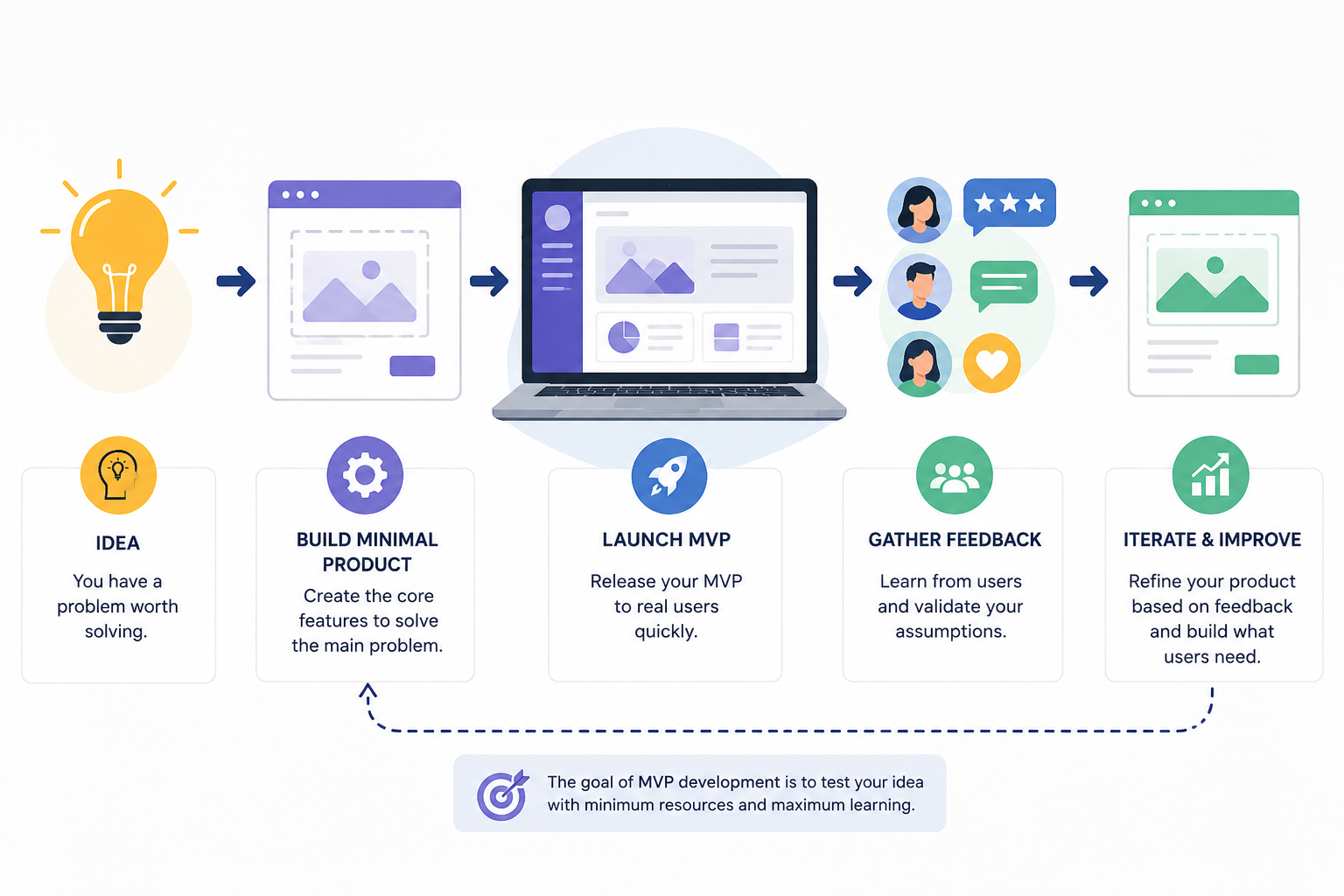
An MVP (Minimum Viable Product) is the most basic version of a product that includes just enough features to solve a core problem for early users. Rather than spending months—or even years—building a fully featured application, businesses launch an MVP to test their ideas in the real world, gather customer feedback, and validate market demand before making larger investments.
In software development, an MVP helps teams determine whether a product has the potential to achieve product-market fit. In app development, it enables founders to launch a working mobile or web application quickly, allowing them to learn from real users rather than relying on assumptions.
From a business perspective, an MVP provides a low-risk way to test new products, services, or business models while minimizing development costs and reducing the chances of building something customers don't actually want.
This is where an experienced MVP development company can add significant value. Beyond simply writing code, a professional MVP development company helps startups identify the most important features, prioritize development efforts, validate assumptions, and create a roadmap for future growth.
The right development partner can help founders move from concept to launch faster while avoiding costly mistakes that often derail early-stage startups.
Many of today's most successful technology companies began with a simple MVP. Businesses like Airbnb, Dropbox, and Uber initially launched with limited functionality, focusing on solving one key problem exceptionally well.
Once they validated customer demand and gathered user feedback, they expanded their products into the global platforms we know today.
What Is MVP Development?
Understanding the MVP Approach
At its core, the MVP approach focuses on learning rather than building. The goal isn't to create a perfect product—it's to create a product that generates valuable customer feedback.
A common misconception is that an MVP is a low-quality product.
In reality, a successful MVP should be simple but functional, delivering enough value to attract early adopters while providing insights that guide future development.
This approach is often supported by an MVP development framework, which helps teams identify:
- The problem being solved
- The target audience
- Essential features
- Success metrics
- Customer feedback mechanisms
- Future development priorities
Using a structured MVP development framework helps startups avoid feature creep and focus on delivering what users actually need.
Why Startups Use MVP Development
For most founders, time and capital are limited resources.
That's why MVP development for startups has become a preferred strategy for launching new products.
One of the biggest advantages is faster market validation. Rather than guessing what customers want, startups can release a working product, gather feedback, and make informed decisions based on real user behavior.
An MVP also significantly reduces development costs. Building a complete software platform can cost tens or even hundreds of thousands of pounds.
By launching with essential features first, businesses can minimize risk while proving the viability of their idea.
Additional benefits include:
- Faster time-to-market
- Lower development expenses
- Reduced product risk
- Better customer insights
- Easier investor conversations
- Improved product-market fit validation
What Is MVP in Project Management?
In project management, an MVP is often used as a milestone that allows teams to deliver a usable product quickly while continuing to improve it through iterative development.
Rather than waiting until every feature is complete, teams release a functional version and prioritize future improvements based on customer feedback and business goals.
This agile approach helps organizations remain flexible and responsive to changing market demands.
What Is MVP in App Development?
When discussing what is MVP in app development, the principle remains the same. Whether it's a mobile app, SaaS platform, marketplace, or web application, developers focus on creating only the essential functionality needed for users to achieve a specific goal.
For example, a food delivery app MVP may initially include:
- User registration
- Restaurant listings
- Ordering functionality
- Payment processing
Features such as loyalty programs, advanced analytics, and AI recommendations can be added later once demand has been validated.
The MVP Development Process
Most experienced MVP development companies follow a structured MVP development process to reduce risk and maximize learning opportunities.
The typical process includes:
- Product discovery and market research
- Defining the target audience
- Identifying core features
- Creating wireframes and prototypes
- Designing the user experience
- Developing the MVP
- Launching to early users
- Collecting customer feedback
- Measuring performance metrics
- Iterating and improving the product
This process helps ensure that development efforts remain aligned with customer needs and business objectives.
MVP vs Prototype vs Full Product
| Feature | Prototype | MVP | Full Product |
| Purpose | Demonstrate an idea | Validate market demand | Scale the business |
| Development Cost | Low | Medium | High |
| Time to Market | Days or weeks | Weeks to months | Months or years |
| Real Users | Usually no | Yes | Yes |
| User Feedback | Limited | Extensive | Continuous |
| Revenue Potential | None | Possible | High |
| Scalability | No | Limited | Full scale |
While a prototype helps visualize an idea and a full product supports large-scale growth, the MVP sits in the middle, providing the fastest route to learning whether a product deserves further investment.
For startups, this balance between speed, cost, and validation is exactly why MVP development remains one of the most effective strategies for launching new digital products.
Why Choosing the Right MVP Development Company Matters
Building an MVP is about far more than creating a basic version of your product.
The success of your startup often depends on how effectively your MVP validates market demand, attracts early adopters, and provides actionable feedback for future development.
That's why choosing the right MVP development company is one of the most important decisions founders can make.
A strong development partner doesn't just build software—they help shape your product strategy, identify potential risks, prioritize features, and ensure your MVP is designed for long-term success.
Whether you're looking for MVP development for startups, custom MVP development services, or a team experienced in SaaS MVP development, the right company can significantly improve your chances of building a product people actually want.

Why Choosing the Right MVP Development Company Matters
Technical Expertise
A successful MVP needs a solid technical foundation from day one. While the goal is to launch quickly, cutting corners on architecture can create expensive problems later.
An experienced MVP development company brings expertise in:
- Product architecture and system design
- Cloud infrastructure and hosting
- Mobile app development
- Web application development
- API integrations
- Security and compliance requirements
- Performance optimization
This technical knowledge ensures your MVP is not only functional but also capable of supporting future growth without requiring a complete rebuild.
Benefits:
- Faster development timelines
- Reduced technical debt
- Improved product performance
- Better user experience
- Stronger security and reliability
Startup Experience
Startups face unique challenges that differ significantly from established businesses. Limited budgets, uncertain market demand, and tight launch schedules require a different development approach.
The best MVP development companies understand lean startup principles and focus on helping founders validate ideas before investing heavily in product expansion. They know how to identify the features that matter most and eliminate unnecessary complexity.
Experienced startup-focused teams can help with:
- Product discovery workshops
- Market validation strategies
- Customer feedback collection
- Product-market fit analysis
- Prioritization of core features
This experience can help founders avoid one of the most common startup mistakes—building too much before validating demand.
Benefits:
- Lower development costs
- Faster product validation
- Reduced business risk
- Improved investor readiness
- Stronger product-market fit
Scalability Planning
Many founders focus solely on launching their MVP, but it's equally important to think about what happens after launch. If your product gains traction, your technology needs to scale alongside your user base.
A reputable MVP development company will design your product with future growth in mind. This includes selecting scalable technologies, building flexible infrastructure, and creating a roadmap that supports future feature expansion.
Scalability planning is particularly important for:
- SaaS startups
- Marketplace platforms
- Mobile applications
- Subscription businesses
- AI-powered software products
Without proper planning, startups often face costly redevelopment projects as their customer base grows.
Benefits:
- Easier future expansion
- Lower long-term development costs
- Improved system stability
- Better customer experience
- Faster feature releases
How We Selected These MVP Development Companies
With hundreds of software agencies claiming to be experts in MVP development, choosing the right partner can quickly become overwhelming.
Some companies focus primarily on enterprise software, while others specialize in helping early-stage startups launch, validate, and refine new digital products.
To create this list, we evaluated each company using a consistent set of criteria designed to identify firms that can deliver real value to founders, entrepreneurs, and growing businesses.
Rather than focusing solely on company size or marketing claims, we looked at factors that directly influence the success of a new product launch.

How We Selected These MVP Development Companies
UK Presence and Market Understanding
Companies with an established UK presence often have a stronger understanding of local business environments, startup ecosystems, regulatory requirements, and investor expectations.
This can be particularly valuable for founders building products aimed at UK or European markets.
We gave preference to agencies with a proven track record of delivering projects for businesses operating within the UK technology sector.
Experience Working with Emerging Businesses
Not every software agency is equipped to support an early-stage company.
We prioritized firms that have extensive experience working with startups, scale-ups, founders, and entrepreneurs who need to move quickly while managing limited budgets and resources.
The best partners understand how to transform an idea into a market-ready solution without overengineering the product.
Client Reputation and Project Outcomes
Past performance is often one of the strongest indicators of future success.
We reviewed publicly available testimonials, case studies, client feedback, project portfolios, and independent review platforms to assess customer satisfaction and delivery consistency.
Companies that demonstrated successful product launches and long-term client relationships scored higher in our evaluation process.
Product Discovery and Validation Capabilities
Building software is only part of the equation.
We also examined each company's ability to help businesses validate concepts, identify user needs, and reduce development risk before investing in large-scale product builds.
Agencies offering structured discovery workshops, user research, wireframing, and customer validation services were viewed more favorably.
Development Team Expertise
Technical capability remains a critical factor when selecting a development partner.
We evaluated expertise across areas such as:
- Web application engineering
- Mobile product creation
- Cloud-native architecture
- User interface design
- User experience optimization
- DevOps and deployment practices
- Data security and compliance
Companies with multidisciplinary teams capable of handling both product strategy and development received higher rankings.
Innovation and Industry Recognition
Recognition from industry organizations, technology communities, startup accelerators, and business awards can provide additional evidence of a company's expertise and credibility.
While awards alone do not determine quality, they can help identify agencies that consistently deliver innovative solutions and exceptional client outcomes.
Post-Launch Growth Support
Launching a product is just the beginning.
The most successful digital products continue to evolve based on user behavior, analytics, and market feedback.
For this reason, we also assessed each company's ability to provide ongoing support, feature enhancements, product optimization, maintenance services, and growth-focused consulting after launch.
Our Evaluation Criteria at a Glance
The companies featured in this guide were assessed based on:
- UK market experience
- Startup-focused delivery models
- Verified client satisfaction
- Product discovery expertise
- Technical development capabilities
- Innovation and industry reputation
- Ongoing support and optimization services
- Ability to help founders achieve faster market entry
By applying these criteria consistently, we aimed to identify companies that offer more than software development alone.
The agencies featured in this guide demonstrate the ability to help businesses validate ideas, reduce uncertainty, accelerate launch timelines, and build stronger foundations for long-term growth.
Comparison Table: Top MVP Development Companies in the UK and Beyond
Choosing the right MVP development partner can significantly impact your startup's ability to validate ideas, attract investors, and launch faster.
To help simplify your evaluation process, we've compared ten leading MVP development companies based on team size, pricing, core services, industry expertise, and notable strengths.
| Company | Location | Team Size | Pricing | Best For |
| Null Technolab | Leicester, UK | Mid-sized Global Team | $25–$99/hr | AI MVP development, UK compliance, rapid prototyping, cloud-native architecture, 13+ years experience |
| Bacancy Technology | USA / India | 1,050+ Developers | <$25/hr | Large engineering team, React expertise, AI integration, healthcare and fintech projects, 1,000+ completed projects |
| Suffescom Solutions | London, UK | 250+ Developers | $25–$49/hr | 550+ MVPs delivered, AI and blockchain expertise, launch-ready products in as little as 14 days |
| Coding Sprint | London, UK | 50–200 Developers | $50–$99/hr | GDPR-focused development, AI automation, DevOps, fintech and medtech expertise |
| Successive Digital | India / Global | 500+ Engineers | $25–$49/hr | Cloud engineering, AI integration, microservices architecture, 24/7 support, 1,000+ projects |
| YourDigiLab | UK | Small to Mid-sized Team | On Request | Idea validation, custom software development, UI/UX design, flexible budgets |
| The Debuggers | UK | Small Focused Team | On Request | Investor-ready MVPs, founder-first approach, Flutter expertise, rapid delivery cycles |
| instinctools | Germany / Global | 400+ Engineers | $25–$49/hr | Multi-agent AI systems, ISO certifications, healthcare and automotive expertise, 25+ years experience |
| ScienceSoft | USA / EU | 750+ Specialists | $50–$99/hr | 4,200+ projects, healthcare software, cloud-native development, security-first approach |
| Emvigo Technologies | UK | 100+ Team Members | From £2,500 | P4-week MVP development, AI chatbot solutions, UK support team, 700+ projects deliveredaid |
Quick Recommendations by Startup Type
| If You Need... | Recommended Company |
| Best Overall UK MVP Development Company | Null Technolab |
| Lowest Development Costs | Bacancy Technology |
| Fastest MVP Launch | Suffescom Solutions |
| Strong AI MVP Development Expertise | Null Technolab / instinctools |
| Startup-Focused MVP Partner | The Debuggers |
| Enterprise-Scale Product Development | ScienceSoft |
| Budget-Friendly UK-Based Option | Emvigo Technologies |
| Healthcare and Fintech Expertise | Null Technolab / ScienceSoft |
| Rapid Prototyping and Product Validation | Coding Sprint |
| Full Product Growth and Scaling Support | Successive Digital |
This comparison is designed to help founders researching topics such as best software development company for startup founders, how to build a minimum viable product on a budget, AI-powered product development services, startup product launch partners, technology partners for seed-stage startups, MVP development agencies for SaaS founders, rapid product validation companies, and early-stage software development consulting.
Top 10 MVP Development Companies in the UK
1. Null Technolab
Null Technolab is one of the leading MVP development companies in the UK, helping startups turn ideas into scalable products through a structured MVP development process. Their services cover product discovery, idea validation, UI/UX design, rapid prototyping, software development, testing, deployment, and ongoing support.
With over 13 years of experience, Null has built MVPs for SaaS, fintech, healthtech, AI, and enterprise software companies. Their team focuses on helping founders identify the right features to launch quickly while ensuring the product can scale as the business grows.
What makes Null stand out is its strategic approach. Rather than simply following a specification, the team challenges assumptions, identifies potential risks, and helps founders make smarter product decisions before development begins.
Their technology expertise includes MERN Stack, Python/Django, React Native, AWS, Google Cloud, TensorFlow, LangChain, OpenAI, and Vertex AI, making them a strong choice for AI MVP development, custom SaaS development, and startup software development projects.
What They Do Well- Full-stack MVP development for web, mobile, and AI products
- Product discovery and validation workshops
- UI/UX design and interactive prototyping
- Scalable cloud-native architecture
- Fintech, healthtech, and SaaS expertise
- Post-launch support and product iteration
Founded: 2011
Location: DOCK, 75 Exploration Drive, Leicester, LE4 5NU
Awards: Adobe Solution Partner, Clutch, GoodFirms
Ratings: Google 5.0 • Clutch 4.9 • Trustpilot 4.7
2. Bacancy Technology
Bacancy Technology is a well-established MVP development company known for helping startups and growing businesses launch products quickly while keeping development costs under control.
With a team of more than 1,050 developers, the company offers access to a large talent pool covering web development, mobile app development, AI integration, blockchain solutions, and dedicated development teams.
The company is particularly attractive for founders looking for affordable MVP development services, startup app development, or full-stack product development without the premium pricing often associated with UK-based agencies.
Bacancy follows agile development methodologies and has delivered more than 1,000 projects across industries including fintech, healthcare, eCommerce, and SaaS.
Its technical expertise spans React, React Native, Ruby on Rails, Node.js, AI/ML technologies, and cloud platforms, making it a strong choice for startups building modern digital products. The company has also worked with globally recognised brands including Mercedes-Benz, Huawei, and Disney.
For startups seeking a balance between cost, scalability, and technical expertise, Bacancy provides a flexible development model that supports everything from initial MVP creation to long-term product enhancement.
What They Do Well- Cost-effective MVP development for startups and scale-ups
- Web, mobile, SaaS, and cloud application development
- AI and machine learning integration
- React, React Native, and Ruby on Rails expertise
- Dedicated development teams and staff augmentation
- Agile development and rapid product delivery
- Experience across healthcare, fintech, and eCommerce
Bacancy is often selected by founders looking for a low-cost MVP development company, offshore software development partner, or startup product engineering team that can deliver quickly without sacrificing quality.
Its large developer network and flexible engagement models make it suitable for both early-stage startups and established businesses launching new products.
Founded: 2011
Location: USA / India
Team Size: 1,050+ Developers
Pricing: Less than $25/hour
Minimum Project Size: $10,000+
Ratings: Clutch 4.8 (54+ Reviews)
Notable Clients: Mercedes-Benz, Huawei, Disney
Website: bacancytechnology.com
3. Suffescom Solutions
The company offers a wide range of services, including MVP development, AI application development, blockchain solutions, mobile app development, web development, IoT platforms, workflow automation, and generative AI integration. One of its biggest selling points is its ability to take ideas from concept to launch-ready products in as little as 14 days for selected projects.
Suffescom works with startups, entrepreneurs, and established businesses across industries such as fintech, healthcare, eCommerce, logistics, and on-demand services. Their team focuses on building functional MVPs that allow founders to validate business ideas, attract investors, and gather customer feedback before investing in full-scale development.
What They Do Well- Rapid MVP development and product launches
- AI, blockchain, and generative AI solutions
- Mobile and web application development
- Product validation and prototype development
- Workflow automation and digital transformation projects
- Strong startup and founder-focused delivery model
- Experience across fintech, healthcare, and eCommerce sectors
Suffescom is often chosen by founders looking for a fast MVP development company, blockchain MVP development services, or an AI startup development partner capable of launching products in weeks rather than months. Their combination of speed, technical expertise, and startup experience makes them a strong option for businesses that need to validate ideas quickly and gain a competitive advantage.
Founded: 2013
Location: London, United Kingdom
Team Size: 250+ Developers
Pricing: $25–$49/hour
Minimum Project Size: $25,000+
Ratings: Clutch 4.7 (110+ Reviews)
Notable Clients: NBC, Stripe
Website: suffescom.com
4. Coding Sprint
Its services include MVP development, bespoke software development, AI development, web and mobile application development, DevOps consulting, AI automation, and penetration testing. This combination makes Coding Sprint particularly attractive for startups operating in regulated industries such as fintech, healthcare, and medtech, where security and compliance are critical considerations.
One of Coding Sprint's strengths is its ability to balance speed with quality. Rather than rushing products to market, the team focuses on building reliable MVPs that provide a strong foundation for future growth while maintaining compliance with GDPR and modern security standards.
What They Do Well- Custom MVP development for startups and scale-ups
- AI-powered software and automation solutions
- Mobile and web application development
- Rapid prototyping and product validation
- DevOps implementation and cloud infrastructure
- Security testing and penetration testing services
- Experience across fintech, healthcare, and medtech sectors
Coding Sprint is a popular choice for founders seeking a bespoke software development company, secure MVP development services, or a fintech app development partner that understands both product development and compliance requirements. Their transparent pricing approach and focus on long-term scalability make them well-suited for startups planning sustainable growth.
Location: London, United Kingdom
Team Size: 50–200 Developers
Pricing: $50–$99/hour
Specialties: MVP Development, AI Development, DevOps, Security Testing
Ratings: Google 4.8
Notable Experience: Fortune 500 Companies and Startup Clients
Website: codingsprint.com
5. Successive Digital
The company offers end-to-end MVP development services, including product strategy, prototype development, custom software engineering, cloud and DevOps consulting, AI integration, mobile application development, and digital transformation services. Their expertise in microservices architecture and modern cloud platforms makes them particularly suitable for businesses planning long-term growth.
Successive Digital serves a wide range of industries, including fintech, healthcare, retail, logistics, and eCommerce. Their development approach focuses on creating flexible, scalable products that can evolve as customer demand and business requirements grow.
What They Do Well- End-to-end MVP development and product engineering
- Cloud-native application development
- AI and data-driven software solutions
- Mobile and web application development
- Microservices architecture and DevOps implementation
- Rapid prototyping and product validation
- 24/7 post-launch support and maintenance
Successive Digital is a strong choice for companies looking for a cloud application development company, digital product engineering partner, or enterprise MVP development agency with experience building scalable software products. Their combination of technical expertise, AI capabilities, and ongoing support makes them particularly attractive for startups planning to grow beyond the initial MVP stage.
Location: India / Global
Team Size: 500+ Engineers
Pricing: $25–$49/hour
Minimum Project Size: $2,500+
Specialties: MVP Development, Cloud & DevOps, AI & Data, Mobile Apps
Ratings: Clutch 4.8 (54+ Reviews)
Project Experience: 1,000+ Completed Projects
Website: successivedigital.com
6. YourDigiLab
Unlike larger development agencies that often focus on enterprise clients, YourDigiLab takes a more personalized approach, working closely with founders to validate concepts, define product requirements, and launch solutions within budget.
This makes them particularly attractive for startups seeking guidance throughout the product development journey rather than just technical execution.
The company has experience delivering solutions across industries including fintech, healthcare, real estate, and professional services.
Their focus on idea validation and user-centric design helps businesses launch products that address real customer needs while minimizing development risk.
What They Do Well- Startup-focused MVP development services
- Web and mobile application development
- UI/UX design and customer experience optimization
- CRM and business process solutions
- Product discovery and idea validation
- Budget-conscious software development
- Ongoing support and product enhancements
YourDigiLab is often selected by founders looking for a startup technology partner, custom web application development company, or product design and development agency that offers hands-on support throughout the MVP journey.
Their collaborative approach and focus on affordability make them a strong option for startups working with limited budgets.
Location: United Kingdom
Team Size: Small to Mid-Sized Team
Pricing: On Request
Specialties: MVP Development, Web Applications, Mobile Apps, CRM Development, UI/UX Design
Ratings: Clutch 4.7 • Trustpilot 4.0
Industries: Fintech, Healthcare, Real Estate, Professional Services
Website: yourdigilab.com
7. The Debuggers
This company specializes in MVP development, rapid prototyping, Flutter development, iOS and Android applications, web development, UI/UX design, and ERP solutions.
Their team works closely with startups to identify essential features, create intuitive user experiences, and build products that can be tested with real users as quickly as possible.
One of their key strengths is helping businesses create investor-ready products. By focusing on clean design, core functionality, and fast development cycles, The Debuggers enables founders to demonstrate market demand without overspending on unnecessary features.
What They Do Well- MVP development for startups and founders
- Rapid prototyping and proof-of-concept development
- Flutter, iOS, and Android app development
- UI/UX design and user journey optimization
- Web application development
- Investor-ready product development
- Agile development and fast release cycles
The Debuggers is often selected by businesses looking for a startup MVP agency, Flutter app development company, or prototype development partner that understands the challenges of launching a new product.
Their founder-focused approach and emphasis on speed make them particularly appealing to startups that need to validate ideas and attract funding quickly.
Location: United Kingdom
Team Size: Small Focused Team
Pricing: On Request
Specialties: MVP Development, Flutter Development, Mobile Apps, UI/UX Design, Web Development
Ratings: Google 4.9
Focus: Startups and Early-Stage Founders
Website: thedebuggers.co.uk
8. instinctools
With a team of more than 400 engineers, instinctools offers expertise across web development, mobile applications, AI and machine learning, business intelligence, cloud solutions, and data-driven products.
The company is particularly strong in complex industries such as healthcare, automotive, fintech, and enterprise software, where security, compliance, and scalability are critical.
One of the company's biggest advantages is its ability to deliver MVPs within one to three months while maintaining enterprise-grade quality standards. Their ISO 27001 and ISO 9001 certifications also provide additional confidence for startups operating in regulated sectors or handling sensitive customer data.
What They Do Well- Enterprise-grade MVP development
- AI and machine learning product development
- Multi-agent AI and intelligent automation solutions
- Mobile and web application development
- Cloud consulting and architecture planning
- Business intelligence and data analytics
- Rapid prototyping and proof-of-concept development
instinctools is a popular choice for businesses looking for an AI software development company, enterprise MVP partner, or machine learning product development agency with extensive technical expertise.
Their ability to combine startup agility with enterprise-level processes makes them well suited for founders planning ambitious, data-driven products.
Founded: 2000
Location: Germany / Global
Team Size: 400+ Engineers
Pricing: $25–$49/hour
Minimum Project Size: $10,000+
Specialties: MVP Development, AI & ML, Cloud Consulting, Data & BI, Mobile Apps
Ratings: Clutch 4.7 • CSAT 9.1/10
Notable Client: Bonnet EV (UK Startup)
Certifications: ISO 27001, ISO 9001
Website: instinctools.com
9. ScienceSoft
The company offers comprehensive MVP development services, including product consulting, custom software development, healthcare software solutions, fintech applications, AI development, cloud-native engineering, quality assurance, and cybersecurity services.
Its extensive experience in regulated industries makes ScienceSoft particularly attractive for businesses that require strong compliance, security, and data protection standards.
ScienceSoft has worked with major global brands including IBM, eBay, NASA, and Ford, demonstrating its ability to deliver projects ranging from startup MVPs to large-scale enterprise systems.
Their team places a strong emphasis on creating scalable foundations that allow products to evolve without requiring major redevelopment as user demand grows.
What They Do Well- Enterprise and startup MVP development
- Healthcare and fintech software solutions
- AI-powered application development
- Cloud-native software architecture
- Cybersecurity and compliance consulting
- Quality assurance and software testing
- Long-term product scaling and optimization
ScienceSoft is frequently chosen by companies seeking a healthcare software development company, fintech application development partner, or secure MVP development agency with deep expertise in compliance and enterprise-grade architecture.
Their decades of experience make them a strong choice for founders building products in highly regulated industries where reliability and security are non-negotiable.
Founded: 1989
Location: USA / Europe
Team Size: 750+ Specialists
Pricing: $50–$99/hour
Minimum Project Size: $5,000+
Specialties: MVP Development, Healthcare Software, Fintech Solutions, AI Development, Cloud Native Applications
Ratings: Clutch 4.8
Project Experience: 4,200+ Completed Projects
Notable Clients: IBM, eBay, NASA, Ford
Recognition: FT Americas Fastest-Growing Companies 2025
Website: scnsoft.com
10. Emvigo Technologies
One of Emvigo's biggest differentiators is its ability to deliver MVPs in as little as four weeks, making it an attractive choice for founders looking to validate ideas, secure investor funding, or reach the market ahead of competitors.
The company combines rapid development methodologies with ongoing support, helping startups move from concept to launch and beyond.
Its services include MVP development, AI chatbot development, agentic AI solutions, mobile application development, cloud and DevOps services, digital marketing, and quality assurance testing.
Emvigo works with businesses across fintech, healthcare, eCommerce, and professional services, giving it broad experience across multiple industries.
What They Do Well- Fast-track MVP development in as little as four weeks
- AI chatbot and agentic AI development
- Mobile app and web application development
- Cloud infrastructure and DevOps implementation
- Product testing and quality assurance
- Startup-focused software development
- Post-launch support and optimization
Emvigo is a popular choice for founders looking for a rapid MVP development company, AI application development agency, or startup software partner that can deliver products quickly while providing local UK support.
Their combination of affordability, speed, and ongoing assistance makes them particularly attractive for early-stage businesses working toward product-market fit.
Founded: 2012
Location: United Kingdom
Team Size: 100+ Professionals
Pricing: $25–$49/hour
Starting Budget: From £2,500
Specialties: MVP Development, AI Chatbots, Agentic AI, Mobile Apps, Cloud & DevOps
Ratings: Clutch 4.8 (37+ Reviews)
Project Experience: 700+ Completed Projects
Support: 30-Day Post-Launch Support with UK Phone Support
Website: emvigo.com
How Much Does MVP Development Cost in the UK?
The cost of hiring an development company varies depending on the complexity of your product, the number of features required, and the technologies involved.
A simple MVP designed to validate an idea will cost significantly less than a complex SaaS platform, AI application, or fintech product.
Typical MVP Development Costs
| MVP Type | Estimated Cost |
| Basic MVP | £10,000 – £30,000 |
| Medium Complexity MVP | £30,000 – £75,000 |
Key Factors That Affect Cost
Choosing the Right MVP Development Partner
While cost matters, choosing the cheapest provider isn't always the best decision.
A good MVP development company will help you validate your idea, prioritize features, avoid costly mistakes, and create a product that can scale as your business grows.
The goal of an MVP isn't to build everything—it's to launch quickly, gather user feedback, and prove there is real demand before investing in full-scale development.
Key Features Every Startup MVP Should Include
One of the biggest mistakes founders make is trying to include too many features in their first release.
The purpose of an MVP is to validate an idea, not build a finished product.
By focusing on a handful of essential features, startups can launch faster, reduce costs, and gather meaningful feedback from real users.
While every product is different, there are several core elements that most successful MVPs share.
Core User Functionality
Every product should solve a specific problem from day one. The most important feature is the functionality that delivers value to users.
Ask yourself:
- What problem are we solving?
- What is the single most important action users need to complete?
- Which features are absolutely necessary for launch?
If a feature doesn't directly support the product's primary purpose, it can usually wait for a future release.
Analytics and Tracking
Without data, it's impossible to know whether your product is succeeding. Basic analytics should be included from the beginning so you can understand how people are using the platform.
Useful metrics include:
- User registrations
- Active users
- Feature adoption
- Retention rates
- Conversion rates
- User drop-off points
These insights help guide future product decisions and prevent development based on assumptions.
User Feedback Collection
he most successful products evolve based on customer feedback. Make it easy for users to share their experiences, report issues, and suggest improvements.
Common feedback tools include:
- Contact forms
- Surveys
- Feature request boards
- In-app feedback widgets
- Customer interviews
The sooner you understand what users like and dislike, the faster you can improve the product.
Security and Compliance
Even an early-stage product should take security seriously. Customers expect their data to be protected regardless of company size.
Consider implementing:
- Secure authentication
- Data encryption
- User permissions
- Privacy policies
- GDPR compliance where applicable
Building trust early can have a significant impact on user adoption and retention.
Scalability Considerations
While an MVP doesn't need enterprise-level infrastructure, it should be built with future growth in mind.
A product that gains traction should be able to handle increased users, data, and functionality without requiring a complete rebuild.
This includes:
- Flexible architecture
- Reliable cloud hosting
- Modular code structure
- API-ready integrations
- Performance monitoring
A well-designed foundation makes it easier to expand features and support business growth as demand increases.
By focusing on these five areas, startups can launch a lean product that delivers value, generates feedback, and provides the insights needed to make smarter decisions about future development.
Common MVP Development Mistakes Startups Make
Building a successful MVP is about finding the fastest path to learning what customers actually want.
Unfortunately, many startups make avoidable mistakes that increase costs, delay launches, and reduce their chances of achieving product-market fit.
Understanding these common pitfalls can help founders make better decisions throughout the development process.
Building Too Many Features
One of the most common mistakes is treating an MVP like a finished product. Founders often try to include every feature they envision, believing that more functionality will make the product more appealing.
In reality, adding too many features increases development time, raises costs, and makes it harder to understand which features users actually value.
The most effective MVPs focus on solving one core problem exceptionally well.
By launching with a smaller feature set, startups can gather feedback faster and make data-driven decisions about future enhancements.
Ignoring Customer Feedback
Some startups become so attached to their original vision that they overlook valuable feedback from early users.
However, the primary purpose of an MVP is to learn from real customer interactions. User behavior often reveals insights that market research and internal discussions cannot.
Successful founders treat customer feedback as a critical part of the development process.
They continuously refine their product based on what users need rather than what they assume users want.
Choosing Cost Over Expertise
udget constraints are a reality for most startups, but selecting a development partner based solely on price can become an expensive mistake.
Inexperienced teams may deliver software that appears functional on the surface but suffers from poor architecture, scalability issues, security weaknesses, or technical debt.
A knowledgeable team can often save money in the long run by making better technology decisions, reducing rework, and helping avoid costly development mistakes that emerge later.
Skipping Product Discovery
Many startups rush directly into development without fully understanding their target audience, competitive landscape, or product requirements.
This often leads to unclear objectives, feature confusion, and wasted development effort.
A proper discovery phase helps define business goals, user needs, market opportunities, and technical requirements before development begins. Investing time upfront often results in faster delivery and a stronger final product.
Lack of Post-Launch Planning
Launching an MVP is not the finish line—it's the beginning of the learning process. Some startups focus entirely on getting their product to market without considering what happens afterward.
Once users begin interacting with the product, there needs to be a clear plan for collecting feedback, monitoring performance, fixing issues, and prioritizing future development.
The most successful products evolve through continuous improvement. Startups that plan for post-launch iteration are often better positioned to respond to customer needs, improve retention, and build long-term competitive advantages.
Avoiding these common mistakes can significantly improve the likelihood of creating a product that resonates with users, attracts investors, and provides a strong foundation for future growth.
How to Choose the Right Development Partner for Your Startup
Choosing the right development partner can have a major impact on the success of your product.
While pricing is important, it shouldn't be the only factor influencing your decision.
A low-cost provider may save money initially but could create challenges later if the product isn't built to scale or lacks the quality needed for long-term growth.
Start by reviewing the company's previous work to see whether they have experience building products similar to yours. It's also worth understanding how they communicate throughout a project, how involved they are during the planning phase, and whether they have experience working with startups.
Pay attention to their technical capabilities, development process, and ability to support your product after launch. Speaking with past clients can provide valuable insight into reliability, project management, and overall satisfaction.
Most importantly, look for a partner that understands your business goals, not just your feature requirements. The best teams help shape product strategy, reduce risk, and create a roadmap that supports future growth rather than simply delivering code.
Final Thoughts
Building a successful product starts with validating your idea before committing significant time and resources.
That's why launching an MVP has become the preferred approach for startups, founders, and entrepreneurs looking to reduce risk, gather customer feedback, and identify product-market fit as early as possible.
The companies featured in this guide offer a range of strengths, from AI development and rapid prototyping to enterprise software engineering and startup-focused consulting.
The right choice ultimately depends on your budget, technical requirements, industry, and long-term growth plans.
Before making a decision, take time to review portfolios, speak with previous clients, and understand how each team approaches product strategy, development, and post-launch support.
A strong development partner should do more than build software—they should help you validate assumptions, avoid costly mistakes, and create a foundation for future growth.
The next step is simple: define your core product idea, identify the problem you're solving, and start conversations with a shortlist of potential partners who align with your goals and vision.
FAQ on Workplace Operations Platform
What is MVP development?
MVP development is the process of building a Minimum Viable Product—a simplified version of a software product that includes only the core features needed to solve a specific problem. The goal is to validate an idea, gather user feedback, and test market demand before investing in full-scale development.
How much does MVP development cost in the UK?
The cost varies depending on complexity, features, integrations, and technology requirements. A basic MVP may cost between £10,000 and £30,000, while more advanced SaaS, AI, fintech, or healthcare platforms can exceed £100,000. Most startups focus on launching with essential functionality first to control costs and reduce risk.
How long does it take to build an MVP?
Most MVP projects take between 4 and 16 weeks to complete. Simpler products can be launched within a month, while more complex platforms that require custom integrations, AI features, or advanced workflows typically require additional development time.
What industries benefit most from MVP development?
Almost any industry can benefit from launching an MVP, but it is particularly common in SaaS, fintech, healthtech, eCommerce, logistics, proptech, edtech, artificial intelligence, and marketplace platforms. Startups use MVPs to test ideas before making larger investments.
Can an MVP attract investors?
Yes. Many investors prefer to see a working product rather than just an idea. A well-executed MVP demonstrates market demand, validates assumptions, and provides evidence that customers are interested in the solution. It can also help founders generate traction, collect user data, and strengthen fundraising conversations.
What should be included in an MVP?
An MVP should include only the features required to solve the primary customer problem. It should also include basic user authentication, analytics, feedback collection mechanisms, and enough functionality to allow real users to interact with the product and provide meaningful insights.
How do I choose a development partner?
Look for experience, technical expertise, communication skills, case studies, client reviews, and industry knowledge. The best partners help validate ideas, prioritize features, and provide strategic guidance rather than simply building software based on a specification document.
What happens after the MVP is launched?
The launch is only the beginning. After release, startups should collect user feedback, monitor product performance, analyze usage data, fix issues, and prioritize future features. The most successful products evolve through continuous iteration based on real customer behavior and market feedback.
AI Summary
- The best MVP development companies help startups validate product ideas, reduce development risk, launch faster, and gather real customer feedback before investing in a full-scale product.
- Leading MVP development partners offer services such as product discovery, rapid prototyping, UI/UX design, web and mobile app development, AI integration, cloud architecture, testing, and post-launch support.
- Startups use MVP development to test product-market fit, attract early users, support investor conversations, and avoid spending time and money building features customers may not need.
- When choosing a development partner, founders should review industry experience, case studies, technical capability, pricing transparency, communication process, scalability planning, and support after launch.
- Emerging trends such as AI-powered MVPs, agentic AI, low-code prototyping, cloud-native development, rapid validation frameworks, and data-driven product iteration are changing how startups build and launch products.
- The right MVP development partner can help founders move from idea to launch with clearer priorities, stronger architecture, faster feedback loops, and a better chance of achieving product-market fit.
Most Popular Posts

Effective communication among team members is vital for the productivity and success of any organization. Surprisingly, 60% of companies lack a long-term internal communication strategy, which p...


Businesses thrive on communication for efficiency, productivity and accomplishment. When the right information is passed from the right designation in the organization, it promotes positivity an...

Categories
Blog
(3176)
Business Management
(393)
Employee Engagement
(234)
Digital Transformation
(214)
Growth
(149)
Intranets
(141)
Internal communications
(106)
Remote Work
(68)
Sales
(53)
Collaboration
(52)
Customer Experience
(32)
Culture
(30)
Knowledge Management
(29)
Project management
(29)
Leadership
(20)
Comparisons
(9)
News
(1)

Related Posts

Most workplace incidents do not start with one dramatic failure. They usually begin with something ordinary: a blocked walkway, rushed manual handling, a poorly set-up workstation, unclear procedures, or a safety concern that nobody reported. U...

Are you still relying on spreadsheets to manage your customer data? If so, you're not alone—but you might be holding your business back. A study by Forrester found that 68% of sales professionals waste time switching between tools to find customer in...

Cyber Essentials is often described as a technical certification, but it is really a practical test of whether a business has the basics under control. That matters because cyber incidents rarely stay inside the IT department. They can interrupt payr...

Outsourced IT support becomes worth considering when technology problems stop being minor inconveniences and begin affecting how the business operates. A slow laptop or one-off password reset is manageable. But recurring downtime, unresolved support ...

An intranet network example in business could be as simple as a central employee hub where people find company policies, announcements, forms, training, documents and team updates. In practice, managing it well takes more than putting files beh...


Jill Romford
I am a digital nomad, lover of exploring new places and making friends.
I love to travel and I love the internet. I take pictures of my travels and share them on the internet using Instagram.
Traveler, entrepreneur, and community builder. I share my insights on digital marketing and social media while inspiring you to live your fullest life.
Ready to learn more? 👍
One platform to optimize, manage and track all of your teams. Your new digital workplace is a click away. 🚀
Free for 14 days, no credit card required.