Insight Blog
Agility’s perspectives on transforming the employee's experience throughout remote transformation using connected enterprise tools.
37 minutes reading time
(7465 words)
AI Detection in the Workplace: The Hidden HR Risk Most Companies Aren’t Ready For

AI Detection in the Workplace: The Hidden HR Risk Most Companies Aren’t Ready For
AI detection in the workplace is growing fast. Discover the risks for HR, false positives, employee privacy concerns and how to govern AI responsibly.
AI Detection in the Workplace: The Hidden HR Risk Most Companies Aren’t Ready For

Artificial intelligence has entered the workplace faster than most HR teams expected.
Employees now use AI to draft emails, summarise meetings, improve reports, create presentations and complete everyday tasks.
Naturally, AI detection has followed close behind.
The scale of adoption explains why. SHRM reported in 2026 that 41% of workers use AI in their jobs, while Microsoft previously found that 75% of knowledge workers were already using AI at work.
More concerning for HR, 52% of those surveyed by Microsoft said they were reluctant to admit using AI for their most important tasks.
s employees increasingly rely on cloud-based AI platforms and external research tools, some may also use a free vpn for pc to securely access resources when working remotely or traveling, adding another layer of complexity to workplace monitoring and governance.
41%
of workers use AI in their jobs
SHRM reported in 2026 that 41% of workers use AI
in their jobs. Microsoft previously found that
75% of knowledge workers were already using AI
at work.
More concerning for HR, 52% of those surveyed
by Microsoft said they were reluctant to admit using AI for
their most important work.
Sources: SHRM (2026) & Microsoft Work Trend Index
But this creates a difficult question: what happens when an artificial intelligence detector flags an employee's work as AI-generated?
Treating every detection as misconduct risks false accusations, damaged employee trust and poorly informed HR decisions. This is why tools like detector.io should be used as part of a wider review process, not as the only basis for workplace decisions.Treating every detection as misconduct risks false accusations, damaged employee trust and poorly informed HR decisions.
That's why AI detection in the workplace needs more than another piece of software. In this article, we'll explore where AI detection can help, where it can go wrong, and how HR teams can build practical AI policies, introduce human oversight and give employees clear, secure ways to use AI responsibly.
Key Takeaways
- AI detection tools can help identify potentially AI-generated workplace content, but detection scores should never be treated as definitive proof of employee misconduct.
- False positives create real HR risks, including unfair accusations, damaged employee trust, discrimination concerns, and poor recruitment or disciplinary decisions.
- Employers need clear workplace AI policies covering approved tools, confidential data, acceptable use, employee monitoring, human review, and appeals.
- HR should work alongside IT, cybersecurity, legal, compliance, and data protection teams to establish effective AI governance across the organisation.
- The goal should not be to stop employees using AI, but to create a secure and transparent environment where people can use it responsibly without sacrificing privacy or accountability.
What Is AI in the Workplace?

What Is AI in the Workplace?
AI in the workplace is much broader than employees using ChatGPT to write an email. It includes technology that can automate everyday tasks, create content, analyse large amounts of information, find company knowledge and help employees make faster, better-informed decisions.
In practice, workplace AI tools are already being used across several areas:
- Task automation takes care of repetitive work such as scheduling meetings, sending reminders, updating records and routing documents.
- Content creation helps employees draft emails, reports, presentations, policies and other workplace materials.
- Software development supports developers with writing, reviewing, debugging and improving code.
- Creative work can generate images, videos, designs and marketing assets from simple instructions.
- Decision support analyses business data, identifies patterns and helps teams understand what actions to consider next.
- Meeting assistance can transcribe conversations, produce summaries, identify decisions and automatically create action points.
- Enterprise AI search allows employees to ask questions in natural language and find answers across company documents, knowledge bases and workplace systems.
- AI agents and automated workflows go a step further by completing multi-stage tasks and taking approved actions with less human input.
What's interesting is that these capabilities are quickly starting to overlap.
A workplace platform might summarise a meeting, identify the tasks that were agreed, create follow-up content and then help an employee find related documents without jumping between several different applications.
That's where the real value of artificial intelligence in the workplace starts to emerge. Rather than adding dozens of disconnected AI tools, organisations can integrate useful capabilities into the systems employees already use—while maintaining appropriate security, governance and human oversight.
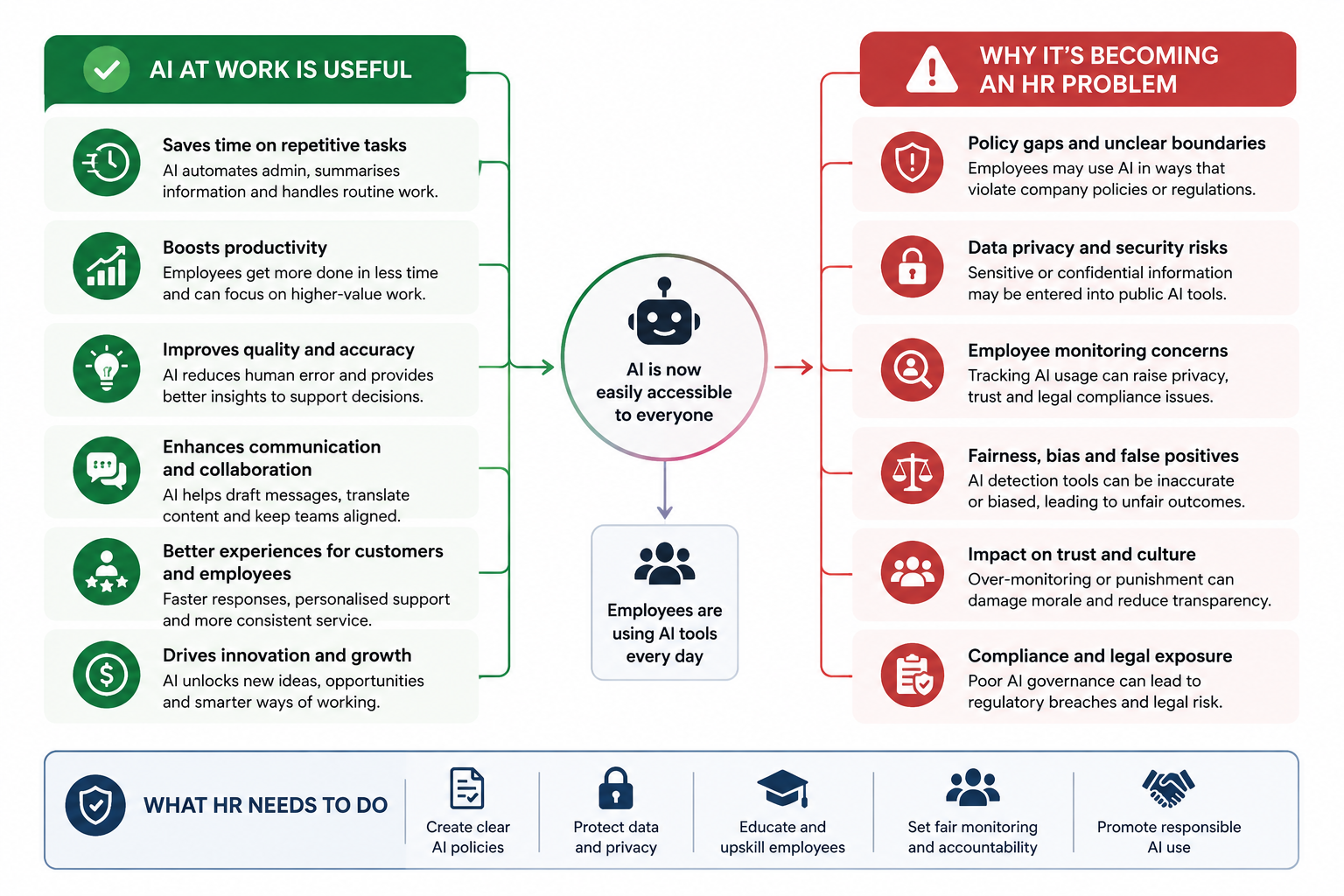
AI at work is useful — so why is it becoming an HR problem?
Here's where things get complicated. Most businesses don't actually want employees to stop using AI.
Used properly, generative AI can save time, reduce repetitive work, help employees find information faster and make everyday tasks easier. For HR teams, it can support recruitment, onboarding, training, employee communications and administrative work.
The problem is that workplace adoption has moved much faster than workplace rules.
An employee might use ChatGPT to rewrite an email. Another might upload meeting notes to an AI tool for summarisation. Someone in recruitment could use AI to screen applications, while a manager might use it to help write a performance review.
These uses aren't automatically wrong, but each creates a different question for HR.
- What information are employees sharing with AI tools?
- Who owns the output?
- Can managers rely on it?
- What happens if AI produces biased or inaccurate information?
- And at what point does AI assistance become unacceptable?
AI at work is useful — so why is it becoming an HR problem?
This leaves HR dealing with several challenges at once:
- Data privacy and security: Employees may unknowingly paste confidential company, customer or employee information into public AI tools.
- Accuracy: AI can confidently produce incorrect information, meaning employees still need to verify what it generates.
- Bias and fairness: AI-assisted recruitment, performance reviews and employee decisions can create serious problems if biased outputs influence people decisions.
- Ownership and accountability: If AI produces something inaccurate or inappropriate, the organisation still needs to know who is responsible for checking it.
- Shadow AI: Employees can start using tools that IT and HR don't know about, making AI use difficult to govern.
- Trust: Heavy-handed monitoring or AI detection can make employees feel they're being watched rather than supported.
- Unclear policies: Employees can't follow rules that haven't been clearly explained to them.
And that's the real HR challenge. The question is no longer whether employees will use AI. It's how organisations allow them to use it without creating unnecessary security, compliance, fairness and employee trust problems.
That tension is also why artificial intelligence detector tools are starting to attract attention. If organisations can't easily see how AI is being used, detection AI can look like a simple answer.
But detecting AI-generated work and proving that an employee has actually done something wrong are two very different things.
Can AI detectors actually tell when employees have used AI?
This is where AI detection gets uncomfortable for HR.
These tools can identify patterns that look like AI-generated writing, but they can't look over an employee's shoulder and prove how a document was created.
Most detectors analyse characteristics such as sentence structure, predictability, word choice and writing patterns before producing a probability score.
An artificial intelligence detector might therefore say that a document is "80% likely to be AI-generated", but that shouldn't be interpreted as 80% proof that an employee used ChatGPT.
And false positives are a genuine concern.
Stanford researchers tested seven popular detectors against essays written by non-native English speakers and found that 61.22% of the human-written TOEFL essays were incorrectly classified as AI-generated.
Even more striking, 97% of the 91 essays were flagged by at least one detector.
61.22%
of human-written essays were wrongly flagged as AI-generated
Stanford researchers tested seven popular AI detection tools against
essays written by non-native English speakers and found that
61.22% of the human-written TOEFL essays were incorrectly classified
as AI-generated.
Even more striking, 97% of the 91 essays tested were flagged by at
least one detector, highlighting the risk of false positives when
automated detection is used without human review.
Source: Stanford University research on AI detector bias
More recent research hasn't made the problem disappear.
A 2025 NAACL study testing several detection systems across unfamiliar models, datasets and prompting methods found that performance could deteriorate dramatically in real-world conditions, with the true-positive rate dropping as low as 0% at a 1% false-positive threshold in certain settings.
That's an important distinction for HR teams experimenting with detection AI. A detector can provide a signal that something deserves a closer look, but it shouldn't become the evidence used to accuse an employee of misconduct.
Imagine questioning someone's performance, rejecting a candidate or starting a disciplinary process because software incorrectly decided their writing sounded "too much like AI." The technology might have made the initial mistake, but the consequences would belong to the employer.
For HR, the safer approach is simple: treat AI detector scores as an indicator, never a verdict. Human review, context and a clearly defined workplace AI policy still need to sit behind any decision affecting an employee.
What happens when a real employee gets falsely accused?

What happens when a real employee gets falsely accused?
A false AI accusation might sound like a minor workplace misunderstanding, but for the employee involved, it can quickly become something much bigger.
Imagine spending several hours writing a report, only for your manager to run it through a chat gpt detector and tell you that software believes you didn't write it. Even if you've done nothing wrong, you're suddenly in the uncomfortable position of having to prove that your own work is actually yours.
That's where HR needs to be extremely careful.
False positives can damage trust between employees and managers, particularly if detector results are treated as evidence of dishonesty or misconduct. The consequences become even more serious when those results influence recruitment decisions, performance reviews, promotions or disciplinary procedures.
There are also legitimate concerns about who may be affected most. Stanford researchers found that AI detectors disproportionately misclassified writing from non-native English speakers. In their study, 61.22% of human-written TOEFL essays were incorrectly identified as AI-generated, highlighting how seemingly neutral technology can potentially produce very uneven outcomes.
An ai written detector also doesn't necessarily understand how AI was used. An employee might have written an entire document themselves before using AI to correct grammar, improve readability or translate a paragraph. That's very different from asking AI to produce the work from scratch.
Why are HR teams suddenly turning to AI detectors?
HR teams aren't looking at these tools simply because AI is the latest workplace trend. They're dealing with a practical problem: generative AI has made it incredibly easy to create polished CVs, cover letters, assessments, reports and other workplace content in seconds.
Recruitment is one of the clearest examples. A candidate can use generative tools to rewrite a CV, produce answers to application questions or complete a written assessment.
Once hired, employees can use the same technology for reports, internal communications, research and other tasks where an employer may reasonably expect original work.
For HR, that creates several concerns:
- Recruitment authenticity: Was the application genuinely written by the candidate?
- Skills verification: Does an assessment demonstrate the person's ability or the capabilities of a generative tool?
- Employee performance: Are managers evaluating someone's work or heavily automated output?
- Compliance: Could confidential employee or company information be uploaded to an unapproved third-party service?
- Workplace standards: Where should the business draw the line between legitimate AI assistance and unacceptable use?
These concerns explain why searches around how to detect AI-generated employee content, checking whether a CV was written by ChatGPT, and identifying AI-generated workplace documents are becoming relevant to HR teams.
But there's a catch. Detection technology isn't perfect. As discussions around why AI checkers keep flagging human writing demonstrate, false positives remain an important part of the debate. Tools such as the UndetectedGPT platform also reflect a wider ecosystem developing around identifying, testing and modifying machine-generated content.
So HR is caught between two problems. Ignoring generative AI use isn't realistic, but automatically treating a detection result as proof isn't a responsible alternative either.
The better goal isn't to catch employees using AI. It's to establish what acceptable AI use actually looks like, protect sensitive company information and make sure people understand where the boundaries are before problems occur.
Here's the problem: AI detectors can get it wrong
The biggest problem with using automated detection at work is surprisingly simple: a positive result doesn't prove that someone used generative AI.
These systems look for patterns associated with machine-generated text. Human writing can contain exactly the same patterns, particularly when someone writes formally, follows a template or uses straightforward language.
Research from Stanford demonstrates how serious this can become. Researchers testing seven detection tools found that 61.22% of human-written TOEFL essays from non-native English speakers were incorrectly classified as AI-generated. Even more concerning, 97% of the essays were flagged by at least one detector.
Think about what that could mean inside a business.
A customer service employee writes a detailed response to a complaint. Software flags it as likely machine-generated, and their manager assumes they've broken company policy. The employee now has to defend work they genuinely produced.
If organisations automatically trust these scores, the impact could include:
- False accusations of inappropriate AI use.
- Unfair performance or disciplinary decisions based on unreliable evidence.
- Discrimination concerns if certain writing styles are disproportionately flagged.
- Lower employee trust when people feel their work is constantly being questioned.
- More work for HR investigating disputes that shouldn't have happened.
Detection tools can still provide useful signals, but that's all they should be: a reason to investigate, not a reason to convict.
Could monitoring AI use become an employee surveillance problem?
There's a big difference between protecting company information and watching everything employees do.
As organisations introduce more technology to understand how employees are using generative AI at work, that line can become surprisingly blurry.
What starts as checking an occasional document could eventually expand into monitoring prompts, browser activity, emails, documents or the applications employees use throughout the working day.
And employees are already sensitive to workplace monitoring. Research from the American Psychological Association found that 32% of employees reported that their employer used technology to monitor them while working. Among workers who were monitored, 51% said they felt uncomfortable about it.
That's where HR needs to think beyond the technology itself.
Monitoring may be justified when an organisation needs to protect confidential information, investigate misconduct or meet regulatory requirements.
But continuous monitoring without clear communication can create a workplace where employees feel they're being watched rather than trusted.
Where should HR draw the line?
| Workplace situation | Potential HR risk | Better approach |
| Checking every employee document | Creates a culture of suspicion | Only investigate when there's a legitimate concern |
| Monitoring employee AI prompts | Privacy and confidentiality concerns | Establish clear employee AI monitoring policies first |
| Tracking which generative tools employees access | Employees may feel constantly watched | Explain how employers monitor generative AI use and why |
| Automatically flagging employee content | Unfair decisions and false accusations | Require human review before taking action |
| Blocking every external AI service | Encourages shadow technology | Provide safe generative AI tools for employees |
| No workplace guidance at all | Employees create their own rules | Develop a responsible AI use policy for employees |
The bigger issue is trust.
If employees don't understand what workplace AI activity employers can monitor, what information is collected or how that information could be used against them, they'll naturally become cautious.
Some may simply stop using useful technology. Others could move towards personal accounts and unapproved applications, creating exactly the shadow AI security risks the organisation was trying to prevent.
A better approach is transparency. Tell employees what is monitored, explain why it's necessary, define acceptable use and provide approved tools.
Good AI governance should make employees feel safer using technology, not make them wonder whether someone is watching every prompt they type.
Who actually decides what's an acceptable use of AI at work?
This shouldn't be a decision left to one HR manager or the IT department.
The difficulty is that acceptable generative AI use in the workplace changes depending on the job.
A Marketing Manager using it to brainstorm campaign ideas is very different from a Finance Manager uploading confidential financial data or a recruiter using automated recommendations to reject candidates.
That's why businesses need shared ownership.
| Job title | Responsibility for workplace AI |
| HR Director / Chief People Officer | Defines employee policies, fairness standards, disciplinary procedures and acceptable workplace use. |
| CIO / IT Director | Approves applications, manages access and ensures new technology works safely with company systems. |
| CISO / Security Manager | Protects sensitive data and establishes what employees can and cannot share with external services. |
| Data Protection Officer | Reviews privacy, personal data processing, retention and regulatory requirements. |
| Legal / Compliance Officer | Assesses employment, regulatory, contractual and intellectual property risks. |
| Department Managers | Decide where AI assistance makes practical sense within specific roles and workflows. |
| Learning & Development Manager | Provides employee training on responsible and effective use. |
| Employees | Follow company guidance, protect sensitive information and remain accountable for work they submit. |
The policy also needs some common sense.
Using a writing assistant to proofread an email, translate content, summarise meeting notes or brainstorm ideas isn't the same as asking a machine to produce an entire client report and submitting it without checking it.
Similarly, a developer using an approved coding assistant may be perfectly acceptable, while someone in payroll entering employee salary information into an unapproved public tool could create a serious data protection problem.
So instead of simply saying "AI is allowed" or "AI is banned," organisations need a responsible generative AI policy for employees that explains what is acceptable by role, task and data sensitivity.
Ultimately, accountability should stay human. AI can assist with the work, but the employee and organisation still need to take responsibility for the outcome.
Your workplace AI policy probably needs updating
If employees are already using generative tools, simply adding a paragraph saying "don't share confidential information with AI" isn't enough.
Organisations need a small set of connected policies that explain what employees can do, what they can't do, who is monitoring usage and what happens when something goes wrong.
A sensible framework should include:
| Policy to introduce | What it should cover | Who should govern it |
| Acceptable AI Use Policy | Approved tools, permitted tasks, prohibited uses and employee responsibilities | HR Director + CIO |
| Generative AI & Data Security Policy | What company, customer and employee data can never be entered into public tools | CISO + Data Protection Officer |
| AI-Assisted Recruitment Policy | Candidate screening, assessments, automated decisions, bias and human review | Head of Talent + HR Director |
| Employee AI Monitoring Policy | What activity can be monitored, why it's collected and how long records are retained | HR + DPO + Legal |
| AI-Generated Content Policy | When employees must review, verify or disclose machine-assisted work | Department Managers + HR |
| AI Investigation & Appeals Policy | How suspected misuse is investigated and how employees can challenge a decision | Employee Relations Manager + Legal |
Having policies written down is only half the job. They need to be rolled out properly.
Publish them somewhere employees can easily find them, explain the changes through internal communications, provide short training sessions and require employees to acknowledge important updates. Managers should also receive additional guidance because they're often the first people who will encounter suspected misuse.
Governance then needs to continue after launch. A Chief People Officer or HR Director can own the employee framework, while the CIO oversees approved technology, the CISO monitors security risks, the Data Protection Officer reviews privacy concerns, and Legal or Compliance Officers assess regulatory exposure. Larger organisations may also establish an AI Governance Committee bringing these roles together.
Most importantly, policies should require human review before an AI-related flag influences recruitment, performance management or disciplinary action. Employees should know what evidence is being considered and have a clear way to challenge incorrect decisions.
The objective isn't to police every prompt. It's to give employees boundaries they can actually understand.
When people know which tools are approved, what information must remain private and how AI-assisted work will be judged, responsible adoption becomes much easier to manage.
What should HR do before introducing AI detection at work?
Before switching on another piece of software, HR needs to understand exactly what problem it's trying to solve.
Introducing technology first and working out the rules afterwards is where organisations can run into trouble.
For HR leaders considering how to manage AI-generated content in the workplace, these are the practical steps worth taking.
1. Define the problem you're trying to solve
Don't introduce monitoring simply because employees are using generative tools. Identify the actual business risk.
Is the concern recruitment assessments, confidential data being shared externally, inaccurate employee work, regulatory compliance or something else?
Having a defined purpose prevents monitoring from quietly expanding beyond its original intention.
2. Test accuracy before using it on employees
Run the chosen system against a controlled sample of known human-written and machine-generated content from different departments.
Include different writing styles, job roles and employees whose first language isn't English.
Record false positives and false negatives before deciding whether the technology is reliable enough for workplace use.
3. Complete a privacy and legal review
Ask your Data Protection Officer, Legal Counsel and CISO to review what information will be collected, where it will be stored, who can access it and how long it will be retained.
This is particularly important when implementing employee monitoring technology and workplace privacy controls.
4. Tell employees what's happening
Employees shouldn't discover monitoring by accident.
Explain:
- What is being checked.
- Why the organisation is checking it.
- What information is collected.
- Who can see the results.
- How long information is retained.
- What happens when content is flagged.
- How employees can challenge a decision.
Transparency can make a significant difference to employee trust.
5. Create a human-review rule
Never allow a probability score alone to trigger disciplinary action, rejection of a candidate or a negative performance decision.
Create an escalation process where HR reviews the evidence, speaks with the employee and considers supporting information such as document history and previous work.
6. Train managers before giving them access
Managers need to understand that a detection score is an indicator, not proof.
Provide practical training showing examples of false positives, acceptable AI assistance and situations that should be escalated to HR rather than handled directly by the manager.
7. Give employees approved alternatives
Telling employees what they can't use isn't enough.
Provide secure generative AI tools for workplace use, explain what company information can be entered and give employees examples of acceptable prompts and workflows.
Otherwise, organisations risk encouraging shadow AI, where employees simply move to personal accounts and unapproved services.
8. Review the process regularly
AI technology changes quickly.
Schedule quarterly or six-monthly reviews involving HR, IT, cybersecurity, data protection and legal teams.
Look at false-positive rates, employee complaints, security incidents and how frequently flagged cases actually resulted in confirmed misuse.
The goal shouldn't be to catch as many employees as possible.
A successful workplace AI governance strategy should help employees use new technology safely while giving HR enough oversight to step in when there is a genuine risk.
What should HR do before switching on AI detection?
Before introducing automated checking across recruitment or employee work, HR should have a clear process for deciding why the technology is needed, what it will monitor and how the organisation will respond when something is flagged.
Simply buying a tool and giving managers access creates unnecessary risk.
Here's a practical HR checklist for introducing AI monitoring in the workplace.
1. Identify the business problem first
Document exactly what you're trying to prevent or improve.
This might include:
- AI-assisted recruitment assessments
- Employees submitting completely generated work
- Confidential information being shared with public tools
- Academic or professional integrity requirements
- Regulatory and compliance concerns
- Unapproved generative tools creating shadow IT risks
If there isn't a clearly defined problem, widespread monitoring probably isn't the answer.
2. Decide what acceptable AI use actually means
Employees need examples rather than vague instructions.
Define whether staff can use generative tools for brainstorming, proofreading, translation, summarising meetings, research, coding, creating first drafts or producing final client-facing content.
Also explain when employees need to disclose that technology helped create their work.
3. Test detection accuracy internally
Before making employment decisions based on any system, test it against content where you already know the origin.
Use:
- Human-written documents
- Fully machine-generated documents
- Human content edited with generative tools
- Content from different departments
- Technical and non-technical writing
- Writing from native and non-native English speakers
Record the false-positive rate of AI content detection tools rather than relying entirely on accuracy claims from the vendor.
4. Carry out an employee privacy assessment
Work with your Data Protection Officer and privacy team to establish what information is being processed.
Ask where employee content is stored, whether prompts or documents leave company systems, who receives the data and how long results remain accessible.
This should form part of your wider employee monitoring and workplace privacy policy.
5. Get Legal and Compliance involved
Your General Counsel, Employment Lawyer or Compliance Officer should review the proposed process before deployment.
Pay particular attention to recruitment, disciplinary action, automated decision-making, discrimination, employee privacy and applicable data protection legislation.
6. Consult employees before rollout
Don't make workplace monitoring something employees discover after it has already happened.
Explain why the organisation is considering it and allow employees to raise concerns.
Depending on the organisation and jurisdiction, this may involve:
- Employee representatives
- Works councils
- Trade unions
- Employee resource groups
- Department representatives
- Internal privacy teams
Employee consultation can reveal practical problems that HR or IT hadn't considered.
7. Publish clear workplace guidance
Create a central responsible AI use policy for employees covering approved applications, prohibited uses, confidential information, disclosure requirements and employee responsibilities.
Put it somewhere people can actually find it—ideally your intranet, employee portal or central knowledge base rather than buried inside a PDF attachment from HR.
8. Establish mandatory human review
This should be non-negotiable.
No employee should face an employment decision based solely on an automated probability score.
Create a documented process requiring a trained person to review flagged content, supporting evidence and the employee's explanation before deciding what happens next.
9. Create an employee appeals process
People need a way to challenge incorrect results.
Document:
- Who employees contact
- What evidence they can provide
- Who reviews the appeal
- How quickly HR should respond
- How incorrect records are corrected
- Whether information remains on the employee's record
A transparent AI-related employee grievance procedure can prevent a technical mistake becoming a much larger workplace dispute.
10. Train managers before giving them access
Managers shouldn't receive a dashboard and be expected to interpret probability scores themselves.
Training should explain false positives, acceptable employee use, privacy responsibilities and when something needs escalating to HR.
Most importantly, teach managers that "likely generated" doesn't automatically mean "employee misconduct."
11. Provide approved tools employees can safely use
Governance works better when employees have an alternative.
Give teams access to company-approved generative AI tools, explain which information can be entered and provide examples of safe prompts.
Otherwise, overly restrictive policies can push employees towards personal accounts and unapproved applications.
12. Assign clear ownership
Someone needs to remain accountable after implementation.
A typical governance structure might include:
- Chief People Officer / HR Director: employee policy and fairness
- CIO / IT Director: approved applications and technology controls
- CISO: information security and data leakage
- Data Protection Officer: privacy and personal information
- Legal Counsel: employment and regulatory exposure
- Learning & Development Manager: employee education
- Department Managers: appropriate use within individual roles
Larger businesses should consider establishing a cross-functional AI governance committee.
13. Track the right metrics
Don't measure success by how many employees get flagged.
Monitor:
- Number of flagged documents
- Confirmed cases versus false positives
- Employee appeals
- Complaints relating to monitoring
- Unapproved tool usage
- Data-security incidents
- Manager escalations
- Employee training completion
- Policy acknowledgement rates
These provide a much better picture of whether your workplace AI governance framework is actually working.
14. Review everything regularly
Generative technology changes too quickly for a policy to be written once and forgotten.
Review your approved tools, monitoring practices, privacy controls, employee guidance and detection accuracy at least every six months—or sooner when significant new technology or regulations emerge.
The principle running through all of this is straightforward: govern the behaviour and the risk, not simply the technology.
HR's objective shouldn't be creating a workplace where employees are frightened of using AI.
It should be creating one where people understand what's acceptable, sensitive information stays protected, managers make fair decisions and useful technology can be adopted without sacrificing employee trust.
The bigger question isn't whether employees use AI
The workplace has already moved beyond the question of whether employees should use generative AI.
People are using it to research ideas, summarise meetings, draft content, analyse information, write code and speed up repetitive tasks.
Trying to eliminate that behaviour completely is unlikely to work. It may simply push employees towards personal accounts and unapproved applications, creating shadow AI risks in the workplace that are even harder for IT and HR teams to manage.
The better question is: how should employees use AI responsibly at work?
Successful organisations will focus on creating an environment where employees understand:
- Which generative tools are approved for work.
- What confidential information must never be shared.
- When machine-assisted content requires human verification.
- Whether employees need to disclose the use of automated tools.
- How workplace monitoring is carried out.
- Who remains accountable for the final work.
This is where a strong workplace AI governance framework becomes more valuable than simply trying to identify machine-generated content.
HR, IT, cybersecurity and compliance teams need to work together to establish boundaries while giving employees enough freedom to benefit from the technology.
Ultimately, the companies that adapt best won't be those that catch the most people using AI. They'll be the ones that create responsible AI practices for employees without sacrificing privacy, accountability or trust.
The benefits of AI in the workplace
With all the concerns around monitoring, privacy and responsible use, it's easy to make workplace AI sound like something HR should be worried about. That's only half the story.
Used responsibly, AI can remove repetitive work, help employees find information faster and give people more time to focus on work that actually requires human judgement.
Research from Microsoft and LinkedIn found that 75% of knowledge workers were already using AI at work, while 90% of people using it said it helped them save time. That's a pretty strong reason for businesses to focus on responsible adoption rather than trying to stop employees from using it altogether.
Some of the biggest benefits of artificial intelligence in the workplace include:
- Less repetitive admin: Routine tasks such as summarising documents, organising information, scheduling and preparing first drafts can be completed much faster.
- Higher employee productivity: AI can reduce time spent searching, rewriting and manually processing information, leaving employees more time for higher-value work.
- Faster access to company knowledge: Intelligent workplace search can help employees find policies, documents, previous conversations and internal expertise without digging through multiple systems.
- Better employee support: HR teams can use intelligent assistants to answer common questions about policies, benefits, onboarding and workplace procedures.
- Improved learning and development: Personalised recommendations can help identify knowledge gaps and provide employees with training that's more relevant to their role.
- Smarter decision-making: Analysing larger datasets can help managers identify trends, risks and opportunities that may otherwise be difficult to spot.
- Better customer service: Employees can summarise customer histories, draft responses and retrieve relevant information faster, helping teams respond more consistently.
- More accessible communication: Translation, summarisation and writing assistance can make workplace information easier to understand for distributed and multilingual teams.
- Stronger employee experience: When repetitive work is reduced and information becomes easier to access, employees can spend more time collaborating, solving problems and doing meaningful work.
The important point is that responsible AI adoption at work isn't about replacing employees. It's about giving people better tools.
That's also why workplace governance matters so much. Organisations need to capture these productivity benefits while protecting sensitive information, maintaining human accountability and establishing clear boundaries around acceptable use.
The goal shouldn't be less AI in the workplace. It should be better, safer and more transparent use of it.
AI and the future of work
The bigger impact of workplace AI won't simply be whether a few tasks become automated. It's likely to change what employees actually do, which skills businesses value and how jobs are designed.
The World Economic Forum's Future of Jobs Report 2025 estimated that structural changes in the labour market could create 170 million new jobs by 2030 while displacing 92 million, resulting in a net increase of 78 million roles. At the same time, employers expect 39% of workers' existing skills to change or become outdated between 2025 and 2030.
That creates a major responsibility for HR.
Rather than viewing artificial intelligence purely as a way to reduce headcount, organisations need to decide how technology can remove lower-value work while employees develop skills that remain distinctly valuable.
We can expect several changes:
- Jobs will be redesigned: Repetitive responsibilities may disappear while analysis, judgement, creativity and problem-solving become more important.
- AI literacy will become a workplace skill: Knowing how to use, question and verify machine-generated information will increasingly matter across departments.
- Continuous reskilling will become essential: Learning won't stop after onboarding. Employees will need regular opportunities to develop new capabilities as their roles evolve.
- Managers will need different skills: Leaders will have to manage teams where humans and intelligent systems increasingly work alongside each other.
- Human judgement becomes more valuable: As machines generate more content and recommendations, employees still need to decide whether those outputs are accurate, appropriate and useful.
We're already seeing this thinking influence large employers. IBM CEO Arvind Krishna has argued that businesses need to rethink their operating models around AI rather than confining the technology to isolated experiments. IBM has also discussed redesigning entry-level roles around problem-solving and analytical capabilities as easily automated tasks change.
For HR teams, that means the future of AI and employment shouldn't only be a conversation about monitoring how employees use technology.
The bigger opportunity is preparing people to work alongside it.
Organisations that invest in AI skills training, employee reskilling and responsible workplace adoption will be in a much stronger position than those that simply introduce new tools and expect employees to figure everything out themselves.
AI may change the tasks people perform, but how successfully that transition happens will depend heavily on the people strategy behind it.
Final Thoughts
AI is already changing how people write, communicate, research and make decisions at work. Trying to turn back the clock isn't realistic.
But neither is introducing technology to monitor employees without thinking carefully about accuracy, privacy and trust.
For HR leaders, the challenge is finding the right balance.
Businesses need to protect confidential information, maintain workplace standards and understand how new technology is being used. At the same time, employees need clear rules, approved tools and confidence that an automated score won't suddenly be treated as proof of wrongdoing.
That's why the strongest approach combines clear workplace policies, employee education, secure technology, transparent monitoring and human oversight.
HR shouldn't be trying to catch employees out. It should be helping people understand where the boundaries are and giving managers a fair process for dealing with genuine concerns.
The organisations that get this right will be better positioned to benefit from generative technology without creating a culture of suspicion.
Because ultimately, the future of AI at work isn't just about what the technology can detect or automate. It's about whether organisations can introduce it in a way that employees understand, trust and actually want to use.
FAQs About AI Detection in the Workplace
What is AI detection in the workplace?
AI detection in the workplace refers to software and processes used to identify content that may have been created or heavily assisted by generative artificial intelligence.
Employers may consider these tools for recruitment assessments, employee reports, written assignments and other situations where understanding how content was produced matters.
Can employers tell if employees are using ChatGPT?
Not with complete certainty from written content alone.
Detection tools can analyse patterns and estimate whether text resembles machine-generated writing, but a high probability score isn't definitive proof. Employers should combine technical indicators with human review and other evidence before reaching conclusions.
Are AI detectors accurate enough for HR decisions?
They shouldn't be used as the sole basis for recruitment, performance or disciplinary decisions.
False positives can occur, meaning genuinely human-written work may be incorrectly flagged. HR teams should treat automated results as one piece of information rather than a final verdict.
Can employers monitor employees using AI tools?
Organisations may have legitimate reasons to monitor workplace technology, particularly for cybersecurity, data protection and compliance.
However, employee monitoring raises privacy, transparency and employment-law considerations. Businesses should clearly explain what is monitored, why it's necessary, how information is used and who can access it.
Should companies ban employees from using generative AI?
A complete ban may be difficult to enforce and could encourage employees to use personal accounts or unapproved applications.
A more practical approach is to provide approved workplace tools alongside clear rules covering confidential information, acceptable use and human verification.
What should a workplace AI policy include?
A generative AI policy for employees should explain approved tools, acceptable and prohibited uses, confidential data restrictions, content verification, disclosure requirements, monitoring practices and accountability.
It should also explain what happens when suspected misuse is identified and how employees can challenge incorrect decisions.
Who should be responsible for AI governance at work?
Responsibility should be shared. HR or the Chief People Officer typically oversees employee policies and fairness, while the CIO manages approved technology, the CISO handles security, the Data Protection Officer oversees privacy, and Legal or Compliance teams assess regulatory risks.
Larger organisations may benefit from creating a cross-functional AI governance committee.
What is shadow AI in the workplace?
Shadow AI happens when employees use generative tools that haven't been approved or managed by their organisation.
This can expose confidential business, customer or employee information and make it difficult for security teams to understand where company data is being processed.
Providing secure alternatives and practical guidance can often be more effective than simply blocking access.
How can HR introduce AI responsibly?
Start with clear use cases rather than deploying technology everywhere at once.
Establish policies, assess privacy and security risks, train managers and employees, introduce human-review requirements and monitor outcomes.
Most importantly, organisations should measure success by whether AI improves work safely and responsibly—not by how many employees they catch using it.
AI Summary
- AI detection is becoming a workplace issue as employers look for ways to identify generative AI use across recruitment, employee assessments, reports, communications, and everyday work.
- AI detector results are not definitive proof that an employee used generative technology. False positives can occur, making human review essential before HR takes action.
- Incorrectly flagging human-written work can damage employee trust, create unfair disciplinary situations, and raise concerns around bias, discrimination, privacy, and workplace monitoring.
- Organisations should establish clear workplace AI policies covering approved tools, acceptable use, confidential information, employee monitoring, disclosure requirements, investigations, and appeals.
- HR should work alongside IT, cybersecurity, legal, compliance, and data protection teams to create a practical AI governance framework and define who is responsible for monitoring workplace use.
- Responsible workplace AI adoption should focus on giving employees secure tools, clear guidance, appropriate training, and transparent boundaries rather than attempting to prevent AI use altogether.
Most Popular Posts

Effective communication among team members is vital for the productivity and success of any organization. Surprisingly, 60% of companies lack a long-term internal communication strategy, which p...


Businesses thrive on communication for efficiency, productivity and accomplishment. When the right information is passed from the right designation in the organization, it promotes positivity an...

Categories
Blog
(3176)
Business Management
(393)
Employee Engagement
(234)
Digital Transformation
(214)
Growth
(149)
Intranets
(141)
Internal communications
(106)
Remote Work
(68)
Sales
(53)
Collaboration
(52)
Customer Experience
(32)
Culture
(30)
Knowledge Management
(29)
Project management
(29)
Leadership
(20)
Comparisons
(9)
News
(1)

Related Posts

Most workplace incidents do not start with one dramatic failure. They usually begin with something ordinary: a blocked walkway, rushed manual handling, a poorly set-up workstation, unclear procedures, or a safety concern that nobody reported. U...

Are you still relying on spreadsheets to manage your customer data? If so, you're not alone—but you might be holding your business back. A study by Forrester found that 68% of sales professionals waste time switching between tools to find customer in...

Cyber Essentials is often described as a technical certification, but it is really a practical test of whether a business has the basics under control. That matters because cyber incidents rarely stay inside the IT department. They can interrupt payr...

Outsourced IT support becomes worth considering when technology problems stop being minor inconveniences and begin affecting how the business operates. A slow laptop or one-off password reset is manageable. But recurring downtime, unresolved support ...

An intranet network example in business could be as simple as a central employee hub where people find company policies, announcements, forms, training, documents and team updates. In practice, managing it well takes more than putting files beh...


Jill Romford
I am a digital nomad, lover of exploring new places and making friends.
I love to travel and I love the internet. I take pictures of my travels and share them on the internet using Instagram.
Traveler, entrepreneur, and community builder. I share my insights on digital marketing and social media while inspiring you to live your fullest life.
Ready to learn more? 👍
One platform to optimize, manage and track all of your teams. Your new digital workplace is a click away. 🚀
Free for 14 days, no credit card required.