
Insight Blog
Agility’s perspectives on transforming the employee's experience throughout remote transformation using connected enterprise tools.
24 minutes reading time
(4803 words)
How Satellite Messengers Help Bridge Communication Gaps in Remote Areas and Keep Distributed Teams Connected

How Satellite Messengers Help Bridge Communication Gaps in Remote Areas and Keep Distributed Teams Connected
Discover how satellite messengers help organizations overcome communication gaps in remote areas, improve worker safety, support emergency response, and keep distributed teams connected beyond cellular coverage.
How Satellite Messengers Help Bridge Communication Gaps in Remote Areas and Keep Distributed Teams Connected

Hey, let's talk about something that's becoming a real game-changer for teams working far from reliable cell service—satellite messengers. If you've ever wondered how people stay connected in the middle of nowhere, this is it.
Satellite messengers are helping organizations bridge communication gaps in remote areas where traditional networks just don't cut it.
In fact, nearly 85% of the world's land area lacks reliable cellular coverage, which makes tools like this more important than ever.
85%
of global land area
Nearly 85% of the world's land area lacks reliable cellular coverage, making satellite communication tools increasingly important for organizations operating in remote, rural, offshore, and high-risk environments.
Source: Global telecommunications and mobile coverage estimates
Whether it's construction crews, mining teams, field service workers, or even humanitarian groups, satellite messengers make sure everyone can stay in touch, share updates, and call for help if needed.
In this article, I'll walk you through how satellite messengers work, why they're so valuable for remote workforce communication, and how they help keep distributed teams connected, safe, and productive—even in the most isolated locations.
Key Takeaways
- Satellite messengers help bridge communication gaps in remote areas where cellular coverage, Wi-Fi, and fixed infrastructure are unreliable or unavailable.
- They support safer remote work by enabling two-way messaging, GPS location sharing, SOS alerts, and emergency communication beyond mobile network coverage.
- Distributed teams in construction, mining, logistics, utilities, maritime, and emergency response can use satellite messengers to stay connected in isolated environments.
- Reliable remote communication reduces downtime, improves incident response, strengthens worker safety, and gives managers better visibility across field operations.
- Satellite messengers work best when combined with a centralized communication platform like AgilityPortal to keep field updates, documents, alerts, and team communication connected.
What Are Satellite Messengers and How Do Satellite Messengers Work for Remote Communication, Employee Safety, and Distributed Workforce Connectivity?
Satellite messengers are specialized communication devices designed to keep people connected in areas where traditional mobile networks are unavailable or unreliable.
Instead of relying on cell towers, these devices use satellite networks orbiting the Earth to send and receive messages.
This makes them especially valuable for organizations operating in remote, rural, offshore, or disaster-affected environments where maintaining communication is critical for safety and productivity.
For businesses with distributed teams, satellite messengers provide a dependable way to stay connected, share updates, and respond quickly to emergencies.
Whether used by field workers, emergency responders, or remote project teams, these devices help ensure that communication remains uninterrupted regardless of location.
What Are Satellite Messengers and How Do Satellite Messengers Work for Remote Communication, Employee Safety, and Distributed Workforce Connectivity?
Understanding Satellite Communication Technology for Remote Areas, Field Workers, and Distributed Teams
Satellite communication works by connecting devices directly to satellites in orbit, bypassing the need for ground-based infrastructure.
This allows users to communicate from virtually anywhere on the planet, even in the most isolated locations using a satellite messenger.
- Satellite messengers connect to orbiting satellites instead of ground-based cell towers, allowing users to send and receive messages from virtually anywhere on the planet, including remote, rural, and offshore locations
- Unlike traditional cellular networks that rely on nearby infrastructure, satellite communication works independently of local coverage, making it a reliable option when mobile signals are weak or unavailable
- Businesses and organizations use a range of satellite-enabled devices, including handheld messengers, wearable trackers, and integrated communication systems designed for field workers, emergency responders, and distributed teams
Key Features of Modern Satellite Messengers for Remote Workforce Communication, Safety, and Operational Efficiency
A satellite messenger comes equipped with a variety of features that support communication, safety, and operational efficiency for remote teams.
These capabilities help organizations maintain visibility, respond to incidents quickly, and keep workers connected no matter where they are.
- Two-way messaging enables remote workers to stay in constant contact with supervisors and team members, even in areas without cellular service
- GPS tracking provides real-time location data, helping organizations monitor worker movements, improve coordination, and enhance overall safety
- SOS emergency alerts allow users to quickly signal for help during accidents or dangerous situations, triggering immediate response from emergency services or internal teams
- Location sharing supports better task coordination, route planning, and team visibility, especially in large or hard-to-navigate environments
- Weather updates deliver critical information about changing conditions, helping teams prepare in advance and reduce risks associated with extreme environments
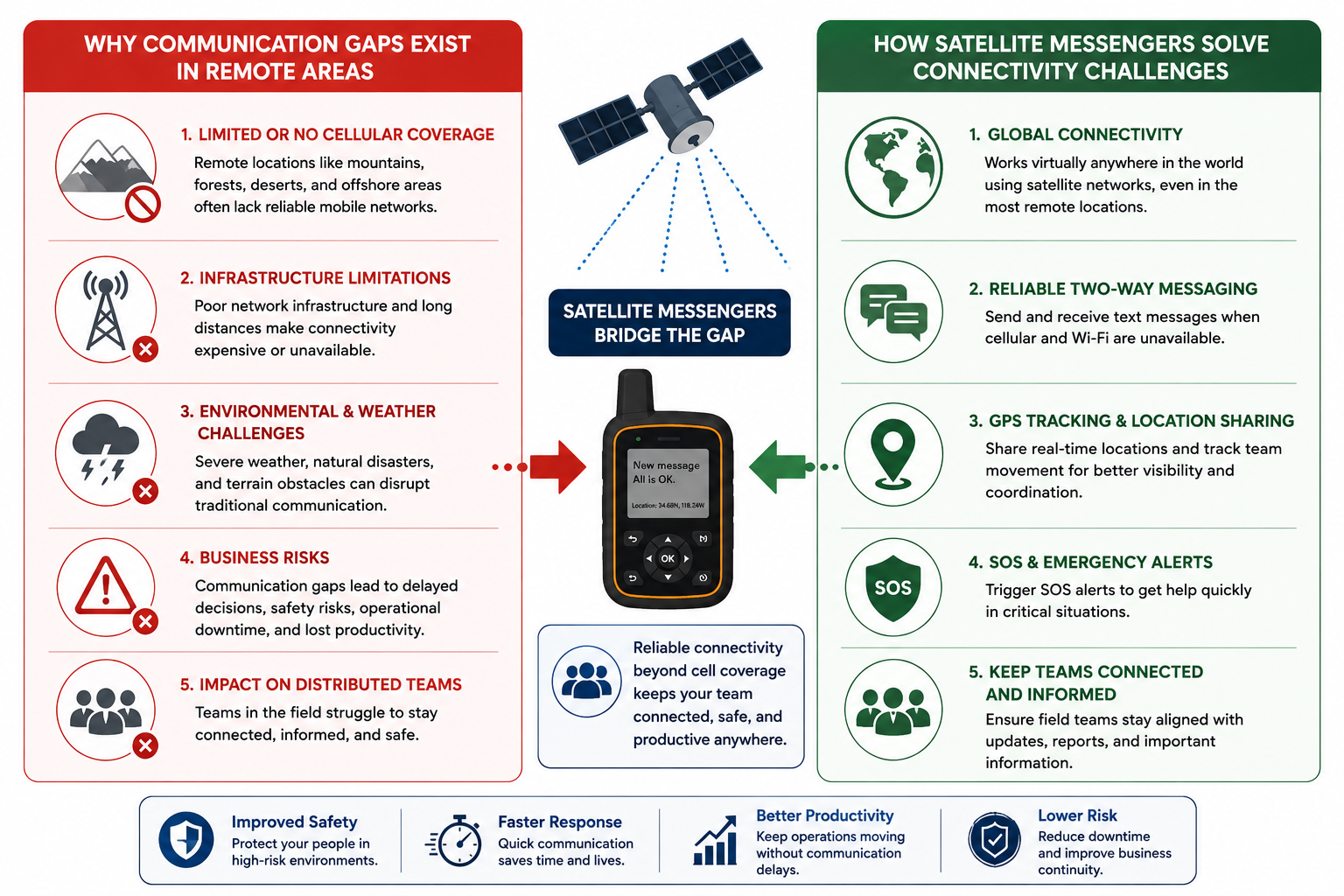
Why Communication Gaps Exist in Remote Areas and How Satellite Messengers Solve Connectivity Challenges for Distributed Teams
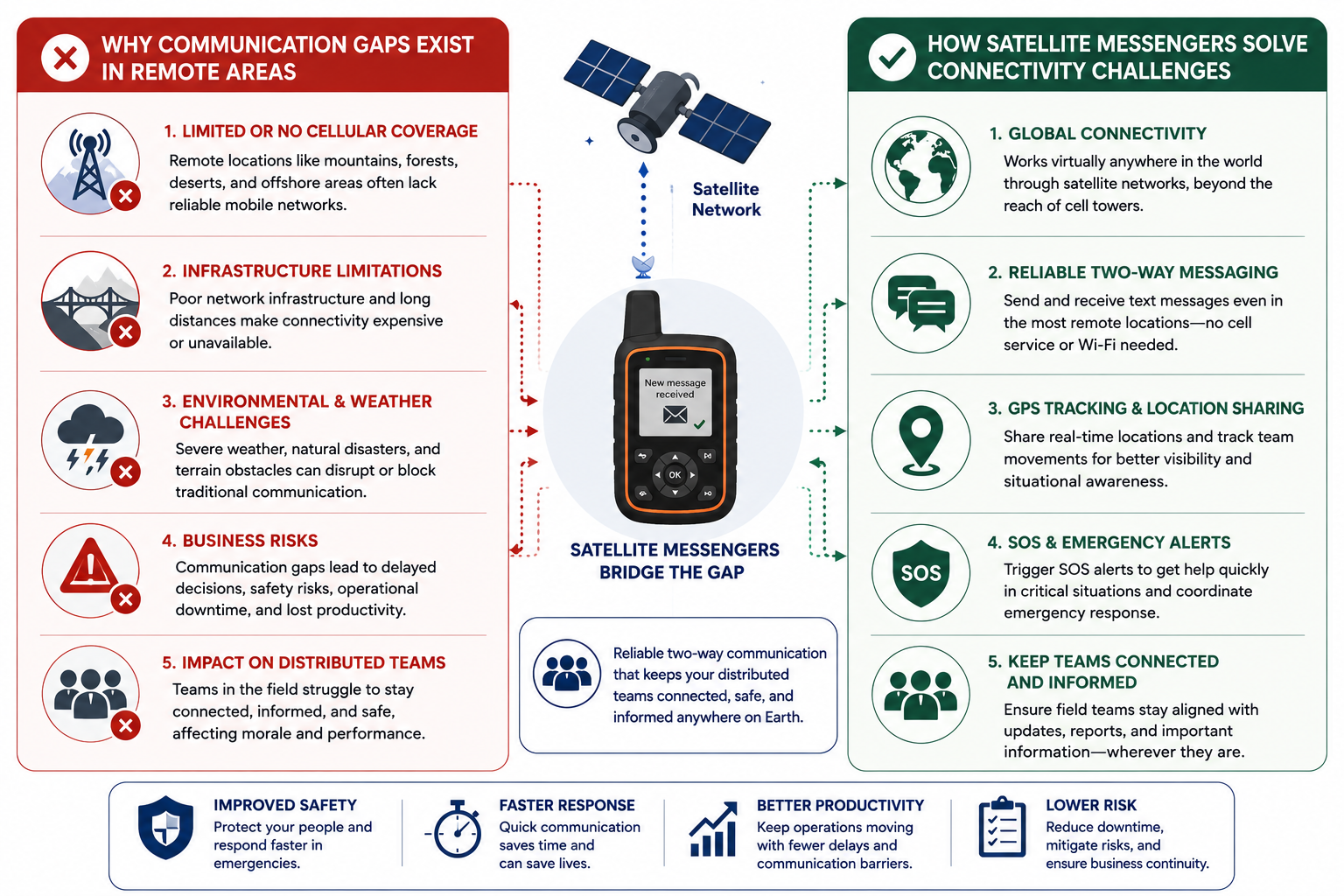
Why Communication Gaps Exist in Remote Areas and How Satellite Messengers Solve Connectivity Challenges for Distributed Teams
Challenges of Traditional Communication Networks in Remote and Isolated Locations
Communication gaps in remote areas are primarily caused by the limitations of traditional communication infr
astructure. Cellular networks rely on towers and ground-based systems, which are often unavailable or unreliable in isolated environments. This creates significant barriers for organizations that depend on real-time communication.
- Lack of mobile coverage in rural, mountainous, and undeveloped regions
- Difficult terrain such as mountains, forests, and deserts that block signal transmission
- Offshore and maritime operations far beyond cellular network reach
- Disaster-affected regions where infrastructure is damaged or completely unavailable
These challenges make it difficult for teams to stay connected, share updates, and respond quickly to changing conditions.
Business Risks of Poor Communication in Remote Work Environments
When communication breaks down, the impact on business operations can be serious.
Organizations operating in remote areas face increased risks that can affect safety, productivity, and overall performance.
- Delayed decision-making due to lack of real-time information
- Increased safety risks for workers without reliable communication tools
- Reduced operational efficiency caused by miscommunication or lack of updates
- Compliance and reporting challenges when data cannot be transmitted promptly
Understanding these risks highlights why investing in reliable communication solutions, such as satellite messengers for remote workforce communication, is critical for maintaining safe and efficient operations.
How Satellite Messengers Help Bridge Communication Gaps
Satellite messengers play a crucial role in ensuring communication remains uninterrupted in areas where traditional cellular networks fail. They provide global connectivity, allowing teams to stay in touch even in the most isolated locations.
This makes them especially valuable for organizations operating in remote environments, where reliable communication is essential for both productivity and safety.
- Global communication access across remote and hard-to-reach areas
- Reliable messaging in isolated locations without cellular coverage
These devices also support real-time coordination among distributed teams.
Field workers can easily communicate updates, report incidents, and stay aligned with project goals, ensuring smoother operations and faster decision-making.
- Enables seamless field worker communication
- Supports quick incident reporting
- Keeps teams updated on project progress
In addition to improving communication, satellite messengers significantly enhance worker safety and emergency response capabilities.
Features like SOS alerts and location tracking ensure that help can be dispatched quickly when needed, offering peace of mind for both employees and employers.
- SOS functionality for emergency situations
- Protection for lone workers in remote areas
- Coordination of emergency evacuations
Finally, satellite messengers contribute to business continuity by maintaining communication during unexpected disruptions.
Whether it's a natural disaster or a network outage, these devices help organizations stay operational and responsive.
Industries That Benefit Most from Satellite Messengers

Industries That Benefit Most from Satellite Messengers
Construction and Infrastructure Projects
Construction teams often operate in remote or developing areas where cellular coverage is limited or nonexistent.
Satellite messengers ensure that project managers, engineers, and field workers can stay connected, share updates, and respond quickly to issues.
- Enable real-time communication between job sites and headquarters
- Improve worker safety with SOS alerts and location tracking
- Support coordination across large or multi-site projects
- Reduce delays caused by communication breakdowns
Mining and Energy Operations
Mining sites and energy operations are frequently located in isolated regions, making reliable communication critical for both safety and productivity.
Satellite messengers provide a dependable way to stay connected in harsh environments.
- Ensure continuous communication in underground or remote locations
- Enhance emergency response capabilities for hazardous situations
- Support monitoring of remote equipment and operations
- Improve compliance with safety regulations
Transportation and Logistics
Logistics companies rely on consistent communication to track shipments and coordinate deliveries.
Satellite messengers help maintain visibility and communication even when vehicles travel through areas without cellular coverage.
- Provide real-time tracking of vehicles and shipments
- Enable drivers to communicate from remote routes
- Improve route planning and delivery efficiency
- Enhance safety for drivers in isolated areas
Maritime and Offshore Industries
Ships, oil rigs, and offshore platforms operate far beyond the reach of traditional networks.
Satellite messengers are essential for maintaining communication between crews and onshore teams.
- Enable communication across oceans and remote waters
- Support emergency alerts and distress signals
- Provide weather updates and navigation assistance
- Improve coordination between offshore and onshore operations
Emergency Services and Disaster Relief
During natural disasters or emergencies, communication infrastructure is often damaged or overloaded.
Satellite messengers provide a reliable backup to ensure responders can coordinate effectively.
- Maintain communication when networks fail
- Support search and rescue operations
- Enable rapid coordination between response teams
- Improve situational awareness in crisis environments
Environmental and Scientific Research Teams
Researchers working in remote environments such as forests, deserts, or polar regions depend on satellite messengers to stay connected and safe while collecting data.
- Allow researchers to send updates from isolated locations
- Provide emergency communication in extreme conditions
- Support tracking of team members in the field
- Enable data sharing with research institutions
Utilities and Field Service Organizations
Utility workers and field service teams often travel to remote sites to maintain infrastructure such as power lines, pipelines, and water systems. Satellite messengers help ensure they remain connected at all times.
- Enable communication during maintenance in remote areas
- Improve response times for outages and repairs
- Enhance worker safety with location tracking and alerts
- Support coordination between field teams and central offices
Satellite Messengers vs Traditional Communication Tools
| Feature | Satellite Messengers | Mobile Phones | Two-Way Radios |
| Global Coverage | ✓ | Limited | Limited |
| GPS Tracking | ✓ | Partial | No |
| SOS Alerts | ✓ | Limited | No |
| Internet Required | No | Yes | No |
| Long-Distance Communication | ✓ | Limited | Limited |
Key Benefits of Satellite Messengers for Distributed Teams
Increased Employee Safety
Satellite messengers play a critical role in protecting workers operating in remote or high-risk environments. With built-in SOS alerts and GPS tracking, employees can quickly signal for help in emergencies, ensuring faster rescue and support when it matters most.
These devices are especially valuable for lone workers who may not have immediate access to assistance.
By providing a direct line of communication to emergency services or central teams, satellite messengers significantly reduce response times and improve survival outcomes in critical situations.
In addition, organizations can set up automated check-ins and geofencing alerts to monitor worker safety proactively. If a worker fails to check in or enters a restricted area, alerts can be triggered instantly, allowing supervisors to take immediate action.
This level of safety oversight helps build a culture of accountability and ensures that employees feel supported, even in the most isolated environments.
Faster Incident Response
When incidents occur, time is everything.
Satellite messengers enable real-time communication between field workers and central teams, allowing organizations to respond quickly to accidents, equipment failures, or environmental hazards.
Instead of waiting for workers to return to areas with cellular coverage, teams can report issues instantly, minimizing delays and preventing situations from escalating.
Faster communication also allows organizations to coordinate emergency services more effectively.
Whether it's dispatching medical assistance, arranging evacuation, or mobilizing backup teams, satellite messengers ensure that the right information reaches the right people without delay.
This rapid response capability can significantly reduce downtime, limit damage, and protect both employees and assets.
Improved Workforce Productivity
Reliable communication helps teams stay aligned and reduces delays caused by lack of connectivity. Workers can send updates, receive instructions, and coordinate tasks efficiently, even in areas without cellular coverage.
This eliminates the need for unnecessary travel back to base locations just to report progress or receive new assignments.
With consistent communication, teams can make quicker decisions and adapt to changing conditions in real time. Managers can provide immediate feedback, clarify instructions, and ensure that projects stay on track.
This level of efficiency not only boosts productivity but also improves overall job satisfaction, as employees can perform their tasks without unnecessary interruptions or confusion.
Better Operational Visibility
With location tracking and regular status updates, managers gain better visibility into field operations. This helps improve planning, resource allocation, and overall decision-making across distributed teams.
Knowing where workers are and what tasks they are performing allows organizations to optimize workflows and reduce inefficiencies.
Enhanced visibility also supports data-driven decision-making.
By analyzing movement patterns, communication logs, and activity reports, organizations can identify trends, improve processes, and allocate resources more effectively. This leads to better project outcomes and a more streamlined approach to managing remote operations.
Reduced Communication Downtime
Unlike traditional communication tools that rely on cellular networks, satellite messengers provide consistent connectivity in remote areas. This reduces downtime and ensures that communication remains uninterrupted regardless of location.
Workers can stay connected even in the most challenging environments, including mountains, deserts, offshore locations, and disaster zones.
Reduced communication downtime means fewer disruptions to operations. Teams can continue working without waiting for signal availability, and critical updates can be shared instantly.
This reliability is essential for maintaining productivity and ensuring that operations run smoothly, even in unpredictable conditions.
Enhanced Compliance and Risk Management
Satellite messengers support compliance with safety regulations by enabling proper monitoring and reporting of field activities.
Organizations can track worker movements, document incidents, and maintain records that support audits and risk management strategies. This level of documentation is crucial for meeting industry standards and avoiding potential legal issues.
Additionally, having a reliable communication system in place demonstrates a commitment to employee safety and operational responsibility. Organizations can use satellite messengers to enforce safety protocols, conduct regular check-ins, and ensure that all activities are properly recorded.
This not only reduces risk but also strengthens trust among employees, stakeholders, and regulatory bodies.
How Satellite Messengers Complement Digital Workplace Platforms
Connecting Remote Workers to the Organization
Satellite messengers play a crucial role in keeping remote workers connected to the wider organization, especially when they are operating far beyond cellular coverage.
These devices ensure that employees in isolated environments can still communicate with headquarters, receive updates, and stay aligned with company goals.
- Enable two-way communication between field workers and office teams
- Provide location tracking to improve visibility of remote staff
- Allow workers to send updates even in areas without internet access
By bridging the communication gap, satellite messengers help remote employees feel more connected, engaged, and supported, reducing isolation and improving overall productivity.
Integrating Field Communications with Centralized Systems
Integrating satellite messenger data with centralized workplace platforms allows organizations to streamline communication and improve operational efficiency.
Instead of siloed communication channels, businesses can bring field updates into a single system for better coordination.
- Sync field messages with internal communication platforms
- Centralize incident reports and updates in one dashboard
- Improve coordination between field teams and management
This integration ensures that critical information flows seamlessly across the organization, enabling faster decision-making and reducing delays caused by disconnected systems.
Sharing Critical Updates Across Teams
Satellite messengers make it possible to share important updates with teams regardless of their location. Whether it's a safety alert, weather warning, or operational change, timely communication is essential for maintaining efficiency and safety.
- Send urgent alerts to remote workers instantly
- Share project updates across distributed teams
- Ensure consistent communication across all locations
With reliable communication in place, organizations can ensure that everyone stays informed, reducing misunderstandings and improving team alignment.
Supporting Knowledge Sharing and Reporting
Effective knowledge sharing is essential for continuous improvement and operational success.
Satellite messengers allow field workers to report issues, share insights, and contribute valuable data back to the organization.
- Enable real-time reporting from remote locations
- Capture field data for analysis and improvement
- Support documentation of incidents and observations
This flow of information helps organizations learn from on-the-ground experiences, improve processes, and make data-driven decisions.
Creating a Unified Communication Strategy
Combining satellite messengers with digital workplace platforms helps organizations build a unified communication strategy that covers both remote and office-based employees.
This ensures consistency, reliability, and efficiency across all communication channels.
- Align communication tools across all teams
- Ensure consistent messaging across locations
- Improve collaboration between remote and central teams
A unified approach reduces communication gaps, enhances collaboration, and supports a more connected and resilient workforce.
Best Practices for Implementing Satellite Communication Solutions
Assess Operational Risks
Before deploying satellite messengers, organizations should take time to evaluate the specific risks associated with their operations.
Understanding potential hazards helps determine where communication gaps exist and how satellite solutions can mitigate those risks effectively.
- Identify environments where communication failure could lead to safety incidents
- Evaluate the likelihood of emergencies such as weather events, equipment failure, or isolation
- Analyze past incidents to understand communication breakdowns
- Determine which roles or teams are most exposed to risk
- Align communication tools with overall risk management strategies
Identify High-Risk Locations
Pinpointing high-risk locations ensures that satellite communication devices are deployed where they are needed most.
This step is critical for maximizing coverage and ensuring worker safety in remote or hazardous environments.
- Map out remote worksites, offshore locations, and isolated regions
- Identify areas with poor or no cellular coverage
- Prioritize locations with high employee density or hazardous conditions
- Consider seasonal risks such as extreme weather or natural disasters
- Continuously update location data as operations expand or shift
Train Employees on Emergency Procedures
Providing proper training ensures that employees know how to use satellite messengers effectively, especially during emergencies.
Clear understanding reduces panic and improves response times when incidents occur.
- Conduct hands-on training sessions for device usage
- Educate employees on SOS features and emergency protocols
- Provide clear instructions for sending and receiving messages
- Run emergency drills to simulate real-life scenarios
- Offer refresher training to maintain readiness
Establish Communication Protocols
Clear communication protocols help standardize how information is shared across teams, ensuring consistency and reliability.
This is especially important when coordinating between remote workers and central operations.
- Define when and how satellite devices should be used
- Establish escalation procedures for emergencies
- Set guidelines for regular check-ins and status updates
- Assign communication responsibilities to specific roles
- Document protocols and make them easily accessible
Integrate Communication Workflows
Satellite messengers should not operate in isolation.
Integrating them into existing communication workflows ensures seamless coordination between field teams and office-based staff.
- Connect satellite messaging with internal communication platforms
- Ensure data from field devices is shared with central systems
- Align satellite communication with reporting and documentation processes
- Enable real-time updates between remote workers and management
- Use centralized platforms like AgilityPortal to unify communication channels
Regularly Test Devices and Emergency Systems
Routine testing ensures that satellite communication devices function properly when needed.
Regular checks help identify issues early and maintain reliability in critical situations.
- Schedule periodic device inspections and functionality tests
- Test SOS alerts and emergency response systems
- Verify battery life and charging procedures
- Update firmware and software regularly
- Encourage employees to report any device issues immediately
Common Challenges and Limitations of Satellite Messengers
Device Costs
Satellite messengers can be expensive upfront, with most devices ranging between $150 and $500 as of 2024. Premium models with advanced GPS tracking and two-way messaging capabilities can exceed $600.
For organizations deploying devices across large teams, these costs can quickly add up, especially when scaling operations in remote environments.
Subscription Fees
In addition to hardware costs, satellite messengers require ongoing subscription plans.
Monthly fees typically range from $15 to $65 per device depending on usage, messaging limits, and coverage areas.
According to industry reports from 2023, businesses managing fleets of 50+ devices can spend thousands annually on connectivity alone, making cost management an important consideration.
Weather and Environmental Factors
Although satellite communication is generally reliable, extreme weather conditions such as heavy storms, dense forest canopies, or mountainous terrain can occasionally interfere with signal strength.
Studies from Iridium Communications in 2022 showed that signal interruptions, while rare, can occur in less than 2% of transmissions in highly obstructed environments.
Message Transmission Delays
Unlike cellular networks, satellite messengers may experience slight delays in message delivery.
Depending on satellite positioning and network traffic, messages can take anywhere from a few seconds to several minutes to send or receive. In critical situations, even small delays can impact response times, which organizations must factor into their communication protocols.
User Training Requirements
Effective use of satellite messengers requires proper training.
Employees must understand how to send messages, trigger SOS alerts, and interpret GPS data.
According to a 2023 workforce safety report, organizations that implemented structured training programs saw a 35% improvement in emergency response efficiency compared to those without formal training.
Future Trends in Remote Workforce Communication
Direct-to-Device Satellite Connectivity
Smartphones are starting to connect directly to satellites, reducing the need for dedicated devices and expanding coverage.
This emerging capability is transforming how remote workers stay connected, especially in areas where traditional cellular networks are unreliable or nonexistent.
With major technology providers investing heavily in satellite-to-phone integration, employees will soon be able to send messages, share locations, and even access limited data services without needing specialized hardware. This shift not only simplifies communication but also reduces costs associated with purchasing and maintaining separate satellite devices.
As this technology evolves, organizations can expect improved accessibility for frontline workers, faster onboarding, and more seamless communication experiences.
It also opens the door for broader adoption across industries that previously relied on expensive or complex communication setups.
- Eliminates the need for separate satellite devices
- Expands communication access to more workers
- Reduces operational and equipment costs
- Simplifies deployment and training
AI-Driven Safety and Predictive Alerts
AI helps detect risks, send alerts, and improve emergency response for remote workers.
By analyzing real-time data from devices, sensors, and communication patterns, artificial intelligence can identify potential hazards before they escalate into serious incidents. For example, AI systems can monitor worker movement, environmental conditions, and behavioral patterns to detect anomalies such as prolonged inactivity or entry into restricted zones.
This proactive approach allows organizations to shift from reactive safety measures to predictive risk management.
Alerts can be automatically triggered and sent to supervisors or emergency teams, ensuring faster response times and potentially saving lives. Over time, AI systems also learn from past incidents, continuously improving their accuracy and effectiveness.
- Detects risks before incidents occur
- Automates emergency alerts and notifications
- Improves response times and decision-making
- Enhances overall workplace safety strategies
Real-Time Location Intelligence and Geofencing
GPS tracking and geofencing allow teams to monitor locations and receive alerts in high-risk areas.
These technologies provide organizations with real-time visibility into where their employees are, which is especially critical for workers operating in remote or hazardous environments. Geofencing enables the creation of virtual boundaries, triggering alerts when workers enter or exit designated zones.
This level of location intelligence helps improve operational efficiency, ensure compliance with safety protocols, and enhance emergency response coordination.
Managers can quickly identify worker locations during incidents, dispatch assistance, and monitor movement patterns to optimize workflows. Additionally, historical location data can be used for reporting, auditing, and continuous improvement.
- Provides real-time visibility of worker locations
- Triggers alerts for high-risk or restricted areas
- Supports faster emergency response coordination
- Improves compliance and operational oversight
Unified Communication Platforms for Distributed Teams
ntegrated platforms combine messaging, tasks, and collaboration to connect field and office teams.
As organizations become more distributed, the need for a centralized communication hub becomes increasingly important. Unified platforms bring together various tools such as messaging, document sharing, task management, and announcements into a single interface, reducing fragmentation and improving efficiency.
These platforms enable seamless communication between remote workers and office-based teams, ensuring that everyone stays aligned regardless of location.
They also support better knowledge sharing, streamline workflows, and enhance productivity. When integrated with satellite communication tools, unified platforms create a powerful ecosystem that ensures connectivity even in the most remote environments.
- Centralizes communication and collaboration tools
- Improves alignment between field and office teams
- Enhances productivity and workflow efficiency
- Supports knowledge sharing and documentation
Hybrid Communication Ecosystems
Combining satellite, cellular, and Wi-Fi ensures reliable communication even during outages.
Hybrid communication ecosystems leverage multiple connectivity options to provide continuous coverage, reducing the risk of communication breakdowns. When one network fails or becomes unavailable, systems can automatically switch to another, ensuring uninterrupted communication for remote teams.
This approach is particularly valuable in industries where downtime can lead to safety risks or operational disruptions. By integrating different communication technologies, organizations can build resilient systems that adapt to changing conditions.
Hybrid ecosystems also allow businesses to optimize costs by using the most efficient network available at any given time.
- Ensures continuous communication across networks
- Reduces risk of outages and disruptions
- Enhances system reliability and resilience
- Optimizes connectivity costs and performance
Final Thoughts
As organizations continue expanding operations into remote locations, maintaining reliable communication becomes increasingly important.
Satellite messengers help bridge communication gaps in remote areas by providing dependable connectivity, improving worker safety, supporting emergency response, and ensuring distributed teams remain connected.
When combined with digital workplace platforms such as AgilityPortal, organizations can create a complete communication strategy that supports both frontline and office-based teams.
AI Summary
- Satellite messengers help organizations bridge communication gaps in remote areas where cellular networks, Wi-Fi, and traditional communication infrastructure are unreliable or unavailable.
- These devices use satellite networks to support two-way messaging, GPS tracking, SOS alerts, location sharing, and emergency communication for distributed teams working in isolated environments.
- Industries such as construction, mining, energy, logistics, maritime, utilities, emergency response, and environmental research benefit from satellite messengers because they often operate beyond standard network coverage.
- For remote workers and field teams, satellite messengers improve employee safety, reduce communication downtime, speed up incident response, and provide better operational visibility across hard-to-reach locations.
- Satellite messengers are not a full replacement for digital workplace platforms, but they complement tools like AgilityPortal by keeping remote workers connected to centralized communication, documentation, announcements, and reporting systems.
- Building a reliable remote workforce communication strategy means combining satellite connectivity, clear communication protocols, employee training, emergency workflows, and a centralized platform for sharing updates across the organization.
Most Popular Posts

Effective communication among team members is vital for the productivity and success of any organization. Surprisingly, 60% of companies lack a long-term internal communication strategy, which p...


Businesses thrive on communication for efficiency, productivity and accomplishment. When the right information is passed from the right designation in the organization, it promotes positivity an...

Categories
Blog
(3174)
Business Management
(392)
Employee Engagement
(234)
Digital Transformation
(214)
Growth
(149)
Intranets
(141)
Internal communications
(106)
Remote Work
(68)
Sales
(53)
Collaboration
(52)
Customer Experience
(32)
Culture
(30)
Knowledge Management
(29)
Project management
(29)
Leadership
(20)
Comparisons
(9)
News
(1)

Related Posts

Cyber Essentials is often described as a technical certification, but it is really a practical test of whether a business has the basics under control. That matters because cyber incidents rarely stay inside the IT department. They can interrupt payr...

Outsourced IT support becomes worth considering when technology problems stop being minor inconveniences and begin affecting how the business operates. A slow laptop or one-off password reset is manageable. But recurring downtime, unresolved support ...

An intranet network example in business could be as simple as a central employee hub where people find company policies, announcements, forms, training, documents and team updates. In practice, managing it well takes more than putting files beh...

Could your employees still find the policies, forms and information they rely on if your intranet moved to a new Microsoft 365 tenant tomorrow? An intranet migration can sound simple on a project plan: move sites, documents and user access from one M...

When Should You Hire IT Consulting Companies? 9 Costly Warning Signs Growing Businesses Can’t Ignore
Is Your Business Growing Faster Than Its IT Can Handle? Is your business growing faster than the systems, support and people behind it can keep up? It is an easy problem to miss at first. A few slow laptops, another spreadsheet workaround, or o...


Jill Romford
I am a digital nomad, lover of exploring new places and making friends.
I love to travel and I love the internet. I take pictures of my travels and share them on the internet using Instagram.
Traveler, entrepreneur, and community builder. I share my insights on digital marketing and social media while inspiring you to live your fullest life.
Ready to learn more? 👍
One platform to optimize, manage and track all of your teams. Your new digital workplace is a click away. 🚀
Free for 14 days, no credit card required.