
Insight Blog
Agility’s perspectives on transforming the employee's experience throughout remote transformation using connected enterprise tools.
40 minutes reading time
(7937 words)
In-House Marketing vs Agency: Costs, Pros, Cons Which is for you?

In-House Marketing vs Agency: Costs, Pros, Cons Which is for you?
Compare in-house marketing vs agency costs, pros and cons. Explore hidden expenses, practical examples and a checklist to choose the right setup.
In-House Marketing vs Agency: Costs, Pros, Cons Which is for you?

In-house marketing vs agency—where should you put your budget to give your business the best chance of growth?
Hiring your own marketer can bring valuable brand knowledge into the business. Working with an agency can give you access to specialist skills. The challenge is finding the right mix of expertise for your workload, budget and business goals.
Hiring your own marketer can bring valuable brand knowledge into the business.
Working with an agency can give you access to specialist skills. Both sound promising, but which option can actually deliver the work you need at a cost you can sustain?
That pressure is real.
Gartner's 2026 CMO Spend Survey found that 56% of surveyed chief marketing officers said they lacked the budget to deliver their strategy. The research mainly represented large businesses, so it provides context rather than a small-business spending benchmark.
56%:
of surveyed CMOs said their marketing organisation lacked
the budget needed to deliver its 2026 strategy
Check what your budget can actually deliver. When comparing in-house marketing vs agency, look beyond salary and retainer fees. Include software, onboarding, specialist support and management time, then check how much remains available to fund the campaigns themselves.
Survey context: Gartner surveyed 401 CMOs and other marketing leaders between January and March 2026 across North America, the UK and Europe. Most represented businesses with annual revenue above $1 billion. This is large-company context, not a small-business budget benchmark.
Source: Gartner — 2026 CMO Spend Survey, published 11 May 2026
The expensive mistake is committing your budget before understanding what you're getting.
A salary may leave you needing additional specialists, while an agency retainer may exclude essential work. Either way, overlooked costs can leave less money for the campaigns you wanted to run.
Before deciding, focus on three things:
- The full cost: Include recruitment, tools, management time and additional fees.
- The skills and capacity: Check who will do the work and whether they can handle your priorities.
- Ownership and accountability: Establish who controls your accounts, approves decisions and measures results.
In this article, we'll compare the costs, pros and cons of in-house and agency marketing, explain when a hybrid approach makes sense, and share a practical checklist to help you choose a setup that fits your business.
Key Takeaways
- In-house marketing vs agency is a decision about workload, skills, budget and management capacity. Neither option is the best fit for every business.
- Compare the full cost of delivering the same work, including employment costs, agency extras, software, specialist support and internal management time.
- An in-house marketer can provide ongoing ownership and close business knowledge, but one generalist cannot cover every marketing discipline.
- An agency can fill specialist skills gaps or provide additional capacity. A hybrid model combines internal ownership with selected external support.
- Whichever setup you choose, appoint an internal owner, agree measurable objectives and confirm access to accounts, files and data before work begins.
Should You Build a Marketing Team or Hire an Agency?

Should You Build a Marketing Team or Hire an Agency
As your business grows, marketing can become too much for the founder or a handful of employees to manage alongside their other responsibilities.
You need more support—but should you hire internally or bring in an agency?
The in-house marketing vs agency debate centres on a practical trade-off: building dedicated knowledge and capacity inside your business versus paying an external team for an agreed mix of expertise and delivery.
The decision becomes clearer when you look at your actual workload.
Do you need someone involved in the business every day, or specialist help with specific campaigns?
Can you support a full-time role, and who will manage the work?
Start with those questions. They give you a stronger basis for comparing the options than salary and agency fees alone.
In-House Marketing vs Agency: What's the Main Difference?
In-house marketing means your employees manage and carry out your marketing. Agency marketing means hiring an external company to deliver an agreed scope of work.
The main differences come down to who does the work, how you manage priorities, what you pay for and where business knowledge sits.
When comparing in-house marketing vs agency, think about how each arrangement would work day to day.
An employee can work closely with your sales and product teams, building an understanding of your customers. An agency develops that understanding through research, briefing and ongoing access to your people.
Neither option guarantees better results.
An internal team needs the right skills, resources and direction. An agency needs a clear brief, realistic expectations and someone inside your business who can make decisions.
Here's how the two approaches compare:
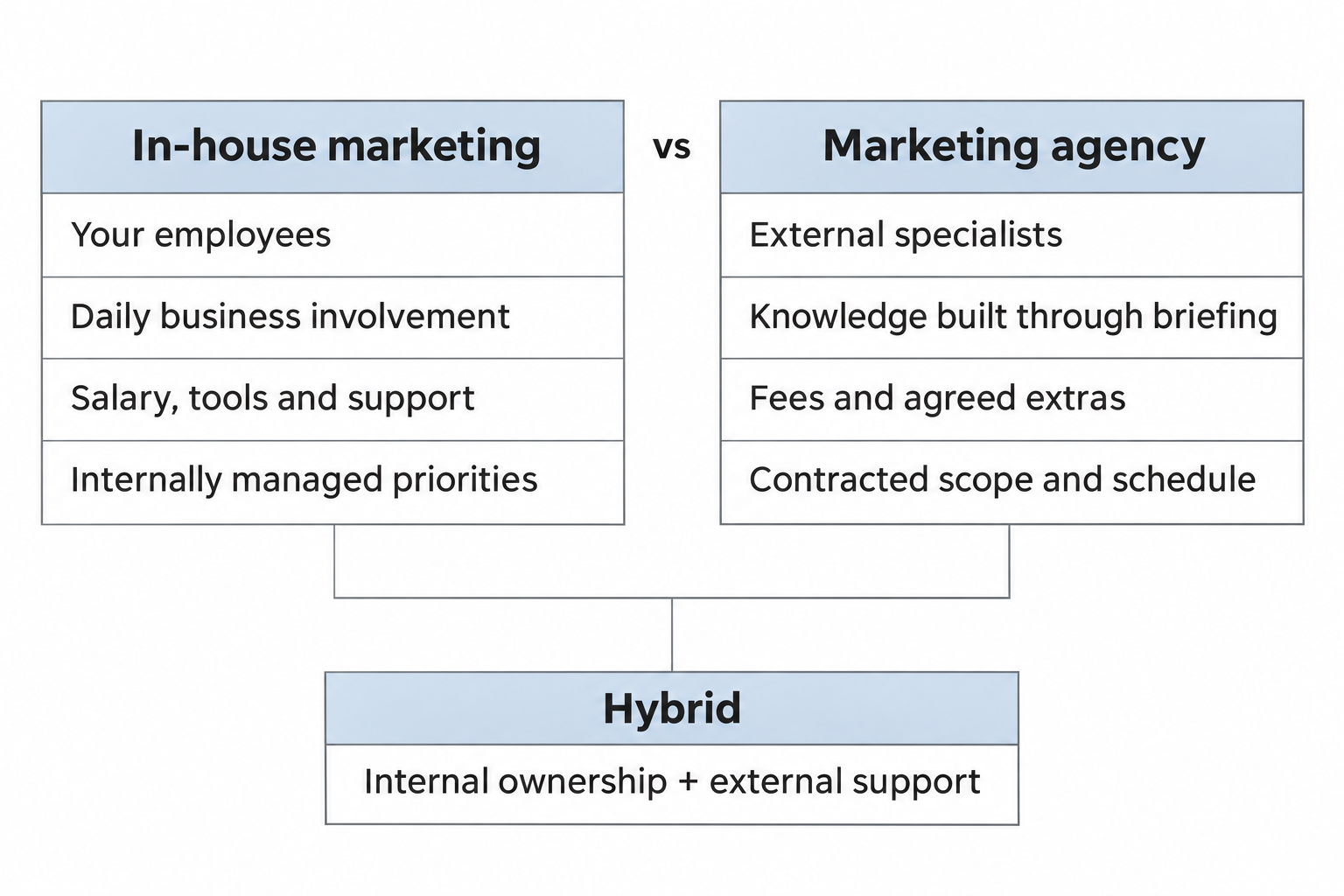
In-House Marketing vs Agency: What's the Main Difference?
| Factor | In-house team | Marketing agency |
| Brand knowledge | Builds through daily involvement with your business, customers and colleagues. | Develops through research, access to your team and regular briefing. |
| Skills | Depends on the employees you hire and the training they receive. | Depends on the agency's expertise and the people assigned to your account. |
| Costs | Includes employment, recruitment, software, training and management. | Includes agreed fees, additional work and internal coordination time. |
| Priorities | Managed through internal reporting lines and business decisions. | Managed through the contract, agreed scope and delivery schedule. |
| Capacity | Depends on team size, workload and availability. | Depends on contracted resources, workload and availability. |
| Continuity | Requires cover for absence, staff turnover and documented processes. | Requires consistent account staffing, clear documentation and effective handovers. |
You can also combine the two through a hybrid marketing model.
For example, an internal marketing manager might own strategy, customer knowledge and approvals while an agency handles specialist SEO or paid advertising.
The right choice depends on the work you need doing, the skills you already have and the time you can commit to managing delivery.
How Much Does In-House Marketing vs an Agency Really Cost?
Comparing a marketer's salary with an agency's monthly retainer gives you only part of the picture.
Both options come with costs beyond the headline price, including software, management time and additional specialist support.
A useful comparison covers the same work, quality expectations and time period. If an employee's workload includes content, email and sales support, while an agency quote covers only SEO, the prices are measuring different things.
When weighing up in house marketing vs agency pros and cons, start with the full cost of getting the work done.
What to Include in the Cost of an In-House Team
An employee's salary is the starting point.
Your budget should also account for:
- Employer costs - Relevant employment taxes, pension contributions and benefits.
- Recruitment and onboarding - Advertising, recruitment fees, interview time and initial training.
- Software and equipment - A computer, design tools, analytics platforms and other subscriptions.
- Training and development - Time and resources to maintain the skills the role requires.
- Management and supervision - Setting priorities, reviewing work and supporting performance.
- External specialists - Freelancers or agencies needed for tasks beyond the team's expertise or capacity.
- Cover and continuity - Support during absences, vacancies and busy periods.
Check what one person can realistically deliver.
A marketer who manages strategy, writes content, runs advertising and produces reports has to divide their time between those responsibilities.
What to Include in Agency Costs
An agency quote also needs a closer look. Ask what is included, what costs extra and how changes to the scope are handled.
Include the following in your comparison:
- Retainer or project fees - The agreed charge for defined services and deliverables.
- Setup and onboarding - Initial research, account configuration, audits and strategy work.
- Excluded deliverables - Copywriting, design, development or other services outside the agreement.
- Additional revisions - Charges for changes beyond the included review rounds.
- Internal coordination - Your team's time spent briefing, approving and providing information.
- Handover and exit costs - Any charges for transferring assets, documenting work or ending the agreement.
Confirm whether advertising management fees include media spend. Also establish who owns the advertising accounts, creative files and reporting data.
Compare Both Options Using the Same Scope
Practical in house marketing vs agency examples help show why the cheapest headline price may not produce the lowest total cost.
Imagine a business needs the following every month:
- Four researched articles, including editing and publication.
- SEO monitoring, recommendations and agreed implementation.
- Management of two paid advertising campaigns.
- A performance report and review meeting.
The table below shows three possible arrangements. All figures are illustrative assumptions in GBP, not salary benchmarks or agency quotations.
The example covers 12 months, excludes VAT and keeps advertising spend separate.
| Cost or delivery factor | In-house | Agency | Hybrid |
| Staffing or service arrangement | One full-time marketer, with occasional specialist support | Agency contracted to deliver the defined scope | Part-time internal marketer coordinating a specialist agency |
| Salary allocation | Around $40,000 | $0 | Around $24,000 |
| Employer costs and benefits | $8,000 assumed allowance | $0 | Around $4,800 assumed allowance |
| Recruitment and onboarding | Around $3,000 | $2,000 agency setup fee | $2,000 recruitment plus $1,000 agency setup |
| Tools, equipment and training | Around $4,000 | $1,200 in client-side costs | $2,000 |
| Agency or freelance support | Around $8,000 | $24,000 annual retainer | $24,000 annual retainer |
| Internal management and coordination time | Around $6,000 estimated time cost | $6,000 estimated time cost | $3,000 estimated time cost |
| Illustrative first-year total | Around $69,000 | Around $45,000 | Around $60,800 |
| Deliverables | Target scope must fit the employee's skills, working hours and specialist support budget | Target scope must be written into the agreement, including implementation and revisions | Responsibilities must be divided clearly to cover the target scope |
| Available capacity | One full-time role plus a limited specialist budget; absence reduces availability | Contracted deliverables or hours; additional work may cost extra | Part-time internal capacity plus contracted specialist delivery |
One thing for sure is these assumptions make the agency arrangement cheaper in the first year. Different salaries, fees, workloads or support requirements could change the result.
The in-house role may also provide capacity for work outside this example, while the agency's commitment depends on its contract.
The totals include an estimated value for internal coordination time. That helps compare the resources each option consumes, although it may represent existing staff time rather than an additional cash payment.
Advertising spend should sit on a separate line. If the business allocates $2,000 a month to advertising, add the same $24,000 annual media budget to each option when comparing the same campaign scope.
Before deciding, ask each potential hire or provider how they would deliver the workload, what support they would need and what would happen during a busy month.
A cheaper arrangement can still be poor value if it leaves essential work unfinished. Compare the full cost with the skills, capacity and deliverables you will actually receive.
What Are the Pros and Cons of In-House Marketing?
Having someone inside your business who understands your customers, knows your products and can join a quick conversation with sales sounds useful—and it can be. But before you hire, think about what you'll ask that person to do and what support they'll need.
You might need one marketer, a small team or an in-house agency: an internal department that provides creative and marketing services across the business. An in-house advertising agency has a more specific focus on planning, creating and managing advertising.
Whichever setup you're considering, here's where it can help—and where you could run into trouble.
Advantages of Building an Internal Team
Your marketer can stay close to the people who know your customers.
Imagine your sales team keeps hearing the same question: "How difficult is it to move from our current system?"
Your marketer can speak to the salesperson, find out what worries the customer and ask the product team how migration works.
That conversation could become a practical guide, a customer email or a resource sales can use on their next call.
Being close to those discussions gives your marketer useful context. It also helps them spot when the message on your website doesn't match what customers need to hear.
Business knowledge builds over time.
Over time, an internal marketer can learn the details that make your content more useful: why customers buy, what slows a sale and which product claims need explaining carefully.
They can build relationships with colleagues who have the answers, too.
You'll get more value from that knowledge when it becomes something others can use.
Encourage your team to maintain:
- Customer questions and objections, with approved answers.
- Brand guidelines and examples of effective content.
- Campaign results, including what underperformed and why.
- Product notes, customer stories and reusable sales materials.
This gives the next employee a starting point and reduces the chance of useful knowledge leaving with one person.
You have a direct say in priorities—but you still need to protect people's time.
If a launch moves forward, you can discuss the change with your marketer and agree what needs to happen.
That direct access can be helpful when several departments need to coordinate their work.
The catch is that every department may start treating marketing as an on-demand service. Sales wants a presentation, HR needs a recruitment campaign and the founder has an idea for tomorrow.
Someone needs to decide what takes priority and what can wait. Otherwise, your dedicated marketer can spend the week reacting to requests while the planned work sits untouched.
You can dedicate capacity to recurring work.
Newsletters, product updates, case studies and sales materials need regular attention.
An internal role can give those responsibilities a home, with someone who follows the work through and improves the process over time.
Before hiring, check how much work you actually have.
A steady workload may support a permanent role; occasional projects may leave you paying for capacity you don't need. Think about quiet periods as well as your busiest month.
Limitations to Plan For
Hiring one person won't give you every marketing skill.
It's tempting to write a job description that includes content, design, SEO, paid advertising, email, video and reporting. But the more disciplines you expect one person to cover, the more carefully you need to assess their strengths.
A good content marketer might need help fixing technical website issues. Someone experienced in advertising may need an editor or designer.
Before you recruit, separate the work into three groups:
- Essential skills: What the person must be able to do confidently from the start.
- Skills they can develop: Tasks where training and practice are realistic.
- Specialist support: Work you'll pay someone else to handle.
That makes the role easier to hire for and gives you a more honest picture of its total cost.
You'll need to manage the person as well as fund the role.
A new marketer will need access to your customers, systems and colleagues.
They'll also need to understand your sales process, business goals and approval requirements before they can make informed decisions.
Be honest about who will provide that support. If nobody has time to brief them, review their work or resolve competing requests, hiring can leave you with another person waiting for direction. Agree who manages the role and what success should look like before their first day.
Absence and turnover can expose weak processes.
Think about what would happen if your marketer were unavailable next Monday.
Could someone find the campaign files, access the advertising accounts and see what is due to be published?
If the answer is no, you have a continuity problem.Build shared access and documentation into everyday work, including a publishing calendar, account ownership records and instructions for recurring tasks. You don't need to document every click, but another person should be able to keep essential work moving.
Outside support may still be necessary.
Even a capable internal team can face projects beyond its experience or available time. A website rebuild, technical audit or major video campaign may justify bringing in a specialist.
Set aside a budget for those situations and involve your marketer in choosing the support.
They can explain the brief, provide business context and help assess the work. Expecting them to learn every specialist discipline while maintaining their normal workload can create delays and frustration.
A Practical Example: Frequent Product Updates
Suppose your software business releases improvements every few weeks.
Each release needs customer emails, website changes, release notes and information for sales. Someone also needs to check that the messaging explains what customers can do with the update.
An internal marketer could work closely with product and sales colleagues to coordinate that process. They might attend a release planning meeting, ask for a demonstration and identify which changes deserve a full campaign.
Their responsibilities could include:
- Gathering accurate information from the product team.
- Turning technical details into clear customer benefits.
- Coordinating emails, website copy and sales materials.
- Reviewing customer questions after the release.
You could still use an external designer for a launch video or a specialist for technical SEO. In this scenario, the internal marketer provides ongoing ownership while outside support fills specific gaps.
Before hiring, write down the work you need done each month.
Estimate the time involved, identify the skills required and decide who will manage it. You'll have a much clearer idea of whether an internal role fits—and what help that person will need to succeed.
When Does In-House Marketing Make More Sense?
In-house marketing starts to make sense when you have a steady workload, need close involvement with the business and can support the person you hire.
Before committing, look at what needs doing during an ordinary month—not just your busiest launch.
These are the signs worth paying attention to.
You Have Enough Recurring Work to Support the Role
If newsletters, product updates, customer stories and sales materials regularly get pushed aside, you may need someone dedicated to keeping them moving.
An internal marketer can take ownership, plan ahead and improve the process as they learn.
But check whether that workload matches the role you're creating. Several hours of specialist advertising work each month won't necessarily justify a full-time advertising hire.
Write down:
- Which tasks happen every week or month.
- How much time they realistically require.
- Which skills are needed to complete them.
- What work will remain during quieter periods.
That gives you a stronger hiring case than a long list of jobs you've been meaning to get around to.
Your Marketing Depends on Daily Access to Internal Knowledge
Some marketing needs frequent conversations with product, sales, operations or customer support. Perhaps your services are complex, your products change often or customer questions require detailed answers.
In those situations, an internal marketer can become part of the conversations that shape the work.
They can ask follow-up questions, check a claim with the right colleague and understand why a particular issue matters to customers.
That access still needs organising. Hiring someone internally won't help much if the people with the answers are never available.
Someone Can Give Marketing Clear Direction
Who will manage your new marketer?
It's a question worth answering before you start interviewing.
They'll need agreed objectives, useful feedback and someone who can resolve competing requests. Without that support, they could spend their time responding to whichever department asks most loudly.
You should be able to identify:
- A manager: Someone responsible for priorities, support and performance.
- An approver: Someone authorised to sign off work without unnecessary delays.
- A business goal: A clear outcome the marketing work should contribute towards.
One person may cover those responsibilities, but they need the time and judgement to do so.
You Can Fund the Role and the Resources Around It
eing able to pay a salary is only the starting point. Your marketer may also need software, training, equipment and occasional specialist support.
Think about what happens after you make the hire.
Is there still money available to run campaigns, produce materials and fix website problems? A stretched budget can leave you with a capable employee who lacks the resources to deliver.
Build the full cost into your plan, including recruitment and employer costs.
Then check whether you can sustain it through quieter trading periods as well as stronger ones.
You Want to Build Internal Capability Over Time
An internal team can be a useful investment when you want customer knowledge, campaign experience and working processes to accumulate within your business.
For that to happen, give your marketer time to document what they learn. Customer insights, content guidelines, campaign results and account records should become shared resources. Otherwise, much of that knowledge may leave when the employee does.
You can build gradually, too. Your first hire might own content and coordination while external specialists handle work that requires deeper expertise.
Hiring one generalist does not create a complete marketing department. Choose the responsibilities that matter most, be realistic about capacity and budget for the gaps. In-house marketing is a stronger choice when you can give someone a well-defined role and the support to succeed.
When Is a Marketing Agency the Better Fit?
A marketing agency can be a good fit when you know what needs doing but don't have the skills or capacity to deliver it internally.
Perhaps your website needs specialist attention, a launch is approaching or your team is already stretched.
The useful question is: what specific gap would an agency fill?
Being clear about that makes it easier to choose a provider and judge whether the relationship is working.
You Have a Defined Project That Needs Specialist Skills
Imagine you're rebuilding your website. You might need research, copywriting, design, development and SEO support within the same project.
Hiring permanent employees for every discipline may be difficult to justify once the website is finished.
An agency could bring those skills together for an agreed scope and timeframe.
Before signing, ask who will handle each part, what you need to provide and whether implementation is included. A strategy document and a completed project are very different deliverables.
The Work Doesn't Justify a Full-Time Hire
You may need specialist help every month without having enough work to support a permanent role.
That's where outsourced marketing can make sense.
For example, your business might need someone to manage advertising campaigns, review performance and recommend improvements. If that work only requires part of someone's working week, external support could provide suitable capacity.
When comparing providers, check:
- Which tasks and deliverables the fee covers.
- Who will work on your account.
- How additional requests are priced.
- Whether there is a minimum contract or notice period.
For anyone considering outsourced marketing for small business, those details matter as much as the monthly fee.
A manageable retainer can become expensive if essential work is regularly charged separately.
Your Internal Team Needs Extra Capacity
Sometimes you already have the right people, but there simply aren't enough hours available.
A product launch, seasonal campaign or growing content programme can put pressure on an otherwise capable team.
An outsourced marketing agency could take on a defined portion of that workload while your employees retain responsibility for priorities and approvals.
Agree where the agency's work starts and ends. If both teams assume the other is writing the landing page or checking campaign tracking, the extra support can create more coordination work than expected.
You Need Help Diagnosing a Specific Problem
Perhaps website traffic is growing but enquiries aren't.
Or advertising is generating leads that sales considers unsuitable. Before buying more activity, you may need someone to investigate what is happening.
External expertise can help when the brief is focused.
Ask the provider to explain:
- What information they need to assess the problem.
- How they will distinguish evidence from assumptions.
- What recommendations and supporting findings you will receive.
Be cautious about accepting a solution before the problem has been examined. A provider recommending a complete rebuild should be able to explain why smaller changes would be insufficient.
You Can Provide a Clear Brief and Timely Decisions
An agency still needs access to your business knowledge.
It needs to understand your customers, offers, priorities and approval requirements.
Before starting, appoint someone who can answer questions, gather feedback and make decisions. Otherwise, work can sit waiting for approval while deadlines move and fees continue.
Outsourcing delivery still requires internal ownership.
Someone inside your business must remain accountable for objectives, budget and results. An agency can contribute expertise and execution, but it cannot resolve priorities your leadership team hasn't agreed on.
Could a Hybrid Marketing Model Work Better?
You don't have to choose between doing everything internally and handing everything to an agency.
A hybrid marketing model combines internal ownership with external support for selected tasks.
For example, your in-house marketing team might manage customer knowledge, content planning and sales coordination. An agency could handle technical SEO, advertising or projects requiring specialist production skills.
Here's one possible division of responsibilities:
| Keep internally | Consider outsourcing |
| Business objectives and priorities | Technical SEO audits and agreed fixes |
| Customer and product knowledge | Specialist campaign execution |
| Budget approval | Video and design projects |
| Brand decisions and final approvals | Research or production overflow |
| Coordination with sales | Skills needed occasionally |
54%:
of surveyed CMOs reported insufficient resources
in Gartner’s 2026 CMO Spend Survey
Identify the gap before choosing how to fill it. List the work your current team cannot cover, then establish whether the problem is specialist expertise, available time or unclear priorities. That distinction helps you assess an internal hire, agency support or a hybrid marketing model.
Survey context: the same 401-leader study described in the budget widget above. “Insufficient resources” should not be interpreted as a specific headcount or skills shortage. This finding does not establish which delivery model works best.
Source: Gartner — 2026 CMO Spend Survey, published 11 May 2026
The split should reflect your team's strengths and workload.
If your internal marketer is experienced in paid advertising, keep that responsibility with them and look elsewhere for support.
Make the Handoffs Clear
A hybrid arrangement needs more than a list of responsibilities. You also need to agree how work moves between people.
Take a campaign landing page: the agency might draft the copy, your product team checks accuracy and your marketer approves publication.
Name those responsibilities before work starts, including who checks tracking and reviews results.
A shared brief and delivery schedule can help everyone see what is due, who owns it and what is holding it up.
Watch for Overlapping Costs
Internal staff and agencies may bring their own software, reporting processes and management routines. Some overlap may be useful, but check whether you're paying twice for the same function.
Review:
- Tools: Can existing systems meet the need before adding subscriptions?
- Reporting: Can both teams work from agreed measures and accessible data?
- Coordination: How much employee time goes into meetings, briefing and revisions?
- Scope: Are two people being paid to complete or check the same task unnecessarily?
A hybrid model can give you a practical balance of continuity and specialist support.
It works best when each person has a clear purpose, the costs are visible and someone inside the business takes responsibility for the whole programme.
What Can Go Wrong With Either Approach?
You can hire a capable marketer or choose an experienced agency and still struggle to get results.
Sometimes the problem sits in how the work is organised: unclear expectations, competing requests or decisions that take too long.
When comparing in-house marketing vs agency, look at how you'll manage these problems. Changing who delivers the work won't automatically fix them.
Unclear Goals Leave Everyone Guessing
"Get us more visibility" sounds reasonable, but it leaves plenty open to interpretation.
Your marketer might focus on website traffic while you're expecting more sales enquiries. Both of you could think the work is heading in the right direction until the reporting meeting.
Before work starts, agree what you want to achieve, how you'll assess progress and which results marketing can reasonably influence.
For example, a business seeking enquiries for a particular service could define:
- What counts as a relevant enquiry.
- How enquiries will be recorded and reviewed.
- Who follows up and reports on their quality.
That gives everyone a shared basis for judging the work.
An Unrealistic Scope Spreads People Too Thin
Suppose you expect one employee to write articles, manage advertising, redesign the website and support every sales request.
Or you expect an agency to fit those tasks into a retainer that covers a few hours each week. Something will have to give.
List the essential work first, estimate the effort involved and ask whoever will deliver it to challenge your assumptions. Then agree what can wait.
Every new priority needs a decision about time, budget or scope. Adding requests without adjusting anything else makes missed deadlines more likely.
Slow Approvals Hold Up Finished Work
Imagine a customer email is ready, but three managers need to review it. One rewrites the offer, another questions the timing and the third hasn't replied. The deadline passes while everyone waits.
Give each type of work a named approver and agree when feedback is needed. Where several people must contribute, consolidate their comments before sending revisions back.
A workable review process should make clear:
- Who checks factual accuracy.
- Who gives final approval.
- When feedback is due.
- Who resolves conflicting comments.
If a review is delayed, agree how that changes the publishing date. Silence should never be treated as approval unless you have explicitly established that process.
Weak Measurement Makes Busy Work Look Successful
Publishing more articles or increasing impressions can show that activity is happening. Those numbers alone won't tell you whether the work is helping your business.
Take an advertising campaign that generates plenty of enquiries. If most come from people outside your service area, the headline total hides a problem.
Review activity alongside relevant outcomes, such as qualified enquiries, booked demonstrations or completed purchases.
Ask sales or customer service what happens after someone responds, and check that tracking works before relying on the report.
Be realistic about attribution, too. A customer may interact with several channels before buying, so avoid giving one campaign credit for every sale that follows.
Poor Handovers Put Your Accounts and Knowledge at Risk
Think about what happens when an employee leaves or an agency contract ends.
Can your business still access its website, advertising accounts, creative files and performance history?
Check this while the relationship is working well. Keep business accounts under appropriate company control, give people access according to their responsibilities and maintain shared records of ongoing work.
A useful handover should cover current campaigns, upcoming deadlines, account access, source files and unresolved issues. Include what has been tried and what was learned, so the next person has something useful to build on.
Whichever approach you choose, clear ownership makes the work easier to manage. Set expectations early, keep access organised and review problems together before they become expensive.
How Do You Choose? Use This Seven-Question Checklist
By this point, you might see advantages on both sides.
That's understandable: the right setup depends on what your business needs and what you can realistically support.
Before hiring someone or signing an agency contract, work through these seven questions. Write down your answers so you can compare potential employees and providers against the same requirements.
1. What Marketing Work Needs Doing Every Month?
Start with a typical month. Include the newsletter, website updates, sales materials, campaigns and reporting that keep getting pushed down the list.
Separate recurring responsibilities from occasional projects.
A steady stream of suitable work could support an internal role. A website redesign followed by a much smaller workload may be better handled through external support.
2. Which Skills Do You Already Have?
Look at what your team can confidently deliver—and whether they have time to do it. Someone knowing how to write a customer email doesn't necessarily mean they have capacity to manage your email programme.
Create a simple skills inventory:
- Covered: Work someone already handles effectively.
- Developing: Work your team could manage with realistic training and support.
- Missing: Work that requires additional expertise.
This helps you identify the gap you're paying to fill. You might need a specialist rather than another generalist.
3. Which Tasks Require Daily Business Knowledge?
Some work depends on frequent conversations with customers, sales or product teams. Other tasks can be delivered through a clear brief and scheduled check-ins.
For example, coordinating frequent product announcements may benefit from close internal involvement. A defined technical audit may need specialist expertise without requiring someone to join your business full-time.
Ask how much access each task requires and who can provide that access.
An agency will still need information, while an employee will still need colleagues to answer questions.
4. What Is Your Full Budget, Including Tools and Management?
Compare the cost of delivering the same workload over the same period. Include employment or agency fees, software, onboarding, specialist support and internal coordination time.
Then check what remains available for campaign delivery.
Can you still fund advertising, design or website changes after paying for the person or provider?
A setup you can barely afford leaves little room to fix problems or respond to new opportunities. Build your budget around a sustainable commitment, with clear limits on additional spending.
5. Who Will Brief, Manage and Approve the Work?
Name the person responsible.
They need enough time and authority to explain priorities, answer questions and make decisions.
Before work begins, establish:
- Who sets the brief and resolves competing requests.
- Who checks accuracy and gives final approval.
- When feedback is expected.
- Who can authorise changes to scope or budget.
If those responsibilities are unclear, settle them first. Hiring or outsourcing can add delivery capacity, but someone still needs to direct it.
6. How Will You Assess Results?
Choose measures that connect to the reason you're investing. If your goal is better sales enquiries, agree what makes an enquiry relevant and how sales will report on its quality.
Review delivery measures alongside business outcomes.
Publishing consistently matters, but you also need to understand whether the content reaches suitable people and helps them take a useful next step.
Agree a review schedule and allow for the type of work involved. A completed design project and an ongoing SEO programme need different ways of Assess Results hssessing progress.
7. What Happens If the Relationship Ends?
Check whether your business can continue operating when an employee leaves or an agency contract finishes.
You should know who controls the accounts, where files are stored and how ongoing work will be handed over. For external contracts, also check notice periods, ownership terms and any exit charges.
You're looking for a practical answer: could the next person find what they need and keep essential work moving?
Three Examples to Help You Apply the Checklist
These hypothetical scenarios show how different needs can lead to different choices.
| Business situation | Possible fit | Assumptions behind the recommendation |
| A founder needs occasional specialist help with advertising or a website project. | A specialist agency or freelancer for a defined scope. | The workload is limited, the founder can provide direction and there isn't enough ongoing work to justify a permanent role. |
| A growing company needs regular content, customer emails and sales materials. | An internal marketer, with specialist support where needed. | The recurring workload supports the role, a manager is available and the budget covers tools and additional help. |
| An established marketing team lacks one specific skill, such as technical SEO. | External expertise alongside the existing team. | Internal staff can own priorities and implementation, while the missing skill is too specialised or infrequent to justify another employee. |
In the in-house marketing vs agency decision, your answers matter more than a general claim that one model is better.
Choose the arrangement that covers your actual workload, gives people clear responsibilities and fits the resources you can sustain.
Wrapping Up - Which Marketing Setup Fits Your Business?
The in-house marketing vs agency decision comes down to the work you need done, the skills it requires and the budget you can sustain.
If you have a steady workload that depends on close involvement with your business, an internal marketer could be a sensible investment. If you need specialist expertise for a defined project or a few tasks each month, an agency may fit better.
A hybrid arrangement could work when your team needs ongoing ownership alongside occasional outside support.
Before committing, make sure you can answer three questions:
- What are we paying for? Compare the same deliverables, quality expectations and time period.
- Who owns the work? Name someone responsible for priorities, approvals and budget.
- How will we judge progress? Agree relevant measures and a realistic review schedule.
You don't need to build your final marketing department today. Choose a setup that covers your current needs, document what you learn and review it as the workload changes.
Use the checklist above to turn that decision into a practical plan.
Frequently Asked Questions
In House Marketing vs Agency: What's the Main Difference?
The main difference in in house marketing vs agency is who employs and manages the people doing the work.
An in-house marketer works within your business, while an agency provides services under an agreed contract. Both need clear objectives, access to business information and someone responsible for decisions.
Agency vs In House: Which Is Cheaper?
The agency vs in house cost comparison depends on the workload and skills required. An agency may be more economical for occasional specialist work, while an employee could provide better value when there is enough recurring work to support the role.
Compare equivalent deliverables and include tools, onboarding, management time and additional support.
Advertising Agency vs In House: Which Offers More Control?
In an advertising agency vs in house comparison, an internal team gives you direct management of employees and their priorities. With an agency, control depends on your agreement, approval process and account access.
Either way, confirm who approves campaigns, authorises spending and owns the advertising accounts and creative assets.
Digital Marketing Agency vs In House: Which Is Better for a Small Business?
The digital marketing agency vs in house decision should start with your most pressing needs. If you need several specialist skills for limited hours, an agency may fit.
If daily content, customer communication and sales support create a steady workload, an internal marketer may make sense. Check that your budget also covers campaign delivery.
In House Marketing vs Outsourcing: What Should You Keep Internally?
When considering in house marketing vs outsourcing, keep clear internal ownership of business objectives, budgets, brand decisions and customer knowledge.
You can outsource execution, research or specialist tasks, but someone inside the business still needs to brief providers, approve work and review results.
In House vs Outsourcing Marketing: Can You Combine Both?
Yes. The in house vs outsourcing marketing choice can lead to a hybrid arrangement. Your internal marketer might manage planning and sales coordination while an external specialist handles technical SEO or advertising.
Define responsibilities, deadlines and handovers so you avoid paying for duplicated work or leaving tasks unassigned.
Should You Manage Marketing In House or Agency-Side as Your Business Grows?
Whether you manage marketing in house or agency-side should depend on how your workload changes.
Growth may create enough recurring work to justify hiring, or it may create a temporary need for additional support. Review capacity, skills gaps and full costs before expanding either commitment.
Marketing In House vs Agency: How Do You Know When to Switch?
Review marketing in house vs agency when essential work is repeatedly delayed, specialist gaps remain unresolved or coordination costs become difficult to justify.
First establish whether the problem is capacity, expertise or unclear direction. Switching providers or hiring employees won't automatically fix weak briefs and slow approvals.
Working In House Marketing vs Agency: How Do the Roles Differ?
For someone comparing working in house marketing vs agency, the distinction is usually the breadth of businesses they support. An internal role focuses on one organisation and its priorities.
Agency work may involve several clients, briefs and deadlines. The actual experience depends on the role, team structure, workload and management—not simply the employer type.
AI Summary
- This in-house marketing vs agency guide compares costs, skills, capacity, ownership and management responsibilities. Cost examples are illustrative assumptions, rather than salary benchmarks or agency quotations.
- In-house marketing can suit businesses with recurring work that requires close involvement with customers, sales and product teams. Employees need clear priorities, suitable resources and ongoing management; one generalist cannot cover every marketing discipline.
- A marketing agency can provide specialist expertise, additional capacity or support for a defined project. Confirm who will deliver the work, what the fee includes and how additional requests, revisions and handovers are handled.
- Compare the full cost of delivering equivalent work over the same period. Include employment costs, agency fees, onboarding, software, specialist support and internal coordination time. Keep advertising spend separate and apply it consistently across the options.
- A hybrid marketing model combines internal ownership with selected external support. Agree responsibilities, account access and review processes to avoid duplicated work, overlapping tools and unclear accountability.
- Choose according to your workload, existing skills and sustainable budget. Use the seven-question checklist to identify gaps, appoint an internal owner, agree relevant performance measures and plan for continuity before committing.
Most Popular Posts

Effective communication among team members is vital for the productivity and success of any organization. Surprisingly, 60% of companies lack a long-term internal communication strategy, which p...


Businesses thrive on communication for efficiency, productivity and accomplishment. When the right information is passed from the right designation in the organization, it promotes positivity an...

Categories
Blog
(3254)
Business Management
(399)
Employee Engagement
(237)
Digital Transformation
(226)
Growth
(152)
Intranets
(142)
Internal communications
(110)
Remote Work
(68)
Sales
(53)
Collaboration
(53)
Customer Experience
(33)
Culture
(30)
Project management
(30)
Knowledge Management
(29)
Leadership
(20)
Comparisons
(9)
News
(1)

Related Posts

AI-assisted software development is rapidly changing how modern businesses build software, and it's happening much faster than many companies expected. From AI coding tools that generate code suggestions in seconds to intelligent testing automation a...

In-house marketing vs agency—where should you put your budget to give your business the best chance of growth? Hiring your own marketer can bring valuable brand knowledge into the business. Working with an agency can give you access to specialist ski...

Are you juggling everything in your business—but struggling to stay on top of your finances? You're not alone. Over 60% of solo entrepreneurs admit they don't feel confident managing their business finances, according to recent surveys. And hon...

Which provider gives you better value in the VPSServer vs Hostinger VPS comparison? If you're searching for cheap VPS hosting, it's tempting to focus on the lowest monthly price. But reliability matters too: Hostinger advertises a 99.9% uptime ...

Which mobile EEG system will fit your experiments—and give you usable data beyond a promising specification sheet? With different electrode types, channel configurations and recording modes to compare, choosing a wireless EEG setup can quickly become...


Jill Romford
I am a digital nomad, lover of exploring new places and making friends.
I love to travel and I love the internet. I take pictures of my travels and share them on the internet using Instagram.
Traveler, entrepreneur, and community builder. I share my insights on digital marketing and social media while inspiring you to live your fullest life.
Ready to learn more? 👍
One platform to optimize, manage and track all of your teams. Your new digital workplace is a click away. 🚀
Free for 14 days, no credit card required.