Insight Blog
Agility’s perspectives on transforming the employee's experience throughout remote transformation using connected enterprise tools.
35 minutes reading time
(6905 words)
10 Mobile EEG Systems Compared: Wireless EEG Options for Your Lab

10 Mobile EEG Systems Compared: Wireless EEG Options for Your Lab
Compare 10 mobile EEG systems by channels, electrodes, sampling, portability and software to shortlist the right wireless EEG setup for your lab.
10 Mobile EEG Systems Compared: Wireless EEG Options for Your Lab

Which mobile EEG system will fit your experiments—and give you usable data beyond a promising specification sheet?
With different electrode types, channel configurations and recording modes to compare, choosing a wireless EEG setup can quickly become complicated.
Research activity is growing too: a 2025 systematic review reported approximately 440 wearable EEG publications in 2024, based on its Scopus search.
Approximately 440:
wearable EEG publications in 2024, reported by a 2025 review
using a Scopus search
Growing research interest makes careful evaluation essential. Publication activity does not establish that every mobile EEG system suits every experiment. Compare electrode contact, movement-related artefacts, event timing and data access against your own protocol.
Research context: The review reports approximately 440 publications in 2024 from a Scopus search for “EEG” AND “wearable” in titles, abstracts and keywords. This is a search-specific publication count, not the number of systems tested, clinical trials or equipment sales.
For research labs and universities, the challenge is finding equipment that suits the actual protocol, from participant movement and preparation time to event timing and data export.
A higher channel count or sampling rate alone won't answer those questions.
This guide compares 10 mobile EEG systems, highlighting their configurations, practical trade-offs and the questions worth asking before booking a demonstration.
Keep reading to build a shortlist around your research needs—and spot the limitations a headline specification might leave out.
Key Takeaways
- Choose a mobile EEG system around your research protocol. Compare channel coverage, electrode preparation, participant comfort and data access rather than relying on the highest headline specifications.
- Portability, wireless transmission and head-worn amplification are separate features. Check the complete setup, including cables, batteries and any phone or computer the participant must carry.
- Confirm specifications for the exact configuration and recording mode. EEG and auxiliary channel counts, wireless streaming rates and internal recording rates may differ.
- Check event synchronisation and recording recovery. Request timing measurements, test connection interruptions and establish how onboard recordings and event markers are retrieved.
- Compare the full ownership cost, including software licences, electrode replacements, consumables, training and support. Verify raw-data access and import a sample into your analysis software.
- Use the Mobile EEG System Evaluation Checklist to assess supplier demonstrations against the same requirements. Review a dataset recorded using your protocol before making a purchase decision.
Why Is Finding a Mobile EEG System Still So Difficult?
Mobile EEG promises more freedom to study brain activity beyond a seated laboratory session.
But choosing a system means balancing competing priorities: participant movement, signal quality, preparation time, event timing and cost.
The central argument is simple: the right wireless EEG system is the one that supports your research protocol—not simply the one with the most channels or the highest sampling rate.
For labs comparing today's tools, several practical issues deserve attention:
- Movement can complicate recordings. A wearable setup gives participants more freedom, but researchers still need to manage motion and muscle artefacts.
- Convenience involves trade-offs. Dry, gel and water-based electrodes bring different preparation, maintenance and participant-comfort considerations.
- Specifications can be difficult to compare. Total channels may include auxiliary inputs, while sampling rates can depend on configuration or recording mode.
- Wireless connectivity needs a recovery plan. Buyers should check connection reliability, onboard storage and what happens when transmission drops.
- The purchase price is only part of the cost. Software licences, consumables, accessories, training and support can affect the overall budget.
That makes a specification-only comparison insufficient.
The following systems should be assessed against what your lab actually needs to record, how participants will behave and how the data will reach your analysis workflow.
How Did We Select These Mobile EEG Systems?
We selected these 10 mobile EEG systems to compare different approaches to portable and wireless recording.
The aim is to help research teams build a shortlist around their experiments, participant needs and recording workflow.
Our comparison draws on manufacturer product pages, specifications and technical documentation.
We focused on five practical areas:
- EEG channel configurations and auxiliary inputs: We considered channel options and whether published totals distinguish EEG channels from additional inputs used for other physiological signals.
- Electrode options and preparation requirements: We looked at dry, gel, saline and water-based configurations, alongside the preparation and maintenance questions each raises.
- Amplifier placement and participant mobility: We considered how equipment is worn or carried and what researchers need to check when planning seated, walking or other movement-based experiments.
- Sampling rates, recording modes and event synchronisation: We examined published recording specifications, noting where capabilities depend on the configuration, wireless streaming or onboard storage.
- Software compatibility, raw-data access and ownership costs: We considered integration requirements and purchasing questions covering licences, accessories, consumables, training and support.
This is a documentation-based comparison, not a hands-on equipment test. Inclusion does not establish that a system will deliver better results for your particular protocol. Likewise, the numbered entries help you navigate the list; they do not represent a performance ranking.
Where specifications vary between models or remain unclear, confirm the exact configuration with the manufacturer. Before purchasing, request a demonstration that reflects your intended experiment, including participant movement, event marking and data export.
Disclaimer: This comparison is based on publicly available manufacturer specifications and documentation, not hands-on testing. Numbered listings are for navigation and do not represent a performance ranking or endorsement. Features, pricing, availability and regulatory status may vary by configuration, region and date. Confirm current details and suitability for your research protocol directly with the manufacturer before purchasing. Inclusion does not imply approval for clinical diagnosis or treatment.
10 Mobile EEG Systems at a Glance
Which systems are worth a closer look?
The table below summarises the 10 mobile EEG systems covered in this guide, highlighting their electrode options, recording configurations and potential research applications.
Numbers indicate listing order, not performance rankings.
Channel counts and sampling rates can vary by model, accessories and recording mode, so confirm the exact package when requesting a quote.
| No. | System | Channels and configuration | Electrode options | Sampling considerations |
| 1 | mBrainTrain Smarting PRO X | Up to 64 channels; confirm EEG/ExG allocation | Gel and dry configurations | Advertised range of 250–4,000 Hz; confirm configuration requirements |
| 2 | Brain Products LiveAmp | 8, 16, 32 or 64 channels; the 64-channel setup combines amplifiers | Compatible active and passive electrode systems | Confirm supported rates for the selected configuration |
| 3 | ANT Neuro eego sports | Manufacturer advertises configurations spanning 8–128 channels | Compatible gel, sponge or dry configurations | Advertised sampling up to 16 kHz; configuration dependent |
| 4 | Neuroelectrics Enobio 32 | 32-channel model | Dry or gel configurations | Confirm current model specifications and recording settings |
| 5 | g.tec g.Nautilus PRO Flexible | Configurations up to 32 EEG channels | Wet, dry and gel-assisted options | Confirm specifications for the selected electrode and amplifier package |
| 6 | Mentalab Explore Pro | Multiple configurations; confirm current channel options | Wet and dry options | Distinguish streaming rates from onboard recording rates |
| 7 | Bitbrain Versatile Plus | Manufacturer material includes configurations up to 64 channels | Water-based sponge electrodes | Rates and connectivity depend on acquisition mode |
| 8 | CGX Quick-32r | Confirm EEG and auxiliary/ExG channel breakdown | Dry electrodes | Confirm current hardware specifications |
| 9 | Wearable Sensing DSI-24 | Distinguish EEG channels from auxiliary inputs | Dry electrodes | Manufacturer lists 300 Hz, with a 600 Hz upgrade option |
| 10 | EMOTIV FLEX 2 | 32-channel platform | Saline or gel | Published output of 128/256 samples per second; distinct from internal sampling |
Use this table to narrow your options before reading the individual profiles.
Ask each supplier to quote against the same research requirements, including electrode type, event synchronisation, software access and recording duration.
This makes differences between packages easier to identify and helps expose costs or limitations that headline specifications may omit.
Which Mobile EEG Systems Should Your Lab Consider?
The following mobile EEG systems offer different combinations of portability, electrode options and recording capabilities.
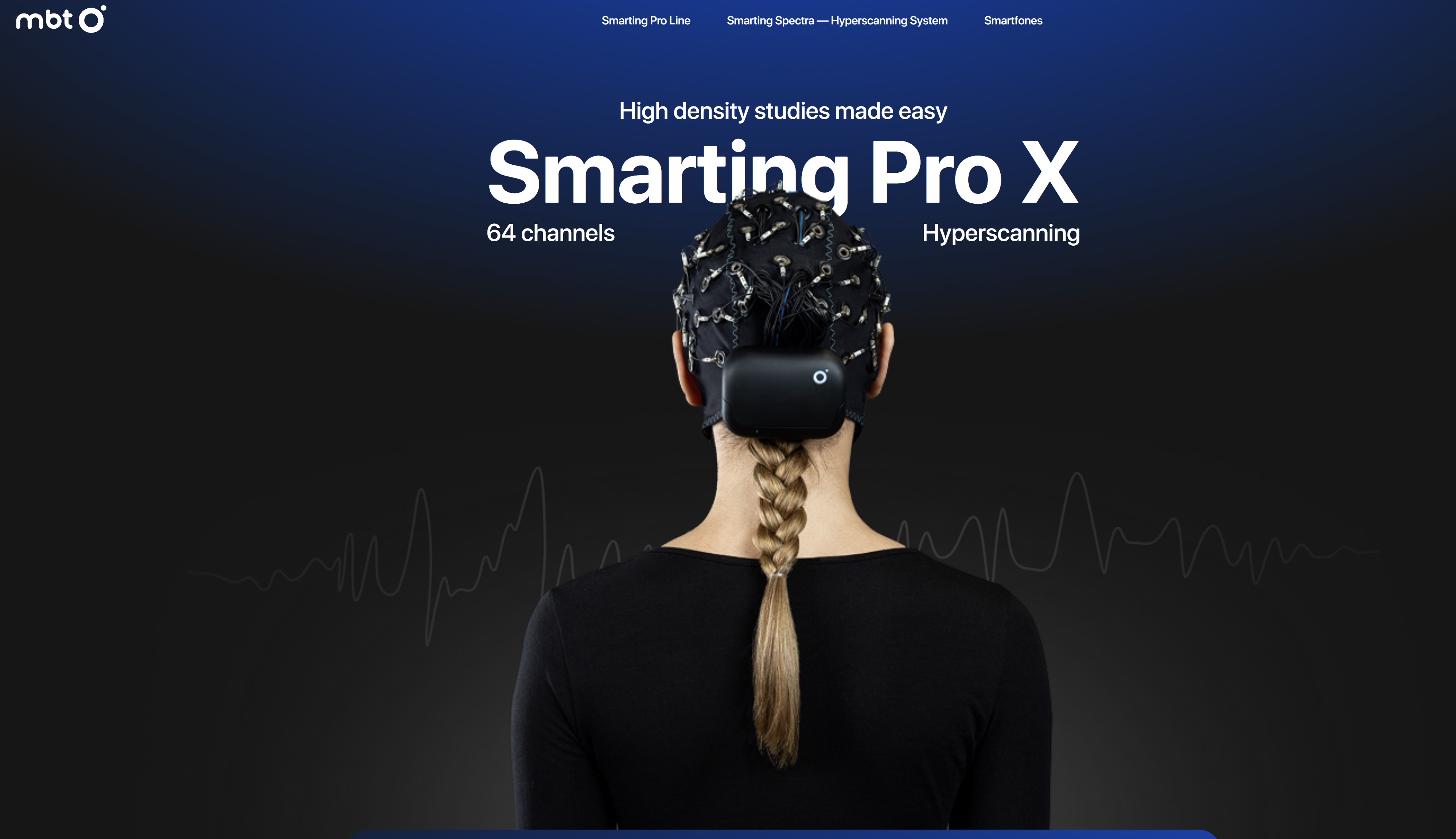
1. mBrainTrain Smarting PRO X — Best for High-Density Mobile EEG Recording
1. mBrainTrain Smarting PRO X — Best for High-Density Mobile EEG Recording
Smarting PRO X is worth considering if your research needs extensive scalp coverage in a portable setup.
Its standout feature is the combination of 64 channels, onboard recording and configurable physiological inputs, allowing researchers to capture EEG alongside other signals.
Key specs and features:
- Channels: 64 unipolar, or 56 unipolar plus 8 configurable bipolar inputs.
- Sampling: Up to 4,000 Hz internally; wireless streaming up to 1,000 Hz.
- Resolution: 24-bit simultaneous sampling.
- Synchronisation: TTL inputs and Lab Streaming Layer (LSL).
- Motion tracking: Integrated accelerometer, gyroscope and magnetometer.
Buying question: "Can our chosen configuration stream all required channels at the sampling rate we need, while recording event markers and auxiliary signals?"
What stands out: The PRO X is wireless, lightweight research-grade EEG built for recording in motion. Its cables are fixed to the head-worn amplifier, which prevents cable sway, a common source of motion artifacts. Synchronization runs over LSL and 1-bit and 8-bit TTL trigger inputs.
Electrode options are gel and dry caps, and the PRO X is compatible with Smartfones. The Smarting PRO line adds on-device recording for outdoor sessions, Bluetooth 5.0, a 9D motion sensor with 3D real-time head tracking, real-time ASR, a mobile app and NFC pairing.
Keep in mind: The published independent validation used an earlier-generation 24-channel Smarting rather than the PRO X, with different participants per system. Rates above 1000 Hz are recorded to internal memory rather than streamed.
2. Brain Products LiveAmp — Best for Modular Wireless EEG Configurations
2. Brain Products LiveAmp — Best for Modular Wireless EEG Configurations
LiveAmp suits labs comparing different channel counts within the Brain Products ecosystem.
Available configurations span 8, 16, 32 and 64 channels, with electrode options covering active, passive gel, sponge and dry setups.
Key specs and features:
- Channels: 8, 16, 32 or 64.
- Sampling options: 250, 500 and 1,000 Hz.
- Resolution: 24-bit.
- Storage: Recording computer, microSD card, or both.
- Weight: Approximately 60 g for 8–32-channel versions; 120 g for the 64-channel version.
What stands out: Multiple channel configurations and electrode choices give labs room to match the package to different protocols.
Main consideration: Wireless throughput depends on channel count and enabled inputs. The manufacturer limits 1,000 Hz transmission to up to 32 channels, including auxiliary and acceleration channels.
Buying question: "How does our channel count affect wireless sampling, amplifier placement and the accessories required?"
3. ANT Neuro eego sports — Best for Configurable Mobile Brain and Body Recording
3. ANT Neuro eego sports — Best for Configurable Mobile Brain and Body Recording
ANT Neuro eego sports is a candidate for studies combining EEG, movement and additional physiological measurements.
Its standout feature is the range of amplifier configurations and electrode options available within the platform.
Key specs and features:
- Channels: Manufacturer advertises configurations spanning 8–128 channels.
- Electrodes: Gel, sponge and dry options.
- Sampling: Up to 16 kHz on supported configurations.
- Integration: LSL compatibility for multimodal workflows.
- Mobile workflow: Wireless transmission through the eego remote Android app.
What stands out: Flexibility to configure a mobile EEG setup around channel coverage, electrode preparation and other recording modalities.
Main consideration: The product family includes amplifiers with different power, weight and sampling specifications. Do not assume every configuration offers the headline maximum.
Buying question: "Which amplifier supports our required channel count and sampling rate, and what equipment must the participant carry?"
4. Neuroelectrics Enobio 32 — Best for Comparing Dry and Gel EEG Workflows
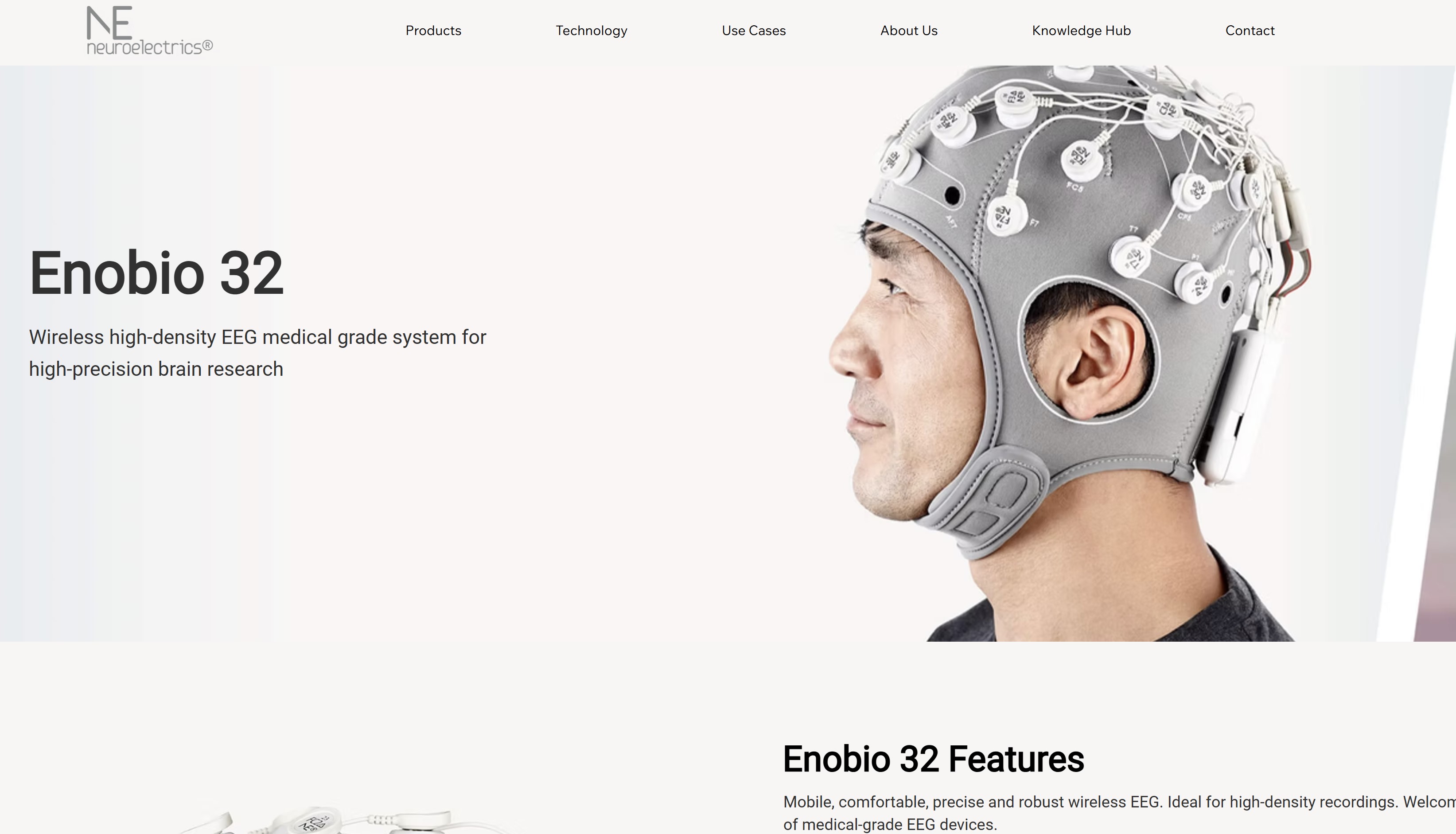
4. Neuroelectrics Enobio 32 — Best for Comparing Dry and Gel EEG Workflows
Enobio 32 offers a wireless platform for labs deciding between dry-electrode convenience and gel-based preparation.
Its flexible cap arrangement and integrated monitoring software make it relevant to teams planning several recording protocols.
Key specs and features:
- Channels: 32.
- Electrodes: Dry or wet configurations.
- Resolution: 24-bit.
- Bandwidth: Published range of 0–125 Hz.
- Software: NIC2 monitoring interface included.
- Event integration: LSL, TCP and hardware-trigger options.
What stands out: Electrode flexibility combined with software for viewing signals, frequency content and recording markers.
Main consideration: Research and medical product versions have different intended uses and regional availability. Confirm the precise model rather than relying on a general "medical-grade" description.
Buying question: "Which Enobio version and electrode package suit our protocol, and which synchronisation accessories are included?"
5. g.tec g.Nautilus PRO Flexible — Best for Interchangeable EEG Electrode Setups
The g.Nautilus PRO Flexible is designed around interchangeable electrode strands.
It is worth shortlisting when a lab wants to switch between supported wet, dry and hybrid electrode arrangements while retaining the same amplifier.
Key specs and features:
- Configurations: 8, 16, 19 or 32 channels.
- Electrodes: g.SCARABEO wet, g.SAHARA hybrid and Safety Connector options.
- Sampling: 500 Hz with 24-bit acquisition.
- Motion tracking: Integrated three-axis accelerometer.
- Integration: Support for Python, MATLAB, Simulink and LSL.
What stands out: Modular electrode connections support changes between recording protocols and preparation methods.
Main consideration: Electrode strands, caps, software and physiological sensors affect the complete package. Sampling interval also should not be confused with measured cross-device synchronisation accuracy.
Buying question: "What hardware and software must we purchase to switch electrode types and synchronise our other devices?"
6. Mentalab Explore Pro — Best for Compact Mobile EEG and Custom Research Workflows
Mentalab Explore Pro combines a compact amplifier with configurable electrodes and access to software tools for custom experiments.
It is a useful candidate for teams developing mobile recording, BCI or multimodal research workflows.
Key specs and features:
- Configurations: The current product page displays 8-, 16-, 32- and 64-channel options.
- Electrodes: Wet and dry choices.
- Recording: Internal memory and Bluetooth streaming.
- Published rates: Up to 1 kHz streaming and 8 kHz offline in the listed amplifier specifications.
- Development: Open-source software API and raw-data streaming.
What stands out: A portable design with customisation options for electrode layouts and software workflows.
Main consideration: The manufacturer page mixes newer channel options with specifications describing up to 32 channels. Obtain a model-specific specification sheet before comparing maximum rates.
Buying question: "What streaming, internal recording and event-timing capabilities apply to the exact model in our quote?"
7. Bitbrain Versatile Plus — Best for Water-Based EEG with Wireless and USB Recording Options
Bitbrain Versatile Plus deserves attention if your lab wants water-based electrodes and a choice of recording modes.
Its standout feature is the ability to select Bluetooth streaming, Bluetooth with local backup, or wired USB acquisition.
Key specs and features:
- Electrodes: Water-based sponge configuration.
- Bluetooth only: Up to 256 Hz, without local backup.
- Bluetooth plus SD: Internal recording up to 2,048 Hz, with 256 Hz live streaming.
- USB acquisition: Up to 1,024 Hz.
- Software workflow: Acquisition-mode configuration through SennsLite.
What stands out: Clearly differentiated modes for mobility, backup storage and wired acquisition.
Main consideration: High-rate SD recordings must be imported separately. A standard export otherwise contains only the Bluetooth-received data. USB use also requires the specified isolator.
Buying question: "Which mode meets our timing and backup needs, and how do we retrieve the complete recording?"
8. CGX Quick-32r — Best for Repeated Dry EEG Recording Sessions
The CGX Quick-32r is a wireless dry-electrode headset aimed at research teams running repeated participant sessions.
Replaceable sensors, replaceable batteries and contact monitoring are its most practical distinguishing features.
Key specs and features:
- Inputs: Scalp montage plus two adjustable ExG inputs; confirm the EEG/ExG breakdown.
- Electrodes: Active dry sensors with active shielding.
- Sampling: 500 Hz.
- Resolution: 24-bit.
- Monitoring: Continuous impedance checks.
- Export: EDF and CSV options.
What stands out: A headset format designed to reduce gel preparation and simplify turnover between participants.
Main consideration: Fit, contact stability and comfort need testing across your participant population. The manufacturer identifies this model as research-use-only.
Buying question: "Can we trial the headset across representative head sizes and hair types, and measure preparation time and usable data quality?"
9. Wearable Sensing DSI-24 — Best for Dry EEG with Included Acquisition Software
The DSI-24 combines dry electrodes, wireless recording and included data-acquisition software.
It is worth considering when your shortlist prioritises a headset workflow with access to raw recordings and external event inputs.
Key specs and features:
- Sensors: 19 scalp electrodes, two ear sensors and three auxiliary inputs.
- Sampling: 300 Hz; a 600 Hz upgrade is listed.
- Synchronisation: Eight-bit trigger input.
- Software: DSI-Streamer with CSV and EDF recording.
- Development: Included C-based API for raw-data access.
What stands out: Acquisition software and API access are included, making them useful items to compare against competing quotes.
Main consideration: The manufacturer's rapid-setup claims are not a guarantee for every participant or protocol. Confirm the sampling upgrade and required synchronisation accessories.
Buying question: "Does our quote include the sampling upgrade, trigger hardware and everything needed to export synchronised raw data?"
10. EMOTIV FLEX 2 — Best for Configurable Gel or Saline Electrode Placement
EMOTIV FLEX 2 offers a wireless cap-based platform with configurable sensor positions.
It is a candidate for labs whose electrode montage and frequency requirements fit its published output and filtering specifications.
Key specs and features:
- Channels: 32, plus CMS/DRL references.
- Placement: Configurable across standard cap locations.
- Electrodes: Gel or saline kits.
- Output sampling: 128 or 256 samples per second.
- Internal sampling: 2,048 Hz.
- Bandwidth: 0.2–45 Hz.
- Connectivity: Bluetooth Low Energy.
What stands out: Flexible electrode placement with a choice between gel and saline preparation.
Main consideration: Internal sampling is different from exported data rate. The published bandwidth and built-in filtering also need to match your analysis requirements.
Buying question: "Which software licences, raw-data permissions and event-marking tools are required, and do the output filters suit our experiment?"
Wireless vs Wired EEG: Which Setup Fits Your Experiments?
Choosing between wireless and wired EEG starts with your experiment. Does the participant need to walk, interact with others, complete a task in virtual reality or remain seated?
A mobile EEG device may support greater freedom of movement, but you still need to establish where the amplifier, battery and recording computer will sit.
The practical question is how the complete setup supports your protocol.
A compact headset can look convenient, yet your experiment may also require trigger hardware, additional physiological sensors or a nearby acquisition computer.
What Equipment Will the Participant Carry?
When comparing a portable EEG system or wireless EEG headset, look beyond the headset itself.
Ask the supplier to demonstrate the complete recording arrangement, including electrode leads, amplifier mounting, batteries and any connected phone or computer.
Consider how that arrangement will affect your actual task.
Equipment that works comfortably during a seated session may need a different mounting approach for walking, reaching or repeated head movements. Include participant fit and comfort in your demonstration checklist.
During the demonstration, check:
- Total carried weight: Include the headset, amplifier, batteries, mounting accessories and connected devices.
- Amplifier placement: Establish whether it attaches to the cap, clips to clothing or requires a belt or backpack.
- Cable routing: Check whether electrode leads restrict movement, pull during the task or need additional securing.
- Battery placement and access: Confirm how batteries are carried and whether replacement interrupts recording.
- Additional sensors: Account for eye-tracking glasses, motion sensors and other equipment used in your protocol.
- Participant fit: Assess adjustment options across the head sizes and hair types represented in your study.
- Comfort during the full task: Test the complete setup for a realistic session duration, including any required VR headset or headphones.
What Happens if the Wireless Connection Drops?
Check whether the system streams data to a computer, records internally or supports both simultaneously.
These are different capabilities, and wireless transmission alone does not establish whether interrupted data can be recovered.
Bitbrain Versatile Plus illustrates the distinction. Its Bluetooth-only mode records on the acquisition computer without an onboard backup.
Its Bluetooth-plus-SD mode stores a separate internal recording, which must be imported to access the complete locally stored data.
Ask the supplier to explain the recovery process, including how event markers and timestamps are handled after an interruption.
Do Streaming and Internal Recording Offer the Same Sampling Rate?
Do not assume a headline sampling rate applies to every recording mode.
Some wireless EEG systems offer higher sampling rates internally than they transmit for live monitoring.
For example, Smarting PRO X advertises internal recording up to 4,000 Hz and wireless streaming up to 1,000 Hz.
This distinction matters when your experiment requires real-time processing rather than later analysis of stored recordings.
Compare the supported rate at your required channel count, with all auxiliary inputs and motion channels enabled.
2,048 hertz:
maximum internal recording rate listed for Bitbrain Versatile Plus
in Bluetooth-plus-SD mode, with live streaming fixed at 256 Hz
The stored recording and live stream can have different rates. Check which data your analysis will use. In this mode, Versatile Plus stores the configured recording internally while transmitting a 256 Hz stream for real-time monitoring. Import the SD recording separately to access the internally stored data.
Specification context: These figures apply to the Versatile Plus acquisition mode described in Bitbrain’s documentation. They are not universal wireless EEG specifications. A higher sampling rate alone does not establish better signal quality or event synchronisation accuracy.
Source: Bitbrain Help Center — Versatile Plus EEG Acquisition Modes
How Will Stimuli and Other Sensors Be Synchronised?
For experiments involving stimulus presentation, eye tracking or other physiological measurements, ask how each device's events reach the EEG recording.
Establish which cables, trigger interfaces, software or licences are required.
When comparing mobile EEG systems, ask the supplier to demonstrate:
- Event marking: How are stimulus onsets, participant responses and other experimental events recorded alongside EEG data?
- Hardware requirements: Are trigger boxes, adapters or additional cables needed, and are they included in the quote?
- Software compatibility: Does the proposed setup support your stimulus-presentation software and other recording devices?
- Timing offset and variability: What delay occurs between an event and its recorded marker, and how consistently is that delay maintained?
- Clock drift: How is alignment maintained between devices throughout longer recording sessions?
- Data export: Are event markers and timestamps preserved when recordings move into your analysis software?
- Verification: Can the supplier demonstrate timing performance using your intended equipment and protocol?
Sampling rate and synchronisation accuracy are different specifications.
A system's sample spacing does not, by itself, establish the timing offset, variability or clock drift between connected devices. Request timing measurements for the proposed configuration.
When Should You Shortlist a Wired or Wireless Setup?
Shortlist wireless options when freedom of movement is a requirement, then assess battery capacity, transmission reliability and backup recording.
Include wired options when participants can remain connected and the setup fits your recording and timing requirements.
Portability, wireless transmission and head-worn amplification are separate features.
A portable EEG device may use a wired connection, while a wireless system may require equipment carried elsewhere.
The strongest buying decision comes from testing the complete workflow against your experiment—from participant preparation to synchronised data export.
What Should You Check Before Buying a Mobile EEG System?
Before buying a mobile EEG system, turn your research protocol into a clear set of requirements.
This gives suppliers the same brief and makes their proposals easier to compare.
Start with the signals you need, how participants will move and how the recordings will reach your analysis software.
Match the Channels and Electrodes to Your Study
Specify the required EEG channels separately from auxiliary inputs for signals such as EOG, ECG or EMG.
Ask whether adding those measurements reduces the available EEG channels or requires extra accessories.
For electrodes, consider the complete session: preparation, contact checks, participant comfort and cleaning afterwards. Ask to assess the proposed dry, gel, saline or water-based setup with participants representative of your study.
Confirm Event Timing, Battery Life and Storage
Describe how stimuli, participant responses and other sensors must align with the EEG recording.
Request timing measurements for the proposed configuration rather than relying on sampling rate alone.
Check whether battery capacity and storage cover preparation, recording and reasonable delays.
For a wireless EEG system, establish what happens during a connection interruption, whether local backup is available and how any stored data is recovered.
Check Data Access and the Full Ownership Cost
Request a sample recording and confirm that your team can import it into the intended analysis software, with channel labels, timestamps and event markers intact.
Ask for an itemised quote covering:
- Hardware and accessories: Caps, electrodes, batteries, chargers and trigger interfaces.
- Software and ongoing costs: Acquisition licences, raw-data access, subscriptions and consumables.
- Training and support: Installation, technical assistance, warranty terms and repairs.
Request a Demonstration Using Your Own Protocol
The most useful demonstration follows your actual experiment.
Ask the supplier to show participant preparation, the intended movements, event marking, recording and data export.
Before committing, have your team inspect a sample dataset from that demonstration. It gives you something concrete to assess alongside the specifications and quote.
Mobile EEG System Evaluation Checklist
Use this checklist to compare shortlisted systems, guide supplier demonstrations and confirm what is included before purchasing.
1. Research Requirements☐ Define the experiment, participant tasks and recording environment.
☐ Specify the required EEG channel count and electrode locations.
☐ List auxiliary inputs needed for EOG, ECG, EMG or other signals.
☐ Confirm whether participants will sit, walk or perform other movements.
☐ Choose the electrode options to evaluate: dry, gel, saline or water-based.
☐ Assess preparation, contact-checking and cleaning requirements.
☐ Check fit across representative head sizes and hair types.
☐ Test comfort throughout a realistic recording session.
☐ Confirm compatibility with headphones, VR headsets or other equipment.
☐ Check the total weight carried, including accessories and batteries.
☐ Confirm amplifier placement and secure cable routing.
☐ Identify any phone, computer, belt or backpack required.
☐ Assess whether the complete setup restricts the intended movements.
☐ Confirm sampling rates at the required channel count.
☐ Distinguish wireless streaming rates from internal recording rates.
☐ Check bandwidth and built-in filters against the analysis requirements.
☐ Confirm compatibility with stimulus software and other sensors.
☐ Request measurements of event timing offset, variability and clock drift.
☐ Identify required trigger hardware, cables and licences.
☐ Confirm battery runtime under the proposed recording conditions.
☐ Check charging time and battery replacement arrangements.
☐ Test wireless connectivity in the intended environment.
☐ Establish what happens during a connection interruption.
☐ Confirm onboard storage capacity and backup-recording options.
☐ Demonstrate how stored recordings are recovered and imported.
☐ Confirm access to raw EEG data and any associated licence costs.
☐ Request a sample dataset in the proposed export format.
☐ Import the sample into the lab's analysis software.
☐ Check that channel labels, timestamps and event markers are preserved.
☐ Verify any required API, SDK or LSL integration.
☐ Obtain an itemised quote for the complete working setup.
☐ Include software subscriptions, consumables and replacement electrodes.
☐ Confirm training, technical support and warranty coverage.
☐ Ask about repair turnaround and replacement equipment availability.
☐ Check the exact model's intended use and applicable regulatory documentation.
☐ Run a demonstration using the lab's own protocol.
☐ Assess recordings from representative participants and movements.
☐ Review the exported dataset with the research team.
☐ Record limitations, missing accessories and unresolved questions.
☐ Confirm the final configuration and supplier commitments in writing.
Evaluation record
System and configuration: ______________________________
Supplier: ____________________________________________
Evaluator and date: ___________________________________
Total quoted cost: ____________________________________
Outstanding questions: ________________________________
Decision: ☐ Shortlist ☐ Further testing ☐ Do not proceed
Mobile-EEG-System-Evaluation-Checklis_20261102-162840_1
143 kb
Frequently Asked Questions About Mobile EEG Systems
What Is a Mobile EEG System?
A mobile EEG system records the brain's electrical activity using portable equipment.
Depending on the configuration, recordings may be stored on the device, transmitted to a computer or both.
When comparing systems, check the complete setup, including electrodes, amplifier, batteries and recording software.
What Is the Difference Between Mobile EEG and Wireless EEG?
Mobile EEG describes portability; wireless EEG describes how data is transmitted. A portable system may still connect to a recording computer by cable.
A wireless EEG system transmits data without that connection, although cables may still connect the electrodes to its amplifier.
Can Wireless EEG Systems Be Used for ERP Research?
Yes, suitable wireless EEG systems can support event-related potential (ERP) research.
However, you need to verify event-marker accuracy, timing variability, sampling rate and software compatibility for the proposed configuration.
For example, Neuroelectrics documents ERP applications and external synchronisation options for Enobio.
How Many EEG Channels Does a Research Lab Need?
The appropriate channel count depends on your research question, electrode coverage and analysis methods.
Start with the montage your protocol requires, then account for auxiliary signals separately.
More channels also introduce additional preparation and data-management requirements, so choose a configuration your study can justify.
Are Dry Electrodes Suitable for Every Study?
Do not assume they are. Evaluate electrode contact, participant comfort and usable recordings under your actual experimental conditions. Compare dry electrodes with the available wet alternatives during a demonstration, especially if your protocol involves movement or lengthy sessions.
What Is the Mobile EEG System Price?
There is no single mobile EEG system price.
A meaningful quote needs to specify the channel configuration, electrode package, acquisition software and required accessories.
Ask for a dated, itemised quotation in your currency, including taxes and delivery, rather than comparing headline hardware prices alone.
What Determines the Total Mobile EEG System Cost?
The total mobile EEG system cost includes both the initial purchase and ongoing expenses. Budget for caps, replacement electrodes, consumables, software subscriptions, batteries, training and repairs.
Compare suppliers over the same ownership period and confirm which software and support services are included.
How Much Is a Portable EEG Machine?
A portable EEG machine price depends on whether you need research equipment, a clinical recording system or another type of device.
These packages serve different purposes and should be compared separately. Request prices for equivalent channel counts, electrode options, software access and intended use.
What Should an EEG System Quote Include?
An EEG system quote should identify the exact amplifier, channel configuration, electrodes, caps, recording software and event-marking accessories.
It should also state raw-data access rights, recurring fees, training, warranty coverage and technical support. Ask the supplier to flag anything required for your protocol that is excluded.
What Is the Best Mobile EEG System?
The best mobile EEG system is the one that meets your protocol's requirements and performs satisfactorily in a realistic demonstration. Compare electrode coverage, participant comfort, event timing, recording reliability and data access.
There is no evidence-based universal winner across all research applications.
Can You Use a Mobile EEG System at Home?
Home EEG recording is possible within appropriately supported clinical or research arrangements.
For example, NHS home video telemetry services provide equipment to record brain activity and video over several days.
This is a managed investigation, rather than simply purchasing a headset for independent diagnosis.
How Do You Choose an EEG Device for Home Use?
Start by identifying the purpose: a clinician-requested investigation, a supervised research study or a non-medical application. For clinical monitoring, ask your healthcare team which equipment and service are appropriate.
Home ambulatory EEG involves instructions for recording daily activities and symptoms alongside the EEG.
Can Portable EEG Be Used for Seizures?
Clinicians may use ambulatory EEG to investigate suspected seizures when further recording is appropriate. NICE recommends considering it when routine and sleep-deprived EEG results are normal but diagnostic uncertainty remains.
A normal EEG does not rule out epilepsy, and research-only equipment should not be assumed suitable for clinical assessment.
What Are Mobile EEG Services?
In healthcare, mobile EEG services generally bring recording equipment and technical support to a patient's location or arrange portable monitoring outside hospital.
Ask each provider whether its service includes electrode setup, video, troubleshooting, equipment collection and specialist interpretation. These are separate considerations from buying an EEG device.
Final Thoughts on Which Mobile EEG System Should Your Lab Choose?
The right mobile EEG system starts with your research question.
Channel count matters, but so do electrode preparation, participant comfort, event timing and access to usable data.
A system that suits seated experiments may require a different configuration for walking studies or recordings involving additional sensors.
Use the 10 systems in this guide to build a shortlist around your essential requirements.
Then ask suppliers to demonstrate the complete workflow: preparing a participant, recording your task, handling connection interruptions and exporting data into your analysis software.
Before buying a wireless EEG system, review a sample dataset and an itemised quote with your team. That gives you a practical basis for assessing both suitability and ownership costs.
Download our Mobile EEG System Evaluation Checklist to record your findings, compare supplier proposals and identify unanswered questions before committing your budget.
AI Summary
- This guide compares 10 mobile EEG systems using manufacturer documentation. It covers recording configurations, electrode options, portability, software and purchasing considerations. The listings are not a hands-on performance ranking.
- Mobile EEG describes portability, while wireless EEG describes data transmission. Check the complete setup, including amplifier placement, electrode cables, batteries and any connected phone or computer.
- Match the system to your research protocol. Compare EEG channels separately from auxiliary inputs, assess electrode preparation and participant comfort, and confirm specifications for the exact model.
- Wireless streaming and internal recording may offer different sampling rates. Check onboard backup, connection-interruption handling and how complete recordings are recovered. Verify event timing separately from sampling rate.
- Compare total ownership costs, including software licences, raw-data access, accessories, consumables, training and support. Request a sample dataset and confirm that channel labels, timestamps and event markers reach your analysis software correctly.
- Use the Mobile EEG System Evaluation Checklist to compare suppliers against the same requirements. Request a demonstration using your protocol, review the exported data and confirm intended use and applicable regulatory documentation before purchasing.
Most Popular Posts

Effective communication among team members is vital for the productivity and success of any organization. Surprisingly, 60% of companies lack a long-term internal communication strategy, which p...


Businesses thrive on communication for efficiency, productivity and accomplishment. When the right information is passed from the right designation in the organization, it promotes positivity an...

Categories
Blog
(3252)
Business Management
(399)
Employee Engagement
(237)
Digital Transformation
(226)
Growth
(151)
Intranets
(142)
Internal communications
(110)
Remote Work
(68)
Sales
(53)
Collaboration
(53)
Customer Experience
(33)
Culture
(30)
Project management
(30)
Knowledge Management
(29)
Leadership
(20)
Comparisons
(9)
News
(1)

Related Posts

Which provider gives you better value in the VPSServer vs Hostinger VPS comparison? If you're searching for cheap VPS hosting, it's tempting to focus on the lowest monthly price. But reliability matters too: Hostinger advertises a 99.9% uptime ...

Which mobile EEG system will fit your experiments—and give you usable data beyond a promising specification sheet? With different electrode types, channel configurations and recording modes to compare, choosing a wireless EEG setup can quickly become...

The goal of people operations is to help in increasing employee engagement and retention. It is a strategic element in organizations that focuses on humanizing impersonal processes. Most of the startups have already paid a high price for not having a...

Searching for "communal work spaces near me" but unsure which option will actually suit your growing business? By the end of this guide, you'll know how to compare offices to rent, spot extra costs and ask the right questions before committing....

Do you know what happens to your information after you share it with an AI assistant? That question sits at the heart of AI privacy—and it's easy to overlook when you're trying to finish a task. You paste in a customer email, upload a spr...


Jill Romford
I am a digital nomad, lover of exploring new places and making friends.
I love to travel and I love the internet. I take pictures of my travels and share them on the internet using Instagram.
Traveler, entrepreneur, and community builder. I share my insights on digital marketing and social media while inspiring you to live your fullest life.
Ready to learn more? 👍
One platform to optimize, manage and track all of your teams. Your new digital workplace is a click away. 🚀
Free for 14 days, no credit card required.