
Insight Blog
Agility’s perspectives on transforming the employee's experience throughout remote transformation using connected enterprise tools.
21 minutes reading time
(4282 words)
Why Interactive 3D Commerce Tools Are Becoming Essential for Ecommerce Brands

Why Interactive 3D Commerce Tools Are Becoming Essential for Ecommerce Brands
Discover why interactive 3D commerce tools are becoming essential for ecommerce brands looking to increase engagement, reduce returns, improve customer confidence, and boost online conversions.
Why Interactive 3D Commerce Tools Are Becoming Essential for Ecommerce Brands

Modern ecommerce is rapidly shifting from static product browsing to immersive digital shopping experiences.
As customer expectations continue to evolve, many online retailers are investing in interactive 3D commerce tools to create more engaging, realistic, and conversion-focused shopping journeys.
Traditional product images often fail to provide the level of detail and confidence modern shoppers expect, especially when purchasing higher-value or customizable products online.
Today's consumers want to rotate products, zoom into details, preview items in their environment, and interact with products before making a buying decision.
This growing demand for interactive product visualization and immersive shopping experiences is pushing ecommerce brands to rethink how products are presented online.
94%
higher conversion potential
According to Shopify, interactive and 3D product content can increase ecommerce conversion rates by up to 94% compared to traditional product imagery. Meanwhile, research from Deloitte highlights how immersive ecommerce experiences improve customer engagement, buyer confidence, and purchase intent across digital storefronts.
Sources: Shopify & Deloitte Digital Commerce Research
The impact is already becoming difficult to ignore.
According to Shopify, interactive and 3D product content can increase conversion rates by up to 94% compared to standard product imagery.
Meanwhile, research from Deloitte shows that immersive ecommerce experiences can significantly improve customer engagement, buyer confidence, and purchase intent across digital storefronts.
This article explores how interactive 3D commerce tools are transforming online shopping, the business benefits driving adoption, and why more ecommerce brands are viewing 3D ecommerce tools as a competitive advantage rather than an experimental feature.
Key Takeaways
- Interactive 3D commerce tools help ecommerce brands create immersive shopping experiences that improve customer engagement and buyer confidence.
- Technologies such as interactive product visualization and 3D product configurator e-commerce platforms allow customers to explore, customize, and preview products before purchasing.
- Modern shoppers increasingly expect AR-powered product experiences, virtual product demos, and mobile-friendly ecommerce interactions across digital storefronts.
- Businesses using 3D ecommerce tools often see higher conversion rates, reduced product return rates, and longer customer engagement on product pages.
- Industries including furniture, fashion, automotive, beauty, and luxury retail are rapidly adopting immersive ecommerce technology to stay competitive online.
What Are Interactive 3D Commerce Tools?
Interactive 3D commerce tools are technologies that allow online shoppers to interact with products in a more realistic and immersive way before making a purchase.
Instead of relying only on static product photos, ecommerce brands can use interactive product visualization to give customers the ability to rotate products, zoom into details, customize features, and even preview items in real-world environments using augmented reality.
As ecommerce competition continues to grow, many businesses are turning to 3D ecommerce tools to create more engaging shopping experiences that improve customer confidence and reduce uncertainty during the buying journey.
Technologies such as a 3D product configurator e-commerce platform are becoming increasingly popular because they allow customers to personalize products in real time before completing a purchase.
Understanding Interactive Product Visualization
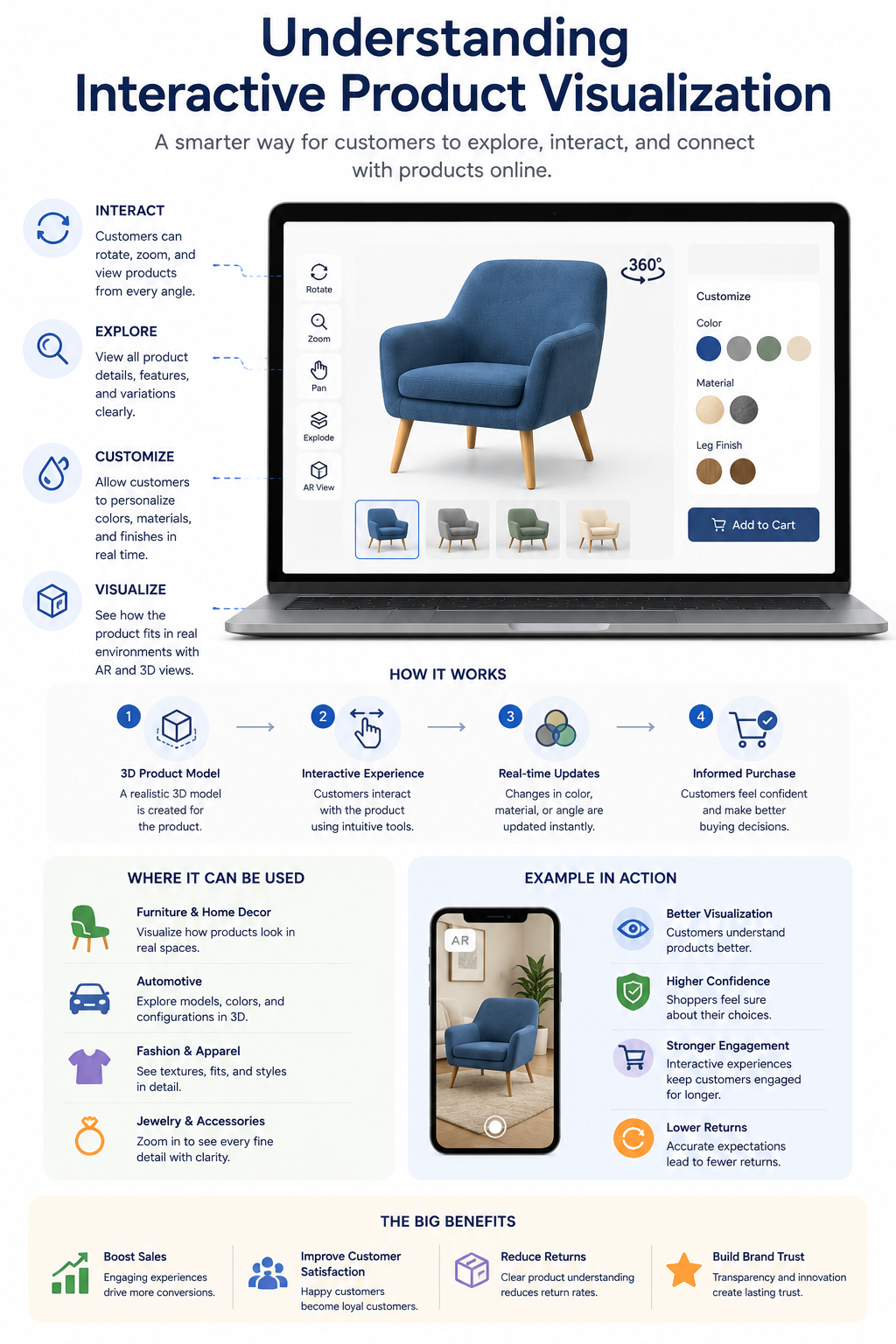
Interactive product visualization allows customers to explore products digitally in ways traditional product galleries cannot support.
Shoppers can rotate products 360 degrees, zoom into specific details, switch colors or configurations, and sometimes interact with products directly within a virtual environment.
Some of the most common features include:
- Rotatable 3D product models that allow users to inspect items from every angle
- Zoom functionality for examining textures, finishes, and smaller details
- Product customization tools powered by a 3D product e-commerce solution
- AR and immersive previews that let users place products into real-world spaces using mobile devices
This type of immersive shopping experience helps customers better understand products before purchasing, which can improve buyer confidence and reduce hesitation.
How 3D Ecommerce Tools Differ From Traditional Product Galleries
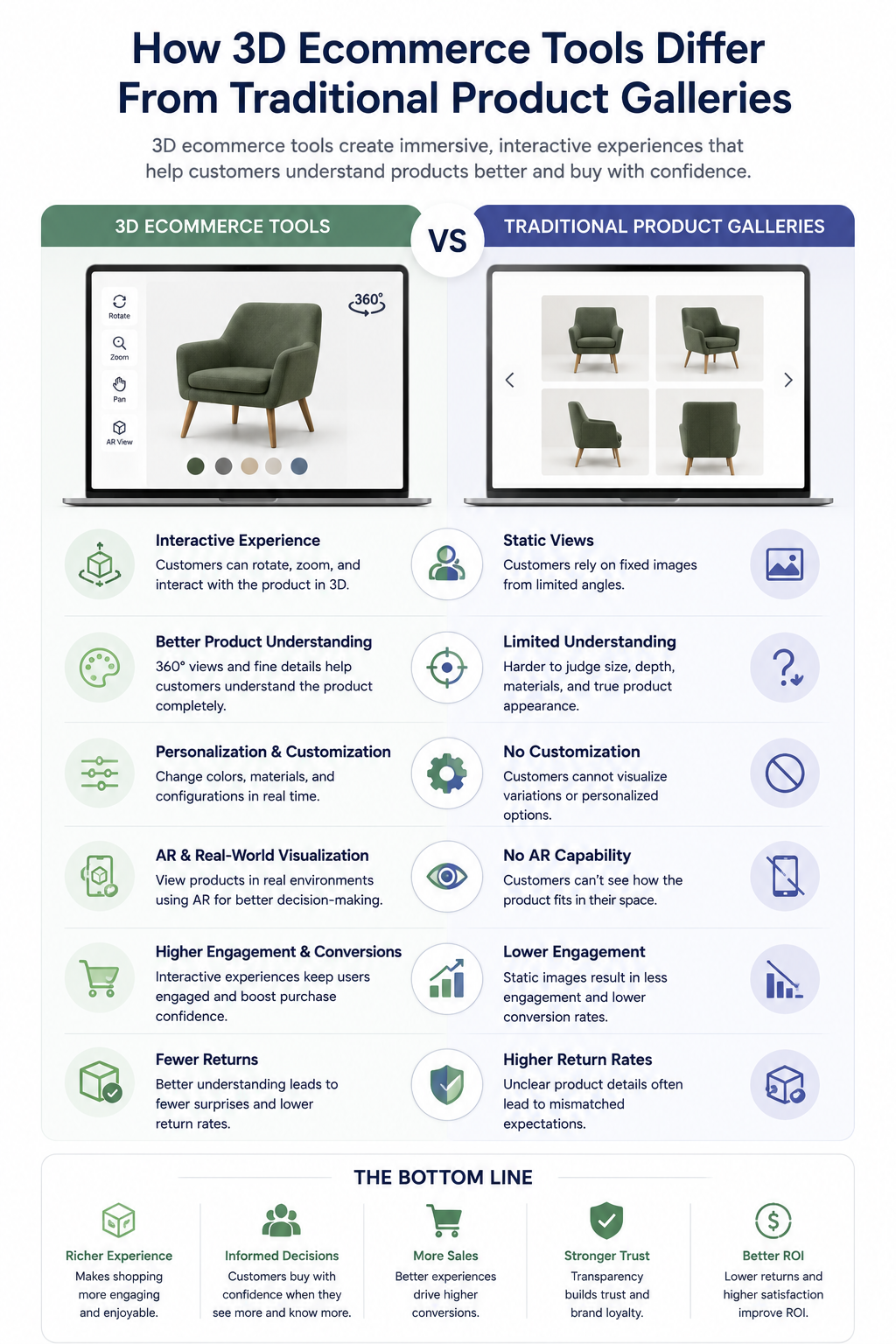
How 3D Ecommerce Tools Differ From Traditional Product Galleries
Traditional ecommerce websites typically rely on static product images and short videos to showcase products.
While these formats still play an important role, they often fail to replicate the in-store shopping experience many consumers prefer.
Interactive 3D commerce tools create a far more engaging experience by allowing shoppers to actively interact with products instead of passively viewing them. This difference can significantly impact customer engagement, purchase confidence, and conversion rates.
Key differences include:
- Static product galleries provide limited visual perspectives, while interactive experiences allow full product exploration
- 3D product visualization improves product understanding by showing dimensions, depth, and functionality more clearly
- Interactive shopping experiences increase time spent on product pages and encourage deeper customer engagement
- Customers gain a stronger sense of ownership before purchasing, which may reduce product returns
For ecommerce brands selling furniture, electronics, fashion, automotive products, or customizable items, these enhanced experiences can provide a strong competitive advantage.
Common Types of Interactive 3D Commerce Tools
There are several types of interactive 3D commerce tools available to modern ecommerce businesses, depending on the shopping experience they want to create.
- 3D Product Configurators - A 3D product e-commerce solution allows shoppers to customize products in real time by changing colors, materials, features, or layouts while instantly viewing updates in 3D. These tools are widely used in industries such as furniture, automotive, fashion, and luxury retail where personalization influences buying decisions.
- Virtual Showrooms - Virtual showrooms recreate physical retail experiences online, allowing customers to browse products within interactive digital environments.
- AR Product Previews - Augmented reality features allow shoppers to place virtual products into their real-world surroundings using smartphones or tablets before purchasing.
- Interactive Product Demos - Interactive demos help customers better understand how products work through animations, guided interactions, and hands-on digital exploration.
Why Ecommerce Brands Are Investing in Interactive 3D Commerce Tools
As online shopping becomes more competitive, ecommerce brands are under increasing pressure to create better customer experiences that drive engagement and conversions.
Traditional product galleries and static images are no longer enough for many modern shoppers who expect immersive and interactive experiences before making a purchase decision.
This shift is one of the biggest reasons businesses are investing heavily in interactive 3D commerce tools, interactive product visualization, solutions.
These technologies help ecommerce brands improve buyer confidence, reduce hesitation, and create more memorable shopping journeys that feel closer to an in-store experience.
Customers Want More Confidence Before Buying Online
One of the biggest challenges in ecommerce is helping customers feel confident enough to purchase products they cannot physically touch or test. Interactive 3D experiences help bridge this gap by giving shoppers a more realistic view of products before checkout.
Brands using interactive product visualization tools often see stronger customer trust because shoppers can explore products in far greater detail than standard product photos allow.
Key benefits include:
- Reduced uncertainty during the buying process
- Better product transparency through 360-degree viewing
- Improved trust and customer confidence
- More informed purchasing decisions
- Greater product understanding before checkout
For industries selling furniture, fashion, electronics, or customizable products, this added level of interaction can significantly influence purchasing behavior.
Interactive Experiences Increase Engagement Time
Interactive ecommerce experiences naturally encourage customers to spend more time exploring products and engaging with online stores. Instead of quickly scrolling through static product pages, users actively interact with 3D models, customization options, and virtual previews.
Longer engagement often creates stronger emotional connections with products, which can positively impact conversion rates and customer retention.
Many ecommerce brands use 3D ecommerce tools to improve:
- Browsing session duration
- Product interaction rates
- Customer engagement levels
- Product exploration behavior
- Time spent on product pages
According to Shopify, shoppers interacting with 3D content are significantly more likely to add products to their cart compared to users viewing only static images.
Modern Shoppers Expect Immersive Ecommerce Experiences
Consumer expectations continue to evolve as major ecommerce brands invest heavily in immersive digital shopping experiences.
Features like augmented reality previews, virtual try-ons, are quickly becoming part of the standard online shopping experience.
Younger, mobile-first consumers especially expect ecommerce websites to deliver interactive and visually rich product experiences that feel modern and personalized.
Several factors are driving this shift, including:
- Growing mobile-first shopping behavior
- The influence of social commerce platforms
- Increased demand for personalized shopping experiences
- Expectations created by major retail brands
- Rising popularity of augmented reality and virtual shopping tools
As immersive ecommerce experiences become more common, businesses that fail to modernize product presentation may struggle to keep customer attention and remain competitive in crowded online markets.
The Biggest Business Benefits of Interactive 3D Commerce Tools
As ecommerce continues to evolve, businesses are increasingly using interactive 3D commerce tools to improve customer experiences and drive measurable business results.
Modern shoppers expect more than static product photos, especially when purchasing expensive, customizable, or visually detailed products online.
By combining interactive product visualization, immersive shopping experiences, and technology, brands can create digital storefronts that feel far more engaging and informative.
These technologies are not only improving customer satisfaction but also helping ecommerce companies increase conversions, reduce returns, and strengthen long-term customer loyalty.
Higher Ecommerce Conversion Rates
Higher Ecommerce Conversion Rates
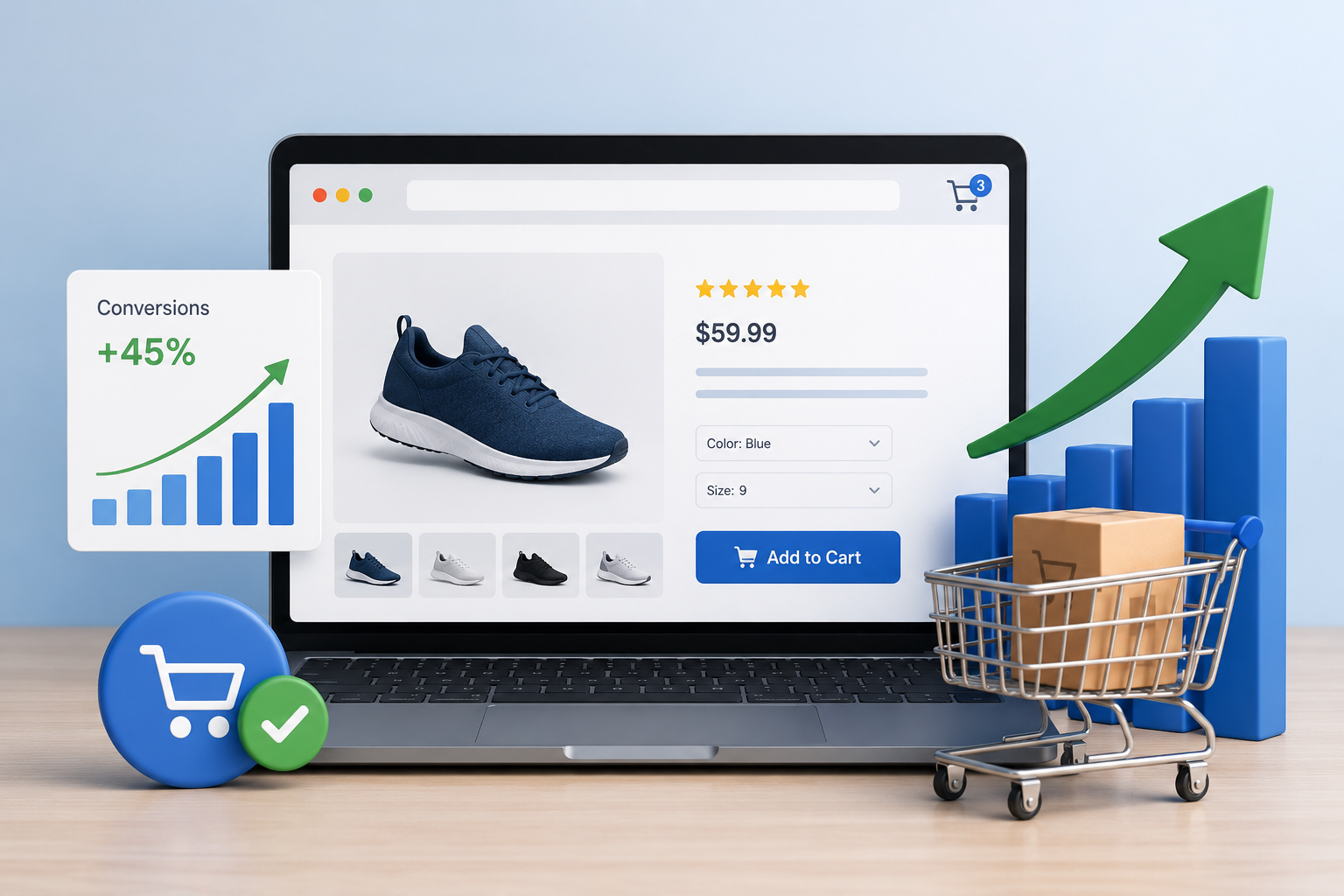
One of the biggest advantages of using 3D ecommerce tools is the impact they can have on conversion rates.
When customers can interact with products in real time, they often feel more confident making purchasing decisions because they better understand what they are buying.
Interactive product experiences reduce uncertainty and create stronger emotional connections between shoppers and products. Instead of relying on imagination, customers can actively explore products from every angle before adding them to their cart.
Businesses commonly see improvements in:
- Better customer decision-making
- Reduced hesitation during checkout
- Increased purchase intent
- More add-to-cart actions
- Higher customer confidence
This creates a far more convincing buying experience compared to viewing a few static product images.
Similarly, automotive brands often use interactive 3D product visualization tools that allow customers to customize vehicle colors, wheels, interior materials, and optional features before requesting a quote or visiting a dealership.
Lower Product Return Rates
Lower Product Return Rates
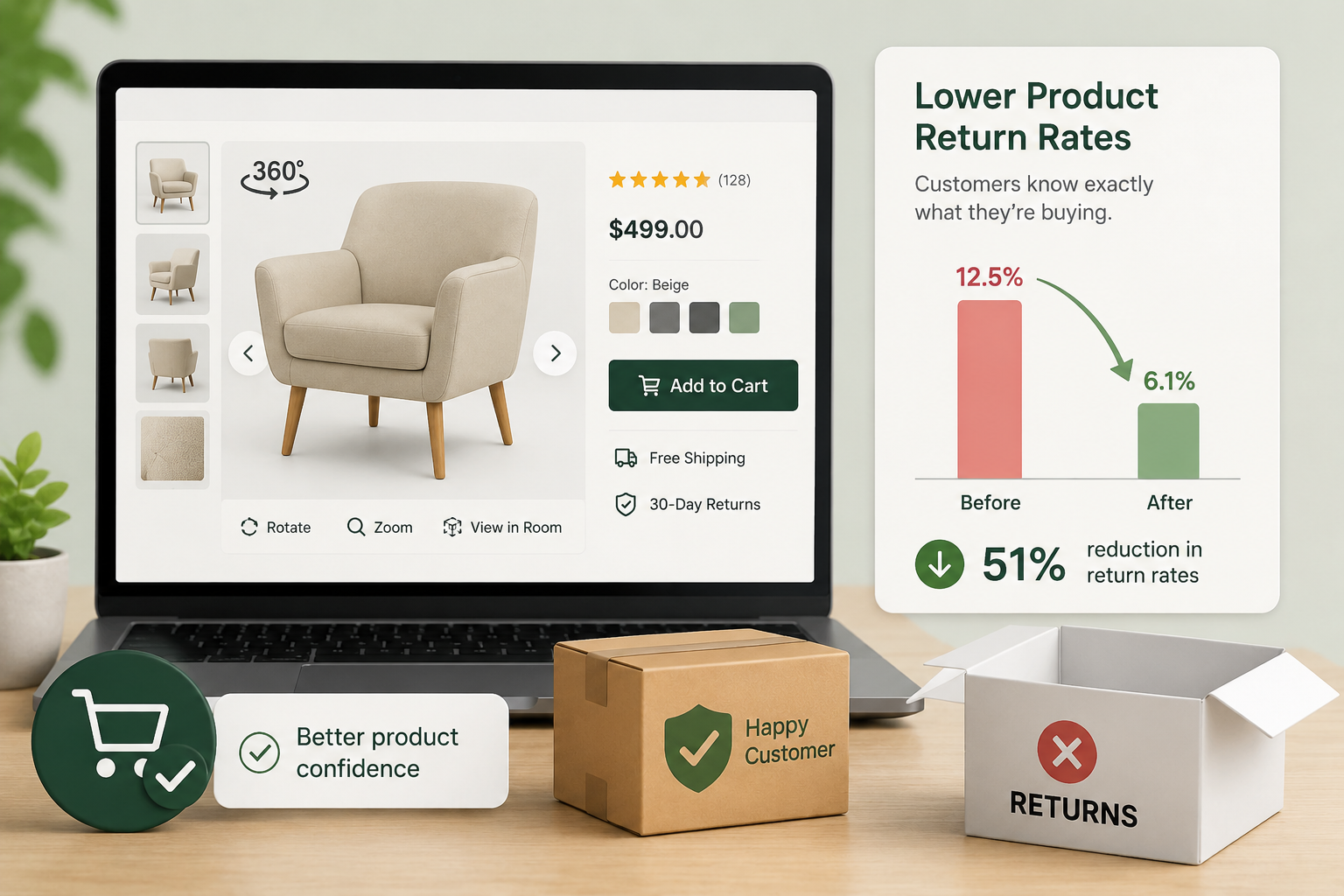
Product returns remain one of the biggest challenges in ecommerce, particularly in industries where customers struggle to accurately judge size, appearance, materials, or functionality online.
Interactive 3D commerce tools help solve this issue by giving shoppers a clearer understanding of products before purchasing.
When customers can closely inspect products and interact with virtual product experiences, expectations become more realistic, which may reduce disappointment after delivery.
Key benefits include:
- Customers better understand products before purchasing
- More accurate buying expectations
- Reduced confusion around product dimensions and features
- Improved transparency during the shopping process
- Better online shopping confidence
Fashion brands are increasingly using virtual try-on technology and immersive ecommerce experiences to help shoppers preview clothing, eyewear, or accessories before buying online.
This can reduce sizing-related returns while improving customer satisfaction.
Likewise, electronics retailers often use interactive product demos to showcase product functionality, ports, accessories, and technical features more effectively than standard image galleries.
Improved Customer Engagement and Retention
Improved Customer Engagement and Retention
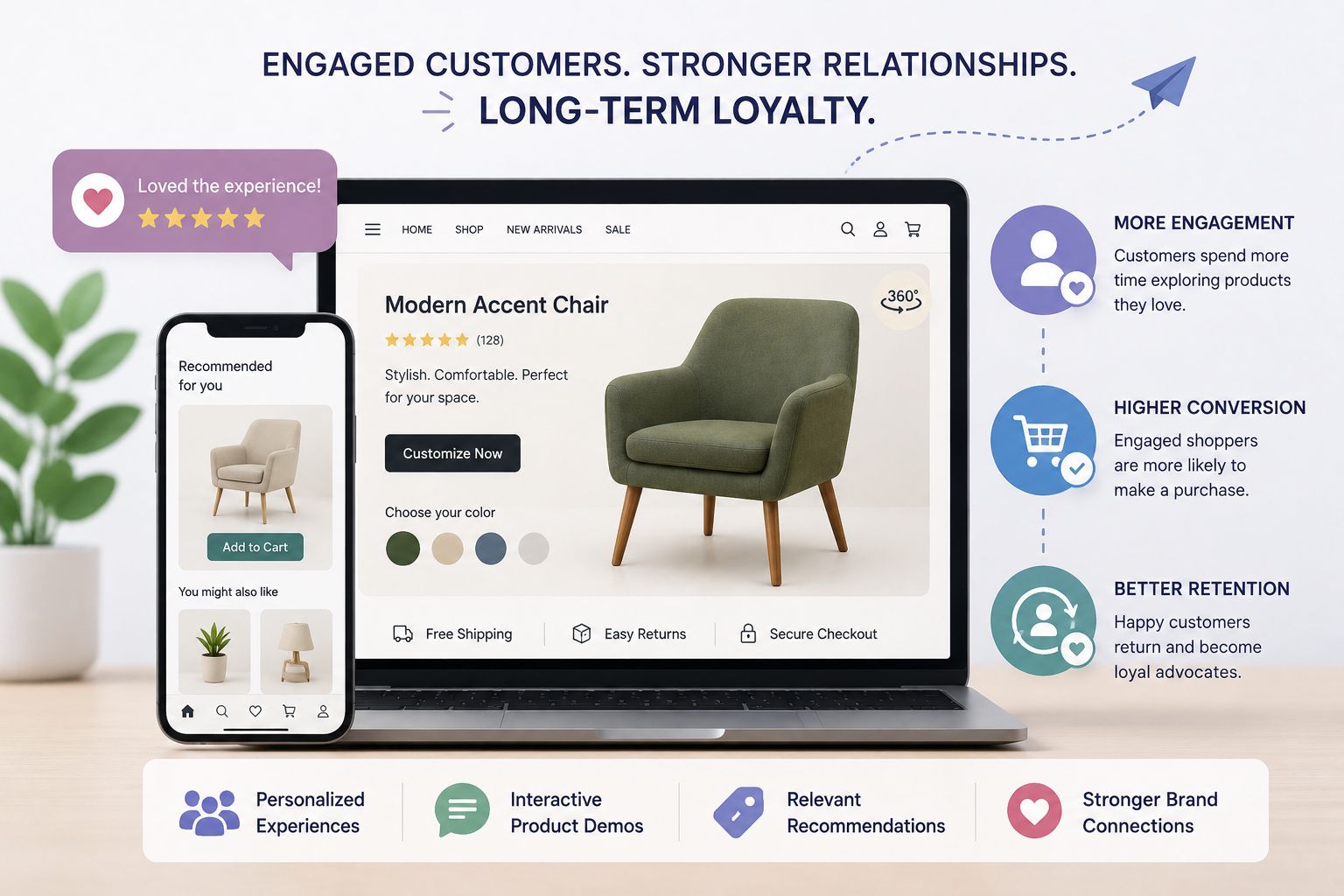
Interactive shopping experiences naturally encourage customers to spend more time engaging with ecommerce websites.
Instead of quickly browsing product pages, users interact with 3D models, product customization tools, and virtual previews that create more memorable shopping experiences.
This increased engagement can strengthen brand perception and improve customer retention over time. Businesses that invest in immersive product experiences often position themselves as more innovative, modern, and customer-focused.
Brands benefit from:
- More memorable online shopping experiences
- Stronger customer engagement
- Improved brand perception
- Increased repeat purchases
- Better customer retention
Luxury brands, for example, frequently use interactive product visualization to create premium digital experiences that mirror high-end in-store shopping.
Customers can inspect luxury watches, handbags, jewelry, or designer products in exceptional detail, helping brands maintain exclusivity while selling online.
Beauty and cosmetics companies are also adopting augmented reality ecommerce tools that allow shoppers to virtually test makeup products before purchasing, creating highly personalized customer experiences.
Better Product Presentation for Complex Items
Better Product Presentation for Complex Items
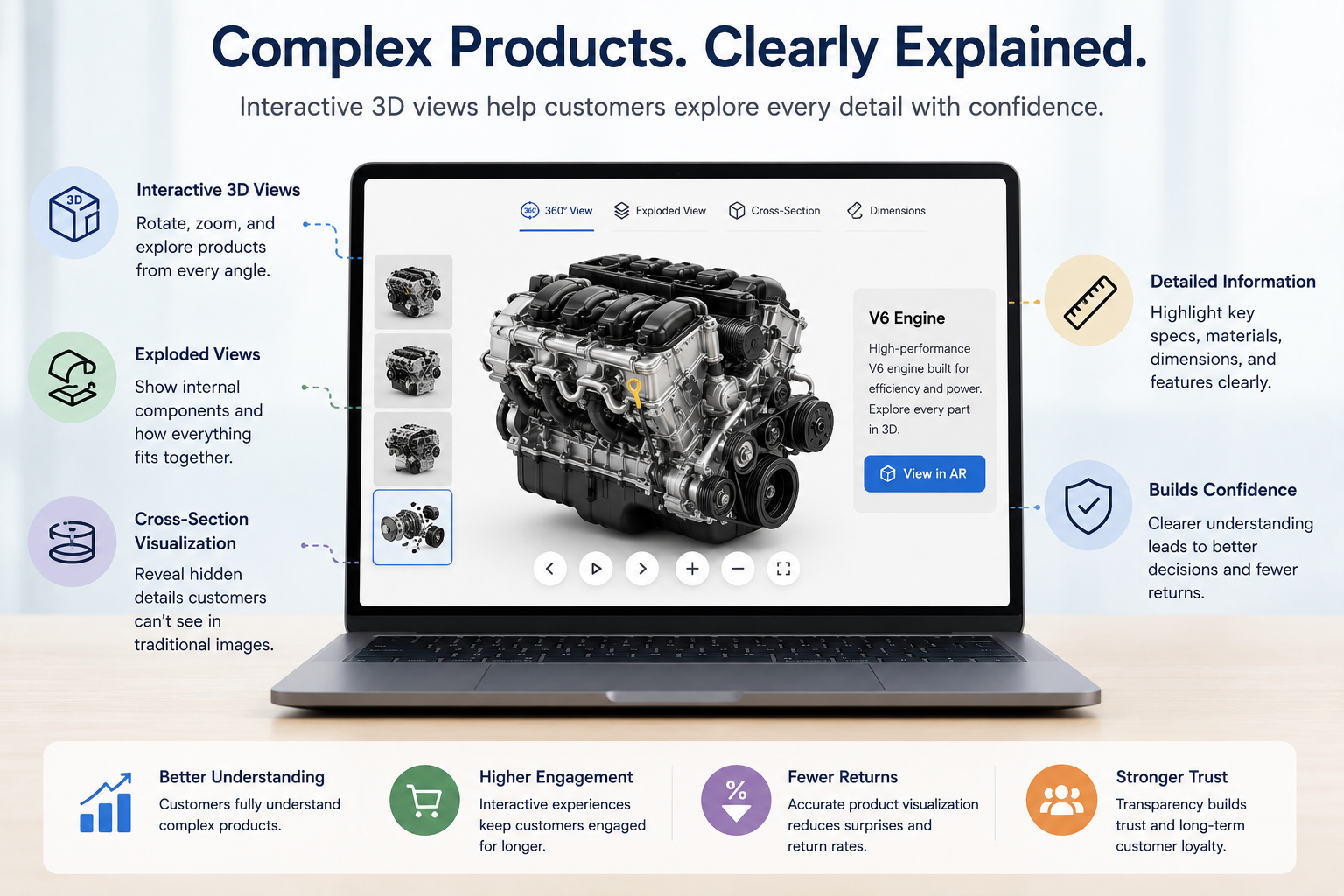
Some products are simply difficult to explain using static images alone.
Products with multiple configurations, technical features, moving parts, or customization options benefit significantly from interactive 3D commerce tools and virtual product configurators.
These immersive ecommerce technologies help customers visualize complex products more clearly while simplifying the buying journey.
Industries benefiting heavily include:
- Furniture and home decor
- Fashion and apparel
- Consumer electronics
- Automotive and industrial products
- Luxury retail and custom goods
For example, a home decor brand may use a 3D room planner that allows customers to visualize how furniture fits within their living space before ordering.
Meanwhile, electronics brands can use interactive 3D product displays to demonstrate internal product features, connectivity options, and product functionality in a visually engaging format.
Industries Seeing the Biggest Impact from 3D Commerce Technology
Interactive 3D commerce tools are no longer limited to experimental ecommerce projects or large enterprise retailers.
From furniture brands to beauty retailers, companies are discovering that interactive product visualization can significantly improve buyer confidence while helping products stand out in crowded digital marketplaces.
Furniture and Home Decor Ecommerce
The furniture and home decor industry has become one of the biggest adopters of 3D ecommerce technology because customers often struggle to visualize how products will fit within their homes before purchasing online.
Interactive room visualization tools and augmented reality shopping experiences help shoppers place furniture into real-world environments using smartphones or tablets. This creates a much more confident buying experience while reducing sizing uncertainty and return rates.
Many leading furniture retailers now use immersive product experiences to improve online shopping, including:
- IKEA using augmented reality apps that allow customers to preview furniture in their homes
- Wayfair offering 3D room planning and product visualization tools
- Ashley Furniture using interactive product displays for online shoppers
Key benefits for furniture ecommerce include:
- Better room visualization before purchasing
- Increased customer confidence around sizing
- Reduced furniture return rates
- More engaging product discovery experiences
- Improved online furniture customization
Fashion and Apparel Brands
Static clothing photos often fail to provide enough detail for online shoppers, especially when buying premium or personalized products. Interactive fashion visualization tools allow customers to preview colors, styles, fabrics, and fit options before purchasing.
Several major fashion and sportswear brands already use immersive ecommerce experiences, including:
- Nike using virtual shoe previews and product customization experiences
- Gucci experimenting with AR-based virtual try-ons
- Adidas offering interactive sneaker customization tools
Fashion brands commonly use these technologies for:
- Virtual try-ons for clothing and accessories
- Personalized product customization
- Interactive sneaker and apparel configurators
- Digital fitting room experiences
- Mobile-first shopping experiences
As personalized ecommerce continues growing, interactive fashion technology is becoming increasingly important for customer retention and brand loyalty.
Automotive and Industrial Ecommerce
The automotive sector has been one of the earliest adopters of advanced 3D product visualization because vehicles naturally involve high levels of customization and detailed product exploration.
Interactive vehicle configurators allow customers to personalize cars by selecting colors, wheels, interiors, lighting packages, and additional features in real time. These digital experiences help buyers feel more connected to products before visiting dealerships or requesting quotes.
Major automotive companies already investing heavily in interactive commerce technology include:
- Tesla using interactive online vehicle configuration tools
- BMW offering immersive vehicle customization experiences
- Audi using 3D car configurators and virtual showrooms
Industrial and manufacturing businesses are also adopting 3D product configurator ecommerce platforms to simplify complex product selection for B2B buyers.
Common use cases include:
- Detailed product exploration
- Interactive product configuration
- Virtual equipment demonstrations
- Technical product visualization
- Industrial parts customization
These tools help simplify complicated purchasing decisions while improving customer understanding of technical products.
Beauty and Cosmetics
Beauty brands are increasingly using augmented reality ecommerce tools and AI-powered product visualization technology to create highly personalized shopping experiences online.
Because customers often want to test products before purchasing, virtual makeup previews and skincare simulations help remove hesitation during the buying process. AR-powered beauty tools allow shoppers to see how products may look on their face in real time using mobile cameras.
Leading beauty and cosmetics companies already leveraging immersive retail technology include:
- Sephora offering virtual makeup try-on experiences
- L'Oréal investing heavily in AI beauty technology and AR shopping tools
- MAC Cosmetics using virtual lipstick and makeup previews
Beauty ecommerce brands use these technologies for:
- AR-based makeup previews
- Personalized beauty recommendations
- Virtual skincare consultations
- Interactive cosmetic testing
- AI-powered beauty matching
As customer expectations continue evolving, immersive ecommerce experiences and interactive product visualization are quickly becoming standard features across many online retail industries rather than premium add-ons.
Interactive 3D Commerce Tools vs Traditional Ecommerce Experiences
Traditional ecommerce websites were originally built around static product images, short descriptions, and basic product galleries.
While this approach still works for simple products, modern consumers increasingly expect more immersive and interactive shopping experiences before making purchasing decisions online.
Interactive 3D commerce tools are changing how customers explore products by creating more engaging digital experiences that closely replicate in-store shopping.
This shift is helping ecommerce brands improve customer engagement, increase buyer confidence, reduce product returns, and create more personalized online shopping experiences.
Businesses using immersive ecommerce technology often see stronger conversion rates because customers spend more time interacting with products and feel more informed before purchasing.
The comparison below highlights the major differences between traditional ecommerce experiences and modern interactive 3D commerce solutions.
| Feature | Traditional Ecommerce | Interactive 3D Commerce |
| Product Images | Static | Interactive |
| Customer Engagement | Limited | High |
| Product Understanding | Moderate | Strong |
| Conversion Potential | Average | Higher |
| Return Reduction | Limited | Better |
| Mobile Experience | Basic | Immersive |
Key Features to Look for in Interactive 3D Commerce Tools
Not all interactive 3D commerce tools deliver the same level of performance, usability, or customer experience.
As more ecommerce brands invest in immersive shopping technology, it is important to choose solutions that improve engagement without negatively impacting website speed, usability, or mobile performance.
The best 3D ecommerce tools combine interactive product visualization, fast performance, mobile optimization, and seamless ecommerce integrations to create smooth and engaging customer journeys.
Below are some of the most important features businesses should evaluate before investing in a 3D product configurator e-commerce platform or immersive ecommerce solution.
Mobile Responsiveness
Most online shoppers now browse from mobile devices, making mobile optimization essential for immersive ecommerce experiences.
Key features include:
- Responsive design across all screen sizes
- Smooth touch interactions and product rotation
- Fast-loading mobile experiences
- Mobile-friendly AR previews
Brands like IKEA and Sephora already use mobile AR shopping tools to improve customer engagement.
Fast-Loading 3D Rendering
Website speed directly impacts ecommerce conversions and SEO performance. Poorly optimized 3D product visualization tools can negatively affect customer experience.
Important capabilities include:
- Optimized 3D model compression
- Smooth animations and product rotation
- Fast-loading interactive displays
- Minimal impact on page speed
This is especially important for furniture, automotive, and fashion ecommerce websites.
AR Compatibility
Augmented reality ecommerce allows shoppers to preview products in real-world environments before purchasing online.
Strong AR features include:
- Virtual try-on experiences
- Real-world product placement
- Mobile camera integration
- Interactive home visualization
Companies like Wayfair and L'Oréal use AR-powered shopping experiences to improve buyer confidence.
Product Customization Support
Popular customization features include:
- Color and material selection
- Dynamic product updates
- Interactive feature configuration
- Personalized shopping experiences
Examples include:
- Nike sneaker customization
- Tesla vehicle configurators
- BMW online car customization
Ecommerce Platform Integrations
Interactive commerce tools should integrate smoothly with existing ecommerce platforms and systems.
Important integrations include:
- Shopify, Magento, and WooCommerce compatibility
- API support for custom ecommerce setups
- CRM and customer data synchronization
- Omnichannel ecommerce support
Analytics and Customer Interaction Tracking
Advanced 3D ecommerce tools should provide analytics that help businesses optimize customer experiences and conversions.
Useful insights include:
- Product interaction tracking
- Customer engagement analytics
- Product configuration popularity
- Conversion tracking for interactive experiences
As immersive ecommerce continues growing, businesses investing in interactive product visualization and 3D product configurator e-commerce technology should focus on platforms that balance speed, usability, and customer engagement.
How AI and Interactive 3D Commerce Are Working Together
Artificial intelligence is rapidly transforming how ecommerce brands use interactive 3D commerce tools to create more personalized, immersive, and data-driven shopping experiences.
As customer expectations continue evolving, businesses are combining AI-powered ecommerce technology with interactive product visualization, increase conversions, and simplify online purchasing decisions.
One of the biggest advantages of AI in immersive ecommerce is personalization. AI-powered systems can analyze customer behavior, browsing history, preferences, and purchase patterns to deliver more relevant product recommendations and tailored shopping experiences.
Instead of showing the same products to every visitor, ecommerce brands can create dynamic shopping journeys that feel more personalized to individual customers.
Companies like Amazon and Nike already use AI-driven personalization to improve product discovery and customer engagement.
AI is also improving predictive product recommendations within interactive shopping experiences.
When customers interact with 3D product models or virtual product configurators, AI systems can suggest related products, upgrades, accessories, or personalized configurations based on user behavior. This helps ecommerce brands increase average order value while making the shopping experience feel more intuitive and helpful.
Another growing trend is AI-generated product visualization. Businesses are increasingly using artificial intelligence to automatically create realistic product renders, generate virtual environments, and produce scalable digital product assets without requiring extensive manual 3D design work.
This allows ecommerce companies to launch immersive product experiences faster while reducing production costs. Companies such as IKEA and Wayfair continue investing heavily in AI-enhanced product visualization and augmented reality shopping experiences.
Smart virtual shopping assistants are also becoming more common within interactive ecommerce environments. AI-powered chatbots and virtual assistants can guide customers through product customization, answer questions in real time, recommend configurations, and help users navigate complex product catalogs.
This creates a more interactive and supportive online shopping experience while helping businesses improve customer satisfaction and reduce friction during the buying process.
As AI technology continues advancing, the combination of artificial intelligence, immersive shopping experiences, and interactive 3D commerce tools is expected to play a major role in the future of digital retail.
Final Thoughts
Interactive 3D commerce tools are quickly becoming a major competitive advantage for ecommerce brands looking to improve customer engagement and online sales.
Modern shoppers increasingly expect immersive product experiences that allow them to explore, customize, and interact with products before purchasing online.
Technologies such as interactive product visualization, augmented reality ecommerce, and 3D product configurator e-commerce platforms are helping businesses create more personalized and confidence-driven shopping experiences.
Brands adopting these technologies early may benefit from higher conversion rates, improved customer trust, and reduced return rates.
As ecommerce continues evolving, the future of online shopping will likely become far more interactive, visual, and experience-focused.
AI Summary
- Interactive 3D commerce tools help ecommerce brands create immersive shopping experiences that improve customer engagement, buyer confidence, and online conversion rates across digital storefronts.
- Modern shoppers increasingly expect interactive product visualization, augmented reality previews, virtual try-ons, and 3D product configurator e-commerce experiences before making purchasing decisions online.
- Traditional product galleries often fail to provide enough detail for customers to fully understand products, especially for furniture, fashion, electronics, automotive, and customizable goods.
- Businesses using 3D ecommerce tools frequently reduce product return rates because customers can better visualize product size, appearance, materials, and functionality before checkout.
- AI-powered personalization, virtual shopping assistants, predictive product recommendations, and immersive product experiences are transforming how ecommerce brands interact with customers online.
- Companies investing in immersive ecommerce technology often improve customer retention, increase time spent on product pages, and create more personalized digital shopping experiences.
Most Popular Posts

Effective communication among team members is vital for the productivity and success of any organization. Surprisingly, 60% of companies lack a long-term internal communication strategy, which p...


Businesses thrive on communication for efficiency, productivity and accomplishment. When the right information is passed from the right designation in the organization, it promotes positivity an...

Categories
Blog
(3190)
Business Management
(394)
Employee Engagement
(235)
Digital Transformation
(217)
Growth
(150)
Intranets
(141)
Internal communications
(106)
Remote Work
(68)
Sales
(53)
Collaboration
(52)
Customer Experience
(32)
Culture
(30)
Knowledge Management
(29)
Project management
(29)
Leadership
(20)
Comparisons
(9)
News
(1)

Related Posts

Welcome to AgilityPortal's guide to the best VPN for Remote teams. How do you give employees secure access to company systems when they work from home, the office and everywhere in between? It's a question more businesses need to answer: 28% of worki...

Have you ever left a meeting thinking everyone agreed on the next step, only to discover a week later that each person remembered something different? Open source meeting transcription can help teams keep a searchable record of the conversation...

The best ai image editors can save a team hours of repetitive work. A marketing manager can remove a distracting background, an HR team can improve a staff event photo, and an online shop can turn a basic product shot into something ready to pu...

Ever opened a PDF just before a meeting and realised you need to edit a page, pull figures from a scanned report, or gather everyone's comments? What should be a quick task can turn into a frustrating search for the right tool. That lost time a...

Looking for a New Job Remotely can feel like a simple next step: update your CV, turn on job alerts and start applying. In reality, the strongest remote job searches start much earlier. You need to be clear about the work you want, the kind of ...


Jill Romford
I am a digital nomad, lover of exploring new places and making friends.
I love to travel and I love the internet. I take pictures of my travels and share them on the internet using Instagram.
Traveler, entrepreneur, and community builder. I share my insights on digital marketing and social media while inspiring you to live your fullest life.
Ready to learn more? 👍
One platform to optimize, manage and track all of your teams. Your new digital workplace is a click away. 🚀
Free for 14 days, no credit card required.