Insight Blog
Agility’s perspectives on transforming the employee's experience throughout remote transformation using connected enterprise tools.
54 minutes reading time
(10779 words)
How to improve employee onboarding: 12 practical tips for HR managers

How to improve employee onboarding: 12 practical tips for HR managers
Discover 12 practical ways to improve employee onboarding, from preboarding and HR checklists to staff training, engagement and a successful first 90 days.
How to improve employee onboarding: 12 practical tips for HR managers

What happens when a new employee walks through the door on their first day, only to discover that nobody knows what they're supposed to be doing?
Their laptop isn't ready, their manager is tied up in meetings, and they're left wondering who to ask for help. Not exactly the warm welcome they were expecting, is it?
Unfortunately, this is where employee onboarding can go wrong.
According to Gallup, only 12% of employees strongly agree that their organisation does a great job of onboarding. That's a worrying figure when you consider how much time, money and effort businesses invest in finding the right people.
12 percent of employees
strongly agreed their organisation did a great job
onboarding new employees
A new employee shouldn't have to spend their first week chasing login details, searching for company policies or wondering who to ask for help. A clear staff onboarding process helps HR managers prepare everything before day one and provide consistent support.
Gallup's 2017 State of the American Workplace report found that only 12% of employees strongly agreed their organisation did a great job onboarding new employees. This is a historical measure of employee perceptions, not a current 2026 benchmark or a measurement of how many organisations have formal onboarding programmes.
Source · Gallup — Essential Ingredients for an Effective Onboarding Program (2019)
And here's the thing: onboarding isn't just about completing paperwork, signing contracts or introducing someone to the team.
It's about helping new employees feel welcome, understand their responsibilities and build the confidence to do their jobs well.
For HR managers and small business owners, getting this right matters. A confusing onboarding experience can leave new hires feeling disconnected, frustrated and unsure whether they've made the right career move.
The good news?
You don't need a huge HR budget to make meaningful improvements.
In this guide, we'll walk through 12 practical ways to improve employee onboarding, avoid common mistakes and create a more welcoming, organised experience, whether you're hiring your fifth employee or your five-hundredth.
Key Takeaways
- Effective employee onboarding starts before day one and continues beyond the first week. A structured staff onboarding process helps new hires understand their responsibilities, build relationships and become confident in their roles.
- Improving onboarding begins with practical steps such as preparing equipment, creating a consistent checklist, assigning an onboarding buddy, providing role-specific training and scheduling regular manager check-ins.
- A practical onboarding plan can cover pre boarding, first-day orientation, first-week training, first-month integration and development throughout the first 90 days. The timeline should reflect the employee's role, experience and training requirements.
- Successful HR onboarding requires shared responsibilities. HR coordinates onboarding procedures and documentation, IT manages system access, managers provide training and feedback, and colleagues help new employees settle in. Essential onboarding docs should be accurate, accessible and appropriately protected.
- Onboarding software can simplify communication, organise training resources and improve task coordination. A digital workplace such as AgilityPortal helps employees access company information, connect with colleagues and find the support they need throughout onboarding.
What is employee onboarding, and why does it matter?
Employee onboarding is the process of welcoming new employees into an organisation and helping them understand their roles, responsibilities, company values and workplace culture.
It's an opportunity to make a positive first impression, introduce new hires to their colleagues and give them the support they need to feel part of the team from day one.
Sometimes called organisational socialisation, onboarding goes beyond simply showing someone around the office or explaining company policies.
It helps employees understand how the business operates, what is expected of them and how their work contributes to the organisation's goals.
A successful new employee onboarding process also makes it easier for people to build relationships, access important information and develop the confidence to work independently.
However, there's a difference between employee orientation and on boarding.
While the terms are sometimes used interchangeably, orientation is typically a short introduction, whereas onboarding is an ongoing process.
Here's how they compare:

What is employee onboarding, and why does it matter?
| Employee orientation | Employee onboarding |
| Usually happens during the first day or week | Continues over several weeks or months |
| Introduces company policies and procedures | Builds skills, confidence and workplace relationships |
| Typically managed by HR | Involves HR, managers and colleagues |
| Focuses on immediate administrative requirements | Supports long-term integration and productivity |
Why does this matter for small businesses?
When you're running a smaller team, every employee makes a difference.
You might not have a dedicated HR department or the resources to run an elaborate onboarding programme.
That's why getting the basics right is so important.
A structured onboarding process helps new employees find answers faster, understand what's expected of them and feel supported from the beginning. It also saves managers from repeatedly explaining the same information to every new hire.
What activities should be included in employee onboarding?
Starting a new job comes with plenty of questions. Who do I report to? Where can I find company policies? What should I be working on during my first week?
A well-organised employee onboarding process helps answer these questions before they become frustrations. It brings together the practical tasks, training and personal introductions that help someone feel comfortable in their new workplace.
And onboarding doesn't have to be complicated.
Even small businesses can create a welcoming experience by planning a few essential activities and making sure nothing important gets overlooked.
Here are some common onboarding activities worth including:
- Before the first day: Confirm the job offer, finalise salary and benefits, send employment documents and share a welcome email.
- Getting everything ready: Set up work equipment, email accounts, software access and any tools the employee will need.
- Introducing the business: Explain company values, workplace culture, policies and where to find the employee handbook.
- Meeting the team: Arrange introductions with colleagues, managers and key people from other departments.
- Learning the role: Provide job-specific training, explain responsibilities and agree on initial performance expectations.
- Building connections: Assign an onboarding buddy, organise a team lunch or schedule informal conversations.
- Helping remote employees: Arrange equipment delivery, explain communication tools and offer support with their home working setup.
- Making employees feel welcome: Share a team announcement or provide a small welcome pack with useful company items.
The goal isn't to squeeze every activity into someone's first day. It's to give new hires the right information and support when they actually need it.
What does a typical employee onboarding process look like?
There's no single onboarding schedule that works for every business.
Someone joining a small marketing team will probably need a different introduction from a new warehouse supervisor or remote software developer.
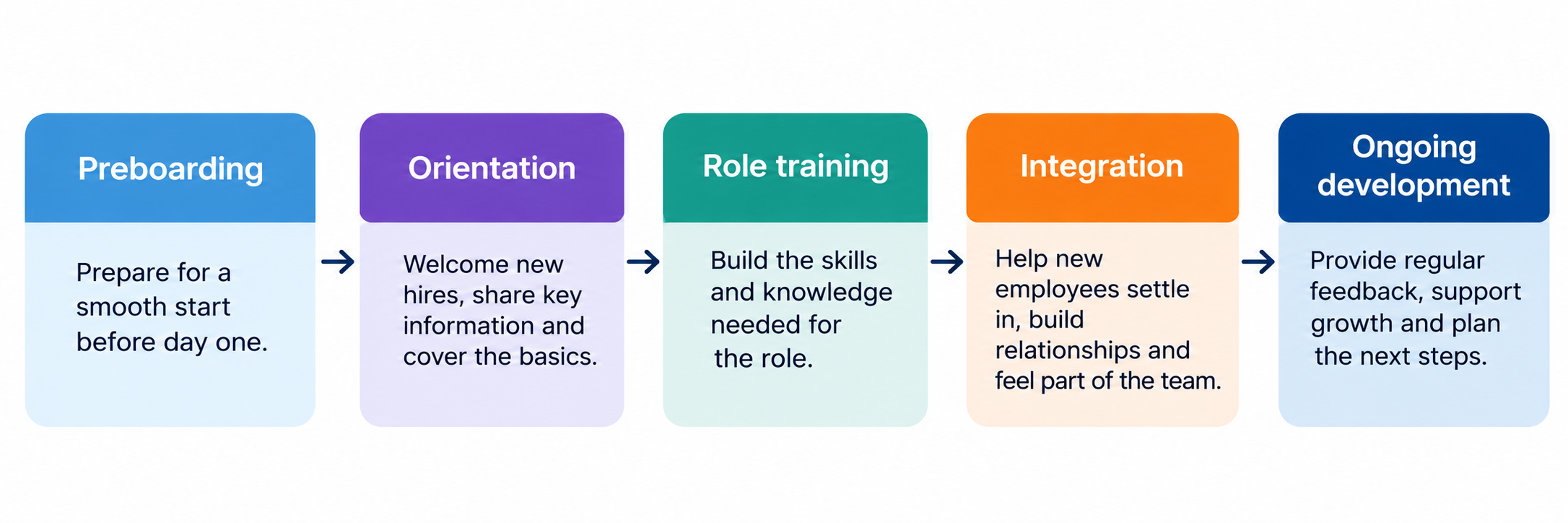
However, most businesses can organise new employee onboarding into four practical stages.
What does a typical employee onboarding process look like
1. Preboarding: Get everything ready before day one
The onboarding experience starts as soon as someone accepts your job offer, not when they arrive for their first shift.
Use this time to complete employment documents, arrange equipment, prepare system access and send a friendly welcome message.
You could also share a simple first-week schedule so the employee knows what to expect.
2. Orientation: Help new hires find their feet
The first day should be about making employees feel comfortable, not overwhelming them with paperwork.
Introduce them to their manager and colleagues, explain how the business operates and show them where to find important information.
Make time for questions, too. Something that seems obvious to an experienced employee might be completely unfamiliar to someone new.
3. Training: Build confidence through practical experience
Once the introductions are out of the way, employees need opportunities to learn how to do their jobs.
This might involve shadowing an experienced colleague, completing short training sessions or working through their first assignments with support.
An onboarding buddy can be particularly helpful here, giving new hires someone they can approach without feeling they're constantly interrupting their manager.
4. Integration: Help employees become part of the team
Getting comfortable with daily tasks is only one part of settling into a new workplace.
Employees also need time to build relationships, understand how decisions are made and feel confident contributing ideas.
Regular manager check-ins, team activities and informal conversations can make this transition easier.
It's also important to explain what success looks like in their role, including responsibilities, priorities and the boundaries of their work.
One thing worth remembering: Good onboarding shouldn't feel like a race to complete a checklist.
Spreading activities across the first few weeks and months gives employees time to absorb information, practise new skills and ask questions.
For HR managers, the real measure of success isn't how quickly someone finishes their onboarding paperwork. It's whether they understand their role, know where to get help and feel confident becoming part of the business.
What makes an employee onboarding process successful?
A successful employee onboarding process isn't about ticking boxes or getting new hires through training as quickly as possible.
It's about making sure people feel supported, understand their responsibilities and have what they need to do their jobs confidently.
Think about your own first day at a new job. Wouldn't it have been easier if you knew exactly what was expected of you and who to turn to when something wasn't clear?
That's what effective onboarding should achieve.
There are five important elements that make a real difference:
- Clear expectations - Employees understand their responsibilities, priorities and what success looks like in their role.
- Easy access to information - Company policies, training materials and essential resources are available when employees need them.
- Consistent communication - Regular conversations give new hires opportunities to ask questions and raise concerns.
- Manager involvement - Line managers actively support employees rather than leaving the entire onboarding experience to HR.
- Measurable progress - Simple milestones and feedback sessions help employees see how they're developing.
Ultimately, a good onboarding experience should help every new employee answer three questions:
- What am I expected to achieve?
- Where can I find the information and support I need?
- How will I know whether I'm making progress?
When employees can answer these questions confidently, they're in a much better position to settle into their roles.
So, how can HR managers put these principles into practice?
Let's look at 12 practical ways to improve employee onboarding without making the process unnecessarily complicated.
12 practical ways to improve employee onboarding
Getting employee onboarding right doesn't mean creating a complicated HR programme or spending thousands on new software.
Often, it's the small things that make the biggest difference, such as having equipment ready, explaining expectations clearly and making sure new hires know where to find help.
It's also worth thinking about how employees prefer to learn during the onboarding process. Some people are comfortable reading lengthy training documents, while others find it easier to listen while following the text on screen.
This is particularly useful during preboarding and the first few weeks, when new employees are expected to work through company policies, onboarding docs, training guides and workplace procedures.
For browser-based learning materials, some tools offer a text-to-speech option that can make written resources easier to follow. Employees can visit the CastReader download page to get started and use its supported reading features to listen to web-based content with synchronised text highlighting.
Rather than replacing written onboarding materials, this gives employees another way to engage with information at their own pace. It can be especially helpful when reviewing detailed instructions or revisiting training resources after their initial introduction.
Of course, accessibility tools are only one part of the experience. The real challenge is creating an employee onboarding process that's consistent, welcoming and easy to follow, regardless of someone's role, location or preferred way of learning.
Here are 12 practical onboarding tips HR managers can start using today.
1. Start onboarding before the employee's first day
Imagine accepting a new job and hearing absolutely nothing from your employer until the morning you're supposed to start. You'd probably wonder whether everything was still going ahead.
That's why preboarding matters.
The period between accepting a job offer and starting work is an opportunity to make employees feel welcome and remove unnecessary uncertainty.
Send a friendly welcome email, confirm employment documents, arrange equipment and make sure important accounts are ready. It's also helpful to share the first-day schedule and introduce the employee to their manager.
Here's a practical idea: Five working days before someone starts, send a short message explaining where to go, what time to arrive, who they'll meet and what their first day will involve.
For remote employees, include instructions for accessing communication tools and receiving equipment.
A little preparation can prevent a lot of first-day confusion.
2. Create a consistent onboarding checklist
It's surprisingly easy to forget something during a busy recruitment period.
Perhaps HR assumes IT has created the employee's account, while IT is waiting for approval. Meanwhile, the new hire is sitting at their desk without access to the systems they need.
A simple employee onboarding checklist can prevent these situations.
Create a reusable checklist covering employment paperwork, equipment, software access, policy acknowledgements, training and introductory meetings.
Most importantly, assign someone to each task and include a deadline.
For example, HR might handle employment documents, IT might prepare accounts, and the line manager might organise role-specific training.
You don't necessarily need specialist software to get started. A shared checklist can work for smaller teams, provided everyone knows what they're responsible for.
As your business grows, consider using a centralised task management system to keep everything organised.
3. Make the first day welcoming rather than overwhelming
Nobody wants to spend their entire first day filling out forms, watching training videos and trying to remember the names of 20 people.
Yet that's exactly what happens in many workplaces.
Instead of treating the first day as an administrative exercise, focus on helping employees feel comfortable.
Start with a friendly welcome, introduce their immediate colleagues and give them time to explore their workspace.
Keep the schedule manageable. A short company introduction, a meeting with their manager and a simple first assignment are often more useful than hours of presentations.
This is closely connected to organisational socialisation, which describes how newcomers develop the knowledge, skills and behaviours needed to become effective members of an organisation.
A new marketing employee could spend part of their first afternoon reviewing recent campaigns with a colleague rather than sitting through another policy presentation.
Remember, the first day should build confidence, not test someone's ability to absorb information.
4. Give new employees one place to find important information
Think about how frustrating it would be to start a new job and discover that company policies are stored in one system, training documents are buried in emails and department information is scattered across several shared folders.
New employees shouldn't have to become detectives just to find basic information.
Create a central location where they can access everything needed during onboarding.
This might include the employee handbook, workplace policies, training materials, department contacts, frequently asked questions and useful links.
An employee intranet or knowledge management system can make this much easier to manage by helping organisations capture, organise and share important information.
For example, AgilityPortal's digital workplace solutions bring company information, documents, communication and collaboration tools into a central environment.
This means new employees can spend less time searching for answers and more time learning their responsibilities.
The important thing isn't which tool you choose. It's making sure information is accurate, easy to search and accessible to the people who need it.
5. Set clear expectations for the first 30, 60 and 90 days
One of the most uncomfortable feelings in a new job is not knowing whether you're doing well.
Employees shouldn't have to guess what their manager expects them to achieve.
A 30-60-90 day onboarding plan gives new hires a clearer picture of what they should focus on during their first three months.
Here's a simple example:
| Timeline | Main focus | What success looks like |
| First 30 days | Learning | Understand responsibilities, systems and team processes |
| Days 31–60 | Contribution | Complete initial assignments with growing independence |
| Days 61–90 | Development | Take ownership of regular responsibilities and agree on future goals |
These milestones should be adapted to the employee's role.
For instance, a customer support representative might be expected to handle straightforward enquiries independently after initial training, while a senior manager may need longer to understand business operations.
Regular conversations about progress also connect with the principles of performance management, which emphasise ongoing support, clear objectives and feedback.
Review the plan regularly and adjust expectations when necessary.
6. Assign an onboarding buddy to every new hire
Sometimes employees feel uncomfortable asking their manager questions they think they should already know the answers to.
Where do people normally eat lunch? How do I request time off? Who should I contact about a software problem?
These everyday questions might seem small, but they can make settling into a new workplace more difficult.
An onboarding buddy gives employees someone approachable who can help them understand how things work.
Unlike a line manager, who focuses on responsibilities and performance, a buddy provides informal guidance and practical support.
The idea shares some similarities with workplace mentoring, where a more experienced person helps someone develop knowledge, confidence and professional relationships.
Choose someone who understands the business, communicates well and has enough time to help.
You could arrange a short introduction on day one, followed by informal check-ins during the first few weeks.
The arrangement doesn't need to be complicated. It just needs to give new employees someone they feel comfortable approaching.
7. Make communication a priority throughout onboarding
Good communication shouldn't stop after the welcome email.
New employees need regular opportunities to ask questions, share concerns and understand what's happening around them.
Schedule short manager check-ins during the first few weeks and make sure HR remains available when additional support is needed.
It's equally important to explain which communication channels employees should use.
Should they email HR about payroll questions? Use team chat for everyday discussions? Contact their manager directly when something isn't clear?
Make those expectations obvious.
For businesses with distributed teams, having a clear internal communication approach helps employees understand how information is shared and where important conversations happen.
Digital workplace tools can support this by bringing communication into a more organised environment.
For instance, AgilityPortal provides team spaces, announcements and discussions that organisations can use to share updates and help employees communicate with colleagues.
A useful habit: End each onboarding check-in by asking, "Is there anything you're unsure about or struggling to find?"
You might discover problems that would otherwise go unnoticed.
8. Personalise onboarding for different roles and working arrangements
Not every employee needs the same onboarding experience.
A remote software developer, a retail assistant and a newly appointed department manager will have very different responsibilities.
Giving everyone exactly the same training can waste time and leave important gaps.
Instead, create a standard onboarding framework covering company information, essential policies and general expectations.
Then add training and resources relevant to each role.
For example:
- Office employees - Introductions to internal systems, team workflows and workplace procedures.
- Frontline workers - Safety training, shift arrangements, operational procedures and mobile access to information.
- Remote employees - Virtual introductions, communication expectations, equipment setup and remote collaboration tools.
- Managers - Leadership responsibilities, reporting processes, team performance and decision-making procedures.
For businesses supporting remote work, it's particularly important to make information accessible without relying on face-to-face conversations.
This approach keeps the onboarding process consistent without making it unnecessarily rigid.
9. Break training into manageable learning activities
Have you ever attended a training session where so much information was presented that you struggled to remember anything afterwards?
New employees experience the same problem.
Trying to explain every system, policy and procedure during the first few days can quickly become overwhelming.
A better approach is to divide training into smaller activities spread across several weeks.
This approach is similar to microlearning, where information is delivered in smaller, focused learning activities rather than lengthy sessions.
Start with the information employees need immediately, then introduce more advanced responsibilities as their confidence develops.
Combine short demonstrations with practical tasks so employees can apply what they've learned.
For example, rather than giving a new employee a lengthy project management manual, show them how to create their first task and let them practise.
Make training documents available afterwards so they can revisit instructions whenever necessary.
Remember, the goal isn't to finish training as quickly as possible. It's to help employees understand and apply what they're learning.
10. Help new hires build relationships across the business
Learning how to do a job is important, but feeling connected to the people around you matters too.
New employees may understand their responsibilities perfectly and still feel isolated if they haven't had opportunities to build relationships.
Encourage introductions beyond their immediate team, particularly with colleagues they'll regularly work alongside.
This could involve informal coffee chats, team lunches, cross-department meetings or participation in workplace communities.
These activities support the social side of organisational culture, helping employees understand shared values, everyday behaviours and how colleagues work together.
For remote employees, consider arranging short virtual introductions rather than expecting relationships to develop naturally through occasional video meetings.
You could also invite new hires to introduce themselves through your employee communication platform.
Keep these activities relaxed and inclusive. Not everyone enjoys large social gatherings, and employees should have different ways to connect.
The aim is to help people feel comfortable asking questions, sharing ideas and contributing to the wider organisation.
11. Collect feedback and improve the onboarding experience
Your onboarding process might look excellent on paper, but that doesn't necessarily mean employees are having a good experience.
The easiest way to find out what's working is to ask the people who've recently been through it.
Collect feedback at several points, such as after the first week, first month and first 90 days.
Keep the questions straightforward:
- Was anything missing or unclear before your first day?
- Do you know where to find the information you need?
- What has been the most confusing part of joining the company?
- Have you received enough support from your manager?
- What could we improve for the next new employee?
You can collect responses through short surveys or informal conversations.
This is where employee engagement becomes relevant. Listening to employees and understanding their workplace experiences can help managers identify areas that need attention.
However, asking for feedback is only useful if you're prepared to act on it.
If several employees mention that system access takes too long, investigate the approval process. If training feels rushed, review the schedule.
Small improvements based on genuine employee experiences can make future onboarding more effective.
12. Measure onboarding success and improve what isn't working
How do you know whether your onboarding process is actually improving?
A completed checklist is a useful starting point, but it doesn't tell you everything about an employee's experience.
HR managers should monitor a few practical measures that show whether new hires are receiving the support they need.
These might include:
- Onboarding task completion - Are essential activities being completed on time?
- Time to productivity - How long does it take employees to perform agreed responsibilities independently?
- New-hire satisfaction - Do employees feel supported and confident in their roles?
- Early employee turnover - How many employees leave during their first few months?
- Training completion - Are employees completing the learning activities required for their jobs?
Each measure has limitations. For instance, an employee might complete every training module without fully understanding the material. Similarly, early turnover can be influenced by factors beyond onboarding.
That's why it's important to combine performance data with feedback from employees and managers.
The principles of HR analytics can help businesses use workforce information to understand patterns and make better decisions about employee experiences.
You don't need a complicated reporting system. Start by tracking a handful of useful measures and reviewing them regularly.
A practical recommendation: Review your onboarding process every quarter. Identify the two or three issues causing the most frustration and focus on fixing those first.
After all, improving employee onboarding isn't about creating the perfect process overnight. It's about making each new employee's experience a little better than the last.
What are the most common employee onboarding mistakes?
You can have a detailed onboarding checklist, a welcome pack and a full training schedule, yet still leave new employees feeling completely lost.
Why?
Because employee onboarding isn't just about completing tasks. It's about how well those activities prepare someone to succeed in their new role.
For HR managers, the challenge is often balancing administrative requirements with the human side of welcoming someone into the business. When responsibilities aren't clear or communication breaks down, even a well-planned onboarding process can fall short.
Here are five common employee onboarding mistakes, why they happen and what HR professionals can do to prevent them.
1. Leaving the entire onboarding process to HR
One of the biggest mistakes businesses make is assuming that onboarding is solely HR's responsibility.
HR might organise employment contracts, payroll information, company policies and initial introductions. But what happens when the employee needs to understand their daily responsibilities, team expectations or how their performance will be measured?
That's where line managers need to get involved.
Without their participation, new employees may complete all the required paperwork but still feel uncertain about what they're supposed to achieve.
How to avoid this mistake: Establish clear responsibilities before the employee starts. HR should coordinate the overall onboarding programme, IT should prepare equipment and system access, and line managers should take ownership of role-specific training, introductions and performance expectations.
For example, a marketing manager could schedule weekly meetings during the employee's first month to review assignments, answer questions and discuss progress.
The important thing is making onboarding a shared responsibility rather than something HR handles alone.
2. Overwhelming new employees with too much information
Think back to the last time you attended a full-day training session. How much information could you actually remember afterwards?
Now imagine being a new employee who is expected to learn company policies, understand several software applications, meet dozens of colleagues and remember complicated procedures within a few days.
It's a lot to take in.
This is often described as cognitive overload, where the amount of information someone needs to process places excessive demands on their working memory.
For new hires, this can make training harder to follow and leave them unsure which information matters most.
How to avoid this mistake: Prioritise essential information during the first week and introduce additional training gradually.
For instance, a new customer service employee might initially learn how to access customer records and respond to common enquiries. More complicated processes, such as escalations and reporting, can follow once they're comfortable with the basics.
Provide written instructions, short training sessions and opportunities to practise. Employees should also know where to revisit information instead of being expected to remember everything immediately.
3. Failing to prepare equipment and system access before day one
Few things create a worse first impression than arriving at a new job and discovering that your laptop hasn't been ordered, your email account doesn't work or nobody has arranged access to the systems you need.
It might seem like a minor administrative delay, but consider the message it sends.
The employee has prepared for their new role, yet the business doesn't appear ready for them.
These problems often happen because HR, IT and department managers work separately, with no clear process for confirming that preparations are complete.
How to avoid this mistake: Introduce a preboarding checklist with specific deadlines and assigned responsibilities.
Before the employee's first day, confirm that:
- Equipment has been prepared and tested.
- Email and essential software accounts are active.
- Appropriate system permissions have been assigned.
- Workspace arrangements or remote equipment deliveries are complete.
- The employee knows who to contact if something doesn't work.
For smaller businesses without a dedicated IT department, assigning one person to coordinate these preparations can prevent unnecessary delays.
Remember, employees should spend their first day getting to know the business, not chasing login details.
4. Giving new hires inconsistent or outdated information
Imagine HR telling a new employee that flexible working requests must be submitted through an online form, while their manager insists that requests should be sent by email.
Which instruction should they follow?
Conflicting information might seem harmless, but it can quickly undermine confidence in the onboarding process.
This becomes particularly problematic when businesses store policies across shared drives, email attachments, outdated documents and disconnected applications.
Employees may struggle to identify which version is correct, while managers waste time answering questions that should have straightforward answers.
How to avoid this mistake: Establish a single, reliable location for onboarding information and assign responsibility for keeping it updated.
An employee intranet or central knowledge base can help organisations organise policies, training resources, department information and frequently asked questions.
HR should also review onboarding documents whenever company procedures change.
For example, if the business introduces a new leave request process, update the employee handbook and onboarding materials at the same time.
The goal is simple: employees should receive the same accurate guidance regardless of who they ask.
5. Treating onboarding as something that ends after the first week
This is perhaps one of the most overlooked mistakes.
A new employee completes orientation, attends a few training sessions and meets their colleagues. By Friday, their onboarding checklist is marked complete.
But are they really ready to work independently?
Probably not.
Employees may still be learning unfamiliar systems, adjusting to workplace expectations and building relationships with their colleagues.
Ending support too early can leave new hires feeling abandoned just as they're beginning to take on more responsibility.
The CIPD's guidance on employee induction highlights the importance of helping employees settle into their organisation and understand their new working environment.
How to avoid this mistake: Treat onboarding as an ongoing process rather than a one-week event.
Schedule structured conversations throughout the first 30, 60 and 90 days. Use these meetings to discuss progress, identify training gaps and understand whether the employee feels supported.
For example, a manager might ask:
- Are your responsibilities becoming clearer?
- Which tasks are you now comfortable completing independently?
- Is there anything preventing you from doing your job effectively?
- What additional training or support would help?
These conversations give managers opportunities to address problems before they become bigger issues.
And don't assume that every employee will be fully settled after 90 days. Some roles require a longer learning period, particularly those involving complex systems, specialist knowledge or management responsibilities.
What should HR managers take away from these mistakes?
Most onboarding problems don't happen because businesses don't care about their employees.
They happen because responsibilities are unclear, information is scattered or the process hasn't been reviewed as the organisation grows.
For HR professionals, the priority should be identifying where new employees experience unnecessary friction and addressing those issues systematically.
Start by reviewing your last three to five new hires. Speak with their managers, check which onboarding tasks were delayed and ask employees what they found confusing.
Look for recurring problems rather than isolated complaints.
A successful onboarding process isn't measured by how quickly HR completes its checklist.
It's measured by whether employees have the knowledge, relationships, resources and confidence they need to perform their roles effectively.
How can onboarding software make the process easier?
Managing employee onboarding through spreadsheets, emails and scattered documents might work when you're hiring one or two people.
But as your business grows, keeping track of training, paperwork, introductions and employee progress becomes much harder.
That's where onboarding software can make a real difference.
Instead of relying on managers to remember every task, businesses can use digital tools to organise activities, share information and give new hires a more consistent experience.
However, not all onboarding tools serve the same purpose. Human resource information systems (HRIS) typically manage employee records, contracts, payroll information and administrative workflows.
Employee intranet platforms focus on communication, knowledge sharing, collaboration and helping new hires connect with the wider business.
Why should businesses use onboarding software?
Here are some practical benefits worth considering:
- Less administrative work - Automate reminders, assign responsibilities and reduce repetitive manual tasks.
- Better organisation - Keep onboarding checklists, training resources and important documents in one accessible location.
- Consistent employee experiences - Make sure every new hire receives the same essential information, regardless of their department or location.
- Easier communication - Help employees find colleagues, ask questions and stay informed about company updates.
- Improved training accessibility - Give employees flexible ways to work through learning materials. For instance, CastReader's Read & Explain mode can provide additional reading and explanation support for compatible content.
- Clearer progress tracking - Monitor completed tasks, outstanding activities and important onboarding milestones.
- Better support for remote teams - Give employees access to company information and communication tools without needing to be physically present.
For example, AgilityPortal brings employee directories, team spaces, company announcements, knowledge resources and task management into one digital workplace.
This can help HR managers organise onboarding information while giving new employees a central place to find answers and connect with colleagues.
Of course, software won't fix a poorly designed onboarding process on its own. Businesses still need clear responsibilities, relevant training and managers who actively support new employees.
The real benefit is making onboarding easier to manage without losing the personal experience that helps new hires feel welcome.
Want to see how this could work for your organisation?
What are the benefits of onboarding new employees?
Hiring the right person is only half the challenge.
Helping them settle in, feel confident and become a productive member of your team is just as important.
A well-planned employee onboarding process can make a real difference to how quickly new hires adjust, how engaged they feel and whether they choose to stay with your business.
94 percent of employees
said they would stay longer at a company that
invested in their career development
Employee development shouldn't begin months after someone joins. Role-specific training, accessible onboarding docs and regular feedback can help new hires build skills from the beginning. A structured HR onboarding plan gives employees opportunities to learn while they settle into their roles.
LinkedIn's 2018 Workplace Learning Report found that 94% of employees said they would stay at a company longer if it invested in their career development. This finding concerns learning and development broadly, not onboarding specifically. It is not a measured 94% retention rate.
Here are some of the biggest benefits of getting onboarding right:
- Improved employee retention - When new hires feel welcomed, supported and understand what's expected of them, they're more likely to develop a positive connection with the business. A structured onboarding programme can help reduce the risk of employees leaving during their first year.
- Faster time to productivity - Nobody expects a new employee to know everything on day one. However, clear training, accessible resources and regular guidance can help people become confident in their responsibilities sooner, rather than spending weeks trying to figure things out.
- Lower recruitment and replacement costs - Hiring isn't cheap, especially for small businesses. When employees leave shortly after joining, organisations may need to repeat recruitment, training and onboarding activities. Investing in a better new-hire experience can help protect that investment.
- Stronger employee engagement - People are more likely to feel motivated when they understand their role, have supportive colleagues and see how their work contributes to the company's goals. Effective onboarding helps establish these connections early.
- Better return on your hiring investment - Onboarding has a financial side, too. Reduced employee turnover, fewer administrative delays and faster productivity can all contribute to lower costs.
The bottom line?
Employee onboarding isn't simply another HR task to complete.
It's an investment in your people and the long-term success of your business. When new employees receive the right support from the beginning, everyone benefits.
How to create an effective employee onboarding plan from day one to 90 days
Ever noticed how some new employees seem to settle into their roles almost immediately, while others spend weeks trying to figure out how everything works?
Often, the difference comes down to preparation.
A successful staff onboarding process doesn't happen by accident. It requires a clear plan that helps employees understand their responsibilities, build relationships and gradually become comfortable in their new working environment.
And here's something worth remembering: you don't need to organise every training session, meeting or introduction during someone's first week.
In fact, spreading activities across the first 90 days gives employees more time to learn, ask questions and put their new skills into practice.
For HR managers, the easiest approach is to divide HR onboarding into five manageable stages, with clear responsibilities and realistic expectations at each point.
1. Preboarding: Prepare everything before the employee starts
The time between accepting a job offer and starting work is often overlooked. Yet this is when new employees are likely to have plenty of questions.
Will my equipment be ready? Who should I contact on my first day? What documents do I need to complete?
A well-organised pre boarding process helps remove that uncertainty and shows employees that the business is looking forward to welcoming them.
Start by sending a friendly welcome email that includes their start date, working arrangements, first-day schedule and manager's contact details.
Then work through the practical preparations:
- Complete employment paperwork - Share contracts, payroll forms and other required onboarding docs through an appropriate secure channel.
- Prepare equipment and access - Arrange laptops, email accounts, software permissions and any equipment needed for remote work.
- Share essential information - Provide a short introduction to company values, workplace policies and frequently asked questions.
- Introduce the team - Let colleagues know who's joining and arrange a few friendly introductions.
- Create a first-week schedule - Include meetings, training activities and time for the employee to settle in.
You could also send a small welcome pack or invite the employee to share a short introduction with their new team.
Just remember that preboarding should feel welcoming, not like an unexpected week of unpaid work. Keep optional learning activities genuinely optional and complete any required employment activities in line with applicable working-time rules.
Send a welcome message around five working days before the start date and confirm that HR, IT and the hiring manager have completed their preparations.
2. The first day: Make employees feel welcome and comfortable
First days can be awkward, even for experienced professionals.
You're meeting unfamiliar people, learning new systems and trying to remember everything while making a good impression.
That's why the first day of onboarding should focus on helping employees feel comfortable rather than overwhelming them with information.
Start with a personal welcome from their manager. Introduce immediate colleagues, explain the day's schedule and show them around their workplace.
For remote employees, arrange a video welcome and make sure they can access the tools needed to communicate with their team.
Other useful first-day activities include:
- Explaining the company's purpose, values and everyday working culture.
- Introducing key colleagues and assigning an onboarding buddy.
- Showing employees where to find policies, training guides and other resources.
- Demonstrating the main communication and collaboration tools.
- Giving employees a simple, achievable first task.
This is also a good opportunity to introduce your digital workplace, where employees can find company information, access documents and connect with colleagues.
Leave some free time in the schedule. New employees need opportunities to process information and ask questions without feeling rushed.
3. The first week: Help employees understand their role
Once the initial introductions are complete, the focus should shift towards helping employees understand how their role works in practice.
This is where structured training and clear onboarding procedures become particularly important.
Rather than explaining everything at once, introduce responsibilities gradually.
For example, a new customer support employee might spend their first few days learning the ticketing system, observing experienced colleagues and responding to straightforward enquiries under supervision.
During the first week, HR managers and line managers should focus on:
- Role-specific training - Explain the tools, processes and responsibilities employees will use regularly.
- Department introductions - Arrange short meetings with colleagues from other teams they will work alongside.
- Accessible learning resources - Provide training guides, onboarding docs and recorded demonstrations that employees can revisit.
- Practical assignments - Give new hires opportunities to apply what they've learned.
- Regular check-ins - Ask whether employees understand their tasks and need additional support.
A central employee communication platform can also help new hires stay connected with colleagues and find answers without searching through long email conversations.
Schedule a short conversation at the end of the first week. Ask what's going well, what's still confusing and whether anything is preventing the employee from doing their job.
4. The first month: Build confidence and encourage independence
By the end of the first week, most employees will have a basic understanding of their workplace. But that doesn't mean they're ready to manage every responsibility independently.
The first month is about turning initial knowledge into practical experience.
Managers should gradually increase responsibilities while making sure employees still have access to guidance and support.
This is also a good time to identify any skills gaps.
For example, a new project coordinator might understand how to update tasks but still need training on reporting, workload planning or managing deadlines.
During the first month, focus on:
- Setting realistic goals - Agree on what employees should achieve during their first 30 days.
- Developing practical skills - Provide additional training based on the employee's responsibilities.
- Encouraging collaboration - Involve new hires in team discussions, meetings and relevant projects.
- Reviewing progress - Hold weekly conversations to discuss achievements and challenges.
- Collecting feedback - Ask employees whether the onboarding experience has met their expectations.
This is where having clear task ownership can help. For instance, AgilityPortal's project management software can help teams organise assignments, responsibilities and deadlines.
At the end of the first month, review the employee's original onboarding goals together. Celebrate progress, discuss any difficulties and agree on priorities for the next 30 days.
5. The first 90 days: Review progress and support long-term development
By the time an employee reaches their third month, they should have a clearer understanding of their responsibilities, workplace expectations and how their role contributes to the business.
But this doesn't mean onboarding should suddenly stop.
Some employees will be working independently by this point, while others may need additional training, particularly in technical, specialist or management positions.
The final stage of a 90-day onboarding plan should focus on evaluating progress and preparing employees for their next phase of development.
Important activities include:
- Reviewing role-specific goals - Discuss what the employee has achieved and where further development is needed.
- Assessing practical skills - Look at completed work, training outcomes and the employee's confidence in handling responsibilities.
- Holding structured feedback conversations - Give employees opportunities to share their experiences and raise concerns.
- Identifying development opportunities - Agree on future training, responsibilities and career development goals.
- Reviewing the onboarding experience - Find out which activities helped and what could be improved for future hires.
If your organisation uses probationary reviews, make sure they follow the employment contract, company policy and applicable employment law.
A 90-day onboarding milestone isn't automatically the same as the end of a probationary period.
Schedule a formal 90-day conversation between the employee and their manager. Use it to review achievements, discuss remaining challenges and agree on clear goals for the months ahead.
A simple 90-day employee onboarding timeline
If you're building an onboarding plan from scratch, this table provides a practical starting point.
| Onboarding stage | Main activities | Who is responsible? |
| Before day one | Welcome email, contracts, onboarding docs, equipment and account setup | HR, IT and hiring manager |
| First day | Workplace orientation, introductions, essential policies and welcome activities | HR and line manager |
| First week | Role training, team meetings, onboarding buddy and initial assignments | Line manager and team |
| First month | Skills development, weekly check-ins, feedback and 30-day goals | Line manager and employee |
| First 90 days | Progress reviews, performance expectations and development planning | Line manager and HR |
The timeline should be flexible enough to accommodate different roles, departments and working arrangements.
For smaller businesses, a shared checklist may be all that's needed to coordinate these activities. Larger organisations may benefit from a more structured digital onboarding system that assigns responsibilities, organises resources and tracks progress.
A successful employee onboarding plan isn't about how many activities you can fit into the first 90 days. It's about giving people the right support at the right time.
When employees know what's expected of them, where to find information and who to ask for help, they're in a much better position to grow into their roles and contribute to the business
Make employee onboarding easier with AgilityPortal
Make employee onboarding easier with AgilityPortal
You've prepared the welcome emails, created an onboarding checklist and planned the first 90 days. But there's still one challenge: how do you keep everything organised without overwhelming HR managers or new employees?
When onboarding information is scattered across emails, shared drives and different applications, even simple tasks can become frustrating.
That's where AgilityPortal can help.
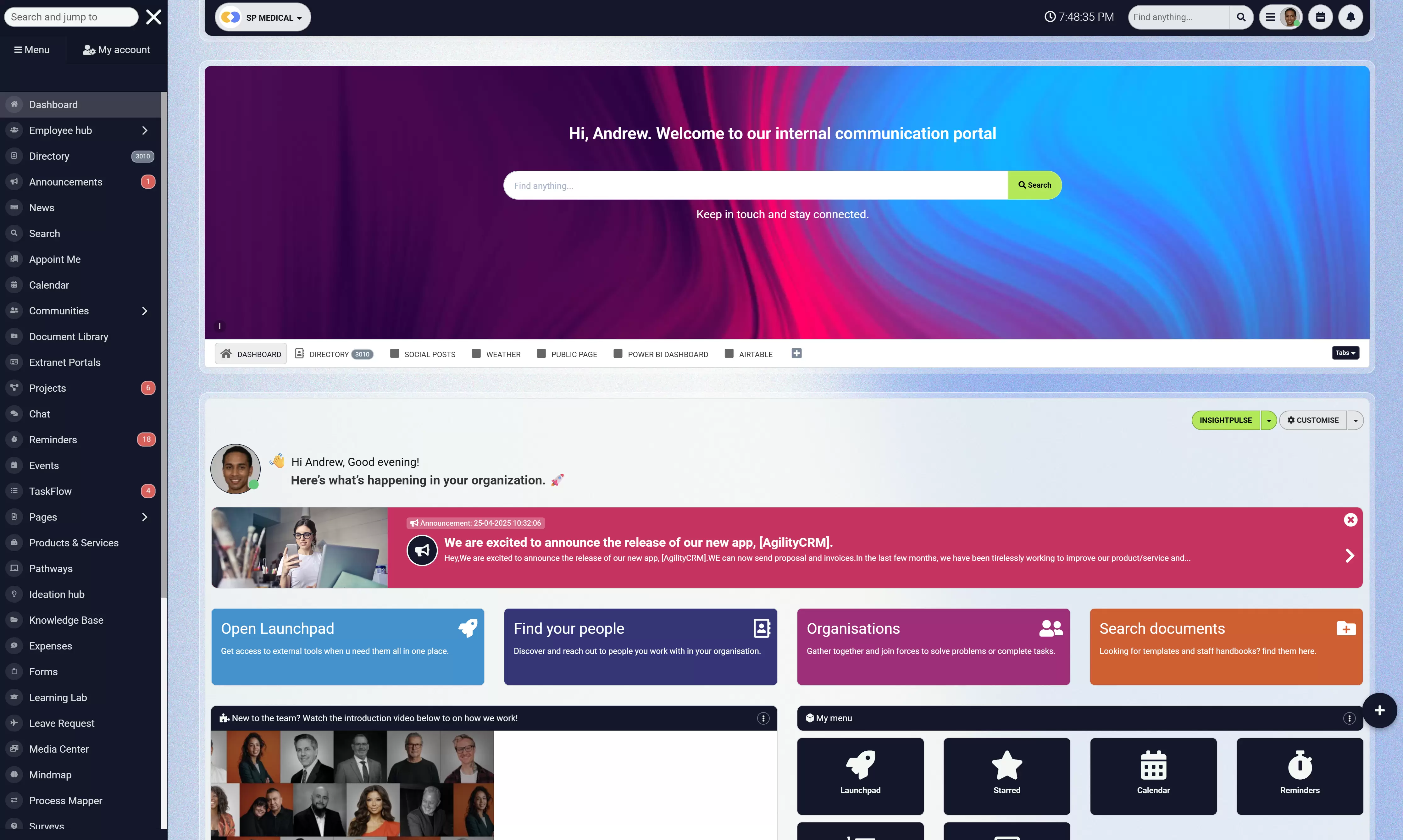
AgilityPortal is an employee intranet and digital workplace platform designed to bring people, information and communication together in one place.
Rather than replacing your existing HR system, it helps create a connected environment where employees can find what they need and feel part of the organisation from day one.
How AgilityPortal supports your employee onboarding process
- Create a central onboarding hub: Organise welcome messages, employee handbooks, company policies, training resources and FAQs in one accessible location.
- Help new hires find the right people: Use the employee directory and organisational chart to help employees identify colleagues, understand reporting relationships and connect with their teams.
- Keep everyone informed: Share company announcements, important updates and welcome messages without relying on lengthy email chains.
- Organise onboarding tasks: Use project and task management features to assign activities, set deadlines and keep responsibilities clear.
- Build stronger team connections: Give new employees access to relevant team spaces, discussions and workplace communities.
- Support employees wherever they work: Provide access to workplace information and communication through desktop and mobile experiences.
- Make important policies easier to manage: Store company documents centrally and use acknowledgement features when employees need to confirm they've read important announcements.
For HR managers, this means less time chasing information and more time supporting people.
For new employees, it means having a familiar place to find answers, connect with colleagues and understand what's happening across the business.
And because AgilityPortal supports organisations with different teams, departments and locations, you can organise onboarding resources around the needs of your workforce.
Give every new employee a better start
Your onboarding process shouldn't depend on whether someone remembers to forward an email, share a document or introduce a colleague.
With the right digital workplace in place, you can make these everyday activities easier to coordinate while keeping the personal touch that makes new employees feel welcome.
Ready to bring your employee onboarding experience together in one place?
Book a personalised AgilityPortal demo and see how your organisation can simplify communication, organise onboarding resources and help new employees settle in with confidence.
AgilityPortal
Make Employee Onboarding Easier From Day One
A successful employee onboarding process starts long before a new hire's first day. But when welcome messages, training resources, onboarding docs and team introductions are scattered across different tools, keeping everything organised can quickly become a challenge.
AgilityPortal brings employee communication, knowledge sharing and collaboration into one digital workplace. HR managers can create central onboarding hubs, organise essential resources, assign tasks and help new employees connect with their colleagues. Whether you're welcoming office-based, remote, hybrid or frontline employees, AgilityPortal helps support a more consistent staff onboarding process without relying on endless email chains or disconnected documents.
Price starts from $99 per 100 users per month
14-day free trial available
No permanent free plan is available, but you can try AgilityPortal free for 14 days with no credit card required.
Try it free for 14 days – no credit card required
14-day free trial available
No permanent free plan is available, but you can try AgilityPortal free for 14 days with no credit card required.
Final thoughts on improving employee onboarding
Enter your texImproving employee onboarding doesn't have to involve expensive software, complicated training programmes or a complete overhaul of your HR processes.
Often, it's the small things that make the biggest difference.
When new employees know what to expect, where to find information and who to turn to for support, they're more likely to feel confident and comfortable in their new roles.
If you're looking to improve your staff onboarding process, start with three simple changes:
- Prepare before day one: Make sure equipment, documents and introductions are ready before employees arrive.
- Create a consistent onboarding checklist: Give every new hire a clear, organised experience without overlooking important steps.
- Keep conversations going: Schedule regular check-ins to answer questions, review progress and offer support beyond the first week.
Remember, successful onboarding is about helping people feel connected, not simply completing paperwork.
Related Guides on Employee Onboarding and HR Best Practices
Looking to improve your staff onboarding process? These AgilityPortal guides explore practical onboarding procedures, preboarding preparation, employee training, HR onboarding software and ways to help new hires settle into their roles. Whether you're welcoming remote employees or building a more consistent onboarding experience, there's plenty here to explore.
- What Is Employee Onboarding? The Role of HR and Its Benefits
- How to Create a Presentation for Your New Employee Onboarding Process
- 7 Essential Remote Employee Onboarding Tips and Checklist
- What Is Employee Onboarding Software and How Do You Choose One?
- How to Streamline Onboarding With a Digital Workplace
- Digital Employee Onboarding: Process, Trends and Benefits
- How to Use Re-Onboarding to Support the Transition to Hybrid Work
- How to Make Your Virtual Onboarding Process More Engaging
- Onboarding With Microsoft Teams: Templates, Apps and Integrations
- 5 Onboarding Best Practices When Hiring a Developer
- Four Ways Onboarding Software Can Save Restaurants Money and Improve Retention
- Starbucks Onboarding: A Practical Look at Employee Training and Development
Together, these resources provide additional guidance on employee onboarding checklists, onboarding docs, workplace training, remote hiring and digital tools that can help HR managers create a more organised experience for every new employee.
Frequently asked questions about employee onboarding, pre boarding and HR onboarding procedures
What are the five stages of employee onboarding?
A practical employee onboarding framework includes five stages: preboarding, orientation, role-specific training, workplace integration and ongoing development.
During pre boarding, HR prepares essential documents, equipment and access. Orientation introduces the employee to the company, while training builds job-specific skills. Integration helps employees develop relationships, and ongoing development supports their long-term progress.
These five stages provide a useful framework rather than a universal onboarding standard.
How long should the staff onboarding process last?
The staff onboarding process typically lasts anywhere from several weeks to several months, depending on the employee's role, experience and responsibilities.
A 30-60-90 day onboarding plan provides a useful starting point, but more complex roles may require six months or longer. The important thing is to continue providing support until employees can confidently perform their responsibilities.
What onboarding docs should be included in an employee onboarding checklist?
An employee onboarding checklist should cover employment contracts, payroll information, workplace policies, training materials, job descriptions and relevant compliance documents.
It should also include equipment setup, system access, team introductions, role expectations and scheduled feedback meetings.
Keep onboarding docs organised and accessible, with sensitive employee records stored securely and only available to authorised personnel.
Who is responsible for HR onboarding and employee onboarding procedures?
HR onboarding is a shared responsibility.
HR teams coordinate documentation, policies and the overall process. Line managers explain responsibilities, provide training and monitor progress. IT prepares equipment and system access, while colleagues and onboarding buddies help new employees settle into the workplace.
Clear ownership of onboarding procedures prevents important activities from being overlooked.
How do you onboard remote employees effectively?
Remote employee onboarding requires preparation, accessible digital resources and regular communication.
Send equipment before the start date, arrange virtual introductions and provide access to training materials and company information.
Schedule regular video check-ins with managers and encourage informal conversations with teammates. A central employee intranet can also help remote employees find information and stay connected.
How can small businesses improve onboarding without a large HR budget?
Small businesses can improve employee onboarding without investing in expensive programmes.
Start with a reusable checklist, organise essential onboarding docs in a shared location and create a simple schedule for training and introductions.
Assign someone to welcome each new employee and arrange regular check-ins during their first few months.
Consistency, clear communication and accessible information often make a bigger difference than the size of your onboarding budget.
AI Summary
- Employee onboarding is the process of helping new hires understand their roles, learn company procedures, build relationships and become productive members of a team. Effective onboarding begins before the employee's first day and continues through training, workplace integration and ongoing development.
- Improving the staff onboarding process starts with preparation, clear expectations and consistent support. Practical improvements include preparing equipment and accounts before day one, creating onboarding checklists, assigning an onboarding buddy, introducing colleagues, providing role-specific training and scheduling regular manager check-ins.
- A structured onboarding plan can be divided into five practical stages: preboarding, first-day orientation, first-week training, first-month integration and development during the first 90 days. These stages provide a useful planning framework rather than a universal standard. Some roles require onboarding support beyond the first three months.
- HR onboarding works best when responsibilities are shared. HR coordinates employment documentation and onboarding procedures, IT prepares equipment and system access, managers explain responsibilities and review progress, and colleagues help new employees settle in. Essential onboarding docs should be organised, kept up to date and made accessible according to appropriate security and privacy permissions.
- Onboarding software can reduce administrative work, improve communication and make company resources easier to find. AgilityPortal supports employee onboarding through centralised knowledge resources, document libraries, employee directories, team Spaces, announcements and task management. These tools help HR managers coordinate activities while giving new employees a connected digital workplace.
Most Popular Posts

Effective communication among team members is vital for the productivity and success of any organization. Surprisingly, 60% of companies lack a long-term internal communication strategy, which p...


Businesses thrive on communication for efficiency, productivity and accomplishment. When the right information is passed from the right designation in the organization, it promotes positivity an...

Categories
Blog
(3294)
Business Management
(403)
Employee Engagement
(241)
Digital Transformation
(228)
Growth
(158)
Intranets
(142)
Internal communications
(111)
Remote Work
(68)
Sales
(53)
Collaboration
(53)
Customer Experience
(34)
Culture
(30)
Project management
(30)
Knowledge Management
(29)
Leadership
(20)
Comparisons
(9)
News
(1)

Related Posts

What happens when a new employee walks through the door on their first day, only to discover that nobody knows what they're supposed to be doing? Their laptop isn't ready, their manager is tied up in meetings, and they're left wondering who to ask fo...

What would happen if your company suddenly needed an important contract, financial record or employee policy, but nobody knew where to find it? Business documents are more than paperwork. They help companies stay organised, meet legal obligatio...

Ever requested a password reset email that never arrived? Or had a customer complain about a missing order confirmation, even though your system says it was successfully sent? It's frustrating, and when it happens regularly, it can cost your bu...

What happens when your website ranks well on Google, but your competitors keep appearing in ChatGPT, Perplexity and Google AI Overviews? Search is changing, and businesses can no longer rely on traditional rankings alone. The best SEO and conte...

Is your automotive eCommerce store struggling with complicated product catalogs, vehicle compatibility searches or disconnected inventory systems? You're not alone. Selling automotive parts online is far more complicated than running a ty...


Jill Romford
I am a digital nomad, lover of exploring new places and making friends.
I love to travel and I love the internet. I take pictures of my travels and share them on the internet using Instagram.
Traveler, entrepreneur, and community builder. I share my insights on digital marketing and social media while inspiring you to live your fullest life.
Ready to learn more? 👍
One platform to optimize, manage and track all of your teams. Your new digital workplace is a click away. 🚀
Free for 14 days, no credit card required.