
Insight Blog
Agility’s perspectives on transforming the employee's experience throughout remote transformation using connected enterprise tools.
40 minutes reading time
(7925 words)
How Data-Driven Finance Helps Business Leaders Make Better Investment Decisions in 2026

How Data-Driven Finance Helps Business Leaders Make Better Investment Decisions in 2026
Discover how data-driven finance helps business leaders reduce risk, improve forecasting, and make smarter investment decisions using real-time analytics, AI, and business intelligence.
How Data-Driven Finance Helps Business Leaders Make Better Investment Decisions in 2026

Every business makes investment decisions, but not every business makes good investment decisions.
The difference often comes down to one thing—Data-Driven Finance.
For years, companies relied on experience, gut instinct, and historical financial reports to decide where to invest their money.
While those methods still have value, today's business environment moves far too quickly for decisions based on outdated information.
Markets change overnight, customer behavior shifts constantly, and unexpected events can have an immediate impact on revenue and profitability.
Businesses that embrace data-driven finance, financial analytics, business intelligence, and real-time reporting are in a much stronger position to spot opportunities, reduce financial risk, and make smarter investment decisions.
In fact, data-driven organizations are 19 times more likely to be profitable than those that don't effectively use data in their decision-making.
19×
More Likely to Be Profitable
Organizations that effectively use Data-Driven Finance, business intelligence, and financial analytics are 19 times more likely to be profitable than businesses that fail to use data to guide financial and investment decisions.
Source: Keboola (citing research on data-driven organizations)
Think of it this way: if you were driving to a new destination, would you rather use a live GPS that updates every few seconds or a paper map printed five years ago?
That's exactly the difference between relying on static financial reports and using real-time financial data powered by AI and analytics.
In this guide, we'll explain what Data-Driven Finance really means, why it's becoming essential for businesses of every size, and how technologies like AI, predictive analytics, and business intelligence are helping leaders make faster, more confident investment decisions.
You'll also discover practical strategies, common mistakes to avoid, and the key financial metrics every business should be tracking to stay competitive.
Key Takeaways
- Data-Driven Finance helps organizations make faster, more accurate investment decisions by combining financial analytics, AI, business intelligence, and real-time financial reporting.
- High-quality financial data, connected business systems, and clearly defined KPIs improve cash flow forecasting, budget planning, financial forecasting, and long-term business performance.
- Businesses that use predictive analytics, executive dashboards, and workflow automation can reduce financial risk, optimize capital allocation, and respond more quickly to changing market conditions.
- Successful implementation depends on strong data governance, accurate reporting, modern finance tools, and a culture that encourages evidence-based decision-making rather than relying on intuition.
- The future of Data-Driven Finance is driven by AI copilots, autonomous finance, continuous forecasting, and machine learning, enabling organizations to make smarter, data-backed business investment decisions.
Why Data-Driven Finance Matters
Making financial decisions shouldn't rely on guesswork or outdated reports.
Data-Driven Finance helps businesses use real-time data, financial analytics, and business intelligence to make decisions based on facts rather than assumptions.
The data can come from many sources, including revenue reports, customer purchasing trends, operational costs, cash flow, market conditions, and business performance dashboards. When this information is brought together, leaders gain a much clearer picture of how the business is performing and where future opportunities or risks may exist.
Many businesses achieve this level of visibility by implementing integrated ERP solutions such as myob enterprise, which centralise financial, operational, and reporting data into a single platform for more informed decision-making.
One of the biggest advantages of Data-Driven Finance is greater accuracy. Decisions backed by reliable data are far more likely to reflect what's actually happening across the business. This leads to more realistic budgets, stronger financial planning, and more confidence when allocating resources or approving investments.
It also enables faster decision-making. Instead of waiting days or weeks for manual reports, executives can access up-to-date dashboards that provide the insights they need almost instantly. This allows businesses to respond quickly to changing market conditions and customer demand.
Another key benefit is better forecasting. By analyzing historical trends alongside real-time data, organizations can predict future revenue, expenses, and cash flow with greater confidence. More accurate forecasts make it easier to plan growth, manage budgets, and prepare for uncertainty.
Finally, better risk management is one of the strongest reasons to adopt a data-driven approach. Continuous monitoring of financial and operational data helps businesses identify warning signs earlier, reduce costly mistakes, and make proactive decisions before small issues become major financial problems.
Simply put, businesses that use Data-Driven Finance are better equipped to make smarter investment decisions, improve financial performance, and adapt to change with confidence.
What Is Data-Driven Finance?
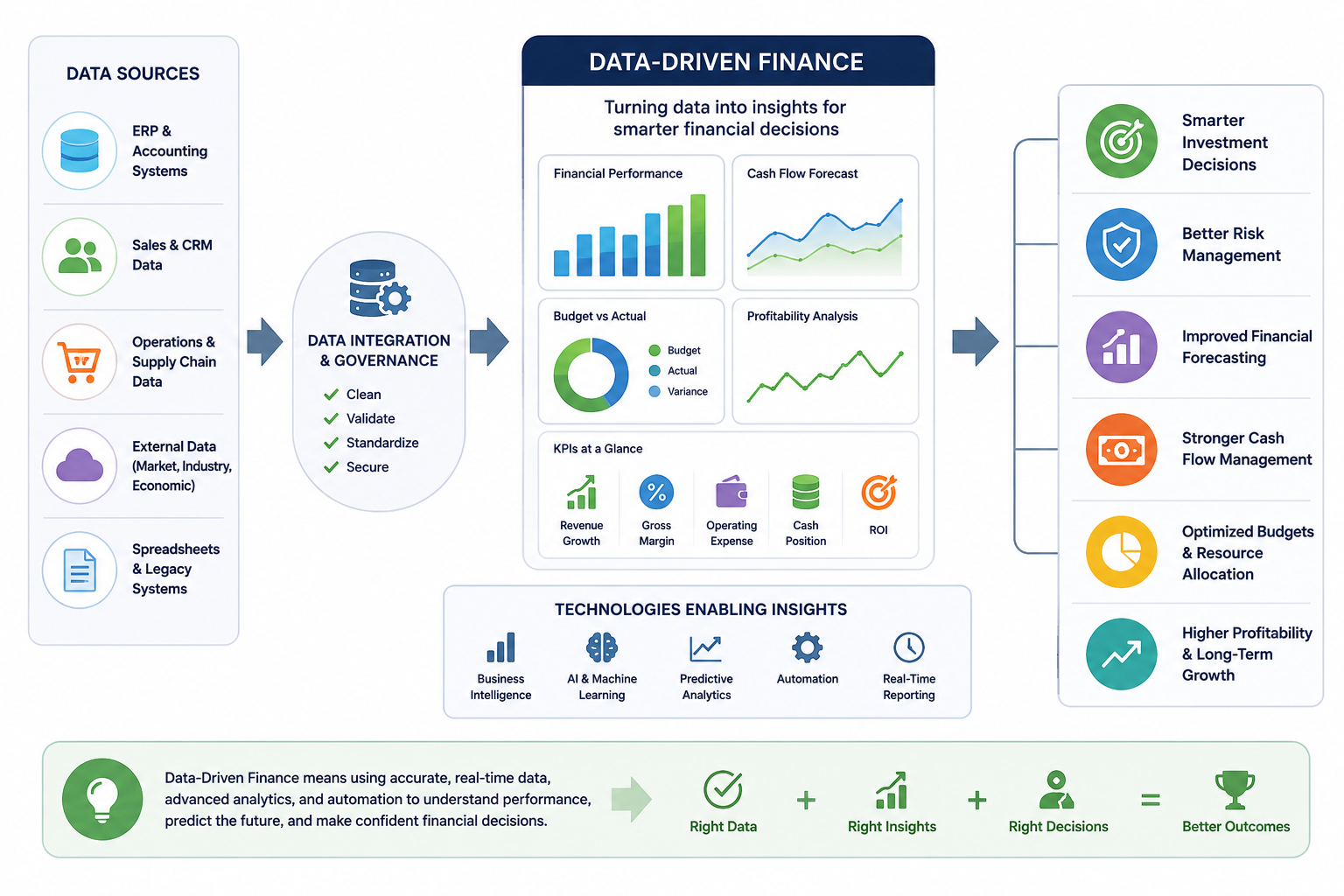
Data-Driven Finance is the process of using accurate, real-time data to make smarter financial and investment decisions.
Rather than relying solely on instinct, outdated spreadsheets, or historical reports, businesses use financial analytics, business intelligence (BI), artificial intelligence (AI), and automation to gain deeper insights into their financial performance and future opportunities.
Whether you're deciding how to allocate your company's budget, invest in new technology, expand into new markets, approve a major capital project, or even determine the best time to buy and sell stocks, data provides the evidence needed to make better decisions with greater confidence.
What Is Data-Driven Finance?
Instead of asking, "What do we think will happen?", Data-Driven Finance helps leaders answer, "What does the data tell us is most likely to happen?"
At its core, Data-Driven Finance combines information from multiple business systems—including accounting software, ERP platforms, CRM systems, payroll, sales data, operational reports, customer trends, and even market data—to create a complete view of an organization's financial health.
Bringing all this information together allows finance teams and executives to identify opportunities faster, improve profitability, reduce unnecessary spending, and manage financial risk more effectively.
Traditional Finance vs. Data-Driven Finance
Traditional financial management often depends on monthly or quarterly reports, manually updated spreadsheets, and historical performance.
While these methods still play an important role, they mainly explain what has already happened.
In today's fast-moving business environment, waiting weeks for reports can mean missing opportunities or reacting too late to potential problems.
Data-Driven Finance takes a different approach.
It continuously collects, processes, and analyzes financial information in real time. This enables finance teams to monitor business performance as it happens, identify emerging trends, forecast future outcomes, and make informed decisions before issues become costly.
For example, instead of discovering a cash flow problem after the month has ended, a real-time finance dashboard can identify declining cash reserves or rising expenses immediately.
Likewise, investors can use live market data and predictive analytics to make more informed decisions about when to buy and sell stocks based on evidence rather than emotion.
Why Spreadsheets Alone Are No Longer Enough
Spreadsheets have been the backbone of financial reporting for decades, but modern businesses generate far more data than spreadsheets were designed to manage.
As companies grow, maintaining hundreds of interconnected files becomes increasingly time-consuming, difficult to audit, and prone to costly human error.
Today's organizations collect financial data from dozens of different sources every minute.
Without connected systems, valuable insights remain scattered across departments, making it harder to identify patterns, forecast accurately, and respond quickly to change.
This is where business intelligence, real-time reporting, automation, predictive analytics, and AI-powered financial tools deliver real value.
These technologies automatically consolidate data, generate interactive dashboards, highlight unusual trends, identify financial risks, and even recommend actions based on historical and real-time information.
Ultimately, Data-Driven Finance gives organizations a more accurate, faster, and intelligent way to make financial decisions.
By replacing guesswork with trusted data, businesses can improve forecasting, strengthen risk management, optimize investments, support long-term strategic planning, and make better decisions with confidence.
In an increasingly competitive economy, organizations that use data effectively are better positioned to grow, adapt, and stay ahead of the competition.
Why Businesses Are Moving Toward Data-Driven Financial Decision-Making
The way businesses make financial decisions has changed dramatically over the last few years.
In the past, leaders could rely on historical reports, annual budgets, and experience to guide investment decisions. Today, that approach is no longer enough.
Markets move faster, customer expectations change quickly, and economic conditions can shift almost overnight.
Business leaders need access to accurate, real-time information that helps them respond with confidence instead of reacting too late.
This is why Data-Driven Finance has become a key part of modern business strategy.
By combining financial analytics, business intelligence, AI, and predictive analytics, organizations can make faster, more accurate decisions while reducing financial risk.
Several factors are driving this shift:
- Economic uncertainty - Global markets have become increasingly unpredictable. Supply chain disruptions, changing interest rates, geopolitical events, and economic slowdowns make it difficult to rely solely on historical trends. Businesses need real-time financial insights to adapt quickly and protect profitability.
- Inflation and rising costs - Higher prices for materials, energy, wages, and services continue to put pressure on business budgets. Data-driven financial reporting helps leaders identify unnecessary spending, monitor cash flow, and make informed decisions about where to invest or reduce costs.
- Faster decision-making - Business opportunities don't wait for monthly finance reports. Whether approving a new project, expanding into a new market, or deciding when to invest, executives need instant access to reliable financial data. Live dashboards and automated reporting dramatically reduce decision-making time.
- Better forecasting - Modern finance teams are expected to predict future performance, not simply report on the past. Using historical data alongside real-time business information allows organizations to build more accurate forecasts, improve budgeting, and prepare for different business scenarios.
- Digital transformation - As businesses adopt cloud software, ERP systems, CRM platforms, and workflow automation, they generate more data than ever before. Data-Driven Finance brings this information together into a single source of truth, helping leaders gain a complete view of business performance.
- Artificial Intelligence (AI) - AI is transforming finance by automating repetitive tasks, detecting unusual financial activity, identifying trends, and improving forecasting accuracy. Instead of spending hours creating reports, finance professionals can focus on analyzing insights and supporting strategic business decisions.
Why more organizations are making the switch
Businesses are adopting Data-Driven Finance because it delivers measurable benefits across the organization:
- Make faster financial and investment decisions using real-time data.
- Improve forecasting accuracy and long-term financial planning.
- Reduce financial risk by identifying issues before they become costly.
- Increase visibility into cash flow, revenue, and operational performance.
- Optimize budgets and allocate resources more effectively.
- Improve profitability through data-backed investment decisions.
- Support executive decision-making with live dashboards and business intelligence.
- Replace manual spreadsheets with automated reporting and analytics.
- Respond more quickly to market changes and customer demand.
- Build a stronger foundation for sustainable business growth.
Organizations that continue relying on outdated reports and disconnected spreadsheets risk falling behind competitors that are using data to make faster, smarter, and more confident financial decisions.
Data-Driven Finance isn't simply about collecting more data—it's about turning that data into actionable insights that drive better business outcomes.
7 of The Biggest Problems with Traditional Financial Decision-Making
Traditional financial management has helped businesses operate for decades, but today's business environment demands much more than monthly reports and spreadsheet analysis.
Markets move faster, customer expectations evolve constantly, and leaders are expected to make high-value investment decisions in days—or sometimes hours—not weeks.
The problem is that many organizations are still relying on disconnected systems, manual reporting, and outdated financial processes. These methods often create delays, increase the likelihood of human error, and make it difficult to react to changing market conditions.
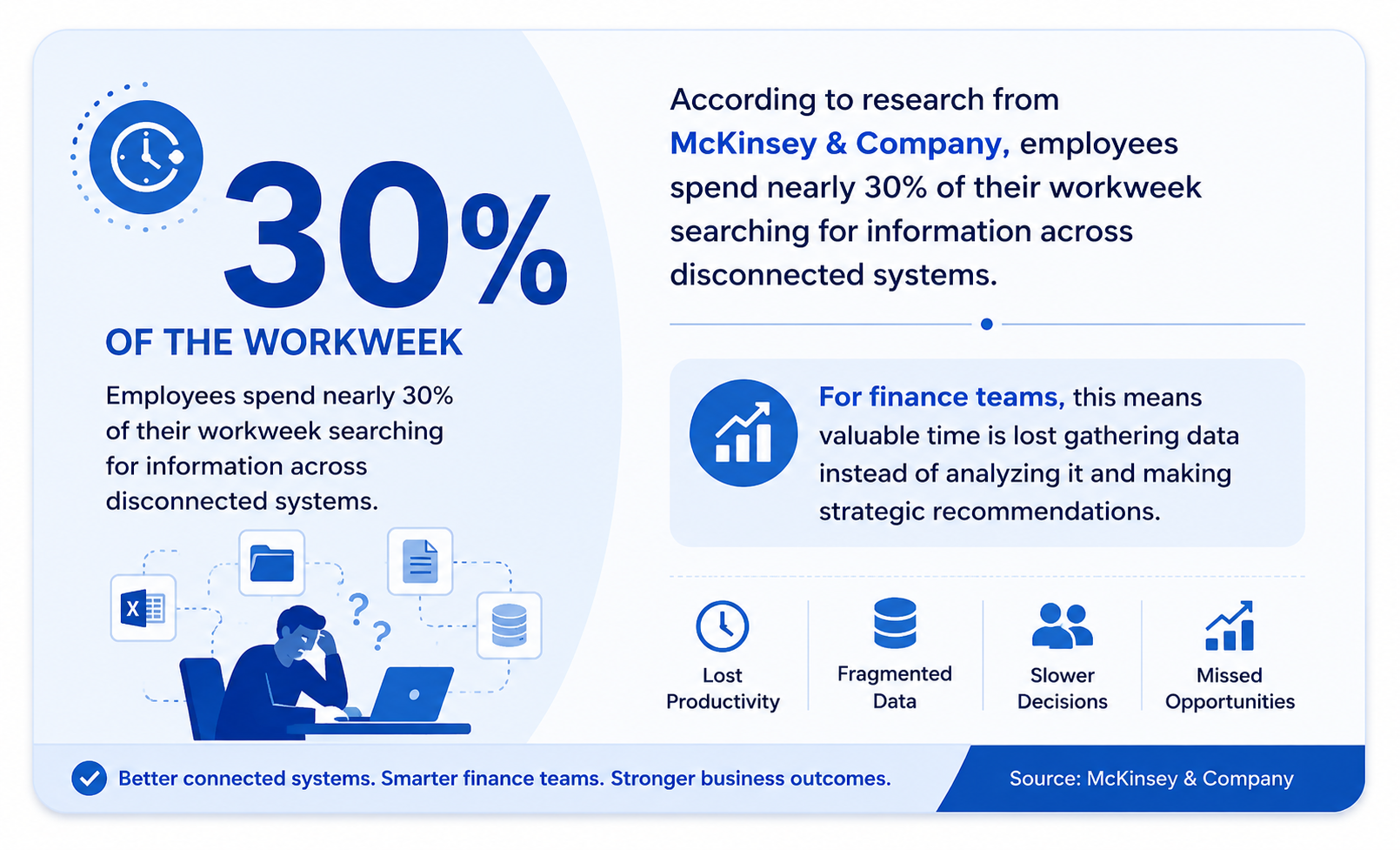
According to research from McKinsey & Company, employees spend nearly 30% of their workweek searching for information across disconnected systems. For finance teams, this means valuable time is lost gathering data instead of analyzing it and making strategic recommendations.
Let's look at some of the biggest challenges businesses face when relying on traditional financial decision-making.
7 of The Biggest Problems with Traditional Financial Decision-Making
Static Financial Reports
Many organizations still depend on weekly or monthly reports to understand business performance. The problem is that by the time these reports are reviewed, the information is already outdated.
Imagine a retail company reviewing sales figures at the end of the month.
During that time, customer demand may have shifted, inventory costs may have increased, or competitors may have changed their pricing. Decisions based on old information can result in missed opportunities and unnecessary financial losses.
The impact:
- Decisions are based on historical data instead of current business conditions.
- Leaders react to problems rather than preventing them.
- Growth opportunities may be missed before they're identified.
Outdated or Incomplete Data
Good financial decisions depend on accurate data.
Unfortunately, many businesses still work with information stored across multiple spreadsheets, accounting systems, CRM platforms, and operational databases that aren't connected.
For example, a manufacturing company may see rising production costs in its ERP system, while the finance team is still using last week's figures in a spreadsheet.
Without a single source of truth, executives may approve investments or budgets based on incomplete information.
The impact:
- Inaccurate forecasting.
- Poor budget allocation.
- Higher operational costs.
- Increased financial uncertainty.
Human Bias Influences Decisions
Even experienced finance professionals can be influenced by personal opinions, past experiences, or assumptions.
When decisions rely too heavily on intuition instead of evidence, businesses increase the risk of making costly mistakes.
For example, a company might continue investing heavily in a product because it performed well last year, despite current customer data showing declining demand. Data-driven insights help remove emotional bias by focusing attention on measurable business performance.
The impact:
- Poor investment decisions.
- Confirmation bias.
- Overconfidence in historical success.
- Missed opportunities for innovation.
Departmental Data Silos
Finance rarely works in isolation. Accurate financial planning depends on information from sales, operations, procurement, HR, marketing, and customer service.
When departments operate using separate systems that don't communicate with one another, finance leaders struggle to see the complete picture.
For example, the sales team may forecast significant growth while the operations team already knows production capacity cannot support it. Without connected data, executive teams may approve investments based on unrealistic assumptions.
The impact:
- Conflicting reports.
- Delayed financial planning.
- Poor collaboration.
- Lower forecasting accuracy.
Manual Forecasting Takes Too Long
Many finance teams still spend days collecting information from multiple spreadsheets before they can build financial forecasts.
While those reports are being prepared, the business continues to change.
Modern financial forecasting tools automatically update projections using live business data, allowing finance teams to spend more time analyzing trends instead of manually compiling reports.
The impact:
- Slow reporting cycles.
- Reduced productivity.
- Delayed investment decisions.
- Less time for strategic planning.
Slow Approval Processes
Investment decisions often require approval from multiple stakeholders. If financial information has to be manually gathered, reviewed, and emailed between departments, projects can be delayed for weeks.
Consider a growing software company that wants to invest in new AI infrastructure.
By the time financial reports have been updated and approvals completed, hardware prices may have changed or competitors may already have launched similar capabilities.
Businesses that use real-time financial dashboards and automated workflows can significantly shorten approval cycles and make decisions while opportunities still exist.
The impact:
- Missed market opportunities.
- Slower innovation.
- Reduced competitive advantage.
- Delayed return on investment (ROI).
Limited Visibility into Financial Risk
Traditional reporting often focuses on explaining what has already happened rather than identifying what could happen next.
Without predictive analytics, finance teams may fail to detect warning signs such as declining cash flow, increasing customer churn, rising operating expenses, or supplier risks until they begin affecting profitability.
For example, a construction company might only discover that project costs are exceeding budget after monthly reporting is complete. With real-time financial monitoring, those issues could have been identified much earlier.
The impact:
- Higher financial exposure.
- Unexpected cash flow issues.
- Increased operational risk.
- Poor strategic planning.
Why Modern Businesses Are Moving Beyond Traditional Finance
The common theme across all these challenges is lack of visibility. When financial information is delayed, incomplete, or disconnected, leaders cannot make decisions with confidence.
That's why organizations are investing in Data-Driven Finance, business intelligence, AI-powered analytics, real-time reporting, and predictive financial forecasting.
These technologies replace manual processes with live insights, giving executives a clearer understanding of business performance and helping them make faster, more informed decisions.
Ultimately, businesses that continue relying on traditional financial decision-making risk falling behind competitors that can identify opportunities earlier, respond to market changes faster, and make investment decisions backed by reliable data rather than assumptions.
Quick Overview: 8 Ways Data-Driven Finance Improves Investment Decisions
8 Ways Data-Driven Finance Improves Investment Decisions
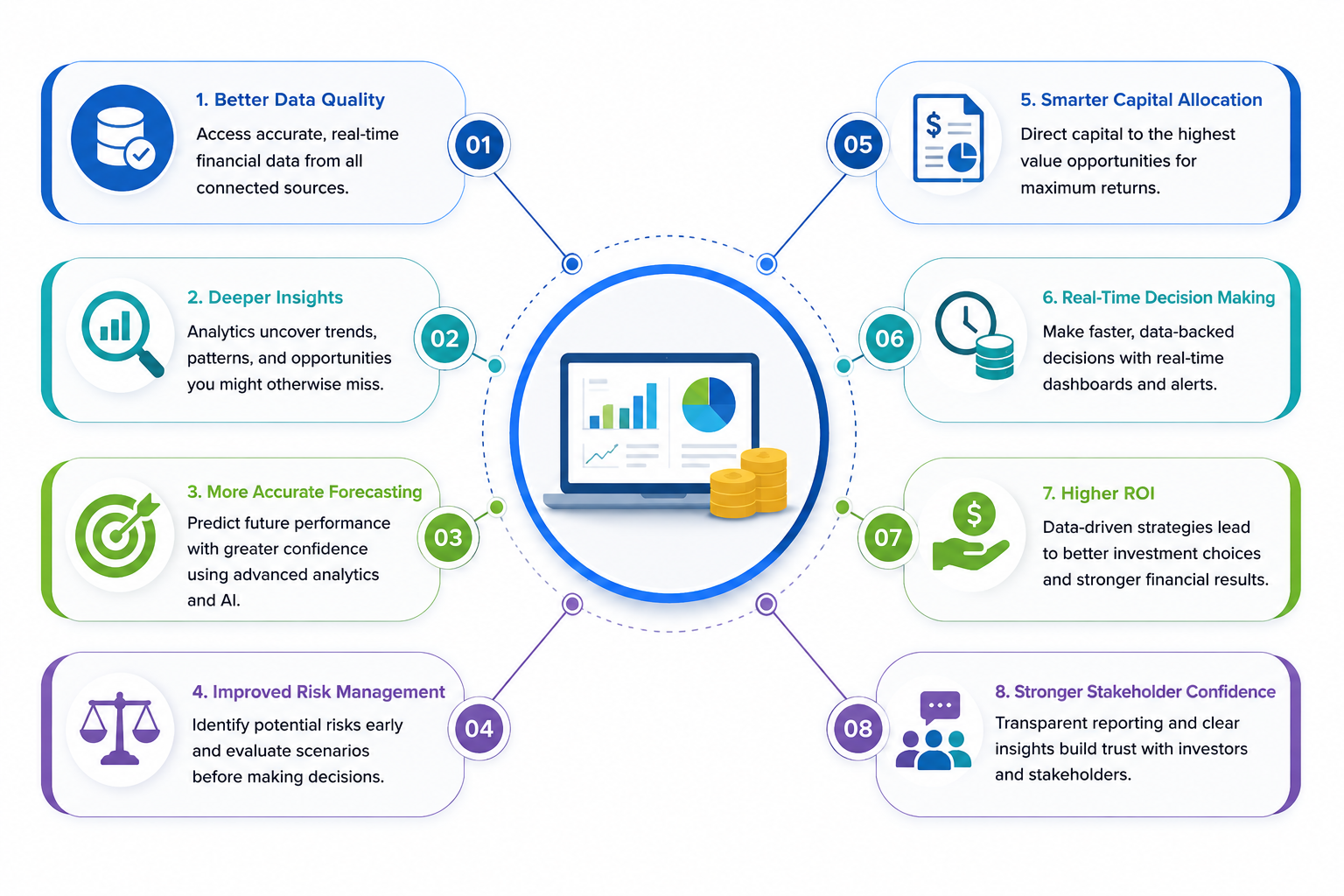
Before we look at each benefit in detail, here's a quick overview of how Data-Driven Finance improves investment decisions and the practical action businesses can take to get started.
| Benefit | Why It Matters | How to Get Started |
| Better Cash Flow Forecasting | Improves visibility into future cash flow so businesses can invest with confidence and avoid liquidity issues. | Connect accounting and banking systems, automate cash flow reporting, and monitor cash flow weekly. |
| Smarter Budget Allocation | Ensures money is invested in the projects, products, and departments that deliver the highest return. | Track department KPIs, review budgets regularly, and use ROI dashboards. |
| Reduced Financial Risk | Helps leaders understand whether investments are generating measurable business value. | Implement risk dashboards, automated alerts, and regular financial health reviews. |
| Better ROI Analysis | Uses historical and real-time data to forecast future performance and prepare for different scenarios. | Measure ROI, operating costs, payback periods, customer lifetime value (CLV), and profitability. |
| Predictive Financial Planning | Gives leaders instant access to financial insights, reducing delays and enabling quicker responses. | Adopt forecasting software, AI analytics, and scenario planning exercises. |
| Faster Executive Decision-Making | Gives leaders instant access to financial insights, reducing delays and enabling quicker responses. | Build executive dashboards with live financial and operational data. |
| Improved Scenario Planning | Allows businesses to prepare for economic uncertainty, market changes, and unexpected events. | Develop best-case, expected, and worst-case financial models that are updated regularly. |
| Real-Time Business Performance Monitoring | Provides continuous visibility into financial health, allowing businesses to identify opportunities and issues immediately. | Integrate ERP, CRM, accounting, payroll, and BI platforms into a single reporting dashboard. |
While every business is different, these eight capabilities form the foundation of a modern Data-Driven Finance strategy.
Even implementing just a few of them can improve financial planning, business intelligence, investment analysis, and executive decision-making, helping organizations become more agile, profitable, and resilient over time.
8 Ways Data-Driven Finance Improves Investment Decisions
Making the right investment decision has never been more challenging. Businesses face rising costs, changing customer demand, economic uncertainty, and increasing competition. Relying on intuition or outdated reports is no longer enough.
This is where Data-Driven Finance makes a real difference.
By combining financial analytics, business intelligence (BI), artificial intelligence (AI), and real-time reporting, organizations can make decisions faster, reduce risk, and invest with greater confidence.
The good news is you don't need to completely transform your finance department overnight. Most successful businesses start by improving how they collect, analyze, and act on financial data.
Below are eight ways Data-Driven Finance improves investment decisions and practical steps you can take to implement each one.

8 Ways Data-Driven Finance Improves Investment Decisions
1. Better Cash Flow Forecasting
Cash flow is one of the biggest reasons businesses succeed or fail. Even profitable companies can experience financial difficulties if they don't accurately predict when money will come in and when expenses need to be paid.
Using real-time financial data instead of static spreadsheets allows finance teams to monitor cash flow continuously and identify potential shortfalls before they become serious problems.
Why it improves investment decisionsBetter cash flow forecasting helps businesses:
- Understand available working capital.
- Avoid unnecessary borrowing.
- Plan future investments with confidence.
- Reduce unexpected cash shortages.
- Make larger purchases at the right time.
Start by:
- Connecting your accounting, ERP, and banking data.
- Tracking cash flow weekly instead of monthly.
- Building live finance dashboards.
- Using forecasting software instead of manual spreadsheets.
2. Smarter Budget Allocation
Every business has limited resources. The challenge is deciding where money will create the greatest return.
Data-Driven Finance allows organizations to identify which products, departments, customers, or projects generate the highest value. Instead of spreading budgets evenly, businesses can invest where the data shows the greatest opportunity.
Why it improves investment decisionsData-backed budgeting helps businesses:
- Reduce unnecessary spending.
- Increase return on investment (ROI).
- Fund high-performing initiatives.
- Eliminate low-value projects.
- Align spending with strategic goals.
Focus on:
- Tracking department performance.
- Measuring project profitability.
- Reviewing budgets quarterly.
- Creating KPI dashboards for executives.
3. Reduced Financial Risk
Every investment carries some level of risk. The goal isn't to eliminate risk but to understand it before making important decisions.
By analyzing historical performance, market trends, customer behaviour, and operational data, finance teams can identify warning signs much earlier than traditional reporting methods.
Why it improves investment decisionsBusinesses can:
- Detect financial risks earlier.
- Reduce costly mistakes.
- Improve compliance.
- Monitor supplier performance.
- Identify declining profitability before it affects growth.
Consider implementing:
- Risk dashboards.
- Automated alerts.
- Financial health scorecards.
- AI-powered anomaly detection.
- Regular scenario reviews.
4. Better ROI Analysis
Every investment should answer one simple question:
Will this generate more value than it costs?
Data-Driven Finance makes answering this question much easier by measuring the true financial impact of every investment.
Instead of relying on assumptions, businesses can compare actual costs, revenue growth, productivity improvements, and operational savings.
Why it improves investment decisionsBusinesses gain:
- Clear investment visibility.
- Better capital allocation.
- Higher profitability.
- Improved shareholder value.
- Faster post-investment reviews.
Measure:
- Total investment cost.
- Expected returns.
- Productivity improvements.
- Revenue generated.
- Payback period.
- Customer lifetime value (CLV).
5. Predictive Financial Planning
Traditional forecasting explains what happened.
Predictive financial planning estimates what is likely to happen next.
Using AI and predictive analytics, businesses can model different financial scenarios before making major investment decisions.
For example, a retailer can estimate how opening a new store might affect revenue, staffing costs, inventory levels, and profitability before spending a single pound.
Why it improves investment decisionsPredictive planning helps businesses:
- Prepare for uncertainty.
- Test different investment scenarios.
- Improve forecasting accuracy.
- Reduce planning errors.
- Make long-term strategic decisions.
Begin with:
- Historical financial data.
- AI forecasting tools.
- Sales forecasting.
- Market trend analysis.
- Quarterly scenario planning.
6. Faster Executive Decision-Making
One of the biggest advantages of Data-Driven Finance is speed.
Executives no longer need to wait for reports to be manually created or reviewed. Instead, they have access to live dashboards showing revenue, expenses, profitability, cash flow, and operational performance in real time.
This means opportunities can be acted on while they still exist.
Why it improves investment decisionsOrganizations can:
- Respond faster to market changes.
- Approve investments sooner.
- Reduce reporting delays.
- Improve collaboration.
- Make evidence-based decisions.
Improve visibility by:
- Creating executive dashboards.
- Automating financial reports.
- Standardizing KPIs.
- Giving leaders access to live data.
7. Improved Scenario Planning
No one can predict the future with complete certainty.
However, businesses can prepare for multiple possible outcomes.
Scenario planning allows organizations to ask questions such as:
- What happens if revenue drops by 15%?
- What if supplier costs increase?
- What if interest rates rise?
- What if demand suddenly doubles?
Instead of reacting after events occur, finance teams already have a plan.
Why it improves investment decisionsScenario planning enables businesses to:
- Prepare for uncertainty.
- Reduce financial surprises.
- Improve resilience.
- Protect profitability.
- Make confident investment choices.
Build multiple financial models based on:
- Best-case scenarios.
- Expected performance.
- Worst-case outcomes.
- Economic changes.
- Market demand.
8. Real-Time Business Performance Monitoring
Investment decisions shouldn't be made using information that is weeks old.
Real-time business intelligence gives executives continuous visibility into the financial health of the organization.
Instead of reviewing dozens of reports, leaders can see everything from one dashboard, including profitability, revenue, cash flow, operational costs, and customer performance.
This allows businesses to identify opportunities much sooner and respond before competitors.
Why it improves investment decisionsReal-time reporting helps businesses:
- Monitor financial performance continuously.
- Improve operational efficiency.
- Detect issues earlier.
- Increase forecasting accuracy.
- Support strategic growth.
Start by integrating:
- Accounting software.
- ERP systems.
- CRM platforms.
- Payroll systems.
- Sales dashboards.
- Business intelligence software.
Data-Driven Finance is about more than creating better reports—it's about creating better decisions.
Organizations that combine financial analytics, AI, business intelligence, and real-time financial reporting are better equipped to allocate budgets, manage risk, forecast future performance, and identify new growth opportunities.
You don't need to implement every tool at once. Begin by improving your data quality, connecting your business systems, and building dashboards around the financial KPIs that matter most.
As your data becomes more accurate and accessible, every investment decision becomes more informed, more strategic, and far more likely to deliver long-term value.
8 Essential Tools Used in Data-Driven Finance That You Can Try
The success of Data-Driven Finance depends on having the right technology in place.
Modern finance teams no longer rely on a single accounting system—they combine multiple tools to collect data, automate reporting, improve forecasting, and support better investment decisions.
Below are some of the most widely used tools and platforms, along with what they do and why businesses choose them.
#1. Enterprise Resource Planning (ERP) Best for: Managing core business operations and financial data.
Popular ERP tools
- SAP S/4HANA
- Oracle NetSuite
- Microsoft Dynamics 365 Finance
- Oracle Fusion Cloud ERP
- Sage Intacct
- Acumatica
ERP software becomes the single source of truth for business data by connecting finance, purchasing, inventory, operations, manufacturing, and HR.
Benefits
- Centralizes financial information.
- Improves financial reporting accuracy.
- Eliminates duplicate data.
- Tracks budgets and spending.
- Supports regulatory compliance.
- Integrates with BI and AI platforms.
Medium to large businesses looking to connect all departments into one financial system.
#2. Business Intelligence (BI) Platforms Best for: Turning business data into actionable insights.
Popular BI tools
- Microsoft Power BI
- Tableau
- Looker
- Qlik Sense
- Domo
- Sigma Computing
Business Intelligence tools transform raw data into interactive dashboards that executives can understand in seconds.
Instead of reviewing spreadsheets, leaders can monitor revenue, expenses, profitability, cash flow, and KPIs in real time.
Benefits
- Live dashboards.
- Interactive reporting.
- Better executive visibility.
- Faster decision-making.
- Connects to hundreds of business applications.
Businesses wanting real-time financial visibility across multiple systems.
#3. Financial Planning & Analysis (FP&A) Software Best for: Budgeting, forecasting, and scenario planning.
Popular FP&A platforms
- Anaplan
- Pigment
- Cube
- Workday Adaptive Planning
- Planful
- Vena
FP&A platforms help businesses forecast revenue, build budgets, model future scenarios, and compare financial performance over time.
Many also use AI to improve forecast accuracy.
Benefits
- Automated budgeting.
- Scenario planning.
- Rolling forecasts.
- Better capital planning.
- Improved collaboration.
Growing organizations with complex budgeting requirements.
#4. Accounting Software Best for: Day-to-day financial management.
Popular accounting platforms
- QuickBooks Online
- Xero
- FreshBooks
- Sage Accounting
- Zoho Books
Accounting software records every financial transaction and provides the foundation for Data-Driven Finance.
Without accurate accounting data, forecasting and analytics become unreliable.
Benefits
- Cash flow management.
- Accounts payable and receivable.
- Tax reporting.
- Expense tracking.
- Bank reconciliation.
Small businesses and finance teams of every size.
#5. Dashboard & Executive Reporting Software Best for: Executive reporting and KPI monitoring.
Popular dashboard tools
- Microsoft Power BI
- Tableau
- Geckoboard
- Klipfolio
- Databox
- Grafana
Dashboards provide a single place to monitor business performance without waiting for monthly reports.
Executives can quickly understand financial health and respond faster to changes.
Benefits
- Live KPI monitoring.
- Faster board reporting.
- Better visibility.
- Easy-to-understand visualizations.
- Mobile access.
CEOs, CFOs, and leadership teams.
#6. AI Finance Assistants Best for: Improving productivity and financial analysis.
Popular AI tools
- Microsoft Copilot
- ChatGPT
- Google Gemini
- Oracle AI
- SAP Joule
- IBM watsonx Assistant
Why AI is transforming finance
AI helps finance professionals automate repetitive work while identifying patterns that humans might miss.
Examples include summarizing financial reports, forecasting trends, identifying unusual transactions, and answering finance questions.
Benefits
- Faster analysis.
- Automated report generation.
- Predictive forecasting.
- Risk identification.
- Better productivity.
Finance teams looking to reduce manual work.
#7. Data Warehouses Best for: Combining data from multiple systems.
Best for: Combining data from multiple systems.
Popular platforms
- Snowflake
- Google BigQuery
- Amazon Redshift
- Microsoft Azure Synapse
- Databricks
Why data warehouses matter
Most businesses have financial data stored across dozens of systems.
A data warehouse brings everything together into one location for reporting and analytics.
Benefits
- Centralized reporting.
- Better data quality.
- Faster analytics.
- Supports AI.
- Scales easily.
Large organizations managing high volumes of data.
#8. Workflow Automation Platforms: Best for: Eliminating repetitive finance processes.
Popular workflow automation tools
- Microsoft Power Automate
- Zapier
- Make
- Workato
- UiPath
- AgilityPortal
Why automation is important
Finance teams spend significant time chasing approvals, processing invoices, updating spreadsheets, and sending reports.
Workflow automation removes repetitive tasks so finance professionals can focus on strategic work.
Benefits
- Faster approvals.
- Fewer manual errors.
- Improved compliance.
- Better productivity.
- Consistent financial processes.
Organizations wanting to improve finance operations and employee efficiency.
Which Tool Is Best?
There isn't a single "best" platform because each solves a different challenge.
Most organizations use several tools together to build a complete Data-Driven Finance ecosystem.
| Business Need | Recommended Tool Type |
| Financial management | ERP or Accounting Software |
| Business reporting | Business Intelligence (BI) |
| Budgeting & forecasting | FP&A Software |
| Executive dashboards | Dashboard Software |
| AI-powered analysis | AI Finance Assistants |
| Centralized business data | Data Warehouse |
| Process automation | Workflow Automation Platform |
The strongest Data-Driven Finance strategies don't rely on one application.
They combine ERP systems, business intelligence, FP&A software, AI, and workflow automation to create a connected financial ecosystem.
When these tools work together, businesses gain more accurate reporting, better forecasting, faster investment decisions, and improved financial performance.
How AI Is Transforming Data-Driven Finance
Artificial intelligence (AI) is changing the way businesses manage their finances. Instead of spending hours collecting data and building spreadsheets, finance teams can now use AI to analyze large amounts of information in seconds, helping them make faster and more accurate decisions.
One of the biggest advantages of AI is predictive analytics.
By analyzing historical data alongside current business trends, AI can forecast future revenue, expenses, and cash flow with greater accuracy. Machine learning takes this even further by continuously learning from new data, allowing forecasts to improve over time.
AI also plays an important role in fraud detection. It can quickly identify unusual transactions or spending patterns that may indicate fraud or financial errors, helping businesses respond before losses occur.
Other capabilities include forecast automation, intelligent budgeting, and financial copilots. For example, AI can automatically update financial forecasts when sales change, recommend budget adjustments based on spending trends, or provide executives with instant answers about financial performance through natural language queries.
Real-world examples include retailers using AI to predict seasonal demand, manufacturers forecasting raw material costs, and SaaS companies monitoring customer churn to improve revenue forecasts.
By combining AI with business intelligence, financial analytics, and real-time reporting, organizations gain deeper insights, reduce risk, and make smarter investment decisions with greater confidence.
Common Mistakes Businesses Make When Implementing Data-Driven Finance
Implementing Data-Driven Finance can transform the way businesses make investment decisions, improve financial forecasting, and reduce risk.
However, simply collecting more financial data isn't enough. Many organizations invest in analytics platforms, AI tools, and business intelligence software without first building the right foundation.
The result? Poor decision-making, inaccurate forecasts, and dashboards that create more confusion than clarity.
If you're planning to build a data-driven finance strategy, avoid these common mistakes.
1. Collecting Too Much Data Instead of the Right Data
One of the biggest mistakes businesses make is believing that more data automatically leads to better decisions.
In reality, collecting every available metric often overwhelms finance teams and makes it harder to identify the information that actually matters.
For example, an executive dashboard showing hundreds of metrics may hide the fact that cash flow is declining or customer acquisition costs are rising.
Instead of measuring everything, focus on the financial data that supports business objectives.
Common signs of this problem
- Too many reports with little insight.
- Teams spend more time collecting data than analysing it.
- Different departments measure different things.
- Important KPIs become buried in unnecessary information.
How to fix it
- Identify the metrics that directly support business goals.
- Remove duplicate or unused reports.
- Prioritize quality over quantity.
- Build dashboards around executive KPIs.
2. Poor Data Quality
Even the most advanced AI or business intelligence platform cannot produce reliable insights if the underlying data is inaccurate.
Duplicate records, outdated spreadsheets, missing transactions, and inconsistent financial reporting all reduce trust in the numbers.
Imagine approving a £500,000 investment based on revenue figures that were never updated correctly. Poor data quality can quickly lead to costly mistakes.
Common causes
- Manual spreadsheet updates.
- Duplicate customer records.
- Inconsistent accounting processes.
- Disconnected software systems.
How to fix it
- Create data validation rules.
- Automate data collection where possible.
- Regularly audit financial information.
- Integrate business systems to create a single source of truth.
3. Ignoring Operational Metrics
Financial reports only tell part of the story.
Many businesses focus solely on revenue and profit while overlooking operational metrics that directly influence financial performance.
For example, rising delivery times, increasing customer complaints, or falling employee productivity may eventually reduce profitability, even if current financial reports still look healthy.
A complete Data-Driven Finance strategy combines financial data with operational insights.
Examples of operational metrics
- Customer satisfaction (CSAT).
- Employee productivity.
- Inventory turnover.
- Order fulfilment times.
- Customer churn.
- Production efficiency.
How to fix it
- Combine finance and operational dashboards.
- Include non-financial KPIs in executive reporting.
- Review business performance across departments.
- Monitor leading indicators, not just financial outcomes.
4. Not Defining Clear Financial KPIs
Many organizations invest in reporting software before deciding what success actually looks like.
Without clearly defined Key Performance Indicators (KPIs), finance teams struggle to understand whether the business is improving or falling behind.
For example, a company may celebrate increasing revenue while ignoring shrinking profit margins or declining cash flow.
Good KPIs help leaders make faster, evidence-based decisions.
Essential financial KPIs include
- Revenue growth.
- Gross profit margin.
- Operating margin.
- Cash flow.
- Working capital.
- Customer Acquisition Cost (CAC).
- Customer Lifetime Value (CLV).
- Return on Investment (ROI).
- EBITDA.
- Forecast accuracy.
How to fix it
- Define KPIs before building dashboards.
- Align KPIs with business objectives.
- Review KPIs every quarter.
- Ensure every department measures the same goals.
5. No Executive Dashboards
Many executives still receive financial reports as spreadsheets or lengthy PDF documents.
While these reports contain valuable information, they rarely provide instant answers.
Modern executive dashboards present live financial data using charts, graphs, and interactive reports that help leaders identify opportunities and risks within seconds.
Imagine a CEO preparing for a board meeting. Instead of reviewing dozens of spreadsheets, they open a dashboard showing cash flow, revenue, profitability, budget performance, and financial forecasts in one place.
Benefits of executive dashboards
- Faster decision-making.
- Improved financial visibility.
- Better collaboration.
- Real-time reporting.
- Easier board reporting.
How to fix it
- Use Business Intelligence tools like Power BI or Tableau.
- Display only executive-level KPIs.
- Connect dashboards to live business data.
- Make dashboards accessible across devices.
6. Lack of Data Governance
Data is only valuable when people trust it.
Without clear data governance, businesses often face inconsistent reporting, security risks, duplicate records, and compliance challenges.
For example, if finance, sales, and operations all calculate revenue differently, executives may receive conflicting reports from different departments.
This creates confusion and slows decision-making.
Strong governance ensures everyone works from the same trusted data.
Good data governance includes
- Defined data ownership.
- Consistent reporting standards.
- Access controls.
- Regular audits.
- Security and compliance policies.
- Documented data definitions.
How to fix it
- Assign data owners for each business area.
- Standardize financial reporting processes.
- Create data quality policies.
- Regularly review data accuracy and security.
Successful Data-Driven Finance isn't about buying the latest software—it's about building the right processes first. Businesses that focus on data quality, financial analytics, business intelligence, AI, and executive reporting are far more likely to improve financial forecasting, reduce risk, and make better investment decisions.
Before investing in new technology, ask yourself these questions:
- Are we measuring the right KPIs?
- Can we trust our financial data?
- Do executives have real-time visibility into business performance?
- Are finance and operational data connected?
- Do we have clear data governance policies?
- Are our investment decisions based on evidence rather than assumptions?
By addressing these common mistakes early, organizations can build a strong foundation for Data-Driven Finance and gain a lasting competitive advantage.
Whats The Future of Data-Driven Finance in 2025?
The future of Data-Driven Finance is moving beyond simply reporting what happened.
Businesses are now using artificial intelligence (AI), machine learning, and real-time analytics to predict what will happen next and recommend the best course of action.
One of the biggest trends is the rise of AI copilots. These intelligent assistants can answer financial questions, generate reports, identify spending trends, and help finance teams make faster, evidence-based decisions. At the same time, autonomous finance is reducing manual work by automating tasks such as invoice processing, expense management, account reconciliation, and financial forecasting.
Another major shift is real-time forecasting. Instead of updating budgets once a quarter, businesses can continuously adjust forecasts as new financial data becomes available. Combined with embedded analytics, decision-makers no longer need to switch between different applications because financial insights are built directly into the software they already use.
Generative AI is also transforming finance by creating reports, summarizing financial performance, and highlighting risks within seconds. As a result, digital finance teams spend less time preparing data and more time delivering strategic advice.
Businesses that embrace these technologies will be better positioned to improve financial planning, investment decisions, risk management, and long-term growth.
The future belongs to organizations that turn data into actionable insights, not just reports.
Final Thoughts on Choosing the Best Workplace Operations Platform
The way businesses make financial decisions is changing.
Companies that continue to rely on spreadsheets, historical reports, and instinct alone risk making slower decisions and missing valuable opportunities. In today's competitive market, Data-Driven Finance has become a strategic advantage rather than a nice-to-have.
Throughout this guide, we've explored how financial analytics, business intelligence, AI, predictive analytics, and real-time financial reporting help organizations improve cash flow forecasting, reduce financial risk, optimize budgets, and make smarter investment decisions. More importantly, these technologies give business leaders the confidence to act on evidence instead of assumptions.
The most successful organizations understand that data is one of their most valuable business assets.
When finance teams have access to accurate, timely, and connected information, they can forecast more accurately, identify risks earlier, respond faster to market changes, and allocate resources where they'll deliver the greatest return.
If you're just beginning your Data-Driven Finance journey, you don't need to transform everything overnight. Start with the fundamentals:
- Improve the quality of your financial data.
- Define the KPIs that matter most to your business.
- Connect your accounting, ERP, CRM, and operational systems.
- Build executive dashboards with real-time reporting.
- Automate repetitive financial processes.
- Introduce AI and predictive analytics as your business matures.
Even small improvements can lead to faster decision-making, better financial planning, and stronger business performance over time.
Before making your next major investment decision, ask yourself these important questions:
- Can we trust the financial data we're using?
- Are our reports based on real-time information or last month's numbers?
- Do our leaders have complete visibility into business performance?
- Are we identifying risks before they become expensive problems?
- Are we using data to guide decisions—or simply to explain them after the fact?
If the answer to any of these questions is "no," now is the right time to strengthen your Data-Driven Finance strategy. The businesses that invest in better financial insights today will be better prepared to adapt, compete, and grow tomorrow.
Frequently Asked Questions About Data-Driven Finance
What is Data-Driven Finance and how does it work?
Data-Driven Finance is the process of using real-time financial data, business intelligence, AI, and analytics to make better financial and investment decisions.
Instead of relying on intuition or outdated spreadsheets, businesses use live data from accounting systems, ERP platforms, CRM software, and operational tools to improve budgeting, forecasting, cash flow management, and risk analysis.
Why is Data-Driven Finance important for modern businesses?
Data-Driven Finance helps businesses make faster, more accurate decisions while reducing financial risk.
It improves forecasting, supports better budget planning, increases visibility into business performance, and allows leaders to respond quickly to changing market conditions.
Organizations that use data effectively are often better positioned to improve profitability and long-term growth.
What are the biggest benefits of using financial analytics for business decisions?
Financial analytics provides valuable insights that help businesses understand performance and identify growth opportunities.
Key benefits include:
- More accurate financial forecasting.
- Better cash flow management.
- Smarter investment decisions.
- Improved budget allocation.
- Reduced financial risk.
- Better return on investment (ROI).
- Faster executive decision-making.
How does AI improve financial decision-making and business forecasting?
Artificial intelligence (AI) helps finance teams automate repetitive tasks, detect unusual financial activity, improve forecasting accuracy, and identify trends hidden within large datasets.
AI can also generate reports, recommend budget adjustments, predict cash flow, and support smarter investment planning.
What are the best tools for implementing Data-Driven Finance?
The most effective Data-Driven Finance strategy combines several technologies rather than relying on a single platform.
Popular tools include:
- ERP software (SAP, Oracle NetSuite, Microsoft Dynamics 365).
- Business Intelligence platforms (Power BI, Tableau).
- FP&A software (Anaplan, Workday Adaptive Planning).
- Accounting software (QuickBooks, Xero).
- AI assistants (Microsoft Copilot, ChatGPT).
- Workflow automation tools (Power Automate, Zapier).
What financial KPIs should every business leader track?
Every business is different, but most finance teams should monitor:
- Revenue growth.
- Gross profit margin.
- Operating margin.
- EBITDA.
- Cash flow.
- Working capital.
- Customer Acquisition Cost (CAC).
- Customer Lifetime Value (CLV).
- Return on Investment (ROI).
- Forecast accuracy.
Tracking these KPIs helps businesses make better financial decisions and improve long-term performance.
How can small businesses implement Data-Driven Finance on a limited budget?
Small businesses don't need expensive enterprise software to become data-driven.
A good starting point includes:
- Using cloud accounting software.
- Creating simple Power BI dashboards.
- Tracking essential financial KPIs.
- Automating manual reporting.
- Reviewing cash flow weekly.
- Using AI tools to analyse financial reports.
Starting small allows businesses to improve financial visibility before investing in larger platforms.
What is predictive financial analytics and why is it important?
Predictive financial analytics uses historical financial data, machine learning, and AI to estimate future business performance.
It helps businesses forecast revenue, predict expenses, identify financial risks, and test different investment scenarios before making major decisions.
Instead of reacting to problems, businesses can prepare for them in advance.
How do executive dashboards improve financial reporting?
Executive dashboards bring together data from accounting software, ERP systems, CRM platforms, and operational tools into one real-time view.
Benefits include:
- Faster reporting.
- Better visibility.
- Real-time financial insights.
- Improved collaboration.
- More confident executive decision-making.
Dashboards reduce reliance on spreadsheets and make financial information easier to understand.
What is the difference between Business Intelligence (BI) and financial analytics?
Although the terms are often used together, they serve different purposes.
Business Intelligence (BI) collects, organizes, and visualizes data through dashboards and reports.
Financial analytics goes one step further by analysing that data to uncover trends, forecast future performance, evaluate investments, and support strategic financial planning.
Most modern businesses use both together as part of a comprehensive Data-Driven Finance strategy.
Can Data-Driven Finance help businesses make better investment decisions?
Yes. One of the biggest advantages of Data-Driven Finance is improving how businesses evaluate investments.
By combining financial analytics, predictive forecasting, business intelligence, and real-time reporting, organizations can compare investment opportunities, calculate expected ROI, identify financial risks, and allocate capital more effectively.
What is the first step to building a Data-Driven Finance strategy?
The best place to start is by improving your financial data quality.
Follow these simple steps:
- Identify your business goals.
- Define the financial KPIs that matter most.
- Connect your business systems.
- Build executive dashboards.
- Automate reporting where possible.
- Introduce AI and predictive analytics as your business grows.
A strong foundation ensures every financial decision is backed by reliable, accurate, and actionable data.
AI Summary
- Data-Driven Finance enables businesses to make smarter investment decisions by combining real-time financial data, business intelligence, AI, predictive analytics, and executive reporting instead of relying on intuition or historical reports alone.
- Organizations adopting a data-driven finance strategy can improve financial forecasting, optimize cash flow management, strengthen budget planning, reduce financial risk, and respond more quickly to changing market conditions.
- Modern finance teams rely on technologies such as ERP software, accounting platforms, Business Intelligence (BI), FP&A software, AI finance assistants, workflow automation, and predictive analytics to improve financial performance and decision-making.
- Building a successful Data-Driven Finance framework requires high-quality financial data, clearly defined KPIs, connected business systems, executive dashboards, data governance, and continuous monitoring of business performance.
- Emerging technologies including AI copilots, autonomous finance, embedded analytics, machine learning, and continuous financial forecasting are transforming how organizations plan investments and allocate capital.
- The businesses that gain the greatest competitive advantage are those that use financial analytics to improve profitability, reduce uncertainty, identify growth opportunities, and make faster, evidence-based investment decisions.
Most Popular Posts

Effective communication among team members is vital for the productivity and success of any organization. Surprisingly, 60% of companies lack a long-term internal communication strategy, which p...


Businesses thrive on communication for efficiency, productivity and accomplishment. When the right information is passed from the right designation in the organization, it promotes positivity an...

Categories
Blog
(3190)
Business Management
(394)
Employee Engagement
(235)
Digital Transformation
(217)
Growth
(150)
Intranets
(141)
Internal communications
(106)
Remote Work
(68)
Sales
(53)
Collaboration
(52)
Customer Experience
(32)
Culture
(30)
Knowledge Management
(29)
Project management
(29)
Leadership
(20)
Comparisons
(9)
News
(1)

Related Posts

Welcome to AgilityPortal's guide to the best VPN for Remote teams. How do you give employees secure access to company systems when they work from home, the office and everywhere in between? It's a question more businesses need to answer: 28% of worki...

Have you ever left a meeting thinking everyone agreed on the next step, only to discover a week later that each person remembered something different? Open source meeting transcription can help teams keep a searchable record of the conversation...

The best ai image editors can save a team hours of repetitive work. A marketing manager can remove a distracting background, an HR team can improve a staff event photo, and an online shop can turn a basic product shot into something ready to pu...

Ever opened a PDF just before a meeting and realised you need to edit a page, pull figures from a scanned report, or gather everyone's comments? What should be a quick task can turn into a frustrating search for the right tool. That lost time a...

Looking for a New Job Remotely can feel like a simple next step: update your CV, turn on job alerts and start applying. In reality, the strongest remote job searches start much earlier. You need to be clear about the work you want, the kind of ...


Jill Romford
I am a digital nomad, lover of exploring new places and making friends.
I love to travel and I love the internet. I take pictures of my travels and share them on the internet using Instagram.
Traveler, entrepreneur, and community builder. I share my insights on digital marketing and social media while inspiring you to live your fullest life.
Ready to learn more? 👍
One platform to optimize, manage and track all of your teams. Your new digital workplace is a click away. 🚀
Free for 14 days, no credit card required.