Insight Blog
Agility’s perspectives on transforming the employee's experience throughout remote transformation using connected enterprise tools.
40 minutes reading time
(8047 words)
The Digital Workplace Strategy Playbook Every HR and IT Leader Needs

The Digital Workplace Strategy Playbook Every HR and IT Leader Needs
Learn how to build a successful digital workplace strategy that improves employee communication, productivity, collaboration, and engagement across hybrid and remote teams.
The Digital Workplace Strategy Playbook Every HR and IT Leader Needs

Most businesses today already have the tools.
That's not really the problem anymore.
The real issue is that employees are constantly jumping between disconnected apps just to get basic work done.
One minute they're checking Microsoft Teams, then Slack, then email, then SharePoint, then another HR platform nobody fully uses. Before long, people waste more time searching for information than actually doing productive work.
That's exactly why having a strong digital workplace strategy matters so much now.
According to research from Atlassian, employees switch between workplace applications more than 1,200 times per day, creating constant distractions and productivity loss.
At the same time, Gartner reports that nearly 47% of digital workers struggle to find the information they need to perform effectively. Those numbers explain why so many organizations feel overwhelmed by tool sprawl and communication chaos.
The workplace changed massively after hybrid and remote work became normal.
Employees now expect faster communication, mobile access, flexible collaboration, and simple digital experiences that actually make work easier instead of more frustrating.
If systems are slow, confusing, or disconnected, employees notice it immediately.
47%
of digital workers struggle to find information
According to Gartner, nearly 47% of digital workers struggle to find the information they need to perform effectively, highlighting how disconnected systems, workplace tool sprawl, and communication overload continue to impact employee productivity.
That's where a modern digital workplace strategy becomes critical.
A successful strategy is no longer just about deploying workplace technology.
It's about creating a connected employee experience where communication, collaboration, knowledge sharing, and workflows all work together in one ecosystem.
And honestly, this is why HR and IT teams can't operate separately anymore.
HR focuses on employee engagement, culture, onboarding, and retention.
IT focuses on security, systems, integrations, and digital infrastructure.
But employees don't separate those experiences in their heads. To them, it's all just "work." If communication is poor, systems are difficult to use, or information is impossible to find, the overall employee experience suffers.
Modern businesses are starting to realize that digital workplace transformation is not simply an IT project anymore. It's a business-wide strategy directly connected to productivity, employee satisfaction, retention, and long-term growth.
The companies getting this right are simplifying communication, reducing app overload, improving employee access to information, and investing in digital workplace solutions that employees genuinely want to use.
Key Takeaways
- A successful digital workplace strategy helps businesses improve employee communication, collaboration, productivity, and knowledge sharing across hybrid and remote teams.
- Many organizations struggle with disconnected workplace tools that create communication silos, information overload, and poor employee experiences.
- Modern digital workplace platforms centralize communication, document management, workflow automation, and employee engagement into one connected environment.
- Employee adoption is one of the most important parts of digital workplace transformation, which is why simplicity, mobile access, and usability matter.
- Businesses that invest in connected workplace technology often improve operational efficiency, employee engagement, onboarding, and long-term workforce productivity.
What Is a Digital Workplace Strategy?
A digital workplace strategy is basically the plan businesses use to improve how employees communicate, collaborate, access information, and get work done using digital tools.
Sounds simple, right? But most companies are still struggling with it.
The average employee now works across multiple workplace apps every single day. Between emails, chat tools, project management software, HR systems, intranet platforms, video meetings, and even industry-specific tools like accounting software for electricians, workers are constantly switching between systems just to complete normal tasks.
In fact, research from Atlassian found employees switch between apps more than 1,200 times per day. That constant context switching creates distractions, slows productivity, and increases digital fatigue across the workforce.
At the same time, Microsoft's Work Trend Index reported that nearly 68% of employees say they do not have enough uninterrupted focus time during the workday.
That's a massive problem for businesses trying to improve efficiency and employee experience.
And honestly, most employees feel it every day.
You've probably seen it yourself:
- Important updates getting buried in email threads
- Teams using five different communication tools
- Employees unable to find documents quickly
- Managers repeating the same information across departments
- New hires feeling overwhelmed by disconnected systems
That's exactly why modern organizations are rethinking the entire digital workplace experience.
A strong digital workplace transformation strategy focuses on creating one connected environment where employees can communicate, collaborate, share knowledge, and complete work without unnecessary friction.
Instead of employees hunting for information across disconnected systems, everything becomes easier to access, manage, and use.
1,200+
app switches per employee each day
Research from Atlassian found employees switch between workplace applications more than 1,200 times per day, creating constant distractions, workflow interruptions, reduced focus, and growing digital fatigue across modern organizations.
Why modern organizations are rethinking the digital workplace
The workplace changed fast once hybrid and remote work became normal.
Employees now work across multiple apps, devices, and locations every day, which is why businesses need stronger digital workplace solutions to stay connected.
The problem is many companies adopted new tools without building a proper long-term digital workplace strategy. As a result, employees now deal with communication overload, disconnected workflows, and app fatigue daily.
According to Gartner, nearly half of digital workers struggle to find the information needed to do their jobs effectively. That creates frustration, wasted time, and lower productivity.
At the same time, employees now expect:
- mobile-first communication
- faster collaboration
- simpler workplace technology
- better digital employee experiences
That's why businesses are investing heavily in:
- employee communication platforms
- workplace collaboration tools
- workflow automation
- modern intranet software
The goal is no longer just adding more software. It's about creating a workplace employees actually enjoy using.
The core goals behind a successful digital workplace strategy
A modern digital workplace strategy is designed to improve both employee experience and business performance.
Most organizations focus on:
- improving employee engagement
- increasing workplace productivity
- reducing communication silos
- simplifying collaboration
- improving knowledge sharing
And the impact is real.
Gallup found highly engaged teams can achieve up to 23% higher profitability compared to disengaged teams. Businesses with stronger internal communication also tend to see better retention and higher employee satisfaction.
When employees can easily access information and communicate without friction, productivity improves naturally.
How HR and IT teams now share responsibility for employee experience
Today, HR and IT both play a major role in shaping the overall digital employee experience.
HR focuses on culture, communication, onboarding, and engagement, while IT manages systems, integrations, security, and workplace infrastructure.
But employees don't separate those experiences. If tools are confusing or communication is poor, frustration builds quickly regardless of which department owns the platform.
That's why successful companies now treat digital workplace transformation as both a technology strategy and a people strategy.
When HR and IT work together, businesses create a more connected, productive, and engaging workplace experience for employees.
Why Many Digital Workplace Strategies Fail
A digital workplace strategy is basically the plan businesses use to improve how employees communicate, collaborate, access information, and get work done using digital tools.
Sounds simple, right? But most companies are still struggling with it.
The average employee now works across multiple workplace apps every single day.
Between emails, chat tools, project management software, HR systems, intranet platforms, video meetings, and even industry-specific tools like accounting software for electricians, workers are constantly switching between systems just to complete normal tasks.
In fact, research from Atlassian found employees switch between apps more than 1,200 times per day. That constant context switching creates distractions, slows productivity, and increases digital fatigue across the workforce.
At the same time, Microsoft's Work Trend Index reported that nearly 68% of employees say they do not have enough uninterrupted focus time during the workday.
hat's a massive problem for businesses trying to improve efficiency and employee experience.
And honestly, most employees feel it every day.
You've probably seen it yourself:
- Important updates getting buried in email threads
- Teams using five different communication tools
- Employees unable to find documents quickly
- Managers repeating the same information across departments
- New hires feeling overwhelmed by disconnected systems
That's exactly why modern organizations are rethinking the entire digital workplace experience.
A strong digital workplace transformation strategy focuses on creating one connected environment where employees can communicate, collaborate, share knowledge, and complete work without unnecessary friction.
Instead of employees hunting for information across disconnected systems, everything becomes easier to access, manage, and use.
Why Modern Organizations Are Rethinking the Digital Workplace
The workplace changed fast once hybrid and remote work became normal.
Employees now work across multiple apps, devices, and locations every day, which is why businesses need stronger digital workplace solutions to stay connected.
The problem is many companies adopted new tools without building a proper long-term digital workplace strategy. As a result, employees now deal with communication overload, disconnected workflows, and app fatigue daily.
According to Gartner, nearly half of digital workers struggle to find the information needed to do their jobs effectively. That creates frustration, wasted time, and lower productivity.
At the same time, employees now expect:
- mobile-first communication
- faster collaboration
- simpler workplace technology
- better digital employee experiences
That's why businesses are investing heavily in:
- employee communication platforms
- workplace collaboration tools
- workflow automation
- modern intranet software
The goal is no longer just adding more software. It's about creating a workplace employees actually enjoy using.
The Core Goals Behind a Successful Digital Workplace Strategy
A modern digital workplace strategy is designed to improve both employee experience and business performance.
Most organizations focus on:
- improving employee engagement
- increasing workplace productivity
- reducing communication silos
- simplifying collaboration
- improving knowledge sharing
And the impact is real.
Gallup found highly engaged teams can achieve up to 23% higher profitability compared to disengaged teams.
Businesses with stronger internal communication also tend to see better retention and higher employee satisfaction.
When employees can easily access information and communicate without friction, productivity improves naturally.
How HR and IT Teams Now Share Responsibility for Employee Experience
Today, HR and IT both play a major role in shaping the overall digital employee experience.
HR focuses on culture, communication, onboarding, and engagement, while IT manages systems, integrations, security, and workplace infrastructure.
But employees don't separate those experiences. If tools are confusing or communication is poor, frustration builds quickly regardless of which department owns the platform.
That's why successful companies now treat digital workplace transformation as both a technology strategy and a people strategy.
When HR and IT work together, businesses create a more connected, productive, and engaging workplace experience for employees.
The Core Components of a Modern Digital Workplace Strategy

The Core Components of a Modern Digital Workplace Strategy
Centralized Employee Communication Systems
A modern digital workplace strategy should make communication simple, fast, and accessible from anywhere.
Employees should not need to jump between multiple apps just to stay informed about company updates or team conversations.
- Company announcements and updates
- Social feeds and team messaging
- Employee mobile apps for faster communication
Knowledge Management and Document Collaboration
Employees waste huge amounts of time searching for documents and information across disconnected systems.
Strong knowledge management tools help teams quickly access files, SOPs, and shared resources in one place.
- Searchable knowledge bases
- Document version control and shared workspaces
- SOP management for operational consistency
Employee Engagement and Culture-Building Tools
Employee engagement is now a major part of digital workplace transformation.
Gallup research shows engaged employees are more productive, motivated, and likely to stay with the business long term.
- Employee recognition systems
- Surveys and feedback loops
- Employee communities and social interaction
Smart Workflow Automation Improves Operational Efficiency
Automation helps businesses reduce repetitive tasks and improve operational efficiency.
Instead of relying on manual processes, companies can streamline approvals, onboarding, and internal requests through workplace automation.
- Employee onboarding workflows
- Approval processes and HR requests
- Automated reminders and task tracking
Mobile-First Access for Frontline and Remote Employees
Many frontline and deskless workers rarely sit behind a computer, which is why mobile-first workplace tools are becoming essential.
Employees need instant access to communication, documents, and updates wherever they are working.
- Mobile intranet access for remote teams
- Support for deskless and frontline workers
- Offline access and multilingual communication
How HR and IT Leaders Can Build an Effective Digital Workplace Strategy

How HR and IT Leaders Can Build an Effective Digital Workplace Strategy
Start by Identifying Employee Pain Points First
One healthcare company with over 600 employees discovered staff were spending too much time searching for documents, switching between communication apps, and chasing updates through email chains.
Before investing in new workplace technology, the HR and IT teams interviewed employees across departments to identify the biggest daily frustrations.
Once they understood the real problems, they focused their digital workplace strategy on simplifying communication and centralizing information access.
- Reduced internal email usage by 38%
- Improved onboarding speed for new employees
- Employees reported faster access to company information
Audit Your Existing Workplace Technology Stack
A professional services firm realized employees were using more than 12 disconnected workplace tools across different departments.
Many platforms overlapped in functionality, while others were rarely used but still generating monthly software costs.
The business carried out a full digital workplace audit and consolidated systems into a smaller number of integrated digital workplace solutions.
- Reduced software costs by consolidating unused tools
- Improved security visibility across systems
- Simplified collaboration with fewer disconnected platforms
Create a Digital Workplace Roadmap Aligned With Business Goals
A growing logistics company struggled with inconsistent communication between office staff and frontline workers.
Leadership created a long-term digital workplace transformation roadmap focused on improving communication, employee engagement, and operational efficiency.
Instead of deploying random tools, every technology decision was tied directly to measurable business outcomes.
- Improved frontline communication across locations
- Increased employee engagement survey scores
- Faster operational updates and workflow completion
Define Business Goals
Start with clear outcomes such as better communication, faster onboarding, higher engagement, or improved productivity.
Map Workplace Priorities
Identify which departments, teams, and employee groups need the most support from the digital workplace strategy.
Choose the Right Tools
Select digital workplace solutions that support communication, collaboration, knowledge sharing, and workflow automation.
Plan the Rollout
Launch in phases so employees can adapt, provide feedback, and build confidence using the platform.
Measure Business Impact
Track adoption, engagement, communication reach, productivity gains, and workflow improvements over time.
Result: A clear roadmap helps businesses connect digital workplace investments to real outcomes, not just another software rollout.
Prioritize Employee Adoption Instead of Feature Overload
One manufacturing business invested heavily in workplace software but saw poor adoption because employees found the system difficult to use. The company shifted focus away from adding more features and instead prioritized user experience, mobile accessibility, and employee training.
The result was a much higher adoption rate across both office and frontline teams.
- Increased platform adoption across departments
- Reduced employee frustration with workplace systems
- Improved collaboration between remote and onsite workers
Measure Success Using Employee Experience and Productivity Metrics
A retail company implementing a new digital workplace strategy tracked employee engagement, communication reach, onboarding completion, and workflow automation metrics over a 12-month period.
Leadership used the data to continuously improve the employee experience instead of treating workplace transformation as a one-time project.
By regularly measuring results, the company could clearly see the business impact of its workplace improvements.
- Higher employee engagement and retention rates
- Faster onboarding and workflow completion times
- Improved visibility into workplace productivity trends
Set Clear Goals
Define success metrics around communication, onboarding, engagement, and productivity improvements.
Track Performance
Measure employee engagement, adoption rates, workflow completion, and communication reach.
Gather Feedback
Use employee surveys, feedback loops, and usage data to identify workplace friction points.
Optimize Workflows
Improve workplace processes, simplify communication, and reduce operational bottlenecks.
Scale Improvements
Continuously refine the digital workplace experience as employee and business needs evolve.
Result: Better employee experiences often lead to stronger engagement, faster workflows, and improved workplace productivity.
The Biggest Digital Workplace Trends Reshaping Modern Organizations
AI-Powered Workplace Assistants Are Becoming Standard
Artificial intelligence is rapidly becoming part of the modern digital workplace strategy.
Businesses are now using AI-powered workplace assistants to help employees search for information faster, automate repetitive tasks, and improve overall workplace productivity.
Instead of employees manually searching through emails, documents, and intranet systems, AI workplace tools can now provide smart recommendations, automated summaries, and instant answers in seconds.
Gartner predicts that by 2028, nearly 75% of enterprise software engineers will regularly use AI assistants in their daily workflows, showing how quickly workplace AI adoption is growing.
Modern digital workplace solutions now commonly include:
- AI-powered enterprise search
- workplace copilots and virtual assistants
- automated meeting and document summaries
- intelligent workflow recommendations
For employees, this means less time searching for information and more time focusing on meaningful work.
Personalized Employee Experiences Are Driving Higher Engagement
One of the biggest changes in the modern workplace is the move toward personalized employee experiences.
Businesses are realizing that employees engage more with workplace platforms when content feels relevant to their role, department, and daily responsibilities.
Instead of showing every employee the same information, companies are using personalized dashboards, targeted communication, and role-based content to improve the overall digital employee experience.
For example:
- HR teams may see onboarding and compliance updates
- frontline workers may receive shift alerts and operational updates
- managers may access productivity reports and team analytics
This creates a more focused workplace experience while reducing information overload.
Research from Salesforce found that 73% of customers and employees expect companies to understand their unique needs and expectations. That same expectation now applies directly to internal workplace technology.
Employee Wellbeing Is Becoming Part of Workplace Strategy
Employee wellbeing is no longer viewed as just an HR initiative. It is now becoming a major part of workplace transformation and long-term business strategy.
Many organizations discovered during remote and hybrid work that constant notifications, meeting overload, and poor work-life balance were contributing to burnout and employee disengagement.
As a result, businesses are now investing in workplace technologies that support mental health, flexible work, and healthier communication habits.
Modern workplace strategies increasingly focus on:
- burnout prevention
- mental health support
- flexible hybrid work environments
- healthier communication expectations
- work-life balance initiatives
According to the World Health Organization, burnout costs the global economy an estimated billions in lost productivity every year. Businesses that actively support employee wellbeing often experience stronger retention, higher engagement, and lower absenteeism.
Simply put, employees perform better when workplace systems support people, not just productivity.
Frontline Worker Technology Investment Is Accelerating
For years, many frontline and deskless workers were excluded from workplace technology investments.
But that is changing rapidly as businesses recognize how important frontline communication is to operational success.
Industries such as healthcare, hospitality, logistics, construction, and retail are now investing heavily in mobile-first employee communication platforms that keep frontline employees connected in real time.
These workplace tools now support:
- mobile communication and messaging
- instant alerts and emergency notifications
- mobile learning and training access
- shift coordination and scheduling
- multilingual communication support
This shift is especially important because frontline employees often do not sit behind desks or regularly access email systems. Businesses need workplace technology that works directly from smartphones and mobile devices.
Research from Gallup shows frontline employees who feel informed and connected are significantly more engaged and productive at work. That is why frontline communication technology is becoming a major focus of modern digital workplace transformation strategies.
Real-World Examples of Strong Digital Workplace Strategy Execution
How Hybrid Companies Improved Collaboration Across Global Teams
A multinational consulting company operating across Europe and North America noticed growing communication problems after expanding its hybrid work model.
Teams were relying on disconnected chat platforms, scattered cloud storage systems, and endless email threads, which created confusion around project ownership and delayed client delivery timelines.
To solve the issue, leadership launched a workplace collaboration initiative focused on creating a more connected digital employee experience.
Instead of introducing more software, the business consolidated its internal communication systems into a centralized collaboration hub where employees could manage discussions, access project documentation, share updates, and communicate in real time.
The company also implemented personalized workspace dashboards so employees only received information relevant to their department, region, and responsibilities. Internal training sessions were rolled out to encourage adoption and reduce resistance to change.
Within eight months, managers reported faster decision-making, fewer duplicated tasks, and improved visibility across distributed teams. Employees also reported feeling more connected to leadership despite working remotely several days per week.
The business later expanded the strategy company-wide after employee satisfaction scores increased significantly during internal reviews.
How Frontline Communication Technology Reduced Operational Delays
A regional logistics provider managing several warehouse facilities struggled with inconsistent communication between operational teams and field employees.
Most frontline workers did not regularly check email, which meant important delivery updates, compliance notices, and operational changes were frequently missed.
The company decided to redesign its workforce communication strategy around mobile accessibility. Instead of relying on desktop systems, managers deployed a mobile workforce platform that delivered instant notifications, shift updates, digital forms, and training content directly to employee smartphones.
What made the rollout successful was the company's focus on simplicity.
The platform was designed specifically for deskless employees with multilingual support, simplified navigation, and real-time messaging capabilities. Supervisors also began using short video updates instead of lengthy operational emails, which dramatically improved engagement among frontline teams.
The results became noticeable within months.
Missed operational updates declined, employee participation in training programs increased, and communication between warehouse locations improved substantially.
The business also saw a measurable reduction in operational delays because employees could access information instantly during active shifts instead of waiting for management briefings.
Most importantly, frontline staff reported feeling more included in company operations, helping improve morale and reduce employee turnover in high-pressure warehouse environments.
How a Healthcare Provider Modernized Internal Knowledge Sharing
A healthcare organization employing more than 900 staff across multiple clinics faced serious issues with internal knowledge management.
Employees regularly struggled to locate HR documents, compliance policies, onboarding materials, and operational procedures because the company relied on an outdated intranet system that few employees trusted or actively used.
Leadership approved a complete intranet modernization project focused on improving employee access to information and streamlining internal communication workflows.
Rather than using the platform purely as a document repository, the organization redesigned the system into a searchable employee experience portal that combined communication, training resources, recognition programs, and knowledge management into one centralized environment.
Staff could now access department-specific resources, onboarding guides, compliance updates, and collaborative workspaces through both desktop and mobile devices.
Managers were also encouraged to publish regular operational updates through the platform instead of relying entirely on email communication.
Over the following year, HR teams reported a major reduction in repetitive employee support requests because staff could independently locate information much faster.
New employee onboarding became more standardized across departments, while collaboration between clinical and administrative teams improved noticeably.
The organization later found that employees were engaging with internal updates more frequently because information was easier to access, better organized, and delivered through a modern workplace experience employees actually wanted to use.
What To Look For in Digital Workplace Solutions
Essential Features Modern Organizations Should Prioritize
One of the biggest mistakes businesses make during digital workplace transformation is focusing too heavily on features instead of actual employee experience.
A successful digital workplace strategy should make work simpler, faster, and more connected for employees across every department.
Modern organizations should focus on workplace technology that improves communication, collaboration, productivity, and information access without creating unnecessary complexity.
Some of the most important features include:
- Centralized communication hubs that reduce email overload and keep company updates, conversations, and announcements in one place
- Document management systems that make files, policies, SOPs, and knowledge resources easier to search and access
- Workflow automation tools that streamline approvals, onboarding, HR requests, and repetitive operational tasks
- Employee analytics and reporting that help leadership measure engagement, adoption, communication reach, and productivity trends
- Mobile accessibility so frontline and remote employees can stay connected from anywhere
- Collaboration workspaces that improve teamwork across departments and distributed teams
These features matter because disconnected systems create friction across the employee journey.
When communication, knowledge sharing, and workflows are spread across too many platforms, employees waste valuable time switching between apps and searching for information.
Research from McKinsey found employees can spend nearly 20% of their workweek searching for internal information or tracking down colleagues for support.
That lost productivity becomes extremely expensive as businesses scale.
The best employee experience platforms remove those barriers by creating a more connected and efficient digital work environment.
Why Integration Flexibility Matters More Than Ever
Most businesses already use multiple workplace tools every day.
The problem is many of those systems do not communicate properly with each other, creating isolated workflows and disconnected employee experiences.
That is why integration flexibility has become a critical part of any modern workplace strategy.
For example, businesses often rely on:
- Microsoft 365 for collaboration and email
- Google Workspace for cloud productivity
- HR systems for employee management
- project management tools for operational workflows
- CRM platforms for customer-facing teams
If these systems remain disconnected, employees are forced to manually move information between platforms, increasing delays, duplication, and frustration.
A strong digital workplace platform should integrate seamlessly with existing business systems instead of replacing everything employees already use.
This helps organizations centralize communication while preserving existing workflows employees are already familiar with.
Integration flexibility also improves:
- employee productivity
- data visibility across departments
- workflow consistency
- operational efficiency
- user adoption rates
Businesses that successfully connect their workplace systems often create a far smoother digital employee experience because employees spend less time navigating disconnected applications.
Security, Compliance, and Scalability Considerations
As businesses expand remote and hybrid work models, workplace security and compliance have become far more important than many organizations initially expected.
Modern enterprise collaboration tools must protect company data while still giving employees easy access to the information they need to work effectively.
Without strong governance controls, businesses risk data leaks, compliance failures, and operational vulnerabilities.
Key areas organizations should evaluate include:
- Role-based permissions to control who can access sensitive information
- Audit trails that track employee actions and document changes
- GDPR compliance for handling employee and customer data securely
- Enterprise scalability so the platform can support long-term business growth
- Secure mobile access for remote and frontline workers
- Single sign-on (SSO) and identity management integrations
Security is no longer just an IT concern. It directly impacts employee trust, operational continuity, and overall workplace resilience.
As organizations grow, workplace systems also need to scale without becoming difficult to manage.
Many businesses initially adopt lightweight communication tools that work well for small teams but later struggle with governance, permissions, and cross-department collaboration as the company expands.
That is why scalable digital workplace solutions are becoming essential for businesses planning long-term growth and workforce expansion.
Why AgilityPortal Supports Modern Digital Workplace Strategy
Why AgilityPortal Supports Modern Digital Workplace Strategy
A lot of businesses today struggle with workplace fragmentation.
Employees often jump between multiple communication tools, disconnected document systems, outdated intranet platforms, and separate collaboration apps just to complete normal daily work.
That approach creates confusion, reduces productivity, and weakens the overall employee experience.
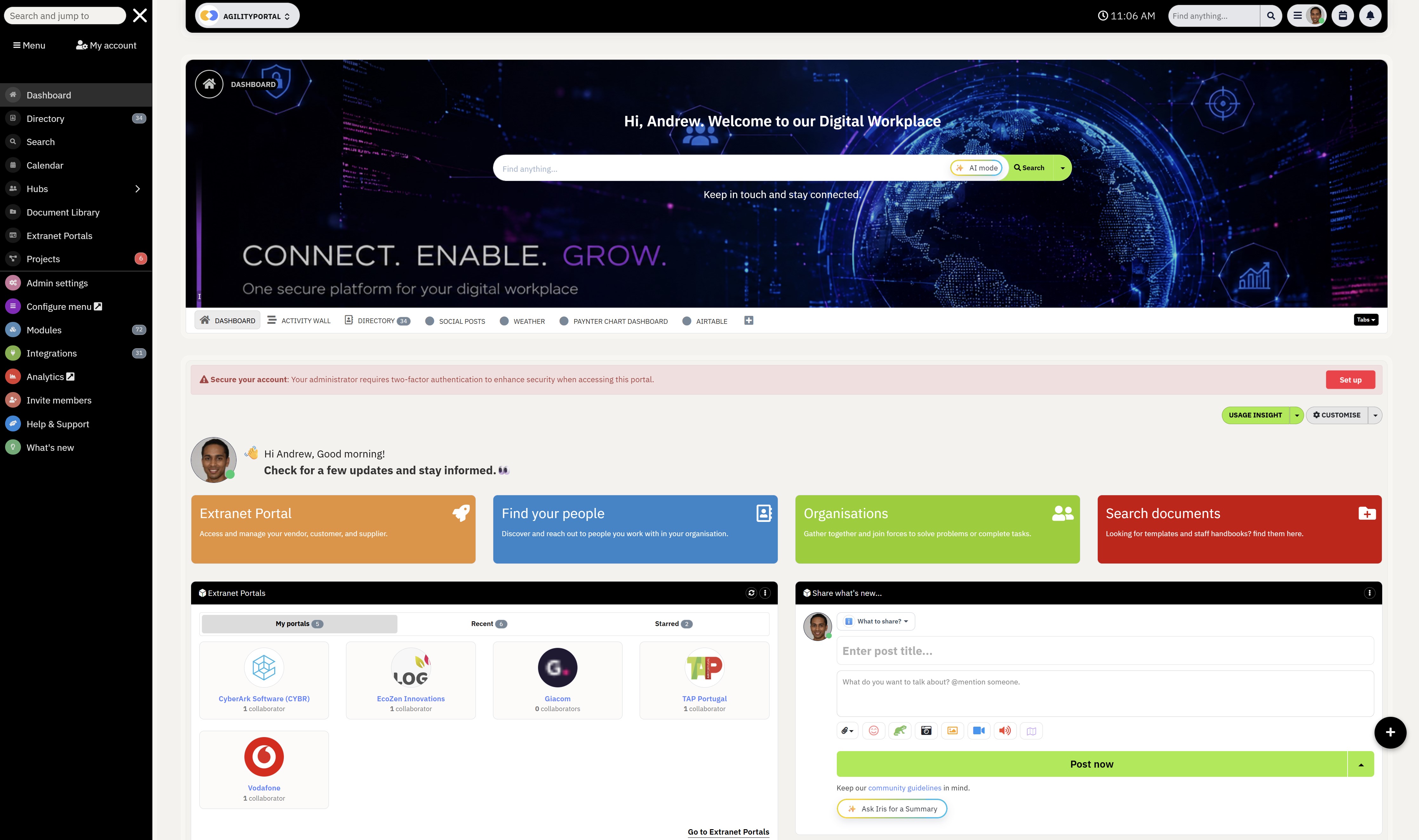
AgilityPortal was designed to solve many of those challenges by bringing communication, collaboration, knowledge management, and employee engagement into one connected digital workplace platform.
Instead of forcing employees to manage multiple disconnected systems, businesses can centralize workplace operations into a more unified employee experience.
This becomes especially important for hybrid, remote, and frontline workforces where communication gaps and information silos can quickly impact productivity
How AgilityPortal Helps Organizations Reduce Workplace Fragmentation
One of the biggest problems modern businesses face is tool overload.
Employees often work across email platforms, chat apps, cloud storage systems, HR software, project management tools, and internal knowledge bases all at the same time.
AgilityPortal helps reduce this fragmentation by creating a centralized workplace hub where employees can communicate, collaborate, access documents, share updates, and manage workflows from a single platform.
For example, instead of employees searching through multiple systems for company updates or operational procedures, businesses can centralize:
- internal communication
- knowledge sharing
- employee announcements
- document collaboration
- team workspaces
- workflow automation
This creates a much smoother digital employee experience while reducing unnecessary app switching and workplace complexity.
Research from Gartner shows employees frequently struggle to locate information quickly in disconnected digital environments.
By consolidating workplace tools into one connected ecosystem, businesses can improve operational efficiency and reduce communication friction across departments.
Why Businesses Use AgilityPortal To Improve Employee Communication and Engagement
Strong communication is one of the most important parts of a successful digital workplace strategy.
Employees who feel informed and connected are generally more engaged, productive, and aligned with company goals.
AgilityPortal helps businesses improve communication through:
- centralized company announcements
- social feeds and discussions
- instant messaging and collaboration spaces
- employee recognition features
- surveys and feedback tools
- personalized notifications and updates
This is especially valuable for organizations with hybrid or distributed teams where maintaining company culture can become difficult over time.
For example, many businesses use AgilityPortal to improve communication between office employees, remote workers, and frontline staff who may not regularly access email systems.
Mobile alerts, real-time notifications, and centralized updates help employees stay connected regardless of where they work.
Gallup research consistently shows highly engaged teams outperform disengaged teams in productivity and retention. That is why employee communication platforms are now becoming a core part of broader workplace transformation strategies.
How Mobile-First Workplace Experiences Improve Adoption Among Frontline Teams
Frontline employees are often the most disconnected part of the workforce because many traditional workplace tools were originally designed for desk-based office workers.
AgilityPortal focuses heavily on mobile-first workplace experiences so employees can access communication, updates, training resources, and operational information directly from smartphones or tablets.
This is particularly important in industries such as:
- healthcare
- logistics
- hospitality
- retail
- construction
- manufacturing
Many frontline employees rarely sit behind a desktop computer during shifts, which means mobile accessibility becomes critical for communication and operational consistency.
AgilityPortal supports mobile workforce engagement through features such as:
- mobile intranet access
- instant push notifications
- multilingual communication
- employee directories
- mobile document access
- digital onboarding workflows
When employees can quickly access the information they need from anywhere, adoption rates typically improve significantly.
Businesses also benefit from faster communication, stronger employee engagement, and more consistent operational processes across distributed teams.
Ultimately, modern digital workplace transformation is not just about adding technology. It is about creating workplace experiences employees genuinely find useful, accessible, and easy to adopt every day.
Modern Digital Workplace Platform
Built to Improve Employee Communication, Collaboration, Engagement & Workplace Productivity
AgilityPortal helps businesses build a stronger digital workplace strategy by centralizing employee communication, collaboration, document management, and workplace knowledge into one connected platform. Instead of relying on disconnected apps and outdated intranet systems, organizations can create a more engaging and productive digital employee experience for hybrid, remote, and frontline teams.
Modern businesses use AgilityPortal to improve workplace communication, reduce information silos, simplify internal collaboration, and support employees with mobile-first workplace tools designed for the future of work. The platform combines employee engagement features, knowledge management, workflow automation, and secure collaboration workspaces into one scalable digital workplace solution.
See how businesses are modernizing workplace communication, collaboration, and employee engagement with AgilityPortal.Final Thoughts on Your Digital Workplace Strategy
The modern workplace is changing faster than ever. Hybrid work, remote collaboration, mobile employees, and rising employee expectations are forcing businesses to rethink how work actually gets done.
The problem is many organizations still rely on disconnected systems that create communication silos, information overload, and operational inefficiencies. When employees spend more time switching between apps or searching for information than completing meaningful work, productivity naturally suffers.
At the same time, employee experience has become a major business priority. Companies are realizing that poor workplace communication, outdated intranet platforms, and frustrating digital tools directly impact employee engagement, retention, and overall performance.
That is why a strong digital workplace strategy is no longer optional.
Businesses that invest in connected workplace technology, better collaboration systems, employee communication platforms, and modern knowledge management tools are creating faster, more productive, and more engaged organizations.
They are also putting themselves in a stronger position to adapt as workplace expectations continue evolving.
The companies succeeding today are not simply adding more workplace software. They are building integrated digital workplace ecosystems that employees genuinely want to use.
If your organization is still struggling with disconnected communication tools, low employee engagement, poor collaboration, or inefficient workflows, now is the right time to evaluate your current workplace systems.
Platforms like AgilityPortal help businesses centralize communication, improve employee engagement, streamline operations, and create a more connected digital workplace experience for hybrid, remote, and frontline teams.
AI Summary
- A digital workplace strategy helps businesses improve employee communication, collaboration, productivity, and access to company knowledge across hybrid, remote, and frontline teams.
- Many organizations struggle because employees use too many disconnected apps, making it harder to find information, complete workflows, and stay aligned with company updates.
- Modern digital workplace solutions bring communication, document management, knowledge sharing, employee engagement, and workflow automation into one connected employee experience.
- A successful digital workplace strategy starts with employee pain points, technology audits, clear business goals, strong adoption planning, and measurable productivity metrics.
- HR and IT teams both play an important role because digital workplace transformation is now about people, culture, security, systems, and business performance.
- Platforms like AgilityPortal help organizations reduce workplace fragmentation, improve internal communication, support mobile access, and create a more connected digital employee experience.
Most Popular Posts

Effective communication among team members is vital for the productivity and success of any organization. Surprisingly, 60% of companies lack a long-term internal communication strategy, which p...


Businesses thrive on communication for efficiency, productivity and accomplishment. When the right information is passed from the right designation in the organization, it promotes positivity an...
Categories
Blog
(2958)
Business Management
(369)
Employee Engagement
(222)
Digital Transformation
(191)
Growth
(142)
Intranets
(135)
Remote Work
(63)
Sales
(53)
Collaboration
(47)
Customer Experience
(30)
Culture
(29)
Knowledge Management
(28)
Project management
(28)
Leadership
(20)
Comparisons
(9)
News
(1)

Related Posts

Remote work is the new thing. With more modern companies moving to work from home, and with telecommuting becoming a more common way for people to work remotely, remote workers are growing in numbers. A Gallup study on the state of remote work ...

Frontline employees are usually the people keeping the business running day-to-day, but ironically, they're often the last people to receive important company updates. Whether it's retail staff, healthcare workers, warehouse teams, hospitality ...

Most businesses today already have the tools. That's not really the problem anymore. The real issue is that employees are constantly jumping between disconnected apps just to get basic work done. One minute they're checking Microsoft Teams, the...

In an era where remote work is on the rise, the trend of celebrating virtually has gained significant popularity. Virtual party ideas for work have become an essential way to foster connection within teams and acknowledge accomplishments, bridg...

Most businesses today are drowning in disconnected workplace tools. One platform handles communication, another manages projects, another stores documents, while HR teams rely on separate systems for onboarding, engagement, and employee updates. ...

Jill Romford
I am a digital nomad, lover of exploring new places and making friends.
I love to travel and I love the internet. I take pictures of my travels and share them on the internet using Instagram.
Traveler, entrepreneur, and community builder. I share my insights on digital marketing and social media while inspiring you to live your fullest life.
Ready to learn more? 👍
One platform to optimize, manage and track all of your teams. Your new digital workplace is a click away. 🚀
Free for 14 days, no credit card required.