Insight Blog
Agility’s perspectives on transforming the employee's experience throughout remote transformation using connected enterprise tools.
54 minutes reading time
(10894 words)
7 Best RIA Databases for Asset Managers and Wealthtech Firms in 2026

7 Best RIA Databases for Asset Managers and Wealthtech Firms in 2026
Compare the 7 best RIA databases for 2026, including advisor data, AUM intelligence, contact accuracy, 13F holdings, integrations, pricing and use cases.
7 Best RIA Databases for Asset Managers and Wealthtech Firms in 2026

Finding RIA data is easy. Finding useful RIA intelligence isn't.
Finding a list of registered investment advisers isn't particularly difficult.
Finding the right advisers, understanding what they manage, who makes the investment decisions, and whether they're actually relevant to your strategy is a very different problem.
That's why the best RIA databases have moved well beyond being simple directories of names, phone numbers and email addresses.
And there's a lot of opportunity to sort through.
According to the Investment Adviser Association's 2026 Industry Snapshot, the number of SEC-registered investment advisers reached a record 16,544 in 2025.
More importantly, those firms served 73.7 million clients and reported $176.8 trillion in assets under management — a 22.3% increase from the previous year.
$176.8T
assets under management
Registered investment adviser firms served 73.7 million clients and reported $176.8 trillion in assets under management, representing a 22.3% increase from the previous year.
Source: Investment Adviser Association, 2026 Industry Snapshot
For asset managers, fund distribution teams and wealthtech firms, that scale makes good data increasingly valuable. You don't just want to know that an RIA exists.
You may need to understand its AUM, investment preferences, holdings, key decision-makers, contact information and other signals that could point to a genuine opportunity.
That's what this guide is designed to help with.
We'll compare seven leading RIA databases — AdvizorPro, FINTRX, Discovery Data, Dakota Marketplace, RIA Database, Altss and RIA Pulse — looking at what data they provide, where each platform stands out, their limitations, and which type of buyer they're best suited to.
Key Takeaways
- The best RIA databases go beyond basic advisor contact lists, combining firm data with AUM, investment intelligence, decision-makers, and prospecting signals.
- Database size alone doesn't determine quality; data accuracy, freshness, filtering, and advisor-level intelligence are often more important.
- Asset managers should prioritise RIA platforms that provide useful investment data such as 13F holdings, product exposure, investment preferences, and allocation intelligence.
- Wealthtech firms may benefit more from technology data, verified advisor contacts, API access, and CRM integrations that support targeted RIA prospecting.
- FINTRX, AdvizorPro, Discovery Data, Dakota Marketplace, RIA Database, Altss, and RIA Pulse each serve different distribution, research, and prospecting use cases.
- Modern RIA intelligence platforms are moving from static databases towards AI-assisted research and precision distribution, helping teams identify which advisors matter and why.
Why RIA Databases Matter Even More in 2026
The independent RIA market continues to grow in influence, giving advisors greater control over investment decisions and where client assets are allocated. At the same time, reaching the right advisors is becoming more challenging.
Firms are increasingly specialised, decision-making can involve multiple stakeholders, and advisors are more selective about the asset managers and investment products they consider.
As a result, the best RIA databases have evolved well beyond basic firm profiles and contact lists.
Modern RIA intelligence platforms can provide:
- Advisor and decision-maker intelligence
- Investment, behavioural and product signals
- Assets under management (AUM) and growth trends
- Custodian, technology and platform relationships
- CRM and marketing platform integrations
- AI-powered research and RIA prospecting tools
The real value isn't simply having access to more financial advisor data. It's being able to identify which RIAs are relevant, understand why they may be a good fit, and approach the right decision-makers with better context.
Modern RIA databases are increasingly built for precision distribution — helping teams focus on the right opportunities rather than relying on broad, high-volume outreach.
What is an RIA database, exactly?
An RIA database is a searchable source of information about Registered Investment Advisers (RIAs), their firms and, depending on the platform, the assets and investment strategies they manage.
Asset managers and wealthtech companies use this data to identify relevant firms and decision-makers rather than prospecting blindly.
You may also see these tools described as a registered investment advisor database, financial advisor database or advisor intelligence platform.
Basic platforms typically provide:
- Firm and advisor names
- Assets under management (AUM)
- Locations and contact details
- SEC or CRD information
- Job titles and decision-makers
More advanced platforms can add 13F holdings, investment preferences, advisor movements, custodian relationships and other intelligence.
For example, imagine an asset manager launching a new fund. A basic database might provide 2,000 RIA contacts. A more sophisticated platform could help narrow those firms by AUM, location, investment strategy or existing holdings, allowing the distribution team to focus on better-fit prospects.
That's why comparing the best RIA databases isn't simply about which provider has the most contacts. Data accuracy, freshness, filtering, investment intelligence and the ability to identify the right decision-makers are ultimately far more important.
What information can you actually get?
The information available depends heavily on the RIA database you choose. Most platforms provide the basics, such as firm names, locations, assets under management (AUM), advisor profiles, CRD information and contact details.
More advanced platforms can go considerably deeper, giving asset managers and wealthtech firms access to data such as:
- Investment preferences and strategies
- 13F holdings and portfolio information
- Custodian relationships
- Advisor and team movements
- Technology used by the firm
- Key decision-makers and verified contacts
- Firm growth, ownership and other prospecting signals
For example, an asset manager could use AUM and 13F data to identify RIAs that already invest in a particular asset class, while a wealthtech provider might care more about firm size, technology usage and the people responsible for buying new software.
The important thing to remember is that not every platform provides every data point. AdvizorPro, FINTRX, Discovery Data, Dakota Marketplace, RIA Database, Altss and RIA Pulse each approach RIA intelligence differently, which is why we'll compare their actual capabilities rather than simply their database size.
Quick comparison of the 7 best RIA databases
Choosing between the best RIA databases comes down to what you actually need the data for.
An asset manager raising capital may prioritise investment preferences and holdings, while a wealthtech company may care more about advisor contacts, firm data and CRM integration.
Here's a quick comparison of the seven RIA database platforms covered in this guide.
| RIA Database | Best For | RIA / Advisor Data | Investment & Holdings Data | CRM / API | Pricing |
| AdvizorPro | RIA prospecting and data integration | Yes | Some investment intelligence | Yes | Contact vendor |
| FINTRX | Private wealth and RIA intelligence | Yes | Yes | Yes | Contact vendor |
| Discovery Data | Large-scale advisor and financial services data | Yes | Yes | Yes | Contact vendor |
| Dakota Marketplace | Asset managers and fundraising teams | Yes | 13F and allocation intelligence | Yes | From $10,000/year |
| RIA Database | Broad RIA and advisor prospecting | Yes | Investment and intent data | Yes | Contact vendor |
| Altss | Alternative investment distribution | Yes | 13F and alternatives exposure | Limited | RIA coverage from $15,000/year |
| RIA Pulse | RIA market and prospecting intelligence | Yes | Varies by dataset | Varies | Contact vendor |
There isn't one registered investment advisor database that's automatically best for every business. For example, AdvizorPro provides data on more than 35,000 RIA firms and 450,000 registered reps and supports integrations and data feeds for teams that want RIA intelligence inside their existing systems.
Dakota Marketplace takes a more investment-distribution-focused approach, combining RIA profiles with verified decision-maker contacts, investment preferences and 13F holdings. Its dedicated RIA offering is currently advertised at $10,000 per year. Meanwhile, RIA Database reports more than 40,000 firms and 500,000 contacts, with over 200 searchable fields and CRM/data-feed capabilities.
Altss is more specialised. Its RIA dataset covers 17,000+ firms and combines 13F holdings with alternatives exposure, AUM and advisor-team information, making it particularly relevant to firms distributing alternative investment products.
The table gives you the quick answer, but the differences become much clearer when you look at each platform individually. Next, we'll break down what each RIA database does well, who it's designed for, and the limitations worth knowing before you book a demo.
7 best RIA databases for asset managers and wealthtech firms in 2026
The best RIA databases now do much more than provide lists of registered investment advisors and email addresses.
The stronger platforms combine advisor data with AUM, investment holdings, decision-maker intelligence, firm changes, CRM integrations and increasingly AI-powered research.
But they aren't interchangeable. Some are built primarily for asset managers raising capital, while others are better suited to wealthtech prospecting, private wealth distribution or detailed RIA market research.
Here are the seven platforms worth considering in 2026.
#1. AdvizorPro — Best for RIA prospecting and wealthtech sales
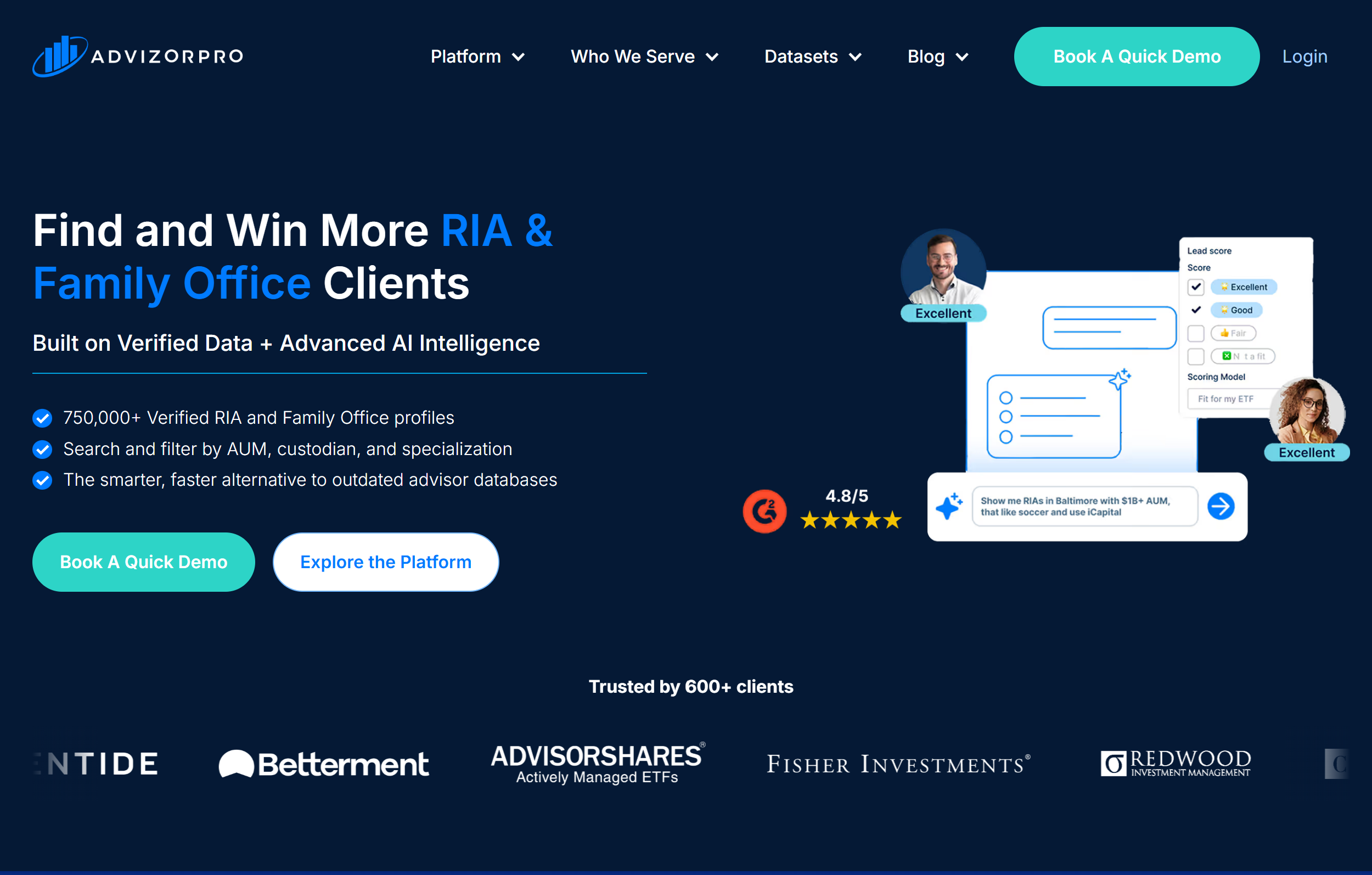
#1. AdvizorPro — Best for RIA prospecting and wealthtech sales
AdvizorPro is particularly well suited to asset managers, ETF issuers and wealthtech companies that want to turn RIA data into targeted prospect lists.
Its registered investment advisor database covers more than 35,000 RIA firms and 450,000 registered reps, with data including AUM, custodians, team structures, ownership, client segments and technology usage. You can filter prospects by characteristics such as firm size, product mix and investment focus.
One feature that stands out for wealthtech companies is tech-stack visibility. Users can identify RIAs using platforms such as Orion, Envestnet, Nitrogen and eMoney, which can help when looking for integration opportunities or firms already using competing technology. AdvizorPro also supports Salesforce, HubSpot and Microsoft Dynamics integrations and can connect its advisor intelligence with AI tools.
- Best for: Asset managers, ETF issuers and wealthtech sales teams
- Standout feature: RIA technology-stack and advisor intelligence
- Pricing: Custom pricing
- Pros: Detailed filtering, strong CRM integrations and useful technology data for wealthtech prospecting.
- Limitations: Pricing isn't publicly displayed, so you'll need a demo and quote to properly compare its cost.
- Our verdict: AdvizorPro is one of the strongest choices when your priority is identifying very specific types of RIAs rather than simply accessing a large contact list.
Our Verdict
AdvizorPro
Best for RIA prospecting and wealthtech sales
4.8
/5
Price
Custom pricing — contact AdvizorPro for a quote
Best feature
Advisor intelligence, tech-stack data and advanced RIA prospecting
#2. FINTRX — Best for private wealth intelligence
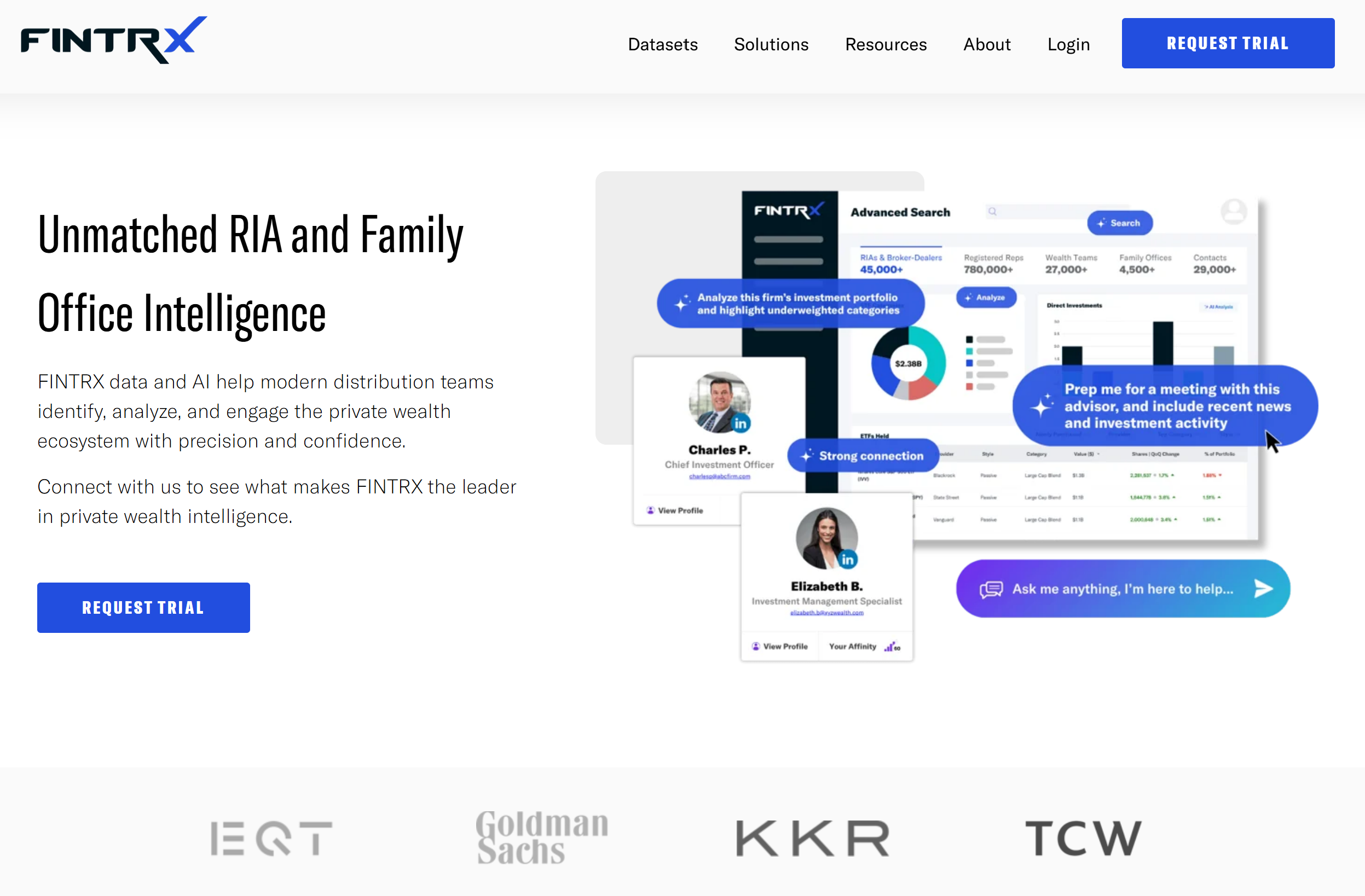
#2. FINTRX — Best for private wealth intelligence
FINTRX goes considerably further than a conventional financial advisor database. It's designed around private wealth intelligence and distribution, making it particularly relevant to asset managers, ETF issuers and firms targeting RIAs and broker-dealers.
The platform currently reports coverage of more than 45,000 RIAs and broker-dealers, 790,000 registered reps and 27,000 wealth teams, alongside more than 650,000 verified emails and $144 trillion in tracked RIA assets.
Users can research AUM, investment strategies, custodian relationships, product allocations and firm growth. FINTRX also provides advisor growth signals, territory building, allocation themes, advisor movement data and tools for identifying key decision-makers.
For example, an ETF issuer could identify advisors holding competing ETFs and use that information to build a much more focused distribution campaign.
- Best for: Private wealth and investment-product distribution
- Standout feature: Depth of RIA, wealth-team and investment intelligence
- Pricing: Custom pricing
- Pros: Extensive coverage, daily updates, strong investment intelligence and useful prospecting signals.
- Limitations: Its breadth may be more than smaller teams need if they're simply looking for basic RIA contact information.
- Our verdict: FINTRX stands out when you need to understand not just who an advisor is, but their team, assets, relationships and potential relevance to your distribution strategy.
Our Verdict
FINTRX
Best overall for private wealth intelligence and RIA distribution
5.0
/5
Price
Custom pricing — contact FINTRX for a quote
Best feature
Private wealth intelligence and investment distribution data
#3. Discovery Data — Best for financial-services data enrichment
Discovery Data takes a slightly different approach. Its strength is broad financial-services intelligence and the ability to clean, enrich and activate data for sales and marketing teams.
Its proprietary FRAME process combines information from sources including the SEC, FINRA, FDIC, state regulators, firm websites, public sources and commercial data partners. Discovery Data then verifies, cleans and analyses that information before turning it into actionable datasets.
That makes it particularly interesting for larger asset managers or financial-services businesses that already have customer and prospect information but need to improve its accuracy, segmentation and usefulness.
Discovery Data also offers behavioural intent intelligence designed to help distribution teams identify financial advisors who have demonstrated interest in particular products or firms.
- Best for: Enterprise financial-services data and enrichment
- Standout feature: Data verification, enrichment and behavioural intelligence
- Pricing: Custom pricing
- Pros: Strong data-quality methodology and broad financial-services coverage.
- Limitations: Buyers looking purely for a straightforward self-service RIA prospecting database may find its broader data-services approach more than they need.
- Our verdict: Discovery Data makes the most sense when RIA intelligence needs to become part of a wider financial-services data and go-to-market strategy.
Our Verdict
Discovery Data
Best for financial-services data enrichment and enterprise distribution teams
4.6
/5
Price
Custom pricing — contact ISS Market Intelligence for a quote
Best feature
Advisor data enrichment, CRM integration and financial-services intelligence
#4. Dakota Marketplace — Best for asset managers raising capital
Dakota Marketplace is one of the clearest fits on this list for investment sales and fundraising teams.
Its wider Marketplace platform covers more than 250,000 LP accounts and 386,000 verified contacts, while its wealth-channel data includes more than 17,000 RIAs. RIA records include verified contacts, CIO biographies, investment preferences and ETF, BDC and closed-end fund holdings derived from 13F filings.
The dedicated RIA product also provides firm AUM, investment focus, custodian information, private fund activity, M&A activity and verified decision-maker contact information.
This is particularly useful when you're not simply prospecting but actively trying to raise assets. A distribution team can identify RIAs that fit its strategy, research allocation behaviour and build targeted outreach lists.
- Best for: Asset managers, fundraisers and investment distribution teams
- Standout feature: Fundraising and capital-allocation intelligence
- Pricing: Dedicated RIA plan currently $10,000 annually; broader Marketplace plans cost more.
- Pros: Built specifically around investment fundraising, verified decision-makers and allocation intelligence.
- Limitations: The cost may be difficult to justify for businesses that only need basic advisor contact data.
- Our verdict: If your primary objective is raising capital through the RIA channel, Dakota Marketplace has one of the clearest use cases among the platforms we've reviewed.
Our Verdict
Dakota Marketplace
Best for asset managers raising capital through the RIA channel
4.7
/5
Price
Custom pricing — contact Dakota for current RIA package pricing
Best feature
RIA allocation intelligence, 13F holdings and verified decision-makers
#5. RIA Database — Best for broad RIA and advisor coverage
Sometimes you really do need a large, searchable registered investment advisor database. That's where the appropriately named RIA Database comes in.
The platform reports more than 40,000 RIA firms, 500,000 contacts and 200,000 email addresses, with more than 200 searchable fields available for targeting.
Beyond the core RIA database, users can access registered rep, family office and bank/trust datasets. There are also data feeds, API and SFTP delivery, Salesforce and HubSpot integration, CRD matching, intent data and analytics capabilities.
That breadth makes it useful when you need to build highly targeted advisor lists across a large portion of the US wealth-management market.
- Best for: Broad RIA prospecting and advisor list building
- Standout feature: Extensive searchable RIA and advisor coverage
- Pricing: Contact for pricing
- Pros: Large dataset, 200+ searchable fields, downloads, CRM integration and additional financial-intermediary datasets.
- Limitations: Teams primarily looking for highly specialised private-markets or alternatives intelligence may prefer a platform built specifically around those workflows.
- Our verdict: RIA Database is a strong option for businesses that want extensive advisor coverage and the flexibility to segment, export and integrate that information into existing sales workflows.
Our Verdict
RIA Database
Best for broad RIA coverage and large-scale advisor prospecting
4.6
/5
Price
Custom pricing — contact RIA Database for a quote
Best feature
40,000+ RIA firms with 200+ searchable prospecting fields
#6. Altss — Best for alternative investment distribution
Altss is different from most of the best RIA databases because its wider focus is private markets and fundraising intelligence.
Its RIA dataset covers more than 17,000 firms and includes AUM, AUM trends, custodian relationships, advisor teams, client composition and geographic data. More importantly for alternative asset managers, it combines this with 13F holdings and information about alternatives and private-market exposure.
That means a manager distributing BDCs, interval funds, private REITs or other alternative products can potentially identify RIAs that already demonstrate relevant exposure rather than starting from a generic advisor list.
Altss says regulatory filing data is updated quarterly when filings occur, while personnel and other signals are monitored continuously. Its broader database also uses continuous verification, with records re-verified within 30 days.
- Best for: Alternative asset managers and private-market distribution
- Standout feature: Alternatives exposure combined with RIA intelligence
- Pricing: RIA coverage is included within Full LP Coverage, listed at $15,000 per year per seat on the standard tier.
- Pros: Strong alternatives focus, 13F analysis and wider private-markets intelligence.
- Limitations: Altss states that its platform is UI-only and doesn't allow data exports, which could be restrictive for teams wanting to move large datasets into other systems.
- Our verdict: Altss is the specialist choice here. If you're selling alternatives through the wealth channel, its ability to identify RIA alternatives exposure could be more valuable than simply having another enormous advisor list.
Our Verdict
Altss
Best for alternative investment distribution through the RIA channel
5.0
/5
Price
RIA coverage from $15,000/year per seat on the Standard Full LP plan
Best feature
Alternatives exposure combined with RIA and 13F intelligence
#7. RIA Pulse — Best affordable option for RIA research
RIA Pulse is the newest platform on our list, having been founded in 2025, but it takes an interesting approach to RIA intelligence by making detailed regulatory and historical research available at a considerably lower entry price than many enterprise platforms.
It covers more than 20,000 RIA firms and lets users search hundreds of data points, including AUM, location, services, client demographics, business affiliations and growth metrics. There's also more than 20 years of historical firm data, watchlists, alerts, machine-learning recommendations and AI-generated Pulse Reports.
RIA Pulse sources its core data directly from SEC Form ADV filings, processes and normalises the filings, and provides access to the underlying source information for auditability.
The biggest surprise is pricing. There's a free tier, while the standard Plus and Pro plans are listed at $99 and $199 per month respectively before promotional discounts. An API is available as a paid add-on to Pro and Team Pro plans.
- Best for: Affordable RIA market research and historical analysis
- Standout feature: 20+ years of searchable RIA history and transparent pricing
- Pricing: Free plan available; Plus $99/month; Pro $199/month before current promotional discounts.
- Pros: Low barrier to entry, transparent pricing, historical data, advanced filtering, CSV exports and AI-assisted research.
- Limitations: It's a much newer platform than the established enterprise providers, and several additional datasets and features are still listed as coming soon.
- Our verdict: RIA Pulse is probably the most interesting option for smaller teams that don't have a five-figure annual database budget. It won't necessarily replace the deeper distribution intelligence of FINTRX or Dakota, but its combination of SEC data, historical analytics and accessible pricing makes it one to watch.
Our Verdict
RIA Pulse
Best for affordable RIA research and historical firm intelligence
4.5
/5
Price
Free tier available, with Plus and Pro subscription options
Best feature
Historical RIA analytics, SEC filing research and AI-generated Pulse Reports
How we compared these RIA databases
Not every registered investment advisor database is built for the same job, so we didn't rank these platforms simply by who claims to have the largest number of contacts.
Instead, we compared the best RIA databases based on how useful their data is for asset managers, wealthtech firms, fund distribution teams and other businesses trying to identify and understand financial advisors.
Our evaluation focused on seven areas:
- Data coverage: The number and range of RIA firms, registered representatives and financial advisor profiles available.
- Data freshness: How frequently RIA data, AUM figures, advisor movements and firm information are updated or verified.
- Contact accuracy: Whether users can identify relevant decision-makers and access useful contact information.
- Investment intelligence: Access to information such as 13F holdings, investment preferences, product exposure, custodians and allocation data.
- Search and segmentation: How easily users can filter RIAs by AUM, location, investment strategy, firm characteristics and other prospecting criteria.
- Integrations: Support for CRM integrations, APIs, data feeds, exports and existing sales workflows.
- Overall value: Whether the platform provides genuinely useful advisor intelligence for its intended audience rather than simply a large financial advisor database.
We also considered pricing transparency and ease of use where this information was publicly available. This gives us a more balanced way to compare RIA data providers such as AdvizorPro, FINTRX, Discovery Data, Dakota Marketplace, RIA Database, Altss and RIA Pulse — and helps you decide which platform actually fits your prospecting or distribution strategy.
Which RIA database is best for your use case?
If you're completely new to RIA databases, here's the easiest way to think about it: you probably don't need the platform with the most data. You need the one that answers the questions your business actually has.
For example, imagine you're selling investment funds to financial advisors. You might want to know which RIA firms manage enough assets to be worth approaching, what they're already investing in and who actually makes the investment decisions.
A wealthtech company has a different problem. It may want a financial advisor database that helps its sales team find independent RIAs of a certain size, identify the technology they already use and get those prospects into Salesforce or HubSpot.
That's why there isn't one best RIA database for everyone.
| If you're trying to... | Consider | Why |
| Find and prospect specific financial advisors | AdvizorPro | Strong RIA prospecting, filtering and advisor intelligence |
| Understand private wealth firms and advisors | FINTRX | Detailed private wealth and RIA intelligence |
| Enrich large financial-services datasets | Discovery Data | Broad financial advisor data and data enrichment |
| Find RIAs that could invest in your funds | Dakota Marketplace | Built around asset manager distribution and fundraising intelligence |
| Search a large dedicated RIA dataset | RIA Database | Broad RIA coverage with extensive search criteria |
| Find RIAs interested in alternative investments | Altss | Focuses heavily on alternatives and private-market intelligence |
| Research RIA firms without a huge budget | RIA Pulse | Accessible RIA research, historical data and lower-cost plans |
Think about what you're actually selling
Say you're an asset manager launching a new ETF. You don't necessarily want a list of every registered investment advisor in America. You want to find RIAs that fit your target profile.
That could mean searching by assets under management (AUM), location, investment strategy, advisor type or existing 13F holdings. In that situation, investment distribution platforms such as FINTRX or Dakota Marketplace may make more sense because the investment intelligence behind the contact can be just as important as the contact itself.
Now imagine you're selling portfolio management software instead.
Your priorities change. You may care more about firm size, advisor contacts, existing technology, CRM integration and accurate prospect data. That's where a platform such as AdvizorPro could be a better fit for a wealthtech sales team.
Alternative asset managers have another requirement again.
If you're distributing private credit, private equity, real estate or other alternative investments, knowing whether an RIA already has exposure to alternatives can make prospecting much more focused. That's the type of use case where Altss becomes particularly interesting.
The simple rule is this: start with the business question, then choose the database.
Don't pay for thousands of extra data points simply because they sound impressive during a sales demo.
Work out whether you need basic RIA contact data, detailed advisor intelligence, 13F holdings, private wealth data, alternative investment exposure, historical AUM information or CRM-ready prospecting data. Once you know that, choosing between the best RIA databases becomes much easier.
Don't choose an RIA database based on record count alone
It's easy to be impressed when an RIA data provider says it has hundreds of thousands of advisor records.
But a huge financial advisor database doesn't automatically mean your sales or distribution team suddenly has hundreds of thousands of useful prospects.
Think about it this way: if you're an asset manager looking for RIAs that might invest in your fund, having 500,000 names isn't particularly helpful if half the records are irrelevant to your strategy or you can't tell who actually makes investment decisions.
When comparing the best RIA databases, the quality and depth of the data can matter just as much as the size of the database. Here are six things worth checking before you sign a contract.
How fresh is the RIA data?
Financial advisor data changes constantly. Advisors move firms, RIAs merge, assets under management rise and fall, job titles change, and people responsible for investment decisions come and go.
So imagine your sales team finds what looks like the perfect prospect, spends time researching the firm and writes a personalised email — only to discover that the advisor left six months ago. Multiply that across hundreds of prospects and outdated RIA data quickly becomes an expensive problem.
When comparing RIA data providers, check:
- How frequently firm and advisor records are updated.
- When AUM data was last refreshed.
- How often email addresses and phone numbers are verified.
- Whether advisor movements and firm changes are tracked.
- Where the underlying data comes from.
- Whether you can see when a record was last updated.
Fresh data won't guarantee a successful conversation, but stale data can stop one before it even starts.
Does it identify the actual decision-maker?
Knowing that an RIA manages $5 billion doesn't tell you who you should contact.
Depending on the firm, investment decisions could sit with a CIO, portfolio manager, investment committee, managing partner or another senior advisor. This is where good advisor intelligence becomes much more useful than a basic registered investment advisor database.
Before choosing a platform, see whether you can identify:
- Chief Investment Officers and portfolio managers.
- Partners and senior financial advisors.
- Investment committee members.
- Relevant wealth management teams.
- Job titles and areas of responsibility.
- Verified contact details for key decision-makers.
The goal isn't simply to find a company. It's to find the person inside that company who might actually care about what you're offering.
Can you see what the RIA invests in?
This can be a big differentiator for asset managers and fund distribution teams.
Knowing an RIA's AUM is useful, but understanding its investment activity can give you much more context. Some advisor intelligence platforms provide access to 13F holdings, investment preferences, product exposure and other portfolio information.
For example, if you're distributing an ETF, seeing that an RIA already holds similar ETFs could make it a much more relevant prospect than a firm selected purely because of its size.
Useful investment intelligence can include:
- 13F holdings and historical holdings.
- ETF and fund exposure.
- Investment strategies or preferences.
- Alternative investment exposure.
- Asset allocation information.
- Changes in holdings or investment behaviour.
You don't necessarily need every one of these fields. You need the investment data that helps answer a simple question: "Is this RIA genuinely relevant to what we're selling?"
How good are the search and filtering tools?
A large RIA database becomes much less useful if you can't quickly narrow it down.
Let's say you want independent RIAs in Texas managing between $500 million and $5 billion that work with high-net-worth clients. A good RIA prospecting platform should help you get close to that target without forcing your team to download thousands of records and clean everything manually.
Depending on your strategy, useful RIA database filters might include:
- Assets under management (AUM).
- Location and geographic territory.
- Firm and advisor type.
- Client demographics.
- Investment strategy or holdings.
- Custodian, technology or firm characteristics.
Good filtering turns a large financial advisor database into a focused prospecting tool. That's often far more valuable than simply having millions of searchable records.
Can you move the intelligence into your CRM?
This is easy to overlook during a product demo.
Your sales team probably isn't going to live inside an RIA database all day. They may already work from Salesforce, HubSpot, Microsoft Dynamics or another CRM, which means useful advisor intelligence needs to fit into that existing workflow.
When evaluating CRM integration and data access, check for:
- Native Salesforce or HubSpot integrations.
- API access.
- CSV or spreadsheet exports.
- Automated data feeds.
- Contact and company enrichment.
- Restrictions on exporting or storing data.
This is one area where platforms can differ significantly. Some RIA databases are designed to push data into your existing sales stack, while others expect users to conduct most of their research inside the platform itself.
Neither approach is automatically wrong — but you need to know which one fits the way your team already works.
Can your sales team actually use the data?
This is probably the most important question of all.
A platform can have sophisticated AI, millions of financial advisor records and hundreds of filters, but none of that matters if your distribution team finds it too complicated to use. The best RIA prospecting tool should help people move from research to action without turning every search into a data-analysis project.
Before committing, ask a few practical questions:
- How quickly can a salesperson build a targeted RIA list?
- Can users save searches and prospect lists?
- Is the interface understandable without extensive training?
- Can teams easily identify why a prospect is relevant?
- Can the data fit into existing sales and CRM workflows?
- Can you test the platform using your real target market?
During a demo, don't just let the vendor show you their favourite features. Give them a real scenario — for example, "Show me RIAs managing over $1 billion that could be relevant to our investment strategy."
If they can quickly turn that question into a useful prospect list, you're learning something far more valuable than the headline number of records in their database.
What should you ask during an RIA database demo?
An RIA database demo can look impressive when the salesperson already knows exactly which searches to run. Your job is to find out whether the platform will work just as well when your own team is using it on a Monday morning.
Instead of asking for a general product tour, give the vendor a real-world scenario. If you're an asset manager, for example, ask them to find RIAs within your target AUM range that have exposure to a particular investment strategy. If you're a wealthtech company, ask them to identify firms matching your ideal customer profile and show how those prospects would move into your CRM.
Here are some useful questions to take into the demo:
- Where does your RIA data come from? Ask which information comes from SEC Form ADV filings, 13F filings, regulatory sources, proprietary research or third-party providers.
- How frequently is the data updated? Find out how often AUM, advisor contacts, firm changes and investment holdings are refreshed.
- Can I identify the actual decision-makers? Ask the vendor to find CIOs, portfolio managers, partners or other people responsible for investment decisions.
- What can I search and filter by? Test AUM, geography, client type, investment strategy, holdings, custodian relationships and other criteria relevant to your business.
- Do you provide 13F holdings or investment intelligence? This can be particularly important for asset managers trying to understand what RIAs already invest in.
- How are emails and contact details verified? A financial advisor database isn't much use if your sales team is constantly dealing with bounced emails and outdated contacts.
- Does it integrate with our CRM? Check Salesforce, HubSpot, Microsoft Dynamics, API access, data feeds and CSV exports rather than assuming integration is included.
- Can we track changes over time? Advisor movements, AUM growth, acquisitions and changes in holdings can all create useful prospecting signals.
- Are there limits on exports or data usage? Some RIA data providers restrict downloads, API access or how information can be stored and used outside their platform.
- What does the subscription actually include? Ask about user licences, additional datasets, API charges, onboarding costs and features locked behind higher pricing tiers.
- Can we test our own target market? Give the vendor five or ten characteristics of your ideal RIA and ask them to build the prospect list while you're watching.
Most importantly, don't finish the demo without asking for a sample of the data. Take a handful of RIA firms your team already knows and compare the platform's AUM, contacts, job titles, holdings and firm information against what you know to be current.
That's a much better test of an RIA prospecting tool than watching a polished presentation. The real question isn't whether the platform looks impressive during the demo — it's whether it can consistently help your team find better prospects once you've paid for it.
RIA databases are becoming intelligence platforms
The biggest change happening to RIA databases in 2026 isn't simply that they contain more data. It's that the better platforms are becoming much smarter about helping users understand what that data actually means.
Think about the old model. An asset manager might open a registered investment advisor database, select New York, set an AUM range and download a spreadsheet containing hundreds of financial advisors.
From there, someone still had to research each firm, work out who mattered, check what they invested in and decide who the sales team should contact.
Modern advisor intelligence platforms are increasingly trying to shorten that journey.
The evolution looks something like this:
Static contact lists → searchable RIA databases → enriched advisor intelligence → opportunity signals → AI-assisted prospecting
Instead of simply asking:
"Which RIAs are based in New York?"
A distribution team can increasingly ask much more commercially useful questions:
"Which New York RIAs fit our target AUM range, have exposure to products similar to ours, and who are the relevant decision-makers we should approach?"
That's a significant difference. The database is moving from being somewhere you look up information to something that can help you prioritise opportunities
AI is changing how teams search RIA data
We're already seeing this shift among some of the RIA data providers covered in this guide.
AdvizorPro, for example, now connects its advisor intelligence directly with ChatGPT and Claude. Instead of manually working through dozens of filters, users can ask natural-language questions about advisors, firms and territories. Its AI tools can also summarise firm profiles, identify talking points and help prepare personalised outreach using its underlying RIA data.
Imagine you're preparing for a meeting with a $3 billion RIA tomorrow morning.
Rather than opening several tabs and piecing the account together manually, an AI-powered advisor intelligence platform could help surface:
- The firm's AUM and recent changes.
- Relevant investment holdings and product exposure.
- Key advisors and decision-makers.
- Custodian or technology relationships.
- Recent firm or personnel changes.
- Useful talking points for the meeting.
The important part isn't the chatbot itself. It's the quality of the financial advisor data sitting underneath it. AI working with incomplete or outdated RIA information simply produces faster answers from weak data.
Prospecting is becoming more about signals than lists
The next step is even more interesting: identifying when an RIA might be worth contacting.
AdvizorPro says its intelligence engine can surface best-fit prospects using behavioural and structural patterns, while RIA Pulse provides machine-learning recommendations based on firms users already follow. RIA Pulse can also alert users when new information appears for firms on their watchlists.
This changes how RIA prospecting can work.
Imagine you're distributing an ETF. Instead of giving your wholesalers a static list of 5,000 advisors and asking them to work through it, an intelligence-led workflow could potentially help them focus on firms where something relevant has changed.
Signals worth watching might include:
- Changes in assets under management.
- New or departing advisors.
- Changes in investment holdings.
- Increased exposure to a relevant asset class.
- Firm acquisitions or ownership changes.
- Behavioural or engagement signals where available.
None of those signals automatically means an RIA wants to buy your product. They provide context for prioritisation, which is an important distinction. Human judgement still matters.
AI can also make meeting preparation much faster
There's another practical use case that has nothing to do with automatically finding prospects: research.
Dakota Marketplace, for example, offers its Joe AI Report Builder for account summaries and meeting preparation using its platform data. In May 2026, Dakota also introduced a ChatGPT integration that allows subscribers to query allocator data, account intelligence and contact records through ChatGPT.
Picture a wholesaler travelling to Chicago with six meetings scheduled over two days. Traditionally, they might spend hours preparing account notes.
With an intelligence platform, the workflow becomes closer to:
Who's the firm? → What do they invest in? → What's changed? → Who am I meeting? → What should I know before walking through the door?
That's where AI-powered RIA prospecting becomes genuinely useful. It isn't about replacing the relationship between an asset manager and financial advisor. It's about giving the person having that conversation better context before it starts.
The best database may eventually be the one that tells you what matters
This is where the RIA database market appears to be heading.
A basic financial advisor database answers who exists.
A searchable database helps answer who matches your criteria. An advisor intelligence platform can go further by helping explain who matters right now and why.
For asset managers and wealthtech firms, that could fundamentally change the value of RIA data. Instead of measuring a platform by whether it contains 100,000 or 500,000 advisor records, buyers may increasingly judge it by whether it can turn those records into useful, timely intelligence.
That's also why clean underlying data remains so important. Dakota itself argues that AI works best when it sits on structured, verified investment intelligence rather than relying entirely on unverified web-scraped information.
So when you're comparing the best RIA databases in 2026, don't just ask how many records they have or whether they've added an AI assistant.
Ask the more valuable question:
Can this platform help my team understand who we should speak to, why they're relevant, and what we should know before starting the conversation?
If it can do that reliably, you're no longer buying a contact database. You're buying an intelligence layer for your distribution strategy.
Final verdict — Which RIA database is best in 2026?
If you've made it this far, you've probably realised there isn't one RIA database that's automatically the right choice for every asset manager, wealthtech company or distribution team.
The platforms we've reviewed approach RIA intelligence from different angles. Some are particularly strong for advisor prospecting, others focus on investment and private wealth intelligence, fundraising, data enrichment, alternative investments or accessible RIA research. The right choice therefore depends much more on what you're trying to achieve with the data than which provider has the longest feature list.
Here's how we'd narrow down the options:
- Best for private wealth and investment intelligence: FINTRX
Here's a simple example. If you're an ETF issuer trying to understand which advisors already hold relevant or competing products, a platform with detailed investment and private wealth intelligence may be particularly useful. If you're a wealthtech company trying to identify RIAs matching a specific profile and move those prospects into your CRM, prospecting capabilities, technology data and integrations may matter more.
An alternative asset manager may prioritise Altss because of its focus on alternatives exposure, while a fundraising team could find Dakota Marketplace better aligned with allocator research and capital-raising workflows. Teams requiring large-scale financial-services data enrichment may lean towards Discovery Data, while organisations primarily looking for broad RIA coverage should consider RIA Database. Smaller teams looking for searchable RIA data and historical research can also consider RIA Pulse.
Ultimately, don't choose a registered investment advisor database because it claims to have the biggest contact list or the most features.
Instead, shortlist the platforms that match your specific use case and test them against the same real-world scenario. Look closely at data accuracy, freshness, advisor coverage, AUM information, investment intelligence, filtering, integrations and how easily your team can turn that information into action.
The best RIA database for your organisation is the one that helps you identify relevant firms, understand why they matter, reach the right decision-makers and give your sales or distribution team enough intelligence to have a more informed conversation.
FAQs about RIA databases
What is an RIA database?
An RIA database is a searchable collection of information about Registered Investment Advisers, financial advisors and wealth management firms. Depending on the provider, it can include assets under management (AUM), contact information, firm details, investment strategies, 13F holdings, custodians and key decision-makers.
Asset managers, wealthtech companies and distribution teams typically use RIA databases to research the market, identify potential prospects and find the right people to approach.
What is the best RIA database for asset managers?
The best RIA database for an asset manager depends on the type of investment product being distributed and the intelligence the sales team needs.
FINTRX is a strong all-round choice for private wealth and investment distribution intelligence, while Dakota Marketplace is particularly relevant to fundraising teams. Altss is worth considering for alternative investment distribution, and AdvizorPro provides strong prospecting and advisor intelligence capabilities.
Rather than choosing purely on database size, compare investment data, contact accuracy, filtering, CRM integrations and how frequently records are updated.
Where can I find a database of Registered Investment Advisers?
The SEC's Investment Adviser Public Disclosure (IAPD) system provides public information about SEC and state-registered investment advisers and is a useful starting point for regulatory research.
Commercial platforms such as FINTRX, AdvizorPro, Discovery Data, Dakota Marketplace, RIA Database, Altss and RIA Pulse take this further by organising and enriching RIA data for prospecting, investment research and distribution workflows.
Can you search RIA databases by AUM?
Yes. Many commercial RIA databases allow users to search and filter Registered Investment Advisers by assets under management (AUM).
For example, instead of searching every RIA in a particular state, an asset manager could narrow the results to firms managing between $500 million and $5 billion. Depending on the platform, that search can then be refined further using geography, client type, investment preferences, holdings, custodian relationships or other criteria.
Which RIA databases provide investment holdings data?
Several RIA intelligence platforms provide investment or holdings information, although the depth and source of that data varies.
FINTRX, Dakota Marketplace and Altss are particularly relevant when investment intelligence is important. Depending on the platform and subscription, users may be able to research 13F holdings, ETFs, funds, investment preferences, alternatives exposure or historical investment activity.
Always check exactly which holdings are covered and how frequently the information is updated before purchasing a subscription.
What is the difference between an RIA database and a financial advisor database?
An RIA database focuses primarily on Registered Investment Adviser firms and the professionals associated with them. A financial advisor database can be broader, potentially covering registered representatives, broker-dealers, wealth managers and other financial professionals.
The distinction matters when prospecting. If your target market is specifically independent RIAs, a dedicated registered investment advisor database may provide more relevant firm-level information and filtering than a general financial advisor list.
How accurate are RIA databases?
No RIA database will be perfectly accurate all the time because the underlying market constantly changes. Advisors switch firms, businesses merge, AUM changes and contact information becomes outdated.
Accuracy therefore depends on where the provider gets its information, how frequently records are refreshed and whether regulatory data is supplemented with proprietary research or verification. Before subscribing, ask the provider to demonstrate several firms you already know so you can check the quality of its advisor data yourself.
How much does an RIA database cost?
RIA database pricing varies considerably. Some newer platforms offer free or relatively inexpensive monthly subscriptions, while specialist investment intelligence platforms can cost thousands or tens of thousands of dollars per year.
For example, RIA Pulse offers lower-cost monthly plans, while specialist products such as Dakota Marketplace and Altss operate at a significantly higher annual price point. Enterprise platforms such as FINTRX, AdvizorPro, Discovery Data and RIA Database generally require businesses to request pricing.
When comparing costs, check whether CRM integrations, API access, exports, additional users and specialist datasets are included or charged separately.
What is the best RIA prospecting tool?
There isn't one RIA prospecting tool that's best for every sales team. AdvizorPro is particularly strong for detailed RIA prospecting and wealthtech sales, while FINTRX combines prospecting with deeper private wealth and investment intelligence.
The right choice depends on what you're trying to discover. A wealthtech sales team may prioritise verified advisor contacts, technology data and CRM integration, while an asset manager may care much more about AUM, 13F holdings, investment preferences and allocation intelligence.
The best approach is to shortlist two or three RIA data providers and test each one using the same real-world prospecting scenario before committing to a subscription.
AI Summary
- The best RIA databases go beyond basic financial advisor lists by combining firm data with AUM, advisor intelligence, investment holdings, decision-maker data, and prospecting signals.
- Asset managers may benefit most from RIA intelligence that includes 13F holdings, investment preferences, product exposure, allocation data, and verified advisor contacts.
- Wealthtech firms may have different priorities, including advisor profiles, technology usage, firmographics, CRM integrations, API access, and tools for targeted RIA prospecting.
- RIA database quality depends on more than record count. Data freshness, contact accuracy, filtering, regulatory sources, historical information, and the ability to identify relevant decision-makers can be more important than database size.
- FINTRX, AdvizorPro, Discovery Data, Dakota Marketplace, RIA Database, Altss, and RIA Pulse serve different use cases across asset management distribution, wealthtech sales, alternative investments, fundraising, and advisor research.
- The best registered investment advisor database should help your team identify the right firms, understand why they are relevant, find the people influencing investment decisions, and turn reliable RIA data into more focused sales and distribution activity.
Most Popular Posts

Effective communication among team members is vital for the productivity and success of any organization. Surprisingly, 60% of companies lack a long-term internal communication strategy, which p...


Businesses thrive on communication for efficiency, productivity and accomplishment. When the right information is passed from the right designation in the organization, it promotes positivity an...

Categories
Blog
(3180)
Business Management
(393)
Employee Engagement
(235)
Digital Transformation
(215)
Growth
(149)
Intranets
(141)
Internal communications
(106)
Remote Work
(68)
Sales
(53)
Collaboration
(52)
Customer Experience
(32)
Culture
(30)
Knowledge Management
(29)
Project management
(29)
Leadership
(20)
Comparisons
(9)
News
(1)

Related Posts

Hiring globally is easier than employing globally Have you found the right person for a role, only to realise they live in a country where your business has no legal entity? That's where EOR international hiring can be useful. An Employer of Re...

Sales operations and planning are essential to harmonizing sales objectives with operational capabilities, ensuring seamless coordination between departments like sales, marketing, production, and finance. This alignment enables businesses to forecas...

How can a business collect the public web data it genuinely needs without creating avoidable security, privacy or supplier-risk problems? That's the question more teams are now facing. From competitor price monitoring and SEO research to brand protec...

The sales interview is a crucial part of the job search process, as it provides an opportunity for the candidate to showcase their skills, experience, and personality to the hiring manager. In this interview, the candidate is evaluated on their...

Most workplace incidents do not start with one dramatic failure. They usually begin with something ordinary: a blocked walkway, rushed manual handling, a poorly set-up workstation, unclear procedures, or a safety concern that nobody reported. U...


Jill Romford
I am a digital nomad, lover of exploring new places and making friends.
I love to travel and I love the internet. I take pictures of my travels and share them on the internet using Instagram.
Traveler, entrepreneur, and community builder. I share my insights on digital marketing and social media while inspiring you to live your fullest life.
Ready to learn more? 👍
One platform to optimize, manage and track all of your teams. Your new digital workplace is a click away. 🚀
Free for 14 days, no credit card required.