Insight Blog
Agility’s perspectives on transforming the employee's experience throughout remote transformation using connected enterprise tools.
32 minutes reading time
(6474 words)
5 Founders Share What They’d Do Differently When Creating a Single Source of Truth

5 Founders Share What They’d Do Differently When Creating a Single Source of Truth
Most companies think they have a single source of truth until employees start relying on Slack, tribal knowledge, and outdated documents. Here’s what 5 founders learned.
5 Founders Share What They’d Do Differently When Creating a Single Source of Truth

If your team is constantly asking, "Where's the latest version of this file?" — you already have an information problem.
Most companies are trying to build a single source of truth, but many end up creating even more confusion.
Files get scattered across Slack, Teams, emails, and cloud drives, making it harder for employees to know what information they can actually trust.
This is known as the single-source-of-truth paradox: the more tools companies add, the more disconnected knowledge becomes.
And the cost is massive.
According to McKinsey, employees spend nearly 20–28% of their workweek searching for information across disconnected systems.
28%
of the workweek
According to McKinsey, employees can spend up to 28% of their workweek searching for information across disconnected systems.
Source: McKinsey Global Institute
That's hours of lost productivity every week caused purely by information chaos.
A separate IDC analysis pegged the figure even higher, at 2.5 hours per day, or about 30 percent of the workday.
In this article, we spoke with 5 founders about their journey to build a single source of truth inside their companies — including what worked, what failed, and what they would do differently today.
Key Takeaways
- A single source of truth is only effective if employees can quickly find, trust, and use the information inside it.
- Many businesses accidentally create information chaos by spreading knowledge across Slack, emails, cloud drives, and disconnected workplace tools.
- Founders consistently highlighted that search quality, governance, and content ownership matter more than flashy documentation systems.
- Knowledge management systems fail when documentation becomes outdated, difficult to search, or dependent on tribal knowledge inside teams.
- Modern digital workplace platforms and employee intranet software help centralise company knowledge, improve collaboration, and reduce time wasted searching for answers.
What Is a Single Source of Truth?
A single source of truth is exactly what it sounds like: one trusted place where your employees can go to find accurate information without searching across multiple tools, chats, or inboxes.
It becomes the central hub for things like:
- Company knowledge
- Documents
- Processes and workflows
- Team communication
- Important updates and announcements
Sounds simple, right? The problem is, most companies think they already have one — until they realise their entire business relies on one employee named Greg.
Greg's been with the company since the early days.
He knows why the API name changed in 2022, which spreadsheet everyone should actually be using, and somehow became the unofficial owner of every undocumented process in the business.
Need access to a system?
Ask Greg. Confused about why a workflow changed last quarter?
Greg probably knows. Need a file nobody can find? Yep — Greg again.
Then Greg takes a two-week vacation in Bali, and suddenly your company's "single source of truth" is sitting on a beach drinking piña coladas while your team panics in Slack.
That's the single-source-of-truth paradox.
Many businesses rely more on people than systems, which means knowledge becomes trapped inside employees instead of being properly documented inside a knowledge management system or digital workplace platform.
Where the Knowledge Workweek Actually Goes
Research from McKinsey shows employees spend a large portion of their workweek searching for information, replying to emails, and navigating disconnected workplace tools instead of focusing on productive work.
Why Companies Are Suddenly Prioritizing a Single Source of Truth

Why Companies Are Suddenly Prioritizing a Single Source of Truth
A few years ago, most companies could survive with scattered folders, endless email threads, and employees simply "knowing where things are." That doesn't work anymore.
The rise of remote and hybrid work has completely changed how teams communicate and share information.
Employees are now working across different locations, time zones, and devices, which means businesses need a proper digital workplace platform where knowledge is easy to access from anywhere.
At the same time, companies are drowning in disconnected SaaS tools. One team uses Slack, another uses Microsoft Teams, files are stored in Google Drive, projects live in Asana, and important decisions disappear inside meetings nobody documented.
Instead of improving productivity, many workplace tools have created information silos that slow employees down.
This is why knowledge management systems and employee communication platforms have become such a major priority. Businesses are realizing that if employees can't find trusted information quickly, collaboration breaks down fast.
AI is also accelerating the problem.
Modern AI search tools and enterprise search systems are only useful if company knowledge is organised properly. If your documents are outdated, duplicated, or spread across multiple systems, AI simply surfaces bad information faster.
There's also a direct business impact. Companies with a strong single source of truth often onboard employees faster, reduce repeated questions, improve team collaboration,
and make decisions quicker because everyone is working from the same information.
Common Tools Companies Use to Create a Single Source of Truth
Most businesses don't rely on just one platform.
Instead, they combine different workplace tools to centralise company knowledge, improve communication, and reduce information silos across teams.
Here are some of the most common tools companies use:
- Internal Wiki Software - Internal wiki tools help companies document processes, policies, SOPs, onboarding guides, and internal knowledge in one searchable location. They're often used to reduce repeated questions and make information easier for employees to find without relying on coworkers.
- Knowledge Management Systems - A knowledge management system is designed to organise and structure company information at scale. These platforms focus heavily on searchability, categorisation, permissions, and knowledge sharing across departments, making them popular with larger organisations and remote teams.
- Employee Intranet Software - Modern intranet software acts as a central employee hub where teams can access company news, documents, directories, announcements, and resources. Many businesses use intranet platforms to improve employee engagement and create a more connected digital workplace.
- Digital Workplace Platforms - Digital workplace platforms combine communication, collaboration, knowledge sharing, and productivity tools into a single experience. Instead of employees jumping between multiple apps, these systems aim to centralise work in one place.
- Collaboration Tools - Tools like chat apps, project management software, and shared workspaces help teams communicate and collaborate in real time. While these tools improve teamwork, they can also create information chaos if conversations and decisions aren't documented properly.
- Enterprise Search Tools - Enterprise search platforms help employees quickly find files, conversations, documents, and knowledge across multiple systems. As companies adopt more SaaS tools, workplace search has become critical for improving productivity.
- Employee Communication Apps - Employee communication platforms are especially important for hybrid and frontline teams. They help businesses share updates, announcements, training, and company-wide communication across mobile and desktop devices.
- Document Management Systems - Document management software helps companies securely store, organise, and manage files with proper version control. This reduces duplicate documents and prevents employees from working from outdated information.
The Single-Source-of-Truth Paradox
On paper, creating a single source of truth sounds like the perfect solution.
One central place for company knowledge, documents, communication, and workflows should make work easier, faster, and less chaotic.
But here's the paradox: many companies invest in knowledge management systems, employee intranet software, and collaboration tools only to create even more confusion.
Instead of simplifying the workplace, employees end up dealing with duplicated files, outdated documentation, scattered conversations, and multiple systems all claiming to be the "official" source of truth.
Why Most "Single Sources of Truth" Create More Chaos
The problem usually isn't the software itself. It's how businesses use it.
Many organisations keep layering tools on top of existing tools instead of reducing complexity. Before long, employees no longer know where information actually lives.
Common problems include:
- Teams keep adding tools instead of removing them - One department uses Slack, another uses Microsoft Teams, projects live in Asana, documents sit in Google Drive, and processes are stored inside a wiki nobody updates anymore.
- Employees stop trusting outdated documentation - Once employees find incorrect or outdated information a few times, they stop relying on the system altogether and go back to asking coworkers directly.
- Information duplication becomes worse - The same document gets copied across folders, chats, and platforms, creating multiple "final versions" of the same file.
- Nobody knows which version is correct - This becomes especially dangerous in fast-moving companies where outdated procedures, policies, or onboarding information can create serious operational issues.
The Psychology Behind the Problem
Most information problems are actually behavioural problems.
Employees naturally choose the fastest and easiest path to answers. If searching your company knowledge base feels slow or frustrating, people won't use it — even if the information technically exists.
That's why many businesses accidentally create what's known as "shadow documentation," where employees keep private notes, personal spreadsheets, bookmarked Slack messages, or unofficial process guides outside the main system.
You've probably seen this happen already.
Instead of searching the knowledge management platform, employees simply message the same experienced coworker every time they need help.
This creates several hidden problems:
- Employees default to asking coworkers - It feels quicker than searching through multiple systems.
- Search fatigue becomes real - If employees repeatedly struggle to find answers, they eventually stop searching entirely.
- Shadow documentation spreads everywhere - Teams begin creating their own unofficial knowledge systems.
- Tribal knowledge grows inside departments - Important operational knowledge becomes trapped inside specific employees instead of being accessible company-wide.
Why Adoption Fails
This is where many single source of truth projects quietly fail.
Companies often assume that simply launching a new platform will automatically change employee behaviour. It won't.
Successful digital workplace adoption requires structure, ownership, governance, and consistent usage from leadership and employees alike.
Some of the biggest reasons adoption fails include:
- Poor search experience - If employees can't find information within seconds, trust in the system disappears quickly.
- No ownership of content - Without clear accountability, documentation becomes outdated fast.
- Information becomes stale - Old policies, broken links, and outdated onboarding guides reduce confidence in the platform.
- Employees don't change habits automatically - People continue using familiar tools and workflows unless the new system genuinely makes work easier.
At the end of the day, a single source of truth is not just a software problem — it's a people problem.
The companies that succeed are usually the ones that focus just as much on behaviour, culture, and usability as they do on technology.
How Technology Helps Solve the Single Source of Truth Problem
The good news is this problem is solvable — but not by simply throwing more software at employees.
Modern workplace technology has evolved far beyond basic file storage and internal wikis.
Today's digital workplace platforms, knowledge management systems, and employee communication tools are designed to centralise information, improve searchability, and reduce the friction employees experience when trying to find answers.
The goal is simple: make accessing company knowledge faster than asking Greg.
Instead of employees jumping between emails, chat apps, shared drives, and disconnected tools, modern single source of truth software creates one connected experience where information is easier to discover, manage, and trust.
Here's how technology is helping companies reduce information chaos:
- AI-powered workplace search - Modern enterprise search tools can scan documents, conversations, intranet content, and cloud storage systems to help employees find answers instantly.
- Centralised knowledge management - Knowledge management systems help businesses organise company documentation, SOPs, onboarding materials, and policies into one searchable hub.
- Version control and document governance - Employees can access the latest approved version of documents instead of working from outdated files scattered across folders.
- Integrated communication tools - Digital workplace platforms combine communication, collaboration, and documentation together so important decisions don't disappear inside chat apps.
- Mobile accessibility for frontline teams - Employee communication apps allow remote and frontline workers to access company information from anywhere, improving engagement and consistency.
- Automation and content ownership - Some systems now automate content reviews, archiving, and approval workflows to prevent documentation from becoming stale.
The key difference is that modern platforms focus less on storing information and more on helping employees actually find and use it.
A Quick Comparison of Common SSOT Tools
Different companies solve the single source of truth problem in different ways depending on their size, workflows, and communication style.
Here's a quick breakdown of how common workplace tools are typically used:
| Tool | Best For | Strengths | Common Limitation |
| AgilityPortal | Digital workplace & employee communication | Combines communication, intranet, knowledge sharing, and employee engagement in one platform | Requires proper structure and adoption strategy |
| Notion | Startups & growing teams | Flexible workspace for docs, wikis, and projects | Can become disorganised as teams scale |
| Confluence | Technical documentation | Strong knowledge management and integrations | Navigation can feel overwhelming |
| Microsoft SharePoint | Enterprise document management | Deep Microsoft 365 integration and permissions | Often criticised for complexity |
| Slack | Team communication | Fast collaboration and real-time messaging | Important knowledge gets lost in chats |
The biggest mistake companies make is assuming the tool itself is the solution.
In reality, even the best knowledge management software fails if employees don't trust the information inside it.
Founder Insight #1: Pick the Workflow You'll Need Tomorrow, Not the One You Have Today
One of the smartest lessons came from David Kemmerer, CEO at CoinLedger, who explained that choosing a single source of truth is really a long-term decision — not a quick operational fix.
A lot of founders make the mistake of picking the easiest tool to set up in the moment.
It works fine when the company has 10 employees, a handful of projects, and everybody still talks daily in Slack. But as the business grows, the cracks start showing fast.
As Kemmerer explained:
“The mistake I see most often is founders picking the SSOT that feels easiest to start with on a Tuesday afternoon. They optimize for the empty page. Six months later, the structure that fit a team of 12 cannot hold a team of 60. By then, half the documentation has migrated into Slack threads, where it dies quietly.”
That's the real danger with poorly planned knowledge management systems and collaboration tools.
Teams outgrow them faster than expected, and once employees lose trust in the structure, information chaos returns quickly.
Instead of choosing the simplest tool today, Kemmerer recommends choosing the workflow and digital workplace structure your company will actually need a year from now.
Here's what that means in practice:
- Think beyond your current team size - The structure that works for a startup often breaks when departments, managers, and processes expand.
- Prioritise scalability over convenience - A slightly steeper learning curve today can prevent expensive migrations later.
- Avoid letting Slack become your documentation system - Real-time communication tools are great for conversations, but terrible as long-term knowledge management platforms.
- Build governance early - Define who owns documentation, who updates it, and where information should live before the company scales.
- Design for discoverability - Employees should be able to find information quickly without relying on tribal knowledge or specific coworkers.
The biggest takeaway?
The best single source of truth software is not the one that feels easiest on day one — it's the one your business can still rely on when your team triples in size.
Founder Insight #2: "Findable" Beats "Complete"
One of the most practical lessons came from Maijid Moujaled, co-founder of Chipper Cash, who realised the goal of a single source of truth is not to eliminate questions completely — it's to make answers easier to find.
Founder Insight
“The goal of a single source of truth is not to eliminate questions completely — it’s to make answers easier to find.”
Before consolidating their documentation and project history into one workspace, information was scattered everywhere. Some decisions lived in Google Docs, others inside Slack threads, and important project updates were spread across different file storage systems.
The result? Employees wasted time hunting for context instead of actually working.
After moving toward a more centralised knowledge management system, something interesting happened: people still asked questions, but the questions became easier and faster to answer.
As Moujaled explained in a published case study, having project decisions documented and shared across the organisation does not remove the need for communication. It simply makes information more discoverable.
That distinction matters more than most companies realise.
A lot of founders try to build the "perfect" knowledge base software where nobody ever has to ask anything again. In reality, that almost never happens. Employees will always ask questions — especially in fast-moving businesses.
The real win is reducing friction.
Instead of spending 30 minutes searching through disconnected tools, employees should be able to find answers in 30 seconds using enterprise search, AI workplace search, or a properly structured digital workplace platform.
Here's what eventually worked for Chipper Cash:
- Better tagging and categorisation - Employees could locate information faster because content was organised properly.
- Cleaner navigation - Instead of overwhelming employees with endless folders, information became easier to browse.
- Centralised project history - Teams could see why decisions were made instead of repeating the same discussions.
- Shorter, more practical documentation - Employees were more likely to read and use concise knowledge articles.
- Improved workplace search - The easier it became to search for answers, the less employees relied on tribal knowledge.
A successful single source of truth is not necessarily the most complete system. It's the one employees can actually navigate, search, and trust under pressure.
Founder Insight #3: The "Nobody Has Time to Document" Trap
One of the biggest myths in knowledge management is that employees refuse to document things because they do not care.
In reality, most teams are simply too busy, we asked Yuval Karmi, founder and CEO of Glitter AI and here said.
Productivity Insight
“Organisations with around 1,000 employees can lose roughly $25 million per year in productivity due to scattered information, disconnected systems, and poor documentation practices.”
Even though Glitter AI was a much smaller startup at the time, Karmi realised the same problem already existed inside his own team — just on a smaller and less obvious scale.
The issue was not really the knowledge management software or the collaboration tools being used. The real bottleneck was that nobody had enough time, structure, or incentive to document information properly.
And by the time documentation finally becomes urgent, it is usually too late.
The employee with the context is:
- On vacation
- Busy with other priorities
- Swamped with meetings
- Or no longer at the company
That's when businesses suddenly realise their "single source of truth" was actually trapped inside people's heads the entire time.
Founder Insight #4: Optimize for the Reader, Not the Writer
David Chan, CEO at Davilane, believes many single source of truth systems fail because companies focus too much on creating documentation instead of making information easy to use.
Reader Experience Insight
“If you optimize for the writer, you get pretty pages that nobody reads. If you optimize for the reader, you get plain pages that everyone trusts.”
That’s the real problem with many knowledge management systems and employee intranet platforms. Companies spend time building polished pages and complicated structures, while employees just want quick answers they can trust.
If employees cannot find information quickly, they immediately return to Slack messages, Microsoft Teams chats, asking coworkers directly, or keeping personal notes outside the system.
According to Chan, employees really care about three things: strong search quality, fast page speed, and confidence that the information they are reading is current.
Everything else is secondary.
The companies that improve adoption usually focus on faster workplace search, simpler navigation, shorter documentation, and regularly removing outdated content.
The best single source of truth is not the prettiest system — it's the one employees actually trust and use every day.
Founder Insight #5: Choose Flexibility, but Expect Chaos
Chris Meisl, CTO and co-founder of Blocknative, makes a strong case for flexibility. For fast-moving teams, a single source of truth cannot be too rigid. It needs to adapt as products, teams, workflows, and priorities change.
But flexibility has a downside.
Tools that can bend in any direction can also bend out of shape. Without clear rules, flexible knowledge management systems quickly become messy. Pages multiply, outdated content stays live, and employees stop trusting what they find.
That's why the real fix is governance, not just software.
The teams that make flexible SSOT tools work usually follow a few non-negotiable rules: every page has an owner, every page has a "last reviewed" date, outdated pages are archived regularly, and publishing workflows are clear.
Because the best single source of truth software still fails without accountability.
Why Documentation Fails in Most Companies
Most documentation systems fail because documenting knowledge feels like extra work instead of part of the workflow.
Employees often think:
- "I'll update the wiki later."
- "Everybody already knows this."
- "I don't have time right now."
- "I'll document it after the project ends."
The problem is, "later" rarely comes.
Meanwhile, important operational knowledge disappears inside Slack messages, meetings, voice notes, or personal documents that nobody else can access.
What Actually Helped
Karmi's approach was not to force employees to write massive documentation manually. Instead, the goal became reducing the effort required to capture and share knowledge in the first place.
Some of the most effective changes included:
- Using templates for repeatable processes - Employees were more likely to document information when they were not starting from a blank page.
- Capturing information automatically with AI tools - AI-powered meeting summaries and workflow capture tools reduced manual admin work.
- Creating simple documentation rules - One effective rule was: "If a question gets asked twice, it goes into the wiki."
- Embedding documentation into workflows - Instead of treating documentation as a separate task, teams attached knowledge sharing directly to projects and communication workflows.
- Making documentation easier to search - Better workplace search and knowledge discovery tools increased employee adoption significantly.
The best single source of truth systems are not built by asking employees to work harder.
They are built by making documentation so easy and accessible that sharing knowledge becomes part of the company culture instead of another task employees avoid.
What they would change
The regrets across these conversations rhymed. Almost every founder said some version of the following:
- They would have named an owner for the SSOT from day one, not from year two.
- They would have written a kill rule for stale pages, not just a publish rule for new ones.
- They would have measured search success, not page count.
- They would have migrated less, but better, when switching tools.
Where Common SSOT Tools Sit on the Structure vs Flexibility Map
Built-in structure → (how much the tool enforces)
Opinionated
& structured
& structured
Flexible
& structured
& structured
Rigid
& sparse
& sparse
Free-for-all
Flexibility → (how easily teams shape pages)
Positioning is illustrative, based on observed founder feedback, not a benchmark study.
Chart: A simple way to map SSOT tools by structure and flexibility before you commit.
A perspective worth watching
For a deeper take on why an internal knowledge base is critical and how to evaluate one, this short explainer walks through the case in plain terms: Why Do You Need an Internal Knowledge Base? (YouTube).
It pairs well with the founder lessons above, especially around governance and adoption.
Signs Your Company Has an Information Chaos Problem
Most companies do not realise they have an information problem until productivity starts slowing down, onboarding becomes painful, and employees begin relying more on coworkers than systems.
At first, the issues seem small.
Someone cannot find the latest version of a document. A team repeats the same conversation in multiple meetings.
Employees start keeping personal notes because they no longer trust the company knowledge base.
Over time, though, these small problems turn into operational chaos.
Here are some of the biggest warning signs your company may already be struggling with information fragmentation and poor knowledge management.
For a deeper take on why an internal knowledge base is critical and how to evaluate one, this short explainer walks through the case in plain terms: Why Do You Need an Internal Knowledge Base? (YouTube).
Employees Constantly Ask the Same Questions
If the same questions keep appearing in Slack, Microsoft Teams, or meetings, it usually means employees cannot find answers easily on their own.
This often points to:
- Poor enterprise search
- Outdated documentation
- Weak knowledge sharing processes
- Information buried across multiple tools
When this happens consistently, employees stop searching altogether and rely on tribal knowledge instead.
Multiple Versions of the Same Document Exist
One of the clearest signs of a broken single source of truth is when employees are unsure which version of a file is actually correct.
You might see:
- "Final_v2_UPDATED_FINAL.pdf"
- Duplicate folders across cloud drives
- Teams working from outdated files
- Different departments storing the same information separately
This creates confusion, mistakes, and wasted time across the organisation.
Onboarding Takes Longer Than It Should
When new employees constantly need help finding information, it usually means company knowledge is not structured properly.
Instead of learning independently, new hires spend weeks asking where things are, who owns what, and how processes actually work.
Strong digital workplace platforms and knowledge management systems should reduce onboarding friction — not increase it.
Employees Rely on Personal Notes and Spreadsheets
When employees stop trusting official systems, they create their own.
This is where "shadow documentation" starts spreading across the business:
- Personal Google Docs
- Private spreadsheets
- Saved Slack messages
- Bookmark collections
- Unofficial process guides
The problem is that none of this knowledge is shared or scalable.
Teams Depend on Meetings to Find Answers
Meetings should be used for decision-making and collaboration — not searching for basic information.
If employees regularly schedule calls just to ask:
- "Where is this document?"
- "What's the latest process?"
- "Did this policy change?"
- "Who approved this?"
…then your company likely has a discoverability problem, not a communication problem.
Important Updates Keep Getting Missed
This is especially common in hybrid workplaces and frontline teams where employees already juggle multiple communication channels.
When information is spread across emails, chats, intranet posts, and shared drives, employees inevitably miss updates.
This can lead to:
- Misaligned teams
- Operational mistakes
- Compliance risks
- Repeated work
- Frustrated employees
Information chaos rarely appears all at once. It builds slowly over time until employees spend more energy searching for information than actually using it.
Why the Future of Work Depends on Trusted Information
The future of work is no longer just about AI, remote work, or collaboration tools. It's about whether employees can actually find and trust the information they need to do their jobs properly.
Right now, most companies are overwhelmed with scattered knowledge spread across Slack, Microsoft Teams, Google Drive, emails, and project management tools. According to McKinsey, employees spend nearly 20–28% of their workweek searching for information or recreating work that already exists. Atlassian also found employees can lose up to 25% of their time simply looking for answers.
That's a huge productivity problem — and AI is making it even more important.
AI-powered workplace tools are only as good as the information feeding them. If company knowledge is outdated, duplicated, or fragmented across systems, AI simply delivers bad answers faster. This is why businesses are investing heavily in knowledge management systems, enterprise search, and digital workplace platforms that centralise trusted information.
The companies gaining an advantage today are not necessarily the ones with the most tools. They are the ones making information easier to find, easier to trust, and easier to use.
When employees can quickly access accurate information:
- Onboarding becomes faster
- Teams collaborate better
- Fewer meetings are needed
- Decisions happen quicker
- Employees waste less time searching
Research from Bloomfire found that 74% of employees miss important information due to poor knowledge sharing practices. That means many businesses are not just losing productivity — they are losing alignment across the organisation.
The biggest shift happening right now is simple:
companies that organise their internal knowledge effectively will move faster than companies drowning in disconnected tools and tribal knowledge.
Struggling to Build a Single Source of Truth?
Struggling to Build a Single Source of Truth?
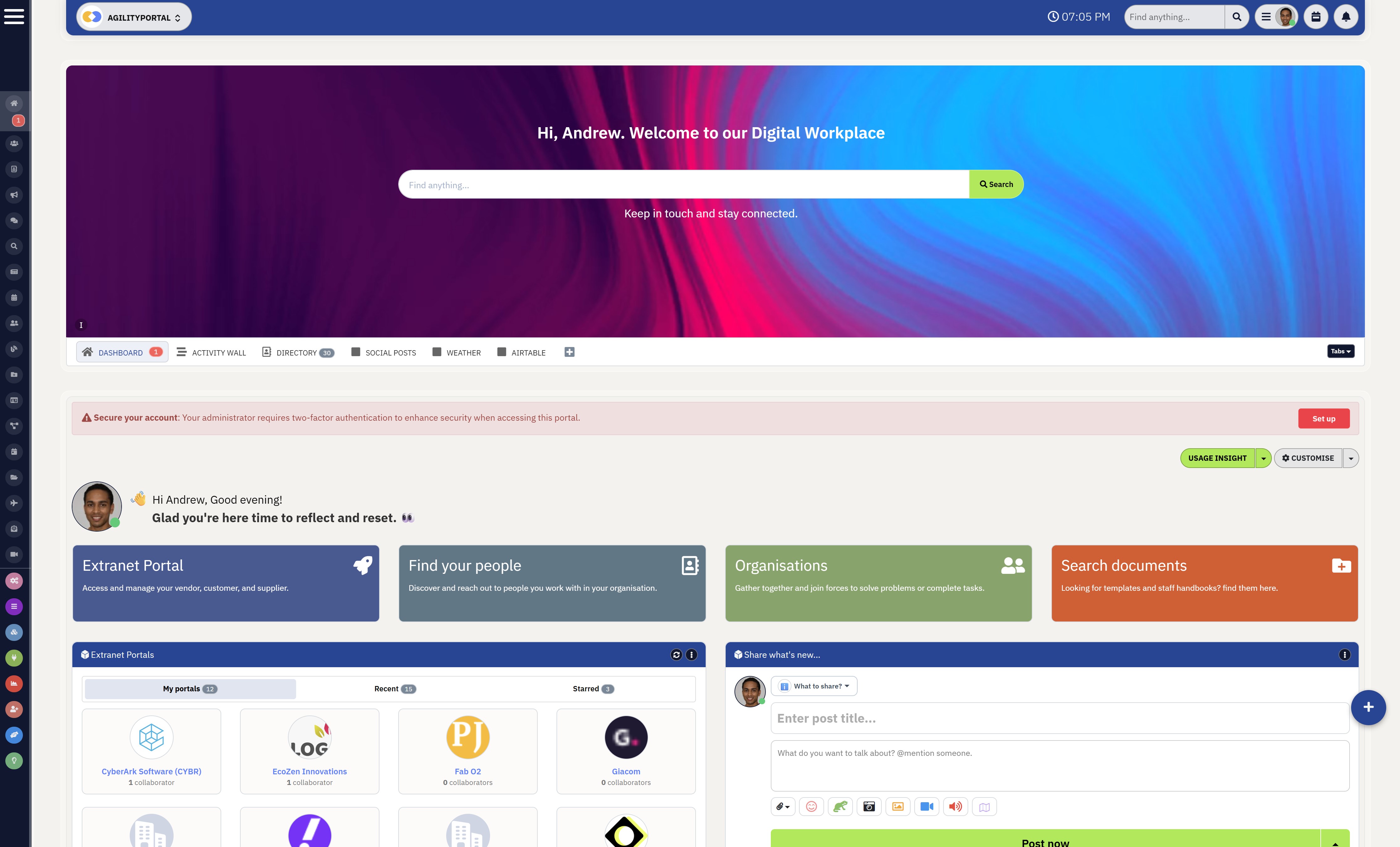
Most companies already have the information they need — the real problem is that it's scattered across Slack messages, emails, shared drives, meetings, and disconnected workplace tools.
AgilityPortal helps businesses centralise communication, company knowledge, documents, employee updates, and collaboration into one connected digital workplace platform designed for modern hybrid teams.
Instead of employees wasting time searching for answers, AgilityPortal makes information easier to find, manage, and trust across the organisation.
With features like:
- Employee intranet software
- AI-powered workplace search
- Document management
- Employee communication tools
- Knowledge sharing
- Mobile access for frontline workers
- Collaboration and engagement features
…teams can reduce information chaos while improving productivity, onboarding, and internal communication.
If your employees are still relying on tribal knowledge, outdated documents, or endless Slack threads, it may be time to rethink how information flows across your business.
AgilityPortal
The Digital Workplace Platform Built to Create a Trusted Single Source of Truth
AgilityPortal helps businesses centralise company knowledge, employee communication, documents, announcements, workflows, and collaboration into one connected digital workplace platform.
Instead of employees searching across Slack threads, shared drives, emails, and disconnected workplace tools, AgilityPortal creates a trusted hub where information stays organised, searchable, and accessible from anywhere.
Start your 14-day free trial — no credit card required.Wrapping up
A single source of truth sounds simple in theory: one place for company knowledge, documents, communication, and decisions.
But as many founders discovered, the real challenge is not collecting information — it's keeping that information trusted, searchable, and easy to use.
That's the paradox.
Many companies invest in knowledge management systems, employee intranet software, and collaboration tools hoping to reduce chaos, only to accidentally create more fragmentation.
Files become outdated, documentation spreads across platforms, and employees return to Slack messages or tribal knowledge instead.
The companies that succeed approach things differently.
They focus less on building the "perfect" system and more on improving the employee experience. Faster search, cleaner navigation, content ownership, and simple governance rules matter far more than flashy layouts or endless documentation.
The biggest shift happening right now is that AI is increasing the value of trusted internal knowledge.
n the AI era, companies that can organise and access reliable information quickly will move faster, collaborate better, and make smarter decisions than businesses drowning in disconnected tools and scattered information.
AI Summary
- A single source of truth helps businesses centralise company knowledge, documents, communication, workflows, and decisions into one trusted and searchable location.
- Many organisations struggle with information fragmentation caused by Slack messages, emails, cloud drives, disconnected collaboration tools, and outdated documentation.
- Founders revealed that the biggest challenge is not collecting information — it is making knowledge easy to find, maintain, trust, and use across growing teams.
- The best knowledge management systems and digital workplace platforms prioritise fast search, clean navigation, mobile accessibility, and governance over overly complex documentation structures.
- Modern employee intranet software and enterprise collaboration tools help reduce time wasted searching for information while improving onboarding, communication, and operational alignment.
- Successful single source of truth strategies depend heavily on employee adoption, content ownership, documentation habits, and keeping information accurate as businesses scale.
Most Popular Posts

Effective communication among team members is vital for the productivity and success of any organization. Surprisingly, 60% of companies lack a long-term internal communication strategy, which p...


Businesses thrive on communication for efficiency, productivity and accomplishment. When the right information is passed from the right designation in the organization, it promotes positivity an...

Categories
Blog
(3174)
Business Management
(392)
Employee Engagement
(234)
Digital Transformation
(214)
Growth
(149)
Intranets
(141)
Internal communications
(106)
Remote Work
(68)
Sales
(53)
Collaboration
(52)
Customer Experience
(32)
Culture
(30)
Knowledge Management
(29)
Project management
(29)
Leadership
(20)
Comparisons
(9)
News
(1)

Related Posts

Cyber Essentials is often described as a technical certification, but it is really a practical test of whether a business has the basics under control. That matters because cyber incidents rarely stay inside the IT department. They can interrupt payr...

Outsourced IT support becomes worth considering when technology problems stop being minor inconveniences and begin affecting how the business operates. A slow laptop or one-off password reset is manageable. But recurring downtime, unresolved support ...

An intranet network example in business could be as simple as a central employee hub where people find company policies, announcements, forms, training, documents and team updates. In practice, managing it well takes more than putting files beh...

Could your employees still find the policies, forms and information they rely on if your intranet moved to a new Microsoft 365 tenant tomorrow? An intranet migration can sound simple on a project plan: move sites, documents and user access from one M...

When Should You Hire IT Consulting Companies? 9 Costly Warning Signs Growing Businesses Can’t Ignore
Is Your Business Growing Faster Than Its IT Can Handle? Is your business growing faster than the systems, support and people behind it can keep up? It is an easy problem to miss at first. A few slow laptops, another spreadsheet workaround, or o...


Jill Romford
I am a digital nomad, lover of exploring new places and making friends.
I love to travel and I love the internet. I take pictures of my travels and share them on the internet using Instagram.
Traveler, entrepreneur, and community builder. I share my insights on digital marketing and social media while inspiring you to live your fullest life.
Ready to learn more? 👍
One platform to optimize, manage and track all of your teams. Your new digital workplace is a click away. 🚀
Free for 14 days, no credit card required.