Insight Blog
Agility’s perspectives on transforming the employee's experience throughout remote transformation using connected enterprise tools.
39 minutes reading time
(7756 words)
PMP, PRINCE2, Agile, or Scrum? The Best Project Management Certifications Compared

PMP, PRINCE2, Agile, or Scrum? The Best Project Management Certifications Compared
Compare PMP, PRINCE2, Agile, and Scrum certifications to discover which project management credential best matches your career goals, industry, experience level, and salary expectations.
PMP, PRINCE2, Agile, or Scrum? The Best Project Management Certifications Compared

Choosing the right project management certification can significantly impact your career, earning potential, and leadership opportunities—but choosing the wrong one could cost you hundreds of dollars, months of study time, and missed career opportunities.
With employers increasingly prioritizing certified professionals, the decision between PMP vs PRINCE2 vs Agile vs Scrum has become more important than ever.
According to the Project Management Institute (PMI), employers will need nearly 25 million new project professionals by 2030, while PMP-certified professionals earn significantly higher salaries than their non-certified peers in many global markets.
At the same time, Agile and Scrum certifications continue to grow in demand as organizations accelerate digital transformation and adopt more flexible ways of working.
25M
new project professionals
According to the Project Management Institute (PMI), employers worldwide will need nearly 25 million new project professionals by 2030 to meet growing demand across industries.
Source: Project Management Institute (PMI)
PMP
salary advantage
According to PMI salary research, PMP-certified professionals consistently earn significantly higher salaries than non-certified project managers across many global markets.
Source: Project Management Institute (PMI) Salary Survey
Whether you're considering PMP certification, PRINCE2 certification, Agile certifications, or Scrum credentials, understanding the strengths, limitations, costs, career benefits, and industry recognition of each option is essential before investing your time and money.
In this guide, you'll discover:
- The key differences between PMP, PRINCE2, Agile, and Scrum certifications
- Which certification delivers the best return on investment
- Salary expectations and career opportunities for each credential
- The best certification based on your experience level and industry
- Common mistakes professionals make when choosing a certification
- A clear roadmap to help you make the right decision with confidence
By the end of this article, you'll know exactly which project management certification aligns with your career goals, helping you avoid costly mistakes and choose the credential that can accelerate your professional growth.
Key Takeaways
- PMP, PRINCE2, Agile, and Scrum certifications each support different career paths, industries, and project delivery styles.
- PMP is best suited for experienced project managers who want global recognition, stronger salary potential, and senior leadership opportunities.
- PRINCE2 is a strong choice for professionals working in the UK, Europe, government, public sector, and structured enterprise project environments.
- Agile and Scrum certifications are ideal for technology teams, digital transformation projects, software delivery, and fast-changing workplace environments.
- The best project management certification depends on your experience level, career goals, industry expectations, and the type of projects you want to lead.
Why Project Management Certifications Matter in Today's Workplace
Project management has evolved far beyond simply keeping projects on schedule and within budget.
Today's organizations rely on project leaders to drive innovation, manage change, coordinate distributed teams, and deliver strategic business outcomes.
As a result, pm certifications have become an important way for employers to identify candidates with proven knowledge, practical skills, and a commitment to professional development.
Whether you're working in technology, healthcare, finance, government, or manufacturing, earning a recognized project management certification can help you stand out in a competitive job market and prepare you for increasingly complex projects.

Why Project Management Certifications Matter in Today's Workplace
Growing Demand for Certified Project Managers
The demand for skilled project professionals continues to grow worldwide.
According to industry reports, organizations across nearly every sector are investing heavily in transformation initiatives, digital modernization, and large-scale business projects. These efforts require experienced project managers who can lead teams, manage risks, and deliver measurable results.
Certification helps demonstrate that you understand established project management frameworks, methodologies, and best practices. For employers, this provides greater confidence that certified professionals can successfully manage projects from initiation through completion.
One of the biggest benefits of certification is its potential impact on earning power.
Many employers are willing to pay higher salaries to certified project managers because they bring validated expertise and often require less onboarding or supervision.
Certifications such as PMP, PRINCE2, Agile, and Scrum are frequently listed as preferred or required qualifications in project management job postings.
Beyond salary benefits, certifications can also open doors to leadership positions, larger projects, and opportunities in highly regulated industries where formal project management processes are essential.
How Certifications Support Digital Transformation Projects
Digital transformation projects are among the most challenging initiatives organizations undertake.
They often involve new technologies, changing business processes, shifting employee behaviors, and coordination across multiple departments. Project management certifications provide frameworks and tools that help leaders navigate these complexities more effectively.
One key area is change management. Successful transformation requires more than implementing new software—it requires helping people adapt to new ways of working. Certified project managers learn techniques for stakeholder engagement, communication planning, risk management, and organizational change that improve adoption and project success rates.
Certifications are also valuable in hybrid and remote work environments. Modern project teams are often distributed across different locations, time zones, and departments. Project management methodologies help leaders establish clear communication channels, define responsibilities, and maintain accountability regardless of where team members work.
Technology implementations, such as cloud migrations, enterprise software deployments, and workplace modernization initiatives, benefit from structured project management approaches.
Certified professionals are trained to manage timelines, budgets, resources, and risks while ensuring business objectives remain aligned with project outcomes.
Finally, certifications strengthen cross-functional collaboration. Digital transformation projects typically involve IT teams, business leaders, operations staff, HR departments, and external vendors. Project managers with formal training are better equipped to coordinate diverse stakeholders, resolve conflicts, and keep everyone focused on shared goals.
In today's rapidly changing workplace, project management certifications are more than just credentials—they are practical tools that help professionals lead successful projects, support organizational growth, and advance their careers.
Related Project Management Resources You May Want to Read
Looking to strengthen your project management skills, improve team collaboration, manage resources more effectively, and deliver projects successfully? These resources explore project management methodologies, Agile practices, leadership skills, project planning, and workplace collaboration strategies.
- Fundamental When Selecting a Project Management Tools
- Intranet Redesign – Project Plan, Process & Surveys
- What Is The Rule of Seven in Project Management?
- Intranet Project Management, Scope & Plan – A Complete Guide
- How Project Managers Can Improve Resource Utilization
- How to Run a SaaS Project Management Like a Pro
- Most Important Project Management Skills
- Best Practices for Project Management and Leadership
- Discover How to Introduce Agile Working Successfully
- How to Use Agile Project Management for SEO & Digital Marketing
Together, these resources provide practical guidance on project planning, Agile methodologies, leadership development, team collaboration, resource management, and digital workplace strategies that can help project managers deliver better outcomes.
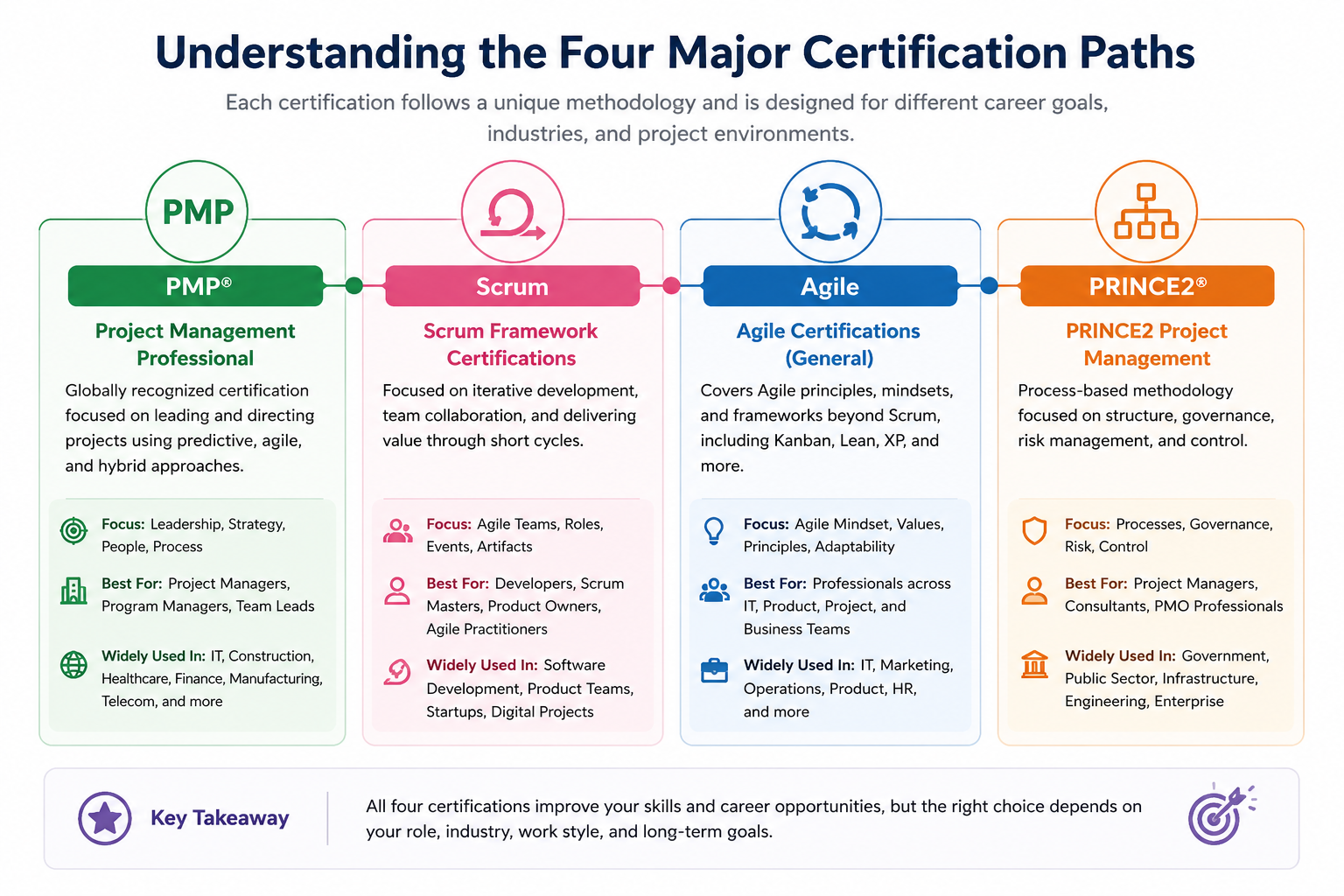
Understanding the Four Major Certification Paths
Choosing the right certification starts with understanding what each path offers and how it aligns with your career goals.
While all four certifications focus on improving project delivery, they differ in methodology, industry recognition, and the types of roles they support.
Understanding the Four Major Certification Paths
What Is PMP Certification?
The Project Management Professional (PMP) certification, offered by the Project Management Institute (PMI), is one of the most recognized project management credentials worldwide.
It validates a professional's ability to lead projects, manage teams, and deliver results across various industries.
Overview
- Globally recognized certification for experienced project managers
- Focuses on predictive, agile, and hybrid project management approaches
- Highly valued across industries including IT, construction, healthcare, and finance
Requirements
- Relevant project management experience
- Secondary degree or bachelor's degree depending on experience level
- Project management education or completion of a pmp certification course
Exam Structure
- 180 multiple-choice and scenario-based questions
- Covers People, Process, and Business Environment domains
- Time limit of approximately 230 minutes
Best Suited For
- Experienced project managers
- Team leaders managing complex projects
- Professionals seeking senior project management roles
What Is PRINCE2 Certification?
PRINCE2 (Projects IN Controlled Environments) is a structured project management methodology widely used in the UK, Europe, and government sectors.
It provides a process-driven framework for managing projects efficiently and consistently.
Foundation vs Practitioner
- Foundation: Introduces PRINCE2 principles and terminology
- Practitioner: Demonstrates the ability to apply PRINCE2 in real-world projects
Methodology Overview
- Focuses on governance, control, and clearly defined project stages
- Emphasizes business justification and risk management
- Suitable for projects of varying sizes and complexity
Best Suited For
- Government and public sector professionals
- Project managers working in structured environments
- Organizations that require standardized project governance
What Is Agile Certification?
Agile certifications focus on adaptive planning, continuous improvement, and delivering value through iterative development.
Rather than following a rigid process, Agile encourages flexibility and collaboration.
Agile Principles
- Customer-focused delivery
- Continuous feedback and improvement
- Cross-functional teamwork
- Rapid adaptation to change
Popular Agile Certifications
- PMI Agile Certified Practitioner (PMI-ACP)
- ICAgile Certifications
- AgilePM Certification
- SAFe Certifications
Best Suited For
- Technology and software professionals
- Product managers and business analysts
- Teams working in fast-changing environments
What Is Scrum Certification?
Scrum certification focuses on the Scrum framework, one of the most widely adopted Agile methodologies. It helps professionals understand how to facilitate Agile teams and improve project outcomes through iterative development cycles.
Scrum Framework
- Organized around short development cycles called sprints
- Encourages transparency, inspection, and adaptation
- Uses defined roles, events, and artifacts to manage work
Scrum Master Roles
- Facilitates Scrum ceremonies
- Removes obstacles affecting team productivity
- Coaches teams on Agile and Scrum best practices
- Supports continuous improvement initiatives
Best Suited For
- Scrum Masters and Agile Coaches
- Software development teams
- Product Owners and project professionals working in Agile environments
PMP vs PRINCE2 vs Agile vs Scrum: Side-by-Side Comparison
If you're trying to decide between PMP, PRINCE2, Agile, or Scrum certifications, the best choice depends on your career goals, industry, and level of experience.
Some certifications focus on structured project governance, while others emphasize flexibility, collaboration, and iterative delivery.
The table below provides a quick comparison of the four most popular certification paths.
| Factor | PMP | PRINCE2 | Agile Certification | Scrum Certification |
| Cost | $405–$655 (PMI members/non-members) | $300–$1,000+ depending on level and provider | $200–$1,500 depending on certification | $150–$1,000 depending on provider |
| Difficulty | High | Moderate | Moderate | Beginner to Moderate |
| Global Recognition | Excellent worldwide | Strong in UK, Europe, Australia, and government sectors | Strong across technology and digital industries | Strong in software development and Agile teams |
| Salary Impact | Highest earning potential among project management certifications | Strong salary boost in enterprise and government roles | Good salary growth in Agile-focused organizations | Valuable for Scrum Masters and Agile practitioners |
| Renewal Requirements | Requires Professional Development Units (PDUs) every 3 years | Practitioner certification requires renewal | Varies by certification body | Varies by certification provider |
| Industry Adoption | Construction, IT, healthcare, finance, manufacturing | Government, public sector, enterprise projects | Technology, product development, digital transformation | Software development, product teams, startups |
| Career Progression | Project Manager, Program Manager, PMO Leader | Project Manager, PMO Manager, Project Consultant | Agile Coach, Delivery Manager, Transformation Lead | Scrum Master, Agile Coach, Product Team Leader |
| Time Required | 2–6 months of preparation | 1–3 months depending on level | Several weeks to a few months | Days to several weeks |
Quick Summary
- Choose PMP if you want the most globally recognized project management certification and are aiming for senior project leadership roles.
- Choose PRINCE2 if you work in government, public sector, or organizations that follow structured project governance frameworks.
- Choose Agile Certification if your organization focuses on adaptability, continuous improvement, and digital transformation initiatives.
- Choose Scrum Certification if you work in software development, product management, or Agile delivery teams and want a fast entry into Agile project leadership.
For many professionals, these certifications are not mutually exclusive.
A common career path is to start with Scrum or Agile certifications, gain practical experience, and later pursue PMP or PRINCE2 to broaden project management expertise and increase career opportunities.
Which Certification Is Best for Your Career Goals?
The best project management certification depends on where you are in your career, the industry you work in, and the type of projects you manage.
While some certifications focus on structured project delivery, others emphasize flexibility, collaboration, and continuous improvement.
Here's a breakdown to help you choose the right path.
Reddit Discussion Insight
Is PMP Certification Actually Worth It?
A Reddit discussion in the r/pmp community shows that many professionals are not only asking whether PMP is worth it, but also whether they are actually eligible before applying.
“The biggest takeaway is simple: PMP can be valuable, but experience matters. You do not always need the title of Project Manager, but you must be able to show real project leadership experience.”
- PMP eligibility depends on both education and project leadership experience.
- Project work can include workplace projects, volunteer projects, implementations, process improvements, or cross-functional initiatives.
- CAPM may be a better first step for professionals who do not yet meet PMP experience requirements.
- The discussion reinforces why choosing the right certification first matters.
Best Certification for New Project Managers
If you're just starting your project management career, Agile or Scrum certifications are often the easiest entry points.
Certifications such as Certified ScrumMaster (CSM) or Professional Scrum Master (PSM) require less experience and provide practical knowledge that can be applied immediately.
PRINCE2 Foundation is another excellent option for beginners because it introduces core project management concepts without requiring extensive project experience.
These certifications help build confidence, improve employability, and provide a solid foundation for future career growth.
Best Certification for Experienced Project Managers
For professionals with several years of project management experience, PMP (Project Management Professional) is widely considered the gold standard. PMP demonstrates advanced project leadership skills and is recognized globally across industries.
Experienced project managers often pursue PMP because it can lead to higher salaries, greater leadership responsibilities, and increased credibility with employers and stakeholders.
If you're managing large, complex projects, PMP is typically the strongest choice.
Best Certification for IT Professionals
Technology projects often require flexibility, rapid delivery cycles, and close collaboration between teams. For this reason, Agile and Scrum certifications are particularly valuable for IT professionals.
Certifications such as Certified ScrumMaster (CSM), Professional Scrum Master (PSM), or PMI Agile Certified Practitioner (PMI-ACP) help IT leaders manage software development projects, digital transformation initiatives, and product delivery teams more effectively.
Best Certification for Digital Workplace Leaders
Digital workplace leaders oversee initiatives involving employee experience, collaboration platforms, communication tools, and organizational change. These projects often combine traditional project management with Agile practices.
A combination of PMP and Agile certifications can be especially beneficial for professionals leading workplace transformation programs.
PMP provides governance and strategic oversight, while Agile certifications support adaptability and continuous improvement in fast-changing environments.
Best Certification for Hybrid Project Teams
Many organizations now operate with a mix of remote and in-office employees, creating unique project management challenges.
Hybrid teams require strong communication, collaboration, and stakeholder engagement skills.
Agile certifications are often the best fit because Agile frameworks encourage transparency, frequent communication, and iterative delivery. Scrum certifications can also help leaders manage distributed teams effectively by establishing clear roles, responsibilities, and workflows.
Best Certification for Government and Enterprise Projects
Government agencies and large enterprises frequently rely on structured project management methodologies with strong governance requirements. In these environments, PRINCE2 and PMP are often the preferred certifications.
PRINCE2 is particularly popular in the UK, Europe, and public-sector organizations due to its process-driven approach and emphasis on accountability.
PMP is widely recognized across global enterprises and is ideal for managing large-scale projects involving multiple stakeholders, budgets, and compliance requirements.
Ultimately, the right certification depends on your career objectives. If you're looking for flexibility and innovation, Agile or Scrum may be the best fit.
If you're aiming for senior leadership roles or managing complex enterprise projects, PMP or PRINCE2 can provide a stronger long-term advantage.
Salary and Career Impact of Each Certification
One of the biggest reasons professionals pursue project management certifications is the potential for higher salaries and better career opportunities.
While certification alone won't guarantee a promotion, it can help demonstrate expertise, improve credibility with employers, and open doors to leadership roles.
The actual salary impact depends on factors such as industry, location, years of experience, and job responsibilities.
Salary and Career Impact of Each Certification
PMP Salary Expectations
The Project Management Professional (PMP) certification is widely regarded as one of the most valuable credentials in the project management field.
PMP-certified professionals often earn higher salaries than their non-certified peers because the certification demonstrates advanced project leadership skills and experience.
Typical salary ranges for PMP-certified professionals include:
- UK: £50,000–£85,000+ per year
- US: $95,000–$150,000+ per year
- Australia: AUD $110,000–$180,000+ per year
PMP certification is particularly valuable for:
- Senior Project Managers
- Program Managers
- PMO Leaders
- Transformation Managers
- Enterprise Project Leaders
£85K+
top UK salary potential
PMP-certified professionals are among the highest-paid project leaders globally. The Project Management Professional (PMP) credential is widely recognized across industries and is often associated with stronger earning potential, greater leadership opportunities, and access to large-scale strategic projects.
🇬🇧 United Kingdom
£50,000–£85,000+
🇺🇸 United States
$95,000–$150,000+
🇦🇺 Australia
AUD $110,000–$180,000+
Salary estimates based on PMI salary surveys and industry market averages for PMP-certified professionals.
PRINCE2 Salary Expectations
PRINCE2 remains highly respected, especially in the UK, Europe, government sectors, and large enterprises.
Professionals with PRINCE2 certification often benefit from increased employability and access to structured project management roles.
Typical salary ranges for PRINCE2-certified professionals include:
- UK: £40,000–£75,000+ per year
- US: $75,000–$130,000+ per year
- Australia: AUD $90,000–$150,000+ per year
PRINCE2 is commonly sought after for:
- Government Projects
- Public Sector Roles
- Infrastructure Projects
- Enterprise Change Initiatives
- Project Support Offices (PSOs)
£75K
top UK salary potential
PRINCE2-certified professionals are highly valued in government, public sector, infrastructure, and enterprise environments where structured project governance is critical. Organizations often seek PRINCE2 practitioners to improve project control, risk management, accountability, and successful project delivery.
🇬🇧 United Kingdom
£40,000–£75,000+
🇺🇸 United States
$75,000–$130,000+
🇦🇺 Australia
AUD $90,000–$150,000+
Salary estimates based on industry salary surveys and market averages for PRINCE2-certified professionals.
Agile Certification Salary Expectations
Agile certifications are increasingly valuable as organizations adopt flexible project delivery methods and digital transformation initiatives. Professionals with Agile credentials are often in demand across technology, software development, and innovation-focused industries.
Typical salary ranges for Agile-certified professionals include:
- UK: £45,000–£80,000+ per year
- US: $85,000–$145,000+ per year
- Australia: AUD $100,000–$170,000+ per year
Agile certifications can support careers in:
- Agile Project Management
- Product Management
- Digital Transformation
- Business Analysis
- Technology Leadership
£80K
top UK salary potential
Agile-certified professionals continue to be in high demand as organizations embrace digital transformation, continuous improvement, and adaptive project delivery. Agile credentials can help professionals access higher-paying roles across technology, product management, business transformation, and enterprise change initiatives.
🇬🇧 United Kingdom
£45,000–£80,000+
🇺🇸 United States
$85,000–$145,000+
🇦🇺 Australia
AUD $100,000–$170,000+
Salary estimates based on industry salary surveys and market averages for Agile-certified professionals.
Scrum Certification Salary Expectations
Scrum certifications, particularly Scrum Master credentials, are popular among professionals working in software development and Agile environments. As organizations continue to embrace Agile frameworks, certified Scrum professionals remain highly sought after.
Typical salary ranges for Scrum-certified professionals include:
- UK: £45,000–£85,000+ per year
- US: $90,000–$155,000+ per year
- Australia: AUD $100,000–$175,000+ per year
Scrum certifications are especially beneficial for:
- Scrum Masters
- Agile Coaches
- Product Owners
- Delivery Managers
- Software Development Leaders
While salary figures vary by region and industry, PMP generally delivers the strongest earning potential for experienced project managers, while Agile and Scrum certifications can provide excellent opportunities in technology-driven organizations.
PRINCE2 remains a strong choice for professionals working in government, public sector, and enterprise environments where structured project governance is essential.
£85K
top UK salary potential
Scrum-certified professionals are among the most sought-after specialists in Agile environments. Organizations adopting Agile delivery frameworks frequently offer competitive salaries to certified Scrum Masters, Agile Coaches, Product Owners, and Delivery Managers.
🇬🇧 United Kingdom
£45,000–£85,000+
🇺🇸 United States
$90,000–$155,000+
🇦🇺 Australia
AUD $100,000–$175,000+
Salary estimates based on industry salary surveys and market averages for Scrum-certified professionals.
Common Mistakes People Make When Choosing a Certification
Choosing a project management certification is a significant investment, so it's important to avoid common pitfalls that can lead to wasted time, money, and effort.
Many professionals rush into a certification program because they feel pressure to advance their careers quickly, only to discover later that the credential doesn't align with their goals or industry requirements.
Taking the time to evaluate your options carefully can help you maximize the return on your investment and ensure your certification supports your long-term professional growth.
Below are some of the most common mistakes professionals make when selecting a project management certification and how you can avoid them.
Following Trends Instead of Career Needs
It's easy to be influenced by what's currently popular in the industry. Social media, professional networking platforms, and online forums are often filled with discussions about the latest certifications and career trends.
While these conversations can be helpful, they shouldn't be the primary factor driving your decision.
A certification that works well for someone else may not align with your role, experience level, industry, or long-term ambitions.
For example, a software development professional may benefit more from Agile or Scrum certifications, while someone managing large enterprise projects may gain greater value from PMP certification.
Before enrolling in any program, ask yourself a few important questions:
- What type of projects do I want to manage?
- Which industries am I interested in working in?
- What skills do employers in my field expect?
- Where do I want my career to be in five years?
By focusing on your personal career objectives rather than industry hype, you'll make a more strategic and valuable certification choice.
Ignoring Industry Requirements
Different industries often favor specific certifications.
While many credentials are recognized globally, certain sectors have clear preferences based on their project management methodologies and organizational structures.
For example:
- PMP is widely recognized across construction, healthcare, finance, manufacturing, and technology sectors.
- PRINCE2 is commonly used in government, public-sector organizations, and many UK-based enterprises.
- Agile certifications are highly valued in software development and digital product teams.
- Scrum certifications are often preferred for organizations using Scrum frameworks and Agile delivery models.
Failing to research industry expectations can result in earning a certification that carries limited value within your target job market.
Before committing to a certification path, review job descriptions, speak with hiring managers, and explore professional networking groups to identify which credentials employers consistently request.
Understanding industry requirements can significantly improve your chances of securing promotions, leadership opportunities, and higher-paying roles.
Choosing the Most Expensive Option
Many professionals assume that a higher price tag automatically means greater value.
While some certifications are more expensive because they include extensive training materials, workshops, or exam preparation resources, cost alone should never determine your decision.
The best certification is the one that aligns with your career objectives and provides practical skills that employers are actively seeking. In some cases, a lower-cost certification may deliver a stronger return on investment than a premium program that isn't relevant to your role.
When evaluating certification costs, consider:
- Exam fees
- Training course expenses
- Study materials
- Membership fees
- Renewal costs
- Time required for preparation
It's also important to calculate the potential career benefits. Will the certification help you qualify for better positions? Could it increase your earning potential?
Does it provide skills that are immediately applicable in your current role?
Looking beyond the initial price can help you make a smarter financial and professional decision.
Not Considering Long-Term Career Goals
A certification should support where you want your career to go, not just your current position.
One of the biggest mistakes professionals make is selecting a certification solely because it helps them solve an immediate challenge, without considering future opportunities.
For example, someone aspiring to become a program manager, PMO leader, or transformation executive may benefit from a different certification path than someone focused on Agile coaching or Scrum leadership.
Think about your long-term aspirations:
- Do you want to lead enterprise-wide initiatives?
- Are you interested in digital transformation projects?
- Would you like to manage multiple project teams?
- Do you plan to move into executive leadership roles?
- Are you aiming to specialize in Agile delivery?
Your answers can help determine which certification provides the strongest foundation for future growth.
A well-chosen credential can open doors for years, while the wrong one may require additional certifications later to fill skill gaps.
Overlooking Renewal and Maintenance Requirements
Many professionals focus heavily on passing the certification exam but overlook what happens afterward. Some certifications require ongoing maintenance to remain active, including continuing education credits, annual membership fees, professional development activities, or periodic renewal exams.
For example, PMP holders must earn Professional Development Units (PDUs) to maintain their certification status. Other credentials may require renewal fees or participation in continuing education programs.
Before choosing a certification, make sure you understand:
- Renewal timelines
- Continuing education requirements
- Annual membership costs
- Recertification exams
- Professional development obligations
These ongoing commitments can affect both your schedule and budget over time.
Understanding maintenance requirements upfront helps prevent unexpected expenses and ensures you can keep your credential active throughout your career.
Focusing Only on Certification and Not Practical Experience
Another common mistake is believing that a certification alone will guarantee career advancement.
While certifications can strengthen your resume and demonstrate professional commitment, employers still place significant value on real-world experience.
Project management is a practical discipline that requires leadership, communication, stakeholder management, problem-solving, and decision-making skills.
Certifications provide valuable frameworks and methodologies, but applying those concepts successfully in real projects is what truly builds credibility.
To maximize the value of your certification:
- Volunteer for project leadership opportunities.
- Participate in cross-functional initiatives.
- Build experience managing stakeholders.
- Practice risk management and project planning.
- Document measurable project outcomes.
Combining certification knowledge with hands-on experience creates a much stronger professional profile and can significantly improve your career prospects.
Failing to Compare Multiple Certification Paths
Many professionals choose the first certification they hear about without comparing alternatives. This can lead to investing in a credential that isn't the best fit for their goals.
Before making a decision, compare certifications based on:
- Industry recognition
- Career relevance
- Cost
- Difficulty level
- Salary impact
- Global acceptance
- Renewal requirements
- Learning objectives
Taking the time to evaluate multiple options allows you to make a more informed decision and select a certification that delivers the greatest long-term value.
Not Speaking with Certified Professionals
One of the most overlooked research methods is simply talking to people who already hold the certifications you're considering.
Certified professionals can provide valuable insights into exam difficulty, study requirements, employer perceptions, and real-world career benefits.
Reach out through professional associations, LinkedIn groups, industry forums, or workplace networks. Their experiences can help you avoid common mistakes and gain a realistic understanding of what each certification offers.
Learning from others who have already completed the journey can often provide more practical guidance than marketing materials or certification websites alone.
The right project management certification can accelerate your career, increase your earning potential, and expand your professional opportunities. However, choosing the wrong certification can result in unnecessary costs and limited career impact.
By avoiding these common mistakes—following trends, ignoring industry requirements, focusing solely on cost, overlooking long-term goals, neglecting renewal obligations, and failing to gain practical experience—you'll be in a much stronger position to select a certification that genuinely supports your professional growth and future success.
Certification Roadmaps by Role
Choosing the right certification path depends on where you are in your career and where you want to go next.
Here's a practical roadmap to help you build the skills and credentials that align with your professional goals.
Project Coordinator Roadmap
If you're just starting your project management career, focus on building foundational knowledge and understanding project processes.
Recommended path:
- CAPM (Certified Associate in Project Management)
- PRINCE2 Foundation
- Agile Fundamentals Certification
- Scrum Master Certification
These certifications help develop core project planning, communication, scheduling, and stakeholder management skills while preparing you for more advanced credentials later.
Project Manager Roadmap
Project managers need a combination of methodology expertise, leadership skills, and practical experience managing teams and budgets.
Recommended path:
- PRINCE2 Practitioner or AgilePM
- PMP (Project Management Professional)
- Advanced Agile Certification
- Change Management Certification
This pathway strengthens your ability to manage complex projects across different industries and delivery frameworks.
Program Manager Roadmap
Program managers oversee multiple interconnected projects and align initiatives with broader business objectives.
Recommended path:
- PMP Certification
- PgMP (Program Management Professional)
- Agile Leadership Certification
- Strategic Portfolio Management Training
These credentials help develop governance, strategic planning, resource allocation, and executive stakeholder management capabilities.
Transformation Manager Roadmap
Transformation managers lead organizational change, digital initiatives, and business modernization programs.
Recommended path:
- Agile Certification
- Change Management Certification
- PMP or PRINCE2 Practitioner
- Digital Transformation or Business Transformation Certification
This combination supports leaders responsible for driving innovation, managing change, and delivering enterprise-wide transformation projects.
PMO Leader Roadmap
PMO leaders establish project governance frameworks, improve delivery standards, and oversee organizational project portfolios.
Recommended path:
- PMP Certification
- PRINCE2 Practitioner
- Portfolio Management (PfMP) Certification
- PMO-Specific Leadership Training
These certifications help PMO professionals strengthen governance, reporting, portfolio oversight, and strategic decision-making skills while supporting organizational growth and project success.
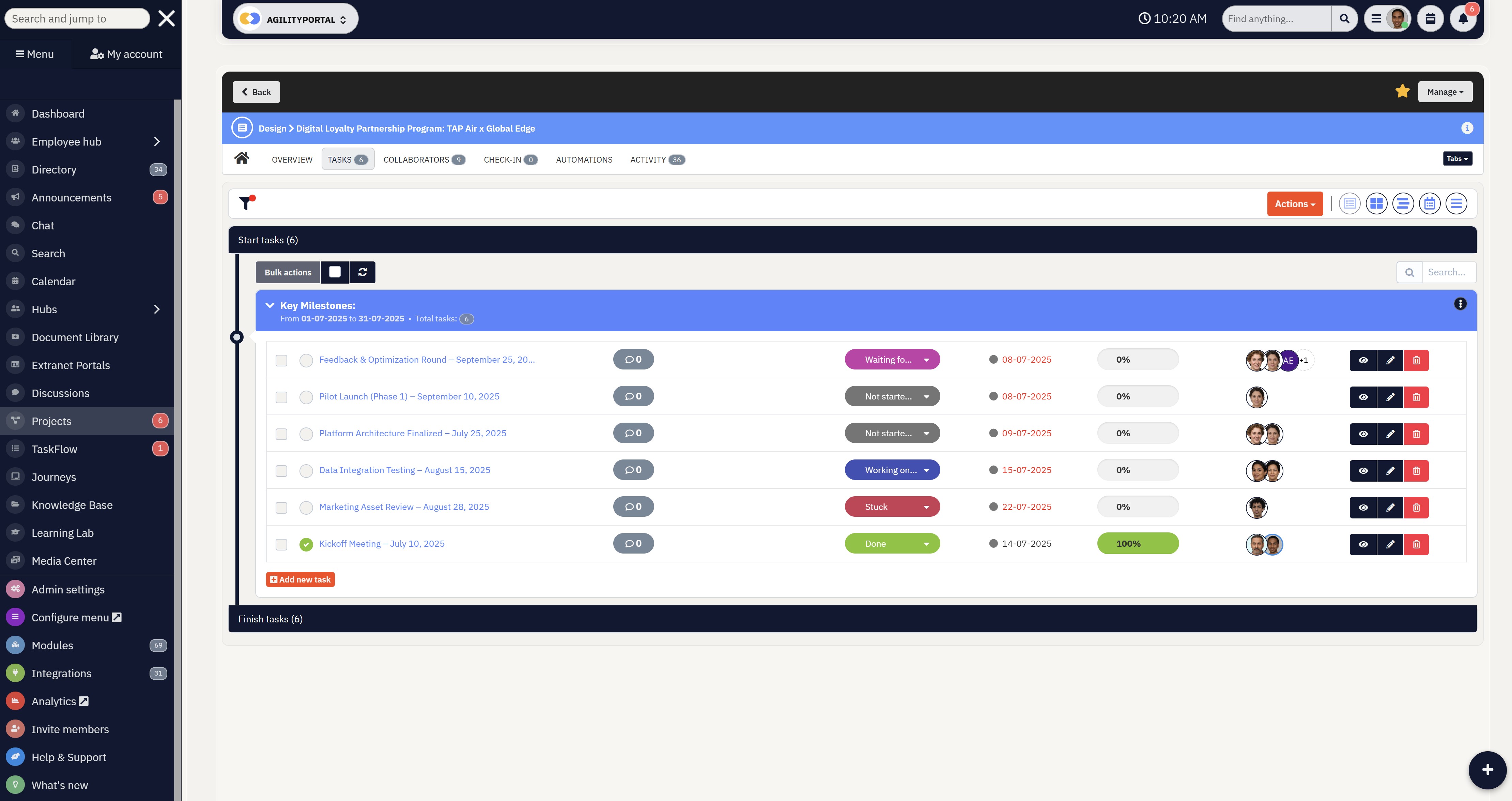
How Collaboration Platforms Help Certified Project Managers Deliver Better Results
How Collaboration Platforms Help Certified Project Managers Deliver Better Results
Earning a project management certification is only part of the equation.
To consistently deliver successful projects, certified project managers need the right digital tools to support communication, collaboration, and execution across teams.
Modern collaboration platforms help bridge the gap between project planning and real-world delivery by creating a connected digital workplace where employees can work more efficiently.
Team Communication
Effective communication is one of the most important skills for any project manager.
Collaboration platforms provide centralized communication channels that reduce email overload, improve response times, and keep project discussions organized.
Whether teams are working remotely, in the office, or in a hybrid environment, having a single source of communication helps ensure everyone stays aligned on project goals and deadlines.
Knowledge Sharing
Project success often depends on how easily teams can access information.
A modern employee communication platform allows organizations to store documents, project updates, policies, and best practices in one searchable location.
This improves knowledge management, reduces duplicated work, and helps new team members get up to speed faster.
Project Visibility
Certified project managers need real-time visibility into project progress, team workloads, and potential risks.
Collaboration software provides dashboards, task tracking, reporting tools, and project updates that help leaders make informed decisions. Increased transparency allows stakeholders to monitor progress and identify issues before they become major problems.
Employee Engagement
Highly engaged employees are more productive and contribute more effectively to project outcomes.
Employee engagement software helps organizations create stronger workplace connections through recognition programs, social collaboration features, feedback tools, and company-wide communications.
Engaged teams are more likely to collaborate effectively and remain committed to project objectives.
Digital Workplace Management
As organizations continue embracing hybrid work and digital transformation initiatives, project managers increasingly rely on digital workplace platforms to coordinate teams and streamline operations.
Solutions like AgilityPortal combine employee communication, knowledge sharing, collaboration tools, intranet capabilities, and employee engagement features into a single platform.
AgilityPortal helps organizations create a connected digital workplace where project managers can improve team collaboration, enhance internal communications, manage company knowledge, and support employee engagement initiatives.
By bringing communication, collaboration, and workplace management together in one platform, AgilityPortal enables certified project managers to deliver projects more efficiently while supporting long-term organizational success.
For professionals pursuing PMP, PRINCE2, Agile, or Scrum certifications, leveraging a modern collaboration platform such as AgilityPortal can significantly improve project execution, stakeholder communication, team productivity, and overall project outcomes.
Digital Workplace & Project Collaboration Platform
Turn Project Management Skills Into Better Team Execution
Certifications like PMP, PRINCE2, Agile, and Scrum can strengthen your project management knowledge—but successful delivery also depends on how well your teams communicate, share knowledge, manage documents, track tasks, and stay aligned. AgilityPortal brings those essentials together in one secure digital workplace.
Start Free Trial
```
Book a Demo
```
A modern platform for project-led organizations that need better communication, collaboration, training, document access, knowledge sharing, and employee engagement in one place.
Final Verdict: Which Certification Should You Pursue First?
If you're still unsure which certification to choose, don't worry—there's no one-size-fits-all answer.
The best certification depends on your current experience, industry, and long-term career goals. Use the decision matrix below as a quick guide to help narrow down your options.
| If You Are... | Recommended Certification | Why It Makes Sense |
| New to project management | PRINCE2 Foundation or Agile Certification | Easier entry point with fewer experience requirements and strong foundational knowledge. |
| Working in IT | Agile Certification or Scrum Certification | Widely used in software development, technology projects, and product teams. |
| Working in Government | PRINCE2 Practitioner | Highly recognized in government, public sector, and large enterprise environments. |
| Leading transformations | PMP Certification | Demonstrates advanced project leadership, stakeholder management, and strategic execution skills. |
| Seeking highest salary potential | PMP Certification | Consistently ranks among the highest-paying project management credentials worldwide. |
Quick Recommendations
- Choose PMP if you already have project management experience and want maximum career growth and earning potential.
- Choose PRINCE2 if you work in structured environments such as government, public sector, or large organizations.
- Choose Agile if your organization embraces flexibility, continuous improvement, and iterative project delivery.
- Choose Scrum if you're focused on software development, product management, or Agile team leadership.
Ultimately, the best certification is the one that aligns with the type of projects you manage today—and the career you want to build tomorrow.
Many professionals eventually combine certifications, such as PMP with Agile or PRINCE2 with Scrum, to broaden their expertise and increase their marketability.
FAQ
Is PMP better than PRINCE2?
It depends on your career goals and industry. PMP is widely recognized globally and is often preferred in North America, while PRINCE2 is popular in the UK, Europe, and government sectors.
If you're managing large, complex projects, PMP may offer greater long-term value. For structured project environments, PRINCE2 can be an excellent choice.
Can Agile replace PMP?
Not entirely. Agile certifications focus on flexible project delivery methods, while PMP covers a broader range of project management principles, including Agile, predictive, and hybrid approaches. Many professionals pursue both to strengthen their credentials.
Is Scrum certification worth it?
Yes, especially if you work in software development, IT, or Agile environments. Scrum certifications can help you qualify for Scrum Master and Agile team leadership roles.
They are often easier and faster to obtain than PMP certification.
Which certification has the highest salary?
PMP consistently ranks among the highest-paying project management certifications worldwide.
However, salaries vary based on experience, industry, location, and role. Specialized certifications in Agile, Scrum, and program management can also command competitive salaries.
What is the easiest project management certification?
For beginners, certifications such as Certified Associate in Project Management (CAPM), PRINCE2 Foundation, or entry-level Agile certifications are generally considered easier than PMP.
They require less experience and have fewer eligibility requirements.
Which certification is best for beginners?
If you're new to project management, CAPM, PRINCE2 Foundation, or Agile Fundamentals certifications are excellent starting points.
If you're entering the broader IT field, certifications like CompTIA ITF+, CompTIA A+, or the Google IT Support Professional Certificate can help build foundational technical knowledge before moving into project leadership roles.
Can I get PMP without project management experience?
No. PMP requires documented project management experience and education requirements set by PMI. If you don't yet qualify, consider CAPM or other entry-level certifications while gaining practical experience.
Is PRINCE2 recognized outside the UK?
Yes. Although PRINCE2 is most popular in the UK and Europe, it is recognized internationally and used by organizations across government, healthcare, finance, and enterprise sectors worldwide.
Should I get Agile or Scrum certification first?
Since Scrum is one of the most widely used Agile frameworks, many professionals start with a Scrum certification before pursuing broader Agile credentials.
Your choice should depend on your role and career objectives.
Which certification is most valuable in 2026?
PMP is expected to remain one of the most valuable project management certifications in 2026.
However, Agile, Scrum, and hybrid project management certifications will continue growing in demand as organizations adopt more flexible ways of working.
Which certification should you pursue first Reddit users recommend?
If you've searched "which certification should you pursue first Reddit" discussions, you'll notice recommendations vary based on career goals.
For IT beginners, Reddit users frequently suggest starting with CompTIA ITF+, CompTIA A+, or the Google IT Support Professional Certificate.
Those interested in networking often move on to the CCNA certification, while cybersecurity beginners commonly pursue CompTIA Security+.
Is CompTIA A+ worth getting?
Yes. CompTIA A+ remains one of the most recognized entry-level IT certifications.
It validates foundational skills in hardware, software, troubleshooting, networking, and operating systems, making it a strong starting point for IT support careers.
What is the difference between CompTIA ITF+ and CompTIA A+?
CompTIA ITF+ is designed for complete beginners who want to understand basic IT concepts.
CompTIA A+ goes deeper into technical skills and is typically the next step for those pursuing an IT career.
Is the CCNA certification better than CompTIA A+?
Neither is better—they serve different purposes.
CompTIA A+ focuses on general IT support skills, while the CCNA certification specializes in networking concepts, routing, switching, and network administration.
Is Professor Messer good for certification exam preparation?
Yes. Professor Messer is one of the most popular free training resources for CompTIA certifications, including CompTIA A+ and CompTIA Security+.
Many candidates use his videos alongside practice exams and study guides.
Is CompTIA Security+ worth it?
Absolutely. CompTIA Security+ is widely recognized by employers and government organizations as an entry-level cybersecurity certification.
It covers essential security concepts, risk management, threats, vulnerabilities, and network security.
Is the Google IT Support Professional Certificate recognized by employers?
Yes. The Google IT Support Professional Certificate is respected as an entry-level credential and can help learners develop practical IT support skills.
Many professionals use it as a stepping stone before pursuing certifications such as CompTIA A+, CompTIA Security+, or CCNA.
AI Summary
- Project management certifications help professionals validate their skills, increase earning potential, improve employability, and qualify for leadership roles across industries such as technology, healthcare, finance, construction, and government.
- PMP, PRINCE2, Agile, and Scrum certifications each serve different career paths, with PMP focusing on comprehensive project leadership, PRINCE2 emphasizing structured governance, Agile promoting adaptability, and Scrum specializing in Agile team delivery.
- PMP remains one of the most globally recognized project management certifications, while PRINCE2 is particularly popular within government, public sector, and enterprise organizations throughout the UK and Europe.
- Agile and Scrum certifications continue to grow in demand as organizations embrace digital transformation, hybrid work environments, software development methodologies, and continuous improvement initiatives.
- Choosing the right certification depends on factors such as experience level, industry requirements, salary goals, career aspirations, project complexity, and preferred project delivery methodologies.
- Combining professional certifications with modern collaboration platforms can help project managers improve communication, stakeholder engagement, knowledge sharing, project visibility, and overall project success.
Most Popular Posts

Effective communication among team members is vital for the productivity and success of any organization. Surprisingly, 60% of companies lack a long-term internal communication strategy, which p...


Businesses thrive on communication for efficiency, productivity and accomplishment. When the right information is passed from the right designation in the organization, it promotes positivity an...

Categories
Blog
(3174)
Business Management
(392)
Employee Engagement
(234)
Digital Transformation
(214)
Growth
(149)
Intranets
(141)
Internal communications
(106)
Remote Work
(68)
Sales
(53)
Collaboration
(52)
Customer Experience
(32)
Culture
(30)
Knowledge Management
(29)
Project management
(29)
Leadership
(20)
Comparisons
(9)
News
(1)

Related Posts

Cyber Essentials is often described as a technical certification, but it is really a practical test of whether a business has the basics under control. That matters because cyber incidents rarely stay inside the IT department. They can interrupt payr...

Outsourced IT support becomes worth considering when technology problems stop being minor inconveniences and begin affecting how the business operates. A slow laptop or one-off password reset is manageable. But recurring downtime, unresolved support ...

An intranet network example in business could be as simple as a central employee hub where people find company policies, announcements, forms, training, documents and team updates. In practice, managing it well takes more than putting files beh...

Could your employees still find the policies, forms and information they rely on if your intranet moved to a new Microsoft 365 tenant tomorrow? An intranet migration can sound simple on a project plan: move sites, documents and user access from one M...

When Should You Hire IT Consulting Companies? 9 Costly Warning Signs Growing Businesses Can’t Ignore
Is Your Business Growing Faster Than Its IT Can Handle? Is your business growing faster than the systems, support and people behind it can keep up? It is an easy problem to miss at first. A few slow laptops, another spreadsheet workaround, or o...


Jill Romford
I am a digital nomad, lover of exploring new places and making friends.
I love to travel and I love the internet. I take pictures of my travels and share them on the internet using Instagram.
Traveler, entrepreneur, and community builder. I share my insights on digital marketing and social media while inspiring you to live your fullest life.
Ready to learn more? 👍
One platform to optimize, manage and track all of your teams. Your new digital workplace is a click away. 🚀
Free for 14 days, no credit card required.