
Insight Blog
Agility’s perspectives on transforming the employee's experience throughout remote transformation using connected enterprise tools.
23 minutes reading time
(4607 words)
Knowledge Management Framework: How Modern Businesses Organize, Share & Retain Knowledge

Knowledge Management Framework & Methodology – UPDATED 2025
Let us try to understand the importance of knowledge management framework and methodology in detail and talk about how an organization can implement this type of framework efficiently.
Knowledge Management Framework & Methodology – UPDATED 2025

As businesses continue evolving through digital transformation, hybrid work, and AI-powered collaboration, the need for a modern knowledge management framework has become more important than ever.
According to IDC, employees spend nearly 30% of their workweek searching for information, while McKinsey reports that effective knowledge-sharing systems can improve productivity by up to 25%.
Organizations can no longer rely on disconnected documents, scattered communication, or siloed information systems to manage business knowledge effectively.
A well-designed knowledge management framework helps businesses centralize knowledge sharing, improve collaboration, retain organizational knowledge, and ensure employees can quickly access the information they need to perform effectively.
Research from Deloitte shows that companies with strong knowledge management practices are 4.5 times more likely to retain top talent, while Gartner estimates that poor knowledge sharing costs large organizations millions of dollars annually in lost productivity.
30%
of the workweek lost searching for information
According to IDC, employees spend nearly 30% of their workweek searching for information, while McKinsey reports that effective knowledge-sharing systems can improve productivity by up to 25%. This highlights why modern businesses are investing heavily in enterprise knowledge management, centralized knowledge bases, and AI-powered knowledge sharing platforms.
Instead of operating as a standalone process, modern enterprise knowledge management frameworks are designed to integrate directly with digital workplace platforms, employee communication tools, document management systems, and operational workflows across the organization.
At its core, a Knowledge Management (KM) framework is a structured approach used to capture, organize, store, manage, and share collective business knowledge and expertise across teams and departments.
Studies indicate that 80% of organizational knowledge is often unstructured, making it difficult for employees to locate critical information without a centralized framework.
Think of it as the organization's operational intelligence system — helping employees find answers faster, reduce duplicated work, improve onboarding, retain institutional knowledge, and support better decision-making across remote, hybrid, and distributed workforces.
In fact, organizations with mature KM strategies have reported up to 35% faster onboarding times and significantly improved employee engagement and operational efficiency.
Key Takeaways
- A modern knowledge management framework helps businesses organize, store, manage, and share organizational knowledge across teams, departments, and digital workplaces.
- Businesses without centralized knowledge management systems often struggle with information silos, duplicated work, poor collaboration, and knowledge loss during employee turnover.
- Enterprise knowledge management frameworks support both explicit knowledge, such as documents and SOPs, and tacit knowledge, including employee expertise and operational experience.
- AI-powered search, centralized knowledge bases, workflow automation, and employee collaboration tools are transforming how businesses access and share knowledge.
- Organizations using effective knowledge-sharing systems often improve productivity, onboarding, operational visibility, and decision-making across remote and hybrid workforces.
- Modern digital workplace platforms help businesses reduce knowledge fragmentation by connecting communication, documentation, collaboration, and enterprise search into one unified environment.
What Is a Knowledge Management Framework?
A modern knowledge management framework defines how an organization captures, organizes, manages, shares, and applies information across the entire knowledge lifecycle.
This includes knowledge creation, knowledge storage, knowledge sharing, knowledge retention, and knowledge accessibility across teams, departments, and digital workplaces.
Effective enterprise knowledge management frameworks support both explicit knowledge, such as documents, SOPs, policies, and internal knowledge bases, as well as tacit knowledge, which includes employee experience, operational context, and institutional knowledge held by individuals.
One of the biggest misconceptions is assuming a knowledge management framework is the same as a knowledge management system or knowledge management software.
They are not the same thing. The framework defines the overall knowledge management strategy, governance, processes, workflows, ownership, and organizational structure around how information is managed.
The knowledge management system is simply the technology layer that supports those processes through collaboration tools, document management, AI-powered enterprise search, and centralized knowledge sharing platforms.
Without a clearly defined knowledge management strategy, even the best digital workplace platform or knowledge management software can quickly become another disconnected information silo.
Modern organizations now treat knowledge management less like a storage problem and more like an intelligent operational system — one where business knowledge is searchable in seconds, connected across platforms, accessible from anywhere, and available at the exact moment employees need it to make better decisions.
Related Knowledge Management Guides You May Want to Read
Looking to improve enterprise knowledge sharing, reduce information silos, and build a stronger digital workplace strategy? The resources below explore knowledge management software, knowledge bases, intranet platforms, knowledge-sharing culture, and operational productivity challenges in modern organizations.
- Best Knowledge Management Software for Modern Businesses
- Wiki vs Knowledge Base: Which One Does Your Company Need?
- How a Knowledge Management Intranet Transforms Organizations
- Knowledge Base vs Intranet: What’s the Difference?
- Why Knowledge Management Fails in Many Organizations
- The Hidden Cost of Time Wasted Searching for Information
- Best Knowledge Database Software for Enterprise Teams
- Building a Strong Knowledge-Sharing Culture in the Workplace
- How Knowledge Management Improves HR and Hiring Processes
Together, these resources create a stronger knowledge management content hub designed to help businesses improve organizational learning, enterprise collaboration, knowledge retention, and operational efficiency across remote and hybrid workforces.
The 5 Most Recognized Knowledge Management Frameworks
Businesses use knowledge management frameworks to organize how information is captured, shared, stored, and applied across the organization.
While there are many models available, a few frameworks have become widely recognized due to their effectiveness in improving collaboration, learning, innovation, and operational efficiency.
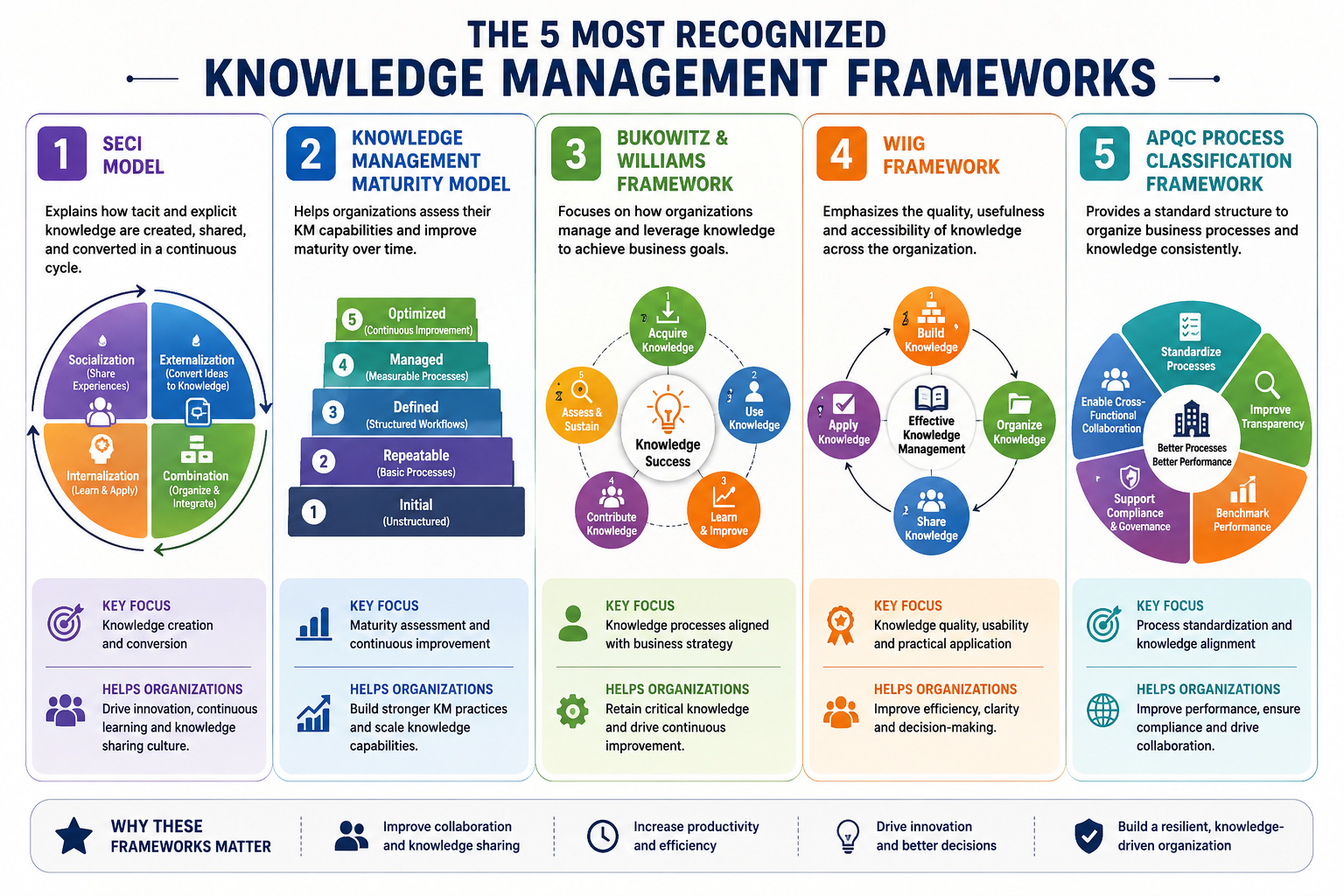
The 5 Most Recognized Knowledge Management Frameworks
#1. The SECI Knowledge Management Model
The SECI Model, developed by Ikujiro Nonaka and Hirotaka Takeuchi, is one of the most influential knowledge management frameworks.
It focuses on how tacit knowledge and explicit knowledge are continuously converted and shared throughout an organization.
The framework includes four stages:
- Socialization — sharing experiences and tacit knowledge
- Externalization — converting ideas into documented knowledge
- Combination — organizing and integrating knowledge sources
- Internalization — learning and applying knowledge practically
This model is commonly used in innovation-driven businesses where collaboration and continuous learning are essential.
#2. The Knowledge Management Maturity Model (KMMM)
The Knowledge Management Maturity Model helps organizations measure how advanced their knowledge management processes are. Businesses use this framework to identify weaknesses, improve workflows, and gradually build a more mature knowledge-sharing culture.
The framework typically moves through stages such as:
- Initial or unstructured knowledge management
- Repeatable processes
- Defined knowledge workflows
- Managed and measurable systems
- Optimized knowledge-driven operations
Large enterprises often use this model when scaling digital transformation and enterprise collaboration initiatives.
#3. The Bukowitz and Williams Framework
The Bukowitz and Williams Knowledge Management Framework focuses on aligning organizational knowledge with business strategy and operational goals. It emphasizes both daily knowledge usage and long-term knowledge sustainability.
The framework is divided into tactical and strategic activities, including:
- Acquiring knowledge
- Using knowledge effectively
- Learning from experiences
- Contributing knowledge back into the organization
- Assessing and maintaining valuable business knowledge
This model works well for organizations focused on continuous improvement and knowledge retention.
#4. The Wiig Knowledge Management Framework
Created by Karl Wiig, the Wiig Framework focuses on ensuring knowledge is organized, useful, and accessible for employees across the business. The framework prioritizes knowledge quality and usability rather than simply storing information.
Core principles include:
- Building knowledge systematically
- Organizing information logically
- Sharing knowledge efficiently
- Applying knowledge to improve decision-making
Many businesses adopt this framework to improve operational efficiency and reduce information overload.
#5. The APQC Process Classification Framework
The APQC framework is widely used by enterprises to standardize business processes and improve organizational knowledge management. It helps businesses classify operational knowledge into structured categories that are easier to manage and optimize.
Organizations use this framework to:
- Standardize workflows and documentation
- Improve process transparency
- Support compliance and governance
- Benchmark operational performance
- Improve cross-functional collaboration
It is particularly popular among large enterprises managing complex operations, compliance requirements, and global teams.
The Biggest Problems Caused by Knowledge Silos
Knowledge silos happen when information stays trapped inside departments, teams, or individual employees instead of being shared across the business.
Over time, these silos create major operational problems that slow growth, reduce productivity, and damage collaboration across the organization.
Some of the biggest problems caused by knowledge silos include:
- Employees wasting time searching for documents, answers, or internal expertise
- Teams duplicating work because they cannot access existing knowledge or past projects
- Poor communication between departments leading to delays and confusion
- Inconsistent customer experiences due to disconnected information and processes
- Increased onboarding time for new employees who struggle to find accurate information
- Critical business knowledge being lost when employees leave the company
- Slower decision-making caused by incomplete or outdated information
- Reduced innovation because teams are unable to collaborate effectively or share ideas
In remote and hybrid workplaces, knowledge silos become even more damaging, making centralized communication, collaboration, and knowledge management systems essential for long-term business success.
Management Framework & Methodology

Knowledge Management Framework
A knowledge management framework is a structure that guides the organization, understanding, delivery and dissemination of information within the enterprise.
This type of framework makes sure that all the elements of knowledge management are in place and connected with each other. It also ensures there are no gaps in the system and the information flows freely throughout the organization.
The basic components of a knowledge management framework include:
- -Identification of requirements
- -Identification of resources
- -Creation of knowledge related processes
- -Application and distribution of knowledge
- -Storage of knowledge
All these processes are dependent on each other and several other factors.
This is why knowledge management frameworks are often different in many respects and can be implemented in numerous ways.
Some models may be sequential while others display processes as an overlapping pattern. As knowledge management depends on other aspects of the organization like project management, information management and strategy and includes a variety of systems and processes, a model can be complex at times.
Knowledge Management Framework Template

Knowledge Management Framework Template
A knowledge management framework is represented as a model that contains proper planning for the components – data, people, technology and processes. It should include the role descriptions, technology functions and process descriptions wherever possible.
The elements should not only work together but also collaborate with the existing systems, technologies, infrastructures within the company. This is why each organization has a knowledge management framework tailored to its own context.
Building Knowledge Management Into The Strategic Framework

Building Knowledge Management Into The Strategic Framework
A knowledge management framework helps focus on the business value of knowledge management efforts. The structure should have in place the direction, management and execution of the framework for successful implementation.
When building knowledge management into a strategic framework, as noted by strategist Wendy Su, one should ensure that all its components are covered, and all the interlinked items are in place to work efficiently.
The structure should include planning for people, processes, data and technology. The first phase of the framework is 'Call to Action' that helps identify the business value and the area of emphasis. An organization should create a framework centred around its business goals.
The framework is built as a matrix with and a knowledge management model is put in place for each axis of the matrix. Here are the key steps involved in building knowledge management into the organization's strategic framework.
Knowledge Mapping

Knowledge Mapping
The first step is to create a detailed map of the available knowledge with a co-relation of knowledge items with explicit knowledge across the organization.
Knowledge mapping helps define current knowledge items, owners and gaps. It allows evaluating existing knowledge and identifying what knowledge assets should be obtained, improved or preserved.
Knowledge Elicitation
A well-designed knowledge map is essential for the organization to elicit knowledge easily. It can achieve this with the help of automated workflows that fill knowledge gaps and manage searches for knowledge.
The use of corporate discussion boards helps analyse knowledge absorption within the system. The company should also have a shareable knowledge management system that helps extract useful information or knowledge assets from different systems including CRM, ERP and SCM.
Knowledge Assessment
The company should use tools to make knowledge available explicitly throughout the company with intuitive creation of assets, rating and comparison of knowledge items and their classification.
Knowledge Distribution
An organization should put in place some push and pull modes for the dissemination of knowledge across departments dynamically. Externalized knowledge can be distributed through intelligent filters that allow instant discovery of knowledge terms and assets.
Another example of this mode is automatic subscriptions to the latest updates for knowledge-related items. Some handy tools for knowledge distribution through push mode include training courses, workshops and articles integrated into the intranet.
Knowledge Maintenance
The framework should help attend the company's knowledge assets and fill any gaps existing in the knowledge map. It allows regular checking on the relevance and removal of knowledge items and assets and their updating.
ITIL Knowledge Management Framework
The ITIL (Information Technology Infrastructure Library) is a widely used framework among organizations aiming to provide IT service management. It emphasizes customer satisfaction through effective service delivery in a cost-effective manner.
Knowledge management is one of the components of the service transition phase of this framework and focuses on gathering, analysing, storing and sharing information and knowledge.
The knowledge management framework was added to version 3 of ITIL as a part of the process that addresses the development and execution of new and changed services.
This dedicated process for knowledge management enables ITIL to provide a comprehensive set of guidelines and workflow for knowledge in the life cycle of IT service management. ITIL also integrates the framework with Problem Management, Incident Management and Interaction Management aspects of the system.
ITIL knowledge management framework aims to enable the organization to access, update and distribute knowledge related to the ITSM life cycle.
It allows for better handling of knowledge, reduces the chances that stakeholders try to solve problems on their own without sharing knowledge and gives the ability to control access to critical information within the organization.
Why Businesses Benefit From a Knowledge Management Framework
A well-designed knowledge management framework helps businesses organize, capture, and distribute information more effectively across the organization.
Instead of knowledge being scattered across emails, chats, spreadsheets, and individual employees, teams gain a centralized system that improves communication, productivity, and long-term operational stability.
Key advantages of implementing a knowledge management strategy include:
- Stronger collaboration and knowledge sharing between departments and teams
- Faster access to company information, procedures, and internal expertise
- Better business decisions based on accurate, up-to-date knowledge
- Increased workplace productivity by reducing time wasted searching for information
- More consistent customer support through easy access to policies, answers, and documentation
- Reduced risk of losing valuable knowledge when employees resign or retire
- Improved compliance, governance, and documentation management
- Greater innovation as employees can build on shared ideas and existing knowledge
- Faster onboarding and employee training with centralized learning resources
- Improved business agility and competitiveness in rapidly changing markets
Organizations that invest in knowledge management systems are often better equipped to scale operations, improve employee experience, and respond quickly to business challenges.
Common Mistakes Businesses Make When Implementing a Knowledge Management Framework
Failing to Create a Centralized Knowledge Hub
One of the most common mistakes is allowing information to remain scattered across emails, shared drives, messaging apps, and employee desktops.
When businesses fail to centralize company knowledge, employees struggle to locate accurate information quickly, leading to wasted time and duplicated work.
For example, a remote marketing team may store campaign documents in Google Drive, Slack, email threads, and personal folders, making it difficult for new employees to find the latest approved assets.
Key problems this creates include:
- Duplicate documents and outdated information
- Employees relying on tribal knowledge
- Slower onboarding processes
- Increased confusion between departments
- Reduced collaboration across teams
Ignoring Employee Adoption and Training
Many organizations invest in knowledge management software but fail to train employees properly or explain why the system matters. As a result, staff continue using old habits, spreadsheets, private chats, or disconnected tools instead of the new platform.
For example, a company may launch a new intranet system, but employees continue asking questions in email chains because they never learned how to search the knowledge base effectively.
Common signs of poor adoption include:
- Low employee engagement with the platform
- Incomplete or outdated documentation
- Teams bypassing the system entirely
- Employees resisting process changes
- Knowledge becoming fragmented again
Allowing Content to Become Outdated
A knowledge management framework quickly loses value when information is not reviewed and updated regularly.
Outdated policies, expired procedures, or inaccurate documentation can create operational risks and reduce employee trust in the system.
For instance, HR documentation may still reference old remote work policies or outdated compliance procedures years after company changes were introduced. Employees then follow incorrect guidance, creating confusion and inconsistency.
This often results in:
- Employees accessing inaccurate information
- Compliance and governance risks
- Repeated support questions
- Poor employee confidence in documentation
- Operational inefficiencies across teams
Focusing Too Much on Technology Instead of Processes
Some businesses believe purchasing knowledge management software alone will solve communication and collaboration problems. In reality, successful knowledge management also requires clear workflows, ownership, governance, and content standards.
For example, a company may deploy an expensive collaboration platform but never define who is responsible for updating policies, approving documentation, or organizing information. Over time, the system becomes cluttered and difficult to use.
This mistake usually leads to:
- Poorly structured information architecture
- Lack of accountability for content updates
- Duplicate or irrelevant documents
- Low user trust in the system
- Decreased long-term adoption rates
Restricting Knowledge Access Between Departments
Knowledge silos remain one of the biggest barriers to successful knowledge management. When departments control information separately, collaboration slows and employees struggle to access the insights they need.
For example, customer support teams may not have visibility into product development updates, causing inconsistent communication with customers and delayed issue resolution.
Typical consequences include:
- Slower decision-making processes
- Reduced cross-team collaboration
- Inconsistent customer experiences
- Duplicate work across departments
- Missed opportunities for innovation
Turn Company Knowledge Into a Competitive Advantage with AgilityPortal
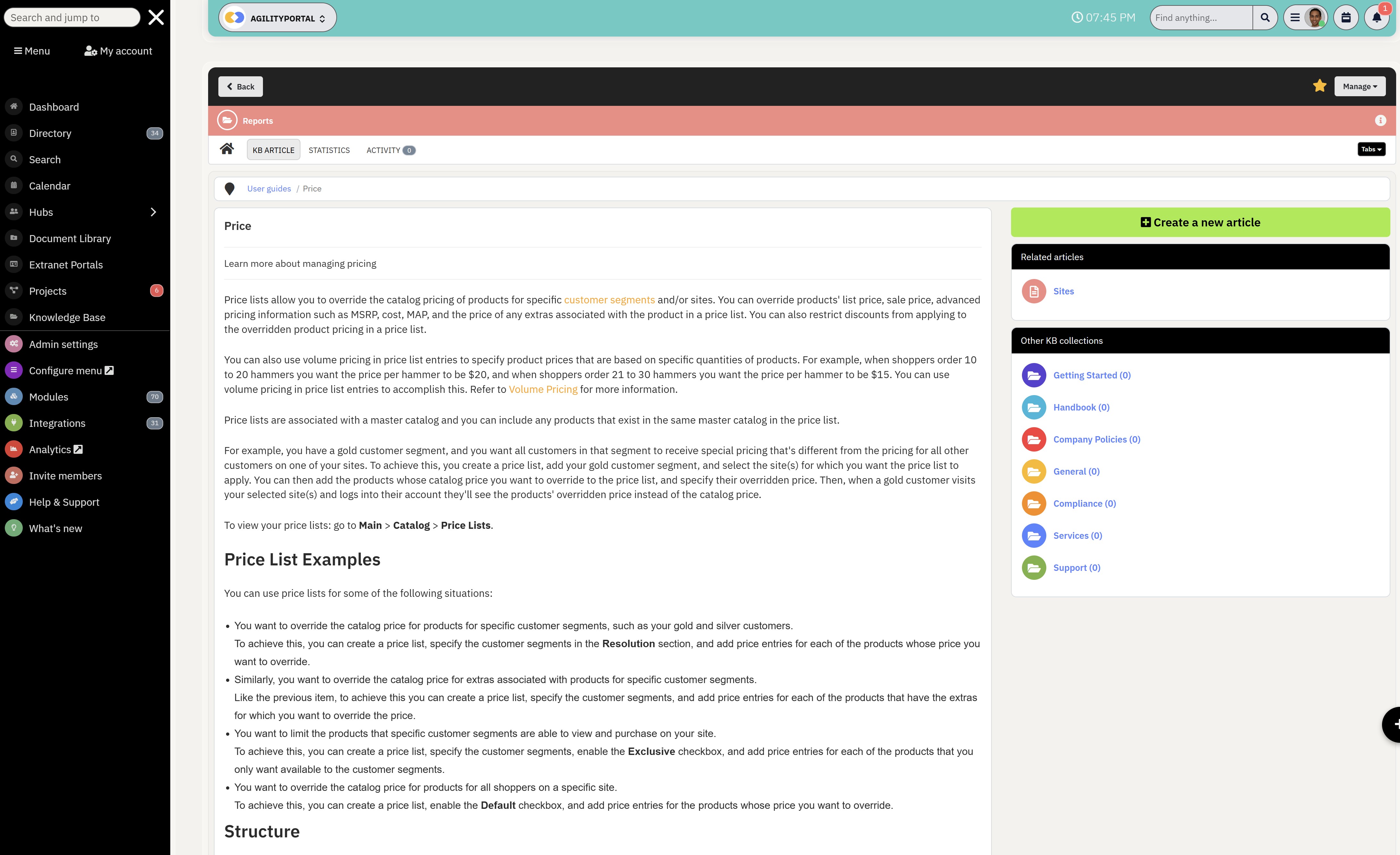
Turn Company Knowledge Into a Competitive Advantage with AgilityPortal
Most businesses are drowning in scattered information. Important knowledge lives inside emails, chat threads, spreadsheets, disconnected tools, and employee heads. When teams cannot quickly access the right information, productivity drops, collaboration suffers, and valuable expertise gets lost.
That's where AgilityPortal changes everything.
AgilityPortal provides a modern, centralized Knowledge Base designed to help organizations capture, organize, and share critical business knowledge in one secure digital workplace platform.
With AgilityPortal's Knowledge Base, your teams can:
- Create structured company documentation, SOPs, policies, and training materials
- Build searchable internal wikis and knowledge libraries
- Reduce repetitive employee questions and support requests
- Improve onboarding with centralized learning resources
- Keep remote and hybrid teams aligned with real-time access to information
- Protect valuable institutional knowledge from employee turnover
- Collaborate across departments without information silos
- Access knowledge from desktop or mobile devices anywhere
Unlike traditional document storage systems, AgilityPortal combines knowledge management, communication, collaboration, and employee engagement into a single connected platform. Employees no longer waste time searching across disconnected tools to find answers.
Whether you are managing frontline workers, hybrid teams, global employees, or growing departments, AgilityPortal helps businesses improve productivity, streamline operations, and create a stronger knowledge-sharing culture.
If your organization is ready to eliminate knowledge silos and build a smarter digital workplace, AgilityPortal provides the tools to make it happen.
```
Final Thoughts
Building an effective knowledge management strategy does not need to happen all at once.
The smartest approach is to begin with the areas where knowledge gaps create the biggest operational risk or productivity challenges. Start by identifying the information, processes, or employee expertise your business could not afford to lose.
Simple first steps often make the biggest impact, such as:
- Encouraging teams to share lessons learned during short weekly knowledge-sharing sessions
- Creating standardized templates for documenting workflows, processes, and decisions
- Capturing frequently asked questions from experienced employees and subject matter experts
- Centralizing important company resources in one searchable location
- Making knowledge sharing part of everyday workflows rather than an extra task
Avoid trying to document everything immediately. Focus on high-value knowledge that improves collaboration, decision-making, onboarding, and operational efficiency.
The goal is not to create a massive document archive, but to ensure employees can easily access the information they need to perform effectively.
Most importantly, knowledge management should become an ongoing business practice, not a one-time project. Organizations that consistently maintain and improve their knowledge-sharing culture are far better positioned to scale, innovate, and retain critical expertise over time.
If your organization is exploring ways to improve internal communication, collaboration, and knowledge sharing, platforms like AgilityPortal can help centralize information, streamline workflows, and make company knowledge more accessible across the business.
AI Summary
- A knowledge management framework helps businesses capture, organize, store, manage, and share organizational knowledge across teams, departments, and digital workplaces.
- Modern enterprise knowledge management strategies are designed to reduce information silos, improve collaboration, retain institutional knowledge, and support faster decision-making across remote and hybrid workforces.
- Businesses use knowledge management systems to centralize documents, SOPs, operational knowledge, employee expertise, onboarding resources, and internal communication into one searchable environment.
- The best knowledge management platforms often include AI-powered enterprise search, document management, workflow automation, collaboration tools, knowledge bases, analytics dashboards, and employee communication capabilities.
- Organizations with strong knowledge-sharing systems often improve operational efficiency, employee onboarding, workforce productivity, and knowledge accessibility across distributed teams.
- Popular knowledge management tools and digital workplace platforms include AgilityPortal, Confluence, Notion, SharePoint, Guru, Document360, Bloomfire, Slab, Zendesk Guide, and Microsoft Viva.
- Before implementing a knowledge management framework, businesses should evaluate scalability, AI search functionality, integrations, employee adoption, security controls, knowledge governance, and long-term operational flexibility.
Most Popular Posts

Effective communication among team members is vital for the productivity and success of any organization. Surprisingly, 60% of companies lack a long-term internal communication strategy, which p...


Businesses thrive on communication for efficiency, productivity and accomplishment. When the right information is passed from the right designation in the organization, it promotes positivity an...
Categories
Blog
(2976)
Business Management
(373)
Employee Engagement
(223)
Digital Transformation
(192)
Growth
(142)
Intranets
(137)
Remote Work
(63)
Sales
(53)
Collaboration
(48)
Customer Experience
(30)
Culture
(29)
Knowledge Management
(28)
Project management
(28)
Leadership
(20)
Comparisons
(9)
News
(1)

Related Posts

The digital workplace has become the foundation of modern business operations. Whether employees work remotely, in the office, or in a hybrid environment, organizations need effective systems that keep people connected, informed, and productive. This...

If you're searching for a Highspot alternative, you're probably evaluating more than just sales enablement features. Today's organizations need platforms that not only help sales teams find content and engage buyers but also support employee co...

This is why many organizations are investing in a modern client and partner portal to create a centralized, secure environment where external users can access documents, collaborate with teams, complete onboarding tasks, receive updates, and find the...

Partner collaboration has become a critical part of business growth, especially for organizations that rely on distributors, resellers, suppliers, affiliates, consultants, and channel partners to generate revenue. Yet surprisingly, many compani...

Most businesses invest heavily in marketing, advertising, social media, and SEO to attract new customers, but many overlook one of their most valuable marketing assets: their employees. That's where employee engagement comes in. Employee engage...


Jill Romford
I am a digital nomad, lover of exploring new places and making friends.
I love to travel and I love the internet. I take pictures of my travels and share them on the internet using Instagram.
Traveler, entrepreneur, and community builder. I share my insights on digital marketing and social media while inspiring you to live your fullest life.
Ready to learn more? 👍
One platform to optimize, manage and track all of your teams. Your new digital workplace is a click away. 🚀
Free for 14 days, no credit card required.