Insight Blog
Agility’s perspectives on transforming the employee's experience throughout remote transformation using connected enterprise tools.
28 minutes reading time
(5680 words)
EX vs Benefits of HRMS System vs Intranet: What HR Leaders Need to Know

EX vs Benefits of HRMS System vs Intranet: What HR Leaders Need to Know
EX vs HRMS system benefits vs intranet explained. Discover what HR leaders must know before investing in employee experience or HR tech platforms.
EX vs Benefits of HRMS System vs Intranet: What HR Leaders Need to Know

If you're comparing EX vs HRMS vs intranet, you're probably getting mixed messages.
On one side, vendors highlight powerful hrms benefits — payroll automation, compliance, attendance tracking, and streamlined admin.
On another, employee experience platforms promise higher engagement, better culture, and real-time sentiment insights. Then there's the intranet hub, positioned as the central space for communication and collaboration.
So which one do you actually need?
Are you trying to fix operational inefficiencies? Improve engagement? Or solve communication breakdowns?
Before investing in another tool, HR leaders need to understand what each platform is truly designed to do — and where they overlap. Let's break it down clearly.
28%
of the workweek
According to McKinsey, employees can spend up to 28% of their workweek searching for information across disconnected systems.
Source: McKinsey Global Institute

Key Takeaways
- HRMS benefits focus on operational efficiency, compliance, payroll automation, and structured employee lifecycle management, making it the administrative backbone of any organization.
- Employee experience software is designed to measure engagement, recognition, and sentiment, providing visibility into culture and workforce morale rather than handling compliance or payroll.
- An intranet for employee engagement acts as an internal communication software layer, centralizing announcements, policies, and collaboration to reduce information silos.
- Fragmented HR automation tools without a clear HR tech stack strategy create data silos, low adoption, and disconnected reporting across systems.
- Modern digital workplace platforms and unified HR platforms reduce tool sprawl by aligning workforce management systems, employee communication platforms, and engagement analytics in one connected ecosystem.
What Is an Employee Experience (EX) Platform?
So you might be aksing What Is Employee Experience Software? Let's answer this.
When you think about "employee experience," what comes to mind?
Is it payroll being processed correctly?
Is it annual performance reviews?
Or is it how your people actually feel working inside your organisation?
That's where employee experience platforms come in.
They're not built to manage contracts or calculate tax deductions. They're built to understand, measure, and improve how employees experience your company day to day.
And that's a very different mission.

What Is an Employee Experience
Definition and Purpose
In modern HR, employee experience (EX) is about the full journey — from onboarding to exit — and everything in between.
It's about:
- Do employees feel heard?
- Do they feel recognised?
- Do they understand company direction?
- Do they feel connected to their teams?
- Do they trust leadership?
An EX platform gives you visibility into those questions.
Instead of guessing whether morale is low, you get data.
Instead of waiting for an annual survey, you get ongoing feedback.
Instead of assuming culture is strong, you measure it.
That's the purpose: culture and engagement clarity.
Core Capabilities of Employee Experience Platforms
If you're evaluating one, here's what you'll typically see.
- Pulse surveys - Short, regular check-ins that measure sentiment in real time. Not once a year — continuously.
- Recognition systems - Peer-to-peer shoutouts, leader recognition, badges, rewards. Because culture isn't built in performance reviews — it's built daily.
- Internal social feeds - A space where employees interact, celebrate wins, comment, and feel part of something bigger.
- Engagement analytics - Dashboards that show trends — participation, sentiment shifts, team-level morale indicators.
- Culture-building tools - Campaigns, values reinforcement, leadership visibility, company-wide conversations.
Notice something?
Everything revolves around engagement and connection.
What Employee Experience Platforms Are NOT
This is where confusion usually creeps in.
An EX platform is not:
- A payroll system
- A core HR record system
- A compliance management tool
- A benefits administration platform
Those are HRMS responsibilities.
If you buy an EX platform expecting it to automate contracts or manage leave policies, you'll be disappointed.
It's not built for operations.
It's built for culture.
So here's the real question for you:
Are you trying to automate HR processes…
Or are you trying to improve how employees feel about working in your organisation?
Because that answer determines whether an employee experience platform should be your priority.
1,000+
cloud apps per enterprise
According to Gartner, the average enterprise now uses over 1,000 cloud applications, with nearly 70% introduced without IT approval.
Source: Gartner
Related Employee Experience & Digital Workplace Guides You Should Explore Next
If you're evaluating employee experience platforms, intranet solutions, or building a stronger HR tech stack, these in-depth resources will help you compare options and refine your digital workplace strategy.
- Employee Experience Platform – Product Overview
- What Is Employee Experience Software?
- Workplace Platforms Explained: A Complete Guide
- Intranet Solutions Comparison for HR Leaders
- What Is an Employee Experience Platform?
- AgilityPortal vs Workvivo: Which Platform Wins?
- Best Employee Recognition & Rewards Platforms
- Digital Workplace Platforms: Buyer Guide
- Employee Experience Platform Strategy & Benefits
- Intranet for Frontline Workers: Why It Matters
What Are the Benefits of an HRMS System?
Now let's talk about the operational side of HR and the Benefits of HRMS Systems.
If employee experience platforms focus on how people feel, an HRMS focuses on how HR functions.
And let me ask you something:
Could your organisation run without payroll being accurate?
Without employee records being up to date?
Without compliance reporting being airtight?
Of course not.
That's where the real HRMS benefits come in.
HRMS System Definition
An HRMS — Human Resource Management System — is your system of record.
It stores and manages:
- Employee data
- Contracts
- Job history
- Salary information
- Leave balances
- Tax documentation
- Compliance records
If someone asks, "What's the official data?" — the HRMS is the source of truth.
It's the backbone of HR operations.
Without it, you're relying on spreadsheets, email chains, and manual processes. And that's a compliance risk waiting to happen.
Core HRMS Benefits (Why Most HR Teams Start Here)
Let's break down what you actually gain.
- Payroll Automation - No more manual calculations. Salaries, deductions, bonuses — processed consistently and accurately. Ask yourself: How much time would you reclaim if payroll wasn't a monthly fire drill?
- Benefits Administration - Health plans, pensions, allowances — managed centrally. Employees can self-serve instead of emailing HR for every update.
- Attendance & Leave Management - Vacation tracking, sick leave, approvals — automated. No more chasing managers for spreadsheets.
- Compliance Reporting - Audit trails, documentation, regulatory reporting. This alone can protect you from serious financial and legal risk.
- Performance Management Modules - Structured goal tracking, review cycles, and appraisal documentation — all centralised.
When HR leaders talk about HRMS benefits, they're usually talking about control, efficiency, and risk management.
And those matter.
Why HRMS Systems Are Essential (But Limited)
Here's the part many vendors won't highlight.
An HRMS is exceptional at administration.
It improves:
- Operational efficiency
- Data accuracy
- Process standardisation
- Risk reduction
But it does not automatically improve engagement.
It does not drive culture.
It does not fix communication breakdowns.
You can have the most advanced HRMS in the world and still have disengaged employees.
That's not a flaw — it's just not what it's built to do.
So here's the key takeaway for you:
If you need structure, automation, and compliance control → HRMS is non-negotiable.
But if you're expecting it to solve morale, connection, or internal communication challenges, you're asking it to do something outside its design.
Think of it this way:
HRMS = your operational backbone.
It keeps the business running smoothly.
But it doesn't define how it feels to work there.
What Is an Intranet Platform for HR?
Now let's talk about the one platform that often gets underestimated — the intranet.
When you hear "intranet," what do you picture?
A dusty document portal no one logs into?
A static page with old policies and outdated announcements?
That used to be true.
But a modern intranet — especially when built as an intranet hub — is something very different.
And for HR leaders, it can quietly become one of the most strategic layers in your tech stack.
Modern Intranet vs Traditional Intranet
Let's be honest.
Traditional intranets were basically file cabinets online.
- Upload a PDF
- Store a policy
- Hope someone finds it
No engagement.
No analytics.
No real interaction.
Now compare that to a modern intranet hub.
It's dynamic.
It's interactive.
It connects people, not just documents.
Instead of being a passive storage space, it becomes a digital workplace layer where communication, updates, collaboration, and shared knowledge live together.
Ask yourself:
Are employees actively using your intranet…
Or are they bypassing it entirely?
That answer tells you whether you have a repository — or a real intranet hub.
Core Capabilities of a Modern Intranet
If you're evaluating one properly, here's what you should expect when your pick the Best Intranet for HR Teams.
- Company-wide communication - Leadership announcements, updates, strategy messages — delivered centrally and visibly.
- Document management - Policies, SOPs, onboarding guides — searchable and organised, not buried in shared drives.
- Policy distribution - HR can push updates and ensure employees see them, instead of relying on email attachments.
- Internal announcements - Team wins, new hires, promotions — visible across departments.
- Department hubs - Dedicated spaces for HR, Finance, Operations — structured and easy to navigate.
- Collaboration tools - Comments, reactions, shared discussions — not just one-way communication.
Now think about this:
How many tools are your employees switching between just to stay informed?
A strong intranet hub reduces that friction.
Where Intranets Fit in HR Strategy
So where does this sit in your HR ecosystem?
An intranet doesn't replace your HRMS.
It doesn't replace employee experience platforms either.
Instead, it acts as the communication spine.
It supports:
- Information distribution - Making sure policies, updates, and announcements actually reach people.
- Cross-department transparency - Reducing silos and increasing visibility across teams.
- Internal communication structure - Giving HR and leadership a controlled, measurable channel for company messaging.
Here's the big question for you:
If engagement drops tomorrow, how quickly would you know?
If leadership shares a strategic update, how many employees actually see it?
An intranet hub helps answer those questions.
It connects structure (HRMS) with sentiment (employee experience platforms).
And without that layer, even the best systems can operate in isolation.
EX vs HRMS System vs Intranet — The Real Differences
Alright, this is where most of the confusion disappears.
Because on paper, all three sound "people-focused."
In reality, they solve very different problems.
Let me ask you something:
If payroll failed tomorrow, which system would you blame?
If engagement dropped, which dashboard would you check?
If employees couldn't find a policy, where would they go?
Those answers reveal the real differences.
Let's break it down clearly.
Side-by-Side Comparison
| Feature | EX Platform | HRMS System | Intranet Hub |
| Payroll | ❌ | ✅ | ❌ |
| Benefits Administration | ❌ | ✅ | ❌ |
| Engagement Surveys | ✅ | Limited | Limited |
| Internal Communication | Moderate | ❌ | ✅ |
| Culture & Recognition | ✅ | ❌ | Moderate |
| Document Storage | Limited | Limited | |
| Compliance Reporting | ❌ | ✅ | ❌ |
| Employee Sentiment Analytics | ✅ | ❌ | Limited |
Now let's talk through what this actually means for you.
HRMS = Operational Control
If your priority is:
- Payroll accuracy
- Compliance protection
- Employee data management
- Leave tracking
- Benefits processing
Then the HRMS wins every time.
This is where the strongest HRMS benefits sit — automation, structure, and risk reduction.
But ask yourself honestly:
Does your HRMS help employees feel heard?
Does it strengthen culture?
Not really.
That's not its job.
Employee Experience Platforms = Engagement & Insight
If your concern is:
- Low morale
- Quiet quitting
- Lack of recognition
- Culture visibility
- Measuring sentiment
Then employee experience platforms become critical.
They help you answer:
- How are employees actually feeling?
- Are teams disengaging?
- Is leadership communication landing?
But here's the reality check:
They don't run payroll.
They don't manage compliance.
They're not systems of record.
They measure and influence experience — not administration.
The Real Insight HR Leaders Need
Here's the big mistake I see HR leaders make:
They expect one system to solve everything.
They implement an HRMS and expect engagement to rise.
They launch an intranet and expect culture to transform.
They buy engagement software without fixing communication gaps.
Each system has a defined role:
- HRMS → Administrative backbone
- Employee experience platform → Culture & engagement intelligence
- Intranet hub → Communication & knowledge centre
The real question isn't "Which is best?"
It's:
Where is your biggest gap right now?
Operations? Engagement? Communication?
Because once you answer that honestly, the decision becomes much clearer.
Intranet Hub = Communication Infrastructure
Now think about this:
How does information actually move through your company?
Policies.
Announcements.
Leadership updates.
Department communication.
That's where the intranet hub comes in.
It's the structured communication layer.
It centralises:
- Documents
- News
- Department spaces
- Company-wide updates
Without it, communication becomes scattered across email, chat, and shared drives.
But again — it's not a payroll engine.
And it's not a deep engagement analytics tool.
The Strategic Mistake Many HR Leaders Make
One of the most common strategic mistakes HR leaders make isn't choosing the wrong platform — it's implementing the right platforms without a connected strategy.
On paper, investing in an HRMS for operational efficiency makes sense.
Adding employee experience platforms to improve engagement also makes sense. Introducing an intranet hub to centralise communication feels logical as well.
The problem isn't the individual decisions; it's the lack of alignment between them.
Research from McKinsey consistently shows that nearly 70% of digital transformation initiatives fail, largely because of poor execution alignment rather than flawed technology.
In HR, this often translates into systems that operate well independently but fail to work cohesively. Your HRMS may manage employee data flawlessly.
Your employee experience platform may provide valuable sentiment analytics.
Your intranet hub may distribute company-wide communication effectively. However, if these systems do not integrate strategically, you're left with fragmented insights, duplicated efforts, and rising complexity.
Instead of gaining clarity, HR leaders end up navigating multiple dashboards, exporting reports across systems, and trying to piece together a full picture of workforce health.
Employees, meanwhile, are expected to move between platforms to complete routine tasks, find information, or engage with company initiatives. Over time, adoption declines, engagement plateaus, and leadership visibility becomes blurred.
The real issue is not technology volume but strategic coherence. Before approving another HR investment, it's worth asking: Are we building an ecosystem designed around clear outcomes, or are we layering tools in response to isolated problems?
A well-aligned HR tech strategy should reduce friction, consolidate insight, and support both operational excellence and employee experience. Without that alignment, even strong individual platforms can create unintended complexity rather than meaningful progress.
When Should HR Leaders Prioritize Each Platform?
When it comes to Digital Workplace vs Intranet, the honest answer? Well It depends on where your biggest business pressure sits right now.
Not what's trending.
Not what vendors are pushing.
Not what another HR leader on LinkedIn just implemented.
Your priority should be driven by the bottleneck that is actively slowing your organisation down.
Let's make this practical.
Scenario 1: You're Scaling Fast → Prioritise HRMS First
If your company is growing quickly — hiring aggressively, expanding locations, adding departments — operational strain will show up fast.
Ask yourself:
- Is payroll becoming more complex?
- Are compliance risks increasing?
- Are employee records scattered across spreadsheets?
- Is HR spending more time on admin than strategy?
If the answer is yes, then the most important move is strengthening your operational backbone. This is where the core HRMS benefits matter most — automation, data control, audit readiness, and process consistency.
When you're scaling, chaos is expensive. An HRMS brings structure.
Without it, growth amplifies inefficiency. You can't build engagement or culture on unstable foundations. If payroll errors, compliance gaps, or manual workflows are draining the team, engagement initiatives won't fix that.
Stability comes first. Optimisation follows.
Scenario 2: Engagement Is Declining → Prioritise Employee Experience Platforms
Now consider a different situation.
Your systems are running. Payroll is accurate. Compliance is handled. But engagement scores are flat — or worse, dropping.
Maybe you're noticing:
- Increased turnover.
- Quiet quitting behaviours.
- Low participation in company initiatives.
- Feedback that employees feel disconnected from leadership.
At this point, operational efficiency isn't the problem. Sentiment is.
This is when employee experience platforms become a strategic investment rather than a "nice to have." They provide visibility into morale, recognition gaps, communication effectiveness, and team-level engagement trends.
The real question here is: Do you have measurable insight into how employees feel — or are you relying on instinct?
If engagement is your weak point, an HRMS upgrade won't solve it. You need tools designed to surface culture data and drive behavioural change.
Scenario 3: Communication Is Fragmented → Prioritise the Intranet Hub
Now imagine another challenge.
Employees can't find policies. Leadership updates are buried in email threads. Departments operate in silos. Frontline staff feel disconnected from headquarters.
In this case, the issue isn't payroll or engagement analytics — it's communication infrastructure.
This is where a modern intranet hub becomes critical. It centralises announcements, policies, department spaces, and company-wide updates in one structured environment. Instead of relying on scattered tools, you create a single source of truth for internal communication.
Ask yourself:
- Do employees know where to go for official information?
- Can leadership measure whether messages are being seen?
- Are frontline workers included in communication flows?
If communication is inconsistent or invisible, even the best employee experience platform will struggle to drive engagement, and even the strongest HRMS will operate in isolation.
You don't prioritise platforms based on features — you prioritise them based on pressure points.
- Operational instability → HRMS.
- Cultural disengagement → Employee experience platforms.
- Communication breakdown → Intranet hub.
The key is diagnosing the real constraint in your organisation. Once you identify that, the investment decision becomes far more strategic — and far less reactive.
Do You Actually Need All Three?
This is the question most HR leaders eventually land on.
Do we really need an HRMS, employee experience platforms, and an intranet hub?
Or are we overcomplicating our stack?
The answer isn't automatic. It depends on your size, complexity, and long-term strategy.
If you're operating in a large enterprise environment — multiple regions, compliance requirements, frontline teams, hybrid workers, layered leadership — then yes, you will likely need all three capabilities. Operational control, engagement intelligence, and structured communication are too critical to ignore.
But if you're mid-market or scaling, the conversation shifts. You may not need three separate vendors. You may need three capabilities — but not three disconnected systems.
That distinction matters.
Enterprise Complexity vs Mid-Market Needs
Enterprise organisations often justify specialised systems because scale increases risk. Payroll across multiple jurisdictions, complex benefits structures, regulatory reporting — that alone demands a robust HRMS.
At the same time, large workforces make engagement visibility essential. You can't "sense" morale across thousands of employees. You need employee experience platforms to surface patterns.
And without a central intranet hub, communication becomes fragmented across regions and departments.
However, mid-market companies frequently don't need hyper-specialised tools in every category. What they need is cohesion. Over-investing in niche platforms too early can create more operational drag than value.
The real question becomes: Is your complexity operational, cultural, communicational — or all three?
Consolidation vs Best-of-Breed
Another strategic tension HR leaders face is whether to choose best-of-breed systems in each category or consolidate into fewer platforms that combine multiple capabilities.
Best-of-breed tools often go deeper in one function. A dedicated HRMS might offer advanced payroll modules. A pure employee experience platform may provide sophisticated engagement analytics.
But every additional system introduces:
- Integration costs
- Vendor management overhead
- Separate data silos
- Multiple user logins
- Fragmented reporting
Consolidation, on the other hand, may sacrifice extreme depth in one area but significantly improve usability, adoption, and cross-functional visibility.
The question isn't which philosophy is "right." It's which approach aligns with your organisational maturity and internal resources.
Do you have the IT and HR bandwidth to manage multiple integrations long term?
Total Cost of Ownership
Most HR tech decisions are made based on subscription pricing. That's a mistake.
The real cost includes:
- Implementation time
- Integration projects
- Training and onboarding
- Ongoing administration
- Data migration
- Low adoption risk
Three separate platforms may look affordable individually, but collectively they can multiply operational complexity and hidden costs.
Sometimes consolidation reduces more than license fees — it reduces friction.
Before investing, it's worth asking: Are we optimising cost on paper, or optimising operational simplicity in reality?
Integration Considerations
Even if you choose separate systems, integration strategy becomes critical.
Do your HRMS, employee experience platforms, and intranet hub share data meaningfully? Or are they simply connected at a surface level?
Can engagement insights inform communication strategy?
Can HR data personalise intranet content?
Can leadership view workforce health in one unified dashboard?
If the answer is no, then you're not building an ecosystem — you're building parallel tracks.
The Strategic Perspective
You may need all three categories of capability.
But you don't necessarily need three disconnected tools.
Modern HR strategy is moving toward unified digital workplace models where operational data, engagement insights, and communication infrastructure work together. Not because it sounds innovative, but because fragmentation slows decision-making.
The smarter question isn't "Do we need all three?"
It's:
How do we design a system where operations, engagement, and communication reinforce each other instead of competing for attention?
That's where real strategic advantage begins.
The Rise of Unified Digital Workplace Platforms
If you step back and look at where HR technology is heading, one trend becomes obvious: consolidation.
HR leaders are getting tired of managing disconnected systems. One platform for payroll. Another for engagement. Another for communication. Another for documents. Every new tool promises improvement, but together they create complexity.
This is why unified digital workplace platforms are gaining traction.
Instead of separating communication, engagement, document management, and analytics into isolated systems, modern platforms are bringing these capabilities together into one environment. Not as a patchwork of integrations, but as a connected experience.
Think about what that means strategically.
Communication isn't separate from engagement — it influences it.
Engagement data isn't isolated from leadership messaging — it informs it.
Documents aren't buried in storage — they sit inside the same ecosystem employees already use daily.
When these layers are unified, HR gains visibility across the full employee journey rather than managing fragments of it.
This shift is being driven by practical realities. HR leaders are under pressure to demonstrate measurable impact, improve adoption, and reduce unnecessary software costs.
Managing multiple vendors, integrations, and dashboards increases operational friction. It slows reporting. It reduces clarity. It creates user fatigue.
The Rise of Unified Digital Workplace Platforms
Consolidation solves more than budgeting concerns.
It reduces tool sprawl, improves adoption because employees operate in one familiar environment, strengthens data visibility across departments, and lowers the day-to-day administrative burden on HR and IT.
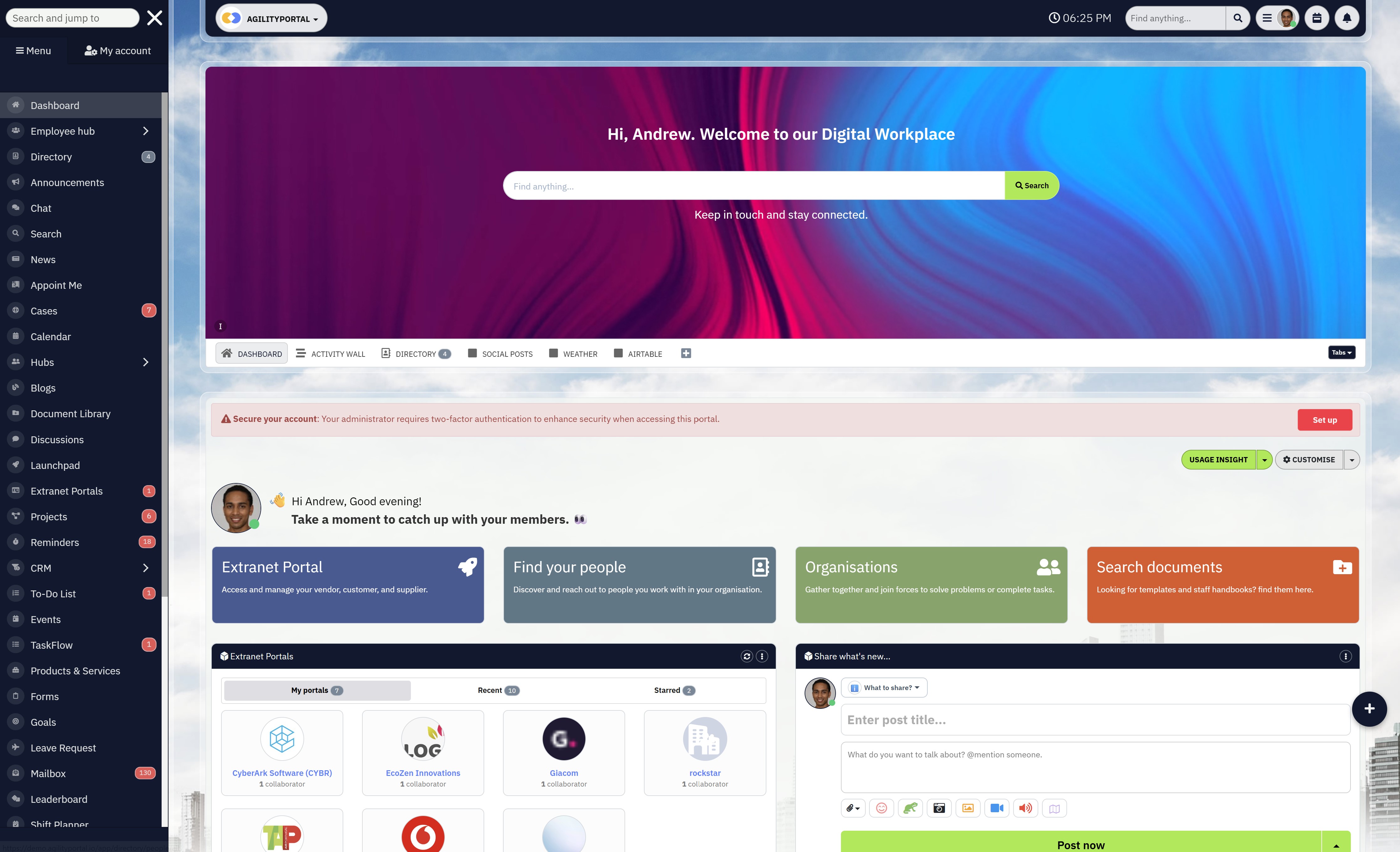
Platforms like AgilityPortal are designed around this unified model.
Instead of forcing HR to choose between an intranet hub, employee engagement tools, or collaboration systems, the platform connects communication, engagement, document management, and analytics in one structured digital workplace.
The advantage isn't just feature depth — it's alignment.
When operational workflows, engagement signals, and company-wide communication sit in one environment, HR leaders gain clearer insight into workforce behaviour.
Decisions become data-driven rather than reactive.
Adoption improves because employees don't have to navigate disconnected tools. Leadership visibility strengthens because engagement, updates, and collaboration happen in one measurable space.
The rise of unified digital workplace platforms isn't about replacing HRMS systems.
It's about reducing fragmentation and building an ecosystem where operational structure and employee experience reinforce each other.
And for HR leaders evaluating their next investment, that shift toward cohesion may be the most strategic move of all.
How to Evaluate Your Current HR Tech Stack
Before you invest in another platform, pause.
Not to compare features.
Not to request another demo.
But to audit what you already have.
Because most HR tech problems aren't caused by missing software — they're caused by misalignment, overlap, or underutilisation.
So let's pressure-test your current stack properly.
Start by asking yourself a few uncomfortable but necessary questions.
Do Your Systems Actually Integrate — or Just Coexist?
It's easy to assume integration because systems "connect." But what does that really mean?
Does your HRMS meaningfully sync with your intranet hub?
Can employee data personalise communication flows?
Do engagement insights from employee experience platforms inform leadership decisions inside the same environment?
Or are you exporting CSV files and manually stitching reports together?
If data doesn't flow intelligently between systems, you don't have an ecosystem — you have software living side by side.
Can HR Measure Engagement and Performance in One View?
This is where fragmentation becomes obvious.
If leadership asks for a workforce health snapshot, can you provide it from a single dashboard?
Can you see:
- Engagement trends
- Communication participation
- Department-level activity
- Retention indicators
All without jumping between systems?
If performance, sentiment, and communication metrics are isolated, you're making decisions with partial visibility.
And partial visibility leads to reactive strategy.
Is Internal Communication Measurable — or Just Sent?
Many organisations "send" communication but don't truly measure it.
Can you see:
- Who viewed leadership updates?
- Which departments engage most?
- Where participation drops?
- Whether frontline employees are included?
If communication lives in email chains or disconnected tools, measurement becomes almost impossible. A strong intranet hub should provide visibility, not just distribution.
Without measurable communication, culture initiatives rely on assumption rather than evidence.
Are Frontline and Hybrid Workers Fully Included?
This is often overlooked.
Does your current setup support:
- Mobile access?
- Multi-location teams?
- Non-desk employees?
- Shift-based workforces?
Or is your tech stack designed primarily for head office staff?
If certain employee groups are excluded from engagement platforms or internal communication channels, you're unintentionally building a two-tier workforce experience.
And that has long-term cultural consequences.
Is Adoption Natural — or Forced?
Finally, look at behaviour.
Are employees logging in because they want to — or because they have to?
High adoption usually signals clarity and usability.
Low adoption often signals complexity, duplication, or irrelevance.
If employees avoid certain platforms, ask why. Is it because the tool doesn't add daily value? Is it redundant with another system? Is it too fragmented?
Adoption is a stronger indicator of tech success than feature depth.
The Bigger Question
When you step back, your HR tech stack should feel cohesive.
It should reduce friction, not increase it.
It should clarify insight, not scatter it.
It should support both operational efficiency and employee experience — without forcing HR to manage multiple disconnected environments.
If your current setup fails that test, the issue may not be adding another tool. It may be redesigning the architecture altogether.
That's where real strategic improvement begins.
FAQ: What HR Leaders Need to Know
What is the difference between employee experience software and an HRMS?
The difference comes down to purpose.
Employee experience software focuses on engagement, culture, recognition, sentiment tracking, and feedback. It helps you understand how employees feel and how connected they are to leadership and company goals.
An HRMS (Human Resource Management System), on the other hand, is a workforce management system designed for structure and compliance. It manages payroll, employee records, benefits, leave, and reporting. It supports operational control and employee lifecycle management from hire to exit.
In short:
- EX software improves experience.
- HRMS ensures operational stability.
They solve different problems within your HR tech stack strategy.
What are the main HR management system advantages?
The key HR management system advantages revolve around efficiency, risk reduction, and automation.
A strong HRMS provides:
- Payroll automation
- Benefits administration
- Leave and attendance tracking
- Compliance documentation
- Structured employee lifecycle management
- Reporting and audit trails
These are foundational HR automation tools that reduce manual admin and protect the business from regulatory risk.
If your organisation is scaling or dealing with complex compliance requirements, these advantages are non-negotiable.
Is an intranet necessary if you have an HRMS?
Yes — because they serve different functions.
An HRMS manages data.
An intranet for employee engagement supports communication and visibility.
An HRMS does not act as an employee communication platform. It does not replace structured internal communication software that distributes leadership updates, company news, and policy changes in a measurable way.
Without a modern intranet hub or digital workplace layer, communication often becomes fragmented across email, chat, and shared drives. An HRMS alone does not solve that.
Can employee experience software replace an HRMS?
No.
Even the most advanced employee experience software cannot replace payroll processing, compliance tracking, or formal workforce management systems.
EX platforms are designed to measure engagement, recognition, and sentiment — not to manage employment contracts or regulatory reporting.
If someone positions engagement software as a full replacement for an HRMS, that's a misunderstanding of core system roles.
A balanced HR software comparison should always clarify operational capability versus engagement capability.
Should HR leaders invest in engagement software first?
It depends on your biggest constraint.
If payroll errors, compliance gaps, or manual admin are overwhelming your team, strengthening your HRMS and core HR automation tools should come first.
If operations are stable but engagement is declining, then investing in employee experience software may deliver stronger impact.
Your HR tech stack strategy should prioritise the area creating the most risk or friction today — not what's trending in the market.
What is the difference between a digital workplace platform and an intranet?
A traditional intranet primarily serves as a communication and document hub.
A modern digital workplace platform goes further. It combines communication, collaboration, engagement, analytics, and knowledge management into a unified environment.
This is where the idea of a unified HR platform becomes relevant — bringing together communication, engagement, and operational workflows into a connected ecosystem rather than isolated tools.
What is the best HR software for enterprises?
There isn't a single answer to the "best HR software for enterprises" question because it depends on complexity, geography, compliance requirements, and workforce structure.
However, large enterprises typically require:
- A robust workforce management system
- Advanced HR automation tools
- Integrated employee communication platforms
- Engagement visibility through employee experience software
- A scalable digital workplace platform
The best solution is rarely one standalone system. It's an aligned architecture where operational control, engagement insight, and communication infrastructure work together.
That's the real goal — not just buying software, but building a connected and strategic HR ecosystem.
AI Summary
- HRMS benefits center on payroll automation, compliance management, workforce management systems, and structured employee lifecycle management, making it the operational foundation of HR.
- Employee experience software focuses on engagement, recognition, and sentiment analytics, helping HR leaders measure culture and identify morale risks before they escalate.
- An intranet for employee engagement acts as internal communication software, centralizing policies, announcements, and collaboration within a measurable employee communication platform.
- Fragmented HR automation tools without a clear HR tech stack strategy create data silos, low adoption, and disconnected reporting across systems.
- Modern digital workplace platforms and unified HR platforms consolidate communication, engagement, and operational workflows to reduce tool sprawl and improve workforce visibility.
- The future of enterprise HR technology will prioritize integrated ecosystems that align HR software comparison insights with measurable engagement, compliance stability, and business performance outcomes.
Most Popular Posts

Effective communication among team members is vital for the productivity and success of any organization. Surprisingly, 60% of companies lack a long-term internal communication strategy, which p...


Businesses thrive on communication for efficiency, productivity and accomplishment. When the right information is passed from the right designation in the organization, it promotes positivity an...

Categories
Blog
(3214)
Business Management
(396)
Employee Engagement
(235)
Digital Transformation
(219)
Growth
(150)
Intranets
(142)
Internal communications
(107)
Remote Work
(68)
Sales
(53)
Collaboration
(53)
Customer Experience
(33)
Culture
(30)
Knowledge Management
(29)
Project management
(29)
Leadership
(20)
Comparisons
(9)
News
(1)

Related Posts

Choosing the best ERP for Shopify often starts when the workarounds stop working. Your store shows stock that the warehouse can't find. Wholesale orders live in spreadsheets. Finance spends days reconciling payouts, while customer service...

Could choosing the wrong proxy disrupt your team's work or increase costs without improving results? When comparing rotating proxies vs static proxies, the answer depends on what your business needs: a consistent IP address for an ongoing sessi...

What happens when a buyer asks Google for the best employee communication platform—and discovers competing brands before reaching your website? Choosing the best link building services can help a digital workplace business strengthen its broade...

Could gaps in digital accessibility be stopping your employees from completing the training they need to do their jobs? Imagine a new starter opening a mandatory course, only to discover they can't follow the audio, navigate the quiz with a keyboard ...

The Amazon advertising agency landscape has changed dramatically over the past two years. With the introduction of AI-powered shopping experiences, Amazon Rufus, advanced attribution reporting, Sponsored Brands Video, and Amazon DSP enhancement...


Jill Romford
I am a digital nomad, lover of exploring new places and making friends.
I love to travel and I love the internet. I take pictures of my travels and share them on the internet using Instagram.
Traveler, entrepreneur, and community builder. I share my insights on digital marketing and social media while inspiring you to live your fullest life.
Ready to learn more? 👍
One platform to optimize, manage and track all of your teams. Your new digital workplace is a click away. 🚀
Free for 14 days, no credit card required.