
Insight Blog
Agility’s perspectives on transforming the employee's experience throughout remote transformation using connected enterprise tools.
37 minutes reading time
(7467 words)
What Should Be in an Employee Financial Wellness Resource Hub? 12 Must-Have Resources

What Should Be in an Employee Financial Wellness Resource Hub? 12 Must-Have Resources
Building an employee financial wellness resource hub? Discover 12 essential resources that help employees manage money, benefits, debt and financial stress.
What Should Be in an Employee Financial Wellness Resource Hub? 12 Must-Have Resources

Money worries don't simply disappear when someone starts work for the day.
An unexpected bill, rising household costs, debt or uncertainty about retirement can easily follow employees into the workplace, affecting how secure and focused they feel.
That's why an employee financial wellness resource hub can be so useful.
Instead of leaving people to search through old emails, HR documents and different benefits systems, it gives them one trusted place to find financial wellness resources, understand their employee benefits and get help when they need it.
And there's still a clear gap between what employees may need and what employers currently provide.
According to CIPD research, only 15% of UK organisations have a formal financial wellbeing policy or strategy in place.
That suggests many businesses still have plenty of room to make employee financial wellbeing more structured, visible and accessible.
15%
have a formal strategy
According to CIPD research, only 15% of UK organisations have a formal financial wellbeing policy or strategy in place, highlighting a significant gap between recognising employee financial stress and providing structured workplace support.
Source: CIPD
The good news is that creating a useful workplace financial wellbeing hub doesn't have to mean turning HR into a team of financial advisers.
It's about bringing together practical financial education, budgeting tools, pension information, debt support, savings resources and trusted external guidance in a way employees can actually understand and use.
So, what should you include?
In this guide, we'll walk through the essential resources worth adding, how to organise them and how to make sure employees can find the right support when it matters.
Key Takeaways
- An employee financial wellness resource hub gives employees one trusted place to find practical information about pay, budgeting, pensions, savings, debt, benefits and financial support.
- More financial resources do not automatically lead to better financial wellbeing. Information needs to be relevant, easy to understand, searchable and available when employees actually need it.
- A useful hub should cover everyday money management, payslips, workplace pensions, employee benefits, emergency support, savings, debt guidance, financial education and major financial life events.
- Privacy matters because employees may be uncomfortable with their employer knowing they are researching debt, hardship or other financial difficulties. Organisations should clearly explain what administrators can and cannot see.
- Employers can provide financial education and signpost trusted services without trying to give employees personalised financial advice. Where specialist or regulated advice is needed, employees should be directed to appropriate independent support.
- An employee hub such as AgilityPortal can centralise financial wellness resources, benefits information, policies, learning and support links, helping employees find the right information without searching across multiple workplace systems.
What is an employee financial wellness resource hub?
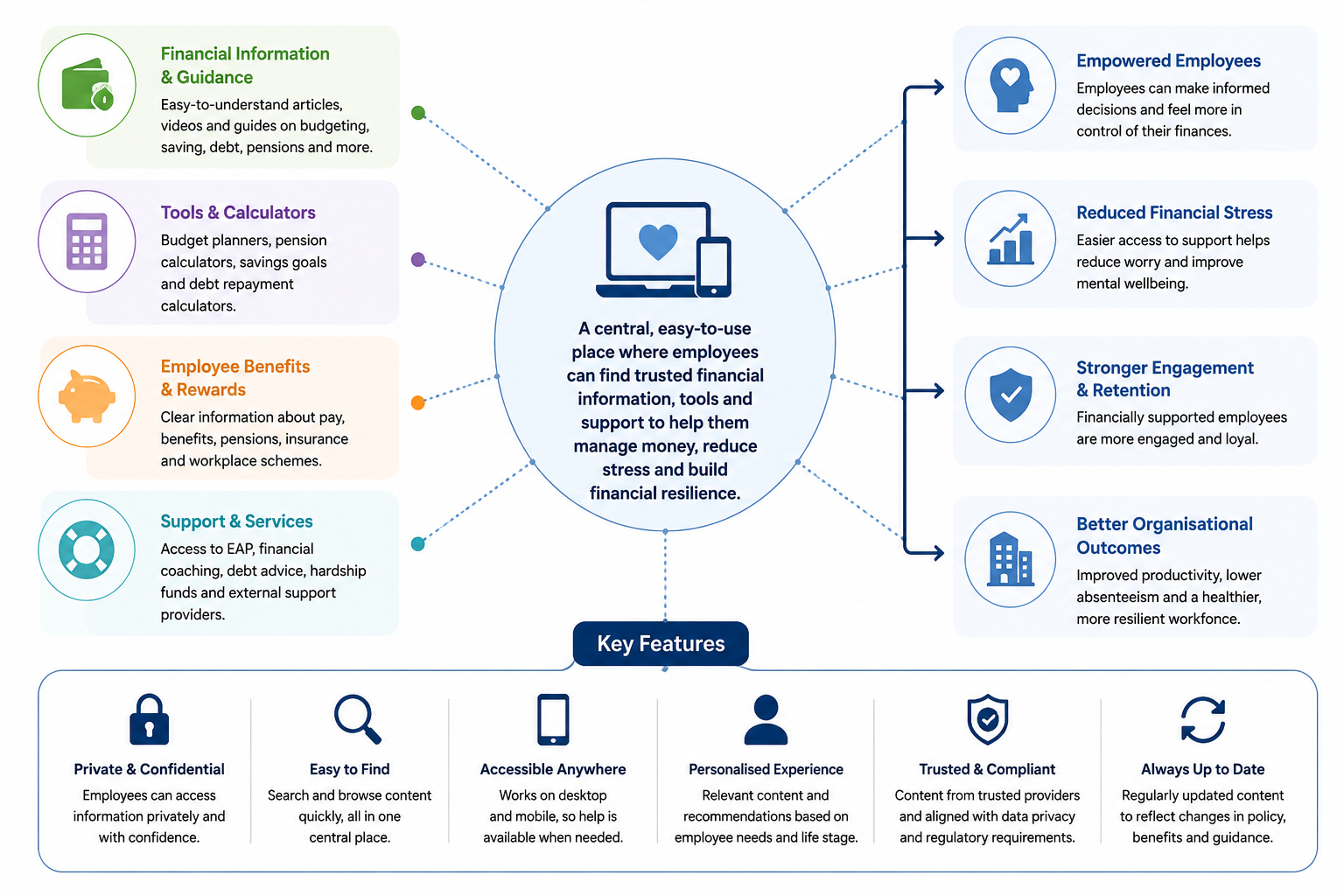
An employee financial wellness resource hub is a central place where employees can find practical information and support to help them make better decisions about their money.
Think of it as a financial wellbeing area inside your employee hub, rather than another folder filled with pension PDFs that nobody remembers exists.
The idea is to make financial wellness resources easy to find when an employee actually needs them.
What is an employee financial wellness resource hub
For example, someone worried about rising household bills might need budgeting tools or debt support, while another employee may simply want to understand their pension contributions or what financial benefits are available through work.
A useful hub could bring together resources such as:
- Budgeting guides and money-management tools
- Pension and retirement information
- Payslip and payroll guidance
- Employee benefits and salary sacrifice information
- Savings and emergency-fund resources
- Debt support and links to independent organisations
- Financial calculators
- Financial education videos, webinars and FAQs
- Guidance for major life events, such as buying a home, having a baby or approaching retirement
- Contact details for confidential or professional financial support
- Guidance on managing irregular expenses, which is particularly valuable for employees with variable pay, commission structures, or side income, since standard monthly budgeting advice doesn't always translate well to inconsistent earnings
This is also where an employee hub such as AgilityPortal can help.
Organisations can create a dedicated financial wellness area inside AgilityPortal where HR teams publish approved resources, benefits information, policies, videos, FAQs and links to trusted external services. Employees then have one searchable workplace destination instead of having to hunt through emails, shared drives and several HR systems.
For example, imagine an employee receives their payslip and doesn't understand a new deduction. Instead of emailing HR and waiting for an explanation, they could search the employee hub, find a simple payslip guide and see who to contact if they still need help.
That's really the point of an employee financial wellness resource hub: not to give employees financial advice, but to make trustworthy information and the right routes to support much easier to find.
Trust matters more here than almost anywhere else on your intranet

Trust matters more here than almost anywhere else on your intranet
Financial wellbeing is personal. If an employee is looking at debt support, emergency savings or financial hardship resources, one of their first thoughts may be: "Can my employer see what I'm looking at?" If that isn't clear, they may avoid the resource altogether.
That's why an employee financial wellness resource hub needs clear privacy boundaries. Employees should understand what information is collected, what administrators can see and what remains private. Employers should also avoid using browsing behaviour to build individual financial profiles of employees.
Trust also depends on the information being accurate. Pension rules, tax information, workplace benefits and external support services can change, so HR should regularly review resources and remove outdated guidance.
There's also an important difference between financial education and regulated financial advice. Employers can provide budgeting resources, explain workplace benefits and signpost debt or pension support, but they shouldn't tell employees what personal financial decisions to make. Where professional advice is needed, employees should be directed to an appropriately authorised service.
With an employee hub such as AgilityPortal, organisations can centralise approved financial wellness resources while clearly explaining how employee privacy is protected.
Ultimately, employees need to feel they can look for financial help without putting their personal circumstances under a microscope.
Why employees need more than another benefits page
Most organisations already offer some form of financial support. There might be a workplace pension, employee assistance programme (EAP), insurance, salary sacrifice schemes, discounts or savings benefits.
The problem is that having these benefits doesn't automatically mean employees know about them, understand them or can find them when they actually need help.
CIPD research highlights this gap.
Around 35% of UK organisations don't measure any aspect of employee financial wellbeing, while roughly two-thirds say they don't have enough data to properly understand the financial challenges their workforce faces. That makes it difficult to know whether existing benefits are solving real employee problems.
35%
don't measure financial wellbeing
According to CIPD research, around 35% of UK organisations don't measure any aspect of employee financial wellbeing, while roughly two-thirds say they lack enough data to properly understand the financial challenges facing their workforce. Without that insight, employers may struggle to know whether existing benefits and financial wellness initiatives are solving the problems employees actually face.
Source: CIPD
And this is where many traditional benefits pages fall short. An employee experiencing financial pressure probably doesn't want to scroll through a long list of corporate benefits trying to work out what might help.
Instead, an employee financial wellness resource hub should organise support around real situations. Someone struggling with monthly expenses should quickly find budgeting or debt support.
Someone planning retirement should find pension guidance. An employee confused about deductions should be able to find a simple payslip explanation.
The important lesson is:
More resources ≠ better financial wellbeing.
What matters is whether those resources are relevant, trustworthy, easy to understand and easy to find at the moment an employee actually needs them.
What should be included in an employee financial wellness resource hub?
A useful employee financial wellness resource hub should cover the different financial situations employees may face throughout their working lives.
The goal isn't to fill the intranet with hundreds of articles. It's to give employees clear routes to trustworthy information, practical tools and professional support when they need them.
Here are 12 areas worth covering.
1. Budgeting and everyday money management
Start with the financial issues employees deal with most often. Provide practical budgeting tools, spending planners and guidance for managing monthly and irregular expenses.
Useful resources include:
- Monthly and weekly budget planners
- Household spending calculators
- Guidance for managing variable income
- Cost-of-living resources
- Tips for reviewing recurring expenses
- Links to reputable money-management services
Keep this practical rather than theoretical. An employee worried about making their salary last until payday needs something they can use immediately.
2. Pay, payslip and salary information
Employees shouldn't need to contact payroll every time they don't understand something on their payslip.
The hub should explain:
- Gross and net pay
- Income tax and National Insurance
- Pension deductions
- Overtime and bonuses
- Salary sacrifice deductions
- Sick and parental pay
- Pay dates and payroll deadlines
- Who to contact about an incorrect payment
A simple annotated example payslip can make this section particularly useful.
3. Workplace pension and retirement resources
Pensions can be difficult to understand, especially for employees who are years away from retirement.
Create one place where employees can understand their workplace pension, including:
- Employee and employer contributions
- Auto-enrolment
- How contributions appear on payslips
- How to access their pension provider
- Pension calculators
- Retirement planning resources
- Where to find independent pension guidance
Avoid giving employees personal investment recommendations. The hub should educate and signpost rather than provide individual financial advice.
4. Employee benefits and total rewards
Many employees don't realise how much financial value sits outside their basic salary.
Bring together information about benefits such as:
- Health and life insurance
- Workplace pensions
- Employee discounts
- Cycle-to-work schemes
- Childcare support
- Salary sacrifice programmes
- Travel benefits
- Wellbeing allowances
- Employee assistance programmes
Where possible, explain eligibility, financial value and how employees actually claim or access each benefit.
5. Debt support and confidential help
Debt can be particularly difficult for employees to discuss with their employer, so this section needs to be handled carefully.
Rather than asking employees to disclose their financial circumstances to HR, provide confidential routes to reputable independent debt-support organisations.
Include guidance covering:
- Credit cards and personal loans
- Overdrafts
- Mortgage or rent difficulties
- Priority debts and household bills
- Debt-management support
- Where to obtain free and independent help
Make it clear whether accessing external support is confidential and what, if anything, the employer can see.
6. Emergency financial support
Sometimes employees aren't looking for financial education. They have an immediate problem.
If your organisation provides emergency support, clearly explain what is available and who qualifies. Depending on the employer, this might include hardship funds, emergency loans, EAP assistance, salary advances or earned wage access.
Employees should be able to quickly understand:
- What help is available
- Eligibility requirements
- How to apply
- Whether applications are confidential
- How long decisions normally take
- Who can see the application
This is one area where complicated processes can make an already stressful situation worse.
7. Savings and emergency-fund resources
Financial wellness isn't only about solving problems. Helping employees become more financially resilient matters too.
The hub could include:
- Emergency savings guidance
- Payroll savings schemes
- Savings calculators
- Short- and long-term savings guidance
- Goal-setting tools
- Information about employer-supported savings benefits
Keep the language realistic. Telling someone under financial pressure that they simply need to "save more" isn't particularly useful without explaining practical ways to get started. The hub could also explain everyday savings terminology, including interest rates, compound interest and APY meaning, so employees have a better foundation when comparing savings options and setting financial goals.
8. Financial education and learning
Not everyone has the same level of financial knowledge, so give employees different ways to learn.
That could include:
- Short articles
- Videos
- Webinars
- Financial wellbeing workshops
- FAQs
- Mini learning courses
- Recorded sessions with financial professionals
Short, situation-specific resources will often be easier to use than asking employees to work through a large financial education manual.
9. Life-event financial guidance
Employees' financial needs change considerably during their careers. Organising some resources around life events can make the hub much easier to navigate.
Create guidance for situations such as:
- Starting a new job
- Having a baby
- Buying a home
- Getting married
- Divorce or separation
- Bereavement
- Becoming a carer
- Promotion or salary changes
- Approaching retirement
For example, an employee expecting a child could find maternity or paternity pay, parental benefits, pension considerations and relevant external financial guidance together rather than searching several systems.
10. Financial calculators and self-service tools
Calculators can help employees turn general information into something more meaningful.
Consider providing approved tools for:
- Budgeting
- Take-home pay
- Pension contributions
- Retirement planning
- Savings goals
- Loan repayments
- Mortgage affordability
Where calculators come from external providers, check them regularly and explain that results are estimates rather than personalised financial advice.
11. Scam and financial-fraud awareness
Financial wellbeing also means helping employees protect the money they already have.
Include simple guidance covering common threats such as phishing, investment scams, impersonation fraud, pension scams and fraudulent payment requests.
More importantly, tell employees what to do next. Provide links to recognised fraud-reporting services, banks, regulators or other appropriate organisations rather than simply describing the warning signs.
12. Access to independent financial guidance
Finally, employees need somewhere to go when an article or calculator isn't enough.
Create a clearly labelled area directing employees towards appropriate independent services for areas such as:
- Debt
- Pensions
- Benefits
- Tax
- Housing
- Financial planning
- Regulated financial advice
This section should also explain an important distinction: workplace financial information and education aren't the same as personalised financial advice.
The best employee financial wellness resource hub doesn't try to answer every financial question itself. It helps employees understand their options, find trustworthy information and know exactly where to go when they need more specialised support.
Don't just dump everything into one giant financial wellbeing library
One of the easiest mistakes to make is treating an employee financial wellness resource hub like a document library. HR uploads pension documents, benefits guides, budgeting PDFs, webinar recordings and external links into one place and assumes the job is done.
From the employee's point of view, that's still a lot of information to search through.
A better approach is to organise financial wellness resources around the problems employees are actually trying to solve. Someone worried about paying their bills isn't thinking, "I need to visit the financial education section." They're thinking, "I need help getting through this month."
That means the structure of your employee hub should reflect real employee needs:
| Employee need | What they should find |
| "I'm struggling this month" | Budgeting tools, debt support, hardship assistance and emergency financial support |
| "I don't understand my pay" | Payslip explanations, deductions, tax information and payroll contacts |
| "I want to start saving" | Parental pay, workplace benefits, leave information and financial guidance |
| "I'm having a baby" | Pension information, contribution guidance, calculators and retirement resources |
| "I'm thinking about retirement" | Confidential debt guidance and links to independent support |
| "I'm worried about debt" | Documentation workflows |
| "I need professional help" | Independent financial guidance and appropriately authorised services |
This approach also works well inside an employee hub such as AgilityPortal. Instead of expecting employees to understand how HR has categorised documents, organisations can create dedicated pages, searchable knowledge articles and links based on common questions and life events.
It turns the financial wellness hub from a place where information is simply stored into a place where employees can actually find answers.
The test is simple: if an employee has a financial question, can they reach useful, trustworthy support in a few clicks without already knowing what the document is called?
How do you make employees actually use the hub?
Building an employee financial wellness resource hub is only half the job. If employees don't know it exists, can't find what they need or don't trust it, even the best collection of resources won't have much impact.
Start by making access simple. Employees should be able to search for everyday questions such as "How does my pension work?", "Where can I get debt help?" or "What benefits do I have?" rather than needing to know the exact name of a policy or document.
Mobile access matters too, particularly for frontline, deskless and remote employees who may rarely use a company laptop.
Financial wellness information should be just as easy to access from a phone as it is from a desktop.
There are several other things that can make the hub genuinely useful:
- Use plain English rather than HR, payroll or financial jargon.
- Make content searchable and organise it around employee needs.
- Clearly explain what activity is private and what administrators can see.
- Provide accessible content in formats employees can easily understand.
- Personalise resources where appropriate, such as by location, benefits eligibility or life stage, without creating intrusive financial profiles.
- Regularly remind employees what's available through announcements, onboarding, benefits campaigns and relevant workplace communications.
- Provide information at the moment employees are likely to need it.
That last point is particularly important. CIPD recommends a "just-in-time" approach to financial education, where information is provided close to the point at which someone needs to make a financial decision.
An employee approaching retirement, for example, will probably find pension guidance much more relevant than they did ten years earlier.
What are the benefits of getting this right?
A well-designed hub makes financial support easier to discover and gives employees a clearer understanding of the benefits already available to them. It can also reduce repetitive questions to HR and payroll because common answers are available through self-service.
For the organisation, that means existing pensions, EAPs, discounts, financial education and other employee benefits have a better chance of actually being used. For employees, it means less time searching across emails and systems and a clearer route to trustworthy help.
The aim isn't simply to increase visits to a benefits page. It's to make sure that when an employee thinks, "I need help with this," they know exactly where to go.
Who should own the employee financial wellness resource hub?
An employee financial wellness resource hub shouldn't become the responsibility of one HR manager.
Financial wellbeing touches pay, benefits, pensions, privacy, technology and employee communications, so several teams usually need to play a part.
HR or the People team can take overall ownership, but that doesn't mean HR should become a source of personal financial advice. Their role is to make sure employees have access to accurate information and know where to find qualified support when they need it.
A simple governance model might look like this:
| Role or team | Main responsibility |
| HR / People | Own the overall financial wellbeing strategy, understand employee needs and coordinate the hub |
| Reward & Benefits | Maintain information about pensions, insurance, salary sacrifice, discounts and other financial benefits |
| Payroll | Keep guidance about pay, deductions, tax, overtime and payslips accurate |
| Internal Communications | Make employees aware of available resources and communicate important updates |
| IT | Maintain secure, reliable and accessible technology for delivering the resources |
| Legal / Compliance | Review privacy, regulatory and financial-advice boundaries where necessary |
| Employees | Provide feedback on which resources are useful and where support is missing |
Ownership also needs to include maintenance.
For example, Payroll might review payslip information when tax rules change, while Reward & Benefits updates pension or insurance information when providers or schemes change.
The key distinction is that employers should provide access to financial education and support, not attempt to manage an employee's personal finances. If someone needs individual debt, pension, investment or other regulated financial advice, the hub should direct them towards an appropriate independent or authorised service.
With clear ownership, employees get reliable information while HR avoids being put in the uncomfortable position of answering financial questions it isn't qualified to answer.
A 10-step checklist for building your financial wellness hub
Creating an employee financial wellness resource hub doesn't need to become a huge HR project.
The important thing is to understand what employees actually need, bring existing support together and make sure the information stays useful over time.
Here's a practical way to approach it.
1. Ask employees what support they actually need
Don't start by guessing. Use anonymous surveys, benefits feedback and common HR or payroll questions to understand where employees are struggling.
Look for needs around:
- Budgeting and everyday expenses
- Understanding pay and deductions
- Debt and financial hardship
- Savings
- Pensions and retirement
- Employee benefits
- Major life events
Anonymous feedback is particularly useful because employees may not feel comfortable discussing financial difficulties directly with their employer.
2. Audit the financial benefits you already provide
Before buying anything new, work out what employees already have access to.
Review pensions, insurance, EAP services, employee discounts, salary sacrifice schemes, payroll savings, financial education and any hardship support.
You may discover that the bigger problem isn't a lack of benefits — it's that employees don't know they exist.
3. Identify what's missing
Compare employee needs with the support currently available.
For example, you may have excellent pension information but very little help for employees dealing with debt, budgeting or emergency expenses.
Create a simple gap analysis and prioritise the areas where employees need the most support.
4. Choose trustworthy information sources
Financial information needs to come from credible sources.
Where appropriate, link employees to government services, regulators, pension organisations, recognised charities and appropriately authorised financial services rather than relying on random online articles.
Also assign someone to check that external resources remain accurate and available.
5. Organise resources around employee needs
Don't expect employees to understand your internal HR filing system.
Create obvious routes such as:
- I need help with money
- I want to understand my pay
- I want to save
- I need debt support
- I'm planning for retirement
- I want to understand my benefits
- I'm going through a major life change
This makes the hub useful even when employees don't know exactly what they're searching for.
6. Establish privacy and governance rules
Decide who owns the hub, who can publish information and who is responsible for reviewing it.
Employees should also understand what information their employer can see when they use financial wellness resources.
Avoid unnecessary tracking or individual financial profiling, particularly around sensitive topics such as debt and hardship.
7. Make everything searchable and mobile-friendly
Employees shouldn't need ten clicks to find help.
Use clear page names, searchable FAQs, short guides and simple navigation. Mobile access is especially important for frontline and deskless employees who may not regularly use a company computer.
An employee hub such as AgilityPortal can provide a central location for these resources alongside existing workplace knowledge, communications and benefits information.
8. Launch it properly
Don't publish the hub and assume employees will discover it.
Introduce it through company announcements, onboarding, manager communications, benefits campaigns and relevant wellbeing initiatives.
More importantly, explain what employees can actually use it for rather than simply announcing "our new financial wellness hub is live."
9. Measure whether employees find it useful
You don't need to monitor individual financial behaviour to understand whether the hub is working.
Look at high-level measures such as resource views, searches, benefit engagement, common unanswered searches and anonymous employee feedback.
This can reveal which resources employees value and where information is still difficult to find.
10. Keep the hub up to date
Financial wellness isn't a publish-once project.
Pension information changes. Benefits change. Tax rules change. External links disappear. Employee needs change too.
Set regular reviews and assign clear content owners so outdated information doesn't sit on the intranet for years.
Ultimately, a successful financial wellness hub isn't the one with the most content. It's the one employees can trust, understand and quickly turn to when a financial question appears.
Where does an employee intranet fit into financial wellbeing?
Where does an employee intranet fit into financial wellbeing
Well an employee intranet won't solve financial stress on its own. What it can solve is a common workplace problem: employees not knowing what financial support already exists or where to find it.
Think about how financial wellbeing information often gets distributed. Pension details might sit in an HR system, payslip guidance in a shared drive, EAP information in an old email and employee benefits on another platform entirely. When someone actually needs help, finding the right information can become a job in itself.
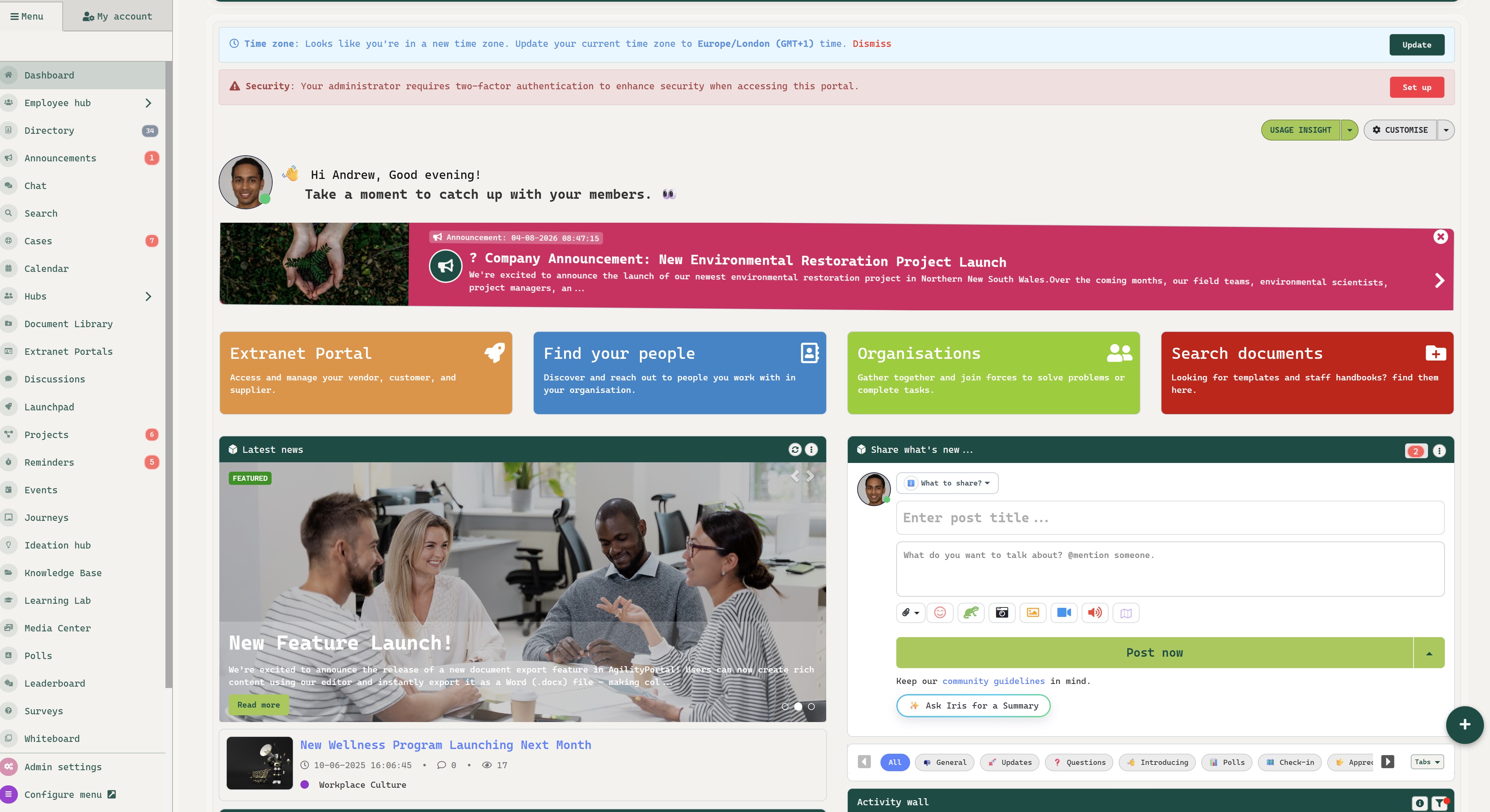
A modern employee intranet or digital workplace can bring those resources together in one searchable place.
For example, organisations can centralise:
- Employee benefits and total rewards information
- Pension and retirement resources
- Payroll and payslip guidance
- Budgeting and financial education
- EAP and confidential support services
- Debt and hardship support routes
- Financial wellbeing policies
- Webinars, videos and learning resources
- Important benefits and financial wellbeing announcements
- Links to trusted external organisations
This is where an employee hub such as AgilityPortal can play a practical role. HR can create a dedicated financial wellness area, publish and update approved resources, share relevant announcements and make information searchable across the workplace.
It also gives organisations a better way to support employees at different moments. A new starter might need help understanding their pension and benefits, while someone approaching retirement may be looking for pension guidance and independent support.
The benefit isn't simply having more financial wellness content. It's giving employees one familiar place to start, reducing time spent searching and helping them discover workplace benefits and support they may otherwise never use.
A good intranet therefore acts as the doorway to financial wellbeing support — not the financial adviser behind it.
AgilityPortal
Give Employees One Trusted Place for Financial Wellness Support
Financial wellness support is much easier to use when employees know exactly where to find it. AgilityPortal gives organisations a central employee hub where HR teams can bring together budgeting guidance, pension information, employee benefits, payroll resources, savings support, debt guidance and links to trusted external services.
Instead of asking employees to search through old emails, shared drives, HR systems and separate benefits portals, organisations can create a dedicated financial wellness area where important information is organised around real employee needs and kept up to date.
Make financial support easier to find when employees need it
Employees can quickly access approved financial wellbeing resources, understand the benefits available to them and find the right route to confidential or independent support without needing to know which system or document contains the answer.
What will employee financial wellness support look like next?
Employee financial wellness is likely to become much more personalised and connected over the next few years.
Instead of giving every employee the same benefits page, organisations will increasingly focus on helping people find relevant support at the moment they actually need it.
Here are some of the trends worth watching.
More personalised financial wellness experiences
Employees at different stages of life rarely need the same financial information.
A new starter may want to understand their pension and payslip, while someone approaching retirement will have completely different questions.
Future employee hubs will increasingly organise and recommend resources based on factors such as location, employment type, benefits eligibility and career stage — without needing to create intrusive profiles of someone's personal finances.
AI-powered workplace search
AI could also change how employees discover financial wellness resources.
Instead of searching through pages of documents, an employee might ask:
"Where can I get confidential debt support?"
or:
"What happens to my pension if I increase my contributions?"
AI-powered workplace search could help locate approved information from the organisation's knowledge base and direct employees towards the right resource. The important part will be keeping AI grounded in approved content rather than allowing it to invent financial guidance.
Just-in-time financial education
Expect financial education to become shorter and more closely connected to real decisions.
Rather than asking employees to complete a long financial wellness course once a year, organisations can provide relevant guidance when someone joins the company, changes benefits, receives a promotion, becomes a parent or approaches retirement.
This makes financial education part of the employee journey rather than another annual HR campaign.
Benefits, HR and employee experience platforms will become more connected
Another important trend is integration.
Financial wellbeing information is often scattered across payroll systems, benefits platforms, pension providers, HR software and employee communications. Bringing these systems closer together can give employees a simpler starting point.
An employee hub such as AgilityPortal can sit at the experience layer, helping employees discover benefits, policies, financial education and approved support services without needing to understand which underlying HR system contains the information.
The future is less about offering more and more about connecting what already exists
The biggest shift may be surprisingly simple. Employers don't necessarily need dozens of new financial benefits. Many already provide valuable pensions, EAP services, discounts, insurance, financial education and other support.
The opportunity is to connect those resources through a smarter employee experience.
Personalisation, AI workplace search, timely education and better-integrated employee hubs could make financial wellness support much easier to discover. But technology should remain the guide, not the financial adviser.
The future of employee financial wellness isn't about knowing everything about an employee's finances. It's about making sure employees can quickly find trustworthy help when they decide they need it.
Financial wellbeing will become more measurable
Organisations will also want better evidence that their financial wellbeing programmes are useful.
The focus should be on meaningful, privacy-conscious measures such as:
- Which resources employees use most
- Benefits awareness and participation
- Common workplace searches
- Unanswered employee questions
- Financial wellbeing survey results
- Engagement with educational programmes
- Employee feedback on available support
The aim shouldn't be to monitor individual financial difficulties. It's to understand whether employees can actually find and use the support the organisation provides.
Final thoughts — make financial help easy to find before employees desperately need it
A good employee financial wellness resource hub isn't measured by how many guides, calculators or benefits documents HR manages to upload.
What really matters is whether an employee can find useful, trustworthy help when a financial question or problem actually appears.
That could be someone trying to understand their payslip, looking for confidential debt support, checking their pension options or simply discovering an employee benefit they didn't know was available.
The best approach is therefore to keep things simple: bring financial wellness resources into one place, organise them around real employee needs, protect privacy and regularly check that the information remains accurate.
An employee hub such as AgilityPortal can support this by giving organisations a central place for financial wellbeing information, employee benefits, policies, learning resources, announcements and links to independent support.
Most importantly, don't wait until employees are already experiencing serious financial difficulties before making support visible.
Financial wellness works better when employees know where help is, trust the information they're being given and can access it without feeling judged. Sometimes the most valuable thing an employer can provide isn't another benefit at all — it's a clear path to the right help at the right moment.
Frequently asked questions about employee financial wellness
What is an employee financial wellness resource hub?
An employee financial wellness resource hub is a central workplace location where employees can find information about budgeting, pay, pensions, savings, debt support, employee benefits and other financial wellbeing resources. It can sit within an employee intranet or digital workplace so people have one trusted place to start when they need financial information or support.
What should be included in an employee financial wellness programme?
A good financial wellness programme should cover more than pensions and employee discounts. Depending on the workforce, it could include budgeting education, savings support, pension guidance, debt resources, financial calculators, EAP services, emergency financial assistance and access to independent professional guidance.
The exact mix should be based on what employees actually need rather than simply adding as many benefits as possible.
How can employers support employee financial wellbeing?
Employers can start by making existing support easier to discover. Bring together pay information, pensions, benefits, financial education and confidential support services in one accessible employee hub.
HR can also provide financial education, communicate benefits more clearly, offer relevant workplace schemes and regularly ask employees what additional support would be useful.
What are some financial wellness examples in the workplace?
Financial wellness examples can include workplace pension contributions, payroll savings, budgeting workshops, employee discounts, salary sacrifice schemes, financial education, EAP support, hardship funds and access to independent debt or pension guidance.
Financial wellness can also be as simple as helping employees properly understand their payslip and the benefits already included in their employment package.
What is Financial Wellness Group?
Financial Wellness Group is the name associated with a UK financial services organisation providing support around financial difficulties and debt solutions. This shouldn't be confused with the broader term "financial wellness," which describes a person's ability to manage their finances and feel financially secure.
If an employee is considering a commercial financial wellness company or debt provider, employers should avoid endorsing a particular solution without carrying out appropriate due diligence. A workplace resource hub can instead signpost reputable independent and appropriately regulated sources of support.
Is Financial Wellness Group part of the NHS?
People searching for "financial wellness NHS" may be looking for financial wellbeing support available to NHS employees or trying to establish whether a particular financial wellness provider is connected with the NHS.
These aren't automatically the same thing. NHS staff should use the financial wellbeing resources provided by their employer or official NHS channels to establish which benefits and support services are available to them.
Where can I find the Financial Wellness Group login, contact number or live chat?
If you're specifically looking for the Financial Wellness Group login, Financial Wellness Group contact number or Financial Wellness Group live chat, use the organisation's official website or existing customer documentation rather than relying on contact details copied onto third-party websites.
Contact information and customer-service arrangements can change, so employers linking to external financial wellness companies should regularly check that links and support information in their employee hub remain current.
What is a financial wellness IVA?
An IVA, or Individual Voluntary Arrangement, is a formal debt solution available in Engla
nd, Wales and Northern Ireland that involves an agreement with creditors to repay all or part of qualifying debts over an agreed period.
An IVA can have significant financial consequences and isn't appropriate for everyone. An employer's financial wellness hub should therefore provide general education and direct employees towards reputable debt guidance rather than suggesting that an IVA is the right solution for an individual employee.
Should employers provide financial advice to employees?
Employers can provide financial education, explain workplace benefits and pensions, and direct employees towards trusted support. However, that is different from giving personalised financial or investment advice.
Where an employee needs regulated financial advice, the safer approach is to direct them towards an appropriately authorised professional or independent service.
Who should be responsible for employee financial wellbeing?
HR or the People team will often coordinate the overall strategy, but responsibility can also involve Payroll, Reward and Benefits, Internal Communications, IT and Legal or Compliance.
Each team has a different role. Payroll keeps pay information accurate, Benefits manages workplace schemes, Internal Communications improves awareness, and HR makes sure employees can easily find the right support.
How do you measure whether financial wellness support is working?
Start with high-level measures rather than tracking individual employees' financial behaviour. Organisations can monitor benefits awareness, anonymous employee feedback, resource engagement, common searches and participation in financial education programmes.
The important question isn't simply how many people visited the financial wellness hub. It's whether employees understand their benefits and can find useful support when they need it.
AI Summary
- An employee financial wellness resource hub gives employees one trusted place to find practical support for budgeting, pay, pensions, savings, debt, workplace benefits and important financial life events.
- Simply offering more employee benefits does not automatically improve financial wellbeing. Resources need to be easy to find, clearly explained and available when employees actually need them.
- A useful financial wellness hub should include budgeting tools, payslip guidance, pension information, employee benefits, debt support, emergency financial assistance, savings resources, financial education, calculators and access to independent guidance.
- Privacy and trust are particularly important because employees may be uncomfortable with their employer knowing they are researching debt, hardship or other personal financial issues. Organisations should clearly explain what usage information can and cannot be seen.
- Financial education should not be confused with personalised or regulated financial advice. Employers can provide trusted information and signpost appropriate services without attempting to make financial decisions for employees.
- An employee hub such as AgilityPortal can centralise financial wellness information, benefits, policies, learning resources and trusted support links, making it easier for employees to find the right help at the right time.
Most Popular Posts

Effective communication among team members is vital for the productivity and success of any organization. Surprisingly, 60% of companies lack a long-term internal communication strategy, which p...


Businesses thrive on communication for efficiency, productivity and accomplishment. When the right information is passed from the right designation in the organization, it promotes positivity an...

Categories
Blog
(3196)
Business Management
(395)
Employee Engagement
(235)
Digital Transformation
(218)
Growth
(150)
Intranets
(141)
Internal communications
(106)
Remote Work
(68)
Sales
(53)
Collaboration
(52)
Customer Experience
(32)
Culture
(30)
Knowledge Management
(29)
Project management
(29)
Leadership
(20)
Comparisons
(9)
News
(1)

Related Posts

Could AI produce your next workplace video faster—and still deliver a message your employees can trust? As more businesses use video for onboarding, training and leadership updates, one question keeps coming up: will AI replace video editors in...

Could the best machine learning systems help your employees spend less time sorting requests, updating spreadsheets and chasing information—and more time doing useful work? That's the opportunity, but finding the right system starts with knowin...

What would happen to your team's work and customer information if an employee's MacBook disappeared today? If you're wondering how to protect your Mac physically, the answer goes beyond buying a case. A MacBook used at home, on a train or in a ...

Welcome to AgilityPortal's guide to the best VPN for Remote teams. How do you give employees secure access to company systems when they work from home, the office and everywhere in between? It's a question more businesses need to answer: 28% of worki...

Have you ever left a meeting thinking everyone agreed on the next step, only to discover a week later that each person remembered something different? Open source meeting transcription can help teams keep a searchable record of the conversation...


Annet Herges
I am a digital nomad, lover of exploring new places and making friends.
I love to travel and I love the internet. I take pictures of my travels and share them on the internet using Instagram.
Traveler, entrepreneur, and community builder. I share my insights on digital marketing and social media while inspiring you to live your fullest life.
Ready to learn more? 👍
One platform to optimize, manage and track all of your teams. Your new digital workplace is a click away. 🚀
Free for 14 days, no credit card required.