Insight Blog
Agility’s perspectives on transforming the employee's experience throughout remote transformation using connected enterprise tools.
44 minutes reading time
(8890 words)
10 Digital Engagement Platforms for Professional Services: What to Look For In 2026

10 Digital Engagement Platforms for Professional Services: What to Look For In 2026
Discover what to look for in digital engagement platforms for professional services firms to improve communication, productivity, and client experience.
10 Digital Engagement Platforms for Professional Services: What to Look For In 2026

What's the real cost of poor communication in professional services firms?
It's rarely obvious at first.
Deadlines slip.
Knowledge gets lost.
Teams duplicate work.
Clients notice inconsistencies.
Over time, these small inefficiencies quietly erode profitability and reputation.
This is exactly why more firms are investing in digital engagement platforms to centralise communication, streamline collaboration, and improve both employee and client experiences.
According to McKinsey & Company, employees can spend up to 28% of their workweek searching for information—a staggering loss of billable time in professional services environments where efficiency directly impacts revenue.
28%
time lost
According to McKinsey & Company, employees can spend up to 28% of their workweek searching for information—a major loss of billable time in professional services environments where efficiency directly impacts revenue.
Source: McKinsey & Company
That statistic alone highlights a critical gap that insider engagement strategies aim to solve: keeping teams informed, aligned, and productive from within.
The pressure is mounting.
Firms that fail to modernise risk falling behind competitors who are already leveraging the top digital engagement platforms to create seamless, connected workplaces.
These platforms are no longer a "nice-to-have"—they're becoming the operational backbone of high-performing consulting, legal, and advisory firms.
But here's the challenge: not all platforms are designed for the complexity of professional services.
Choosing the wrong one doesn't just waste budget—it can slow adoption, frustrate teams, and make existing problems worse.
So the real question is this—how can firms identify the right solution before inefficiencies start costing them more than they realise?
Key Takeaways
- Digital engagement platforms help professional services firms reduce time wasted searching for information, directly protecting billable hours.
- Disconnected tools create inefficiencies, making it harder for teams to collaborate, access knowledge, and deliver consistent client outcomes.
- A strong digital workplace platform combines communication, knowledge management, and collaboration into one structured environment.
- Features like mobile access, integrations, analytics, and role-based permissions are critical for supporting modern, distributed teams.
- Long-term success depends on adoption, simplicity, and scalability—not just feature lists or initial cost.
The Current Climate: Why Professional Services Firms Are Struggling to Stay Aligned
Professional services firms are operating in a completely different environment than they were just a few years ago—and most haven't fully adapted.
Hybrid work is now the norm, teams are spread across regions, and the volume of information flowing through the business has exploded.
On paper, there are more tools than ever to support this shift. In reality, it's created a new set of problems.
Instead of improving collaboration, many firms are dealing with fragmented systems. Internal communication software, document storage, project tools, and client engagement software often sit in silos.
Employees are forced to jump between platforms just to complete simple tasks, slowing everything down.

The Current Climate: Why Professional Services Firms Are Struggling to Stay Aligned
This lack of integration makes it harder to maintain a single source of truth, which is critical in environments where accuracy and consistency directly impact client outcomes.
Knowledge is another major challenge.
In consulting, legal, and advisory firms, institutional knowledge is one of the most valuable assets—but it's often buried in email threads, chat messages, or outdated folders.
Without proper knowledge management tools, teams waste time searching for information or recreating work that already exists. That inefficiency doesn't just affect productivity—it eats into billable hours.
There's also a growing disconnect between leadership and employees.
Without strong employee experience platforms or structured engagement strategies, firms struggle to maintain visibility, alignment, and culture across distributed teams.
This weakens team collaboration tools and reduces overall engagement, especially among remote staff.
The result? Slower delivery, inconsistent client experiences, and reduced profitability. This is exactly the gap that modern digital workplace platforms are designed to solve—but only if they're implemented correctly.
25%
time lost weekly
According to Atlassian, teams can lose up to 25% of their time due to inefficient workflows, app switching, and fragmented systems—directly impacting productivity and billable output in professional services environments.
Source: Atlassian Workplace Productivity Report
What Is a Digital Engagement Platform?
What Is a Digital Engagement Platform
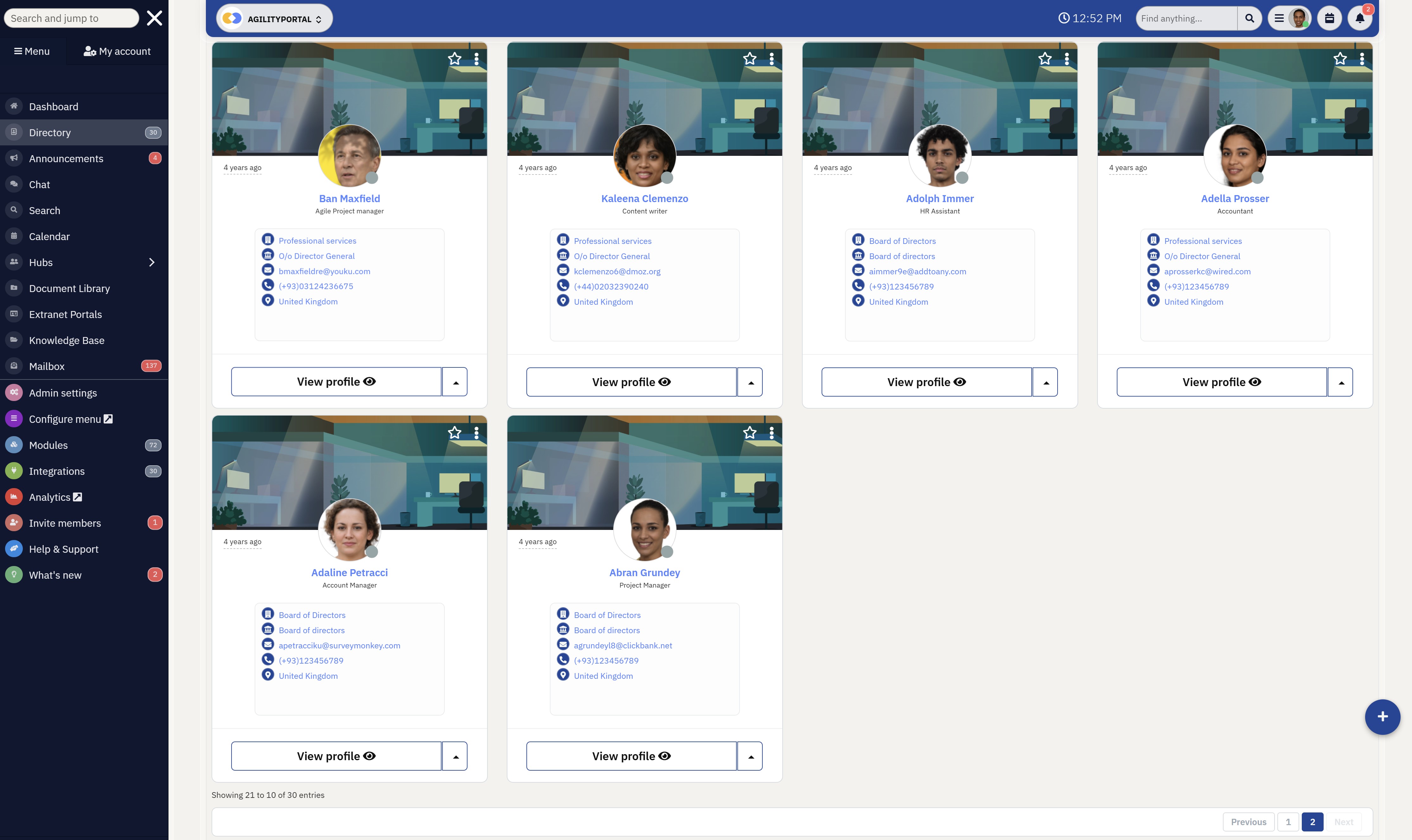
A digital engagement platform is a centralised system designed to connect employees, information, and workflows in one place—making it easier for organisations to communicate, collaborate, and stay aligned.
In professional services firms, where knowledge is the product and time is billable, these platforms act as the backbone of insider engagement, ensuring teams have instant access to the information they need to perform at a high level.
Instead of relying on disconnected tools like email, chat apps, shared drives, and project systems, a digital engagement platform brings everything together into a single, structured environment.
This includes internal communication (announcements, messaging, updates), document and knowledge management, collaboration tools, and employee engagement features such as surveys, recognition, and analytics.
The goal is simple: reduce friction.
When employees don't have to search across multiple systems or chase colleagues for answers, productivity increases and decision-making speeds up. For professional services firms, that translates directly into improved efficiency, better client delivery, and stronger internal alignment.
What separates the top digital engagement platforms from basic communication tools is their ability to go beyond messaging. They create a true digital workplace—one where teams can access knowledge, manage tasks, engage with leadership, and stay connected regardless of location.
Ultimately, a digital engagement platform isn't just a tool—it's a strategic layer that supports how modern firms operate, scale, and deliver consistent value to clients.
Why Professional Services Firms Need Digital Engagement Platforms
Professional services firms don't sell products—they sell expertise and time, so efficiency directly impacts revenue.
When teams can't find information or stay aligned, productivity drops fast.
That's where digital engagement platforms make a difference.
These firms depend on fast, reliable knowledge sharing. Without proper knowledge management tools, insights get lost, work is duplicated, and delivery slows down.
Add to that distributed teams working across locations, and communication becomes even harder without modern team collaboration software.
There's also the client impact. Inconsistent information or outdated documents can damage trust. A strong client engagement platform ensures everyone works from the same source of truth.
Bottom line—inefficiency doesn't just waste time, it reduces billable hours.
Firms using the top digital engagement platforms aren't just improving communication—they're protecting revenue and operating more effectively.
What Makes Professional Services Different (And Why Most Tools Fall Short)
Too Many Disconnected Systems
Most professional services firms operate across a mix of platforms—messaging apps, email, file storage, CRMs, and project tools.
The problem isn't the tools themselves, it's the lack of connection between them.
Teams end up switching constantly just to complete basic tasks, which slows workflows and creates confusion.
Without a unified workspace, there's no clear single source of truth, making it harder to stay aligned.
Information Is Fragmented
In industries driven by expertise, access to the right information at the right time is critical.
Yet in many firms, key documents, processes, and insights are scattered across folders, inboxes, and legacy systems.
This weakens knowledge accessibility and leads to repeated work, delays, and inconsistent outputs.
Over time, it becomes a serious barrier to scaling efficiently.
Legacy Intranets Fail to Engage
Traditional intranet systems, such as Microsoft SharePoint, were never designed for modern, fast-moving teams.
They're often difficult to navigate, hard to maintain, and rarely used by employees day-to-day.
As a result, adoption drops, and the platform fails to deliver value.
Today's firms need something far more intuitive—tools that actually support employee communication, collaboration, and daily workflows without friction.
Here Are 10 Digital Engagement Platforms Comparison for Professional Services
| Platform | Best For | Key Strength | Weakness |
| AgilityPortal | All-in-one internal communication & engagement | Combines intranet, communication, knowledge management, and engagement tools in one platform | Less brand awareness compared to legacy tools |
| ON24 | Firms focused on client-facing webinars & events | Strong for hosting client engagement and thought leadership events | Not built for internal operations or team collaboration |
| Guru | Knowledge-driven consulting teams | Strong real-time knowledge capture and verification | Limited communication and engagement features |
| Sociabble | Firms focused on internal comms and advocacy | Excellent for content distribution and employee engagement | Lacks deep document and workflow capabilities |
| Axero | Mid-sized firms needing structured intranet | Combines social intranet with collaboration tools | UI feels dated compared to newer tools |
| Claromentis | irms wanting customisable intranet + LMS | Flexible modules for learning, comms, and processes | Requires setup effort and ongoing admin |
| Jive | Large firms needing community-style collaboration | Strong discussion forums and knowledge sharing | Expensive and declining adoption |
| Bloomfire | Firms needing searchable knowledge hubs | Powerful AI-driven search and content indexing | Limited real-time communication tools |
| eXo Platform | Firms wanting open-source digital workplace | Highly customisable with strong collaboration features | Requires technical expertise to manage |
| ThoughtFarmer | Knowledge-heavy professional services firms | Strong document management and internal comms | Less focus on engagement analytics |
#1. AgilityPortal (Best All-in-One Digital Engagement Platform for Professional Services)
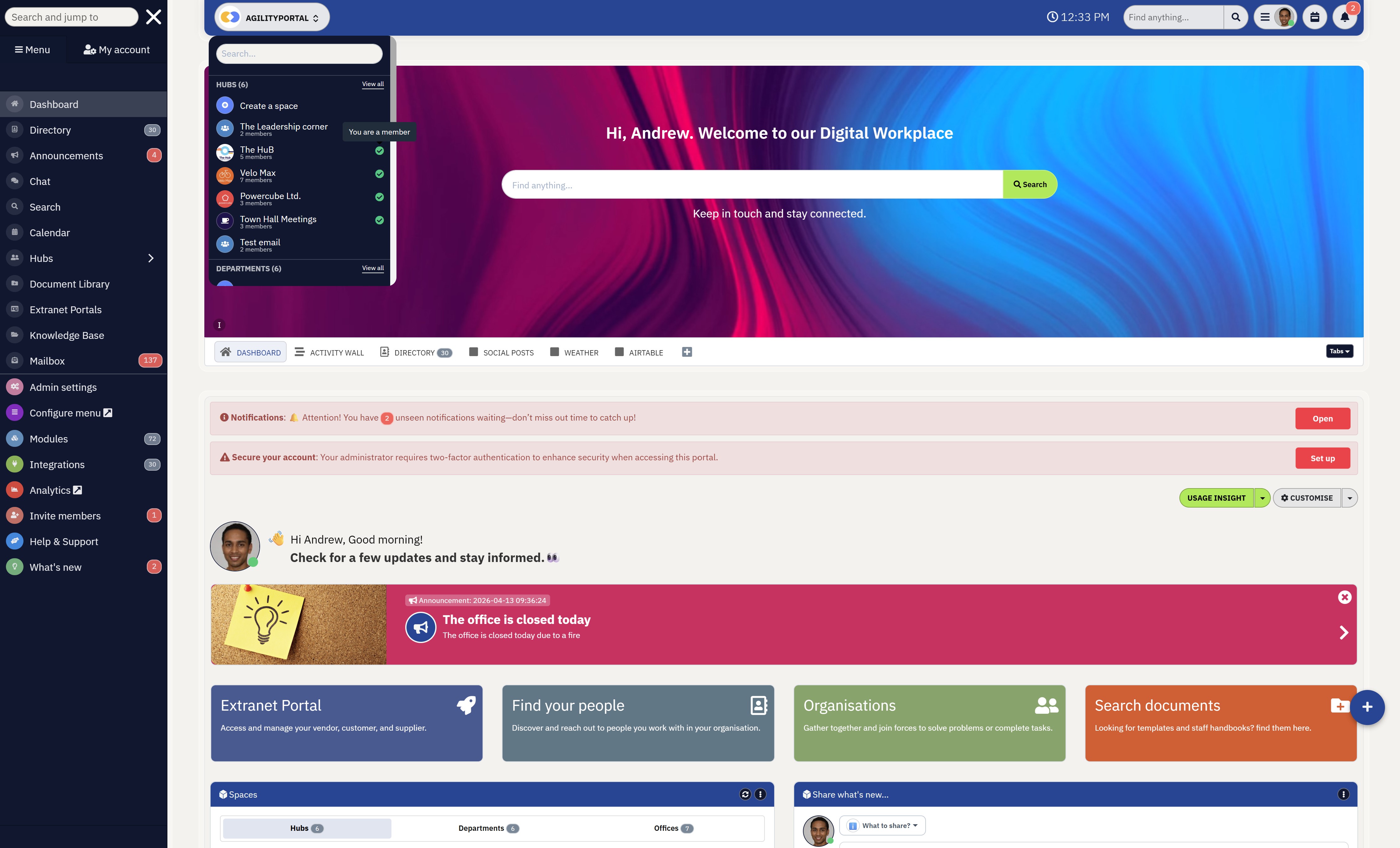
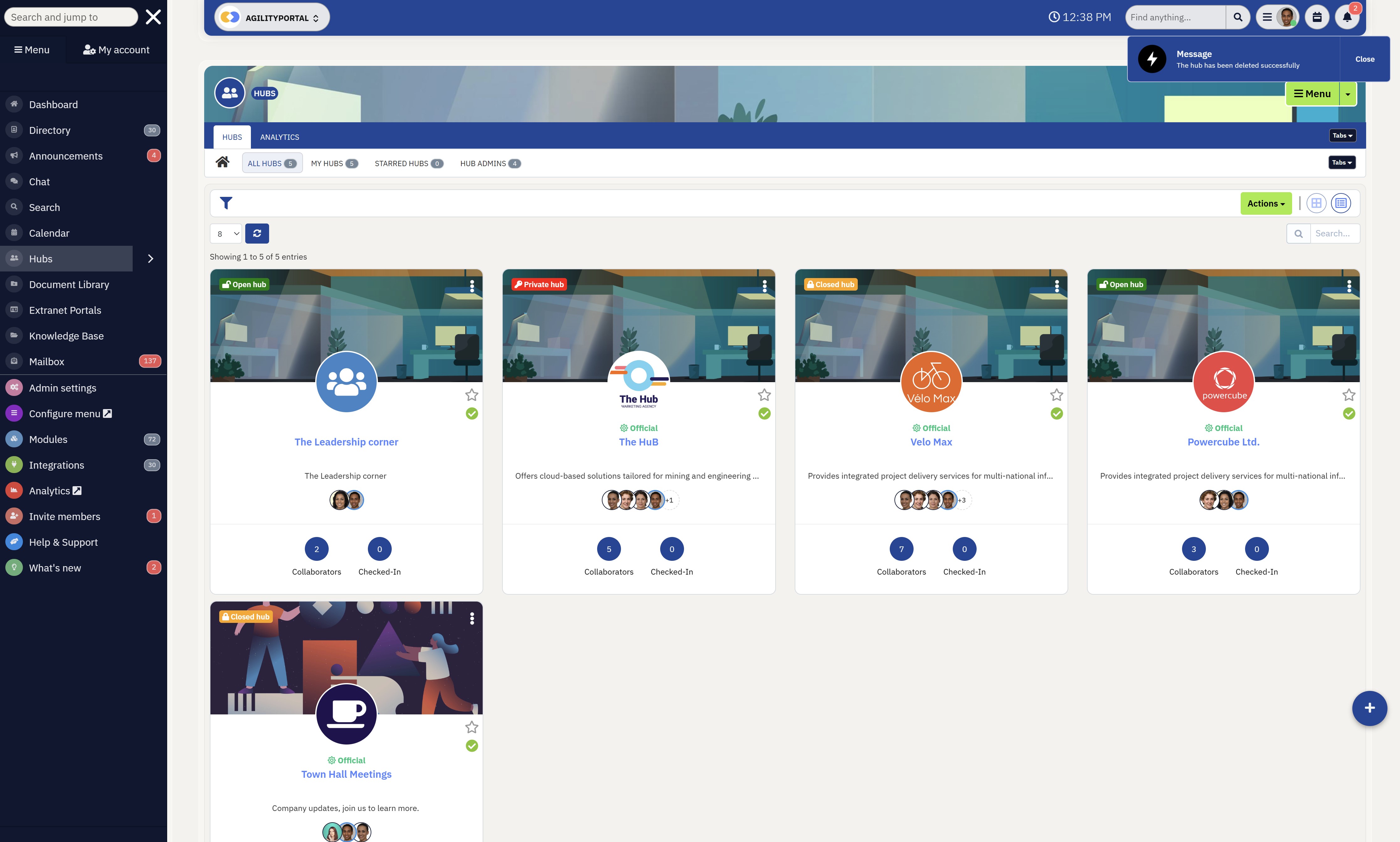
AgilityPortal takes a different approach—it's built as a complete digital workplace, not just another communication or engagement tool.
From what most firms experience, the biggest win is consolidation. Instead of juggling chat apps, shared drives, intranet pages, and HR tools, everything sits in one structured environment.
That alone solves a major problem—tool fragmentation and lost billable time.
But… that all-in-one power comes with a trade-off. It's not a simple plug-and-play chat tool. To get real value, firms need to structure their workspace properly and invest a bit of time upfront.
AgilityPortal (Best All-in-One Digital Engagement Platform for Professional Services)
Key Features:
- Centralised internal communication platform (news feed, announcements, chat)
- Built-in knowledge management system with document storage and search
- Employee engagement tools (surveys, recognition, mood tracking)
- Structured team collaboration workspaces
- Mobile-first employee app for remote and field teams
- Secure role-based permissions and access control
- Integrations with Microsoft 365, Google Workspace, and HR tools
Pros:
- Replaces multiple disconnected tools with one platform
- Strong balance between communication, knowledge, and engagement
- Designed for hybrid and distributed professional services teams
- Reduces time wasted searching for information
- Scales effectively as firms grow
Cons:
- Requires onboarding to fully utilise all features
- May feel feature-heavy for very small teams
- Not ideal if only basic messaging is needed
Pricing:
- Starts from around $99 per 100 users/month
- 14-day free trial available (no credit card required)
- Discounts available for annual billing
If the goal is to eliminate tool sprawl and create a structured, scalable digital workplace, AgilityPortal stands out.
It's particularly effective for professional services firms that need to combine communication, knowledge sharing, and engagement—while protecting billable time and improving internal alignment.
AgilityPortal
The All-in-One Digital Engagement Platform Built to Replace Tool Chaos
AgilityPortal is built for professional services firms that need more than another chat app or basic intranet. It brings internal communication, employee engagement, knowledge management, document sharing, and team collaboration into one secure digital workplace platform.
Instead of losing billable hours searching through emails, shared drives, and disconnected systems, teams get one central hub where people, knowledge, updates, and workflows stay connected.
Start your 14-day free trial — no credit card required. Built for teams that want less tool switching and more work done.#2. ON24 (Best for Client Engagement & Thought Leadership)
ON24 takes a very different approach—it's not built for internal operations, but for external engagement and revenue generation through content.
The biggest strength is its ability to turn webinars into a full demand generation engine. One event doesn't just end when the session finishes—it keeps working.
That alone solves a major problem—wasted content and low ROI on marketing efforts.
It's not designed to manage internal communication, collaboration, or knowledge sharing.
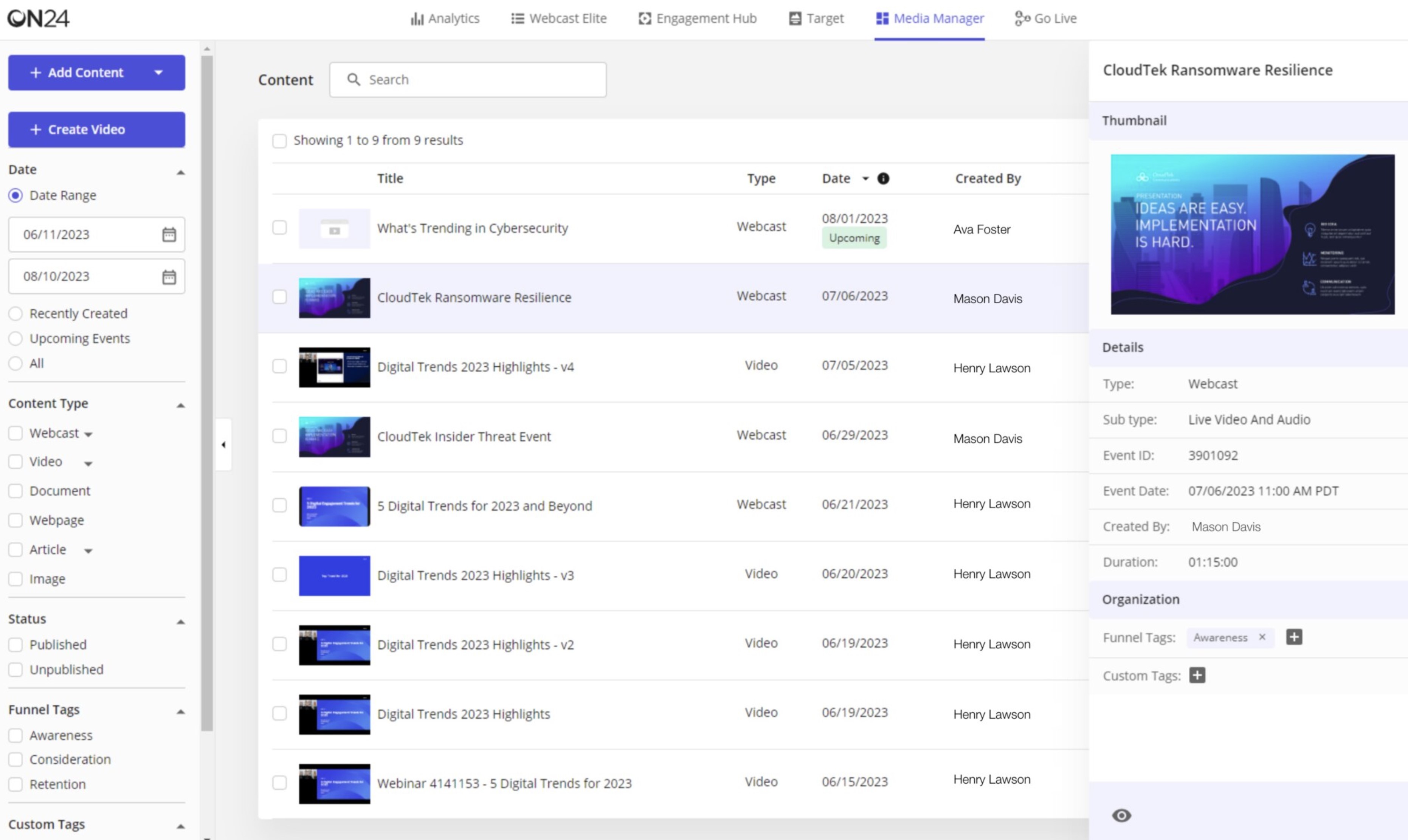
ON24 (Best for Client Engagement & Thought Leadership)
Key Features:
Pros:
Cons:
- AI-powered ACE (Analytics and Content Engine)
- Live CPE/CPD certification widgets for professional accreditation
- Hyper-personalised content hubs for targeted audience experiences
- Advanced webinar and virtual event hosting tools
- Deep engagement analytics and buying intent tracking
- Automated content repurposing engine (webinars → blogs, eBooks, clips)
Pros:
- Transforms webinars into long-term content assets
- Powerful buying intent data for sales and marketing teams
- Ideal for firms relying on thought leadership to drive leads
- Strong analytics and audience insights
- Supports professional services compliance (CPE/CPD credits)
Cons:
- Not built for internal collaboration or employee engagement
- Requires marketing strategy to fully maximise value
- Can be expensive for smaller firms
- Less relevant for day-to-day team operations
ON24
A Client Engagement Platform Built for Webinars, Events, and Buying Intent
ON24 is designed for firms that rely on thought leadership, webinars, and digital events to generate demand. It works well as a client engagement platform, helping professional services firms turn webinars into content hubs, audience insights, and sales-ready engagement data.
See how ON24 supports webinars, virtual events, content experiences, and client engagement campaigns.#3. Guru (Best for Real-Time Knowledge Management & Team Enablement)
Guru takes a very focused approach—it's built to solve one problem extremely well: getting the right information to the right people, exactly when they need it.
That alone solves a major issue—time wasted searching for information.
It's not designed to be a full digital workplace or replace communication platforms.
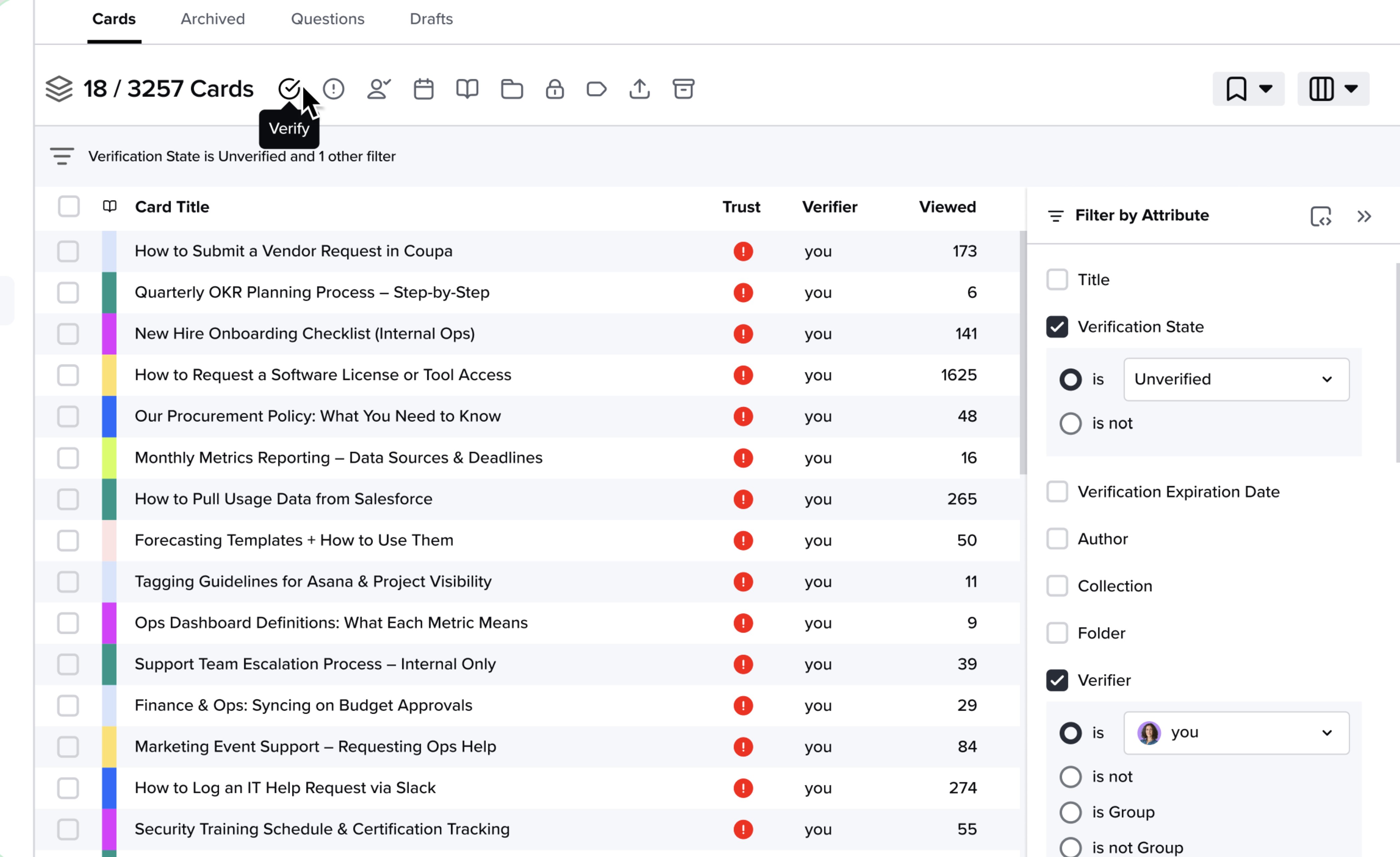
Guru (Best for Real-Time Knowledge Management & Team Enablement)
Key Features:
Pros:
Cons:
- AI-powered enterprise search and knowledge surfacing
- Browser extension for accessing knowledge within daily workflows
- Verification workflows to keep content accurate and up to date
- Structured knowledge cards and collections
- Integration with tools like Slack, CRM systems, and help desks
- Basic analytics on content usage and engagement
Pros:
- Reduces time spent searching for information
- Ensures knowledge is always up to date and verified
- Easy to embed into existing workflows
- Strong adoption due to simplicity and speed
- Ideal for knowledge-heavy professional services teams
Cons:
- Limited internal communication features
- Not a full collaboration or engagement platform
- Requires ongoing content governance to stay effective
- Not designed to replace intranet or project tools
Guru
A Real-Time Knowledge Management Platform Built for Fast Access to Information
Guru is designed to solve one critical problem—getting the right information to the right people, instantly. It works as a knowledge management software that sits inside your existing workflows, helping teams access verified content without switching tools.
See how Guru helps teams reduce time spent searching and improve knowledge access across workflows.#4. Sociabble (Best for Internal Communications & Employee Advocacy)
Sociabble takes a different angle—it's built around content distribution and employee advocacy, rather than being a full digital workplace.
From what most firms experience, the biggest advantage is reach.
It makes it easy to push company updates, campaigns, and curated content out to employees—and even turn them into brand advocates.
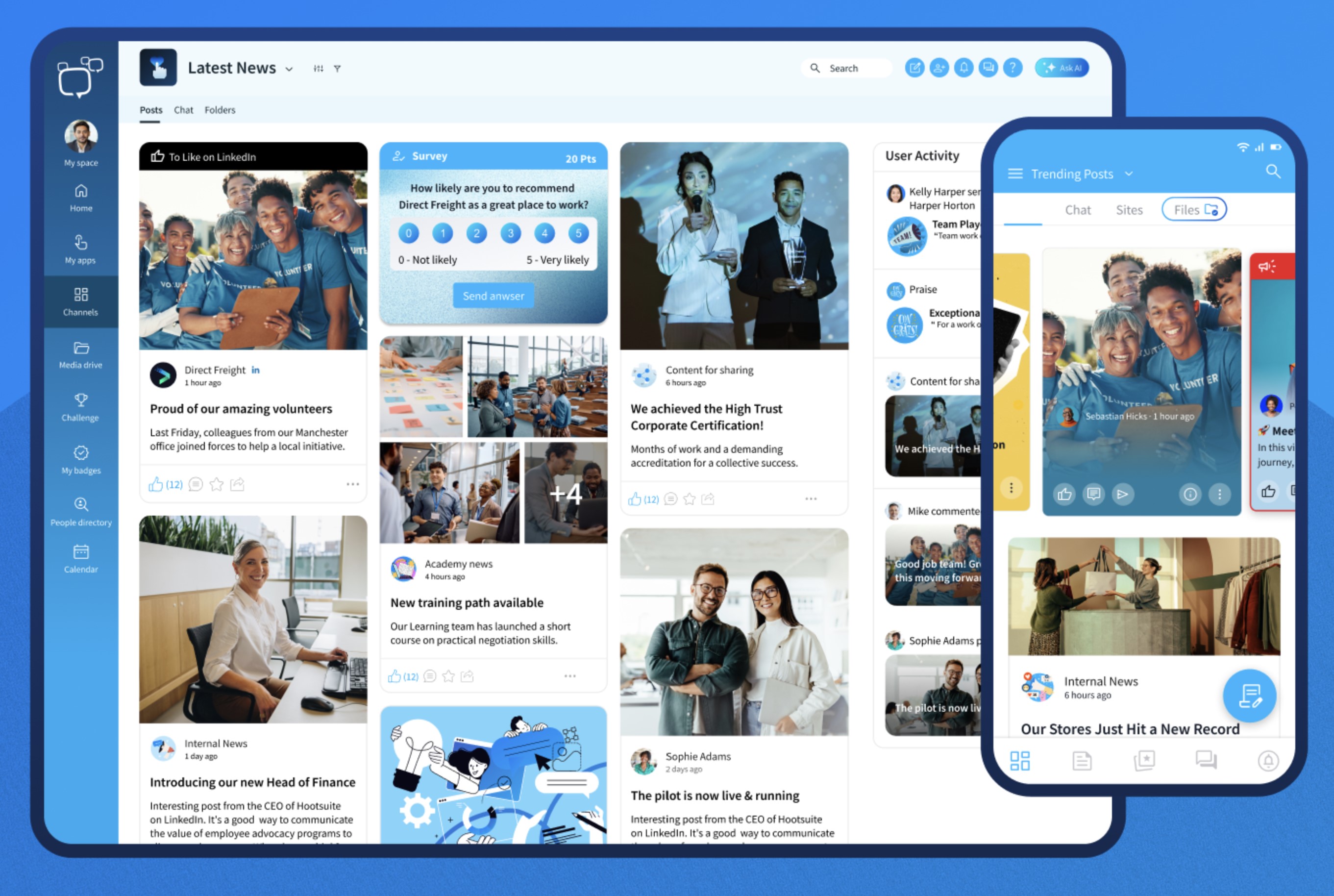
#4. Sociabble (Best for Internal Communications & Employee Advocacy)
Key Features:
Pros:
Cons:
- Centralised content distribution and news feed
- Built-in employee advocacy tools (content sharing to social channels)
- Gamification features to boost engagement and participation
- Multi-channel delivery (mobile, email, push notifications)
- Content curation and scheduling tools
- Basic analytics and engagement tracking
Pros:
- Excellent for improving reach of internal communications
- Encourages employees to share branded content externally
- Easy to use and quick to roll out
- Strong mobile experience for distributed teams
- Helps boost engagement through gamification
Cons:
- Limited knowledge management and document structure
- Not suitable as a full collaboration platform
- Lacks deep workflow and project management features
- Requires consistent content strategy to stay effective
Sociabble
An Employee Communication & Advocacy Platform Built to Amplify Content
Sociabble is designed to help organisations distribute content at scale while turning employees into brand advocates. It works as an employee communication platform that focuses on delivering updates, campaigns, and curated content across distributed teams.
See how Sociabble helps organisations improve internal communication and turn employees into content amplifiers.#5. Axero (Best for Structured Intranet & Internal Collaboration)
Axero is the only intranet solution that empowers developers, marketers, communications, and HR professionals to build and manage digital work experiences that get results.
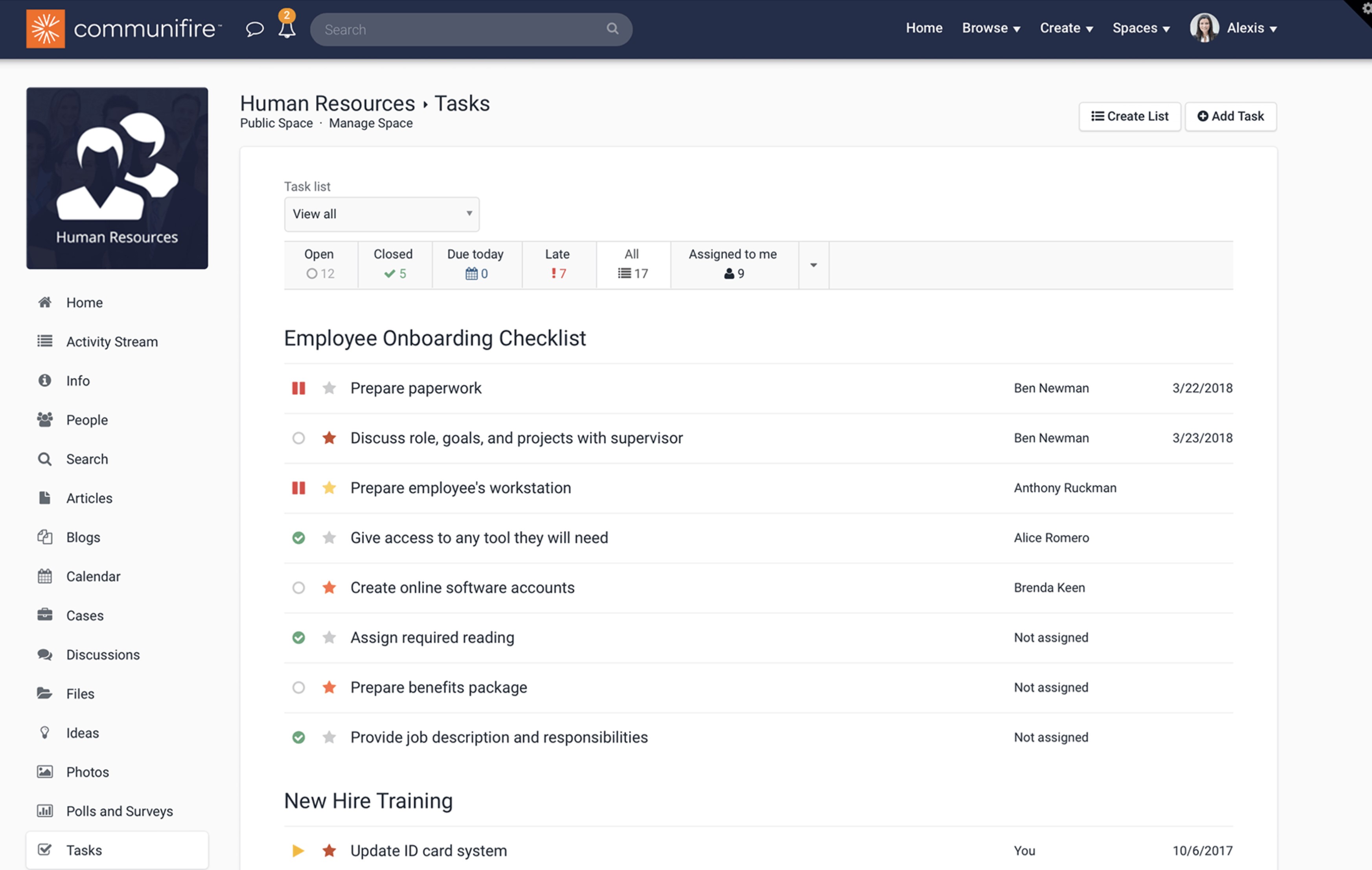
#5. Axero (Best for Structured Intranet & Internal Collaboration)
Key Features:
Pros:
Cons:
- Centralised company intranet and employee portal
- Document and file sharing with structured organisation
- Built-in internal communication tools (news, announcements)
- Social features (activity feeds, comments, profiles)
- Workflow and task management capabilities
- Integration with common business tools
Pros:
- Strong structure for organising company information
- Combines intranet with basic collaboration features
- Helps centralise communication and documents
- Suitable for mid-sized to large organisations
- Improves internal visibility across departments
Cons:
- Interface can feel dated compared to modern platforms
- Limited advanced engagement and analytics features
- Not as strong for real-time communication
- Requires setup and governance to stay organised
Axero
A Structured Intranet Platform for Internal Communication & Knowledge Organisation
Axero is built as a social intranet platform that helps organisations organise communication, documents, and collaboration in one place. It’s particularly useful for firms that need structure and governance across internal content and workflows.
See how Axero helps organisations centralise communication, documents, and internal collaboration.#6. Claromentis (Best for Customisable Intranet & Process Management)
From what most firms experience, the biggest advantage is control.
Teams can tailor the platform around their workflows—whether that's onboarding, internal processes, or document management.
That solves a key issue—lack of standardisation across teams and processes.
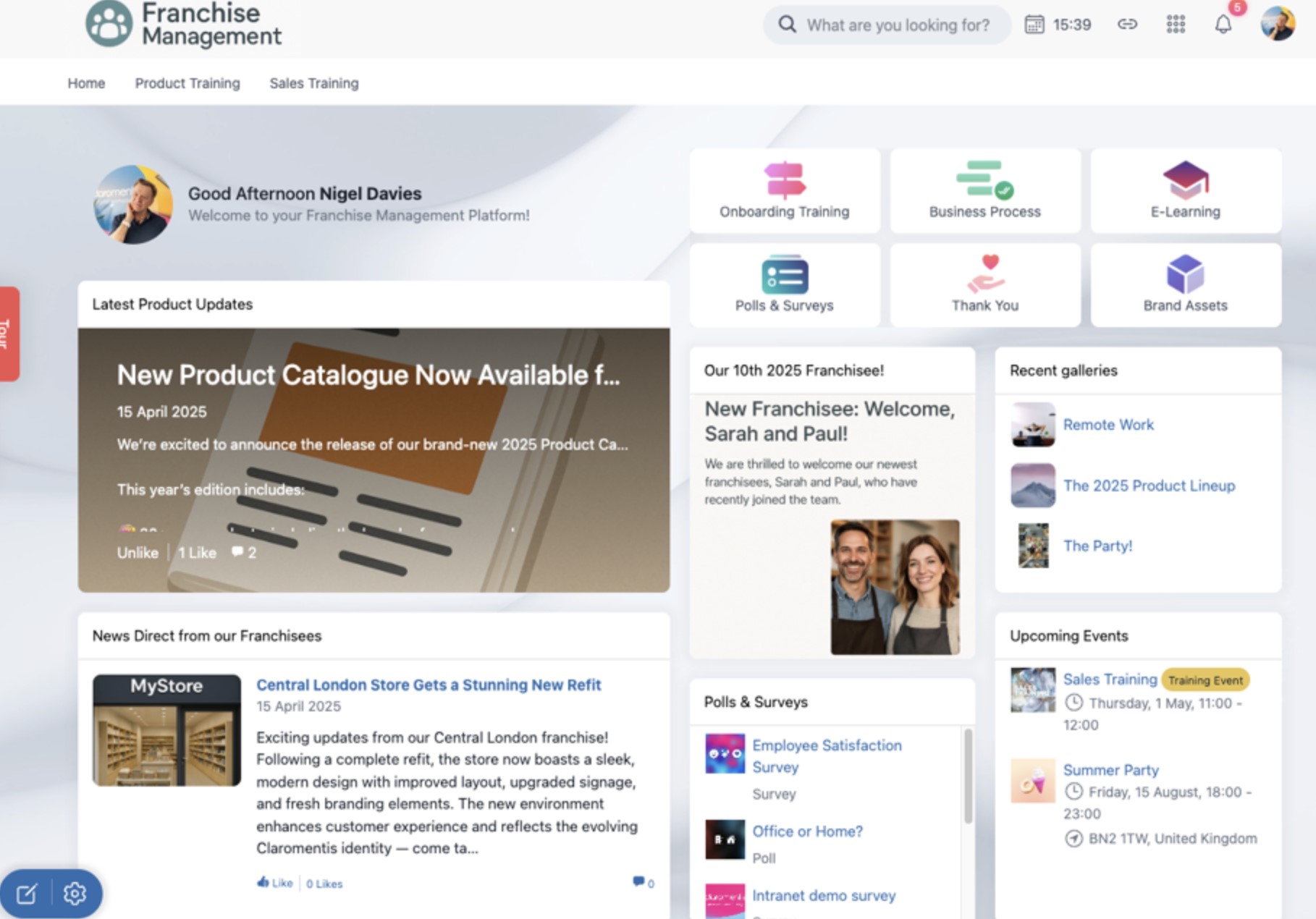
Claromentis (Best for Customisable Intranet & Process Management)
Key Features:
Pros:
Cons:
- Customisable company intranet and employee portal
- Built-in business process and workflow management tools
- Integrated learning management system (LMS)
- Document and knowledge management capabilities
- Internal communication tools (announcements, updates)
- Role-based permissions and access control
Pros:
- Highly flexible and configurable to business needs
- Combines intranet, processes, and learning in one platform
- Strong for standardising internal workflows
- Suitable for growing professional services firms
- Good balance between structure and functionality
Cons:
- Requires setup and ongoing management
- User experience not as modern as newer tools
- Limited real-time communication features
- Can feel complex for smaller teams
Claromentis
A Customisable Digital Workplace Platform for Processes, Learning & Intranets
Claromentis is built as a flexible digital workplace platform that combines intranet, learning, and process management into one system. It’s well-suited for organisations that need to standardise workflows while keeping communication and knowledge centralised.
See how Claromentis helps organisations manage processes, learning, and internal communication in one platform.#7. Jive (Best for Community-Driven Collaboration & Knowledge Sharing)
Jive takes a community-first approach—it's built around discussion, collaboration, and shared knowledge, rather than structured workflows or modern engagement layers.
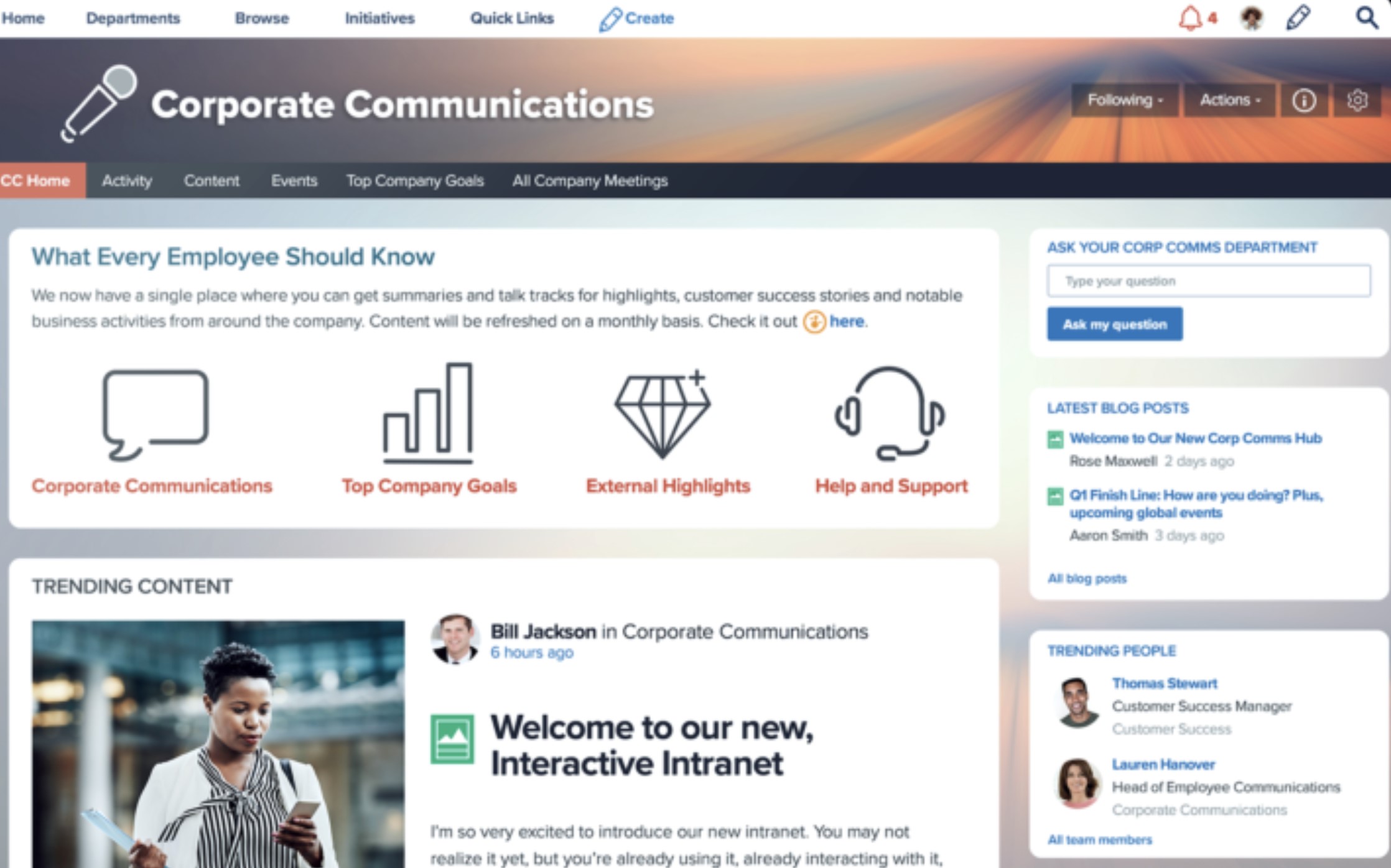
#7. Jive (Best for Community-Driven Collaboration & Knowledge Sharing)
Key Features:
Pros:
Cons:
- Community-based discussion forums and collaboration spaces
- Knowledge sharing through posts, Q&A, and content hubs
- Social features (profiles, comments, activity streams)
- Integration with enterprise tools and systems
- Search functionality for discovering shared knowledge
- Basic analytics on engagement and activity
Pros:
- Strong for encouraging collaboration and knowledge exchange
- Breaks down silos between departments
- Supports large organisations with distributed teams
- Good for building internal communities
- Encourages employee participation and interaction
Cons:
- Lacks structured document and knowledge management
- Interface can feel outdated compared to modern platforms
- Not ideal for managing workflows or processes
- Requires active participation to deliver value
Jive
A Community-Driven Collaboration Platform for Knowledge Sharing & Engagement
Jive is built as an enterprise collaboration platform focused on connecting employees through communities, discussions, and shared knowledge. It’s particularly useful for organisations that want to break down silos and encourage cross-team collaboration.
See how Jive enables organisations to build internal communities and improve collaboration across teams.#8. Bloomfire (Best for Centralised Knowledge Sharing & Content Discovery)
Bloomfire takes a focused approach—it's built to help organisations capture, organise, and surface knowledge at scale.
Digging through folders or asking around, employees can quickly find answers through a searchable knowledge hub.
That solves a major issue—time lost searching for internal expertise and information.
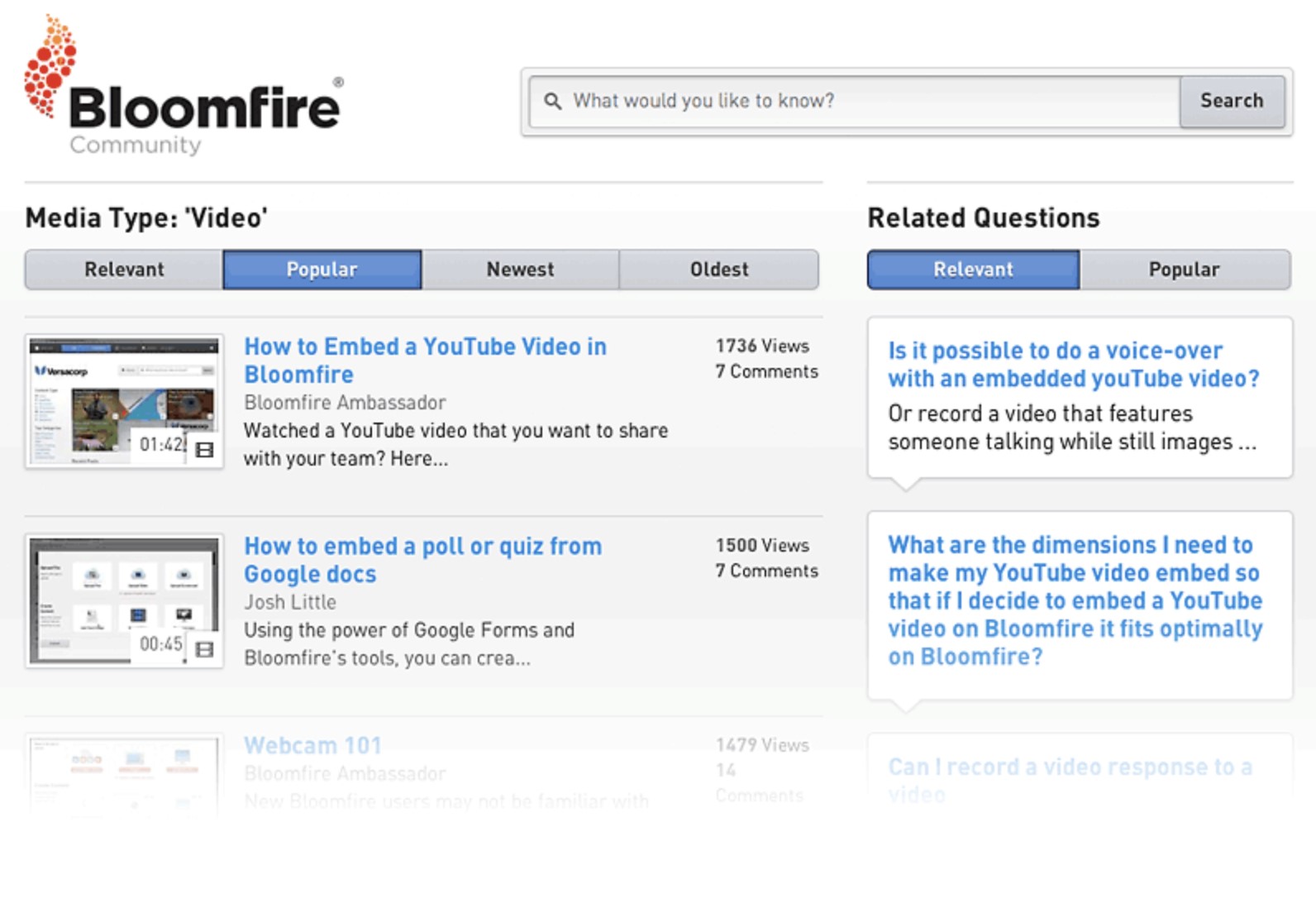
#8. Bloomfire (Best for Centralised Knowledge Sharing & Content Discovery)
Key Features:
Pros:
Cons:
- AI-powered search and content indexing
- Centralised knowledge base and content library
- Rich media support (videos, documents, Q&A content)
- Content categorisation and tagging for easy discovery
- Basic analytics on content usage and engagement
- Integration with common business tools
Pros:
- Excellent for organising and surfacing knowledge
- Reduces time spent searching for information
- Supports rich content formats (video, documents, FAQs)
- Easy for teams to contribute and share insights
- Scales well for knowledge-heavy organisations
Cons:
- Limited internal communication features
- Not designed for collaboration or workflow management
- Requires ongoing content updates to stay relevant
- Not a complete digital engagement platform
Bloomfire
A Knowledge Sharing Platform Built for Fast Content Discovery & Insights
Bloomfire is designed to help organisations centralise and surface knowledge quickly. It works as a knowledge sharing platform that makes it easy for teams to find answers, access documents, and reuse expertise without digging through multiple systems.
See how Bloomfire helps organisations centralise knowledge and improve content discovery across teams.#9. eXo Platform (Best Open-Source Digital Workplace for Customisation)
eXo Platform takes a very different approach—it's built as an open-source digital workplace, giving organisations full control over how their platform is configured and deployed.
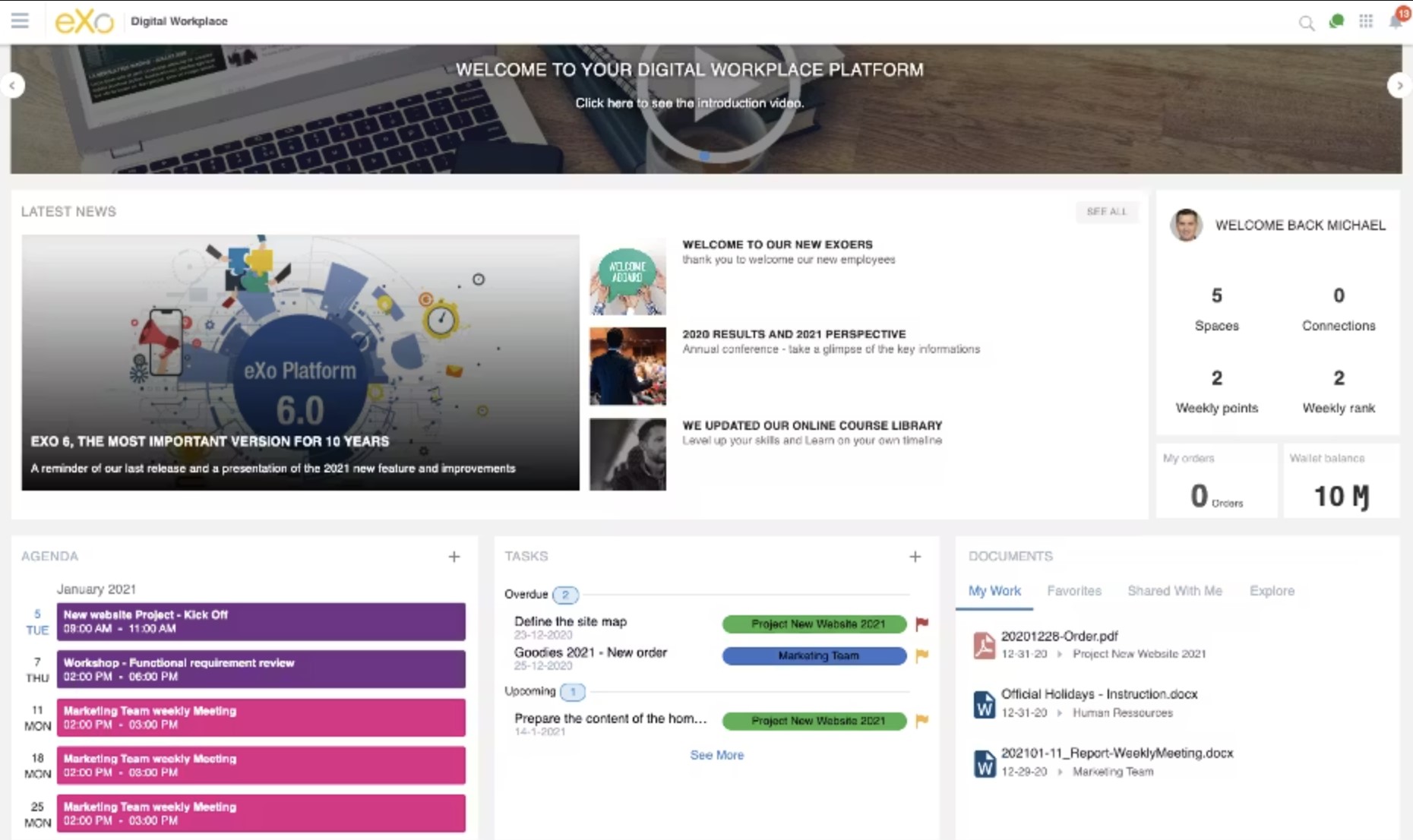
#9. eXo Platform (Best Open-Source Digital Workplace for Customisation)
Key Features:
Pros:
Cons:
- Open-source digital workplace and intranet platform
- Social collaboration tools (activity streams, discussions, profiles)
- Document and knowledge sharing capabilities
- Customisable modules and extensible architecture
- Integration with enterprise systems and APIs
- Role-based access control and permissions
Pros:
- Highly customisable to fit specific business needs
- Full control over data, hosting, and configuration
- Strong collaboration and community features
- No vendor lock-in
- Suitable for organisations with in-house technical teams
Cons:
- Requires technical expertise to deploy and maintain
- Longer implementation time compared to SaaS tools
- User experience not as polished as modern platforms
- Limited out-of-the-box features without customisation
eXo Platform
An Open-Source Digital Workplace for Full Control & Customisation
eXo Platform is built for organisations that want complete control over their environment. It works as an open-source digital workplace platform, allowing teams to customise their intranet, collaboration tools, and internal systems without being locked into rigid SaaS solutions.
See how eXo Platform gives organisations full control over their intranet, collaboration, and digital workplace setup.#10. ThoughtFarmer (Best for Knowledge-Centric Intranet & Internal Communication)
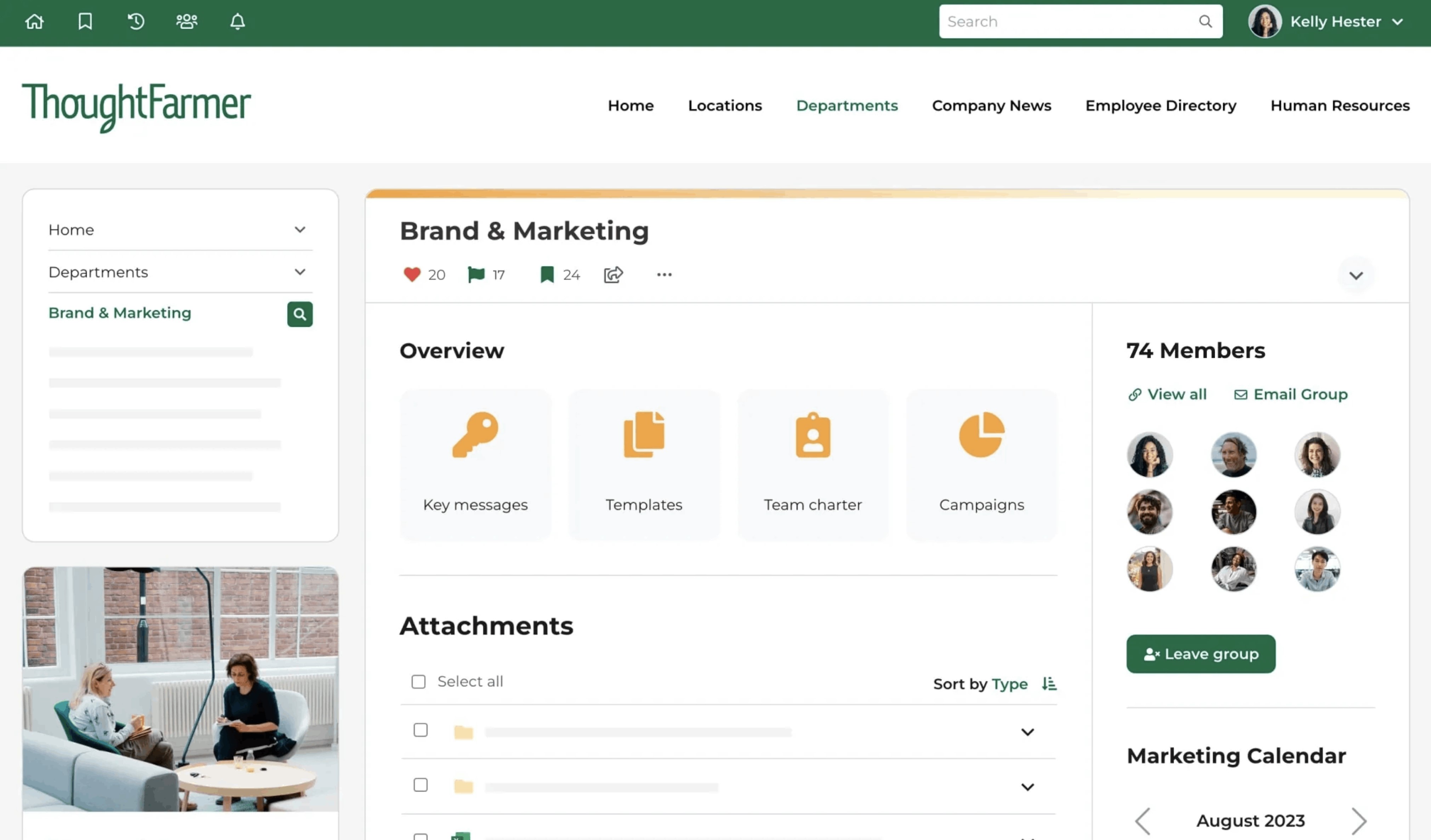
ThoughtFarmer takes a knowledge-first approach—it's built to help organisations capture, organise, and share internal knowledge in a structured, easy-to-navigate intranet.
It gives teams a central place to store processes, documents, and company information, making it easier to onboard employees and maintain consistency.
That solves a major issue—information scattered across emails, folders, and disconnected systems.
#10. ThoughtFarmer (Best for Knowledge-Centric Intranet & Internal Communication)
Key Features:
Pros:
Cons:
- Centralised intranet and knowledge base platform
- Document and content management with structured pages
- Internal communication tools (news, updates, announcements)
- Employee directory and profile pages
- Search functionality for quick knowledge access
- Basic analytics on content usage
Pros:
- Strong for organising company knowledge and processes
- Easy to navigate and use for non-technical teams
- Improves onboarding and knowledge sharing
- Helps maintain a single source of truth
- Reliable and stable intranet solution
Cons:
- Limited real-time communication features
- Lacks advanced employee engagement tools
- Not designed for complex workflows or collaboration
- Interface can feel less modern compared to newer platforms
ThoughtFarmer
A Knowledge-Centric Intranet Platform for Internal Communication & Clarity
ThoughtFarmer is designed to help organisations centralise knowledge and improve internal communication. It works as an intranet software that focuses on making documents, processes, and company information easy to find and manage.
See how ThoughtFarmer helps organisations centralise knowledge and improve internal communication.Key Features to Look for in Digital Engagement Platforms
Choosing the right digital engagement platform isn't about stacking features—it's about solving real operational problems inside professional services firms.
The best platforms combine communication, knowledge, and collaboration into one connected experience.
Centralised Communication Hub
A strong internal communication platform is the foundation, but for professional services teams, it's even more critical.
Consultants, lawyers, and advisors often work across multiple clients and projects at once.
Without a central hub, updates get buried in emails or scattered across chat tools.
By bringing announcements, team discussions, and updates into one place, firms reduce miscommunication and keep everyone aligned.
The real benefit?
Faster decision-making and fewer costly mistakes, especially when deadlines and client expectations are tight.
Knowledge Management & Document Sharing
In professional services, knowledge is the product.
A structured knowledge management system ensures that documents, frameworks, and client insights are easy to find and reuse.
Instead of recreating work or chasing colleagues for files, teams can access a single source of truth.
This directly improves efficiency and protects billable hours, while also ensuring consistency in client delivery.
Integration with Existing Tools
Professional services firms already rely on a mix of systems—CRMs to manage client relationships, HR platforms to track people and performance, and project management tools to deliver work.
The problem is, these systems often operate in isolation. Teams end up switching between tabs, duplicating data, and manually updating information, which slows everything down.
A modern digital workplace platform solves this by acting as the connective layer between these tools.
Instead of forcing employees to adapt their workflow, it integrates directly with existing systems, bringing data, updates, and actions into one central environment.
This means a consultant can access client information, project updates, and internal communication without leaving the platform.
For professional services teams, this is especially valuable because their work is highly time-sensitive and client-driven. The less time spent navigating systems, the more time can be spent delivering value.
It also reduces the risk of working with outdated or inconsistent data—something that can easily impact client outcomes and trust.
Employee Engagement & Feedback Tools
High-performing firms don't just track performance—they understand their people.
Built-in employee engagement software helps teams share feedback, recognise contributions, and stay connected.
For distributed teams, this is key to maintaining culture and motivation. Engaged employees are more productive, collaborate better, and deliver stronger results for clients.
Mobile Access for On-the-Go Teams
Professional services teams aren't always at a desk.
A mobile-first employee app ensures consultants and field staff can access documents, updates, and communication tools wherever they are.
This keeps projects moving, reduces delays, and allows teams to respond to clients quickly—something that directly impacts client satisfaction.
Role-Based Access & Security
Handling sensitive client data is part of the job.
With role-based access controls, firms can ensure the right people see the right information—nothing more, nothing less.
This not only protects data but also builds trust with clients, which is essential in industries where confidentiality and compliance are non-negotiable.
The key takeaway? These features aren't just "nice to have." For professional services firms, they directly impact efficiency, client delivery, and profitability—which is exactly why choosing the right digital engagement platform matters.
Common Mistakes to Avoid When Choosing a Digital Engagement Platform
Let's be blunt—most firms don't fail because they pick a "bad" platform.
They fail because they pick the wrong one for how their teams actually work.
If you're evaluating digital engagement platforms, here are the mistakes you need to actively avoid—because they will cost you time, adoption, and ultimately revenue.
Choosing Based on Features, Not Use Case
It's easy to get pulled into feature comparisons.
One platform has more integrations, another has better analytics, another has AI baked in.
But here's the reality: features don't drive value—usage does.
Professional services teams don't need more tools—they need tools that fit how they deliver work. If your consultants can't quickly access documents, collaborate, and communicate in context, those "extra features" become irrelevant.
Focus on your workflows. Ask yourself:
- How do teams share knowledge today?
- Where does work slow down?
- What actually impacts billable hours?
Ignoring Adoption and User Experience
You can invest in the most powerful pl
atform on the market—but if your team doesn't use it, it's dead on arrival.
This is where most firms get it wrong. They prioritise capability over usability.
Professional services teams are busy. If a platform feels complex, slow, or disconnected from their daily work, they'll default back to email, chat, or whatever they already know.
- If it's not intuitive, it won't be used
- If it requires heavy training, adoption will drop
- If it doesn't fit into daily workflows, it will be ignored
And here's the impact: low adoption = fragmented communication = inconsistent client delivery.
Overcomplicating with Too Many Tools
This is one of the biggest silent killers of productivity.
Most firms already have:
- a chat tool
- a document system
- a project tool
- a CRM
- an intranet (that no one uses)
Adding another platform on top without consolidation just makes things worse.
Don't ask, "What else can we add?"
Ask, "What can we replace?"
The top digital engagement platforms reduce tool sprawl—they don't add to it.
Not Considering Scalability
What works for a 20-person team will break at 200.
This is where short-term thinking becomes expensive. Many firms choose a tool because it solves today's problem—without considering how the business will grow.
As your firm scales, you'll need:
- better permissions and access control
- more structured knowledge management
- stronger reporting and visibility
- the ability to support multiple teams and regions
If your platform can't evolve with you, you'll end up replacing it—costing time, money, and momentum.
Choose a platform that can support where your firm is going, not just where it is today.
The Real Impact of Getting This Wrong
If you ignore these mistakes, the impact isn't theoretical—it's operational:
- Teams waste time searching instead of delivering
- Knowledge gets lost or duplicated
- Communication becomes inconsistent
- Client experience starts to slip
- Billable hours quietly disappear
And that's the part most firms underestimate—the cost isn't just the platform, it's the inefficiency it creates.
How to Evaluate Digital Engagement Platforms (Checklist)
Before you commit to any digital engagement platform, you need to pressure-test it properly.
Most platforms look great in a demo—but the real question is: will it actually work for your team in the real world?
Use this checklist to cut through the noise and make a decision that won't come back to bite you later.
✅ Does it replace multiple tools?
- Can it combine internal communication, document management, and collaboration tools in one place?
- Will it reduce your reliance on email, chat apps, and shared drives?
- Does it eliminate tool switching for your team?
If the answer is no, you're probably adding complexity—not removing it.
✅ Is it easy for non-technical users?
- Can employees use it without training or long onboarding sessions?
- Does the interface feel intuitive from day one?
- Can new hires quickly find what they need without asking others?
Remember: if it's not easy, it won't get used. Adoption is everything.
✅ Can it scale with your firm?
- Will it still work when your team doubles or expands globally?
- Does it support role-based access, departments, and multiple teams?
- Can it handle growing volumes of documents and knowledge?
Short-term solutions create long-term problems—don't fall into that trap.
✅ Does it integrate with your current stack?
- Does it connect with your CRM, HR system, and project tools?
- Can it pull data into one place instead of forcing manual updates?
- Will it reduce duplication and errors across systems?
Disconnected tools are one of the biggest productivity killers.
✅ Does it support both employee and client engagement?
- Can your team collaborate internally and deliver consistent client experiences?
- Does it improve communication across projects and stakeholders?
- Will it help your team respond faster and work more efficiently?
In professional services, internal efficiency directly impacts client satisfaction.
✅ Does it improve access to knowledge?
- Can employees quickly find documents, processes, and answers?
- Is there a strong knowledge management system with search and structure?
- Does it reduce time spent asking colleagues for information?
✅ Does it reduce friction in daily work?
- Can teams complete tasks without switching between multiple tools?
- Does it simplify workflows instead of adding steps?
- Does it actually make work faster—not just "more digital"?
If it doesn't make work easier, it's the wrong platform.
Don't just ask "Does this platform have the features?"
Ask:
"Will this actually make my team faster, more aligned, and more efficient?"
Because that's what separates average tools from the top digital engagement platforms.
How to Choose the Right Digital Engagement Platform
When you're comparing different digital engagement platforms, don't get distracted by long feature lists or flashy demos.
That's where most firms go wrong.
The real question is: what will this platform actually change once your team starts using it?
A better way to evaluate your options—especially in professional services—is to ask:
- Will this reduce the time our team spends searching for information?
- Can consultants and teams easily find documents, updates, and client insights without asking around?
- Does it bring internal communication, knowledge management, and collaboration tools into one place?
- Will it improve how teams work together across projects, locations, and clients?
- Can leadership actually see what's happening across teams without chasing updates?
- Does it support both employee engagement and day-to-day operations—not just one or the other?
- Will it scale as the firm grows without needing to replace it later?
- Does it integrate with the tools we already rely on (CRM, HR, project systems)?
- Can it turn fragmented workflows into something structured and repeatable?
- Is there onboarding or support to help us implement it properly—not just buy it?
That last one matters more than most people think.
Because here's the truth—most platforms don't fail because of technology. They fail because they're never fully adopted or properly implemented.
For professional services firms, the impact is even bigger. Every inefficiency directly affects billable time, client delivery, and profitability.
So don't just choose a platform based on what it can do.
Choose one based on what it will actually help your team do better, faster, and more consistently.
Because with the right setup, a digital engagement platform becomes more than software—it becomes the system that keeps your entire firm aligned and operating efficiently.
23 min
to refocus
Research from University of California, Irvine shows it can take over 23 minutes to refocus after switching tasks. In environments with multiple tools and constant interruptions, this creates a major productivity drain for professional services teams.
Source: University of California, Irvine
How the Right Platform Impacts Business Performance
Choosing the right digital engagement platform isn't just an IT decision—it directly affects how your firm performs, delivers, and grows.
In professional services, where time equals revenue, even small inefficiencies can have a measurable impact.
Here's where the difference really shows.
Improves Billable Efficiency
Let's start with the biggest one—time.
In most firms, a surprising amount of time is lost not doing the work, but trying to find the information needed to do it.
Documents sit in different systems, conversations happen across multiple tools, and knowledge isn't always easy to access.
The right platform changes that.
By centralising knowledge management, internal communication, and document access, teams spend less time searching and more time delivering.
Over time, that efficiency compounds—projects move faster, teams become more productive, and profitability improves without increasing headcount.
28%
workweek spent searching
According to McKinsey & Company, employees can spend up to 28% of their workweek searching for information—and in professional services, that translates directly into lost billable hours and reduced productivity.
Source: McKinsey & Company
Enhances Client Experience
Clients don't see your internal tools—but they feel the impact of them.
When teams are working with disconnected systems, it leads to delays, inconsistent information, and slower response times.
That creates friction in the client experience, even if the work itself is strong.
A well-implemented digital workplace platform ensures everyone is working from the same, up-to-date information.
Communication becomes clearer, handovers between teams improve, and responses become faster and more accurate.
The result?
- Quicker turnaround times
- More consistent delivery
- Stronger client confidence
In a competitive market, that consistency is often what separates firms that retain clients from those that lose them.
Strengthens Internal Alignment
One of the most overlooked issues in professional services firms is misalignment.
Different teams working on the same client may be using different documents, following different processes, or simply not sharing information effectively. Over time, this creates duplication, confusion, and unnecessary risk.
The right platform acts as a single source of truth.
With structured access to information, clear communication channels, and shared workspaces, everyone operates from the same foundation. Leadership gains visibility, teams stay aligned, and decisions are made based on accurate, consistent data.
That alignment doesn't just improve efficiency—it reduces errors and creates a more predictable, scalable way of working.
If you get this right, the impact is clear:
- More time spent on billable work
- Better client experiences and retention
- Stronger alignment across teams
- Less operational friction
If you get it wrong, the opposite happens—and the cost builds quietly over time.
That's why the top digital engagement platforms aren't just tools—they're operational systems that shape how your firm performs every day.
Final Thoughts: Choosing the Right Digital Engagement Platform
At this point, it should be clear—choosing a digital engagement platform isn't really about comparing features. It's about solving the problems that slow your team down every day.
Too many firms focus on what a platform can do instead of what it will actually fix. But in professional services, the real issues are usually the same: wasted time searching for information, disconnected communication, and inconsistent ways of working.
That's where your focus needs to be.
Start with the fundamentals:
- Will your team actually use it?
- Does it simplify how people work—or add another layer?
- Can it connect your systems instead of creating more silos?
Because if adoption isn't there, nothing else matters.
Simplicity is just as important.
The best platforms don't overwhelm teams with complexity—they remove friction. They make it easier to find information, communicate clearly, and get work done without thinking about the tool itself.
Integration is the final piece.
Your platform shouldn't replace everything—it should connect everything. When your internal communication tools, knowledge management system, and collaboration workflows are aligned, the business runs smoother without constant manual effort.
And here's the shift most firms miss:
The right platform doesn't just support your operations—it becomes your operations.
It becomes the place where work happens, where knowledge lives, and where teams stay aligned. In effect, it turns into your firm's central operating system.
Get that right, and you don't just improve efficiency—you create a more scalable, consistent, and high-performing organisation.
AI Summary
- Digital engagement platforms help professional services firms improve communication, knowledge sharing, project visibility, and employee collaboration across distributed teams.
- For law firms, consultancies, agencies, accountants, and advisory businesses, the right platform reduces wasted time searching for files, updates, client information, and internal resources.
- Modern platforms combine intranet features, document management, internal communication, task coordination, analytics, and integrations into one central digital workspace.
- Professional services teams should look for tools that support secure permissions, client-sensitive information, role-based access, mobile access, and searchable knowledge hubs.
- The best digital engagement platforms in 2026 focus on adoption, usability, automation, and measurable employee engagement rather than simply adding another communication channel.
- Choosing the right solution starts with identifying where your firm loses time: poor communication, scattered documents, weak visibility, disconnected systems, or low employee engagement.
Most Popular Posts

Effective communication among team members is vital for the productivity and success of any organization. Surprisingly, 60% of companies lack a long-term internal communication strategy, which p...


Businesses thrive on communication for efficiency, productivity and accomplishment. When the right information is passed from the right designation in the organization, it promotes positivity an...

Categories
Blog
(3248)
Business Management
(399)
Employee Engagement
(237)
Digital Transformation
(224)
Growth
(151)
Intranets
(142)
Internal communications
(110)
Remote Work
(68)
Sales
(53)
Collaboration
(53)
Customer Experience
(33)
Culture
(30)
Project management
(30)
Knowledge Management
(29)
Leadership
(20)
Comparisons
(9)
News
(1)

Related Posts

Searching for "communal work spaces near me" but unsure which option will actually suit your growing business? By the end of this guide, you'll know how to compare offices to rent, spot extra costs and ask the right questions before committing....

Do you know what happens to your information after you share it with an AI assistant? That question sits at the heart of AI privacy—and it's easy to overlook when you're trying to finish a task. You paste in a customer email, upload a spr...

What would happen if your website moved successfully, but your customers and employees suddenly couldn't reach you by email? Email migration tools can help transfer your messages, but keeping business communication running takes more than copyi...

Does your team still message HR to ask where the holiday policy is? Employee self service should make everyday tasks easier, giving people a straightforward way to find answers, access documents and submit requests. But when policies are buried...

How quickly can a new partner go from signing an agreement to confidently working with your business? If the answer involves chasing documents, forwarding training links and answering the same questions repeatedly, your onboarding process may n...

Jill Romford
I am a digital nomad, lover of exploring new places and making friends.
I love to travel and I love the internet. I take pictures of my travels and share them on the internet using Instagram.
Traveler, entrepreneur, and community builder. I share my insights on digital marketing and social media while inspiring you to live your fullest life.
Ready to learn more? 👍
One platform to optimize, manage and track all of your teams. Your new digital workplace is a click away. 🚀
Free for 14 days, no credit card required.