Insight Blog
Agility’s perspectives on transforming the employee's experience throughout remote transformation using connected enterprise tools.
31 minutes reading time
(6249 words)
AI/ML Consulting Services: What Your AI Initiative Should Deliver Before Intranet Deployment

AI/ML Consulting Services: What Your AI Initiative Should Deliver Before Intranet Deployment
Learn how AI/ML consulting services help enterprises plan, govern, and deploy AI successfully. Discover best practices, common mistakes, and expert guidance.
AI/ML Consulting Services: What Your AI Initiative Should Deliver Before Intranet Deployment

Let's be honest—most AI projects don't fail because the technology isn't good enough.
They fail because businesses jump straight into buying AI tools without first figuring out what problem they're actually trying to solve.
In fact, according to IBM's Global AI Adoption Index, 42% of enterprise-scale companies have actively deployed AI, but many organisations still struggle to turn those investments into meaningful business results.
That's where AI consulting and machine learning consulting become valuable.
A good consulting partner shouldn't just recommend the latest AI model—they should help you build a clear strategy, organise your company knowledge, improve data quality, and make sure employees are actually ready to use AI.
Otherwise, you're simply adding another piece of software that people may ignore.
42%
of enterprises
According to the IBM Global AI Adoption Index, 42% of enterprise-scale organisations have actively deployed AI. Despite growing adoption, many businesses still struggle to translate AI investments into measurable operational improvements and business outcomes.
Source: IBM Global AI Adoption Index
Think about your company intranet for a moment.
If it's full of outdated documents, duplicate files, or information employees can't trust, even the smartest AI won't magically produce better answers.
As the saying goes, garbage in, garbage out. The quality of your AI depends on the quality of the information it learns from.
Here's the part many businesses overlook: the organisations that prepare properly today are far more likely to gain a competitive advantage tomorrow.
While competitors are still experimenting with AI, you could already be giving employees instant access to trusted knowledge, faster search, and smarter workplace automation.
In this guide, we'll walk through what AI consulting and machine learning consulting services should actually deliver before your intranet deployment begins.
You'll learn how to prepare your data, improve governance, involve the right people, and build an AI-powered intranet that employees genuinely find useful—instead of becoming another expensive project that never delivers on its promise.
Key Takeaways
- Successful AI initiatives begin with clear business objectives, high-quality data, and well-defined use cases rather than choosing technology first.
- AI/ML consulting services should assess data readiness, governance, security, integrations, and organisational processes before implementation begins.
- Starting with a focused pilot project allows organisations to validate results, gain employee feedback, and reduce deployment risk before scaling.
- Responsible AI adoption depends on governance, role-based access, employee training, human oversight, and continuous performance monitoring.
- An AI-ready digital workplace combines communication, knowledge management, collaboration, and enterprise search to maximise the value of artificial intelligence.
Why Do So Many Enterprise AI Initiatives Fail?

Why Do So Many Enterprise AI Initiatives Fail
If you're planning to invest in AI, don't make the mistake of thinking the technology alone will solve your problems.
That's one of the biggest reasons AI initiatives fall short.
Before you speak with artificial intelligence consulting companies, take a step back and ask yourself one simple question: What business problem are we trying to solve?
If you can't answer that clearly, neither the best AI platform nor the best consultants will be able to deliver the results you're expecting.
Good AI consulting starts with your business goals—not the technology. Whether you want to improve employee productivity, reduce time spent searching for information, automate repetitive tasks, or build a smarter intranet, every AI decision should support a measurable outcome.
The same applies to machine learning consulting.
Your consultants shouldn't begin by recommending models or algorithms.
They should first understand your processes, review your existing knowledge, identify data gaps, and make sure your organisation is actually ready for AI.
42%
of enterprises
According to the IBM Global AI Adoption Index, 42% of enterprise-scale organisations have already deployed AI. However, many still struggle to achieve measurable business value because they skipped critical planning, governance, and data preparation before implementation.
Source: IBM Global AI Adoption Index
Are you focusing on technology instead of business outcomes?
Don't buy AI because everyone else is doing it. Instead, define exactly what success looks like. Decide which processes need improving, who will benefit, and how you'll measure the results.
Technology is only the tool—the business outcome is what really matters.
Before investing in AI, make sure you can answer these questions:
- Which business problem are you trying to solve? For example, reducing support requests, improving knowledge discovery, or automating repetitive tasks.
- Who will benefit the most from AI? Identify the teams, departments, or employees that will use it daily and where it will have the biggest impact.
- How will you measure success? Set clear KPIs such as time saved, faster onboarding, improved employee satisfaction, or fewer hours spent searching for information.
Is poor knowledge management reducing your AI's accuracy?
AI is only as good as the information it can access.
If your intranet contains outdated policies, duplicate documents, or poorly organised content, your AI will return inconsistent answers.
Before deployment, clean up your knowledge base, remove outdated information, and organise content so employees—and AI—can trust it.
Have you defined success before your AI project begins?
Enter your text here One of the most common mistakes is launching an AI initiative without clear KPIs.
Before implementation, decide how you'll measure success.
That could be reducing support tickets, improving search accuracy, increasing employee productivity, or shortening onboarding time.
Clear goals make it much easier to evaluate whether your AI investment is delivering real business value....
What Should AI/ML Consulting Services Deliver Before Intranet Deployment?
Before you sign a contract with any artificial intelligence consulting companies, make sure you know exactly what you're paying for.
A successful AI project isn't just about deploying a chatbot or adding machine learning to your intranet. It's about creating a clear roadmap that helps your business work smarter, improve employee productivity, and deliver measurable results.
The best AI/ML consulting services for enterprises should spend as much time understanding your business as they do discussing technology.
Likewise, experienced machine learning consulting services should help you prepare your data, improve knowledge management, and identify opportunities where AI can genuinely make a difference.
Before your AI intranet project begins, your consulting partner should help you answer questions like these:
- What business problems are you trying to solve? Focus on real challenges such as reducing support requests, improving document search, automating repetitive tasks, or speeding up employee onboarding.
- How will AI improve the employee experience? Your AI solution should make it easier for people to find information, collaborate, and complete everyday work—not create another system they have to learn.
- Is your company data ready for AI? Clean, accurate, and well-organised information is essential if you want AI to deliver reliable answers.
- Who owns the project? Assign executive sponsors, IT leaders, HR, compliance teams, and department managers before implementation begins.
- How will you measure success? Define KPIs such as employee productivity, knowledge search accuracy, reduced response times, or lower operational costs.

Should your AI strategy align with measurable business goals?
Should your AI strategy align with measurable business goals?
Yes—and this should be your first priority. Every AI initiative should support a business objective that you can measure.
If your consultants can't explain how AI will improve your organisation, it's worth asking why.
Good enterprise AI implementation strategy starts with outcomes like:
- Reducing the time employees spend searching for information.
- Improving internal communication across distributed teams.
- Automating repetitive administrative work.
- Delivering faster employee onboarding.
- Increasing productivity without increasing headcount.
What business problems should AI solve first?
Start with the problems that waste the most time or money.
These are usually the areas where AI delivers the fastest return on investment.
For many organisations, that includes:
- Employees struggling to find company policies or documents.
- Knowledge locked away in multiple systems.
- Too many repetitive HR or IT support questions.
- Manual approval workflows slowing down the business.
- Poor communication between office and frontline employees.
Avoid trying to solve every problem at once. A focused AI deployment is far more likely to succeed than a large-scale project with unclear priorities.
Which stakeholders need to be involved before deployment begins?
Don't leave AI decisions to the IT department alone. The most successful projects involve people from across the business because AI will eventually affect everyone.
Your planning team should typically include:
- Executive leadership to define business objectives and approve investment.
- IT and security teams to manage infrastructure, integrations, and data protection.
- HR and Internal Communications to improve employee adoption and engagement.
- Compliance and legal teams to ensure governance and regulatory requirements are met.
- Department managers and end users to provide practical feedback on how AI will support everyday work.
Getting the right people involved early reduces risk, improves adoption, and helps ensure your AI intranet deployment delivers long-term value instead of becoming another technology project that fails to gain traction.
Is Your Existing Company Knowledge Ready for AI?
Before you roll out any AI solution, take a close look at the information your business already has.
Whether you're deploying an AI assistant, intelligent enterprise search, or a modern digital workplace, the quality of your content will directly affect the quality of the answers employees receive.
Many organisations underestimate this step. Years of duplicated files, outdated policies, and disconnected knowledge repositories can quickly reduce confidence in AI.
If employees receive inaccurate answers, they won't trust the system—and adoption will suffer.
Before moving forward, assess whether your organisation is ready by asking these questions:
- Is company knowledge stored in one central location, or spread across multiple systems?
- Can employees easily find the latest version of important documents?
- Are outdated files and duplicate content regularly reviewed and removed?
- Does your content have clear ownership and review dates?
- Can sensitive information be protected with the right access permissions?
Where is your organisational knowledge currently stored?
Start by mapping where your business information lives today.
Many companies store documents across SharePoint, Microsoft Teams, Google Drive, network folders, email attachments, and legacy file servers.
While this may seem manageable for employees, it creates a challenge for enterprise knowledge management and AI-driven search.
Create an inventory of your information sources before introducing AI.
This will help you identify missing content, duplicate records, and systems that should be connected as part of your intelligent workplace strategy.
How do duplicate and outdated documents affect AI responses?
AI can't tell which document is "correct" if your organisation has multiple versions of the same policy or procedure.
Instead, it may surface conflicting information, causing confusion and reducing employee confidence.
To improve answer quality, you should:
- Remove duplicate documents wherever possible.
- Archive outdated policies and obsolete content.
- Keep a single source of truth for important business information.
- Introduce version control and document approval processes.
- Schedule regular content reviews to keep information current.
These simple housekeeping tasks can significantly improve the performance of AI-powered enterprise search and workplace assistants.
Should you clean and organise content before deploying AI?
Absolutely. Cleaning your content is one of the highest-value activities you can complete before deployment.
The goal isn't simply to organise files—it's to ensure your AI has access to accurate, trusted, and well-structured information.
Before going live, make sure you:
- Organise documents into logical categories.
- Apply consistent naming conventions across files.
- Remove redundant, obsolete, and trivial (ROT) content.
- Add metadata and document owners where appropriate.
- Review user permissions to protect confidential information.
- Establish a governance process for future content updates.
The better your content is organised today, the more accurate your enterprise AI knowledge base, AI document management system, and digital workplace search will be tomorrow.
Think of it as laying the foundation—if your knowledge is well managed, your AI will have a much stronger platform to build on.
What Features Should an AI-Powered Intranet Deliver?
If you're investing in an AI-powered intranet, don't settle for flashy features that look impressive during a demo but add little value to employees.
Instead, focus on capabilities that solve everyday workplace problems, improve productivity, and make company knowledge easier to access.
The best enterprise AI platforms don't replace employees—they remove the frustration of searching for information, answering repetitive questions, and switching between multiple applications.
Every feature should have a clear business purpose and help people work faster with greater confidence.
When evaluating an AI-enabled digital workplace, these are the features you should expect.
| AI Capability | Why It Matters | Business Benefit |
| Natural language search | Employees ask questions in plain English instead of searching folders. | Faster access to trusted company knowledge. |
| AI knowledge assistant | Provides instant answers using approved company documents. | Reduces support requests and saves time. |
| Document summarisation | Creates quick summaries of long policies, procedures, and reports. | Employees understand information faster. |
| Content generation | Helps draft announcements, knowledge articles, emails, and meeting notes. | Reduces manual writing and improves consistency. |
| Intelligent recommendations | Suggests related documents, experts, and resources. | Improves collaboration and knowledge sharing. |
| Enterprise search across systems | Searches SharePoint, cloud storage, HR systems, and intranet content from one place. | Eliminates information silos. |
Should employees be able to search company knowledge using natural language?
Absolutely. Your employees shouldn't need to remember file names or navigate complicated folder structures just to find a policy or procedure.
Modern AI enterprise search software allows employees to ask questions naturally, such as:
- "What's our remote working policy?"
- "How do I submit an expense claim?"
- "Who approves annual leave?"
- "Where can I find the employee handbook?"
Instead of returning hundreds of documents, AI should deliver a clear answer with links to the original source, giving employees confidence that they're viewing the latest information.
How can AI reduce time spent searching for documents?
One of the biggest productivity killers is searching across multiple systems for the same piece of information. Employees often waste valuable time checking email, SharePoint, Teams, network drives, and shared folders before finding the correct document.
A modern intelligent document search solution should help employees:
- Search every connected knowledge source from one place.
- Find the latest approved version of a document.
- Locate subject matter experts related to specific topics.
- Discover relevant policies, procedures, and training materials.
- Access information securely based on their role and permissions.
The result is less time searching and more time getting work done.
Can AI help employees create and summarise workplace content?
Yes—and this is where many businesses see immediate productivity gains.
Instead of starting from a blank page, AI can help employees create high-quality content while maintaining a consistent tone across the organisation.
Useful capabilities include:
- Drafting company announcements.
- Summarising lengthy reports and meeting notes.
- Creating knowledge base articles.
- Writing HR policies and internal communications.
- Generating onboarding guides and training materials.
- Translating workplace content for multilingual teams.
These features help employees spend less time writing and more time focusing on higher-value work.
How does conversational AI improve the employee experience?
Employees increasingly expect workplace technology to be as easy to use as the apps they use every day.
That's why conversational AI for employee support is becoming an essential feature of modern digital workplaces.
Rather than navigating menus or submitting support tickets, employees can simply ask questions and receive instant, context-aware answers.
A conversational AI assistant can help employees:
- Find company information in seconds.
- Complete routine HR and IT tasks.
- Receive personalised recommendations.
- Access policies without searching multiple systems.
- Get answers any time of the day, from any device.
When implemented correctly, conversational AI doesn't replace people—it removes everyday friction, helping employees stay productive while allowing HR and IT teams to focus on more complex work.
How Can AI Improve Internal Communication Across the Workplace?
Strong internal communication isn't about sending more messages—it's about making every message count.
If employees are constantly switching between email, chat apps, and multiple business systems, important updates can easily get lost.
This is where AI can make a real difference. Instead of treating everyone the same, AI can help deliver personalised communications, prioritise important announcements, and ensure employees receive information that is relevant to their role.
The result is a more connected workforce with less noise and better engagement.
How Can AI Improve Internal Communication Across the Workplace
Can AI personalise announcements for different departments?
Yes—and it should. Not every employee needs to receive every company update. Sales teams, HR, Operations, Finance, and frontline workers all have different priorities.
Rather than sending company-wide emails, AI can automatically target communications based on employee attributes such as:
- Department or business unit.
- Office location or region.
- Job role or seniority.
- Team or project membership.
- Employment type (office, remote, or frontline).
- Individual interests or subscriptions.
This means employees spend less time filtering through irrelevant information and more time focusing on updates that affect their work.
How can AI help reduce email overload?
If your employees are receiving dozens of internal emails every day, chances are many of them are being ignored.
AI can reduce inbox fatigue by moving routine communications into a central digital workplace where information is easier to discover.
Instead of relying solely on email, AI can help by:
- Summarising lengthy announcements into key points.
- Highlighting urgent messages that require action.
- Grouping related updates into a single notification.
- Recommending relevant news based on an employee's role.
- Delivering reminders only when they're actually needed.
This approach not only reduces email volume but also increases the chances that important communications are read and acted upon.
Should AI support multilingual communication across global teams?
Absolutely. As organisations grow across different countries and regions, language should never become a barrier to collaboration.
Modern AI translation for internal communications allows businesses to publish content once and automatically make it available in multiple languages, helping everyone stay informed without creating additional work for communication teams.
Consider choosing a platform that supports:
- Automatic translation of company announcements.
- Multilingual knowledge base articles.
- AI-generated summaries in different languages.
- Language-specific search results.
- Consistent messaging across global offices.
Supporting multiple languages isn't just about convenience—it helps create a more inclusive workplace where every employee has equal access to important company information, regardless of where they work or which language they speak.
What does an AI-powered communication workflow look like?
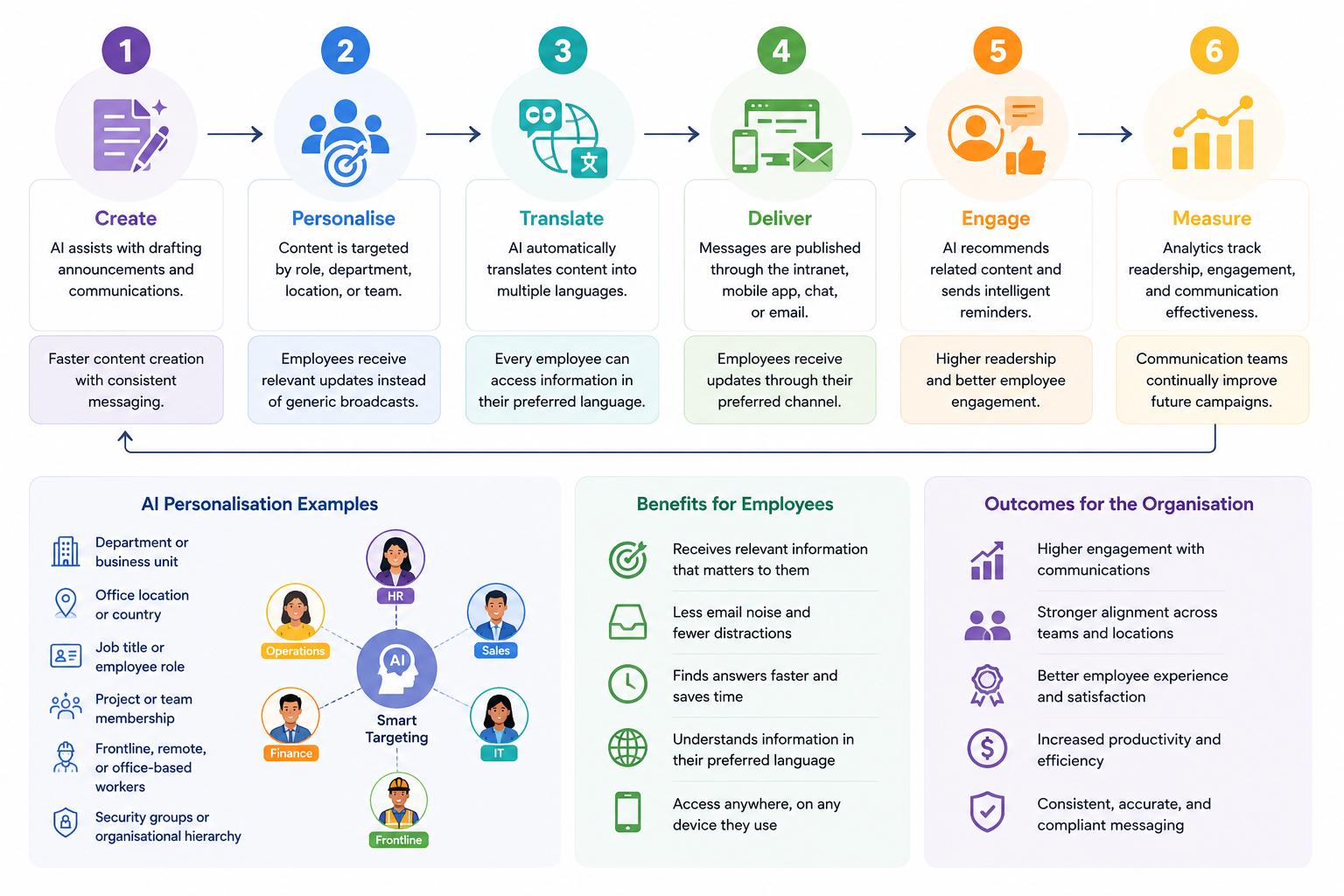
The following roadmap illustrates how AI can improve internal communication from the moment a message is created through to employee engagement and continuous optimisation.
| Stage | AI Activity | Employee Benefit |
| 1. Create | AI assists with drafting announcements and communications. | Faster content creation with consistent messaging. |
| 2. Personalise | Content is targeted by role, department, location, or team. | Employees receive relevant updates instead of generic broadcasts. |
| 3. Translate | AI automatically translates content into multiple languages. | Every employee can access information in their preferred language. |
| 4. Deliver | Messages are published through the intranet, mobile app, chat, or email. | Employees receive updates through their preferred channel. |
| 5. Engage | AI recommends related content and sends intelligent reminders. | Higher readership and better employee engagement. |
| 6. Measure | Analytics track readership, engagement, and communication effectiveness. | Communication teams continually improve future campaigns. |
What Should Your AI Implementation Roadmap Look Like?
A successful AI rollout should never begin with a company-wide launch.
The safest approach is to build an enterprise AI adoption roadmap that moves from discovery and testing to wider deployment, measurement, and ongoing improvement.
Think of the roadmap as a controlled journey rather than a single technology project.
Each stage should answer a clear question: What problem are you solving?
Is your data ready?
Will employees use the solution?
How will you measure value?
A practical roadmap normally includes six stages:
- Discover and assess current challenges, processes, and information gaps.
- Plan and prepare the data, technology, security, and governance requirements.
- Pilot and validate the solution with a small group of employees.
- Refine and optimise the experience using feedback and performance data.
- Scale and deploy the solution across additional teams or locations.
- Measure and evolve the platform as business needs change.
Following a phased AI transformation plan for businesses reduces risk and gives your organisation time to learn before committing more budget or resources.
Should you start with a pilot project before company-wide rollout?
Yes. A pilot project gives you the opportunity to prove that the technology works in a real business environment before introducing it to everyone.
Choose one clearly defined use case rather than trying to test every possible AI feature.
For example, you might begin with an employee assistant that answers common HR questions, helps staff find policies, or supports new starters during onboarding.
A well-managed pilot should include:
- A specific business problem and measurable objective.
- A small but representative group of employees.
- A controlled set of approved documents or data sources.
- Clear ownership across IT, HR, security, and the relevant department.
- A fixed testing period.
- A process for gathering employee feedback.
- Agreed criteria for deciding whether to expand, revise, or stop the project.
For example, you might measure whether the pilot reduces repetitive HR tickets, shortens the time employees spend searching for information, or improves the accuracy of internal answers.
Starting small doesn't mean thinking small. It gives you a safer way to build confidence and evidence before moving towards a broader AI workplace technology rollout.
Which departments usually benefit from AI first?
The best place to start is usually a department with high information volumes, repetitive tasks, or frequent employee questions.
These areas often produce visible results quickly, making it easier to demonstrate value to leadership and the wider workforce.
| Department | Suitable First Use Cases | Potential Benefit |
| Human Resources | Onboarding support, policy questions, benefits guidance, leave information | Fewer repetitive enquiries and a smoother employee experience |
| IT Support | Password guidance, software help, troubleshooting, service requests | Faster answers and reduced pressure on support teams |
| Internal Communications | Announcement drafting, content summaries, translation, message targeting | More relevant communications and improved readership |
| Operations | Process guidance, procedure lookup, compliance instructions | Faster access to accurate operational information |
| Finance | Expense questions, invoice guidance, approval processes | Reduced administrative work and fewer processing delays |
| Sales and Marketing | Proposal support, content creation, customer research, document retrieval | Quicker preparation and more consistent output |
Don't select a department simply because it appears enthusiastic about AI.
Choose an area where there is a clear problem, accessible data, supportive leadership, and a realistic opportunity to measure improvement.
This makes your department-by-department AI deployment strategy easier to manage and gives other teams a proven example they can learn from.
How should employee training and change management be planned?
Even the best technology will fail if employees don't understand it, trust it, or know when to use it.
Training and communication should therefore begin before the system goes live—not after employees start encountering problems.
Your AI change management programme should explain why the organisation is introducing the technology, how it will support employees, and what safeguards are in place.
Start by communicating:
- Which workplace problems the AI solution is designed to solve.
- What the system can and cannot do.
- Which information sources it uses.
- How employees should check important answers.
- How personal and company data will be protected.
- Where users can report inaccurate or unhelpful responses.
Training should also be tailored to different groups.
A frontline employee may need simple mobile guidance, while managers, content owners, administrators, and compliance teams will require more detailed instruction.
A practical training plan might include:
- Short role-based demonstrations.
- Quick-start guides and short videos.
- Live question-and-answer sessions.
- Department champions who support colleagues.
- A feedback channel for reporting problems.
- Refresher training after new features are introduced.
Employee feedback should continue after launch. Review common questions, adoption levels, failed searches, and low-confidence responses to identify where the system or its content needs improvement.
The goal isn't to force employees to use AI. It's to create enough trust, clarity, and practical value that using it becomes the easiest way to get work done.
Common AI Deployment Mistakes to Avoid
AI can improve productivity, search, communication, and decision-making—but only when it is introduced into a business that is ready for it. Too many organisations invest in new technology before fixing the underlying problems that caused inefficiency in the first place.
The biggest risks usually come from poor planning, weak ownership, unclear processes, and low employee involvement.
Avoiding these mistakes early can save your organisation from wasted budget, low adoption, and disappointing results.
Are you expecting AI to fix poor business processes?
AI should improve a good process, not hide a broken one.
If employees already follow inconsistent procedures, duplicate work across departments, or rely on outdated approval steps, adding AI may simply make those problems happen faster.
Before automating anything, review the process from beginning to end.
Ask yourself:
- Is the process still necessary?
- Are there too many approval stages?
- Do different teams follow different versions of the same procedure?
- Is information stored in too many places?
- Are employees working around the system because it is too difficult to use?
For example, an AI assistant cannot give reliable guidance if every department follows a different expense process. Likewise, automating a slow approval workflow will not help if the real problem is unclear ownership.
A proper AI process optimisation plan should simplify the workflow first, remove unnecessary steps, and then identify where automation can create genuine value.
Why shouldn't AI replace governance?
AI can support decisions, but it should not become the decision-maker for every workplace issue. Clear rules, human oversight, and accountability are still essential.
Without governance, employees may receive inaccurate answers, sensitive data could be exposed, or automated recommendations may be used without proper review. This becomes especially risky when AI is involved in HR, compliance, finance, legal matters, or employee performance.
Your responsible AI governance framework should define:
- Who owns the system.
- Which data sources AI can access.
- Who approves new use cases.
- How confidential information is protected.
- When human review is required.
- How inaccurate outputs are reported and corrected.
- How performance, fairness, and compliance are monitored.
AI should make governance easier to apply—not replace it. Employees still need to know who is accountable when something goes wrong.
The safest approach is to treat AI as a support tool that helps people make faster, better-informed decisions while keeping final responsibility with the appropriate human owner.
What happens when employees are excluded from AI adoption?
When employees are left out of the process, adoption usually suffers.
People are more likely to resist new technology when it appears without explanation, training, or an opportunity to provide feedback.
They may worry that AI is being introduced to monitor them, reduce jobs, or change their role without consultation.
This can lead to:
- Low usage after launch.
- Mistrust of AI-generated answers.
- Employees returning to old tools and processes.
- Increased resistance to future technology projects.
- Valuable feedback being missed.
- Poor return on the organisation's investment.
A strong employee-centred AI adoption strategy should involve users before deployment begins.
Speak to employees about their daily frustrations, test the solution with real teams, and use their feedback to improve the experience.
Employees should understand:
- Why the technology is being introduced.
- Which problems it is designed to solve.
- How it will affect their daily work.
- What information it can and cannot access.
- How they can challenge or report an incorrect answer.
- Where they can get help or training.
You should also appoint employee champions across different departments and locations. These users can test features, support colleagues, and provide honest feedback during rollout.
The organisations that see the strongest results are usually those that introduce AI with employees, rather than simply deploying it to them.
How Can AgilityPortal Support Your AI Initiative?
How Can AgilityPortal Support Your AI Initiative
Choosing an AI platform is only part of the equation.
For AI to deliver meaningful business value, it needs access to trusted company knowledge, structured communication channels, and well-organised business processes.
This is why many organisations are moving away from disconnected workplace tools and adopting a modern digital workplace platform that combines communication, collaboration, document management, and AI in one secure environment.
Rather than forcing employees to search across multiple systems, an integrated approach gives AI access to richer, more accurate information.
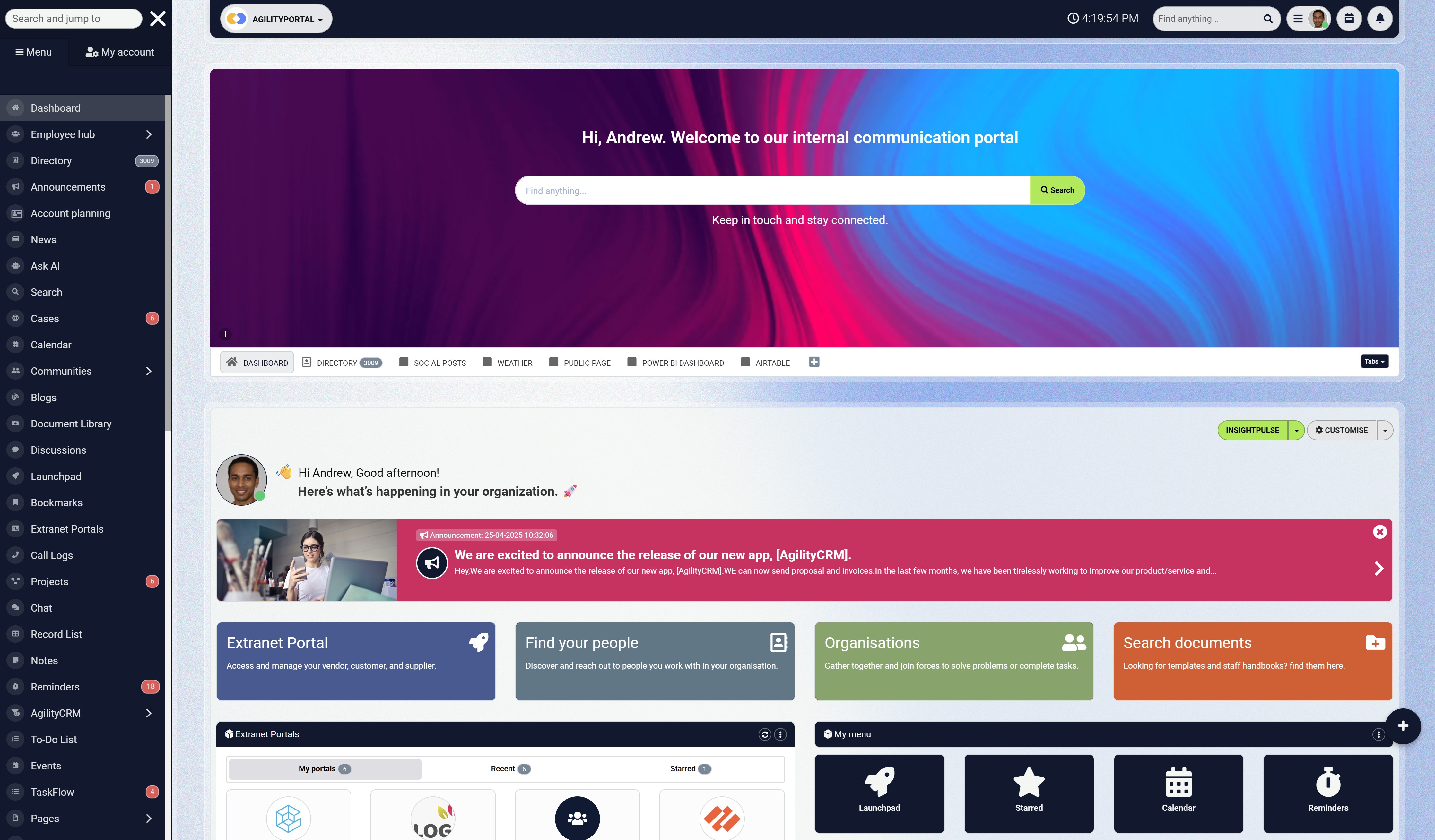
AgilityPortal is one example of this approach, bringing together employee communications, knowledge sharing, collaboration, and AI-powered capabilities within a single platform.
What should businesses look for in an AI-ready digital workplace?
An AI-ready workplace is about much more than adding a chatbot.
The platform should provide a strong foundation that allows AI to deliver reliable answers while maintaining security, governance, and a positive employee experience.
When evaluating a digital workplace, look for capabilities such as:
- A central knowledge base with version-controlled documents.
- Powerful enterprise search across company content.
- Role-based permissions and secure access controls.
- AI-assisted search and content discovery.
- Built-in employee communication tools.
- Mobile access for frontline and remote workers.
- Workflow automation and approval processes.
- Analytics to measure engagement and knowledge usage.
- Integration with Microsoft 365, Google Workspace, HR systems, and other business applications.
These capabilities ensure AI has access to trusted information rather than scattered files stored across disconnected systems.
Which AI capabilities help employees work more efficiently?
Employees don't need dozens of AI features—they need practical tools that remove friction from their working day.
Within an integrated workplace platform, AI can help employees:
- Find company policies using natural language questions.
- Summarise lengthy documents and meeting notes.
- Draft announcements, emails, and knowledge articles.
- Surface relevant documents based on the task being performed.
- Recommend related resources and subject matter experts.
- Translate communications for multilingual teams.
- Reduce repetitive HR and IT support enquiries.
For managers and administrators, AI can also help identify knowledge gaps, improve content quality, and provide insights into how employees interact with company information.
The goal isn't simply to automate tasks—it's to help employees spend less time searching for information and more time doing meaningful work.
Why do integrated communication, knowledge management, and AI work better together?
AI performs best when it can understand the full context of an organisation.
If company knowledge is stored in one system, conversations in another, documents somewhere else, and employee updates are distributed through email, AI has an incomplete picture.
Bringing these capabilities together creates a much stronger foundation for intelligent workplace experiences.
An integrated platform allows organisations to:
- Publish announcements and make them searchable.
- Store documents in a central knowledge repository.
- Connect conversations with relevant resources.
- Deliver personalised communications to different employee groups.
- Apply consistent security permissions across all content.
- Provide AI with accurate, governed business information.
This approach reduces duplicate content, improves search accuracy, and gives employees a single place to communicate, collaborate, and find trusted information.
Rather than viewing AI as a standalone tool, organisations should think of it as an intelligent layer that enhances communication, knowledge management, and collaboration.
When these elements work together, employees receive faster answers, managers gain better insights, and businesses are far more likely to achieve a successful AI implementation.
AgilityPortal
Turn Your AI Strategy into a Smarter Digital Workplace
An AI strategy is only as effective as the information behind it. AgilityPortal provides the secure digital workplace where employees can communicate, collaborate, access trusted knowledge, and find information faster using AI-powered enterprise search. Instead of connecting multiple disconnected systems, bring documents, communications, workflows and company knowledge together in one AI-ready platform.
Starts from $99/month for up to 100 employees
14-day free trial included
No credit card required
Final Thoughts
Artificial intelligence has the potential to transform how organisations work, but success depends on far more than choosing the right AI platform.
The businesses seeing the greatest return are those that begin with a clear strategy, prepare their data, establish strong governance, and involve employees throughout the journey.
Before investing in any AI solution, make sure your organisation has trusted knowledge, well-defined processes, secure access controls, and measurable business objectives.
Starting with a focused pilot and scaling gradually allows you to reduce risk, build employee confidence, and demonstrate real business value before expanding across the organisation.
If your goal is to build an AI-powered intranet or digital workplace, the foundation matters just as much as the technology itself.
By combining enterprise knowledge, communication, collaboration, and intelligent search in one secure platform, organisations can move beyond AI experimentation and create lasting improvements in productivity, decision-making, and the employee experience.
The organisations that treat AI as a long-term business capability—not just another software purchase—will be best positioned to unlock its full potential.
AI Summary
- AI/ML consulting services help organisations move from early experimentation to a structured implementation plan built around measurable business goals, trusted data and practical employee use cases.
- Before deploying AI within an intranet, businesses should assess their data quality, knowledge structure, security requirements, system integrations and internal ownership.
- The strongest AI initiatives usually begin with focused use cases such as enterprise search, employee support, document summarisation, onboarding assistance and workflow automation.
- A phased rollout reduces implementation risk by allowing organisations to test the technology with a small user group, collect feedback and improve the experience before wider deployment.
- Responsible adoption requires clear governance, role-based access, human oversight, employee training and documented processes for reviewing inaccurate or inappropriate AI responses.
- AgilityPortal can provide the communication, knowledge management, collaboration and document foundation needed to support a secure, connected and AI-ready digital workplace.
Most Popular Posts

Effective communication among team members is vital for the productivity and success of any organization. Surprisingly, 60% of companies lack a long-term internal communication strategy, which p...


Businesses thrive on communication for efficiency, productivity and accomplishment. When the right information is passed from the right designation in the organization, it promotes positivity an...

Categories
Blog
(3232)
Business Management
(396)
Employee Engagement
(235)
Digital Transformation
(222)
Growth
(151)
Intranets
(142)
Internal communications
(110)
Remote Work
(68)
Sales
(53)
Collaboration
(53)
Customer Experience
(33)
Culture
(30)
Knowledge Management
(29)
Project management
(29)
Leadership
(20)
Comparisons
(9)
News
(1)

Related Posts

What is virtual office software, and could it help your remote team feel more connected? Working from home has its perks, but having plenty of calls and messages doesn't always mean feeling part of a team. Gallup's 2026 State of the Global Work...

In today's competitive talent landscape, learning and development (L&D) has become a non-negotiable priority for enterprises. Organizations that invest in employee growth not only boost engagement and retention but also build agile, future-ready ...

Employee engagement is increasingly crucial in the fast-paced work world of today. Remote work is becoming the norm, hence companies have to use creative ideas to keep good morale and promote a friendly workplace. Feedback, sentiment analysis, ...

The best weather APIs can do more than put a temperature icon on your company homepage. Used thoughtfully, they can help employees check conditions at their workplace, give managers more context when planning outdoor work, and bring useful weat...

Have you ever welcomed a new employee, shared a mountain of information, and wondered how much they'll remember by tomorrow? A clear presentation can make the first day easier by showing new starters who to contact, where to find key informatio...


Jill Romford
I am a digital nomad, lover of exploring new places and making friends.
I love to travel and I love the internet. I take pictures of my travels and share them on the internet using Instagram.
Traveler, entrepreneur, and community builder. I share my insights on digital marketing and social media while inspiring you to live your fullest life.
Ready to learn more? 👍
One platform to optimize, manage and track all of your teams. Your new digital workplace is a click away. 🚀
Free for 14 days, no credit card required.