
Insight Blog
Agility’s perspectives on transforming the employee's experience throughout remote transformation using connected enterprise tools.
35 minutes reading time
(7091 words)
Digital Banking Security - How Secure Communication Protects Customer Data

Digital Banking Security - How Secure Communication Protects Customer Data
Learn how secure communication strengthens digital banking security, protects customer data, reduces cyber risks, and supports banking compliance.
Digital Banking Security - How Secure Communication Protects Customer Data

Digital banking security has become one of the biggest priorities for banks and financial institutions.
Every day, employees handle sensitive customer information, approve payments, review loan applications, and respond to fraud alerts. While banks invest heavily in firewalls, encryption, and cybersecurity tools, one area is often overlooked—how employees communicate with each other.
Many of these breaches don't happen because hackers break through sophisticated security systems. Instead, they start with simple human mistakes, such as sending confidential information to the wrong person, using personal messaging apps, or sharing sensitive files through unsecured channels.
This is why cyber risk management in digital banking is about much more than protecting networks. It also means giving employees safe and reliable ways to communicate, share documents, and work together without putting customer information at risk.
When staff rely on disconnected emails, consumer messaging apps, or outdated file-sharing methods, the chances of mistakes and data leaks increase significantly.
$6.08M
Average breach cost
According to the IBM Cost of a Data Breach Report, the average data breach in the financial sector costs approximately $6.08 million, making banking one of the most expensive industries for cyber incidents.
Surprisingly, many breaches don't begin with sophisticated hacking techniques. Instead, they often result from everyday human mistakes, such as sending confidential information to the wrong recipient, using personal messaging applications, or sharing sensitive files through unsecured communication channels.
Source: IBM Cost of a Data Breach Report
Modern secure communication in cyber security focuses on protecting every conversation, file, and notification that moves through an organisation.
By using secure communications systems with encryption, role-based permissions, audit logs, and secure document sharing, banks can reduce risk while making it easier for employees to collaborate and stay compliant with regulations such as GDPR, PCI DSS, ISO 27001, and FCA operational resilience requirements.
In this guide, you'll learn how secure communication helps financial institutions strengthen digital banking security, protect customer data, reduce insider risks, and build a safer workplace for both employees and customers.
Key Takeaways
- Digital banking security depends on more than cybersecurity software—secure employee communication is essential for protecting customer data and reducing operational risk.
- Many banking data breaches begin with everyday human mistakes, including sending confidential information to the wrong recipient or using unsecured communication channels.
- Secure communication platforms centralise messaging, announcements, document management, and workflows into one protected environment, making collaboration both safer and more efficient.
- Security features such as encryption, multi-factor authentication, role-based permissions, audit trails, and secure document sharing help financial institutions strengthen compliance and reduce cyber risks.
- By replacing fragmented communication tools with a unified employee communication platform, banks can improve governance, accelerate decision-making, and better protect sensitive customer information.
What Is Digital Banking Security?
When most people think about digital banking security, they picture hackers trying to break into bank systems. While that's certainly part of it, there's much more to keeping customer data safe.
Digital banking security is about protecting every piece of sensitive information as it moves through a bank—from online transactions and account details to internal emails, documents, and employee conversations.
It combines people, technology, policies, and secure communication practices to make sure customer information stays private and protected.
Think about how many people might access customer information during a normal banking process.
A customer service adviser, loan officer, fraud analyst, compliance team, and branch manager may all need to work together. If they rely on unsecured email, personal messaging apps, or outdated file-sharing methods, the risk of sensitive information being exposed increases dramatically.
This is why employee responsibility is just as important as technology.
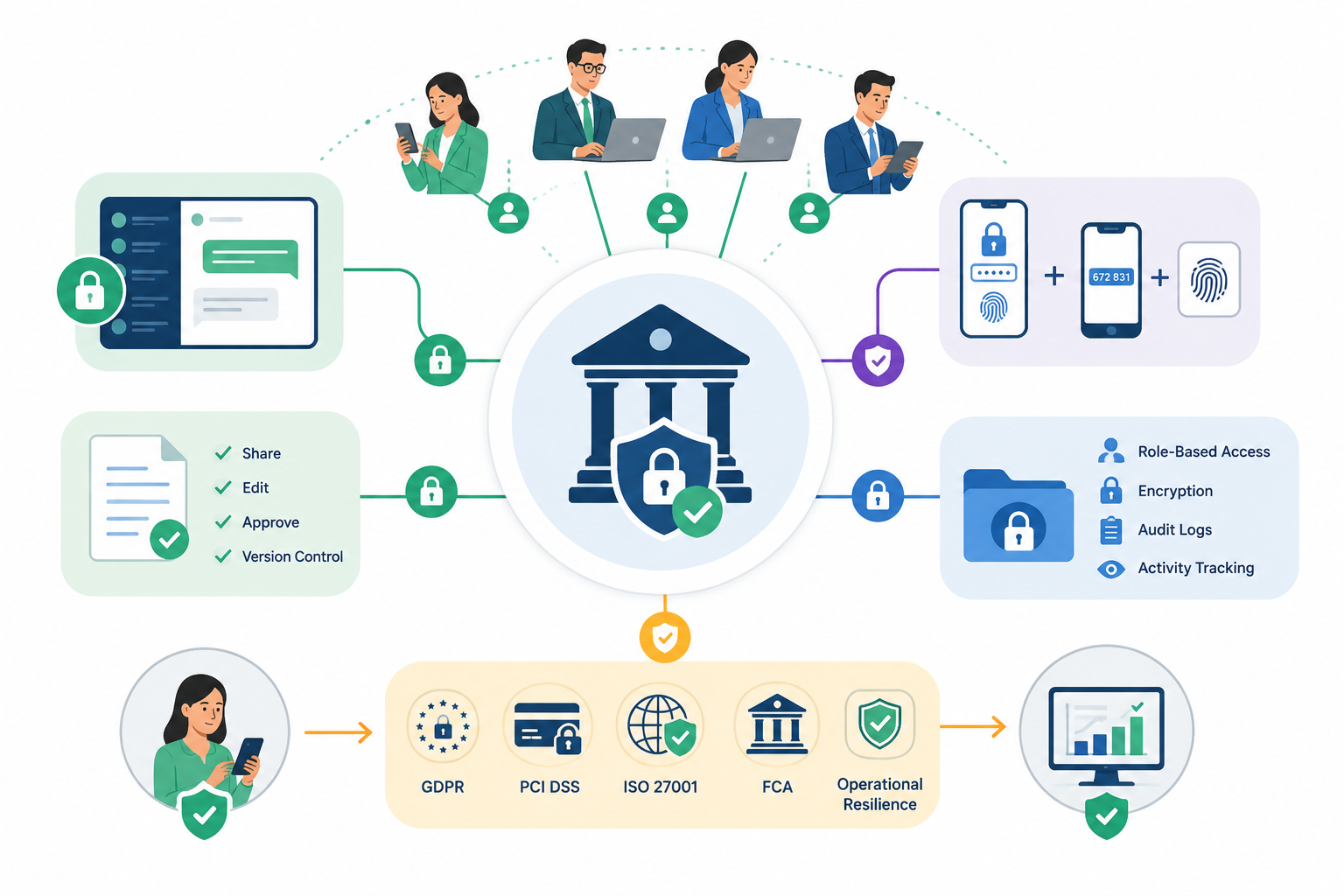
Every member of staff plays a role in protecting customer information by following security policies, using approved communication tools, and reporting anything suspicious. At the same time, banks need to provide secure systems that make it easy for employees to communicate without taking unnecessary risks.
Technology also plays a vital role.
Several digital banking platform services use multi-factor authentication (MFA) to strengthen security by requiring users to verify their identity through multiple methods, such as a password combined with a one-time code, biometric authentication, or a trusted device.
This extra layer of protection makes it much harder for cybercriminals to gain unauthorised access, even if passwords are compromised.
Modern banks also invest in secure communication systems that encrypt conversations, protect shared documents, provide role-based access controls, and keep detailed audit logs.
These tools help employees collaborate safely while supporting compliance with regulations such as GDPR, PCI DSS, ISO 27001, and operational resilience requirements.
At its core, digital banking security isn't just about stopping cyber attacks—it's about creating a secure environment where employees can work confidently, customers can trust their bank, and sensitive information remains protected every step of the way.
Why Digital Banking Security Is More Important Than Ever

Why Digital Banking Security Is More Important Than Ever
Well it comes down to Banking has changed dramatically over the past decade and it doesnt stop.
Customers now expect to check their balances, transfer money, apply for loans, and even open new accounts without ever visiting a branch.
While these digital services have made banking faster and more convenient, they've also created more opportunities for cybercriminals to target financial institutions.
Today's banks don't just need to protect their online banking platforms—they also need to secure the way employees communicate, share information, and work together.
Every device, employee, branch, and third-party service connected to a bank increases the number of potential entry points for cyber attacks.
Here are some of the biggest reasons why digital banking security has become more important than ever:
- Rapid growth in digital banking means more financial transactions and sensitive customer information are being processed online every day.
- Mobile banking adoption allows customers to manage their finances from anywhere, making strong authentication and secure communication essential.
- Online lending and digital account opening require banks to securely collect, verify, and store large amounts of personal and financial data.
- Remote and hybrid working means employees often access banking systems from different locations, increasing the need for secure communication and controlled access.
- Third-party vendors and cloud services help banks deliver better digital experiences, but they also introduce additional security and compliance risks if not managed properly.
- Insider threats, whether accidental or intentional, remain one of the biggest causes of data breaches. A simple mistake, such as sending confidential information to the wrong person, can have serious consequences.
- AI-powered cyber attacks are becoming more sophisticated, using artificial intelligence to create convincing phishing emails, automate attacks, and identify system vulnerabilities faster than ever before.
- Stricter regulations, including GDPR, PCI DSS, and operational resilience requirements, require banks to demonstrate that customer data is protected at every stage of its lifecycle.
The good news is that technology is helping banks stay one step ahead.
By investing in secure communication in cyber security, employee training, and modern secure communications systems, financial institutions can reduce risk, strengthen compliance, and protect customer information without slowing down day-to-day operations.
Digital banking security isn't just the responsibility of the IT department anymore—it's a shared responsibility across the entire organisation. Every employee, every conversation, and every document plays a part in keeping customer data safe.
The Biggest Communication Risks in Banking
Most banks have strong cybersecurity measures in place, but technology alone isn't enough to protect customer information.
Many security incidents begin with everyday communication mistakes rather than sophisticated cyber attacks.
An employee sends a confidential document to the wrong person, shares information using an unapproved messaging app, or stores sensitive files in an unsecured location.
As banks become more digital and employees work across multiple locations, communication has become one of the most overlooked areas of digital banking security.
Understanding these common risks is the first step towards reducing them.

The Biggest Communication Risks in Banking
Using Consumer Messaging Apps
Apps like WhatsApp, Messenger, or personal text messages may be convenient, but they weren't designed for handling confidential banking information.
Conversations can be difficult to monitor, archive, or audit, making it harder to demonstrate compliance and protect customer data.
Sharing Sensitive Documents Through Email
Email remains one of the most common ways to exchange information, but it's also one of the easiest ways for sensitive data to be exposed.
A simple typo in an email address or an incorrect attachment can result in confidential customer information being sent outside the organisation.
Shadow IT
Employees sometimes use their own software or cloud storage services because they're faster or more familiar than company-approved tools.
While this may seem harmless, it creates blind spots for IT teams and increases the risk of data breaches and compliance failures.
No Version Control
When multiple copies of the same document are shared through email or stored in different locations, employees can quickly lose track of which version is the most up to date.
This can lead to mistakes, outdated information being used, and unnecessary security risks.
Weak Access Controls
Not every employee should have access to every piece of customer information.
Without role-based permissions, confidential data may be viewed, edited, or shared by people who don't need access, increasing the risk of accidental or intentional data exposure.
Poor Employee Awareness
Even the most advanced security systems can't prevent every mistake.
Employees who aren't regularly trained on phishing, secure communication, and data protection are more likely to click malicious links, download harmful attachments, or unknowingly share sensitive information.
Delayed Fraud Notifications
When fraud alerts and security updates are delayed or sent through multiple disconnected systems, response times slow down.
The longer it takes employees to receive critical information, the greater the potential impact on customers and the organisation.
Communication Silos
Different departments often use different tools to communicate, making it difficult to share information quickly and securely.
Fraud teams, compliance officers, customer service representatives, and branch staff all need access to accurate information, but disconnected communication can lead to delays, duplicated work, and missed security issues.
Modern secure communication in cyber security brings messaging, document sharing, announcements, and workflows together into one protected platform.
Combined with secure communications systems that offer encryption, role-based permissions, audit trails, and multi-factor authentication, banks can significantly reduce communication risks while improving collaboration and protecting customer data.
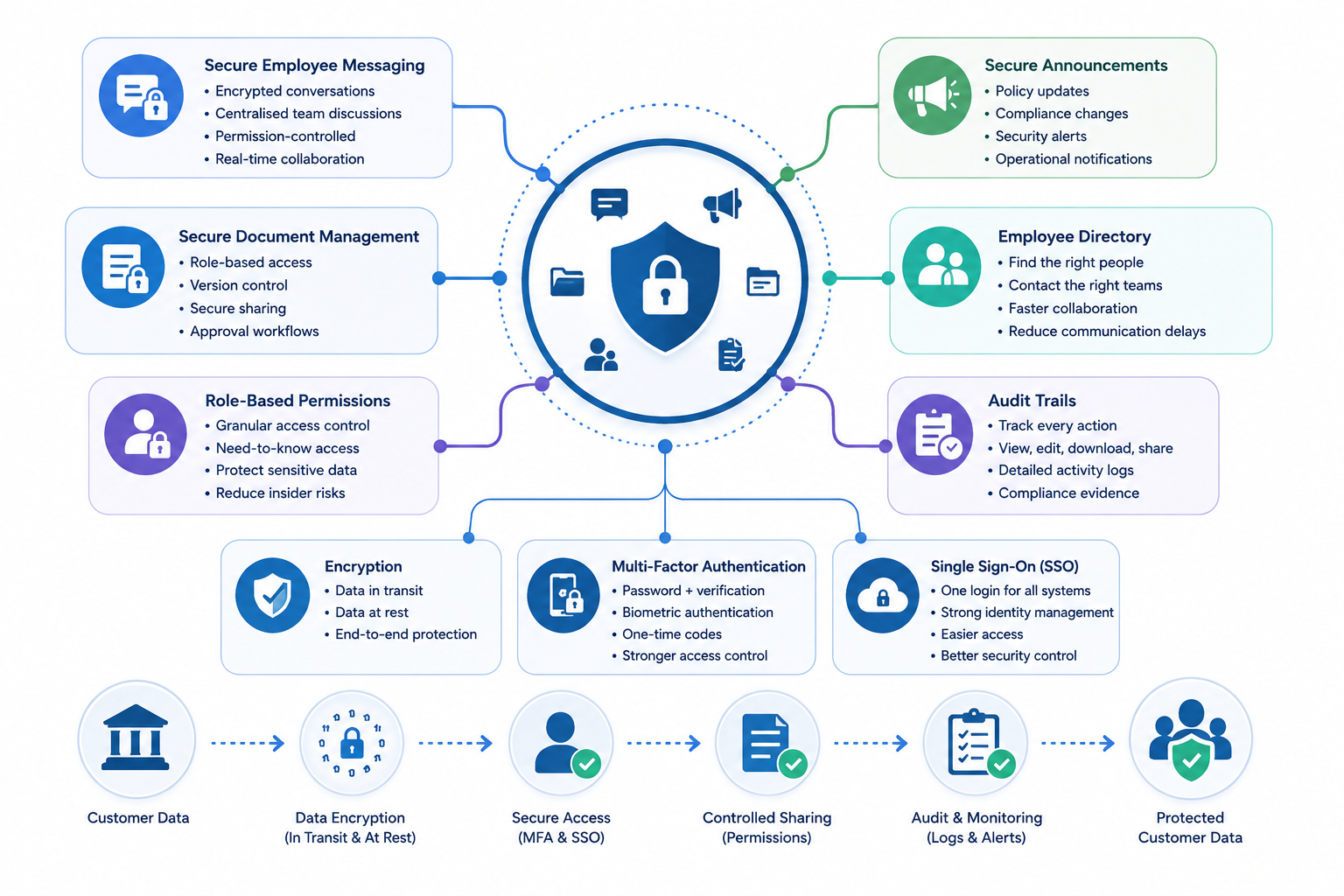
How Secure Communication Protects Customer Data
Protecting customer information isn't just about installing antivirus software or building stronger firewalls.
Every day, bank employees exchange messages, share documents, approve transactions, and discuss sensitive customer cases. If those conversations happen through unsecured channels, customer data becomes far more vulnerable to accidental exposure or cyber attacks.
A modern secure communication platform gives employees a safe place to work together while ensuring every conversation, document, and action is protected.
Instead of relying on disconnected emails, personal messaging apps, or shared folders, everything is managed in one secure environment with the controls banks need to meet strict regulatory requirements.

How Secure Communication Protects Customer Data
Secure Employee Messaging
Employees need to communicate quickly, especially when dealing with fraud investigations, customer enquiries, or urgent operational issues.
Secure messaging allows staff to collaborate in real time without exposing sensitive information.
Benefits include:
- End-to-end encrypted conversations
- Centralised team discussions
- Permission-controlled messaging
- Faster collaboration between departments
- Reduced reliance on unsecured email
Secure Announcements
Keeping everyone informed is essential in banking, particularly when policies or regulations change.
Secure announcements ensure important updates reach the right employees instantly.
Typical announcements include:
- Compliance updates
- New security policies
- Fraud alerts
- Operational changes
- Regulatory notices
- Business continuity updates
Secure Document Management
Banks handle thousands of confidential documents every day, from loan applications and contracts to compliance reports and customer records.
Secure document management helps ensure these files remain protected throughout their lifecycle.
Key features include:
- Role-based document permissions
- Version control
- Secure document sharing
- Approval workflows
- Automatic document history
- Centralised document storage
Employee Directory
When employees can quickly find the right person, work moves faster and communication becomes more secure.
Instead of sending information to the wrong department or using personal contacts, staff can easily locate colleagues within the organisation.
Benefits include:
- Quickly find subject matter experts
- Contact the correct department
- Reduce communication delays
- Improve collaboration across branches
- Minimise misdirected information
Role-Based Permissions
Not every employee needs access to every customer record. Role-based permissions ensure people only see the information they need to perform their job, helping reduce both accidental and intentional data exposure.
Role-based access can control:
- Customer records
- Financial reports
- Compliance documentation
- Internal policies
- Sensitive projects
- Executive communications
Audit Trails
One of the biggest advantages of secure communication platforms is complete visibility.
Every important action is recorded, making it easier to investigate incidents, demonstrate compliance, and identify unusual activity.
Audit logs can record:
- Who viewed a document
- Who downloaded a file
- Who edited content
- Who shared information
- Who deleted records
- Time and date of every action
Encryption
Encryption protects sensitive information whether it's being stored or shared between employees.
Even if data is intercepted, encryption makes it unreadable to anyone without the proper authorisation.
Banks typically use encryption for:
- Data at rest
- Data in transit
- Secure messaging
- Shared documents
- Mobile devices
- Cloud storage
Multi-Factor Authentication (MFA)
Passwords alone are no longer enough to protect banking systems. Multi-factor authentication adds another layer of security by asking users to verify their identity using more than one method before gaining access.
Many digital banking platforms now use MFA by combining:
- Passwords
- One-time verification codes
- Biometric authentication, such as fingerprint or facial recognition
- Trusted mobile devices
- Authentication apps
This significantly reduces the risk of unauthorised access, even if a password has been compromised.
Single Sign-On (SSO)
Single Sign-On allows employees to securely access multiple business applications using one set of login credentials.
It simplifies the user experience while giving IT teams greater control over user identities and access permissions.
Benefits include:
- Stronger identity management
- Reduced password fatigue
- Faster employee access
- Easier account management
- Improved security contro
Mobile Security
Today's banking employees aren't always sitting behind a desk. Relationship managers, executives, field teams, and branch staff often need secure access while on the move.
A secure mobile communication platform provides:
- Encrypted mobile messaging
- Secure document access
- Multi-factor authentication
- Remote device management
- Secure file sharing
- Consistent security across every device
By bringing messaging, documents, announcements, approvals, and employee communication together into one protected platform, banks can significantly reduce communication risks while improving collaboration.
The result is a safer workplace, faster decision-making, stronger regulatory compliance, and better protection for the customer information that matters most.
Secure Communication Features Every Bank Should Have
Choosing a secure communication platform isn't just about finding an app that lets employees send messages. Banks need a solution that protects sensitive customer information, supports regulatory compliance, and makes it easier for employees to work together without creating unnecessary security risks.
The right platform should combine secure messaging, document management, identity controls, and governance into one secure environment.
This reduces the need for multiple disconnected applications while giving IT and compliance teams greater visibility over how information is shared across the organisation.
Below are some of the most important features every financial institution should look for when evaluating a secure communication platform.
- Secure Messaging - Secure messaging replaces unsecured emails and consumer chat applications with encrypted conversations designed for business communication. Employees can discuss customer cases, fraud alerts, and operational issues knowing their conversations remain protected.
- Employee Announcements - Important updates should reach the right employees immediately. A secure announcement system allows banks to distribute policy updates, compliance notices, fraud alerts, and operational communications from one central location.
- Document Management - Banks manage thousands of confidential documents every day. A secure document management system ensures files are stored safely, version controlled, and only accessible to authorised employees.
- Multi-Factor Authentication (MFA) - Passwords alone are no longer enough. Multi-factor authentication provides an additional layer of protection by requiring users to verify their identity before accessing sensitive systems and information.
- Role-Based Access Control (RBAC) - Employees should only have access to the information they need to perform their role. Granular permissions help minimise insider risks while protecting confidential customer and financial data.
- Audit Logs - Every action performed within the platform should be recorded. Audit logs help banks monitor activity, investigate incidents, and demonstrate compliance during internal or external audits.
- Mobile Access - Today's employees work from branches, regional offices, home offices, and customer locations. Secure mobile access ensures staff can communicate safely without compromising security.
- Employee Directory - A central employee directory helps staff quickly locate colleagues, subject matter experts, and department contacts, reducing communication delays and improving collaboration across the organisation.
- Workflow Approvals - Many banking processes require approvals before actions can be completed. Automated workflows create a secure approval process while providing a complete audit trail for compliance purposes.
- Encryption - Encryption protects sensitive information both while it is being transmitted and while it is stored. This ensures customer information remains unreadable to unauthorised users, even if data is intercepted.
Secure Communication Features Every Bank Should Have
| Feature | Why It Matters | Key Business Benefit |
| Secure Messaging | Encrypts employee conversations and replaces unsecured email or consumer chat apps. | Protects confidential discussions and reduces data leakage. |
| Employee Announcements | Delivers important updates, fraud alerts, and policy changes instantly. | Ensures employees receive critical information quickly. |
| Document Management | Centralises confidential files with permissions and version control. | Improves governance while reducing document-related risks. |
| Multi-Factor Authentication (MFA) | Requires multiple verification methods before granting access. | Prevents unauthorised account access, even if passwords are compromised. |
| Role-Based Access Control (RBAC) | Restricts access based on job responsibilities. | Reduces insider threats and protects sensitive customer data. |
| Audit Logs | Records every user action within the platform. | Simplifies investigations and supports regulatory compliance. |
| Mobile Access | Provides secure communication across smartphones and tablets. | Enables safe remote and hybrid working. |
| Employee Directory | Helps staff quickly find colleagues and subject matter experts. | Speeds up communication and improves collaboration. |
| Workflow Approvals | Automates approval processes for documents and business tasks. | Increases efficiency while maintaining accountability. |
| Encryption | Protects data both in transit and at rest. | Keeps customer information secure from interception and unauthorised access. |
| Single Sign-On (SSO) | Allows employees to access multiple systems with one secure login. | Improves security while reducing password fatigue. |
| Compliance Reporting | Generates reports for audits and regulatory requirements. | Makes it easier to demonstrate compliance with GDPR, PCI DSS, ISO 27001, and other standards. |
Regulatory Compliance Supported by Secure Communication
Meeting regulatory requirements has become one of the biggest challenges facing banks and financial institutions.
It's no longer enough to simply protect customer data with firewalls and antivirus software. Regulators expect organisations to demonstrate that sensitive information is managed securely throughout its entire lifecycle—from the moment it's created to the point it's archived or deleted.
This is where secure communication platforms make a real difference.
By centralising employee messaging, document management, approvals, and file sharing into one protected environment, banks gain greater control over how information is accessed, shared, and stored.
Features such as encryption, role-based permissions, multi-factor authentication, audit logs, and document version control not only improve security but also make it much easier to demonstrate compliance during audits.
Below are some of the key regulations and standards that secure communication platforms help support.
GDPR (General Data Protection Regulation)
GDPR requires organisations to protect personal data and process it responsibly.
A secure communication platform helps reduce the risk of personal information being shared with the wrong people by providing controlled access, encrypted messaging, secure document sharing, and detailed audit trails.
Key benefits include:
- Protects personal customer information
- Restricts access using role-based permissions
- Encrypts sensitive communications
- Maintains detailed activity logs
- Supports secure data retention policies
PCI DSS (Payment Card Industry Data Security Standard)
Banks and payment providers handle millions of card transactions every day. PCI DSS focuses on protecting payment card information from theft and unauthorised access.
A secure communication platform supports PCI DSS by:
- Securing payment-related communications
- Restricting access to authorised employees
- Protecting confidential documents
- Recording user activity for auditing
- Reducing the use of unsecured communication channels
ISO 27001
ISO 27001 is an internationally recognised standard for information security management. It encourages organisations to manage information securely by reducing risks and implementing appropriate security controls.
Secure communication platforms contribute by:
- Protecting confidential business information
- Supporting access management
- Providing document governance
- Maintaining comprehensive audit records
- Encouraging secure collaboration across teams
SOC 2
SOC 2 focuses on how organisations manage customer data using five trust service principles, including security, availability, confidentiality, processing integrity, and privacy.
A secure communication platform helps by:
- Protecting confidential customer information
- Monitoring user activity
- Securing internal communication
- Providing access controls
- Supporting evidence collection during audits
Operational Resilience
Financial regulators expect banks to continue operating during cyber incidents, service disruptions, or unexpected events. Secure communication plays a vital role in ensuring employees can continue working together during these situations.
Benefits include:
- Rapid incident communication
- Business continuity support
- Secure mobile communication
- Faster decision-making
- Centralised emergency updates
DORA (Digital Operational Resilience Act)
DORA strengthens digital resilience across financial institutions operating within the European Union.
It requires organisations to improve cyber resilience, manage ICT risks, and respond effectively to security incidents.
Secure communication platforms support DORA by:
- Improving secure internal coordination
- Protecting sensitive operational information
- Recording communication history
- Supporting incident response processes
- Strengthening governance and accountability
FCA Expectations
The UK's Financial Conduct Authority (FCA) expects financial institutions to manage operational risk, protect customer information, and maintain effective governance.
Secure communication platforms help organisations meet these expectations by:
- Improving communication during operational incidents
- Protecting confidential customer information
- Supporting stronger access controls
- Providing complete audit trails
- Demonstrating good information governance
Data Governance
Good data governance ensures customer information remains accurate, secure, and only accessible to authorised people.
Without proper governance, organisations can quickly lose control over where sensitive information is stored and who has access to it.
Secure communication platforms improve data governance by:
- Centralising communication and documents
- Controlling user permissions
- Maintaining document version history
- Tracking every user action
- Supporting secure retention and deletion policies
While no communication platform can guarantee compliance on its own, it provides the security controls and visibility that banks need to build a strong compliance programme.
By combining secure messaging, document management, encryption, role-based access, audit trails, and governance tools in one place, financial institutions can reduce risk, simplify regulatory audits, and better protect the customer information entrusted to them.
Expert Insight
“Many banks invest heavily in cybersecurity tools but overlook one of the biggest risks—how employees communicate every day. Secure communication reduces human error, strengthens compliance, and protects customer information before problems occur.”
Jessica Jones
Director at AgilityPortal
Real Banking Scenarios Where Secure Communication Makes a Difference
Secure communication isn't just a nice feature to have—it's something banks rely on every day.
From responding to fraud incidents to approving loans and sharing compliance updates, employees need a safe and reliable way to exchange information without putting customer data at risk.
Here are some common scenarios where secure communication helps financial institutions work more efficiently while protecting sensitive information.
Fraud Response: How Secure Communication Enables Rapid Detection and Action
When suspicious activity is detected, every second matters. Fraud teams, customer service advisers, branch staff, and security specialists need to communicate immediately to investigate incidents and protect customer accounts.
A secure communication platform allows teams to:
- Send real-time fraud alerts
- Coordinate investigations across departments
- Share evidence securely
- Notify affected teams instantly
- Maintain a complete audit trail
Secure Branch Communication Across Multiple Locations
Banks often operate across multiple branches, regional offices, and remote teams. Keeping everyone informed can be difficult if information is spread across emails, phone calls, and different messaging platforms.
Secure communication helps by:
- Sharing operational updates instantly
- Communicating service interruptions
- Announcing policy changes
- Delivering important business announcements
- Improving collaboration between branches
Secure Loan Processing and Document Approval Workflows
Loan applications often involve several departments reviewing the same documents before approval. Sharing paperwork through email can create confusion, duplicate files, and unnecessary security risks.
A secure communication platform enables teams to:
- Share loan documents securely
- Approve applications through controlled workflows
- Track document versions
- Restrict access to authorised employees
- Keep a complete history of every approval
Compliance Teams and Regulatory Communication Management
Regulatory requirements change regularly, and employees need access to the latest policies and procedures. Secure communication ensures compliance teams can distribute important information quickly while maintaining proper governance.
Typical uses include:
- Publishing policy updates
- Sharing regulatory guidance
- Managing compliance documentation
- Tracking employee acknowledgements
- Supporting internal audits
Executive Leadership
Senior leaders often communicate highly confidential business information, including strategic decisions, financial performance, mergers, acquisitions, and organisational changes. These discussions require a higher level of security than standard email.
Secure communication allows executives to:
- Deliver confidential announcements
- Share board documents securely
- Collaborate on strategic initiatives
- Protect sensitive business information
- Control access to executive communications
Customer Service
Customer service teams regularly work with account information, payment enquiries, complaints, and identity verification requests. Fast communication is important, but so is protecting customer privacy.
Secure communication helps customer service teams:
- Resolve customer enquiries faster
- Collaborate securely with other departments
- Share customer information safely
- Reduce unnecessary email traffic
- Improve response times
Risk Management
Managing operational and cybersecurity risks requires fast, coordinated communication across multiple departments.
During a security incident, employees need immediate access to accurate information so decisions can be made quickly.
A secure communication platform supports risk management by:
- Sending instant incident notifications
- Coordinating response teams
- Sharing investigation updates securely
- Recording communication for future reviews
- Supporting business continuity planning
Although each department has different responsibilities, they all depend on one thing—secure, reliable communication.
By bringing messaging, announcements, document sharing, approvals, and collaboration into one protected platform, banks can reduce operational risk, improve employee productivity, strengthen compliance, and better protect the customer information entrusted to them.
Choosing a Secure Communication Platform
Not all communication platforms are built for the banking industry. While many tools offer basic messaging and file sharing, financial institutions need much more than convenience.
They need a platform that helps protect sensitive customer information, supports regulatory compliance, and gives employees a secure way to communicate every day.
When evaluating a secure communication solution, look beyond the user interface and consider the security controls that sit behind it.
Features such as encryption, role-based permissions, audit logs, and multi-factor authentication aren't simply nice-to-have additions—they're essential for reducing cyber risks, protecting customer data, and meeting industry regulations.
The checklist below highlights some of the most important features every bank should consider before investing in a secure communication platform.
Encryption
Protects sensitive messages and files while stored and shared.
Multi-Factor Authentication
Adds an extra identity check beyond a username and password.
Role-Based Permissions
Limits access based on an employee's role and responsibilities.
Secure Mobile Access
Allows employees to communicate safely from approved mobile devices.
Document Management
Centralises files with version control, permissions, and secure sharing.
Workflow Automation
Creates controlled approval processes with clear accountability.
Secure Messaging
Replaces consumer messaging apps with protected business conversations.
Employee Directory
Helps employees quickly find the right colleague or subject expert.
Audit Logs
Records who viewed, changed, downloaded, or shared information.
Compliance Reporting
Provides evidence to support internal reviews and regulatory audits.
Cloud Security
Protects hosted data using secure infrastructure and access controls.
API Integrations
Connects securely with identity, HR, document, and banking systems.
Why Banks Are Investing in Unified Employee Communication Platforms
Why Banks Are Investing in Unified Employee Communication Platforms
Many banks have accumulated dozens of communication and collaboration tools over the years.
Employees might use email for one task, a messaging app for another, a shared drive for documents, and separate systems for policies, approvals, and announcements. While each tool solves a specific problem, using too many disconnected platforms can create new security risks and make compliance much harder to manage.
Every additional application introduces another place where sensitive information can be stored, shared, or accessed. It also becomes more difficult for IT teams to monitor activity, enforce security policies, and maintain a complete audit trail.
As a result, many financial institutions are moving away from fragmented communication tools and investing in unified employee communication platforms.
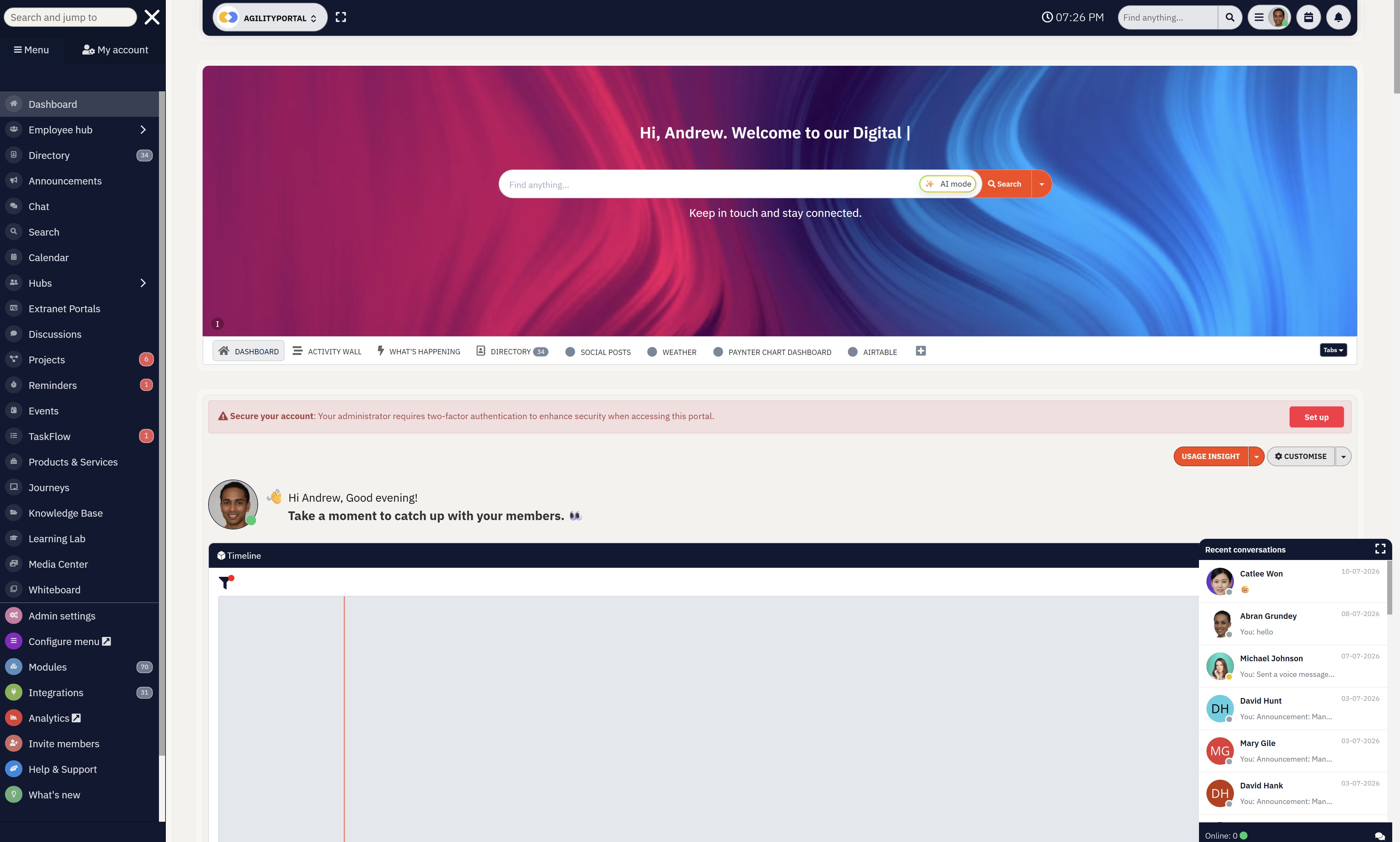
Instead of switching between multiple applications throughout the day, employees can access everything they need from one secure digital workplace. This not only improves productivity but also gives organisations greater visibility and control over how customer information is handled.
A modern unified employee communication platform typically brings together:
- Secure messaging for protected employee conversations
- Company announcements for sharing critical updates and fraud alerts
- Document management with permissions, version control, and secure file sharing
- Knowledge bases that provide employees with instant access to policies, procedures, and operational guidance
- Employee directories to quickly find colleagues, departments, and subject matter experts
- Digital forms for requests, approvals, compliance reporting, and internal processes
- Workflow automation to streamline approvals and reduce manual tasks
- Mobile communication so employees can stay connected securely from any location
- Compliance tools including audit logs, access controls, and document governance
- Governance features that help enforce security policies and demonstrate regulatory compliance
By bringing these capabilities together in one platform, banks reduce the need for employees to use unsecured email, consumer messaging apps, personal file-sharing services, or multiple disconnected systems.
This significantly lowers the risk of sensitive customer information being exposed while making day-to-day communication simpler and more efficient.
Platforms like AgilityPortal are designed with this approach in mind, combining employee communication, secure messaging, document management, knowledge sharing, workflow automation, and governance into a single digital workplace.
Rather than managing several standalone applications, financial institutions can centralise communication, strengthen security, improve employee collaboration, and support compliance from one secure platform.
Ultimately, a unified employee communication platform isn't just about making work easier—it's about creating a more secure, connected, and resilient organisation.
By reducing communication silos and centralising business-critical information, banks can better protect customer data, respond faster to security incidents, and build greater trust with both employees and customers.
Built for Secure Banking Communication
Protect Customer Data With One Secure Employee Communication Platform
Banks and financial institutions often rely on disconnected email systems, messaging apps, shared drives, document platforms, and manual approval processes. This makes it harder to control how sensitive customer information is accessed, shared, stored, and tracked across departments and branch locations.
AgilityPortal helps financial organisations centralise secure employee communication, document management, policy updates, knowledge sharing, workflow approvals, and internal collaboration within one governed digital workplace.
- Secure employee messaging for branches, remote teams, and head-office staff
- Targeted company announcements, fraud alerts, policy updates, and compliance notices
- Controlled document sharing with permissions, version history, and centralised storage
- Role-based access controls that limit sensitive information to authorised employees
- Audit trails that record document access, changes, downloads, and communication activity
- Multi-factor authentication and Single Sign-On support for stronger identity security
- Digital forms, approval workflows, employee directories, and secure mobile access
- Designed to support banking security, governance, operational resilience, and regulatory compliance
Final Thoughts
Digital banking security is about much more than stopping hackers or installing the latest cybersecurity software.
Every email, instant message, document, announcement, and employee interaction has the potential to either strengthen or weaken your organisation's security posture.
As banks continue to embrace digital services and flexible ways of working, secure communication has become a critical part of protecting customer information.
Relying on disconnected communication tools, personal messaging apps, or outdated file-sharing methods creates unnecessary risks that can lead to data breaches, compliance issues, and slower responses to security incidents.
By bringing communication, documents, workflows, and knowledge into one secure environment, financial institutions gain greater visibility, stronger governance, and better control over how sensitive information is handled.
A modern secure communication platform helps banks:
- Protect confidential customer data
- Reduce insider threats and human error
- Strengthen compliance with regulations such as GDPR, PCI DSS, and ISO 27001
- Improve operational resilience during security incidents
- Speed up collaboration across departments and branches
- Simplify document management and approval workflows
- Create a more connected and productive workforce
As cyber threats continue to evolve, banks need solutions that protect both their technology and the people using it.
Investing in secure communication isn't simply about meeting regulatory requirements—it's about building trust, improving operational efficiency, and creating a safer experience for employees and customers alike.
If your organisation is looking to modernise internal communication while strengthening digital banking security, platforms like AgilityPortal provide a secure, all-in-one digital workplace that brings together employee communication, secure messaging, document management, workflow automation, and governance.
By replacing fragmented tools with a single secure platform, banks can improve collaboration, reduce security risks, and better protect the customer data that matters most.
FAQ
What is digital banking security?
Digital banking security refers to the technologies, processes, and policies banks use to protect customer information, financial transactions, and digital services from cyber threats.
It includes everything from encryption and multi-factor authentication to secure employee communication, fraud detection, and access controls that help keep sensitive data safe.
Why is secure communication important in banking?
Banks handle highly confidential information every day, including customer records, payment details, loan applications, and compliance documents.
Secure communication ensures this information is shared only with authorised employees through encrypted channels, reducing the risk of data breaches, human error, and regulatory non-compliance.
How does secure communication protect customer data?
Secure communication platforms protect customer data by encrypting messages and documents, restricting access with role-based permissions, recording user activity through audit logs, and supporting secure file sharing.
Together, these security controls help prevent unauthorised access while improving visibility and accountability across the organisation.
What communication features should banks look for?
When choosing a secure communication platform, banks should prioritise features such as:
- End-to-end encryption
- Multi-factor authentication (MFA)
- Role-based access control
- Secure messaging
- Document management
- Audit logs
- Workflow automation
- Employee announcements
- Mobile access
- Single Sign-On (SSO)
- Compliance reporting
- Secure cloud storage
These features help improve security while supporting regulatory compliance and day-to-day collaboration.
Can secure communication platforms help with GDPR?
Yes. While a communication platform alone does not guarantee GDPR compliance, it can provide many of the controls organisations need to support compliance.
Features such as encryption, audit trails, access permissions, document governance, and secure data sharing help financial institutions protect personal information and demonstrate accountability during audits.
Is email secure enough for banks?
Traditional email remains useful, but it should not be the primary method for sharing highly sensitive customer information.
Emails can be sent to the wrong recipient, forwarded without authorisation, or accessed through compromised accounts. Secure communication platforms offer stronger protection by using encryption, controlled access, audit logs, and centralised document management.
What is the safest way for bank employees to communicate?
The safest approach is to use an enterprise-grade secure communication platform designed for regulated industries.
These platforms combine encrypted messaging, secure document sharing, role-based permissions, multi-factor authentication, and detailed audit trails to help employees communicate safely while protecting confidential customer information.
How can banks reduce insider security risks?
Reducing insider risk requires both technology and employee awareness.
Banks should:
- Provide regular cybersecurity training
- Implement role-based permissions
- Require multi-factor authentication
- Use secure communication platforms
- Monitor activity with audit logs
- Secure document sharing and storage
- Automate approval workflows
- Establish clear communication and data handling policies
By combining secure technology with good governance, banks can significantly reduce the risk of accidental or intentional data exposure while strengthening overall digital banking security.
AI Summary
- Digital banking security extends beyond firewalls and cybersecurity software. Protecting customer data also depends on how employees communicate, share documents, and collaborate across the organisation.
- Many banking data breaches begin with human error, such as sending confidential information to the wrong recipient, using personal messaging apps, or sharing sensitive files through unsecured communication channels.
- Secure communication platforms centralise employee messaging, announcements, document management, approvals, and knowledge sharing into one protected environment, reducing cyber risks while improving productivity.
- Key security features include encryption, multi-factor authentication (MFA), role-based access control (RBAC), audit logs, secure mobile access, document version control, and workflow automation to help banks strengthen governance and regulatory compliance.
- Financial institutions can use secure communication platforms to improve fraud response, support compliance teams, streamline loan approvals, coordinate branch operations, and protect sensitive customer information across multiple locations.
- When selecting a secure communication platform, banks should evaluate security certifications, encryption standards, compliance capabilities, mobile accessibility, identity management, integrations, scalability, governance features, and long-term operational resilience.
Most Popular Posts

Effective communication among team members is vital for the productivity and success of any organization. Surprisingly, 60% of companies lack a long-term internal communication strategy, which p...


Businesses thrive on communication for efficiency, productivity and accomplishment. When the right information is passed from the right designation in the organization, it promotes positivity an...

Categories
Blog
(3216)
Business Management
(396)
Employee Engagement
(235)
Digital Transformation
(219)
Growth
(150)
Intranets
(142)
Internal communications
(107)
Remote Work
(68)
Sales
(53)
Collaboration
(53)
Customer Experience
(33)
Culture
(30)
Knowledge Management
(29)
Project management
(29)
Leadership
(20)
Comparisons
(9)
News
(1)

Related Posts

How is Edge AI changing business operations in 2026, and when does it make sense to process data near where it is created instead of sending it all to the cloud? The investment forecasts point to growing interest: Capgemini Research Institute's...

Choosing the best ERP for Shopify often starts when the workarounds stop working. Your store shows stock that the warehouse can't find. Wholesale orders live in spreadsheets. Finance spends days reconciling payouts, while customer service...

Could choosing the wrong proxy disrupt your team's work or increase costs without improving results? When comparing rotating proxies vs static proxies, the answer depends on what your business needs: a consistent IP address for an ongoing sessi...

What happens when a buyer asks Google for the best employee communication platform—and discovers competing brands before reaching your website? Choosing the best link building services can help a digital workplace business strengthen its broade...

Could gaps in digital accessibility be stopping your employees from completing the training they need to do their jobs? Imagine a new starter opening a mandatory course, only to discover they can't follow the audio, navigate the quiz with a keyboard ...


Jill Romford
I am a digital nomad, lover of exploring new places and making friends.
I love to travel and I love the internet. I take pictures of my travels and share them on the internet using Instagram.
Traveler, entrepreneur, and community builder. I share my insights on digital marketing and social media while inspiring you to live your fullest life.
Ready to learn more? 👍
One platform to optimize, manage and track all of your teams. Your new digital workplace is a click away. 🚀
Free for 14 days, no credit card required.