Insight Blog
Agility’s perspectives on transforming the employee's experience throughout remote transformation using connected enterprise tools.
22 minutes reading time
(4349 words)
Agile Workplace Staffing - How Managed IT Services Enable Growth in 2026

Agile Workplace Staffing - How Managed IT Services Enable Growth in 2026
Discover how agile workplace staffing and managed IT services help businesses build flexible teams, maintain IT security, and support modern digital workplaces.
Agile Workplace Staffing - How Managed IT Services Enable Growth in 2026

Agile workplace staffing is becoming essential for businesses that want to stay competitive in a fast-changing digital economy.
Companies are no longer relying only on fixed teams; instead, they are building flexible workforces that can quickly adapt to new projects, changing customer demands, and emerging technologies.
When paired with a reliable Managed IT Services, organizations gain the ability to scale teams efficiently while keeping their infrastructure, security, and systems running smoothly.
In fact, research from Gartner shows that more than 60% of organizations now use Managed IT Service providers to support critical IT operations, highlighting how important external expertise has become for modern businesses.
In this guide, we'll explain how agile workplace staffing works, why a Managed IT Service plays such an important role in supporting distributed teams, and how companies can combine both strategies to enable sustainable growth in 2026 and beyond.
60%+
of organizations
Research from Gartner shows that more than 60% of organizations now rely on Managed IT Service providers to support critical IT operations and maintain modern digital infrastructure.
Source: Gartner IT Services Research
What Is Agile Workplace Staffing?
Agile workplace staffing is a workforce strategy where companies build flexible teams that can quickly adapt to changing business needs.
Instead of relying only on permanent, fixed roles, organizations use a mix of full-time employees, contractors, specialists, and project-based professionals to respond to new opportunities or challenges.
In a traditional workforce model, companies hire employees for specific roles that remain relatively stable for long periods.
Agile workplace staffing works differently.
Teams are formed around projects, goals, or short-term initiatives, and the workforce can scale up or down depending on demand.
This approach allows businesses to remain competitive in fast-moving industries where technology, customer expectations, and market conditions change rapidly.
Technology also plays a major role in enabling this model.
Many organizations rely on collaboration platforms, cloud tools, and a reliable provide to ensure distributed teams can work securely and efficiently from different locations.
Without strong IT support and infrastructure, agile staffing models would be difficult to manage at scale.

What Is Agile Workplace Staffing
Why Businesses Are Adopting Agile Workforce Models
There are several reasons why organizations are moving toward agile workforce strategies.
- Remote and hybrid work - The shift toward remote and hybrid work has changed how businesses structure their teams. Companies now hire talent from different regions and allow employees to work from home or multiple office locations. Agile staffing makes it easier to support these flexible work arrangements.
- Skills shortages - Many industries are facing significant talent shortages, especially in areas such as technology, cybersecurity, and data analytics. Agile workplace staffing allows businesses to bring in specialists when needed rather than waiting to hire permanent staff.
- Faster product cycles - Modern businesses need to launch products and services faster than ever before. Agile teams can quickly form around new initiatives, complete projects efficiently, and then move on to the next challenge.
- Demand for flexibility - Organizations want the ability to respond quickly to market changes. Agile staffing allows businesses to scale resources up or down without the long-term commitments associated with traditional hiring models.
Key Characteristics of an Agile Workforce
An agile workforce typically shares several defining characteristics that help organizations stay adaptable and productive.
- Project-based teams - Instead of working in rigid departments, employees often collaborate in cross-functional teams built around specific projects or goals.
- Scalable staffing models - Companies can increase or decrease their workforce depending on demand. This flexibility helps businesses manage costs while still accessing the skills they need.
- Technology-enabled collaboration - Agile teams rely heavily on digital tools for communication, knowledge sharing, and collaboration. Platforms that support messaging, document management, and internal communication—combined with a dependable Managed IT Service—help ensure that distributed teams can stay connected and productive regardless of location.
Key Takeaways
- Agile workplace staffing allows businesses to build flexible teams that scale quickly as projects, market demands, and workforce needs change.
- External IT operations support helps organizations maintain reliable infrastructure, cybersecurity protection, and system performance without expanding internal IT departments.
- Technology platforms play a critical role in supporting distributed teams by enabling communication, collaboration, and secure access to business systems.
- Combining workforce agility with modern digital workplace tools improves productivity, reduces operational complexity, and accelerates business growth.
- Platforms like AgilityPortal help organizations create a connected workplace where employees can collaborate, share knowledge, and stay engaged across departments and locations.
What Are Managed IT Services?
It refers to the practice of outsourcing the management, monitoring, and maintenance of a company's IT systems to a specialized third-party provider, commonly known as a Managed Service Provider (MSP).
Instead of relying solely on internal IT teams, businesses partner with these providers to handle critical technology operations on an ongoing basis.
The main goal of a Managed IT Service is to ensure that an organization's technology infrastructure runs reliably, securely, and efficiently without constant disruptions.
MSPs typically monitor systems 24/7, detect potential issues before they become major problems, and provide ongoing support to keep business operations running smoothly.
This approach has become increasingly popular as companies adopt cloud technologies, remote work environments, and complex digital systems that require constant oversight.
By working with a IT Service provider, businesses gain access to specialized technical expertise, advanced monitoring tools, and proactive system management that would otherwise be difficult to maintain internally.
Common Managed IT Service Offerings
Most Managed IT Service providers offer a range of solutions designed to support modern business operations and maintain a stable IT environment.
- Network management - MSPs monitor and maintain network performance, ensuring reliable connectivity across offices, remote locations, and cloud platforms. This includes monitoring bandwidth, managing routers and switches, and resolving connectivity issues.
- Cloud services - Many businesses now rely on cloud platforms for storage, collaboration, and software applications. A Managed IT Service provider helps manage cloud environments, optimize performance, and ensure secure access to cloud resources.
- Cybersecurity monitoring - Security is a major concern for organizations handling sensitive data. MSPs monitor networks for suspicious activity, implement security protocols, and help protect businesses from threats such as malware, ransomware, and data breaches.
- Help desk support - Employees often need technical assistance when systems fail or software problems arise. Managed IT providers typically offer help desk services that allow staff to quickly resolve technical issues without disrupting productivity.
- Infrastructure maintenance - This includes maintaining servers, updating software systems, applying security patches, and ensuring that hardware and software environments remain stable and up to date.
Why Companies Outsource IT Operations
Many organizations choose to outsource IT responsibilities because it offers several strategic advantages.
- Cost control - Hiring and maintaining a full internal IT department can be expensive. Managed services allow businesses to pay a predictable monthly fee for ongoing support, making budgeting easier and reducing unexpected IT costs.
- Access to expertise - Technology evolves quickly, and maintaining expertise across networking, cybersecurity, cloud systems, and infrastructure can be challenging. A Managed IT Service provider gives businesses access to experienced specialists without needing to hire multiple internal experts.
- Reduced downtime - IT disruptions can significantly impact productivity and revenue. Because MSPs continuously monitor systems and respond quickly to problems, they help reduce downtime and keep operations running smoothly.
Related Agile Workplace & IT Strategy Guides
If you're exploring agile workplace staffing, modern IT operations, and digital workplace strategies, these resources explain how businesses manage technology infrastructure, support remote teams, and build scalable environments that improve productivity and operational resilience.
- Why Human-Centered Managed IT Services Are More Vital Than Ever
- How to Increase Employee Productivity in Modern Workplaces
- What Is an IT Helpdesk? How IT Support Improves Business Efficiency
- Solving Remote Work IT Challenges: A Practical Guide
- Hiring IT Support: How to Find and Hire Top Talent
- What Does a Managed Service Provider Do? A Business Guide
- IT Challenges for Remote Teams and How Businesses Can Solve Them
- Driving Digital Transformation With the Right Technology Strategy
Why Agile Workplace Staffing Needs Managed IT Services
Technology Is the Backbone of Agile Teams
Agile workplace staffing depends heavily on technology because teams are often distributed across different locations, time zones, and departments.
Employees may be working from home, regional offices, or even different countries, which means reliable digital infrastructure becomes essential for collaboration and productivity.
Without stable systems, agile teams quickly run into problems such as communication delays, lost data, or system downtime.
Tools like cloud platforms, collaboration software, internal communication platforms, and project management tools all require secure and consistent IT support to function properly.
Managed IT providers monitor systems around the clock, ensure networks remain stable, and maintain the performance of critical applications.
By proactively managing infrastructure, they allow agile teams to focus on delivering results rather than troubleshooting technical issues.
Scaling Infrastructure as Teams Grow
One of the biggest advantages of agile workplace staffing is the ability to scale teams quickly when new opportunities arise. However, growing teams also require scalable technology infrastructure.
For example, when a company hires new remote employees, those workers need access to systems, secure login credentials, collaboration tools, and cloud-based applications.
Without proper infrastructure management, onboarding new staff can become slow and inefficient.
It helps businesses expand their IT environment without needing to build large internal IT departments. They handle tasks such as provisioning new accounts, managing cloud resources, expanding storage capacity, and ensuring that systems can support increased workloads.
This allows companies to grow their workforce without worrying about whether their technology can keep up with the pace of expansion.
Maintaining Security Across Remote Workforces
Remote and hybrid work environments introduce new security challenges that many organizations are not fully prepared to manage on their own. Employees may connect from personal devices, public networks, or unsecured home environments, which increases the risk of cyber threats.
These risks include phishing attacks, unauthorized system access, data leaks, and malware infections. For companies managing distributed teams, protecting sensitive information becomes significantly more complex.
A professional provider helps mitigate these risks by implementing strong security measures such as multi-factor authentication, endpoint monitoring, firewall protection, and real-time threat detection. They also ensure systems remain updated with the latest security patches and compliance requirements.
By securing networks and monitoring potential threats, Managed IT providers help organizations maintain safe digital environments where agile teams can work confidently and securely.
Key Benefits for Businesses
Faster Business Growth
One of the biggest advantages of combining agile workplace staffing with a reliable IT Service teamis the ability to grow quickly without overwhelming internal resources.
When companies expand their teams, launch new products, or enter new markets, their technology infrastructure must scale at the same pace.
Managed IT providers help organizations deploy new systems, onboard employees faster, and ensure that critical tools remain available as workloads increase.
Instead of waiting for internal IT teams to build infrastructure from scratch, businesses can rely on an experienced It team provider to handle the technical side of growth.
This allows leadership teams to focus on strategy, innovation, and customer experience while knowing their IT environment can support expansion.
Key ways this supports business growth include:
- Faster onboarding for new employees and project teams
- Scalable cloud infrastructure that grows with demand
- Rapid deployment of collaboration and productivity tools
- Reliable system performance during periods of rapid expansion
Reduced IT Complexity
Modern workplaces rely on a wide range of technologies, including cloud platforms, collaboration tools, cybersecurity systems, and internal communication software.
Managing all of these systems internally can quickly become complex, especially for companies with distributed teams or hybrid work environments.
It can simplify this complexity by centralizing the management of infrastructure, monitoring system performance, and handling updates and maintenance. Instead of juggling multiple vendors and tools, businesses can work with a single provider that ensures their IT environment remains stable and efficient.
This streamlined approach reduces operational headaches and helps organizations maintain a more organized technology ecosystem.
Businesses often experience reduced complexity through:
- Centralized monitoring and management of IT infrastructure
- Simplified vendor relationships through a single service provider
- Automated system updates, patching, and maintenance
- Better visibility into system performance and security risks
- Streamlined support for cloud and hybrid environments
Improved Workforce Productivity
Technology problems can have a direct impact on employee productivity.
When systems crash, applications fail, or networks become slow, employees spend valuable time trying to resolve issues instead of focusing on their work.
Businesses gain proactive monitoring and rapid technical support. Managed service providers detect potential problems early and resolve them before they disrupt employees or critical operations.
Reliable systems allow agile teams to collaborate smoothly, access information quickly, and complete projects without unnecessary interruptions. Over time, this leads to improved efficiency and a more productive workforce.
Some of the productivity improvements organizations often see include:
- Faster resolution of technical issues through dedicated help desk support
- Reduced downtime caused by system failures or outages
- Improved collaboration through stable digital workplace tools
- Secure remote access for distributed and hybrid teams
- Consistent performance across devices and applications
Cost Predictability
Another major advantage of using is predictable budgeting. Instead of dealing with unexpected repair costs, emergency IT support, or expensive infrastructure upgrades, businesses typically pay a fixed monthly fee for ongoing services.
This subscription-based model makes it easier for companies to plan their technology spending and avoid sudden financial surprises. It also allows organizations to access enterprise-level IT support without the cost of hiring a large internal IT department.
For many businesses adopting agile workplace staffing models, predictable IT costs are essential for maintaining financial stability while scaling operations.
Financial predictability typically comes from:
- Fixed monthly pricing for IT monitoring and support
- Reduced need for large upfront infrastructure investments
- Lower risk of costly downtime or emergency repairs
- Access to enterprise-grade IT expertise without hiring full-time staff
- Easier long-term budgeting for technology upgrades and maintenance
Challenges Businesses Must Address
Vendor Selection
Choosing the right technology support partner is one of the most important decisions when outsourcing IT operations. Not all service providers offer the same level of expertise, infrastructure monitoring, or cybersecurity protection.
Businesses must carefully evaluate providers to ensure they can support both current operations and long-term growth.
Organizations should assess whether the provider has experience supporting cloud infrastructure management, hybrid workplaces, and enterprise collaboration platforms.
A reliable provider should also offer proactive monitoring, strategic guidance, and scalable technology solutions that evolve with the business.
When evaluating potential providers, companies should consider factors such as:
- Proven experience delivering outsourced IT support services
- Strong reputation and client references in their industry
- Ability to manage cloud systems, network infrastructure, and remote environments
- Clear service level agreements (SLAs) and response times
- Scalable IT service management solutions that grow with the organization
Taking the time to select the right partner can prevent operational disruptions and ensure that the company's technology environment remains reliable and secure.
Integration with Internal Teams
Another challenge organizations often face is ensuring that external technology providers work effectively with internal teams.
Even when IT operations are partially outsourced, internal staff members still rely on these systems to perform daily tasks.
Successful integration requires clear communication, well-defined responsibilities, and alignment between business objectives and technology strategy.
External support teams should function as an extension of the company's internal IT department rather than operating in isolation.
To achieve this alignment, organizations should focus on:
- Establishing clear communication channels between internal staff and technology service providers
- Defining responsibilities between internal IT teams and external support specialists
- Aligning digital workplace technology strategies with business goals
- Implementing collaboration tools that support cross-team coordination
- Creating transparent reporting on system performance and infrastructure health
When internal and external teams collaborate effectively, organizations gain stronger operational efficiency and better technology outcomes.
Data Security and Compliance
Protecting business data is one of the most critical responsibilities when adopting outsourced technology services.
Companies must ensure that their systems, networks, and cloud environments meet strict security and regulatory requirements.
Organizations operating in industries such as healthcare, finance, or government often face additional compliance obligations related to data protection, privacy regulations, and cybersecurity standards.
Without proper oversight, businesses risk data breaches, regulatory penalties, and reputational damage.
Working with experienced IT infrastructure security providers helps organizations strengthen their defenses and maintain compliance across digital systems.
Important security considerations include:
- Implementing cybersecurity monitoring and threat detection systems
- Maintaining compliance with data protection regulations such as GDPR
- Securing remote access for distributed and hybrid employees
- Protecting sensitive company data stored in cloud platforms and databases
- Performing regular security audits and vulnerability assessments
By prioritizing strong security practices and compliance frameworks, businesses can protect critical information while supporting modern workplace technologies.
The Future of Agile Workplaces
AI-Driven Workforce Planning
Artificial intelligence is rapidly changing how organizations plan, allocate, and manage their workforce.
Instead of relying on manual forecasting or static hiring plans, businesses are beginning to use AI-powered tools to analyze skills, workloads, and project requirements in real time.
These systems can identify talent gaps, recommend staffing adjustments, and even predict when teams may need additional support. For companies operating in fast-moving industries, this level of insight helps ensure the right people are working on the right projects at the right time.
AI-driven workforce planning also improves decision-making by analyzing historical data, productivity trends, and employee engagement signals.
As organizations adopt more flexible workforce models, AI will become a critical tool for maintaining balance between staffing levels, operational efficiency, and long-term business goals.
Cloud-First Infrastructure
Modern workplaces are increasingly built on cloud-first technology infrastructure.
Instead of relying on traditional on-premise servers and systems, organizations are shifting toward cloud platforms that allow employees to access tools and data from anywhere.
This approach is especially important for companies that support remote work, hybrid teams, or global operations. Cloud-based systems provide flexibility, scalability, and stronger resilience against disruptions.
Businesses can quickly expand storage, deploy new applications, and integrate collaboration tools without major hardware investments.
Cloud infrastructure also improves system reliability by distributing workloads across secure environments managed by professional providers.
Some of the most important advantages of cloud-first technology environments include:
- Secure access to systems for remote and hybrid teams
- Scalable infrastructure that supports business growth
- Faster deployment of digital workplace tools
- Improved system reliability and disaster recovery capabilities
- Simplified integration between business applications
Digital Workplace Ecosystems
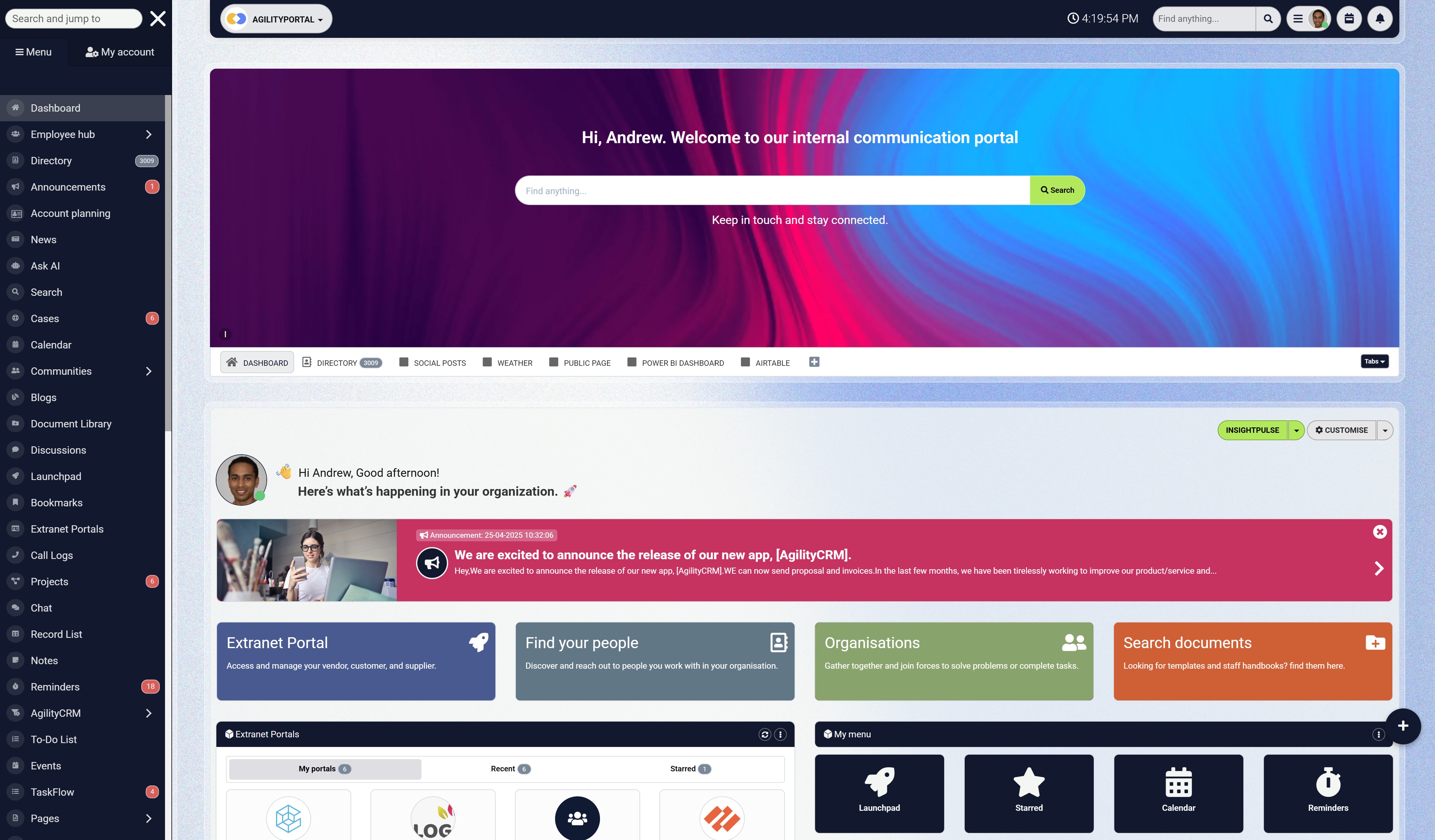
Digital Workplace Ecosystems
The future workplace is no longer built around a single tool or isolated software systems.
Instead, organizations are moving toward integrated digital workplace ecosystems where communication, collaboration, knowledge management, and employee engagement exist within one connected platform.
This shift helps eliminate the fragmentation that many businesses experience when using multiple disconnected tools. Employees can access company updates, share knowledge, collaborate on projects, and manage documents in a single environment.
Platforms like AgilityPortal are designed to support this type of agile digital workplace by bringing together internal communication, knowledge sharing, document management, and team collaboration into one unified system.
Rather than forcing employees to jump between multiple applications, integrated platforms create a central hub where teams can stay informed, connected, and productive.
Key components of modern digital workplace ecosystems often include:
- Centralized employee communication and company news
- Knowledge bases and document management systems
- Team collaboration spaces and project work hubs
- Employee engagement tools such as polls and feedback
- Mobile-first access for frontline and remote workers
As businesses continue to adopt agile workforce models, having a connected digital workplace platform will become essential for maintaining productivity, communication, and employee engagement across distributed teams.
Looking for an Intranet That Employees Actually Use?
Many organizations invest in intranet software expecting better communication and collaboration, but end up with platforms employees rarely visit. Poor search, scattered tools, and outdated interfaces often make intranets more frustrating than helpful.
AgilityPortal is a modern digital workplace and intranet platform designed to centralize communication, documents, and employee collaboration in one place. Instead of managing multiple disconnected systems, your teams get a single platform where they can find information, stay aligned, and get work done faster.
- Modern intranet hub for communication, knowledge, and collaboration
- Powerful search that helps employees find documents and information quickly
- Employee engagement tools including news feeds, recognition, and spaces
- Integrations with Microsoft 365, Google Workspace, and business systems
- Mobile-first intranet experience for remote and frontline workers
- Analytics and dashboards to track engagement and platform adoption
If you're evaluating intranet platforms in this guide, AgilityPortal gives you a modern solution that improves communication, simplifies knowledge sharing, and connects employees across your organization.
Try AgilityPortal Free for 14 Days
No credit card required
Wrapping up
Agile workplace staffing and modern IT support strategies are becoming essential components of how businesses operate in a rapidly evolving digital environment.
Organizations can no longer rely on rigid workforce models or outdated technology systems if they want to remain competitive. Instead, they must build flexible teams supported by reliable digital infrastructure that allows employees to collaborate, communicate, and work efficiently from anywhere.
When companies combine agile workforce strategies with scalable technology management, they gain the ability to adapt quickly to market changes, launch new initiatives faster, and support distributed teams without compromising productivity or security.
Reliable infrastructure, strong cybersecurity practices, and cloud-based collaboration tools all play a critical role in enabling this modern way of working.
Platforms such as AgilityPortal help organizations support this transition by creating a centralized agile digital workplace where employees can communicate, access knowledge, collaborate on projects, and stay connected across departments and locations.
Businesses that invest early in flexible workforce models and integrated digital workplace platforms will be far better positioned to innovate, scale operations, and support the workforce of the future.
AI Summary
- This guide explains how agile workplace staffing helps organizations build flexible teams that can scale quickly as business needs and project demands change.
- Modern companies increasingly rely on external technology partners to manage infrastructure, cybersecurity, and operational IT support.
- Research from Gartner shows that more than 60% of organizations now depend on external IT providers to support critical business systems and maintain reliability.
- Combining flexible workforce strategies with scalable technology infrastructure allows businesses to grow faster while maintaining stable operations.
- Cloud platforms, collaboration tools, and secure digital workplace systems play a critical role in supporting distributed and hybrid teams.
- Platforms such as AgilityPortal help organizations create an agile digital workplace where communication, collaboration, and knowledge sharing are centralized.
- Businesses that adopt flexible workforce models alongside modern workplace platforms can improve productivity, strengthen employee engagement, and scale operations more efficiently.
Most Popular Posts

Effective communication among team members is vital for the productivity and success of any organization. Surprisingly, 60% of companies lack a long-term internal communication strategy, which p...


Businesses thrive on communication for efficiency, productivity and accomplishment. When the right information is passed from the right designation in the organization, it promotes positivity an...

Categories
Blog
(3174)
Business Management
(392)
Employee Engagement
(234)
Digital Transformation
(214)
Growth
(149)
Intranets
(141)
Internal communications
(106)
Remote Work
(68)
Sales
(53)
Collaboration
(52)
Customer Experience
(32)
Culture
(30)
Knowledge Management
(29)
Project management
(29)
Leadership
(20)
Comparisons
(9)
News
(1)

Related Posts

Cyber Essentials is often described as a technical certification, but it is really a practical test of whether a business has the basics under control. That matters because cyber incidents rarely stay inside the IT department. They can interrupt payr...

Outsourced IT support becomes worth considering when technology problems stop being minor inconveniences and begin affecting how the business operates. A slow laptop or one-off password reset is manageable. But recurring downtime, unresolved support ...

An intranet network example in business could be as simple as a central employee hub where people find company policies, announcements, forms, training, documents and team updates. In practice, managing it well takes more than putting files beh...

Could your employees still find the policies, forms and information they rely on if your intranet moved to a new Microsoft 365 tenant tomorrow? An intranet migration can sound simple on a project plan: move sites, documents and user access from one M...

When Should You Hire IT Consulting Companies? 9 Costly Warning Signs Growing Businesses Can’t Ignore
Is Your Business Growing Faster Than Its IT Can Handle? Is your business growing faster than the systems, support and people behind it can keep up? It is an easy problem to miss at first. A few slow laptops, another spreadsheet workaround, or o...


Jill Romford
I am a digital nomad, lover of exploring new places and making friends.
I love to travel and I love the internet. I take pictures of my travels and share them on the internet using Instagram.
Traveler, entrepreneur, and community builder. I share my insights on digital marketing and social media while inspiring you to live your fullest life.
Ready to learn more? 👍
One platform to optimize, manage and track all of your teams. Your new digital workplace is a click away. 🚀
Free for 14 days, no credit card required.