
Insight Blog
Agility’s perspectives on transforming the employee's experience throughout remote transformation using connected enterprise tools.
22 minutes reading time
(4416 words)
Why Most HRMS Rollouts Fail — And the HRM and Change Management for HR Examples That Got It Right

Why Most HRMS Rollouts Fail — And the HRM and Change Management for HR Examples That Got It Right
Why HRMS projects fail and what actually works. Real hr change management examples, practical change management in HRM, and lessons HR teams can apply fast.
Why Most HRMS Rollouts Fail — And the HRM and Change Management for HR Examples That Got It Right

Let's be blunt: most HRMS projects don't fail because the software is bad.
They fail because hr and change management is treated as an afterthought. Organisations buy powerful HR systems, roll them out, train people once, then act surprised when adoption collapses.
The numbers back this up.
Studies consistently show that around 70% of organisational change initiatives fail, and HR technology projects sit right in that danger zone.
Gartner has reported that over 50% of HR leaders say their HR technology implementations did not deliver the expected business value, even when the tools themselves were technically sound. That's not a product issue. That's a change problem.
Employee resistance is the real blocker.
Research from Prosci shows that projects with effective change management are up to 6× more likely to meet or exceed objectives compared to those with poor or no change management.
Yet many HR teams still assume resistance means "employees hate change" or "people don't like new systems." In reality, employees resist confusion, disruption, and unclear benefits. When HR can't clearly explain why the system matters to daily work, people revert to old habits fast.
Poor change management in the HR department makes this worse.
HR teams often underestimate how much changes in HR management affect trust. When payroll, leave, performance reviews, or onboarding suddenly feel harder instead of easier, confidence drops instantly.
According to Gallup, only 23% of employees worldwide feel engaged at work, and badly handled system changes actively push that number down by adding friction instead of removing it.
The takeaway is simple.
HRMS success has far less to do with features and far more to do with behaviour.
If HR doesn't lead change deliberately—communication, reinforcement, leadership visibility, and ongoing support—the system becomes just another expensive tool people work around instead of with.
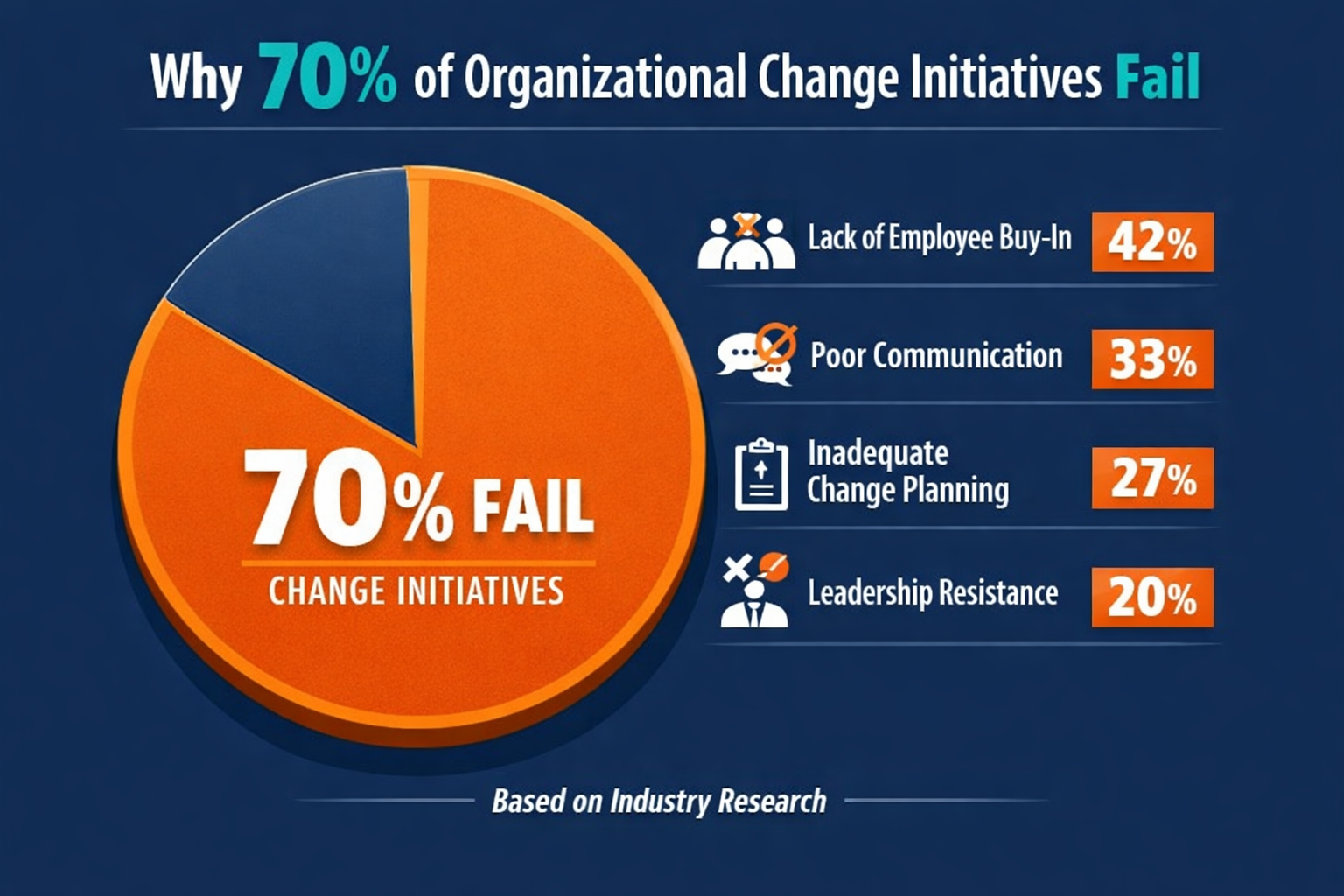
Poor change management in the HR department makes this worse.
Key Takeaways You’ll Get From This Guide
- Why most HRMS projects fail due to weak change management in HR, not bad software
- What effective change management for HR actually looks like in real organisations
- Proven HR change management examples that drove real adoption, not just logins
- The critical role of the HR change manager in reducing resistance and confusion
- How poor change management in the HR department leads to wasted spend and shadow systems
- What successful changes in HR management have in common after HRMS rollout
If your HR system exists but employees still avoid it, this guide will show you exactly what to fix and where most HR teams go wrong.
Read this article: : Top 6 AI-Powered Project Management Tools To Use In 2023
What Change Management for HR Actually Means

What Change Management for HR Actually Means
Change management for HR is not about sending announcement emails, running one training session, or uploading a PDF to the intranet. That's activity, not change.
Change management in human resources is about deliberately shifting behaviour—how people work, where they go for information, and what they trust day to day.
This is where HR change management is very different from IT change management.
IT focuses on systems being live, secure, and technically stable. HR focuses on people actually using the system willingly.
An HRMS can be 100% implemented from a technical standpoint and still be a complete failure if employees avoid it. Data from Gartner shows that nearly 60% of employees say new workplace systems make their job harder, not easier.
That gap exists because behaviour change was never managed.
HR owns behaviour change because HR owns the employee experience. Policies don't drive adoption—habits do.
When HR introduces a new system, employees immediately ask three silent questions:
- Will this slow me down?
- Will I be judged or monitored?
- What happens if I don't use it?
If HR doesn't answer those questions clearly and early, resistance kicks in.
Prosci research shows that employees are 5× more likely to adopt change when they understand the personal impact, not just the organisational benefit.
That understanding doesn't come from system demos. It comes from HR-led communication that connects the system to real work.
The role of HR in change management spans the entire lifecycle of an HRMS rollout. Before launch, HR defines the "why," aligns managers, and sets expectations.
During rollout, HR reinforces usage through leadership visibility, simple guidance, and feedback loops.
After launch, HR monitors adoption, fixes friction points, and keeps reinforcing the change until new behaviour becomes normal. McKinsey data shows that sustained reinforcement increases change success rates by over 30%, yet this phase is where most HR teams stop.
Bottom line: change management for HR is not a side task. It's core HR work.
If HR treats system change as a technical event instead of a human transition, the system will technically succeed—and practically fail.
The Cost of Ignoring Change Management in HRM (Now With Real Stats)

The Cost of Ignoring Change Management in HRM (Now With Real Stats)
Ignoring change management in HR isn't just sloppy planning — it's expensive and predictable.
When organisations skip structured change work, the fallout shows up in wasted licences, shadow systems, stalled adoption, and frustrated employees.
Here's what the data says:
- Most change initiatives fail outright. Research consistently shows that about 70% of change efforts don't achieve their intended goals — primarily because people weren't brought along, not because the technology was bad.
- Only a third of changes get adopted healthily. A 2025 Gartner survey found that just 32% of leaders reported achieving healthy change adoption among employees — meaning most teams still struggle to get people to change how they work even after rollout.
- That's especially costly when you consider adoption metrics matter directly to ROI: organisations with strong change adoption see higher productivity, better performance, and reduced long-term resistance, whereas those without it see inertia, wasted effort, and disengagement.
- Financial and productivity impacts are real and measurable. Data from Gallup shows only about 21% of employees worldwide are highly engaged, and disengagement during change costs an estimated $438 billion in lost productivity globally. When HR systems fail to stick, that disengagement bleeds straight into your bottom line.
- Wasted licences and inefficient tool use are common. When users default back to old tools or shadow systems because the new HRMS doesn't fit their workflows, organisations end up paying for subscriptions people don't use, and potentially buying more disparate tools to "fix" the first failure. This is exactly what happens when change management in HR departments gets minimal planning — people adapt around the system, not with it.
Bottom line: the cost of ignoring change management in HRM isn't hypothetical.
Projects get delayed, budgets inflate, adoption collapses, and your organisation pays twice — once for the software and again for the inefficiencies created when it sits unused or under-utilised.
The Role of the HR Change Manager (And Why Most Organisations Skip It)
When change lands, employees don't resist because they are difficult.
They resist because they feel uncertain, uninformed, and exposed.
The role of HR in managing resistance to change is to reduce fear, protect trust, and guide people through disruption without pretending everything is fine.
One of the biggest concerns during organisational change is fear of the unknown—especially around job security, performance monitoring, and role relevance. If HR stays vague or overly positive, anxiety fills the gap.
Research shows that employees who feel informed during change are 3.6× more likely to remain engaged than those left in the dark.
Clear, honest communication from HR doesn't remove uncertainty, but it stops rumours from becoming the truth.

Information loss is another major risk. During change, employees actively look for clarity, but fragmented messaging, inconsistent updates, and unclear ownership create confusion fast.
This is where change management in human resources becomes operational, not theoretical. HR must act as the single source of truth, reinforcing what is changing, what is not, and what support is available.
Organisations that provide structured change support experience up to 47% less productivity dip during transitions compared to those that don't.
Trust is the hardest thing to maintain and the easiest thing to lose. Employees are the backbone of any organisation, and change exposes whether leadership actually values them or just expects compliance.
Involving employees through focus groups, feedback sessions, and pilot groups signals trust.
According to Deloitte, organisations that actively involve employees in change decisions are more than twice as likely to meet their transformation goals and see higher retention during periods of disruption.
Change also triggers emotional responses—uncertainty, frustration, even disengagement. HR's job is not to eliminate those feelings but to anticipate them and manage them responsibly.
With preparation and strategic foresight, HR can turn change from something that happens to employees into something that happens with them. When HR leads change deliberately, resistance doesn't disappear—but it becomes manageable, constructive, and far less damaging.
The 5 Core Responsibilities of HR in Managing Change Resistance
- Set Clear Expectations Early - Explain what is changing, why it's happening, and how it affects employees personally—before rumours do the damage.
- Maintain Open and Honest Communication - Share updates regularly, even when there are unknowns. Silence creates fear faster than bad news.
- Provide Practical Support During Transition - Offer training, guidance, and hands-on help that fits real workflows, not just theoretical use cases.
- Involve Employees in the Change Process - Use focus groups, feedback loops, and pilot programmes to give employees a voice and a sense of ownership.
- Protect Trust and Monitor Impact - Track sentiment, adoption, and friction points, then adjust quickly before resistance turns into disengagement or attrition.
If HR treats resistance as defiance, change will fail. If HR treats it as feedback, change becomes survivable—and often successful.
HR Change Management Examples That Worked (Real Patterns, Not Theory)
When HRMS change management works, it almost never looks flashy.
There's no big launch day, no one-off training blitz, and no expectation that behaviour will magically change overnight.
What does work is a set of repeatable patterns rooted in how people actually adopt new ways of working.
The following HR change management examples show up again and again in successful rollouts across industries.
1. Phased Rollouts Beat Big-Bang Launches Every Time
One of the most consistent success patterns in change management human resources is rolling out systems in phases instead of all at once.
Organisations that tried to launch every module on day one often overwhelmed employees and triggered avoidance. In contrast, phased rollouts reduced cognitive load and built confidence gradually.
Data backs this up.
Prosci reports that organisations using incremental, staged change approaches are up to 30% more likely to meet adoption goals than those using big-bang launches.
Employees had time to build habits before the next change arrived, which is critical when systems affect daily tasks like leave requests, approvals, and performance check-ins.
2. Leaders Used the System First (And Publicly)
Another pattern that separates failed rollouts from successful ones is leadership behaviour.
In high-adoption organisations, leaders didn't just endorse the HRMS—they used it visibly. Managers submitted requests, completed reviews, and shared updates through the system instead of bypassing it.
This matters more than most HR teams realise.
Gartner research shows that employees are 3× more likely to adopt new tools when managers actively model the behaviour.
When leaders ignore the system, employees read that as permission to do the same. Successful HR change management examples remove that ambiguity fast.
3. Feedback Loops Were Built Into the Rollout
Successful HR teams didn't assume they got everything right the first time.
They baked feedback into the rollout through pulse surveys, drop-in sessions, and quick feedback forms tied directly to system usage. That feedback wasn't collected for optics—it was used to fix friction.
According to McKinsey, change initiatives that actively collect and act on employee feedback are up to 2.6× more likely to succeed.
Employees are far more willing to tolerate disruption when they see problems acknowledged and resolved quickly. Silence kills trust; responsiveness builds it.
4. HR Positioned the HRMS as a Daily Tool, Not an "HR System"
The most effective hr change management examples avoided branding the platform as "the HR system."
Instead, HR framed it as how work gets done: where updates live, requests happen, and decisions are tracked. This subtle shift changed perception.
When systems are positioned as "HR tools," employees associate them with compliance and control.
When positioned as daily work tools, adoption rises.
Deloitte research shows that organisations focusing on employee experience rather than administrative efficiency see up to 40% higher technology adoption rates during transformation efforts.
The Pattern Behind Every Successful Example
Across all these examples, one truth holds: successful change management in human resources focuses on behaviour first, technology second.
HR teams that planned for habit formation, leadership visibility, and continuous feedback didn't eliminate resistance—but they controlled it.
And that control is the difference between an HRMS that exists and one that actually works.
Why These HRMS Change Management Examples Succeeded
The HRMS change management examples that actually worked didn't succeed by accident. They followed a few hard rules that most organisations ignore. When you strip away the tools, vendors, and timelines, success came down to how change management in HRM was owned, communicated, and reinforced.
Clear ownership inside the HR department was the first differentiator. In successful cases, HR didn't assume adoption would "just happen" once the system went live. One person—or a clearly defined team—owned change end to end. That ownership covered communication, feedback, adoption tracking, and course correction. Research from Prosci shows that initiatives with clear change ownership are up to 6 times more likely to meet objectives than those where responsibility is spread thin or left ambiguous. Without ownership, problems surface late, and by then resistance has already taken hold.
Change communication was tied directly to real employee pain points, not abstract business goals. Employees don't care that a system "supports strategic alignment." They care that booking leave is faster, approvals don't get lost, and information is easier to find. Successful HR teams framed messages around everyday frustrations the HRMS removed. According to Gartner, employees are over 4 times more likely to support change when communication focuses on personal impact rather than organisational benefit. This approach reflects a broader shift in changes in HR management, where employee experience now carries more weight than internal efficiency alone.
Training focused on outcomes, not features, was the third major success factor. Failed rollouts often relied on long demos covering every function of the system. Successful ones trained employees on what they needed to get done, not what the software could theoretically do. McKinsey data shows that outcome-based training improves skill application by up to 35% compared to feature-heavy training. When employees quickly see how the system helps them complete real tasks, adoption accelerates naturally.
Taken together, these factors explain why some HRMS rollouts stick while others stall. The examples that worked treated change as a management discipline, not a launch activity. Ownership was clear, communication was grounded in reality, and training respected how people actually learn. That combination is what turns change management in HRM from a risk into a repeatable advantage.
Read this article: : Top 6 AI-Powered Project Management Tools To Use In 2023
Common HR Change Management Mistakes to Avoid (And How to Fix Them)
Let's be direct.
Around 70% of change management initiatives fail, and HR-led change is no exception.
The reason is rarely lack of effort. It's poor structure, weak leadership involvement, and misunderstanding the process of change itself.
Below are the most common HR change management mistakes—and exactly how to manage organisational change properly instead.
Mistake 1: Treating Change as a One-Off Project
Many HR teams still treat change as something with a start date and an end date. Launch the system. Run training. Move on.
That's a guaranteed failure.
Change is not an event. It's a behavioural transition that takes time.
Best practice change management treats change as a cycle: prepare, adopt, reinforce, adjust.
McKinsey data shows that organisations that actively reinforce change after go-live are 30–40% more likely to sustain adoption than those that stop at launch.
Design change as a continuous process. Reinforcement plans, follow-up communications, and adoption reviews must be built into the project from day one.
Mistake 2: Overloading Staff on Day One
HRMS rollouts often fail because employees are hit with too many features at once.
The assumption is "more value = faster adoption." In reality, more features usually mean more confusion.
Cognitive overload is a silent adoption killer. Studies in workplace transformation show that when employees feel overwhelmed, usage drops sharply within the first 30 days, even if training was completed.
Use staged adoption. Introduce only what employees need to do their jobs today. Save advanced functionality for later phases.
This aligns with best practice change management and dramatically improves habit formation.
Mistake 3: Ignoring the Manager's Role in Change Management
One of the biggest mistakes HR makes is assuming change is an HR-only responsibility. It isn't.
The manager's role in change management is critical.
Gartner research shows employees are up to 5× more likely to adopt change when their direct manager actively supports it. If managers bypass the system, complain about it, or stay silent, employees follow suit.
Managers must be treated as change leaders, not just recipients.
Train them first, equip them with talking points, and hold them accountable for reinforcing change in daily work.
Mistake 4: No Clear Change Management Team Structure
When everyone owns change, no one owns change.
In failed initiatives, the change management team structure is vague or missing entirely. HR assumes IT will handle it.
IT assumes HR will. Leadership assumes training will fix it. Adoption falls through the cracks.
Prosci research consistently shows that initiatives with a clearly defined change structure are up to 6× more likely to succeed.
Define roles clearly:
- Executive sponsor (direction and authority)
- HR change lead (behaviour, communication, adoption)
- Managers (reinforcement and local leadership)
- Support owners (training, feedback, fixes)
Mistake 5: Excluding Executives From Active Change Leadership
Many executives approve change but don't visibly participate in it. That sends the wrong signal.
Change management for executives is not about approving budgets.
It's about visible commitment. Deloitte data shows transformations with active executive sponsorship are more than twice as likely to meet objectives compared to those with passive sponsors.
Executives must communicate the "why," model the behaviour, and publicly use the new system. If leaders don't change, no one else will.
Mistake 6: Poorly Designed Change Management Interventions
Generic interventions—mass emails, one-size-fits-all training, static documentation—rarely work.
Effective change management interventions are targeted and practical. They address specific friction points: confusion, fear, workflow disruption, and trust.
Use interventions such as:
- Manager-led team discussions
- Pilot groups and champions
- Short, role-specific training
- Feedback loops with visible action
These interventions directly support the process of change rather than just broadcasting information.
How to Manage Organisational Change the Right Way (In Practice)
To manage organisational change properly in the HR department, follow this structured approach:
- Prepare – Define ownership, assess readiness, and identify resistance early
- Communicate – Explain why the change matters personally, not just strategically
- Enable – Train for outcomes, not features; support real workflows
- Reinforce – Monitor adoption, fix friction, and reward new behaviours
- Adjust – Use feedback to refine processes continuously
This isn't theory. Organisations that follow a structured change process consistently outperform those that treat change as a rollout task.
If HR ignores these mistakes, it joins the 70% of change management initiatives that fail.
If HR fixes them, change becomes predictable, manageable, and repeatable. The difference is not effort—it's discipline, structure, and leadership.
A Practical Change Management Framework HR Teams Can Reuse
This is where most HR teams struggle—not because they don't care, but because they don't have a repeatable framework. Good intentions don't scale.
A clear process does.
The framework below is designed for change management human resources teams who want predictable adoption, not guesswork.
Step-by-Step HRMS Rollout Framework (That Actually Works)
Step 1: Prepare Before You Announce Anything
Change fails early when HR announces tools before preparing people.
What HR should do first:
- Identify what will change for employees day to day, not just what the system does
- Map current workflows vs future workflows
- Identify high-impact roles (managers, frontline teams, approvers)
- Assign clear ownership for hr and change management
Stat to remember: Organisations that assess change readiness upfront are up to 2× more likely to achieve adoption targets than those that don't.
Step 2: Communicate for Personal Impact, Not Strategy
Employees don't adopt systems because of vision decks. They adopt systems because it makes their job easier.
Effective HR communication answers:
- What's changing for me?
- What stays the same?
- What will be harder at first?
- Where do I go when I'm stuck?
Avoid over-polished messaging. Clarity beats optimism every time.
Step 3: Enable Through Role-Based Training (Not Feature Demos)
Most HRMS training fails because it's generic.
Instead:
- Train by role, not by system module
- Focus on tasks employees must complete weekly
- Keep sessions short and repeatable
- Support training with simple, searchable help
McKinsey research shows outcome-based training improves real-world application by 30–35% compared to feature-led training.
Step 4: Launch in Phases, Not All at Once
Big-bang launches overwhelm people and kill confidence.
Best practice:
- Start with 1–2 core workflows
- Let habits form before expanding
- Reinforce success publicly
This phased approach is a cornerstone of strong change management human resources practices.
How to Measure Adoption Beyond Logins (This Is Critical)
Logins lie. Real adoption shows up in behaviour.
What HR should track instead:
- Are processes completed fully inside the system?
- Are managers approving tasks through the platform?
- Are old tools still being used "on the side"?
- Where do employees get stuck or drop off?
Data insight: Gartner reports that organisations measuring behavioural adoption—not system usage—are 40% more likely to sustain change long term.
When to Adjust Processes Instead of Forcing Tools
This is where mature HR teams stand out.
If employees consistently resist:
- Don't assume laziness
- Don't add more training
- Don't blame culture
Instead, ask:
- Is the process realistic?
- Does it match how work actually happens?
- Are we forcing HR logic onto operational roles?
Sometimes the right move is to change the process, not push harder on the tool. That's real hr and change management—adapting systems to people, not people to systems.
The Framework in One Line
Prepare deliberately. Communicate honestly. Train for outcomes. Launch in phases. Measure behaviour. Adjust fast.
HR teams that reuse this framework stop relying on hope and start managing change as a discipline.
That's the difference between an HRMS that exists—and one that actually gets used.
What Changes in HR Management Look Like After Successful Adoption
When HRMS adoption actually sticks, the impact goes far beyond using a new system.
Changes in HR management show up in how HR operates, how decisions are made, and how employees interact with the function day to day.
This is where change management in HRM finally pays off.
HR shifts from admin to enablement.
After successful adoption, HR stops acting as a manual processing centre and starts operating as a true enabler of work.
Routine tasks—leave requests, approvals, document access, policy updates—run without constant HR intervention.
According to Deloitte, organisations that successfully digitise HR processes can reduce administrative workload by 30–40%, freeing HR teams to focus on talent, performance, and employee experience instead of chasing forms and fixing errors.
Better data leads to better decisions and less firefighting.
When people actually use the system consistently, HR data becomes reliable.
That changes everything.
Absence trends, turnover risk, engagement signals, and workload patterns are visible early instead of after problems explode.
Gartner research shows organisations with high-quality HR data are 3× more likely to make faster, more confident workforce decisions. Instead of reacting to issues late, HR moves into a preventative role—spotting problems before they become crises.
Employees start trusting HR systems again.
Trust is one of the biggest indicators of successful change.
Before adoption, employees often see HR systems as slow, unreliable, or purely bureaucratic.
After successful change management, that perception flips.
Processes work the same way every time, approvals don't disappear, and information is easy to find.
Gallup data consistently shows that employees who trust internal systems and processes are significantly more engaged and less likely to disengage during organisational change.
The biggest signal of success is subtle: HR gets fewer complaints, fewer "can you just do this for me" requests, and fewer workarounds. That silence isn't disengagement—it's confidence.
When HRMS adoption works, HR stops firefighting and starts leading.
That's the real outcome of effective change management in HRM, and it's what modern changes in HR management are supposed to deliver.
Final Takeaway: HRMS Success Is a Change Problem, Not a Software Problem
After looking at real hr change management examples, one conclusion is unavoidable: HRMS projects don't fail because of bad software.
They fail because change management for HR is treated as secondary, optional, or something that can be outsourced to vendors or IT.
HR must lead change because HR owns behaviour, trust, and the employee experience.
Vendors can configure systems. IT can deploy them. Only HR can explain why the change matters, anticipate resistance, and guide employees through new ways of working.
Organisations that delegate change leadership away from HR consistently struggle with low adoption, shadow systems, and disengagement. Research shows that initiatives led by internal change owners are far more likely to sustain adoption than those driven externally.
What to do differently in your next HRMS rollout is clear. Start planning change before the system is even selected. Assign a clear HR change owner. Involve managers early.
Communicate honestly about what will be harder at first. Train employees on outcomes, not features. Reinforce usage long after go-live. These are not "nice to haves"—they are the difference between a system that exists and one that actually gets used.
One action HR leaders should take this quarter: audit adoption, not usage.
Stop asking how many people logged in. Start asking whether key processes are completed end to end inside the system, whether managers are reinforcing usage, and where employees still work around the tool. That single shift in focus forces HR to manage change deliberately instead of hoping it sticks.
In the end, HRMS success is simple but uncomfortable. If HR treats change as a people problem and leads it properly, the technology works. If HR treats change as a software problem, no platform will save it.
Most Popular Posts

Effective communication among team members is vital for the productivity and success of any organization. Surprisingly, 60% of companies lack a long-term internal communication strategy, which p...


Businesses thrive on communication for efficiency, productivity and accomplishment. When the right information is passed from the right designation in the organization, it promotes positivity an...

Categories
Blog
(3196)
Business Management
(395)
Employee Engagement
(235)
Digital Transformation
(218)
Growth
(150)
Intranets
(141)
Internal communications
(106)
Remote Work
(68)
Sales
(53)
Collaboration
(52)
Customer Experience
(32)
Culture
(30)
Knowledge Management
(29)
Project management
(29)
Leadership
(20)
Comparisons
(9)
News
(1)

Related Posts

Could AI produce your next workplace video faster—and still deliver a message your employees can trust? As more businesses use video for onboarding, training and leadership updates, one question keeps coming up: will AI replace video editors in...

Could the best machine learning systems help your employees spend less time sorting requests, updating spreadsheets and chasing information—and more time doing useful work? That's the opportunity, but finding the right system starts with knowin...

What would happen to your team's work and customer information if an employee's MacBook disappeared today? If you're wondering how to protect your Mac physically, the answer goes beyond buying a case. A MacBook used at home, on a train or in a ...

Welcome to AgilityPortal's guide to the best VPN for Remote teams. How do you give employees secure access to company systems when they work from home, the office and everywhere in between? It's a question more businesses need to answer: 28% of worki...

Have you ever left a meeting thinking everyone agreed on the next step, only to discover a week later that each person remembered something different? Open source meeting transcription can help teams keep a searchable record of the conversation...


Jill Romford
I am a digital nomad, lover of exploring new places and making friends.
I love to travel and I love the internet. I take pictures of my travels and share them on the internet using Instagram.
Traveler, entrepreneur, and community builder. I share my insights on digital marketing and social media while inspiring you to live your fullest life.
Ready to learn more? 👍
One platform to optimize, manage and track all of your teams. Your new digital workplace is a click away. 🚀
Free for 14 days, no credit card required.