
Insight Blog
Agility’s perspectives on transforming the employee's experience throughout remote transformation using connected enterprise tools.
25 minutes reading time
(4987 words)
Cloud vs Dedicated Server: Choosing the Right Setup for Performance, Security & Scale

Cloud vs Dedicated Server: Choosing the Right Setup for Performance, Security & Scale
Compare Cloud vs Dedicated Server to understand performance, security, scalability, compliance, and cost differences — and discover when dedicated hosting is the better choice for growing businesses.
Cloud vs Dedicated Server: Choosing the Right Setup for Performance, Security & Scale

Businesses adopting modern infrastructure often assume that moving entirely to the cloud will automatically improve scalability, reduce operational costs, and simplify IT management.
While enterprise cloud services offer flexibility and rapid deployment, many organisations eventually discover that shared cloud environments can introduce performance limitations, unpredictable monthly spending, latency issues, and compliance concerns as workloads become more demanding.
According to Flexera's State of the Cloud Report, more than 84% of enterprises now operate using multi-cloud strategies, yet managing cloud spending remains one of the biggest challenges facing IT teams today.
Many businesses underestimate long-term infrastructure costs, especially when storage, bandwidth, scaling requirements, and high-performance workloads begin to grow rapidly.
84%
of enterprises use multi-cloud
According to Flexera's State of the Cloud Report, more than 84% of enterprises now operate using multi-cloud strategies, yet managing cloud spending remains one of the biggest challenges facing modern IT teams.
Source: Flexera State of the Cloud Report
This ongoing debate around Cloud vs Dedicated Server infrastructure has pushed many organisations to reassess whether shared cloud platforms are always the best solution for mission-critical systems.
In many cases, dedicated infrastructure delivers stronger performance consistency, better security isolation, greater compliance control, and more predictable operational costs than traditional cloud environments.
This article explores the real differences between enterprise cloud services and dedicated infrastructure, including how each model works, where each performs best, the hidden limitations businesses often overlook, and when dedicated infrastructure becomes the smarter long-term choice for performance, security, and scalability.
Key Takeaways
- Enterprise cloud services provide scalability and rapid deployment, but shared environments can introduce performance fluctuations, rising operational costs, and compliance limitations as workloads grow.
- Dedicated infrastructure delivers isolated hardware resources, predictable performance, stronger security control, and better workload consistency for mission-critical enterprise systems.
- Businesses running AI workloads, enterprise databases, ecommerce platforms, ERP systems, or compliance-sensitive applications often benefit more from dedicated infrastructure environments.
- Many organisations now adopt hybrid infrastructure strategies that combine cloud flexibility with the performance, compliance, and security advantages of dedicated servers.
- The best infrastructure decision depends on workload demands, scalability requirements, operational costs, compliance obligations, and long-term business growth objectives.
What Are Enterprise Cloud Services?
Enterprise cloud services refer to large-scale cloud computing solutions designed to help organisations manage applications, storage, databases, networking, security, and computing resources through internet-based infrastructure instead of relying entirely on on-premise hardware.
In simple terms, enterprise cloud computing allows businesses to access computing power, software platforms, and storage resources on demand without needing to build and maintain expensive physical infrastructure internally. These services are typically delivered through global cloud providers that manage the underlying servers, networking systems, security layers, and data centres.
Unlike traditional IT environments that rely heavily on in-house servers, enterprise cloud platforms provide businesses with flexible infrastructure that can scale rapidly as operational demands change.
This is one of the main reasons why cloud adoption has accelerated across industries such as finance, healthcare, ecommerce, SaaS, and enterprise software development.
According to Gartner, worldwide public cloud spending is expected to surpass $1 trillion in the coming years as organisations continue shifting workloads away from traditional infrastructure models and into cloud-based ecosystems.
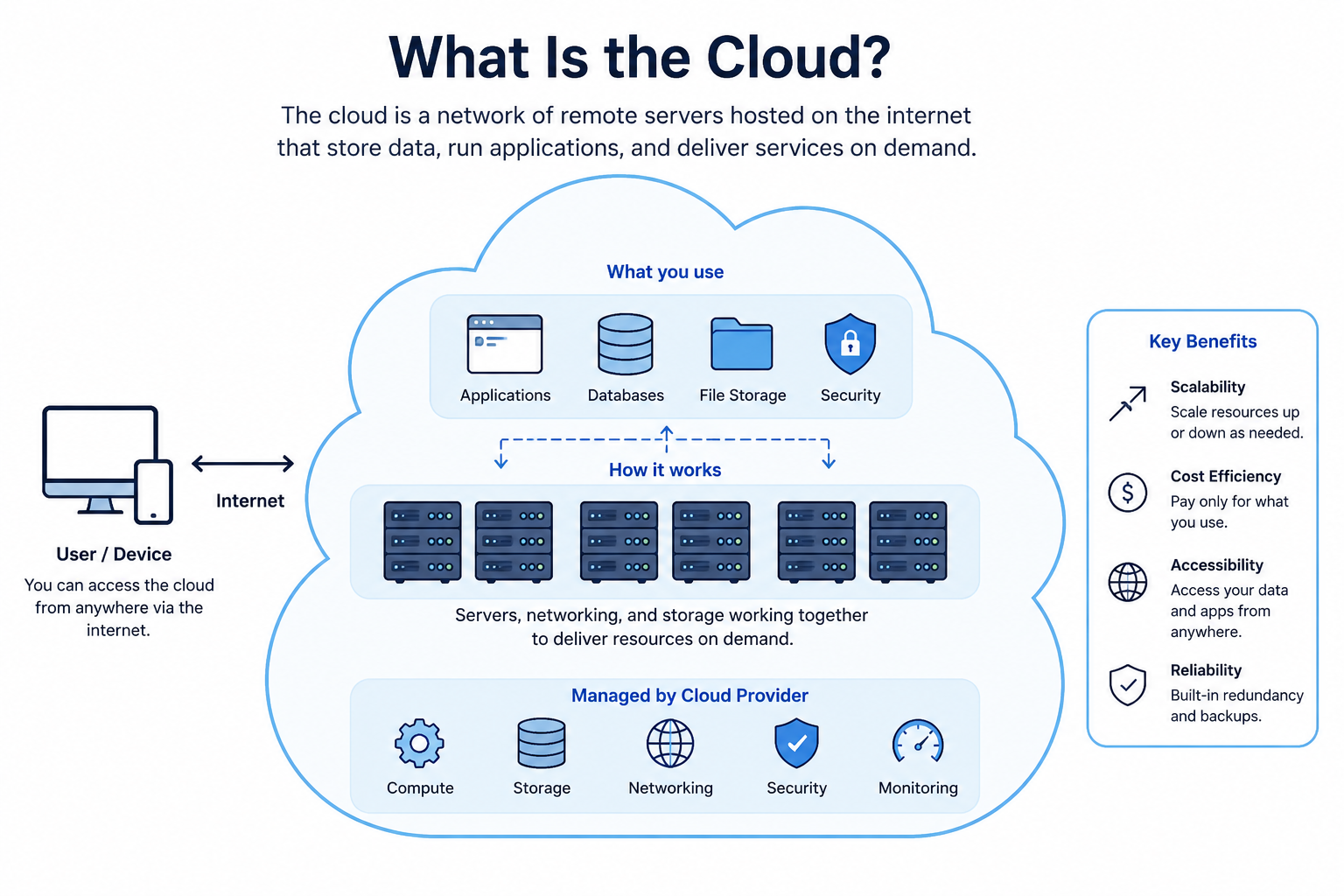
What Are Enterprise Cloud Services
How Does Enterprise Cloud Computing Work?
Understanding how enterprise cloud computing works starts with understanding the concept of shared infrastructure.
Most enterprise cloud environments operate using virtualised resources hosted inside large-scale data centres managed by cloud providers such as Amazon Web Services, Microsoft Azure, and Google Cloud.
These providers distribute computing resources across multiple customers using virtual machines, containers, software-defined networking, and distributed storage systems.
Businesses can then rent processing power, storage, databases, security tools, and applications as needed rather than purchasing physical servers outright.
Most enterprise cloud environments include:
- Public cloud infrastructure that allows businesses to access scalable computing resources through the internet
- Multi-tenant environments where multiple organisations share the same underlying hardware securely through virtualization
- Elastic scaling that automatically increases or decreases resources based on workload demand
- Managed cloud ecosystems that reduce the burden of maintaining hardware, operating systems, and updates internally
This model gives businesses far greater flexibility compared to traditional infrastructure because resources can be deployed almost instantly without large upfront capital investments.
There are many well-known enterprise cloud examples used by organisations globally today. Some of the most common include:
- Amazon Web Services (AWS)
- Microsoft Azure
- Google Cloud Platform (GCP)
- IBM Cloud
- Oracle Cloud Infrastructure
- Salesforce Cloud Services
These platforms support everything from enterprise applications and AI workloads to storage systems, collaboration platforms, business analytics, and global content delivery networks.
Why Businesses Move to Enterprise Cloud Services
Many organisations adopt enterprise cloud services because they offer faster deployment, improved operational flexibility, and reduced infrastructure management responsibilities.
Some of the biggest advantages include:
- Faster deployment of applications and services
- Reduced need for maintaining physical servers internally
- Flexible scaling during traffic spikes or seasonal demand
- Improved accessibility for remote and global teams
- Lower upfront hardware investment
- Access to advanced cloud security and disaster recovery capabilities
However, while enterprise cloud computing offers major operational benefits, it is not always the ideal solution for every workload.
As infrastructure demands grow, many businesses eventually begin evaluating whether dedicated infrastructure may provide better long-term performance, cost predictability, and security control for critical systems.
What Is Dedicated Infrastructure?
Dedicated infrastructure refers to computing environments where servers, storage, networking resources, and processing power are allocated exclusively to a single organisation rather than being shared across multiple customers.
Unlike many public cloud environments that operate using shared multi-tenant systems, dedicated infrastructure provides businesses with isolated hardware resources designed for maximum control, stability, and performance consistency.
As businesses scale, many organisations eventually discover that shared cloud environments can struggle to support resource-intensive applications, compliance-heavy operations, and predictable high-performance workloads.
This is one of the main reasons why dedicated infrastructure continues to play a major role in modern enterprise computing strategies.
According to IDC, more than 70% of enterprise workloads still run on some form of dedicated or private infrastructure, especially within industries where security, latency, uptime, and compliance remain critical operational priorities.
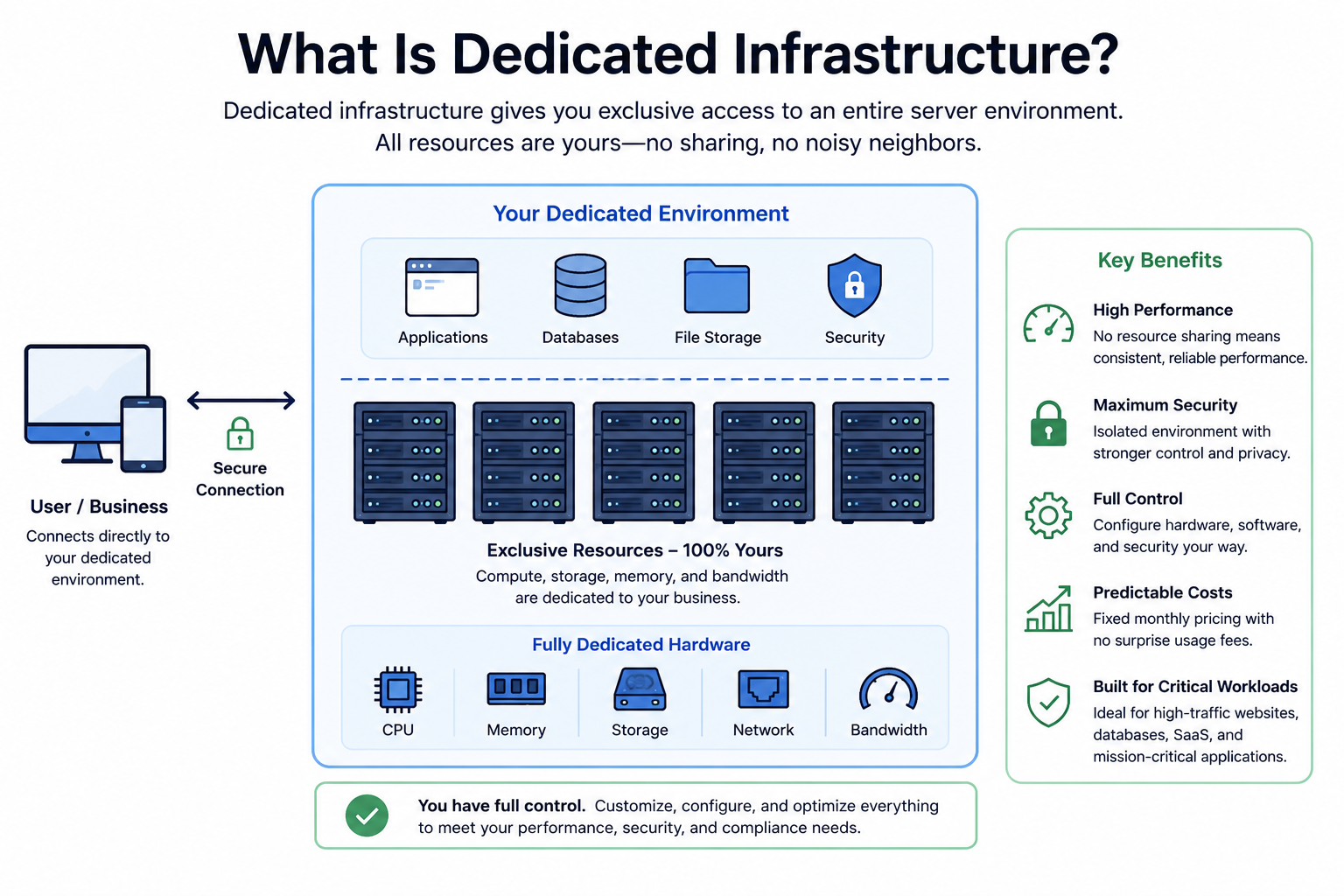
What Is Dedicated Infrastructure
Understanding Single-Tenant Infrastructure
Single-tenant infrastructure means the underlying hardware is reserved entirely for one business.
This allows organisations to avoid the resource-sharing limitations often found in traditional cloud platforms.
- Dedicated Servers - Dedicated servers provide businesses with exclusive access to physical hardware resources including CPU, RAM, storage, and bandwidth. Unlike virtualised cloud environments, no other customers share the same physical machine. This is particularly important for businesses running high-traffic applications, enterprise databases, AI processing workloads, or performance-sensitive systems that require guaranteed resources at all times.
- Private Infrastructure Environments - Private infrastructure environments give organisations greater control over networking configurations, security policies, compliance management, and application performance. Many enterprises use private infrastructure to support sensitive internal systems, customer data, and regulated workloads.
- Bare-Metal Hosting - Bare-metal hosting refers to non-virtualised physical servers that deliver direct hardware access without the overhead created by virtualization layers. This often results in lower latency, faster processing, and improved workload consistency. Bare-metal environments are commonly used for high-performance enterprise applications, gaming platforms, big data analytics, and AI infrastructure.
- Isolated Workloads - One of the biggest advantages of dedicated infrastructure is workload isolation. Since resources are not shared with external customers, businesses can avoid many of the performance fluctuations caused by "noisy neighbour" issues commonly associated with shared hosting environments.
Enterprise Cloud Services vs Dedicated Infrastructure — The Core Differences
When businesses compare enterprise cloud services vs dedicated infrastructure, the decision usually comes down to five major factors: performance, security, scalability, management complexity, and long-term cost control.
While both infrastructure models can support enterprise applications, they operate very differently behind the scenes.
For growing businesses, understanding these differences is critical because the wrong infrastructure setup can lead to performance bottlenecks, rising operational costs, compliance risks, and scalability limitations as workloads expand.
According to Uptime Institute research, nearly 60% of organisations report that infrastructure outages cost more than $100,000 per incident, making infrastructure reliability and workload performance a major business concern for enterprise IT leaders.
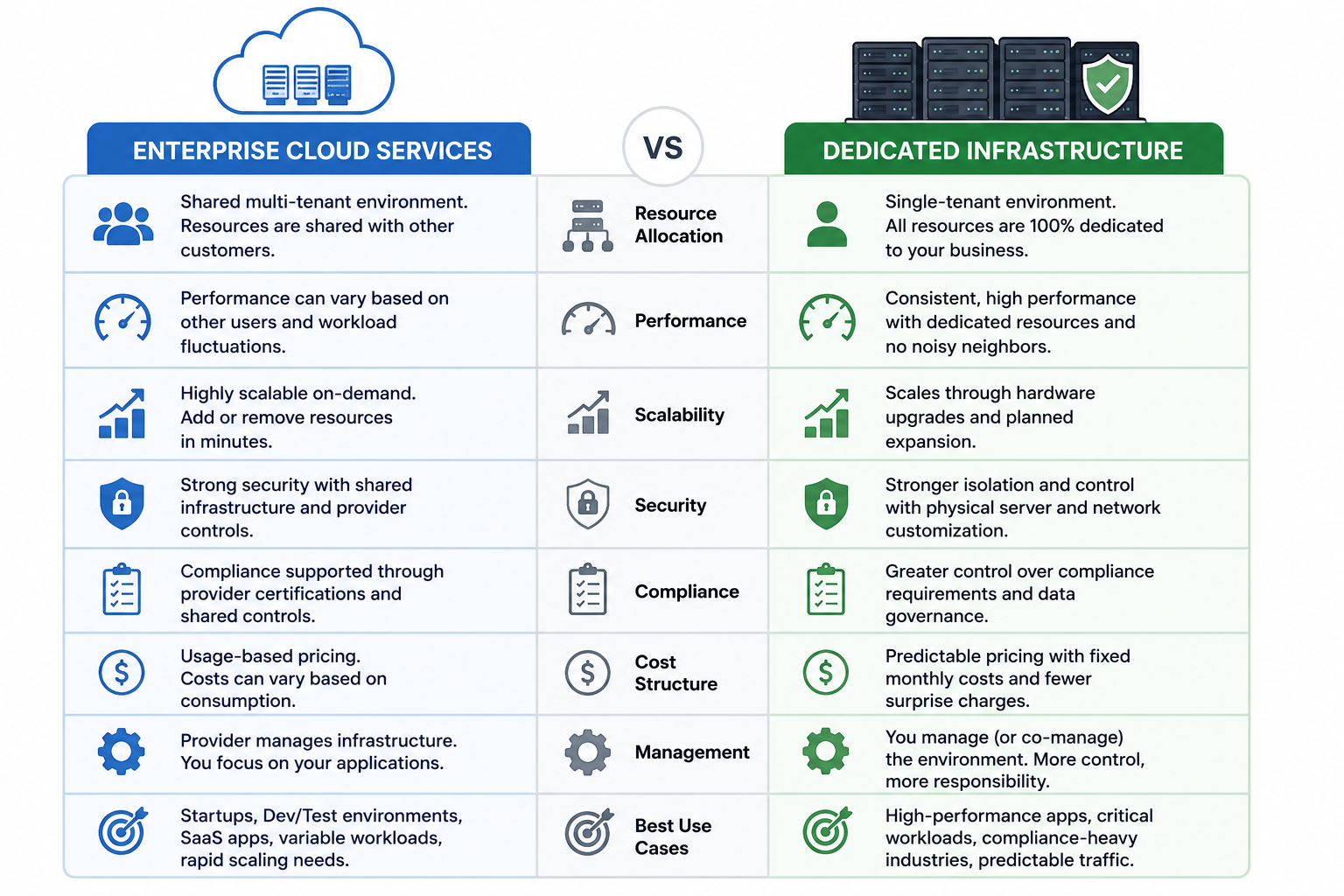
Enterprise Cloud Services vs Dedicated Infrastructure — The Core Differences
Performance and Workload Consistency
Performance is one of the biggest reasons organisations begin reconsidering shared cloud environments.
While enterprise cloud platforms offer flexibility and rapid deployment, performance consistency can vary depending on how resources are allocated across shared infrastructure.
Shared Resources vs Isolated Resources
Most public cloud environments operate using shared multi-tenant infrastructure where multiple customers use the same physical hardware through virtualization technologies.
Although this improves scalability and resource efficiency, it can also introduce unpredictable performance fluctuations during periods of high demand.
Dedicated infrastructure works differently. Businesses receive isolated hardware resources that are not shared with external tenants, resulting in far more stable and predictable application performance.
This becomes particularly important for:
- Enterprise databases
- ERP systems
- AI processing workloads
- Streaming platforms
- Ecommerce websites during peak traffic
- High-frequency transaction systems
CPU Throttling and Resource Contention
One common issue in cloud hosting environments is CPU throttling.
When neighbouring workloads consume excessive resources, businesses may experience slower application response times, latency spikes, or degraded system performance.
Dedicated servers eliminate many of these problems because the business has exclusive access to all computing resources.
This is one reason searches around dedicated server vs VPS hosting continue to grow among businesses looking for better performance stability.
Storage Performance Variability
Cloud storage systems often prioritise scalability over consistent throughput performance.
While this works well for many workloads, storage-heavy applications can experience inconsistent read/write speeds depending on network congestion and shared infrastructure activity.
Dedicated infrastructure provides businesses with more predictable storage performance, especially when using NVMe storage, RAID configurations, and bare-metal environments optimized for enterprise applications.
High-Traffic Application Behaviour
Applications experiencing heavy user traffic, large transaction volumes, or real-time processing requirements often perform better on dedicated environments where server resources are guaranteed.
For businesses operating high-performance ecommerce platforms, SaaS products, or large enterprise systems, dedicated infrastructure can significantly reduce latency and improve overall user experience.
Security and Compliance Considerations
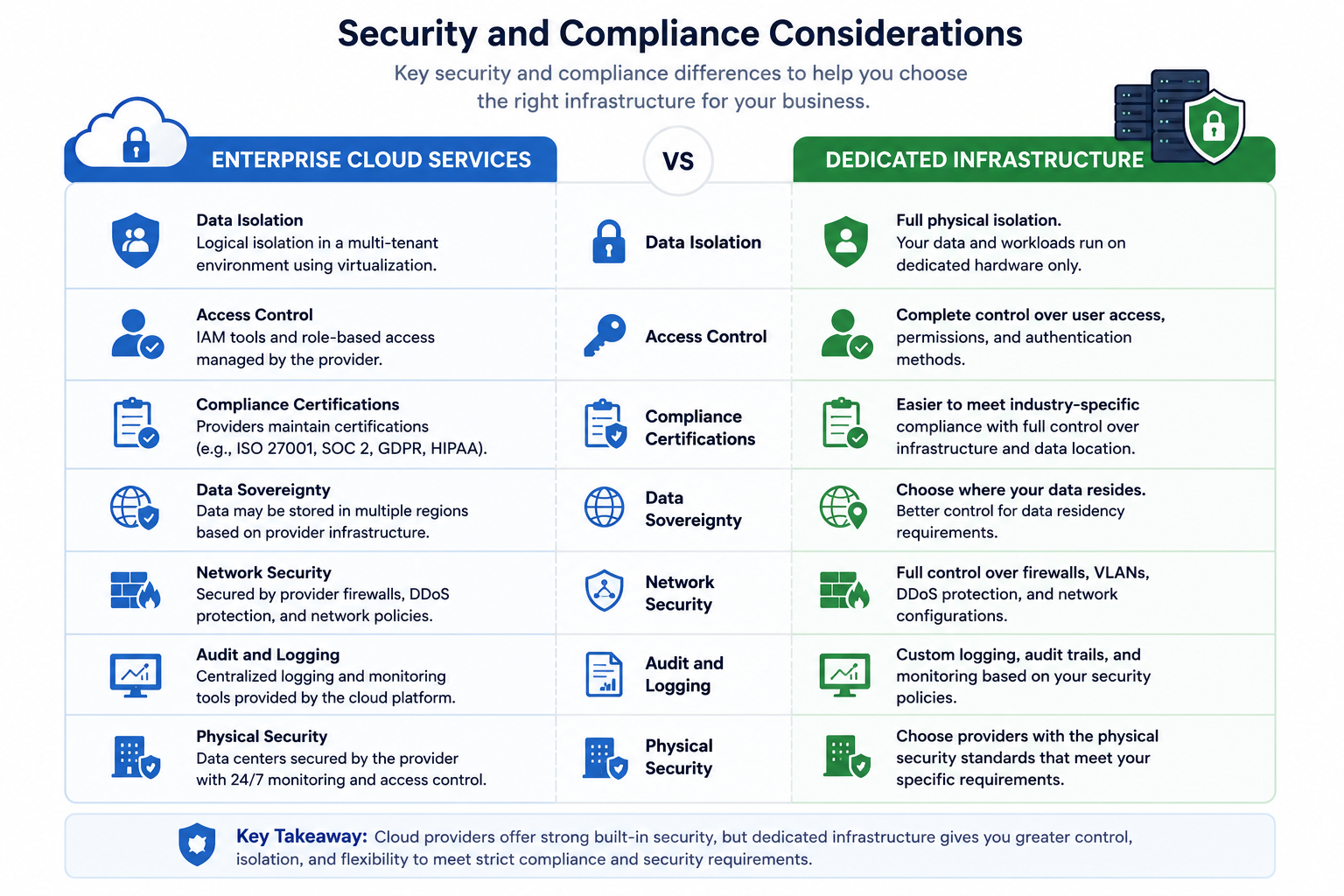
Security remains one of the biggest factors influencing infrastructure decisions for enterprise organisations.
Data Isolation
In shared cloud environments, virtualization separates customer workloads logically, but businesses still operate on shared physical infrastructure. Some organisations view this as an unnecessary security risk for sensitive workloads.
Dedicated infrastructure offers complete physical isolation, reducing exposure to neighbouring tenant risks and improving security segmentation.
Compliance Requirements
Many industries operate under strict regulatory frameworks involving:
- GDPR
- HIPAA
- PCI DSS
- SOC 2
- ISO 27001
Dedicated infrastructure often provides stronger compliance control because businesses can customize security configurations, access controls, data storage policies, and network segmentation more extensively than in shared cloud environments.
Industry Regulations
Financial services, healthcare providers, government contractors, and enterprise SaaS providers frequently require infrastructure environments with strict auditability, data sovereignty, and security governance.
In many cases, dedicated hosting environments simplify compliance management compared to highly distributed public cloud ecosystems.
Security Customization
Dedicated infrastructure gives organisations more control over:
- Firewall configurations
- Intrusion prevention systems
- Encryption policies
- Network segmentation
- Hardware-level security
- Private networking environments
This level of control is often essential for enterprise computing environments handling sensitive customer data or mission-critical applications.
Scalability Comparison
Scalability is one of the biggest advantages associated with enterprise cloud services, but dedicated infrastructure has evolved significantly in recent years.
Horizontal Scaling
Cloud environments excel at horizontal scaling because businesses can rapidly deploy additional virtual resources during traffic spikes or workload increases.
This makes cloud infrastructure highly attractive for:
- Startups
- SaaS applications
- Development environments
- Seasonal ecommerce traffic
- Rapidly growing businesses
Vertical Scaling
Dedicated infrastructure often performs better for vertical scaling, where applications require larger amounts of CPU power, memory, storage performance, or processing capacity on a single machine.
This is common in:
- Enterprise databases
- AI and machine learning workloads
- Video rendering
- Big data processing
- High-performance enterprise applications
Hybrid Expansion Strategies
Many modern organisations no longer choose between cloud or dedicated infrastructure exclusively. Instead, they adopt hybrid infrastructure strategies that combine both environments.
For example:
- Customer-facing applications may run in the cloud
- Sensitive databases remain on dedicated infrastructure
- Backup systems operate across multiple environments
- AI workloads use bare-metal servers for performance optimization
Hybrid models allow businesses to balance scalability, performance, and cost efficiency more effectively.
Infrastructure Flexibility
Enterprise cloud services provide excellent deployment flexibility, while dedicated infrastructure delivers greater customization and control.
The best infrastructure model often depends on the organisation's workload type, compliance requirements, traffic patterns, and long-term operational strategy.
Infrastructure Management Responsibilities
Infrastructure management varies significantly between cloud environments and dedicated hosting solutions.
Managed Cloud Simplicity
One major advantage of enterprise cloud services is reduced hardware management responsibility.
Cloud providers manage:
- Physical servers
- Networking hardware
- Infrastructure redundancy
- Hardware maintenance
- Global data centres
This allows internal IT teams to focus more heavily on applications and business operations.
Dedicated Infrastructure Administration
Dedicated infrastructure typically requires more hands-on management unless businesses use fully managed hosting providers.
Responsibilities may include:
- Operating system management
- Security patching
- Backup configuration
- Performance optimization
- Server monitoring
- Disaster recovery planning
However, this added control often results in better performance tuning and stronger infrastructure customization.
DevOps Considerations
Modern DevOps teams increasingly combine cloud automation with dedicated infrastructure to support CI/CD pipelines, container orchestration, and scalable enterprise deployments.
Infrastructure-as-code, Kubernetes, and automation tools have made dedicated environments far easier to manage than traditional on-premise systems.
Operational Overhead
Cloud infrastructure generally reduces operational overhead initially, but as environments scale, management complexity can increase significantly due to:
- Multi-cloud deployments
- Resource sprawl
- Cost optimization
- Security governance
- Service dependencies
Many enterprises eventually discover that cloud simplicity decreases as infrastructure environments become larger and more distributed.
Cost Structure Differences
Cost is one of the most misunderstood aspects of enterprise infrastructure planning.
Predictable Pricing vs Usage-Based Pricing
Dedicated infrastructure typically operates using fixed monthly pricing models, making long-term budgeting easier.
Enterprise cloud services usually rely on consumption-based pricing tied to:
- Compute usage
- Storage consumption
- Data transfer
- API requests
- Bandwidth
- Scaling activity
While cloud pricing appears cost-effective initially, costs can grow rapidly as workloads scale.
Hidden Cloud Costs
Many organisations underestimate hidden cloud expenses such as:
- Data egress fees
- Cross-region traffic
- Redundant storage
- Backup services
- Idle resources
- High-performance compute instances
According to Flexera, managing cloud spending remains one of the top challenges facing enterprise IT teams globally.
Long-Term Infrastructure Economics
For stable, predictable workloads, dedicated infrastructure can become significantly more cost-efficient over time compared to constantly scaling cloud environments.
This is especially true for businesses operating:
- High-traffic applications
- Data-intensive platforms
- Streaming services
- Enterprise SaaS products
- AI workloads
Egress and Bandwidth Fees
Bandwidth pricing is another major consideration in the debate around enterprise cloud services vs dedicated infrastructure.
Cloud providers frequently charge premium rates for outbound traffic and data transfers, which can become extremely expensive for businesses handling large volumes of content delivery, media streaming, or customer downloads.
Dedicated hosting environments often provide more predictable bandwidth pricing and higher transfer allowances for data-heavy operations.
Enterprise Cloud Services vs Dedicated Infrastructure — Comparison Table
| Infrastructure Factor | Enterprise Cloud Services | Dedicated Infrastructure | Best Fit For |
| Resource Allocation | Shared multi-tenant virtualized resources | Exclusive single-tenant hardware resources | Predictable enterprise workloads |
| Performance Consistency | Performance can fluctuate depending on neighbouring workloads | Stable and consistent performance with guaranteed resources | High-traffic applications, ERP systems, AI workloads |
| Scalability | Rapid horizontal scaling and on-demand resource allocation | Scales through hardware upgrades or hybrid infrastructure expansion | Fast-growing businesses and variable workloads |
| Security Isolation | Logical separation through virtualization | Full physical isolation with dedicated hardware | Finance, healthcare, and compliance-heavy industries |
| Compliance Control | Usage-based billing with variable monthly costs | Predictable fixed monthly pricing | GDPR, HIPAA, PCI DSS regulated businesses |
| Cost Structure | Limited low-level hardware control | Full control over operating systems, networking, and configurations | Long-term stable enterprise workloads |
| Infrastructure Control | Cloud provider manages underlying hardware infrastructure | Business or hosting provider manages infrastructure environment | Businesses requiring advanced customization |
| Management Responsibility | Shared storage environments with variable throughput | Dedicated high-performance storage configurations | Enterprises needing infrastructure flexibility |
| Storage Performance | Often includes expensive egress and transfer fees | Usually includes predictable bandwidth pricing | Data-intensive applications and enterprise databases |
| Bandwidth Costs | Rapid deployment within minutes | Slower provisioning depending on server configuration | Streaming, downloads, media delivery platforms |
| Deployment Speed | Highly resilient but dependent on shared environments | Extremely reliable with isolated workloads | Agile development and temporary workloads |
| Best Use Case | Startups, SaaS platforms, development environments | Enterprise applications, regulated industries, high-performance systems | Mission-critical enterprise systems |
| Common Limitation | Rising cloud costs and unpredictable performance | Higher management responsibility and setup complexity |
When Enterprise Cloud Services Make the Most Sense
Best use cases for cloud-first environments
Enterprise cloud services are ideal for businesses that need flexibility, speed, and the ability to scale without investing heavily in physical infrastructure. Startups often choose cloud-first environments because they can launch quickly, reduce upfront costs, and access enterprise-grade tools without managing expensive servers.
Rapid deployment projects also benefit from cloud computing since teams can provision resources instantly instead of waiting for hardware setup and configuration.
Cloud platforms are also widely used for development and testing environments because developers can create temporary environments, test applications, and shut them down when no longer needed.
Businesses running variable traffic applications, such as eCommerce stores or SaaS platforms, benefit from automatic scaling that adjusts resources during traffic spikes.
Why cloud infrastructure works well for distributed teams
Cloud infrastructure supports remote and hybrid work by giving employees secure global access to systems, files, and applications from anywhere.
Collaboration becomes easier because teams can work on shared documents and platforms in real time. In addition, businesses gain access to a large managed services ecosystem, including security, backups, analytics, and AI tools.
Businesses that benefit most from cloud agility
SaaS startups, digital agencies, and remote-first companies often gain the most value from enterprise cloud services because they require fast scaling, operational flexibility, and seamless collaboration across distributed teams.
When Dedicated Infrastructure Wins
While enterprise cloud services offer flexibility and fast deployment, there are many situations where dedicated infrastructure becomes the better long-term solution for businesses that require predictable performance, stronger security control, and stable operating costs.
As workloads become more demanding, many organisations eventually discover that shared cloud environments cannot always deliver the consistency needed for mission-critical systems.
- Businesses running high-performance applications such as ERP systems, enterprise databases, AI processing workloads, real-time analytics platforms, video streaming services, and large ecommerce environments often benefit from dedicated infrastructure because exclusive hardware resources provide consistent CPU power, memory allocation, storage throughput, and low-latency performance without interference from neighbouring workloads commonly found in shared cloud hosting environments.
- Security-sensitive industries including financial services, healthcare providers, legal firms, insurance companies, and government organisations frequently choose dedicated infrastructure because isolated environments provide greater control over compliance requirements, firewall policies, encryption standards, access management, audit logging, and data sovereignty regulations such as GDPR, HIPAA, PCI DSS, and SOC 2.Companies struggling with unpredictable cloud costs often migrate resource-heavy workloads to dedicated servers after discovering that bandwidth usage, storage scaling, API requests, and traffic spikes can significantly increase monthly cloud expenses over time, particularly for businesses operating SaaS platforms, media streaming services, or high-traffic customer applications.
- According to Gartner, performance predictability and cost optimization remain two of the biggest reasons enterprises continue investing in dedicated and hybrid infrastructure strategies alongside public cloud adoption.
- Dedicated infrastructure also reduces "noisy neighbour" problems that occur in shared virtualized environments where one customer's excessive resource usage can impact other tenants on the same physical hardware, resulting in slower application response times, inconsistent uptime, and degraded user experience during periods of peak demand.
The Hidden Problems Businesses Often Experience With Enterprise Cloud Services
While enterprise cloud services provide flexibility, scalability, and faster deployment, many businesses eventually encounter operational challenges that are rarely discussed during the initial cloud migration process.
As infrastructure environments grow more complex, organisations often discover that cloud computing introduces hidden costs, management difficulties, and performance limitations that can impact long-term scalability and operational efficiency.
Rising Cloud Spending Over Time
One of the most common issues businesses face with enterprise cloud computing is uncontrolled cost growth.
While cloud hosting initially appears cost-effective because it removes large upfront hardware investments, monthly operational expenses can increase rapidly as workloads scale.
- Many businesses experience "cloud cost creep" where storage usage, compute resources, bandwidth consumption, backup services, and API requests gradually increase over time, creating infrastructure bills that become difficult to predict or optimize.
- Unused cloud resources are another major problem because organisations frequently provision virtual machines, storage volumes, and development environments that remain active even when no longer required, resulting in unnecessary monthly spending across large enterprise cloud environments.
- Scaling inefficiencies can also impact long-term cloud economics because workloads requiring constant high-performance resources may become significantly more expensive in public cloud environments compared to dedicated infrastructure with fixed monthly pricing.
According to Flexera's State of the Cloud Report, managing cloud spending remains the number one challenge facing enterprise IT teams globally.
Vendor Lock-In Challenges
Cloud vendor dependency is another growing concern for businesses adopting enterprise cloud services.
- Many cloud providers offer proprietary tools, databases, networking services, and infrastructure ecosystems that make migrations increasingly difficult once applications become deeply integrated into the provider's platform.
- Businesses attempting to migrate workloads between cloud providers often face application compatibility issues, infrastructure redesign costs, operational downtime risks, and significant technical complexity during the transition process.
- Vendor lock-in can also reduce long-term flexibility because organisations may become dependent on pricing structures, infrastructure limitations, or service availability controlled entirely by the cloud provider.
This is one reason why many enterprises are now adopting hybrid infrastructure strategies that combine cloud flexibility with dedicated infrastructure control.
Performance Unpredictability in Shared Environments
Although cloud infrastructure is highly scalable, shared multi-tenant environments can introduce performance consistency issues for demanding enterprise workloads.
- Latency spikes often occur during periods of high infrastructure activity when shared cloud resources become heavily utilized across multiple customers operating within the same environment.
- Resource contention can negatively impact application response times, database performance, and user experience, especially for businesses running real-time applications, AI processing systems, enterprise databases, or high-traffic ecommerce platforms.
- Shared hardware limitations are particularly problematic for performance-sensitive workloads because businesses have limited control over neighbouring resource consumption inside public cloud environments.
This ongoing concern is one reason searches for cloud hosting vs dedicated hosting and dedicated server vs VPS continue growing among businesses seeking more predictable infrastructure performance.
Compliance and Data Sovereignty Concerns
Compliance management can become significantly more complex inside distributed cloud environments.
- Many organisations must comply with regional hosting laws that dictate where customer information, healthcare records, financial transactions, or sensitive business data can legally be stored and processed.
- Data governance challenges often emerge when businesses operate across multiple geographic regions because cloud providers may distribute workloads dynamically across global infrastructure networks unless specific controls are configured carefully.
For industries with strict regulatory obligations, dedicated infrastructure often provides greater control over compliance management, auditability, security policies, and data residency requirements.
Hybrid Infrastructure — Why Many Enterprises Combine Both
Many modern organisations no longer rely entirely on public cloud services or dedicated infrastructure alone. Instead, businesses are increasingly adopting hybrid infrastructure strategies that combine the scalability of enterprise cloud services with the stability and performance control of dedicated environments.
This approach allows organisations to place workloads in the environments best suited to their operational requirements. For example, customer-facing web applications, APIs, and collaboration platforms often remain in the cloud because cloud environments provide rapid scalability, global accessibility, and flexible deployment options.
At the same time, many enterprises move critical workloads such as databases, enterprise applications, storage-intensive systems, and AI processing environments onto dedicated infrastructure where performance consistency, security isolation, and compliance control are easier to manage.
Hybrid environments also improve operational resilience because businesses can distribute workloads across multiple infrastructure layers instead of depending entirely on a single provider or hosting model. This helps reduce downtime risks and improves disaster recovery capabilities.
According to Gartner, hybrid cloud adoption continues to accelerate as enterprises look for better workload optimization, stronger security governance, and more predictable infrastructure performance.
For many organisations, hybrid infrastructure provides the best balance between cloud flexibility and dedicated server reliability, allowing IT teams to improve scalability, optimize costs, strengthen compliance management, and maintain greater control over mission-critical systems.
How to Choose Between Enterprise Cloud Services and Dedicated Infrastructure
Choosing between enterprise cloud services and dedicated infrastructure depends heavily on the organisation's workload requirements, security priorities, scalability goals, and long-term operational strategy.
While cloud infrastructure offers flexibility and rapid deployment, dedicated environments often provide better performance consistency and infrastructure control for demanding workloads.
Before making a decision, IT leaders should evaluate several critical factors including workload type, compliance requirements, expected business growth, and traffic predictability.
Applications with fluctuating demand or short-term scalability needs often perform well in cloud environments, while resource-intensive enterprise systems may benefit more from dedicated infrastructure with guaranteed hardware resources.
Budget planning is another major consideration. Enterprise cloud services typically use consumption-based pricing models that can become difficult to predict as workloads scale.
Dedicated infrastructure usually provides fixed monthly pricing, making long-term infrastructure costs easier to manage for stable enterprise environments.
Security obligations also play a major role in infrastructure planning. Industries handling financial transactions, healthcare records, or sensitive customer information often require stronger compliance management, data isolation, and infrastructure customization than shared cloud environments can easily provide.
Businesses should also consider their internal technical expertise.
Cloud environments reduce some hardware management responsibilities, while dedicated infrastructure may require more advanced server administration, performance optimization, and security management skills.
There are also clear signs that an organisation may have outgrown shared cloud infrastructure, including escalating monthly cloud costs, slow application performance during peak traffic, increasing security concerns, and frequent resource limitations impacting customer experience or operational reliability.
For many enterprises, the ideal solution is no longer cloud-only or dedicated-only, but a hybrid infrastructure strategy that balances scalability, performance, security, and long-term cost efficiency.
Wrapping up
Enterprise cloud services provide flexibility and rapid deployment, but they are not always the best fit for every workload.
As businesses scale, many encounter challenges involving performance consistency, security control, compliance, and rising operational costs.
Dedicated infrastructure continues to deliver major advantages for organisations that require predictable performance, isolated environments, stronger compliance control, and long-term infrastructure stability.
For many enterprises, the right strategy is no longer cloud-only or dedicated-only — but a carefully balanced infrastructure approach built around actual workload demands.
AI Summary
- Enterprise cloud services provide scalable, flexible infrastructure that allows businesses to deploy applications, storage, and computing resources quickly without managing physical hardware internally.
- Dedicated infrastructure delivers isolated hardware resources, predictable performance, stronger security control, and greater customization for businesses running mission-critical or compliance-sensitive workloads.
- Many organisations experience hidden cloud challenges including rising monthly costs, resource contention, unpredictable performance, bandwidth fees, and vendor lock-in as infrastructure demands grow.
- Dedicated servers often outperform shared cloud environments for ERP systems, enterprise databases, AI processing, streaming platforms, and high-traffic applications requiring stable resource allocation.
- Hybrid infrastructure strategies are becoming increasingly common because businesses want to combine cloud scalability with the security, compliance, and performance advantages of dedicated infrastructure.
- Successful infrastructure planning depends heavily on workload requirements, compliance obligations, scalability needs, operational costs, and long-term performance expectations rather than choosing cloud-only environments by default.
Most Popular Posts

Effective communication among team members is vital for the productivity and success of any organization. Surprisingly, 60% of companies lack a long-term internal communication strategy, which p...


Businesses thrive on communication for efficiency, productivity and accomplishment. When the right information is passed from the right designation in the organization, it promotes positivity an...

Categories
Blog
(3186)
Business Management
(393)
Employee Engagement
(235)
Digital Transformation
(216)
Growth
(150)
Intranets
(141)
Internal communications
(106)
Remote Work
(68)
Sales
(53)
Collaboration
(52)
Customer Experience
(32)
Culture
(30)
Knowledge Management
(29)
Project management
(29)
Leadership
(20)
Comparisons
(9)
News
(1)

Related Posts

The best ai image editors can save a team hours of repetitive work. A marketing manager can remove a distracting background, an HR team can improve a staff event photo, and an online shop can turn a basic product shot into something ready to pu...

Ever opened a PDF just before a meeting and realised you need to edit a page, pull figures from a scanned report, or gather everyone's comments? What should be a quick task can turn into a frustrating search for the right tool. That lost time a...

Looking for a New Job Remotely can feel like a simple next step: update your CV, turn on job alerts and start applying. In reality, the strongest remote job searches start much earlier. You need to be clear about the work you want, the kind of ...

Hiring globally is easier than employing globally Have you found the right person for a role, only to realise they live in a country where your business has no legal entity? That's where EOR international hiring can be useful. An Employer of Re...

Sales operations and planning are essential to harmonizing sales objectives with operational capabilities, ensuring seamless coordination between departments like sales, marketing, production, and finance. This alignment enables businesses to forecas...


Jill Romford
I am a digital nomad, lover of exploring new places and making friends.
I love to travel and I love the internet. I take pictures of my travels and share them on the internet using Instagram.
Traveler, entrepreneur, and community builder. I share my insights on digital marketing and social media while inspiring you to live your fullest life.
Ready to learn more? 👍
One platform to optimize, manage and track all of your teams. Your new digital workplace is a click away. 🚀
Free for 14 days, no credit card required.