
Insight Blog
Agility’s perspectives on transforming the employee's experience throughout remote transformation using connected enterprise tools.
17 minutes reading time
(3475 words)
Alcoholism in the Workplace: The HR Leader’s Role in Alcohol and Workplace Safety Incidents

Alcoholism in the Workplace: The HR Leader’s Role in Alcohol and Workplace Safety Incidents
Alcoholism in the workplace is a serious risk. Learn the HR leader’s role in alcohol and workplace safety, prevention, policies, and incident response.
Alcoholism in the Workplace: The HR Leader’s Role in Alcohol and Workplace Safety Incidents

Alcoholism in the workplace is not a personal problem HR can ignore anymore.
It is a serious business risk.
It affects alcohol and workplace safety, productivity, team trust, and legal responsibility.
When something goes wrong, leaders do not ask why HR did not know. They ask why HR did not act.
Here is the hard truth: there is Only BAC Level at Which Safe Driving Can Be Guaranteed — 0.00%.
Even small amounts of alcohol slow reaction time and judgment.
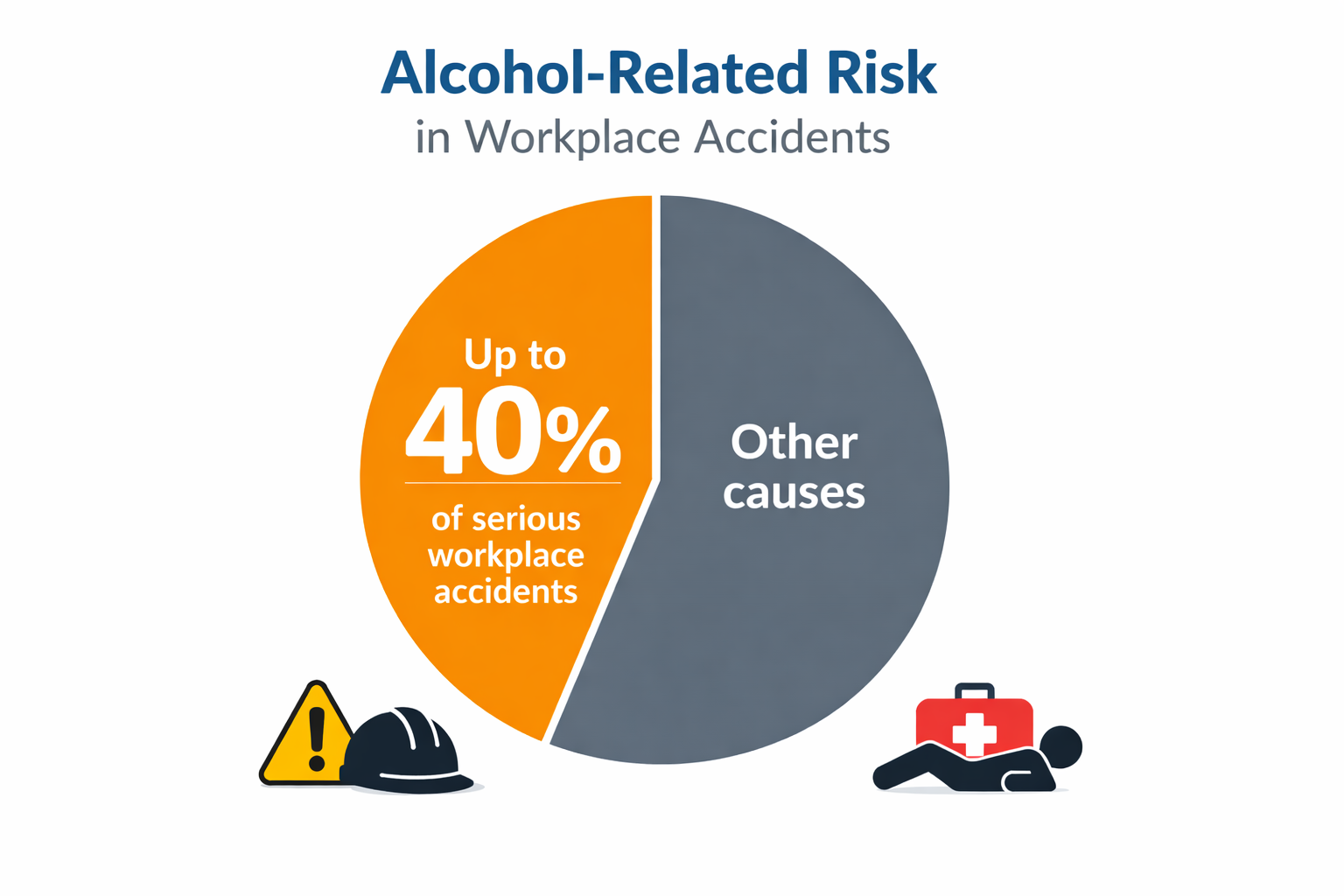
According to safety studies, alcohol is a factor in up to 40% of serious workplace accidents, especially in jobs involving driving, machinery, healthcare, or physical labor.
For HR leaders, this is about duty of care.
Alcoholism in the workplace increases the risk of injuries, near misses, absenteeism, and costly claims.
This article explains the HR leader's role, what signs to watch for, and how to reduce alcohol-related safety incidents before they turn into legal, financial, or human disasters.
Read this article: : Top 6 AI-Powered Project Management Tools To Use In 2023
Why Alcoholism in the Workplace Is an HR Problem (Not Just a Personal One)
Alcoholism in the workplace is often treated like a private issue.
That mindset is risky.
When alcohol affects performance, safety, or behavior at work, it becomes an HR problem whether we like it or not.
The real cost of untreated workplace alcoholism shows up fast.
Missed shifts. Poor decisions. Slower reactions. More mistakes.
These issues hurt productivity, but more importantly, they put people in danger.
This is where alcohol and workplace safety collide. One bad decision can lead to an injury, a serious accident, or even loss of life.
Impairment usually shows up before a major incident. HR may see patterns like frequent lateness, unexplained absences, mood changes, conflict with coworkers, or declining performance.
These are warning signs, not personality quirks. Ignoring them does not make the risk go away—it lets it grow.
There is also a clear link between alcohol misuse, absenteeism, and accidents. Employees struggling with alcoholism in the workplace are more likely to call in sick, leave early, or work while impaired.
That increases the chance of errors, near misses, and safety incidents.
From an HR point of view, this is not about judging someone's life choices. It is about protecting everyone else at work.

This is why proactive steps matter.
An alcohol awareness campaign helps shift the conversation from punishment to prevention.
It educates employees, reduces stigma, and makes it clear that safety comes first. When HR leads with awareness instead of silence, problems are spotted earlier and handled more responsibly.
Ignoring alcohol-related risks also exposes HR to liability.
If an incident happens and there is no policy, no training, and no alcohol awareness campaign in place, the organization looks careless. Regulators, insurers, and lawyers will ask what HR did to prevent it. "We didn't know" is not a defense.
Key takeaway: Alcohol misuse is a workplace risk, not a lifestyle debate. HR leaders who treat it that way protect their people, their organization, and themselves.
The Link Between Alcohol and Workplace Decision-Making
One of the most overlooked impacts of alcohol is how it influences decision-making.
Even small amounts can reduce inhibition, increase overconfidence, and impair judgment. In a workplace context, this can translate into:
- Poor decision-making during business travel
- Risky behavior after company-sponsored events
- Delayed reaction times when employees are on call
- Reduced awareness of safety protocols
For leaders and HR professionals, the goal is not to police personal behavior, but to recognize how alcohol-related impairment can spill into professional responsibilities.
This is particularly relevant for roles involving driving, operating equipment, handling sensitive data, or representing the company publicly.
Alcohol and Workplace Safety – Where the Real Risks Are

When we talk about alcohol and workplace safety, not all jobs carry the same level of risk.
But that does not mean some roles are "safe" when alcohol is involved. For HR leaders, the risk is about impact, not job titles.
In safety-critical roles, the danger is obvious.
Driving, operating machinery, working in healthcare, construction, or manufacturing leaves no room for mistakes.
One slow reaction or poor decision can cause serious injury or worse. In these roles, alcoholism in the workplace is not just a performance issue. It is a safety threat.
In non-safety roles, the risk is easier to miss. Office staff, remote workers, and knowledge workers may not use heavy equipment, but alcohol still affects judgment, focus, and behavior.
That can lead to bad decisions, data mistakes, missed deadlines, or unsafe choices that impact others. A remote worker who logs in while impaired can still cause real damage.
HR is also legally accountable for alcohol-related incidents that could have been prevented.
If an employee causes harm while impaired and there were warning signs, no policy, or no training, HR will be asked why action was not taken. This includes accidents, harassment claims, and safety breaches.
Near-misses are another big risk area. These are the close calls that do not end in injury, so they get brushed off. A forklift that almost hits someone. A driver who swerves but avoids a crash.
A nurse who makes a medication error but catches it in time. These moments are warnings. HR often overlooks them, but regulators do not.
After-hours drinking still matters too. If an employee drinks after work and then drives a company vehicle, comes in early the next morning, or is on call, the risk carries over.
Alcohol does not reset just because the clock says the shift is over.

This is why HR needs clear rules, consistent enforcement, and strong education.
An alcohol awareness campaign helps employees understand how alcohol affects safety, even when they think they are "fine."
It also shows that the organization takes safety seriously, before an incident forces the issue.
Alcohol and Workplace Safety — Key Risks:
- Alcohol and workplace safety risks exist in every role, not just high-risk jobs.
- In safety-critical roles, alcoholism in the workplace is a direct safety threat.
- Office and remote work are not risk-free; poor judgment still causes harm.
- HR is accountable when alcohol-related risks are ignored or unmanaged.
- Near misses are early warnings, not lucky breaks.
- After-hours drinking can still affect work safety the next day.
- Clear policies and training reduce legal and financial risk.
- An alcohol awareness campaign helps prevent incidents by educating early.
- Bottom line: if alcohol affects judgment, HR must act.
The bottom line is simple. Alcohol risks are not limited to one role, one shift, or one location.
If alcohol can affect decisions, it can affect safety—and that makes it an HR responsibility.
The HR Leader's Legal and Ethical Responsibilities

The HR Leader's Legal and Ethical Responsibilities
- Employers are legally expected to protect staff from foreseeable harm at work.
- If a risk is visible and ignored, the organization can still be held liable.
- This includes impairment, reduced alertness, and unsafe behavior on the job.
- Workplace compliance obligations sit with HR, not just line managers.
- Missed warning signs do not remove accountability.
- Substance-related risk is a workplace hazard, not a private lifestyle matter.
- Early intervention is required when conduct, judgment, or safety is affected.
- Complaints, incident reports, and close calls must trigger action.
- If no action is taken, HR must record the reasoning clearly.
- Confidentiality has limits.
- Health-related information must be handled carefully and shared only when necessary.
- Data protection rules apply, but they do not override safety obligations.
- Protecting privacy does not mean allowing unsafe conditions to continue.
- Education and prevention are part of ethical leadership.
- Staff training and clear communication show the organization acted responsibly.
- Awareness reduces risk long before formal discipline is needed.
Straight talk: Inaction creates exposure.
When HR stays silent, the risk grows—and so does the fallout.
Spotting Alcohol Issues at Work Without Playing Detective
HR is not there to diagnose anyone.
That is not your job.
Your role is to notice risk patterns that affect performance, safety, and team stability.
The goal is early awareness, not accusation.
Most problems show up long before a serious incident.
The mistake many HR teams make is waiting for proof instead of paying attention to patterns.
Behavioral warning signs HR should track
Some changes are subtle. Others are not.
What matters is consistency over time.
- Sudden mood swings or irritability
- Withdrawal from team interaction
- Increased conflict with coworkers or managers
- Defensiveness when questioned about work issues
- Declining professionalism or boundary issues
One sign alone means very little.
Several together mean HR should start paying attention.
Performance red flags managers often miss
Managers are busy.
Many focus only on outputs, not behavior.
- Missed deadlines with vague explanations
- Slower thinking or poor decision-making
- Increased mistakes in routine tasks
- Forgetting instructions or meetings
- Work quality that drops without a clear reason
These issues are often written off as stress or burnout.
Sometimes they are. Sometimes they are not. HR's role is to look deeper, calmly and objectively.
Attendance and pattern-based indicators
Attendance tells a story when you stop looking at it one day at a time.
- Frequent Monday or Friday absences
- Repeated sick days after paydays or events
- Leaving early or arriving late without patterns improving
- Long breaks that stretch beyond policy
Patterns matter more than excuses. HR should track trends, not judge explanations.
Why managers need training, not gut instinct
Many managers rely on feelings instead of facts.
That creates risk.
- Some avoid action because they fear being wrong
- Others overreact based on personal bias
- Most do not know what to document properly
Training helps managers understand what to observe, what to report, and what not to assume.
It also protects the company by keeping responses consistent and fair.
What HR should document—and what they should not
Good documentation protects everyone.
HR should document:
- Observable behavior
- Dates, times, and frequency
- Impact on work or team safety
- Actions taken and outcomes
HR should not document:
- Medical assumptions
- Personal opinions
- Rumors or second-hand claims
- Labels or diagnoses
The rule is simple: write what you see, not what you think it means.
Handled correctly, early detection leads to support, not punishment. Handled poorly, it leads to silence, escalation, and eventually incidents HR could have prevented.
Read this article: : Top 6 AI-Powered Project Management Tools To Use In 2023
Policies That Actually Protect Alcohol and Workplace Safety
Policies That Actually Protect Alcohol and Workplace Safety
A workplace policy only works if people understand it and trust it.
Too many alcohol policies are written to protect the company on paper, not to guide real decisions at work. That is where problems start.
A modern policy needs to be clear, practical, and easy to follow.
Employees should know what is expected of them without needing a lawyer to explain it.
Managers should know exactly when to step in and what steps to take next. If the policy creates confusion, it increases risk instead of reducing it.
What a strong workplace alcohol policy should include:
- Clear expectations around being fit for work
- Rules that apply during work hours, on-call time, and company events
- Guidance on reporting concerns safely and early
- Steps managers must follow when issues arise
- Support options available to employees
- Consequences explained in plain language
Vague "zero tolerance" statements often sound tough, but they cause problems in real life. They leave no room for judgment, early support, or common sense. Employees may hide issues out of fear.
Some managers may avoid acting because they do not want to trigger extreme outcomes. Clear rules work better than harsh slogans.
But alcohol testing is another area where policy matters.
You can try testing, but testing can be justified in safety-critical roles, after incidents, or where the law allows it. Used correctly, it supports safety. Used carelessly, it damages trust and morale.
Testing backfires when:
- It feels random or unfair
- It is used as punishment instead of prevention
- Employees do not understand when or why it happens
Policies also need to be consistent. Different rules for different teams create confusion and resentment. What applies in one department should apply in another.
What applies in one location should apply everywhere, unless the law clearly requires otherwise. Consistency protects HR when decisions are challenged.
Reality check: A policy no one understands will not protect people, and it will not protect HR either. Clear, fair, and well-communicated rules are what actually reduce risk.
Intervention Without Punishment-First Thinking
When alcohol-related issues show up at work, many HR teams jump straight to discipline.
That reaction is understandable—but it is often the wrong first move. A punishment-first approach pushes problems underground instead of fixing them.
HR's job is to reduce risk, not just enforce rules.
That means knowing when firm action is needed and when support will prevent a bigger problem later.
Sometimes disciplinary action is appropriate.
This is usually the case when:
- There is an immediate safety risk
- Policies have already been explained and ignored
- An employee refuses help or denies clear evidence
- Behavior continues after support has been offered
Discipline protects the wider workforce.
It also shows that safety rules matter. HR should not hesitate when people are at risk.
But in many cases, support is the smarter move—especially early on.
When warning signs appear without a major incident, early intervention can stop things from escalating.
When support makes sense:
- Performance or behavior is slipping, but no incident has occurred
- The employee is open to conversation
- There is a chance to correct the issue before harm happens
- The role allows for temporary adjustments
This is where structured support tools matter.
Employee Assistance Programs, or EAPs, give HR a safe middle ground.
They allow employees to get help without turning the situation into a disciplinary record on day one.
EAPs can offer counseling, referrals, and confidential support while HR keeps focus on safety and performance.
EAPs works best when:
- Employees know they exist before a problem starts
- Managers understand how to refer someone properly
- HR follows up instead of assuming the issue is solved
Compassion does not mean lowering standards. Safety still comes first. HR must set clear boundaries, track progress, and act if things do not improve.
The balance is simple: support early, enforce when needed, document always.
HR mindset shift: Prevention beats termination—every time.
When HR steps in early and acts thoughtfully, fewer situations reach the point where firing feels like the only option.
Training Managers to Act Before Incidents Happen
HR cannot carry this responsibility alone.
Managers are the ones closest to day-to-day behavior, performance changes, and team dynamics.
If they are not trained to spot risk early and respond correctly, problems will either be ignored or handled badly. Both outcomes increase harm.
Managers often stay silent because they are unsure what to do. Some fear saying the wrong thing.
Others worry about legal trouble or damaging relationships.
Without training, many choose the easiest path: do nothing and hope it goes away. That is how small issues turn into serious incidents.
Managers need clear guidance on what to say and what to do.
This does not mean accusing or diagnosing. It means sticking to facts and impact.
Managers should be trained to:
- Focus on observed behavior, not personal assumptions
- Use simple, neutral language
- Explain how behavior affects work or safety
- Raise concerns early, not after a crisis
- Know when to involve HR
They also need to know what not to do.
Guessing, lecturing, threatening, or promising confidentiality they cannot keep only makes things worse.
Clear escalation paths matter just as much.
Too many issues stay hidden because people try to "handle it quietly."
That approach protects no one. It leaves HR out of the loop and removes any chance of early support or risk control.
Good escalation paths should:
- Be simple and written down
- Tell managers exactly when to involve HR
- Remove fear of "overreacting"
- Protect managers who raise concerns in good faith
When escalation feels safe, problems surface earlier. When it feels risky, people stay silent.
Culture is the final piece.
Employees and managers need to believe that safety matters more than stigma.
That does not happen through posters or slogans. It happens through consistent action.
A strong culture shows that:
- Speaking up is supported, not punished
- Safety concerns are taken seriously
- Support is offered before blame
- Rules are applied fairly and consistently
When managers are trained, supported, and clear on their role, incidents become less likely.
HR's influence grows not by controlling everything, but by enabling others to act early and responsibly.
What Happens After an Alcohol-Related Safety Incident
When an incident happens, the way HR responds matters just as much as the incident itself.
This is the moment where credibility is either built or lost.
Slow, unclear, or defensive responses make things worse fast.
Immediate HR response checklist
The first priority is safety, not blame.
- Make sure everyone involved is safe and receives medical help if needed
- Remove any immediate risk from the workplace
- Separate the incident from rumors by controlling communication
- Secure basic facts while memories are fresh
- Involve the right leaders early, not hours or days later
Delays create confusion. Confusion creates liability.
Investigation without blame
An investigation should focus on what happened, not who to punish first.
Jumping to conclusions shuts people down and damages trust.
- Stick to observable facts and timelines
- Interview witnesses calmly and privately
- Avoid labels, assumptions, or emotional language
- Look at systems, policies, and warning signs—not just individual actions
The goal is to understand root causes, not to protect egos or rush discipline.
Reporting, compliance, and follow-up
Once facts are clear, HR must handle reporting properly.
This is where many teams slip up.
- Document everything clearly and consistently
- Report to regulators or insurers when required
- Follow internal health and safety procedures
- Communicate outcomes on a need-to-know basis only
After reporting, follow-up matters. Check whether actions were completed, support was provided, and controls were updated.
Closing the loop shows professionalism.
Preventing repeat incidents
The worst outcome is treating the incident as "handled" and moving on.
- Review whether policies were clear and followed
- Identify gaps in training or supervision
- Strengthen reporting or escalation paths
- Re-educate teams where needed
- Track similar risks going forward
Each incident is a warning. Ignoring the lesson almost guarantees another one.
Key point: The post-incident response defines HR credibility.
Calm, structured action builds trust. Panic, silence, or shortcuts destroy it.
Building a Safer Workplace Long-Term
Building a safer workplace over the long term starts with normalizing honest conversations about impairment.
When employees feel they can speak openly without fear of immediate punishment, problems surface earlier.
HR plays a key role in setting this tone by encouraging respectful dialogue, clear expectations, and consistent messaging that safety comes first. Silence and stigma only allow risk to grow in the background.
Regular policy reviews are also essential.
Workplace risks change, laws evolve, and teams work differently than they did even a few years ago. An outdated policy creates false confidence and leaves gaps that only show up after an incident.
HR should revisit alcohol and impairment policies on a routine basis to ensure they are clear, relevant, and actually used in practice, not just stored in a handbook.
Long-term safety also depends on data, not gut feeling.
Tracking incidents, near misses, absenteeism patterns, and safety reports helps HR spot trends early.
Data-driven monitoring allows leaders to act before problems escalate and provides evidence that the organization is taking reasonable steps to reduce risk.
Without data, safety decisions become reactive instead of preventive.
Finally, wellbeing and safety must be aligned, not treated as separate efforts. Programs that support mental health, stress management, and workload balance directly reduce safety risks over time.
When wellbeing strategies connect clearly to safety outcomes, employees understand that support is not a soft extra—it is a core part of keeping everyone safe at work.
Conclusion: HR Sets the Tone for Alcohol and Workplace Safety
Alcoholism in the workplace will not solve itself, and it will not stay hidden forever.
When HR treats alcohol-related risk as a box-ticking exercise, the real danger grows quietly in the background.
Small warning signs turn into incidents, and incidents turn into injuries, claims, and broken trust.
By the time action is forced, the damage is already done.
HR leaders who face the issue directly set a very different tone.
They create workplaces where safety comes before excuses, where problems are addressed early, and where people know support exists before a crisis hits.
This approach reduces incidents, protects the organization, and shows employees that leadership takes their wellbeing seriously.
This is not about watching people or controlling personal choices.
It is about protecting teams, preventing harm, and meeting the responsibility that comes with leadership. When HR leads with clarity, consistency, and courage, everyone benefits.
Most Popular Posts

Effective communication among team members is vital for the productivity and success of any organization. Surprisingly, 60% of companies lack a long-term internal communication strategy, which p...


Businesses thrive on communication for efficiency, productivity and accomplishment. When the right information is passed from the right designation in the organization, it promotes positivity an...

Categories
Blog
(3186)
Business Management
(393)
Employee Engagement
(235)
Digital Transformation
(216)
Growth
(150)
Intranets
(141)
Internal communications
(106)
Remote Work
(68)
Sales
(53)
Collaboration
(52)
Customer Experience
(32)
Culture
(30)
Knowledge Management
(29)
Project management
(29)
Leadership
(20)
Comparisons
(9)
News
(1)

Related Posts

The best ai image editors can save a team hours of repetitive work. A marketing manager can remove a distracting background, an HR team can improve a staff event photo, and an online shop can turn a basic product shot into something ready to pu...
Warning: Undefined variable $column in /home/agilitysite/public_html/templates/martex/html/mod_easybloglatestblogs/default_horizontal.php on line 29
Warning: Undefined variable $column in /home/agilitysite/public_html/templates/martex/html/mod_easybloglatestblogs/default_horizontal.php on line 30

Ever opened a PDF just before a meeting and realised you need to edit a page, pull figures from a scanned report, or gather everyone's comments? What should be a quick task can turn into a frustrating search for the right tool. That lost time a...

Looking for a New Job Remotely can feel like a simple next step: update your CV, turn on job alerts and start applying. In reality, the strongest remote job searches start much earlier. You need to be clear about the work you want, the kind of ...

Hiring globally is easier than employing globally Have you found the right person for a role, only to realise they live in a country where your business has no legal entity? That's where EOR international hiring can be useful. An Employer of Re...

Sales operations and planning are essential to harmonizing sales objectives with operational capabilities, ensuring seamless coordination between departments like sales, marketing, production, and finance. This alignment enables businesses to forecas...


Jill Romford
I am a digital nomad, lover of exploring new places and making friends.
I love to travel and I love the internet. I take pictures of my travels and share them on the internet using Instagram.
Traveler, entrepreneur, and community builder. I share my insights on digital marketing and social media while inspiring you to live your fullest life.
Ready to learn more? 👍
One platform to optimize, manage and track all of your teams. Your new digital workplace is a click away. 🚀
Free for 14 days, no credit card required.